Research has clearly documented the impact of caregiving for people with dementia on several aspects of caregiver’s life, as well as its negative consequences in their physical and emotional state (Pinquart & Sörensen, Reference Pinquart and Sörensen2003; Vitaliano, Zhang, & Scalan, Reference Vitaliano, Zhang and Scalan2003). Nevertheless, less attention has been paid to the state and progression in the caregivers’ state after patient’s death. After such a long period focused on care, caregivers would have to cope with a new situation, which would often require an adaptation process. But how is it? Are the caregivers able to resume their lives when the care ends? To answer these questions two alternative hypotheses have been proposed (see, Piccini, Bernaldo de Quirós, & Crespo, Reference Piccini, Bernaldo de Quirós and Crespo2012). Firstly, according to the stress-relief or recovery hypothesis (Bernard & Guarnaccia, Reference Bernard and Guarnaccia2002; Tweedy & Guarnaccia, Reference Tweedy and Guarnaccia2007), when this experience comes to an end, the caregivers may feel some relief over the end of the loved one’s suffering and the demand of caregiving. Consequently after the initial grief response to loss, their emotional state will improve over time until a stage of resolution or recovery. In this line, some studies suggest that the bereaved dementia caregivers experience significant relief in depressive symptoms just 13 weeks after the care recipient’s death (Schulz et al., Reference Schulz, Mendelshon, Haley, Mahoney, Allen, Zhang and Belle2003). In contrast, the complicated grief and stress model theorizes that caregivers experience an increase in emotional distress as a result of the death of the care recipient, due to the former interdependence between the caregiver and the care recipient. In this context, the death of the care recipient would end caregiving activities, but the emotional impact of the experience could remain (Elder, Reference Elder1994).
Actually, some longitudinal studies have shown that caregivers are not uniform in their emotional response to bereavement, showing distinct trajectories and also an evolution over time (Bonanno, Boerner, & Wortman, Reference Bonanno, Boerner, Wortman, Stroebe, Hansson, Schut and Stroebe2008). So, Aneshensel, Botticello, & Yamamoto-Mitani (Reference Aneshensel, Botticello and Yamamoto-Mitani2004) found that depressive symptoms tend to drop over time. Specifically, depressive symptom scores were highest during the first year following bereavement, dropped substantially during the second, and remained about the same level during the third and fourth year, until declining somewhat in the fifth year. Moreover, they identified distinctive clusters of depressive symptoms: 18% of caregivers were temporarily distressed after death improving over time from severe to moderate symptoms levels; 8% showed a repeatedly distressed trajectory, consistent with the conceptualization of complicated or traumatic grief; 10% showed repeatedly asymptomatic trajectory, corresponding to the concept of absent grief; but the most common trajectory (64%) corresponded to a stable symptoms level or repeatedly symptomatic (with no recovery effect), though their symptoms level should not be considered abnormal. Additionally, data showed that caregivers with few symptoms before bereavement tend to maintain these stages afterwards, while emotionally distressed caregivers tend to become more distressed.
As part of the REACH study, Schulz, Boerner, Shear, Zhang, & Gitlin (Reference Schulz, Boerner, Shear, Zhang and Gitlin2006) reported high levels of depressive symptoms and complicated grief in 20% of caregivers. In this same study Zhang, Mitchell, Bambauer, Jones, & Prigerson (Reference Zhang, Mitchell, Bambauer, Jones and Prigerson2008) identified three emotional trajectories: 16.5% of the caregivers reached levels of syndrome depression that, even so, tend to dismiss over time; in contrast, the most common trajectories correspond to the recovery paradigm, (49.5% showing persistently absent depressive symptoms and 34% depression under the syndrome level).
These studies, however, did not differentiate the trajectories of spouses vs. adult children, though both clinical evidence and experimental data suggest so. Meuser & Marwitt (Reference Meuser and Marwit2001), in a qualitative study, found that spouses showed more intense and persistent grief and more problems to readapt their daily lives. On the other hand, Tweedy & Guarnaccia (Reference Tweedy and Guarnaccia2007) analyzed depression specifically in spousal caregivers, considering husband vs. wives. Their data showed that both, male and female, reported and increase in depression after the death of the dementia-patient care recipient spouse. However, as time passed husbands showed a decrease in depression while wives reported increased depression levels. More interestingly, in their comparison of husband and daughter caregivers of breast cancer patients, Bernard & Guarnaccia (2003) found that data from husband supported a complicated grief model, showing differences between husbands’ and daughters’ experiences of caregiver strain and later bereavement adjustment. Nevertheless, their data could also be interpreted in relation to gender effects.
The persistence of symptoms after care-recipient’s death seems to relate to several aspects of the caregiving situation. So Boerner, Schulz, & Horowitz (Reference Boerner, Schulz and Horowitz2004) found that pre-loss caregiving benefits (i.e. positive feelings toward caregiving experience, such as companionship, fulfillment, enjoyment or satisfaction) were associated with higher level of post-loss depression and grief. This factor was also relevant in the prediction of depression and grief in Schulz et al. (Reference Schulz, Boerner, Shear, Zhang and Gitlin2006) study. Moreover, these authors also found a significant effect of some sociodemographic aspects (educational level and incomes), the reaction to care (burden), and the emotional status both before the death and after it.
Regarding the influence of patient’s death circumstances, recently Jacinto (Reference Jacinto2009) has stated that Alzheimer’s disease patients most likely will not be able to say good-bye to the caregiver and that this lack of closure can contribute to the caregiver’s experience of complicated grief. Additionally, Herbert, Dang, & Schulz (Reference Hebert, Dang and Schulz2006) found correlation between depression levels and complicate grief in caregivers and the lack of preparedness to cope the death of their relative, while Haley et al. (Reference Haley, Bergman, Roth, McVie, Gaugler and Mittelman2008) observed less depressive symptoms when the patient had died at home. Information about these aspects seems to be essential to provide a foundation for developing health care policy on end-of-life and on the effect of bereavement on family caregivers (Schulz et al., Reference Schulz, Mendelshon, Haley, Mahoney, Allen, Zhang and Belle2003).
Additionally, up to date there are no studies about the emotional status of caregivers after the care-recipient’s death in Spain, though there is evidence from previous studies on sociocultural background differences in caregiving outcomes (Kim, Knight, & Longmire, Reference Kim, Knight and Flynn Longmire2007).
Consequently, the present study offers a preliminary analysis of this topic, with two aims: (1) to examine the emotional state of caregivers of persons with dementia after the death of the care recipient in Spain, where the patient’s care at home tends to be usual and long lasting, considering the effect of kinship (spouses vs. adult children) and the time since the decease; and (2) after been guided by the existing literature on caregiving and bereavement, to analyze the patient’s death circumstances and their influence in the present emotional state of caregivers.
Based on data from previous studies, and on the stress relief model, we propose the following hypotheses: (a) most of former caregiver will not show emotional distress, that is, they will show low depression levels and no complicated grief; (b) there will be significant differences in spouses’ vs. children’s emotional response after the decease: spouses will show more depressive symptoms and grief, especially when the time since the decease is long; and (c) former caregivers that were not able to say good-bye, were not prepared for their relative’s death, and whose relative death had not taken place at home, will have more depressive symptoms and grief.
Methods
Participants
The sample consisted of former family caregivers of persons with dementia whose relative had already deceased. Eligibility criteria included: having cared of a relative diagnosed of dementia; being 18 years or older; having lived in the same residence as the care recipient; having been the sole or main caregiver; having provided care for a minimum of 6 months; and time elapse since the death of the care recipient being between 3 and 36 months; three first months were discarded to avoid the intense grief response that Schulz et al. (Reference Schulz, Boerner, Shear, Zhang and Gitlin2006) identify in this population in the first 15 weeks.
We assessed 57 caregivers recruited from different Family Associations in Spain Footnote 1 . Seven caregivers did not complete the assessment; therefore the final sample consisted of 50 caregivers. Participation in the study was voluntary and was always carried out after they were informed of the goal of the study and guaranteed the confidentiality of the information provided.
Measures
Beck Depression Inventory (BDI-II)
(Beck, Steer, & Brown, Reference Beck, Steer and Brown1996; Spanish version by Sanz, Perdigón, & Vázquez, Reference Sanz, Perdigón and Vázquez2003). It has 21 items to appraise depressive symptoms in the preceding week. According to its authors the cutoffs points of this version are: 0–13: minimal depression; 14–19: mild depression; 20–28: moderate depression; and 29–63: severe depression. It has high internal consistency (α = .91), and an average test-retest reliability of .72 across 20 studies (Dozois & Covin, Reference Dozois, Covin, Hersen, Hilsenroth and Segal2004).
Texas Revised Inventory of Grief (TRIG)
(Faschingbauer, Zisook, & De Vaul, Reference Faschingbauer, Zisook, De Vaul and Zisook1987; Spanish version by García-García, Landa, Trigueros, & Gaminde, Reference García-García, Landa, Trigueros and Gaminde2001), a scale specially designed to assess an array of past and present lost-related thoughts, emotions, and behavior (e.g. I still cry when I think of the person who died, I still get upset when I think about the person who died). In this study only TRIG-Present scores were considered. The TRIG is the most widely used and well known grief measures (Neimeyer, Hogan, & Laurie, Reference Neimeyer, Hogan, Laurie, Stroebe, Hansson, Schut, Stroebe and Van den Blink2008). The Cronbach´s coefficient alpha for TRIG-Present scale was .86; there were positive correlations between both TRIG-scales and the ones of the Grief Experience Inventory (Sanders, Mauger, & Strong, Reference Sanders, Mauger and Strong1985).
Sociodemographic information and history of caregiving
It was obtained through a structured personal interview designed ad hoc to assess the most important variables regarding the caregiver (gender, age, marital status,…), the patient (diagnosis, age, gender,…) and their care context characteristics (duration of caregiving, daily schedule as caregiver, use of day care centers and other services,…). Caregivers were also asked to provide information about the circumstances surrounding the care recipient death, such as the place where their relatives died, if the patient had felt pain before death, if they consider the death was a relief to the patient and to themselves, if they had been prepared for the patient´s death, and the possibility to said “good bye” to the care recipient. Finally, caregivers were asked about their use of and need for bereavement related services. All these data were collected following suggestion by Shultz et al. (Reference Schulz, Mendelshon, Haley, Mahoney, Allen, Zhang and Belle2003).
Procedure
All caregivers received a letter to invite them to participate in the project and to describe the study. After giving their consent, they received a telephone call with screening questions to verify the inclusion criteria. Then the caregivers were interviewed through a structured protocol. Afterwards they were mailed the remaining instruments and their instructions. The caregiver returns it through a self-addressed stamped envelope, preserving their anonymity.
Data analyzes
When missing data in the BDI-II and the TRIG did not exceed 15% of each test, they were replaced with the mean value in the remaining items of the test. Participants exceeding this percentage of missing data were not included in the correspondent analysis. Internal consistency for the BDI-II and the TRIG was computed through the Cronbach’s alpha coefficient. Additionally, the adjustment of the variables to normal distribution was checked using Kolgomorov-Smirnov test.
Chi square and Mann-Whitney U-tests were used to verify homogeneity between completers and non-completers caregivers. Non parametric test were selected due to the sample size and the differences in the groups sizes. Descriptive statistics were then used to characterize the sample and their emotional status. Since there are no normative data to interpret TRIG score, this result was compared with the data reported in the Spanish validation of the scale using t-test.
Since window time of death of the care recipient was quite wide (3 months to 3 years), and since previous studies have shown the evolution of symptoms over time, we examined the effect of time since death on caregiver’s symptoms, considering differences between the first year and afterwards. Moreover, the effect of caregiver-care recipient kinship was also examined. Thus, multivariate analyzes of covariance were performed on depression and grief scores with kinship (spouse vs. adult-child) and time since death (3–12 months vs. 13–36 months) as independent variables and gender and age as covariates, since the effect of these variables on emotional state has been consistently established both in community samples and caregivers (e.g. Pinquart & Sörensen, Reference Pinquart and Sörensen2006). Then we analyzed the effect of variables referred to the patient’s death circumstances by mean of multivariate analyzes of covariance on depression and grief scores, considering caregiver’s age and gender, time since the patient’s death and kinship between caregiver and care-recipient as covariates.
Results
Sample characteristics and group homogeneity
Due to the high percentage of non-completers participants (12.28%), we assessed the homogeneity of the two groups in sociodemographic variables and in care characteristics. None of these differences reached statistical significance.
The final sample was composed of former caregivers of relatives with Alzheimer disease, whose age ranged between 25 and 89 years, (M = 61.14 years; SD = 13.54). Most were married or living with their partner (54%), female (88%) and did not have paid jobs (72%). Similarly, most of the care recipients were women (58%) and their mean age at death was 81.54 (SD = 7.37) years old. Caregivers were spouses (32%) or adult children (68%) of the care recipient. In most of the cases (66%) patient’s death have occurred more than one year ago, while 34% of deaths have occurred in the last year.
Most of the caregivers (98%) said that they received professional help and also from non-formal sources (84%). However, caregiving had been time-consuming with a mean of 17.88 (SD = 7.24) hours per day during an average period of 72.74 (SD = 43.52) months.
Former caregiver’s emotional state
Internal consistency values for the BDI-II and the TRIG were .90 and .91, respectively, both in the excellent range. Additionally, Kolgomorov-Smirnov test showed that both variables adjusted to normal distribution (z = 1.102, p = .176 for depression; z = 0.748, p = .631 for grief).
The participants showed low levels of depression and present grief. Specifically, depression average level of 11.97 (SD = 9.09) corresponded to minimal depression according to the cut-off points for the BDI-II. Most of the caregivers (65.3%) presented minimal depression, and only 6.1% showed scores for severe depression. The participants showed medium level of present grief with a mean score of 47.76 (SD = 11.57). When compared with the Spanish validation data (M = 51.95; SD = 10.21), which included bereaved people for different death causes, participants showed significantly lower grief (t = –2.45, df = 45, p = .05, d = –0.40).
Effect of time and kinship on former caregivers’ emotional state
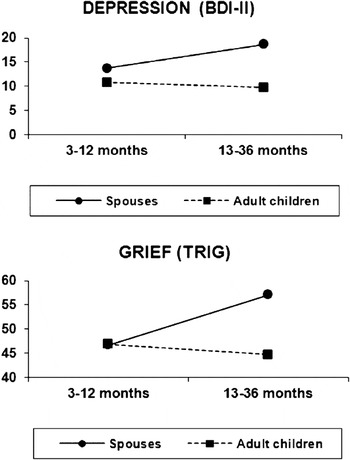
Multivariate analysis of covariance was first run to examine the effects of kinship (16 spouses, 34 adult children) and time elapsed since patient’s death (17 for 3–12 months, 33 for 13–36 months) on their depression and grief scores. Results of between-subject analysis for depression indicated no significant effect of kinship (F = 1, 827, df = 1, p = .179), time (F = 0, 597, df = 1, p = .444) or the interaction (F = 0, 977, df = 1, p = .329). Nevertheless, there were significant main and interaction effect for grief. As can be seen in Figure 1, spouses showed higher grief than adult children in both time set (F = 10, 528, df = 1, p = .002); additionally data show higher grief in the second-and-third year group (F = 4, 259, df = 1, p = .046), in connection with the significant interaction effect between kinship and time (F = 4, 297, df = 1, p = .045).
Depression and grief in spouses (n = 16) and adult children (n = 34) caregivers over time after the death of the dementia-patient care recipient.

Patient’s death circumstances
Most of the caregivers reported that their relatives have died at home (56%), and they were present at death (64%). Moreover most of caregivers considered that the death had supposed a relief both for the patient (82%) and for themselves (74%). Surprisingly, since they had cared for dementia patients, 68% of the caregivers informed they have said “good-bye” the patient before dying. On the other hand, over a half of the caregivers estimated themselves (50%) and the patients (52%) prepared for death before happening. In contrast, only 24% reported presence of pain in patients. Around a 16% of caregivers used bereavement-related services after the patient’s death, though up to 38% stated having needed such services.
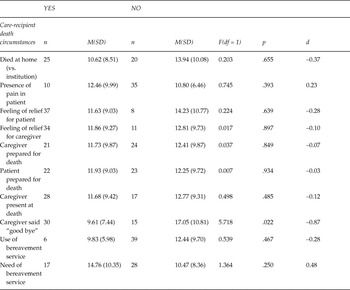
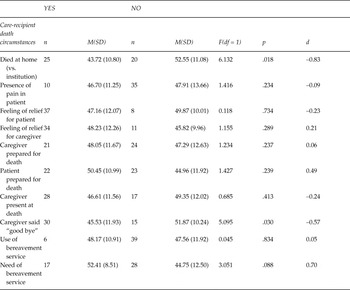
Further analysis on these circumstances showed significant effect on caregivers’ emotional state only for place of death and for the possibility of saying “good-bye”. Specifically, caregivers had more intense grief when the patient had not died at home (i.e. in an institution) and when they were not able to say “good-bye”, and had higher depression level when they were not able to say “good-bye” (Tables 1 and 2). No other circumstances of the patient’s death had a significant effect on caregivers’ depression or grief.
Effect of the circumstances of patient’s death on depression level in bereaved caregivers

Effect of the circumstances of patient’s death on grief in bereaved caregivers

Discussion
All in all, this study shows that most caregivers of dementia patients have no a complicated emotional response to bereavement, even after a long period of care (over six years here). According to the data only 6% of the caregivers have symptoms of severe depression, and most of them (over 65%) have no significant depression level. This result corroborates the findings of Schulz et al. (Reference Schulz, Mendelshon, Haley, Mahoney, Allen, Zhang and Belle2003), who found that within one year after the death the level of symptoms were substantially lower than the levels reported while they were acting as caregivers, and of Schulz et al. (Reference Schulz, Boerner, Shear, Zhang and Gitlin2006). Moreover, it is worth mentioning that here caregivers in the first three months after death were no included in the study, which precludes the intense emotional response that initially occurs to the loss of a beloved persons in most cases and situations.
Nevertheless, caregivers do not have uniform responses to bereavement. So taking all the caregivers as a whole could mask important individual differences. Actually the analysis of the effect of time and kinship show that these variables have a significant effect on caregivers’ grief: grief is higher in spouses than in adult child, even after controlling the effect of gender and age. These data are in concordance with the findings of Bernard & Guarnaccia (2003) that showed complicated grief in husband but not in daughters caregivers of breast cancer patients, though in this study gender and kinship effect could overlap. Nonetheless, in the present study, where gender effects were controlled, there is an increased grief only in spouse caregivers, which could be explained by a greater interdependence caregiver-care recipient in this relationship. Furthermore, data also corroborate the qualitative findings of Meuser & Marwitt (Reference Meuser and Marwit2001). It remains open the analysis of the interaction kinship-gender, though it would require greater sample size.
As Schulz et al. (Reference Schulz, Mendelshon, Haley, Mahoney, Allen, Zhang and Belle2003) suggest, these results are underscored by the fact that only a minority of the caregivers reported using or needing bereavement-related services and that a large majority of them reported feeling relieved by the death. However, since in the present study the number of caregivers that report need of such services over-duplicates the number of caregivers that used them, it could indicate lack of this kind of services or difficulties to access to them in our country.
Data about the circumstances of the patient’s death are in the line of the results found in the United States (US) by Schulz et al. (Reference Schulz, Mendelshon, Haley, Mahoney, Allen, Zhang and Belle2003). So most of the caregivers report feelings of relief for the patient (90% in US; 82% here) and for the caregivers themselves (72% in US; 74% here), as well as preparedness for death (68.5% in US; 50% here). Regarding this last variable, present data are quite similar to findings of Herbert et al. (Reference Hebert, Dang and Schulz2006), who reported a 67% of caregivers prepared for death, though there caregivers have occupied the role for 3 years, while here the mean was over 6 years. Moreover Herbert et al. (Reference Hebert, Dang and Schulz2006) showed a significant and direct correlation between lack of preparedness for death and both depression and grief. These data are not supported by the present study, which found no significant effect of this variable on the emotional state of the bereaved caregiver.
Conversely data show important differences when caregivers report the presence of pain in the patient: 63% in US (Schulz et al., Reference Schulz, Mendelshon, Haley, Mahoney, Allen, Zhang and Belle2003) and 24% here. These differences could reflect differences in end-of-life care between countries, though it will deserve further consideration. More significantly, data also show differences in the number of patients that died at home: 32% in Schulz et al. (Reference Schulz, Mendelshon, Haley, Mahoney, Allen, Zhang and Belle2003), 47% in Aneshensel et al. (Reference Aneshensel, Botticello and Yamamoto-Mitani2004), and 56% here. So data point out that care of persons with dementia at home not only is usual and lost lasting in our country, but also in many occasions follows until the death of the patient. Furthermore, the place of death seems to have an effect on caregivers’ grief; grief response is lower when patients died at home. In this line, Schulz et al. (Reference Schulz, Mendelshon, Haley, Mahoney, Allen, Zhang and Belle2003) showed that caregivers whose relatives were institutionalized did not show recovery from depression symptoms, which suggests that relief from providing daily care alone did not account for the caregivers’ recovery from bereavement. Similarly, Haley et al. (Reference Haley, Bergman, Roth, McVie, Gaugler and Mittelman2008) observed lower depression level when the patient had died at home. Several studies have shown that disabled elderly persons wish to remain at home as long as possible and that family members want to honor this preference (Pritchard et al., Reference Pritchard, Fisher, Teno, Sharp, Reding, Knaus and Lynn1998; in Spain, IMSERSO, 2005). Present data suggest that when they are able to do it so, they could also improve their emotional status. However, the significant effect of the place of death has been found in grief but not in depression, as shown in previous studies.
Additionally, this study provides first evidence of the positive relationship between saying good-bye to the patient and caregivers’ emotional status (depression and grief). This implies a special challenge due to the cognitive impairment in dementia patients (Jacinto, Reference Jacinto2009). On this respect it is particularly striking that up to 68% of the caregivers considered they had been able to say good-bye to their relatives, which could suggest some form of “symbolic good-bye” that would require further research, or even that they grieve for the loss of the patients before the death, as has been previously proposed (Holland, Currier, & Gallagher-Thompson, Reference Holland, Currier and Gallagher-Thompson2009). Alternatively, the use of engagement coping could mediate the effect of saying good-bye, since it has been shown that the use of more disengagement and less engagement coping in caregivers predicts anxiety and depression symptoms (García-Alberca et al, Reference García-Alberca, Cruz, Lara, Garrido, Gris, Lara and Castilla2012).
In sum, this study sheds new light on bereavement experience and provides information about their specificity in our caregiving context. All in all, as Schulz et al. (Reference Schulz, Mendelshon, Haley, Mahoney, Allen, Zhang and Belle2003) pointed out, these findings reinforce the argument that an understanding of the effects of bereavement requires close attention to the context of the death. Furthermore, data put forward that the need for support after death seems to be limited to a number of caregivers, which suggest that targeted intervention strategies may be the most appropriate ones. Specifically, special attention should be given to spouses caregivers over time, not only in the very first phase post-bereavement. Additionally, caregivers should require special attention when their relatives died in an institution and when they were not able to say good-bye to them, which implies great difficulties in most of patients with dementia. Particularly, early intervention strategies to allow some kind of farewell before the cognitive impairment of the patient progresses could be an alternative, as well as formal support services that allow caregivers to maintain the patient at home up to death or, when this is not possible, intervention strategies that support the caregivers in their difficult decision and after institutionalization.
Consequently data are in concordance with Schulz et al. (Reference Schulz, Mendelshon, Haley, Mahoney, Allen, Zhang and Belle2003) conclusions that “investment in resources for intervention and support may have the largest benefit when they are applied to caregivers and patients in the period of caregiving that immediately precedes the patient’s death”.
Several study limitations of the study deserve mention. First, the small sample size does not allow generalization of the results and negatively affect to the statistical power of the tests used. Moreover, it is a convenience sample, in which female caregivers, adult children, non active worker and mainly people linked to Alzheimer and Dementia Associations are over-represented. So the representativeness of the sample could be an important shortcoming since the number of caregivers linked to associations in Spain hardly reaches the 6% (IMSERSO, 2005). Second, time elapse since death of the care recipient was quite wide (3–36 months). Last, the cross-sectional design precludes causal inferences. Consequently future research should include pre and post loss measures to improve knowledge about caregivers’ response to bereavement.