Introduction
The invasibility of a habitat by a phytophagous insect pest is determined, in part, by the presence or absence of competitors, mutualists, and natural enemies. Apart from competition for resources with resident species, new phytophagous insect pests interact with natural enemies that may harm them or with mutualists that assist establishment and spread in new habitats (Liebhold & Tobin, Reference Liebhold and Tobin2008). When invasive and resident phytophagous insects share a species of mutualist they can interact indirectly via this third species. This interaction with the mutualist may result in different outcomes for each phytophagous insect. If an increase in the density of the resident phytophagous species causes a reduction in the intensity of the mutualistic interaction with the invasive species, then the two species compete and the resident species will hinder the establishment of the invader. However, the resulting increase of the resident species might lead to a corresponding increase in the intensity of the mutualistic interaction with the invasive species (van Veen et al., Reference van Veen, Morris and Godfray2006). The result would then be a mutualism mediated by true mutualists that favor the establishment of the invasive insect.
In a well-known mutualistic relationship, some hemipterans produce a carbohydrate-rich excretion called honeydew that is collected by ants. Honeydew producers benefit from ant attendance because predation, disease, and parasitism are reduced, and, in some species, enhanced reproduction occurs (e.g., Banks, Reference Banks1962; Way, Reference Way1963; Addicott, Reference Addicott1979; Völkl, Reference Völkl1992; Flatt & Weisser, Reference Flatt and Weisser2000). The intensity of the mutualism between honeydew-producing hemipterans and ants depends, in part, on the relative attractiveness of honeydew to ants, which may lead to competition between different species for ants in the field (Addicott, Reference Addicott1978; Bristow, Reference Bristow1984; Cushman & Addicott, Reference Cushman, Addicott, Huxley and Cutler1991; Cushman & Whitham, Reference Cushman and Whitham1991; Müller & Godfray, Reference Müller and Godfray1999; Pekas et al., Reference Pekas, Tena, Aguilar and Garcia-Marí2011). Ants therefore may respond more intensively to more profitable resources during honeydew collection activities (Davidson, Reference Davidson1978; Nonacs & Dill, Reference Nonacs and Dill1991; Bonser et al., Reference Bonser, Wright, Bament and Chukwu1998; Mailleux et al., Reference Mailleux, Detrain and Deneubourg2000). Such differences in the reward for the foraging ant may be either larger volumes of honeydew (Bristow, Reference Bristow, Huxley and Cutler1991; Völkl et al., Reference Völkl, Woodring, Fischer, Lorenz and Hoffmann1999) or higher-quality honeydew that has preferred amino acids or sugars (Cushman, Reference Cushman1991; Cushman & Addicott, Reference Cushman, Addicott, Huxley and Cutler1991; Völkl et al., Reference Völkl, Woodring, Fischer, Lorenz and Hoffmann1999; Woodring et al., Reference Woodring, Wiedemann, Fischer, Hoffmann and Völkl2004). As consequence of this competition between honeydew producers, the less attractive species usually suffer higher predation and parasitism (Fischer et al., Reference Fischer, Völkl and Hoffmann2001), and ants may use these low-quality honeydew-producing hemipterans as prey (Styrsky & Eubanks, Reference Styrsky and Eubanks2007). Therefore, honeydew-producing hemipterans compete for ants and this competition may hinder the establishment of an invasive honeydew producer in a new area.
Alternatively, an invasive honeydew producer may benefit from the presence of other honeydew-producing species because their presence may increase the intensity of the mutualistic interaction between ants with the invader. For example, ants disrupt or kill parasitoids of the armored scale Aonidiella aurantii (Maskell) (Hemiptera: Diaspididade), which does not produce honeydew, as an indirect consequence of ant-attendance of neighboring honeydew producers (Teresa Martinez-Ferrer et al., Reference Teresa Martinez-Ferrer, Grafton-Cardwell and Shorey2003). Consequently, ant activity because of honeydew producers causes an increase of this armored scale (DeBach et al., Reference DeBach, Fleschner and Dietrick1951; Moreno et al., Reference Moreno, Haney and Luck1987; James et al., Reference James, Stevens and O'Malley1997; Pekas et al., Reference Pekas, Tena, Aguilar and Garcia-Marí2010).
Psyllids (Hemiptera) are honeydew producers that have high invasion potential due to their small size and high reproductive potential. In this study, we sort to determine whether the mutualistic relationship between the Argentine ant, Linepithema humile (Mayr) (Hymenoptera: Formicidae), and six established species of honeydew producers may hinder or favor the establishment of the invasive Asian citrus psyllid, Diaphorina citri Kuwayama (Hemiptera: Liviidae), in urban citrus growing in southern California via competition or mutualism. Linepithema humile is one of the most important invasive ant species in agricultural, urban and natural environments that are characterized by Mediterranean climates, including southern California (Vega & Rust, Reference Vega and Rust2001). In agricultural and urban areas, L. humile maintains trophobiotic relationships with various honeydew-producing hemipterans such as brown soft scale, Coccus hesperidum L. (Coccidae), citrus mealybug, Planococcus citri (Risso) (Pseudococcidae), wooly white fly, Aleurothrixus floccosus (Maskell) (Aleyrodidae), cottony cushion scale, Icerya purchasi (Maskell) (Monophlebidae) and several species of aphids. Diaphorina citri was first detected in Florida and Texas in 1998 and 2001, respectively (French et al., Reference French, Kahlke and da Gracía2001; Halbert & Munjunath, Reference Halbert and Manjunath2004). In southern California, D. citri was discovered in 2008 and is a significant new threat to California citrus because it spreads a bacterium that causes a lethal and incurable disease of citrus, huanglongbing (HLB) (Bové, Reference Bové2006; Grafton-Cardwell et al., Reference Grafton-Cardwell, Stelinski and Stansly2013). Adult psyllids lay eggs on citrus flush growth, and at emergence, nymphs redistribute along growing shoots. Nymphs subsequently settle, form colonies, and feeding may cause distortion and death of young leaves. Diaphorina citri has five instars, and all the nymphal stages secrete solid honeydew, but instars 1–3 produce low amounts. Field studies in Florida indicate that substantial mortality of D. citri nymphs results from generalist predators. In addition, fourth and fifth instars are also attacked by an introduced ectoparasitoid, Tamarixia radiata (Waterston) (Hymenoptera: Eulophidae) (Michaud, Reference Michaud2004; Qureshi & Stansly, Reference Qureshi and Stansly2009; Qureshi et al., Reference Qureshi, Rogers, Hall and Stansly2009). As part of a classical biological control program targeting D. citri, more than 70,000 T. radiata sourced from the Pakistani Punjab have been released at >250 sites in southern California during 2011–2013. All of these release sites have been in urban areas where D. citri-infested citrus grow in residential gardens (Hoddle, Reference Hoddle2013).
The occurrence of several ant-attended honeydew-producing hemipteran species on the same host plant and the recent arrival of D. citri in urban citrus in southern California provided an excellent opportunity to test whether mutualistic relationships between ants and established species of honeydew producers hindered or favored the establishment of a new invasive citrus pest, D. citri. To investigate this possibility, we first determined whether L. humile tended D. citri colonies. Once we ascertained that L. humile tends D. citri colonies, we measured and compared the intensity of this mutualistic interaction with D. citri to other honeydew producers on the same trees that were also tended by L. humile. We, then, examined whether an increase in the density of other honeydew-producing species affected the intensity of the mutualistic interaction between L. humile and D. citri. Finally, we investigated whether an increase in the density of the other honeydew producers affected the size of D. citri colonies and the total number of D. citri nymphs trees. In addition, we compared parasitism rates by T. radiata in trees with and without ant activity for the same date and sampling locality. The results of these studies are presented here.
Methods and materials
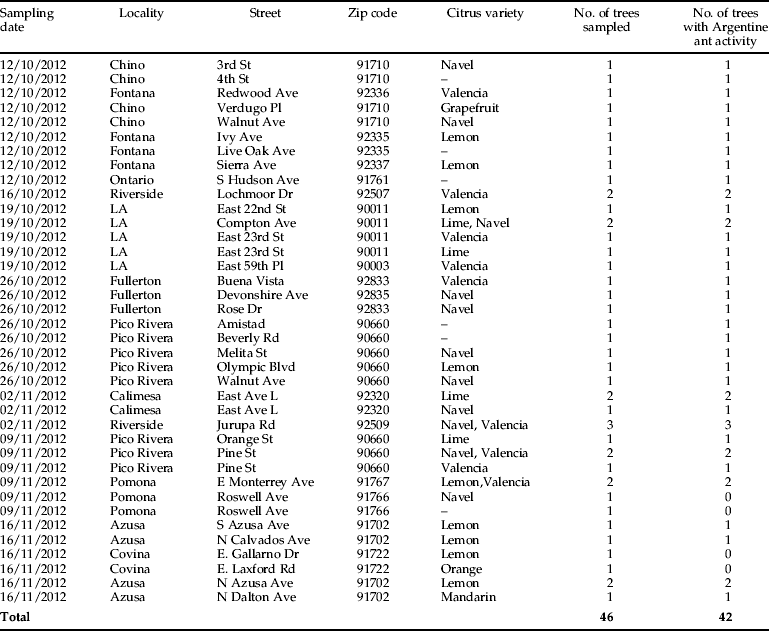
A total of 36 urban gardens with D. citri infested citrus were sampled in southern California from 10 October to 16 November 2012 (Table 1). Between one and three citrus trees were sampled per yard and sampling was carried out between 10.00 and 16.00 h.
Sampling dates and sites, number of sampled trees per site and variety, and presence of Argentine ant, Linepithema humile, in tree canopies.

To determine if L. humile was actively foraging in study trees, we quantified the number of ants moving past a landmark on the tree trunk during a 1-min period. We defined ant activity as a binomial (absence, presence) factor for three reasons: (i) the number of ants ascending and descending the trunk was generally very high and hard to count precisely; (ii) the trunk may not have been the only access point into trees; and (iii) citrus trees varied in size. We considered that a tree was occupied by L. humile when we encountered at least one ant on the trunk during our observation.
To determine the association between L. humile and honeydew producers, each canopy was examined for 10 min. During this time, we identified all honeydew-producer colonies at a height between 0.5 and 2 m and counted the number of attending ants per colony. Then, we recorded the species of each colony and counted the number of honeydew producers (for D. citri we only counted those individuals that secrete high amounts of honeydew, the 4th and 5th instars) per colony for each species. We use three ratios to analyze the ant–hemipteran association: (i) ant-attendance, (ii) absolute ant-attendance, and (iii) relative ant-attendance. We considered that a colony was attended by L. humile when at least one ant was tending a colony. ‘Absolute ant-attendance’ was calculated as the number of ants per honeydew-producer colony. Absolute ant-attendance was also used as a measure of potential honeydew preference because ants respond more intensively to a more profitable resource (Mailleux et al., Reference Mailleux, Deneubourg and Detrain2003). ‘Relative ant-attendance’ was calculated as the number of attending ants divided by the number of honeydew producers, and was used to measure the effectiveness of ant protection (Itioka & Inoue, Reference Itioka and Inoue1996; Harmon & Andow, Reference Harmon and Andow2007). The two latter variables were measured only for ant tended colonies.
Simultaneously, we examined 4th and 5th instar D. citri nymphs for signs of parasitism by T. radiata. Parasitized nymphs can be easily recognized by being dark brown with a flat body and beige filament-like secretions radiate from the periphery of the mummy (Chien et al., Reference Chien, Chiu and Ku1989). Parasitism was calculated as the number of parasitized nymphs divided by the total number (alive and parasitized) of nymphs in each D. citri colony.
Data analysis
A Generalized Linear Mixed Model (GLMM) (Breslow & Clayton, Reference Breslow and Clayton1993) was used to analyze the effect of hemipteran colony size and the total number of other hemipterans on ant-attendance (binomial error assumed), absolute (Poisson error) and relative ant-attendance (normal error) by L. humile on D. citri colonies. General Linear Mixed Model was also used to analyze the effect of the number of other honeydew producers (log transformed) on the size of D. citri colonies (normal error). In previous analyses, ‘tree’ was considered a random effect in all the GLMMs. A lineal model was used to analyze the effect of the total number of other honeydew producers per tree (log transformed) on the total number of D. citri nymphs per tree (log transformed).
Differences in ant-attendance and relative and absolute ant-attendance among honeydew-producing species were first measured by plotting all data together. GLMM was also used to test whether there were differences among honeydew-producing species in ant-attendance (binomial error) and absolute ant-attendance (Poisson error). In previous analyses, ‘tree’ was considered a random effect in all the GLMMs. A Kruskall–Wallis test was used to analyze differences in relative ant-attendance. All tests were run at 0.05 levels of significance. Next, we compared ant attendance (the three ratios) of D. citri with the rest of the honeydew producers sequentially in trees where they co-existed. Owing to the low numbers of aphids (Aphis gossypii and A. spiraecola) the data for both aphid species were combined. Kruskall–Wallis tests were used to analyze differences in absolute and relative ant-attendance and GLMs based on binomial distribution (McCullagh & Nelder, Reference McCullagh and Nelder1989). Further, we re-evaluated the significance of the explanatory variables using an F test after re-scaling the statistical model by a Pearson's χ 2 divided by the residual degrees of freedom because overdispersion was detected in GLMs.
A GLM was used to analyze the effect of ant presence on parasitism rates (binomial error assumed) of D. citri by T. radiata. The statistical software package ‘R’ (http://www.R-project.org) and its package lme4 were used in our analyses.
Results
Ant activity
Linepithema humile was present in 91.3% (42 out of 46) of sampled trees (Table 1).
Relationship between L. humile and D. citri
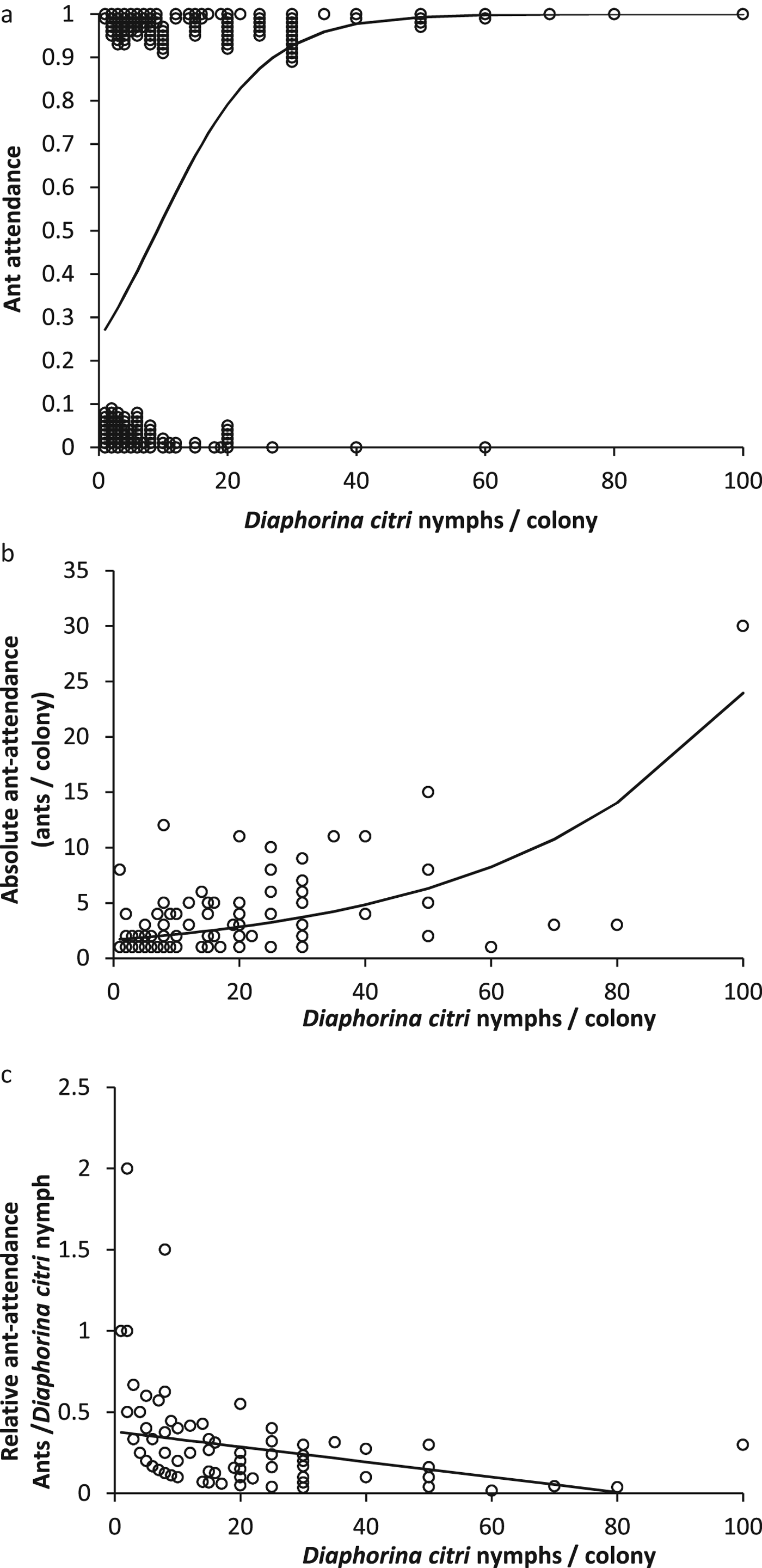
A total of 189 D. citri colonies were observed in trees with ant activity. Of these, 107 (56.61%) were tended by L. humile. The mean number of D. citri nymphs per colony was 17.58±1.7 (SEM) when they were tended by ants and 7.74±1 when they were not tended. The probability that L. humile tended D. citri colonies increased significantly as the number of D. citri nymphs per colony increased (χ 21=28.61; P<0.0001) (fig. 1a). When D. citri colonies were tended by L. humile, the number of attending ants per colony (absolute ant-attendance) also increased significantly as the number of D. citri nymphs per colony increased (χ 21=88.89; P<0.0001), but the number of attending ants per nymph (relative ant-attendance) decreased (F 1, 72=8.81; P=0.0041) (fig. 1b, c).
Effect of colony size of the mutualism between the Argentine ant Linepithema humile and Diaphorina citri nymphs. (a) Ant-attendance [Ant attendance=1/(1+ (1 /(exp (0.12 * D. citri nymphs) – 1.11)))] (data are binary as colonies either were or were not ant tended, but are shown slightly vertically displaced to indicate sample sizes), (b) absolute ant-attendance [number of ants per colony=exp (0.027 * D. citri nymphs +0.51)], and (c) relative ant-attendance [Number of ants per D. citri nymphs=0.38–0.0047 * D. citri nymphs)].
Relationship between L. humile and other honeydew producers
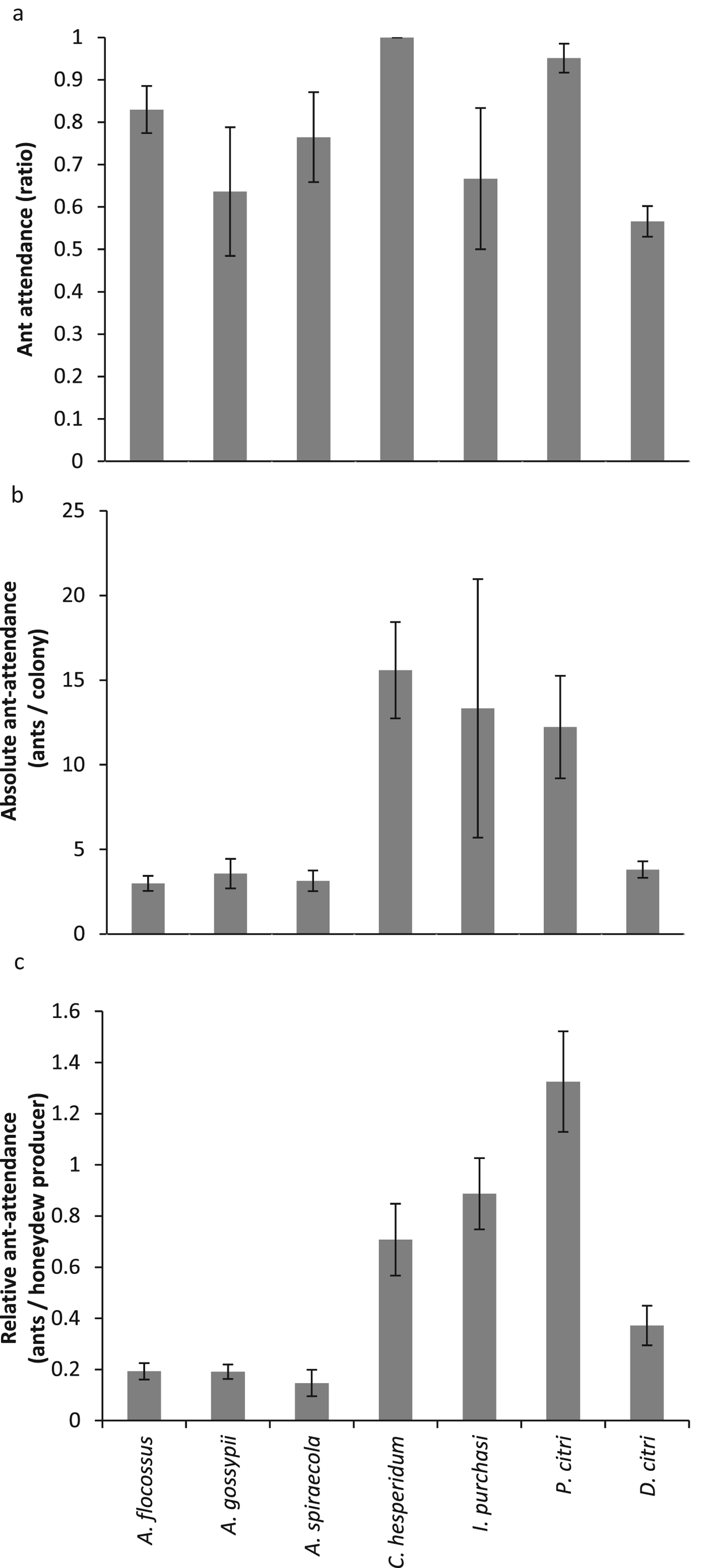
Linepithema humile attended other honeydew-producing species within the same trees. Pooling data from all sampled trees, ants attended 86.5±2.7% (n=156) of all observed honeydew-producer colonies (fig. 2a). Ant-attendance varied significantly among honeydew-producing species (χ 26=90.84; P<0.0001). The number of ants per colony (absolute ant-attendance) and per honeydew producer (relative ant-attendance) also varied among honeydew-producing species (Number of ants per colony: χ 26=553.8; P<0.0001; number of ants per honeydew producer: K=99.49; P<0.0001) (fig. 2b, c).
Relation between Linepithema humile and different honeydew-producing species (wooly white fly, Aleurothrixus floccosus; citrus aphids: Aphis gossypii and A. spiraecola; brown soft scale, Coccus hesperidum; cottony cushion scale, Icerya purchasi; citrus mealybug, Planococcus citri; citrus psyllid, Diaphorina citri) in citrus yard trees from southern California. (a) Ant-attendance. (b) Absolute ant-attendance. (c) Relative ant-attendance.
When we sequentially compared ant attendance of D. citri nymphs with the other honeydew producers in trees where they coexisted, D. citri colonies were tended at significantly lower levels than the white fly A. flocossus, brown soft scale C. hesperidum, and the mealybug P. citri (Table 2). The number of ants per colony (absolute ant-attendance) was significantly higher in C. hesperidum and P. citri colonies than in D. citri colonies (Table 2). Finally, the number of ants per honeydew producer (relative ant-attendance) was significantly higher in P. citri colonies than in D. citri colonies (Table 2).
Ant (Linepithema humile) attendance on Diaphorina citri versus other honeydew-producing species in citrus yard trees from Southern California were they coexisted. Ant-attendance (%), absolute ant-attendance, and relative ant-attendance have been compared only in those trees were hemipteran species co-existed.
Effect of other honeydew producers on D. citri attendance by L. humile
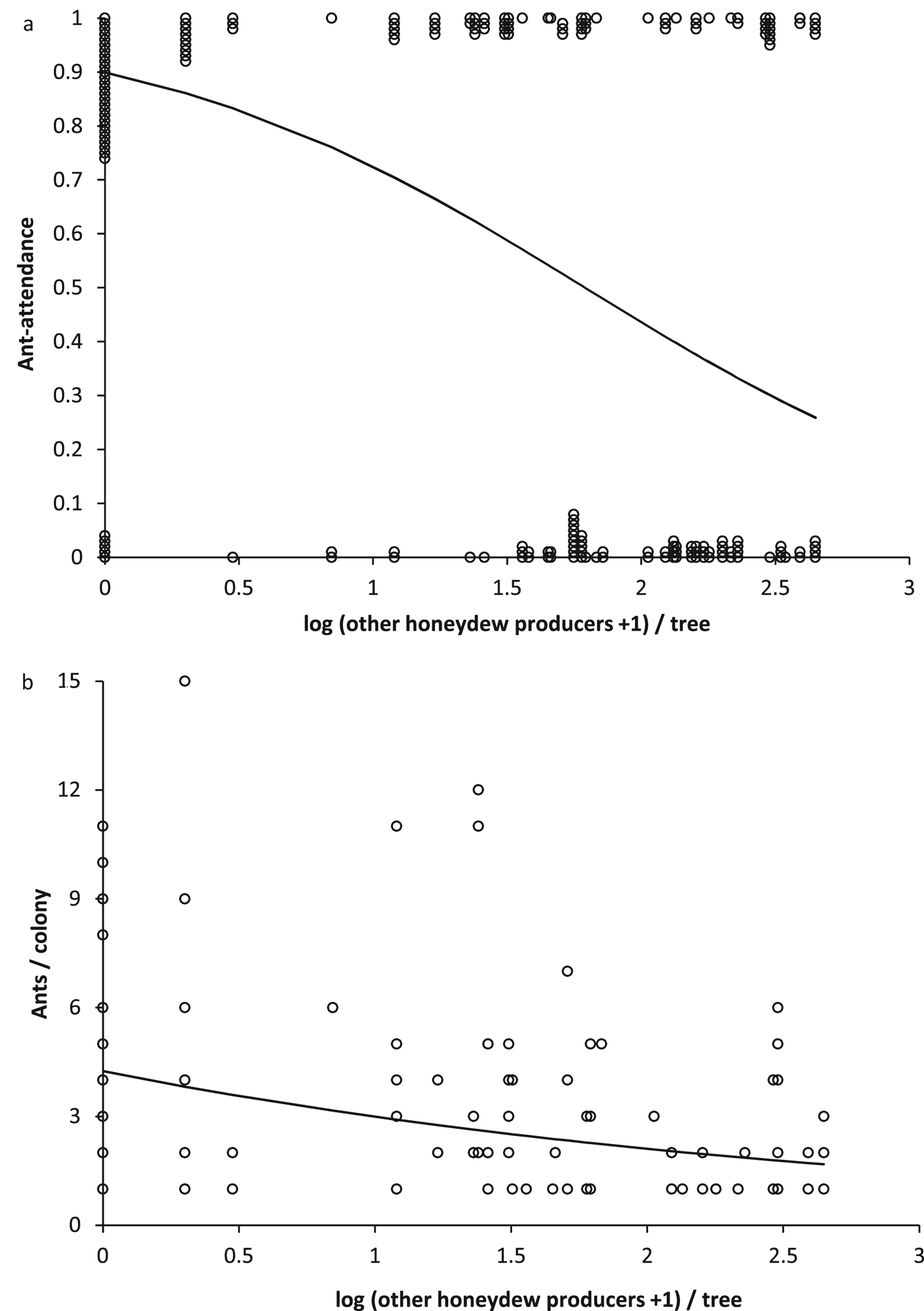
The probability that D. citri colonies were tended by L. humile decreased as the number of other honeydew producers per tree increased (χ 21=13.5; P=0.0002) (fig. 3a). When D. citri colonies were attended by L. humile, the number of ants per colony (absolute ant-attendance) decreased as the number of other honeydew-producing hemipterans per tree increased (χ 21=6.64; P=0.01) (fig. 3b). However, the number of ants per D. citri nymph (relative ant-attendance) was independent of the number of other hemipterans per tree (F 1, 31=0.04; P=0.84).
Effect of other honeydew producers on: (a) ant-attendance [Ant attendance=1/(1+ (1 /(exp (−1.22 * (log (Other honeydew producers +1) +2.19)))] (data are binary as colonies either were or were not ant tended, but are shown slightly vertically displaced to indicate sample sizes) and (b) absolute ant-attendance of Diaphornia citri colonies by Linepithema humile [Ants per D. citri colony=exp ((−0.35 * Log (Other honeydew producers +1) +1.44].
Effect of other honeydew producers on D. citri colonies
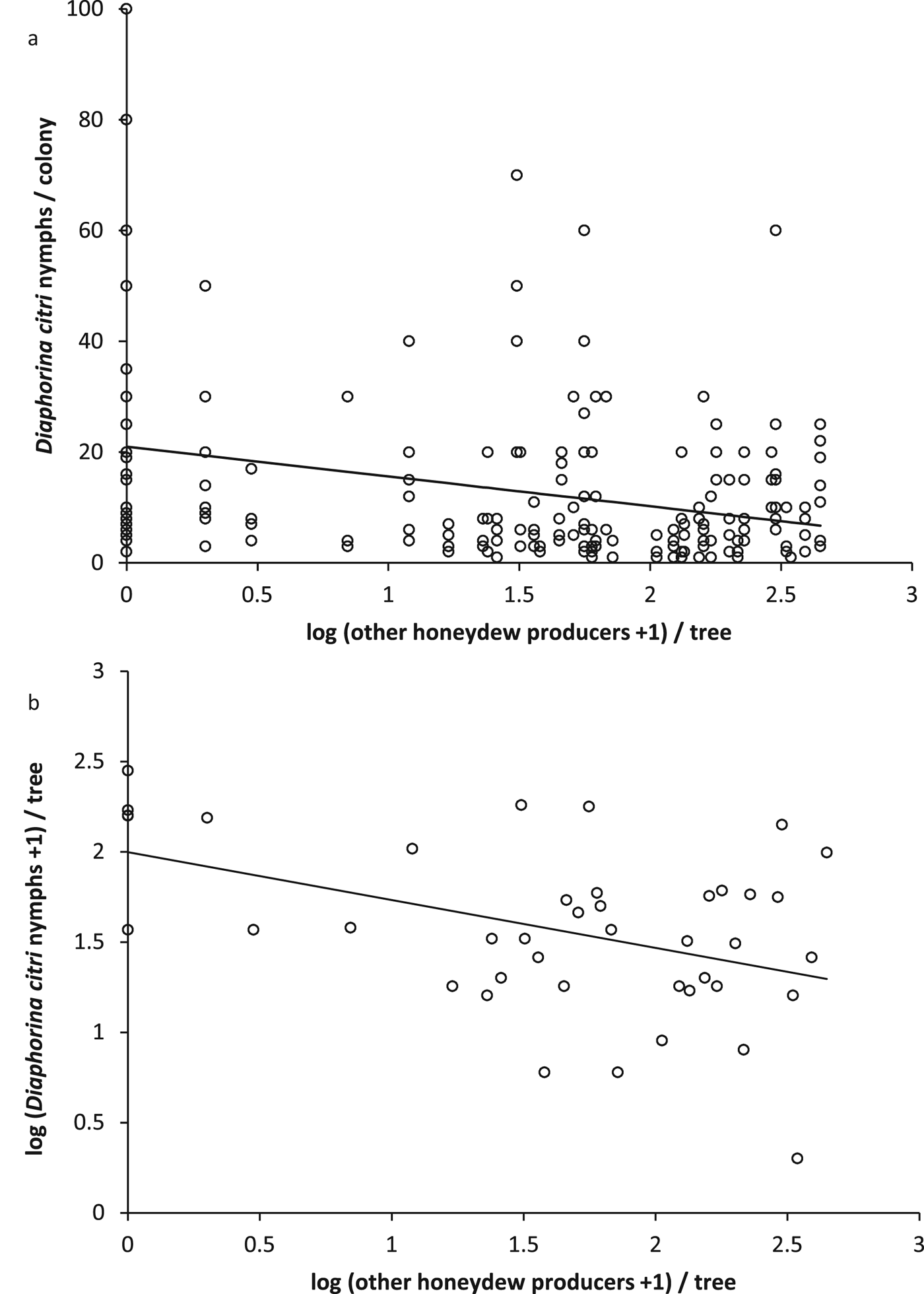
Both the number of D. citri nymphs per colony (F 1, 40=9.97; P=0.003) and the total number of D. citri nymphs per tree (F 1, 40=10.53; P=0.0024) decreased as the number of other honeydew producers per tree increased (fig. 4).
Effect of other honeydew producers on Diaphorina citri density: (a) D. citri-colony size [D. citri nymphs per colony=20.97 – (5.38 * (log (Other honeydew producers +1))]; (b) Total D. citri nymphs per tree [log (D. citri nymphs per tree +1)=1.99 – (0.27 * log (Other honeydew producers +1))].
Effect of L. humile on D. citri parasitism by T. radiata
Parasitism of D. citri nymphs by T. radiata was significantly higher (F 1, 9=9; P=0.015) in trees without L. humile activity (91.25±5.9% [n=4 trees]) than in those with ant activity (11.57±8.5% [n=7]) when we compared trees sampled in localities where we encountered at least one tree without ant activity (Pomona on 9 November 2012 and Azusa-Covina on 16 November 2012. The trees sampled in Azusa and Covina were separated by less than 2.5 km).
Discussion
The invasive Argentine ant, L. humile, was the only ant species observed in our study and it was present in 90% of the citrus trees sampled in ten urban localities in southern California. As previously documented, L. humile has excluded native ants in these residential areas and monopolized sugar sources in the form of hemipteran-produced honeydew (Vega & Rust, Reference Vega and Rust2001). This aggressive and territorial ant provides excellent protection to honeydew producers infesting citrus (Moreno et al., Reference Moreno, Haney and Luck1987; Klotz et al., Reference Klotz, Rust and Phillips2004; Shik & Silverman, Reference Shik and Silverman2013) and the recently introduced D. citri has not been an exception to the tending behaviors of this ant. We consider ant tending of D. citri an example of an invasional meltdown, where the invasive ant L. humile, has facilitated, in part, the invasion of D. citri by protecting it from natural enemies through the development of a mutualistic relationship.
During our field observations, L. humile harvested solid honeydew secreted by psyllid nymphs and was observed returning it to nests using its mandibles. In return, L. humile guarded and tended more than 55% of the D. citri colonies. The intensity of this mutualism depended on psyllid density. Specifically, the probability that L. humile tended a D. citri colony and the intensity of the mutualism depended on the size of the colony. This relationship is probably due to the larger amount of honeydew secreted by larger colonies. Thus, the probability that a colony was tended by ants was almost 100% when colonies had more than 20 nymphs, whereas less than 50% of D. citri colonies with ten nymphs or fewer were tended. The intensity of this relation may be higher during later hours since ants increase their activity in citrus canopies at the end of the day to collect honeydew (Pekas et al., Reference Pekas, Tena, Aguilar and Garcia-Marí2011), here we conducted observations from 10:00 to 16:00. The pattern of density dependence described herein as well as its subsequent effect in hemipteran survival has been observed in other hemipteran–ant interactions (Addicott, Reference Addicott1978; Cushman & Whitham, Reference Cushman and Whitham1989, Reference Cushman and Whitham1991; Breton & Addicott, Reference Breton and Addicott1992; Itioka & Inoue, Reference Itioka and Inoue1996; Morales Reference Morales2000; Billick & Tonkel, Reference Billick and Tonkel2003). However, the size of the colony was not the only factor that affected the mutualism between L. humile and D. citri.
Diaphorina citri competes for L. humile with other honeydew-producing species that feed on citrus. In this competition, L. humile responded equally or less intensively to D. citri than to other honeydew-producing species. Generally, ants respond more intensively to honeydew resources more predictable in procurement (Noe & Hammerstein, Reference Noe and Hammerstein1994; Bonabeau et al., Reference Bonabeau, Theraulaz, Deneubourg, Aron and Camazine1997) and value (Davidson, Reference Davidson1978; Nonacs & Dill, Reference Nonacs and Dill1991; Bonser et al., Reference Bonser, Wright, Bament and Chukwu1998; Mailleaux et al., Reference Mailleux, Detrain and Deneubourg2000). Such differences in value to foraging ants may be due to either larger volumes of honeydew (Bristow, Reference Bristow, Huxley and Cutler1991; Völkl et al., Reference Völkl, Woodring, Fischer, Lorenz and Hoffmann1999), or the presence of preferred amino acids or sugars in the honeydew (Völkl et al., Reference Völkl, Woodring, Fischer, Lorenz and Hoffmann1999; Woodring et al., Reference Woodring, Wiedemann, Fischer, Hoffmann and Völkl2004). The sugar composition and concentration of the honeydew secreted by the main citrus honeydew-producing species are known (Tena et al., Reference Tena, Pekas, Wäckers and Urbaneja2013). However, similar studies do not appear to have been completed for D. citri honeydew. When we compared the sugar composition of honeydew obtained by Tena et al. (Reference Tena, Pekas, Wäckers and Urbaneja2013) and ant preference herein, we could not find any relationship. Considering the strong correlation between amino acid and sugar concentrations (Woodring et al., Reference Woodring, Wiedemann, Fischer, Hoffmann and Völkl2004), it does not seem that these components played a crucial role in the preference of L. humile. On the other hand, L. humile tended more intensively colonies that reliably secreted honeydew. Colonies of P. citri and C. hesperidum last for several months and even years on citrus, whereas D. citri, aphids and A. flocossus colonies may last less than 1 month making the latter a relatively unreliable honeydew source. This distinct hierarchy shown by L. humile is similar to that of the dominant and native ants Lasius grandis (Formicinae) and Pheidole pallidula (Nylander) in Mediterranean citrus (Pekas et al., Reference Pekas, Tena, Aguilar and Garcia-Marí2011). Considering these results and the vegetative parts where these hemipterans form colonies, one might expect that the relatively short lived D. citri colonies could establish mutualisms with aphids. This is because these hemipterans form colonies in the same vegetative organs (tender new flush) and might benefit by mixing their colonies and increasing the amount of honeydew secreted together to attract ants (van Veen et al., Reference van Veen, Morris and Godfray2006). However, our field observations in urban citrus in southern California suggest that these herbivores avoid each other and they do not benefit from common ant attendance. We only encountered two colonies of D. citri (out of the 189) and aphids within the same flush. This lack of mutualism might be also explained by the fact that competition for tender new flush (limited resource) between aphids and psyllids is stronger than the potential benefits of a mutualism relationship.
Interestingly, our results demonstrated that the presence of other honeydew-producing species distracted L. humile from D. citri colonies. The intensity of the mutualistic interaction of L. humile and D. citri measured as ant-attendance and absolute ant-attendance decreased as the density of other honeydew producers increased. However, relative ant-attendance was independent of the density of other honeydew-producing species. Several studies on ants from the genera Lasius and Formica have successfully used the relative ant-attendance ratio to measure the effectiveness of ant protection (Banks, Reference Banks1962; Breton & Addicott Reference Breton and Addicott1992; Itioka & Inoue, Reference Itioka and Inoue1996; Morales, Reference Morales2000; Harmon & Andow, Reference Harmon and Andow2007). For example, in the mutualism aphids-Lasius neograndis (Way), low relative ant-attendance allowed predators to approach aphid colonies from the perimeter and feed without detection because ants were concentrated in the midst of the aphid colonies, whereas they move around the perimeter and detected predators when the number of ants per hemipteran is high (Harmon & Andow, Reference Harmon and Andow2007). Although we recognize that a higher relative ant-attendance ratio will facilitate the protection of D. citri, we also consider that this ratio might not measure ant protection of D. citri by L. humile as accurately as it did in previously tested mutualisms for two reasons. First, L. humile is more aggressive than ants in the genera Lasius and Formica and the degree of protection provided by tending ants depends also on their aggressiveness (Bristow, Reference Bristow1984; Buckley & Gullan, Reference Buckley and Gullan1991; Kaneko, Reference Kaneko2003; Styrsky & Eubanks, Reference Styrsky and Eubanks2007). Second, the structure of D. citri colonies affords easy protection by ants. Most of D. citri nymphs settle along tender green twigs which can allow just one L. humile to effectively patrol an entire colony within 2–10 s (Tena pers. obs.). Thus, high densities of other honeydew producers in citrus trees might negatively affect the protection of D. citri colonies even though the density of other honeydew producers did not affect the relative ant-attendance of D. citri colonies by L. humile.
In fact, the presence of high densities of other honeydew-producing species in citrus trees reduced not only the intensity of the mutualistic interaction of L. humile with D. citri, but also the density of D. citri. Consequently, indirect competition between honeydew producers for L. humile may hinder the establishment of D. citri and facilitate its biological control at least during October–November in southern California when flush densities and, consequently, D. citri densities are relatively low. Although we have demonstrated the effect of this competition on D. citri, we have not analyzed the mechanisms that have generated the decrease of D. citri densities. The most obvious hypothesis is that natural enemies attacked nymphs more successfully when D. citri colonies are not tended by ants. Our results indicated that parasitism by T. radiata is ∼80% greater when L. humile is absent. Although our conclusions about natural enemy effectiveness are based on small samples, this hypothesis is supported by previous studies, which have elegantly demonstrated that, as consequence of competition for mutualistic ants, the less preferred honeydew-producing species are not tended effectively by ants and their populations subsequently decrease because of increased attacks by natural enemies (Cushman & Whitham, Reference Cushman and Whitham1991; Fisher et al., Reference Fischer, Völkl and Hoffmann2001). In the case of D. citri, it is well known that generalist predators (e.g., coccinellids) are the main natural enemies of D. citri (Michaud, Reference Michaud2004; Qureshi & Stansly, Reference Qureshi and Stansly2009) and it has been recently demonstrated that predation rates decrease in the presence of ants (Peña et al., in prep). In our study, we did not measure predation, but our results showed that D. citri colonies suffered higher attacks from T. radiata when L. humile was absent. Controlling ants may be important when establishing T. radiata in southern California as part of an emerging classical biological control program targeting D. citri.
Acknowledgements
This work was supported, in part, by funds from the Citrus Research Board and the California Department of Food and Agriculture's Specialty Crop Grant SCB10007 awarded to MSH. AT was a recipient of a postdoctoral fellowship from the MCINN (Juan de la Cierva program) and his stage at UCR was funded by the Marie-Curie International Research Exchange Scheme No 269196 (Programme: FP7-PEOPLE-2010- IRSES). We thank cooperating homeowners in southern California for unlimited access to citrus in their gardens. Grace Radabaugh, CDFA, assisted with field observations.