INTRODUCTION
Palliative sedation (PS) is defined as the use of specific sedative medications to relieve intolerable suffering from refractory symptoms by a reduction in patient consciousness (de Graeff & Dean, Reference de Graeff and Dean2007). In palliative medicine, PS is considered to be an important and ethically accepted treatment for a small selected group of patients (Morita et al., Reference Morita, Tei and Inoue2003; Cherny et al., Reference Cherny and Radbruch2009), with a reported prevalence between 2.5% to 16% of all deaths (Seale, Reference Seale2009; Miccinesi et al., Reference Miccinesi, Rietjens and Deliens2006; Chambaere et al., Reference Chambaere, Bilsen and Cohen2010; Jaspers et al., Reference Jaspers, Nauck and Lindena2012). However, uncertainties exist regarding definition and practice of PS, which may be vulnerable to unskilled and abusive practices (Billings & Block, Reference Billings and Block1996). Commonly accepted prerequisites for the initiation of PS include: the existence of intolerable suffering from refractory symptoms, the imminence of death, and the presence of an incurable disease. It is now widely accepted that PS does not hasten death (Maltoni et al., Reference Maltoni, Pittureri and Scarpi2009; Reference Maltoni, Scarpi and Rosati2012a).
Psychological and existential distress as an indication for PS is a controversial issue (Boston et al., Reference Boston, Bruce and Schreiber2011; Materstvedt & Bosshard, Reference Materstvedt and Bosshard2009). There is an emerging literature suggesting PS as a tolerable intervention for existential distress in case of refractory suffering. Muller-Busch et al. (Reference Muller-Busch, Andres and Jehser2003) mentioned that palliative sedation is being increasingly administered to treat specific existential rather than physical suffering. Few empirical studies have been conducted about attitudes of care professionals toward palliative sedation taking existential suffering into account. Blondeau et al. (Reference Blondeau, Roy and Dumont2005) conducted a study to measure the effect of prognosis (long vs. short-term) and the nature of suffering (physical vs. existential) on the attitudes of palliative care professionals towards PS (Blondeau et al., Reference Blondeau, Roy and Dumont2005). Their results indicated that sedation was considered to be an acceptable practice in case of intractable physical, but not existential suffering, irrespective of the temporal prognosis.
The purpose of this study is two-fold. First, to explore, in the French part of Switzerland, physicians' attitudes toward palliative sedation. Second, to specifically highlight the most significant physicians' motives associated to their acceptance or rejection of palliative sedation according to the type of prognosis and suffering. In order to do so, the same research design used by Blondeau et al. (Reference Blondeau, Roy and Dumont2005) was employed.
METHODS
Design and Outcome Measure
This pilot study replicated the same 2 × 2 experimental design developed by Blondeau et al. (Reference Blondeau, Roy and Dumont2005). A different combination of the two independent variables (prognosis and suffering) was used. Four clinical vignettes were developed (vignette 1: short prognosis (<10 days)/existential suffering; vignette 2: long prognosis (4 to 8 weeks)/existential suffering; vignette 3: short prognosis (<10 days)/physical suffering; vignette 4: long prognosis (4 to 8 weeks)/physical suffering). Each vignette presented a terminally ill cancer patient with a summary description of his physical and psychological condition, medication, and family situation (see Appendix 1). The respondents' attitude toward sedation was assessed with a six-point Likert scale from 1 (strongly disagree = dis-favorable attitude toward sedation) to 6 (strongly agree = favorable attitude toward sedation). Participants were requested to specify their position in written comments.
The “physical suffering” vignettes described a severe therapy-refractory physical symptom (nociceptive visceral pain and neuropathic pain, respectively). The “existential suffering” vignettes described in both cases a deep existential distress due to increasing despondence, a loss of meaning in life/sense of dignity in life, and a repeated wish to die. This was clearly differentiated from depression, and the patients retained full decision-making capacity. A content validity analysis of the vignettes was performed in Canada by three palliative care physicians (the original vignettes are available from the author on request). The research protocol and the consent forms were approved by the research ethics committee of the University of Lausanne.
Participant Recruitment
Physicians working regularly with palliative patient in the French part of Switzerland were selected from palliative care units, palliative care mobile team, rehabilitations centers with palliative care beds. General practitioners were selected on the basis of their affiliation to the Swiss Society of Medicine and Palliative Care. In total, 201 physicians were selected for the study. Each participant was randomly assigned to receive one of the four vignettes. Beside the clinical vignette, each clinician received by mail an information document and a signed consent form. The signed consent form and the study documents had to be returned in two separate envelopes in order to guarantee the respondent's confidentiality.
Statistical Analysis
General linear model analyses were calculated to measure both the impact of each independent variable (existential/physical suffering and short/long term prognosis) and the effect of their interaction on the physicians' attitude toward sedation. All analyses were computed using the statistical software SPSS 20.0.
Two independent coders analyzed the written comments by specifically selecting the personal motives warranting either agreement or disagreement with PS. Textual responses were unified to units of meaning. No specific software was used.
RESULTS
Participants
Of the 201 selected physicians, (77) 74 (36%) completed both the clinical vignette and the signed consent form. (56) 57% of the respondents were men. Twelve percent of the physicians were younger than 36 years, 20% were between 36 and 45 years old, (31) 32% between 46 and 55 years old, and 33% were older than 56 years. (29) 26% of physicians had less than 6 years of clinical experience in palliative care, 20% had between 6 and 10 years of experience, 14% between 11 and 16 years of experience, and 27% more than 16 years of experience (with 14% missing data for this question).
The number of respondents per subgroup in accordance with the types of vignettes was the following: 13 respondents completed vignette 1 (short prognosis/existential suffering), 17 completed vignette 2 (long prognosis/existential suffering), 24 completed vignette 3 (short prognosis/physical suffering); and 20 completed vignette 4 (long prognosis/physical suffering). The analyses (Chi square tests) indicated that the four groups were equivalent to each other with respect to age, sex, experience in palliative care, and clinical environment.
Attitude toward Sedation
With respect to physical suffering, physicians' attitudes toward sedation tended to be favorable, regardless of whether the prognosis was for the short-term (M = 4.54, SD = 1.67) or the long-term (M = 4.75, SD = 1.71). With respect to existential suffering, physicians' attitudes toward sedation tended to be unfavorable, regardless of whether the prognosis was for the short-term (M = 2.62, SD = 2.06) or the long-term (M = 1.88, SD = 1.54). The analysis of variance using general linear models showed that only the type of suffering had a significant impact on the attitude toward sedation (F = 33.92, df = 1, p = 0.000). Neither the prognosis (F = 0.406, df = 1, p = 0.526) nor the interaction between prognosis and type of suffering (F = 1.308, df = 1, p = 0.257) influenced the physicians' attitudes. Figure 1 illustrates the difference in the physicians' attitudes according to the type of suffering and the type of prognosis.
Distribution of the scores reflecting the physicians' attitudes toward sedation according to the four vignettes from 1 (strongly disagree = dis-favorable attitude toward sedation) to 6 (strongly agree = favorable attitude toward sedation).

Written Comments
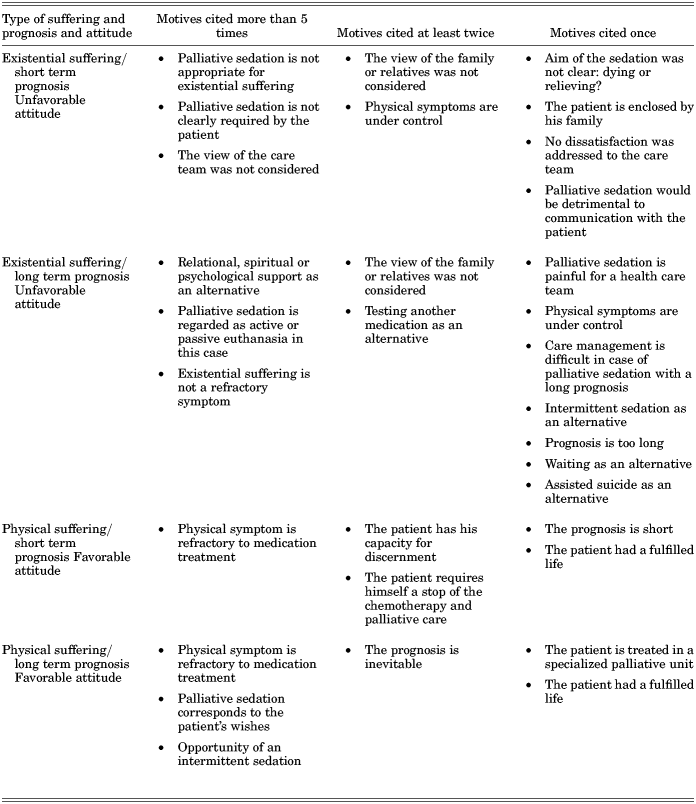
An analysis of the written comments was done by highlighting the motives specified by the physicians to explain their point of view. The number of motives varied between one and six according to the physicians. Only three physicians did not report any justification to explain their position toward PS but wrote general considerations about their conception of palliative care. The motives are reported in Table 1.
Motives linked to the physicians' attitudes towards terminal sedation according to the four vignettes
DISCUSSION
The response rate was globally low (36%). No explicit reason was found; the time required to read the vignette and complete the questionnaire may have been a hindrance. The response rate was lower for the two vignettes related to existential suffering than for physical suffering. It is possible that these specific vignettes may cause some unease and raise questions that could discourage participation in the study. Interestingly, more written motives were listed when doctors answered to the vignettes regarding existential suffering compared to those regarding physical suffering.
Existential Suffering
In the case of existential suffering, physicians seem slightly less opposed to PS in case of short-term prognosis. A repeated argument against PS refers to the fact that the “refractory nature” of a symptom cannot be applied to existential suffering. Apparently, physicians have difficulty to assume the responsibility for prescribing a pharmacological solution for the relief of existential distress. Indeed, medical recommendations on PS are still very cautious regarding existential distress, whereas the definition of refractory symptoms employed in these papers clearly includes all types of suffering (Cherny & Portenoy, Reference Cherny and Portenoy1994; Cherny et al., Reference Cherny and Radbruch2009). De Graeff and Dean (Reference de Graeff and Dean2007) state that “palliative sedation therapy for psychological or existential distress should be initiated only under exceptional circumstances and only after consultations with experts in this area.” This last point is also mentioned in the two proposed guidelines specifically addressing palliative sedation in case of existential suffering (Rousseau, Reference Rousseau2001; Schuman-Olivier et al., Reference Schuman-Olivier, Brendel and Forstein2008). However, the mention of a psychiatric expertise excluding a depression in our existential suffering/long-term prognosis vignette did not appear to influence the negative attitude of the responding physicians. This may be explained by the fact that one of the most cited motives for the refusal of PS in our study is the purported association between PS and active euthanasia (Billings & Block, Reference Billings and Block1996; Janssens et al., Reference Janssens, van Delden and Widdershoven2012; Raus et al., Reference Raus, Sterckx and Mortier2012).
In general, the free comments revealed widespread perceptions by the physicians of feeling lost and not competent enough when assessing and treating existential suffering, as has been already reported in several papers on the subject (Blondeau et al., Reference Blondeau, Roy and Dumont2005; Cherny & Portenoy, Reference Cherny and Portenoy1994). This perception may well have an influence on the willingness of the responding physicians to approve the initiation of PS in the cases described.
Physical Suffering
For both the vignettes based on physical suffering, physicians are rather favorable to PS, independently of the prognosis. The two major motives mentioned by the physicians are the refractory nature of the physical symptoms and the fact that sedation would be congruent with the patient's wishes. Discussing the ethical principles involved in PS in the case of physical suffering, Blondeau et al. (Reference Blondeau, Roy and Dumont2005) mention the principles of beneficence, proportionality (which requires that the benefit outweighs the detriment), respect of autonomy and also the law of double effect as possible justifications to initiate sedation. The main motives cited by the Swiss respondents referred principally to beneficence and respect of autonomy. However, the sole view of the patient tended to be perceived as insufficient to justify the initiation of PS: physicians in Switzerland and Canada often quoted the opinion of the relatives and of the care team as being important in this context (Maltoni et al., Reference Maltoni, Scarpi and Rosati2012b).
This study has several limitations, including (1) the modest response rate, (2) the clear separation of the concepts of physical and existential suffering in the vignettes, which is rarely the case in daily clinical practice, and (3) the fact that only the prognosis and the type of suffering were considered as variables for this study. Nevertheless, our data show a remarkable congruence with the results of the Canadian study. This indicates a general agreement with the practice of PS for refractory physical symptoms, as well as a general uneasiness of physicians on both sides of the Atlantic with the prescription of PS for existential suffering. Subsequent phases of our research program will explore and analyze in more depth similarities and divergences observed in both jurisdictions. A qualitative analysis based on semi-structured interviews with study participants is ongoing in order to analyze the variety of discourses on PS in relation to different contexts of care.