INTRODUCTION
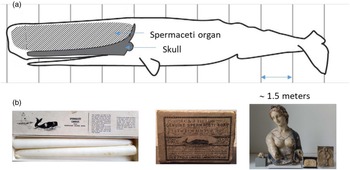
Spermaceti is a waxy substance found in the head cavities of sperm whales (Physeter macrocephalus and P. catodon) (Figure 1a). After extraction from sperm oil, spermaceti forms brilliant white, oily crystals that were used as an ingredient in a variety of commercial applications, such as candles, soap, cosmetics, machine oil, leather waterproofing, rust-proofing materials and many pharmaceutical compounds from the end of the 18th to the beginning of the 20th century (Figure 1b). The production of spermaceti candles was responsible for an increase in the whaling industry in the mid-18th century, negatively impacting the sperm whale population (Starbuck Reference Starbuck1878; Lengellé Reference Lengellé1955; Zallen Reference Zallen2019). Spermaceti wax was also used as an art material for modeling sculptures. To establish accurate 14C dates for artworks made with this wax (Regert et al. Reference Regert, Langlois and Colinart2005), such as the Flora bust of the Bodemuseum in Berlin (Figure 1b) (Reiche et al. Reference Reiche, Beck and Caffy2021), it is essential to determine the impact of marine reservoir effects (MREs) on spermaceti radiocarbon dates (Alves et al. Reference Alves, Macario, Ascough and Bronk Ramsey2018).
(a) Schematic view of a sperm whale with the location of the spermaceti organ, a cavity filled with almost 2000 L of wax-like liquid called spermaceti (redrawn from Nakamura et al. Reference Nakamura, Zenitani and Kato2013); (b) examples of ancient manufactured products made with spermaceti: candles, soap and artworks (the “Flora bust” formerly attributed to Leonardo da Vinci [Reiche et al. Reference Reiche, Beck and Caffy2021], Inv. No. 5951, Skulpturensammlung-Museum für Byzantinische Kunst [SBM], Staatliche Museen zu Berlin [SMB]—Stiftung Preußischer Kulturbesitz [SPK] and two objects by Richard Cockle Lucas: “Woman and Winged Woman” Inv. No. SBM Lfd. Nr. 247 and “Leda and the Swan” Alte Nationalgalerie, SMB-SPK, Inv. No. B II 433 © SMB-SPK).

For that purpose, well-dated samples of spermaceti were sought at the Muséum National d’Histoire Naturelle (MNHN, Paris, France). The chemical library of the MNHN contains more than 9000 items composed of isolated or synthesized pure molecules and natural extracts of historical products. Among them are spermaceti specimens studied by the French chemist M. E. Chevreul (1786–1889) at the beginning of the 19th century. To determine MRE values for spermaceti, we measured 14C in eight substances preserved in their original containers labeled in French as spermaceti, blanc de baleine or cétine. We present here marine reservoir age estimates (R), calculated as the difference between 14C results and the expected radiocarbon age of spermaceti specimens based on their estimated years of collection, and reservoir age offset (ΔR values) estimated from the Marine20 global marine curve (Heaton et al. Reference Heaton, Köhler, Butzin, Bard, Reimer, Austin, Bronk Ramsey, Grootes, Hughen and Kromer2020).
MATERIALS AND METHODS
Sample Description, Estimated Dates of Spermaceti Collection and Whale Death
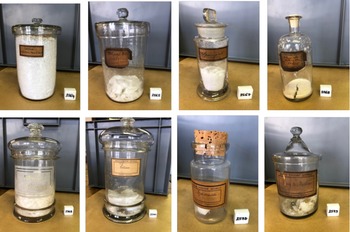
The Muséum National d’Histoire Naturelle houses spermaceti specimens studied by the French chemist M. E. Chevreul during his work on animal fats. Chevreul reported the properties of spermaceti in his fifth memoir read to the Académie in 1815 (Chevreul Reference Chevreul1815). He discovered its composition, principally a cetyl palmitate (ester of cetyl alcohol and palmitic acid, C15H31COO-C16H33) that he dubbed “cétine”. Eight glass jars are still preserved in the MNHN collection containing white waxy substances (Figure 2). They are labeled “spermaceti”, “blanc de baleine” (another French term for spermaceti meaning whale white) and “cétine” (cetine). There are two main hypotheses concerning the biological function of the spermaceti organ in sperm whales: buoyancy control or an acoustic role in echolocation (Clark Reference Clark1970; Koopman Reference Koopman2018).
Specimens collected by the French chemist M. E. Chevreul (1786–1889) and preserved at the Muséum National d’Histoire Naturelle (Paris, France) under the reference MNHN-CH-SC. From top left to bottom right: n°2564 cétine cristallisée dans l’alcool, n°2565 blanc de baleine purifié, n°2567 spermaceti, n°2568 blanc de baleine dans alcool, n°2569 blanc de baleine, n°2570 cétine, n°2572 spermaceti, n°2573 blanc de baleine (see Table 1 for translation of the labels).

To estimate 14C ages of these historical spermaceti samples, several parameters were taken into account. The first is linked to the sperm whale itself, its distribution, diet, and metabolism. The second is the duration of different stages occurring after the death of the whale: whaling campaign, spermaceti processing, sale of the final product and Chevreul’s research investigations.
Sperm whales have one of the widest global distributions: they are found in all deep oceans, from the equator to the edge of the Arctic and Antarctic for males. They hunt for food (up to one ton per day), mainly cephalopods (squids) (Kawakami Reference Kawakami1980), during dives that routinely reach depths of 600–1000 m and regularly more (Clarke Reference Clark, Martins and Pascoe1993). During their long life—up to 60 years—they integrate 14C from various water masses. The turnover rate of spermaceti, which is a liquid composed of wax esters and triglycerides (Wellendorf Reference Wellendorf1963; Morris Reference Morris1973) is unknown. However, since the turnover times of fatty acids in human adipose tissue have a half-life in the order of six months to two years (Strawford et al. Reference Strawford, Antelo, Christiansen and Hellerstein2004; Spalding et al. Reference Spalding, Bernard and Näslund2017), it might be assumed that spermaceti has a ≤10-yr tissue turnover rate.
The durations of the whaling campaign, spermaceti processing, and selling of the final product were considered. In the late 18th–early 19th century, whaling expeditions could last up to five years (Starbuck Reference Starbuck1878; Tower Reference Tower1907; Irwin Reference Irwin2012). After a sperm whale was killed and once aboard the ship, the spermaceti was extracted from the head, separated from the oil and placed in barrels to be transported to manufactories. To be useable, spermaceti was refined by boiling. Purified spermaceti was then placed in barrels, and after a few more months of storage, the spermaceti was once again heated, hardened, and returned to bags to remove any final remnants of oil. The remaining waxy spermaceti was once again heated before being shaped into candles or other manufactured products. As a result, several years, estimated between 2 and 6 years, passed between the killing of a sperm whale and the end product. Chevreul, who began his investigations on animal fats in 1811 or 1813 (B. Bodo, personal communication), reported the properties of spermaceti for the first time in 1815 (Chevreul Reference Chevreul1815), then in 1817 (Chevreul Reference Chevreul1817), and finally in his first famous book published in 1823 (Chevreul Reference Chevreul1823). Chevreul abandoned fat chemistry in 1823 or 1824 when he was appointed director of dyeing at the Gobelins, the royal tapestry factory in Paris. Based on his publications, we can estimate that Chevreul obtained spermaceti materials between approximatively 1811 and 1820. Taking into account both the whaling and commercial practices of the time and Chevreul’s scientific work, it can be assumed that the spermaceti samples of the MNHN come from sperm whales caught at the beginning of the 19th century, probably between 1805 and 1815, i.e., AD 1810 ± 5.
Sample Preparation and 14C Measurements
Between 2 and 3 mg of spermaceti, blanc de baleine or cétine specimens were used. Except for two replicas cleaned by the standard ABA treatment, CO2 was directly obtained from all the samples by combustion at 850°C for 5 hr in a sealed quartz tube with an excess of CuO (400–500 mg) and a 1-cm Ag wire. CO2 was collected on a semi-automated rig (Dumoulin et al. Reference Dumoulin, Comby-Zerbino, Delqué-Kolic, Moreau, Caffy, Hain, Perron, Thellier, Setti, Berthier and Beck2017). CO2 was then reduced to graphite with hydrogen over iron catalyst (Vogel et al. Reference Vogel, Southon, Nelson and Brown1984). Radiocarbon measurements were performed by accelerator mass spectrometry (AMS) using the LMC14/ARTEMIS facility, a 3MV NEC Pelletron (Cottereau Reference Cottereau, Arnold, Moreau, Baqué, Bavay and Caffy2007; Moreau et al. Reference Moreau, Messager, Berthier, Hain, Thellier, Dumoulin, Caffy, Sieudat, Delqué-Količ and Mussard2020). Oxalic Acid II was used for normalization, and international intercomparison samples (FIRI H and FIRI I) for validation (Scott Reference Scott2003). 14C ages were calculated using the Mook and van der Plicht (Reference Mook and van der Plicht1999) recommendations.
Calculation of MRE Values
Marine reservoir ages (R) were calculated by subtracting the expected radiocarbon age (in 14C years) of the Muséum spermaceti specimens from the measured 14C values.
Based on the above information (see the previous sections), a global date for the death of the sperm whales that produced the spermaceti samples was estimated at AD 1810 (with an uncertainty of ± 5 yr). To take into account spermaceti turnover estimated at 10 years and to reflect the material variability (different sperm whales from various unknown locations), a shift of 5 years and additional uncertainties were applied. As a result, a date of AD 1805 ± 15 was finally set, corresponding to an expected radiocarbon age of 157 ± 15 yr BP.
ΔR values were calculated using the DeltaR function in the Marine Radiocarbon Database (http://calib.org/JS/JSdeltar20/) from the 14CHRONO Centre (Reimer and Reimer Reference Reimer and Reimer2001) in September 2021. As the software does not enable errors on the collection year to be taken into account, two ΔR values (ΔRmin and ΔRmax) were calculated using the two extreme values of the estimated death date of the sperm whales—AD 1790 (1805–15) and AD 1820 (1805+15)—as the independent age determination. An alternative approach, based on Macario et al. (Reference Macario, Souza, Aguilera, Carvalho, Oliveira, Alves and Chanca2015), used Bayesian modeling in OxCal 4.4, by considering all the samples in a single phase, with ΔR undetermined over a range from –200 to 200 and including the calendar date as a C_Date of 1805 ± 15 yr (see Supplementary material)
RESULTS AND DISCUSSION
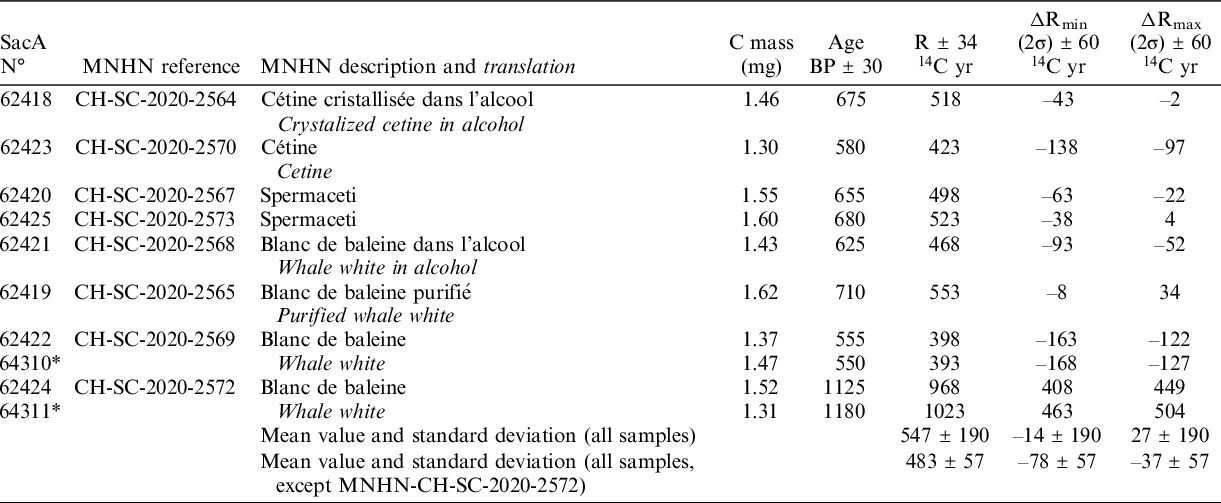
For all the samples (except MNHN-CH-SC-2020-2572), AMS 14C dating results were from 550 to 710 ± 30 BP (Table 1). Calculated R values were obtained between 393 and 553 (± 34) 14C yr and ΔRmin/max between –168 and 34 (± 60) 14C yr. Bayesian modeling provided ΔR from –136 to 25 14C yr (95.4%) (Supplementary material). Taking into account the uncertainties, the results obtained by the two approaches are in agreement.
14C results for the spermaceti, blanc de baleine and cétine specimens of the Muséum National d’Histoire Naturelle (National Museum of Natural History, Paris, France): age BP, R calculated for an expected radiocarbon age of 157 ± 15 yr BP, ΔRmin (for an estimated death date of AD 1790) and ΔRmax (for an estimated death date of AD 1820).

* These samples were pretreated by the ABA procedure.
For one sample (MNHN-CH-SC-2020-2572), we observed an older age at 1125 ± 30 BP. This sample was measured a second time, after ABA pretreatment, providing a similar result (1180 ± 30 BP). Two R values were obtained: 968 and 1023 (± 34) 14C yr and ΔR values were from 408 to 504 (± 60) 14C yr.
On average, 14C dates on spermaceti samples (except MNHN-CH-SC-2020-2572) showed a mean offset R of 483 ± 57 yr (Table 1) from their estimated dates. These results are quite surprising as they reflect rather the global-average marine reservoir age of surface waters while sperm whales are deep divers. On the contrary, the result obtained for the sample MNHN-CH-SC-2020-2572 seems to be more consistent with deep-water values and may indicate a different origin or provenance for this specimen.
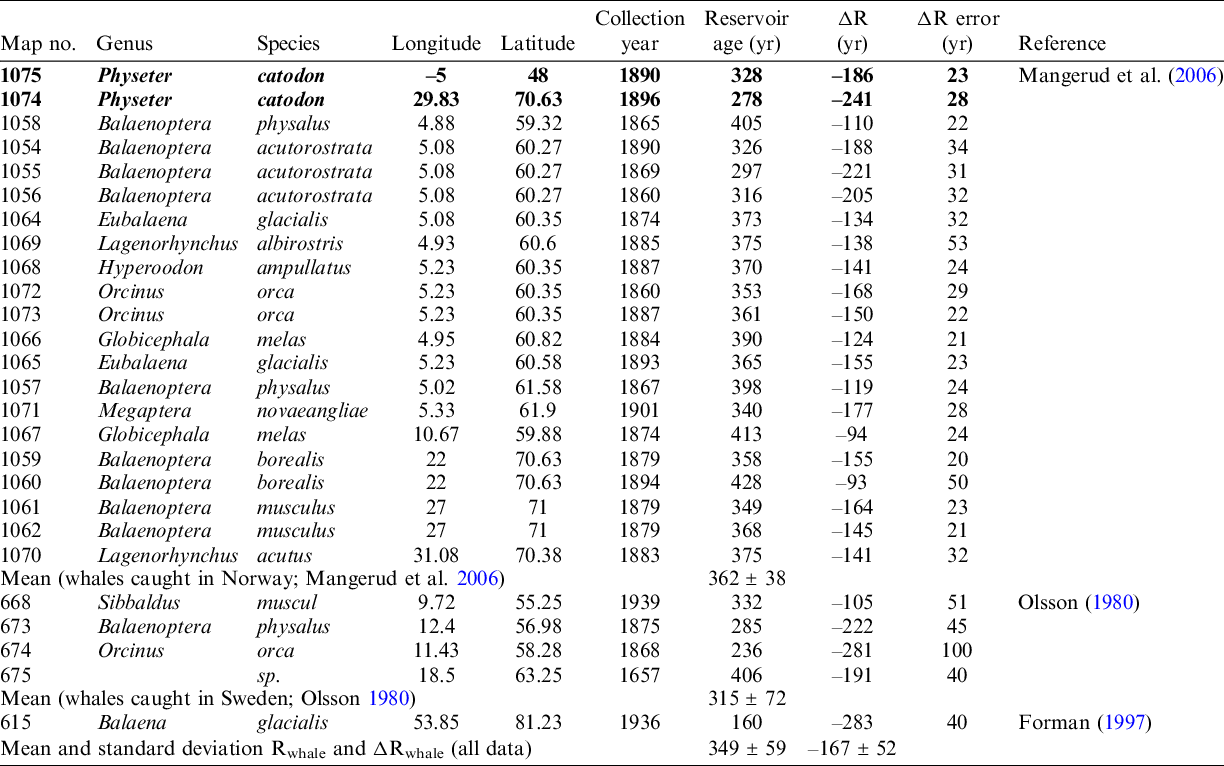
To the best of our knowledge, no MRE value has been reported for sperm whale spermaceti. The only comparison that can be made is with two values obtained for bones and published by Mangerud et al. in Reference Mangerud, Bondevik, Gulliksen, Hufthammer and Høisæter2006. Recalculated from Marine20 (calib.org/marine/), R values for bones of sperm whales collected in Bretagne, France in 1890 and in North-Norway in 1896 are 278 and 328 14C years, respectively (Table 2). For other species, Mangerud et al. (Reference Mangerud, Bondevik, Gulliksen, Hufthammer and Høisæter2006) determined an average marine reservoir age (MRA) of 362 ± 38 yr relative to IntCal20/Marine 20 for various whales caught in Norway in the 19th century and Olsson (Reference Olsson1980) a MRA of 315 ± 72 yr relative to IntCal20/Marine 20 for whales living near Sweden (Table 2). In total, 26 bones from different species of whales are recorded in the Marine20 database and provide a mean Rwhale value of 350 ± 60 14C yr (Table 2). Other publications, not recorded in Marine 20, recommended using a ca. 200 yr marine reservoir correction for bowhead whales (Balaena mysticetus) from the Canadian Arctic (Dyke et al. Reference Dyke, MecNeely and Hopper1996) or ca. 350 years for a 17th century Finback whale (Balaenoptera physalus) bone collected in Spitsbergen (Birkenmajer and Olsson Reference Birkenmajer and Olsson1998). Furze et al. (Reference Furze, Pienkowski and Coulthard2014) provided reservoir offset values for bowhead whales corresponding to a MRA of 570 ± 95 14C yr, based on an exhaustive compilation of published marine mammal radiocarbon dates, both live-harvested materials and subfossils, from the Canadian Arctic Archipelago.
Reservoir age and ΔR for bones of various species of whale extracted from the Marine20 database (Reimer and Reimer Reference Reimer and Reimer2001). Location of collection is indicated by the longitude and latitude coordinates. Values for sperm whale (Physeter catodon) are indicated in bold.

The measured deviations from the marine calibration curve (ΔR) for the spermaceti samples are from –168 to 34 (± 60) 14C yr (Table 1) or from –136 to 25 14C yr (95.4%) depending on the calculation procedure used. These results differ from the values reported for two sperm whale bones, –241 ± 28 and –186 ± 23 14C yr, respectively and from most of the ΔR values obtained on bones from other species of whales recorded in the Marine20 database (Table 2). The mean ΔR values for the spermaceti samples (from –78 to 27 14C yr) are higher than the mean ΔR values for whale bones (–167 ± 52 14C yr).
Many factors can be put forward to explain these discrepancies: difference between spermaceti and bone turnovers, the unknown location and variability of sperm whales in the oceans, the industrial refining process used for spermaceti, and the impact of Chevreul’s research work. Very little is known about the formation of spermaceti, which is a liquid composed of esters and acids, but it can be assumed that carbon integration differs from that which occurs in bones. In addition, unlike sperm whale bones, spermaceti is not a crude material, but has undergone many physical transformations, including several boiling/solidification cycles. And, lastly, some of the materials preserved at the Muséum are the result of Chevreul’s experiments. For example, it is highly probable that the samples labeled “Cétine” or “Blanc de baleine purifié” were purified by Chevreul. Although we did not observe any significant difference in the 14C results between purified and non purified samples, it may be more accurate to select the “Spermaceti” samples for MRE values of this wax substance, that is to say, marine reservoir ages of 498 and 523 ± 34 14C yr and ΔR from –63 to 4 ± 60 14C yr. No other MRE values are reported in the literature for sperm whale spermaceti and further measurements on crude material would be necessary to confirm the results obtained here. Furthermore, it should be pointed out that in the case of these marine animals which travel all around the oceans during their long life, ΔR values cannot be related to a specific location but rather refer to spatially and temporally averaged values for that species.
CONCLUSION
Our study investigated the marine reservoir effect of spermaceti, a wax obtained from the head of the sperm whale. R(t) and ΔR values were determined for eight samples collected by the French chemist Chevreul at the beginning of the 19th century and kept in the collection of the National Museum of Natural History, Paris, France. The R(t) and ΔR values obtained in this study are higher than those reported in the literature for sperm whale bones collected in France and Norway at the end of the 19th century and also higher than almost all the values recorded for whales in the Marine20 database.
The values presented here are the first ever obtained for spermaceti. As they are based on museum specimens, there are some limitations such as the unknown location of the sperm whales caught for the spermaceti production as well as the possible chemical transformation of the material during Chevreul’s scientific work. These large uncertainties may limit the absolute dating of spermaceti wax objects and better-known reference materials would be necessary to improve accuracy.
ACKNOWLEDGMENTS
The authors are grateful to the Muséum national d’Histoire naturelle (National Museum of Natural History, Paris, France) for providing the samples. The authors would like to thank Christine Bailly and Séverine Amand for searching for, labeling and preparing the spermaceti samples, Pr Bernard Bodo for useful information on Chevreul’s work and Pr Matthieu Lebon for his helpful advice on the Muséum collections. The present study arises from the dating of wax artworks, initiating by Dr Ina Reiche. The authors gratefully acknowledge the two anonymous reviewers for their comments that have improved the manuscript, and particularly for the suggestions on the Delta R calculation using Bayesian modeling. This is LSCE contribution number 7803.
Supplementary material
To view supplementary material for this article, please visit https://doi.org/10.1017/RDC.2022.79