Early intervention (EI) in bipolar disorder (BPD)
EI in young people with BPD is a surprisingly neglected area despite concerns raised over a decade ago by Conus & McGorry (Reference Conus and McGorry2002). This neglect is in marked contrast to the explosion of interest in EI in psychosis that encouraged the roll out of EI services across England, Canada, Australia and New Zealand over the last decade. EI in BPD lags about 20 years behind. However, this delay provides an opportunity to learn from EI in psychosis, to maximise some of the strengths of this approach and avoid some of the problems it can generate. There are also encouraging signs that the field is finally taking off. There have been several explorative studies of early detection of the BPD prodrome (see below) and contributions include those working in EI in psychosis, youth mental health, child and adult BPD research fields. This coalescence of interest has the potential to generate a rich mix of new ideas, insights and innovative treatment approaches for the next generation of young people with BPD. The clinical staging model provides a rational premise for these new approaches.
Why does EI in young people with BPD deserve greater attention?
BPD is more prevalent than schizophrenia and affects 2% of adolescents. It goes on to affect 0.8–1.6% of the adult population with 2.8–6.5% of the population affected under a broader category of bipolar spectrum disorders (Conus et al. Reference Conus, Macneil and McGorry2014).
With its onset in adolescents and young adults, BPD can severely derail young people from their normal developmental trajectory resulting in dropping out of education, work, relationships and returning them to a dependency on their parents. This can trigger additional mental health problems which are aggravated if there are premorbid adjustment difficulties, post manic depressive symptoms and cognitive impairment (Martinez-Aran et al. Reference Martinez-Aran, Vieta, Colom, Reinares, Benanarre, GAasto and Salamero2000; Pope et al. Reference Pope, Dudley and Scott2007).
Contrary to popular belief, BPD has serious capacity to produce chronic disability. This is particularly so in adolescent onset cases. Even though symptomatic remission with treatment in the first episode is the norm (70–95%) functional recovery from the first episode is much poorer (35–56%) (Scott, Reference Scott2012) and relapse rates (80%) are very high (Keller et al. Reference Keller, Lavori, Coryell, Endicott and Mueller1993). Neurocognitive deficits are already evident after the first episode and fall between those seen in first episode schizophrenia and normal health controls (Demmo et al. Reference Demmo, Melle, Kvitland, Andreassen, Vik Lagerberg and Ueland2014).
The overall societal burden of BPD is ranked higher than schizophrenia (6th in a World Bank study of the global burden of diseases) (Conus et al. Reference Conus, Macneil and McGorry2014). It is ranked even higher (4th) among 10–24 years olds (Gore et al. Reference Gore, Bloem, Patton, Ferguson, Joseph, Coffey, Sawyer and Mathers2011). It is the disorder associated with the greatest loss of ‘human capital’ (i.e. the gap between individuals pre-morbid potential and their post onset functioning) (Scott, Reference Scott2012). It costs services nearly as much as schizophrenia (annual costs in England: £1.6 v. £2.2 billion) and is a greater cost of lost employment (annual costs in England: £5.2 v. £4 billion) (McCrone et al. Reference McCrone, Dhanasiri, Patel, Knapp and Lawton-Smith2008). Lifespan is significantly shortened by 12 years (Laursen, Reference Laursen2011). Lifetime rates of suicide in BPD are 5% (Moreno, Reference Moreno2014) but higher in young people in the early stages of illness. BPD accounts for 6% of all suicides (Schaffer et al. Reference Schaffer, Sinyor, Reis, Goldstein and Levitt2014).
Part of the problem are the long delays of almost a decade between the average age of onset (mid-late adolescence) and average age of first presentation to services (mid-20s) (McCraw et al. Reference McCraw, Parker, Graham, Synnott and Mitchell2014), and subsequent long delays in obtaining correct diagnosis and treatment (Berk et al. Reference Berk, Dodd, Callaly, Berk, Fitzgerald, de Castella, Filia, Filia, Tahtalian, Biffin, Kelin, Smith, Montgomery and Kulkarni2007a; Drancourt et al. Reference Drancourt, Etain, Lajnef, Henry, Raust, Cochet, Mathieu, Gard, Mbailara, Zanouy, Kahn, Cohen, Wajsbrot-Elgrabli, Leboyer, Scott and Bellivier2013; Kroon et al. Reference Kroon, Wohlfarth, Dieleman, Sutterland, Storosum, Denys, de Haan and Sturkenboom2013; McCraw et al. Reference McCraw, Parker, Graham, Synnott and Mitchell2014). These delays may the increase risk of relapse, of progression to more severe stages of the illness (Baldessarini et al. Reference Baldessarini, Tondo, Baethge, Lepri and Bratti2007; Altamura et al. Reference Altamura, Buoli, Albano and Dell’Osso2010; McCraw et al. Reference McCraw, Parker, Graham, Synnott and Mitchell2014) and of neurodegenerative changes (Gildengers et al. Reference Gildengers, Chung, Huang, Begley, Aizenstein and Tsai2014). The more relapses the poorer the response to treatment and the greater the risk of chronicity (Berk et al. Reference Berk, Brnabic, Dodd, Kelin, Tohen, Malhi, Berk, Conus and McGorry2011), hence understanding and identifying the progression of BPD is crucial.
What is the natural history of BPD?
Most BPD patients experience their first episode as depression before the age of 18 (Perlis et al. Reference Perlis, Miyahara, Marangell, Wisniewski, Ostacher, DelBelloe, Bowden, Sachs and Nierenberg2004; Duffy et al. Reference Duffy, Alda, Crawford, Milin and Grof2007; Kroon et al. Reference Kroon, Wohlfarth, Dieleman, Sutterland, Storosum, Denys, de Haan and Sturkenboom2013; McCraw et al. Reference McCraw, Parker, Graham, Synnott and Mitchell2014). The majority will then have experienced some manic symptoms by the age of 21 (Berk et al. Reference Berk, Dodd, Callaly, Berk, Fitzgerald, de Castella, Filia, Filia, Tahtalian, Biffin, Kelin, Smith, Montgomery and Kulkarni2007a; Drancourt et al. Reference Drancourt, Etain, Lajnef, Henry, Raust, Cochet, Mathieu, Gard, Mbailara, Zanouy, Kahn, Cohen, Wajsbrot-Elgrabli, Leboyer, Scott and Bellivier2013) and then their first manic episode by their mid-20s (Merikangas et al. Reference Merikangas, Akiskal, Angst, Greenberg, Hirschfeld, Petukhova and Kessler2007). The earlier the age of onset of either depressive or manic episodes the greater the likelihood of chronicity (Swann, Reference Swann2010).
First episode mania (and thereby BPD) is exceptionally rare before puberty (Douglas & Scott, Reference Douglas and Scott2014; Baldessarini et al. Reference Baldessarini, Tondo and Tohen2012). Much higher rates are reported in the United States (Post et al. Reference Post, Luckenbaugh, Grunze, Nolen, Keck, Leverich, Suppes, McElroy, Kupka and Rowe, Altshuler2010), even in pre-school kids, but this may be due to the broader US diagnostic criteria that include irritability as a core symptom of childhood mania (Pavuluri et al. Reference Pavuluri, Graczyk, Henry, Carbray, Heidenreich and Miklowitz2004). Between 1994 and 2003 there was a 40-fold increase in the diagnosis of BPD in the under 20-year-old population in the United States (Morena et al. Reference Moreno, Laje, Blanco, Jiang, Schmidt and Olfson2007). Samples of bipolar (BP) kids in the United States include a very high proportion (over 70%) with co-morbid attention deficit hyperactivity disorder (ADHD) (Liebenluft & Dickstein, Reference Leibenluft and Dickstein2008) and, given the rapid rise in psychotropic prescribing in the US pre-school population, one has to wonder how many have been prescribed antidepressants and stimulants.
Nonetheless, even if true mania is rare before puberty, depression is not and up to a quarter of BPD patients experience their first episode of depression before puberty (McCraw et al. Reference McCraw, Parker, Graham, Synnott and Mitchell2014). Childhood depression is similar to adult episodes but shorter and more often accompanied by psychomotor retardation, mixed affective features and irritability. Children are more likely to have recurrent depressive episodes than manic, more chronicity and more severe suicidality (Swann, Reference Swann2010).
Untreated, a young person with BPD will typically go on to experience 10 episodes in their lifetime with around four episodes per decade. These episodes tend to occur with gradually increasingly frequency up to the 5th episode and then the frequency stabilises for the remainder. Psychotic features commonly complicate manic phases (70–88%) (Tohen et al. Reference Tohen, Zarate, Hennen, Khalsa, Strakowski, Gebre-Medhin, Salvatore and Baldessarini2003) (particularly with adolescent onset) but are relatively rare during depressive phases.
If treated, 85–90% of first episode manic patients will have achieved remission by 6 months (Conus et al. Reference Conus, Macneil and McGorry2014). However, residual cognitive deficits are common (Conus et al. Reference Conus, Macneil and McGorry2014), particularly following episodes complicated by psychotic features. Depression commonly follows acute manic episodes and may be seen as partly reactive to the traumatic impact of the manic episode as well as part of the natural cycle of the condition. As many as 40% of patients experience depressive symptoms for 40% of the next 3 years (Joffe et al. Reference Joffe, MacQueen, Marriott and Young2004). About 20% develop chronic persistent affective symptoms (usually depression complicated by degrees of cognitive impairment).
What are the difficulties of establishing a diagnosis of BPD in young people?
Diagnosing BPD in young people for the first time using traditional classification systems is a challenge for a number of reasons. First, there are significant differences between the Diagnostic and Statistical Manual of Mental Disorders (DSM) and International Classification of Diseases in conceptualising BPD, for example the contradictory interpretations of whether first episode mania constitutes BPD (First, Reference First2009). Second, there is an arbitrary distinction between the bipolar spectrum disorders with assumptions that they are distinct diagnostic categories, for example hypomania, mania, BP Type I & II, BP NOS, schizoaffective disorder when in reality they may be just different stages and degrees of the same disorder (Fig. 1). Third, age influences the expression of BPD disorder: in children these features mimic other disorders such as ADHD, oppositional defiant disorder, etc. Fourth, there is worrying evidence that BPD is seriously over-diagnosed in clinical practice, particularly in young children (Ghouse et al. Reference Ghouse, Sanches, Zunta-Soares, Swann and Soares2013). Fifth, the majority of young people with BPD suffer from co-morbidities, for example substance use disorders which blur the clinical picture and presentation. Finally, aspects of ‘normal’ adolescent behaviours may mimic BPD.
Course of mood swings and clinical thresholds in bipolar disorder (BPD).

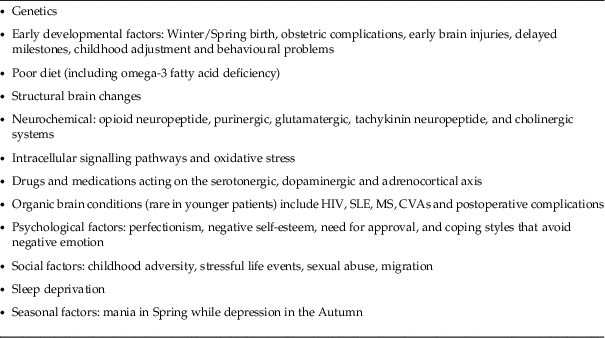
When formulating a diagnosis, it is crucial to identify why a young person might be at risk or already have developed BPD. Each person carries their own unique constellation of risks and protective factors. There are probably many different pathways that ultimately lead to the onset and progression of BPD. The aetiological factors along the way are complex, varied and dynamic – reaching a tipping point in adolescence. It is likely that a sizeable proportion of young people carry a high risk for BPD but fortunately never develop the condition as they are not exposed to the lifestyle/environmental factors that trigger onset and progression of the illness. Some risks are fixed and some are modifiable. These aetiological factors are important to identify as they reveal opportunities for prevention of initial onset or progression of BPD (Table 1).
Aetiological factors in BPD
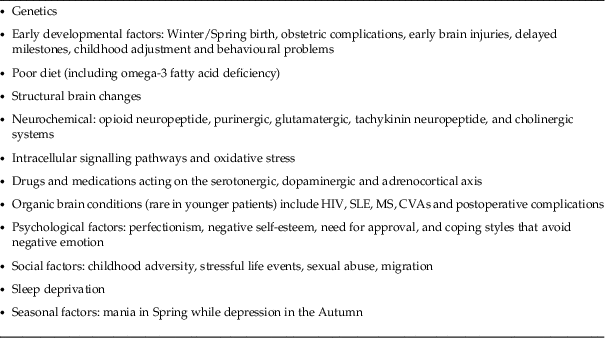
BPD, bipolar disorder; HIV, human immunodeficiency virus; SLE, systemic lupus erythematosus; MS, multiple sclerosis; CVA, cerebrovascular accident.
Given the pervasive impact of some aetiological factors, it is not surprising that co-morbidity (anxiety disorders, addictions, etc.) is common. Substance use and alcohol abuse complicates as many as 69% of young patients with first onset BPD (Hasty et al. Reference Hasty, Macneil, Kader, Lucas, Hallam, O’Regan, Berk, McGorry and Conus2006). Unfortunately, these first presentations are commonly dismissed as just drug induced episodes and the opportunity to intervene early in BPD is lost. Comorbidities are associated with longer delays in accessing treatment and poorer prognosis (Strakowski et al. Reference Strakowski, Williams, Fleck and Delbello2000; Leboyer et al. Reference Leboyer, Henry, Paillere-Martinot and Bellivier2005; Perroud et al. Reference Perroud, Cordera, Zimmermann, Michalopoulos, Bancila, Prada, Dayer and Aubry2014).
There is considerable debate about the overlap in young people between BPD and conditions such as ADHD and emotional unstable personality disorder (EUPD). Given the potential for misdiagnosis and inappropriate treatments it is worth discussion ADHD and EUPD in more detail.
Studies suggest that 20% of young ADHD patients meet diagnostic criteria for BPD. Likewise about the same proportion of adult BP patients meet the criteria for ADHD (Perroud et al. Reference Perroud, Cordera, Zimmermann, Michalopoulos, Bancila, Prada, Dayer and Aubry2014). BPD patients with ADHD tend to have greater levels of other co-morbidities, for example anxiety, depression, substance use, childhood traumas and EUPD. They also have worse outcomes and poorer treatment response. ADHD screening measures are unreliable in this population and diagnosis should be left to psychiatrists with clinical expertise in these conditions (Perroud et al. Reference Perroud, Cordera, Zimmermann, Michalopoulos, Bancila, Prada, Dayer and Aubry2014). In children, ADHD and manic symptoms are very similar but one important distinction is whether they are episodic (Leibenluft & Dickstein, Reference Leibenluft and Dickstein2008). ADHD should not be diagnosed during acute (or even post-acute) phases of mania. One should be mindful of the risk that psychostimulants (used in ADHD) may exacerbate BPD. DelBello et al. (Reference DelBello, Soutullo, Hendricks, Niemeier, McElroy and Strakowski2001) urged caution with stimulants when their study demonstrated that their use was associated with an earlier age of onset of BPD.
Similarly, studies show that about 10% of BP Type 1 and 20% of BP Type II patients meet the criteria for EUPD. The reverse is also seen with about 10% of EUPD patients meeting criteria for BP Type 1 and another 10% for BP Type II disorders. EUPD does not appear to be part of the BPD spectrum but recent studies suggest that EUPD is a significant contributor to over-diagnosis of BPD (Zimmerman & Morgan, Reference Zimmerman and Morgan2013). This has implications for the inappropriate use of medications in EUPD patients wrongly diagnosed with BPD. Diagnoses of EUPD should rely on comprehensive personality assessments done outside the acute episodes of BPD. Of note is that EUPD patients subjective self-ratings of mood are highly unstable and often contradict their clinical presentation so it important not to rely in these measures for diagnosis.
The interface between BPD and conditions such as ADHD and EUPD poses considerable challenges. It is possible that a small proportion of patients diagnosed with ADHD and EUPD are actually experiencing early onset BPD. It is also possible that these disorders increase the risk of other disorders such as substance use which themselves increase the risk of BPD. BPD itself is also likely to be a primary cause of co-morbid complications through its psychological impact and disruption to education, employment, relationships, and self-esteem. These complications of BPD could unmask co-existing vulnerabilities for EUPD and substance use disorders. The cognitive deficits often seen after episodes of BPD (particularly complicating psychotic episodes) may mimic attention deficit disorder.
EI in BPD: detection, intervention and prevention at each stage of illness: the clinical staging model
In recent years the field of EI has adopted the Clinical Staging Model (commonly used in medical conditions such as cancer) to conceptualise the emerging stages of psychiatric disorder (McGorry et al. Reference McGorry, Hickie, Yung, Pantelis and Jackson2006; Scott et al. Reference Scott, Leboyer, Hickie, Berk, Kapczinski, Frank, Kupfer and McGorry2013; Berk et al. Reference Berk, Berk, Cotton, Macneil, Daglas, Conus, Bechdolf, Moylan and Malhi2014). The model avoids the rigid cross-sectional diagnostic categories of BP subtypes and takes a longitudinal view of emerging BPD. The model assumes that earlier stages of illness may respond to more benign interventions, and that a certain percentage of individuals will naturally progress from early stages to more advanced stages depending on risk factors and available treatments. An important aspect of this model is that many disorders share common features in the early stages possibly due in part to common genetic and environmental vulnerabilities (Lichtenstein et al. Reference Lichtenstein, Yip, Björk, Pawitan, Cannon, Sullivan and Hultman2009). They then have the ‘pluripotential’ to progress and branch into these separate conditions depending on additional factors. This model provides a clinical rationale for EI and reserves intensive treatments for later stages of illness. The effectiveness of earlier interventions can be measured by their capacity to prevent progression to more advanced stages of illness. The challenge is to identify who is most at risk of progression and targeting stage-specific treatments more effectively so that the risk of unnecessary treatment is minimised. This model has already been applied to schizophrenia (McGorry et al. Reference McGorry, Hickie, Yung, Pantelis and Jackson2006), BPD (Culebra, Reference Culebra2010; McNamara et al. Reference McNamara, Nandagopal, Strakowski and Del-Bello2010; Scott et al. Reference Scott, Leboyer, Hickie, Berk, Kapczinski, Frank, Kupfer and McGorry2013; Berk et al. Reference Berk, Berk, Cotton, Macneil, Daglas, Conus, Bechdolf, Moylan and Malhi2014; Power et al. Reference Power, Conus, Macneil and Scott2014) and eating disorders. The following below outlines this model in BPD Type I (Fig. 2).
Clinical staging model for bipolar disorder.
Stage 0: identifying the asymptomatic population at high risk for BPD
Genetic vulnerability is one of the most important predisposing factors for BPD and accounts for over 60–85% of the variance (Barnett & Smoller, Reference Barnett and Smoller2009; Lichtenstein et al. Reference Lichtenstein, Yip, Björk, Pawitan, Cannon, Sullivan and Hultman2009). First degree relatives of affected cases carry a 10-fold risk of developing BPD and this risk increases with the degree of familial loading, for example having two affected parents carries a 25% risk while a monozygotic twin carries a 38–43% risk (Barnett & Smoller, Reference Barnett and Smoller2009). In reality, only 20% of bipolar patients have an affected first degree relative with BPD (Conus et al. Reference Conus, Ward, Lucas, Cotton, Yung, Berk and McGorry2010) so family history alone is of little benefit in detecting most people at risk of BPD. In addition, while several genetic risk variants have been associated with BPD, their cumulative predictive value is not yet clinically useful (Psychiatric GWAS Consortium Bipolar Disorder Working Group, 2011). Complicating this is that relatives of patients with other disorders also carry a high risk of BPD, for example offspring of patients with schizophrenia carry five times the average population risk of BPD (Lichtenstein et al. Reference Lichtenstein, Yip, Björk, Pawitan, Cannon, Sullivan and Hultman2009).
It is likely that only a small fraction of those carrying a high genetic risk actually ever develop the condition and do so only in response to the interaction of developmental and environmental factors mentioned above (Elanjithara et al. Reference Elanjithara, Frangou and McGuire2011). Identifying who is most at risk under what circumstances is a challenge. Falsely attributing risk would be common. This is an important consideration as more genetic/biomarkers become available (Luby & Navsaria, Reference Luby and Navsaria2010) as their detection may produce unwanted iatrogenic effects stigmatising individuals particularly if preventative measures are not readily available. A number of centres are already developing biobanks for genomic medical research, for example the Bipolar Biobank set up in 2008 at the Mayo Clinic with the aim of early identification and medical intervention for individuals at risk.
The ideal would be to identify not only relatively fixed risks such as the genetic factors but the cumulative risks of potentially modifiable factors so that vulnerable individuals might be able to reduce their high risk status by addressing these modifiable risk factors, for example avoid antidepressant, stimulant and illicit drug use. With greater computing power now available to analyse increasingly large datasets of biomarkers and environmental risks/protective factors, it may well prove possible to utilise ‘Big Data’ approaches to the prevention of BPD (McIntyre et al. Reference McIntyre, Cha, Jerrell, Swardfager, Kim, Costa, Baskaran, Soczynska, Woldeyohannes, Mansur, Brietzke, Powell, Gallaugher, Kuldow, Kaidanovich-Beilin and Alsuwaidan2014).
Stage 0 interventions: health education programmes and raising awareness
There is a prima facia case for providing health education and preventative programmes for high-risk groups such as the children of affected parents or first degree relatives. Genetic counselling, provided in a sensitive and timely manner highlighting the benefits of early detection and prevention, should be offered to parents and prospective parents, if one (or both) has BPD, given that the risk of their child developing BPD is 10% and major depression 25%. Genetic counselling actually helps dispel stigma about BPD in these families (Meiser et al. Reference Meiser, Mitchell, McGirra, Van Hertend and Schofield2005). It may help parents reduce delays in their offspring accessing treatment and focus their efforts on reducing their children’s exposure to additional risk factors/triggers such as drugs and antidepressant medications. There is also a good case for early detection training for professionals who are more likely to come in contact with those in the early stages of the illness, such as teachers, tutors, emergency services, police and primary care staff.
Stage 1: identifying the bipolar prodrome and the symptomatic ultra high-risk group
Most BPD patients experience a prodrome before their first manic episode (Howes & Falkenberg, Reference Howes and Falkenberg2011) that can be separated into the distal and the proximal prodrome or ‘at risk’ syndrome phases (Conus et al. Reference Conus, Ward, Hallam, Lucas, Macneil, McGorry and Berk2008) (see Fig. 1).
The distal prodrome is characterised by a distinct shift from pre-morbid states to the earliest manifestations of mood disorder (e.g. anxiety, depression, sleep disturbance, emotional instability). Spontaneous remission may be the norm and only a small proportion might progress to the next stage of the disorder (typically in response to triggers). In clinical practice it may prove difficult to differentiate what is developmental, situational, and what represents a distinct pathological shift towards a prodrome, for example a sleepless exam stressed teenager using drugs. This period includes episodes of clinical depression and brief elation. These depressive episodes are more likely to be associated with an abrupt onset, psychomotor retardation, agitation, pathological guilt, irritability, and hypersomnia (Forty et al. Reference Forty, Smith, Jones, Caesar, Cooper, Fraser, Gordon-Smith, Hyde, Farmer, McGuffin and Craddock2008; Mitchell et al. Reference Mitchell, Goodwin, Johnson and Hirchfield2008). Tondo et al. (Reference Tondo, Visioli, Preti and Baldessarini2014) identified four factors associated with the later development of BPD in a very large sample of patients presenting with first episode depression. They were younger at onset, male, cyclothymic temperament and family history of BPD. About half of 10-year-olds with depressive episodes will have a manic episode by early adulthood (Geller et al. 2001) while about a quarter of young adults with a major depressive episode (particularly psychotic depression) will go on to experience a manic episode within 15 years (Goldberg et al. Reference Goldberg, Harrow and Whiteside2001).
Attenuated self-limiting episodes of elation (lasting <4 days) often emerge about 2 years before the transition to BPD (Correll et al. Reference Correll, Penzner, Lencz, Auther, Smith, Malhotra, Kane and Cornblatt2007). It may be associated with improved functioning but shifting uncharacteristically to greater risk taking. A proportion will progress to hypomania with elation, irritability, disorganisation, insomnia, attentional deficits, grandiosity, paranoia, aggression and more detrimental risk taking. It is likely than only a minority of these episodes progress on to the proximal prodrome and Stage 2.
The proximal prodrome is the phase when attenuated manic/mixed affective features emerge in the immediate lead up to the first manic episode (Stage 2). It typically lasts a few days to a few weeks (Correll et al. Reference Correll, Penzner, Lencz, Auther, Smith, Malhotra, Kane and Cornblatt2007). It may progress incrementally into a first manic episode or may wax and wane erratically from day to day (see Fig. 1) before finally progressing or alternatively remitting spontaneously when the triggers are removed. The ‘transition’ is when the criteria for mania/hypomania are first met.
Correll et al. (Reference Correll, Hauser, Penzer, Auther, Kafantaris, Saito, Olvet, Carrion, Birmaher, Chang, DelBello, Singh, Pavuluri and Cornblatt2014a) evaluated the prodrome in 52 young people (aged 16±2.8 years) before their first manic episode. The onset was gradual with a slow deterioration in 60%, fast deterioration in 29% and rapid onset and deterioration in 11%. Two-thirds had at least three sub-threshold manic symptoms for more than 4 months and the average manic prodrome was 10.3±14.4 months suggesting that early detection would be feasible.
Unlike in schizophrenia, there are as yet no well-established Ultra High Risk (UHR) criteria for BPD. However, Bechdolf et al. (Reference Bechdolf, Ratheesh, Cotton, Nelson, Chanen, Betts, Bingmann, Yung, Berk and McGorry2014) have developed the Bipolar At-Risk (BAR) criteria, which include the peak age of onset (15–25), genetic loading, sub-threshold mania, cyclothymia, or depressive symptoms. A pilot follow-up study of 35 young patients (aged 15–24 years) meeting the BAR criteria found that 14% developed first episode mania within 1 year compared with none of a matched control group. Their results suggest the BAR criteria have high specificity and sensitivity.
Similarly, Conus et al. (Reference Conus, Ward, Lucas, Cotton, Yung, Berk and McGorry2010) have developed the First Episode Mania Prodrome Inventory that combines premorbid risk factors, recent markers of vulnerability, and attenuated symptoms of mood disorder. Though highly specific in BPD patients when tested retrospectively it has yet to be validated in identifying UHR patients.
Finally, Correll et al. (Reference Correll, Olvet, Auther, Hauser, Kishimoto, Carrion, Snyder and Cornblatt2014b) have developed a clinical rating scale called the Bipolar Prodrome Symptom Interview and Scale-Prospective (BPSS-P) which they have recently validated in young people aged 12–23 years.
Stage 1: intervening early in the BP prodrome
As yet there are very few trials of interventions in this phase of illness. However, psychosocial and psychoeducational interventions involving families of children at high risk of BP show promising results (Nadkarni & Fristad, Reference Nadkarni and Fristad2010; Miklowitz et al. Reference Miklowitz, Chang, Taylor, George, Singh, Schneck, Dickinson, Howe and Garber2011). Judicial use of mood stabilisers may be helpful (Howes & Falkenberg, Reference Howes and Falkenberg2011) particularly if antidepressants are being prescribed. Strawn et al. (Reference Strawn, Adler, McNamara, Welge, Bitter, Mills, Barzam, Cerullo, Chang, Strakowski and DelBello2014) recommend against using antidepressants alone in young depressed patients with a first degree relative as they appear to aggravate the risk of irritability, aggression, impulsivity and hyperactivity, particularly the younger the patient. Several trials of omega-3 fatty acids show promise in young patients with BPD and may have a role in the prodrome (Malhi et al. Reference Malhi, Bargh, Coulston, Das and Berk2014).
Stage 2: early identification of the first episode of BPD
Stage 2 is when transition has occurred to first episode of hypomania/mania and when a diagnosis of BPD can first be made. By the time first episode manic patients present to services, 70–88% will have complicating psychotic features (Tohen et al. Reference Tohen, Zarate, Hennen, Khalsa, Strakowski, Gebre-Medhin, Salvatore and Baldessarini2003). Most will have a history of treated/untreated depression. Not all first episode manic patients will present to services and only come to the attention of services much later during a subsequent depressive phase – only then revealing their prior history of untreated mania. Most young people with first episode manic psychosis do not seek help on their own initiative, usually come to the attention of services via police, family or community agencies, and require hospitalisation (Power et al. Reference Power, Elkins, Adlard, Curry, McGorry and Harrigan1998). Initial presentations may not be easy to distinguish from non-affective psychotic illnesses and substance use disorders.
Though standard acute inpatient treatment will produce full remission from mania in 6 weeks for 50% of first episode patients, this may take longer in younger patients, males, those with longer duration of untreated mania, and co-morbid psychotic features (Tohen et al. Reference Tohen, Zarate, Hennen, Khalsa, Strakowski, Gebre-Medhin, Salvatore and Baldessarini2003). By 1 year, over 90% of adult onset patients will have achieved remission from their first episode of mania. In adolescent first episode mania the remission rates are 85% (DelBello et al. Reference DelBello, Hanseman, Adler, Fleck and Strakowski2007). Follow-up treatment, however, is difficult to maintain and drop-out rates are high. In the adolescent group only a third maintain good treatment adherence (DelBello et al. Reference DelBello, Hanseman, Adler, Fleck and Strakowski2007). Prophylactic use of mood stabilisers is often reserved for those with more established histories. Relapse is unfortunately common, and the majority of patients progress onto Stage 3 (below).
Stage 2: intervening early in the first manic episode of BPD
Reducing the duration of untreated BPD (DUBP)
While there is good evidence that delays in detection, diagnosis and treatment are associated with greater levels of morbidity (Baldessarini et al. Reference Baldessarini, Tondo, Baethge, Lepri and Bratti2007; McCraw et al. Reference McCraw, Parker, Graham, Synnott and Mitchell2014) there is still no clear evidence yet that shortening DUBP improves treatment response or outcome. Those with long or short DUBPs do equally as well once mood stabiliser medication is started. Though it is encouraging that response rates are good regardless of DUBP, these findings may be a consequence of the very long DUBPs observed in the patient populations studied so far. For example in McCraw et al. (Reference McCraw, Parker, Graham, Synnott and Mitchell2014), the mean DUBP was 18 years (median 15 years) with only 15% of their sample experiencing DUBPs <5 years before their were diagnosed and treated properly. Studies need to identify populations with much shorter DUBPs for comparison.
Guidelines for treatment of first episode mania
There are very few treatment guidelines specifically for first episode mania (Conus et al. Reference Conus, Berk and McGorry2006). Most refer to it in the context of first episode psychosis (Lambert et al. Reference Lambert, Conus, Lambert and McGorry2003; Power & McGorry, Reference Power and McGorry2011). They generally agree on the use of either lithium, valproate, or atypical antipsychotics as the first line of treatment (Nivoli et al. Reference Nivoli, Murru, Goikolea, Crespo, Montes, González-Pinto, García-Portilla, Bobes, Sáiz-Ruiz and Vieta2012). In more severe presentations, for example manic psychosis or if first line treatment fails then combination therapy (lithium or valproate with an atypical antipsychotic) is more efficacious than monotherapy (Nivoli et al. Reference Nivoli, Murru, Goikolea, Crespo, Montes, González-Pinto, García-Portilla, Bobes, Sáiz-Ruiz and Vieta2012). Anti-manic doses of lithium or valproate need to be achieved quickly, for example for lithium blood levels of 0.8–1.0 are required (NICE guidelines). Adjunctive atypical antipsychotic medication should be introduced gradually starting at a low dose and then increased every two weeks if no response is observed as per the guidelines for first episode psychosis (Power & McGorry, Reference Power and McGorry2011). They should be gradually withdrawn several months after remission and lithium or valproate continued as a prophylaxis (valproate should be avoided in young females because of the very high risk of polycystic ovarian disease).
In clinical practice, antipsychotics are prescribed for 75–100% of first episode manic patients and up to 40% are still receiving them 6 months later (Conus et al. Reference Conus, Berk and McGorry2006). Olanzapine is possibly one of the more efficacious anti-manic antipsychotics (Conus et al. Reference Conus, Berk and McGorry2006) and is one of the antipsychotics (along with risperidone and quetiapine) recommended in the NICE guidelines in the United Kingdom for the treatment of mania. Quetiapine is favoured by guidelines in the United States (Mohammad & Osser, Reference Mohammad and Osser2014). Haloperidol is advised against due to acute side effects (Lambert et al. Reference Lambert, Conus, Lambert and McGorry2003). Mood stabilisers are only prescribed in 50–85% of patients during the first manic episode and this drops to 44% by 6 months in some studies. Lamotrogine and carbamazepine are not recommended in acute mania (Nivoli et al. Reference Nivoli, Murru, Goikolea, Crespo, Montes, González-Pinto, García-Portilla, Bobes, Sáiz-Ruiz and Vieta2012).
The treatment of first episode mania in children is similar to adults (Leibenluft & Dickstein, Reference Leibenluft and Dickstein2008). However, response rates in children are very poor compared with adults. Until 2007, Lithium was the only medication licenced by the US Food and Drug Administration (FDA) for treatment of mania in children even though the evidence base is very limited in children. Atypical antipsychotics have a stronger evidence base than lithium in children and adolescents and in 2007 the FDA approved the brief use of risperidone in children with BPD. However, they have greater safety concerns. Valproate and carbamazepine have very little evidence in their favour. Lamotrogine is not advised in children because of the higher risk of potentially fatal skin rashes (Leibenluft & Dickstein, Reference Leibenluft and Dickstein2008).
Guidelines for maintenance treatment following acute first episode mania
The question remains as to how long mood stabilisers should be continued after the first episode of mania. The APA guidelines recommend only 6 months in adults and 18 months in adolescents. Regardless of the recommendations only a minority of patients adhere to treatment (Conus et al. Reference Conus, Berk and McGorry2006). This exposes patients to a very high risk of relapse and to poorer responses to lithium prophylaxis at later stages of BPD (Kessing et al. Reference Kessing, Vradi and Andersen2014b). To reduce this, acute phase treatment (whether monotherapy or combination therapy) should be continued for several months before gradually making the transition to the longer maintenance phase (Swann, Reference Swann2010). In adults, lithium or valproate are preferable as prophylactic agents and antipsychotics should be withdrawn gradually (Conus et al. Reference Conus, Berk and McGorry2006). The exception is if the acute manic episode proved very difficult to stabilise and high doses of antipsychotic were required. Mood stabilisers should be maintained at anti-manic doses until several months after ceasing the antipsychotic. After that the doses can be reduced slowly to prophylactic doses. In children, prophylactic lithium appears to confer little benefit with relapse rates the same as for placebo, that is 50% (Leibenluft & Dickstein Reference Leibenluft and Dickstein2008). The evidence is similarly disappointing for anticonvulsants.
A recommendation of 3 years of maintenance mood stabiliser in adult onset cases would seem sensible as this is when most relapses would otherwise occur (Tohen et al. Reference Tohen, Zarate, Hennen, Khalsa, Strakowski, Gebre-Medhin, Salvatore and Baldessarini2003). For childhood onset patients, Geller & Luby (Reference Geller and Luby1997) recommend maintenance anti-manic treatment be continued throughout adolescence given the higher risk of relapses and chronicity in this age group. Relapses become increasingly unlikely the longer remission is maintained. However, prophylactic treatment might need to be longer in patients with (a) earlier age of onset (b) strong family histories (c) mixed episodes, (d) psychotic features, (e) limited response to treatment, (f) previous depressive episodes and (g) high risk of suicide. Ideally, in the future it might be possible to quantify individual’s prognosis and thereby more accurately determine their relative risk of relapse (with or without medication) as each year in remission passes.
Psychological interventions
Psychological interventions during the aftermath of first episode mania are crucial to promoting recovery, reducing secondary morbidity and preventing relapse. Patients respond better if they are younger and at an earlier stage of illness (Kessing et al. Reference Kessing, Hansen, Christensen, Dam, Gluud and Wetterslev2014a). Learning to self-monitor and manage ones illness (akin to physical illnesses such as diabetes) is a realistic goal. Most first episode patients need a considerable amount of time and counselling to process the enormity of what has happened. Residual manic symptoms will hinder this process so it is important to time these interventions appropriately to the phase of recovery. It is also important to respect a certain level of denial as an excessive focus on the negative implications can risk depressing young patients or prompt them to rebel. Aids such as ‘life-charts’, ‘mood diaries’, ‘lithium passports’, relapse signatures and plans, patients own clinical files, will help develop more confidence in self-management under the guided supervision of their treating clinician (Swann, Reference Swann2010).
Psychoeducation and cognitive-behavioural therapy (CBT) have been shown to be effective in BPD particularly if undertaken early in the course of the illness (Scott et al. Reference Scott, Paykel, Morris, Bentall, Kinderman, Johnson, Abbott and Hayhurst2006; Colom, Reference Colom2008; Macneil et al. 2012) and in young people (Pavuluri et al. Reference Pavuluri, Graczyk, Henry, Carbray, Heidenreich and Miklowitz2004). Adding CBT to medication is associated with fewer relapses and cost savings of £1400 per patient (Lam et al. Reference Lam, McCrone, Wright and Kerr2008).; Sessions can be provided either in individual or group format, for example the Bipolar Program in St Patrick’s Hospital, Dublin operates a 5 day closed group programme during the last week in hospital and then a weekly afternoon group session for 12 weeks follow-up.
Family interventions
Family interventions in young people with BPD have been shown to be at least as effective as individual psychological interventions (Miklowitz et al. Reference Miklowitz, Otto, Frank, Reilly-Harrington, Wisniewski, Kogan, Nierenberg, Calabrese, Marangell, Gyulai, Araga, Gonzalez, Shirley, Thase and Sachs2007). The focus includes pychoeducation, addressing psychological reactions, problematic communication styles and assisting in mood monitoring and relapse planning (Miklowitz & Goldstein, Reference Miklowitz and Goldstein1997; Macneil et al. Reference Macneil, Hasty, Conus, Berk and Scott2009). In children with BPD, two studies of family psycho-education improved knowledge about BPD and access to services (Fristad et al. Reference Fristad, Gavazzi and Mackinaw-Koons2003) and was associated with reduced rates of depression and mania during the 12 months afterwards (Miklowitz et al. Reference Miklowitz, Otto, Frank, Reilly-Harrington, Wisniewski, Kogan, Nierenberg, Calabrese, Marangell, Gyulai, Araga, Gonzalez, Shirley, Thase and Sachs2007b).
Vocational/educational/psychosocial interventions
Young first episode patients need practical advice about re-establishing normal daily routines, sleep cycles, recreation drug/alcohol use, what to tell friends, prospective employers, colleges, insurers, licensing authorities, etc. Liaising with employee and student support agencies will facilitate return to work/education plans thereby helping individuals to regain a sense of purpose, goals, self esteem and routine (Macneil et al. Reference Macneil, Hasty, Conus, Berk and Scott2009). This support should be sustained over the 12–24 months of recovery.
Self-help resources
There is a rapidly expanding array of youth friendly self-help books now available on BPD (see www.bipolaruk.org.uk and www.rcpsych.ac.uk/). In addition there are several youth-oriented educational videos (see http://ie.reachout.com/inform-yourself/depression/bipolar-disorder) and documentaries, for example Stephen Fry’s series. These go a long way to help demystify the condition and normalise the treatment, particularly for first episode patients and carers.
Discharge and long-term follow-up/recommendations
First episode young manic patients should be followed up by services for several years. If they disengage with follow-up prematurely then it should trigger assertive outreach given the risk of relapse and suicide is so high. Until individualised prognostic indicators have been developed, it is advisable to help patients consider all the ramifications of stopping medication well in advance of any attempt to cease it. If a patient insists on taking the risk then prophylactic medication should be slowly withdrawn (preferably after 3 years) and relapse prevention counselling including the carers/parents. Long-term recommendations should include advice about drugs, alcohol, stimulants, steroids, childbirth and reducing risks for one’s children.
Stage 3: detecting and intervening early in relapses
Most young first episode manic patients will experience further episodes of either depression or mania. In about 60% this will occur within the first 2 years after the first manic episode: 20% directly switch to depression while 37% first achieve remission and then relapse (24% mania, 13% depression) (Tohen et al. Reference Tohen, Zarate, Hennen, Khalsa, Strakowski, Gebre-Medhin, Salvatore and Baldessarini2003). Manic relapses are more likely after manic psychosis, while depression is much more likely after mixed manic first episodes (Tohen et al. Reference Tohen, Zarate, Hennen, Khalsa, Strakowski, Gebre-Medhin, Salvatore and Baldessarini2003). Predisposing factors include use of drugs/alcohol, antidepressants and absence of psychotherapeutic interventions (Delbello et al. Reference DelBello, Hanseman, Adler, Fleck and Strakowski2007). Triggers are similar to the initial episode, or follow cessation of medication. Complications are common and the risk of suicide is high. With each relapse the risk of further relapses worsens (Kessing et al. Reference Kessing, Hansen and Andersen2004) and the response rate to lithium or olanzapine deteriorates (Pfennig et al. Reference Pfennig, Schlattmann, Alda, Grof, Glenn, Muller-Oerlinghausen, Suwalska, Rybakowski, Willich, Bauer and Berghöfe2010; Berk et al. Reference Berk, Brnabic, Dodd, Kelin, Tohen, Malhi, Berk, Conus and McGorry2011). Similarly, with longer delays (>6 months) in treating depressive episodes the response to treatment worsens (Bukh et al. Reference Bukh, Bock, Vinberg and Kessing2013).
Stage 3 interventions: treating and reducing further relapses
Steps taken in Stage 2 may well go a long way to preventing further relapse but when they fail then re-evaluating the factors involved and taking additional steps to prevent relapse is essential to avoid emerging chronicity. Avoidance of relapse triggers, closer monitoring of treatment adherence, intervening early in relapses, combination therapies, psychosocial rehabilitative interventions, addressing co-morbidities and relapse prevention counselling should all be considered. The difficulty is determining how long to continue maintenance treatments – perhaps at least 5 years after the last relapse would be a sensible minimum. In established BPD, Tondo et al. (Reference Tondo, Baldessarini and Floris2001) demonstrated that lithium maintenance for 6 years reduces the frequency of manic relapses by 64% and depressive episodes by 47%. Hospitalisation rates were reduced by 82%. However, only 30% of these BP patients achieved complete remission throughout the maintenance period.
In a randomised controlled trial (RCT) of relapse prevention therapy, Perry et al. (Reference Perry, Tarrier, Morriss, McCarthy and Limb1999) demonstrated the benefits on reducing the number of manic relapses and increasing time to relapse as well as social functioning and employment. In another RCT of relapse prevention therapy, Scott et al. (Reference Scott, Paykel, Morris, Bentall, Kinderman, Johnson, Abbott and Hayhurst2006) found that the effect was only significant in those with fewer episodes (<12).
Stage 4: treatment refractory unremitting chronic BP
Eight per cent of first episode manic patients fail to achieve remission from mania after 12 months of treatment (Tohen et al. Reference Tohen, Zarate, Hennen, Khalsa, Strakowski, Gebre-Medhin, Salvatore and Baldessarini2003). For the rest an increasing proportion become treatment refractory to medications such as lithium and olanzapine after each relapse (Conus et al. Reference Conus, Macneil and McGorry2014). Although there is no agreed definition of treatment resistance in BPD (Berk et al. Reference Berk, Conus, Lucas, Hallam, Malhi, Dodd, Yatham, Yung and McGorry2007b) it includes treatment refractory and persistent mania, depression, rapid cycling and the 20% of BPD patients who develop chronic features of mood disturbance complicated by cognitive deficits and enduring disability. It is more likely in those with earlier age of onset, comorbidity, psychotic features, longer duration of untreated illness, poor treatment adherence, and rapid cycling BPD (Berk et al. Reference Berk, Conus, Lucas, Hallam, Malhi, Dodd, Yatham, Yung and McGorry2007b). Childhood onset BP is very likely to persist as chronic mixed manic with high levels of co-morbidity (Geller & Luby, Reference Geller and Luby1997)
Stage 4: prevention and EI in treatment refractory BPD
If treatment refractory BPD emerges despite steps taken at earlier stages then it is important that it is recognised early and appropriate interventions are provided promptly. This should include a thorough diagnostic re-examination, including organic factors, Axis II considerations, and medication blood levels. Inadequate treatment and medication non-adherence are possibly the most common causes. Rarer causes are conditions such as human immunodeficiency virus and systemic lupus erythematosus. Combined medication regimens and psychosocial interventions are recommended though there is limited evidence for their effectiveness in this group (Gitlin, Reference Gitlin2006). Clozapine or electroconvulsive therapy should be considered if all else fails.
Specialised EI services for BPD
Several early detection centres focus on young people ‘at ultra-high risk’ of BPD. They include centres in Dresden (Pfennig & Leopold, Reference Pfennig and Leopold2014), New York (Correll et al. Reference Correll, Hauser, Penzer, Auther, Kafantaris, Saito, Olvet, Carrion, Birmaher, Chang, DelBello, Singh, Pavuluri and Cornblatt2014a, Reference Correll, Olvet, Auther, Hauser, Kishimoto, Carrion, Snyder and Cornblatt2014b), and Melbourne (Berk et al. Reference Berk, Brnabic, Dodd, Kelin, Tohen, Malhi, Berk, Conus and McGorry2011; Bechdolf et al. 2014). There is a much greater number of early detection centres for young people with psychosis. It would seem sensible to expand their remit and expertise to include BPD risk and integrate them into existing services for young people. For kids with complex presentations, specialist CAMHS/Tier 4 assessment/diagnostic clinics would be advisable given the high rates of co-morbidity and potential for misdiagnosis.
Although there are well established mood disorder clinics very few specialise in the first episode. Those that do include the First-Episode Bipolar Disorder Unit led by Professor Michael Berk at Orygen Youth Health in Melbourne. Others include the Copenhagen Affective Disorders Clinic in Denmark and Jano Program in Valdecilla Hospital, Santander, Spain. Both latter centres demonstrated better outcomes with their specialist programmes (Gonzales et al. Reference Gonzalez, Artal, Gomez, Caballero, Mayoral, Moreno, Alvarez-Jimenez, Gook, Villacorta, Higuera and Vazquez-Barquero2012; Kessing et al. Reference Kessing, Hansen, Hvenegaard, Christensen, Dam, Gluud and Wetterslev2013).
Vastly more widespread and well established are EI services for psychosis most of which already serve first episode manic/depressive psychosis patients. However, surprisingly few have published data on their BP subgroup or whether they have any specific programmes/interventions for them (Conus et al. Reference Conus, Berk and McGorry2006; Macmillan et al. Reference Macmillan, Howells, Kale, Hackmann, Taylor, Hill, Bradford and Fowler2007). Without specific subprogrammes the risk is that their needs are subsumed into the larger non-affective population.
The recent development of youth mental health services is an excellent opportunity to provide more accessible and age appropriate early detection and intervention programmes for young people with BPD. However, their broad remit risks diluting the clinical expertise required for EI in BPD. It is essential therefore that the open front end of these youth services have established pathways into a range of more specialist EI programmes, such as for BPD, either within or closely linked to their service (Power et al. Reference Power, Conus, Macneil and Scott2014). Otherwise they risk evolving separately and a golden opportunity will be lost.
Conclusions
The focus on EI in young people with BPD is finally gathering momentum. It has just as much justification as EI in schizophrenia. The Staging Model provides a sensible rationale for stage specific detection, intervention and prevention strategies. With this, one could detect as early as possible what stage of BPD an individual is at, what the risks of further progression are, and what interventions to offer to reduce those risks. What is needed now is more research evidence to support this. The challenge will be to realise this in clinical practice and provide the next generation of young people with BPD a far better prospect of recovery – for some even prevention altogether.
Acknowledgements
The author wishes to thank Philippe Conus, Jan Scott, Pat McGorry and Andreas Bechdolf for their helpful comments.
Financial Support
The author has not received any remuneration or financial support for the preparation of this review. Nor is the author associated with or on the advisory board of any pharmaceutical company.