Charles Darwin's theory of evolution through natural selection has long generated controversy in the United States. Although discussion regarding evolution has gone on and off the agenda at the national level (Larson Reference Larson and Comfort2007), conflict regarding what should be taught in public schools has been a staple of American state and local politics for years (Masci Reference Masci2007b). Renewed debate over Darwin's ideas has raised the salience of evolution as a public issue over the past two to three decades. Among state and local governments, efforts have been made to reduce the status of evolution in science curriculums and to promote teaching intelligent design as an alternative perspective on the origins of human life as science (Masci Reference Masci2005). Attention at the federal level to origins of life issues has increased since the 2004 presidential election. American president George W. Bush advocates that theories that rely on a Supreme Being be taught in addition to evolution (Wilcox and Larson Reference Wilcox and Larson2006) and nearly one-third of the primary candidates who competed for the 2008 Republican presidential nomination stated that they did not believe in evolution (Masci Reference Masci2007a).
The anti-Darwinism found in American politics is generally attributed to the religious make-up of the country (Masci Reference Masci2007a). The secularization that characterizes Europe and other economically developed nations has largely bypassed the United States. Most Americans say that they believe in God (92%), and a majority report that they attend religious services regularly (54%), and pray daily (58%). One-third of the adult population believes that Scripture is the literal word of God (Pew Forum on Religion and Public Life 2008a). Many Americans report that they will reject scientific findings if they are contrary to their religious beliefs, and acceptance of evolution is perceived as incompatible with Scripture (Keeter, Masci, and Smith Reference Keeter, Masci and Smith2007).
Cross-national surveys illustrate the degree to which Americans are unique among developed nations in their views regarding the origins of life (Mazur Reference Mazur2005; Weissmann Reference Weissmann2006). In one survey, a third of those polled in the United States stated that human evolution is “absolutely false,” while the proportion of European adults who shared this belief ranged from 7% in Denmark, France, and Great Britain to 15% in the Netherlands (Miller, Scott, and Okamoto Reference Miller, Scott and Shinji Okamoto2006). Public opinion polls conducted in the United States show that a majority of respondents (57%) support instruction in creationism along with evolution and one-third (33%) favor teaching creationism instead of evolution (Pew Research Center for People and the Press 2005).
The scientific community has viewed the current controversy regarding evolution versus intelligent design with alarm, anger, and frustration. These forces are convinced that religious conservatives have united with ideological conservatives to dictate how science will be practiced and taught in the United States (Lambright Reference Lambert2008; Miller Scott, and Okamoto Reference Miller, Scott and Shinji Okamoto2006; Weismann 2006).
This debate regarding the role of evolution in public school curricula is often described in the United States in terms of a war: a culture war and a “war against science” (Mooney Reference Mooney2005). Bishop (Reference Bishop2007) sees it as the ultimate culture war issue: “Indeed, the longstanding debate about evolution and its psychological implications for the existence of God…may be the fundamental dimension that underlies all the other culture wars issues in American public life” (p. 4). Thus, if a culture war exists among the American people it should be clearly evident in public opinion over the origins of human life.
Is this an accurate description of what has occurred in the origins of life debate? This is the question we examine in this article as we analyze whether attitudes toward evolution are explained by religious belief, political ideology, or both. Data from the 2006 General Social Survey (GSS) are used to examine American acceptance of evolution in light of hypotheses implied by the culture wars thesis.
THE AMERICAN ORIGINS OF LIFE DEBATE
The American biology battles began immediately after World War One, and reflected a nation divided over the changes taking place in the country as a result of advances in science and technology, urbanization, rapid immigration, and growing secularization. Americans were familiar with religious movements playing a major role in politics; Evangelical Protestants were strong proponents of many of the Progressive era “reforms” such as women's suffrage and increased economic regulation (Wald and Calhoun-Brown Reference Wald and Calhoun-Brown2007, 208–209).
However, by the 1920s it was evident that traditional religion had lost authority, which was reflected in a significant shift in social mores and acceptance of a scientific rather than a religious worldview. The effects on American society were “shattering” (Wald and Calhoun-Brown Reference Wald and Calhoun-Brown2007, 208), and the groups that formed in response to modernization define to this day American politics on so-called moral issues. A cultural elite that rejected faith because they viewed scientific thinking and religion as incompatible became more prominent (Larson Reference Larson and Comfort2007). Protestants able to accommodate scientific findings within their belief system became the founders of what we call today “mainline” denominations, such as the Methodists and Presbyterians. Another group, those unwilling to abandon a literal interpretation of Scripture, viewed certain components of modernity as incompatible with their faith and therefore unacceptable. Conflict regarding the theory of evolution in particular divided modernists from fundamentalists, and from the beginning of the controversy the split over evolution was viewed as a significant cleavage between modernists and advocates of traditional values (Larson Reference Larson and Comfort2007).
This new cleavage was put on public display in 1925 when an anti-evolution statute was challenged in the state of Tennessee. The “trial of the century” involved two well-known attorneys “litigating the issue of religious religion versus naturalistic science and academic freedom versus popular control over education” (Larson Reference Larson and Comfort2007, 67–68). The trial pitted high school biology teacher John Scopes, who was backed by prominent American scientists, educators, and cultural figures, against orthodox, fundamentalist lawmakers. Although Scopes was found guilty, the decision was rapidly overturned and the publicity surrounding the trial led most observers to conclude that anti-evolution forces had been defeated. The end result was more mixed. To avoid controversy some textbook publishers removed references to evolution after the Scopes trial and evolution by and large was not a major part of American science education until 1957. At that time, the launching of the Russian satellite Sputnik propelled Americans to focus on improvements in science, and evolution became a central part of science education (Wilcox and Larson Reference Wilcox and Larson2006).
With the theory of evolution by natural selection back in the public school curriculum, conflict developed once again, and again it was left to the courts to arbitrate the dispute. In 1968, the U.S. Supreme Court struck down an Arkansas state law forbidding the teaching of evolution (Epperson v. Arkansas), and ruled in 1987 that a state cannot mandate “balanced treatment,” which requires instruction in creationism alongside the teaching of evolutionary theory that was required under Louisiana law (Edwards v. Aguillard). Beginning in the 1990s, a number of school boards and state legislatures across the nation considered policies that would mandate that alternatives to evolution be taught; in some areas skepticism of evolution was mandated policy. A disclaimer that evolution is an unproven theory was required to be read before teaching evolution in one Louisiana school district and such a disclaimer written on a sticker was affixed to science textbooks in a Georgia school district but both have similarly failed to pass judicial muster (Masci Reference Masci2005).
Debate over the role of evolutionary theory in science education recently surfaced again with demands that intelligent design be taught alongside evolution. Proponents of intelligent design claim that natural selection cannot account for the complexity found in life; therefore there must be an intelligent designer or Supreme Being responsible. States have considered legislation that would mandate teaching criticisms to evolution, most notably intelligent design, and school boards have considered similar policies. For instance, in 2004, the school board of Dover, Pennsylvania, adopted such a requirement that became a test case of this new strategy. After a federal court judge in 2005 ruled that the teaching of intelligent design as required by the Dover Area School District was a violation of the establishment clause, the number of challenges to instruction in evolution dropped considerably (Masci Reference Masci2007b).
Nevertheless, evolution continues to generate controversy in the United States. According to a 2005 survey by the National Science Teachers Association, 31% of the teacher respondents reported that they felt pressured to include faith-based alternatives to evolution in their science classes and/or to downplay or ignore evolution (Matus and Winchester Reference Matus and Winchester2008). A 2006 public opinion poll conducted by the Pew Forum found that 42% of the American public believes that human and other living things have existed in present form only. A slight majority (51%) of Americans reported that there has been evolution over time while 7% of those polled responded that they did not know (Masci Reference Masci2007a).
However, the distribution of creationists, theistic creationists, and evolutionists differs substantially across surveys depending on question wording. An example of a typical question is that used by the Gallup Organization in 2004: “Which of the following statements comes closest to your views on the origin and development of human beings? Human beings have developed over millions of years from less advanced forms of life, but God guided this process, or human beings have developed over millions of years from less advanced forms of life, but God had no part in this process, or God created human beings pretty much in their present form at one time within the last 10,000 years or so?” Of respondents to this question, 45% indicated that they believed God created humans, 38% believed that God guided the development of humans, and 13% thought that God had no part in human development, while the remaining 4% did not know (Bishop Reference Bishop2006). Bishop (Reference Bishop2006) summarizes the variation across surveys: As we have seen, depending on the wording of the question the percentage of apparent biblical creationists can vary from as little as 42% to as high as 64%; the percentage of theistic evolutionists or believers in ‘intelligent design’ from as much as 41% to as little as 10–18%; and the percentage of Darwinist or naturalistic evolutionists, from as low as 10–13% to as high as 33–46% (p. 12).
As a result of cognitive interviews, Bishop (Reference Bishop2007) suggests that respondents do not all interpret the standard Gallup question on the origins of human life in the same manner. It may be that much of what this question taps is more generally an individual's belief in God and that a Darwinist natural selection explanation is seen as a rejection of the belief in God. This would explain why theistic evolution responses are frequently selected and natural selection alternatives are infrequently chosen by respondents when both are offered.
Perhaps less susceptible to this source of measurement error are questions that ask solely about attitudes toward evolution without reference to God or divine intervention in creating human life. Variations of the following 2006 GSS question have been asked in several public opinion polls: “Human beings, as we know them today, developed from earlier species of animals. (Is that true or false?)” (Davis and Smith Reference Davis and Smith2007, 1353). Based on this type of question, Bishop (Reference Bishop2006) notes that “the percentage endorsing the proposition that ‘human beings, as we know them today, developed from earlier species of animals’ has hovered around 45 percent for the past twenty years” (p. 10, emphasis in original).Footnote 1
The debate over the origins of life is generally described as a culture war (Hunter Reference Hunter, Hunter and Wolfe2006; Larson Reference Larson2004; Ruse Reference Ruse2000; Shrom Reference Shrom2006). The term culture war is used a great deal, frequently with no significant data to support its use (Fiorina, Abrams, and Pope 2006). However, to the extent that any issue mobilizes the cultural war troops, the debate over evolution should do so.
THE CULTURE WARS DEBATE
Popular commentators and some social scientists characterize American politics as a “culture war” where conservative Christians regularly do battle with more secular citizens over the role of religion in contemporary American society (Hunter Reference Hunter1991; Reference Hunter1994). Two characteristics of a culture war are identified by Hunter (Reference Hunter1991). First, key cleavages are no longer defined along denominational lines, but between those who hold orthodox views on moral authority and those who claim a more progressive worldview. This orthodox-progressive division generates incompatible worldviews that have implications for public opinion and behavior. Some studies report significant differences in opinion and political behavior when comparing Americans who adhere to a transcendent view of moral authority with those who believe that moral authority can change (White Reference White2003; Wuthnow Reference Wuthnow1988; Reference Wuthnow1989). Many others disagree, finding at best limited support for this component of the culture war thesis (DiMaggio, Evans, and Bryson Reference DiMaggio, Evans and Bryson1996; Fiorina, Adams, and Pope Reference Fiorina, Adams and Pope2006; Wolfe 1998).
Second, a marriage between religious doctrine and political ideology occurs. More specifically, Hunter (Reference Hunter1991, 128) describes this as an: “isomorphism between religious conservatism and political preservationism…and between religious liberalism…and political reformism.” One of the more intriguing observations offered by James Davison Hunter in his description of current culture wars is that political and religious conjunctions are found on issues where there are no obvious connections between the two. For example, the conservative organization Christian Coalition lobbied during the 1990s for the Republican Party's “Contract with America” platform, which included such secular issues as a congressional balanced budget amendment and legislative terms limits (Wald and Calhoun-Brown Reference Wald and Calhoun-Brown2007, 221). If in fact there is a connection or “isomorphism” between political opinions and religious orthodoxy, we should find that political conservatives have joined religious conservatives in their refusal to accept the theory of evolution and that support for evolution defines religious and political liberals. The politics surrounding evolution have been described in this fashion, because of its high salience with the American public, while opposition to evolution is “a way to mobilize the forces” in the culture wars (Slevin Reference Slevin2005).
Disagreement in the culture war debate revolves around the range of policy issues involved in cultural battle. Some argue that acceptance of doctrinal orthodoxy among Americans predicts a wide variety of attitudes in addition to moral issues, including civil rights, and the environment (Hunter Reference Hunter1991). Other scholars reject this notion. Drawing from the literature on mass opinion constraint, Layman and Green (Reference Layman and Green2005) find that the orthodox-progressive divide is evident only under limited circumstances. It is most likely to occur when political candidates differentiate themselves on moral issues, the issues are salient to voters, and religious leaders and interest groups work to mobilize voters on the issue (see also Kohut et al. Reference Kohut, Green, Keeter and Toth2000; Wilcox and Larson Reference Wilcox and Larson2006).
The origin of life controversy appears to fit this description. The media has covered the arguments of scientists who support intelligent design as well as conflict involving state standards for science education and the content of biology textbooks. Millions of dollars have been spent to build creationist museums, supporting and publishing research critical of evolution, and promoting programs that challenge the validity of evolution (Slevin Reference Slevin2005). The most prominent organizations of the Christian Right have supported anti-evolution instruction (Mooney Reference Mooney2005), and the state Republican parties in several states called for faith-based alternatives to evolution (Patterson and Rossow Reference Paterson and Rossow1999). Public opinion regarding human evolution ought to provide a good test of some of the hypotheses offered in the culture war literature.
Many in the scientific community believe this marriage between political ideology and religious orientation accurately describes the climate scientists' face in the United States. An article in Science presenting cross-national public opinion data regarding evolution concludes that science in the United States has become highly politicized, with orthodox religious beliefs teaming up with partisanship to challenge science. Science's “nonpartisanship identification that largely protected it from overt partisanship” is over (Miller, Scott, and Okamoto Reference Miller, Scott and Shinji Okamoto2006, 766).
We examine whether the origins of life debate does in fact demonstrate a merger of religion and politics in the section that follows. Our hypotheses stem from the culture war thesis as well as other research on attitudes toward moral issues and science.
HYPOTHESES
Based on the culture wars thesis, we expect that respondents who hold orthodox Christian beliefs will be less likely than others to accept evolution. Public opinion data already show a strong relationship between religion and beliefs regarding the origins of life (Bishop Reference Bishop2007; Mazur Reference Mazur2005). Among white evangelicals, 65% asserted that life did not evolve while, 28% accepted evolution, and 7% expressed no opinion (Masci Reference Masci2007a). Jelen and Lockett (Reference Jelen and Lockett2008) find that Evangelical Protestant clergy are much more likely to disagree that “evolution is the best explanation for the origins of life” than are mainline Protestant or Catholic clergy.
Furthermore, for the culture wars thesis to hold, orthodox religious beliefs should have a greater influence on attitudes about evolution than religious denomination. In particular, possessing an orthodox worldview should reduce the likelihood that an individual will accept evolution. For instance, Jelen and Lockett (Reference Jelen and Lockett2008), report that clergy who view the Bible as the inerrant word of God are less likely to accept the theory of evolution. This effect has been described by Altemeyer and Hunsberger (Reference Altemeyer and Hunsberger1992) as a manifestation of right-wing authoritarianism that is characterized by a predisposition to defer to perceived authorities in society, such as religious leaders and hence, the Bible as the inerrant word of God. The orthodox worldview values social conformity and perceives threats to the existing social order as dangerous (Duckitt and Fisher Reference Duckitt and Fisher2003). This explanation is consistent with the observation that for some individuals teaching evolution in public schools amounts to teaching atheism and thus, challenges the very nature of a Christian life (Bishop Reference Bishop2007).
The culture war thesis also holds that political conservatism and religious orthodoxy go together, so we expect that a conservative political ideology is related to rejecting evolutionary theory. For instance, in her study of school board members, Deckman (Reference Deckman2002) found that religious fundamentalists (measured by identification with a fundamentalist faith tradition), and those holding a conservative political ideology were statistically significant predictors of support for teaching creationism.
We note that the impact of faith tradition or religious denomination on so-called moral issues has been disputed. Proponents of the culture war thesis contend that faith traditions no longer have much impact on attitudes and beliefs; the progressive and orthodox dimensions cut across denominational lines (Hunter Reference Hunter1991; Wuthnow Reference Wuthnow1988; Reference Wuthnow1989). Layman and Green (Reference Layman and Green2005) argue otherwise, finding that religious tradition affects political behavior independent of religious orthodoxy. They maintain that denominations help people link their religious orientations to political positions.
Other variables hypothesized to influence attitudes toward evolution include gender, race, age, and education. We expect that those who view the Bible as the literal word of God are more likely to reject evolutionary theory than others. Since women compared to men (Fowler et al. Reference Fowler, Hertzke, Olson and Dulk2004) and African Americans compared to white Americans are more likely to be biblical literalists (Wald and Calhoun-Brown 1997), we anticipate that women and African-Americans are more likely to reject evolution. A second reason to expect gender to be related to attitudes toward evolution is the research showing that women are less supportive of science than are men (Bak Reference Bak2001; Fox and Firebaugh Reference Fox and Firebaugh1992; Schlesinger and Heldman Reference Schlesinger and Heldman2001). Research on the relationship between education, scientific literacy, and belief in evolution is not as clearly specified as many imagine. There are some highly educated individuals skeptical of evolutionary theory; however, on the whole education level is negatively associated with acceptance of evolution (Bishop Reference Bishop2007; Deckman Reference Deckman2002; Mazur Reference Mazur2005). Similarly, although Mazur (Reference Mazur2005) reports that scientific literacy is not clearly related to belief in evolution, others argue that the linkage exists (Miller Scott, and Okamoto. Reference Miller, Scott and Shinji Okamoto2006). Our expectations are based on the assumption that support and/or familiarity with science leads to greater support for evolution. For this reason, we expect that educational level is positively associated with acceptance of evolution. Similarly, we anticipate that age is negatively related to a belief in evolution (Bishop Reference Bishop1998; Masci Reference Masci2007a; Reference Masci2007b) because older Americans were less likely to have been taught evolution.
DATA AND METHODS
The data used in this project come from the 2006 GSS that contains the following question: “Human beings, as we know them today, developed from earlier species of animals. Is that true or false?” (Davis and Smith Reference Davis and Smith2007). Additionally, some individuals responded “don't know,” which will be treated as a valid response category, and not merely as missing data as is common in most studies that use survey data. For this reason, variation across all three categories will be examined by estimating multinomial logistic regression models.
Among the independent variables included in the estimated models are: male, African-American, other non-white race, age, having taken a college science course, and having at least a bachelor's degree. All of these demographic variables are dichotomous, with the exception of age which is measured in years. Respondent political ideology is operationalized with two binary variables, one for being a politically conservative and another for being liberal, with political moderates serving as the base group.Footnote 2
Important for testing the culture wars thesis are religious denominational affiliation and orthodox religious beliefs. To identify an individual's religious denomination, we utilize the coding scheme developed by Kellstedt et al. (Reference Kelledst, John Green, Smidt and Kellstedt1996; see also, Layman and Green Reference Layman and Green2005) that groups the variety of denominations identified in the GSS into the following categories: Evangelical Protestant, Mainline Protestant, Black Protestant, Catholic, Jewish, and unaffiliated.Footnote 3 The impact of religious denominational affiliation is captured by dummy variables for each of the five denominational categories, with unaffiliated being treated as the base category.
Another hypothesized correlate of attitude toward evolution, orthodox Christian religious doctrine, is measured with a binary variable that represents agreement with the statement: “the Bible is the actual word of God and is to be taken literally, word for word.” Frequency of attending religious services is included in the form of a binary variable representing that the respondent attends services at least once per week.
FINDINGS
A total of 1,860 participants in the 2006 GSS offered a response to the item: “Human beings, as we know them today, developed from earlier species of animals.” Respondents are evenly split between regarding the statement as “true” (779 or 41.9%) or indicating that it is “false” 791 (or 42.5%). Consistent with previous surveys that employ a question asking only about accepting or rejecting evolution, a sizeable proportion of respondents did not know whether the statement is either “true” or “false” (290 or 15.6%).
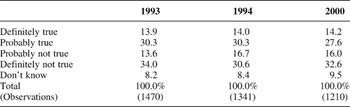
In previous years, a similar item was included in the GSS: “Human beings developed from earlier species of animals.” Instead of the true/false dichotomy employed in 2006, the following response options were read to respondents: “definitely true,” “probably true,” “probably not true,” and “definitely not true.” Table 1 presents percentage distributions for each of the three years that the four-item response set was used. While the pattern of responses is fairly similar to that found in 2006 with the two-item response set, the proportion of “don't know” responses is about only half the 15.6% reported in 2006. A likely explanation for this difference is that individuals who do not have a strong opinion about human evolution are more comfortable choosing a response that is modified by “probably” than a straightforward “true” or “false” declaration. While the difference between those offering one of the true versus one of the false responses is comparable to that found with the 2006 data, the four-item response set suggests that generally those who think evolution is “not true” are more definite in their opinion than are those who think evolution is “true.” A further examination of this pattern, however, is beyond the scope of the present analysis that focuses on the 2006 GSS data.
Percentage distributions: Human beings developed from earlier species of animals

Note: Cell entries are column percents.
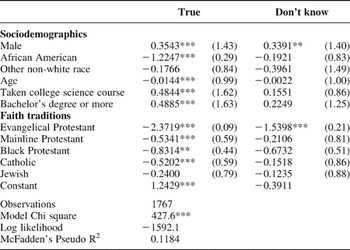
The multinomial logistic regression model reported in Table 2 examines variation in these responses as a function of socio-demographic traits and religious denomination. For this and the other reported models, the response “false” is used as the comparison category. That is, the coefficients represent the effect of a variable on responding “true” or “don't know” as compared to “false.” As is evident from this model, those who think the evolutionary thesis regarding humans is “true” are different from other respondents. The coefficients reported in the first column indicate that relative to those that view the statement about evolution as “false,” “true” respondents are more likely to be male, non-African-American, and younger. Additionally, a four-year college degree and a college science course increase the likelihood of accepting versus rejecting evolution.
Multinomial logit estimates: faith traditions and attitudes toward evolution

Note: Comparison group is “False.” Numbers in parentheses are odds ratios.
* p ≤ 0.10, **p ≤ 0.05, ***p ≤ 0.01.
In comparison with “don't know” respondents, those who respond “true” are more likely to be white, younger, and to have taken a college science course; however, there is no difference between these groups in the likelihood of having completed at least a four-year degree.Footnote 4 However, in terms of demographic characteristics, those who responded “don't know” are virtually indistinguishable from those who regard the statement as “false,” the only difference being that the former are more likely to be male.
It is also apparent from this first model that faith tradition is an important correlate of this attitude. As expected, Evangelical Protestants are less likely than religiously unaffiliated respondents to accept the human evolution thesis. The odds ratio for this coefficient indicates that those who are unaffiliated with a religious denomination are 11 times as likely to respond “true” to this survey item as are Evangelical Protestants. Furthermore, all other Christians (mainline Protestants, Black Protestants, and Catholics) also are less likely than the unaffiliated to accept evolution. Religiously unaffiliated respondents are roughly twice as likely as those of these three Christian denominations to respond “true” rather than “false.”
Even so, Evangelical Protestants stand apart from all other faith traditions in regards to evolutionary attitudes. While the model indicates that Jews are not significantly different from the unaffiliated, an alternative model indicates that Jews are different only from Evangelical Protestants.Footnote 5 In terms of faith tradition, the only difference between “don't know” respondents and others, relates to being an Evangelical Protestant who is less likely to respond “don't know” as compared to “true,” and to those who are more likely to respond “false” than “don't know.”
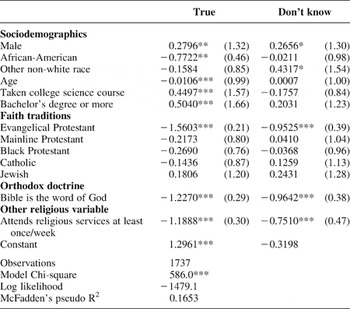
However, the culture wars thesis suggests that it is not faith tradition that matters for attitudes on policy issues so much as one's orientation toward an orthodox or progressive worldview. To examine the relative importance of faith tradition versus orthodox-progressive beliefs, the model reported in Table 3 includes a binary variable that represents a key element of orthodox Christian doctrine: viewing the Bible as the inerrant word of God. These estimates indicate that doctrinal Christian orthodoxy indeed is a more important determinant of attitudes about human evolution than is religious faith tradition, a finding that supports the culture wars thesis.
Multinomial logit estimates: orthodox Christian doctrine and attitudes toward evolution

Note: Comparison group is “False.” Numbers in parentheses are odds ratios.
* p ≤ 0.10, **p ≤ 0.05, ***p ≤ 0.01.
As hypothesized, embracing orthodox Christian doctrine reduces the likelihood that a respondent accepts evolution as opposed to rejecting this thesis. The odds ratio indicates that those who accept the Bible as the word of God, are only about a third as likely as are others to indicate that evolution is “true” as compared to “false.” Furthermore, once orthodox Christian beliefs are controlled for, faith tradition matters much less for distinguishing between those who accept and those who reject evolution. The coefficients for the mainline Protestant, Black Protestant, and Catholic variables are no longer statistically significant. Only the Evangelical Protestant coefficient retains statistical significance but even that is much smaller in magnitude. Last, the level of an individual's religious commitment also influences these attitudes as indicated by the fact that respondents who attend religious services at least once a week are statistically less likely than others to accept evolution. In contrast, beliefs about the Bible are not useful for distinguishing between “true” and “don't know” responses, although being an Evangelical Protestant and frequent church attendance increase the likelihood of responding “don't know” as opposed to “true.”
The key difference between “false” and “don't know” respondents emerges in this model. While there are few demographic differences between these two groups, those who are uncertain about evolution espouse a less orthodox Christian doctrine. Embracing an orthodox Christian doctrine and frequent church attendance more usefully distinguish between “false” and “don't know” respondents, in the expected manner.
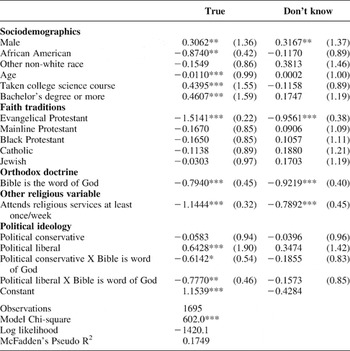
The culture wars thesis goes beyond the importance of the orthodox-progressive divide for shaping public opinion. It also suggests that an isomorphism has occurred between doctrinal Christian orthodoxy and political ideology. But has such a marriage between religious belief and political ideology taken place over the issue of evolution? The model reported in Table 4 provides a test of this aspect of the culture wars thesis by including binary variables representing conservative and liberal political ideologies. Comparing “true” and “false” responses, while a rejection of the evolution thesis for humans is consistent with orthodox Christian doctrine, it appears to be unrelated to a conservative political ideology as is frequently assumed. To the extent that political ideology is related to attitudes toward evolution, it is that political liberals are more likely to accept the veracity of evolution than are political moderates or conservatives. In other models not reported, the conservative political ideology variable emerged as statistically significant only in the absence of the orthodox Christian doctrine variable.
Multinomial logit estimates: political ideology and attitudes toward evolution

Note: Comparison group is “False.” Numbers in parentheses are odds ratios.
* p ≤ 0.10, **p ≤ 0.05, ***p ≤ 0.01.
The interaction terms provide some insight into the relationship between political ideology and religious beliefs for comparing evolutionary believers and disbelievers. These results indicate that a particular category of political conservatives, those who accept the inerrancy of the Bible, are more likely to reject the validity of evolution. But political conservatives who do not accept this face of orthodox Christian doctrine do not differ from political moderates. This suggests that a rejection of evolution is not part of a conservative ideology, but is instead a part of one's orthodox beliefs. It is characteristic of only a subset of political conservatives and is not particularly characteristic of political conservatives in general.
It is also interesting to note that political liberals who accept the Bible as the inerrant word of God are also less likely than others to accept the validity of evolution. While it appears that an acceptance of evolution is consistent with a liberal political ideology, even for these individuals religious Christian orthodoxy has an influence on attitudes. In contrast, comparisons of “don't know” respondents with “true” and “false” respondents separately indicate that none of the political ideology variables are useful correlates for distinguishing those who are uncertain from either the supporters or skeptics of evolution.
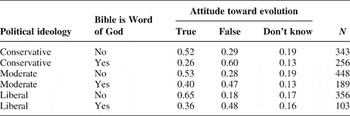
Using this last model, predicted probabilities were generated to illustrate the substantive effect of political ideology and Orthodox doctrine on evolution attitudes (see Table 5). It is clear from these probabilities that believing the Bible is the word of God has a strong impact on responses, regardless of political ideology. Where respondents do not accept the inerrancy of the Bible, the most likely response is to regard human evolution as “true,” although political liberals are more likely to do so than conservatives or moderates. However, for individuals who accept the Bible as the word of God, the most likely response is that human evolution is “false,” regardless of political ideology. For instance, among conservatives accepting the Bible as the word of God increases the probability of responding “false” from 0.29 to 0.60, and the effect is even substantial among liberals as the probability increases from 0.18 to 0.48. Acceptance of doctrinal Christian orthodoxy seems more important in explaining attitudes about human evolution than does political ideology.Footnote 6
Predicted probabilities of attitude toward human evolution by political ideology and belief that the Bible is the word of God

Note: Other independent variables set at the mode/median.
Thus, it is clear that the supporters and skeptics of human evolution differ in several key ways. Demographically those who accept evolution are more likely to be male, non-African-American, younger, more highly educated, and exposed to science in their college studies. In terms of faith tradition they are less likely to be Evangelical Protestants but more importantly are less likely to accept orthodox Christian doctrine. Accepting evolution also is correlated with being a political liberal, but being a political conservative is not correlated with rejecting evolution apart from the influence of religious orthodoxy.
It is also apparent that individuals who are uncertain about the veracity of human evolution are a group that is distinct from both the believers and disbelievers. In comparison to those that accept human evolution, those who are uncertain are older and are less likely to have studied science in college. In comparison to the detractors of human evolution, those who are uncertain are less religiously committed and less likely to embrace orthodox Christian doctrine. Thus, they appear to lack the exposure to either science or religious doctrine that would give them clear guidance about what to think in regards to evolution.
Overall, these findings provide partial support for the culture wars thesis as it pertains to evolution. Attitudes about whether humans today evolved from earlier species of life are more fully explained by doctrinal Christian orthodoxy, not religious tradition, as the culture wars thesis suggests. However, an isomorphism between orthodox Christine doctrine and conservative political ideology has not occurred, at least among the general public. These data suggest that only a certain group of political conservatives, those that accept orthodox Christian doctrine, reject evolution as sound scientific theory.
CONCLUSION
The war metaphor is used to describe the conflict surrounding evolutionary theory; however, it is a war with fewer troops than often imagined. It certainly appears as if rejection of evolutionary theory is a tenet of contemporary political conservatism. The conservative journal National Review, for example, regularly published articles in support of intelligent design on its website (Mooney Reference Mooney2005). However, our analysis shows that ideological conservatism among the American public is not strongly related to beliefs regarding the origins of life. The widespread assumption that political conservatives reject the theory of human evolution through natural selection is a result of the strength of the religious right within the Republican Party. Although religious conservatives do not constitute a majority within the Republican Party and their strength varies from place to place, the support given their policy agenda suggests their influence (Wilcox and Larsen 2006). White evangelicals have been the most predictable supporters of the Republican Party, and 77% of these Americans report that moral values are very important to their vote (Pew Forum on Religion and Public Life 2008b). The low voter turnout generally characterizing primaries means that anyone who can mobilize supporters is likely to win. Mobilization comes from invoking issues with strong appeal (Jelen Reference Jelen2000); opposition to evolution is an issue easily understood so it is a natural rallying cry for campaign support and fund raising.
The culture war in regard to evolution is fought by elites with support from those with orthodox Christian religious beliefs. It is ideological only to the extent that liberals define themselves in terms of support of evolution; conservatives lack cohesion regarding the origins of life. These data are supportive of those who contend that the culture war exists primarily among pundits and political activists (e.g., Fiorina, Adams, and Pope Reference Fiorina, Adams and Pope2006; Wolfe Reference Wolfe, Hunter and Wolfe2006).
A similar conclusion is likely appropriate regarding the so-called war against science. Citizens holding orthodox Christian religious views will likely oppose policies they perceive to be inconsistent with a literal interpretation of the Bible. Observers who point to a faith-based fear of science are likely correct. In particular instances, even if they represent a relatively small number of people, they can exert considerable influence (Layman and Green Reference Layman and Green2005). However, just as political conservatism is not defined by anti-evolution views: it is highly questionable whether political conservatives would unite in opposition to other scientific issues because of opposition from orthodox Christians. The controversy over fetal stem cell research suggests the significant cleavages that exist among conservatives with a scientific issue that has religious opposition but is perceived as producing possible benefits. Politics in America is based on coalitions, at times religious and political conservatives coalesce, and when they do they can be quite powerful; however, there is little evidence to suggest this represents an enduring coalition.