Introduction
The Antarctic is divided into biogeographic zones that correspond to different climatic regions: the sub-Antarctic zone (small groups of islands scattered in the Southern Ocean), the maritime Antarctic (west coast of the Antarctic Peninsula and neighbouring archipelagos), and finally the continental Antarctic (east and south part of the Antarctic Peninsula and the Antarctic continent) (Ochyra Reference Ochyra1998).
The phylum Tardigrada consist currently of ca. 1000 species inhabiting terrestrial and aquatic (freshwater and marine) environments throughout the world (Degma and others Reference Degma, Bertolani and Guidetti2012). Tardigrades are known as one of the most extreme-climate resistant animals in the world, thus it is not surprising that they are also found in the Antarctic. Studies on Antarctic tardigrades were initiated in the beginning of the 20th century and progressed very slowly up to the 1990s and 2000s when more research on the subject was conducted. Currently, nearly fifty tardigrade species have been reported from the Antarctic region, mostly from islands in the maritime Antarctic (Convey and McInnes Reference Convey and McInnes2005).
In this study we report five species from the Antarctic, including one new species that belongs to a southern hemisphere genus Ramajendas Pilato and Binda, Reference Pilato and Binda1990. Ramajendas differs from other genera of the family Isohypsibiidae by having the Ramajendas-type claws (that is with very long and node-like curved primary branches of external claws). So far, the genus has comprised three species. The first species was described by Ramazzotti in 1972 as Hypsibius (Isohypsibius) renaudi from the Kerguelen Islands (sub-Antarctic) and was later transferred to the genus Isohypsibius Thulin, 1928 by Ramazzotti and Maucci (Reference Ramazzotti and Maucci1983). In 1990 Pilato and Binda erected the genus Ramajendas, described a new species R. frigidus from Victoria Land (continental Antarctica) and also transferred Isohypsibius renaudi to the new genus. The last species, until now, R. heatwolei was described by Miller and others in 1995 from Macquarie Island (sub-Antarctic).
Four other species found in this study, Acutuncus antarcticus (Richters, 1904), Echiniscus jenningsi Dastych, Reference Dastych1984, Diphascon (D.) victoriae Pilato and Binda, Reference Pilato and Binda1999, Hypsibius dujardini (Doyère, 1840), have been already reported from the Antarctic region in the past (Convey and McInnes Reference Convey and McInnes2005).
Material and methods
Thirteen mostly soil samples were collected from nine localities on the Antarctic continent and some of the neighbouring islands, during the 14th Ukrainian Antarctic Expedition between the 22 February and the 28 March 2010 by the second author (for more details see below). Samples were collected and examined for tardigrades using standard methods (Dastych Reference Dastych1980). After extractions, animals were mounted on microscope slides in Hoyer's medium. All specimens were examined, measured and photographed using Phase Contrast Microscopy (PCM). In total 788 specimens and 32 eggs were examined.
All measurements are given in micrometers [μm]. Structures were measured only if their orientation was suitable. Body length was measured from the anterior extremity to the end of the body, excluding the hind legs. Buccal tube length and the level of the stylet support insertion point were measured according to Pilato (Reference Pilato1981). Buccal tube width was measured as the external diameter at the level of the stylet support insertion point. Claws were measured according Beasley and others (Reference Beasley, Kaczmarek and Michalczyk2008). The pt ratio is the ratio of the length of a given structure to the length of the buccal tube expressed as a percentage (Pilato Reference Pilato1981). Configuration of cuticular gibbosities is denoted according to Michalczyk and Kaczmarek (Reference Michalczyk and Kaczmarek2010).
Species were identified using keys in Fontoura and Pilato (Reference Fontuora and Pilato2007), Kaczmarek and others (Reference Kaczmarek, Goldyn, Prokop and Michalczyk2011), Ramazzotti and Maucci (Reference Ramazzotti and Maucci1983), and original descriptions (Dastych Reference Dastych1984; Miller and others Reference Miller, Horning and Dastych1995, Reference Miller, McInnes and Bergstrøm2005; Pilato and Binda Reference Pilato and Binda1990, Reference Pilato and Binda1997, Reference Pilato and Binda1999). Tardigrade taxonomy is presented according to Marley and others (Reference Marley, McInnes and Sands2011) and Degma and others (Reference Degma, Bertolani and Guidetti2012).
Raw data underlying the description of Ramajendas dastychi sp. nov. are deposited in the Tardigrada register (Michalczyk and Kaczmarek in press) under http://www.tardigrada.net/register/0007.htm
Sampling localities
1. 65°10ʹ22ʹʹS; 64°05ʹ22ʹʹW, ca. 1 m asl: Antarctic Peninsula, Graham Coast, Kiev Peninsula, sea coast at the foot of south-western slopes of Mount Scott, moist coarse sand, 5 m inland (2 samples, slide codes: Mt Scott, sampling 1 and 2).
2. 65°14ʹ54ʹʹS; 64°04ʹ48ʹʹW, ca. 11 m asl: Antarctic Peninsula, Graham Coast, Kiev Peninsula, northern coast of Waddington Bay, sea coast at the foot of western slopes of Mount Mill, near an old British emergency hut, huge moss field on a rocky hill, as if at the bottom of a temporary stream (1 sample, slide code: VRA02).
3. 65°09ʹ56ʹʹS; 64°08ʹ47ʹʹW, ca. 9 m asl: west of Antarctic Peninsula, Wilhelm Archipelago, northern part of Petermann Island, lichen from rock (1 sample, slide code: 870/1).
4. 65°14ʹ02ʹʹS; 64°09ʹ43ʹʹW, ca. 2 m asl: west of Antarctic Peninsula, Wilhelm Archipelago, Yalour Islands, fine soil from the bed of a dry stream (2 samples, slide codes: V04, sampling 1 and 2).
5. 65°15ʹ04ʹʹS; 64°14ʹ34ʹʹW, ca. 5 m asl: west of Antarctic Peninsula, Wilhelm Archipelago, Argentine Islands, eastern coast of Galindez Island, soil (1 sample, slide code: V12 sampling 1).
6. 65°15ʹ09ʹʹS; 64°15ʹ44ʹʹW, ca. 5 m asl: west of Antarctic Peninsula, Wilhelm Archipelago, Argentine Islands, northern part of Skua Island, wet sand and stones with organic remnants at the glacier foot (2 samples, slide codes: VS03, sampling 1 and 2).
7. 65°14ʹ13ʹʹS; 64°18ʹ18ʹʹW, ca. 5 m asl: west of Antarctic Peninsula, Wilhelm Archipelago, Argentine Islands, North-east Barchans Islands, relatively wet coarse sand among pebbles (2 samples, slide codes: V0201 sampling 1 and V0203).
8. 65°10ʹ45ʹʹS; 64°29ʹ32ʹʹW, ca. 5 m asl: west of Antarctic Peninsula, Wilhelm Archipelago, Roca Islands, Locator Island, very fine soil (1 sample, slide code: MR, Middle Roca sampling 1).
9. 65°11ʹ49ʹʹS; 64°32ʹ19ʹʹW, ca. 5 m asl: west of Antarctic Peninsula, Wilhelm Archipelago, Cruls Islands, fine soil among rocks in an inlet of the island (1 sample, slide code: Crulz sampling 2).
Results
In total we found 788 tardigrade specimens and 32 eggs. Definitely the most abundant species was Acutuncus antarcticus (684 specimens, 87% of all records). Moreover, we found: Echiniscus jenningsi, Diphascon (D.) victoriae, Hypsibius dujardini and Ramajendas dastychi sp. nov. (see below for more details).
In two samples we also found thirteen specimens belonging to the Macrobiotus harmsworthi group, however, given that we have not found their eggs, we were unable to identify them to the species level. In order to avoid potential misinterpretations, we decided not to report here these incomplete identifications.
Taxonomic Account
Phylum: Tardigrada (Spallanzani, 1777); Class: Heterotardigrada Marcus, 1927; Superfamily: Echiniscoidea Richters, 1926; Family: Echiniscidae Thulin, 1928; Genus:Echiniscus C.A.S. Schultze, 1840.
Echiniscus jenningsiDastych, Reference Dastych1984; Number of specimens: 1 individual; Localities: 1
Remarks: Even though we found only a single specimen, we were confident in the identification as it corresponded perfectly to the original description by Dastych (Reference Dastych1984). The species belongs to the bigranulatus group (sensu Michalczyk and Kaczmarek Reference Michalczyk and Kaczmarek2006, Reference Michalczyk and Kaczmarek2007). It is a southern hemisphere species limited to Antarctic Regions. It was previously known only from the Antarctic Peninsula and some of Antarctic Islands (McInnes Reference McInnes1994).
Class: Eutardigrada Richters, 1926; Order: Parachela Schuster, Nelson, Grigarick and Christensen, 1980; Superfamily: Hypsibioidea Pilato, 1969 (in Marley and others Reference Marley, McInnes and Sands2011); Family: Hypsibiidae Pilato, 1969; Subfamily: Diphasconinae Dastych, 1992; Genus:Diphascon (Diphascon) Plate, 1888.
Diphascon (Diphascon) victoriaePilato and Binda, Reference Pilato and Binda1999; Number of specimens: 3 individuals;
Localities: 6.
Remarks: Although we found only three specimens, we were confident in identifying them to D. (D.) victoriae because they corresponded perfectly to the original description by Pilato and Binda (Reference Pilato and Binda1999) and were also successfully identified with the key by Fontoura and Pilato (Reference Fontuora and Pilato2007). The species belongs to the pingue group and has been previously known only from its locus typicus in the Victoria Land (Pilato and Binda Reference Pilato and Binda1999).
Subfamily: Hypsibiinae Pilato, 1969; Genus:Acutuncus Pilato and Binda, Reference Pilato and Binda1997.
Acutuncus antarcticus(Richters, 1904) Number of specimens: 684 individuals and 17 eggs. Localities: 1, 3–4 and 6–9.
Remarks: The most abundant and prevalent species in the studied material. It was present in 10 of 13 examined samples (from 7 of 9 localities). Formally placed in Hypsibius, the species was often misidentified, but work by Dastych (Reference Dastych1991) corrected/amended most of the records and Pilato and Binda (Reference Pilato and Binda1997) reassigned the species to the current genus. A. antarcticus is widely distributed in fellfield and freshwater habitats in the Antarctic, but was also reported from South Shetlands, South Orkneys, South Sandwich Island and South Georgia. All records from the northern hemisphere are probably misidentifications (Dastych Reference Dastych1991).
Genus:Hypsibius Ehrenberg, 1848.
Hypsibius dujardini(Doyère, 1840); Number of specimens: 6 individuals; Localities: 2.
Remarks: Considered cosmopolitan in the past, it is most likely a complex of very similar (possibly also cryptic) species found throughout the world. Because of a poor original description Hypsibius dujardini sensu stricto urgently needs a modern redescription. Nevertheless, the examined specimens correspond perfectly with the original description and the H. dujardini characters proposed by Miller and others (Reference Miller, McInnes and Bergstrøm2005).
Superfamily: Isohypsibioidea Marley, McInnes and Sands, 2011; Family: Isohypsibiidae Marley, McInnes and Sands, 2011; Genus:Ramajendas Pilato and Binda, Reference Pilato and Binda1990.
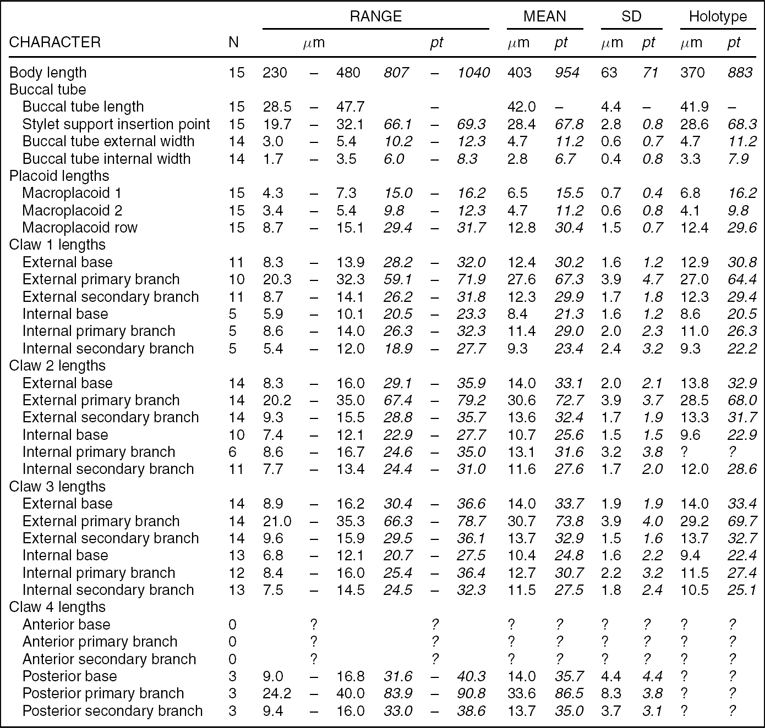
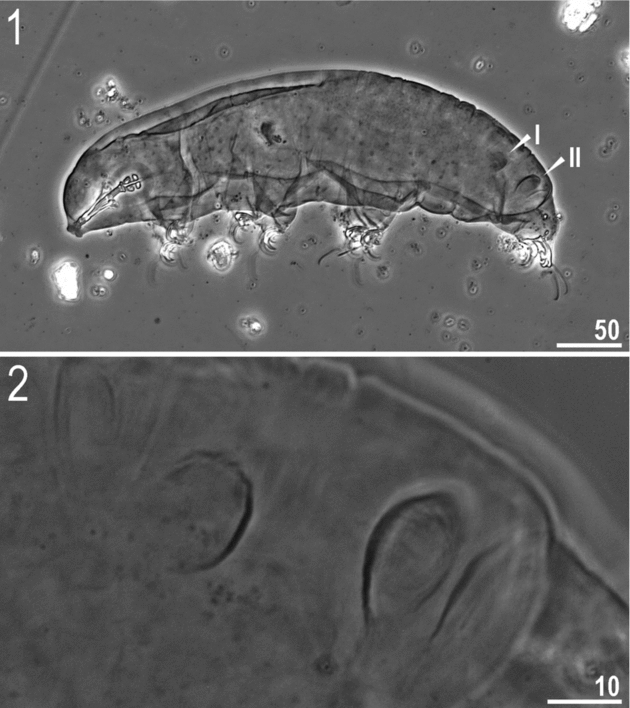
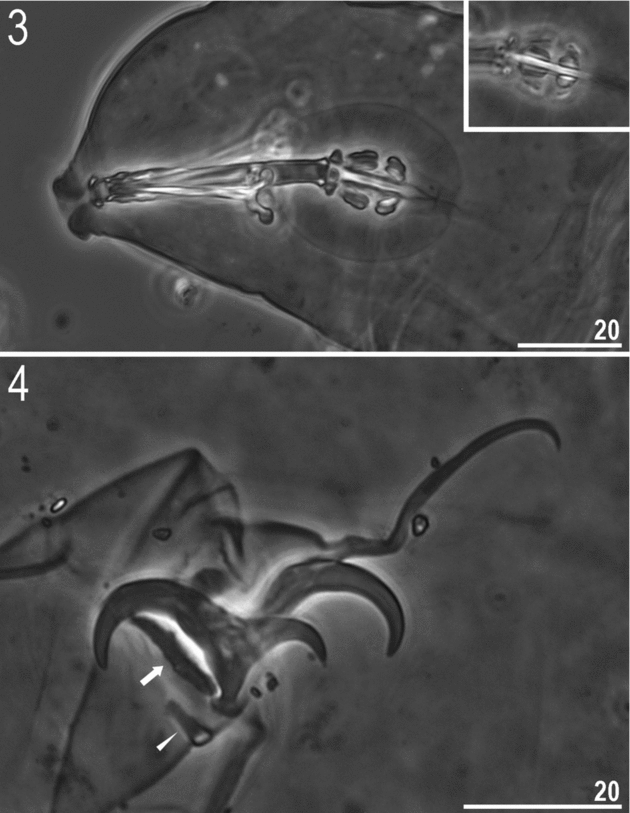
Ramajendas dastychi sp. nov. (Table 1, Fig. 1–4); Localities: 3, 5, 8; Type material: Holotype and 67 paratypes (56 individuals and 11 eggs); Type locality: 65°09΄56΄΄S; 64°08΄47΄΄W, ca. 9 m asl: west of Antarctic Peninsula, Wilhelm Archipelago, northern part of Petermann Island, lichen from rock (1 sample, slide code: 870/1); Additional material: samples 5 (23 specimens and 4 eggs) and 8 (1 specimen).
Measurements [in μm] and pt values of selected morphological structures of Ramajendas dastychi sp. nov. mounted in Hoyer's medium (N – number of specimens/structures measured, RANGE refers to the smallest and the largest structure among all measured specimens; SD – standard deviation, ? – trait oriented unsuitably for measurement).

Ramajendas dastychi sp. nov.: 1 habitus (holotype, lateral view, arrowheads indicate the two rows of gibbosities); 2 caudo-dorsal cuticle with gibbosities (holotype).
Ramajendas dastychi sp. nov.: 3 buccal apparatus (holotype, lateral view, the insert shows placoids in the frontal view); 4 claws III (paratype, arrow indicates the short longitudinal bar and the arrowhead shows a portion of the thin transverse bar).
Description (measurements inTable 1): Body white/colourless (after preparation) (Fig. 1). Eyes present (also after preparation). Cuticle smooth, but with two transverse rows of gibbosities in the caudo-dorsal part of the body (two gibbosities in each row, configuration II:2–2) (Figs. 1–2). In some individuals gibbosities are well defined whereas in others weakly developed and therefore difficult to identify under PCM. Legs without gibbosities.
Mouth antero-ventral. Peribuccal lamellae and papulae absent. Bucco-pharyngeal apparatus of the Isohypsibius type (Fig. 3). Oral cavity armature absent or not visible under PCM. Buccal tube without the ventral lamina and with a single delicate posterior bend (visible in lateral view only). Two rod-shaped macroplacoids in the pharyngeal bulb present. The first macroplacoid (with a central constriction) distinctly longer than the second (with a subtle posterior constriction). Microplacoid and septulum absent (Fig. 3).
Claws of the Ramajendas type with extremely elongated and flexible primary branches of external claws (Fig. 4). Primary branches of claws with thin, but well visible accessory points ending at the highest point of the primary branch. Smooth lunules (Fig. 4) present on all legs, but distinctly larger under external claws. A single long and thin transverse (sometimes sinusoidal in shape) cuticular bar is present under internal and external claws I–III. Additionally, a short thick longitudinal (often with irregular edges) bar is present near internal claws I–III (Fig. 4).
Eggs (3–7) smooth, deposited in exuvium.
Differential diagnosis
Until now only three species were described in the genus Ramajendas. The new species differs from all others by the presence of gibbosities on the dorso-caudal cuticle. Additionally, R. dastychi sp. nov. differs specifically from:
R. frigidus Pilato and Binda, Reference Pilato and Binda1990 by shorter placoids (I: (7.5 [19.6]) and II (5.3 [13.9])) in R. frigidus (specimen 330 long) vs. (I: (6.0 [15.2]) and II (4.0 [10.2]) in the new species (specimen 336 long)), and by a shorter placoid row (13.1 [34.3] in R. frigidus (specimen 330 long) vs. 11.6 [29.4] in the new species (specimen 336 long)).
R. heatwolei Miller and others, Reference Miller, Horning and Dastych1995 by the absence of cuticular sculpturing, stylet supports inserted in a more caudal position (pt ca. 63.6 in R. heatwolei vs. 66.1–69.3 in the new species), and by a slightly larger body size (187–275 in R. heatwolei vs. 230–480 in the new species).
R. renaudi (Ramazzotti, Reference Ramazzotti1972) by slightly shorter buccal tube (42.8 in R. renaudi (specimen 330 long) vs. 39.4 in the new species (specimen 336 long)), shorter placoids (I: (9.8 [22.9]) and II (7.3 [17.0])) in R. renaudi (specimen 330 long) vs. (I: (6.0 [15.2]) and II (4.0 [10.2]) in the new species (specimen 336 long)), and by a shorter placoid row (18.2 [42.4] in R. renaudi (specimen 330 long) vs. 11.6 [29.4] in the new species (specimen 336 long)).
We dedicate this species to a distinguished Polish tardigradologist, Dr. Hieronymus Dastych.
Type depositories: Holotype and 80 paratypes are deposited in the Department of Animal Taxonomy and Ecology at the Adam Mickiewicz University (Poznań, Poland).
Discussion
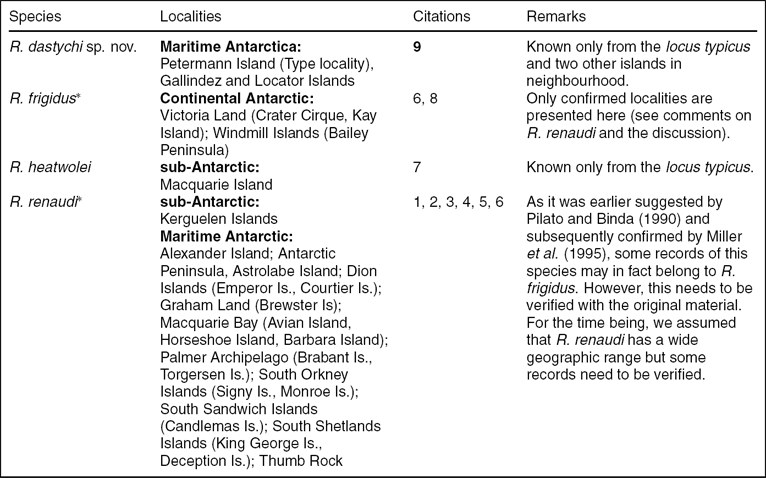
Distribution of the genus Ramajendas is limited to the Antarctic, maritime Antarctic and sub-Antarctic regions. Ecologically, Ramajendas has been most often reported from interstitial habitats near or on the beach. The nominal species, Ramajendas renaudi, appears to have a relatively wide distribution, for example it is known from the Kerguelen Islands (locus typicus), many islands in the maritime Antarctic and also from the Antarctic Peninsula. R. frigidus has been reported only from Victoria Land and the Windmill Islands (Convey and McInnes Reference Convey and McInnes2005). Finally, R. heatwolei is known from its type locality (Macquarie Island) and R. dastychi sp. nov., from its type locality (Petermann Island) and immediate environs (Locator and Gallindez Islands) (see also Table 2 and the comments below).
Distribution of the species from genus Ramajendas based on current literature (1 – Ramazzotti (Reference Ramazzotti1972); 2 – Jennings (Reference Jennings1976a); 3 – Jennings (Reference Jennings1976b); 4 – Dastych (1994); 5 – Usher and Dastych (1987); 6 – Pilato and Binda (Reference Pilato and Binda1990); 7 – Miller and others (Reference Miller, Horning and Dastych1995); 8 – Miller and others (1996); 9 – present study; * – see remarks and discussion).
The relatively wide geographic range of R. renaudi is potentially an artefact caused by the unique claw morphology of this species. Unique and obvious traits are probably a primary cause of underestimation of species numbers which in turn result in overestimation of species ranges. This is so, because when such traits are present, researchers seem not to pay sufficient attention to other morphological and morphometric details and variation. As a consequence, multiple taxa are likely to be attributed to a single species. This phenomenon has been described in other tardigrade taxa such as Milnesium, Paramacrobiotus or the Macrobiotus hufelandi and harmsworthi groups (for example Michalczyk and others Reference Michalczyk, Wełnicz, Frohme and Kaczmarek2012a, Reference Michalczyk, Wełnicz, Frohme and Kaczmarek2012b). Thus, it would not be surprising if older records of specimens with Ramajendas-type claws were classified as R. renaudi without further insights into potential differences in morphometry. As it was shown by Pilato and Binda (Reference Pilato and Binda1990), some species of the genus Ramajendas have a very similar morphology but are clearly different in terms of morphometry. Pilato and Binda (Reference Pilato and Binda1990) additionally suggested that some specimens reported by Dastych (Reference Dastych1984) as Hypsibius renaudi, and by Jennings (Reference Jennings1976a, Reference Jennings1967b) as Hypsibius (Isohypsibius) renaudi, may in fact belong to R. frigidus. Another possibility is that these maritime Antarctic R. frigidus/R. renaudi individuals represent a number of as yet undescribed species that could be differentiated only by morphometric characters. Thus, based on the limited available data and the above mentioned concerns, we should conclude that the exact geographic ranges of R. frigidus and R. renaudi cannot be currently described beyond the type locales, although they may indeed be wider.
Acknowledgements
We are grateful to Nataliia Iakovenko (Ukrainian Academy of Sciences) for extracting tardigrades from the samples and to Sandra McInnes (British Antarctic Survey) for her valuable comments that improved our manuscript. The research was supported by a grant from the Polish National Science Centre (no. N N304 014939; ‘Environmental factors determining biodiversity of soil-dwelling Tardigrada of Victoria Land (Continental Antarctic)’).