A systematic review showed that one of two hospital admissions may be arising from adverse drug events (ADEs) (Reference Leendertse, Visser, Egberts and van den Bemt1). A same prevalence of occurrence of adverse drug reactions (ADRs) can be observed during the length of hospital stay of inpatients (Reference Dequiro, Mol and van Doormaal2); however, only 6 percent of them are reported (Reference Hazell and Shaki3). This proportion is far below than that one recommended by the World Health Organization, which targets the number of 250 reports per million of inhabitants (Reference Ribeiro-Vaz, Herdeiro, Polónia and Figueiras4). Therefore, underreporting decreases the sensitivity of the passive method of vigilance, hindering and delaying the assessment of risk/benefit of the drugs available on the pharmaceutical market.
Despite of this limitation, the spontaneous reporting systems provide high volume of information at a low cost and their most important function is the early detection of a signal (hypothesis regarding a causal relationship between the use of a drug and the development of ADR). The voluntary reports of ADE are done, mainly, by health professionals, especially physicians (Reference Meyboom, Egberts, Gribnau and Hekster5), pharmacists (Reference Conforti, Opri and D'Incau6), and nurses (Reference Gedde-Dahl, Harg and Stenberg-Nilsen7). When the minimum and desirable fields for ADE are filled in the yellow card (or another specific document, because the safety drugs polices vary from country to country), this information helps to prevent and/or decrease the occurrence of ADR, medication errors and ineffective treatment, as well as to contribute to the quality of the drugs (8). Therefore, it is necessary to develop strategies that contribute to the promotion of pharmacovigilance by multidisciplinary teams in healthcare institutions.
General educational interventions (EI) have been demonstrated as an effective method applied to change the health professionals’ behavior/attitude (Reference Forsetlund, Bjorndal and Rashidian9), because the main reasons of underreporting (ignorance, diffidence, lethargy, indifference, and complacency) (Reference López-Gonzalez, Herdeiro and Figueiras10) are demonstrated, the appropriate concepts and practices of pharmacovigilance are explained and the correct fill of forms are elucidated. Therefore, EI contribute to decrease the lack of knowledge among the reporters and to increase the awareness regarding the importance of this service in health institutions. Consequently, there is an improvement in the adherence of nurses, pharmacists and physicians in the service, resulting in the increment of the problems reporting related to safety, quality, and effectiveness of health technologies (Reference Molokhia, Tanna and Bell11).
In this context, the present study aimed to identify the techniques of educational interventions used to promote pharmacovigilance in healthcare institutions by health professionals and to assess their impact on ADE reports.
METHODS
A systematic review was performed in PUBMED, PAHO, LILACS, and EMBASE computerized databases, between November of 2011 and January of 2012, updated in March/2013, to identify original studies that assessed the impact of educational interventions to encourage spontaneous reporting of ADE by health professionals.
The strategy of search was carried out according to PRISMA Statement(Reference Moher, Liberati, Tetzlaff and Altman12). The following health descriptors were used for data collection: “education, continuing” OR “education, medical” OR “intervention” OR “health knowledge, attitudes, practice” AND “adverse drug reaction reporting systems” OR “adverse drug reaction reported spontaneously” AND “pharmacovigilance”. A manual search was also performed in the references of selected articles to look for relevant studies that might not be identified by the health descriptors used (STEP 1).
A first screening of all articles identified was carried out, with a view to exclude review manuscripts, editorials, letters, news, abstracts of conference proceedings, data from thesis/dissertations, and original studies published in journals indexed in the databases consulted which were not written in English, Portuguese, or Spanish languages (STEP 2).
The selected articles were reviewed and those which did not perform educational interventions for health professionals to promote spontaneous reports of ADE in healthcare institutions and did not assess their impact were excluded from the present study. Included manuscripts were independently reviewed by two authors (C.P., F.R.V.) (STEP 3). Quality assessment of the manuscripts was not carried out. Disparities were resolved by discussion.
The extraction of the following variables of interest was performed: (i) design of the study; (ii) target group; (iii) workplace (level of health care where the educational interventions were carried out, corresponding to: primary [family physicians, pharmacies and drugstores]; secondary [outpatient clinics]; and tertiary [hospitals]); (iv) duration of the educational interventions; (v) techniques developed and applied; (vi) the impact on ADE reporting; and (vii) country where the study was performed.
The impact on ADE reporting was assessed in terms of the quantitative and qualitative parameters that were compared before and after the educational interventions. The quantitative impact was identified as the increase in the absolute numbers, percentages or rates of ADE reports after the educational intervention. The qualitative impact was observed as the increase in the absolute numbers, percentages or rates of reports of ADR classified as serious, unexpected, with a high degree of causality and related to new drugs on the market after the educational interventions.
RESULTS
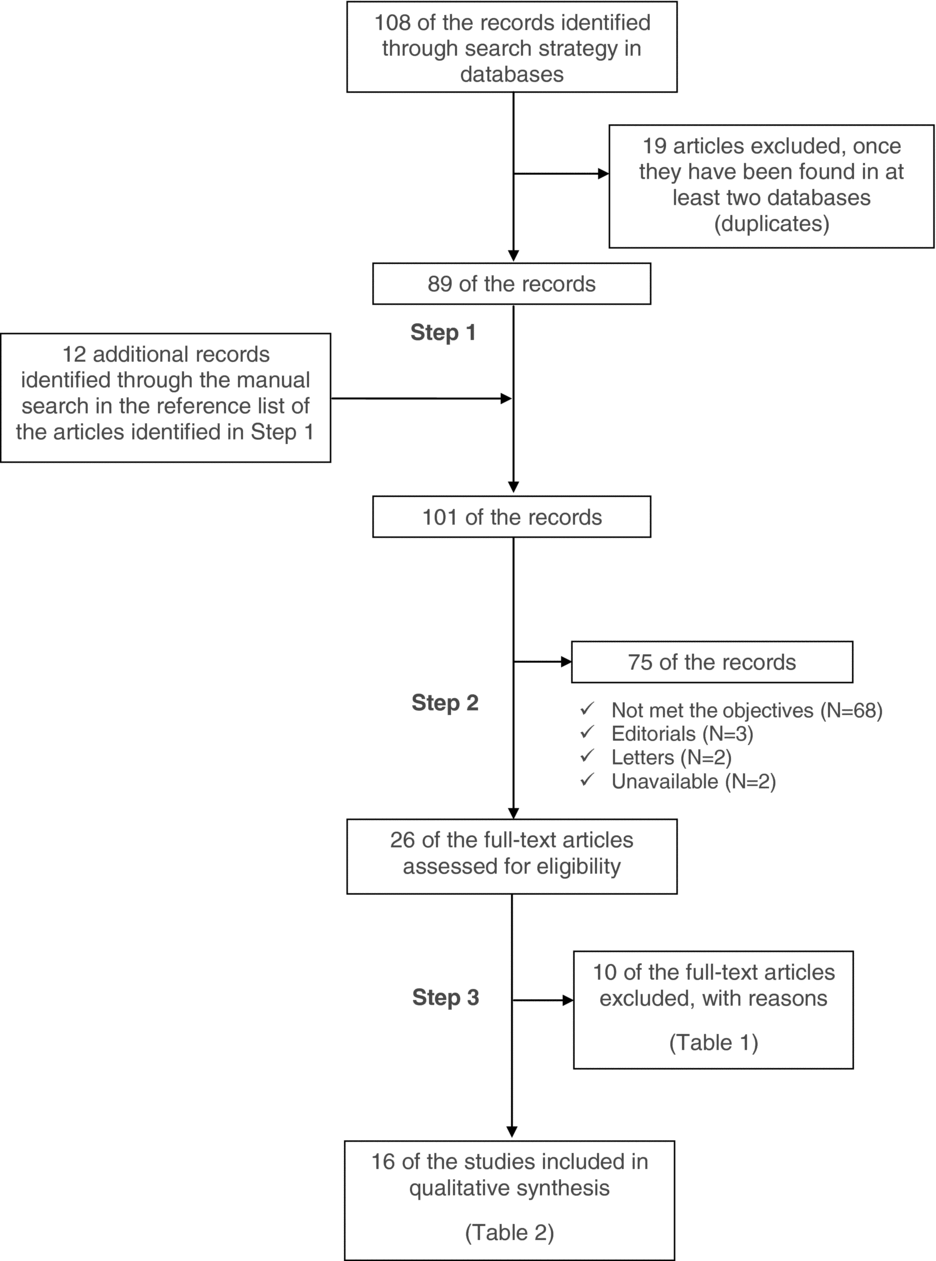
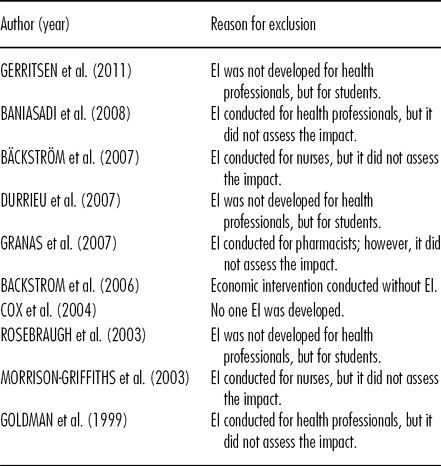
Using the search strategy in computerized databases and manual search (STEP 1), a total of 101 articles was identified (Figure 1). After the initial screening, twenty-six were selected to be reviewed (STEP 2). Of these, sixteen met the inclusion criteria (Reference Ribeiro-Vaz, Herdeiro, Polónia and Figueiras4,Reference Herdeiro, Ribeiro-Vaz and Ferreira13–Reference Johansson, Brunlöf, Edward and Wallerstedt27) (STEP 3); and ten were excluded (Reference Gerritsen, Faddegon, Dijkers, van Grootheest and van Puijenbroek28–Reference Goldman37) (Table 1).
Flowchart of article selection process for systematic review on ADR reporting, adapted to The PRISMA Statement.

Articles Excluded after Content Analysis and the Reason for Exclusion
Note. EI, educational intervention.
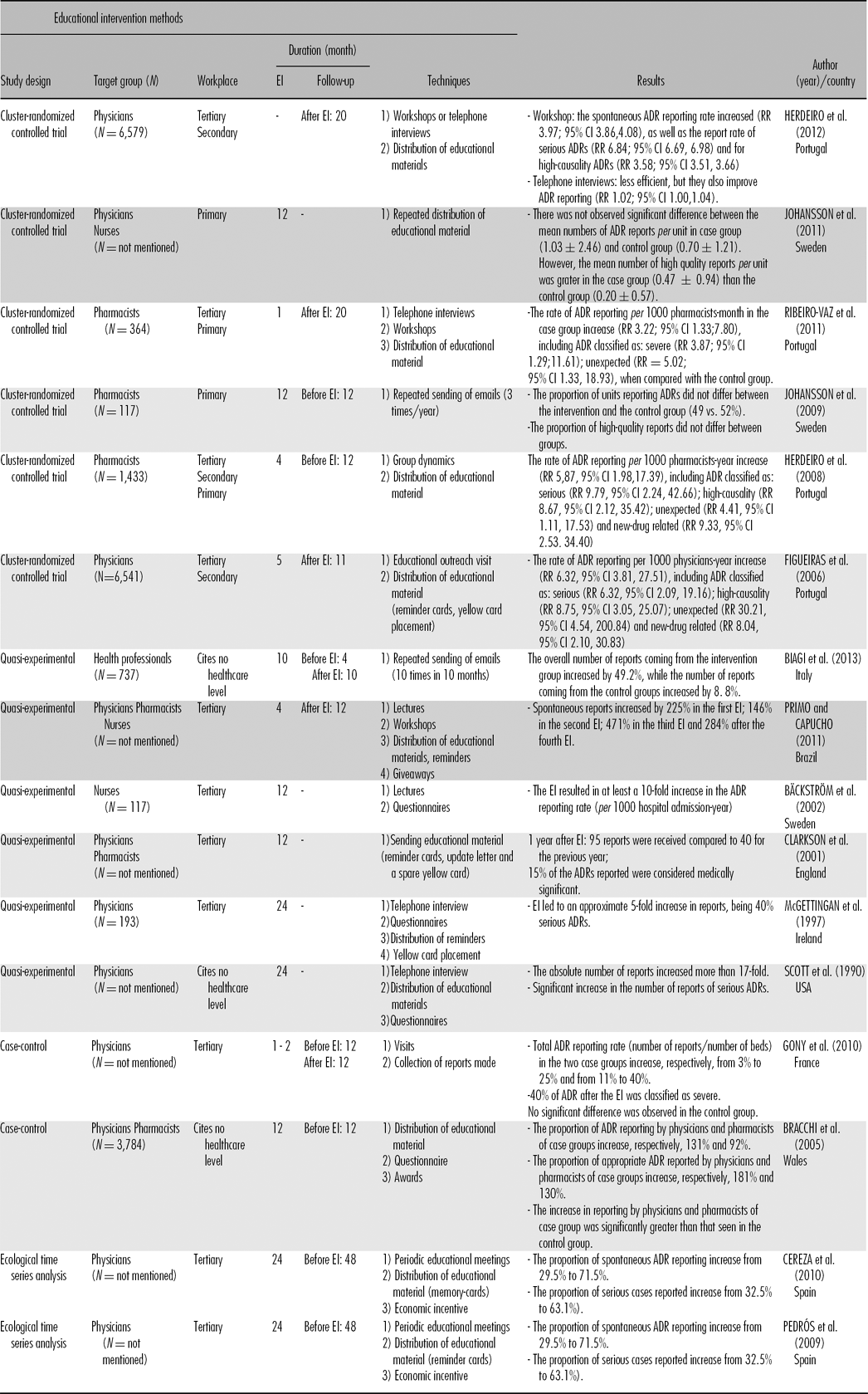
The designs of the eligible studies were longitudinal (six randomized controlled trials, five quasi-experimental, two case-control studies, two ecological time series analysis, one observational analytic), with duration ranging between 1 month and 2 years. A breakdown by geographical region showed that fourteen studies were conducted in Europe. In general, the physician was the main professional involved in the educational interventions (N = 12) and tertiary health care was the preferred level to carry out the interventions (N = 11). The educational interventions techniques frequently developed in the studies were: distribution of educational material or repeated sending of emails (N = 14); presentations - lectures, workshops, group dynamics, periodic meetings and outreach visits (N = 10) and interviews or questionnaires (N = 8) (Table 2).
Description of the Countries, Level of Healthcare, Methods, and Educational Interventionsʼ Impact of the Studies Published in the Databases PUBMED, PAHO, LILACS, and EMBASE, from November of 2011 to January of 2012, Updated in March of 2013
Note. EI, educational intervention; ADR, adverse drug reaction; RR, relative risk; CI, confidence interval.
Regarding the impact of educational interventions, most studies (N = 12)(4,Reference Herdeiro, Ribeiro-Vaz and Ferreira13–Reference Scott, Thacher-Renshaw and Rosenbaum23) showed an increase in the absolute numbers, percentages or rates of the spontaneous reports of ADR (including those considered serious, unexpected, with a high degree of causality and related to new drugs) and technical defects of health technologies. Two studies assessed only quantitative impacts (24,25); one showed only qualitative impacts (Reference Johansson, Hägg and Wallerstedt26); and the other one did not show significant differences in the indicators evaluated (Reference Johansson, Brunlöf, Edward and Wallerstedt27) (Table 2).
DISCUSSION
Pharmacovigilance-based educational interventions showed positive impacts (quantitative and qualitative) on ADE spontaneous reporting by health professionals in twelve studies analyzed, which adopted multifaceted techniques for interventions, including: lectures, placement of yellow cards, distribution of printed educational materials and giveaways, as well as the organization of workshops. The strategies adopted contributed to the adherence of health professionals to pharmacovigilance activities, changing the behavior/attitude of the employees toward the reporting of suspicions of problems related to safety and quality of health technologies. These findings corroborate the data of a systematic review performed by Forsetlund et al. (Reference Forsetlund, Bjorndal and Rashidian9), whose authors noted that general interventions (not related to ADR reporting/vigilance) developed for health professionals which apply multifaceted techniques are more effective in changing their behavior/attitude than single strategies.
Two studies applied only one technique in the educational intervention – repeated sending of emails (Reference Biagi, Montanaro and Buccellato24,Reference Johansson, Brunlöf, Edward and Wallerstedt27). However, just one showed a quantitative impact on ADR reporting (Reference Biagi, Montanaro and Buccellato24). The difference may be explained due to the major frequency of EI technique carried out by the Italian group (they sent an email with a brief newsletter on drug safety, once a month, for 10 months) (Reference Biagi, Montanaro and Buccellato24) when compared with the work performed by the Swedish group (they sent an email, three times in a year, with information regarding the importance of ADR report) (Reference Johansson, Brunlöf, Edward and Wallerstedt27). This finding suggests the importance of continuing education for health professionals to improve ADR reports.
The assessment of educational interventions’ impact by the absolute numbers of ADE reports has an important limitation, because this indicator does not take several factors into account that may increase or decrease these numbers. Therefore, the safety indicators may be overestimated. For example, the rise in the absolute number of spontaneous reports of ADE may be related to the inauguration of new wards or to the recruitment of new employees in the health institutions. Therefore, the improvement in the number of ADE reports might not be associated, necessarily, with the educational interventions.
Most interventions (N = 11) were conducted at the tertiary healthcare level. This is a good strategy in countries where the health professionals work in different levels of healthcare services (primary/secondary and tertiary), because the knowledge and attitudes acquired in educational interventions at the hospital can cover a larger geographic area, improving the surveillance of different drugs. However, the conduction of EI is necessary in all healthcare levels (drugstores, pharmacies, offices, ambulatories, and hospitals), with the purpose of stimulating the passive vigilance, the detection of ADE and to contributing for the assessment of drug safety and the regulation of pharmaceutical market.
Physicians were frequently included in the educational interventions identified (N = 12). In Europe, these professionals contribute with the most of the ADR reports received by Pharmacovigilance Centers (Reference Zolezzi and Parsotam38); indeed, some international programs of drug monitoring, for example the Swedish program, do not allow ADR reporting by pharmacists and nurses (Reference Grootheest, Olsson, Couper and de Jong-van den Berg39). The reason for this approach may be the belief that doctors, because they are the professionals responsible for the diagnosis, perform ADR reports of better quality (8).
All studies were conducted in countries that are members of the official World Health Organization (WHO) Program for International Drug Monitoring, which demonstrate the concern of these nations to raise the compliance of the health professionals to the pharmacovigilance service and to achieve the target number of ADR reports recommended by WHO. Therefore, the rates of underreporting would be minimized, allowing accurate evaluation of the safety, quality and effectiveness of available health technologies on the pharmaceutical market.
Regarding the duration of educational interventions, it was noted that those of longer duration aimed to cover larger numbers of employees of the institutions to increase the health professionals’ adherence and participation in the study, and to contribute to safety drug analysis. Besides, the periods established for the monitoring of ADE spontaneous reporting were useful to demonstrate the need for continuing education, because the numbers and rates of reports tended to be equal to those in the period before intervention, that is to say, a few months after the application of the educational intervention techniques. Therefore, Ribeiro-Vaz et al. (Reference Ribeiro-Vaz, Herdeiro, Polónia and Figueiras4) recommend the periodic updating of professionals, to keep them aware about the importance of reporting the suspicion of ADE.
Limitations of the Study
Data may be underestimated, owing to selection bias, because just four databases were consulted and only articles written in Spanish, English and Portuguese were analyzed. Consequently, some other pharmacovigilance educational interventions carried out to improve ADE reporting may not have been identified by the methodology adopted in this study. Furthermore, the quality assessment of the eligible manuscripts was not carried out. Therefore, the reliability of the findings demonstrated in the systematic review should be evaluated with caution.
CONCLUSION
Educational interventions for the promotion of pharmacovigilance by health professionals should: (i) be directed at a multidisciplinary health team and include issues related to ADR, technical defects of health technologies, medication errors and ineffective therapy; (ii) use multifaceted techniques with: lectures, group dynamics (to practice correct filling of yellow card), distribution of educational material and certificates; (iii) continue for the length of time needed to reach most professionals in the health institution (this variable depends on the size of the establishment staff); (iv) be conducted at all levels of health care to reach different patients and drugs, making it possible to assess the attributes of safety, quality and effectiveness of most drugs available in the public health sector, and (v) be offered periodically, with the view to update the health professionals in the pharmacovigilance service.
CONTACT INFORMATION
Caroline Pagotto Pharmacy student of the School of Pharmaceutical Sciences of the Universidade Estadual Paulista Júlio de Mesquita Filho – UNESP
Fabiana Varallo, MD, PhD student of the School of Pharmaceutical Sciences of the Universidade Estadual Paulista Júlio de Mesquita Filho – UNESP
Patrícia Mastroianni, PhD, (pmastro@fcfar.unesp.br) Assistant Doctor Professor of the School of Pharmaceutical Sciences of the Universidade Estadual Paulista Júlio de Mesquita Filho – UNESP
CONFLICTS OF INTEREST
All authors report they have no potential conflicts of interest.