Intracranial stents are designed to keep stenotic cerebral vessels open after angioplasty, thereby preventing recurrent ischemia. In Europe, the Wingspan stent system was granted CE marking in 2009. Placing medical devices on the European market is subject to European law (1). In contrast to drug approval, there is no obligation for manufacturers of medical high-risk devices in Europe to submit reliable clinical studies on their efficacy before market entry. The intended use of medical devices is defined by the manufacturer itself and is part of the “CE” labeling process. In contrast to the United States, authorities in Europe cannot apply restrictions to the intended use of a new medical device.
In the United States, the Food and Drug Administration (FDA) approved the Wingspan stent in 2005 on the basis of a small case series involving forty-five patients under the Humanitarian Device Exemption (HDE) program (2). Medicare and Medicaid refused to cover the costs of this procedure because of a lack of evidence on its efficacy from reliable clinical trials, leading to the initiation of the randomized SAMMPRIS trial. In April 2011, enrolment into SAMMPRIS was stopped due to a 2.5 higher 30-day stroke and death rate in the percutaneous transluminal angioplasty and stenting (PTAS) compared with the control group taking intensive medication only and published in November 2011(Reference Chimowitz, Lynn and Derdeyn3). In January 2014, the final results of the study with a median follow-up of 32.4 months were published showing persistence of the peri-procedural disadvantage of PTAS (Reference Derdeyn, Chimowitz and Lynn4).
The VISSIT study (an international randomized controlled trial conducted using the balloon-expandable Pharos Vitesse stent in patients with symptomatic intracranial arterial stenosis) was stopped after only 112 patients of the planned sample size of 250 had enrolled, following an unplanned interim analysis that was performed because of the negative results of the SAMMPRIS trial (Reference Zaidat, Castonguay and Fitzsimmons5). The VISSIT study also showed that the use of a balloon-expandable stent resulted in an increased 12-month risk of added stroke or transient ischemic attack (TIA) in the affected vascular territory, and an increased 30-day risk of any stroke or TIA compared with patients who had only been given medication. Subgroup analyses were not performed because of the relatively small number of cases (Reference Zaidat, Fitzsimmons and Woodward6).
A rapid report on stents for the treatment of intracranial artery stenosis provided by the German Institute for Quality and Efficiency in Health Care (IQWiG) on September 10, 2014 concluded that, when comparing PTAS with medical therapy to medical therapy alone, there was evidence of greater harm in the PTAS group regarding the stroke endpoint. This harm was attributable, in particular, to the significant increase in peri-procedural strokes. Concerning other patient-relevant endpoints, however, no evidence of benefit or harm could be established for PTAS in combination with medical therapy against medical therapy alone (7).
In the United States, the publication of SAMMPRIS resulted in a significant reduction in the indications for use of intracranial stents. Approved intracranial stents are now only applicable for patients who have had two or more strokes despite aggressive medical management, whose most recent stroke occurred more than 7 days before the planned stent implantation, who have made good recovery from previous stroke and who have more than 70 percent stenosis in the affected brain vessel (8). In Europe, there has been no such change in the intended use of PTAS as a consequence of the SAMMPRIS study.
Since its first publication in September 2011, the results of the SAMMPRIS study have been the subject of intense debate (9;Reference Farooq, Al-Ali, Min and Gorelick10). The review by Farooq et al. (Reference Farooq, Al-Ali, Min and Gorelick10) concluded that over time, more effective and safer endovascular procedures may be developed and further trials would be needed to determine if these procedures with advanced technology lower the risk of stroke compared with aggressive medical therapy in high-risk subgroups.
In Germany, there is an ongoing debate about whether limiting the use of intracranial stents to a narrow, selected group of patients, which was imposed by the FDA after publication of the SAMMPRIS study (8) on August 8, 2012, is necessary. The German Society of Neuroradiology (DGNR), the German Stroke Society (DSG), and the German Society of Neurology (DGN) criticized SAMMPRIS in a joint press release of January 19, 2012, for the fact that the U.S. researchers implanted stents in patients who, due to an intracranial artery stenosis, had suffered stroke symptoms for the first time. This broader patient population would differ from the treatment criteria as applied in Germany, where only patients with recurrent strokes or transient ischemic attacks under dual antiplatelet therapy should be considered for PTAS (11).
In Germany, available registries provide data for only a subgroup of hospitals and no actual published data is available. For example, the INTRASTENT registry covers eighteen hospitals in Europe (Reference Kurre, Berkefeld and Brassel12), while health insurance claims data from AOK covers 195 German hospitals which performed intracranial stenting in 2013. The AOK provides statutory health insurance to 24 Million people or almost 30 percent of the German population
To evaluate the frequency and indication for intracranial stenting in patients with intracranial artery stenosis before and after the emergence of high-level evidence by the initial publication of the SAMMPRIS results in 2011, we analyzed health insurance claims data from AOK. Since the peri-procedural risk was lower at high-enrolment sites in a stenting registry funded by the National Institute of Health, and because neurologists recommend intracranial stenting in experienced centers only (13), we also analyzed the number of PTAS procedures for intracranial artery stenosis per hospital in a 3-year period (2010–13) as an approximation to hospital volume per year.
METHODS
The evaluation was performed by the Research Institute of the AOK (WIdO), using anonymized nationwide administrative claims data for inpatient episodes and medication.
Patients who had undergone intracranial stenting were identified by OPS (Operationen- und Prozedurenschlüssel / operations and procedures) codes 8–840, 8–841, 8–843, and 8–844 with 0 as the 5th digit in the German Procedure Classification (14) in the year concerned. To limit the analysis to patients with intracranial stenting due to intracranial stenosis, all patients with selective embolization using metal coils (OPS 8–836.m), cerebral aneurysms, arteriovenous fistulas and idiopathic intracranial hypertension (ICD-10-GM I67.0, I67.1, I72.0, I72.5, Q28.0–Q28.3, and G92.2) were excluded. Identified cases were analyzed in depth, to see whether other indications could have been the indication for stenting. The patients identified were analyzed by whether the hospital had coded them for a stroke (ICD-10-GM I63.*, I64.*) or for cerebral transient ischemia (ICD-10-GM G45).
An additional evaluation on the incidence of recurrent stroke during a 5-year period before PTAS was limited to the 90 percent subgroup of patients insured by the AOK for an uninterrupted period of 5 years before stent implantation.
For this group of patients, an analysis was carried out to assess how many patients with intracranial stenting met the criteria of two or more cerebral ischemic events in a 5-year period despite aggressive medical management. Aggressive medical management was defined as a prescription for at least one platelet aggregation inhibitor (ATC B01AC) or, due to other medical indications, vitamin K antagonists (ATC B01AA), thrombin- or factor-Xa inhibitors (ATC B01AE, B01AF) in the quarter year preceding hospitalization and in the quarter year of hospitalization before the day of admission. Dual antiplatelet therapy could not reliably be identified in the claims data, as acetylsalicylic acid is sometimes sold over the counter (OTC) without a prescription. For that reason, we regarded the criteria for dual antiplatelet therapy fulfilled when there was at least one antiplatelet drug in the billing data.
To estimate whether only higher volume centers performed intracranial stenting, AOK-cases per hospital were assessed over a 3-year period as an approximation to hospital volume per year.
RESULTS
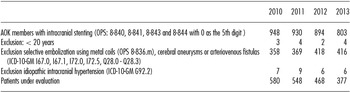
Intracranial stent implantation due to intracranial artery stenosis was performed in 1,973 AOK patients from 2010 to 2013 (2010: 580, 2011: 548, 2012: 468, 2013: 377) (Table 1). No extrapolation for the German population as a whole was carried out; the percentage of AOK patients in the German population was approximately 30 percent in the period under consideration.
AOK Members with Intracranial Stenting Due to Intracranial Stenosis

AOK, Allgemeine Ortskrankenkasse, German statutory health insurance, covering about 30 percent of the German population (approximately 24 million insurants); OPS, Operationen- und Prozedurenschlüssel / German Procedure Classification); ICD-GM, International Statistical Classification of Diseases and Related Health Problems, 10th revision, German Modification.
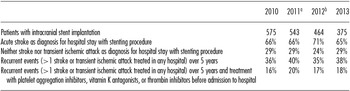
In two-thirds of patients (2010: 66 percent, 2011: 66 percent, 2012: 71 percent, 2013: 65 percent), an acute ischemic stroke was coded during hospitalization for PTAS. By contrast, neither stroke nor a TIA was coded for nearly one third of the patients (2010, 29 percent; 2011, 29 percent; 2012, 24 percent; 2013, 29 percent).
Patient observation was possible for a period of 5 years before stent implantation for 1,752 AOK patients (90 percent of our cohort). Including the 5 years preceding intracranial stent implantation, 36 percent were seen to have had more than one stay in hospital with a coded ischemic stroke or TIA (2010) (2011, 40 percent; 2012, 35 percent; 2013, 38 percent). Only 17 percent (2010, 16 percent; 2011, 20 percent; 2012, 17 percent; 2013, 18 percent) fulfilled the expected criteria for prescription of platelet aggregation inhibitors or anticoagulants for other medical indications, respectively, and there were at least two admissions to hospital for an ischemic cerebrovascular event (Table 2). In 60 percent of the patients, stent implantation was carried out on the day of admission or the day after; and in a total of 85 percent of patients within their first 7 days in hospital.
Indications for Intracranial Arterial Stent Implantation in AOK Members with Intracranial Stenosis

AOK, Allgemeine Ortskrankenkasse, German statutory health insurance, covering about 30 percent of the German population.
a November 2011: Publication of SAMMPRIS.
b January 2012, Recommendation of German specialist medical societies, to treat strokes primary by medication; March 2012, limitation of the use of intracranial stents in USA; June 2012, VISSIT trial stopped.
During the observation period, intracranial stenting was performed in 195 hospitals in Germany. In sixty-one hospitals, only one AOK patient per hospital had intracranial stenting due to intracranial artery stenosis during a 3-year period (2010–Reference Kurre, Berkefeld and Brassel12); in twenty-six hospitals, this figure was two AOK patients, and in twelve hospitals, three AOK patients, respectively. So in ninety-nine hospitals, three or less patients were treated in the 3-year period. A total of 339 patients were treated in 141 hospitals performing this procedure on less than ten AOK patients in 2010 to 2012; 344 in twenty-four hospitals with 10 to 19 procedures; 194 in fourteen hospitals with 20 to 29 procedures; 372 in seven hospitals with 30 to 39 procedures; and 333 in nine hospitals with 40 to 240 procedures.
DISCUSSION
Our results show that, intracranial stenting in intracranial artery stenosis decreased by 35 percent from 2010, one year before the publication of SAMMPRIS, to 2013 (2 years after its publication). The continuing broad use of this intervention is questioned. The number of cases with recurrent strokes or TIAs under aggressive medical therapy, reflecting a high indication quality for the procedure, remain dissatisfying and unchanged during the observation period. During the 3-year evaluation period of this study, the ratio of patients which had a stroke or TIA when admitted to hospital for stent implantation remained around 70 percent. Only one of three patients had a recurrent cerebrovascular event and one of five patients met the criteria outlined in the recommendation by the medical societies mentioned above; that is, recurrent stroke or TIA despite aggressive medical management.
The percentage of hospitals (51 percent, 99/195) performing this high-risk procedure on less than four patients with intracranial stenosis per year (extrapolated) is concerning.
In contrast to the United States, there was no restriction in Germany for the use of intracranial stents after publication of the dramatic results of SAMMPRIS, thus making it possible to analyze how fast this high-level evidence influenced what happens in practice.
The results suggest that, in Germany, intracranial stents are implanted in cases of recurrent stroke under optimal medical treatment in only approximately one-fifth of patients. This remained largely unchanged after the results of the SAMMPRIS trial were published. The reason why this transfer of knowledge has been slow cannot be found in claims data. Neuroradiological and Neurological Societies recommended in January 2012 that only patients with recurrent strokes or transient ischemic attacks undergoing dual antiplatelet therapy should be considered for PTAS (11). Our results do not show that these recommendations have fully been actioned.
The results from the period before publication of SAMMPRIS are supported by data published by a German intracranial stenting registry (INTRASTENT) in 2010 showing that patients with a stenosis of less than 70 percent and showing a TIA as the index event were treated and included in the study without a preceding event, and obviously without a time limit between stroke and stent implantation (Reference Kurre, Berkefeld and Brassel12). Furthermore, Vajda et al. (Reference Vajda, Miloslavski and Guthe15) reported in 2010 a case series of ninety-five consecutive patients from one German medical center who had a stenosis of greater than 50 percent and stenosis-related symptoms, and were treated with a drug-eluting stent. A lack of response to medical therapy was not a mandatory criterion for inclusion in that study.
To the best of our knowledge, this is the first study describing changes in treatment practices for intracranial stenting after the publication of SAMMPRIS. For the United States, we identified one study on trends in this procedure between 2005 and 2010 (Reference Tanweer, Wilson, El Helou, Becske and Riina16) but no reports on more recent developments. This is surprising, as there has been intense discussion of the SAMMPRIS results in the United States, and a survey on PTAS in ICAS among U.S. neuro-interventionalists and neurologists found a marked decline in preference for this intervention in the post-SAMMPRIS period (Reference Turan, Cotsonis and Lynn17).
Our research can be seen as a contribution to the field of translational research. Morris et al. aimed to review the literature describing and quantifying time lags in the health research translation process. Because of the broad variation found in the literature, they conclude that it is not possible to calculate an average. Estimating the time lag between evidence being published and its impact on practice is difficult, as studies use different measures at different points in time. Each phase of translational research is associated with a set of research activities which contribute to lags, that is, processes surrounding grant awards, ethical approvals, publication, phase I, II, III trials, approvals for drugs, postmarketing testing, guideline preparation and so forth (Reference Morris, Wooding and Grant18).
One comparable example could be the time lag between the evidence that platinum can reduce the mortality in advanced testicular cancer and the time to reach this low mortality rate. This time lag was more than 20 years in Germany (Reference Hölzel and Altwein19). In the translational process from research to practice, this study on intracranial stenting provides an opportunity to estimate the time lag between study results and practical application, with changes in practices measured on a population basis using claims data, after the publication of high-level evidence emerged discouraging the procedure. Taking into account the fact that the intervention is applied in critically ill patients and a negative benefit harm ratio had been shown, a quicker uptake of the evidence might have been expected.
The large dataset used in this study of inpatient intracerebral stenting is a major strength of this study. As the largest provider of statutory health insurance in Germany, the AOK provides nationwide healthcare insurance for approximately 30 percent of the German population (20) and anyone who is resident in Germany is allowed to enroll in the AOK regardless of factors such as age, comorbidity, income, or type of employment. Data are derived from billing data for drugs and inpatient hospital treatment. Billing data are not the highest level of evidence but are the best evidence on the number and indication of intracranial stenting in German hospitals. Inpatient and medication data have a relatively high quality, because they are used to settle the reimbursement of medical services. Healthcare providers and healthcare insurers jointly issue binding guidelines for coding diagnoses and procedures in hospital claims (21).
Because intracranial stents constitute a relevant price factor in the hospital invoice, the quality of the coding of the procedure as well as the underlying diagnosis is checked carefully by providers and payers. Another advantage is the broad hospital coverage, including both major centers and smaller local hospitals. Finally, barring termination of AOK membership, subjects can be traced continuously after discharge, which eliminates problems related to sample attrition and provides complete follow-up information irrespective of whether patients were treated by the same or a different hospital. One limitation was that outpatient diagnoses were not included in the analysis. No statement can be made about recurrent strokes that possibly occurred while patients were still in the hospital. As 60 percent of procedures were performed on day 0 or 1 of the patient's stay in hospital, and 85 percent within the first 7 days, in-hospital recurrent strokes could only explain a part of the deviation from the criteria formulated by the FDA and the medical societies mentioned above.
CONCLUSION
In contrast to the United States, there was no regulatory narrowing of the application of intracranial stenting in Germany after SAMMPRIS was published. Analyzing the claims data provided little evidence of changed indications for stenting in cases of intracranial atherosclerotic disease which might have been expected following the emergence of high-level evidence regarding its restricted use.
CONFLICTS OF INTEREST
The authors have nothing to disclose.