Context
As the population ages, health care systems are striving to establish quality residential and long-term care services for seniors experiencing decreasing autonomy. In Quebec, residential and long-term care centers (CHSLDs) – known as nursing homes in the United States – must maintain high-quality services in a context characterized by serious difficulties recruiting and retaining staff and a gradual worsening of clients’ conditions in terms of physical and cognitive autonomy (MSSS, 2003). Cognitive impairment often entails problem behaviors. For example, the prevalence of psychological and behavioral symptoms related to dementia among CHSLD residents is between 55 and 85 per cent (Beck et al., Reference Beck, Vogelpohl, Rasin, Uriri, O’Sullivan and Walls2002). Moreover, dementia is often accompanied by aggressive behaviors, either physical or verbal. According to a study carried out in Quebec, more than one out of five residents exhibit disruptive aggressive physical or verbal behaviors, and approximately one out of ten residents exhibit both forms of aggressive behavior (Voyer et al., Reference Voyer, Verreault, Azizah, Desrosiers, Champoux and Bédard2005). These behaviors affect not only the quality of life of the residents, but also that of their families, friends, and formal caregivers (Pitkala, Laurila, Strandberg, & Tilvis, Reference Pitkala, Laurila, Strandberg and Tilvis2004). Indeed, caregivers struggle with major physical and mental health problems. Because of the nature and context of the caregiving occupation, workers are confronted not only with stress, work overload, and a lack of time, resources, flexibility, and equipment, but also with the precariousness of life, the aggressive behaviors of residents and their families or co-workers, and their own limitations (Shields & Wilkins, Reference Shields and Wilkins2006).
To meet the needs of aging persons living with dementia, health care professionals have developed new approaches to care, including the “person-centered care approach” (PCCA). This approach, which is based on a humanistic concept, suggests that, rather than focusing only on the disease of dementia, caregivers regard the whole life experience and capacities of persons living with dementia (Kitwood, Reference Kitwood2008). From the perspective of long-term care, this concept entails a set of practices aimed at helping the person with dementia enter into a relationship (with formal and informal caregivers, and with other residents) – what we call “Being in a relationship” – and to be seen as having a life history and his/her own interests (what we call “Being in a social world”). The person-centered care approach also implies a favorable context, particularly in terms of the organization of the nursing staff’s work (“Being in place”), and a desire to respect the values and preferences of persons when providing care (“Being with self”) (McCormack, Reference McCormack2004). This approach has been widely studied in the extensive literature on long-term care (Edvardsson & Innes, Reference Edvardsson and Innes2010; McCormack, Reference McCormack2004). This approach can be an alternative or a complement to pharmacological treatments aimed at reducing the disruptive behaviors of persons with dementia (Cohen-Mansfield & Mintzer, Reference Cohen-Mansfield and Mintzer2005; Kong, Evans, & Guevara, Reference Kong, Evans and Guevara2009; Sloane et al., Reference Sloane, Hoeffer, Mitchell, Mckenzie, Barrick and Rader2004).
The implementation of care models consistent with this approach implies a major change in culture in the long-term care setting (Miller et al., Reference Miller, Miller, Jung, Sterns, Clark and Mor2010; White-Chu, Graves, Godfrey, Bonner, & Sloane, Reference White-Chu, Graves, Godfrey, Bonner and Sloane2009), and caregiver training is an essential facilitating factor for this change. The research presented here focuses on one model of person-centered practice called “relationship-based care” (RBC). The aim of this study, conducted one month following the RBC training, was to analyze trained formal caregivers’ assessment of the usefulness of this approach and to analyze their capacity to transfer skills acquired during training to their care practices, as well as to identify facilitating and impeding factors in this regard.
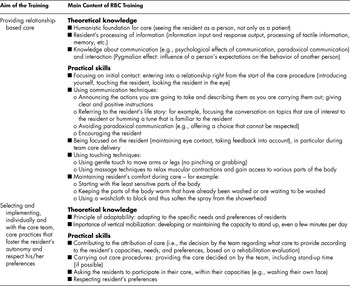
The Association pour la santé et la sécurité du secteur des affaires sociales (ASSTSAS, association for health and safety in the social affairs sector)Footnote 1 has developed and widely disseminated RBC in Quebec since 2002, supporting long-term care institutions through training. Between 2005 and 2008, 35 long-term care institutions in Quebec implemented RBC in more than 73 facilities. The goal of RBC is to improve the quality of care provided to residents while contributing to greater job satisfaction and improving the occupational health and safety of caregivers, particularly by reducing the disruptive behaviors exhibited by residents. To this end, RBC training aims to teach caregivers theoretical knowledge and practical skills that are consistent with the four components of person-centered approaches. Specifically, as Table 1shows, RBC content revolves around two main goals: (a) providing relationship-based care (initial contact, maintaining contact with the resident, and adapting to his/her feedback, using communication and touching techniques), and (b) selecting and implementing, individually and with the care team, care practices which foster the resident’s autonomy and which respect his/her preferences.
Elements of relationship-based care (RBC) training

RBC differs from other practice models based on the person-centered approach in two respects. First, RBC puts forward a technique that helps to relax muscle contractions, thus facilitating access to certain parts of the body for washing when that task is required. This technique involves massaging the antagonistic muscle and then massaging the tendons of the contracted muscle, until the contraction is relaxed. The second respect in which RBC differs is that RBC is characterized by the great importance it attaches to vertical mobilization. Thus, it requires developing and maintaining the capacity of all residents, depending on their limitations, to stand up (or at the very least to sit up), even just for a few minutes a day, until the end of their lives.
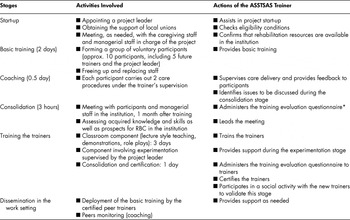
The ASSTSAS developed an entire RBC implementation process, which Table 2summarizes. The process consists of a first phase focused on training a dozen or so caregivers (mostly patient care attendants and nurses’ assistants), and ideally would include the person in the institution who is responsible for implementing the approach (this person becomes the project leader). A later phase involves training the trainers. The latter are recruited among the first caregivers who receive the basic training and who then become peer trainers in their work setting. Subsequently, the ASSTSAS trainers provide follow-up for the trainers, on an as-needed basis. This training is provided mostly to patient care attendants and, in a smaller proportion, to other staff categories: nurses, nurses’ assistants, occupational therapists, physiotherapists, and recreation technicians.
RBC implementation process

* This questionnaire is the data source of this study
The basic training takes place over two days. Various teaching and learning strategies are used, including interactive presentations, experience sharing, videos, and demonstrations involving residents in care units. These activities allow the trainees to learn the theoretical foundations of RBC and to develop the practical skills required by this approach (see Table 2). This training is followed by a second stage involving a half-day of coaching, during which each participant carries out two care procedures under the supervision of the trainer, who provides the trainee with personalized feedback. The last stage in the RBC training process is the consolidation stage (one half-day) in which all trained participants and their immediate supervisor are brought together to review the entire approach and discuss the issues involved in RBC implementation, four weeks after the training.
Current Knowledge
Studies conducted in the long-term care sector indicate that the knowledge acquired in a training situation does not always lead to the transposition of acquired skills to the work situation (Aylward, Stolee, Keat, & Johncox, Reference Aylward, Stolee, Keat and Johncox2003; Beck, Ortigara, Mercer, & Shue, Reference Beck, Ortigara, Mercer and Shue1999; Bourgeois, Dijkstra, Burgio, & Allen, Reference Bourgeois, Dijkstra, Burgio and Allen2004; Chao, Reference Chao2005). From this perspective, current knowledge on the transfer to a work setting of skills developed in training among caregivers working in long-term care provides a number of possible avenues for investigation. According to numerous authors, to effectively change care practices in long-term care facilities, it is necessary to act on the skills of individuals and to ensure that the work situations facilitate the transfer of skills acquired in training. Moreover, these authors also point out the need to plan for measures to reinforce and maintain these skills over time.
Acting on Skills and Individual Predispositions through Training
For a sustainable transformation of practices in long-term care, Aylward et al. (Reference Aylward, Stolee, Keat and Johncox2003) suggested that training programs should aim not only at developing the skills of individuals (through knowledge and skills acquisition) but also at changing individuals’ beliefs. According to these authors, this transformation appears to be fostered by the use of experiential active-learning strategies: role playing, simulations, group discussions, videos followed by a debate, case studies conducted in teams, and so on. These learning activities aim at both (a) the acquisition of concrete care strategies and (b) the development of a reflective position on one’s care practices. Numerous studies indicate that such mechanisms generate learning processes that are richer and more easily transferable to practice situations (Beck et al., Reference Beck, Ortigara, Mercer and Shue1999; Braun, Cheang, & Shigeta, Reference Braun, Cheang and Shigeta2004; Kemeny, Boettcher, DeShon, & Stevens, Reference Kemeny, Boettcher, DeShon and Stevens2006). Other conditions that are conducive to the success of training include, for example, reliance on prior analysis of the training needs expressed by the learners as well as on their individual characteristics (different learning styles, cultural sensitivities, and initial educational level) (Aylward et al., Reference Aylward, Stolee, Keat and Johncox2003; Beck et al., Reference Beck, Ortigara, Mercer and Shue1999). According to Beck et al. (Reference Beck, Ortigara, Mercer and Shue1999), adequate training of the trainer also constitutes an important condition for success.
Conceiving a Work Situation that Facilitates the Transfer of Acquired Skills
The successful implementation of person-centered care approaches cannot be limited to the acquisition of skills by caregivers. It also requires adapting the entire context of care (care practices, work organization, and physical environment) to the needs and preferences of both residents and caregivers, such as through flexibility in organizing meals, personal hygiene care, and rest (Cohen-Mansfield & Parpura-Gill, Reference Cohen-Mansfield and Parpura-Gill2007; Kemeny et al., Reference Kemeny, Boettcher, DeShon and Stevens2006). This flexibility also implies flexibility in work organization (e.g., work hours and time constraints). This adaptation should be based on a joint concern for continuity and quality of care, and for consideration of caregivers’ needs (Cohen-Mansfield & Bester, Reference Cohen-Mansfield and Bester2006). Lastly, it is also necessary to adapt the physical environment (Glouberman, Richards, El Bestawi, Seidman-Carlson, & Teperman, Reference Glouberman, Richards, El Bestawi, Seidman-Carlson and Teperman2007; Hoeffer et al., Reference Hoeffer, Talerico, Rasin, Mitchell, Stewart and McKenzie2006). Living environment adaptations may involve the equipment used (e.g., use of shower stretchers or terry towels for bathing patients), normalizing decoration (for example by hiding medical devices and using domestic decoration items to create an environment as «home-like» as possible) or physical conditions (comfortable heat, subdued lighting, and so on). These changes may involve reviewing the architectural design of the building, such as the arrangement of rooms and units, and connections between the different areas (Cohen-Mansfield & Parpura-Gill, Reference Cohen-Mansfield and Parpura-Gill2007). Moreover, for a sustainable transformation of care practices, PCCA implementation projects should involve favorable working conditions, including a reduction in time constraints and a work organization that is conducive to teamwork (Aylward et al., Reference Aylward, Stolee, Keat and Johncox2003; Burgio et al., Reference Burgio, Stevens, Burgio, Roth, Paul and Gerstle2002; Cohen-Mansfield et al., Reference Cohen-Mansfield, Creedon, Malone, Parpura-Gill, Dakheel-Ali and Heasly2006; Emilsson, Reference Emilsson2006). Organizational conditions must also be addressed, including the quality of supervision carried out by the immediate supervisors, the commitment of senior management, and the integration of this approach into the organization’s mission (Buelow, Winburn, & Hutcherson, Reference Buelow, Winburn and Hutcherson1998; Emilsson, Reference Emilsson2006; Kaskie, Reference Kaskie2004; Shaller, Reference Shaller2007; Stolee et al., Reference Stolee, Esbaugh, Aylward, Cathers, Harvey and Hillier2005).
Planning for Measures to Reinforce and Maintain Practices over Time
There appears to be a consensus that specific training, even when based on experiential learning mechanisms, is not enough to achieve meaningful and lasting results in terms of learning and transfer to practice (Aylward et al., Reference Aylward, Stolee, Keat and Johncox2003). Consequently, several studies have shown that mechanisms for follow-up, supervision, or reinforcement must be put in place (Bourgeois et al., Reference Bourgeois, Dijkstra, Burgio and Allen2004; Burgio et al., Reference Burgio, Stevens, Burgio, Roth, Paul and Gerstle2002; Hoeffer et al., Reference Hoeffer, Talerico, Rasin, Mitchell, Stewart and McKenzie2006; Stolee et al., Reference Stolee, Esbaugh, Aylward, Cathers, Harvey and Hillier2005). These mechanisms can take various forms: (a) continuous evaluation; (b) regular communication of progress to employees, residents, and their families and friends; (c) granting sufficient financial resources to maintain practices; and (d) exchanging knowledge with other services or agencies (Shaller, Reference Shaller2007; Stolee et al., Reference Stolee, Esbaugh, Aylward, Cathers, Harvey and Hillier2005). This follow-up can also involve discussions of cases at work team meetings (Buelow et al., Reference Buelow, Winburn and Hutcherson1998) or can be based on observations of care procedures (Bourgeois et al., Reference Bourgeois, Dijkstra, Burgio and Allen2004; Burgio et al., Reference Burgio, Stevens, Burgio, Roth, Paul and Gerstle2002; Hoeffer et al., Reference Hoeffer, Talerico, Rasin, Mitchell, Stewart and McKenzie2006).
Research Objectives
The general objective of this study was to document, shortly after training, the trainees’ perceptions regarding the usefulness of RBC and the trainees’ capacity to transfer the skills acquired in training to their actual care practices. More specifically, this study aimed to contribute in an exploratory way to the two following specific objectives:
(1) Identifying the dimensions of RBC deemed by the caregivers to be the most helpful and the easiest to integrate into their work and describing the caregivers’ justifications for this, and
(2) identifying the dimensions of RBC deemed by the caregivers to be the most difficult to integrate into their work and describing the caregivers’ justifications for this.
Methodology
Study Population
The population under study consisted of all workers – 420 people – who participated in the training provided by an ASSTSAS trainer between 2004 and 2008.
Study Variable, Study Design, and Data Source
The variable studied was the trainees’ perception of their capacity to integrate RBC into their care practices, rather than its actual integration. The perception of individuals on a given subject is considered here as a construct related to their personal experience, potentially having multiple dimensions. This phenomenon was thus addressed according to a constructivist epistemology (Berger & Luckmann, Reference Berger and Luckmann1966). In developing the RBC training, the ASSTSAS trainers devised their own in-house training evaluation questionnaire with the aim of continuously improving their practices. The study design we used is a descriptive study based on a survey designed for administrative evaluation purposes by the ASSTSAS. This study therefore presents a secondary analysis of data. The survey method used was a pencil-and-paper questionnaire with open-ended questions (Roulston, Reference Roulston and Given2008). We conducted a content analysis of the participants’ responses (Krippendorff, Reference Krippendorff2003). Our rationale for the design selection follows: (1) the questionnaire was already developed and used by the ASSTSAS trainers, which allowed us to gather a large amount of data covering a five years’ period; and (2) in questionnaires, open-ended questions are relevant to generate data about a participant’s point of view, without influencing the responses or suggesting answers. Those questions allow participants to highlight the topics that are meaningful to them. Also, with those questions, the respondent must perform a cognitive task in order to answer; open questions also encourage more participation in the survey than closed questions only (Ballou, Reference Ballou and Lavrakas2008).
The questionnaire was completed anonymously by all the trainees when they met during the consolidation stage, one month after the training. The open-ended questions, whose answers were analyzed as part of this study, are presented in Table 3. The data provided by the ASSTSAS were already grouped together for each training session as opposed to individual data. The numbers shown in parentheses in the tables of results (see Tables 4 through 7) thus refer to the groups rather than to individual participants. For example, G22 means the unit of meaning comes from data from the 22ndgroup.
Number of coded units of meaning attributed to each question of the questionnaire (tables of results 4 to 7)

Participants in the Study
Of all workers who participated in the training provided by an ASSTSAS trainer between 2004 and 2008, 392 participants (94%) completed the questionnaire. Since the questionnaire did not contain socio-demographic data, it was impossible to further specify the profile of participants. Nevertheless, a previous study [33] Poulin et al. (Reference Poulin, Bleau and Gineste2004) focusing on the same training demonstrated that 75 per cent of participants in the training were patient care attendants or nurses’ assistants. The other respondents were nurses (16%) or other health professionals (9%) such as physical rehabilitation therapists or psychologists. The ASSTSAS mentor-trainers were of the opinion that the profile of the respondents of all questionnaires was similar to that of the previous study. The respondents all belonged to one of 41 training groups made up of participants from 43 public and private long-term care facilities. These institutions were distributed among 14 regions of Quebec. Three of these regions – National Capital (03), Mauricie (04), and Montréal (06) – accounted for 51 per cent of participants. On average, the training groups included 9.8 participants, and 75 per cent of the groups included between 9 and 12 participants.
Data Analysis
The answers to the open-ended questions were subject to a systematic content (Krippendorff, Reference Krippendorff2003). Each open-ended question’s answers were considered as a coding unit: that is, they were described (categorized) as separate units. For each open-ended question’s answers, units were created with categorical distinction (i.e., because they had something in common). Those units could be a full respondent’s answer, a single sentence, or a series of words. A total of 2,733 units of meaning were identified and then categorized. Some categories were created by referring to RBC aims and content as described in the participants’ manual (ASSTSAS, 2007). Some other categories emerged from the participants’ point of view, according to the grounded-theory perspective (Strauss & Corbin, Reference Strauss and Corbin1990). The categories of meaning were first determined based on four questionnaires selected at random. These categories were subsequently tested with other questionnaires and then enriched and refined based on the companion training documents developed by the ASSTSAS and through discussions with one of the training developers. The coding was subject to interjudge agreement within the research team (two persons). Table 3presents the number of coded units for each of the questions analyzed and shows how those units were grouped together in the results tables.
The results obtained in this way were then interpreted and discussed in light of the existing literature on the person-centered care approach. We also presented the results to a group of about 30 caregivers – in the context of a knowledge transfer event that was organized by the ASSTSAS (Viau-Guay & Feillou, Reference Viau-Guay and Feillou2011) – as well as to the ASSTSAS trainers. This validation process enabled us to ensure that the results met constructivist paradigm scientific criteria, that is, trustworthiness and credibility for the community (caregivers and trainers) as well as transferability to other long-term setting contexts (Denzin & Lincoln, Reference Denzin, Lincoln, Denzin and Lincoln2011).
Findings
The findings are presented here according to each of our two aforementioned objectives.
Objective 1: Identifying the dimensions of RBC deemed by the caregivers to be the most helpful and the easiest to integrate into their work and describing the caregivers’ justifications for this.
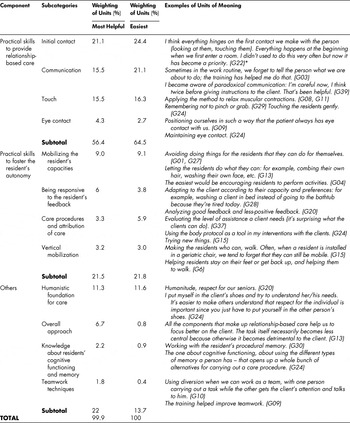
As Table 4shows, the practical skills used to provide relationship-based care (initial contact, communication skills, touching techniques, and eye contact strategies) emerged from the respondents’ discourse as being the RBC training components that were the most helpful and the easiest to integrate into their work (between 56.4 and 64.5% of the coded units of meaning). The practical skills related to developing residents’ autonomy were also mentioned by the caregivers but in a smaller proportion (approximately 20% of coded units). Finally, between 13.7 and 22 per cent of coded units referred to other RBC components, such as general principles (for example, a humanistic view of the residents), overall approach, knowledge about resident’s cognitive functioning, and teamwork techniques.
Categorization, weighting of units of meaning, and examples of units about the components of the RBC training deemed to be most helpful and the easiest to integrate into the work setting

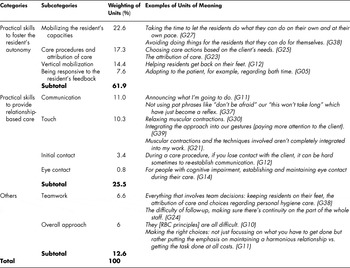
* Since data were pooled and cannot be linked to individual participants, units of meaning sources indicate the example’source referring to the group (e.g., G24 meaning the example comes from the group 24 data).
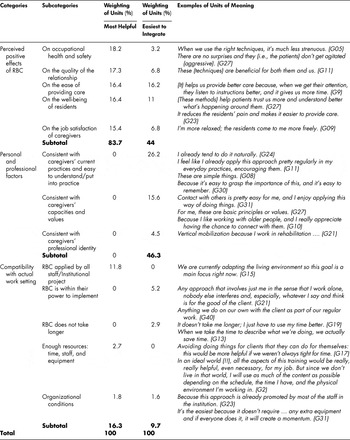
As Table 5shows, the great majority (83.7%) of the coded units – linked to the caregivers’ justifications regarding the RBC training components they considered to be the most helpful – referred to the positive effects of RBC that the caregivers experienced post-implementation. These effects were for the resident (in terms of well-being and quality of the relationship) as well as for the caregivers themselves (in terms of occupational health and safety, job satisfaction, and ease of providing care). The caregivers’ positive perception of the effects of the approach also emerged from the analysis of justifications related to the RBC training components that were deemed to be the easiest to integrate into the work setting (44% of coded units). The effects mentioned by the caregivers were related to the resident’s well-being but also strongly to the caregivers themselves (ease of providing care, job satisfaction, and occupational health and safety).
Categorization, weighting of units of meaning, and examples of justifications regarding the components of the RBC training deemed to be the most helpful and the easiest to integrate into work setting

When questioned why some RBC training components were deemed to be easy to integrate into their work, many caregivers cited personal and professional factors (46.3% of units). More specifically, the caregivers’ discourse indicated that RBC was consistent with their current practices and easy to understand or to put into practice (26.2%). Some units also referred to the fact that RBC was consistent with the caregivers’ capacities, values, and professional identity. Finally, a smaller number of coded units (from 9.7 to 16.3%) referred to RBC’s compatibility with the actual work setting. Subcategories referred to (a) RBC’s being applied by all staff or being an institutional project, (b) RBC’s not taking longer or being within the respondent’s power to implement, (c) having enough resources (time, staff, and equipment), and (d) relying on organizational conditions favorable to RBC implementation (e.g., having time to exchange information about residents between shift changes).
Objective 2: Identifying the dimensions of RBC deemed by the caregivers to be the most difficult to integrate into their work and their justifications for this.
As highlighted in Table 6, the practical skills aimed at fostering the resident’s autonomy and the means used to achieve this objective, such as vertical mobilization and the attribution of care (i.e., the decision by the team regarding what care to provide according to the residents’ capacities and needs, based on a rehabilitation evaluation), emerged as being the component of RBC training considered by the caregivers to be the most difficult to integrate into their work (61.9% of units). Other components related to the practical skills involved in providing relationship-based care were also mentioned, such as communication (11% of units) and touch techniques (especially techniques for relaxing muscular contractions). Finally, some caregivers also described other components of RBC training, such as the recommended teamwork, and the overall approach as being difficult to integrate into their work.
Categorization, weighting of units of meaning, and examples about the components of the training deemed to be the most difficult to integrate into the work setting

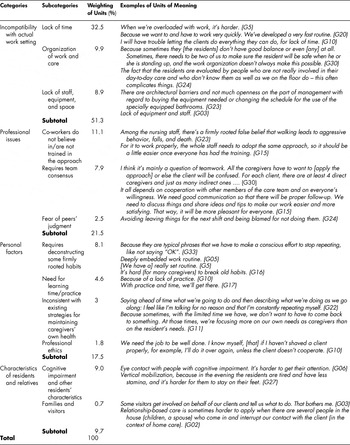
The analysis of the caregivers’ justifications concerning this question (see Table 7) shows that, for many of them, the incompatibility of RBC with the actual work setting constituted a major impeding factor for integrating RBC into their practices (51.3% of coded units). More specifically, approximately one third of the coded units (32.5%) referred to the perceived lack of time to apply the approach adequately. Professional issues were also cited (21.5% of units): (a) co-workers who had not been trained in the approach or who did not believe in it, (b) the need for team consensus to implement RBC, and (c) the fear of peers’ judgment.
Categorization, weighting of units of meaning, and examples of justifications regarding the components of the RBC training deemed to be the most difficult to integrate into the work setting

Another important category of the caregivers’ justifications concerning the dimensions of RBC deemed to be the most difficult to integrate into their work was related to personal factors (17.5% of units). The caregivers mentioned that the approach required deconstructing some habits, in particular with regard to communication (e.g., not offering false choices such as asking “Do you want to take a bath?” if it is going to happen anyway, or describing their actions as they were carrying them out). Other respondents mentioned that RBC could be inconsistent with strategies (not repeating the same things over and over again; focusing on their own needs) for maintaining their own health or with their conception of a job well done (as they saw it, fostering the residents’ autonomy could result, in some cases, in less hygienic care). Finally, some coded units (9.7%) referred to the characteristics of residents (such as cognitive impairment or fatigue) or to the presence of families or visitors who, as perceived by some caregivers, could make RBC more difficult to apply in their day-to-day care practice.
Interpretation and Discussion
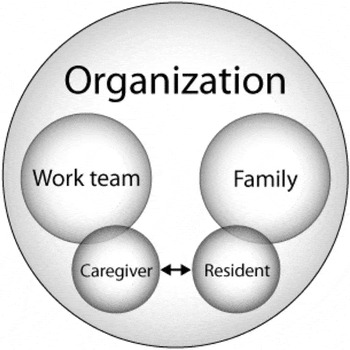
The findings reveal that, one month following the end of the training, the caregivers perceived RBC to be generally helpful, overall, and that they intended to continue integrating this approach into their care activities. However, when questioned more specifically on which RBC components they considered helpful, easy, or difficult to integrate into their work, nuances appeared and brought to light factors that could impede the transfer of this approach into the work setting. More specifically, we discuss the findings here on the basis of a social ecological model (Bronfenbrenner, Reference Bronfenbrenner1977), wherein individual behavior is examined in light of the multiple systems in which the person interacts. As Figure 1illustrates, the integration of RBC can be described as the interaction between two individuals – the caregiver and the resident – each of whom is part of a microsystem: that is, for caregivers, the microsystem is their work group, and for residents, it is their families. The interaction between these two microsystems takes place in a mesosystem: the long-term care facility itself.
The implementation of relationship-based care is based on a social ecological model (Bronfenbrenner, 1977)

Caregivers
The findings indicate that RBC fostered strong support among many participants, in particular because it was based on the values of dignity and maintaining autonomy – values consistent with their personal and professional identity. Many participants considered that they could integrate RBC because it was consistent with their current practices. The respondents’ answers indicated that receiving training in this approach and/or experimenting with it in real-life situations led them to believe in the positive effects of the approach for themselves, the residents, and the quality of the care relationship. However, several respondents pointed out that integrating these new skills involved breaking firmly rooted habits, which they perceived as being difficult to do. They also found the ease of integrating these skills to be potentially compromised by the caregiver’s degree of fatigue. Moreover, a number of respondents reported feeling conflicted between the values linked to maintaining the resident’s autonomy, values that are advocated by RBC, and the professional ethics linked to “a job well done”.
These observations are in line with those found in studies reviewed by Aylward et al. (Reference Aylward, Stolee, Keat and Johncox2003), according to which transforming care practices requires acting not only on individuals’ knowledge and skills but also on individuals’ beliefs. These findings also show that, even though participants generally shared the value of dignity on which RBC is based, the more specific dimensions of this approach, such as the value of autonomy and the suggestion that “relationship-based” care can help save time, may go against the previously held beliefs of participants, which could constitute an impeding factor for the transformation of work practices. This finding can be interpreted based on transformational learning theory (Mezirow, Reference Mezirow and Mezirow2000) or on experiential learning theory (Fenwick, Reference Fenwick2003). According to the conception of learning grounded in these theories, any process that involves major change begins with the destabilization of beliefs or governing variables (Schön, Reference Schön1983) which are the foundation of action. Then, through a process of searching for and constructing meaning, the individual will gradually arrive at a new conception and new beliefs, which will be tested in real-life situations. Depending on how pertinent the individual finds this new conception for action, the change might become stabilized, or it might be subject to a new cycle of searching for, then construction, meaning. This process can be iterative, and can take place over a relatively long period of time.
Caregiver’s Microsystem: The Care Team
The care team – the caregivers who share common tasks and share the care provided to a particular group of residents – is a dimension of RBC that clearly emerged from the caregivers’ discourse. This dimension, however, is less well documented in the literature on training in long-term care settings, and is not explicitly present in Aywlard et al.’s literature review (2003). Many of the study respondents perceived the care team’s support to be a facilitating factor for integrating the approach into their work practices. This finding is consistent with studies that underline the positive impact of team empowerment on caregivers’ performance as well as quality of care (Yeatts & Cready, Reference Yeatts and Cready2007). Examples of team empowerment include providing certified nurse aides with more information on the special needs of residents and more opportunities to be involved in decision making. However, some respondents reported fearing judgment by their peers if they implemented the approach because they felt that it would slow down their work pace while increasing the workload of their co-workers.
These findings also bring to light tensions that can arise between the different professions, in particular with the nursing staff. In the caregivers’ view, these tensions impede the opportunities to transfer the techniques learned – especially those linked with maintaining and developing residents’ autonomy – because they require consensus among the care team. These findings are also in line, more broadly, with the literature on the service relationship, according to which all relations involving service are fundamentally characterized by the existence of various concerns (related to the employee status, the work group, the client, and the self) which can sometimes clash (Caroly & Weil-Fassina, Reference Caroly and Weil-Fassina2004; Schoot, Proot, Legius, ter Meulen, & de Witte, 2006). The potential strength of relationship-based care is that it benefits both “client-based” concerns (such as the well-being of the resident and improved quality of care) and the “self-based” concerns (improved occupational health and safety, feeling of job satisfaction, and so on). Thus, it is reasonable to consider that an RBC implementation which is essentially limited to the transformation of individuals is likely, in the end, to generate tension between the self-based concerns and those concerns inherent to the work activity, in particular those linked to the work group (care team). These findings are also consistent with a historical-cultural perspective of such activity. In that perspective, the interaction between a subject (the caregiver) and an object (relationship-based care) is mediated by the rules and values shared by the subject’s community of practice (Engestrom, Reference Engestrom2001; Lave & Wenger, Reference Lave and Wenger1991).
Residents and Their Families as Microsystems
Some caregivers mentioned the difficulties related to the lack of support from residents’ families. Although this interpretation is not coherent with person-centered care, some caregivers seem to think that the presence of a family member can interfere with the caregiver-resident relationship. This highlights the fact that the interaction between the microsystems involving the “work group” and “families of residents” may not always be harmonious in relation to RBC. This finding is consistent with the affirmation that the involvement of residents’ families is likely to facilitate the implementation of person-centered care approaches (Shaller, Reference Shaller2007). According to this principle, RBC’s training could be enriched by advocating more clearly the importance for the caregivers to establish a relationship not only with residents, but also with their families and with other significant persons.
Organization as a Mesosystem for RBC
According to the literature, the successful implementation of person-centered care approaches requires that the entire context of care be adapted to result in, for example, more-flexible care practices, less constraining work organizations, and a modified physical environment (Buelow et al., Reference Buelow, Winburn and Hutcherson1998; Emilsson, Reference Emilsson2006; Grossman et al., Reference Grossman, Compton, Igna, Ronfeldt, Shahan and Williamson2009; Kaskie, Reference Kaskie2004; Matthews, Farrell, & Blackmore, Reference Matthews, Farrell and Blackmore1996; Shaller, Reference Shaller2007; Stolee et al., Reference Stolee, Esbaugh, Aylward, Cathers, Harvey and Hillier2005). The current findings indicate that, from the caregivers’ perspective, these conditions are not always present in those care settings which have implemented RBC. In particular, the study participants emphasized that the training should be part of an institutional project, that there should be enough staff for care units, and that the work should be organized to be more conducive to collaboration between caregivers when providing care.
The analysis of the caregivers’ comments demonstrates more particularly that several of the caregivers wished to see training in RBC extended to the entire caregiving staff as well as to other categories of staff, so that the approach could be applied by all. Some caregivers also felt that the training, beyond the specific training sessions, should include more-frequent opportunities to practice the approach, with feedback provided on some of its dimensions over the weeks or months following the training. These findings are in line with the idea that maintaining a change in care practices, beyond the training period, requires implementing mechanisms for follow-up, supervision, or reinforcing the practices (Aylward et al., Reference Aylward, Stolee, Keat and Johncox2003). These mechanisms have been found to lead to the achievement of the most meaningful and lasting results of training and transfer to practice (Bourgeois et al., Reference Bourgeois, Dijkstra, Burgio and Allen2004; Burgio et al., Reference Burgio, Stevens, Burgio, Roth, Paul and Gerstle2002; Sloane et al., Reference Sloane, Hoeffer, Mitchell, Mckenzie, Barrick and Rader2004; Stolee et al., Reference Stolee, Esbaugh, Aylward, Cathers, Harvey and Hillier2005). They become even more necessary in light of the concerns we have already expressed (on changing habits and beliefs, regulating work in the team, etc.), which imply a long-term process is required to foster sustainable implementation.
Study Strengths and Limitations
As reported by Edvardsson and Innes (Reference Edvardsson and Innes2010), a common approach in studies of person-centered interventions in dementia has been to use outcome measures such as (a) the prevalence of behavioral and psychological symptoms of dementia (BPSD), (b) the use of neuroleptic medications, and/or (c) the quality of life. Tools attempting to measure person-centered care use different perspectives, mainly care staff and family caregivers, and, more rarely, cognitively unimpaired care recipients. As opposed to the many tools reviewed by Edvardsson and Innes (Reference Edvardsson and Innes2010), this secondary analysis does not aim to evaluate person-centered care’s results or outcomes. With this analysis, our interest is to examine the person-centered care implementation process from the caregivers’ point of view. From our perspective, findings of this study add a complementary insight on how person-centered care might be difficult to implement for some caregivers, and how this implementation could be more successful, especially by a greater involvement of the care team. Those findings are consistent with the idea that implementing person-care approaches require major change in culture in the long-term care setting (Miller et al., Reference Miller, Miller, Jung, Sterns, Clark and Mor2010; White-Chu et al., Reference White-Chu, Graves, Godfrey, Bonner and Sloane2009) and might help health professionals managers to understand why many person-care trainings do not generate long-term effects on caregivers’ work practices (Aylward et al., Reference Aylward, Stolee, Keat and Johncox2003). More specifically, the open-ended nature of the questions in the study questionnaire made it possible to examine the perception of a great number of caregivers regarding the transfer of this approach to the work setting. In particular, the subquestions “Why” allowed us to enrich the knowledge on the facilitating or impeding factors for this transfer. The clear opposition between the answers to the questions regarding the dimensions of RBC that the caregivers found most helpful/easiest (practical skills related to resident and caregiver relationship) and most difficult (principles and practical skills linked with the aim of fostering the residents’ autonomy) to integrate into their work shed interesting light on the RBC components that are more susceptible to being transferred into practice.
The methodology used nevertheless presents some limitations. Participants answered the questionnaire in the trainer’s presence. Thus, there might have been a social desirability bias: that is, the respondents might have tended to answer more positively to please the trainer. However, in our view, since a self-administered paper-and-pencil questionnaire was used instead of an interview, for example, the social desirability bias was reduced. Another limitation of the questionnaire was the lack of socio-demographic data on the respondents and the fact that the data had already been grouped together. More-detailed data would have made it possible to highlight the differences between the various subgroups: men/women, novices/experts, and patient care attendants/other categories of staff. Moreover, because the ASSTSAS-provided data were already pooled for each training group, links could not be made between the answers of the same individual.
Furthermore, since the questionnaire was distributed only one month after the end of the basic RBC training, it was not possible to ascertain whether the implementation of the approach was sustained over time. The caregivers’ perceptions documented in this study indicate that adequate longer-term follow-up could positively influence the sustainability of the approach. Therefore, subsequent research is needed to examine the effective role of such follow up. Some studies suggest that the degree to which practices are maintained over time should be evaluated at least two months, or even six months, after the training (Burgio et al., Reference Burgio, Stevens, Burgio, Roth, Paul and Gerstle2002). In addition, the methods used for this evaluation should go beyond the use of questionnaires. Thus, in future studies investigating the RBC approach, it will be important to not only use paper-and-pencil questionnaires but also to record the verbal comments made at the consolidation meeting by those trained in RBC.
Another limitation of the methodology involves the well-documented difference between the discourse of actors regarding their work activity and their actual work activity. It can be hypothesized that this discourse is associated with the work activity; however, the nature of this association is not clear. The data are liable to tell us more about the standards of the work group than the actual activity itself (Sannino, Reference Sannino2008; Theureau, Reference Theureau and Hollnagel2003). This is why the broader research project of which this study is a part provides for other investigations involving a survey of all institutions that have implemented RBC, focus-group discussions with key actors, and case studies of RBC implementation projects that are already completed or under way, including observations of the individual and collective care actions of caregivers. All these activities will make it possible to draw a more detailed portrait of the factors that facilitate or impede the transfer of RBC skills from the training situation to the work situation.
Conclusions
The findings of this study demonstrate that, when it comes to a complex caregiving organization, a person-centered approach to care such as RBC constitutes a challenge in terms of training but also, and mainly, in terms of implementation (Verkade et al., Reference Verkade, van Meijel, Brink, van Os-Medendorp, Koekkoek and Francke2010). The analysis of the respondents’ discourse shows that, one month after training, they generally supported the approach and saw the benefits of it. However, some respondents felt that the approach clashed with some of their firmly rooted beliefs or values. The participants also stated that some – mostly organizational – constraints hampered the integration of the approach into their work situation. Support from the caregivers’ institution thus becomes essential in this regard.
This study adds to the evidence suggesting that, in order to transform care practices in a sustainable way, training in person-centered approaches such as RBC must be consistent with the values and beliefs of participants. They must also take into account the difficulty of breaking old habits, as well as the influence of the work group, which can act as a driving force or as a brake to implementation. It is therefore necessary to plan for sufficient learning time and opportunities to practice and hold group discussions about the reorganizations and compromises that must be made in order to foster the sustainable implementation of the approach. These findings also indicate that it is not enough to act on the individual skills of caregivers through training but that the entire care situation and work organization must also be dealt with. To obtain lasting effects, this training should be integrated into an institutional project that addresses working conditions, work organization, the work group, and the support of residents and their families.