1 Goal and structure
The goal of this paper is to provide a detailed and accurate phonetic description of the oral monophthongs of Upper Tanana Athabascan. The language is spoken by about 95 people in eastern interior Alaska; most of the speakers are in their 50s or older.
The vowel inventory of Upper Tanana is unusually large for an Alaskan Athabascan language, with six or seven phonemic vowels, depending on the dialect. Vowel length, nasalization, and low tone are also phonemic. While there is little disagreement among scholars about five of the vowels, about nasalization, and about tone, they disagree regarding the articulation of two of the vowels (/ɘ/ and /ʌ/ in our analysis; variably represented in earlier studies).Footnote 1 They also raise the question of whether the ‘length’ distinction is more one of quality accompanied by quantity, as found in Lower Tanana (Tuttle Reference Tuttle1998), or is primarily of quantity, as is the case in two neighboring languages of Upper Tanana, namely Ahtna (Kari Reference Kari1990) and Tanacross (Holton Reference Holton2000).
This study was motivated initially by the fact that several descriptions of the vowel inventories of Upper Tanana (Milanowski Reference Milanowski1961, Krauss Reference Krauss1962, Leer Reference Leer1977, Minoura Reference Minoura and Miyaoka1994) partially contradict each other, and are also at odds with our auditory perception of the vowels in question. None of these papers is an instrumental phonetic study. Instead they rely on auditory and visual impressions of the researchers. In the present paper we will attempt to fill this gap in the description of Upper Tanana.
There is a strong focus on comparative phonology in three of the sources mentioned above (Krauss Reference Krauss1962, Leer Reference Leer1977, Minoura Reference Minoura and Miyaoka1994). In addition, the most detailed of these studies (Minoura Reference Minoura and Miyaoka1994) does not always rigorously distinguish between phonetic description and phonological representation, between the historical development and the present state of certain segments.
In the light of this tradition, we find it necessary to clarify our goal. We offer a purely descriptive, synchronic, phonetic characterization of the vowel space in Upper Tanana. If a certain development has taken place before the present state of the language, we take the outcome of this development as our starting point. To give an example, the word for ‘squirrel’ has developed differently in the two dialects under discussion here; in Northway, the word is dlegn /tɬekn/, in Tetlin, it is dlagn /tɬakn/. From a diachronic viewpoint, this development certainly merits discussion (it is discussed in some detail in Minoura Reference Minoura and Miyaoka1994: 176), but for the present purposes, this is not relevant. The word for ‘squirrel’ is simply categorized as a word containing an /e/ in Northway and as a word containing an /a/ in Tetlin. Both vowels exist in the inventories of both dialects.
Similarly, we are not concerned with morphological processes. From a diachronic perspective, Upper Tanana has several layers of stem suffixation (see Leer Reference Leer1979 for a discussion of historical stem morphology in the Athabascan language family). Some of these processes (in particular aspectual suffixes on verb stems) have been obscured by time, while others are still transparent. An example of a transparent, productive morphological process is nominal possession that results in stem alternation between unpossessed and possessed forms, such as unpossessed xüh /xɘh/ ‘pus’ vs. possessed -xüü’ /xɘːʔ/ ‘something's pus’. The morphological structure of these forms is not of interest to us in the present context; we are interested only in the synchronic vowel distinction illustrated by such pairs.
The paper is structured as follows. Section 2 gives background information: Section 2.1 discusses issues of Upper Tanana phonology that are necessary to this paper; Section 2.2 describes the existing literature on Upper Tanana vowels; and in Section 2.3 we formulate our research questions. In Section 3, we briefly describe our methodology. Section 4 contains our results regarding the overall vowel space (Section 4.1), the sixth vowel pair /ɘ/–/ɘː/ (Section 4.2), and the seventh vowel /ʌ/ (Section 4.3). We address questions of vowel quantity and quality in Section 4.4. Effects of surrounding consonants are described in Section 4.5. We briefly discuss the results in Section 5.
2 Background, expectations, and questions
2.1 Upper Tanana Athabascan
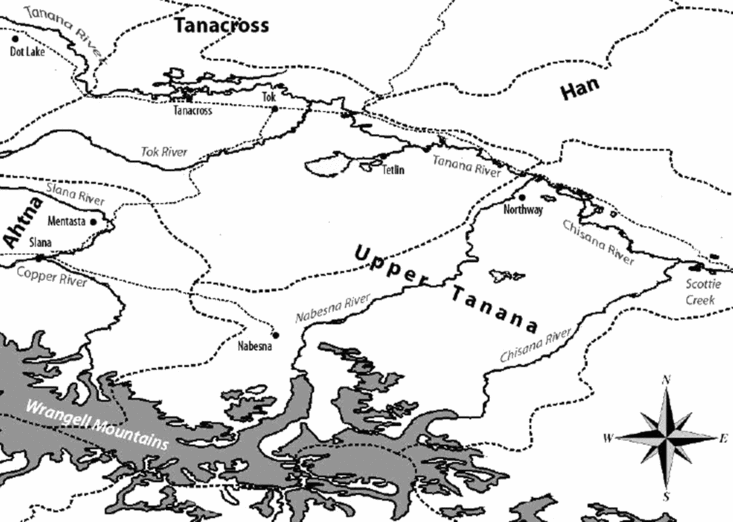
Upper Tanana traditionally was spoken in five settlements: Beaver Creek, Scottie Creek, Northway, Nabesna, and Tetlin. Each village had its own characteristic dialect (Minoura Reference Minoura and Miyaoka1994). Today, most speakers reside in Beaver Creek (Canada) and Northway and Tetlin (Alaska). For this study, we focused on two dialects, Northway and Tetlin. A map showing the Alaskan portion of the Upper Tanana language area is shown in Figure 1.
A map of the Alaskan part of the Upper Tanana language area (map by Olga Lovick).

Neighboring related languages are Ahtna, Tanacross, Han, and Southern Tutchone (all Athabascan). Of these languages, Tanacross is most similar to Upper Tanana. Differences between these languages are primarily tone marking (Tanacross marks high tone where Upper Tanana marks low tone; see Krauss Reference Krauss, Hargus and Rice2005) and the historical development of the stem syllable in Upper Tanana (Leer Reference Leer1977, Reference Leer1979, Reference Leer, Jelinek, Midgette, Rice and Saxon1996; Minoura Reference Minoura and Miyaoka1994; Tuttle & Lovick Reference Tuttle and Lovick2008), which results in a vowel system that is unique among Athabascan languages.
In the following sections, we show the consonant inventory of Upper Tanana and briefly discuss the structure of the stem syllable, since that is where our measurements are taken from.
2.1.1 The consonant inventory
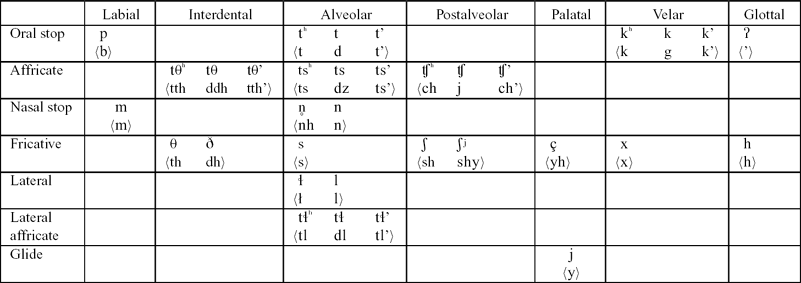
The consonant inventory presented in Table 1 departs somewhat from the one in Minoura (Reference Minoura and Miyaoka1994: 165). This reflects a difference in approach; Minoura (Reference Minoura and Miyaoka1994) is a diachronic phonological paper, sometimes conflating past and present phoneme distinctions, whereas the present paper aims to be strictly synchronic. Some of Minoura's symbols are chosen to reflect distinctions that are relevant in a diachronic view, but not from a synchronic standpoint. In our study, we use additional symbols in places where a historically predictable process has generated a consonant that in contemporary speech contrasts with another segment. We also give the orthographic representation for each of the sounds in angled brackets 〈 〉, since this is the representation that most scholars of Upper Tanana have employed.Footnote 2
The consonant inventory of Upper Tanana Athabascan. For each phoneme, the orthographic representation following Tyone (Reference Tyone1996: xiii) is given in angled brackets.

Several of these phonemes need to be discussed briefly. Upper Tanana has a three-way distinction for most stops and affricates: plain, aspirated, and ejective. Minoura (Reference Minoura and Miyaoka1994: 165) treats the plain stops and affricates as voiced. The fricative/lateral element of the affricates is indeed phonetically partially voiced (the lateral element is voiced throughout), but the stops themselves are voiceless. For this reason, we represent them using voiceless symbols. The Upper Tanana orthography uses voiced symbols (e.g. 〈d, dz, dl〉) for these sounds.
A second note concerns the status of /p/. Minoura (Reference Minoura and Miyaoka1994: 167f., 180) points out that the status of /p/ is unclear, since the allophone [p] only occurs in the word abah /ʔapah/ ‘ouch’. In all other contexts, it occurs in a prenasalized, fully voiced form [ᵐb] (ibid.), like in the word ts'älmbeet /ʦ'ʌlᵐbeːt/ ‘arctic loon’. /m/, the other labial consonant, occurs only in syllables containing another nasal segment (another nasal consonant or a nasalized vowel; an example for this consonant is the word mänh /mʌ / ‘lake’). Minoura (ibid.) points out that for this reason, it would be possible to treat [ᵐb] and [m] as allophones of the phoneme /m/, just as [nd] is treated as an allophone of stem-initial [n]. Not having conducted an investigation of this problem, we remain agnostic for the present paper. When transcribing words containing one of these sounds, we simply chose the one that was phonetically present.
2.1.2 Syllable structure
Minoura (Reference Minoura and Miyaoka1994: 161) formalizes the structure of the Upper Tanana syllable as follows:Footnote 3, Footnote 4
(1) (C0) C1 V (V) (C2) (ə) (ʔ)
The minimal structure is CV. Not all stems have an initial consonant; if such a stem occurs without prefixes, a glottal stop is inserted. Onset consonant clusters are limited to two consonants and are the result of affixation. Stems may only have one onset consonant. ‘C0’ in Minoura's (Reference Minoura and Miyaoka1994) notation indicates the consonant /ɬ/ which, according to Minoura (Reference Minoura and Miyaoka1994: 162), is the only consonant that can be the first in a syllable-initial consonant cluster.
The nucleus can be a short or long vowel, or a diphthong. In prefixes, the nucleus can also be /n/.
The coda is the most restricted, yet also the most complex part of the Upper Tanana syllable. Only a few consonants can occur in codas: /t k ɬ l n ç j ʔ/, and some of these are the product of historical affixation. In stem syllables, there is the possibility of a historically vocalic suffix following these consonants that surfaces as follows:
• /t k/: In the Northway dialect, as a homorganic nasal consonant. In the Tetlin dialect, as [i].
• /ɬ
 ç/: As voicing of the coda consonant (to /l n j/). If the suffix also contains a glottal stop, the coda will be /lʔ nʔ jʔ/, respectively.
• Voiced consonants and glottal stop: No change.
(A detailed phonotactic analysis proving or refuting Minoura's claims is beyond the scope of this paper.) Typical stems are illustrated in (2).
(2)

Minoura (Reference Minoura and Miyaoka1994: 170–171) treats the /ti/ and /tn/ in (2e) and (2f) as part of the coda of the stem syllable. For the present paper, we remain agnostic as to whether we agree with him, or whether it might be more appropriate to treat them as separate syllables.
2.2 Representations of the Upper Tanana vowel space
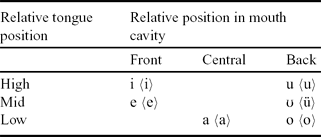
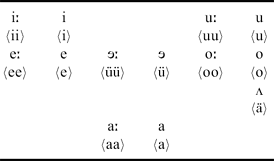
There are several conflicting descriptions of the Upper Tanana vowel space that will be discussed in turn. The oldest of these is in Milanowski (Reference Milanowski1961: 8) for the Tetlin dialect, shown in Table 2. Orthographic representations are included in angled brackets.
The vowel system of the Tetlin dialect of Upper Tanana according to Milanowski (Reference Milanowski1961: 8f.); orthography adjusted to modern convention.

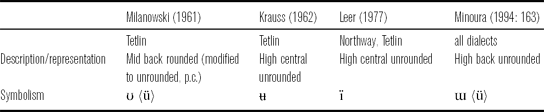
The chart in Table 2 shows a total of six vowels. Milanowski (ibid.) points out that ‘all vowels are voiced and can be modified by length, and some can be nasalized’.Footnote 5 In November 2007 (personal communication), Milanowski stated that he had chosen the symbol /ʊ/ to describe a ‘mid back rounded vowel’. He added that since then, he ‘had changed [his] mind, the vowel is not rounded’. We take this to mean that his analysis of the sound has changed, not the vowel itself. To summarize, Milanowski recognizes six oral vowels that can be modified by length.
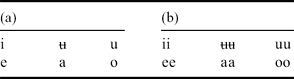
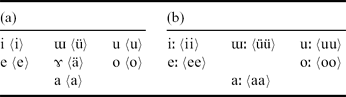
In a letter to Milanowski dated 25 June 1962, Krauss represents the vowel system as shown in Table 3. Krauss’ (Reference Krauss1962) representation illustrates the length contrast mentioned in Milanowski (Reference Milanowski1961). Since Krauss does not provide articulatory descriptions of the vowels, we have to deduce these from his choice of symbols and from his placement of the symbols on the vowel chart. /ʉ/ usually represents a tense, high, central, rounded vowel (Pullum & Ladusaw Reference Pullum and Ladusaw1986: 154). The position of this vowel on the chart similarly suggests that Krauss (Reference Krauss1962) interprets /ʉ/ as a high central vowel. This interpretation has been confirmed in personal communication (April 2007), where Krauss also clarified that this vowel was unrounded. Krauss (Reference Krauss1962) also recognizes the two diphthongs ‘ea (and its variants, etc.) and eu or iu’. Thus, in Krauss’ description, we see six phonemic vowels that can be modified by length as well as two diphthongs. Note that Krauss (Reference Krauss1962) places the sixth vowel (his /ʉ/) higher and more forward than Milanowski's /ʊ/ indicates (Reference Milanowski1961).
The vowel system of the Tetlin dialect of Upper Tanana in Krauss (Reference Krauss1962) not considering nasalization: (a) short vowels; (b) long vowels.

Subsequent descriptions of Upper Tanana include references to the high central vowel proposed by Krauss (Reference Krauss1962). Leer (Reference Leer1977) represents this vowel as [ï], suggesting also a high central unrounded vowel. Leer also is the first linguist to note the vowel [ë] (Leer's representation) in the Northway dialect of Upper Tanana, resulting in a seven-vowel system. He indicates that this vowel has merged with /a/ in the Tetlin dialect.
Most recently, Minoura (Reference Minoura and Miyaoka1994: 163) describes the Upper Tanana vowel system as shown in Table 4. Minoura (Reference Minoura and Miyaoka1994), like Krauss (Reference Krauss1962) and Leer (Reference Leer1977), does not explicitly state where in the oral cavity these vowels are pronounced. However, since he uses IPA notation (see Minoura Reference Minoura and Miyaoka1994: 162), and judging from the placement of symbols on the chart, we assume that /ɯː/ represents a high back unrounded vowel, and that /ɤ/ represents a mid back unrounded vowel. Minoura (Reference Minoura and Miyaoka1994: 163) also points out that /ɤ/ has merged with /a/ in the Tetlin dialect. He acknowledges the diphthongs /ea/ and /iu/. He also points out that nasalization is phonemic for at least some of these vowels.
The Upper Tanana vowel system following Minoura (Reference Minoura and Miyaoka1994: 163), not considering nasalization: (a) short vowels; (b) long vowels.

This description is echoed for the most part in Tyone (Reference Tyone1996), a text collection edited by James Kari. In this publication, all the vowel distinctions are indicated through consistent orthography, but there is no phonetic or phonological discussion.
A summary of the different representations of this vowel is given in Table 5. These conflicting descriptions of the Upper Tanana vowel system illustrate the need for accurate phonetic description and give rise to a number of questions.
Representation of 〈ü, üü〉 in earlier studies of Upper Tanana vowels.

2.3 Our questions
While all scholars agree on the existence of long and short /i e a o u/, there are two problematic cases. The ‘sixth vowel’ is described by Milanowski (Reference Milanowski1961) as a mid back rounded vowel and by Krauss (Reference Krauss1962), Leer (Reference Leer1977), and Minoura (Reference Minoura and Miyaoka1994) as a central high unrounded vowel. Our first task is thus to provide an exact description of this vowel.
We will do the same for the ‘seventh vowel’ reported by Leer (Reference Leer1977), Minoura (Reference Minoura and Miyaoka1994), and Tyone (Reference Tyone1996). We will also demonstrate that in the Tetlin dialect, it has indeed merged with /a/.
Minoura (Reference Minoura and Miyaoka1994: 163) reports that the difference between the ‘long’ and ‘short’ vowels is mainly one of quantity, but that quality also plays a role. We will investigate how quantity and quality interact in the distinction between these vowels.
Finally, we observed during our investigation that vowels are strongly affected by certain surrounding consonants. We will report on those co-articulatory effects.
3 Methodology
3.1 Word list preparation
The word list used in this study (see Appendix A) was compiled from existing resources on Upper Tanana Athabascan, namely Milanowski & Jimerson (Reference Milanowski and Jimerson1975) and Kari (Reference Kari1997). For the most part, we assumed that these authors accurately represent the phonemes; i.e. we assumed that if Milanowski & Jimerson (Reference Milanowski and Jimerson1975) spell 〈u〉, they represent what we found to be /ɘ/ whereas if they spell 〈u〉, they represent what we found to be /u/.Footnote 6 The categorization is thus by (assumed) phonemic transcriptions by other linguists who worked with the phonology and the diachrony of the language. In a few cases, we changed the categorization of a particular vowel to match more closely current articulation (see Lovick Reference Lovick2011 for a discussion of sound change in Upper Tanana). We hope the word list in the appendix will help sort out any errors we make in our categorization.
In compiling the list, several issues were considered.
• Only oral monophthongs were included in this study.
• For each vowel, long and short, at least ten example words were sought.
• Only stem vowels were used. Upper Tanana, like all other Athabascan languages, is morphologically complex. The stem is usually in word-final position, preceded by one or more prefixes. Studies of other Athabascan languages (Tuttle Reference Tuttle2003, Reference Tuttle2008) have shown that stem vowels and affix vowels may be significantly different in quality and quantity.
• Words were selected to avoid known co-articulation effects on vowel quality, and adjusted in response to other co-articulations that we found in the output of individual speakers. Some of these phonetic effects are discussed in Section 4.5 below.
• We tried to exclude arcane vocabulary from the list. However, some vowels are more rare than others (/oː/ in particular is very rare), and as a result, some of the words on our list are not known to every speaker. Dialectal variation also affected the composition of the word list.
Speakers also suggested additional words, frequently by association (e.g. when asked for jign /ʧikn/ ‘berry’, speaker CD volunteered the names for all types of berries). While originally not part of the list, we included these tokens if they contained one of our target vowels. When the word list did not yield enough tokens for a particular vowel, we supplemented it with data from other word list recordings from the same speaker. This happened in the case of speakers AS and RB. We only worked with speaker YJ once, so we did not use supplemented data. The list in Appendix A includes a complete list of words used for this study.
3.2 Speaker selection
The word list was recorded with four female speakers, two from Tetlin (CD, YJ) and two from Northway (AS, RB). All speakers are native speakers of Upper Tanana but are also proficient in English. The youngest of our speakers is in her 50s, while the others are in their 70s.
We chose these speakers because they are reported to be good representatives of the dialects spoken in their village.
Originally, we recorded the word list with a number of additional speakers. In the end, only four of the collected data sets became part of this study, for two reasons:
(i) All other data sets did not contain enough tokens; sometimes because the speaker had trouble remembering the target words, sometimes because of too much background noise that made a number of tokens unusable. We only used data sets with sufficient data points to allow us to draw conclusions.
(ii) Only one of the data sets with a male speaker from Northway was of high enough quality for inclusion in this study. We were unable to match this with a recording of a male Tetlin speaker; there are only about 10 Tetlin speakers in total, and not all of them are interested in language work.
The resulting data to be analyzed in this paper thus include recordings of our word list by two speakers of the Northway dialect and two speakers of the Tetlin dialect, all female.
3.3 Recording
Recordings were made using a Marantz Professional Solid State Recorder PMD 671 and a cardioid condenser microphone, Audio Technica AT813a. Recordings were made at a sampling rate of 44.1 kHz in 32 bit PCM wave format and saved in that format.
All recordings were made in the speakers’ homes. While we realize that studio recordings would be preferable, they were not feasible under our circumstances.
Speakers were asked to translate individual words from English into their language. If their translation did not match our target word, we suggested the target word. Sometimes they accepted it (correcting our pronunciation), while sometimes they refused the target word or pointed out that it was in a different dialect. Speakers were asked to repeat each word at least twice. Several speakers repeated words more frequently; however, we have observed that asking Upper Tanana Elders for more than two repetitions usually elicits a ‘Can't you listen properly?’ response, so we left this up to the speakers’ discretion.
3.4 Measurements
Each vowel token was measured for F1, F2, and duration, using the averaged formant function in Praat 5.1.26 (Boersma & Weenink Reference Boersma and Weenink2009). All measurements were done by hand. The sample measured for each vowel began at the end of any transitional F2 movement, and ended at the end of visible F2, or at the end of voicing where vowels were partially devoiced in word-final position or preceding glottal consonants. All measurements were repeated following initial review of this study, and further material was added from new recordings.
Vowel plots were generated using the NORM vowel normalization and plotting suite (Thomas & Kendall Reference Thomas and Kendall2007). This application is a web-based interface to the Vowels R package (Kendall & Thomas Reference Kendall and Thomas2010). Plots containing data from more than one speaker were normalized using the Nearey1 normalization formula (Adank, Smits & van Hout Reference Adank, Smits and van Hout2004). This method is vowel-extrinsic but formant-intrinsic, and was chosen because it reduces physiological variation while retaining sociological and dialectal variation. Values in normalized plots are not scaled to Hertz or Bark values.
Statistics for this paper were done using JMP 7.0.2.
The tolerance for structured word repetition among our speakers being limited, our samples are not embedded in frames, but are in elicitation form. For this reason, no measurements were made of F0 and we will not report on tonal contrasts in this paper, though the Northway dialect is tonal (Minoura Reference Minoura and Miyaoka1994: 170). Intonational effects are audible in our recordings and are being studied separately (Lovick & Tuttle Reference Lovick and Tuttle2010).
4 Results
4.1 The Upper Tanana vowel space
Our first finding is that the different dialects of Upper Tanana have different vowel inventories. These findings are consistent with observations made by Leer (Reference Leer1977) and Minoura (Reference Minoura and Miyaoka1994).
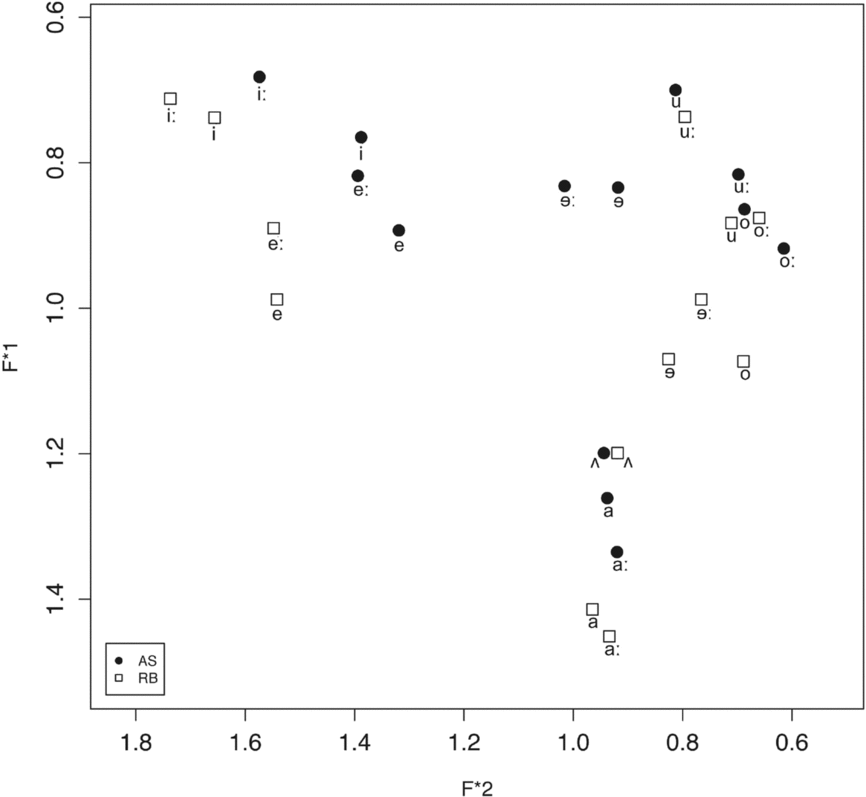
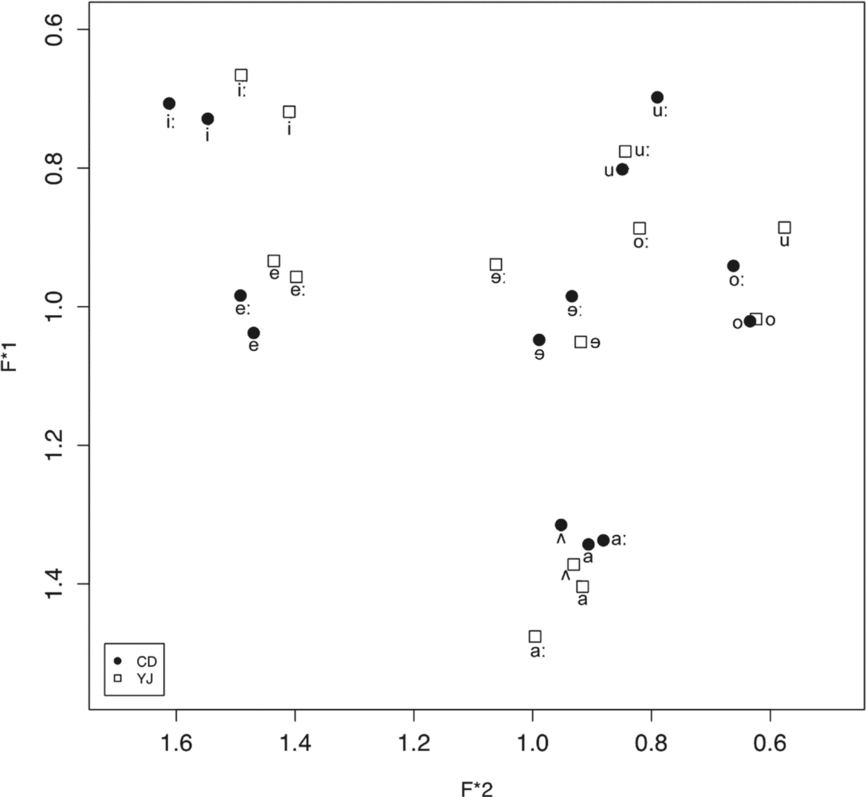
The Tetlin dialect of Upper Tanana has six vowel qualities: /i u e ɘ o a/. For each of these qualities there are two quantities, short and long, with the short member of the pair being slightly more centralized. The Northway dialect has a seventh vowel, /ʌ/, that has merged with /a/ in Tetlin. This vowel does not have a quantity distinction; it is always short. Figures 2 and 3 show vowel spaces for Northway and Tetlin, respectively. These plots were generated using the Nearey1 normalization formula given in Thomas & Kendall (Reference Thomas and Kendall2007). Each point in Figures 2 and 3 represents mean F1–F2 formant values for a particular vowel for a particular speaker. Speakers are differentiated by shape.
The vowel space of Northway Upper Tanana, normalized using the Nearey1 method.

The vowel space of Tetlin Upper Tanana; normalized using the Nearey1 method.

While the overall shape of the Upper Tanana vowel space is not atypical of Alaskan Athabascan vowel spaces (with a relatively small inventory of peripheral vowels and a second set of shorter, more central vowels), Upper Tanana has more phonemic vowels than other Alaskan Athabascan languages through the presence of /ɘ ɘː ʌ/. Neighboring Tanacross has a six-vowel system (Holton Reference Holton2000) and Ahtna a five-vowel system (Kari Reference Kari1990) (in addition to a quantity distinction). The existence of /ɘ ɘː ʌ/ is unique to Upper Tanana, and indeed one of the defining characteristics of this language (Minoura Reference Minoura and Miyaoka1994: 164). The phonetic status of these vowels will be addressed in the following sections.
4.2 The sixth vowel: /ɘ/ and /ɘː/
As discussed above in Section 2.2, the sixth vowel pair, orthographic 〈ü, üü〉, is represented quite differently in descriptions of the historical development and phonology of the Upper Tanana vowel system. Table 5 above gives a summary of the descriptions and representations, their authors and the dialects studied.
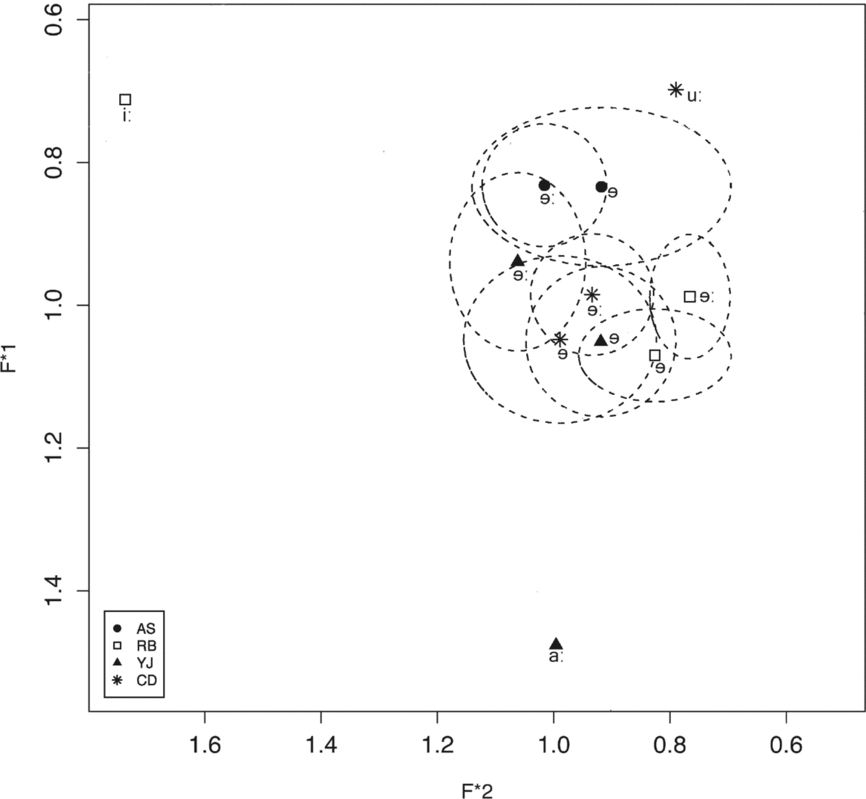
Plotting the vowels gives us two results. First, the vowels in question are not high; they are better described as mid vowels. Second, there is considerable variation within and across speakers. Each of these findings will be discussed in turn.
Figure 4 shows a plot of all tokens of this vowel pair for all speakers. This plot was generated by creating a plot of all the speakers’ vowel spaces with ellipses representing variability (one standard deviation). This was done in order to avoid distortions arising from the application of the Nearey normalization to an incomplete data set. For presentation purposes, other vowels and ellipses except for 〈ü, üü〉 were removed from the plot, though the most peripheral speaker mean for the high and low vowels was retained to provide perspective.
The place of /ɘ/ and /ɘː/ in the Upper Tanana vowel system.

From Figure 4 it is clear that only Milanowski (Reference Milanowski1961) was right regarding the vertical position of this vowel; 〈ü, üü〉 is certainly not a high vowel. Since we were present at the recording of the vowels measured in our study, we can also attest (confirming the findings of Krauss Reference Krauss1962, Leer Reference Leer1977, and Minoura Reference Minoura and Miyaoka1994) that no lip rounding is present; we thus describe the vowel as a mid, unrounded vowel and choose the symbol /ɘ/ to represent it.
Figure 4 also demonstrates the high variability between speakers. Among our four speakers, considerable variation appeared in the horizontal location of this vowel. For one Northway speaker, RB, /ɘ/ and /ɘː/ are significantly different in formant structure as well (this will be discussed again in Section 4.4). Formant values for our speakers are compared in Tables 6–9.
Means and standard deviations (SDs) F1 and F2 for /ɘ/ and /ɘː/ (speaker AS).

Means and standard deviations (SDs) F1 and F2 for /ɘ/ and /ɘː/ (speaker RB).

Means and standard deviations (SDs) F1 and F2 for /ɘ/ and /ɘː/ (speaker CD).

Means and standard deviations (SDs) F1 and F2 for /ɘ/ and /ɘː/ (speaker YJ).

It is clear that /ɘ/ and /ɘː/ occupy a large territory in the vowel space for all the speakers. This fact may go some way to explaining some of the variety in previous descriptions. RB pronounces /ɘ/ and /ɘː/ as a back vowel (best represented as [ɤ] and [ɤː]); AS, CD and YJ pronounce it more as a central vowel, hence the representation of this vowel pair as /ɘ/ and /ɘː/. Note that this variation crosscuts the dialect lines as we understand them; RB and AS speak the Northway dialect, YJ and CD the Tetlin dialect. However, it seems clear from these formant values that we are not observing a high vowel. While it is not incorrect to include ‘back’ in the description, ‘high’ does not fit our data.
The choice of the symbol ɘ to represent the sixth vowel calls for some comment. Given the position of this vowel's territory, and its variability in quality across the speakers in our study, we could have chosen to represent the vowel with the schwa symbol, ə. This would create difficulties for us, however, since this symbol is tightly associated with unmarked (frequently reduced or epenthetic) vowels in both diachronic and synchronic Athabascanist linguistics, and the Upper Tanana vowel is not unmarked. We do not want to suggest with our symbolism that the sixth vowel is a ‘reduced’ or unmarked vowel in any sense (see also Section 5 below for argumentation on this point). For this reason, we have chosen an IPA symbol that resides near the center of the chart, does not represent a rounded vowel and does not represent a high vowel.
What is also clear is that however far back the pair /ɘ/ and /ɘː/ takes its position, its place in the phonetic vowel space is central, and in this area it has no real competition. /a aː ʌ/ are much lower overall, /o oː/ are back and rounded, and /e eː/ are clearly front. We will discuss the relationship between the phonetic vowel space and the phonology of the Upper Tanana vowels in Section 5.
4.3 The seventh vowel: /ʌ/
As mentioned above in Section 2.2, we expect the Northway and Tetlin vowel inventories to differ in the presence of a seventh vowel /ʌ/ in Northway that is not predicted to be present in Tetlin. Both Leer (Reference Leer1977) and Minoura (Reference Minoura and Miyaoka1994) indicate that this vowel (transcribed /ë/ and /ɤ/, respectively) is a mid unrounded vowel, central or back.
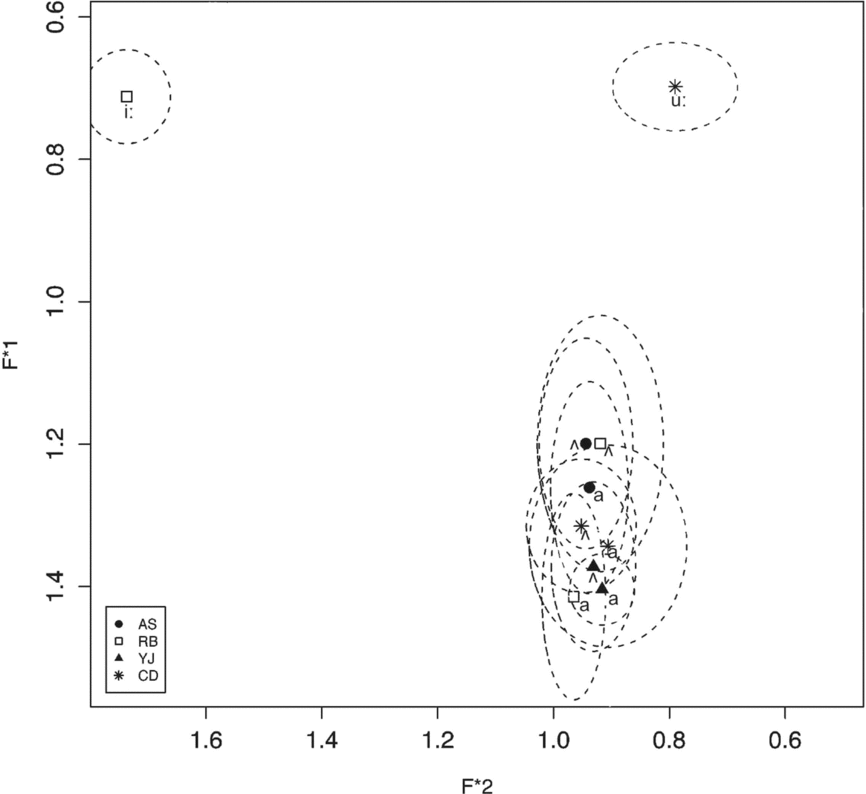
Our data show that this vowel is better described as a mid low back unrounded vowel /ʌ/. It also becomes apparent that the Tetlin speakers do not distinguish between /a/ and /ʌ/, and that only one of our Northway speakers (RB) does appear to have a clear distinction. For AS, the distinction is much less clear. Formant values of these vowels are given in Tables 10–13.
Means and standard deviations (SDs) /a/ vs. /ʌ/ for speaker RB (Northway).

Means and standard deviations (SDs) /a/ vs. /ʌ/ for speaker AS (Northway).

Means and standard deviations (SDs) /a/ vs. /ʌ/ for speaker CD (Tetlin).

Means and standard deviations (SDs) /a/ vs. /ʌ/ for speaker YJ (Tetlin).

Speaker RB shows a clear distinction between /a/ and /ʌ/, with F1 being significantly higher in /a/ (p < .0001) and F2 also higher for /a/ than for/ʌ/, but with far less significance (p = .046). This distinction is reported to be characteristic of the Northway dialect (Leer Reference Leer1977, Minoura Reference Minoura and Miyaoka1994).
For AS, F1 is marginally significantly different in /a/ vs. /ʌ/ (p = .048 in a t-test), and F2 is not significantly different (p = .73). Auditorily, these two sounds are indistinguishable in her speech. This is somewhat surprising, given that AS is a Northway speaker, and previous descriptions led us to expect a reliable distinction between these two phones. AS has never spent a significant amount of time in Tetlin (personal communication, 2008), so it is unclear where this feature of her idiolect originates.
For the Tetlin speakers CD and YJ, it is correct to say that /ʌ/ has merged with /a/, as has been suggested by Leer (Reference Leer1977) and Minoura (Reference Minoura and Miyaoka1994). Hypothesis testing for CD shows neither F1 nor F2 to differ significantly in formant structure. F1 is slightly higher in /a/ (p = .26) and F2 slightly lower in /a/ (p = .059).
For speaker YJ, F1 is slightly higher in /a/ than in /ʌ/ (p = .35), and F2 is slightly lower in /a/ than in /ʌ/ (p = .52). Thus, for both Tetlin speakers, our findings are consistent with those of all other researchers. These findings are also consistent with our own aural impressions. Speaker RB is the only one for whom we (as non-native speakers) can tell the difference between /a/ and /ʌ/.
Figure 5 shows the distribution and the variability of /a/ and /ʌ/ in all four speakers’ vowel spaces. Like Figure 4, Figure 5 was created by normalizing the vowel space of all speakers. We erased all vowels not under discussion and merely kept the most extreme token of /iː/ and /uː/ as reference points.
Distribution and variability of /a/ and /ʌ/ across all speakers.

As shown in Figure 5, only speaker RB (indicated by the square) clearly distinguishes these sounds, with a low /a/ and a considerably higher /ʌ/. For all other speakers, /a/ and /ʌ/ cluster together quite closely. The lack of a distinction is expected for the two Tetlin speakers, but somewhat surprising for the Northway speaker AS. We regard it as a property of her idiolect, since impressions from other Northway speakers suggest that her pronunciation of this vowel is unusual. However, further research on the status of /a/ vs. /ʌ/ in the speech of other Northway speakers is needed.
4.4 Quantity vs. quality
The question of the importance of quantity vs. quality has been raised in earlier literature. Minoura (Reference Minoura and Miyaoka1994: 163) observes that ‘Upper Tanana resembles [Ahtna and Tanacross] in the partial loss of the full/reduced opposition and the reorganization into a long/short vowel system’. Minoura's statement is based on the assumption, drawn from Krauss's (Reference Krauss1964) comparative work, that the vowels of Proto-Athabascan were distinguished by quality, primarily by a distinction between the ‘full’ (peripheral) and ‘reduced’ (central) vowels. In synchronic studies of the daughter languages, even systems that fully reflect the historical quality distinction show strong quantity effects. For example, in Lower and Middle Tanana Athabascan, ‘full’ vowels measure roughly twice the length of ‘reduced’ vowels, even though no two vowels in these systems share quality (Tuttle Reference Tuttle1998). In contrast, Kari (Reference Kari1990) and Holton (Reference Holton2000) report primarily quantity-based distinctions in two close neighbors of Upper Tanana, Ahtna and Tanacross, respectively.
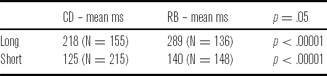
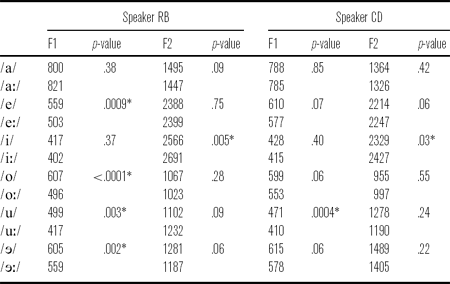
Our data support Minoura's observation: long–short vowel pairs are very similar in quality, but not completely. Hypothesis testing on this point for the two speakers CD (Tetlin) and RB (Northway), for whom we have consistent duration data, shows that while short stem vowels are significantly shorter than long stem vowels, formant values are not always significantly different. Figures are given for duration in Table 14.
t-tests for duration for speaker CD (Tetlin) and speaker RB (Northway).

Table 14 demonstrates that long vowels are about twice as long as short vowels. When examined for differences in formant structure, the six pairs of short and long vowels show variety within and across these two speakers. Results of analyses of variance for formant values are summarized in Table 15. Only results significant at p < .05 are discussed below.
Comparisons of formant values within short–long pairs (* = statistically significant).

These comparisons suggest a greater dependence on pure quantity in the vowel inventory of CD (Tetlin), and a more equal role for quantity and quality in the inventory of RB (Northway). It may be observed that significant quality differences do exist for both speakers in the high vowel pairs /i/–/iː/ and /u/–/uː/. The tests also show that the mid vowel pairs /e/–/eː/, /ɘ/–/ɘː/ and /o/–/oː/ are distinguished by quality and quantity for RB; since we only use one speaker per dialect in this comparison, we cannot determine whether this is dialectal or idiolectal. The distinction between /a/ and /aː/ is by quantity alone for both speakers. It is easy to see how Minoura (Reference Minoura and Miyaoka1994) arrived at his observation of partial reorganization from a quality to quantity distinction in Upper Tanana. Judging from the difference between the speakers (or dialects), this is a diachronic change still in progress. From our synchronic perspective, it is perhaps most relevant to observe the robustness of the quantity values, and the more ambiguous facts for quality.
We conclude that the long–short pairs of vowels in these speakers of the Northway and Tetlin dialects are significantly distinguished by quantity, but only the high vowels in both dialects show significant differences in formant structure that correlate to their quantity.
4.5 Consonant effects
Speakers RB and AS speak the tonal Northway dialect. Low-toned syllables frequently are creaky, and both speakers will also creak preceding a glottal stop. This did not influence our measurements of F1 and F2. However, there are a few other environments affecting the vowels that are worthy of a brief discussion. We provide spectrograms illustrating these coarticulations, but we did not examine the effects statistically, since our data sets do not contain sufficient examples for such testing.
4.5.1 Devoicing
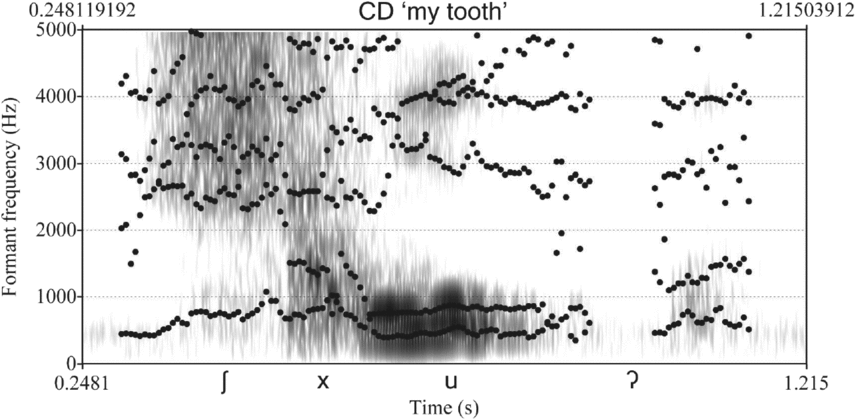
All our speakers partially devoice stem vowels preceding a glottal stop. This is illustrated in Figure 6, using the word shxu’ /ʃxuʔ/ ‘my tooth’, pronounced by speaker CD.
Devoicing preceding glottal stop in shxu’ /ʃxuʔ/ ‘my tooth’.

This affected our measurements in so far as we did not measure the vowel up to the onset of closure for the coda consonant (which is what we did in the case of all other coda consonants). Since the voiceless segment can be quite long, doing so would have skewed our duration results. For this reason, we only measured the voiced portion of the vowel.
4.5.2 Nasalization
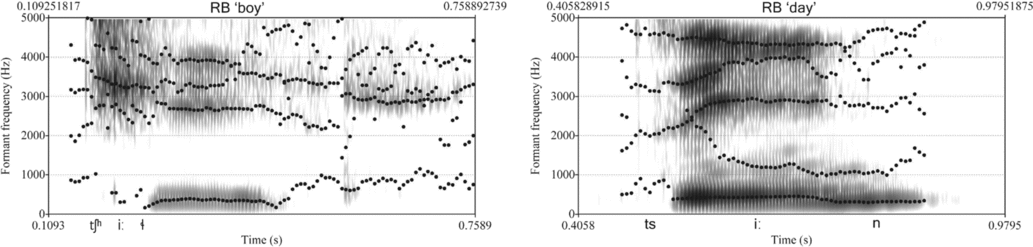
Speaker RB strongly nasalizes vowels in nasal-final syllables, i.e. syllables ending in /n tn kn/. This came as a surprise for us, since nasalization is phonemic for all vowels in Upper Tanana. The effect is most pronounced for the long high front vowel /iː/. Nasalization sometimes, but by no means always, affects F2.
The image in Figure 7 shows how nasality can affect F2. In the spectrogram of chiił /ʧʰ iːɬ/ ‘young man, boy’, with a non-nasal coda, the vowel is not nasalized. F2 is consistently between 2600–2700 Hz. In the spectrogram of dziin /ʦiːn/ ‘day’, the coda consonant is /n/, resulting in non-phonemic nasalization of the preceding vowel. F2 rises slightly following the initial affricate /ʦ/ (the slight rise is normal in this context). In this example, however, the formant tracker has identified a nasal formant at around 1 kHz. For this reason, we excluded all tokens with the syllable rhyme /iːn/ for this speaker.
Effects on F2 of non-phonemic nasalization preceding nasal consonant. Left panel: chiił /ʧʰ iːɬ/ ‘young man, boy’; right panel: dziin /tsiːn/ ‘day’.

In the speech of YJ, nasal codas frequently influence the vowel /ʌ/ in an unpredictable fashion: tokens with /ʌ/ followed by /n/ are ‘all over the map’, as opposed to tokens with other codas, which cluster together. Sometimes formants appear unaffected by the following nasal, in other tokens they are strongly affected. For this speaker we excluded nasal tokens if the formant values were very different from those of vowels followed by different coda consonants. We also excluded all tokens with any vowel followed by a nasal coda if the value for F2 was too unusual.
4.5.3 Coda /l/
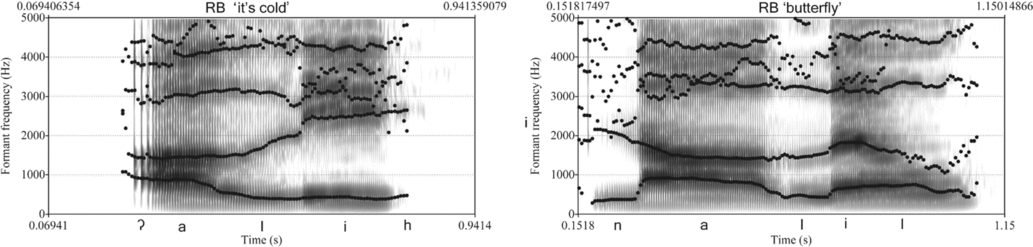
Upper Tanana /l/ is quite velarized in the pronunciation of all our speakers, particularly in coda position. As a result, it strongly affects preceding short high front vowels (the effect is much less pronounced for long vowels). In words with an underlying high front vowel, we find that F1 is somewhat higher while F2 is considerably lower, reflecting assimilation to the velarized lateral. This is particularly the case if the onset consonant of the syllable is also /l/. An example for this is the word ‘butterfly’, naalil /naːlil/ in the Northway dialect, lahlil /lahlil/ in the Tetlin dialect.
Figure 8 shows spectrograms for two words pronounced by RB (Northway dialect): alih /ʔalih/ ‘it's cold’ and naalil /naːlil/ ‘butterfly’. The image on the right shows clearly that F2 is considerably lower preceding /l/ than preceding other consonants.
Raising of F1 and lowering of F2 preceding /l/. Left panel: alih /ʔalih/ ‘it's cold’; right panel: naalil /naːlil/ ‘butterfly’.

An exception to this is speaker YJ, mainly because her /i/ vowels are not as far front as the ones of other speakers.
The lateral fricative /ɬ/ in syllable-final position has no effect on preceding vowels.
4.5.4 Palatalization
Two environments trigger palatalization (raising, fronting) of the target vowel: the fricative /ʃʲ/ before any vowel, and an alveolar oral stop preceding a high back vowel.
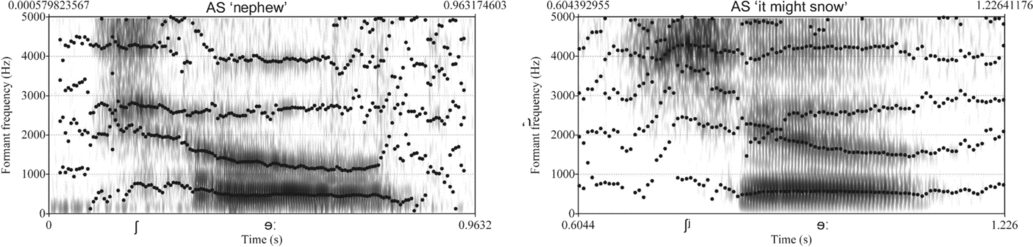
The consonant /ʃʲ/ is a complex phoneme, derived from Proto-Athabascan *y (Minoura Reference Minoura and Miyaoka1994: 166). It contrasts with /ʃ/; in our data, we even have a near-minimal pair taashyüü /ʃʲɘː/ ‘it will snow’ vs. shüü /ʃɘː/ ‘my nephew’. It significantly impacts the following vowel, as is evident from the graphic. This effect exists for all our speakers; we systematically excluded tokens with this phoneme in stem-initial position.
The image on the left of Figure 9 is a spectrogram of shüü /ʃɘː/ ‘my nephew’; the one on the right is a spectrogram of the stem syllable of taashyüü /tʰaːʃʲɘː/ ‘it might snow, it will snow’. F2 of the syllable with the palatalized onset is considerably higher than F2 of the syllable with the unpalatalized onset.
Palatalization of /ɘː/ following /ʃʲ/. Left panel: shüü /ʃɘː/ ‘my nephew’; right panel: taashyüü /tʰaːʃʲɘː/ ‘it might snow, it will snow’.

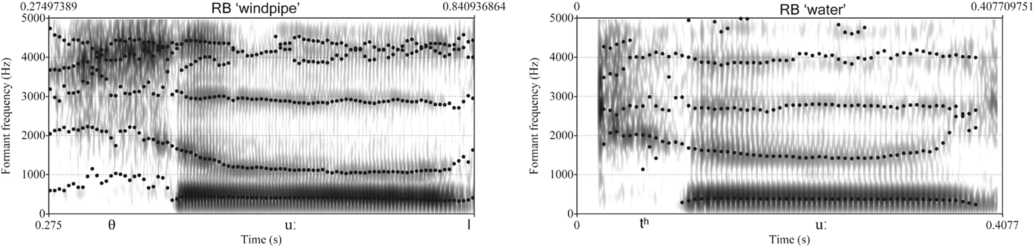
The second environment for palatalization, a dental stop followed by a high back rounded vowel /uː/, affects only RB. In this environment, her /uː/ vowels are fronted considerably.
Figure 10 contrasts the long vowel /uː/ in different environments. On the left side, it follows a /θ/, in the word shthuul’ /ʃθuːlʔ/ ‘my windpipe’, and has an unremarkable formant structure. On the right, it occurs following a /tʰ/ in the word tuu /tʰuː/ ‘water’, which triggers palatalization, manifesting itself through raised F2.
Palatalization of /uː/ following /t/. Left panel: shthuul’ /ʃθuːlʔ/ ‘my windpipe’; right panel: tuu /tʰuː/ ‘water’.

5 Discussion and summary
We set out to answer three questions regarding the Upper Tanana vowel space. Our first question concerned the exact phonetic realization of the ‘sixth’ vowel in Upper Tanana. Former accounts contradict each other and do not reflect our auditory impressions. In the speech of three of our speakers, /ɘ/ and /ɘː/ are mid central unrounded vowels; in the speech of the fourth speaker the position of this vowel pair is mid back: [ɤ]. Since three previous sources had represented this vowel quality very differently, we believe it is important to note that the first detailed description of the Upper Tanana vowel space (Milanowski Reference Milanowski1961) recorded very similar placement to that which we observed.
While the subsequent accounts of Upper Tanana vowels (Krauss Reference Krauss1962, Leer Reference Leer1977, Minoura Reference Minoura and Miyaoka1994) seem to have departed farther from phonetic detail in their description of this vowel, they did recognize the status of /ɘ/ as a central vowel. Thus, the phonological system set up by them was correct, even if the exact placement of the sixth vowel was not. This system is presented in Table 16.
The vowel system of Upper Tanana.

Our second task was to determine the position of the seventh vowel, /ʌ/, and to demonstrate the merger of /ʌ/ and /a/ in the Tetlin dialect, reported in previous descriptions of the Upper Tanana vowel system. Not only were we able to illustrate this, we also found that one of the Northway speakers also has this merger.
The vowels /ɘ ɘː ʌ/ have a special status in Upper Tanana phonology and are indeed defining elements of this language (Minoura Reference Minoura and Miyaoka1994: 164). They only exist as stem vowels and are not attested in affixes. As pointed out by Leer (Reference Leer1977), they are the result of historical sound change in the stem syllable; the historically identical vowels in affixes have undergone different sound changes. The other vowels of Upper Tanana are not restricted in this way and can occur anywhere in the word.
It is important to note that /ɘ/ and /ɘː/ are not unmarked vowels, despite their central position in the vowel space. The unmarked vowel (a historical schwa) has become /ʌ/ in the Northway dialect, which has merged with /a/ in the Tetlin dialect. Historical evidence of the marked status aside, there are synchronic indications of this: length contrast and nasalization.
In the Northway dialect, /ʌ/ is the only vowel that is not part of a short/long vowel pair; it is always short. The /ɘ/–/ɘː/ pair, on the other hand, does exhibit a length contrast. This was demonstrated in Section 1; xüh /xɘh/ ‘pus’ vs. possessed -xüü’ /xɘːʔ/ ‘pus (n. poss.)’. Comparable alternations are not possible for /ʌ/.
Similarly, /ɘ/ and /ɘː/ have nasalized counterparts / / and /ː/, while the nasal counterpart of /ʌ/ exists only for some speakers. // and /ː/ are not particularly common vowels, and Minoura (Reference Minoura and Miyaoka1994: 164) dedicates some space to the discussion of whether the long nasalized vowel in particular is phonemic or not. // and /ː/ are quite distinct, both from their oral counterparts and from the other nasalized vowels /ĩ õ ã/. /ʌ/, on the other hand, does not exhibit a clear distinction. Kari (Reference Kari1997) reports a nasalized /
 / in the conjunction nts'
 ’ /nʦ'ʔ/ ‘and’, which is historically accurate. For some speakers of the Northway dialect, however, this vowel is auditorially indistinguishable from the considerably more common nasal vowel /ã/.
To summarize, the mid central vowel /ɘ/ exhibits a four-way contrast of length and nasalization, while the mid low back vowel /ʌ/ does not distinguish length (and for some speakers, nasalization). We expect an unmarked vowel to show less contrast than the marked ones; and for that reason, we treat /ʌ/ as an unmarked vowel, while /ɘ/ is a full member of the Upper Tanana vowel space.
While it is not unusual for a default vowel in an Athabascan language to be peripheralized, the direction of development in Upper Tanana is unusual. The reflex of historical schwa is a front vowel /ɛ/ in Ahtna (Kari Reference Kari1990: 16) and very similar in Tanacross (Holton Reference Holton2000, Arnold, Thoman & Holton Reference Arnold, Thoman and Holton2009), both near neighbors to Upper Tanana. A similar mid front vowel is found in Slave (Rice Reference Rice1989: 29), when not affected by surrounding segments. More distant geographically, the Navajo reflex is written 〈i〉 and pronounced [ɪ] in the absence of phonological influences (McDonough Reference McDonough2003: 123). A development similar to that of Upper Tanana has taken place only in Beaver (Story Reference Story, Cook and Rice1989), where the historical schwa has merged with /a/.
Default vowels in Athabascan languages, historically central, are prosodically non-prominent and tend to be more subject to assimilation to neighboring segments than the ‘full’ vowels historically associated with peripheral positions in the vowel space. We saw this effect in the two different forms for /tɬekn/ vs. /tɬakn/ ‘squirrel’, which we discussed in the introduction; in the Northway dialect, a historical schwa followed by /kn/ always became /e/, while it became /a/ in Tetlin. When a central vowel becomes more peripheral, we might wonder whether it could take on the relative resistance to co-articulatory effects seen in the historically peripheral vowels. However, what we have seen so far in the Upper Tanana vowel system seems to suggest the contrary: a central vowel moves toward the periphery (Tetlin /a/) but remains short and undifferentiated; a peripheral vowel centralizes, creating /ɘ/, but retains the phonological properties of a peripheral vowel. Co-articulatory effects affect peripheral and central vowels alike at this point of the language.
We also compared what are commonly termed ‘long’ and ‘short’ vowel pairs to see whether they differed more in quality or in quantity. While the high vowels show some quality differences, the main difference is length, with long vowels typically almost twice as long as short vowels. This finding supports Minoura's (Reference Minoura and Miyaoka1994) observations of a vowel system with two operative distinctions in vowel pairs, but with a stronger role for quantity than for quality.
Other intriguing findings in our data set involve the unexpected effects of the coda consonant /l/ on front vowels, and of coda /ʔ/ on voicing. Neither effect has previously been discussed in related languages to our knowledge, and this may set the stage for further research on the consonants of Upper Tanana Athabascan.
In this paper, we have provided an acoustic phonetic study of the vowel system of Upper Tanana Athabascan. We have seen that, while former accounts clearly articulate the phonological system, the phonetic realization of two of the vowels is clarified by acoustic measurement. In the process, we have identified several coarticulation effects that have not been previously reported.
Acknowledgements
The authors gratefully acknowledge the dedication and insight of all those who work with Athabascan phoneme inventories, especially those of the highly endangered Alaskan Athabascan languages. We are particularly grateful to James Kari, Michael Krauss, Jeff Leer, Paul Milanowski and Nobukatsu Minoura, all of whom contributed original analyses of Upper Tanana Athabascan, and who provided valuable comments on earlier versions of this work. We also wish to thank the anonymous reviewers who helped us improve this paper for publication.
Without the concentration and careful judgment of our Upper Tanana consultants, this work could not have been attempted. We therefore thank them most deeply, and extend the thanks to members of their families who gave us time and space to work on their language and in some cases provided valuable insight as well. Along these lines, we also find it appropriate to thank the members of our families who helped with the coffee, the driving and the baby during the research for this study.
The research for this paper was partially sponsored through Olga Lovick's Presidential University of Alaska International Polar Year Post-Doctoral Fellowship, sponsored by Conoco-Phillips.
None of these people or organizations are responsible for any errors of fact or representation that may be contained in this article.
Appendix A. Word list
The appendix contains a list of all words used in the study. For the most part, the list contains stems without affixes, since speakers would give different forms (i.e. for the stem de’ ‘horn’, we were offered the forms ude’ ‘his horn’ and ch'ide’ ‘something's horn’; for the stem koh ‘cough’, we were offered the forms dagnkoh ‘I'm coughing’ and delkoh ‘he's coughing’, etc.) and we wanted to keep the list as short as possible. In the case of many nouns, however, we give the whole noun, since the meaning of the stem cannot be isolated quite so easily. If an entry in the appendix has several syllables, the target vowel is in the final syllable unless otherwise indicated.
The appendix is presented in table format (Table A1). The first column indicates which vowel was targeted. The second column contains the orthographic stem/word, the third column a phonemic IPA transcription. The fourth column is a gloss of a word or a stem; it also contains some grammatical information (lexical category, whether it is a possessed form of a noun, aspect for verbs). The next four columns indicate which speaker offered how many tokens for this word or stem (* = 1 token, **** = 4 tokens).
Word list.

A few notes on the transcription. Upper Tanana stops and affricates are classified as voiceless plain, voiceless aspirated, and ejective. This is not phonetically accurate in all cases; the fricative segment of the plain affricates /ʧ/ and /ʦ/ becomes voiced at some point, and the lateral element of /tɬ/ is voiced throughout (the affricate is thus phonetically [tl]). For consistency's sake, and in recognition of the phonological system, we chose to represent affricates with voiceless symbols only.
The distinction between plain, aspirated, and ejective stops is neutralized in word-final position (see Minoura Reference Minoura and Miyaoka1994: 168). Orthographically, this is indicated by choosing the symbol for the aspirated stop (〈t〉 and 〈k〉); in the transcription, we chose to use the symbol for the plain stop (/t/ and /k/; Upper Tanana has no affricates in codas).
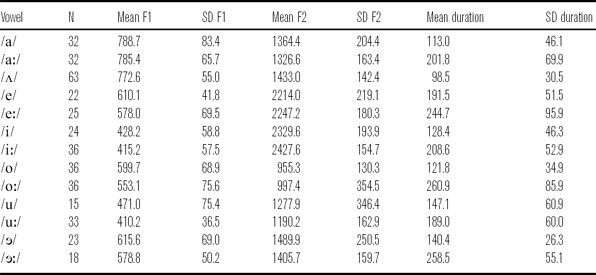
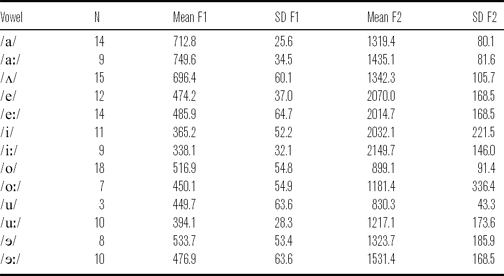
Appendix B. Formant charts
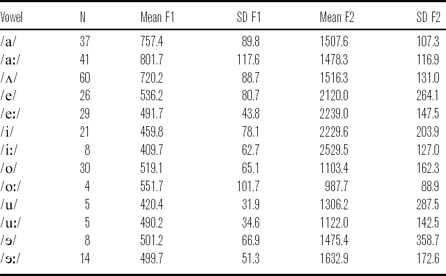
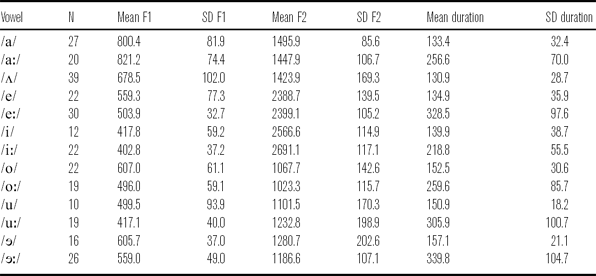
Mean formant values for each speaker are given in Tables B1–B4. Vowel duration is included for two speakers for whom the data are most consistent in register.
Means and standard deviations (SDs) F1 and F2 for speaker AS (Northway).

Means and standard deviations (SDs) F1, F2 and durations for speaker RB (Northway).

Means and standard deviations (SDs) F1, F2 and durations for speaker CD (Tetlin).

Means and standard deviations (SDs) F1 and F2 for speaker YJ (Tetlin).