Introduction
The ability to regenerate amputated appendages has been documented in many taxa, including annelids (Yanez-Rivera & Mendez, Reference Yanez-Rivera and Mendez2014), cnidarians (Passamaneck & Martindale, Reference Passamaneck and Martindale2012), planarians (Lobo et al., Reference Lobo, Beane and Levin2012) crustaceans (Shock et al., Reference Shock, Foran and Stueckle2009), and insects (Wolpert, Reference Wolpert2015). Among vertebrates, limb regeneration is known for some species of fish (Murciano et al., Reference Murciano, Fernandez, Duran, Maseda, Ruiz-Sanchez, Becerra, Akimenko and Mari-Beffa2002; Cuervo et al., Reference Cuervo, Hernandez-Martinez, Chimal-Monroy, Merchant-Larios and Covarrubias2012) and lizards (Alibardi, Reference Alibardi2012), but the capacity is most highly developed in urodele amphibians (Brockes & Gates, Reference Brockes and Gates2014). Salamanders, especially Ambystoma mexicanum (Shaw), have often been used as a model system (e.g., Nacu & Tanaka, Reference Nacu and Tanaka2011) and have revealed a complex interplay between neural (e.g., Satoh et al., Reference Satoh, Graham, Bryant and Gardiner2008, Reference Satoh, Bryant and Gardiner2012) and endocrinological (Kumar et al., Reference Kumar, Nevill, Brockes and Forge2010) factors in the process of limb regeneration from epithelial tissues.
There has been little work on limb regeneration in insects and most has focused on elucidating mechanisms of regeneration during nymphal molts in species with incomplete metamorphosis, such as cockroaches (Truby, Reference Truby1983; Tanaka et al., Reference Tanaka, Ohtake-Hashiguchi and Ogawa1987), mantids (Karuppanan, Reference Karuppanan1998), bugs (Knobloch & Steel, Reference Knobloch and Steel1988), and crickets (Lakes & Mucke, Reference Lakes and Mucke1989; Li et al., Reference Li, Zhang and Na2007). Regeneration in arthropods can occur only during the process of molting when the epidermis separates from the cuticle; molting is often delayed following amputation and more than one molt may be required for complete regeneration in both crustaceans (e.g., Selin, Reference Selin2003) and insects (Wigglesworth, Reference Wigglesworth1965). Although the pupal stage of holometabolous insects effects a transformation of the entire body plan, an ideal opportunity for regeneration, research has rarely addressed the possibility of pupal stage regeneration of limbs lost in larval stages. Singh et al. (Reference Singh, Kango-Singh, Parthasarathy and Gopinathan2007) demonstrated that the adult legs of Bombyx mori (L.) (Lepidoptera: Bombycidae) develop from their larval prototypes, rather than imaginal discs, and do not regenerate either segments or complete legs ablated in the larval stage. Lee et al. (Reference Lee, Sze, Kim and Suzuki2013) used RNA interference techniques to demonstrate a similar continuity between larval and adult leg development processes in Tribolium castaneum (Herbst) (Coleoptera: Tenebrionidae). Mitten et al. (Reference Mitten, Jing and Suzuki2012) explored the proteases involved in the healing process prior to blastema formation and leg regeneration during larval molts in T. castaneum, but again, leg regeneration in the pupal stage was not observed (Shah et al., Reference Shah, Namigai and Suzuki2011).
Harmonia axyridis Pallas (Coleoptera: Coccinellidae) is a polyphagous insect predator that has often been employed in biological control, but is now a cosmopolitan invasive species causing negative ecological impacts throughout much of the world (Michaud, Reference Michaud2002; Koch, Reference Koch2003; Roy & Wajnberg, Reference Roy and Wajnberg2008). Preliminary experiments with an H. axyridis population native to Beijing, China, revealed that a large proportion of larvae subjected to foreleg amputation early in the fourth instar were able to regenerate the leg during the pupal stage. Both male and female H. axyridis are sensitive to indicators of relative fitness in their mates, such as elytral background color which can be either red/orange (succinic) or black (melanic), the two phenotypes being alternatively advantaged or disadvantaged depending on whether they occur in the spring or fall generation (Wang et al., Reference Wang, Michaud, Zhang, Zhang and Liu2009). Both sexes can modulate their reproductive investment according to whether the phenotype of their mate is seasonally favored, as measured by strength of mate preference (females), duration of copula (males), and egg retention period post-copula (females). We hypothesized that regenerative ability could potentially serve as an ‘honest’ signal of mate quality, sensu the handicap principle (Zahavi, Reference Zahavi1975; Grafen, Reference Grafen1990a , Reference Grafen b ; Zahavi & Zahavi, Reference Zahavi and Zahavi1997), since only individuals with high fitness would be expected to survive, and repair, such a significant physiological trauma.
In the present study, we used laboratory experiments to test the consequences of leg regeneration for male fitness, female choice, and offspring fitness in H. axyridis. We hypothesized that (1) physiological costs of amputation would be manifest in negative impacts on pupal development, adult body size, and/or adult reproductive performance; (2) regenerative capacity would be correlated with other traits contributing to elevated fitness and; (3) females should mate preferentially with regenerators, provided they are able to distinguish them, and discriminate against non-regenerators. In addition, since males of many coccinellid species, including H. axyridis, use paternal effects to modulate the developmental phenotype of their progeny in beneficial ways (e.g., Michaud et al., Reference Michaud, Bista, Mishra and Omkar2013; Mirhosseini et al., Reference Mirhosseini, Michaud, Jalali and Ziaaddini2014), we argued (4) that amputation would negatively impact offspring phenotypes via diminished paternal effects and, (5) that these impacts would be greater for progeny of non-regenerators than regenerators, assuming regenerative capacity was a property of high-fitness genotypes. Finally, we assessed the heritability of regeneration by subjecting subsets of the F1 generation to limb amputation and comparing their survival and regenerative capacity among paternal types.
Materials and methods
Insect colony
Adult H. axyridis (ca. 300) were collected by sweep net from a wheat field on the campus of Beijing Academy of Agriculture and Forestry Sciences (BAAFS) in Beijing, PRC. The beetles were held in aluminum frame cages (40.0 × 40.0 × 45.0 cm) covered with nylon mesh, 20 pairs per cage, and provisioned daily with ad libitum Myzus persicae Sulzer grown on tobacco seedlings in a climate-controlled growth chamber. The cages were held in climate-controlled growth chambers (Sanyo, MH351, Osaka, Japan) set to a constant temperature of 25.0 ± 1.0°C, RH = 60–70% and a 16:8 L:D photoperiod under a light intensity of 600 lux. All experimental insects were maintained under the same conditions as the stock colony. Eggs were collected daily and held in plastic Petri dishes (9.0 cm diam) until eclosion. Neonate larvae were reared in similar Petri dishes, five per dish, with ad libitum M. persicae nymphs refreshed daily until larvae pupated.
Limb amputation
A cohort of 300 H. axyridis larvae were reared from the offspring of five females. As larvae molted to the fourth instar, a series of 40 were selected from each maternal lineage on the basis of similarity in size, for a total of 200. From each sibling group, 30 were assigned to treatment (limb amputation) and 10 to controls. For limb amputation, newly-molted, fourth instar larvae (ca. 24 h post-molt) were chilled for 5 min in a refrigerator at 5.0°C. The left foreleg of each larvae was then amputated at the base of the coxa using a surgical scalpel. The larvae were then isolated in plastic Petri dishes (4.5 cm diam) with their maternal lineage marked, and provisioned daily with ad libitum microencapsulated beads of artificial diet (Tan et al., Reference Tan, Zhao, Wang and Zhang2014). Control larvae were treated in exactly the same way except that no limb was amputated. We recorded developmental time, the number of larvae that pupated, the fresh mass of pupae on their second day of pupation, and the number and sex of successfully emerging adults. Treatment adults were divided into two groups according to whether or not they had regenerated the amputated limb during pupation. Emerged adults were isolated in Petri dishes (as above) and fed ad libitum artificial diet, refreshed daily. Each adult was weighed on the day of emergence, prior to feeding, and again 7 days post-emergence. Since more melanic individuals (black elytra with variable numbers of red spots) were represented in the regenerated group than were succinic individuals (orange/red elytra with variable numbers of black spots), and melanism is a criterion for mate choice that varies seasonally in this species (Wang et al., Reference Wang, Michaud, Zhang, Zhang and Liu2009, Reference Wang, Michaud, Tan, Murray and Zhang2012), it was decide to use only melanic forms in subsequent mating tests.
Mating observations – no choice
Three mating treatments were established (n = 50 replications per treatment) when adults were 10 days old: (1) regenerated ♂ × control ♀, (2) unregenerated ♂ × control ♀ and, (3) control ♂ × control ♀. Beetles were paired in Petri dishes with ad libitum diet beads, ensuring that all pairings were non-siblings, and directly observed to record time to copula and duration of copula. Upon termination of copula, the male was removed and female held in isolation with ad libitum diet beads refreshed daily for the duration of her life. We recorded the total eggs laid by each female, the proportion hatching, and her longevity (days from emergence to death).
Mating observations – choice
Another cohort of 300 larvae were reared from the offspring of five females and prepared for the experiment as described above. Once they molted to the fourth instar, 150 were operated on in the same manner as described above. Mating arenas were prepared in Petri dishes (as above) with ad libitum diet beads (n = 100) in each. Each replicate consisted of a Petri dish containing one male of each type (regenerated, unregenerated, and control), selected to be approximately similar in size to prevent any possibility of size-based effects on male mating success. Small (1.0 mm2) color-coded squares of adhesive plastic film were affixed to the left elytra of each male so that control and regenerated males could be distinguished. A single, control female, non-sibling to all males, was then introduced to the dish and directly observed until she copulated. We recorded the type of male selected by the female, the time to copula, and the duration of copula. Following termination of copula (disengagement of genitalia), the males were removed and all reproductive data were recorded for the female (as in the previous experiment) for the duration of her life.
Performance of the F1 generation
A series of ca. 500 larvae were reared from 5 to 6 egg clusters collected from each of the three no-choice mating treatments. The first instar larvae were isolated in plastic Petri dishes (as above) and supplied with ad libitum diet beads until they pupated. Following emergence of adults, the duration of development and survival (%) of each developmental stage was recorded. An additional 200 larvae were reared from each no-choice paternity treatment (in five cohorts of 40 individuals) and, within 24 h of molting to the fourth instar, a series of 150 larvae (selected to be of approximately similar size) each had a left foreleg amputated (as above). All larvae were then reared on ad libitum diet beads, refreshed daily, until they emerged as adults, which were then assessed for limb regeneration.
Data analysis
All data passed tests for normality (Shapiro–Wilk test) and homogeneity of variance (Levene's test) and were analyzed by ANOVA. A 2-way ANOVA was used to test for interactions between maternal lineage and treatment. When three or more means were compared, they were separated by the Bonferroni test (α = 0.05). Mating frequencies in 3-way choice tests and frequencies of melanism in the F1 generation were analyzed using the Chi-square (χ2), Goodness-of-fit test.
Results
Limb amputation
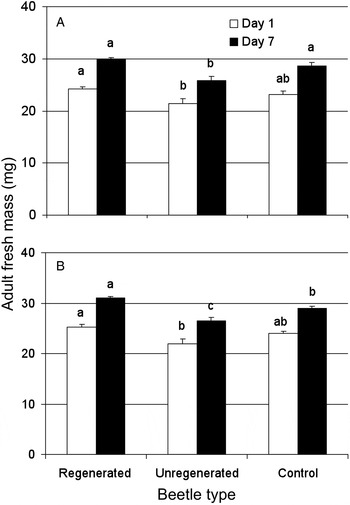
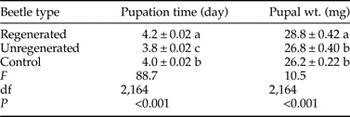
Of the 150 larvae subjected to foreleg amputation, 124 (82.7%) survived to emerge as viable adults and, of these, 93 (75.0%) regenerated the severed leg (42♀♀, 51♂♂), whereas 31 (25%) did not (15♀♀, 16♂♂). Of regenerated individuals, 64.5% were melanic, compared to 45% of non-regenerates; control phenotypes were 67% melanic. Pupae that survived the treatment were heavier 2 days post-pupation than were control pupae, and both were heavier than pupae that died (F 2,190 = 39.38, P < 0.001, Bonferroni α = 0.05). Regenerating beetles spent, on average, 4–5 h longer in the pupal stage than did controls, whereas unregenerating beetles pupated almost half a day earlier (table 1). Regenerated males were heavier than unregenerated males on both weighing dates (F 2,85 = 5.1, P = 0.008 and F 2,85 = 13.9, P < 0.001, respectively, fig. 1a). The same pattern held true for females (F 2,76 = 6.6, P = 0.002 and F 2,85 = 21.4, P < 0.001, respectively) except that on the second sampling date, regenerated females were heavier than control females, that were in turn heavier than unregenerated females (fig. 1b). Regenerating beetles also gained more weight during their first week of adult life (mean ± SE = 5.7 ± 0.25 mg) than did non-regenerating beetles (mean ± SE = 4.5 ± 0.41 mg; F 2.164 = 3.60, P = 0.030), with controls intermediate (mean ± SE = 5.1 ± 0.32 mg).
Mean (+SE) fresh body weights of H. axyridis males (A) and females (B) on their first (open columns) and seventh (closed columns) days of adult life following regeneration of a single foreleg amputated in the fourth instar (regenerated) or not (unregenerated) or unoperated (control). Columns bearing different letters were significantly different from others of the same type (Bonferroni, α = 0.05).

Mean (±SE) pupation times and fresh weights 2 days post-pupation for H. axyridis adults that either had a single foreleg amputated in the fourth larval instar and regenerated the leg following pupation (regenerated) or did not (unregenerated), or were unoperated (control). Values bearing the same letter were not significantly different within columns (Bonferroni, α = 0.05).

Mating observations – no choice
There was no significant interaction between ‘maternal lineage’ and ‘treatment’ for time to copula (F 8,135 = 0.38, P = 0.927), fecundity (F 8,135 = 0.16, P = 0.996), or egg fertility (F 8,135 = 0.16, P = 0.995), but the interaction term was significant for duration of copula (F 8,135 = 3.28, P = 0.002). Furthermore, there was no significant main effect of maternal lineage on time to copula (F 4,135 = 0.77, P = 0.544), fecundity (F 4,135 = 1.21, P = 0.308), or egg fertility (F 4,135 = 0.355, P = 0.840), but there was on duration of copula (F 4,135 = 4.69, P = 0.001). The time to copulation was shortest for females provided with regenerated mates and longest for those provided with unregenerated males, with control males intermediate (table 2). Duration of copula was similar for control and regenerated males, but was reduced by about 40% for unregenerated males. Females paired with regenerated males obtained the highest fecundity, 20% higher than females paired with control males, whereas fecundity was 30% lower for females paired with unregenerated males. There was no significant effect of treatment on egg fertility.
Mean (±SE) time to copula, duration of copula, and reproductive success of female H. axyridis mated to males in a no-choice situation that either had a single foreleg amputated in the fourth larval instar and regenerated the leg following pupation (regenerated) or did not (unregenerated), or an unoperated, control male (control). Values bearing the same letter were not significantly different within columns (Bonferroni, α = 0.05).

Mating observations – choice
Females preferred to mate with regenerated males, selecting them 53 of 100 trials, compared to 20 unregenerated males and 25 control males (χ2 = 19.18, 2 df, P < 0.001). There were no significant interactions between maternal lineage and treatment for duration of copula (F 6,98 = 1.98, P = 0.078), female fecundity (F 6,98 = 0.31, P = 0.928), or egg fertility (F 6,98 = 0.84, P = 0.540). Also, there were also no significant main effects of maternal lineage on duration of copula (F 4,98 = 0.67, P = 0.615), female fecundity (F 4,98 = 2.15, P = 0.081), or egg fertility (F 4,98 = 2.11, P = 0.087). Duration of copula was about 4% lower in pairings with regenerated males compared to control males, but 46% lower in pairings with unregenerated males (table 3). Fecundity was similar for females that mated with control and regenerated males, but was reduced by about 25% for females that mated with unregenerated males. However, egg fertility was highest for females choosing regenerated males, with no difference between females choosing control and unregenerated males.
Mean (±SE) duration of copula, and reproductive success of female H. axyridis given a choice of males that either had a single foreleg amputated in the fourth instar and regenerated the leg during pupation (regenerated) or did not (unregenerated), or an unoperated, control male (control). Values bearing the same letter were not significantly different within columns (Bonferroni, α = 0.05).

Performance of the F1 generation
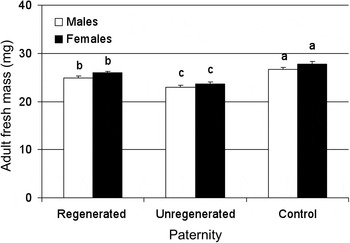
The 2-way ANOVA revealed no significant interactions between maternal lineage and treatment for male body mass (F 6,88 = 2.27, P = 0.086) or female body mass (F 6,112 = 1.30, P = 0.277) and there were no significant main effects of maternal lineage for male (F 4,88 = 2.27, P = 0.086) or female body mass (F 4,112 = 2.27, P = 0.086). Progeny sired by control males had significantly faster development than progeny of operated males, regenerated or not, in the critical egg, fourth instar and pupal stages, leading to faster larval and total developmental periods (table 4). There were no significant interactions between maternal lineage and treatment for eclosion time (F 8,197 = 0.40, P = 0.920), duration of the fourth instar (F 8,170 = 1.50, P = 0.161), pupation time (F 8,161 = 0.38, P = 0.932) or total developmental time (F 8,161 = 1.07, P = 0.388) and no main effects of lineage on eclosion time (F 4,197 = 0.63, P = 0.641), pupation time (F 4,161 = 1.01, P = 0.405), or total developmental time (F 4,161 = 0.28, P = 0.888), although there was a main effect of maternal lineage on duration of the fourth instar (F 4,170 = 4.28, P = 0.003). Progeny sired by unregenerated males were less likely to survive from egg to adult than progeny of either regenerated or control males (table 4). Adult fresh mass was highest for progeny of control males, followed by progeny of regenerated males, and lowest for progeny of unregenerated males (fig. 2), regardless of whether sons (F 2,117 = 23.21, P < 0.001) or daughters (F 2,93 = 15.17, P < 0.001) were considered.
Mean (+SE) fresh body weights of H. axyridis male (open columns) and female (closed columns) progeny sired by males of three different types: those that successfully regenerated a single foreleg amputated in the fourth instar (regenerated) or did not (unregenerated) or unoperated (control). Columns bearing different letters were significantly different from others of the same sex (Bonferroni, α = 0.05).

Mean (±SE) developmental parameters for progeny of H. axyridis females mated to males that either regenerated a foreleg amputated in the fourth instar (regenerated) or did not (unregenerated), or an unoperated, control male (control).

1 Pairwise, two-tailed test of proportions, weighted by sample size.
Means followed by different letters were significantly different within rows (Bonferroni, α = 0.05).
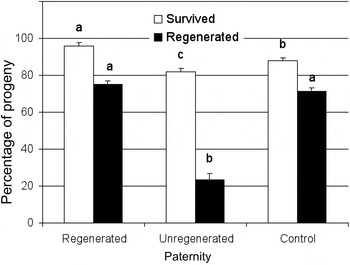
When subjected to leg amputation early in the fourth instar, progeny sired by regenerated males were significantly more likely to survive leg amputation than were those sired by control progeny, which in turn were more likely to survive amputation than those sired by unregenerated males (F 2,12 = 17.5, P < 0.001, fig. 3). Furthermore, rates of limb recovery were similar for progeny sired by regenerated and control males, but were about two-thirds lower for progeny sired by unregenerated males (F 2,12 = 134.7, P < 0.001). Progeny of regenerated males were 78.2% melanic, which was twice the frequency of melanism in progeny of unregenerated males (39.5%) or control males (38.3%; χ2 = 20.84, 2 df, P < 0.001).
Mean (+SE) percentages of H. axyridis progeny that survived (open columns) and regenerated a single foreleg amputated in the fourth instar (closed columns) when sired by males of three different types: those that successfully regenerated a single foreleg amputated in the fourth instar (regenerated) or did not (unregenerated) or unoperated (control). Columns bearing different letters were significantly different from others of the same type (Bonferroni, α = 0.05).

Discussion
Amputation of a single foreleg had negative impacts on beetle development, supporting our initial hypothesis, and regenerating beetles were less impacted than non-regenerating beetles, supporting our second hypothesis. Beetles that successfully regenerated forelegs pupated at heavier weights than did control or non-regenerating beetles, suggesting that they consumed more food prior to pupation (not quantified), presumably due to the resource demands of regeneration. The longer time spent by regenerating beetles in the pupal stage relative to controls can be construed as a cost of regeneration. However, regeneration was also associated with greater weight gain during maturation, i.e., the first week of adult life, compared to non-regeneration, suggesting that regenerative capacity was associated with high voracity in both larval and adult stages. The larval ecology of H. axyridis involves strong intraguild interactions with many other predatory arthropods on the aphid colonies where they develop (Michaud, Reference Michaud2002; Pell et al., Reference Pell, Baverstock, Roy, Ware and Majerus2008; Katsanis et al., Reference Katsanis, Babendreier, Nentwig and Kenis2013). Clearly, the ability to regenerate a lost limb will yield a selective advantage for predators that must develop in an environment full of dangerous competitors. However, it is also possible that limb regeneration is not under direct selection itself, but is linked to other traits that are (e.g., high egg fertility). Further investigation is thus warranted to determine what other biological traits might be linked to regenerative ability in both males and females.
Our third hypothesis was also supported; females clearly favored mating with regenerating males over controls or non-regenerators. Females assigned unregenerated males in the no-choice experiment took longer to accept them and obtained shorter copulations and lower fecundities relative to either control or regenerated males. Thus, failure to regenerate a leg was associated with a reduction in male fitness that was not suffered by males able to regenerate. Females were also able to distinguish regenerated males from control males, despite their superficial similarity, coupling with them more than twice as quickly in the no-choice experiment, and more often than expected by chance in the choice experiment. Females that selected unregenerated males received shorter copulations and obtained lower fecundities than those selecting control or regenerated males. Females selecting regenerated males obtained higher egg fertility than females selecting control males, although their mean fecundity was similar and their duration of copula slightly shorter. Thus, regenerative capacity appeared to be associated with a suite of male traits that were both preferred by females, and that improved their reproductive performance, raising the possibility that it is a byproduct of selection acting on other traits associated with male fitness or reproductive success.
The mechanism by which females recognized regenerated males was not resolved in these experiments. Since regenerated beetles tended to have higher pupal weights, it might be argued that females responded to the larger size of regenerated males. Ueno et al. (Reference Ueno, Sato and Tusuchida1998) found that H. axyridis males collected in copula in central Japan tended to be larger than those collected as solitary beetles, although this was true only for non-melanic forms and could have resulted from large males being more successful in overpowering reluctant females. For example, Perry et al. (Reference Perry, Sharpe and Rowe2009) found that starved female Adalia bipunctata L. were just as likely to resist matings from large males as from small ones, although the former were more effective at countering this resistance. To our knowledge, size has not yet been unequivocally established as a criterion for female choice in any coccinellid species. We suggest that qualitative differences in biochemistry associated with regenerative capacity are more likely to explain our results than differences in male size. Various species-specific alkaloids are endogenously produced by coccinellids (Daloze et al., Reference Daloze, Braekman and Pasteels1995; Laurent et al., Reference Laurent, Braekman, Daloze and Pasteels2002; Haulotte et al., Reference Haulotte, Laurent and Braekman2012). Although used primarily in defense, these compounds serve multiple ecological signaling functions including oviposition deterrence (Hemptinne & Dixon, Reference Hemptinne and Dixon2000; Martini et al., Reference Martini, Haccou, Olivieri and Hemptinne2009) and sexual identity (Hemptinne et al., Reference Hemptinne, Lognay and Dixon1998). Evidence of kin-recognition in H. axyridis and other coccinellids (Joseph et al., Reference Joseph, Snyder and Moore1999; Michaud, Reference Michaud2003; Martini et al., Reference Martini, Dixon and Hemptinne2013) suggests that these insects are sensitive to subtle, qualitative differences in semiochemistry that could also facilitate individual recognition and assessment of physiological condition. Regenerative capacity was also positively associated with melanism in both generations, suggesting a pleiotropic influence of melanism on processes involved in regeneration. Melanin has pleiotropic effects on multiple biological functions in both vertebrates and invertebrates, including developmental processes (True, Reference True2003). For example, previous work on H. axyridis has shown that alkaloid profiles can vary as a function of degree of melanization (Bezzerides et al., Reference Bezzerides, McGraw, Parker and Husseini2007) and that melanism itself is a flexible criterion for mate choice in this species (Osawa & Nishida, Reference Osawa and Nishida1992; Wang et al., Reference Wang, Michaud, Zhang, Zhang and Liu2009, Reference Wang, Michaud, Tan, Murray and Zhang2013).
The trauma of amputation inflicted costs on males that extended to the fitness of their progeny, supporting our fourth hypothesis. Progeny of amputated males had slower development and lower adult mass compared to control males, regardless of whether they regenerated the limb or not, indicating that amputation negatively impacted (or diminished) normal paternal effects. Paternal effects in the Coccinellidae can vary with male age and condition but are normally beneficial, typically enhancing egg fertility, accelerating progeny development, and increasing adult body size (e.g., Michaud et al., Reference Michaud, Bista, Mishra and Omkar2013; Mirhosseini et al., Reference Mirhosseini, Michaud, Jalali and Ziaaddini2014). Deleterious genetics appeared to be associated with a lack of regenerative ability, as progeny of unregenerated paternity had lower survival than progeny of control paternity, and lower adult body mass than progeny of regenerated paternity, supporting our fifth hypothesis.
Female reproductive data support a linkage between regeneration and male fitness; females obtained more viable offspring by mating with regenerated males, even though their developmental phenotypes were slightly impaired. Since regeneration is not fixed within the population, tradeoffs likely exist between regenerative capacity and other traits linked to fitness. A better understanding of these tradeoffs will require data on the relative fitness of regenerators versus non-regenerators with and without the trauma of leg loss, under both laboratory and natural conditions. Experimentally, this would require some molecular marker of regenerative capacity that, if recoverable from the egg chorion, could be used to distinguish regenerators in the larval stage without subjecting them to amputation. However, regenerative capacity had relatively high heritability; when offspring of regenerated males were themselves subjected to foreleg amputation, they had higher rates of survival than offspring of either control or unregenerated males. Although progeny of regenerated and control beetles exhibited similar regenerative abilities, progeny of unregenerated beetles had only one-third the probability of replacing the limb.
One caveat of our experiments is that the left foreleg was always amputated, and it is possible the regenerative process may have a lateral bias. Behavioral lateralization is well recognized in higher vertebrates (Rogers & Andrew, Reference Rogers and Andrew2002) and evidence is emerging of its importance in insect behavior as well (Frasnelli et al., Reference Frasnelli, Vallortigara and Rogers2012). For example, Benelli et al. (Reference Benelli, Donati, Romano, Stefanini, Messing and Canale2015) used high-speed video recording to demonstrate population-level behavioral asymmetries in Mediterranean fruit flies, Ceratatis capitata (Wiedemann), characterized by the preferential utilization of left-side body parts (forelegs and wings) in aggressive same-sex interactions. If there exist behavioral asymmetries in the mating behavior of H. axyridis, amputation of the right foreleg may not yield the same results as amputation of the left, assuming regenerated forelegs differ in functionality. Thus, limb-regenerating H. axyridis beetles could represent a useful model system for exploring the lateralization of biological and behavioral processes in tandem.
Conclusion
A large majority of H. axyridis larvae subjected to limb amputation early in the fourth instar were able to regenerate the limb during pupation, although they required additional resources to do so (increased consumption and more time in the pupal stage). Regenerated males were preferred as mates by females and endowed them with higher reproductive success, although paternal effects on progeny were compromised. To date, research on limb regeneration in holometabolous insects has been limited to examination of mechanisms in larvae of flour beetles and silkworms, species unable to regenerate legs beyond larval stages. Our findings suggest that pupal limb regeneration in the Coleoptera, and perhaps other holometabolous insect orders, might be more widespread than currently recognized. The fact that the H. axyridis population remains polymorphic for regenerative capacity and suggests that it may entail fitness tradeoffs, an important topic for future investigation. This is the first report of complete limb regeneration in the pupal stage by a holometabolous insect, and the first known example of sexual selection for regenerative capacity.
Acknowledgements
This study was funded through the Major State Basic Research Development Program of China (973 Program (No. 2013CB127605), Beijing Nova program (No. Z121105002512039) and Special Fund for Agro-scientific Research in the Public Interest (No. 201303108), and the Beijing NOVA program (No. Z121105002512039). This is contribution No. 15-157-J of the Kansas Agricultural Experiment Station.