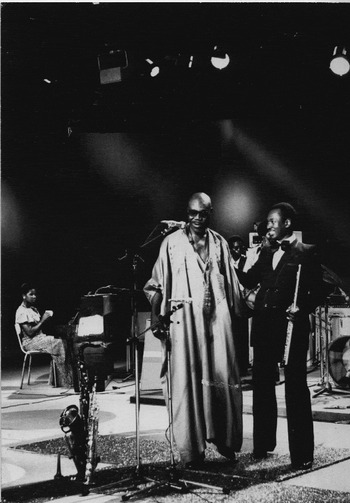
INTRODUCTION: A TALE OF TWO ORCHESTRAS
On 11 January 1964, just over three years after formal independence from France, the Republic of Mali's ruling party – Union Soudanaise de Rassemblement Démocratique Africain (US-RDA) – sent ten students to Cuba for conservatory training. The goal was to establish a professional corps of musical educators for Mali's cultural institutions, such as the National Arts Institute and a proposed National Conservatory (Touré Reference Touré1996: 90). By 1965, these students had formed a band and in 1967 they recorded their first album at Havana's legendary Egrem Studios under the name ‘Las Maravillas de Mali’ (The Mali Marvels). On vacation in Mali later that year, Las Maravillas members affirmed their commitment to their country with a performance for President Modibo Keita at the presidential palace in Bamako. For these artists, the Malian ‘nation’ was no empty concept; it was a homeland to which they hoped to return and an ideal they were called on to represent as cultural ambassadors. In 1970, two years after the military coup that toppled the Keita regime, Las Maravillas members came home to a state they scarcely recognized and that, in turn, scarcely recognized them.Footnote 1
In 1972, Lieutenant Tiécoro Bagayoko, head of the national security services and principal artistic patron at the Motel de Bamako, dissolved the Motel's house band and formed a new group, Les Ambassadeurs du Motel. Tailored to Bagayoko's penchant for ‘authentic’ music, the group was composed of local Malian musicians and cultivated a repertoire grounded in jeliya, the Mande tradition of musical panegyric. In 1973, Bagayoko used his political clout to stage a musical coup, acquiring vocalist and rising star Salif Keita from the Rail Band, the popular orchestra of the downtown railway station. A noble (hòròn) by birth and a musician by profession, Keita was a master of the vocal art of jeliya, a genre of praise song that greatly pleased his new Motel patron. In 1975, Bagayoko staged yet another coup de culture, insisting that his private orchestra, Les Ambassadeurs, join the National Orchestra, Las Maravillas, on a tour to neighbouring Guinea for the Quinzaine Artistique, a state-sponsored cultural festival. Following the lead of their front man, Keita, Les Ambassadeurs stole the show. Their success highlighted the divergent fortunes of these two groups and signalled a definitive shift from public to private interests in the cultural policy of post-colonial Mali.
To observe the experiences and expressions of Las Maravillas de Mali and Les Ambassadeurs du Motel, from the former's propitious departure to Cuba in 1964 to the latter's performative triumph at the Quinzaine Artistique in 1975, is to witness a key shift in Malian governance, manifest in diverging conceptions of national belonging and state patronage. By following the lives and works of Las Maravillas and Les Ambassadeurs across a decade split by the 1968 coup, this essay will historicize the tension between ‘nationalism’ – the prescriptive ideal of an inherent political community – and ‘statism’ – the affiliative politics of partisan governance – in post-colonial Mali. I do so by drawing attention to the significant role played by professional musicians in interpreting and shaping these changes in politics and society. Through oral history, recorded sound, and documentary evidence, I explore the way members of Las Maravillas and Les Ambassadeurs accommodated and critically negotiated the ‘nationalist’ and ‘statist’ regimes of Mali's socialist First Republic (1960–8) and the subsequent military dictatorship (1968–79) of its Second Republic.
This historical reflection has important implications for the present day. On 22 March 2012 an improvised mutiny at Mali's main garrison triggered a coup d’état. This event has thrust the Malian nation state into an entrenched political and economic crisis and contributed to its de facto territorial splitting following emboldened ethnic nationalist and Islamist uprisings in the north.Footnote 2 Unfolding in the wake of celebrations commemorating fifty years of independence from colonial rule (1960–2010), and sounding a violent counterpoint to reformist ‘springs’ manifest across North and sub-Saharan Africa, the coup and its aftermath refocus attention to debates about the nature and scope of political community, governance, citizenship and sovereignty in contemporary Africa.Footnote 3 The soundscapes of celebration and protest echoing on the airwaves, over the Internet, and in the raised voices of urban assemblies remind us of the important role the performing arts (and music in particular) play in giving substance to, but also offering timely critique of, state–subject relations within nations and, with regard to Mali's de facto division, their fragments (Chatterjee Reference Chatterjee1994).Footnote 4 In following the post-colonial careers of Las Maravillas and Les Ambassadeurs we explore social and musical encounters with national community and state authority from which emerge broader questions of political sovereignty and accountability that continue to be asked of the modern nation state – in Mali, Africa and the world – into the present.
NATIONALISM, STATISM AND THE POLITICS OF CULTURE IN MALI
I begin by charting the conceptual terrain of this inquiry. In Mali, the terms faso and jamana gloss locally salient ideologies of ‘nation’ and ‘state’, marking poles of socio-political filiation and affiliation along a historical continuum of post-colonial governmentality. As Mande cultural theorist Chérif Keïta writes, ‘the word jamana, which implies risk-taking, distance and unpredictability stands, in the mind of the Malinke, in sharp contrast with the relative complacency and predictability which mark life within the limits of the faso, the father's house or the fatherland’ (1996: 102). Articulated through the discourse of Mande social thought that pervades the Malian public sphere,Footnote 5 faso and jamana represent the collectively ‘stable’ and individually ‘unpredictable’ relations that bind political subjects to the nation state, by birth or by choice. They signify, in other words, categorical forms of governmentality, the disciplinary and regulatory politics through which populations are conceived, managed and administered in modern polities (Foucault Reference Foucault2007: 108–9). As keywords in the discursive field of post-colonial governance in Mali, I employ faso and jamana as hermeneutic devices through which the more general concepts of ‘nationalism’ and ‘statism’ may be better understood in the Malian context. Derived from Mali's lingua franca, Bamana, faso and jamana communicate particular meanings and feelings about the nation state that the terms ‘nationalism’ and ‘statism’ do not, alone, convey. Thus, I juxtapose these two sets of terms (faso/jamana and nationalism/statism) throughout the essay to highlight the historically contingent and culturally salient significations and sentiments that accrue to nationalist and statist governmentalities in this West African nation state.
In Bamana, faso translates as ‘father's home’, and refers to one's native community in a patriarchal society. After independence in 1960, faso takes on the political meaning of ‘nation’, becoming the ‘homeland’ of the new Malian citizen, or Maliden, meaning ‘child of Mali’. This neologism is particularly evident in popular song of the era. ‘Rise and build the nation!’ (‘An ka wuli ka fasobaara!’) sings Boubacar Traoré in his 1960s hit ‘Mali Twist’, ‘performing the nation’ (Askew Reference Askew2002) on the airwaves and dance floor. ‘Emigration is bad!’ (‘Tunga ma nyi!’) warns the Bamako band Pionnier Jazz, calling on children of Mali to ‘return to their homeland’ (‘na an ka faso la’). ‘We are nothing without work for our homeland!’ (‘An te foyi la ni fasobaara te’) proclaims the Ensemble Instrumental National, reminding their Malian public that they ‘are in a good place’ (‘aw bè sigi diya’).Footnote 6 Much like the post-independence concept of Ujamaa in Tanzania, faso comes to signify a socially rooted political ideal of collectivity within a prescribed state socialism.Footnote 7 In 1968, a US-RDA party official emphasized the importance of this familial state–subject relationship, writing: ‘Mali is a big family whose head is the Union Soudanaise RDA party. As a good father, the US-RDA wants to make all its children happy.’Footnote 8 Articulating a moral bond of consanguinity, the socio-political concept of faso, along with the familial notion of political subjectivity, Malidenya, entailed citizens’ common duty to support and advance the national interests of their fakòròba, or ‘elder patron’, the one-party state.
In contrast to the nationalist concept of faso, jamana refers to a theoretically voluntary society derived from the Arabic jamaca, meaning ‘assembly’ or ‘congregation’.Footnote 9 In the years following the coup in 1968, a new statism defined political subjectivity in terms of individual responsibility to the government, emphasizing voluntary and, in practice, opportunistic allegiances over the inherent yet prescribed ties of the faso. It is this post-national(ist) and affiliative statism that I am qualifying with the term jamana. This socio-political sense of jamana can be heard at the conclusion of President Moussa Traoré's Reference Traoré1979 Independence Day speech, when he emphasizes that ‘what must be developed among Malians, is a sharper sense of the State, that is to say the citizen's solidarity with the State’ (Traoré Reference Traoré1979: 6). A historically deeper reference may be traced to the colonial-era canton chiefs, or jamanatigiw, the principal agents of what Mahmoud Mamdani (Reference Mamdani1996) calls the ‘decentralized despotism’ of associative indirect rule – a colonial mode of statist affiliation – in French West Africa (see Delavignette Reference Delavignette1950). While the political subjects of (post-)colonial statism do draw on the filial ties of kinship and clan relations (for which ‘nepotism’ represents another significant qualifier), the jamana ‘family’ does not appeal to national consciousness as the patrimonial faso does. Indeed, within the disciplinary hegemony of the jamana state, the very idea of ‘the nation’ as an inherent political community is radically unsettled. As an expression of post-colonial governmentality, jamana is, as I have elsewhere argued, an ‘equivocal and troublesome’ (or ‘risky’ and ‘unpredictable’, in Keita's terms) category of political society that may be understood as an ideological counterpoint to the more concrete and explicitly nationalist concept of the post-colonial faso (County and Skinner Reference Skinner, Falola, Afolabi and Adésànyà2008: 182–3).
In this essay, I will trace the socio-political expressions of this discursive move from nationalism to statism – faso to jamana – by examining Mali's post-colonial politics of culture before and after the 1968 coup. My focus is on the experience of Malian artists who were the objects of and subject to Mali's cultural policies under nationalist and statist regimes. In this historical context, I interpret ‘culture’ not as a natural and neutral concept of social formation and identification but as an emergent and contested target of post-colonial governmentality. As an edifying and expedient (Yudicé Reference Yudicé2004) product of state patronage in Mali's First Republic (1960–8), ‘culture’ – articulated through state-sponsored music, theatre, and dance troupes – accrued nationalist use value, becoming a salient means of propaganda for the government's nation-building efforts (see Keïta Reference Keïta2001: 27).Footnote 10 Yet determining both the ‘use’ and ‘value’ of national culture was a negotiated, contested, and, thus, thoroughly political process, manifest in particular encounters with an emergent national hegemony. Following the 1968 coup, the political project of producing national consensus and fostering nation building (fasobaara) through cultural expression lost its privileged status, engendering a post-national (or post-faso) politics of culture characterized by the devolution of cultural institutions, the widespread emigration of culture producers, and the proliferation of parastatal and privatized patronage networks. It is to this post-colonial cultural politics that I now turn.
To begin with, a particular look at the experience of Las Maravillas de Mali reveals a shifting and contested set of political and professional obligations and expectations engendered by state-sponsored culture under the US-RDA and its military successor. For Las Maravillas members, what is at stake in this story is no less than the status and identity of the professional artist in the post-colonial nation state.Footnote 11 Having departed a state that cast itself as the ‘elder patron’ of an ancestral homeland – a politics of faso – Maravillas members returned to find an ambivalent regime predicated on state loyalty – a politics of jamana – in which their prior service to the nation as cultural ambassadors was consistently dismissed and devalued. Theirs is the story of an emergent and disputed political subjectivity and expressive culture – that of the professional artist – in the Malian post-colony.
MALI GOES TO CUBA: THE NATIONALISM OF LAS MARAVILLAS DE MALI
In 1963, Cuba, with its strong cultural and historical ties to Africa and with vested political interests in supporting the continent's independent socialist governments, granted the Republic of Mali ten scholarships for musical study at Havana's Alejandro Garcia Caturla Conservatory.Footnote 12 US-RDA officials carried out selections, recruiting students from towns and cities throughout the country: from Gao and Timbuktu in the north, Kita and Kayes in the west, the midland town of Mopti, and the southern cities of Bamako, Koutiala and Sikasso. Little consideration was given to prior musical experience or study, suggesting the selection process may have been influenced by local cronyism.Footnote 13 The scholarship selection does seem to have been a point of contention among established artists in Bamako, some of whom expected to be recruited from their state-sponsored groups for the highly valued conservatory positions (M. Coulibaly interview, 2008). Nevertheless, the process proceeded quickly and without protracted dispute. Within a few months of the scholarships’ announcement, the students were set to depart in January 1964.
With ten conservatory scholarships from Cuba, the US-RDA embarked on a programme to create a professional cadre of music educators to support the state's modernist cultural policy. Like Mali's political elites, many of whom forged their political ideologies at top schools in Senegal and France during the inter-war years (Foltz Reference Foltz1965; Manchuelle Reference Manchuelle1995; Chafer Reference Chafer2007), this group of prospective musical elites, it was anticipated, would modernize Mali's cultural production, and the artistic profession more specifically, through the rigours of institutionalized study abroad (Keïta Reference Keïta2001: 25) and the assimilation of Western instrumentation and music theory. The developmentalist idea of ‘modernity’ inherent in this and other such policies went hand in hand with claims to political and economic sovereignty. Such modernizing projects entailed the creation of institutions and industries capable of ‘building the nation’ (fasobaara), free from the influence and dependence on foreign interests and intervention, particularly that of France, the former colonizer. ‘Mali will be judged based on your behaviour,’ President Keita is said to have told the students before their departure to Havana, invoking the cautionary voice of the schoolteacher, Keita's first profession (D. Coulibaly interview, 2006). Expectations were high that the young scholars’ studies abroad would bear fruit, and quickly.
What came quickly, however, were the difficulties. A 1966 report filed by the sub-section of the US-RDA in Cuba, to which the students themselves belonged, states that, after a year of study, Malian officials were questioning the quality of the students’ education in Cuba.Footnote 14 The report cites a lack of instruments, a paucity of available professors, and insufficient weekly coursework. Worse, doubts were raised about some of the students’ loyalty to the party and the sincerity of their nationalist sentiments; that is, their commitment to the patron-state, the faso, was called into question. Officials made efforts to rectify these problems by allocating funds from the Malian mission to the United Nations to purchase instruments and filing formal complaints with the Cuban authorities about the students’ sub-standard training. As for the students, it was decided that they form an ‘orchestra’ (French, orchestre: a generic term referring to an urban dance band that uses Western instrumentation, including horns, flutes, keyboards, violins, guitars, drum kits, and Latin percussion). It was hoped that this extracurricular activity would bolster the young musicians’ academic study and provide a framework to ‘verify the comrades’ level of party activism and put them on the right path’ ahead of their planned vacation to Mali during the summer of 1967.
Taking their inspiration from a popular Cuban charanga group at the time, Orquesta Maravillas de Florida, the new Malian orchestra took the name ‘Las Maravillas de Mali’ and, from July 1965, began regular rehearsals (Figure 1). In September of that year, Las Maravillas performed for the first time at the Guinean Embassy in Cuba in honour of Mali's fifth anniversary of independence, an important opportunity for the group to prove itself to anxious Malian officials. A few months later, they made their first appearance on Cuban national television. Tours inland soon followed. In 1967 Las Maravillas recorded their first (and only) self-titled album at Havana's Egrem Studios for initial release on Areito records in Cuba (Las Maravillas de Mali 1967). Encouraged by these experiences, the ten students-turned-artists departed for Mali in June 1967 with a great deal of enthusiasm and pride. Upon arrival, members of Las Maravillas de Mali found their home country in the throes of economic and political crisis.
Las Maravillas de Mali. From left to right: Boncana Maïga, Bah Tapo, Alou Traoré, Kalilou Traoré, Salif Traoré, Moustaph Sacko and Drahmane Coulibaly. (Photo courtesy of Drahmane Coulibaly)

THE SUMMER OF '67: THE SENTIMENTS AND SOUNDS OF NATIONAL CRISIS
By 1967, the US-RDA was struggling to salvage a moribund economic development programme, to no avail. Massive fraud, the inconvertibility of the national currency, poor market conditions, and rampant inflation all contributed to the collapse of agricultural production and the stagnation of the economy (Diarrah Reference Diarrah1991: 59). With mounting budget deficits, necessitating large amounts of foreign aid, and a weak national currency that threatened the country's export-driven five-year plan, President Keita turned to France for assistance. The 1967 Franco-Malian monetary agreement effectively ceded control of Mali's monetary policy to France, critically undermining the national sovereignty of the former French colony. On 6 May, the Malian franc was devalued by 50 per cent, resulting in increased foreign debt, rising crop prices and more budget shortfalls (ibid.). At the same time, political divisions within the Bureau Politique National (BPN), the governing body of the US-RDA, had become increasingly polarized and destabilizing. The forcible ousting of Ghanaian President Kwame Nkrumah in 1966, along with a military coup in neighbouring Upper Volta, inspired panic among leftist party officials in Mali, and voices of dissent were perceived with greater suspicion and concern. Almost immediately, Keita established the Conseil National de Défense de la Révolution (CNDR), which assumed many of the BPN's political responsibilities in the name of defending Mali's socialist option. On 22 August 1967, the BPN was dissolved completely, leaving the CNDR in charge for the start of Mali's ‘Active Revolution’. The US-RDA's inclusive vision of the Malian state (faso) was in full-blown crisis. An exclusive logic of state power (jamana) was emerging. Such were the economic and political conditions encountered by Las Maravillas during their summer vacation in Mali in 1967.
While these were indeed trying times for Mali, Las Maravillas band members stressed the joys of returning to their families and relating their adventures in Cuba to comrades back home. They were also eager to prove to their government the value of its investment (fiscal, but also moral) in their studies. The official highlight of the group's return, perhaps for both the musicians and their President, Modibo Keita, was a performance at the presidential palace in Bamako. When Las Maravillas performed the impromptu song, ‘Modibo and Today's Day’ (Modibo et le jour d'aujourd'hui), the beleaguered and increasingly isolated President, to whom the song was dedicated, got up to dance. Maravillas’ flutist, the late Drahmane Coulibaly, remembered this moment with a sense of pride and accomplishment: ‘There [before the President] were the young people to whom the Malian government had given its trust, who were sent to Cuba for a complete musical education, and, while they have not yet finished their studies, are now making [the President] dance. It was a source of pride’ (D. Coulibaly interview, Reference Coulibaly2008). No longer in need of being ‘put on the right path’, Las Maravillas had come home to affirm their loyalty to the patron-state, the faso.
Yet Maravillas members were well aware that all was not well in the homeland. In another song, ‘Soubalé’, chosen for the group's self-titled 1967 album for its ‘patriotic’ content, Las Maravillas musically cast contemporary political and economic struggles in terms of Mali's imperial past. ‘Soubalé’ is a danzón piece, following the typical form of this popular Cuban genre (an 8-bar passeo introduction, followed by a 16-bar parte de la flauta, a 24-bar parte del violen, and ending with an improvisatory danza in two parts) with charanga instrumentation (flute, violins, piano, double bass and percussion). While its generic arrangement suggests dancehall entertainment, the song's historical theme, lyrical expression, and portions of its musical form make it an early example of ‘Africanized’ orchestral music in post-independence Mali. Before considering the thematic, lyrical and musical features of this piece, I will briefly describe the cultural political significance of the aesthetics of ‘Africanization’ ‘Soubalé’ embodies.
From the mid-1960s, strongly inspired by the authenticité movement in Sékou Touré's Guinea (Rivière Reference Rivière1977: 91; Counsel Reference Counsel2006: 83; see also McGovern Reference McGovern2004), national cultural groups in Mali (including musical groups and theatre and dance troupes) were encouraged by state officials to make their performance repertoires more ‘authentic’, to ‘Africanize’ them. For modern orchestras, like Las Maravillas de Mali, this meant gradually divesting their music of foreign, and especially Western influence (see Touré Reference Touré1996: 90). As Las Maravillas member Drahmane Coulibaly explains:
At this time, the artist's mission was to increase awareness of our Malian culture. Thus, for example, orchestras that used to play mostly meringues, chachachas, [and] jazz … began to turn to arrangements of our own pieces, songs that were typically Malian. … That's how we made ‘Soubalé’. … We chose that [piece] because we didn't want to limit our repertoire to Cuban songs. And, we arranged it in our own way. (D. Coulibaly interview, 2011)
Initially, the Africanization of orchestral music was limited to composing nationalist lyrics in local languages, but, later, groups were told to arrange ‘folkloric’ melodies and rhythms and incorporate select ‘traditional’ instruments from the Malian countryside (cf. Ivaska Reference Ivaska2005). As former Las Maravillas director Panka Dembelé explained to me, by the late 1960s, ‘we [artists], obligatorily, politically, we were told, “nothing but Malian songs. Malian folklore”’ (P. Dembelé interview, Reference Dembelé2007a). ‘Soubalé’, as we shall observe, incorporates aspects of both lyrical and instrumental Africanization, framed by the historical theme its title conveys, while remaining faithful to the structure and style of danzón, one of the most popular Cuban dance forms of the day.
Common to many Africanized orchestral pieces in Mali are explicit references to the founding epics of Mande civilization. Set in the thirteenth-century Mali Empire, ‘Soubalé’ tells the story of Sunjata Keita, the Mali Empire's heroic founder-king, who sent a group of emissaries and a herd of cattle to coastal Gambia to purchase horses for his soldiers. On their return trip through present-day Senegal, the Jolof king, known as Jolofin Mansa, intercepted the Malians. He confiscated their horses and had all but one of the envoys killed. Desiring to humiliate Sunjata, Jolofin Mansa sent the remaining emissary home, with the message that Sunjata's army was not deserving of horses, but a pack of dogs (a grave insult). The story continues by telling how Sunjata, aggrieved but undeterred, stood up to this foreign aggression, conquered the Jolof kingdom, and brought peace to the Empire. Heard in the context of late-1960s Mali, in the midst of worsening social, political, and economic conditions, ‘Soubalé’ represents a clear call for President Modibo Keita, a descendant of the medieval Mande king (as reflected in their shared clan name ‘Keita’), to confront and defeat the aggressions of his era. It is a perceptive, if belated, expression of patriotic solidarity at a time of deep national crisis.
This hopeful call to nationalist action is given voice in a short lyrical vamp that repeats throughout the final danza section, a part that stands out for its appeal to the forms and styles of Mande music in a piece that otherwise follows the musical conventions of danzón. ‘Subali Masaya!’ the group sings, invoking the triumphant memory of Mali's imperial ancestor, Sunjata Keita. This refrain employs the metrically regular and melodically fixed mode of Mande song (dònkili) to signify, through the recurrent voicing of a regal praise name (Subali Masaya), the enduring patrimony (fasiya) of Old Mali (Maliba).Footnote 15 Sung as a chorus, this refrain also evokes a sense of collectivity that binds this heritage to a nation (faso) and its people (Malidenw). Audible expression of cultural heritage can further be heard in the section's instrumental accompaniment, itself strongly reminiscent of Mande music structure (see Charry Reference Charry2000). Underlying the music is a circular bass pattern, much like the cyclical accompaniment (kunbèn) of the kora, a twenty-one stringed Mande harp. On top of this bass line, and in dialogue with the vocal refrain, is the flute, which performs a series of descending melodic phrases, similar to the ornamented solo melody (bolomanboli) of Mande instrumental performance. In between the vocal chorus, bass accompaniment, and solo woodwind, the violins and piano trace a simple chord progression (I-IV-V), while the drum kit and congas elaborate a syncopated rhythm. In this way, ‘Soubalé’ moves both the filial spirit of the Malian citizen and the sequenced steps of the urban dancehall patron. Both ‘authentic’ and ‘modern’, this quintessentially Afro-Cuban air is an upbeat expression of socio-musical fidelity to the faso at a time of growing social, economic and political anxiety.
THE 1968 COUP AND THE CULTURAL POLITICS OF JAMANA
On 19 November 1968, a band of junior officers led by Lieutenant Moussa Traoré carried out a coup d’état against the struggling Keita regime. Citing economic crisis, political turmoil, and the arbitrary violence of the Milice Populaire, a loosely governed parastatal security force, the soldiers formed the Comité Militaire de Libération Nationale (CMLN), a transitional government that promised (at least, initially) a rapid return to civilian rule. Throughout the day, on a repeating loop, the national radio broadcast a popular song and praise poem, along with an announcement in French confirming the fall of the Keita regime (Bagayogo Reference Bagayogo1992: 45 fn 12; see also Diawara Reference Diawara2003: 209–10). The song, ‘Sanu Nègèni’ (‘Little Bar of Gold’), composed by singer Tata Boré, heralded new political beginnings. In the chorus, Boré sang:

Originally broadcast in 1964, ‘Sanu Nègèni’ had been popular with the previous regime, as well as with rural and urban radio audiences (Schulz Reference Schulz1996: 268), until its not-so-veiled message of political change led to a ban in 1967, when the Keita government, fighting for its political life, had become insular and repressive (Diawara Reference Diawara2003: 209 fn 43).Footnote 16
The praise poem broadcast the day of the 1968 coup came from the voice of Banzoumana Sissoko, known to Malians as the ‘Old Lion’ for his mastery of the verbal arts of jeliya (Keïta Reference Keïta, Conrad and Frank1995b). The text, entitled ‘Joba’, described the Jara warrior aristocracy that ruled the Bamana Kingdom of Sègu from 1766 to 1861. Accompanied by his ngoniba (large Mande lute), Sissoko asserted that those who would claim power must demonstrate their dignity, acquired through virtuous leadership and acts of bravery on the battlefield. It was a direct critique of the perceived indignities of the previous regime, as well as a cautionary message for the new military leaders (Bagayogo Reference Bagayogo1992: 45). A sign of the times, the radio broadcast was the primary medium of Sissoko's nationalist art, as it was for other state-sponsored artists in Mali (see Diawara Reference Diawara and Barber1997); indeed, until his death in 1987, it is said that whenever a period of political change or crisis arose, the iconic sounds of Sissoko's ngoniba and voice could be heard on the national radio throughout the day.
In contrast to the symbolic and cautionary performances broadcast on the radio on 19 November were the dramatic and jubilant public displays that erupted on the streets of Bamako the following day. As Bintou Sanankoua reports, the city was struck by a popular frenzy:
The population descend[ed] into the streets, breaking off branches from the trees of independence (maliyirini) which they waved in the air crying, ‘Long live liberty,’ ‘Long live the comité militaire de libération nationale,’ ‘Long live the army,’ ‘Down with the milice,’ ‘Down with Modibo,’ all within a thunder of car horns which literally deafened the entire city. (1990: 55)
For Malian artists working under the aegis of the state, however, the celebratory spirit would be short-lived. One of the first official acts of the CMLN was to disband all state-sponsored cultural groups, including the national and regional orchestras and ensembles (P. Dembelé, interviews, 2007a and 2007b). A new politics of culture would develop in a state hostile to the cultural nationalism advanced by the previous government.
In a post-coup society characterized by some as ‘every man for himself’ (B. Maïga, interview, 2008) and by President Traoré as requiring ‘vigilance maintained not only by each soldier, but by each citizen’ (Traoré Reference Traoré1971: 78), a sentiment of radical individualism took hold (see Konaté Reference Konaté1990: 48). While Modibo Keita's US-RDA had presented the party-state as the elder patron (fakòròba) of a national citizenry (Malidenw), Moussa Traoré's political philosophy suggested a community reliant on individual participation in and loyalty to a theoretically voluntary state (jamana) – what Diarrah has called a ‘dictatorial family’ (1991: 21). Not to be confused with the consanguineous faso, this was a ‘family’ predicated on personal allegiance and curried favours, highlighting the underlying nepotism of this individualist regime (see Plave Bennet Reference Plave Bennett1975). This nepotistic conception of political society may be contrasted with an earlier collectivist representation of Mali's First Republic as a ‘people's dictatorship’ (Campmas Reference Campmas1978: 443). The difference between the two terms is one of emphasis and agency: in the ‘dictatorial family’, it is the autocrat who qualifies the political community; in the ‘people's dictatorship’ the polity's citizenry are given primacy. The dissolution of state-sponsored cultural groups under CMLN rule suggested that the arts were not going to be a favoured expression of political affiliation within the new government, at least initially. Rather than watch their professional status and identity collapse at the hands of a state that had once sustained them, many Malian artists chose to leave their homeland (faso) and cultivate their creative labour abroad.
In 1970, following a year of uncertainty as the CMLN consolidated its authority, Las Maravillas de Mali left Cuba definitively and returned to their native land. Their welcome home, however, was much cooler than it had been in the summer of 1967. Group members were suspected of having communist sympathies (D. Coulibaly interview, Reference Coulibaly2006) and complained of being spied on, neglected and virtually disowned by the state that, under the previous regime, had foreseen important roles for them in the public service (B. Maïga interview, 2000). After five months of waiting to receive their work status from the Ministry of Education, Maravillas members were given positions in the public service officially deemed ‘revocable and precarious’ (D. Coulibaly interview, Reference Coulibaly2008). In the words of the late musicologist, Adama Niambele:
The new military authority intended to employ [Las Maravillas members] as lowly functionaries, even though these musicians returned with the equivalent of a doctorate in music. … The decision to offer them a subaltern rank, with a mere ten francs at the end of the month, you must admit that that's not right. (A. Niambele interview, 2011)
Faced with this hostile and derisory situation, Las Maravillas member Boncana Maïga opted to pursue a musical career in Côte d'Ivoire, becoming one of many artists who would renounce Mali in the 1970s for its more prosperous southern neighbour (Figure 2). Remembering this decision, Maïga told me: ‘What they wouldn't give me [in Mali], they gave me in Côte d'Ivoire: respect for the musician, respect for the trained professional, respect for the human being’ (B. Maïga interview, Reference Maïga2008). This sentiment was echoed by the former High Commissioner for Youth and Sports, Moussa Keita (the younger brother of President Modibo Keita), who first sponsored the Cuba programme:
When one knows that the thing for which one has been prepared doesn't have a place, it's true that one could react as Boncana did. … He was essentially anti-putschist! He was not free [in Mali]. Every day, he saw things that were contrary to his deepest convictions. [The members of Las Maravillas] who remained [in Mali] chose to accept [those contradictions], and they were not easy to accept. (M. Keita interview, Reference Maïga2000)
Boncana Maïga with Mano Dibango at the National Television soundstage in Abidjan, Côte d'Ivoire. (Photo courtesy of Drahmane Coulibaly)

After receiving a prestigious teaching position in 1973, Maïga briefly returned to Mali to convince his band mates to join him abroad, but none followed. ‘They believed that by staying [in Mali], [the state] would give the opportunity to become something. But, those opportunities didn't exist. It was every man for himself back then … so I left’ (B. Maïga, interview, Reference Maïga2008). Maravillas members who stayed behind chose instead to bear the heavy burden of marginalization in their Malian homeland (faso) by accepting a political community (jamana) that consistently dismissed and devalued their artistic lives and works. To understand such a choice is to observe the enduring strength of nationalism conceived as the faso – the patrimonial homeland – in post-colonial Mali; for many, this sentiment would persist even in the face of the growing politics of clientelism and coercion that defined the jamana state in Mali's Second Republic.
In 1970, despite the ‘derisory’ conditions of their employment, the remaining Maravillas members were directed to form a new National Orchestra (Orchestre National, henceforth ‘ON’) under the name ‘Las Maravillas de Mali’. By 1972 all pre-existing sections of the ON had been permanently dissolved, signalling a formal break with the cultural institutions of the previous regime. Despite the re-formation of their group, Las Maravillas’ activities remained limited and, lacking a coherent nationalist mandate (with calls to ‘build the homeland’ long since stifled), inconsequential. Between 1970 and 1977, only one international performance event was listed in a government document recording the group's activities (on this event, more below).Footnote 17 Without a formal contractual agreement with the state that would guarantee their civic status as salaried fonctionnaires, or civil servants, many state-sponsored artists had no choice but to leave the country. Abidjan, the Ivoirian capital, with its relatively liberal (that is, market capitalist) political economy fostered by President Houphouet-Boigny, became the destination of choice. Echoing the sentiments of his colleague Boncana Maïga, artist Amadou Traoré (a founding member of Pionnier Jazz, a municipal orchestra founded in 1960, and, from 1970 to 1972, the bandleader of the B section of the Malian ON) described this dramatic shift in state-sponsored culture in moral and economic terms:
It was like breaking someone's spirit. We were happy with our group. We played well. People came to dance. We always packed the house. But, the only moral support … we had [from the state] was our salary that fed our poor families. By breaking up the national formations, well, the state broke us as well. That's why I left. That's why I went to Côte d'Ivoire. I had no desire to stay in [Mali]. (A. Traoré, interview, 2007)
With a wealthy merchant class bolstered by a growing economy based on cocoa and coffee exports, Abidjan fostered a rich culture of artistic patronage in the 1970s unmatched in other francophone West African cities. As entrepreneurial patrons turned to the arts as a site of investment, a commercial music industry quickly emerged. As Chérif Keïta writes, ‘musicians came from the four corners of francophone Africa to try their luck in Côte d'Ivoire. This situation imposed a new kind of rationality on the African artist, who could no longer hope to survive by courting local audiences or counting on the patronage of the State’ (2001: 53). As if to affirm this point about the commercial ‘rationalization’ of the artistic profession in the 1970s, artist Yacoub ‘Jimmy’ Ouerdraogo, a former guitarist in the Ségou regional orchestra ‘Super Biton’, explained to me, ‘If you hadn't done Abidjan, you weren't yet an artist!’ (Y. Ouerdraogo interview, Reference Ouerdraogo2007) In Abidjan's rationalized music scene, ‘being an artist’ meant finding a good producer and selling records, which Ivoirian record companies released by the thousands in the 1970s (see discography in Counsel Reference Counsel2006). Still in the grips of dirigiste statism, it would be another decade before the Bamako music scene would experience its own ‘rationalization’ of artistic culture as a commercial enterprise.
In the early 1970s, artists who remained in Mali witnessed a new statist regime of cultural patronage come into being. If before artists had worked to sustain a nationalist ideology in the service of a highly centralized one-party state, patronage of the arts after the coup, while still bound to the state, emphasized individual allegiances to agents of state power over the party or national bureaucracy. This is not to say that individual political cronyism did not exist prior to the coup – it did, as demonstrated by the regional selection process to determine which students would receive scholarships for conservatory study in Cuba – but such acts rarely represented an end in and of themselves. Selection of the group that would later form Las Maravillas de Mali in 1963, despite initial reports of political favouritism, was ultimately intended to contribute to the US-RDA's broader national development agenda. Under the CMLN, by contrast, political cronyism became a fin politique tout court. Chérif Keïta describes how
[T]he general attitude of personal moderation which characterized the first generation of Malian leaders was quickly replaced by an attitude of self-aggrandizement and ostentatious frivolity. In many cases, the new leaders adopted behaviours that encouraged clientelism and transformed modern musicians into laudatory clients [louangeurs] in the service of state officials. (2001: 28)
For Malian artists under military rule, the locus of socio-economic agency shifted from the state to the artists themselves – a cultural-political move from national patronage to state clientelism, from a governmentality of faso to jamana. To better understand this shift, it is worth taking a comparative look at the emergence of one of Mali's most successful groups of the 1970s, Les Ambassadeurs, before returning, in conclusion, to the waning career of Las Maravillas de Mali.
LES AMBASSADEURS POST-NATIONAUX
Under the post-coup jamana political order, professional musicians became ‘agents of propaganda devoted to the celebration’ of a nepotistic cadre of military officers in high-ranking positions within the government (Keïta Reference Keïta2001: 28). Consonant with an affiliative politics of culture at the time, artists were the laudatory clients of the state, in which political cronyism and the cult of personality of the powerful were the rule. The rise of a new generation of state-sponsored groups in the early 1970s came to signify this era of jamana statism in musical terms. Regional and municipal orchestras thrived during this time, as decentralized political fiefdoms emerged within the ‘dictatorial family’ of the CMLN. Live musical performances were largely elite affairs, with ticket prices prohibitive to the common citizen.Footnote 18 Young political patrons favoured the Africanized dance music of the modern orchestras, and orchestral performances became the highlight of the popular Biennial arts and cultural festivals, with groups like Segou's Super Biton and Mopti's Kananga attaining national and international prominence. The legendary Rail Band, which, until the mid-1990s, was the house band at the municipal Motel de Gare in Bamako, also came of age at this time. Yet perhaps the most striking example of this shift in the cultural-political order of things was that of Les Ambassadeurs, which, during its six-year career in Bamako (1972–8), embodied this new form of clientelist musicianship in the jamana state.Footnote 19
Les Ambassadeurs was formed in 1972 under the patronage of Lieutenant Tiécoro Bagayoko, who headed the national security services. Bagayoko was an active participant in the 1968 coup, a member of the ruling CMLN, and a regular patron at the bar-room dancehall at the Motel de Bamako on the city's left bank. Before Les Ambassadeurs, the Star Band, a group composed of mainly foreign musicians from Senegal, Ghana and Côte d'Ivoire, animated the Motel bar. The Star Band's foreign mix of American, Afro-Cuban and Congolese pop songs did not appeal to Bagayoko, who insisted that the group perform ‘national music’, which, for the ruling military elite, meant laudatory self-aggrandizing jeliya, an ‘authentic’ genre of clan-based Mande panegyric and musical performance (see Keïta Reference Keïta2001: 29); Bagayoko petitioned Motel owner Ousmane Makalo to bring local musicians into the group, those capable of suiting his musical tastes. To front his new group, Makalo turned to the Rail Band, where a young albino singer named Salif Keita was attracting attention with his ‘voix terrible’ (stunning voice). A noble (hòròn) by birth, Keita had mastered the art of jeli praise song, or fasada, a skill which served him well in the clientelist culture of the CMLN but which was also the source of great consternation and critique among culturally conservative sectors of society, and his family in particular (see Keita Reference Keita1990 video; Keïta Reference Keïta2001). For members of Keita's clan, music (fòli) represented an ignoble profession, with praise song considered a verbal art to be received by a hòròn, not offered. Yet, Keita's intent was not to pass himself off as a jeli. Rather, he was trying to establish a career as an artist, which in 1970s Mali meant cultivating the ‘dishonourable’ though professionally lucrative art of laudatory jeliya.
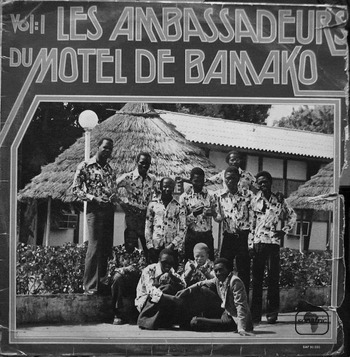
Les Ambassadeurs’ recruitment of Salif Keita from the Rail Band in 1973 created what has been described as a ‘ministerial crisis’ (Clerfeuille and Seck Reference Clerfeuille and Seck1993). The Minister of Public Works, who oversaw the downtown train station and motel where the Rail Band was based, refused to release Keita, the acknowledged ‘pearl’ of the group. But, Tiécoro Bagayoko, the CMLN's national security director and one of the most influential figures within the military government's inner circle, eventually won out. With Bagayoko's support, Les Ambassadeurs du Motel, with Keita as their front man, embarked on a rich period (1974–8) of recording and international tours (Figure 3). Their unique and innovative blend of popular foreign ‘standards’ (they were particularly well known for their spot-on James Brown covers) and epic praise songs (fasaw) in the tradition of jeliya, together with the sophisticated arrangements of the late Guinean guitarist Manfila Kanté and Keita's startling vocals, made Les Ambassadeurs the most popular Malian orchestra of their time. In 1975, Les Ambassadeurs were invited to Guinea to perform for the Quinzaine Artistique (a national cultural festival) in the Guinean capital, Conakry. Originally, Mali was to be represented solely by its ON, Las Maravillas de Mali, but Tiécoro Bagayoko used his influence to have his personal group, Les Ambassadeurs, join them. ‘This wasn't normal,’ Panka Dembelé, ex-director of the Malian ON, told me. ‘The festival was reserved for national groups’ (P. Dembelé interview, 2007b, my emphasis). The Guinean festival would prove to be a turning point for both bands and further erode the whole idea of an inherently ‘national’ politics of culture.
Les Ambassadeurs du Motel. Salif Keita is in the first row, second from right (Cover image from their 1977 Sonafric release)

The story of Les Ambassadeurs’ performance in Guinea, which today has become the stuff of legend among Mali's artists and music aficionados, focuses on an audacious vocal performance by Salif Keita at Conakry's Palais du Peuple in front of President Sékou Touré. According to Las Maravillas flutist Drahmane Coulibaly (interview, 2006), Keita called on his group to play the piece ‘Wajan’, originally popularized by renowned jeli vocalist Ami Koita. Like Las Maravillas’ ‘Soubalé’, discussed above, Les Ambassadeurs’ version of ‘Wajan’ establishes a relatively simple accompaniment pattern (kunbèn) over which Keita sings lyrical praise for President Touré, whom he calls ‘Manju’, a praise name similar to Sunjata Keita's honorific (Subali Masaya) in ‘Soubalé’. Unlike ‘Soubalé’, however, Salif Keita's performance features dramatic lyrical improvisation, a vocal practice known in Mande music as tèrèmeli (a word that also refers to verbal negotiation and bartering; see Durán Reference Durán2007: 589). While the choral refrain of ‘Soubalé’ signifies a sense of musical solidarity, consonant with the collective ethos of the national faso, Keita's vocals, which not only reference the person of Sékou Touré but also draw attention to the singer's own virtuosic self, evoke a pronounced individualist aesthetics in the self-aggrandizing spirit of the jamana state.
To the surprise of all in attendance at the Conakry festival, Keita walked straight up to Touré, knelt down before him, and offered his vocal tribute.
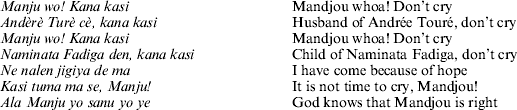
Touré rose and placed his hand on Keita's head while the singer extolled the head of state. Keita, whose albinism was a source of great social stigma and personal affliction in his home country, was profoundly humbled by the ‘humanity’ of Touré's gesture (Keita Reference Keita1990), which apparently included, following the performance, substantial gifts. This performance was a defining moment in the young singer's career. The song, released on record three years later under the title ‘Mandjou’ by the newly renamed ‘Les Ambassadeurs Internationaux’ (1978), remains highly regarded among aficionados of Malian popular music (Keïta Reference Keïta2001: 63).Footnote 20
Yet controversy swirled around Keita's ‘Mandjou’ performance. On the one hand were contemporary observers who, deeply critical of Sékou Touré's authoritarian and repressive regime, could not understand how Keita could justify such lavish praise for a brutal dictator. On the other hand were Keita's band mates who, when Sékou Touré purportedly presented the singer with a presidential medal, clothing and money following the performance, criticized the singer for failing to acknowledge their role in the famed (some might say infamous) praise song. ‘You wouldn't have received anything if it weren't for your group’, band member Isiaka Dama claims to have told Keita (I. Dama, interview, Reference Dama2007). Such disapproval also came from the Malian ON, Las Maravillas, whose musical director, Panka Dembelé, issued a personal protest to President Touré for showing preference to a private orchestra at a national event. By way of explanation, Dembelé reports that Touré told him that due to his totemic relationship to albinos he was obliged to honour Keita, but, in a conciliatory gesture, Touré presented similar gifts to Las Maravillas’ lead singer, Kassé Mady Diabaté (a renowned jeli vocalist recruited into the ON after Las Maravillas’ return from Cuba in 1970) (P. Dembelé interview, Reference Keita2007b). Taken together, these criticisms highlight the troubled professional position of West African artists, who, forced to negotiate the jamana state, including the fraught politics of praise for the powerful, experienced a turn toward radical individualism in their profession in the 1970s, with individuals taking the place of institutions as state clients in the shadow of a receding nation.
CONCLUSION: WHAT'S IN A NAME?
Though not nearly as dramatic or contentious as Keita's ‘Mandjou’ performance, the 1975 Quinzaine Artistique in Guinea marked a similar ‘individualist’ turn in the declining career of Las Maravillas; ironically, perhaps, this cultural political shift manifested in a titular invocation of ‘African’ solidarity and conviviality, of the faso. Following their performance, and in the wake of the ‘Mandjou’ controversy, President Sékou Touré congratulated the Malian ON, Las Maravillas de Mali. He suggested that the group give more space to vocal jeliya, an ‘authentically’ African genre and the birthright of the group's new singer Kassé Mady Diabaté (and, as mentioned above, the unofficial music genre of the jamana state). Touré also encouraged the ON to change its name, which he deemed ‘un-African’ (D. Coulibaly interview, Reference Coulibaly2006; P. Dembelé interview, Reference Dembelé2007b). ON Director Panka Dembelé communicated Touré's suggestion to Mali's new Minister of Culture, Mahamane Touré.Footnote 21 Mahamane Touré, whose policies supported the preservation and valorization of indigenous traditions, favoured Touré's idea and announced a public competition to find a new name for the Malian ON. Within days, a new name, ‘Le Badema National’, was announced on the radio, with the term ‘badema’ (also spelled ‘badenma’) referring to familial intimacy and social solidarity in Mande society. Yet, socio-cultural symbolism and socio-political realities proved discordant in this case. This was made clear to me in an interview with former Badema music director, Fernand Coulibaly, when I asked him about the socio-political meaning of the name ‘Le Badema National’.
FC: Well, today, when I say ‘Badema’, [the name should] correspond to [the artist's] vocation.
RS: National solidarity expressed through music.
FC: Voilà. And superficially the name remains, but the value does not remain on the inside. I directed this orchestra for six years. I know what there is on the inside. And, I don't mean to denigrate, I cannot denigrate my own country, but what I'm saying is true. … In fact I think that the tendency is now reversed. Here in Mali, when one is ‘badenma’, one refuses betrayal. One no longer has the right to shame another person. But, today, someone might say, I don't give a damn about all of that! The only thing I care about is surviving. (F. Coulibaly interview, 2006)
Coulibaly's contemporary lament about how the notion of badenma lost its value as a unifying and moralizing socio-cultural concept – in an age when individual survival outweighs loyalty to family and community (‘I don't give a damn about all of that!’) – recapitulates the way the concept of ‘the nation’ (faso) and expressions of ‘national culture’ lost value and salience during the first decade of the Second Republic. More generally, Coulibaly's comments resonate with the perception of a generalized moral anxiety within the post-1968 jamana state. In the words of novelist and social critic Moussa Konaté: ‘The most acute problem for Malians is a moral problem, insofar as positive values, without which one could not have a harmonious society, are increasingly exhausted even as a new mentality forms around negative values’ (1990: 119).
To follow the musical careers of Las Maravillas de Mali and Les Ambassadeurs du Motel is to observe an epistemic shift in post-colonial Malian politics that historicizes such moral misgivings. The lives and works of these professional artists elucidate the gradual discursive move from the people's dictatorship of the national faso to the dictatorial family of the jamana state. More generally, their stories elaborate a formative period in the history of Malian nation building and statecraft in which the ideas (and ideals) of ‘nation’ and ‘state’ remained contested signifiers. These socio-musical histories index a period when the commonplace coupling of the ‘nation state’ fractured along ideological fault lines. At a time when these ideas have been tossed back up into the air – a time of widespread political unrest, economic crisis, social protest and violence – it is wise to remember the experiences of those who performed the nation and state, to paraphrase Kelly Askew (Reference Askew2002), in pursuit of a meaningful space for expressive culture within the shifting ideologies and institutions of the post-colony.
ACKNOWLEDGEMENTS
This study began as a component of my doctoral work at Columbia University. I thank Aaron Fox, Ana Ochoa, Ellen Gray, Gregory Mann and Brian Larkin for guidance at this stage.
Earlier versions of this text were presented at the conference on ‘1968: A Global Perspective’ at the University of Texas in Austin in 2008 and at the 2009 meeting of the Society for Ethnomusicology in Mexico City. I thank the members of both panels, on ‘Music and politics in 1968’ and ‘Music, ethics, and value’ respectively. I thank my colleagues Harmony Bench, Heather Inwood and Ying Zhang at Ohio State University for their recent critical readings of an initial draft of this article. Special thanks go to Seybou Keita and Fassiriman Dembelé for assisting me with song lyric translations, to my research assistant Matthew Campbell for helping me edit and format this article, and to two anonymous readers at Africa for their excellent editorial feedback. The research for this study was generously funded by grants from the Social Science Research Council, the Wenner-Gren Foundation, and the College of Arts and Sciences at The Ohio State University. This essay is dedicated to the memory of Drahmane Coulibaly, a Mali Marvel (1943–2010).