Research on the sexual orientation of gays and lesbians has evolved from the analysis of its manifestations and characteristics to the study of subjects’ oppression and discrimination due to their sexual orientation (Herek, Reference Herek2010). As Kitzinger (Reference Kitzinger2005) points out, the problem of homosexuality has now become a problem of heterosexism. In the words of Herek (Reference Herek, D’Augelli and Patterson1995), heterosexism is “the ideological system that denies, denigrates, and stigmatizes any non heterosexual form of behavior, identity, relationships, or community” (Herek, Reference Herek, D’Augelli and Patterson1995, p. 321). The heterosexual sexual orientation is considered natural and normal. In contrast, the homosexual sexual orientation continues to be perceived as problematic and unnatural (Herek, Reference Herek2010). The expression of heterosexism (like that of homophobia) has gradually changed from more hostile forms to more subtle or modern manifestations (Augoustinos, Reference Augoustinos2009; Morrison, Morrison, & Franklin, Reference Morrison, Morrison and Franklin2009).
While social attitudes about gays and lesbians people have gradually improved since the advent of the gay rights movement in the 1970s, this increased tolerance has not necessarily extended to the issue of gay parenting (Clarke, Reference Clarke2001; Ellis, Kitzinger, & Wilkinson Reference Ellis, Kitzinger and Wilkinson2003). Moreover, a growing body of research suggests that being raised by same-sex parents does not, in and of itself, negatively impact children (Anderssen, Amlie, & Ytteroy Reference Anderssen, Amlie and Ytteroy2002; Allen & Burrell, Reference Allen and Burrell1997; Bos, van Balen, & van den Boom, Reference Bos, van Balen and van den Boom2005; Golombok & Tasker Reference Golombok and Tasker1996; Patterson, Reference Patterson2006). The meta-analysis by Crowl, Ahn, and Baker (Reference Crowl, Ahn and Baker2008) investigated differences between children raised by same-sex and heterosexual couples. No differences were found between children in cognitive development, psychological adjustment, gender identity or sexual partner preference.
The complexity of the attitudes toward parents of the same sex requires new instruments that can measure modern or subtle expressions of prejudice. The main purpose of our study is to provide evidence about heterosexuals’ beliefs about the effects on children raised and educated by parents of the same sex, a question that has not been analyzed in detail in the literature. Our second objective is to compare the beliefs of Spanish and Chilean students about the quality of the child-rearing practices of same-sex parents. To this end, we present the validity and reliability results for the Scale on Beliefs about Children’s Adjustment in Same-Sex Families (SBCASSF, Frias-Navarro, 2009; Frias-Navarro & Monterde-i-Bort, 2012) in two samples. The scale consists of two subscales: Normative Opposition and Individual Opposition.
The Normative Opposition subscale represents a subtle form of heterosexism, according to Peel (Reference Peel2001). The heterosexist argument emphasizes that society does not accept same-sex parents, and it requires gays and lesbians people to adapt to heterosexism by not having children (Clarke, Reference Clarke2001). Unlike other expressions of prejudice, the so-called heterocentrics are so common (and at the same time probably inevitable) that they are difficult to detect with general or traditional homophobia scales. This form of everyday heterosexism is, therefore, much more difficult to identify and change. It is found in situations that are accepted as present and common in our society, but can still involve prejudice, given that the child’s maladjustment is attributed to the gay and lesbian parents’ sexual orientation, in contrast to the normality of children raised by heterosexual parents. Members of the hetero-normative group minimize the impact of this subtle expression of prejudice, stating that these are common situations in society and institutionalizing discrimination against same-sex parents, while eliminating individual responsibility in the development of the rejection. Homophobic bullying has repeatedly been cited as an argument in favor of avoiding the education and rearing of children by same-sex parents (Clarke, Reference Clarke2002; Tasker & Golombok, Reference Tasker and Golombok1997). Therefore, the Normative Opposition subscale has a special value, given that it tries to identify symptoms of rejection of same-sex parents that are less evident, due to their normalization, as in the case of the social rejection children will experience. The normalization of prejudice based on the idea that gays’ and lesbians’ sexual orientation is generally not socially accepted, and that the children will be exposed to ridicule and social rejection by their classmates, certainly does not imply acceptance of sexual diversity. Due to this situation of socially acceptable rejection based on its daily presence in society or social customs, the score on the Normative Opposition subscale is expected to be higher than that on the Individual Opposition subscale, as occurs in other dimensions of prejudice, for example, between subtle and openly manifested prejudice (Frias-Navarro & Monterde-i-Bort, 2012).
The Individual Opposition subscale identifies symptoms of open and more aggressive rejection of homosexual parents; therefore, it would be expected to present a stronger relationship with traditional subscales of prejudice against same-sexual couples. The Individual Opposition and Normative Opposition subscales are correlated, given the link that exists between homophobia and the degree of support of same-sex parenthood (Crawford & Solliday, Reference Crawford and Solliday1996; King & Black, Reference King and Black1999). People who are opposed to the parenthood of gay and lesbian couples usually present arguments against gays and lesbians and highlight the negative effects of lesbian mothers and gay fathers on their children’s adjustment.
The first hypothesis of this study maintains that the expression of beliefs about the adjustment of children raised by parents of the same-sex, as measured by the SBCASSF, has two dimensions, with the subtle dimension (normative opposition) being statistically different from open expressions of rejection of same-sex parents (individual opposition).
Second, taking into account the existing rights and laws in Spain and Chile, the two samples are also likely to have different effect sizes in the two dimensions mentioned. While in Spain a law allowing marriage between people of the same-sex has been passed, adoption is allowed, and there are anti-discrimination laws (Gerhards, Reference Gerhards2010; Gómez & Barrientos-Delgado, Reference Gómez and Barrientos-Delgado2012), in Chile only recently has a law on civil union been discussed, and there are still no anti-discrimination laws. Therefore, the second hypothesis states that there will be statistically significant differences in the scores on the two subscales of the SBCASSF instrument, with Chile obtaining higher scores.
Third, the validity of the study will be supported by the relations sustained in the literature between the sex of the subject and attitudes toward same-sex couples. The gender variable has consistently been found to be associated with negative attitudes toward gay men and lesbians, as men commit the vast majority of assaults against gay men and lesbians (Ellis et al., Reference Ellis, Kitzinger and Wilkinson2003; Herek, Reference Herek2002; Moskowitz, Rieger, & Roloff, Reference Moskowitz, Rieger and Roloff2010). Therefore, men’s and women’s scores will differ in a statistically significant way on the two dimensions of the SBCASSF instrument. The men will show greater rejection of same-sex parents.
Fourth, another test of the validity of the instrument will be its relationships with the contact with gay and lesbian people variable, opinions on traditional family values and sex roles, and attributions about the origin of sexual orientation. Prior investigations have demonstrated that heterosexuals’ attitudes toward lesbian and gay people can be related to their interpersonal experiences with gay and lesbian individuals (Collier, Bos, & Sandfort, Reference Collier, Bos and Sandfort2012; Cooley & Burkholder, Reference Cooley and Burkholder2011; Heinze & Horn, Reference Heinze and Horn2009; Mazziotta, Mummendey, & Wright, Reference Mazziotta, Mummendey and Wright2011). Therefore, the fourth hypothesis proposes that the more contact there is with people of a homosexual sexual orientation, the less rejection there will be toward same-sex parents.
Fifth, opinions assigning different traditional roles to men and women also predict more negative attitudes toward gays and lesbians (Whitley & Aegisdottir, Reference Whitley and Aegisdottir2000). Therefore, the fifth hypothesis proposes that scores on traditional roles opinions should be positively correlated with scores on negative attitudes toward gays and lesbians.
Sixth, the results from the literature point out that the greatest degree of homophobia is related to attributions maintaining that the same-sex sexual orientation is learned (there is control over the choice of the same-sex sexual orientation by the person), compared to genetic or biological explanations (there is no control) about the origin of the same-sex sexual orientation, which are linked to a lesser degree of prejudice (Ernulf, Innala, & Whitam, Reference Ernulf, Innala and Whitam1989; Frias-Navarro, Monterde-i-Bort, Pascual Soler, & Badenes Ribera, in press; Herek, Reference Herek2002; Smith, Zanotti, Axelton, & Saucier, Reference Smith, Zanotti, Axelton and Saucier2011; Whitley, Reference Whitley1990). Therefore, the sixth hypothesis proposes that scores on beliefs about the learned origin of the sexual orientation of gay men and lesbians should be positively correlated with scores on negative attitudes toward gays and lesbians.
Seventh, the validity of the SBCASSF will also be analyzed through its relations with the well-known scale by Herek on Attitudes toward Lesbians and Gay Men, ATLG (Herek, Reference Herek1984, Reference Herek1988). Our working hypothesis maintains that the pattern of correlations will be stronger between the individual opposition dimension and the ATLG scales, compared with correlations with the normative opposition dimension, whose items identify a more modern and subtle rejection of homosexual parents.
Method
Participants
Convenience non-probability sampling was used. The Spanish sample is composed of 217 university students. Nine subjects described themselves as non heterosexual and were eliminated from the study. Of the 208 participants, 41 are men (19.7%), 165 are women (79.3%), and 2 people did not answer the question about sex (1%) (M age = 21.55, SD = 6.77).
The sample of Chilean participants was initially made up of 300 university students. Fourteen subjects described themselves as homosexual, and three did not answer the question. For the analyses, 17 participants were excluded. The final sample in Chile is composed of 283 participants (M age = 20.05, SD = 2.74), 108 men (38.2%) and 175 women (61.8%).
Instruments and variables
Demographics
The same evaluation instruments were used with the two samples of participants. The participants answered three personal questions: sex, age and sexual orientation (self-identification as: gay, lesbian, bisexual or heterosexual).
Personal beliefs about the origin of same-sex sexual orientation
A Likert-type response scale is used that ranges from 1 “completely disagree” to 5 “completely agree” (items: “genetic factors are the causes of homosexuality”, “on many occasions, homosexual behavior is learned” and “the homosexual sexual orientation can be changed if the person so desires”).
Traditional values, contact variable and gender roles
In the study, information was also gathered related to opinions about traditional family values (“having a family is one of my most important goals in reaching personal fulfillment”), contact variable (“In my family or my closest friends I have close relationships with gays”) gender roles (“women are usually better suited than men for taking care of children and the elderly). A Likert-type response scale is used that ranges from 1 “completely disagree” to 5 “completely agree”.
Scale on Beliefs about Children’s Adjustment in Same-Sex Families (SBCASSF, Frias-Navarro, 2009; Frias-Navarro & Monterde-i-Bort, 2012)
This instrument measures subjects’ beliefs about the effects of the child-rearing and educational practices of same-sex parents on the psychological and social adjustment of their children. The SBCASSF consists of 14 items distributed in two subscales: Normative Opposition (NOp) and Individual Opposition (IOp), with seven items on each subscale. A Likert-type response scale is used that ranges from 1 “completely disagree” to 5 “completely agree”. The higher the score is, the greater the degree of rejection of the child-rearing and educational practices of same-sex parents Footnote 1 .
The Normative Opposition subscale (NOp) identifies beliefs and opinions linked to everyday heterosexism. The items on this subscale attribute to society, and not to the subject’s own beliefs, the child’s social rejection and, consequently, his or her maladjustment due to belonging to a family with same-sex parents. The Individual Opposition subscale (IOp) identifies opinions involving open and more aggressive rejection toward the effects of the child-rearing and educational practices of same-sex parents. The attribution of the children’s possible psychological difficulties and maladjustments is directly linked to the sexual orientation of the same-sex parents.
The total score on the SBCASSF and the scores on the two subscales show a high internal consistency for the samples studied. In Spain, the Cronbach’s alpha value for the whole scale is .94, for the Individual Opposition subscale the Cronbach’s alpha value is .91, and for the Normative Opposition sub-scale the Cronbach’s alpha value is .90. In Chile, the internal consistency values are also quite acceptable, with a Cronbach’s alpha value for the whole scale of .94, for the Individual Opposition sub-scale the Cronbach’s alpha value is .92, and for the Normative Opposition sub-scale the Cronbach’s alpha value is .91.
Attitudes Toward Lesbians and Gay Men (ATLG, Herek, 1984, Reference Herek1988)
The ATLG is an instrument designed to measure subjects’ attitudes toward lesbian women and gay men. It is considered an instrument for measuring traditional, old-fashioned attitudes of rejection of homosexuality. The scale consists of 20 items distributed in 2 subscales: attitudes toward lesbians (ATL) and attitudes toward gay men (ATG). The response options indicate the level of agreement or disagreement with the items on a Likert-type scale from 1 for “completely disagree” to 5 for “completely agree”. The higher the score on the sub-scales is, the greater the degree of rejection toward lesbians and gay men. The Spanish adaptation of the scale by Cárdenas and Barrientos (Reference Cardenas and Barrientos2008) was used. The ATLG shows good internal consistency for the samples studied. In Spain, the Cronbach’s alpha value for the whole scale is .90, for the ATL subscale the Cronbach’s alpha value is .77, and for the ATG subscale the Cronbach’s alpha value is .86. In Chile, the Cronbach’s alpha value for the whole scale is.90, for the ATL subscale the Cronbach’s alpha value is .77, and for the ATG subscale the Cronbach’s alpha value is .86.
Procedure
This study was part of cross-cultural research between Spain and Chile about group relations and attitudes toward different social groups. The participants were guaranteed anonymity in filling out the paper and pencil questionnaires. The questionnaires were filled out during class time, and the participants obtained extra credit in the Chilean sample, but not in the Spanish one. Participation in the study was voluntary. The order of presentation of the instruments was: demographic variables, Scale on Beliefs about Children’s Adjustment in Same-Sex Families, Attitudes Toward Lesbians and Gay Men, personal beliefs about the origin of same-sex sexual orientation, traditional values, contact variable and gender roles.
Results
Normative Opposition and Individual Opposition
Hypothesis 1. The factor structure of the SBCASSF was analyzed by means of exploratory factor analysis (EFA). Considering that the two factors are usually significantly correlated, we applied an oblique rotation method (Oblimin) with the parameter δ = 0, establishing the most oblique solution possible (Fabrigar, Wegener, MacCallum, & Strahan, Reference Fabrigar, Wegener, MacCallum and Strahan1999). The results of the principal axes exploratory factorial analysis with oblique rotation point to the two-factor composition of the SBCASSF scale in the two samples of participants. The items are grouped following the original structure of the scale in the two dimensions of Individual Opposition and Normative Opposition (Barrientos, Cárdenas, Gómez, & Frias-Navarro, Reference Barrientos, Cárdenas, Gómez and Frias-Navarro2013). It has demonstrated the invariance of scores in the two groups: Spain and Chile (Frias-Navarro et al., 2012).
Hypothesis 2. In the sample of Spanish participants, the correlation between the two subscales is high, positive and statistically significant, r = .71; p < .001, confidence interval from .64 to .78 with a level of confidence of 95%. The results of the repeated measures design reveal that the mean Normative Opposition scores (M = 18.28, SD = 6.15) are higher than those for Individual Opposition (M = 12.95, SD = 6.36), with the difference being statistically significant. Within-subjects ANOVA F(1, 200) = 251.28; p < .001, d = 1.12, 95% CI [0.91, 1.33]. The effect size d was used as a measure of the magnitude of differences (Navarro, Llobell, & Pérez, Reference Navarro, Llobell and Pérez2000). Cohen (Reference Cohen1988) established a conventional interpretation of effect sizes in which d = 0.20 is considered a small effect, d = 0.50 is a medium-sized effect and d = 0.80 is a large effect. These guidelines are used throughout this article for interpreting results. The program utilized was the DSTAT, version 1.10, by Johnston (Reference Johnson1993). By observing the value of the effect size, the conclusion can be drawn that the subjects’ scores on the normative opposition subscale are found approximately one standard deviation above the scores obtained on the individual opposition subscale.
In the sample of Chilean participants, the correlation between the two subscales is also high, positive and statistically significant, r =.75; p < .001, confidence interval from .70 to .80 with a confidence level of 95%. The results of the repeated measures design reveal that the mean scores on Normative Opposition (M = 24.01, SD = 6.73) are higher than those for the Individual Opposition factor (M = 20.21, SD = 8.14). Within-subjects ANOVA F(1, 281) = 137.62, p < .001, d = 0.70, 95% CI [.53, .87]. The difference between the scores on the two subscales is also statistically significant.
A comparison of the effect sizes and their confidence intervals shows that there is no overlapping between the intervals of the effect sizes in the Spanish sample and the intervals of the Chilean sample when the differences between the individual and normative scores are compared. Therefore, a statistically different pattern of effects is detected, with the Chilean sample scoring above the Spanish sample on both subscales. The profile of differences found between the two subscales is the same in both countries (the score on the normative subscale is higher than that of the individual opposition subscale), but the absence of overlapping confidence intervals in the two countries reveals that there are statistically significant differences between the scores of the Chilean students and those of the Spanish students. The sample of Chilean participants obtains higher scores than the Spanish participants on both the Normative Opposition subscale and the Individual Opposition subscale. However, it can be observed that in the Spanish sample the effect size is greater (d = 1.12) than in the Chilean sample (d = 0.70), indicating a greater discrepancy between the two dimensions.
Differences according to sex
Hypothesis 3. The study indicates that Spanish men (M = 16.41, SD = 7.71) manifest a greater degree of individual opposition than Spanish women do (M = 11.97, SD = 5.61). ANOVA between-subjects F(1, 202) = 16.95; p < .001, d = 0.73, 95% CI [0.38, 1.09].
The analysis of the scores on the normative opposition subscale reveals that Spanish men again obtain higher scores (M = 21.28, SD = 6.45) than Spanish women (M = 17.53, SD = 5.94), between-subjects ANOVA F(1, 199) = 12.12; p = .001. The effect size is medium, d = 0.62, 95% CI [0.27, 0.98], ranging from small to large effect sizes. In the Chilean sample, the men (M = 22.39, SD = 8.08) show a greater degree of individual opposition than the women (M = 18.94, SD = 7.88), F(1, 282) = 12.47; p < .001, d = 0.43 (medium), 95% CI [0.19, 0.68].
The study of the scores on the normative opposition subscale reveals that the Chilean men also obtain higher scores (M = 25.85, SD = 6.65) compared to Chilean women (M = 22.96, SD = 6.55), F(1, 282) = 12.89; p < .001, d = 0.44 (medium), 95% CI [0.20, 0.68].
Contact and traditional values
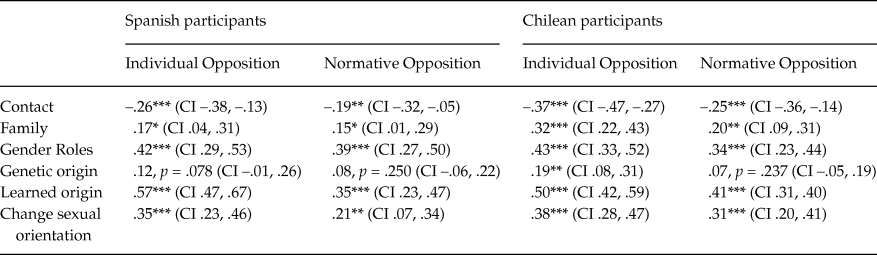
Hypothesis 4. The correlations between the contact variable and the score on the individual opposition subscale are statistically significant for both the sample of Spanish participants, r = –.26, p < .001, 95% CI [– .38, –.13] and the Chilean sample, r = .37, p < .001, 95% CI [–.47, –.27]. The correlations are also statistically significant on the normative opposition subscale, both for the Spanish sample, r = –.19, p = .008, 95% CI [–.32, –.05] and for the Chileans, r = –.25, p < .001, 95% CI [–.36, –.14] (see table 1).
Correlations between the individual opposition and normative opposition subscales and the contact variable, traditional values, and etiology and change of the homosexual sexual orientation

Note: * p < .05, ** p < .01, *** p < .001. CI is the Confidence Interval of the correlation coefficient with a confidence interval of 95%.
Hypothesis 5. In the first place, there is a positive correlation between the variable linked to the desire to form a traditional family as a goal for personal fulfillment and the individual opposition subscale, both for the sample of Spanish participants, r = .17, p = .013, 95% CI [.04, .31]) and for the Chilean sample, r = .32, p < .001, 95% CI [.22, .43] (see table 1). There is also a statistically significant correlation between the traditional family variable and the score on the normative opposition subscale, in both the Spanish, r = .15, p = < .031, 95% CI [.01, .29] and Chilean, r = .20, p = .001, 95% CI [.09, .31] samples.
Second, the correlations become stronger when an analysis is performed of the relationships between opinions about gender roles and the scores on the SBCASSF. The belief that women are usually more suited to taking care of children and the elderly is related in a statistically significant way to the scores on the individual opposition subscale, Spain: r = .42, p < .001, 95% CI [.29, .53]; Chile: r = .43, p < .001, 95% CI [.33, .52], and with those on the normative opposition subscale, Spain: r = .39, p < .001, 95% CI [.27, .50]; Chile: r = .34, p < .001, 95% CI [.23, .44] (see table 1).
Attributions about the origin of sexual orientation of gay man and lesbian
Hypothesis 6. When a genetic origin is attributed to the sexual orientation of gay men and lesbians, the correlations are only statistically significant in the case of the Chilean sample and the individual opposition subscale, r = .19, p = .001, 95% CI [.08, .31]; Spain: r = .12, p = .078, 95% CI [–.01, .26]. In contrast, the results point out that beliefs about the learned origin of the sexual orientation of gay men and lesbians are those most clearly related to the perception of maladjustment in children raised by same-sex parents (see table 1). The scores on the individual opposition subscale correlate in a statistically significant way with the belief that the sexual orientation of gay men and lesbians is learned, Spain: r = .57, p < .001, 95% CI [.47, .67]; Chile: r = .50, p < .001, 95% CI [.42, .59] and with the belief that one can change his or her sexual orientation if he or she so desires, Spain: r = .35, p < .001, 95% CI [.23, .46]; Chile: r = .38, p < .001, 95% CI [.28, .47].
The correlation between the normative opposition subscale and the belief about the genetic origin of the sexual orientation of gay men and lesbians is not statistically significant in the Spanish or Chilean samples, Spain: r = .08, p = .250, 95% CI [–.06, .22]; Chile: r = .07, p = .237, 95% CI [–.05, .19] (see table 1). In contrast, the scores on the normative opposition subscale correlate in a statistically significant way with the belief that the sexual orientation of gay men and lesbians is learned, Spain: r = .35, p < .001, 95% CI [.23, .47]; Chile: r = .41, p < .001, 95% CI [.31, .40], and with the belief that the sexual orientation of gay men and lesbians can be changed if the homosexual person so desires, Spain: r = .21, p = .003, 95% CI [.07, .34]; Chile: r = .31, p < .001, 95% CI [.20, .41].
Relationships between the SBCASSF and the ATLG scale by Herek
Hypothesis 7. The study of the relationship between the scores on the subscales of the Scale on Beliefs about Children’s Adjustment in Same-Sex Families and those on the scale of Attitudes Toward Lesbians and Gay Men by Herek (Reference Herek1984) shows that there is a statistically significant link between the scores obtained on the two scales, both in the sample of Spanish participants and in the sample of Chilean participants (see table 2). The correlations are greater when the relationship is analyzed between the individual opposition subscale (more open and direct rejection of same-sex parents) and the subscales of the Herek instrument on traditional attitudes of rejection, thus supporting the validity of the two dimensions of the SBCASSF.
Correlations between the individual opposition and normative opposition subscales and the ATLG scale by Herek

Note: ** p < .001. CI is the Confidence Interval of the correlation coefficient with a confidence interval of 95%.
Discussion
The analysis of the two dimensions of the SBCASSF reveals that the score on the normative opposition subscale is higher than the score for individual opposition, supporting the hypothesis that rejection of gay men and lesbians is moving toward more modern and subtle forms. Thus, our results can be framed within the modern prejudice model (Morrison & Morrison, Reference Morrison and Morrison2011; Morrison et al., Reference Morrison, Morrison and Franklin2009; Whitley & Kite, Reference Whitley and Kite2010).
The comparison of the Spanish and Chilean scores shows that the scores are higher in Chile on both the individual opposition and normative opposition subscales. The differences between the two samples are statistically significant. Furthermore, the results show that in the sample of Spanish students the difference between the two dimensions is greater than in the Chilean sample (effect size greater in Spanish), indicating a greater discrepancy between the two dimensions. These discrepancies are probably a reflection of underlying differences in the ideals about equality and respect for diversity of each culture (Nierman, Thompson, Bryan, & Mahaffey, Reference Nierman, Thompson, Bryan and Mahaffey2007). The World Values Survey (2008) points out the differences between the two cultures, scoring Chile as having more conservative positions than Spain.
The results of the study support the relations described in the literature between the sex of the subject and his or her attitudes toward gays and lesbians (Falomir-Pichastor, Martínez, & Paterna, Reference Falomir-Pichastor, Martínez and Paterna2010). The men in the Spanish and Chilean samples obtained higher scores on the individual opposition and normative opposition subscales. The meta-analytic study carried out by Petersen and Hyde (Reference Petersen and Hyde2010) reveals a mean effect size of –0.29, 95% CI [–0.39, –0.19], with the women manifesting more tolerant attitudes. Our results indicate a greater effect size.
The analysis of family values and traditional gender role attitudes provides support for results found in the literature indicating that rejection of same-sex parents is related to holding traditional values, especially regarding heterosexist questions (Whitley, Reference Whitley2001). Our study shows a negative relationship between contact with gay men and lesbians and scores on the normative and individual opposition subscales, as has been shown in the literature in both adults (Anderssen, Reference Anderssen2002) and adolescents (Heinze & Horn, Reference Heinze and Horn2009).
Our findings show a relationship between rejection of same-sex parents and the belief that the sexual orientation of gay men and lesbians is learned or can be changed, in both the Spanish and Chilean samples (Sheldon, Pfeffer, Javaratne, Feldbaum, & Petty, Reference Sheldon, Pfeffer, Javaratne, Feldbaum and Petty2007). The correlations diminish or disappear if one believes that the sexual orientation of gay men and lesbians is genetic. Again, the hetero-normative perspective dominates the subjects’ prejudice, given that opting for a non heterosexual orientation implies deviating from the natural norm and, therefore, being subjected to social rejection.
As predicted in our study hypothesis, the ATLG scale (Herek, Reference Herek1984, Reference Herek1988) maintains stronger correlations with the individual opposition subscale than with the normative opposition subscale, again supporting the two-dimensionality of the SBCASSF. That is, the results show that the two subscales that measure traditional prejudice (ATLG scale and individual opposition) maintain a higher correlation between them, supporting the convergent validity of the SBCASSF instrument.
The study’s findings should be interpreted with certain limitations in mind. The cross-sectional nature of our data does not allow causal statements. The sampling procedure used (selective sample) also limits the external validity of our findings. Replication with participants who are not college students (to improve generalizability) would be important. However, previous research has found that patterns of men’s and women’s attitudes toward lesbians and gay men are similar in both nationally representative adult samples and in college student convenience samples. Another limitation of our study has to do with the non counter-balanced presentation of the measurement instruments and order could have effects that are not controlled. It would be advisable to replicate the study with another order of presentation of the instruments. Furthermore, some variables were measured with a single item. However, our findings follow the lines of research on sexism, the etiology of homosexuality, traditional roles, and contact with people of a homosexual sexual orientation (Herek, Reference Herek1998; Morrison et al., Reference Morrison, Morrison and Franklin2009). Moreover, using diverse methodologies, future research examining modern prejudice should test hypotheses that specify its associations with other variables. Due to limited resources, only two countries were studied. Future research is needed to investigate the relationship between hostile prejudice and modern prejudice across a wide range of cultures. Finally, it should be noted that repeated use of statistical tests opens the possibility of some correlations being significant due to Type I error.
In order to understand and explain prejudice, it is necessary to integrate various approaches, as Akrami, Ekehammar, and Yang-Wallentin (Reference Akrami, Ekehammar and Yang-Wallentin2011) point out. Social and personality constructs interact in the expression of prejudice. This study contributes to the literature on rejection of same-sex parents and the transformation of prejudice into more subtle but equally discriminatory forms. At the same time, the findings provide useful information for programming social policies for prevention and intervention in areas related to sexual diversity.
In conclusion, having new measurement instruments adapted to new expressions of rejection and prejudice against gay men and lesbians is crucial for dealing with homophobia. The new expression of homophobia is less open and less aggressive, but continues to be just as discriminatory as the traditional form. We might think great advances have been made in tolerance toward and acceptance of the sexual orientation of gay men and lesbians, but the hetero-normative perspective continues to be present, often supporting prejudice and rejection of the sexual orientation of gay men and lesbians because it does not fit its view. As Pennington and Knight (2011, p.70) point out,
“if same-sex parenting is already a social reality and the children of these families are not same-sex attracted in ratios that exceed those raised by heterosexual couples, then this leaves homophobia as the main influence on participants’ attitudes towards same-sex parenting. We therefore suggest that it is the continued acceptance of hetero-normative and homophobic assumptions that pose a greater risk to children’s wellbeing than being raised by, or born into, same-sex families”.