Introduction
Elderly people who need institutional care are often frail, disabled, or have multiple chronic conditions, making them heavily dependent on caregivers (Joshi and Flaherty, Reference Joshi and Flaherty2005). Caregivers may demonstrate abusive behavior when dealing with highly dependent elderly people. Elder abuse is a common, well-known but under-reported problem. Evidence about the prevalence and severity of elder abuse in institutional settings worldwide is limited, with the majority of studies on elder abuse having been conducted in the U.S.A. Although different forms of elder abuse often occur simultaneously, physical abuse is the most obvious manifestation; by contrast, psychological or emotional abuse, including verbal or nonverbal insults, humiliation, infliction of mental or emotional suffering, isolation or withdrawal from services or supportive network (Joshi and Flaherty, Reference Joshi and Flaherty2005) can be harder to identify. One early survey of staff working in nursing homes found that 36% reported observing physical abuse but 81% witnessed psychological abuse (Pillemer and Moore, Reference Pillemer and Moore1989). Goergen (Reference Goergen2001) conducted a survey on elder abuse in residential settings in Germany and found that verbal and psychological abuse were the most common subtypes of elder abuse. Ogioni et al. (Reference Ogioni, Landi and Bernabei2007) also reported that verbally abusive behavior was the most frequently observed type of elder abuse behavior, prevalent in 8% of their sample. Another study concluded that observation of and committing acts of psychological abuse was much higher; 70% had observed others yelling at patients in anger, and 33% reported yelling themselves (Joshi and Flaherty, Reference Joshi and Flaherty2005). Research on elder abuse by caregivers in Asian countries has yielded similar results. A study from Korea found that emotional abuse was the most prevalent form of elder abuse (Oh et al., Reference Oh, Kim, Martins and Kim2006). Another study of 355 Chinese elders in Hong Kong found an overall abuse prevalence of 21.4%, and the authors attributed this relatively high rate of elder abuse to a high rate of verbal abuse (Yan and Tang, Reference Yan and Tang2001). Chinese and cross-cultural elder abuse studies demonstrate that elder abuse exists in various forms across cultural groups, but Chinese groups were more likely than non-Chinese groups to identify particular acts as psychological abuse (Tam and Neysmith, Reference Tam and Neysmith2006). In Taiwan, one study showed 22.6% of the institutionalized elderly participants reported having been psychologically abused (Wang, Reference Wang2006).
Elder abuse is a complex problem with multiple risks and causes, and it may be difficult to detect unless caregivers are educated about abuse and how to identify contributing factors. Awareness of such factors may help caregivers understand and anticipate situations where maltreatment may be preventable (Muehlbauer and Crane, Reference Muehlbauer and Crane2006). Although the literature has shown that an elderly person's personal characteristics are correlated with abuse (Cooper et al., Reference Cooper, Katona, Finne-Soveri, Toponkova, Carpenter and Livingston2005; Mehta, Reference Mehta2005), caregiver risk factors may be more amenable to change and should receive more attention from health care professionals.
Several caregiver characteristics likely play a role in elder abuse behaviors. Among them, the age of caregivers has been found to be associated with psychological abuse of the elderly (Childs et al., Reference Childs, Hayslip, Radika and Reinberg2000; Saveman and Sandvide, Reference Saveman and Sandvide2001; Wang, Reference Wang2005) although findings have been inconsistent. In addition, Liu (Reference Liu2006) and Wang (Reference Wang2005) identified that education was a significant correlate of caregiver psychological abuse behavior. Situational factors such as long work hours, and heavy duties and responsibilities increase the risk of elder abuse (Jayawardena and Liao, Reference Jayawardena and Liao2006; Liu, Reference Liu2006). Moreover, Muldary (1993) pointed out that caregivers who lack knowledge in geriatric care may experience tension, which results in inappropriate behavior when caring for the elderly. Jayawardena and Liao (Reference Jayawardena and Liao2006) concluded that inadequate social support and lack of geriatric care training of the caregiver can contribute to their abusive behavior. In addition, research to date has addressed the relationship between the work of caregiving related stress and elder abuse behavior. For example, care giving role-related stress, burden, strain, overload, and conflict are associated with abuse of elderly persons receiving care (Wu and Wang, Reference Wu and Wang2004; Wang, Reference Wang2005; Liu, Reference Liu2006). However, most of the studies above were conducted using professional nurses as study samples; research that explores non-professional caregiver (nurse aids) factors contributing to elder abuse is therefore needed.
Muehlbauer and Crane (Reference Muehlbauer and Crane2006) postulated that professional health care workers in daily contact with older adults are responsible for identifying risk factors and becoming aware of caregiver risk factors in order to prevent and manage abuse. Although a few studies have tested the relationship among institutional caregivers’ personal characteristics and working context with elder abuse behavior (Goergen, Reference Goergen2001; Wang, Reference Wang2005) they were not enough to show significant outcomes. In addition, these studies have relied on general analytic methods using regression to examine the contributing factors or correlates to elder psychological abuse behavior. Such analyses may not adequately account for measurement error and individual variation. This study contributes to the literature by applying structural equation modeling (SEM) to the relationships of personal and situation caregiver factors and psychological elder abuse.
The aim of this study was to adopt SEM to test the most effective model for explaining caregiver psychological abuse behavior. The conceptual framework includes variables selected from previous literature: the caregivers' hours of work each day, years of education, age, geriatric care training, gerontological care knowledge, social resources, and self-reported work stress. We hypothesized that there will be an effect of these personal characteristics and situational factors on the level of psychological elder abuse.
Methods
Sampling
The sample comprised a total of 197 caregivers recruited from seven long-term care facilities stratified by levels of care in southern areas of Taiwan. Names of all caregivers were obtained from each institution, and the potential subjects were approached about their willingness to participate in the study. Participation criteria included: (1) aged 20 years or more; (2) employed as a full-time non-professional nurse's aid for at least three months; and (3) able to communicate either in Mandarin or Taiwanese.
Procedures
Institutional review board approval was obtained. The study was explained to research participants and consent forms were obtained. The consent form and questionnaire package were distributed by the researcher and self-administered by the participants in 2007. Responses were anonymous through a given identification number (ID). If questionnaires were not returned within one week, participants received one reminder from the researcher. Questionnaires that were not completed were not included in the data analysis. Finally, 183 caregivers returned and completed all questions with a response/completion rate of 94%.
Measures
A structured questionnaire was used to collect all data. In addition to a caregiver demographic information sheet, the following instruments were adapted and only a part of each instrument was used to ensure all factor loadings of the items in the research model were greater than or close to 0.5.
Caregiver psychological abuse behavior was measured using the Caregiver Psychological Elder Abuse Behavior Scale (CPEAB) (Hsu, Reference Hsu2006). Sixteen items were drawn from the CPEAB and each item was rated on a four-point Likert-type answer format ranging from (1) “never behave this way” to (4) “often behave this way”. The total score represented the sum of all items (range = 16–64), with higher scores indicating a higher tendency toward abusive behavior. The original CPEAB content validity index (CVI) was 0.95. Test-retest reliability over a two-week period was estimated by Intra-class Correlation Coefficient (ICC = 0.85, p < 0.001). The 16 tems demonstrated a Cronbach's α internal consistency of 0.78.
Fourteen items from the Work Stressors Inventory Chinese version (WSI-C) (Lin, Reference Lin2000) was selected to measure caregiver work stress. Each item is rated on a five-point rating scale that ranges from never (0) to often (4) regarding how frequently in the past month they have experienced the work events described in the items. Scores are summed, with increasing scores indicating increasing stress levels (range = 0–56). The average representative validity for each item was 4.20 (range 1–5). Test-retest reliability over a two-week period was between 0.77 and 0.98 (p<0.01) in the original scale (Lin, Reference Lin2000), and the WSI-C showed high internal consistency (Cronbach's α = 0.88) in this study.
Social resources were measured using the Personal Resources Questionnaire (PRQ-2000), a 15-item seven-point Likert scale developed by Weinert (Reference Weinert, Strickland and Dilorio2003). PRQ-2000 measures perceived social support in the following areas: intimacy, social integration, nurturance, worth, and assistance. The PRQ-2000 scores range from 15 to 105 with higher scores indicating higher levels of perceived social support. The Chinese version was developed and had an original Cronbach's α of 0.84 for internal consistency and a divergent validity of r = −0.51 (p<0.0001) with Center for Epidemiologic Studies Depression Scale (CES-D). In our study, Cronbach's α = 0.92.
The Gerontological Nursing Scale (KGNS) was originally developed in Chinese by Lee (Reference Lee1998) to measure knowledge among nursing staff toward caring for the elderly. The KGNS contains 50 items relating to four domains: aging related biostatistics, physical problems and care, psychological and social issues related to aging. Respondents answer each of the items with yes, no, or uncertain. Scoring of the KGNS is done by assigning one point for each item that is correctly answered. Total scores can range from 0 to 50 with higher scores indicating more knowledge of elderly care. A Cronbach's α of 0.77 was established for the internal consistency (Lee, Reference Lee1998). The internal consistency reliability in this study was 0.84.
Analysis
The SPSS 14.0 and AMOS 7.0 statistical software was used to analyze the data with the SEM procedure. Confirmatory factor analysis was conducted to test the measurement model which described the nature of the relationship between a number of latent variables and the observed variables corresponding to each of the constructs (social resources, work stress, and psychological abuse behavior). The structural model which explained the relationships among all variables was tested. The observed variables – hours worked each day, education, age, training, and knowledge in geriatric care – were exogenous variables. The latent variables, social resources and stress were also exogenous variables while abuse behavior was an endogenous variable.
Results
Sample characteristics
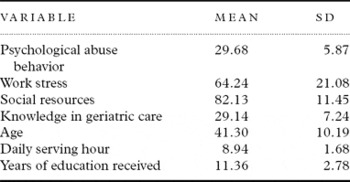
Of the 183 caregivers who completed the study, only five (2.7%) were male. Most caregivers were married (68.9%). Subjects’ age ranged from 21 to 60 years old (mean 41.3; SD = 10.2) and 72.7% of caregivers had had geriatric caregiving training. Caregivers reported an average of 11.4 (SD = 2.8) years of education; the average number of hours worked each day was 8.9 (SD = 1.7, range = 8–12). Table 1 represents the means and standard deviations of the measured variables.
Mean and standard deviation of the measured variables (N = 183)

Model testing
Overall model fit (external) and fit of internal structure of the model were used to evaluate a good model fit for this study (Bagozzi and Yi, Reference Bagozzi and Yi1988; Bentler, Reference Bentler1990; Chen, Reference Chen2007), including the following components: (1) the non-significant χ2 (p>0.05); (2) the ratio of χ2 and its degrees of freedom value between 1 and 3; (3) the goodness-of-fit index (GFI) value of 0.90 and adjusted goodness-of-fit index (AGFI) value of 0.8 or higher; (4) the normed fit index (NFI) and the Tucker-Lewis coefficient (TLI) value of 0.9 or higher; and (5) the root mean square error of approximation (RMSEA) value of 0.05 or lower.
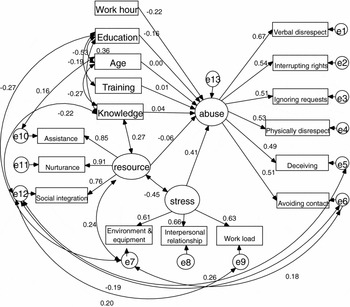
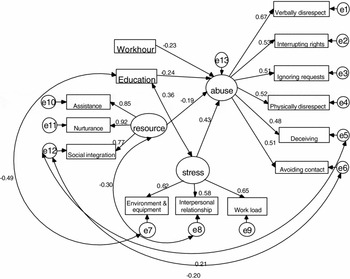
We started with a fully saturated model based on literature review and then removed those variables that contributed less to the endogenous variable. The hypothesized model is presented in Figure 1. The model-fit indexes are as follows: χ2 = 134.26, df = 103, p = .021; CMIN/DF = 1.30; GFI = 0.92, AGFI = 0.88, TLI = 0.95, RMSEA = 0.041, NFI = 0.88. Since the p level for χ2 was <0.05, which indicated an undesirable model fit, a second model was tested (Figure 2) to find a superior fit to the model. Secondly, in the hypothesized model, the relationship between abuse and age, geriatric care training and gerontological care knowledge showed no significant relationship, indicating that age and geriatric training and knowledge have no relationship with psychological abuse behavior. Therefore, we proposed a second model. All the model-fit indexes (χ2 = 87.84, df = 70, p = .073; CMIN/DF = 1.26; GFI = 0.94, AGFI = 0.91, TLI = 0.96, RMSEA = 0.037) of the second model exceeded their respective common acceptance levels except for the NFI value (0.88). The p level for χ2 of .greater than 0.05 implied that the hypothesized theoretical model fit the data adequately. Although χ2 can be influenced by sample size (Bentler and Bonett, Reference Bentler and Bonett1980), past literature has indicated that χ2 with its degrees of freedom ratio actually provides a better index than χ2 alone (Hatcher, Reference Hatcher1994). In our model, χ2 with its degrees of freedom ratio is 1.26, which also meets the model fit criterion that χ2 should have a degrees of freedom ratio between 1 and 2 (Bagozzi and Yi, Reference Bagozzi and Yi1988; Bentler, Reference Bentler1990; Chen, Reference Chen2007). The NFI of 0.88 indicates that the model fit has a discrepancy that is 88% of the way between the independent model and the saturated model (Bentler and Bonnet, Reference Bentler and Bonett1980), which implies that the tested model may be altered to improve its fit. Although the NFI does not support a good fit for the tested model, other goodness-of-fit indices do support the model fit. The RMSEA which is not sensitive to the sample size, indicates a good model fit in relation to degrees of freedom (Bagozzi and Yi, Reference Bagozzi and Yi1988). The GFI and the AGFI represent a perfect fit between the hypothetical model and the sample data.
Initial model of caregiver factors to psychological elder abuse (N = 183)

Final model of caregiver factors to psychological elder abuse (N = 183)

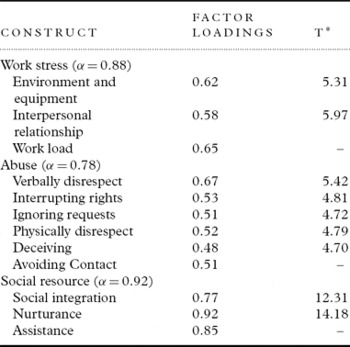
Convergent validity can be evaluated by examining the factor loadings from the confirmatory factor analysis. The standardized factor loadings, the t-scores, and scale internal consistency for the indicator variables are shown in Table 2. The factor loadings are equivalent to standardized regression weights for predicting observed variables from latent constructs (Hatcher, Reference Hatcher1994). All our factor loadings of the items in the research model were greater than 0.50 except for one (0.48), and all were significant (p<0.001). According to Hair et al. (Reference Hair, Anderson, Tatham and Black1992), factor loadings greater than 0.50 are considered to be meaningful. Overall, the model fit indices and the factor loadings partially supported the reliability and validity of the constructs for their indicator variables.
Factor loadings and t-values of the indicator factors (N = 183)

*Significance at p = 0.001 level.
Structural model
The modification index (MI) test indicates that the covariance paths between the exogenous variables of education and error term e9 and stress, of resources and error term e8, the error term e12 and e5, e6 would improve the model fit. The final model of caregiver psychological abusive behavior and the model parameters is presented in Figure 2. In the final model, results showed that hours worked each day, years of education, and social resources had significant negative relationships with abuse behavior (coefficient = −0.23, −0.24, −0.19; t = −2.64, −2.47, −2.08; p = 0.008, 0.014, 0.037 respectively) while stress level showed a significant and positive relationship with abuse behavior (coefficient = 0.43, t = 3.32, p = .000). Hours worked each day showed a negative relationship with abuse behavior implying that the more hours of work each day by the caregiver, the less psychological abusive behavior they manifested. Conversely, caregivers with more years of education, lower social resources, and higher work stress were more likely to demonstrate psychological abuse behavior. Altogether, these four variables accounted for 25% of the variance in abuse behavior, with stress contributing more to abusive behavior than the other three variables (hours worked each day, education, and social resources).
Discussion
The hypothesis was partially supported by our findings. The effects of caregiver education, social resources, and work stress on psychological abuse behavior were supported by previous literature (Jayawardena and Liao, Reference Jayawardena and Liao2006; Liu, Reference Liu2006; Wang, Reference Wang2005; Wu and Wang, Reference Wu and Wang2004). In turn, caregiver work stress was found to be the strongest correlate to psychological abuse behavior toward the elderly in our study. Caregivers may experience stress due to a variety of reasons, such as role strain, demand, and work overload, especially if they have limited resources to cope with the caregiving situation (Jayawardena and Liao, Reference Jayawardena and Liao2006). Caregivers with lower educational levels tended to display more abusive behavior. This may be explained by Wang (Reference Wang2005) who suggested that limited education or misinformation regarding an elderly person's needs or right may result in abusive behavior. On the other hand, although hours worked each day was identified as a significant factor in psychological elder abuse in this study, it is unusual to find that those who work more hours per day are less likely to mistreat elders psychologically. Although previous literature has shown the opposite, i.e. that overtime work and staff shortages were risk factors for abuse (Goergen, Reference Goergen2001; Jayawardena and Liao, Reference Jayawardena and Liao2006; Liu, Reference Liu2006), our dependent variable is specified in psychological abuse which is more subtle and intrinsic. A possible reason may be that in our study, we found that caregivers who work more than 8 hours a day were those who reported a higher monthly salary, which implies that those who have more financial resources may be less stressed in their life and so they are less abusive. In addition, the findings on hours worked each day and geriatric knowledge are in contrast with the previous literature and may therefore be artifacts of selection (Muldary, Reference Muldary1993).
Our finding of a lack of association of age with abuse behavior is in contrast with the literature that has suggested that caregiver age is statistically significant for all psychological abuse dimensions (Childs et al., Reference Childs, Hayslip, Radika and Reinberg2000; Wang, Reference Wang2005). However, previous literature yielded inconsistent findings: Suitor and Pillemer (Reference Suitor and Pillemer1992) discovered that older caregivers were more likely to be abusive than their younger peers whereas Childs et al. (Reference Childs, Hayslip, Radika and Reinberg2000) found that middle-aged caregivers were more likely to manifest abusive behavior than older caregivers. In Taiwan, Wang (Reference Wang2005) found that younger caregivers displayed more abusive behavior toward the elderly. This unexpected finding might be due to the fact that the majority of our participants were middle-aged. The homogeneity of our sample may preclude detection of a significant relationship between caregiver age and elder abuse.
Without appropriate strategies or resources to help caregivers manage or alleviate their work stress, the problem will continue to jeopardize the health and well-being of the elderly. Therefore, caregiver stress management and resource support systems should be established. Interventions such as psycho-educational programs and mutual support groups led by professional nurses may teach caregivers how to deal with their own feelings of stress associated with caring for elderly residents.
This study has several limitations. First, the study findings may not be generalizible to populations outside of Taiwan. Further research should consider caregivers from other parts of world, or undertake a cross-cultural investigation. Second, due to limited research evidence, some important caregiver factors were missing from the model, so there is a need to investigate additional caregiver factors contributing to psychological elder abuse behavior. For example, caregiver personality traits and facility characteristics may play a role in abuse behavior. Future research should also examine whether elderly factors have any influence on abuse. Longitudinal experimental designs would enhance our understanding of the causality and interrelationships between or among variables significant to caregiver psychological abuse behavior.
In conclusion, this study has highlighted some critical correlates of caregiver psychological abuse behavior toward caring for the institutionalized elderly. Caregiver work stress and social resources affect abuse behavior the most, which are the major determinants of elder psychological abuse in our model. These findings should be incorporated into practice, especially for caregivers serving in institutional settings. Older persons deserve to be treated humanely and with respect. To help reduce psychological abuse of elders, caregivers would benefit from stress management and social resources interventions provided by employers or government programs.
Conflict of interest
None.
Description of authors' roles
J. Wang designed the study, supervised the data collection and wrote most of the paper. W. Chang assisted with writing the paper and collected the data. H. Tseng was responsible for the statistical analysis.
Acknowledgments
Financial support was received from the National Science Council of Taiwan under contract NSC 92-2314-B-242-003.