Introduction
Ménière's disease is a clinically heterogeneous condition characterised by hearing loss, fluctuating aural symptoms and vertigo. It is a chronic condition that is generally progressive in nature. Usually only one ear is affected, but with increased duration of the disease the likelihood of bilateral involvement increases, up to an estimated 47 per cent.Reference Chaves, Boari and Lei Munhoz1,Reference Stahle, Friberg and Svedberg2 While the histopathological finding of endolymphatic hydrops, reflective of increased endolymph volume, is associated with Ménière's disease,Reference Hallpike and Cairns3 the actual physiological cause and cell types where Ménière's disease originates remain an open question.Reference Foster and Breeze4,Reference Merchant, Adams and Nadol5 Currently, the diagnosis of Ménière's disease is determined clinically by patient history and documentation of audiometric disease findings, with diagnostic criteria determined by committee opinion, most recently by a joint opinion of international committees.Reference Lopez-Escamez, Carey, Chung, Goebel, Magnusson and Mandalà6
In terms of long-term efficacy, treatments for Ménière's disease symptoms related to hearing loss remain fairly ineffective.Reference Hoa, Friedman, Fisher and Derebery7,Reference Wright8 The suspicion that Ménière's disease represents a more heterogeneous group of disorders with similar clinical presentations may explain some of the observations regarding the poor efficacy of clinical treatments for fluctuating and progressive hearing loss. It is thought that further defining groups of patients with shared features or subtypes within Ménière's disease will facilitate more effective studies to determine efficacious treatments for hearing loss in Ménière's disease.
Recently, an effort was made by Frejo and colleagues to characterise the heterogeneity of both bilateral and unilateral Ménière's disease in a cohort of patients in Europe.Reference Frejo, Soto-Varela, Santos-Perez, Aran, Batuecas-Caletrio and Perez-Guillen9,Reference Frejo, Martin-Sanz, Teggi, Trinidad, Soto-Varela and Santos-Perez10 These researchers defined five subtypes in both bilateral and unilateral Ménière's disease by utilising two-step cluster analysis on several clinical variables. These phenotypic subgroups were identified in a population tracked by the Ménière's Disease Consortium from Portugal and Spain, where the familial disease prevalence has been reported to be higher than elsewhere.Reference Requena, Espinosa-Sanchez, Cabrera, Trinidad, Soto-Varela and Santos-Perez11 The existence and distribution of these subtypes has not been established in the US population.
Our primary objective was to investigate the distribution of the proposed Ménière's disease clinical subtypes in a tertiary medical centre in a large metropolitan area, which may generally reflect a US population, and compare it to that reported in a European population. This study is an important first step towards understanding the distribution of patients with Ménière's disease in the USA as they relate to this classification system. It has implications both for current treatment and for constructing studies to determine more effective treatments.
Materials and methods
A retrospective, cross-sectional, single-institutional chart review study was conducted. The electronic medical records were searched to identify those patients of two neuro-otologists who had been assigned International Classification of Diseases revision 9 or 10 codes, corresponding to Ménière's disease or probable Ménière's disease (codes 386, 386.01, 386.02, H81.01, H81.02, H81.03 and H81.09), between January 2013 and March 2018. This project received ethics approval from the Georgetown University Institutional Review Board (identification number: 2018-0286).
Clinical documentation was reviewed for information including: vertigo, aural symptoms, alternative diagnoses, audiogram evidence of hearing loss, family history of Ménière's disease, co-morbid autoimmune disease, history of migraine, bilateral or unilateral involvement, synchronic or metachronic hearing loss (if bilateral involvement), onset of hearing loss one month or longer prior to onset of vertigo (if unilateral involvement), history of autoimmune disease, history of hypertension, history of hyperlipidaemia, history of smoking, history of type 2 diabetes, and history of drop attacks. Inclusion criteria for history of migraine were patient reports or the entry of migraine as a medical problem into the patient's medical record. Family history of Ménière's disease or probable Ménière's disease was determined by patients’ reports, and patients who reported a first-degree family member having Ménière's disease were counted as positive for family history.
These data were organised into a database, and patients were confirmed to have definite, probable, possible or no Ménière's disease. Only patients with definite Ménière's disease were included in the final analysis (Figure 1). The 1995 American Academy of Otolaryngology – Head and Neck surgery guidelines for the definition of Ménière's disease was used.
Schematic diagram demonstrating number of cases initially identified and numbers excluded. ICD = International Classification of Diseases

Patients with definite Ménière's disease were categorised into one of five subgroups, for unilateral and bilateral Ménière's disease, as established previously (Table 1).Reference Frejo, Soto-Varela, Santos-Perez, Aran, Batuecas-Caletrio and Perez-Guillen9,Reference Frejo, Martin-Sanz, Teggi, Trinidad, Soto-Varela and Santos-Perez10 The unilateral and bilateral subgroups were defined as in Table 1.
Definitions of Ménière's disease clinical subtypesReference Frejo, Soto-Varela, Santos-Perez, Aran, Batuecas-Caletrio and Perez-Guillen9,Reference Frejo, Martin-Sanz, Teggi, Trinidad, Soto-Varela and Santos-Perez10

MD = Ménière's disease; SNHL = sensorineural hearing loss
Pearson's chi-square test was applied to determine the statistical significance of the distribution difference between the unilateral Ménière's disease population of this study and that of the Frejo et al. 2017 population.Reference Frejo, Martin-Sanz, Teggi, Trinidad, Soto-Varela and Santos-Perez10 Fisher's exact test was applied to test the statistical significance of the distribution difference between the bilateral Ménière's disease population of this study and that of the Frejo et al. (2017) population,Reference Frejo, Martin-Sanz, Teggi, Trinidad, Soto-Varela and Santos-Perez10 given the lower number of bilateral Ménière's disease cases in the present study. Unpaired student's t-test was used to test for statistical differences between spontaneous Ménière's disease demographic characteristics.
Results
Eighty-one patients with definite Ménière's disease were included in the final analysis. Seventy-five cases (92.6 per cent) were sporadic and six (7.4 per cent) were familial.
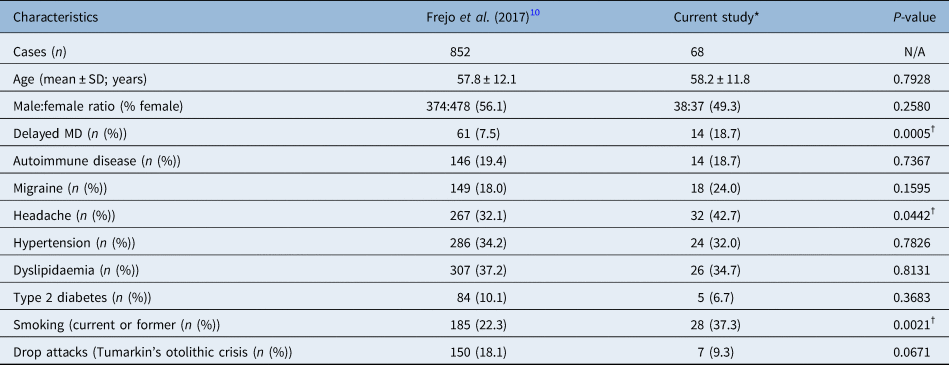
Baseline characteristics of the sporadic unilateral cases were compared with the sporadic unilateral cases described previously in a Spanish and Portuguese population (Table 2).Reference Frejo, Martin-Sanz, Teggi, Trinidad, Soto-Varela and Santos-Perez10 The rate of bilateral disease in our sporadic population was 11.1 per cent. The age, gender distribution, and rates of autoimmune disease, type 2 diabetes, hypertension, dyslipidaemia and migraine were all similar between the present unilateral sporadic population and the unilateral sporadic population reported by Frejo et al. (2017).Reference Frejo, Martin-Sanz, Teggi, Trinidad, Soto-Varela and Santos-Perez10 Our sporadic cases had a significantly higher rate of smoking, at 37.3 per cent, compared with the European unilateral sporadic cases (22.3 per cent, p = 0.0021). Additionally, our unilateral sporadic cases had a somewhat lower rate of drop attacks, at 9.3 per cent, than the European unilateral sporadic cases (18.1 per cent, p = 0.0671).
Characteristics of sporadic unilateral Ménière's disease populations in previous study and current study

*Sporadic population only; familial cases excluded (n = 6). †Statistically significant finding (p < 0.05). N/A = not applicable; SD = standard deviation; MD = Ménière's disease
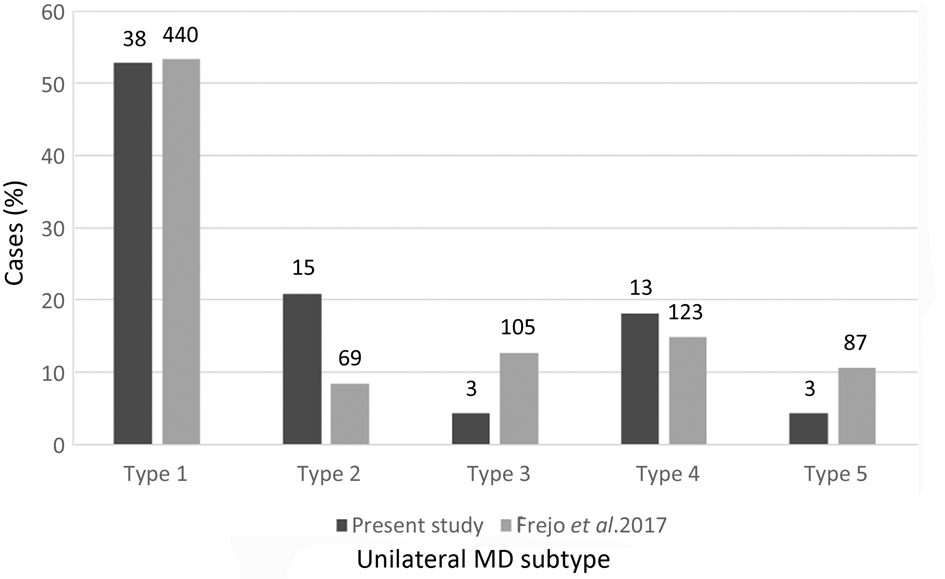
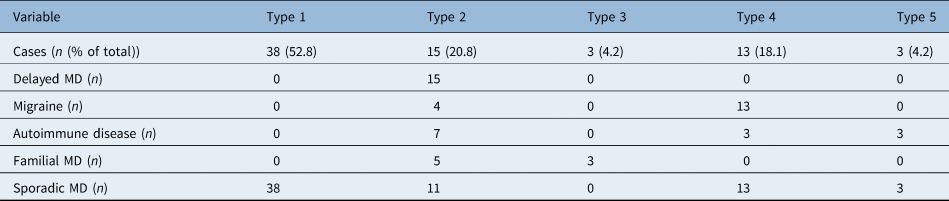
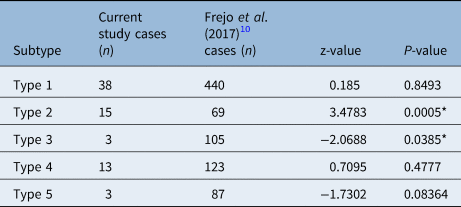
Both familial and sporadic cases were organised into one of five phenotypic subtypes, for bilateral and unilateral Ménière's disease cases, as defined previously (Table 1). There were 72 cases of unilateral Ménière's disease (Figure 2): 38 cases of type 1 (52.8 per cent of unilateral Ménière's disease), 15 cases of type 2 (20.8 per cent), 3 cases of type 3 (4.2 per cent), 13 cases of type 4 (18.1 per cent), and 3 cases of type 5 (4.2 per cent) (Table 3). The Pearson's chi-square statistic for the distribution of our unilateral Ménière's disease population among the five subtypes compared with the distribution observed in the study by Frejo et al. (2017)Reference Frejo, Martin-Sanz, Teggi, Trinidad, Soto-Varela and Santos-Perez10 was 18.1294 (p = 0.0012), indicating a significant difference between the distributions. The result is significant at p < 0.05. Among our unilateral Ménière's disease population, there were more cases of delayed Ménière's disease (type 2) and fewer familial cases (type 3) than in the European population reported by Frejo et al. (2017),Reference Frejo, Martin-Sanz, Teggi, Trinidad, Soto-Varela and Santos-Perez10 resulting in a statistically different subtype distribution (Table 4).
Bar chart comparing percentages of unilateral Ménière's disease (MD) subtypes observed in our US population compared with those reported by Frejo et al. (2017)Reference Frejo, Martin-Sanz, Teggi, Trinidad, Soto-Varela and Santos-Perez10 in a European population.

Unilateral Ménière's disease subtypes in current study*

* Includes both sporadic and familial cases (n = 72). MD = Ménière's disease
Two-tailed z-test for difference in proportions of unilateral Ménière's disease subtypes in current and previous studies

*Statistically significant finding (p < 0.05).
There were nine cases of bilateral Ménière's disease: six cases of type 1 (66.6 per cent of bilateral Ménière's disease cases), two cases of type 3 (22.2 per cent) and one case of type 5 (11.1 per cent). No cases of type 2 or type 4 Ménière's disease were observed. Comparison of the subtype distribution in our bilateral Ménière's disease population with that observed by Frejo and colleagues (2016) revealed similar distributions using Fisher's exact test (p = 0.4270).Reference Frejo, Soto-Varela, Santos-Perez, Aran, Batuecas-Caletrio and Perez-Guillen9
Discussion
In general, the clinical subtypes observed in this study from a large metropolitan city in the USA were similar to those of a European cohort. However, there were several differences between our sporadic Ménière's disease population and the European cohort. For instance, our unilateral sporadic Ménière's disease population demonstrated a higher prevalence of delayed onset Ménière's disease (18.7 per cent) than the European cohort (7.5 per cent, p = 0.0005). This finding suggests that the US population may have a higher propensity to develop hearing loss and aural symptoms without vertigo (cochlear hydrops) before going on to develop the characteristic vertigo. Our sporadic unilateral Ménière's disease population also had a higher frequency of headache (42.7 per cent vs 32.1 per cent, p = 0.0442), which may be attributable to our smaller sample size. These findings indicate that Ménière's disease in our cohort might be genetically distinct from the European population, and/or may suggest that various environmental and epigenetic factors play important roles in defining the phenotypes of Ménière's disease in these two cohorts.
• Ménière's disease is rare and lacks evidence-based treatment
• Classifying patients into phenotypic subtypes may improve predictions regarding which patients may respond to which treatments
• This study applied classification schemes for unilateral and bilateral Ménière's disease, as defined in a European population
• The distribution of unilateral phenotypes in this US population was different from that of the European population
The sporadic Ménière's disease US population studied here had a significantly higher rate of smoking (37.3 per cent) than the sporadic European unilateral Ménière's disease cohort (22.3 per cent, p = 0.0021). Our study counted patients as smokers if they were either current or former smokers. One of our patients was a current smoker and 27 were former smokers. The inclusion criteria for smokers in the European cohorts were not specified. Our lone current smoker was a patient with sporadic, delayed unilateral Ménière's disease, which corresponds to unilateral Ménière's disease subgroup type 2. The higher rate of smoking among the US population could suggest that a vascular pathogenesis may be more common. Kim and colleagues (2015) found smoking to be associated with higher odds of tinnitus, supporting the contribution of smoking to at least one of the criteria for Ménière's disease.Reference Kim, Lee, An, Sim, Park and Kim12 However, other studies have found smoking to be a protective factor against the development of Ménière's disease.Reference Bruderer, Bodmer, Stohler, Jick and Meier13,Reference Gaur, Kasliwal and Gupta14
Another difference between our unilateral sporadic population and the European unilateral sporadic cohort was the lower trend of drop attacks in our population (9.3 per cent, vs 18.1 per cent in the European cohort, p = 0.0671). This finding may represent a phenotypic difference between our US population and the European population. Our unilateral Ménière's disease population had significantly more type 2 cases (‘delayed Ménière's disease’) than the population reported by Frejo et al. (2017)Reference Frejo, Martin-Sanz, Teggi, Trinidad, Soto-Varela and Santos-Perez10 (Table 4, p = 0.0005). This also suggests a phenotypic difference that would characterise this US population as exhibiting less severe disease, or a greater tendency to alter the homeostasis of the cochlea than the vestibular organ. None of our 15 patients with unilateral type 2 disease suffered from drop attacks, further suggesting that this may represent a more benign phenotype. The Spanish population excluded patients with a diagnosis of Ménière's disease for less than five years, while our cohort did not. Therefore, the increased presence of drops attacks and smaller proportion of type 2 disease cases could be a result of the larger proportion of advanced Ménière's disease cases in the Spanish population compared with our US cohort.
In terms of our primary objective of comparing phenotypic distribution in a US population with what has been reported elsewhere, we found that our unilateral Ménière's disease distribution was statistically different to that of the European cohort. This result suggests that unilateral Ménière's disease cases in the USA have a characteristically different phenotypic distribution to cases in Europe.
In our cohort, bilateral Ménière's disease and unilateral Ménière's disease accounted for 11 per cent and 89 per cent, respectively, while the Spanish and Portuguese cohort findings reported by Frejo et al. showed a significantly higher rate of bilateral disease than unilateral disease (23 per cent vs 77 per cent).Reference Frejo, Soto-Varela, Santos-Perez, Aran, Batuecas-Caletrio and Perez-Guillen9,Reference Frejo, Martin-Sanz, Teggi, Trinidad, Soto-Varela and Santos-Perez10
Prior studies have suggested that the US Ménière's disease population consists of fewer familial cases,Reference Requena, Espinosa-Sanchez, Cabrera, Trinidad, Soto-Varela and Santos-Perez11 which is supported by the observation of fewer familial cases in our unilateral population (unilateral Ménière's disease type 3). The higher rate of bilateral cases and familial cases in the European population suggests that the Spanish and Portuguese cohorts might be more genetically homogenous than our US cohort.
We felt that the number of bilateral cases was too small to draw strong conclusions regarding subtype distribution. The frequency of bilateral disease was 11.1 per cent, which is in line with previous reports.Reference Chaves, Boari and Lei Munhoz1,Reference Huppert, Strupp and Brandt15,Reference House, Doherty, Fisher, Derebery and Berliner16
Our study did have several important limitations. A major limitation of our study relative to European studies is our confidence in confirming a family history of Ménière's disease. We relied on patient reports of familial disease, whereas the European researchers utilised nationalised healthcare records to populate their database. Additionally, they excluded patients with a diagnosis of Ménière's disease for less than five years, while many of our patients are early in their disease course. For these reasons, we may be describing the same disease but at different points in its development. Migraine history was based on clinical documentation that did not explicitly utilise specific diagnostic criteria (such as the International Classification of Headache Disorders, 3rd edition); therefore, it is possible that patients categorised with a positive migraine history were not experiencing true migraines.
In this study, sample size limited the conclusions that could be drawn about the bilateral cases and familial cases. Furthermore, the single-institution, two-neuro-otologist study design (with the small sample size) limits the generalisability of our findings to the entire population of US Ménière's disease patients. As definite Ménière's disease is relatively rare, future directions may include the addition of data from other US institutions, in order to increase external validity.
At present, there is no evidence-based treatment that improves outcomes for patients with Ménière's disease.Reference Wright8 Well-defined subtype phenotypic classification schemes are useful for delineating which patients may benefit from which interventions. The application of the scheme used here in a US population represents an important step in understanding Ménière's disease patients in the USA as well supporting the utility of these subtypes.
Conclusion
We demonstrate the applicability of a Ménière's disease phenotyping classification system in a US-based Ménière's disease cohort. Our unilateral Ménière's disease population, comprising patients seen at a tertiary care referral centre, has more cases of delayed sensorineural hearing loss (type 2) than the European population, making the distribution of subtypes statistically different. Understanding the phenotypic heterogeneity in unilateral and bilateral Ménière's disease is important for categorising the disease and for designing future clinical trials.
Competing interests
None declared