Motivation is an essential variable to consider in the treatment of drug addictions (Kizilkurt & Giynas, Reference Kizilkurt and Giynas2019; Miller & Rollnick, Reference Miller and Rollnick2012; Rubenis et al., Reference Rubenis, Fitzpatrick, Lubman and Verdejo-García2018), as low motivation is associated with higher rates of treatment dropout (Ball et al., Reference Ball, Carroll, Canning-Ball and Rounsaville2006), and motivational intervention is associated with higher retention rates (Ostergaard et al., Reference Ostergaard, Jatzkowski, Seits, Speidel, Weber, Lübke, Höcker and Odenwald2018; van den Bosch & Verheul, Reference van den Bosch and Verheul2007), which is clearly linked to better intervention results (Cox & Klinger, Reference Cox and Klinger2002; DiClemente et al., Reference DiClemente, Corno, Graydon, Wiprovnick and Knoblach2017). In fact, motivation has become a crucial factor in the reformulation of the cognitive-behavioral model of relapse in drug use (Hendershot et al., Reference Hendershot, Witkiewitz, George and Marlatt2011). It is now considered as one of the phasic factors, that is, variables closer in time to the final consumption behavior, which can fluctuate in time and context.
When substance abuse coexists with a personality disorder (PD), motivation is a particularly relevant therapeutic objective (Martínez-González & Verdejo-García, Reference Martínez-González and Verdejo-García2014). In fact, treatments that have shown effectiveness in this type of patients have in common motivational intervention (Hadjipavlou & Ogroduiczuk, Reference Hadjipavlou and Ogroduiczuk2010), assuming that it must be an essential part of the treatment, especially in the first phases (Bateman & Fonagy, Reference Bateman and Fonagy2000; van den Bosch & Verheul, Reference van den Bosch and Verheul2007; Verheul et al., Reference Verheul, van den Bosch, Ball, Oldham, Skodol and Bender2005). Although the presence of PD has traditionally been linked to low motivation and therapeutic failure, which can justify the small number of investigations on this issue, other studies have shown results that are discrepant with this view (Verheul, Reference Verheul2001). Not only may PD not be associated with a lower level of motivation but instead, a higher level of motivation has been found in patients with PD when initiating treatment compared to patients without this psychopathology (van Beek & Verheul, Reference van Beek and Verheul2008).
The motivational level of the patient who initiates treatment seems to be influenced by the degree of psychological discomfort or distress, as a factor that impels him/her to seek therapeutic help (Martínez-González et al., Reference Martínez-González, Munera and Becoña2013). In the case of drug treatment, distress is associated with drug consumption, so the disappearance of the discomfort that accompanies abstinence can substantially decrease motivation for treatment, even precipitating therapeutic dropout (Miller, Reference Miller1985; Mulder et al., Reference Mulder, Jochems and Kortijk2014).
Investigating the basic components of motivation could improve the prognosis of and approach to drug addiction. Wilkinson and LeBreton (1986) propose two differentiated dimensions, motivation for treatment itself and readiness for change. Of these two, some authors consider that readiness for change is the determining dimension and with greater relevance for future behavior (van den Bosch & Verheul, Reference van den Bosch and Verheul2007; Verheul et al., Reference Verheul, van den Bosch, Ball, Oldham, Skodol and Bender2005). However, other authors focus on motivation for treatment, considering that the factor readiness for change depends to a large extent on the way therapists interact with patients, and as being susceptible to treatment (Miller & Rollnick, Reference Miller and Rollnick2012). In any case, both aspects of motivation are of great therapeutic interest, so instruments to measure them a differentially, such as the Motivation for Treatment Questionnaire (MTQ–8; van Beek & Verheul, Reference van Beek and Verheul2008), have been developed. The original validation study of the MTQ–8 was carried out with a broad sample of patients with PD, allowing a detailed analysis of motivation in the different subtypes of this population. Bartak et al. (Reference Bartak, Spreeuwenberg, Andrea, Holleman, Rijnierse, Rossum, Hamers, Meerman, Aerts, Busschbach, Verheul, Stijnen and Emmelkamp2010, Reference Bartak, Andrea, Spreeuwenberg, Thunnissen, Ziegler, Dekker, Bouvy, Hamers, Meerman, Busschbach, Verheul, Stijnen and Emmelkamp2011) used this questionnaire to study patients with PD of Cluster A in greater depth. The questionnaire, which has excellent psychometric properties, making it a short and very useful instrument, is specifically designed for the evaluation of motivation in patients with PD.
Given the importance of motivation and the need to measure its components, the objectives of this study were: (a) To determine construct validity and the psychometric properties of the MTQ–8 to evaluate motivation; (b) to study differences in motivation at the beginning of treatment in groups with and without PD; and (c) to analyze the impact of psychological distress on motivation in drug-dependent patients.
Method
Participants
The sample was made up of 125 patients (84% male) who started treatment at a Provincial Drug Addiction Center of Granada between January 2011 and January 2017. They were randomly allocated to one of the treatment teams at the center in which the author JMMG works. Comorbid psychopathology was evaluated, discarding the expected effects of substance use.
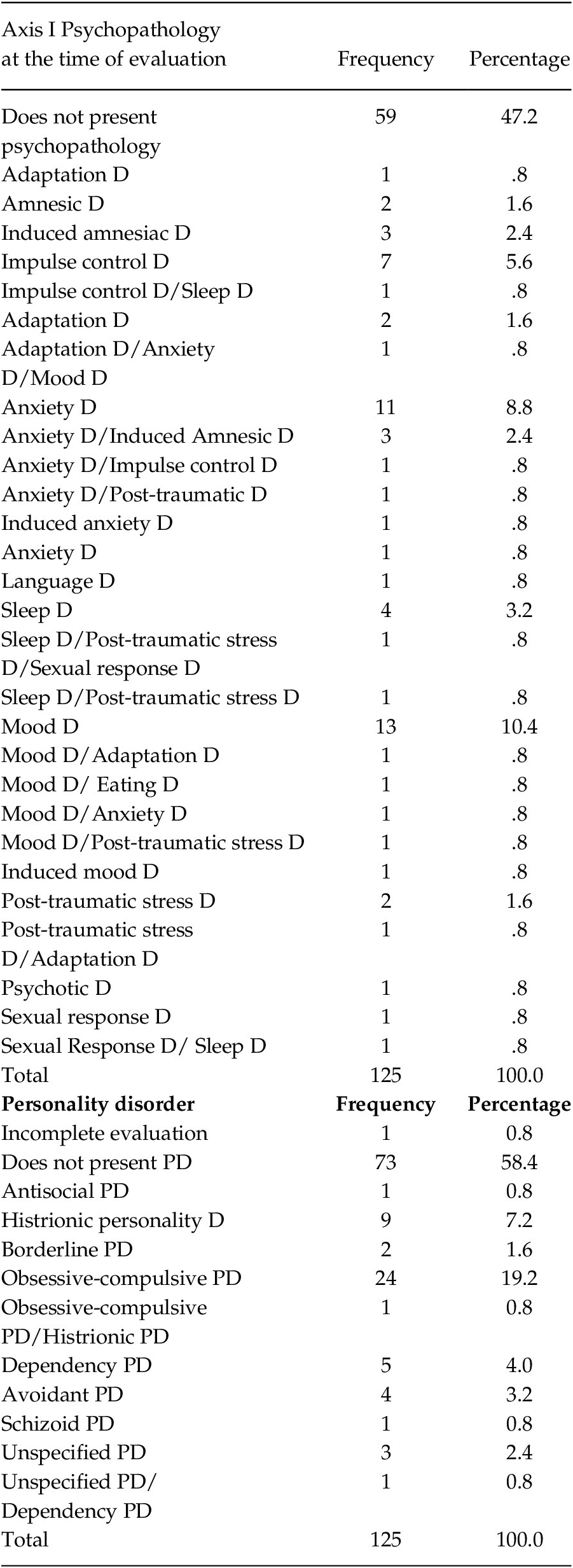
Mean age was 41.18 years (DT = 10.698; range: 20–70 years). 65.6% (n = 82) presented primary alcohol addiction, with an average age of 45.59 years (DT = 9.826), and 34.4% (n = 43) addiction to cocaine, with an average age of 32.77 years (DT = 6.43). Forty percent (n = 50) of the patients had been previously treated, and 42.7% (n = 53) presented PD. and 53.6% (n = 67) a psychopathology other than PD Patients' comorbid psychopathology at the initial evaluation can be found in Table 1.
Psychopathology at the Time of Initial Evaluation

Average withdrawal time of consumption at the time of evaluation was 35.29 days (SD = 86.42); 30.12 days (SD = 41.03) for patients with alcohol addiction (SD = 138.08), and 45.49 days for patients with cocaine dependence. The evaluation of patients' psychopathology, which is carried out in the first month of treatment, excludes from the study patients who may present psychopathology induced by consumption. The duration of the withdrawal ranged from 1 to 900 days.
Instruments
Structured Clinical Interview for DSM IV Axis I (SCID–I; First et al., Reference First, Spitzer, Gibbon and Williams1996). It evaluates the presence of Axis I psychopathology according to the criteria of the Diagnostic and Statistical Manual of Mental Disorders –IV–TR (American Psychiatric Association [APA], 2013).
International Personality Disorder Examination (IPDE; López-Ibor et al., Reference López-Ibor, Pérez and Rubio1996). It assesses PD in drug addicts, satisfactorily resolving the overlap of the symptoms of the two psychopathologies.
Motivation for Treatment Questionnaire (MTQ–8; van Beek & Verheul, Reference van Beek and Verheul2008) (see Appendix). It evaluates the level of motivation for treatment in people with drug addiction, with and without PD. It evaluates the motivational dimensions for treatment and readiness for change with two subscales of four items each. Participants must indicate the degree to which they identify with each item by means of a Likert-type scale ranging from 1 (strongly disagree) to 7 (strongly agree). The internal consistency of the subscales is α = .77 and α = .63, respectively. To develop the Spanish version used in this study, we conducted a process of: (a) Translation of the original questionnaire into Spanish; (b) back-translation of this Spanish version into English; and (c) comparison of the equivalence of both versions. The initial translation into Spanish was made by a member of the research team (José M. Martínez-González), based on previous formulations of the items presented in van Beek and Verheul (Reference van Beek and Verheul2008).
General Health Questionnaire (GHQ–28; Goldberg & Hiller, Reference Goldberg and Hiller1979). It evaluates non-psychotic psychopathology, establishing a severity index of psychological adjustment constructed from the sum of four subscales: Somatic Symptoms, Anxiety, Social Dysfunction, and Depression (González-Saiz et al., Reference González-Saiz, Carulla, Martínez J, López, Ruiz and Guerra1997). Sensitivity and specificity parameters showed optimal values of 60.7% and 73.7%, respectively (Pérez et al., Reference Pérez Moreno, Lozano Rojas and Rojas Tejada2010).
The number of previous treatments and the number of sessions attended by the patients in the treatment was obtained from the computer registry of incidents that exists in the Information System of the Andalusian Plan on Drugs and Addictions.
Procedure
The patients were treated by a team of made up of a social worker, a doctor, and a psychologist. During the first consultation with the psychologist, the psychopathological evaluation was carried out with the SCID–I and the IPDE, and the GHQ–28 and MTQ–8 questionnaires to be completed at home and delivered in the next session in 15 days were explained and handed out. The participants did not present any psychotic psychopathology or cognitive alterations that could prevent the correct comprehension of the questionnaires. Patients who did not provide the completed questionnaires at the next session were excluded from the study. All 125 participants in the study were abstinent at the time of the first evaluation.
The patients signed an informed consent. The research was approved by the Ethics Committee for Research at the University of Granada.
Analysis
For the first goal, Rasch analysis (RA), based on the Partial Credit Model (Masters, Reference Masters1982), was performed using the RUMM2020 software and, for the following goals, Student's t-tests and linear regression, respectively, were performed with SPSS v24.
Results
Structure and Properties of the MTQ-8 according to RA
An initial RA on the set of the 8 items of the MTQ–8 showed a lack of fit of the questionnaire to the Rasch model (χ2 = 34.78, p < .004). All items showed disordered thresholds with similar patterns. Ordering of thresholds was achieved through uniform rescoring through collapsing response categories to a four-point scale (0 = totally disagree, 1 = disagree, 2 = agree, and 3 = totally agree). Rescoring did not improve the lack of fit indicating that the motivation construct of the MTQ is not one-dimensional. As this first finding supported the factorial structure proposed by van Beek and Verheul (Reference van Beek and Verheul2008), represented by the subscales of Motivation for Treatment (Items 1 to 4) and Readiness for Change (Items 5 to 8), RA was performed separately for each subscale. To determine the fit of each subscale to the model, we obtained the habitual statistics in the literature (Elder et al., Reference Elder, Czuba, Kersten, Caracuel and McPherson2017; Pallant & Tennant, Reference Pallant and Tennant2007).
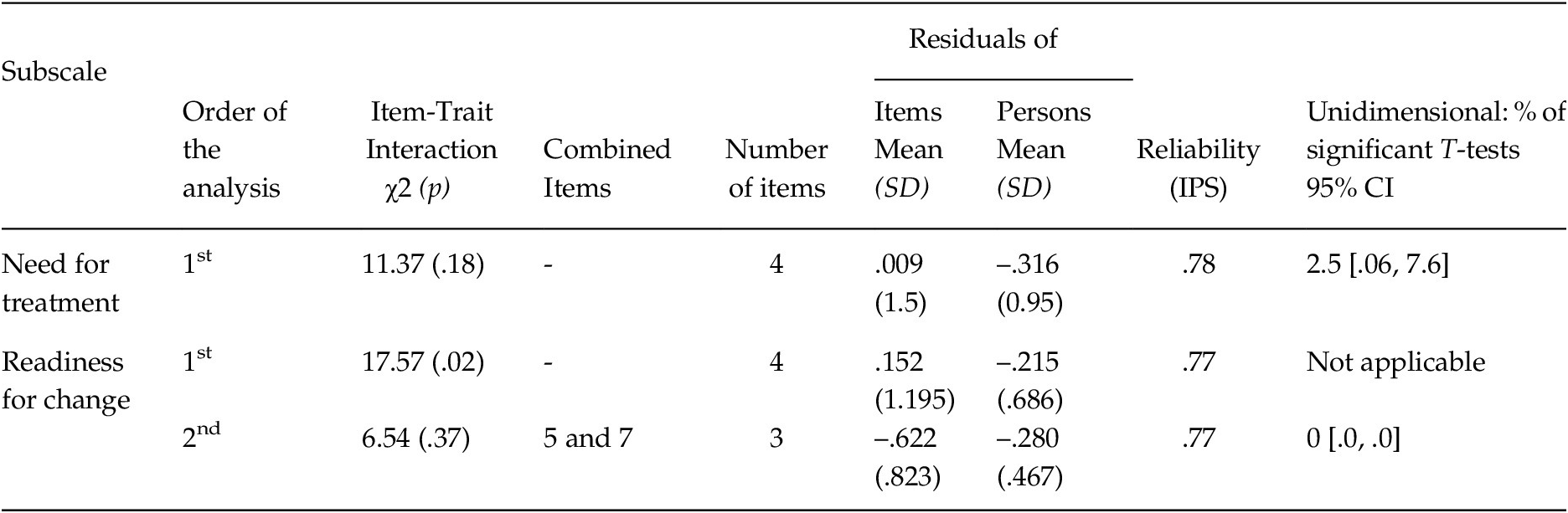
First, we determined the chi-square of the item-trait interaction, whose value is statistically nonsignificant if a subscale fits the model, indicating that all its items invariably measure the different levels of motivation, low, medium, or high. Table 1 indicates that only Subscale 1 fit the model. In parallel, the values of the residuals of each item were reviewed to determine their individual fit to the subscale. All items showed adequate fit values (mean of the residual within the ± 2.50 range and nonsignificant individual chi-square value after Bonferroni adjustment). These results indicated that the 4 items of each subscale contribute to forming the latent construct. Then, in order to find the source of global misfit of Subscale 2, the values of the correlations between the residuals of its items were calculated, finding that those of Items 5 and 7 had a correlation of .683 with each other, much higher than the acceptable value of .3. This high correlation violates the assumption of independence of the items, indicating that the response to one of the items conditions the response to the other. As both items contribute to the construct, they were merged into a single super-item, and a new RA was applied, which showed a good fit of the subscale (see Analysis 2 in Table 2).
Summary of Results of Rasch Analyses of the Subscales

Note. IPS = Person Separation Index; % percentage of significant t-tests with a 95% confidence interval; CI = Confidence interval (lower limit – upper limit, in percentages).
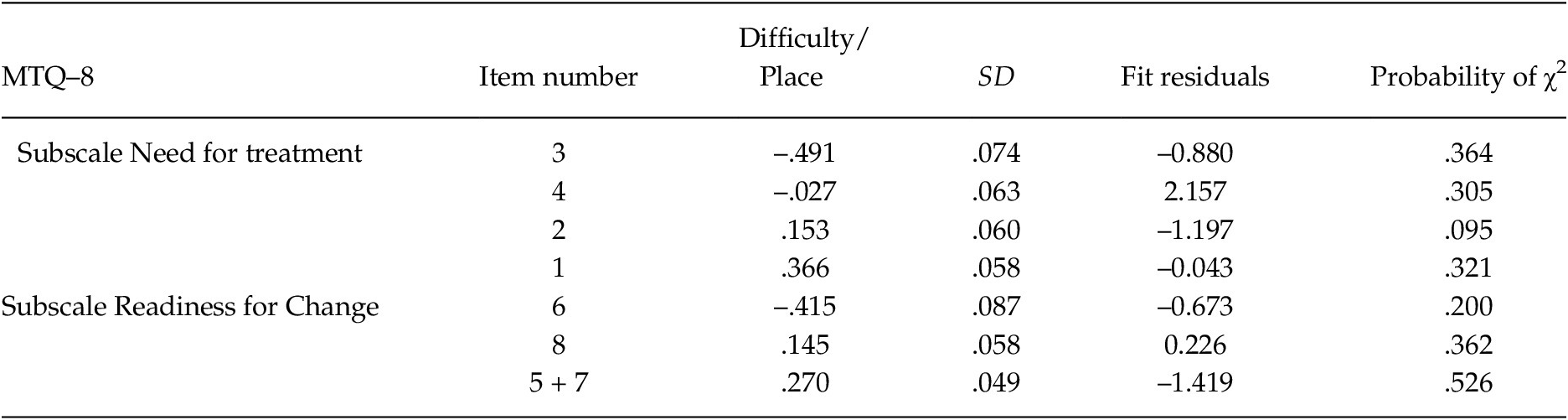
Difficulty Hierarchy of the Items of the Ordered Subscales Starting with where it is more Likely for Participants to Choose Response Options Close to 7

Secondly, it was found that the residuals for items and for people in each subscale achieved the generally accepted values of around 0 for the mean and 1 for the standard deviation (Bond & Fox, Reference Bond and Fox2015). Third, the unidimensionality of the subscales was determined following the procedure considered more robust and demanding (Tennant & Pallant, Reference Tennant and Pallant2006) consisting of three steps: (a) Analysis of principal components of the residuals of each subscale, defining two subsets of items—one with the items of positive charge and the other with the negative charge (Smith & Miao, Reference Smith, Miao and Wilson1994); (b) checking the fit to the Rasch model of each subscale separately and obtaining the estimation of the participants' location in each of the subsets; and (c) comparing the estimates using a paired t-test. The criterion that guarantees the one-dimensionality of each subscale requires that the percentage of significant t-tests remaining outside the 95% confidence interval should not exceed 5% of the total (Tennant & Conaghan, Reference Tennant and Conaghan2007). Both subscales fulfilled this criterion, showing that they are one-dimensional (see Table 2).
Differential Item Functioning (DIF) of Each Subscale
The analyses ruled out the presence of DIF attributable to any of the qualitative factors of the study: Sex, presence of PD or dual pathology, type of main consumption substance (alcohol or cocaine), presence of DSM Axis I symptomatology, or having received treatment previously.
Response Categories Functioning
RA allows determining whether participants can adequately and consistently discriminate the seven Likert-type response options presented to them. It was found that the response thresholds were disordered in all the items, indicating a malfunction of the seven response categories because the participants could not consistently distinguish so many degrees of motivation.
Item Calibration or Difficulty
The items of both scales can be sorted according to the difficulty for people to choose high values from among the response options. This difficulty represents the amount of the motivation construct contained in the item. Table 3 shows the hierarchy of each subscale, where the first items are those in which the participants more easily choose the higher responses on the scale of 1 to 7, indicating that these items measure simple aspects of the motivation construct. The last items of the hierarchy are those that represent the highest levels of the construct, so the participants who choose responses close to 7 are those who have more robust motivation. This hierarchy is of great clinical interest for evaluation. The estimation of item difficulty is stable with a 95% confidence when, as in this study, the samples are larger than 100 and there is a reasonable fit of people's residuals (Linacre, Reference Linacre1994).
Adequacy of the Sample to Item Difficulty
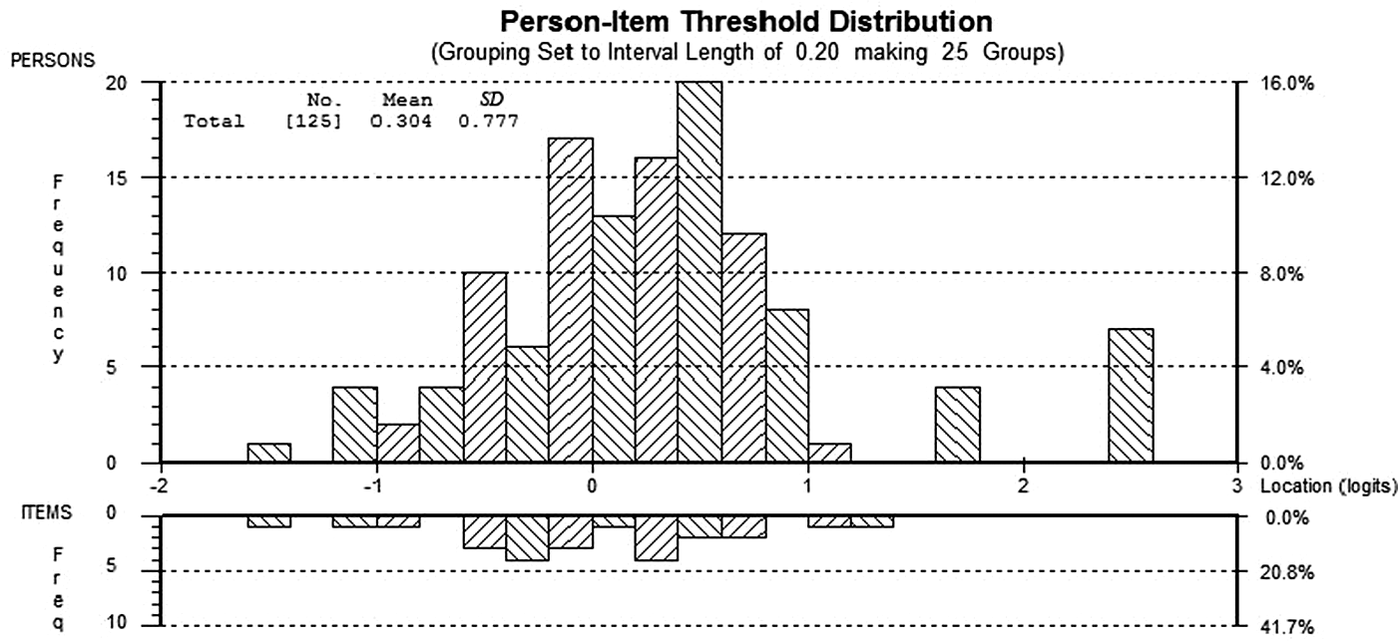
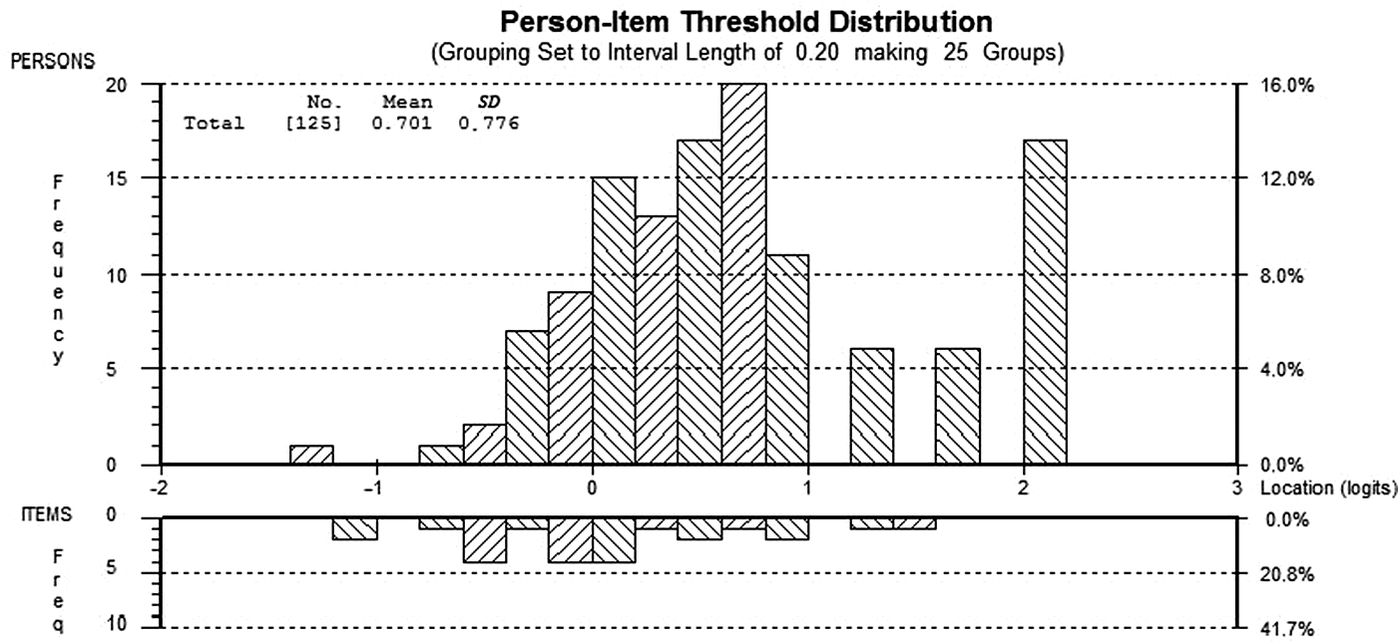
The visual inspection of Figures 1 and 2 helps to determine whether the hierarchical distribution of the items in each subscale allows us to measure all the construct levels present in the sample studied. Figure 1 shows 11 participants, who represent 8.8% of the sample (represented at the top of the figure), to the right of the last response option of the items (at the bottom). This result indicates that part of the sample has a higher degree of motivation for treatment than can be measured with the items included in Subscale 1. For these participants, there is a ceiling effect that prevents them from being evaluated precisely. The same phenomenon occurs in the subscale Readiness for Change (Figure 2), in which 23 participants (18.4% of the sample) are located to the right of the last item that appears at the bottom of the figure.
Distribution of Items (Top) and Participants (Bottom) on the Construct of the Subscale Need for Treatment.

Distribution of Items (Top) and the Participants (Bottom) on the Construct of the Subscale of Readiness for Change.

Reliability
The index of person separation (IPS) is the Rasch model statistic that represents the reliability of the results and is considered equivalent to the Cronbach alpha coefficient. The values obtained (see Table 2) are very close to the value of .80, indicating that an instrument is useful for classifying people in at least three levels of the construct (low, medium, and high motivation) (Linacre, Reference Linacre2002).
Differences in Motivation in Drug Dependent Patients depending on the Presence or Absence of PD
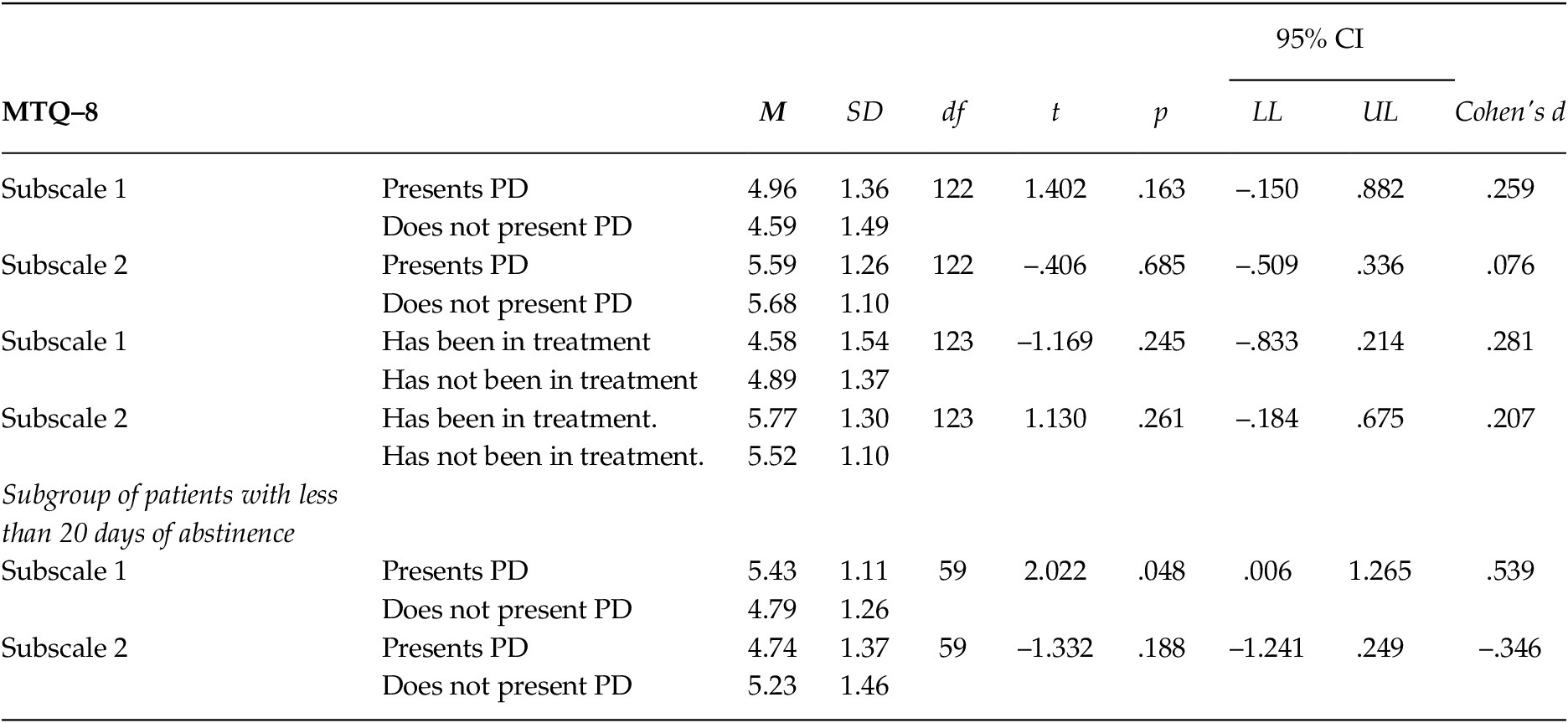
For the entire sample, neither of the two MTQ–8 subscales obtained statistically significant differences between the groups of patients with and without PD. In order to determine the impact that a shorter abstinence time may have, we analyzed a subsample of patients who had been abstinent less than 20 days, the recommended reference for dual diagnosis in addictions. This subsample of 61 patients was made up of a subgroup of 25 people with PD and a subgroup of 36 people without PD. The level of motivation of the subgroup with PD compared to non-PD patients was significantly higher in the Motivation for Treatment subscale. No significant differences were found in the second subscale (Table 4).
Differences in Motivation in the MTQ–8 Subscales as a Function of the Presence or Absence of Personality Disorders and Previous Treatments

Note. Subscale 1 = Motivation for Treatment; Subscale 2 = Readiness for Change; CI = 95% Confidence interval; d = Cohen's Delta.
Relationship between Psychological Distress and Prior Treatments on the Level of Motivation at the Beginning of Treatment
The linear regression models show that the Psychological Adjustment score of the GHQ–28 positively predicted the score in the subscale of Motivation for Treatment (R 2 = .183, β = .074, p < .001) but not in the Readiness for Change subscale. There were no significant differences in the level of motivation in relation to previous treatments.
Discussion
The first objective of the study was to determine the properties of the MTQ–8. The RA confirmed the adequate construct validity and the structure of the questionnaire in two dimensions represented by the subscales proposed by van Beek and Verheul (Reference van Beek and Verheul2008), also identified by de Weert-van et al. (Reference de Weert-van, Gongora, von Sternberg and de Jong2015): Motivation to initiate Treatment and Readiness for Change. The analyses carried out showed that both subscales are adequate measurement instruments, although it was necessary to merge Items 5 and 7 in the latter subscale. In addition, the analyses suggested possible changes to improve the psychometric properties of the questionnaire. The first advisable change would be to reduce the current seven response options, as people cannot systematically discriminate between more than 4 or 5 ordered thresholds of most constructs (Hagquist et al., Reference Hagquist, Bruce and Gustavsson2009). Second, if we want to accurately measure high levels of motivation in patients, there should be at least one item on each subscale that is more difficult.
As for the second goal, no differences were found in motivation associated with the presence of PD. Although the traditional conceptions of PD have established a relationship between PD and low motivation (Martínez-González & Verdejo-García, Reference Martínez-González and Verdejo-García2014), our results suggest that the variable psychological adjustment is the one that significantly influences motivation, rather than the categorical diagnosis of PD. These results are consistent with the postulates of van Beek and Verheul (Reference van Beek and Verheul2008) and Miller and Rollnick (Reference Miller and Rollnick2012). In addition, the results in the subsample of patients with less than 20 days of abstinence indicate that motivation for treatment is even greater in patients with PD than in those who do not present PD. These results were already found by van Beek and Verheul (Reference van Beek and Verheul2008), so it is evident that motivation for treatment should be addressed especially in the first weeks of abstinence.
These results are clinically relevant, as they find that the diagnosis of PD in drug-dependent patients should not be associated with significantly decreased motivation compared to non-PD patients when initiating treatment (van Beek & Verheul, Reference van Beek and Verheul2008). The highest levels in the dimension motivation for treatment in the group of patients with PD show that these patients can engage in the treatment as much as or more than the rest. In addition, this finding has theoretical implications, supporting the postulates of authors who indicate that absence or low levels of motivation should not be conceptualized as a personality trait, but instead that motivation is a state characteristic that is susceptible to modification through specific interventions to that effect (Marlatt, Reference Marlatt, Marlatt and Gordon1985; Miller & Rollnick, Reference Miller and Rollnick2012).
Although van den Bosch and Verheul (Reference van Beek and Verheul2008) assumed that the motivational factor of greater weight was readiness for change, the results of the study indicate that, in drug-dependent patients with PD, the factor motivation for treatment is also relevant. Taking into account that the patient's motivation to start treatment will help treatment initiation, the time when the patient will be able to benefit from different psychotherapeutic strategies—among which the motivational interview is worth mentioning—can substantially improve the second dimension, readiness for change (Miller & Rollnick, Reference Miller and Rollnick2012).
As a last goal, it is noted that psychological distress is relevant to understand the dimension of motivation, focused on patients' motivation for treatment when initiating the therapeutic process. As in previous studies (Martínez-González et al., Reference Martínez-González, Munera and Becoña2013; van Beek & Verheul, Reference van Beek and Verheul2008; van Manen et al., Reference van Manen, Helene, van den Eijnden, Meerman, Thunnissen, Hamers, Huson, Ziegler, Rtijnen, Busschabach, Timman and Verheul2011), we confirmed that psychological distress plays a relevant role in motivation for treatment, to the extent that it predicts a high percentage of the variance of motivation for treatment, the precursor of the demand for therapeutic attention. However, psychological distress does not predict preparation or readiness for change. This finding supports the habitual clinical practice of attributing great importance to the presence of distress in patients and it is in tune with the fact that the reduction of psychological discomfort significantly affects the motivation of drug-dependent patients with PD (Martínez-González & Verdejo-García, Reference Martínez-González and Verdejo-García2014). The clinical implication of the psychological distress-motivation relationship should lead professionals to keep in mind throughout the entire intervention that many patients drop out of treatment as soon as the level of related distress (mainly related to addiction) has disappeared, so it is necessary to anticipate this effect and take measures to avoid it.
Among the limitations of the study is the small sample, as a larger sample of patients diagnosed with PD could have allowed us to analyze in depth the differences between the groups of disorders. The small sample size also affects the negative results of the DIF, which should therefore be considered as an estimate and not as definitive. On another hand, we do not have any repeated measures, which could have shown us the evolution of motivation and of the influential variables in motivation throughout the treatment and of variables that would have allowed us to study the predictive capacity of the questionnaire.
In conclusion, the MTQ–8 motivation questionnaire consists of two subscales to appropriately measure motivation for treatment and readiness for change, but several improvements suggested in the article could be included. The presence of PD is not associated with a lower level of motivation for treatment in this type of drug-dependent patients. In addition, those with a short time of abstinence and PD feel higher motivation for treatment. The level of psychological distress is positively related to the need for treatment.
Appendix MTQ–8