






Crossref Citations

This article has been cited by the following publications. This list is generated based on data provided by Crossref.
Karreth, Johannes
Polk, Jonathan T.
and
Allen, Christopher S.
2013.
Catchall or Catch and Release? The Electoral Consequences of Social Democratic Parties’ March to the Middle in Western Europe.
Comparative Political Studies,
Vol. 46,
Issue. 7,
p.
791.
Avdagic, Sabina
2013.
Partisanship, political constraints, and employment protection reforms in an era of austerity.
European Political Science Review,
Vol. 5,
Issue. 3,
p.
431.
Dannreuther, Charles
2014.
The European Social Model after the crisis: the end of a functionalist fantasy?.
Journal of Contemporary European Studies,
Vol. 22,
Issue. 3,
p.
329.
Arndt, Christoph
2014.
Social democracy’s mobilization of new constituencies.
Party Politics,
Vol. 20,
Issue. 5,
p.
778.
Rennwald, Line
and
Evans, Geoffrey
2014.
When Supply Creates Demand: Social Democratic Party Strategies and the Evolution of Class Voting.
West European Politics,
Vol. 37,
Issue. 5,
p.
1108.
Arzheimer, Kai
2016.
Bürgerinnen und Bürger im Wandel der Zeit.
p.
17.
Xu, Qingwen
and
Halsall, Jamie P.
2017.
Living in the Age of Austerity and Migration.
Illness, Crisis & Loss,
Vol. 25,
Issue. 4,
p.
340.
Zohlnhöfer, Reimut
Engler, Fabian
and
Dümig, Kathrin
2018.
The Retreat of the Interventionist State in Advanced Democracies.
British Journal of Political Science,
Vol. 48,
Issue. 2,
p.
535.
Abou‐Chadi, Tarik
and
Immergut, Ellen M.
2019.
Recalibrating social protection: Electoral competition and the new partisan politics of the welfare state.
European Journal of Political Research,
Vol. 58,
Issue. 2,
p.
697.
Falski, Maciej
2019.
Semiotics of the “third force”.
Narodna umjetnost,
Vol. 56,
Issue. 1,
p.
27.
Abou-Chadi, Tarik
and
Wagner, Markus
2019.
The Electoral Appeal of Party Strategies in Postindustrial Societies: When Can the Mainstream Left Succeed?.
The Journal of Politics,
Vol. 81,
Issue. 4,
p.
1405.
Bandau, Frank
2019.
Was erklärt die Krise der Sozialdemokratie? Ein Literaturüberblick.
Politische Vierteljahresschrift,
Vol. 60,
Issue. 3,
p.
587.
Johns, Robert
and
Kölln, Ann‐Kristin
2020.
Moderation and Competence: How a Party's Ideological Position Shapes Its Valence Reputation.
American Journal of Political Science,
Vol. 64,
Issue. 3,
p.
649.
Schwander, Hanna
and
Vlandas, Tim
2020.
The Left and universal basic income: the role of ideology in individual support.
Journal of International and Comparative Social Policy,
Vol. 36,
Issue. 3,
p.
237.
Zohlnhöfer, Reimut
and
Bandau, Frank
2020.
The European Social Model under Pressure.
p.
501.
Marinova, Dani M.
2020.
Electoral accountability, clarity of responsibility and labor market policy.
Electoral Studies,
Vol. 68,
Issue. ,
p.
102237.
Rennwald, Line
2020.
Social Democratic Parties and the Working Class.
p.
71.
Hieda, Takeshi
2021.
Linking electoral realignment to welfare politics: an assessment of partisan effects on active labour market policy in post-industrial democracies.
Comparative European Politics,
Vol. 19,
Issue. 5,
p.
555.
Schleiter, Petra
Böhmelt, Tobias
Ezrow, Lawrence
and
Lehrer, Roni
2021.
Social Democratic Party Exceptionalism and Transnational Policy Linkages.
World Politics,
Vol. 73,
Issue. 3,
p.
512.
Gaasendam, Christiaan Reinier
Abts, Koen
Swyngedouw, Marc
and
Meuleman, Bart
2021.
Lost connection? The attitudinal and ideological (in)congruence of social democracy’s elites, members and voters in Flanders-Belgium.
Acta Politica,
Vol. 56,
Issue. 3,
p.
395.
This Research Note investigates the extent to which social democracy has changed in Europe and Australasia as a result of the introduction of the ‘Third Way’. In the next section, I discuss the programmatic change made by social democratic parties with respect to the welfare state and economic management, issues that have always been considered their core business.Footnote 1 In the following section, the shift from the ideology of the traditional welfare state to the ideas of the so-called social investment state, as part of the Third Way ideas, will be explored. This change over time (1975–2004) will be measured by means of two scales: one representing the traditional social democratic position on ‘social welfare’; the other indicating the new tendency of social democracy towards ‘social investment’. Indeed, a number of social democratic parties have shifted their policy positions towards what has become known as the ‘Third Way’ and away from their original position as measured by the overall Left–Right scale.Footnote 2 Finally, I shall address to what extent this change in ideology has been influenced by the vote-seeking and office-seeking behaviour of social democratic parties.Footnote 3 This is intended to explore the question of to what extent the change is a ‘new’ way for left-wing politics or rather implies a movement of social democracy towards the centre or (even) to the right within party systems after 1990.
This comparative analysis covers nineteen social democratic parties and their main competitors in: Australia, Austria, Belgium (two parties),Footnote 4 Britain, Denmark, Finland, France, Germany, Greece, Ireland, Italy, the Netherlands, New Zealand, Norway, Portugal, Spain, Sweden and Switzerland. The period under review is 1975–2004 and the comparative analysis is carried out at the party level as well as at the party-system level. The data used are the Manifesto Research Group data (see footnote 2) and the Comparative Political Data Set.Footnote 5 Both datasets are publicly available. The statistical method used is that of descriptive inference.
‘The third way’: a new direction? from welfare state to social investment state
The term ‘Third Way’ is by no means new. It figured in discussions within social democratic parties directly after the Second World War, indicating an alternative to both capitalism and communism.Footnote 6 The usage of the term then faded and the salient terms became ‘democratic socialism’ and ‘Keynesian welfare statism’.Footnote 7 It is precisely these tenets that the present propagators of the ‘Third Way’ dispute. For example, in the Blair/Schroeder declaration (1998) in support of this new direction for social democracy, traditional social democracy is said to be flawed because:Footnote 8
— It confuses social justice with equality of outcome.
— It confounds achieving equality with higher levels of public spending and taxing.
— It believes that state intervention could prevent (or remedy) market failures.
— It distorts the rights of individuals and the balance between the individual and the collective.
— It too often elevates rights over responsibilities, so that the idea of mutual obligations tends to be lost.
In short, the relationship between socialism and democracy has changed from a collective to an individual responsibility and the relationship between citizen and state has been redefined.Footnote 9
The concept of the Third Way, as popularized by Giddens, seeks to renew social democracy by addressing these issues as well as taking into account the contemporary challenges associated with globalization, individualism, new developments in technology, ecology and the transformation of values and lifestyles. According to the Blair/Schroeder declaration, these issue areas, and in particular those relating to ‘welfare statism’, make change necessary in the policy stances of the left and drive the need for a ‘new’ social democracy:
— Macro-economic policy should be directed at sound public finances, i.e. no deficit spending or rising public debts, but instead making allowance for tax cuts to enhance economic development in the ‘post-industrial’ society.
— Welfare state programmes ought to aim at transforming the existing safety net of entitlements into a springboard for individual development and people taking personal responsibilities, instead of becoming dependent on the state.
— Labour market policy making must be developed to promote individual responsibilities, labour market mobility and the flexibility of the labour force (i.e. ‘lifetime learning’ and lifelong employability).
Taking this as the platform for Third Way ideas with the associated proposals for social democratic policy, to what extent has European social democracy turned in Third Way directions? The use of the plural here signifies that a turn to a Third Way type of party manifesto should not be considered as a uniform recipe for social democracy. As I will show, the opposite is the case.Footnote 10
In summary, the Third Way approach advocates that the traditional welfare – or social security state – should be replaced by the social investment state. In the social investment state, social justice is no longer to be achieved by an ex-post reduction of socio-economic inequalities, but by providing equality of opportunities. Employment and employability are the key issues in a social investment state: welfare to work setting. Access to employment should be facilitated through the provision of education, thereby establishing equality of opportunity. The central idea is that the state is responsible for guaranteeing access to certain goods but need not directly provide these goods itself. ‘Welfare’ in a social investment state presupposes a correct balance between incentives, opportunities and obligations for its citizens: ‘no rights without responsibilities’, as Giddens has put it. Social justice defined by inclusion is no longer to be solely achieved by the state, but also by the market. The development from traditional social democracy to the Third Way can therefore be summarized as the abandonment of an explicit stance favouring a generous social welfare state together with state interventionism. The alternative is a move towards a social investment state promoting market regulation instead of rigid welfare entitlements and state regulation of the market economy.Footnote 11
Before considering in this section the extent and direction to which social democratic parties have indeed changed their programmes towards a Third Way, I will consider the question of whether and to what extent they have changed their positions in terms of the general left–right distinction within their respective party systems, indicating a development from a ‘traditional’ (left-wing) to a ‘modern’ (or radical centrist in Giddens’s terminology) type of social democratic party.
Changing social democratic ideas: from left to right?
If social democratic parties have moved their positions and, in particular, have indeed changed their preference for a social security state into a preference for a social investment state, is this evident in their party manifestos? Manifestos play an important role during election campaigns, when public attention centres on these documents. While few voters ever read these documents, they are disseminated by the media. Therefore, manifestos are a good measure of the change and movement of social democratic ideas with respect to the welfare state.Footnote 12
Social democratic party positions may be measured in three different ways: (1) by looking at a Third Way scale; (2) by using a scale appropriate for the electorate and (3) by employing a Left–Right scale. The latter scale, which was developed by the Manifesto Research Group (see footnote 2), is considered in this Note as a benchmark to assess not only the movement of social democratic parties as such, but also of the national party systems under review here. The electoral scale, which is labelled Working Class Appeal, is meant to measure to what extent social democratic parties do indeed target specific groups in society.Footnote 13 In other words, is the original social democratic constituency – which used to be the ‘working class’ – still an important target of Third Way democratic socialism? Finally, the Third Way scale is, of course, developed to measure the change and movement towards a policy position away from the social security state towards a social investment state, as discussed in the previous section. For in a highly developed welfare state, government tries to control the economy and soften the negative effects of the market system by means of a high level of social security spending and other kinds of state interventionism.Footnote 14 Conversely, the social investment state presupposes a more reserved stance of government with respect to direct market interventions. In the social investment state, government gives more way to the market and assumes that the market is capable of ensuring job growth and a reasonable distribution of income.Footnote 15
A shift of social democratic policy to the centre of a party system may also imply that the social democratic parties are turning towards new electorates. A shift towards the Third Way may be an attempt to move beyond their traditional working-class electorate and recruit middle-class support. The original emphasis of social democracy on the traditional welfare state clearly coincides with the interests of the labour movement and less advantaged groups on the labour market. If there is a tendency towards Third Way policy stances, these groups may well get less attention or even negative attention in party programmes. Issues dear to the middle class could well be mentioned more frequently rather than those favoured by the working class.Footnote 16
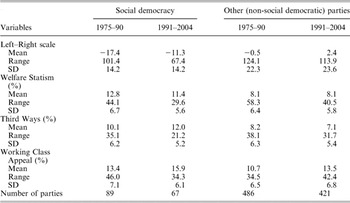
Table 1 shows, first of all, that the differences in terms of Right versus Left tend to decrease over time, but are still considerable between social democratic and other parties (13.7 points between 1991 and 2004). Nevertheless, noticing the smaller range of social democratic parties, both over time and across nations, the differences are smaller than before 1990. The same observation can be made as regards the saliency of traditional ‘Welfare Statism’ and Third Way approach to the ‘Social Investment State’. Both the averages and the range decrease slightly after 1990. Social democratic parties appear to stress less the basic tenets of the traditional welfare state (−1.4), whereas this remains the same for other parties. Third Ways are also less emphasized. This is not the case with Working Class Appeal: more programmatic emphasis is laid on labour groups, minorities and those in need of support by social democratic parties and ‘other parties’ (changes of 2.5 and 2.8 points, respectively).
Distribution of Left versus Right, Traditional Welfare Statism, Third Way and Working Class Appeal before and after 1990
Note: See fnn. 2 and 3 for operationalization of party positions and fnn. 2, 3, 15 and 16 for sources.
All figures are percentages but for the Left–Right scale, where movement to the left is shown as a negative value, and to the right as positive.
Table 1 also shows that Social Democracy is still more left leaning than many other parties, and that its adherents remain by and large faithful to the extant type of Welfare State. Hence, Third Way statements are apparent, but not much more than in other parties.Footnote 17 Working Class Appeal grows moderately and may well indicate an attempt by social democratic parties to realign its ‘core’ vote. Yet this feature is also visible in the scores of other parties and can thus be considered as a development to a ‘catch-all’ electoral strategy.Footnote 18
However, the most striking result from Table 1 is the convergent development that has taken place. Although the movement of social democratic parties is more pronounced, the differences from other parties have become limited (the range decreases by 34 points on the Left–Right scale and 14.5 points on traditional welfare statism). Only the attention paid to the working-class constituency (and the weaker groups in society) increases slightly, but the actual level of ‘appeal’ is, as stated, quite similar for all parties under review: the difference between both groups is only 2.4 points. The statistical ranges are less than before 1990 and this – again – points to party system convergence. This is in particular the case for the social democratic parties. As shown in Table 1, the range for all parties on the different scales is – except for the Left–Right scale – quite close to the ranges of social democratic parties.
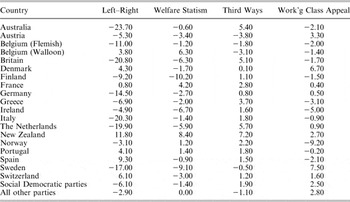
As party differences diminish, although social democratic parties are still more to the left than most other parties, movement tends to be towards the ‘centre of gravity’ for most party systems. This implies that exactly this party family is relaxing its policy positions (in terms of the type of welfare to be provided) as well as its appeal to the electorate (as regards its original constituencies). However, as Table 2 shows, some parties are still close to their original ideology whereas others clearly have moved towards the ‘radical centre’. Hence, Third Ways have emerged, but some social democratic parties in Europe have remained by and large ‘true’ to their original ideological position. In addition, ‘other parties’ show a similar pattern, indicating that the differences between party families continued to fade during the 1990s.Footnote 19
Change in Social Democratic Positions Before and After 1990 by Country
Notes: A negative value means movement from Left to Right; less emphasis on Welfare Statism, Third Ways or Working Class Appeal. A positive value means more to the Left and more emphases on the other indicators of programmatic change. Change is between the average positions for 1975–90 and 1991–2004. See also fnn. 15 and 16.
In Table 2, the scores reported in Table 1 are disaggregated at the national level. In some countries – most notably Australia, Flemish Belgium, Finland, Germany, Great Britain, Italy, the Netherlands and Sweden – not only is there a move towards the ‘radical centre’, but also this is accompanied by more emphasis on Third Ways ideas and less on maintaining the traditional welfare state (e.g. Australia, Finland, Flanders, Great Britain, Ireland, the Netherlands and Sweden). In many cases, the change of discourse also affects ideas about the working class (French Belgium, Ireland and Norway in particular), but this is not a unilateral movement: in Austria, Denmark and Sweden, the opposite movement can be discerned. Finally, the relationship between emphasizing traditional welfare and Third Ways (promoting the Social Investment State) is absent (Pearson’s r = 0.08 for 1975–90 and 0.21 for 1991–2004). Yet it is obvious that overall Social Democracy is in flux and moving to the centre of gravity of party systems. Yet at the same, time not all social democratic parties move in the same direction. This diversity within the party family is further underpinned by the observation that the ‘other parties’ show similar developments. Although the trend is convergent in many party systems, the variation across the party systems remains considerable.
From Table 2, we can thus infer that there is a movement towards a Third Way position across party systems that is not confined to Social Democracy alone. Yet to a large extent, the position of many social democratic parties still tends to be ‘leftist’ (in the traditional sense). The listing in Table 2 shows that there is still considerable cross-national variation regarding the change in positioning of the social democrats. For example, the New Zealand, Spanish, Swiss and French social democratic parties remain solidly on the left and combine it with a positive score on the Third Way scale. Conversely, the main propagators of the Third Way, the British Labour party and the German SPD, as well as the Italian left-wing alliance, indeed show considerable change from ‘left’ to ‘centre’.
As most parties, and the social democratic ones in particular, have changed course, it appears reasonable to suggest that this was in part motivated by vote seeking and office seeking. After1990 especially, it appears to have led to a movement towards Third Way ideas and an appeal to the working class, expressing a strategy to maintain or regain political power.
The power resources of social democracy: votes and office
It is clear from the previous section that the overall trend is a shift towards the centre of gravity of the respective party systems in each country, combined with a simultaneous movement of social democracy away from its traditional policy stance with respect to the welfare state. This can be considered as an indicator of Third Way politics and it is by and large confirmed by the increase of 1.9 points on this scale, whereas the other parties show a decline of 1.1 points in this respect (see Table 1). The question is then to what extent party system change and the ‘new’ politics of social democracy have affected its power resources in terms of votes and office.Footnote 20
Wolfgang Merkel notes that European Social Democracy has experienced relatively historically high levels of voters’ support (30.9 per cent) and participation in government (43.5 per cent) in the 1990s.Footnote 21 However, this is a somewhat optimistic observation if one looks at the statistical range (respectively 37.2 per cent in votes and 49.1 per cent in terms of government participation after 1990). In Table 3, the change in average votes, seats and government participation before and after 1990 is reported in relation to the extent to which parties have changed their programmatic profile. To this end, a classification has been developed that has been derived from the programmatic variables used: left to right movement; less traditional welfare statism; more Third Way attention and working-class appeal. If a party scores strongly on three of the four indicators, it implies a ‘major’ change of strategy; if two out of four, it is moderate; if only one, it is considered as a minor change; and if none, of course, no change of strategy has occurred. Portugal exemplifies no change, whereas Britain and the Netherlands demonstrate a ‘major’ change of strategy.
Effect of Change in Strategy of Social Democratic Parties after 1990
Note: N = Number of parties in Votes, Seats and Government participation. See for sources fnn. 3 and 5, and Jaap Woldendorp, Hans Keman and Ian Budge, Party Government in 48 Democracies (1945–1998). Composition – Duration – Personnel (Dordrecht: Kluwer, 2000 [updated to 2004]).
The electoral performance of social democratic parties has been less strong and stable than has been suggested.Footnote 22 Now, the question is to what extent vote-seeking and office-seeking behaviour are related to Third Way politics and whether this strategy has paid off. Apparently, change has occurred and this may well be associated with a change in strategy. However, the vote share has gone down (on average −2.7 per cent) as has the proportion of seats in parliament (on average −2.1 per cent). Yet damage control is visible if a party did change its strategy towards the Third Way. In fact, if this change was moderate, at least it did not hurt government participation, and if it involved a major change then it seems to have paid off in terms of seats in parliament and government office. Government participation went up by 13 points on average for all parties and indeed increased after 1990. To a large extent, this result has been due to the reappearance of Labour in Britain in 1997, the relatively long reign of the Dutch Labour Party (1989–2002), the emergence of Schroeder in Germany in 1998, and the relatively strong position of social democracy in Spain and Portugal. Yet at the same time, the Scandinavian social-democratic stronghold has been under siege, and also elsewhere votes and seats appear harder to come by after 1990.
The most striking feature is the growth of social democracy in government participation after 1990. However, a caveat should be registered. Since most European democracies elect their parliamentary representatives by proportional representation (PR), a multiparty system regularly occurs. This implies more often than not that coalitions have to be formed, which confounds our observations, because parties losing electorally can still end up in government. Yet at the same time, it appears that a changed strategy helps to preserve votes and office, in particular government participation. Moving to the ‘centre of gravity’ and moderating the policy stance as regards welfare statism are paradoxically rewarded in parliamentary seats and government office.Footnote 23 How is this relationship shaped? What indicators of strategic change have been important in accounting for the changes reported in Table 4?
Degree of Changing Strategy towards Third Ways by Social Democracy
Note: Derived from Tables 2 and 3. N = 146. Percentage scores represent the proportion of those social democratic parties that have indeed shown change on each of the variables.
Parties viewing government participation as their main goal seem to play down their ideology in order to maximize their votes or in order to become attractive coalition partners. This assertion is in accordance with the Downsian model of party competition, which predicts that parties are not primarily ideologically driven but predominantly tend to follow (median) voter preferences to maximize their votes.Footnote 24 We know that many social democratic parties have followed a vote-maximizing and office-maximizing strategy regarding their policy stances as well as regards their left–right position and accordingly have moved towards the centre of gravity of their party system. In addition, it follows – given this movement towards the centre – that Third Way politics has become more prominent and apparently has a greater bearing on the votes and offices gained.Footnote 25
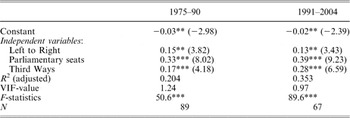
Table 4 shows the extent to which social democratic parties have changed their strategy before and after 1990. With the exception of Working Class Appeal, about 35 to 45 per cent of all social democratic parties have moved to the centre and altered their policy position as regards welfare statism. Most striking is perhaps the farewell to the traditional Welfare State or social security state (44.8 per cent) trading it off against the Social Investment State.Footnote 26 This change of strategy does indeed appear to be conducive to more votes and offices: the Pearson correlation coefficients between less traditional welfare statism, on the one hand, and more Third Ways attitudes, on the other hand, and votes and seats are: r = 0.37 and 0.44 (significance: p < 0.05). However, this relationship does not hold as regards government participation. It appears that the translation from votes and seats to government is less directed by the strategic choice for moving to the centre and relaxing the traditional policy position regarding the welfare state (in contrast to the case put by Giddens and Huber and Stephens).Footnote 27 Yet at the same time, we observe a strong increase in government participation. In part, this can be understood as an effect of the politics of government formation, which is a complex and delicate game involving more variables in the equation than votes and office.Footnote 28 Except for Britain, most of the countries under review have experienced only governing by coalition (and in Scandinavia, often under minority conditions). Hence, to understand the relationship between changing strategies and government participation, we must look at the combined effects of Third Way strategies, left to right movement of social democratic parties and their legislative weight. The impact of these factors on government participation is examined by means of regression analysis.
It is clear from Table 5 that if and when a Third Way strategy is employed, the chances of social democracy governing appear to rise. This chance increases after 1990. I conclude, therefore, that a programmatic change towards the centre of the party system, with a Third Ways profile preserves the vote-seeking capacity of social democratic parties, but it mainly enhances its office-seeking ability. As far as change of social democracy occurs, it appears to result in a modest rise in votes and a strong rise in government office (recall Table 3). Third Way politics appears to be mainly a function of a general shift in party systems. As Table 1 shows, the reason is that most parties – including non-social democratic ones – show the same level of attention paid to this part of the electorate. There is little comparative advantage in this type of party competition. The analysis so far confirms that the programmatic development of social democratic parties has little bearing on their vote-seeking capacity (see Table 3). Hence, as an electoral strategy, neither continuity nor change pays off in more votes for social democracy. To put it even more strongly: social democracy gains little from its movement to the centre of gravity, or as Giddens wrote to the ‘radical centre’, other than keeping office.
Regression Analysis of Social Democratic Participation in Party Government
Notes: OLS-regression. VIF-values ⩽2.0 are considered to show absence of colinearity. The coefficients are betas (standardized). T-values in brackets. **Significant at 0.05, ***significant at the 0.01 level. See also Tables 2 and 3.
Conclusion and some speculation
In so far as social democracy has shifted its programmatic stance towards the centre of gravity, it does not enhance its electoral position. However, such a shift does pay as regards its office-seeking capacity. In addition, it can be argued that the converging tendency in many party systems – as manifested in the diminishing differences between parties of the left and the right – appears to have resulted in a new situation where coalition formation becomes less influenced by policy-seeking behaviour and is more directed by office seeking.
This development could well explain the emergence of ‘innovative’ coalitions, where we see party combinations that did not occur often before 1990. Examples of this development are growing: the ‘purple’ coalition in the Netherlands (1994), the first ever involvement of the Liberals and Greens together in Finnish coalitions (1995), the ‘Green/Red’ coalition in Germany (1998), the ‘purple’ variant with a Green touch in Belgium (in 1999), and the coalitions formed in New Zealand after 1996. Hence, one could contend that the changing (often converging) format of party systems has an impact on the overall complexion of (coalition) governments resulting in social democratic incumbency flourishing in the 1990s.
Taking all together, I conclude that the Third Way should rather be considered as a social democratic strategic answer to the emergence of neo-liberal ideas on the role of the state and concomitant rise of right-wing parties after 1990. It certainly is not yet an ideological transformation of social democracy everywhere. In the midst of changing party systems and modes of party competition, the development of the Third Way appears to be more of a pragmatic move to enhance social democratic electoral appeal and governmental viability.