


Suicide reduction has recently become the aim of governmental strategies in, for example, England (Department of Health, 1993, 2002), the USA (Reference VastagVastag, 2001), Australasia and Nordic countries (Reference Taylor, Kingdom and JenkinsTaylor et al, 1997), and global strategies through a campaign of the World Health Organization (2004). The main suggested targets for intervention have been people with undetected depression and those recently or currently in psychiatric care – usually with ‘severe mental illness’ (as defined in the various policy documents). Less attention has been paid to those who are known to hospital services because of non-fatal self-harm, although recent primary research (Reference Jenkins, Hale and PapanastassiouJenkins et al, 2002; Reference Hawton, Zahl and WeatherallHawton et al, 2003) and systematic review (Reference Owens, Horrocks and HouseOwens et al, 2002) have confirmed that their rate of subsequent suicide is far higher than expected. Unfortunately, much research on suicide after non-fatal self-harm is poor, based on small and highly selected samples, weak methods for detecting suicides during follow-up, and flawed analysis (Reference Owens, Horrocks and HouseOwens et al, 2002). We therefore set out to determine long-term mortality and cause of death for around 1000 consecutive patients who attended one of the UK's largest accident and emergency departments because of self-poisoning during a brief period in the mid-1980s.
METHOD
The study sample comprised all episodes of self-poisoning that had resulted in attendance at the accident and emergency department in Nottingham, UK, during 9 months between November 1985 and July 1986 (Reference Owens, Dennis and JonesOwens et al, 1991). Nottingham is a large city in the East Midlands of England and its accident and emergency department is one of the busiest in the UK. The only exclusions were patients aged under 14 years and episodes where the self-poisoning was deemed accidental. Episodes were included if, at the time of the person's arrival, clerical staff recorded the reason for attending as ‘overdose’ or ‘self-poisoning’. At that stage they attached a research data-sheet to the clinical record. The researchers (D.O. and M.D.) examined accident and emergency records every week to ensure inclusion of episodes not identified at the time of arrival but subsequently diagnosed as self-poisoning by medical staff. The original study compared the characteristics and short-term outcome of patients admitted briefly to the general hospital with those of patients who returned home directly from the accident and emergency department (Reference Owens, Dennis and JonesOwens et al, 1991).
For the present investigation, each person's first attendance during the study period was used as the index episode. We provided the Office for National Statistics with identifying data on each person and they determined, up to the end of 2002, whether each person was alive or had died during the follow-up period of 16–17 years. The Office for National Statistics sent us lists of those who could not be traced and of those who had died. In the case of deceased patients the Office for National Statistics sent us a draft of the death certificate, including ICD–10 coding (World Health Organization, 1993). We did not have access to coroners’ notes concerning the deaths. Data from death certificates were obtained for deaths in England and Wales, and Scotland.
In the original study, medical staff in the accident and emergency unit had completed checklists about the patients while they were in the emergency room. Checklists asked about potential risk factors for seriousness of the index episode as a suicide attempt and for adverse outcome, with items such as past self-harm, psychiatric history, living arrangements, and social and medical status. We collected fairly complete data about variables that could routinely be extracted from the accident and emergency case records such as age and gender, substances ingested, and whether poisoning was accompanied by cutting. In the case of alcohol consumption around the time of the self-poisoning, we always made a judgement that it had not taken place unless it was specifically stated in the record that the person gave an account of taking alcohol, or a smell of alcohol was mentioned, or a breath test or blood test was positive for alcohol. Unfortunately, the checklists were not always complete; for the many risk factors enquired about, the median valid sample size was 71% of the total sample (Reference Owens, Dennis and JonesOwens et al, 1991). In view of the absent data, only some of these potential risk factors are examined in the present study; where they are analysed, valid sample size is shown. In the case of rating the level of consciousness, we have complete data because we always judged that the person was fully conscious unless the checklist or the case record said otherwise.
Data were analysed using SPSS version 10.1 for Windows and Stata version 8.2 for Windows. Cox's proportional hazards regression was used to model survival to death either by suicide or all causes. When, in certain analyses, Cox regression proved impossible – because of insufficient outcome events for the model – logistic regression was used. Ethical approval for the investigation was received from the Nottingham Research Ethics Committee.
RESULTS
Index episodes
We identified 1091 episodes, 40% (441 out of 1091) by males. In 22 episodes (2%) self-poisoning was accompanied by self-cutting. In 39% of episodes (423 out of 1091) alcohol consumption was reported by the patient or detected by staff. In 539 episodes (49%) patients ingested analgesics (mainly paracetamol); in 364 episodes (33%) minor tranquillisers; in 127 (12%) antidepressants; in 75 (7%) other psychotropic drugs; in 14 (1.3%) non-ingestible substances; and in 230 episodes (21%) other miscellaneous drugs. In 32% of episodes (346 of 1091) the person had taken more than one drug. In 581 out of 1091 episodes (53%), the patient's state of consciousness was recorded on our checklists or in accident and emergency records as alert, in 303 (28%) as mildly drowsy, in 150 (14%) as very drowsy, and in 57 (5%) as unconscious. Admission to hospital took place in 69% of episodes (755 out of 1091) (2% to the psychiatric unit, 67% to general wards).
The sample consisted of 976 people because 115 out of 1091 episodes were repeats. Over the 365 days from their index attendance, 119 out of 976 people repeated self-poisoning (12.2%). At least 273 out of 976 patients (28%) had had a previous episode, and at least 268 out of 976 (27%) had seen a psychiatrist in the past.
Mortality
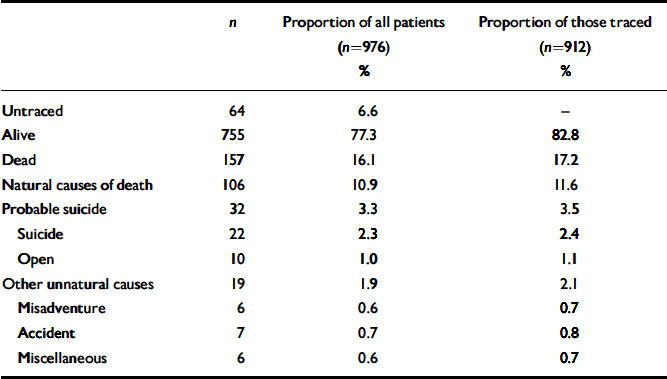
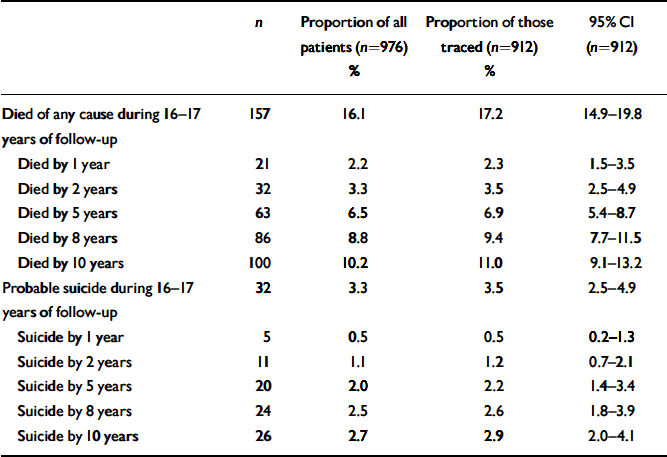
The Office for National Statistics traced 912 (93%) of the 976 people. Those not traced were similar to those traced in terms of age and gender. By the end of 2002, at least 157 out of 912 people (17%) had died (Table 1). The category of probable suicide incorporates deaths designated by coroners as suicides or open verdicts; in addition, all the deaths in our category of ‘probable suicide’ were coded by the Office for National Statistics as X60–X84 (intentional self-harm) or Y10–Y34 (event of undetermined intent). From this point forward, the term ‘suicides’ will be used for this broader group. Table 2 sets out the timing of deaths. Suicides took, on average, half as long to occur as did other deaths. Median time to death for the 32 suicides was 4.1 years (interquartile range (IQR) 1.5–8.3) whereas the median was 8.3 years (IQR 3.5–12.6) for the 125 deaths that were not suicides (difference in medians=4.3 years, bootstrapped 95% CI 1.6–6.9).
Tracing of patients in the study and causes of death
| n | Proportion of all patients (n=976) % | Proportion of those traced (n=912) % | |
|---|---|---|---|
| Untraced | 64 | 6.6 | - |
| Alive | 755 | 77.3 | 82.8 |
| Dead | 157 | 16.1 | 17.2 |
| Natural causes of death | 106 | 10.9 | 11.6 |
| Probable suicide | 32 | 3.3 | 3.5 |
| Suicide | 22 | 2.3 | 2.4 |
| Open | 10 | 1.0 | 1.1 |
| Other unnatural causes | 19 | 1.9 | 2.1 |
| Misadventure | 6 | 0.6 | 0.7 |
| Accident | 7 | 0.7 | 0.8 |
| Miscellaneous | 6 | 0.6 | 0.7 |
Timing of deaths, by any cause and by suicide
| n | Proportion of all patients (n=976) % | Proportion of those traced (n=912) % | 95% C1 (n=912) | |
|---|---|---|---|---|
| Died of any cause during 16-17 years of follow-up | 157 | 16.1 | 17.2 | 14.9-19.8 |
| Died by 1 year | 21 | 2.2 | 2.3 | 1.5-3.5 |
| Died by 2 years | 32 | 3.3 | 3.5 | 2.5-4.9 |
| Died by 5 years | 63 | 6.5 | 6.9 | 5.4-8.7 |
| Died by 8 years | 86 | 8.8 | 9.4 | 7.7-11.5 |
| Died by 10 years | 100 | 10.2 | 11.0 | 9.1-13.2 |
| Probable suicide during 16-17 years of follow-up | 32 | 3.3 | 3.5 | 2.5-4.9 |
| Suicide by 1 year | 5 | 0.5 | 0.5 | 0.2-1.3 |
| Suicide by 2 years | 11 | 1.1 | 1.2 | 0.7-2.1 |
| Suicide by 5 years | 20 | 2.0 | 2.2 | 1.4-3.4 |
| Suicide by 8 years | 24 | 2.5 | 2.6 | 1.8-3.9 |
| Suicide by 10 years | 26 | 2.7 | 2.9 | 2.0-4.1 |
Characteristics of those who died in the follow-up period
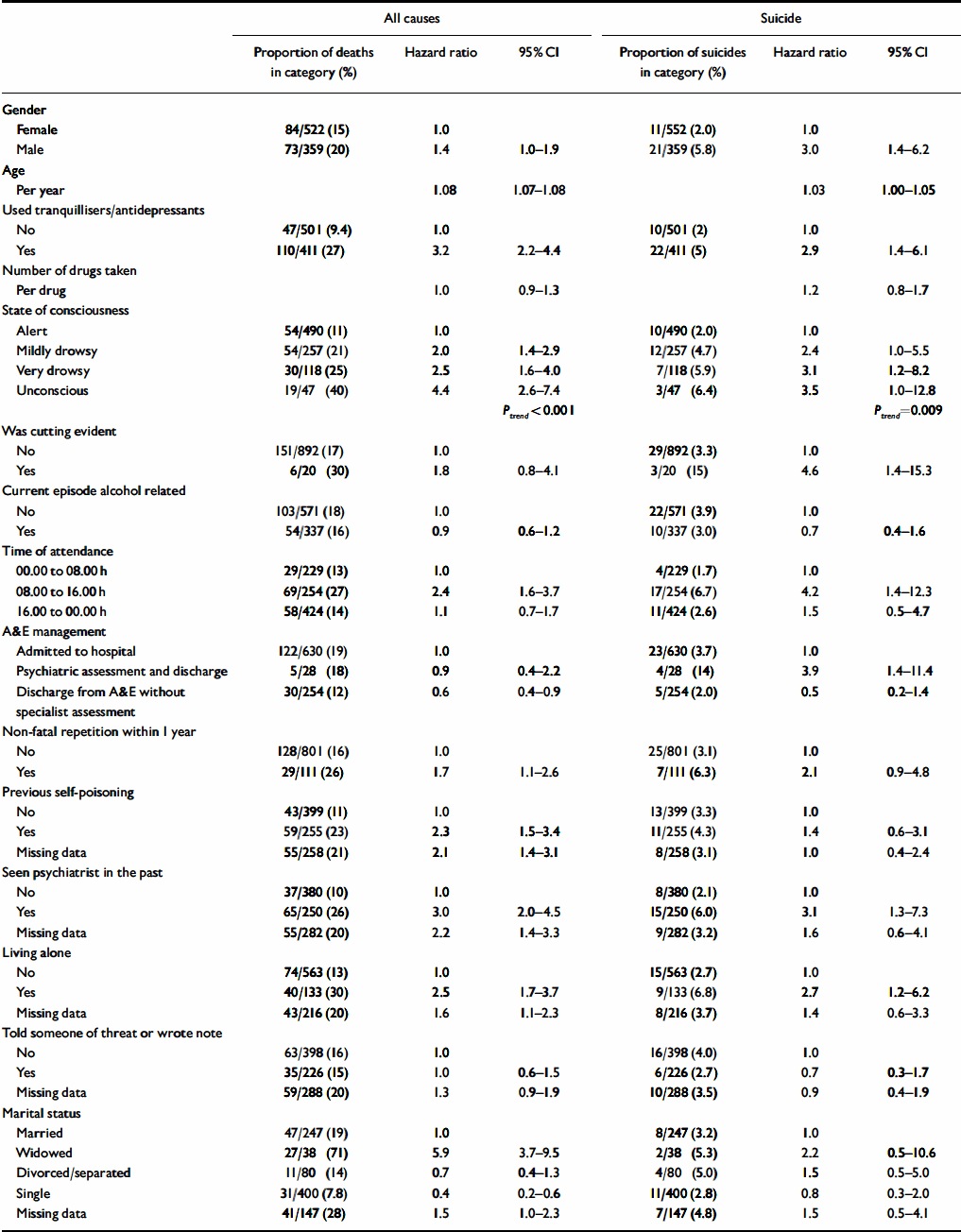
Table 3 sets out mortality according to a variety of patient characteristics. As expected, proportionately more males than females had died regardless of cause (hazard ratio=1.4, 95% CI 1.0–1.9); for suicides rather than all deaths, the hazard ratio (3.0, 95% CI 1.4–6.2) was much higher. Age at index episode was associated with death by any cause, and with suicide (Table 3).
Survival analyses of time to death from all causes and from suicide, according to characteristics of patients traced (n=912)1
| All causes | Suicide | |||||
|---|---|---|---|---|---|---|
| Proportion of deaths in category (%) | Hazard ratio | 95% CI | Proportion of suicides in category (%) | Hazard ratio | 95% CI | |
| Gender | ||||||
| Female | 84/522 (15) | 1.0 | 11/552 (2.0) | 1.0 | ||
| Male | 73/359 (20) | 1.4 | 1.0-1.9 | 21/359 (5.8) | 3.0 | 1.4-6.2 |
| Age | ||||||
| Per year | 1.08 | 1.07-1.08 | 1.03 | 1.00-1.05 | ||
| Used tranquillisers/antidepressants | ||||||
| No | 47/501 (9.4) | 1.0 | 10/501 (2) | 1.0 | ||
| Yes | 110/411 (27) | 3.2 | 2.2-4.4 | 22/411 (5) | 2.9 | 1.4-6.1 |
| Number of drugs taken | ||||||
| Per drug | 1.0 | 0.9-1.3 | 1.2 | 0.8-1.7 | ||
| State of consciousness | ||||||
| Alert | 54/490 (11) | 1.0 | 10/490 (2.0) | 1.0 | ||
| Mildly drowsy | 54/257 (21) | 2.0 | 1.4-2.9 | 12/257 (4.7) | 2.4 | 1.0-5.5 |
| Very drowsy | 30/118 (25) | 2.5 | 1.6-4.0 | 7/118 (5.9) | 3.1 | 1.2-8.2 |
| Unconscious | 19/47 (40) | 4.4 | 2.6-7.4 | 3/47 (6.4) | 3.5 | 1.0-12.8 |
| Ptrend <0.001 | Ptrend =0.009 | |||||
| Was cutting evident | ||||||
| No | 151/892 (17) | 1.0 | 29/892 (3.3) | 1.0 | ||
| Yes | 6/20 (30) | 1.8 | 0.8-4.1 | 3/20 (15) | 4.6 | 1.4-15.3 |
| Current episode alcohol related | ||||||
| No | 103/571 (18) | 1.0 | 22/571 (3.9) | 1.0 | ||
| Yes | 54/337 (16) | 0.9 | 0.6-1.2 | 10/337 (3.0) | 0.7 | 0.4-1.6 |
| Time of attendance | ||||||
| 00.00 to 08.00 h | 29/229 (13) | 1.0 | 4/229 (1.7) | 1.0 | ||
| 08.00 to 16.00 h | 69/254 (27) | 2.4 | 1.6-3.7 | 17/254 (6.7) | 4.2 | 1.4-12.3 |
| 16.00 to 00.00 h | 58/424 (14) | 1.1 | 0.7-1.7 | 11/424 (2.6) | 1.5 | 0.5-4.7 |
| A&E management | ||||||
| Admitted to hospital | 122/630 (19) | 1.0 | 23/630 (3.7) | 1.0 | ||
| Psychiatric assessment and discharge | 5/28 (18) | 0.9 | 0.4-2.2 | 4/28 (14) | 3.9 | 1.4-11.4 |
| Discharge from A&E without specialist assessment | 30/254 (12) | 0.6 | 0.4-0.9 | 5/254 (2.0) | 0.5 | 0.2-1.4 |
| Non-fatal repetition within 1 year | ||||||
| No | 128/801 (16) | 1.0 | 25/801 (3.1) | 1.0 | ||
| Yes | 29/111 (26) | 1.7 | 1.1-2.6 | 7/111 (6.3) | 2.1 | 0.9-4.8 |
| Previous self-poisoning | ||||||
| No | 43/399 (11) | 1.0 | 13/399 (3.3) | 1.0 | ||
| Yes | 59/255 (23) | 2.3 | 1.5-3.4 | 11/255 (4.3) | 1.4 | 0.6-3.1 |
| Missing data | 55/258 (21) | 2.1 | 1.4-3.1 | 8/258 (3.1) | 1.0 | 0.4-2.4 |
| Seen psychiatrist in the past | ||||||
| No | 37/380 (10) | 1.0 | 8/380 (2.1) | 1.0 | ||
| Yes | 65/250 (26) | 3.0 | 2.0-4.5 | 15/250 (6.0) | 3.1 | 1.3-7.3 |
| Missing data | 55/282 (20) | 2.2 | 1.4-3.3 | 9/282 (3.2) | 1.6 | 0.6-4.1 |
| Living alone | ||||||
| No | 74/563 (13) | 1.0 | 15/563 (2.7) | 1.0 | ||
| Yes | 40/133 (30) | 2.5 | 1.7-3.7 | 9/133 (6.8) | 2.7 | 1.2-6.2 |
| Missing data | 43/216 (20) | 1.6 | 1.1-2.3 | 8/216 (3.7) | 1.4 | 0.6-3.3 |
| Told someone of threat or wrote note | ||||||
| No | 63/398 (16) | 1.0 | 16/398 (4.0) | 1.0 | ||
| Yes | 35/226 (15) | 1.0 | 0.6-1.5 | 6/226 (2.7) | 0.7 | 0.3-1.7 |
| Missing data | 59/288 (20) | 1.3 | 0.9-1.9 | 10/288 (3.5) | 0.9 | 0.4-1.9 |
| Marital status | ||||||
| Married | 47/247 (19) | 1.0 | 8/247 (3.2) | 1.0 | ||
| Widowed | 27/38 (71) | 5.9 | 3.7-9.5 | 2/38 (5.3) | 2.2 | 0.5-10.6 |
| Divorced/separated | 11/80 (14) | 0.7 | 0.4-1.3 | 4/80 (5.0) | 1.5 | 0.5-5.0 |
| Single | 31/400 (7.8) | 0.4 | 0.2-0.6 | 11/400 (2.8) | 0.8 | 0.3-2.0 |
| Missing data | 41/147 (28) | 1.5 | 1.0-2.3 | 7/147 (4.8) | 1.5 | 0.5-4.1 |
Substances ingested in the self-poisoning episode were related to long-term outcome: if either tranquillisers or antidepressants were taken, all-cause and suicide mortalities were higher than expected. The number of separate drugs taken in the index episode did not seem to affect outcome. Impairment of consciousness at the non-fatal episode was, however, progressively related to subsequent death from any cause and from suicide. The 20 patients who cut as well as poisoned themselves at the index episode showed a marked excess of suicides. Alcohol consumption at the time of non-fatal self-harm showed no important relationship with mortality.
Self-poisoning leads to a diurnal consultation pattern in which there is disproportionate attendance during the evening and early hours of the night. We found that those who attended during the 8 h that might represent the normal working day (08.00 to 16.00 h) were those more likely to die during follow-up – whether by any cause or by suicide.
Basic decisions about the clinical management of the index episode, categorised into three groups, showed a relationship with eventual mortality. Compared with patients admitted to hospital (mainly to general medical or short-stay wards, a few to psychiatric units), those who were assessed by a psychiatrist in the accident and emergency department before discharge home showed the highest suicide rate, whereas those who were either discharged by accident and emergency staff or took their own decision to leave the unit had the lowest overall mortality.
During 16–17 years of follow-up, more of those who had repeated non-fatal self-harm within a year of the index episode had died than had those who had not repeated. Non-fatal repetition was, however, more firmly related to deaths regardless of cause than to death by suicide; in the case of suicides, the confidence interval for the hazard ratio is wide (Table 3).
Our checklists asked accident and emergency staff to collect information about a number of personal characteristics but the data were incomplete, with the deficits confounded by time of day and by patients’ consciousness (Reference Owens, Dennis and JonesOwens et al, 1991). Analysis of mortality according to a history of self-harm, psychiatric history, living alone, marital status and the making of threats or leaving notes suffer from this shortfall in data – rendering uncertain the meaning of our findings. We do not report results for the other incompletely collected variables because either there was no unexpected relation with mortality or no clear relation with subsequent suicide: for recent physical illness, employment, contact with general practitioner, and refusal of any care offered in accident and emergency.
The patient's report of past self-harm (whether or not it had resulted in attendance at hospital) was associated with all-cause mortality but not definitely with suicide, although data were missing on 28% of cases. Relations with all-cause mortality and with suicide were, however, found for past psychiatric contact (whether reported on the checklist, in the accident and emergency record, or found on the Nottingham psychiatric case register), and for whether or not patients were living alone at the time of the index self-harm.
Interplay of risk factors
Cox's proportional hazards regression models were used to determine which factors independently affected survival.
Death from any cause
Our model for survival to death from all causes included all the variables set out in Table 3, entered simultaneously. However, despite many relations between single variables and survival, only three variables showed a clear effect when the factors were considered together: increasing age (hazard ratio=1.07 per year, 95% CI 1.06–1.08), male gender (hazard ratio=1.9, 95% CI 1.3–2.6) and whether the person had cut himself or herself as well as self-poisoned (hazard ratio=4.2, 95% CI 1.8–10.0).
Suicide
There were too few suicides for robust modelling of all the variables included in Table 3. For suicide, only four variables could be included simultaneously in our survival analysis model: age, male gender, use of tranquillisers or antidepressants, and impairment of consciousness. Of these, only age (hazard ratio=1.02 per year, 95% CI 1.0–1.04) and male gender (hazard ratio=2.9, 95% CI 1.4–6.1) showed an independent relation to suicide.
Secondary regression analysis of suicide data
Disappointed by the few variables that the model could incorporate, we re-analysed these data using logistic regression – a less satisfactory technique for this project because it ignores the differences between patients’ length of follow-up. In this more speculative regression model, however, we were able to include all the variables in Table 3: impairment of consciousness (P value for linear trend over categories=0.007), previous self-harm (odds ratio=0.3, 95% CI 0.08–0.9), psychiatric history (odds ratio=3.9, 95% CI 1.2–13.1), being admitted during the daytime (odds ratio=4.1, 95% CI 1.2–14.3), and discharge directly from accident and emergency after psychiatric assessment (odds ratio=4.6, 95% CI 1.1–19.0) were the only factors to play a clearly independent role.
DISCUSSION
Methodological considerations
The present study has three clear strengths. First, it is based on a consecutive sample of patients who attended hospital over a very short period of time and is not, as are many studies of self-harm, restricted to patients seen by mental health services or admitted to wards in the general hospital. Population rates of self-poisoning in Nottingham, based on these data, were higher than those reported elsewhere at the index time (Reference Dennis, Owens and JonesDennis et al, 1990), so we consider the sample highly representative of people attending UK hospitals because of self-poisoning. Second, we were able to trace a high proportion of the sample, with only 6% untraced. Third, we have used survival analyses that take account of the variable duration of follow-up.
Our large sample allows reasonably precise estimates of incidence of suicide, but there are few suicides for the analysis of patients’ characteristics, particularly in the mathematical models. We were limited also by the lack of data that were recorded consistently in accident and emergency records and research checklists that were filled in by accident and emergency staff at all hours of the day and night; however, no epidemiologically sound research on self-harm has been able to overcome this disadvantage of 24-h sampling in emergency units.
High mortality rates after self-harm
Our sample, from a large industrial city, was collected in just 9 months and followed-up for a highly uniform time: all for between 16 and 17 years. When our findings are compared with those analysed recently in a study in Oxford, UK, the similarities are striking despite great differences in the timing of sampling and follow-up. The huge sample of more than 11 000 patients from the socially more affluent Oxford was assembled over a 20-year period between 1978 and 1997 and traced for between 3 and 22 years. They found a 3.0% incidence of suicide at 15 years after self-harm (Reference Hawton, Zahl and WeatherallHawton et al, 2003) compared with our 3.5% at 16 years. Using age standardisation, they estimated that suicides were 66 times more likely in the first year after self-harm than in the general population of England and Wales. In the Oxford study, 10% of the sample undertook self-injury but not self-poisoning; it is unlikely that this sampling discrepancy greatly distorts the comparability of the two studies. The present work and other findings (Reference Jenkins, Hale and PapanastassiouJenkins et al, 2002; Reference Hawton, Zahl and WeatherallHawton et al, 2003) point to the persistence of a very high rate of suicide over many subsequent years; non-fatal self-harm is plainly a sign of long-term needs. Mortality from causes other than suicide is also many times higher than the expected rate.
Possible underestimation of subsequent suicide
There are at least two reasons why our findings may fall short of a completely accurate representation of mortality from suicide after non-fatal self-harm. First, suicide may be more likely following self-injury than after self-poisoning. This relationship seems, however, to be complex: non-fatal episodes involving violent methods of injury (such as hanging or jumping) may be linked with high intent and have a high subsequent suicide rate whereas episodes that involve self-cutting may be associated with lower intent and a lower suicide rate (Reference Harriss, Hawton and ZahlHarriss et al, 2005). It is not obvious, therefore, whether the inclusion of self-injury episodes would have led us to a slightly higher or slightly lower estimate of suicide following self-harm.
Second, some verdicts of accident or misadventure may have been suicides. We did not gain access to coroners’ records of deaths but studies where such records have been scrutinised found that misclassification can be detected and that suicide can sometimes be imputed (Reference Foster, Gillespie and McClellandFoster et al, 1997). For example, verdicts of accident and misadventure in our sample included several deaths from road traffic accidents, by drowning and by drug overdose. A small number of these or other deaths may have been misclassified because we adhered to the operational definition of suicide or open verdicts.
Predicting suicide
We found that suicide after self-harm was associated with various clusters of factors. First, there are characteristics that precede the episode of self-harm: being older, being male, living alone and reporting past psychiatric contact. Second, there are aspects of the act of self-harm: taking psychotropic drugs, or cutting as well as self-poisoning. Third, we found associations with the attendance at the emergency unit: attending in the daytime, and being drowsy or unconscious. Fourth, we found a less certain association with later events: being discharged directly from the unit after psychiatric assessment, and with early non-fatal repetition of self-harm.
The first three of these clusters suggest grounds for a strategy of risk assessment and intervention targeted at high-risk groups, but closer scrutiny does not support such a proposal. The only factors evident at the time of assessment in the accident and emergency department that showed independent effect on suicide as the outcome were previous history and severity of the current episode – the prognostic markers common to most medical assessments. Discharge after assessment by a psychiatrist, in particular, did not have an independent effect – presumably because the decision by staff in the accident and emergency department to seek an immediate psychiatric opinion reflects higher risk that was evident through other features of the person or episode.
Our findings are puzzling in relation to the clinical significance of a history of self-poisoning because previous studies have suggested that it is a risk factor (Reference Hawton and FaggHawton & Fagg, 1988; Reference Zahl and HawtonZahl & Hawton, 2004). When no other variables were adjusted for, our results confirm that previous overdose seemed to indicate a small (but not statistically significant) increase in risk of suicide (risk ratio=1.4, 95% CI 0.6–3.1). Previous findings, however, have not been adjusted for other variables. After allowing for other factors in the logistic regression model, past self-poisoning emerged as a potentially protective factor (odds ratio=0.3), although the confidence interval was very wide (0.08–0.9), indicating that a wide range of interpretations is possible. Moreover, previous self-poisoning is strongly related to having seen a psychiatrist, and adjustment for this factor in the same model is likely to explain the discrepancy. Without adjustment for past psychiatric contact the odds ratio for a history of previous self-poisoning increases substantially and no longer appears to have a significant protective effect.
Taking the best predictor among all the variables that we analysed individually, the relative risk of subsequent suicide for any impairment of consciousness compared with being alert is 2.6 (from Table 3, combining the three levels of impairment). With an incidence of subsequent suicide at 16 years of 3.5%, the positive predictive value of this item is 2%. It seems clear that a ‘high-risk strategy’ – attempting to identify those individuals who qualify for special attention – is a hopeless approach to the problem of suicide subsequent to self-harm. The predictive values of the patient characteristics that point to higher than average risk are just too poor to be useful, even in groups of patients at high risk (Reference Powell, Geddes and HawtonPowell et al, 2000). Estimates of average risk for a group are not usually matched by any corresponding ability to predict which individuals are likely to have a bad outcome (Reference RoseRose, 1992).
These predictive values are derived from a relatively small study and may be imprecise because of sampling variability and incomplete collection of data by the accident and emergency staff. However, even if the corrected predictive values were rather higher, the practical consequences would be likely to be similar to those set out here. Were the shorter-term risk of suicide to be considered – instead of the long-term risk, as here – then the predictive values would be weaker still, because the incidence of suicide is much lower in the short term.
Being aware that non-fatal self-harm is the best risk factor we have for the potential prevention of suicide, how then should health services react to self-harm episodes? The first answer lies in adopting a ‘population strategy’ rather than a ‘high-risk strategy’ (Reference RoseRose, 1992): one that consistently offers good basic assessment and care responsive to the needs of all who attend hospital after self-harm. This prescription may seem bland but there is plenty to be done because, unfortunately, current practice in the assessment and care following self-harm is too often woefully poor (Reference Hughes, Hampshaw and RenvoizeHughes et al, 1998; Reference Kapur, House and CreedKapur et al, 1998; Reference Head, Campbell-Hewson and O'KeaneHead et al, 1999; Reference Hickey, Hawton and FaggHickey et al, 2001; Reference Slinn, King and EvansSlinn et al, 2001; Reference Kapur, House and DodgsonKapur et al, 2002; National Institute for Clinical Excellence, 2004). Second, we need large randomised trials of widely practicable interventions after self-harm (Reference GeddesGeddes, 1999); as things stand we know little about what might be effective, because hardly any worthwhile research has been undertaken (NHS Centre for Reviews and Dissemination, 1998; Reference ComptoisComptois, 2002). Governmental strategies for suicide prevention should emphasise ‘risk assessment’ less and the assessment of needs rather more.
Clinical Implications and Limitations
CLINICAL IMPLICATIONS
-
▪ An elevated suicide rate remains for many years after non-fatal self-poisoning.
-
▪ In self-poisoning, few characteristics of patients or episodes are useful predictors of subsequent suicide.
-
▪ Improvement in services for assessment and care of all those attending after self-poisoning is the logical clinical response to our weak evidence about how to identify high risk and what intervention to choose.
LIMITATIONS
-
▪ A small number of patients (6% of the total) could not be traced16 years later.
-
▪ There were too few probable suicides (32) to allow for the inclusion of many variables in the most suitable type of regression model.
-
▪ Collection of data in the accident and emergency department at all times of day and night restricted the depth and coverage of variables studied.
Acknowledgements
The study was funded by a grant from The UK National Health Service's Northern and Yorkshire Regional Research Capacity Committee. We thank Penny Wakefield for collecting data and the NHS Central Register, Office for National Statistics for their prompt and careful work.




eLetters
No eLetters have been published for this article.