


%20--%3e%3c!DOCTYPE%20svg%20PUBLIC%20'-//W3C//DTD%20SVG%201.0//EN'%20'http://www.w3.org/TR/2001/REC-SVG-20010904/DTD/svg10.dtd'%3e%3csvg%20version='1.0'%20id='Layer_1'%20xmlns='http://www.w3.org/2000/svg'%20xmlns:xlink='http://www.w3.org/1999/xlink'%20x='0px'%20y='0px'%20width='64px'%20height='64px'%20viewBox='5.5%20-3.5%2064%2064'%20enable-background='new%205.5%20-3.5%2064%2064'%20xml:space='preserve'%3e%3cg%3e%3ccircle%20fill='%23FFFFFF'%20fill-opacity='0'%20cx='37.785'%20cy='28.501'%20r='28.836'/%3e%3cpath%20fill='%23595959'%20d='M37.441-3.5c8.951,0,16.572,3.125,22.857,9.372c3.008,3.009,5.295,6.448,6.857,10.314%20c1.561,3.867,2.344,7.971,2.344,12.314c0,4.381-0.773,8.486-2.314,12.313c-1.543,3.828-3.82,7.21-6.828,10.143%20c-3.123,3.085-6.666,5.448-10.629,7.086c-3.961,1.638-8.057,2.457-12.285,2.457s-8.276-0.808-12.143-2.429%20c-3.866-1.618-7.333-3.961-10.4-7.027c-3.067-3.066-5.4-6.524-7-10.372S5.5,32.767,5.5,28.5c0-4.229,0.809-8.295,2.428-12.2%20c1.619-3.905,3.972-7.4,7.057-10.486C21.08-0.394,28.565-3.5,37.441-3.5z%20M37.557,2.272c-7.314,0-13.467,2.553-18.458,7.657%20c-2.515,2.553-4.448,5.419-5.8,8.6c-1.354,3.181-2.029,6.505-2.029,9.972c0,3.429,0.675,6.734,2.029,9.913%20c1.353,3.183,3.285,6.021,5.8,8.516c2.514,2.496,5.351,4.399,8.515,5.715c3.161,1.314,6.476,1.971,9.943,1.971%20c3.428,0,6.75-0.665,9.973-1.999c3.219-1.335,6.121-3.257,8.713-5.771c4.99-4.876,7.484-10.99,7.484-18.344%20c0-3.543-0.648-6.895-1.943-10.057c-1.293-3.162-3.18-5.98-5.654-8.458C50.984,4.844,44.795,2.272,37.557,2.272z%20M37.156,23.187%20l-4.287,2.229c-0.458-0.951-1.019-1.619-1.685-2c-0.667-0.38-1.286-0.571-1.858-0.571c-2.856,0-4.286,1.885-4.286,5.657%20c0,1.714,0.362,3.084,1.085,4.113c0.724,1.029,1.791,1.544,3.201,1.544c1.867,0,3.181-0.915,3.944-2.743l3.942,2%20c-0.838,1.563-2,2.791-3.486,3.686c-1.484,0.896-3.123,1.343-4.914,1.343c-2.857,0-5.163-0.875-6.915-2.629%20c-1.752-1.752-2.628-4.19-2.628-7.313c0-3.048,0.886-5.466,2.657-7.257c1.771-1.79,4.009-2.686,6.715-2.686%20C32.604,18.558,35.441,20.101,37.156,23.187z%20M55.613,23.187l-4.229,2.229c-0.457-0.951-1.02-1.619-1.686-2%20c-0.668-0.38-1.307-0.571-1.914-0.571c-2.857,0-4.287,1.885-4.287,5.657c0,1.714,0.363,3.084,1.086,4.113%20c0.723,1.029,1.789,1.544,3.201,1.544c1.865,0,3.18-0.915,3.941-2.743l4,2c-0.875,1.563-2.057,2.791-3.541,3.686%20c-1.486,0.896-3.105,1.343-4.857,1.343c-2.896,0-5.209-0.875-6.941-2.629c-1.736-1.752-2.602-4.19-2.602-7.313%20c0-3.048,0.885-5.466,2.658-7.257c1.77-1.79,4.008-2.686,6.713-2.686C51.117,18.558,53.938,20.101,55.613,23.187z'/%3e%3c/g%3e%3c/svg%3e)
%20--%3e%3c!DOCTYPE%20svg%20PUBLIC%20'-//W3C//DTD%20SVG%201.0//EN'%20'http://www.w3.org/TR/2001/REC-SVG-20010904/DTD/svg10.dtd'%3e%3csvg%20version='1.0'%20id='Layer_1'%20xmlns='http://www.w3.org/2000/svg'%20xmlns:xlink='http://www.w3.org/1999/xlink'%20x='0px'%20y='0px'%20width='64px'%20height='64px'%20viewBox='5.5%20-3.5%2064%2064'%20enable-background='new%205.5%20-3.5%2064%2064'%20xml:space='preserve'%3e%3cg%3e%3ccircle%20fill='%23FFFFFF'%20fill-opacity='0'%20cx='37.637'%20cy='28.806'%20r='28.276'/%3e%3cg%3e%3cpath%20fill='%23595959'%20d='M37.443-3.5c8.988,0,16.57,3.085,22.742,9.257C66.393,11.967,69.5,19.548,69.5,28.5c0,8.991-3.049,16.476-9.145,22.456%20C53.879,57.319,46.242,60.5,37.443,60.5c-8.649,0-16.153-3.144-22.514-9.43C8.644,44.784,5.5,37.262,5.5,28.5%20c0-8.761,3.144-16.342,9.429-22.742C21.101-0.415,28.604-3.5,37.443-3.5z%20M37.557,2.272c-7.276,0-13.428,2.553-18.457,7.657%20c-5.22,5.334-7.829,11.525-7.829,18.572c0,7.086,2.59,13.22,7.77,18.398c5.181,5.182,11.352,7.771,18.514,7.771%20c7.123,0,13.334-2.607,18.629-7.828c5.029-4.838,7.543-10.952,7.543-18.343c0-7.276-2.553-13.465-7.656-18.571%20C50.967,4.824,44.795,2.272,37.557,2.272z%20M46.129,20.557v13.085h-3.656v15.542h-9.944V33.643h-3.656V20.557%20c0-0.572,0.2-1.057,0.599-1.457c0.401-0.399,0.887-0.6,1.457-0.6h13.144c0.533,0,1.01,0.2,1.428,0.6%20C45.918,19.5,46.129,19.986,46.129,20.557z%20M33.042,12.329c0-3.008,1.485-4.514,4.458-4.514s4.457,1.504,4.457,4.514%20c0,2.971-1.486,4.457-4.457,4.457S33.042,15.3,33.042,12.329z'/%3e%3c/g%3e%3c/g%3e%3c/svg%3e)
Introduction
Candida auris was first identified in 2009 in Japan, with the earliest known strain thought to have occurred in 1996 in South Korea. Reference Simon, Li and Silver1, Reference Al-Rashdi, Al-Maani, Al-Wahaibi, Alqayoudhi, Al-Jardani and Al-Abri2 Since its identification, it has emerged as a multi-drug resistant organism (MDRO) that presents a serious global threat. Reference Simon, Li and Silver1–Reference Ademe and Girma7 This specific species of yeast has gained significant attention over recent years due to major outbreaks of invasive infections in the healthcare setting and its unique resistance profile to current antifungal treatment options. Reference Simon, Li and Silver1–Reference Garcia-Bustos, Cabanero-Navalon and Ruiz-Saurí6 In 2019, the Centers for Disease Control and Prevention (CDC) included C. auris as an urgent threat associated with increased morbidity and mortality rates in the Antibiotic Resistance Threat Report. 3 Current literature suggests that C. auris infections are associated with significant morbidity and mortality, with mortality rates ranging between 30% and 72% in patients with invasive infections. Reference Simon, Li and Silver1,Reference Al-Rashdi, Al-Maani, Al-Wahaibi, Alqayoudhi, Al-Jardani and Al-Abri2,Reference Sikora, Hashmi and Zahra4,Reference Garcia-Bustos, Cabanero-Navalon and Ruiz-Saurí6,Reference de Cássia Orlandi Sardi, Silva, Soares Mendes-Giannini and Rosalen8,Reference Benedict, Forsberg and Gold9
C. auris differs from other Candida species due to several characteristics. It is not considered a resident commensal organism and is not typically present within the human gastrointestinal tract, unlike other Candida species. It has a unique ability to contaminate surfaces and medical devices within the hospital environment, despite the use of disinfectants, and remains viable for numerous months. Reference Sikora, Hashmi and Zahra4–Reference Garcia-Bustos, Cabanero-Navalon and Ruiz-Saurí6 This allows the transmissibility of the pathogen to be exceptionally high and rapid, resulting in an increased risk for prolonged outbreaks in healthcare facilities. Another distinctive characteristic of C. auris is its multi-drug resistant susceptibility profile. It is the only fungal species to demonstrate intrinsic resistance to the three main classes of antifungals: azoles, amphotericin B, and echinocandins. Reference Ademe and Girma7,Reference de Cássia Orlandi Sardi, Silva, Soares Mendes-Giannini and Rosalen8,Reference Ostrowsky, Greenko and Adams10,Reference Chowdhary, Prakash and Sharma11 This makes it challenging when treating patients with C. auris infections, especially invasive infections. Although nearly all clinical cases of C. auris have shown some level of antifungal resistance, current literature does vary regarding the susceptibility patterns to specific agents. Reference Ademe and Girma7,Reference de Cássia Orlandi Sardi, Silva, Soares Mendes-Giannini and Rosalen8,Reference Ostrowsky, Greenko and Adams10,Reference Chowdhary, Prakash and Sharma11 A CDC Morbidity and Mortality Report from 2020, which evaluated 331 C. auris isolates, found that over 99% were resistant to fluconazole, 61% were resistant to amphotericin B, and 4% were resistant to echinocandins. Reference Ostrowsky, Greenko and Adams10 Susceptibility to antifungal agents also has been found to be dependent on the specific clade of C. auris that is identified, which is distinct by geographical region. Clades I-IV have all been identified within the United States. Reference Price, Mirasol and Ward12,Reference Narayanan, Selvakumar, Siddharthan and Sanyal13,Reference Chow, de Groot, Badali, Abastabar, Chiller and Meis14
C. auris infection rates have continued to increase in the United States. Reference Benedict, Forsberg and Gold9,Reference Najeeb, Siddiqui and Anas15,16,Reference Lyman, Forsberg, Sexton, Chow, Lockhart and Jackson17 Specifically within the studied healthcare system, geographical distribution of C. auris infections have primarily been in the Florida and Nevada regions. The healthcare system witnessed significant increases of cases in Nevada over a short period, while Florida had a more gradual increase in cases. Reference Rossi, Chavez and Iverson18 Limited literature currently exists in regard to risk factors associated with C. auris infections, especially when evaluating the role geographical location plays in the acquisition of this pathogen. There have been many proposed risk factors that could potentially predispose patients to C. auris infections. Generally, these are similar to other Candida infections, such as prolonged intensive care unit (ICU) admission, total parenteral nutrition (TPN) administration, and the presence of indwelling devices. Reference Simon, Li and Silver1,Reference Al-Rashdi, Al-Maani, Al-Wahaibi, Alqayoudhi, Al-Jardani and Al-Abri2,Reference de Cássia Orlandi Sardi, Silva, Soares Mendes-Giannini and Rosalen8 There is also limited data on the comorbid conditions associated with the pathogen. The objective of this study is to describe C. auris infections from two different geographical regions within a large health-system, both of which have experienced a significant increase in the occurrence of C. auris, but with distinct clades. Our aim was to describe patient factors associated with the organism and identify similarities and differences in relation to geographic location.
Methods
We conducted a multicenter, retrospective, descriptive analysis within a large healthcare system of over 180 acute care facilities in 20 states across the United States. We identified patients if they had a positive clinical culture for C. auris from any source and at any time after hospitalization within the healthcare system. Thirty-seven hospitals across 5 states were identified to have at least one patient meeting study inclusion criteria. Patients were included in this study if they were admitted as an inpatient, at least 18 years old upon discharge from inpatient care, had an admission date between January 1, 2021 and September 30, 2022, and had a valid clinical specimen that grew C. auris documented in both the electronic health record (EHR) and Premier TheraDoc®, a clinical surveillance tool used to track hospital-acquired infections and other hospital-related safety issues. C. auris identification was by MALDI-TOF method. Positive cultures could potentially represent clinical cultures or colonization, but cultures or positive PCR swabs identified as surveillance or point prevalence screens were excluded. Facilities within the healthcare system were not performing routine admission screening for C. auris during the study period, but point prevalence surveillance was completed on all patients in the same hospital unit of an identified C. auris isolate at the guidance of state and local health departments. Patients were excluded if they were missing any required inpatient data, such as medication orders and administrations, specimen collection, and demographics. Data were collected from the EHR of patients admitted to facilities within the large healthcare system. EHR data collected during the course of patients’ clinical care within the healthcare system are input into an enterprise data warehouse in a standardized manner for analysis. This research was IRB exempt in accordance with institutional policy, as no sensitive patient-specific information was involved. This research was supported (in whole or in part) by HCA Healthcare and/or an HCA Healthcare affiliated entity. The views expressed in this publication represent those of the author(s) and do not necessarily represent the official views of HCA Healthcare or any of its affiliated entities.
The primary goal was to evaluate the clinical characteristics associated with patients with C. auris and identify variation based on geographical location. Secondary outcomes included antimicrobial utilization and exposure at any time during hospitalization, prevalence of concomitant MDROs, source of C. auris index culture, and subgroup analysis that included the following: patients that experienced mortality or transitioned to hospice care upon discharge, patients that required mechanical ventilation, patients who were admitted to the ICU at some point during their hospital admission, and patients with the presence of concomitant MDROs other than C. auris.
The Western Region included patients with a positive clinical culture for C. auris admitted to a facility within the healthcare system west of the Mississippi River. The Eastern Region included patients with a positive clinical culture for C. auris admitted to a facility within the healthcare system east of the Mississippi River. Eastern and Western regions were chosen for comparison based on evolving epidemiology data for different clades in different regions across the United States. Reference Price, Mirasol and Ward12 Patient demographics, comorbidities, and clinical characteristics were taken from the EHR. The primary inpatient admission was defined as the patient encounter associated with the positive C. auris specimen. Previous inpatient admission within prior 90 days was determined by an inpatient admission at the same facility that has a discharge date and time within 90 days of the primary admission. Time to C. auris culture was defined as admission date to collection date of index C. auris culture. Clinical characteristics include a COVID-19 positive test, mechanical ventilation, transfusion of blood products, dialysis, and TPN administration. Elixhauser comorbidity index scores were calculated as a proxy for comorbidities. Additional culture data were acquired to determine the presence of concomitant MDROs. An MDRO was defined as one of the following: methicillin-resistant Staphylococcus aureus (MRSA), vancomycin-resistant Enterococcus, extended-spectrum beta-lactamase-producing organisms (ESBLs), multi-drug resistant (MDR) Pseudomonas aeruginosa (defined as testing either intermediate or resistant to at least one drug in at least three of the following six categories: extended-spectrum cephalosporin, fluoroquinolones, aminoglycosides, carbapenems, piperacillin/tazobactam and cefiderocol), carbapenem-resistant P. aeruginosa, and carbapenem-resistant Acinetobacter species. Antimicrobial exposure was defined as having receipt of at least one dose of the following agents at any point during hospitalization or within the previous 90 days: vancomycin, cefepime, ceftriaxone, meropenem, linezolid, piperacillin/tazobactam, metronidazole, fluoroquinolones, micafungin, and fluconazole.
Patient baseline and clinical characteristics were expressed with frequencies and percentages for categorical data and either medians with interquartile ranges or means with standard deviations for continuous data. Statistical analyses were completed in R Studio (version 2023.06.0). Elixhauser comorbidity index scores were calculated using the comorbidity package from ICD-10 codes. Reference Quan, Sundararajan and Halfon19 Multivariable logistic regression analysis was completed to evaluate mortality or discharge to hospice differences between variables. P-values for differences in proportions between the two groups were calculated via Pearson’s chi-squared test with a continuity correction, while P-values between group means and group medians were calculated by t-tests and Mood’s median tests, respectively. Fisher’s Exact Test was used to determine p-values for antifungal resistance differences between regions. Significance was considered to be a P value less than .05.
Results
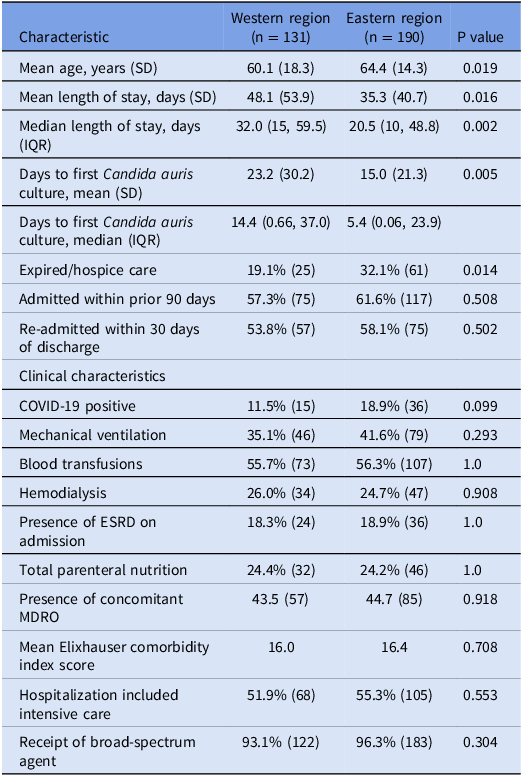
There were 390 unique patients with a positive culture for C. auris during the study time frame. From the identified patients, 69 patients were excluded from the study population for incomplete data, which left 321 patients included from 37 hospitals across 5 states (Figures 1 and 2). The Western Region contained 131 patients while the Eastern Region contained 190 patients. Hospitals in Nevada were responsible for the majority of patients in the Western Region, as they had 118 of the 131 patients, and hospitals across Florida were responsible for the majority of patients in the Eastern region, contributing 183 of the 190 patients. The average age for the Western and Eastern Region was 60.1 years and 64.4 years, respectively (P = .019). Median length of stay was 32 days and 20.5 days for the Western and Eastern Region, respectively (P = .002). All baseline characteristics are listed in Table 1. Over 60% of patients had index C. auris culture obtained after day 3 of hospital admission (Western 66.4% vs Eastern 56.8%). Patients were also likely to have a previous hospitalization within the prior 90 days in both the Western and Eastern regions (57.3% vs 61.6%, P = .508), and a large proportion were re-admitted within 30 days of discharge (Western 53.8% vs Eastern 58.1%, P = .502). Subjects who experienced mortality or transitioned to hospice care at discharge was significantly higher in the Eastern Region compared to the Western Region (32.1% vs 19.1%, P = .014). Multivariable logistic regression analysis confirmed significant mortality or discharge to hospice differences for patients in the Eastern Region compared to the Western Region (aOR 2.110; 95% CI 1.107, 4.022), receipt of blood transfusion (aOR 2.272; 95% CI 1.113, 4.639), and Elixhauser score (aOR 1.061; 95% CI 1.027, 1.095) (Figure 3, Table 2).
Pie chart of included patients based off location.

Flowchart of the patients included in the study.

Multivariable logistic regression analysis for mortality and geographical region.

Baseline and clinical characteristics of patients with a positive Candida auris cultures separated by geographical location

ESRD, end-stage renal disease.
Multivariable logistic regression analysis for mortality and geographical region

The clinical characteristics of included patients were comparable between regions (Table 1). Over one-third of patients required mechanical ventilation at any point during their admission, while greater than half of the total study population had receipt of a blood transfusion. Over 25% of all patients received hemodialysis, while 24.3% received TPN during their hospital stay. There were no significant differences of hemodialysis or TPN between the regions. Almost half of the total study population had the presence of an MDRO during the same admission as the C. auris index culture, with methicillin-resistant S. aureus (MRSA) and MDR P. aeruginosa being the most common in the Western Region and ESBL-producing organisms and MDR P. aeruginosa the most common in Eastern Region. The average Elixhauser Comorbidity Index Score for the Western and Eastern regions was 16 and 16.4, respectively. The percentage of patients whose hospitalization required an admission to the ICU at any time-frame during their stay was more than 50% in both groups. Less than 10% were admitted to the ICU as their initial level of care. The most common admitting diagnosis was sepsis, representing 28.7% of patients. The top three index sources of C. auris cultures were blood (30.8%), skin/soft tissue (28.7%), and the urinary tract (22.7%).
Antimicrobial exposure was also similar between Western and Eastern Region patients, with vancomycin being the most common in both regions (Western 67.9% vs Eastern 74.7%). Many patients had receipt of antipseudomonal antibiotics during their admission as 60% of the total population received cefepime. For antifungal exposure, 72.5% and 69.5% had exposure to micafungin at some point during admission for the Western and Eastern regions. Fluconazole resistance was significantly different between the Western and Eastern regions (95.7% vs 86.0% resistance) (Table 3).
Microbiology data

Only index culture source and susceptibilities were captured and shown here. Percent resistant only includes those with susceptibility cultures. Resistance interpretation based on established guidelines provided by the Clinical and Laboratory Standard Institute and are as follows listed as tentative MIC breakpoints: amphotericin B ≥ 2 ( ≥ 1.5 if Etest is used), fluconazole ≥32 mcg/mL, anidulafungin ≥4, caspofungin ≥2, and micafungin ≥4.
Several subgroup analyses were conducted. Patients who experienced mortality or transitioned to hospice care had a significantly longer time to first positive C. auris compared to those who did not (17 d vs 5 d, P = .007). The clinical profile was significantly different for the mortality and hospice care subgroup except for the presence of concomitant MDROs (Table 4).
Baseline and clinical characteristics of patients with a positive Candida auris culture who experience mortality or transitioned to hospice care vs those who did not

Discussion
This is the largest collection of clinical cases of C. auris in the United States to date. This study describes patient characteristics observed in a population with this specific fungal pathogen, and how they differ in association with geographical location. It is important to consider whether the clinical profile of patients with C. auris may be different based on geographical location, given the known variation in the specific clades of C. auris identified by region as well as potential differences in local epidemiology. Reference Price, Mirasol and Ward12
In general, the data presented in this study suggests that C. auris is associated with patients at increased risk of mortality. High mortality rates among patients with C. auris have been reported in other studies as well. Reference Simon, Li and Silver1,Reference Al-Rashdi, Al-Maani, Al-Wahaibi, Alqayoudhi, Al-Jardani and Al-Abri2,Reference de Cássia Orlandi Sardi, Silva, Soares Mendes-Giannini and Rosalen8,Reference Benedict, Forsberg and Gold9 Specifically, the study conducted by Simon, et al demonstrated an in-hospital mortality rate of 44.6% in patients with C. auris candidemia. Reference Simon, Li and Silver1 However, it was a small study that only included 83 patients. A study by Benedict et al analyzed a total of 192 C. auris hospitalizations across 42 hospitals. This study reported 34% of patients experienced in-hospital mortality or transitioned to hospice care, similar to the current study. The study by Benedict et al also reported similar clinical patient characteristics to our study, as 75.5% of the hospitalizations in their study involved an ICU stay and mechanical ventilation was used 43% of hospitalizations. Interestingly, a larger percentage of patients included in the study had their first positive C. auris culture within 2 days of admission (55.5% vs 39.3%). Reference Benedict, Forsberg and Gold9
Our study also demonstrated that patients with this pathogen typically have an elevated comorbidity index, with patients included in this study having an average Elixhauser Comorbidity Index Score of 16.2. This would suggest that those with significant comorbidities represents the profile of patients susceptible to this condition. Other literature has also shown that affected patients typically present with significant comorbidities. Other studies have demonstrated that these patients commonly have high-risk health conditions such as diabetes mellitus, cardiovascular disease, kidney disease, lung disease, and immunodeficiency. Reference Al-Rashdi, Al-Maani, Al-Wahaibi, Alqayoudhi, Al-Jardani and Al-Abri2,Reference Osei Sekyere20 Other patient and clinical factors shown in this study that were similar between the two geographical locations included extended length of stay, recent previous hospital admission, ICU admission, mechanical ventilation, and receipt of blood transfusions, hemodialysis, and TPN. The high prevalence of patients with blood transfusions, hemodialysis, and TPN may simply reflect the presence of indwelling devices and catheters, which have already been established risk factors for fungal infections. Reference Simon, Li and Silver1,Reference Al-Rashdi, Al-Maani, Al-Wahaibi, Alqayoudhi, Al-Jardani and Al-Abri2,Reference de Cássia Orlandi Sardi, Silva, Soares Mendes-Giannini and Rosalen8
The source of C. auris infections and colonization most commonly arise from the skin, such as the axilla and groin areas. These areas provide the ideal environment for the organism to colonize, replicate, and persist. We observed that the majority of subjects had a blood or skin and soft tissue source, which correlates with other current literature. Reference Simon, Li and Silver1,Reference Al-Rashdi, Al-Maani, Al-Wahaibi, Alqayoudhi, Al-Jardani and Al-Abri2,Reference Osei Sekyere20 We also observed that it is common for patients infected or colonized with C. auris to also have MDROs present. This may be due to the level of acuity and length of stay many of the study population experienced, which generally placed them at increased risk of infections and receipt of broad-spectrum antimicrobials. Reference Luyt, Bréchot, Trouillet and Chastre21
One significant difference observed between the regions was the rate of patients who experienced death or transitioned to hospice care at discharge. Although it is difficult to draw a definite reason for this difference, there are some possible explanations. One explanation is the possibility of different C. auris clades affecting the two groups. Clade IV isolates have been shown to be associated with the highest mortality rates, followed by isolates from clades I, III, and II. Reference Narayanan, Selvakumar, Siddharthan and Sanyal13 Isolates from clade II generally are more drug-susceptible compared to the other clades. Reference Price, Mirasol and Ward12,Reference Narayanan, Selvakumar, Siddharthan and Sanyal13 The difference in virulence factors may have contributed to the difference of mortality and hospice care seen in the current study. While the majority of cases in the USA have been Cade I22, Clade III has predominated in the Nevada region that makes up the majority of samples for the Western region in this analysis. Reference Rossi, Chavez and Iverson18 However, we were unable to test for specific clades in this study.
While this study is the largest collection of clinical cases of C. auris, there are several important limitations that should be noted. First, the study is observational in nature. Second, the included patients could have been colonized with C. auris, which limits the generalizability of the study strictly to patients with true clinical infections. Third, we cannot infer causality for either morbidity or mortality in relation to presence of C. auris in this study. Additionally, antimicrobial utilization represented any administration during hospitalization rather than exposure preceding obtainment of clinical C. auris culture that may have selected for it. Lastly, results of this study represent the experience of a single healthcare system, although it is a system with an expansive geographical presence in the United States.
In conclusion, patients identified with C. auris are characterized by significant underlying morbidity and disease burden. Further research is warranted to understand the attributable morbidity and mortality in association with this organism, specifically in patients with documented clinical infections. More information regarding appropriate infection prevention measures against C. auris is also warranted and more pointed studies analyzing confirmed clinical cultures, such as fungemia, which would not be representative of colonization.
Acknowledgments
None.
Financial support
None reported.
Competing interests
All authors report no conflicts of interest relevant to this article.




 Open access

