On 16 November 1864, General William T. Sherman's army marched south from Atlanta, Georgia, leaving the city in ashes. On 20 February 1865, Sherman's army marched north from Columbia, South Carolina, leaving the city in ashes. The fires have ever since been central to the civic identities of the two communities and important to the broader formation of Confederate memory. As early as 1867, Augusta native William Henry Peck published a novel entitled The M'Donalds; or, The Ashes of Southern Homes about a widow and daughter driven from Atlanta by Sherman's invasion. The women flee “from refuge to refuge” until they eventually seek a safe haven in the hometown of their Hampton and Preston relatives, where they suffer through the burning of Columbia. The serial repetition of the trauma points toward the infinitude of Yankee depravity.Footnote 1 The usefulness of this parallelism notwithstanding, the cities mostly marked the ordeals in divergent ways. Atlanta tended to build monuments to its renewal; Columbia preferred to highlight ruins of its lost glory. The contrast illuminates the importance of local variation within the Lost Cause and the relation of Confederate memory to cultural forms that originated long before the American Civil War.
The wartime experiences of Atlanta and Columbia differed significantly. Atlanta was the Union goal in a hard-fought campaign that began in early May 1864 and reached the Chattahoochee river by early July, which prompted Confederate evacuation of hospitals and military machinery. The bombardment that opened on 20 July continued for more than a month; on some days, Union artillery fired five thousand shells into the city. After further fierce fighting that brought Confederate military casualties to an estimated total of 35,000 over a period of four months, Sherman's army occupied the city from early September until mid-November.Footnote 2 Columbia's crisis was, in contrast, a whirlwind. The Confederate government evacuated its Union prisoners only one day before the federal army reached the Congaree river. A brief bombardment announced the arrival. To a much greater extent than Atlanta, where Sherman expelled the civilian population shortly after his army occupied the city, the destruction of Columbia revolved around face-to-face encounters between Union soldiers and local residents. Confederate military and civilian casualties were minimal. The last federal units left the city seventy-six hours after the first units entered it.Footnote 3
More important for commemoration was a disparity in postwar growth that caused the Civil War monuments of Atlanta to address national audiences while the Civil War ruins of Columbia appealed to local elites. The cities were comparable in size during the war. Atlanta was the ninety-ninth-biggest municipality in the United States census of 1860, with a population of 9,554. Columbia was four-fifths as large, with 8,054 residents. Wartime refugees and the military economy swelled both populations to peaks well over 20,000, and both cities contracted as Sherman approached. After the war Atlanta gained increasing importance as the railroad gateway to the West and grew to nearly four times the size of Columbia by 1880. Both towns developed manufacturing economies and typified New South boosterism, although in separate ways. Atlanta was a wide-ranging competitor for investment and tourism. Columbia industrialists instead concentrated on struggles against South Carolina agrarians and factory laborers.
Remembrance of Sherman in the capitals of Georgia and South Carolina demonstrates the community variation that animated the Lost Cause even as the cultural formation helped the postwar South achieve more regional cohesion than secession had ever enjoyed. Confederate memory certainly engaged in intersectional dialogue with Union memory, but the Lost Cause thrived because its promoters found it useful at home, which required adaptation to different wartime experiences and postwar societies.Footnote 4 Although scholarship has recognized that Confederate memory provided a medium for debating economic development, Atlanta and Columbia combined industrialization with different commemorative styles.Footnote 5 Eagerness to attract tourism encouraged Atlanta marketeers to maintain that modern America built best on the foundations of the former Confederacy. Determination to dress the scars of class politics prompted Columbia polemicists to highlight what modern America lost in Confederate defeat. The complementary facets of the Lost Cause made memory of the cities' shared ordeals a more versatile and valuable resource than “the standard plot” that the leading history of Sherman's legacy has seen “beginning to harden into place” in The M'Donalds.Footnote 6
Remembrance of Sherman in Atlanta and Columbia also exposes connections between form and content in American memory of the Civil War. Reliance on monuments and ruins linked the Lost Cause to fundamental commemorative frameworks of Western civilization, although southerners turned the genres in new directions.Footnote 7 The touchstones characteristic of Atlanta and Columbia shaped local literature. Mid-twentieth-century writers from both cities produced best-selling novels about Sherman's invasion that drew on civic models of monuments and ruins to promote potent myths and legends. By the Civil War centennial, however, the classic structures for identification with the past faced profound challenges across Europe and the United States. The decline of monuments and ruins contributed to the collapse of the Lost Cause and the transformation of Confederate memory in the aftermath of the civil rights revolution.
THE ARCHITECTURE OF THE LOST CAUSE
Atlanta and Columbia established many places of Confederate commemoration during the seventy-five years after the Civil War. These sites did not all center on the burning of the cities, but local trauma figured prominently even when the capitals tried to look back broadly at the war records of Georgia and South Carolina. The spectacular resurgence of Atlanta undergirded its assertion of regional and national leadership in a series of monuments that began with conventional obelisks and statues but became highly distinctive. Columbia cultivated an increasingly stylized array of ruins that recalled Sherman's depredations. As the cradle of the New South created a focal point for Lost Cause celebration of capitalism, the cradle of secession developed a vantage point for Lost Cause critique of populism. Confederate memory flourished in both communities.
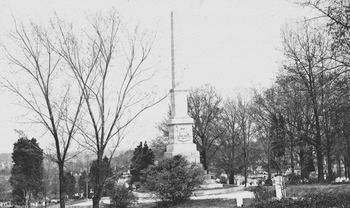
The obelisk dedicated at Oakland Cemetery in April 1874 typified the tendency of Atlanta monuments to address broad audiences. The work was the project of the Atlanta Ladies Memorial Association, organized in 1866 to supervise Memorial Day exercises at the graves of Confederate soldiers buried in the city cemetery. Almost all of these men had died in the large wartime hospital complex in Atlanta. The memorial association embarked in 1868 on expansion of the Confederate section by exhuming and reinterring the remains of soldiers buried in scattered graves during the Atlanta campaign. Upon completion of that initiative the women turned to fund-raising for a monument, which prompted a sharp debate between supporters who wanted to install it in the cemetery and proponents of a downtown site. Both sides emphasized the far-reaching significance of the monument. The Atlanta Constitution stressed that the four thousand graves in the memorial grounds included “representatives of every State and county of the late Confederacy.”Footnote 8 The women held the cornerstone-laying ceremony for the monument on the day of Robert E. Lee's funeral in Virginia, 15 October 1870, immediately after a large public meeting in his honor at City Hall. Eulogist John B. Gordon, one of Lee's leading lieutenants, associated Atlanta with both the Confederate hero and his Union antithesis, Sherman. The crowd cheered when Gordon declared that Lee's respect for the bounds of civilized warfare “left the line of his march marked and marred by no devastated fields, charred ruins or desolated homes.” The main speaker at the 1874 dedication compared the sixty-five-foot-high obelisk to famous monuments of the classical world. “Soldiers of the Confederacy rank with the heroes and patriots of memorable Marathon and ‘Old Thermopylae,’” he contended.Footnote 9
Monument to the Confederate Dead, Oakland Cemetery. Photograph 1895. Courtesy of the Kenan Research Center at the Atlanta History Center.

The memorial association's tribute helped to nurture one of the chief amenities of a nineteenth-century American city, a rural cemetery. During the location debate, the Constitution observed that placement in the city cemetery would “attract visitors thither, and the pride of the living will be laudably stimulated to the proper preservation and ornamentation of the graves and grounds.” Two years later, the city council renamed the city cemetery Oakland. The park-like setting soon grew into a popular urban refuge like Mount Auburn Cemetery near Boston, Green-Wood Cemetery in Brooklyn, Spring Grove Cemetery in Cincinnati, and Hollywood Cemetery in Richmond, all of which featured prominent Civil War memorials.Footnote 10 Twenty years after the obelisk dedication, the memorial association further enhanced Oakland, and again highlighted Sherman's attack, by installing a memorial among the graves of soldiers who died in the Atlanta campaign. Georgia Marble and Finishing Works proprietor Thomas M. Brady's sculpture of a wounded lion resting on a Confederate battle flag imitated the famous Lion of Lucerne (1819) designed by Bertel Thorvaldsen in honor of Swiss Guards massacred in the French Revolution. The visual quotation exemplified the national aspirations of Atlanta, including its self-promotional fervor. The project testified that Georgia was “producing today more and better marble, sounder and larger blocks, than can be produced in any other state in the union.”Footnote 11
Atlanta businessmen embodied their vision of post-Sherman regeneration in the Henry Grady monument dedicated in October 1891, two years after the sudden death of the thirty-nine-year-old orator and newspaper editor. Grady was on a speaking tour in Boston when he contracted the cold that turned into fatal pneumonia. The inscription of the monument quoted a passage from that speech and added a eulogist's observation that “when he died he was literally loving a nation into peace.”Footnote 12 The tribute inevitably evoked Grady's most famous address, “The New South,” delivered to the 1886 banquet of the New England Society of New York, at which he spotted Sherman in the audience and quipped that the general “is considered an able man in our parts, though some people think he is a kind of careless man about fire.” Grady told the large gathering at Delmonico's restaurant that “from the ashes he left us in 1864 we have raised a brave and beautiful city.” The wartime destruction was merely the prelude, perhaps even the necessary predicate, to the postwar boom. The promoters of the monument aimed to reproduce the intersectional sensation of “The New South” by collecting donations from around the country and inviting New York governor and Democratic presidential hopeful David B. Hill to deliver the dedicatory address. Conspicuous in the governor's entourage was former Union general Henry W. Slocum, the corps commander who had accepted the Atlanta mayor's surrender of the city in September 1864.Footnote 13
Atlanta monuments developed within the framework of a vigorous hospitality industry focussed on hosting conventions.Footnote 14 The dedication of the Grady statue took place during a fair intended to duplicate the success of the Piedmont Exposition that Grady had masterminded four years earlier. Oakland served as a pilgrimage site for women who came to the city for the second annual convention of the United Daughters of the Confederacy during the Cotton States and International Exposition of 1895. That festival also brought attention to another installation with some features of a public monument, the cyclorama rendition of the Battle of Atlanta painted by a team of artists in Milwaukee. The circular canvas measured about fifty feet in height and four hundred feet in circumference. Leading Atlanta businessmen bought it in 1893 and persuaded the city council to install it in a frame building in Grant Park before the Cotton States Exposition. Afterward the city acquired the cyclorama in exchange for renovations to the building and the canvas in preparation for display at the national reunion of the United Confederate Veterans in July 1898.Footnote 15
The so-called Eternal Flame of the Confederacy epitomized the Atlanta penchant for enduring monuments rather than fragmentary ruins. One of the original gaslit street lamps installed in 1855, the post was knocked down and broken into three pieces by a Union shell in August 1864. The city council returned it from storage to Whitehall and Alabama Streets in 1880, with a hole in the bottom that recalled Sherman's bombardment. The lamppost first attracted embellishment for the national United Confederate Veterans reunion of 1919. The Old Guard, a veterans' organization that perpetuated remembrance of the Gate City Guard, a socially elite militia unit, installed a plaque on the lamp post in honor of former Confederate officer and prominent Atlanta realtor Andrew J. West. Twenty years later, on the eve of the Atlanta premiere of the movie Gone with the Wind (1939), the Old Guard and the local chapter of the United Daughters of the Confederacy affixed a second plaque dedicating the lamppost as the Eternal Flame of the Confederacy, with the benefit of pipes and fuel donated by Atlanta Gas Light.Footnote 16 This variation on the commemorative genre of the eternal flame, an important interwar form energized in the United States by the 1938 dedication of the Eternal Light Peace Memorial at Gettysburg, demonstrated the determination of Atlanta to draw a monumental promise of permanence from a dilapidated municipal fixture.Footnote 17
Eternal Flame of the Confederacy. Photograph by A. A. Hoehling, 1957. Courtesy of the Kenan Research Center at the Atlanta History Center.

Columbia, in contrast, specialized in ruins. That emphasis partly dated from February 1865. Atlanta had burned as Union soldiers left the city, but Columbia burned shortly after they entered the city. Diarists and letter writers in Sherman's army commented on what they saw, and these descriptions soon entered into print alongside dispatches from northern journalists who visited the South at the end of the war. Visual images of devastated Columbia were more common than images of devastated Atlanta. Harper's Weekly published graphic illustrations of the fire and its aftermath.Footnote 18 George N. Barnard included four powerful pictures of building remnants in his Photographic Views of Sherman's Campaign (1866). Columbia photographer Richard Wearn documented the damage in a series of nineteen cartes de visite.Footnote 19 The importance of South Carolina as the font of pro-slavery secession added context to these accounts. Northerners often compared the state capital with humbled ancient cities. Some Columbia residents situated their city in a classical aesthetic tradition in which ruins signaled the frustrations of life and inevitability of death. Emma LeConte applied conventional images of transcendent nature and ephemeral humanity when she observed in her diary after a walk around town in March 1865 that “the bursting green will make a sad contrast with the melancholy ruins.” Others saw the rubble as a return to barbaric vandalism. Columbia physician Daniel HeywardTrezevant endorsed the testimony of a New York Herald correspondent who traveled with Sherman's army that he had witnessed “scenes that would have driven Alaric the Goth into frenzied ecstasies.”Footnote 20
Columbia residents did not lack pride in their regenerative powers, but commemoration remained wistful. Although printer Julian Selby named the newspaper that he launched after Sherman's departure the Daily Phoenix, the image did not take hold as firmly as it did in Atlanta, which placed the firebird on the city seal in 1887.Footnote 21 Even at the triumphal dedication of the South Carolina Monument to the Confederate Dead in May 1879, when Democrats celebrated the overthrow of Reconstruction, orator John Preston stressed the incompleteness rather than integrity of the soldier statue at the state house. He noted that women, too, deserved recognition and indicated that their Wayside Hospital for traveling soldiers would have been the perfect memorial but was destroyed during the Union occupation. Pointing out that the marble soldier looked into the heart of the burned district, Preston declared that
this monument of stone is placed on the spot where these women stood shelterless, in the black winter night, with their old men and half-naked children gazing thitherward at their crumbling houses and the things sacred to God, but not secure from man, burned to the ground by those who had slain the men whose effigy overtops the column.
The orator asked, “Is not this monument meant, in part, to commemorate that scene?”Footnote 22 If Atlanta wrenched monuments from its ruins, Columbia found ruins in its monuments.
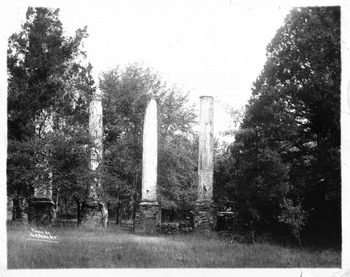
The elaboration of a commemorative landscape of ruin in Columbia was mostly a twentieth-century project. The bereft columns of the burned Millwood plantation house, seat of Confederate general Wade Hampton's family, became an icon that evoked not only the commander's unsuccessful defense of his hometown against Sherman but also the turn-of-the-century overthrow of his Bourbon wing of the Democratic Party.Footnote 23 The image circulated in postcards and book illustrations. Isabelle Martin, éminence grise of local Confederate memory, proclaimed Millwood the most meaningful historic site in Richland County. A huge picture of the columns decorated the fire curtain for the Columbia Theatre in City Hall. When the city established Dreher High School on part of the former Hampton estate in 1938, the school chose for its seal an abstracted rendition of the Millwood columns.Footnote 24
Millwood ruins. Sargeant Photo Company. Photograph c.1925. Courtesy of the South Caroliniana Library, University of South Carolina.

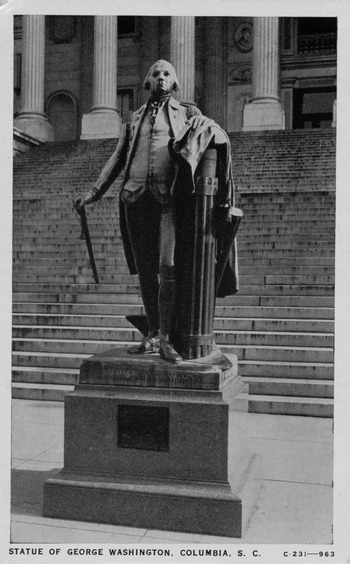
The state house was the centerpiece of the memory theater. While building a grand stone capitol in the 1850s to replace the original wooden structure of 1787–90, the state of South Carolina purchased from the state of Virginia a bronze cast of Jean-Antoine Houdon's marble portrait statue of George Washington. The bronze was in storage in the basement of the unfinished capitol when Sherman's soldiers took the building. Supervising architect John R. Niernsee later found the staff held by Washington broken and inferred that the statue had “received several bruises from brickbats, addressed to face and breast.” William Gilmore Simms thought in 1865 that “the bronze seems to have defied destruction and may be considered still perfect,” but later South Carolinians regarded its flaw as its most important feature. The legislature installed the statue in 1907 on the terrace in front of the state house, in direct line with the main door and the Confederate soldier monument. State archivist Alexander Salley added a bronze tablet in 1930 which alleged that during Sherman's occupation “soldiers brickbatted this statue and broke off the lower part of the walking cane.”Footnote 25 Disrespect for Washington and for art was proof of Yankee barbarism. The legislature extended this strategy of spotlighted disfigurement in 1937 by affixing bronze stars at six spots where the Union bombardment had hit the western façade of the state house. Slight though the damage was, it symbolized an irremediable grievance.Footnote 26 A year later another legislative appropriation provided for installation of a tombstone-like marker on the wartime site of the original state house, where Salley furnished an epitaph reporting that the structure had been designed by White House architect James Hoban and “burned by Sherman's troops.”Footnote 27 The inscription suggested that the grounds were still scarred, that the state might not have demolished the old capitol upon completion of the replacement that was ready for use three years after the war.
The treatment of parallel Sherman legends underscored the commemorative counterpoint between the cities. Folk memory of the Atlanta fire maintained that Catholic priest Thomas O'Reilly saved his Church of the Immaculate Conception and nearby Episcopal, Methodist, Baptist, and Presbyterian churches from the flames by appealing to religious sympathies in Sherman's army. In characteristic Atlanta fashion, all five parishes demolished the supposedly rescued buildings in the generation after the war. The churches joined with the city and the Atlanta Historical Society in 1945 to place a substantial monument next to City Hall in honor of O'Reilly's “courageous protest.”Footnote 28 Folk memory of the Columbia fire claimed that black sexton Holland Mitchell saved First Baptist Church, site of the 1860 secession convention, by steering Union soldiers toward the original church, used for Sunday School meetings since completion of the larger temple in 1859.Footnote 29 The Columbia Sesquicentennial Commission of 1936 installed a historical marker at First Baptist Church that recited this legend. Across the street the commission placed a marker at the site where Union troops burned the home of Robert W. Gibbes, including his impressive collections of art, manuscripts, and natural-history artifacts. Like the marker that the legislature placed on the state house grounds, the commission's markers cast First Baptist Church as a surviving piece of a desolated cityscape.
The city sesquicentennial precedent for the installation of the state house stars in 1937 and state house marker in 1938 typified the local impetus for commemoration in Columbia, which did not seek to attract wider attention on the seventy-fifth anniversary of its burning in 1940. Atlanta, in contrast, made the most of the national spotlight generated by the premiere of Gone with the Wind during the seventy-fifth anniversary of Sherman's March to the Sea. If provincial in origin, however, Confederate memory in Columbia was not shy in moral purview. Margaret Babcock Meriwether wrote in The State newspaper during the Blitz that “Columbia is one American city which can grieve with England in the true sympathy of shared experience … Photographs of Columbia in March 1865, might be reprinted today without a change except in caption: Coventry, November 1940.”Footnote 30
Statue of George Washington, Columbia, South Carolina. Postcard by Graycraft Card, c.1935. Courtesy of the South Caroliniana Library, University of South Carolina.

Meriwether's analogy was in some ways delusional. Apart from her implicit equation of Sherman and Hitler, the reported deaths of two civilians in the February 1865 burning of Columbia scarcely compared with the more than five hundred civilian deaths and many serious injuries in the November 1940 bombardment of Coventry, much less the eventual total of approximately 60,000 civilian deaths in German bombing raids on England during World War II.Footnote 31 But her claim also resembled C. Vann Woodward's famous argument a few years later that southerners were keenly aware that “history has happened to our people in our part of the world.” The assertion of an experience of loss contrasted with the October 1870 insistence of John B. Gordon, who commanded a brigade at Gettysburg and surrendered at Appomattox, that “Lee was never really beaten. Lee could not be beaten!”Footnote 32 The brooding Confederate memory centered on the ruins of Columbia counterbalanced the ebullient Confederate memory centered on the monuments of Atlanta. Such adaptability made the Lost Cause useful in a variety of situations.
TALES OF TWO CITIES
The civic contrast in remembrance of Sherman extended to two best-selling novels of the mid-twentieth century, Margaret Mitchell's Gone with the Wind (1936) and Elizabeth Boatwright Coker's La Belle (1959). The ordeals of Atlanta and Columbia are pivotal to the stories of attractive young women who come to be reviled in their communities as scalawags. The similarity between the scandalous protagonists even prompted one biographer of Wade Hampton (who figures in both novels) to claim that Mitchell based the fictional Scarlett O'Hara on the historical precedent of Marie Boozer.Footnote 33 But the characters differ fundamentally, as do the places of memory featured in the narratives. Mitchell adapted the monumental frame of Atlanta remembrance to create a powerful myth. Coker sifted through the ruins of Columbia remembrance to burnish a local legend. Lost Cause literature expanded on the possibilities suggested by Lost Cause architecture.
Gone with the Wind is a monumental novel not only in its massive length and enduring popularity but also in its authorial strategies. Like the obelisk to the Confederate dead in Oakland cemetery and the portrait statue of Henry Grady, the epic interweaves the life trajectories of individuals and the historical arc of the Civil War era. The death of Melanie Wilkes, secretary of the Association for the Beautification of the Graves of Our Glorious Dead, marks the end of an epoch in the South as well as a terminal crisis in the affairs of Ashley Wilkes, Rhett Butler, and Scarlett O'Hara. As Confederate monuments asserted relationships between death and afterlife in the defeat and legacy of the Confederacy, the novel revolves around a host of juxtapositions across lines of geography, gender, race, ethnicity, class, and generation. The structure follows the dualistic mythmaking pattern of sectionalism that William Taylor mapped in Cavalier and Yankee: The Old South and American National Character (1961). “Divides are conjured up in order to become bridges of some kind,” Lawrence Buell has observed more recently.Footnote 34
Sherman's invasion is the historical center of Mitchell's saga. Scarlett's delivery of Melanie and Ashley's child amid the explosion of military stores and breakdown of social order during the Confederate evacuation of Atlanta advances a feminist variation on the civic narrative of rebirth. The rebuilding of the city becomes the basis for Scarlett's return to wealth. Her sawmills supply the lumber to replace and improve upon the town that Sherman has left in ashes.
Scarlett's personification of Atlanta is part of her monumentality. She shares a christening year with her adopted hometown, and “like herself, the town was a mixture of the old and new in Georgia, in which the old often came off second best in its conflicts with the self-willed and vigorous new.”Footnote 35 Her business dealings with Republicans and indiscretions with Ashley prompt gossip but cannot lead to her expulsion from society. Her temperament is also remarkably perdurable. She is largely ageless and changeless, and she is capable of continual rejuvenation. Rhett argues in their final interview that Scarlett is “still a child” (1030). Tomorrow is always another day for her.
Mitchell further develops the mythmaking monumentality of her heroine by identifying her closely with the O'Hara family plantation, Tara, named for the richly ornamented site recorded in the eleventh-century Book of Invasions as the seat of the high king of Ireland. This homestead is the touchstone of Scarlett's resilience. The near-homonym with “terra” stresses that “the indestructible red earth on which she stood” (490) is the essence of the estate with which her father and Ashley memorably identify her (36, 535). Rhett later observes that Scarlett is “like the giant Antæus who became stronger each time he touched Mother Earth” (968).Footnote 36 She flees to Tara in the Confederate evacuation of Atlanta, and she plans to return there after Rhett leaves her. The plantation house, “built to last five hundred years” (404), survives when Twelve Oaks and other neighboring mansions are “gone with the wind which had swept through Georgia” (397). Like an effective public monument, moreover, Tara inspires not only reverence but political action. Despite Scarlett's diffidence toward the Confederate cause, “when she looked at Tara she could understand, in part, why wars were fought” (434). She kills a plundering Union soldier in “a blow of revenge for Tara” (441).
La Belle did not match the commercial success of Gone with the Wind, but Coker's work sold well on its release in 1959 and resulted in three reprint editions, for the last of which Bantam produced 700,000 paperback copies in 1978.Footnote 37 Some reviewers thought that “this excellent historical novel of Civil War days in the South compares favorably with Gone with the Wind” and that Coker's protagonist “out-Scarlet-ed the Gone with the Wind beauty.”Footnote 38 Both authors prided themselves on their research. Deeply rooted in the Atlanta community of Civil War enthusiasts, Mitchell insisted that “the history in my tale was as water proof and air tight as ten years of study and a lifetime of listening to participants would make it.”Footnote 39 In contrast with her predecessor's confident profusion of detail, Coker's project highlighted the gaps, conjectures, errors, and lies in the documentary record. She originally planned to write a nonfiction book but realized that she “could never fail to be influenced by the spell” of small-town gossip.Footnote 40 La Belle collected shards of evidence in an effort to recast and refresh a Confederate legend.
The legend of Marie Boozer sprang from Columbia, the city of her birth. She lived in the South Carolina capital for parts of her childhood and settled there in the late 1850s as she entered adolescence. The young beauty soon became a conspicuous figure in local society. One witness later recalled that “she was the patron saint of the South Carolina College in its halcyon period just prior to the War of Secession, and her ball cards were filled weeks in advance by the young swains of the bluest blood and most aristocratic families of the state.”Footnote 41 Reminiscences were often unreliable, however, because Boozer and her mother left Columbia at the head of the South Carolinians who went north with Sherman's army on 20 February 1865. Local speculation about her subsequent career became astonishingly lurid. Mary Boykin Chesnut recorded that within weeks rumors were circulating that Boozer had “indiscriminately” married various Union officers.Footnote 42 Former Daily Phoenix editor Julian Selby pseudonymously published a pamphlet entitled A Checkered Life in 1878 that purported to trace Boozer's adventures. In one pornographic scene set in Salt Lake City, she consummates marriages with the younger and the older Brigham Young, the first after a “harem” strips Boozer and tortures her with “long-handled, short-lashed whips” while the Mormon official watches, “as gratified as a hyena before breakfast.”Footnote 43 University of South Carolina history professor Yates Snowden brought out a reprint edition in 1915 with an introductory essay, also pseudonymous, entitled “A Study in Scarlet.”
By this point tall tales abounded about the ways in which Boozer had died after her marriage to a French aristocrat in the diplomatic corps. One version reported in various forms that a sequence of bed-hopping during a posting to Japan had led her to become the mistress of the prime minister, who had ordered her executed after she took a new lover. A different set of stories explained that she had become a member of the harem of a pasha in Istanbul or married a caliph in Baghdad, who in response to Boozer's infidelities had ordered her beheaded or had ordered her heelstrings cut so that she could not run away, after which “she became enormously fat, much to the Caliph's pleasure, and toward the last it took four giant Nubians to fetch and carry the beauty on her golden cushion” (314). Yet another variant maintained that she had ended her days in Africa with Zulus who adored her and “reluctantly did what was necessary to keep her forever.” One of Coker's informants reported that he had “personally seen Marie's shrunken head, with all its glory of golden hair on a tribal altar.”Footnote 44
Coker, the granddaughter of a Civil War mayor of Columbia, aimed to prune these Lost Cause fantasies. An appendix to La Belle clarified that Boozer passed away quietly at the estate of her husband's family in 1908. But the focus of the story remained the way in which the ruination of Columbia, which Coker identified as “the most important event” in the novel, caused the heroine to become a ruined woman.Footnote 45
Building on Snowden's account, Coker describes Boozer as a loyal Confederate until her departure with Sherman's army, blamed on the protagonist's Machiavellian northern-born mother. While on the road Boozer passes information to southern forces and remains confident that her betrothed, a handsome cavalryman, will rescue her. Unfortunately, he takes part in the most famous incident of the Boozer legend, an early morning Confederate raid that supposedly discovered the debutante refugee and Sherman's cavalry commander H. Judson Kilpatrick in their bedclothes.Footnote 46 In Coker's version, Boozer is the innocent victim of a misunderstanding. She has been sleeping in a different part of the house from Kilpatrick and merely happens to appear at the front door in response to the raid at the same time the general suddenly emerges from a night spent with a “yellow girl to warm his back” (189). Boozer's appalled fiancée renounces her. Certain that she can never love again, she succumbs to sexual dissipation in New York after she marries an elderly merchant. Divorced by her husband for flamboyant infidelities, she enjoys adventures in Europe with notorious courtesans before deciding to marry Count Pourtalès in a stroke of desperate luck after she meets him on a steamship while travelling to New York to visit her dying mother.
As Gone with the Wind reinforced Scarlett O'Hara's monumentality by identifying her with Tara, La Belle dramatized Marie Boozer's ruin by identifying her with the home of John and Caroline (Hampton) Preston. She exclaims helpfully at one point in the novel that “this house has been a symbol to me” (153). Coker describes the Prestons as arbiters of the genuine aristocracy that her protagonist nearly entered before departure with Sherman rendered the future countess a mere social climber like her mother. The novelist quotes John Preston's alleged appraisal of Marie as “the most beautiful piece of flesh and blood” he ever saw (57) and imagines a rivalry between Marie and the Prestons' daughter “Buck,” the symbolic belle in Mary Boykin Chesnut's epic chronicle of the Civil War. La Belle sets Marie's first ball at the Preston mansion, where she reencounters her childhood sweetheart Willie C. Their failed romance serves as a reminder of rumor that Marie had actually been in love with Buck's brother Willie, who died in the Battle of Peachtree Creek.Footnote 47 The Preston mansion, the townhouse pendant to the Hamptons' plantation seat at Millwood, is also representative of the broader community because it became a ruin in the sense that the state house and First Baptist Church were ruins: it survived as a fragment of the beautiful cityscape that Sherman destroyed. After General Wade Hampton used his aunt's house for his headquarters during the last day before the Confederate evacuation, General John A. Logan used it for his headquarters during the Union occupation. Coker recounts the oft-told Columbia story that Logan ordered the house burned on his departure, only to be overruled by Sherman's promise to the head of the Ursuline Convent that she might have the space for nuns and pupils left homeless by the fire.
The Preston mansion looked like a ruin when Coker wrote La Belle. Reinstated by the Ursulines, the Prestons could no longer afford the property. Scalawag governor Franklin Moses bought it in 1873 and held interracial parties there, for the Lost Cause a degradation comparable to the taint that Marie Boozer shared as a cousin of scalawag lieutenant governor Lemuel Boozer.Footnote 48 Long owned by educational institutions that built dormitories and other structures on the block, the mansion was essentially abandoned on the eve of World War II. The once-famous gardens ran riot. A 1940 newspaper report echoed Emma LeConte's wartime trope of human ephemerality, musing on “the old Hampton-Preston place in Columbia, where the only triumph, in the midst of general desolation and defeat, is the victory of green.”Footnote 49 After World War II, developers clear-cut the property and commerce moved in. The dilapidated mansion became a boardinghouse marked with a neon sign advertising “Rooms” and surrounded by an apartment complex, a drugstore, a laundromat, a radio supply company, plumbers, and other enterprises. A writer for The State sighed in 1958, the year before the publication of La Belle, that the classical conception of a ruin had given way to a tawdrier version in which
all that is left of the old gardens are two gaunt evergreens in the front, and one or two straggling magnolias whose creamy blossoms mingle their perfume with smells of cooking food, motor oil, and other odors from the various businesses that now stand on the site of the gardens.Footnote 50
Not even gone with the wind to make way for the rise of a dynamic New South, the supposed gentility of the Old South suffered beneath indignities heaped on it by the world the Yankees made.
The relevance of the current cityscape to La Belle points to a distinction between the Lost Cause novelists' approaches to their work. Mitchell hoped to prove that “somehow, the period of the sixties always seemed much more real to me than my own era.”Footnote 51 Coker tried to explain why “to this day people in Columbia still speak of Marie and her mother with as much curiosity, envy, admiration and opprobrium as they do of the fiery General Sherman who once visited the city” (8). The contrasting claims to independent and mediated access to the past did not result from the nine-year gap between the authors' birthdates or the longer span between the drafting of their books. The divergence reflected separate local cultures of Confederate memory as well as personality differences between the flapper–antiquarian who wrote Gone with the Wind and the corporate socialite who wrote La Belle. The armatures for these myths and legends, however, were already unstable.
MEMORIAL DISPLACEMENT
Monument and ruins were fading cultural forms by the publication of Mitchell's and Coker's books. The decline in heroic and teleological understandings of the past intersected with the rise of a new commemorative economy centered on film.Footnote 52 The 1959 purchase of the plywood and papier-mâché façade used for Tara in the movie version of Gone with the Wind, shipped from Hollywood by Atlanta entrepreneurs in a well-publicized tourism initiative, pointed toward a reversal in the long-standing relationship between pictures and the built landscape. Unlike the photographs and paintings of Millwood that reproduced the image of a place, the effort to satisfy the many visitors searching for Scarlett O'Hara's fictional home sought an additional market position for an image created by the motion-picture industry.Footnote 53 The repudiation of Lost Cause monuments and ruins in Atlanta and Columbia during the years surrounding the Civil War centennial anniversary showed that the civil rights revolution of the same period was not the only challenge to the continuity of Confederate memory.
The effort to carve a colossal frieze on Stone Mountain outside Atlanta dramatized the mid-twentieth-century decay of public monuments. Promoted for more than a decade with considerable fund-raising success, the project sputtered to a halt in the 1920s with little work accomplished because of conflicts between its sponsors and sculptor Gutzon Borglum. His subsequent turn to the presidential portraits at Mount Rushmore (1927–41) resulted in the twilight flourish of the monumental era that Stone Mountain had almost become. The state of Georgia revived the project for the Civil War centennial, and carving resumed in 1964 with the assistance of technology far more advanced than the equipment used decades earlier. Walker Hancock completed the mounted figures of Jefferson Davis, Robert E. Lee, and Stonewall Jackson within six years. But the memorial coexisted uneasily with the surrounding recreational park. Organizers managed to draw only one-tenth of the crowd anticipated for the May 1970 dedication, where vice president Spiro Agnew praised “young men of the South and young men of the North … fighting side by side in Vietnam” and worried that “we have paid too great a price for being one nation to let ourselves now come apart at the seams.”Footnote 54 The meager audience illustrated not only the intensity of the current social crisis but also the weakening of the dedicatory platform since the unveiling of the Henry Grady statue, which had attracted an audience more than twice as large from a much smaller Atlanta.
The cityscape revealed a similar pattern. Hit by a bus in the 1950s and later withdrawn to storage during subway construction, the Eternal Flame of the Confederacy was eventually relocated to the Underground Atlanta retail and entertainment district, where the gas lamp attracted little attention.Footnote 55 Two outdoor sculptures revisited the theme of the phoenix. In 1969 the Rich Foundation presented to the city Atlanta from the Ashes, designed by an employee in the display department for the centennial anniversary of Rich's Department Store two years earlier. Installed next to the original Rich's building, the composition of a female figure lifted from flames by a large bird was moved to a park in 1995, shortly after Macy's acquired the company that had bought out the Rich family. Within a decade Macy's eliminated the Rich's brand. Italian sculptor Francesco Somaini completed a more abstract Phoenix in 1970 for the First National Bank of Atlanta, an enterprise founded in 1865 for which the firebird served as a symbol. First National donated the work to the city in 1981 when the bank disappeared in a merger. The two essays in corporate advertising functioned less as civic monuments than as tokens of ambition and evanescence in the business world.
Columbia meanwhile demonstrated the emerging alternatives to the ruin as a cultural form: urban renewal and historic preservation. In the seven years after the 1954 adoption of a municipal substandard-housing ordinance, the Columbia Urban Rehabilitation commission demolished 1,090 buildings, about twice as many as the number of structures lost in the Union occupation of February 1865. The leveled dwellings included decrepit nineteenth-century mansions converted into boardinghouses along the same lines as the old Hampton-Preston property.Footnote 56 Economic development claimed other marginalized mansions. In 1962 a chain hotel razed the grand home once owned by Confederate printing contractor Blanton Duncan that had served as Sherman's headquarters while he was in Columbia.Footnote 57
The Hampton-Preston mansion might well have been destroyed during this period, but it became the focus of a campaign that resulted in purchase of the house by the Richland County Historic Preservation Commission in 1967. Unable to fund restoration of the property, local activists persuaded the South Carolina Tricentennial Commission to buy it for use as a historic house museum and regional exposition center in observance of the state anniversary in 1970. Although promotion of tourism had become a stronger impetus to commemoration in Columbia, the project continued to reflect the local perspective of city elites. Their eagerness to highlight antebellum gentility prompted the demolition of all structures added to the Hampton-Preston block since the Civil War. The zealous and hasty purification resulted in the misdating and consequent demolition of a four-story wing that the Prestons had added to the north side of the mansion in 1848–50. 1Similar errors and compromises in work on the interior and exterior of the original building “rendered the house as it had never before appeared,” in the words of the project historian.Footnote 58 Historic preservation tried in vain to extricate the mansion from the passage of time, rather than let it remain an emblem of the ravages of the past.
Although the monuments and ruins consecrated by Atlanta and Columbia during the seventy-five years after the Civil War remained in place in 1970, the Stone Mountain dedication and Hampton-Preston mansion opening that year showed that the energy had drained from both commemorative frameworks. Mid-century modernist iconoclasm complicated segregationists' efforts to marshal Confederate memory in response to the civil rights movement and may account for some of their disappointment with the results. Massive resistance achieved no moment of civic renewal comparable to the brilliant sunset of commemorative tradition at the Lincoln Memorial during the March on Washington in August 1963.Footnote 59 The most dynamic segregationist commemorative initiatives in Atlanta and Columbia, the decision of the Georgia legislature to add the southern cross to the state flag in 1956, and the decision of the South Carolina legislature to raise the Confederate battle flag over the state house in 1962 instead mobilized regional commemorative apparatus that drew much of its force from recent popular culture.Footnote 60 Although Confederate memory persisted, its transformation was so fundamental that the years surrounding the Civil War centennial constituted the end of the Lost Cause era.
CONVERGENT COMMEMORATIONS
The civic contrast in Sherman remembrance dissolved as Confederate memory in Atlanta and Columbia turned from monuments and ruins toward new vehicles. State embrace of the battle flag, including its display on license plates, typified the growth of commemoration grounded in commerce. Costumed impersonation of Confederate soldiers similarly dramatized the politics of consumption and recreation. Reenactors presented simulations of the battles in the Atlanta campaign and the skirmishes in the Carolinas campaign. Owners of professional hockey franchises alluded playfully to local memory of Sherman in the names of the Atlanta Flames and the Columbia Inferno. Participation in these forms of remembrance differed sharply from ritual engagement in earlier sites of pilgrimage or witness, or in the newer “therapeutic memorials” that proliferated around the United States after the dedication of the Vietnam Veterans Memorial in Washington in 1982.Footnote 61
Challenges to the arguments of Confederate memory made parallel headway in Atlanta and Columbia. Protests against state endorsement of the Confederate battle flag roiled the capital cities. Georgia removed the southern cross from its state flag in 2001; South Carolina removed the Rebel banner from the state house dome in 2000 and from the capitol grounds in 2015. Preservation activists in both communities developed historic house museums related to Sherman's invasion but designed to confront local histories of race relations. The Margaret Mitchell house, opened in 1997, provided a forum for discussion of southern literature that prioritized self-examination rather than the didactic inspiration to which Lost Cause monuments had aspired. The Woodrow Wilson Family Home, reopened in 2014 after a structural and interpretive renovation, treated Reconstruction as a period of lost opportunity rather than ruinous tyranny in surveying the Columbia where the future President lived as a teenager during the early 1870s. Historical markers unveiled at the sesquicentennial anniversaries of the burning of Atlanta and Columbia showed how much public narratives had changed in the last fifty years. The Georgia Historical Society and Georgia Battlefields Association installed a plaque at the Jimmy Carter Presidential Library and Museum which explained that Sherman's army destroyed “Atlanta's industrial and business (but not residential) districts” and that “contrary to popular myth,” Union troops “primarily destroyed only property used for waging war” during the March to the Sea. The tablet credited Sherman with “hastening the end of slavery and the reunification of the nation.”Footnote 62 The South Carolina Department of Archives and History installed a marker that attributed the spread of the Columbia fire equally to “high winds, burning cotton, and Union soldiers,” repudiating the long-standing local insistence that Sherman maliciously torched the secessionist capital.Footnote 63
Changes in the form of staunchly pro-Confederate memory preceded and exceeded changes in its content during the long history of the civil rights movement. Newer champions of the Confederacy inherited the Lost Cause tradition of downplaying the pro-slavery origins of secession, although they increasingly rested their ideological defense on the sufferings of earnest yeomen soldiers rather than on constitutional arguments about states' rights. The principal modes of commemoration, in contrast, underwent thorough transformation. Monuments and ruins passed into eclipse alongside orations, parades, and decoration of graves on Confederate Memorial Day. The timing and magnitude of this structural shift suggests a connection with the profound reconfiguration of the constituency for Confederate memory, in which the gender, religious, and class foundations of the Lost Cause disintegrated. Confederate memory may have weakened as an instrument for mobilizing elite and middle-class white southerners against the civil rights movement not only because racial attitudes changed but also because commemoration ceased taking place in cultural forms long associated with the delineation of class status, such as monuments and ruins.
Scholarship on Confederate memory has often regarded the white South as an undifferentiated unit and ignored research on commemoration in other parts of the world. Community investments in the burning of Atlanta and Columbia suggest the usefulness of narrower and wider angles of examination. Attention to local variation within the Lost Cause offers insights even though remembrance of Sherman eventually collapsed into near uniformity. Confederate memory pervaded different economies and social orders. It provided the Atlanta business community with marketable attractions and Columbia elites with warnings against hooliganism. The resulting cultural products ranged from the conventionality of the Oakland obelisk and Millwood columns to the idiosyncrasy of the Eternal Flame of the Confederacy and the landscape of victimhood at the South Carolina state house. Margaret Mitchell transmuted remembrance of Sherman into an extraordinary literary and cinematic phenomenon; Elizabeth Boatwright Coker documented and publicized a spectacular historical legend. Contextualization of these achievements requires local analysis.
At the same time, examination of Atlanta monuments and Columbia ruins identifies opportunities to expand on scholarship that usually focuses separately on memory of the American Revolution, the Napoleonic Wars, the Civil War, the Franco-Prussian War, and World War I. Remembrance of war from the late eighteenth century until the mid-twentieth century drew on a widely shared vocabulary, elements of which developed much earlier and parts of which were not unique to military contexts. Awareness of this repertory isolates the emergence of new features and informs understanding of the relationship between experience and memory. Sherman is an especially rewarding figure to situate within this field because commentators have so often described his campaigns as an exception to the boundaries of nineteenth-century warfare and a precedent for patterns that became common in World War II.Footnote 64 Commemorations of the burning of Atlanta and Columbia illuminate the resolution and persistence of the sectional tensions that exploded in the Civil War. These case studies also demonstrate the continuities and discontinuities of memory in the transnational history of war as a social institution.