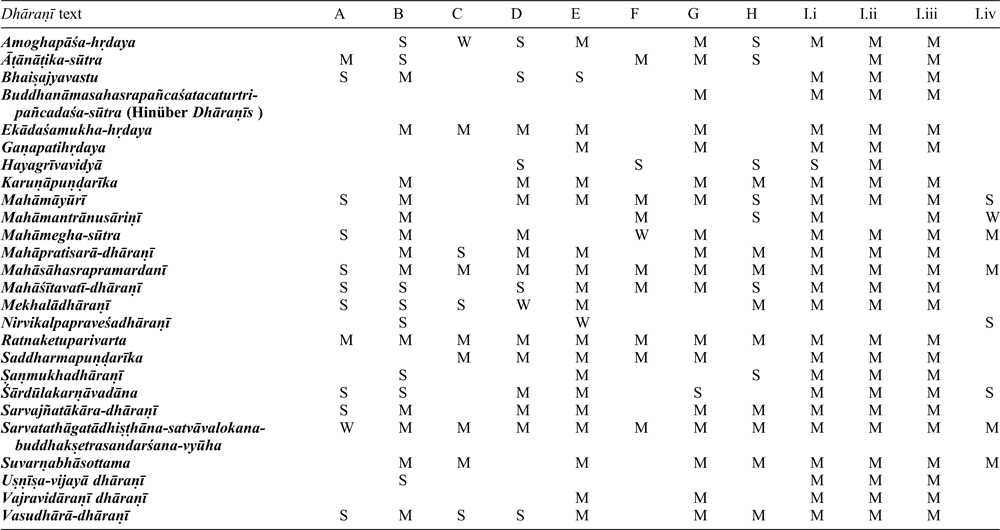
In a previous study of dhāraṇī literature, my primary concern was with the semantics of the term dhāraṇī (Davidson Reference Davidson2009). There I argued that the term had been somewhat misunderstood or presented in a one-sided manner. In the ensuing period, I have become satisfied that a rough approximation of the semantic contours of the term dhāraṇī are contained in that study.Footnote 2 Certainly, there is much more to be said with respect to the conventional semantics of dhāraṇī, and there is little doubt that refinements to my presentation will be necessary as new documents are explored. Among the many things missing in my cursory examination is an investigation of the other linguistic aspects of dhāraṇī use in India. One in particular begs to be addressed: the pragmatics of those expressions and textual sections belonging to the literary genre of dhāraṇī texts. While the previous study examined the semantic value of the term dhāraṇī as a subject term, the topic of this study will be statements found in dhāraṇī texts themselves.
To that end, this paper will present briefly the emerging discipline of historical pragmatics and its applicability to Indian Buddhist documents. It will outline a rough approximation of what may be said about the pragmatics of dhāraṇī statements found in the Mahāyānist scriptures containing dhāraṇīs, including texts from both early and later periods and admitting of data from other categories of spells (mantra, hṛdaya, vidyā). At the same time, some other linguistic phenomena will be brought into the discussion, especially questions of syntax, semantic change and grammaticalization, as these are entailed by pragmatics. In the process, the alternative voices of either grammatical or Mīmāṃsā pragmatic observations will be engaged on those few occasions where appropriate; one may indeed argue that analyses of pragmatics have been part of the discussion in Indian religion for quite some time. In our instance, however, their hermeneutics will be found to be not entirely appropriate in several respects. Only occasionally do we see that either grammatical, Mīmāṃsā or Smārta formulae provide guidance to the emerging Buddhist dhāraṇī literature.
Three inhibitions to the study of dhāraṇī pragmatics have occasionally been voiced. First is the idea that dhāraṇī literature encodes the personal inspiration of an individual, thus making the examination of implication and performance superfluous. According to this idea, the expression of the dhāraṇī is a consequence of individual inspiration apart from social or linguistic conventions. Second, there is the position that – as sacred phrases – mantras or dhāraṇīs cannot be considered with the same tools as other forms of language use.Footnote 3 In this model, because mantras are sacred, they are categorically different from other kinds of linguistic expression, so that our linguistic tools cannot be applied to them. Consequently, the pioneering studies of mantra by Gonda (Reference Gonda1963) and Wayman (Reference Wayman1975) – as well as more recent works by Padoux (Reference Padoux1989), Patton (Reference Patton1995), and Wilke and Moebus – emphasized the ideology of mantras: the emic classifications, particular attributes, postulated values and sonic theology. This position appeared more compelling when scholars such as Staal emphasized the idea of the meaninglessness of mantras (anarthaka) because discussions in the Nirukta or Jaiminimīmāṃsā-sūtra seem to coincide with a semantic (truth-conditional) definition of meaning, so that mantras appeared outside of natural language.Footnote 4 Finally, there is the issue of the conservative reticence of those handling Indian Buddhist ritual documents either to encounter the Indian world at large or to employ new methods available for their use.Footnote 5
In response, I would like to suggest that the data on formalized religious linguistic expressions support the position that Indian Buddhist ritual language is an irreducibly social phenomenon, and that to read these texts as individually expressed and personally sanctified phrases is to overlook the processes of their formation and employment.Footnote 6 It may be germane to point out that Biblical, Patristic and Classical studies are in advance of Indian Buddhist studies in this regard. Following in their philological footsteps, I will argue that it is imperative to take such formulaic expressions out of their “sacred” category and examine them as natural vocal events. Curiously, Vedic exegesis in part even supports this examination, arguing that both Vedic mantras and natural language operate with the same denotation.Footnote 7 To that end, the results of the last several decades of pragmatic investigation into language use will be invoked, not because this discipline is the final word on such phrases, but because it has not yet been adequately employed.Footnote 8
Semantics or historical pragmatics?
In this light, the difference between the semantic study of the materials and their pragmatic study might be clarified. It is common to trot out Morris's now rather shopworn tripartite definition of semiotics as divided into semantics, pragmatics and syntax (McDermott Reference McDermott1975), but the field of linguistics has developed so significantly in the last half century that this division is no longer as applicable as it once was. One needs but a modest review of the literature to realize that pragmatic use influences syntactic, semantic and phonological developments over time. Recent work has highlighted both the difference between semantics per se, and the effervescence of the study of discourse in situ (pragmatics), while still acknowledging a mutual patterning. In Recanati's description:
The view I have just described is very widespread and deserves to be called the Standard Picture (SP). It enables the theorist to maintain the three assumptions listed at the beginning of this section. (i.e.) Semantics and pragmatics each has its own field of study. Semantics deals with literal meaning and truth conditions; pragmatics deals with speech acts and speaker's meaning. (Recanati Reference Recanati2004: 452)
Yet most scholars in the study of pragmatics today realize that these divisions are more heuristic than easily identifiable, and that language in general is resistant to typologies with hard boundaries.Footnote 9 Still, it is relatively clear that meaning may be inferred, implied or contextually determined in a manner that truth-conditional semantics has had difficulty delineating (Levinson Reference Levinson1983, Roberts Reference Roberts2004). So if one takes the sentence: “John can write his name well”, by truth-conditional semantics this statement is true or false if John can write his name well. But if it is uttered in response to a question as to whether John is a good Sanskritist, it clearly implies that he is not, if the best that can be said is that he can write his name well. As Traugott and others have argued (Traugott and Dasher Reference Traugott and Dasher2002, Blutner Reference Blutner2004), semantic change often follows on the heels of pragmatic use, so that the development of idioms, technical applications, slang and other semantic variations are often first defined in context, only later to enter the lexicon in a conventionalized form.
Over the last half century, forms of pragmatics have developed tools that will help shed light on some of the problems we must consider, and one of these, speech act theory, has been particularly fruitful. As is now very well known, Austin's typology of speech acts (Austin Reference Austin1962: 151–64) has been employed, changed or modified by several scholars, but Searle's schematism appears to be the best known and most widely applied, even if it is still occasionally contested. Searle divided speech acts (i.e. illocutionary acts) into five types, emphasizing the verbal force associated with each (Searle Reference Searle1969, Reference Searle1979; Searle and Vanderveken Reference Searle and Vanderveken1985). In his typology, there are: (1) assertive statements, affirming or proposing a specific truth statement; (2) commissive statements, committing the person to a specific performance or act; (3) directive statements, attempting to command or otherwise to direct the listener to an action; (4) declarative statements, making declarations that alter the state of the social community; and (5) expressive statements, one person revealing to another a psychological attitude. As may be suspected, these are primarily determined by the verbal force, and Searle has articulated multiple instances of English versions of such statements. In some measure, these can be transposed into Indic structures. An example of (1) assertives might be any one of the many religious truth claims (darśana); of (2) commissives might be the vows or promises (vrata, samaya) found in Indian religious texts; of (3) directives would be sentences employing the imperative and optative verbs or their gerundive adjectival forms; of (4) declaratives would be the formal statements that open or close ceremonies or confer consecration, coronation or other ceremonial functions; and of (5) expressives would be the first person expressions of sincerity in confessions, praise, congratulations, condemnations and so forth.
This or related typologies have been employed by various Vedic scholars, notably Wheelock Reference Wheelock1982, Patton Reference Patton1995, Findly Reference Findly1989, Thompson Reference Thompson1998, Ilieva (Reference Ilieva2003), Taber and, more recently, Dahl (Reference Dahl2008). (We note that other scholars like Houben (Reference Houben2000) and Proferes (Reference Proferes2003) have used the term pragmatics in a ritual-performative rather than a linguistic sense.) The contributions of these and other scholars mark quite an advance over previous work, for they have not only attempted to apply the observations of Austin, Searle and others to the problem of Vedic statements, but have articulated indigenous linguistic categories and noted areas where English-language based systems are a poor fit. However, in the application of speech act linguistics to the study of documents, there is a disturbing tendency either to misuse speech act theory or to provide an empty gesture to speech acts in particular, as Gorman has discussed in terms of literary criticism (Gorman Reference Gorman1999; also Gaskill Reference Gaskill2008). Additionally, Searle's typology has not gone unchallenged, whether in light of ritual use or for ordinary language expressions (e.g. Wheelock Reference Wheelock1982, Stiles Reference Stiles1981, Siebel Reference Siebel2003, Hughes Reference Hughes1984). Wheelock, for example, has argued that speech-act theory is primarily formulated to deal with vernacular social expressions, that is, sentences and situations that are modern and familiar. His analysis has not received wide acceptance for various reasons, but it does beg the question of the relationship of ritual repetition to other formalized expressions.
Even with such legitimate reservations in mind, it is appropriate to engage the questions about the pragmatic use of Indian texts, in this case Indian Buddhist texts, ever cognizant of limitations. Perhaps more important, pragmatics is concerned with the changes of fields of meaning that happen in conversational contexts, in which social interactions have presuppositions, understand the implicatures, sense the discontinuities between what is said and what is meant, to mention but a few of the topics associated with pragmatics analysis. In dealing with historical documents, many, if not most, of these factors are not clear or transparent. But such conceptual obscurity does not mean that the questions are unimportant, and indeed I would argue that the opacity of the discourse structures we deal with should invite us to seek out contextual understanding, even while acknowledging that it is fraught with uncertainties, some of which will remain contested or intractable over time.
In response to these and similar needs, linguists with a philological background began to apply pragmatic tools and procedures to historical texts, developing the discipline now known as “historical pragmatics”. Andreas Jucker and Elizabeth Traugott, in particular, started to employ such strategies to examine works, first in English and then expanded to other languages, yielding a growing series of studies and eventually the founding of the Journal of Historical Pragmatics. Jacobs and Jucker (Reference Jacobs and Jucker1995: 6) describe the field in the following manner:
Historical pragmatics deals with changes in the linguistic structure resulting from altered communicative needs which are due to changes in the social structure, or, in other words, with changes in traditions of language use resulting from changes in the situational context, e.g. the institutionalisation or a medium of change. Hence the aims of a historically conceived pragmatics include (1) the description and the understanding of conventions of language use in communities that once existed and that are no longer accessible for direct observation, and (2) the description and the explanation of the development of speech conventions in the course of time. However, historical pragmatics can also be used as a philological tool to explain literary artefacts from the past.
This latter is true in the pursuit of “pragmaphilology”, (1) above, further defined by Jacobs and Jucker (Reference Jacobs and Jucker1995: 11):
Pragmaphilology goes one step further and describes the contextual aspects of historical texts, including the addressers and addressees, their social and personal relationship, the physical and social setting of text production and text reception and the goal(s) of the text.
Pragmaphilology is understood to be a “macro approach”, emphasizing alterations in the sociocultural conditions wherein speech acts occur. In distinction, the other form (2) above, “diachronic pragmatics”, is identified as a “micro approach” (Traugott Reference Traugott2004: 538). Jacobs and Jucker (Reference Jacobs and Jucker1995: 13) understand that:
diachronic pragmatics focuses on the linguistic inventory and its communicative use across different historical stages of the same language. Within the diachronic studies it is possible to distinguish two subtypes. Some studies may take a linguistic form (such as discourse markers, relative pronouns or lexical items) as a starting point in order to investigate the changing discourse meanings of the chosen element or elements, while the other subtype takes the speech functions (such as a specific speech act or politeness) as their starting point in order to investigate the changing realizations of this function across time.
The application of the discipline of historical pragmatics to the study of dhāraṇīs would seem at first blush to be immediately apparent, for investigations into all of these circumstances remain desiderata: the changing nature of Buddhist discourse, the macro social environment of India, the intermediate social environment of Buddhist monasteries and their support communities, the smaller environments of Mahayanist groups employing such phrases and placing them in their scriptures, to mention but the more urgent. This essay will be one – certainly incomplete and probably faulty – attempt at applying the methods of historical pragmatics to a few of the many dhāraṇī texts in our archive.
Dhāraṇī pragmatic divisions
Dhāraṇī literature is sufficiently complex to resist easy categorization, which is part of the reason it is simultaneously so interesting and so frustrating. However, in terms of its pragmatic contextualization, we can say that the presentation of dhāraṇī texts often divides into several relatively discrete types of statement. (a) First, we find precipitating assertives, whether articulating a problem condition or a miraculous event. (b) Second, we will consider the directive to speak or perform the dhāraṇī, with the verb in the imperative or rarely in the optative. (c) Third, we find commissive statements promising to communicate a dhāraṇī. (d) Fourth, we have assertives in the forms of precedent or predictive statements, extolling the use of this dhāraṇī or vidyā or hṛdaya by a/some/many previous Buddhas, and many include a predictive statement that it will be preached in the present or future as well. (e) Fifth, we find assertives as benefit statements, usually about the dhāraṇī's power as a prophylactic against disease, poison, possession, or enemies, but also as an affirmation of health, welfare or even soteriological efficacy. (f) Sixth, we find assertive hybrid warning statements. (g) Seventh, there are the ubiquitous expressives: praise, homage, confession, condemnation, etc. (h) Eighth, we find perlocutionary expressives or assertives, about the joy and amazement of the audience who received this dhāraṇī, and occasionally other, sometimes less beneficial perlocutionary sentiments are indicated. (i) Ninth, we find the mantra-dhāraṇī itself, specifying the phrase to be recited. I simply employ the term mantra-dhāraṇī as a designation to differentiate it from the larger dhāraṇī text, and in recognition that it is a term employed in the Bodhisattvabhūmi (272.23–273.3), so as to avoid a neologism; the Saddharmapuṇḍarīka employs both the designations mantra-dhāraṇī (397.3) and dhāraṇī-mantra (396.3, 398.3, 399.9, 400.1, 401.1), which are equally clear. Other texts employ analogous designations.Footnote 10
Readers of Buddhist scriptures will notice that many, perhaps most, of the items in the list (a)–(i) will have been employed in previous Buddhist texts as part of the overall textual strategy. Their presence in dhāraṇī texts serves to reinforce the authenticity and legitimacy of these works. As Austin pointed out, in terms of speech acts:
There must exist an accepted conventional procedure having a certain conventional effect, the procedure to include the uttering of certain words by certain persons in certain circumstances. (Austin Reference Austin1962: 26; see also Sbisà Reference Sbisà2009)
Mutatis mutandis, allowing for the changed circumstances of ritual works, the newer Mahāyāna dhāraṇī texts were expected to emulate well-established paradigms. That does not mean they were necessarily successful in this process, and under section (d) we will discuss the problem of uptake and its success or failure.
One caveat should be expressed, precipitated by the discussion of ritual order articulated by the late Frits Staal. As is well known, Staal argued that ritual order is meaningless, by which I understand him to have meant that ritual units can be rearranged syntactically without affecting their semantic value (Staal Reference Staal1986a, Reference Staal1986b, Reference Staal2008). His model is grounded in the linguistic background of transformational grammar, which in its more extreme forms argues that syntactic units may be rearranged without a substantial change in semantic value. Here, pragmatics certainly has something to say, as contextual use and statement order are important. Consequently, the above list should not be taken as somehow indicative of either the respective place or the precise importance of such items in a specific dhāraṇī text. As the analysis unfolds, it will be clear that these items are sometimes shifted about. Their relocation, however, carries with it a degree of pragmatic significance, and I would argue that – just as in relocating specific items to the beginning of an English sentence may indicate emphasis – the pragmatic force is somewhat different for such items depending on their respective locations. Ideally, each text should be considered independently as an assemblage of pragmatic signifiers.
Nonetheless, we may also note that the position-related differences in pragmatic force are moderated to some degree because of the process of formalization. In addition to the attributes of formalism – redundancy and parallelism – already identified by others, Irvine listed four further qualities of formality that appear cross-culturally valid: increased code structuring; code consistency; the invocation of positional identities; and the emergence of a central situational focus (Irvine Reference Irvine1979: 774–9; Howell Reference Howell1986). These are apparent in the codification of language, the consistency (intertextuality) of expression, the recognition of hierarchical relationships accompanied by attendant politeness concerns, and the transmission of the mantra-dhāraṇī itself as the central focus. Tambiah (Reference Tambiah1979) saw many of these same formalization functions in the anthropology of the rituals he examined, providing a modern, vernacular model to the textual Sanskrit with which we are concerned. Consequently, in light of the issues of formalization, we would best consider the items (a) to (i) across texts, for the formalization of language yields a pragmatic force that has echoes in other texts with which the hearer/reader would have been familiar.
In selecting items for examination, it would be well to foreground two basic concerns. First, the fundamental, important scriptural statements should be given preference over less central, peripheral statements. That is, those scriptures with the greatest overall resonance in the Indian Buddhist tradition should be the initial field of investigation. This would ideally be determined by a system of weighting based on reference, commentary, translation and actual ritual use in the period in question, to mention but the more obvious parameters. Unfortunately, in the absence of any rigorous quantification of such variables, this weighting must remain an idealized aspiration rather than an easily realized placement system. Yet it is reasonably easy to identify the most important of the Mahāyāna scriptures that employ dhāraṇīs or similar phrases (hṛdaya, vidyā often re-branded as dhāraṇīs) for these are the ones for which there is generally – albeit not always – some surviving Sanskrit version. And that gives rise to the second concern. The analysis would best avoid translated texts (Chinese, Tibetan, etc.) at this time for its primary data, although these may be employed to assist the resolution of some questions of earlier recension, semantic value, pragmatic use, and so on. Nonetheless, having some surviving Sanskrit text is better than no Sanskrit text in this instance – particularly if there is a translation to validate early use – as so much of the pragmatic force of the statements is encoded in the nuance of the Sanskrit vocabulary, as I hope will be clear in the ensuing discussion. These two concerns, however, do lessen the textual field considerably. Moreover, explicitly dhāraṇī literature frequently employs phrases and ritual statements also found in other spell genres (mantra, vidyā, hṛdaya) that are not always termed dhāraṇī, but that nonetheless share commonalities with the literature so designated. This other spell literature will consequently be exploited in the discussion.
Finally, experienced readers of dhāraṇī works will note one or more textual features missing in the (a)–(i) list given above. In response, I would beg the reader's indulgence; the items (a)–(i) are not exhaustive and represent the standard phrases I find most commonly expressed in dhāraṇī literature overall. This essay is simply a preliminary attempt at mapping them linguistically. As the dhāraṇī texts become longer – as the sixth- to eighth-century texts translated into Chinese and Tibetan attest – they become more complex and the kinds of statements have greater variation. One particular lapse in my agenda is constituted by the vidhi, vidhāna, kalpa or sādhana ritual materials, even though they are sometimes found side-by-side with the above sections. Such vidhi materials form the ritual instructions for the construction of an altar (sthaṇḍila, maṇḍala), offering materials to one or another figure, and over time come to include homa, bali and other offerings. The primary reasons for this neglect are threefold: first, it appears that the earliest of the dhāraṇī works and chapters in texts do not include such ritual specificity, which is itself a problem in understanding how these dhāraṇī materials were to be employed at their earliest phases. Second, it is increasingly clear to me that such rituals are grounded either in the gṛhya literature of the Smārta Vedic traditions or in the popular forms of yakṣa, nāga or other local spirit cults and must be resolved in relation to those sources as much as can be. Establishing this relationship is such a complicated task that it should be reserved for another occasion. Third, the structures of vidhi rituals are such that they do not materially contribute to the discussions of pragmatics as more commonly encountered in the dhāraṇī texts. Consequently, as interesting as such vidhi literature is, it must be reluctantly set aside. Indeed, I envision the process of dhāraṇī pragmatic taxonomy as a prelude to the examination of these more complex rituals.
A. Precipitating assertives
In the imagined narrative at the beginning of dhāraṇī texts, there is sometimes an event said to precipitate the expression of the dhāraṇī. If such a narrative is present, the nature of the event is sometimes a problem condition, either personal or social. In the former instance, we find the assertion that monks encounter afflictions having either supernormal or natural causes that exceed the Saṃgha's ability to control. So Svāti in both the Bhaiṣajyavastu and the Mahāmāyūrī goes wandering into the religious life and becomes snake-bitten, a common enough circumstance and emblematic of a larger sphere of afflictions regularly encountered in South Asia, whether from insects, snakes, disease, fever or from some affliction not falling into the canon of modern medicine.
sa kāṣṭhaṃ pāṭayitum ārabdho yāvad anyatamasmāt pūtidārusuṣirān niṣkramyāśīviṣeṇa dakṣiṇe pādāṅguṣṭhe dṛṣṭaḥ | sa viṣeṇa saṃmūrchito bhūmau patito lālā vāhayati mukhaṃ ca vibhaṇḍayati akṣiṇī ca saṃparivartayati | Bhaiṣajyavastu 285.14–17Footnote 11
He [Svāti] began to break off some wood, and just then from another putrid piece of hollow wood a poisonous snake emerged and bit him in the big toe of his right foot. He passed out from the venom, fell to the ground, spit up saliva, his face distorted, and his eyes rolling back in his head.
A less salubrious approach is taken in the case of Surasundarī, the wife of the cakravartin Utpalavaktra, in innumerable kalpas in the past, as found in the Ratnaketuparivarta. The karmic tale (pūrvayoga) is related by Śākyamuni in order to remove doubt about the relationship between karma and consequences (p. 33.2: karmapratyaya eṣa draṣṭavyaḥ). With her thousand ladies-in-waiting, she comes to offer to Jyotiḥsomyagandhāvabhāsaśrī Tathāgata, and they ask him to explain the deathless path to beneficial states devoid of obscuration (p. 37.7: vada vitimirasugatipatham amṛtam). In reply Jyotiḥsomyagandhāvabhāsaśrī offers them the ratnaketudhāraṇī which will transform them from the female to the male state, implying that the author believed the feminine condition to be the emblem of their karmic defilements (karmāvaraṇa), existing as their problem condition.Footnote 12
Assertives of supernormal causes, as understood by modern standards, would include the case of Ānanda's falling under the control of a witch in the Śārdūlakarṇāvadāna.Footnote 13 The categories of natural and supernormal, however, are modern, and they sometimes seem to be represented with similar statements in dhāraṇī documents, as in the case of Rāhula's affliction in the Mahāśītavatī-dhāraṇī:
śītavane mahāśmaśāne iṅghikāyatanapratyuddeśe tatrāyuṣmān rāhulo ’tīva viheṭhyate | devagrahair nāgagrahair yakṣagrahai rākṣagrahair marutagrahair asuragrahair kinnaragrahair garuḍagrahair gandharvagrahair mahoragagrahair manuṣyagrahair amanuṣyagrahair pretagrahair bhūtagrahaiḥ piśācagrahaiḥ kumbhāṇḍagrahair dvīpibhiḥ kākair ulūkaiḥ kīṭaiḥ sarīsṛpair anyaiś ca manuṣyāmanuṣyaiḥ satvaiḥ | Mahāśītavatī 1.4–10Footnote 14
Rāhula was living in the Śītavana cemetery in the Iṅghikāyatana region and was tormented by possessive spirits among the gods, among the nāgas, among the yakṣas, among the rākṣasas, among the maruts, among the asuras, among the kinnaras, among the garuḍas, among the gandharvas, among the mahoragas, among the humans and non-humans, among the pretas, among the bhūtas, among the piśācas, among the kumbhāṇḍas, and also tormented by leopards, crows, owls, insects, serpents, and by other beings, human and non-human.
Identifiably supernormal events include the appearance of catastrophic portents at the beginning of the Mahāsāhasraparmardanī:
tena khalu punaḥ samayena vaiśālyāṃ mahānagaryāṃ mahān bhūmicālo 'bhūd abhrakūṭaṃ ca prādurbhūtam | mahatī cākālavātāśanir mahāmeghaś ca samutthito devo garjati guḍaguḍāyati vidyutaś ca niścaranti | daśadiśaś cākulībhūtās tamo 'ndhakāraṃ ca prādurbhūtam | nakṣatrāṇi ca na bhāṣante | candrasūryau na prabhavato na tapato na virocato na ca prabhāsvarau bhavataḥ ‖ Mahāsāhasraparmardanī 1.20–25Footnote 15
Then, you should realize that at that time, in the great city of Vaiśālī there was a great earthquake, and a tower of cloud appeared. And a massive inauspicious wind and lightning occurred, with a great cloud the rain god stood up roaring, as if with rumbling in his belly, and thunderbolts scattered everywhere. In all the ten directions, everyone became perplexed, and a darkness akin to night appeared. But there were no constellations visible. Nor did the sun or moon shine, or provide heat, or illuminate or reveal their brilliance.Footnote 16
Some of the more significant statements about similar portents have to do with fending off the work of Māra, and one episode turns the narrative around. At one time, towards the end of the Ratnaketuparivarta, Māra and all his minions appear before the Buddha and pay homage.Footnote 17 The Bodhisattva Kautūhalika asks if Māra has had a change of heart, but the Buddha replies in the negative. Just then, an entity called Agasti-māra comes before the Buddha, prays that if any of Māra's minions should appear, may that agent of distress have no power. Agasti-māra then utters a dhāraṇī, which yields those results, based on the power of his previous aspiration.
This episode builds on a wider theme throughout the spell scriptures: while there are spirits, yakṣas, nāgas, kumbhāṇḍas, and so on, who have decided to protect the Dharma, there are many, many more demons, spirits and such like, who are not so beneficent, and this sets up the need for the expression of mantras to be used as apotropaic aids in warding off the less benign elements of the preternatural mob. So one of the oldest of the Buddhist apotropaic scriptures, the Āṭānāṭika-sūtra, provides various mantras to ward off the effects of the several demons, with the problem of their potential trouble as the specific motivation.Footnote 18 Likewise, the Ratnaketuparivarta picks up the same theme to provide the motivation for the expression of the vajrakhavasari, a mantra-dhāraṇī that is both the essence of all demons and equally capable of overcoming a daunting list of denizens of the spirit world.Footnote 19 Other kinds of assertive narratives certainly occur, some miraculous. A number of dhāraṇī texts indeed specify no difficulty that the dhāraṇī is to solve, but instead begin with a supernatural occurrence (prātihārya) that suddenly appears, either through the action of Śākyamuni or from some other source. So the Sarvajñatākāra-dhāraṇī begins by the Bodhisattva Ratnavairocana noting the sudden appearance of beams of light and asking its source (p. 7: paramāścaryābhūt tatprāpto ’haṃ bhagavan kuta ime raśmaya āgatāḥ | kasyaiṣa viṣaya prabhāva | ko ’tra hetupratyayo bhaviṣyati |).
The precipitating assertives function as specific kinds of graphic linguistic acts in the text, acts that prompt individuals to take further action, especially the Buddha but also specific Bodhisattvas, the four Great Kings (catur mahārāja), and various other entities, as we will see. The supposition is that the various Buddhist entities will respond to such difficulties, amazing circumstances, or almost anything incomprehensible or out of the ordinary. To be sure, not all of the dhāraṇī texts provide such narratives – they simply relate the mantra-dhāraṇī and are done with the matter – but many of the dhāraṇī texts take great pains to establish a complex social world in which the expectation is that the Buddha, as one of great compassion (mahākāruṇika), will be certain that his followers are equipped with the tools necessary to provide for their needs.
In this regard, the assertives establish the need for mantra-dhāraṇīs within the context of an extremely conservative institution; Buddhists have voiced the assumption that innovations are acceptable to the degree that they are responses to difficulties or circumstances bereft of other forms of control. This idea goes back to the earliest level of the tradition, and the Buddha is said to have affirmed that he did not initiate a new rule without there being a cause.
na tāva sāriputta satthā sāvakānaṃ sikkhāpadaṃ paññāpeti uddisati pātimokkhaṃ yāva na idh’ ekacce āsavaṭṭhāniyā dhammā saṃghe pātubhavati. (Vinaya Texts III.9.28–30)Footnote 20
It is not the case, Śāriputra, that the Teacher establishes one of the [Vinaya] rules of instruction or teach the Prātimokṣa to the disciples without some events appearing in the Saṃgha that operate as the basis for defilement.
Thus, like the Vinaya rules, the dhāraṇīs were therapeutic responses to new aggravated conditions; they appeared to fit well with the mythology of cosmic decline and the imminent loss of the Saddharma. The disjuncture, clear from historical perspective but perhaps not so evident at the time, was that most of the situations reported in dhāraṇī precipitating assertives have had a long narrative history in the Saṃgha without the necessity for the inauguration of new apotropaic procedures. Thus, the intrusion of vidyās, mantras and other kinds of spells into the Buddhist canon must have had some measure of social and historical impetus behind whatever mythological motive has been furnished by the statements of their inauguration.
B. Dhāraṇī directives
Based on such precipitating assertives, we find most dhāraṇī or mantra texts providing directives to others either to speak or “take up” this spell, whether for the benefit of selected members or for the entire community. Three of the dhāraṇī sections – (b) the directive statement, (f) the warning assertive hybrids, and (i) the actual mantra-dhāraṇī – will have a high degree of variation, but most of them employ direct or indirect illocutionary directive speech acts and construct what Mauri and Sansò call “directive strategies”.
By directive strategies we mean constructions and markers that encode positive directive speech acts, i.e. situations in which the speaker orders someone to do something … As directive speech acts are complex situations involving different components such as, e.g., the speaker's wish, the appeal to the addressee, and the expectation of an imminent actualization of the order, the diachronic sources of directive markers include different strategies originally attested in indirect speech acts and primarily devoted, among other things, to the expression of futurity/imminence (e.g., future constructions), or to the expression of the speaker's wish (e.g., optative constructions). (Mauri and Sansò Reference Mauri and Sansò2011: 3489–90)
Accordingly, while it is clear that the optative and imperative verb forms seen in this dhāraṇī section implicate such directive strategies, other forms of pragmatic force may also be uncovered around the Buddha's command. Moreover, since we are dealing with Indian speech acts, a cautious approach would require recognition that there are statements describing pragmatics in some sense within Indian writing overall (Taber Reference Taber1989, Patton Reference Patton1995, Thompson Reference Thompson1998). For example, as Taber and Patton have shown, there is a similarity between the typologies of mantra statements found in both Smārta and Mīmāṃsā literature on the one hand and the categories described in pragmatics analysis on the other, even if they cannot be directly equated.
As is well known from a study of both Smārta and Mīmāṃsā literature, the primary verbal vehicle for orthodox Sanskrit directives is the optative form (liṅ), which has the emic illocutionary force of the injunction (codanā). The seminal Jaiminimīmāṃsā-sūtra recognizes this force in its various applications of codanā and the commentators affirm that codanā identifies such optative verbs as “let him sacrifice” (yajeta). (Jaiminmīmāṃsā-sūtra 1.1.2, 2.1.5, 2.1.32 etc., reading with Śabara). Curiously, however, most Buddhist dhāraṇī directives and mantra-dhāraṇīs or vidyās, appear to prefer the imperative (loṭ) forms rather than the better recognized optative (liṅ) of the Smārta and Mīmāṃsā authorities. In distinction to the Smārta third person indeterminate “one” or “anyone” (yaḥ or yaḥ kaścit), this directive is usually invoked with second person direct address (tvam or yūyam), whether expressed or implied.
udgṛhṇa tvam ānanda imāṃ ṣaḍakṣarīvidyāṃ dhāraya vācaya paryavāpnuhi| Śārdūlakarṇāvadāna 4.16–17
Take up this six-syllable vidyā, Ānanda, hold it, speak it, master it!
As in this directive, a result of Ānanda's having been captured by a witch's spell, it would appear that the specific directive form is in some measure dependent on the narrative associated with the text, and whether there is a precipitating event in which a single person is the principal in the narrative. If there is no narrative of a precipitating assertive (as in A. above), but the text simply begins by indicating the existence of a mantra-dhāraṇī, then we sometimes see the Buddha ordering a figure to speak the spell.
atha [khalu bhagavān āryāvalo]kiteśvaraṃ bodhisattvaṃ mahāsatvam etad avocat ‖ bhāṣa tvaṃ śuddhasatva | yasyedanīṃ kālam manyase ‖ anumoditaṃ tathāgatena paścimena kāle paścime samaye bodhisatvayānikānāṃ pitṛkāryaṃ kariṣyati ‖ Amoghapāśahṛdaya-dhāraṇī 319.
Then you should know that the Lord said this to the Bodhisattva Mahāsattva Ārya-Avalokiteśvara, “Speak, O pure being, if you think now the proper time for this! It is approved by the Tathāgata and [the dhāraṇī] will act as an ancestor for those mounted on the Bodhisattva vehicle in the later days, in the subsequent days of the Dharma.
If there is a precipitating assertive of a problem or miraculous condition, then the individual so afflicted may be directed to take up the mantra-dhāraṇī, as Rāhula is so directed when he is afflicted by all the demons:
udgṛhṇa tvaṃ rāhula imāṃ mahāśītavatī nāma dhāraṇīṃ vidyāṃ | Mahāśītavatī-dhāraṇī 2.8
Take up, Rāhula, this spell of the Mahāśītavatī-dhāraṇī!
Sometimes the person so directed is not the principal, but instead a senior or representative person in the Saṃgha who may provide assistance to the individual afflicted. So the direct address in the Mahāmāyūrī is Ānanda, who is able to employ the spell to cure Svāti, who has become incapacitated.
evam ukte bhagavān āyuṣmantam ānandam etad avocet | gaccha tvam ānanda tathāgatasya vacanenānayā mahāmāyūryā vidyārājñā svāter bhikṣo rakṣāṃ kuru | guptiṃ paritrāṇaṃ parigrahaṃ paripālanaṃ śāntiṃ svastyayanaṃ daṇḍaparihāraṃ śastraparihāraṃ viṣadūṣaṇaṃ viṣanāśanaṃ sīmābandhaṃ dharaṇībandhaṃ ca kuru| Mahāmāyūrī 3.11–14
This said, the Lord replied thus to Ānanda. “Go, Ānanda, and protect Svāti the monk with this Great Peacock Spell, the Queen of Spells, [expressed] by the Tathāgata's voice! [With it], perform [his] cover, guarding, assistance, shield, pacification, health, warding off punishment, warding off weapons, removing poison, destroying poison, securing a sacred perimeter, and securing the site!”
We also find this conversational imperative use retained in the later dhāraṇīs, such as the Mahāmantrānusāriṇī.
gacchānanda vaiśālīṃ gatvā indrakīle pādaṃ sthāpayitvā imāni mahāmantrānusāriṇī mantrapadāni bhāṣasva | imāś ca gāthāḥ | Mahāmantrānusāriṇī C.1.3
Go, Ānanda, and having reached Vaiśālī, place your foot on the threshold and recite these mantra words of the Mahāmantrānusāriṇī and these verses, too.
Likewise the Saṇmukhī-dhāraṇī:
udgṛhṇīdhvaṃ yūyam kulaputrā imāṃ ṣaṇmukhī-nāma-dhāraṇīṃ sarvajagaddhitārtham | Saṇmukhī-dhāraṇī 9.
You must take up, O sons of good family, this Six-door Dhāraṇī for the sake of the welfare of the entire world.
The imperative use is so widely distributed that it appears to be employed by the disciples to request that the Buddha teach in the Nirvikalpapraveśadhāraṇī, (p. 94[3]: ni[rvikalpapraveśāṃ dhāraṇīṃ deśatu bhagavan|]) although this form is reconstructed by Matsuda from the Tibetan and must be treated with caution. Nonetheless, that usage is found elsewhere, as when the four Mahārājas revealed mantras in the Mahāsāhasrapramardanī. There, each of them employs the second-person imperative to direct the Buddha to listen to their mantra words (pp. 4–6: tatra mantrapadāny asti lokanātha śṛṇohi me ‖). But the result is that they become frightened when the Buddha trumps their mantras, and so the blunt imperative appears to set the stage for the Buddha's unfavourable reception. Elsewhere in the same text, yakṣas cry out to the Buddha for protection using the third-person imperative (p. 29.7: trāyatu naḥ śramaṇo gautama), yielding a strong appeal, slightly blunted by the more polite third-person form. Thus, the imperative would seem to be generally associated with a direct address and a pragmatic force indicating the presumption of either hierarchical rank or an increased strength of appeal.
In other areas, we find a distinctive optative use with a third-person indefinite rather than a second-person definite subject, but this is a commonplace about benefits in Mahāyāna scriptures. This use is assertive in form but pragmatically is part of an implicit directive strategy, an extended application acknowledged by Searle (Reference Searle1979: 28–9). The form is generally found in sections describing how, whatever son or daughter of good family were to learn, speak, internalize, broadcast, write or have written even a verse of a scripture, he/she would soon reach final awakening.Footnote 21 In many instances, these verbs are all expressed with optatives, but other verb and participial forms are sometimes present as well. That optative use occasionally finds expression associated with mantras or vidyās, as in the Śārdūlakarṇāvadāna,
yaḥ kaścid ānanda ṣaḍakṣaryā vidyayā paritrāṇaṃ svastyayanaṃ kuryāt sa yadi vadhārho bhavet daṇḍena mucyate | Śārdūlakarṇāvadāna 5.5–7 (To. fol. 234a5)
Whoever, Ānanda, would secure his protection or health with this six-syllable vidyā, if he is worthy of death, he will be released with a judgment.
However, in none of these instances have I located the optative as an explicit directive in the manner of the imperative so commonly used.
Interestingly, Pāṇini does not strongly differentiate between the optative and imperative, and in more than one sūtra he explicitly identifies their conventional semantics (Aṣṭādhyāyī 3.3.161–2: vidhinimantraṇāmantraṇādhīṣṭasaṃpraśnārthaneśu liṅ | loṭ ca |; Aṣṭādhyāyī 3.3.173: āśīṣi liṅloṭau |). Jayāditya's examples of both liṅ and loṭ uses in the Kāśikāvṛtti commentary on these sūtras are virtually identical, further blurring the distinction. Nonetheless, as van de Walle has pointed out, the optative is more closely associated with polite discourse, while the imperative is employed in slightly more blunt and forceful directives. Between these two stand the gerundive which, Pāṇini indicates, overlaps the optative and imperative meanings, even if with a passive sense (kṛtya: e.g., Aṣṭādhyāyī 3.3.163, 169–72). Van de Walle's (Reference Van de Walle1993: 104–10) examination of the use of these modal forms affirms that, in Classical Sanskrit, they are somewhat more nuanced and context-specific than in the grammarians' discussion, for the latter are frequently based on Pāṇini.
The politeness value of the optative is recognized in a modal question posed by the crowd in the Mahāsāhasrapramardanī to the Buddha when faced with the sudden appearance of a massive cloud and deep darkness, flecked with lightning, “Given that this is the case, how might we be liberated thus from this fear-inducing calamitous form?” (p. 2.14–15: kathaṃ nāmaitat syād vayam evaṃ rūpād upadravato bhayasthānāt parimucyema). Here and elsewhere, the employment of the optative appears to follow the Smārta use that directly ties optional goals (kāmyakarma) with specific practices. However, it sometimes blends into the Buddhist use of the imperative, which implies an urgent directive of the moment, in a determinate time and space.
C. Dhāraṇī commissives
The directive statements are sometimes buttressed with related or supportive affirmations that various mythic entities will confer these dhāraṇīs on the individuals identified in the various narratives, or they may support possessors of such dhāraṇīs with protection and defence, or practise the dhāraṇīs themselves.Footnote 22 Often, the figures protected are dharmabhāṇakas, Mahāyānist preachers who are doubtless the most important of the dhāraṇī patrons and users to be identified in the scriptures. In this aspect of the frame narrative, the dharmabhāṇaka or other Mahāyāna supporter will receive instruction in this or that mantra-dhāraṇī from one or another figure under certain conditions. In the Saddharmapuṇḍarīka, for example, the Bodhisattva Bhaiṣajyarāja vows to offer his dhāraṇī of protection to any person invested in that text.
dāsyāmo vayaṁ bhagavaṁs teṣāṁ kulaputrāṇāṁ kuladuhitṝṇāṁ vā yeṣām ayaṁ saddharmapuṇḍarīko dharmaparyāyaḥ kāyagato vā syāt, pustakagato vā, rakṣāvaraṇaguptaye dhāraṇīmantrapadāni | Saddharmapuṇḍarīka 396.2–3
We will confer, O Lord, the words of the following dhāraṇī-mantra – for the purpose of protection, shelter and security – and on any son or daughter of good family who may have taken this Saddharmapuṇḍarīka, this teaching of Dharma, and learned by heart or retained as a book.
A variant on this commissive is found in the Sarvatathāgatādhiṣṭhāna (§§36–7), where Vajrapāṇi informs the Buddha of his commitment on behalf of dharmabhāṇakas in the past and requests (a polite directive; see Archer Reference Archer2010) that he be allowed to proclaim his mantra-dhāraṇī in the present, thereby juxtaposing commissives and directives.
Beyond the specifically Buddhist figures, the various worldly divinities are shown to pronounce commissives in support of those following the Mahāyāna:
aham api bhadanta bhagavan sarasvatī mahādevī tasya dharmabhāṇakasya bhiksor vākyavibhūṣanārthāya pratibhāṇaṃ upasaṃhariṣyāmi | dhāraṇīṃ cānupradāsyāmi | suniruktavacanabhāvaṃ saṃbhāvayiṣyāmi | mahāntaṃ ca dharmabhāṇakasya bhikṣor jñānāvabhāsaṃ kariṣyāmi | yāni kānicit padavyañjanāni itaḥ suvarṇabhāsottamāt sūtrendrarājāt paribhraṣṭāni bhaviṣyanti vismaritāni ca | tāny ahaṃ sarvāṇi tasya dhamabhāṇakasya bhikṣoḥ suniruktapadavyañjanāny upasaṃhariṣyāmi | dhāraṇīṃ cānupradāsyāmi smṛtyasaṃpramoṣaṇāya | Suvarṇabhāsottamasūtra 102.16–103.6
I too, noble Lord, the Great Goddess Sarasvatī will nurture inspiration, for the purpose of ornamenting the vocal presentation of the preaching monk, and confer on him the dhāraṇī. I will bring about his state of vocal facility in analysis. I will fashion in that preaching monk a great light of knowledge. And whatever words or letters will have been lost or forgotten from this Lord King of Sūtras, this Suvarṇabhāsottama, I will refresh all of those well-etymologized words and letters for that preaching monk, and I will confer on him the dhāraṇī for the sake of retention of his recollection.
As in the case of the Bodhisattvas in the Saddharmapuṇḍarīka, there is a very similar statement in the Suvarṇabhāsottama (pp. 112.8–113.13) from Śrī Mahādevī that echoes many of the commissive vows taken by Sarasvatī. Such vows also appear intermittently in other scriptures, some of which, like the Sarvatathāgatādhiṣṭhāna, express them through the agency of several worldly divinities (§§ 69, 79, 85–6, etc.).
A distinctive position is occupied by the four Mahārājas in dhāraṇī literature, an extension of their much earlier function as protectors of the Buddhist dispensation. As they live in the four directions surrounding Mt. Sumeru, they would appear to be a Buddhist iteration of the larger Indian fixation on the gods of the directions (Wessels-Mevissen Reference Wessels-Mevissen2001). In this instance, the different Mahārājas may take the vow to confer a dhāraṇī of protection on the dharmabhāṇaka or other supporter in the future. As Virūḍhaka affirms:
aham api bhagavan dhāraṇīpadāni bhāṣiṣye bahujanahitāya teṣāṃ ca tathārūpāṇāṃ dharmabhāṇakānām evaṃrūpāṇāṃ sūtrāntadhārakāṇāṃ rakṣāvaraṇaguptaye dhāraṇīmantrapadāni | Saddharmapuṇḍarīka 399.7–9
I also, O Lord, will speak these dhāraṇī words, for the welfare of the many, the dhāraṇī-mantra words for the protection, shelter and security of the Dharma preachers as have been described, and for the bearers of the sūtras as have been mentioned.
These statements by kings of demons – as the four Mahārājas are – are immediately followed by a group commissive by eleven rākṣasī demonesses, from Lambā to Hārītī, who reveal their (? collective) mantra so that the dharmabhāṇakas will be protected from a lengthy menu of demons and nasty spirits, who apparently live to harass preachers (Saddharmapuṇḍarīka pp. 400–02). Nor is this the only place where the four Mahārājas commit to the protection of those invested in dhāraṇī scriptures, for we see much more lengthy statements in the Suvarṇabhāsottama and the Mahāsāhasraparmardanī, both of which feature the four great protector kings.
In pragmatic terms, the explicature (explicit message) in almost all such commissives is not simply that the figures involved will broadly support anyone reciting the dhāraṇī scriptures, but that they each come equipped with their own powerful spells which they reveal in the course of the commissive statement. These mantras they promise to reveal or to employ again at a later time, usually if the conditions of their support are fulfilled by the dharmabhāṇakas maintaining the dhāraṇī scripture. The implicature (implied message) of many such texts is that the great Bodhisattvas, the worldly gods and the local spirits are all conspirators in the spread of the Buddhist message.Footnote 23 Their explicit commitment comes with the implicit understanding that the preachers are more generally favoured in the hierarchy of Indian religious agents. Because they are the specific cause for the spread and maintenance of the Mahāyānist dhāraṇī tradition, the dharmabhāṇakas also spread the material and intellectual goods that dhāraṇīs confer, detailed extensively throughout the literature. The support of these men by the worldly gods is thus implicitly circular: because the dharmabhāṇakas spread the means for the further production of health and wealth, the gods, spirits and others may all be granted greater offerings by dharmabhāṇaka followers, further motivating their support.
D. Dhāraṇī precedent and predictive assertives
The previous assertives, directives and commissives have as their purpose the legitimization of the use of mantra-dhāraṇīs, with minimal and maximal implied goals, both of which extend from the directive statements. The minimal perlocutionary (affective reception) goal was that the current formulator/user of the mantra-dhāraṇī would be understood as acting in a legitimate manner within the Buddhist world and not acting in an illegitimate manner. In my previous study (Davidson Reference Davidson2009: 115–16) I cited a section in Māhīśāsaka-vinaya in which monks reciting “Namo bhagavan!” doubted whether this was legitimate. Thus the minimal implication is authority of expression and reassurance in which the directive statement (“take up, Ānanda”) could be relocated – as sometimes observed in the use of religious texts – out of context and understood to apply to readers or to listeners in real time, who would be expected to replace Ānanda or whomever as the object of the direct address with their imagined selves projected into the narrative. In distinction, the maximal perlocutionary goal would to be persuasive: to increase that use and application of mantra-dhāraṇīs by spreading the message to new populations and across Indian language systems.
Notwithstanding these goals, there were clear inhibitions to this process. One is the problem of felicity conditions. Austin (Reference Austin1962: 26–47) indicated that speech acts misfire in the face of faulty felicity conditions. Most of the felicity conditions have to do with the speaker (in our case the author) and the participants: A. There must be a procedure and the speaker must be authorized, B. the participants must perform the act correctly and completely, and Г. the participants are sincere in the performance and conduct themselves appropriately afterwards. Austin was not entirely clear on the difference between this latter felicity condition and the kinds of perlocutionary goals that would extend from a successful performance (Levinson Reference Levinson1983: 236–46), but for our purposes one of the constituents of sincerity would be that somehow the mantra-dhāraṇīs be designated the word of the/a Buddha.
To this end, dhāraṇī or Mahāyāna hṛdaya framing statements may contain an assertion of the previous pronouncement or use of the mantra-dhāraṇī by Buddhas or Bodhisattvas in the past. This material may be placed in the introductory section associated with the directive illocutionary force, or alternatively it may be located in a concluding statement following the mantra-dhāraṇī, or be absent altogether. When present, the specification of the previous pronouncement of the mantra-dhāraṇī by one or more Buddhas in the past reiterates an important trope in Buddhist literature, similar in many regards to Indian literature in general. Because the overall trope is entirely mythological, it has occasionally been set aside in the past by scholars seeking “historical” substance. But whether it comes before or after the actual pronouncement of the mantra-dhāraṇī, the trope establishes not history but precedent, an important attribute in a society gravely concerned with legal technicalities.
In this process, the inauguration of a new behaviour is caught in the horns of more than one dilemma. The first is that new behaviours, even if grudgingly admitted as necessary, are understood to be disruptive. Again and again, the social fabric of Buddhist India is depicted as potentially fragile, easily torn and difficult to repair. While this is in part a legacy of caste, with its strategy of dividing society as a vehicle of social control, it is equally a consequence of the quickness with which Indians resort to accusations of flaws – real or imagined – in their co-religionists, and the minuteness of the inspection of potential infractions. Illustrations of this principle are strewn throughout the various prātimokṣa rules of the Vinaya traditions, both in its prohibitions against false accusation (e.g. saṃghāvaśeṣadharmas 8–10) and in the various discussions about whether an accusation under any of the rules is correct or not.
The second dilemma is equally compelling: the need for new rituals in accord with the changing religious horizon of India even while actual Indian historical record keeping is relatively meagre. Were Indians to rely on an archive of factual precedents maintained in other legal or ritual writing (Greek, Roman, Chinese), they might have selected analogies based on prior judgements to argue the validity of new(er) ritual systems, or at least tied their mythological statements to a hagiographical presentation of a historical person. To be sure, they did this in selected instances, as in the case of Nāgārjuna and the retrieval of the Prajñāpāramitā scriptures or the case of Asaṅga and the retrieval of the Yogācārabhūmi. But human hagiographies became strongly de-emphasized in the Mahāyāna discourse during the first several centuries ce for reasons still obscure. Caught between the horns of the two dilemmas (lack of precedent and ritual need), mythology – being the default mode of much of Indian civilization – was placed in service to expound the utility of, and precedent for, a rite newly brought into the Buddhist fold.
As an example of the form, we find the Karuṇāpuṇḍarīka introducing its primary dhāraṇī in the following manner:
udgṛhṇa tvaṁ kulaputremaṁ sarvajñātākāradhāraṇīmukhapraveśaṁ sarvātītais tathāgatair arhadbhiḥ samyaksaṁbuddhair yauvarājyābhiṣiktānāṁ bodhisattvānāṁ deśitaṁ | ye caitarhi daśasu dikṣu sarvalokadhātuṣu buddhā bhagavantas tiṣṭhanti dhriyante yāpayanti te ’pi buddho bhagavanto yauvarājyābhiṣiktānāṁ bodhisattvānāṁ deśayanti, ye ’pi te bhaviṣyanty anāgate ’dhvani buddhā bhagavantas te ’pi yauvarājyābhiṣiktānāṁ bodhisattvānām imaṁ sarvajñatākāradhāraṇīmukhapraveśaṁ deśayiṣyanti | Karuṇāpuṇḍarīka 21.5–16Footnote 24
You should, O son of good family, take up this entrance into the means of the dhāraṇī of omniscience, which was preached by all the Arhats, the Tathāgatas of the past to Bodhisattvas consecrated as princes [i.e. tenth bhūmi Bodhisattvas]. And [it] is nourished and upheld by those lord Buddhas residing at present in all the world systems in the ten directions; the lord Buddhas preach it to the Bodhisattvas consecrated as princes. And the lord Buddhas who will reside in the future, will preach to the Bodhisattvas consecrated as princes this means of the dhāraṇī of omniscience.
Here the precedent statement is part of the noun phrase following the directive, with its imperative verb. The nature of the dhāraṇī entrance is qualified by the lengthy assertive statement of its continually being part of the preaching of the Buddhas of the past, present and future. Elsewhere, we find phrases like “these dhāraṇī words, O Lord, have been pronounced and approved by the Tathāgatas, the Arhats, the Samyaksambuddhas, as many as are equal to the grains of sand in the river Ganges” (imāni bhagavan dhāraṇīpadāni gaṅgānadīvālikāsamais tathāgatair arhadbhiḥ samyaksaṁbuddhair bhāṣitāni, anumoditāni ca) come after the mantra-dhāraṇīs in the three instances in which it is invoked in the Saddharmapuṇḍarīka-sūtra (pp. 397.2–3, 398.5–6, 400.1–2). Yet many of the lengthy dhāraṇī texts surviving, as well as their translations into Chinese or Tibetan, include such affirmations in an introductory section, prior to the mantra-dhāraṇī pronouncement.
In this, they continue an older form, that unites some of the tangents of the Jātakas, the Avadānas, or other spell literature (hṛdaya, vidyā), which employ many of the same precedent forms. As the early Mataṅgī-sūtra section of the Śārdūlakarṇāvadāna affirms:
iyam ānanda ṣaḍakṣarī vidyā ṣaḍbhiḥ samyaksaṃbuddhair bhāṣitā caturbhiś ca mahārājaiḥ śakreṇa devānām indreṇa brahmaṇā ca sahāpatinā | mayā caitarhi śākyamuninā samyaksaṃbuddhena bhāṣitā| Śārdūlakarṇāvadāna 4.19–21
This six-syllable spell was preached by six Samyaksambuddhas, and by the four Great Kings, and to the gods by Śakra-Indra and by Brahma-Sahāpati. And here it is being pronounced by me, Śākyamuni Samyaksambuddha.
Consequently, the affirmation that it has been preached by six previous Buddhas aligns the mythology of the spell with the cult of the seven Buddhas, which is evinced in archaeological sites and was a fertile ground for the production of mantra-dhāraṇīs.Footnote 25 The Mataṅgī-sūtra provides an early affirmation of the alliance of these figures and spell literature, but later each of the Buddhas (Vipaśyin, etc.) will be provided independent mantra-dhāraṇīs, both in collected texts and in autonomous works (Davidson forthcoming).
Some of these mythological frames provide their mantra-dhāraṇīs with an extensive pedigree, as in the case of the sixth-century Ekādaśamukha, in which Avalokiteśvara describes his previous practice (pūrvayoga) as the king of sorcerers who were great ṛṣis (maharṣividyādhararāja) at the time of the Buddha Śatapadmanayana-cūḍāpratihata-saṃgavelāma-raśmirāja, from whom he received this teaching, which has fourteen benefits.Footnote 26 At another time he was king of the ṛṣividyādharas devoted to the Buddha Mandāravagandha-tathāgata, from whom Avalokiteśvara also received this teaching. That story is dwarfed by the later Mahāpratisarā-dhāraṇī narrative, which is extraordinarily lengthy and baroque, and occupies much of the text.
Pragmatically, there are two directions indicated by such affirmations: first they facilitate an accommodation to the common ground for presuppositions about the nature of the mantra-dhāraṇīs; and second, they place the mantra-dhāraṇī in an imagined narrative that allows the reciter to participate in the word of the Buddha (Roberts Reference Roberts2004: 199). By the first of these, I mean that the text asserts the validity of a specific mantra-dhāraṇī, but this presupposes that mantra-dhāraṇīs in general have been and may be understood to constitute the pronouncement of a/the/many/all Buddhas in the past. Thus, the particular element (mantra-dhāraṇī, vidyā, hṛdaya) will take its place among other dhāraṇīs that are understood to be categories of known revelations. Many problems attend this assumption, however, because none of these elements have an assured position in the architecture of the word of the Buddha.
As is well known, the categories of approved revelation include the various elements in the Tripiṭaka, generally understood as being classified into the twelve branches (dvādaśāṅga) of the literature that informs Mahāyāna scriptural discussions: discourses (sūtra), chanted elements (geya), prophecies (vyākaraṇa), verses (gāthā), ebullient expressions (udāna), responses (nidāna), exemplary narratives (avadāna), disciples’ narratives (itivṛttaka), previous birth stories (jātaka), extensive scriptures (vaipulya), miraculous teachings (adbhutadharma) and incontrovertible exegesis (upadeśa).Footnote 27 However, neither mantra-dhāraṇīs nor other kinds of mantric expressions (vidyā, mantra, hṛdaya) find a convenient place in any of the categories, even those – as in the twelve-branch system's “extensive scripture” (vaipulya) – that are sometimes employed to justify the composition and inclusion of the Mahāyāna scriptures overall. Moreover, the standards of scriptural authenticity that have been used since the time of the old Mahāparinirvāṇa-sūtra to admit new scriptures – they descend through the sūtras, are reflected in the vinaya and should not contradict reality (sūtre ’vataranti vinaye saṃdṛśyante dharmatāñ ca na vilomayanti) – appear to exclude the admission of such forms of spells as an independent category.Footnote 28 These categories of scriptural classification and validation are our best understanding of the shared assumptions that would constitute the pragmatic common ground.
When an assertion, however, violates the common-ground suppositions, it will either require a minor adjustment (accommodation) in the presupposition (van Fintel Reference Van Fintel2008) or be rejected with a failure of perlocutionary effect. Given the controversial nature of dhāraṇīs at an early stage, it is probable that some in the community reacted with the “Hey wait a minute!” response, which Shanon and van Fintel indicate is a marker of the violation of suppositions that cannot be smoothly accommodated.Footnote 29 Verification of spells’ challenge to received understanding is visible in two aspects of the scriptures.Footnote 30 First, in scriptures that introduce spells, there is often – as in the Saddharmapuṇḍarīka citation above – a specific identification that the mantra-dhāraṇī or vidyā was pronounced by some/a/the Buddha. This is pleonastic given that the entire scripture was to be so understood as buddhavacana, but most often only the spell elements are so specially marked in the text. Second, we find that the narrative of precedent is occasionally, as in the Bhaiṣajyavastu, given a secondary section to address doubt in the minds of the monks. This is an effective trope employed more broadly within that Vinaya to reinforce lessons of karma, generally in the case of extraordinary events that may be explained by past actions; but here it has been turned to the pronouncement of the mantra in order to aid its uptake.
bhikṣavaḥ saṃśayajātāḥ sarvasaṃśayacchettāraṃ buddhaṃ bhagavantaṃ papracchuḥ | āścaryaṃ bhagavan yāvac ca bhagavatā mahāmāyūrī vidyā upakarā bahukarā ca | na bhikṣava etarhi yathā mamātīte ’py adhvany akṣaṇapratipannasya vinipatitaśarīrasyāpi mahāmāyūrī vidyārājā upakarā bahukarā ca | tac chrūyatām | Bhaiṣajyavastu 287.11–15Footnote 31
Then (after hearing the vidyā and its benefits and being directed to its recitation) all the monks became doubtful. In order to relieve themselves of doubt, they asked the Lord Buddha, “Magnificent, Lord, that the Great Peacock Spell should be beneficial and esteemed even by the Lord!” “O monks, not just here in this life, but also in a past existence was this Great Peacock Spell beneficial and esteemed, when I had fallen into an untimely existence, my body under threat. So listen to this narrative”.
If the affirmation of mantra-dhāraṇīs as buddhavacana is found preceding the mantra-dhāraṇī, then it most often works in conjunction with the directive strategies to provide pragmatic force to them that they would not otherwise receive. If the affirmation comes after the mantra-dhāraṇī, then it tends to work with statements of the supernatural benefits of the mantra-dhāraṇī. Most interestingly, there are many instances in which this is not explicit, and we may presume the spells were communicated in less contentious environments.
E. Benefit assertives
There are too many benefit statements to begin to do justice to the wealth of hyperbolic claims made by the dhāraṇī authors for their spells and the rituals surrounding them. The vast majority relate to relieving an individual from fear, anxiety, and the spectrum of vagaries of life in South Asia: lack of food, water, capricious political figures, disease, animals, insects and noxious spirits. Perhaps because of the predisposition of Mahāyāna scriptures to grandiosity, the benefit claims for spells far exceeded the problem that precipitated the pronouncement of the dhāraṇī or vidyā in the first place.
In the Mahāmāyūrī, for example (as also in the Bhaiṣajyavastu material presented in section A above), the precipitating narrative was the imminent death, by snakebite, of the hapless monk Svāti. Once the Buddha pronounces the Great Peacock Spell, however, he goes on to articulate a broad swath of potential benefits that are not limited to medical emergencies.
na cāsya rājabhayaṃ bhaviṣyati | na caurabhayaṃ bhaviṣyati | nāgnibhayaṃ bhaviṣyati | nodakena kālaṃ kariṣyati | na cāsya kāye viṣaṃ kramiṣyati | na śastraṃ kramiṣyati | sukhaṃ ciraṃ jīviṣyati | sthāpayitvā ānanda paurāṇāṃ [karmavipākam] svapnāṃ sukhaṃ ca prativibudhiṣyati | svastho nirupadravo niruttrāso nihatapratyarthiko nihatapratyamitro nirupahataḥ sarvaviṣabhayavinirmuktaḥ sukhaṃ ciraṃ jīviṣyati | sthāpayitvā ānanda paurāṇaṃ karmavipākaṃ| Mahāmāyūrī 58.20–59.6
[For one reciting this Great Peacock Spell], there will be no fear of kings’ [capricious punishment], no fear of thieves or of fire, or of death by drowning. Nor will poison afflict his body, nor weapons, and he will live long and prosper, only excepting the results of prior karma. And he will awake happy from dreams. He will be content, not experience catastrophe, lead a life lacking terror, his enemies destroyed, his opponents ruined, himself untouched, freed from fear of any poison, living long and prosperously, only excepting the results of prior karma.
Similarly the “six-syllable” spell given in the Śārdūlakarṇāvadāna was articulated in response to Ānanda's being controlled by an outcast witch, although Ānanda was freed from the witch's spell by a different mantra. No matter – the benefits of the second spell apparently far exceed those of the one the Buddha is depicted as actually employing.
yaḥ kaścid ānanda ṣaḍakṣaryā vidyayā paritrāṇaṃ svastyayanaṃ kuryāt sa yadi vadhārho bhavet daṇḍena mucyate | daṇḍārhaḥ prahāreṇa prahārārhaḥ paribhāṣaṇayā paribhāṣaṇārho romaharṣeṇa romaharṣaṇārhaḥ punar eva mucyate | Śārdūlakarṇāvadāna 5.5–7
Whoever, O Ānanda, would create protection and prosperity [himself] with this six-syllable spell, even if he were to be worthy of death, he would be released with [merely] a [prison] sentence; one worthy of a sentence would get a beating; one worthy of a beating would get a scolding; one worthy of a scolding would be released with his hair happily horripilating; and one worthy of happy horripilation would actually be liberated.
In most such instances, we find an extensive discussion of all possible advantages. Even more astonishing, by the medieval period every sort of moral degradation that Buddhists had specified as utterly irredeemable and normally resulting in immediate retribution could now be eliminated from the individual by merely reciting the appropriate mantra-dhāraṇī, truly a sea-change in Buddhist ritual response.Footnote 32 Consequently, the Karuṇāpuṇḍarīka could affirm:
bhāvayamānaś ca bodhisattvo mahāsattva imaṃ sarvajñatākāradhāraṇīmukhapraveśaṃ | yadi tasya bodhisattvasya pañcānantaryāṇi karmāṇi kṛtāni syur upacitāni tāny apy asya parikṣayaṃ gacchanti | Karuṇāpuṇḍarīka 29–7
And for a bodhisattva mahāsattva cultivating this entrance in the means of the dhāraṇī of omniscience, even if that bodhisattva may have performed and accumulated the five sins of immediate retribution, for him even those are destroyed.
This did not sit well with some authors, to be sure, and the Ratnaketuparivarta reserves these five from the action of such remarkable practices,
sthāpyānantaryakāriṇaṃ saddharmapratikṣepakaṃ vā āryāpavādakaṁ vā | yad anyat kāyavāṅmanaḥphalavipākadauṣṭhulyaṁ tat sarvaṁ parikṣayaṁ yāsyati | Ratnaketuparivarta p. 151.2–4
Setting aside only the sins of immediate retribution, the rejection of the true Dharma, or disparagement of the saints, any other defilements maturing from results of body speech and mind, are all destroyed.
But this difference of opinion was set forth in all kinds of places, including in the rendering of the above idea – stated several times throughout the Ratnaketuparivata – in its Chinese translations. Dharmakṣema's earlier translation (414–426 ce) specifically maintained that these five sins are able to be destroyed (T.397(9).13.150b4: 即能令滅除五逆罪), whereas the same statement in Prabhāmitra's later (627–30 ce) translation is in accord with the Gilgit text (T.402.13.575c6: 唯置作五逆者誹謗正法者謗無賢聖者) and the Tibetan: the sins of immediate retribution cannot be so remediated (To.138, fol. 262a5–6: mtshams med pa byed pa dang | dam pa'i chos spong ba dang | ’phags pa la skur pa ’debs pa ma togs par gang gzhan lus dan ngag dang | yid kyi ’bras bu rnam par smin pa'i gnas ngan len de thams cad yongs su byang bar ’gyur ro |)
Nonetheless, eventually the whole range of mantra-dhāraṇī benefits appears to have been accepted. As the list of potential transgressions became longer with increased ritualization in India – and the potential for ritual violations – so did the release from those sins that could be afforded by the maintenance, recitation and transmission of the mantra-dhāraṇīs, even with a single recitation.
evaṃ mahardhiko ’yaṃ mama bhagavan [hṛdayam] ekavelāṃ prakāśitvā catvāro mūlāpattayaḥ kṣa[yaṃ] gacchanti pañcānantaryāṇi karmāṇi niravayavaṃ tanvīkariṣyanti | Ekādaśamukhahṛdaya-dhāraṇī 38.5–7Footnote 33
Thus having recited just once this my miraculous “essential” spell, all of the four fundamental transgressions are reduced to nothing, and even the five sins of immediate retribution are indivisibly diminished.
The Ekādaśamukhahṛdaya-dhāraṇī continues, by identifying a cornucopia of benefits, with virtually no item omitted from the list, but even earlier a specifically soteriological statement highlights the manner in which benefits became extended:
yaḥ kaścit kulaputro vā kuladuhitā vā imāṃ ṣaṇmukhī-nāma-dhāraṇīṃ triṣkṛtvā rātres triṣkṛtvā divasya cānuvar(t)tayiṣyati sa sarva-karmāṇi kṣepayitvā kṣipram anuttarāṃ samyak-sambodhim abhisambhotsyate ‖ Ṣaṇmukhīdhāraṇī 10.
Whatever son or daughter of good family should thrice perform this Ṣaṇmukhīdhāraṇī at night, and during the day, and follow its instruction, having destroyed all the hindrance of karma, he will quickly awaken to highest supreme awakening.
Eventually, this cascade of potential benefits to reciting a mantra-dhāraṇī, with its uneasy relationship between worldly and religious priorities, will become codified in finite lists, such as the twenty rewards (viṃśatir anuśaṃsāḥ) and the eight other elements obtained (aparān aṣṭau dharmmān pratilapsyante), found in the Amoghapāśa-hṛdaya (Amoghapāśahṛdaya-dhāraṇī 317–18).
F. Warning assertive hybrids
Throughout the text of the dhāraṇīs we find various assertive warnings to those not compliant with the injunctions of the dhāraṇī, be they various demons or persons unimpressed by the dhāranī's revelation. It would appear that, initially, the statements predicted that dire consequence would be automatic, as in the case of the gāthā at the conclusion of the dhāraṇī chapter in the Saddharmapuṇḍarīka:
saptadhāsya sphuṭen mūrdhā arjakasyeva mañjarī |
ya imaṁ mantra śrutvā vai atikramed dharmabhāṇakam ‖ XXI.1‖ Saddharmapuṇḍarīka 402.4–5.
Whoever, having listened to this mantra, should still transgress against the dharmabhāṇaka, may his head split into seven parts, like the blossom cluster of the arjaka.
This is a relatively old trope in Indian literature, that an opponent in a contest of speech or transgressor against a religious system will be cursed with an exploding cranium, often because that person is incapable of answering a question. Its early phraseology (mūrdhā te vipariṣyati) goes back at least as far as the Śatapathabrāhmaṇa (14.6.7, 14.6.8) and the older Upaniṣads (e.g. Bṛhadāraṇyaka 3.7.1, 3.9.26; Chāndogya 1.8.6, 1.8.8), and the relationship between those and the specifically Buddhist form indicates that it was widely understood to be the potential consequence of an oral contest, eventually taken into the literary vocabulary at an early period (Witzel Reference Witzel1987: 408–9). Dhāraṇī texts generally asserted the consequence of transgression to be the head bursting into seven parts, like the pod or blossom of the arjaka (a species of basil, perhaps ocimum grassimum or ocimum album closely related to the tulasi and well known in medical literature). The plant sends out a cluster of pods at each joint that is quite dramatic and apparently served as the basis for the metaphor.
The Saddharmapuṇḍarīka articulates the older form of the trope – as seen in much late Vedic and early Buddhist literature – that the consequences will be automatic without personal or divine intervention; thus the sentence is a modal assertive articulating a potential, for it does not personally invoke the action, if the Buddha or other figure had issued a specific threat. A stronger modal warning, seen in other dhāraṇī literature, makes the future head-splitting the result of the intervention of the full panoply of Buddhist spirits and protective beings, whose threat and weapons are invoked as warnings to those who consider such transgressions. This form echoes earlier warning narratives found in the Dīghanikāya and the brāhmaṇas, wherein a god or supernatural being (Soma, Indra, Vajrapāṇi, etc.) exercises judgemental functions in the case of criminal behaviour or ritual violation (Insler Reference Insler1989–90).
The Mahāmāyūrī's statement is a standard example of the type, not the shortest but by no means the longest expression. After a rather lengthy identification of all the beings and elements who should not transgress against the power of the vidyā, the text issues the appropriate warning:
yaś cemām ānanda mahāmāyūrīvidyārājñīm atikramet tasya vajrapāṇiḥ saptadhā mūrdhānam arjakasyeva mañjarīṃ sphoṭayiṣyati | sarvabuddhabodhisatva-pratyekabuddhaśrāvakānāṃ tejasā naṣṭa āloko naṣṭaś cetasaḥ | āryapudgalās tena visaṃvāditā bhaveyuḥ | catvāraś cainaṃ mahārājānaḥ kṣuraparyantaiḥ śastrair mahāntaṃ vyasanam āpādayeyuḥ | śakraś cāsya devānām indras tridaśagaṇaparivṛto vajreṇa mūrdhānam abhibhindyāt | brahmatejasā cāsya vibhūtir bhasmaṃ gacchet | Mahāmāyūrī 58.12–17Footnote 34
And whoever, O Ānanda, might transgress against the Great Peacock Spell, the Queen of Spells, Vajrapāṇi will break his head into seven parts, like the blossom cluster of an arjaka. And with the majesty of all the Buddhas, Bodhisattvas, Pratyekabuddhas and Śrāvakas, his light and mind will be destroyed. That is what would be the case for one who has deceived the noble beings. And the four Great Kings would visit enormous calamity on him with their weapons, edges sharp as razors. And Śakra, the Indra of the gods, surrounded by his retinue of [gods of the] thirty[-three], would split his head with his vajra, and by the majesty of Brahma, his wealth will be turned into ashes.
Similar statements are found elsewhere, as in the Mahāśītavatī-dhāraṇī, but it seems entirely directed to spirits possessing the individual:
yo graho na muñcet saptadhāsya sphuṭen mūrdhā arjakasyeva mañjarī | vajrapāṇiś cāsya mahāyakṣasenāpatir vajreṇādīptena prajvālitena ekajvālībhūtena tāvad vyāyacched yāvan mūrdhānaṃ sphoṭayet | catvāraś ca mahārājāno ’yomayena cakreṇa mūrdhānaṃ sphoṭayeyuḥ | kṣuradhārāprahāreṇa vināśyeyus tasmāc ca yakṣalokā(c) cyavanaṃ bhaveyuḥ | aḍakavatyāṃ rājadhānyāṃ na labhate vāsam | Mahāśītāvatī-dhāraṇī 5.8–15Footnote 35
Which ever seizer would not release [the person], his head would split in seven like the blossom cluster of an arjaka. And Vajrapāṇi the Great General of Yakṣas will take his flaming, glowing vajra, and in a single flaming mass, would fight that possessing spirit, until his head exploded. And the four Great Kings would split his head with their iron cakras, so that they would destroy him as if with the stroke of a razor's edge, causing him to die and leave the realm of the yakṣas. Then he would never obtain residence in the capital city, Aḍakavatī.
Here the commentary ascribed to Karmavajra clarifies that Vaiśravaṇa gathers together in his residence of Aḍakavatī all the protective spirits – the thirty-two Mahābalas, the twenty-eight Senāpatis, etc. – and that the spirits who had transgressed the Mahāśītavatī-dhāraṇī would be barred from obtaining that heavenly position.Footnote 36
While it is uncertain whether any of these threats are associated with the modern parasomnia medical condition of exploding head syndrome, it is clear that the admonition would have been taken seriously, since the head was considered the residence of semen in Indian medical physiology. Consequently, the threat was as much a spectre of emasculation as of death.Footnote 37 The introduction of the agency of the Buddhist personages, as well as the activity of the guardian spirits, meant that, from the Gupta period onwards, Buddhist literature was being influenced by a tide of increasingly important theism. In this more pronounced theistic world, the threat of divinely ordained retribution served the purpose of authenticating the proclamation of the dhāraṇī as the speech of the Buddha, not to be contested (or else).
Pragmatically, these statements are all assertive in form, but serve a directive function with declarative dimensions as well; consequently they are assertive hybrids acting as indirect directives and declaratives (Archer Reference Archer2010). As modal warnings or veiled threats, they direct the listener/reader to understand that those in defiance of the pronouncement will receive their just desserts. Their declarative overtones extend from the employment of threats in dedications from the time of the “schism edict” of Aśoka (Tieken Reference Tieken2000). Threat statements became a commonplace in both sacred and secular uses, especially notable in dedicatory inscriptions where the threats of the incursion of sin – equal to the five great sins – are found in such places as Kuḍā cave (Burgess Reference Burgess1881: 11) and Sāñchī (Marshall and Foucher Reference Marshall and Foucher1940 I: 341–2, nos. 396, 404), to mention but a few such locales. These have some declarative force because they are exercised at the completion of a specific building programme or property dedication and rely on the institutional position of the pronouncer to be effective, but are indirect in their pragmatic force (Clapp Reference Clapp2009). Nonetheless, they are still formally assertives, and Searle had recognized that hybrid assertives would of necessity be a special case to be considered (Searle Reference Searle1979: 20, 30–57; Searle and Vanderveken Reference Searle and Vanderveken1985: 180–82). Even then, the liminal nature of threats in speech act theory continues to be a topic of discussion, as do the closely related forms of promises (Salgueiro Reference Salgueiro2010).
G. Expressives in praise of the Buddha or Bodhisattvas
Calling attention to the ubiquitous expressives of praise, confession, amazement, fear and so on in the dhāraṇī texts might seem a bit pleonastic, but nonetheless they are a type of statement that occurs in virtually every one (see Appendix A). Such expressives are most often encountered in one or more of three places: in the initial homage (e.g. namo buddhāya), in the dialogue within the body of the text, often after the revelation of a mantra-dhāraṇī, and within the specific mantra statements of the mantra-dhāraṇīs. The former are sometimes questionable as to whether they were the consequence of later scribes or manuscript owners, but the second, the dialogical praises, are embedded in the dhāraṇī narrative exposition and appear less contrived. So, after the revelation of a dhāraṇī by another agent, frequently the Buddha approves with formalized expressions, “Well done, O Bhaiṣajyarāja, that you have, for the benefit of beings, expressed the words of this dhāraṇī, performed their safety and protection, based on compassion for beings”. (Saddharmapuṇḍarīka p. 397: sādhu sādhu bhaiṣajyarāja sattvānām arthaḥ kṛto dhāraṇīpadāni bhāṣitāni sattvānām anukampām upādāya rakṣāvaraṇaguptiḥ kṛtā).
These expressives often blend with E, the assertives of benefits, and occasionally C, commissive statements, so we find Brahmā's expression that:
subhāṣitā iyaṃ vidyā mahāsāhasraparmardanī |
vidyām aham pravakṣāmi dārakānāṃ hitaṃkarī |
buddhavīraṃ namasyāmi dharmarājaṃ śubhākaraṃ‖
yena prathamato vidyā jaṃbudvīpe prakāśitā | Mahāsāhasraparmardanī 35.3–6
This is well-expressed, this Mahāsāhasrapramardanī. I will proclaim this spell, which benefits boys. Homage to the Buddha-Hero, the King of Dharma, the source of benefit, by whom this spell was proclaimed to this Jaṃbudvīpa
The weaving of all these together should not surprise us, and Searle has indicated that various speech act environments may employ ritual statements in multiple ways (Searle Reference Searle1979: 28–9). Here the statement also echoes the old expressive that, whatever the Buddha says, it is well-spoken (subhāṣita). Expressives of homage are also frequently encoded into mantras, as will be shown below (I.i).
H. Narrative perlocutionary expressive or assertive statements
Even with evidence that dhāraṇīs’ status was not assured at the outset, some texts emulate the larger Buddhist scriptural strategy of articulating a narrative perlocutionary expressive – a first-person expression of the psychological or behavioural reception of the speech act. In this, the reader is not involved, but rather the narrative receiver, sometimes a person or group who was not initially favourable to the use of dhāraṇīs or spells but was later won over to the new pronouncement. Such figures act as paradigms for the reader or hearer to understand how to behave in light of the text's message. This had also been a very old trope in Buddhist texts. Often in the Pali tradition, and at least once in the Āgamas, we find a revelation moment articulated, as in the case of the Aggīka Bhāradvāja in the Vasalasutta section of the Suttanipāta.
abhikkantaṃ bho gotama abhikkantaṃ bho gotama seyyathāpi bho gotama nikkujjitaṃ vā ukkujjeyya paṭicchannaṃ vā vivareyya mūḷhassa vā maggaṃ ācikkheyya andhakāre vā telapajjotaṃ dhāreyya cakkhumanto rūpāni dakkhintīti evam evaṃ bhotā gotamena anekapariyāyena dhammo pakāsito |Footnote 38
Hey, Gotama – excellent! Yeh, Gotama – excellent! I mean, Gotama, it's like something that's inverted has been rectified, or something hidden has been revealed. Or it's like you've shown the road to someone lost, or brought an oil lamp into a dark place, and those with vision can now see things that were there all along. Just like that, by you Gotama, sir, in many ways you illuminate Dhamma!
Such perlocutionary narrative expressives tend to be the stock in trade of missionary religions, and the Buddhists employed them to affirm the value of the message and to lead the reader into a receptive state of mind. Mahāyāna sūtras, engaging a somewhat different vocabulary from that found in the Pali texts, were nonetheless intent on much the same goal; it is specifically the Mahāyāna version that most dhāraṇīs employed. Here the statement is that of a third-person assertive rather than a first-person expressive.
idam avocad bhagavān | āttamanā āyuṣmān ānanda āyuṣmāṃś ca svātir bhikṣur ye ca tasyāṃ parṣadi sannipatitāḥ sanniṣaṇṇāḥ devanāgayakṣagandharvāsuragaruḍakinnara-mahoraga-yakṣārākṣasamanuṣyāmanuṣyās te ca sarve bhagavato bhāṣitam abhyanandann iti | Mahāmāyūrī 61.1–4
Thus the Lord explained. Then they were delighted, the Venerable Ānanda, and the Venerable monk Svāti, and all those collected and seated in that assembly – those gods, nāgas, yakṣas, gandharvas, asuras, garuḍas, kinnaras, mahoragas, yakṣās [sic], rākṣasas, human and non-human – all of them were pleased to hear the Lord's statement.
Similar reports of delight and enjoyment are found in formulaic perlocutionary sentences in dhāraṇī literature, and they are simply replicating the overall structure and vocabulary of their Mahāyāna background.Footnote 39
Conversely, for those not given to immediate expressions of joy with the pronouncement of the mantra-dhāraṇī, the dhāraṇī scriptures sometimes describe threatening or terrifying moments in the audience. As depicted in the Mekhalā-dhāraṇī:
ye kecit pāpakarmāṇaḥ ojāhāra | prthivyā prativasaṃti | sa[rve te] mekhalā vidyāṃ śrutvā saṃtrastā diśividiśi vrajaṃti | Mekhalā-dhāraṇī 156–7Footnote 40
And all those sinful beings feasting on [beings’] vitality and living in the ground, if they hear this Mekhalā-vidyā, then they become terrified and flee in all the various directions.
The theme of terror of the pronouncement occurs elsewhere, sometimes with a twist. In the Mahāsāhasrapramardanī, for example, the four kings express their mantras with great hubris. In reply, the Buddha utters his own mantra that terrifies the guardians of the directions, who all bow towards him (buddhasya vacanaṃ śrutvā lokapālāś caturdiśam | uttrastā bhītasaṃvighnā asthāsuḥ prāñjalīkṛtāḥ ‖ Mahāsāhasrapramardanī, p. 6.29–30).
However, Buddhist scriptures have been sensitive to portray their audience reception as overwhelmingly positive. The mantra-dhāraṇī brings joy and happiness to their lives, as it provides so many benefits, and the successful healing, or demon quelling or positive conclusion to whatever event precipitated the pronouncement of the dhāraṇī in the first place is treated as entirely benign. Yet those receiving the dhāraṇī pronouncement with a negative attitude – as many must have done – are cast in a similarly negative light: they may be powerful but ultimately it is their fear of the power of the Buddha or anxiety at the loss of control that is driving their urge to escape from the radius of the dhāraṇī's pronunciation.
All told, we might acknowledge that dhāraṇī perlocutionary expressives and assertives are deceptively sophisticated. They operate as a narrative of closure to the teaching of the spell, so that it will be understood as not threatening to those who will listen. Indian Buddhist audiences within such narratives are led from consternation and confusion to affirmation of their understanding of the Buddha (now shifted somewhat) and joy in his compassion. The scriptural statements represent two possible understandings of the text – positive and negative – and in doing so they control the message of its possible reception. Indian audiences outside of the text, hearing a dhāraṇī narrative for the first time, will be instructed by example to follow the correct reception of the spell, for that is the pattern already established by the principal characters inscribed in the narrative. The textual authors adroitly mimic prior Buddhist perlocutionary formulae, which becomes every bit as important as the opening phrase, “Thus have I heard”, by its simple ubiquity.
I. Mantra-dhāraṇīs as directives with complex coding
The mantras that almost invariably constituted the heart of the dhāraṇī texts are so complex and so promiscuously produced with such variation in length and components that it is difficult to envision a sufficient or all-encompassing catalogue of traits. A beginning might be attempted, however, and in my estimation there are four fundamental parts to many of the mantra-dhāraṇīs: i) natural language sentences, or phrases, including both noun and verb phrases; ii) discourse markers representing the grammaticalization of various previous Indic language parts of speech; iii) the non-referential and non-lexical vocal elements that operate both as echoes of other parts of speech (especially imperative verbal endings) and as speech elements that appear designed to interrupt linguistic construction; and iv) assertives of mantras as statements of truth.
I.i. Mantra-Dhāraṇīs as natural language
Part of the reason for the relatively quick dismissal of the assessment that mantras are categorically meaningless (based on a truth-conditional model) is that some mantras or vidyās, particularly the early ones, are entirely natural language expressions, but this is not very well recognized. An example from the Śārdūlakarṇāvadāna may be offered. This is the vidyā the Buddha is depicted as reciting to counteract the spell of the witch capturing Ānanda:
Despite the irregular grammar, the meaning is clear and in keeping with the early Buddhist idea that nirvāṇa may be an object of appeal. And we are told that Ānanda was immediately released from the witch's spell and returned to his own monastery without a problem.
When mantras are not entirely composed of natural language expressions, then they still may have a component, whether a noun or verb phrase. In Buddhist mantras, the noun phrase is sometimes one of homage to one or more Buddhas. This form is not initially as well attested as other mantra forms, but given that we see a similar homage used as a mantra in the early-fifth-century translation of the Māhīśāsakavinaya, as noted before, it is clear that such forms were found as early as the fourth century. Certainly we see in the Mahāmāyūrī such lines as “Rain, O god, in all the ten directions! Homage to the Buddhas! Svāhā (Mahāmāyūrī 7.19, 8.12: varṣatu devaḥ samantena daśasu diśāsu | namo budhānāṃ svāhā |). Such homages to a/the Buddha(s) begin almost every dhāraṇī in the collections of Buddhas’ names in the c. fifth-century Central Asian manuscripts edited by Hoernle and von Hinüber, giving the name of one or another of the Buddhas found in various lists: namo akṣobhyā[ya] tathāgatāya, namo amitābhāya tathāgatāya, etc.Footnote 41 By the sixth century it is common to find such statements as the Megha-sūtra's “homage to all Buddhas: bring to accomplishment the mantra's words, Svāhā!” (Megha-sūtra, p. 302: namaḥ sarvabuddhebhyaḥ sidhyantu mantrapadāni svāhā) as definitely part of a dhāraṇī. As we see the movement into full tantric literature these noun phrases, most often at the beginning of the mantra-dhāraṇī, became increasingly important.
Other than noun phrases, the use of individual nouns or declined adjectives is distributed throughout dhāraṇī literature. One needs only to examine words like jvāle mahājvāle or agaṇe gaṇe gauri gandhāri caṇḍāli (Saddharmapuṇḍarīka p. 398.4, 399.9) to understand that at least some of these are feminine singular in the vocative case, and doubtless reflect the direct address to a goddess or other feminine spirit at the village or popular level, taken into Buddhist mantra-dhāraṇīs. Other forms may include specific Buddhist terms, not integrated into a sentence and sometimes appearing as if on a list that may have non-Buddhist nouns as well: dāntabhūmiḥ damathabhūmiḥ smṛtibhūmiḥ prajñābhūmir vaiśāradyabhūmiḥ pratisaṃvidbhūmi anutkṣepabhūmiḥ (Karuṇāpuṇḍarīka 43.13–5).
The verb phrases are evinced frequently, early and late. As Wayman (Reference Wayman1985) noted in the case of the tantras, such verbs are often second-person imperatives and are sometimes repeated. Initially, the roots √bhū, √sat, and √sidh are seen with some frequency: bhavatu, astu, sidhyantu. These are often connected with nouns, but not always. We find such sensible statements as: “May there be benefit for four-footed animals!” (Mahāmāyūrī p. 39.2: svasti bhavatu catuṣpadānāṃ), but then forms like cekaratke akṣayam astu (May it be indestructible!) ninile mamale appear with the verb between non-lexical vocalizations (Karuṇāpuṇḍarīka p. 24.7–8). Much of the sixth–seventh-century Uṣṇīṣa-vijayā dhāraṇī is entirely comprehensible as a natural language expression, containing, as it does, such statements as “Asperse me, All you Tathāgatas, with the consecrations of the nectar of speech of the Best of Sugatas, with mantra words of the Great Seal!” (Uṣṇīṣa-vijayā dhāraṇī, Yuyama, p. 171; Müller and Nanjio, p. 35: abhiṣiñcantu māṃ sarvatathāgatāḥ sugatavaravacanāmṛtābhiṣekair mahāmudrāmantrapadaiḥ). Other vocalizations may be intended to represent second-person imperative verbs, but it is not quite clear, as in the use of hara hara, dhara dhara, bhara bhara (e.g. Mahāmāyūrī pp. 37, 46; Ratnaketuparivarta p. 134; Mahāpratisarā pp. 115–21).
I.ii. Mantra-dhāraṇī discourse markers
One of the more interesting phenomena evident in mantra-dhāraṇīs is the development of discourse markers as significant elements – oṃ, tadyathā, and svāhā being the most important in dhāraṇī use, sometimes accompanied by a lesser and often later employment of hūṃ and phaṭ. I propose to examine the first two of these in detail because of their prominence, since one of them (tadyathā) is found in so many mantra-dhāraṇīs, and they will help establish some of the regular patterns of use in the case of syllables with reduced or absent semantic value.
The mantras found embedded in dhāraṇī texts reiterate and replicate many of the functions that previously unfolded in words found in the earlier mantras in the Brāhmaṇas, the Upaniṣads, and generally the Smārta tradition overall, especially as it was worked out in the Śrautasūtras, the Gṛhyasūtras and related texts. The syllable oṃ in particular exhibits many of the pragmatic principles that we see employed later in Buddhist dhāraṇī texts, going from a natural-language expression to discourse marker through a series of transformations. However, as in the case of mantras generally, the analysis of this has been inhibited by theological considerations. Overwhelmingly, Indological discussions have privileged oṃ as a noun, and its division into a-u-m in Aitareya-brāhmaṇa 5.32–4 and elsewhere (Jaiminīya-upaniṣad-brāhmaṇa 1.1.5; Mānava-dharmaśāstra II.76; Wilke and Moebus 2011: 435–8). This theological articulation of the word as a subject or predicate term in a sentence has occluded its natural language origin, and indeed it is difficult to find oṃ in a sentence as a natural lexeme where the wealth of theological values attributed it can be understood as operative in any cogent sense. It can function either as the subject or predicate of a theological proposition under such circumstances, but cannot still be employed in this environment as an interjection, rejoinder, a discourse marker or any of the other natural language functions it has exhibited.
Earlier scholars have offered several analyses of the syllable, with the primary semantic assessments being either an affirmative interjection (e.g. Weber Reference Weber1853: 187–8; Keith Reference Keith1908–26: 490) or a conjunction equivalent to atha, “then” (Bloomfield Reference Bloomfield1890). Parpola (Reference Parpola1981) reviewed the evidence and argued correctly that it was equivalent to an interjection of affirmation, closely related to the affirmative interjection ām. He argued that ām/om derived from a Dravidian interjection of assent, ām, which is said to be itself a modification of ākum. Furthermore, Parpola has argued that the particle ām experienced a nasalized vowel, yielding ōm, which eventually produced oṃ. According to this etymology, we recover ākum > ām > om > oṃ. The driving mechanism for this language change is not treated by Parpola, who does not address the question by employing linguistic tools developed to understand language or phonetic change in general. In part this was because of the conservative nature of Indology and in part because linguistics had yet to gain an appreciation of interjections, which remain relatively neglected particles whether in English or any other language (Ameka Reference Ameka1992a).
Whatever its etymology may prove to be, oṃ certainly has a conventionalized semantic field of affirmation or assent, and its early uses are consistently glossed in that manner, even if they occur in formalized ritual expressives in the Yajur-veda (Vājasaneyi-saṃhitā 2.13: oṃ pratiṣṭha “yes, advance!”; Maitrāyaṇī Saṃhitā 4.1.11: oṃ śrāvaya “yes, announce!”; 4.9.2: om indravantaḥ pracarata, “yes, you with Indra, advance!”; 4.9.21: oṃ vā oṃ vā oṃ vā e ai svarṇajyotiḥ, “yes, indeed! yes, indeed! yes, indeed! e, ai, yes golden light”). However, two environments remain unexplored: the variation of employment of oṃ in dialogical examples with the implicatures of meaning that are not quite so conventionalized, and the historical process of change that the syllable has undergone. In going from its early position as an interjection, oṃ has gone through gradient grammaticalization and has become a pragmatic marker, indicating specific kinds of ritual speech acts.Footnote 42 These are relatively regular linguistic developments.
In Bṛhadāraṇyaka-upaniṣad 3.9.1 there is a conversation recorded that reveals the pragmatics of oṃ in the particular. This well-known section is theologically important for its discussions of the number of divinities. But here, oṃ is not part of the theology; rather it is part of the exchange between Vidagdha Śākalya and Yājñavalkya, the latter having proposed that he was the most learned of brahmans at a gathering hosted by King Janaka of Videha.
atha hainaṃ vidagdhaḥ śākalyaḥ prapraccha kati devā yājñavalkyeti sa haitayaiva nividā pratipede yāvanto vaiśvadevasya nividy ucyante trayaś ca trī ca śatā trayaś ca trī ca sahasrety om iti hovāca katy eva devā yājñvalkyeti
Now Vidagdha Śākalya expressed this question,
“Yājñavalkya, how many gods are there?”
Yājñavalkya replied through specifying the invocation,
“As many as are expressed in the invocation to the All Gods: ‘Three and three hundred, three and three thousand!’”
[Dissatisfied, Vidagdha Śākalya] continued,
“Yes, no doubt, [om iti hovāca] but exactly how many gods are there, Yājñavalkya?”
Vidagdha continues interrogating Yājñavalkya on the number of gods, forcing Yājñavalkya into different replies, “thirty-three” then “six”, then “three”, then “two”, until finally Yājñavalkya comes down to the conclusion that there is only one god. In each of his many ripostes, Vidagdha has said “yes, no doubt (oṃ)” in a similar manner, but remains unsatisfied and pursues his questioning:
“Yes, no doubt, but then exactly which are these ‘Three and three hundred, three and three thousand’ [mentioned in the Vaiśvadeva invocation]?”
om iti hovāca katame te trayaś ca trī ca śatā trayaś ca trī ca sahasreti (BAU 3.9.1 also related in Śatapathabrāhmaṇa 14.6.9.1–2)
Here the particle oṃ is very far from the theological properties found specified elsewhere, where it is akṣara “indestructible” or praṇava “the vibrator” (van Buitenen Reference Van Buitenen1959). Instead, this is a natural language exchange, immediately recognizable. Vidagdha is one of those scholars who will insistently ask questions, and Yājñavalkya is a paṇḍita who believes himself to have all the answers. As is usual in these circumstances, the question-answer form invokes issues of politeness and “face” (Nevala Reference Nevala2010), but here Vidagdha is unrelenting in his pursuit and is playing the role of the argumentative Indian: every answer Yājñavalkya gives is riposted with a “yes but” response, for Vidagdha wishes to claim the prize of most learned for himself.
Oṃ in this linguistic environment appears to be a developed “primary interjection” in the typology of White and others (White Reference White1963; Ameka Reference Ameka1992a; Gehweiler Reference Gehweiler2010). Ameka defines them as “little words or non-words which in terms of their distribution can constitute an utterance by themselves and do not normally enter into construction with other word classes, for example, Ouch, Wow, Gee, Oho, Oops, etc. They could be used as co-utterances with other units … In this usage, they are related to connectors which always occur with another utterance – hence their discourse marking functions” (Ameka Reference Ameka1992a: 105, also Ameka Reference Ameka1992b; White Reference White1963: 356; Wilkins Reference Wilkins1992). Primary interjections are certainly well known in Sanskrit: āṃ, dhik, aho, ahā, hā, etc. Moreover, such expressions may be developed to carry other kinds of pragmatic force, and it appears that oṃ here is operating as a specific kind of primary interjection, a phatic interjection. “Phatic interjections are used in the establishment and maintenance of communication contact” (Ameka Reference Ameka1992a: 114) and are therefore different from other interjections (e.g. expressive, cognitive, conative, etc.). In this regard, phatic interjections may serve as continuity markers, allowing agreement by way of continuing the conversation. Such interjections are very common, and oṃ here operates in a manner roughly similar to how the modern Hindi interjections of hāñ, ji, ṭik and the well-known Indian head-wave gesture all function to show concert with the speaker, even if substantial agreement is not really indicated. And in the above conversation, complete agreement is certainly not implied. The implicature (non-conventional pragmatic meaning) of oṃ in this conversation is something of the order of, “I understand what is being said, and I can see what that means, but I still am not completely satisfied and do not accept your statements at face value”.Footnote 43 That is also a reason to revisit Bloomfield's (Reference Bloomfield1890) argument, that oṃ could be glossed by another primary phatic interjection, atha “and now”, since the two share certain conversational continuing functions.
Consequently, the phatic interjection in this application has a politeness component, one that allows Vidagdha to pursue the questioning without either reprimand or dismissal, until finally he goes beyond the established limits and Vidagdha's head explodes, a fate assigned transgressors, as we have already seen. In challenging Yājñavalkya's knowledge, Vidagdha Śākalya is placing himself in the subordinate position to Yājñavalkya. But Vidagdha is obsessed with both Yājñavalkya's presumption to superiority and the cognitive dissonance inherent in the various descriptions of the gods; and here the well-attested Indian desire for a complete determination of the entire category of deva collides with the ever-shifting descriptions and identities of the deities. So, Vidagdha's responses to each of Yājñavalkya's statements embody a positive affirmation, oṃ, which the Aitareya-brāhmaṇa vii.18 assigns a status marking. After noting that the Adhvaryu responds to the ṛc verses with an oṃ but to the gāthā verses with a tathā, the text affirms that oṃ is divine whereas tathā is human. Here Sāyana comments that oṃ, employed with the chandorūpa meter, is the manner in which one signals agreement to gods; conversely, one signals agreement with men when employing tathā (om ity etac chandorūpaṃ daivaṃ devair aṅgīkārārthe prayujyate | tat tathety antaṃ mānuṣyaṃ manuṣyā aṅgīkāre tatheti śabdaṃ prayuñjate | Sāyana, Aitareya-brahmaṇa cy, p. 859). This has been taken to identify theological value – and it is certainly implied – but the actual use we see is sociolinguistic: one employs oṃ to superiors and tathā to equals or inferiors.
This status marking appears important with the grammaticalization of oṃ when it becomes employed as a discourse marker at the beginning of mantras.Footnote 44 As already mentioned, the Yajurveda illustrates a ritualized use of oṃ, but there the interjection is also used as a polite softening of the imperative. The Vājasaneyi directive oṃ pratiṣṭha “Yes, advance!” is said to the sacrificer by the Brahman, to indicate that he has been accepted by Savitṛ, who urges that he should give his fire stick.Footnote 45 Parpola (Reference Parpola1981: 200) points out that oṃ introduces the imperative in the sense of prasava, “assent or permission”. It also has the pragmatic value of turning an imperative into a polite request.Footnote 46 As we have seen, bare imperatives (loṭ) are the most direct of directives, and the prefix oṃ here renders it less forceful even if just as authoritative. Consequently, oṃ facilitates the retention of face and softens the illocutionary force, a mark of politeness.
Because it became placed at the beginning of imperatives as a pragmatic status marker, when later mantras began to be articulated, oṃ was apparently carried through. At that moment, it no longer functioned as an affirmative phatic interjection, but was grammaticalized into a discourse marker. Grammaticalization is a process whereby a word becomes part of a grammatical code, and undergoes change as a result. As Hopper and Traugott (Reference Hopper and Traugott2003: xv) express it: “we now define grammaticalization as the change whereby lexical items and constructions come in certain linguistic contexts to serve grammatical functions and, once grammaticalized, continue to develop new grammatical functions”. In the case of oṃ, it becomes a marker of sanctity at the advent of the recitation of a text or phrase, and in the process oṃ exhibits a classic mark of grammaticalization: a shift of value from semantic to pragmatic.Footnote 47
Thus, grammaticalization is sometimes understood to entail a “bleaching” of semantic value (Roberts Reference Roberts and Traugott2010). In this instance, the previous conventionalized semantic force of oṃ that allows it to operate as an affirmative phatic interjection is lessened and endowed with grammatical reference that in some measure lessens its lexical value. Such a model of semantic bleaching would seem to resonate with the alteration in the function and placement of oṃ, pointing to what comes after instead of replying to what has come before. In signalling the sanctity of the following text, oṃ becomes a discourse marker, described by Brinton (Reference Brinton2010: 285–6) as having the following attributes:
They are phonologically “short” items that preferentially occur in sentence-initial position … Semantically, discourse markers are seen as having little or no semantic content: they are non-referential/non-propositional in meaning (although historically they typically derive from lexemes with full semantic content, and may retain traces of the original proposition meaning of these lexemes). Some discourse markers, but not all, express procedural (inferential) rather conceptual meaning … Finally, it has been observed that discourse markers, because of their lack of semantic content, pose difficulties for translation.
But Hopper and Traugott (Reference Hopper and Traugott2003: 94–8) have argued that grammaticalization actually marks a shift of meaning instead, so that, in the case of oṃ, the new function as a discourse marker replaces the semantic value of a lexical item with the function value of a grammatical particle. There is much to be said for that, given that oṃ assumes two mutually exclusive properties; not only does it become a discourse marker for the advent of a mantra, but conversely becomes equipped with an entire theology when treated as a noun. That is, in the overwhelming number of instances of the use of oṃ, it is simply a place holder that marks the beginning of the sacred phrase, yet there is little semantic value in its position. This is, in part, a function of its routinization as well: “Signal simplification typically results from the routinization (idiomatization) of expressions” (Hopper and Traugott Reference Hopper and Traugott2003: 72) Certainly, given the ubiquity that oṃ assumes in the early medieval period, there can be little doubt that it becomes de-semanticized in some measure. While grammaticalization has been proposed as an irreversible process, so that the original word can no longer operate with its original syntactic function or semantic value, this model is contested (e.g. Janda Reference Janda2001: 291–303), and in our instance it does not seem to be entirely the case. Oṃ was not immediately eclipsed in ordinary language situations, for outside of the religious sphere, oṃ continued to be employed as a phatic interjection at least into the early medieval period.Footnote 48 Even in the modern period, the relatively common North Indian Vaiṣṇava expression “Hari oṃ !” appears to retain semantic echoes of the earlier phatic interjection.
The above extended investigation of oṃ was engaged to signal some of the many pragmatic attributes of the mantra-dhāraṇīs overall, but similar functions are notable in two words that have been consistently employed in Buddhist mantra-dhāraṇīs: tadyathā and svāhā. It is a curious fact that most of the early Buddhist mantra-dhāraṇīs do not seem to employ the syllable oṃ. Neither the received texts of the early Mahāyāna sūtras, nor the early translations into Chinese seem definitively to use the syllable. Part of the problem in determining this is the normative use of 唵 (ǎn) to represent oṃ, although it is sometimes transcribed by phonetically related characters (e.g. 菴). Both of these, however, are also used to identify other sounds, especially in mantras, so while we have mantras with the syllable ǎn 唵 from the Drumakinnararāja-paripṛcchā (T. 624.15.367a2) translation attributed to Lokakṣema, they apparently have other values, given their rendering in other Chinese and Tibetan translations.Footnote 49 Other early translations are equally conflicted, such as the two Mahāmāyūrī anonymous translations of 350–431 ce. In each of these, the character 菴 is found once (T. 986.19.477c22, T. 987.19.480a5) but this appears to signal a syllable like am or some similar pronunciation. Arguably, the earliest version of the Mahāmāyūrī mantra is found in the Bhaiṣajyavastu of the Mūlasarvāstivāda-vinaya, and there is no use of oṃ reflected there.Footnote 50 Even in the extensive received Sanskrit text, oṃ is found in but three places, and none of them appear to be reflected in the earliest versions.Footnote 51 I have not been able to find a secure use of oṃ in any Buddhist context prior to the anonymous translations into Chinese thought to date from the early sixth century. In works like the Saptabuddhaka, however – triangulating between the Liang translation (502–557 ce), the 587 ce translation attributed to Jñānagupta and the Tibetan canonical translation – the oṃ in the healing mantra oṃ hulu hulu is certain; other mantras also include oṃ in that scripture.Footnote 52 Similar evidence is available from the *Mūlyamantra (anon. 502–557 ce) for which we also have Gilgit fragments, a 706 ce translation by Bodhiruci II and a Tibetan canonical version.Footnote 53 The apparent conclusion is that oṃ per se is not firmly attested in the first centuries of the mantra-dhāraṇī texts.
Instead, the discourse marker function is often held by tadyathā and svāhā, and of the two, the former is the more distinctive. Tadyathā also went through a process of grammaticalization, and its path is more in keeping with the development of discourse forms, since it was never laden with the theology found in oṃ. Tadyathā is apparently not a word found in the Vedic saṃhitās, for it is neither listed in Franceschini's 2005 enlargement of Bloomfield's Vedic Concordance nor is it found in Whitney's (Reference Whitney1881) “Index verborum”. However, it does occur in a few of the Brāhmaṇas, and the Aitareya-brāhmaṇa is particularly helpful in illuminating the development of the term.
Tadyathā begins without being a strictly bound term, and simply indicates the anaphoric deictic “that” (tat) in proximity to the relative cataphoric deictic of manner, “in the manner that” (yathā). In Aitareya-brāhmaṇa 2.37 the unbound, envelope form (tad āhur yathā) occurs three times. This paragraph begins by indicating a relationship between the recitation of two kinds of verse: stotra and śastra, the former sung whereas the latter is chanted. Each has two varieties, and the text tries to unravel a trope employed in Vedic literature that the sacrifice is the gods’ chariot, with the stotra as the outer reins of the two horses and the śastra verses as the inner reins. In the same manner that the pairs of outer and inner reins are separated into right and left so as not to confuse the horses, the stotra and śastra chants are separated by application, pavamāna and ājya in the former case, praüga and ājya in the latter.Footnote 54 The simile intrudes on the instructions, which are that “with respect to that [metaphor] they said, ‘indeed, according to the stotra, so too the śastra’” (tad āhur yathā vāva stotram evaṃ śastram). The text struggles to harmonize the simile (which should indicate that stotra and śastra simultaneously co-operate, as the right inner rein and the left outer rein are worked in union) with the instruction (śastra following after stotra) and the problem of manner (yathā), since the stotra is sung and the śastra is chanted.
For our purposes, though, the words tad and yathā operate in different directions and for different purposes in the initial two phrases – they have yet to become lexicalized into a single, bound form, nor have they been grammaticalized into a specific place position (reduced syntagmatic variability).Footnote 55Aitareya-brāhmaṇa 2.37 continues by applying the simile to the relationship of śastra verses and those of the yājya offering: “They said, ‘indeed, according to the śastra so too the yājya to Agni; the Hotṛ lauds with the ājya verse”. (tad āhur yathā vāva śastram evaṃ yājyāgneyaṃ hotājyaṃ śaṅsaty). After discussing this relation, however, in the final statement, the “they said” is elided and the two words are joined, “That [the śastra is intoned silently by the Hotṛ] means as the śastra so the yājyā consecration verse (tadyathaiva śastram evaṃ yājyā)”.Footnote 56
Here there is only a hint at the grammaticalization that will occur, since the phrase is a contraction of the previous one (tad āhur yathā vāva śastram evam yājyā), but tadyathā begins to be employed as a discourse marker of enumeration by the end of the Aitareya-brāhmaṇa. In places like Aitareya-brāhmaṇa 7.1, we find an intermediate point closer to the eventual use.Footnote 57 There directions on the dismemberment of the sacrificial animal (paśor vibhakti) are given along with the distribution of the parts. Those who do otherwise, then let it be that they rend animals like thieves or sinners (atha ye ’to ’nyathā tadyathā selagā vā pāpakṛto vā paśuṃ vimathnīraṃs tādṛk tat). Here tadyathā begins to assume the position of a discourse marker that identifies members of a class, which is the reason that the author appeared compelled to add “like that” (tādṛk tat) at the end, which would be redundant were tadyathā to have retained its earlier semantic value.Footnote 58 A somewhat similar situation is observable in Mahābhāṣya1.4.21[1], discussing two examples of potential confusion of reference when the dual for eyes and feet is not employed; the two examples are made to follow tadyathā: tadyathā akṣīṇi me darśanīyāni | pādā me sukumārā iti.Footnote 59 By this time, similar bound discourse marker forms appear in Pali (seyyathā) and in Ardhamāgadhī (sejahā, taṃjahā) as well, suggesting either a linguistic diffusion or that the discourse markers may have an earlier, unattested common source.Footnote 60
Tadyathā is not entirely subsumed into a grammatical position quite yet, but by the time it shows up in classical inscriptions, it has achieved the state recognizable in normative Buddhist Sanskrit use. In the inscriptions of the Vākāṭākas, for example, tadyathā introduces a list of the exemptions allowed brāhmaṇas to whom land is donated, as in the case of the Jāmb Plates of Pravarasena II.Footnote 61
yathāsyopacitā[ṃ] pūrvvarājānumatāñ cāturvvaidyagrāmamaryyādā[ṃ] vitarāmas tadyathāakaradāyī abhaṭacchatraprāveśya[ḥ] apāramparagobalavardda[ḥ] apuṣpakṣīrasandoha[ḥ] acārāsanacarmmāṅgāra[ḥ] alavaṇakliṇvakreṇikhanakaḥ sarvvaviṣṭisaparihāraparihṛtaḥ sanidhiḥ sopanidhi[ḥ] saklṛptopāklṛpta[ḥ] ācandrādityakālīyaḥ putrapautrānu[gā]mikaḥ bhuñjato
Mirashi translates this:
And We grant the following exemptions which are incidental to a village bestowed on a Brāhmaṇa proficient in the four Vedas and are appropriate, as approved by former kings: – It is not to pay taxes; it is not to be entered by soldiers and policemen; it does not entitle (the State) to customary cows and bulls; it does not (also) entitle it to (royalties on) flowers and milking; it is exempt from (the obligation to provide) grass, hides as seats and charcoal (to touring royal officers); it is exempt from (royalties on) the purchase of fermenting liquors and digging of salt; it is free from all kinds of forced labour; it is donated together with (the right to) hidden treasures and deposits (and) together with major and minor taxes; it is to be enjoyed as long as the sun and the moon (will endure) and it is to follow the succession of sons and son's sons.
Thus tadyathā becomes grammaticalized from a non-bound anaphoric deictic (tat that) added to a cataphoric deictic of manner (yathā just as) into a bound form with a distinctive function: “to whit”, “that is to say”, “id est (i.e.)”, and any number of related forms. In the specifically Buddhist mantra-dhāraṇī use, it has a more identifiable function – it is a marker that often introduces the beginning of all or a distinctive part of the mantra, much as svāhā signals the completion of the section. Accordingly, it acts very much in the manner of oṃ elsewhere, and may even be matched with it, as in the late Sarvathathāgatādhiṣṭhāna (§37: namaḥ sarvabuddhānāṃ sarvabodhisattvārhantānāṃ tadyathā oṃ vajradhara vajradhara, etc.). However, in the early Buddhist mantras, tadyathā and svāhā are the preferred inaugurating and completing signs. In the Central Asian dhāraṇīs edited by von Hinüber, they become formulaic.
namo akṣobhyā[ya] tathāgatāya tadyathā[male] male jyoti svāhā ‖
namo amitābhāya tathāgatāya tadyathāamṛ[te am]ṛtobhate amṛtasaṃbhave amitagaganakīrtakare svāhā ‖ Von Hinüber Reference Von Hinüber1987/88: 233
Other dhāraṇīs are a little more complex, but most often they follow in this same pattern: “Homage [Buddha/Bodhisattva name here, dative case] tadyathā [various mantra syllables] svāhā.” This is not always observed, and there are mantra-dhāraṇīs that place the/a homage immediately before the svāhā, but they tend to be the exception. Occasionally, tadyathā is replaced by another marker, as in the case of the Mahāsāhasrapardanī's and Suvarṇabhāsottama's employment of syād yathedam instead.Footnote 62 Even then, if the precise discourse marker has been replaced, the discourse marker pragmatic function and position remain intact.
In most Buddhist mantra-dhāraṇīs, svāhā is the discourse closure marker, although other markers, including hūṃ and phaṭ, have alternatively been employed. The etymology of svāhā is most often identified as “well said” (su + āha), also a bound form, but it is further recognized that svāhā is closely related to svadhā. Smārta texts generally affirm that svāhā is to be used in offerings to the gods whereas svadhā is employed for the ancestors (Baudhāyana-dharmasūtra 2.6.11.2–3, Āpastambīya-dharmasūtra 1.13.1; but see Bṛhaddevatā 8.111–12). Be that as it may, the function of svāhā in Buddhist contexts is also a discourse marker, this time indicating closure. Unfortunately, there is little in the way of evidence for the actual formation of svāhā, since both svāhā and svadhā arrive in Ṛgveda X.14.3 in their current form, but it is possible that both derive from an older Indic ritual vocalization, phonetically differentiated from each other as their functions became differentiated. And in fact, none of the other mantra-dhāraṇī discourse markers can be as well mapped as oṃ and tadyathā.
The Buddhists, certainly, employed svāhā as it was already formulaic, and they most likely obtained their impetus from rules of mantra formation found in the Gṛhyasūtras. So the Khādiragṛhyasūtra indicates that homas are offered with svāhā at the end of their mantras (Khādiragṛhyasūtra 1.1.19: svāhāntā mantrā homeṣa). Similarly, the Hiraṇyakeśigṛhya-sūtra declares that mantras are always to have svāhā at their conclusion (Hiraṇyakeśigṛhya-sūtra 1.3.2: mantrānte nityaḥ svāhākāraḥ) and goes on to add that new mantras may be manufactured for deities for which there is no mantra, simply by adding svāhā (1.3.3: amantrāsu amuṣmai svāhā | iti yathādevatam). These kinds of mantra rules (mantraparibhāṣā) provided the guidance necessary for Buddhists to formulate their new mantra-dhāraṇīs as they began to develop a deeper involvement with such phrases.
I.iii. Mantra-dhāraṇī non-referential or non-lexical phonemes
Even accounting for observable sentences, stray nouns and verbs, interjections, exclamations and discourse markers, we are left with the fact that a great number of the syllables do not represent any words with known semantic values or identifiable markers with pragmatic force. Some may be drawn from Dravidian languages, as Bernhard (Reference Bernhard1967) argued, but he was not correct in assessing them as mnemonic devices – they only become mantra-dhāraṇīs when no longer recognizable. Indeed, the entire discussion of mantra-dhāraṇīs in the Bodhisattvabhūmi relies on the idea that such phrases are not referential (anartha), in the argument I presented previously (Davidson Reference Davidson2009). There, apparently Dravidian-based words – iṭi miṭi kiṭi – are articulated as part of the example, and the Mahāmāyūrī in three places recognizes that it employs similar Dravidian words (Mahāmāyūrī: ili misti kili misti ili kili misti ili me sidhyantu drāmiḍā mantrapadāḥ, pp. 9.18, 14.7, 44.18; see also Karuṇāpuṇḍarīka 39.1–3: Sarvajñatākāra-dhāraṇī 16.1, 19.8). We also have traces of Prakritic words in the recognizable nouns (e.g. istrī for strī, śiri for śrī), so we may assume that some of the syllables are drawn from that source as well.Footnote 63
It would be disingenuous not to acknowledge that mantra-dhāraṇī “words” are predominantly not natural language events. That leaves the possibility – to be explored in detail elsewhere – that these non-natural language syllables are graphic representations of a vocalization that has both similarities and dissimilarities to glossolalia or to other recorded forms of non-language vocalization. It is difficult to frame otherwise the kind of repetitive non-linguistic expressions we find in so many mantra-dhāraṇīs: veduri veduri vedurī maṭṭite maṭṭite koṭi koṭi vidyumati hu hu hu hu hu hu hu hu cu cu cu cu cu cu cu cu ru ru ru ru ru ru ru ru ca ca ca ca ca ca ca ca sa svāhā (Mahāmāyūrī p. 17). While such phrases were justified in doctrinal or theological terms, they cannot be assigned value as either lexemes or operators in sentences.
I.iv. Mantra-dhāraṇīs as acts of truth
Skilling (Reference Skilling1992: 144–6) noted that Buddhist spell literature includes references to mantras or dhāraṇīs as statements or professions of truth (satyavacana, satyavākya, satyādhiṣṭhāna), a Sanskritic Buddhist use that is closely related to cognate expressions in Pali (saccakiriyā) and Vedic (satyakriyā). As a trope for the affirmation of virtue or supernormal ability, professions of truth are scattered throughout Buddhist literature, and have been studied in significant detail (e.g. Wakahara Reference Wakahara2002). When a person makes a profession of truth, it commonly entails the manipulation of reality: the extinguishing of a fire, bringing of rain, removal of poison or the reversing of the course of the River Ganges, to name but a few. As in the case of our directives (A. above), they most often make use of the imperative, and have been typified in the Milindapañha in that way:
ye keci siddhā saccam anugāyanti | visaṃ halāhalaṃ agadaṃ bhavatū’ti | tesaṃ saha saccam-anugītena visaṃ halāhalaṃ khaṇena agadaṃ bhavati | Milindapañha 120.32–121.3
Those siddhas who chant a truth, “May the halāhala poison become medicine!” for them the halāhala poison becomes instantly transformed into medicine with their chanting of that truth.
Apparently, because of the manner in which phrases mutated into spells, the power of truth became identified with mantras or vidyās as statements of truth. For our purposes, the clearest application is when a mantra or dhāraṇī references itself as a profession of truth. The Sambuddhamantra in the Śārdūlakarṇāvadāna (4.4) concludes with such an affirmation:
etena satyavākyena svasty ānandāya bhikṣave |
By this act of truth, let health return to Ānanda!
Similarly, the longish mantra in the Sarvatathāgatādhiṣṭhāna (§56), contains within itself a phrase:
ya tvayā pūrve satyādhiṣṭhānaṃ kṛtam tena satyena sarvāśāṃ me paripūraya |
And that profession of truth that you performed previously, by that truth may all my desire be fulfilled!
Stronger still is the mantra statement addressed to Sarasvatī in the Suvarṇabhāsottama:
āvāhayāmi mahādevīṃ buddhasatyena dharmasatyena saṃghasatyena indrasatyena varuṇasatyena ye loke satyavādinaḥ santi teṣaṃ satyavādināṃ satyavacanena āvāhayāmi mahādevīm | Suvarṇabhāsottama p. 109.7–10
I invoke the Great Goddess [Sarasvatī] by the truth of the Buddha, of the Dharma, of the Saṃgha, of Indra, and of Varuṇa! All those who are speakers of truth in the world, by the expressions of truth of these speakers of truth, I invoke the Great Goddess!
Thompson's perceptive analysis of the Indic usage indicates that it is a performative utterance that affirms the authority of the principle in the statement.Footnote 64
What seems to be fundamental, in all contexts [both Vedic and non-Vedic], is that the satyakriyā, is an assertion of personal authority, an assertion that rests on the power of the performer to accomplish sometimes very remarkable things – as we will see – by the mere utterance of certain words, and in a recognizably regular and formal way. Thompson Reference Thompson1998: 125–6
This is certainly true in the broader picture of the event, and observable in the case of the Aṣṭasāhasrikā and Aṣṭādaśasāhasrikā Prajñāpāramitā texts, which makes an expression of truth a touchstone of whether a Bodhisattva is irreversible or not. If the Bodhisattva is, then he is capable of extinguishing a fire by the mere expression of speech. However, if the fire jumps around, going from building to building and not really being extinguished, then he is not irreversible and must continue to cultivate the path (Aṣṭasāhasrikā 189–91; Aṣṭādaśasāhasrikā 5–7). Both scriptures even leverage this trope by warning the Bodhisattva against hubris: Māra might come along and, while the Bodhisattva performs an exorcism expecting this expression of truth to validate his spiritual standing, Māra could expel the wayward spirit, leaving the Bodhisattva to become proud and self-important. Operating on the same principles (but in reverse), Hara has examined literary devices wherein acts of truth operate as validation of the person when wrongfully accused, so that gods or elements of reality are called on to vindicate the character's innocence (Hara Reference Hara2009).
The evaluation of Buddhist mantra-dhāraṇīs as statements of truth is complicated by the non-linguistic sounds included in these phrases, as mentioned before (I.iii). Even then, it is apparent that Buddhists may employ them as directives, since there is most frequently an imperative that commands or implores some figure, explicit or not, to perform the function encoded in the mantra-dhāraṇī, as we saw in the case of Sarasvatī. Other examples are legion, but this one might be cited from the Mahāmegha-sūtra:
namo bhagavate mama svasti bhavatu sarvasattvānāṁ maitrī bhavatu | sarvabhūteṣv abhayaṁ bhavatu | sarvatiryyaggatānāṁ śāmyantu sarvadurgatayaḥ | namaḥ sarvanivāraṇaviskambhiṇe | sidhyatv ayaṁ sarvatathāgatavidhiḥ | sarvabuddhāvalokitavidhiḥ | tadyathā | sphaṭa [x7] svāhā | Mahāmegha 310.5–8
Homage to the Lord! May he be beneficial for me! May he be loving to all beings! May there be fearlessness among all spirits! May the difficult destinies be pacified for all those born among animals! Homage to Sarvanivāraṇaviṣkambhin [sic]! May this ritual of all the Tathāgatas be accomplished, and the ritual of the Vision of all Buddhas! That is to say, “Sphaṭa [x7] svāhā!”
We even find the rather bizarre expressive and directive to nasty brahmans in the Mahāmāyūrī,
ye brāhmaṇā vāhitapāpadharmāḥ teśāṃ namas | te mama sarvasatvānāṃ ca rakṣāṃ kurvantu| Mahāmāyūrī 42.20–21
All those brahmans invested in sinful duties, homage to them! Let them protect me and all sentient beings.
Thus, the idea of a mantra-dhāraṇī as an act of truth expresses several somewhat problematic questions. First, it is evident that many of them cannot be truth in the sense of truth-conditional semantics, for at least some do not exclusively express statements comprehensible in natural language. Second, their presumption of efficacy appears dependent on the narrative of initial expression, and the needs of the individual in the subject case of that narrative. In this instance, as Thompson has pointed out, the direction of fit is to refashion the world into a vessel that is in accord with the intention and desire of the speaker, who speaks the words of the Buddha through his own mouth. In Searle's terms (Searle Reference Searle1979: 3–20; Searle and Vanderveken Reference Searle and Vanderveken1985: 92–8) that implicates, as in the case of all directives, a world to the word fit, so that the words of the mantra-dhāraṇī operate to express the intention of the Buddha and alter the nature of reality. We must surmise that, in the cases where the explicit “truthfulness” of the utterance is outside of linguistic parameters, it was understood to be a coded expression that contained extra-linguistic meaning. This must have been true, whether it meant the compression of significance from the compendium of the scriptures overall (as seen in some texts; Davidson Reference Davidson2009) or from the specific intention of the Buddha(s) to effect discrete changes in the structure of reality on behalf of the believers, as seen in the use of most mantra-dhāraṇīs.
Little wonder that the “statement of truth” language is expressed in but a minority of such texts, and that, at a later day, we see that Ānanda is told in the Vasudhārādhāraṇī that it was Sucandra's great faith that caused the effects witnessed (Vasudhārādhāraṇī p. 146: śrāddhānanda sucandro nāma gṛhapatiḥ paramaśrāddhaḥ). On a different trajectory, in several mantras the Sarvatathāgatādhiṣṭhāna replaces satyādhiṣṭhānena with tathāgatādhiṣṭhānena or buddhādhiṣṭhānena (§§ 31, 38, 70); twice it even places the two forms side-by-side (§§ 56, 87). These late texts suggest that the authors wished to argue that it is by the authority or truth of the Buddha that transformations to the nature of reality are effected. Thus, we see the older satyakriyā discourse fading to the point that it is intermittently supplanted by the new theistic devotionalism, the leitmotif of India from the Gupta period forward.
Conclusion: Encoded suppositions and expectations
The purpose of this study was to bring to bear some of the tools of historical pragmatics, so that the formalized statements in Buddhist dhāraṇī literature could be evaluated. The macro results are found below in Appendix A, which examines how the forms A–I discussed in the essay are employed in the individual texts, indicating the overall Buddhist use of pragmatics in dhāraṇī literature. However, this table should be used with caution, for some of the instances of the individual statements could easily be contested or otherwise interpreted, and the sample is equally quite limited, representing but a small fraction of the corpus of dhāraṇī texts or chapters. In keeping with this cautionary admonition, the limited goal of this application was simply a better understanding of the dynamics and structure of these texts, so that their development and evolution might be better mapped out. The other goal was to determine if nomothetic linguistic tools can be effectively brought to bear on the evaluation of dhāraṇī texts, rather that inventing, on the spot, a typology of dubious validity, neither really emic nor etic, or invoking emic typologies exclusively. In this instance, the applicability of pragmatics analysis to Buddhist dhāraṇī textual statements affirms their place within the parameters of normative language and vocalization use, rather than standing outside of it.
Just as important, we may conclude from the exercise yielding Appendix A that the dhāraṇī genre is highly formalized and, to a degree, formulaic. Whatever their initial impetus, dhāraṇīs became a commonly affirmed genre of texts by means of establishing a formal horizon of expectations by which the genre would be known. Their explicit goals were protection of individuals and communities, healing from disease and catastrophe, the mitigation of prior karma and the liberation of the person from soteriological bondage. Their implicit goals were the further integration of Buddhist practices into the evolving cosmos of Indian ritual, both Brahmanical and folk ritual, which had developed a dynamic relationship to mantras, however these were understood. Their method was to establish a series of phrases that were considered to encode truth, whatever that may have meant, but the encoding was framed in a formal presentation that may be explored by pragmatic analysis. In this regard, we may conclude that Buddhist dhāraṇī texts work in pragmatic patterns recognizable cross-culturally, even if they have distinctive attributes and values that extend from their specific origins.
Provisional pragmatic grid – Sanskrit dhāraṇī texts