

1. INTRODUCTION
‘per la qual cosa justícia deperex e.s pert a aquels que la demanen e la deuen haver, e la juredicció nostra n’és menys temuda e menyspreada’Footnote 1
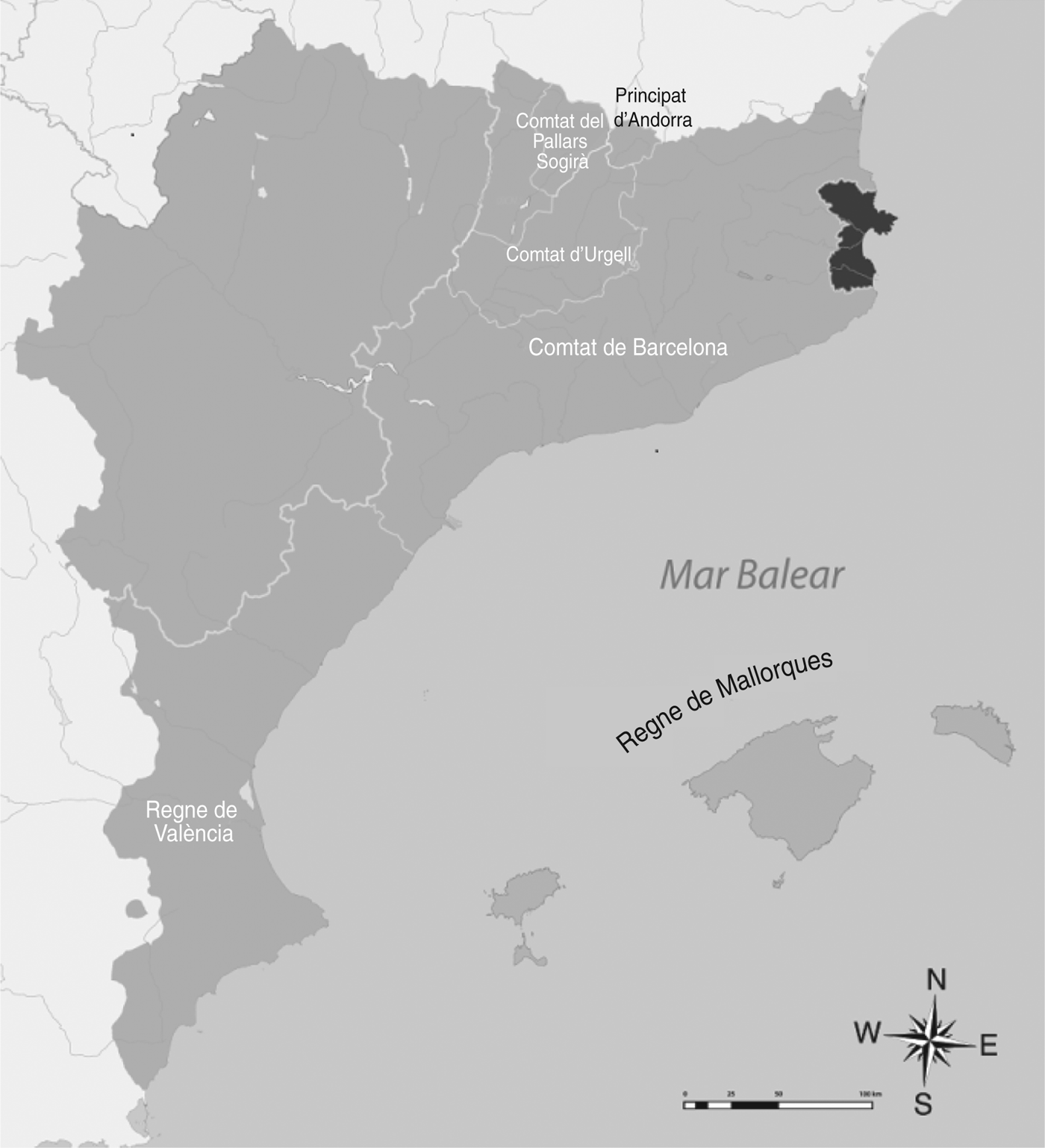
During the last two decades historiographical interest in medieval credit in the lands of the ancient Crown of Aragon has considerably increased. Thus, at the moment we have a good number of both local and regional studies of different aspects of credit networks and the people who had a role in them.Footnote 2 The aim of the present article is to study the role played by local law courts – also called bailiff's courts or jurisdictional courts – in the credit market in the southern area of the ancient county of Empúries, situated on the northeast Catalan coast (Figure 1).
The county of Empúries in the kingdom of Aragon.

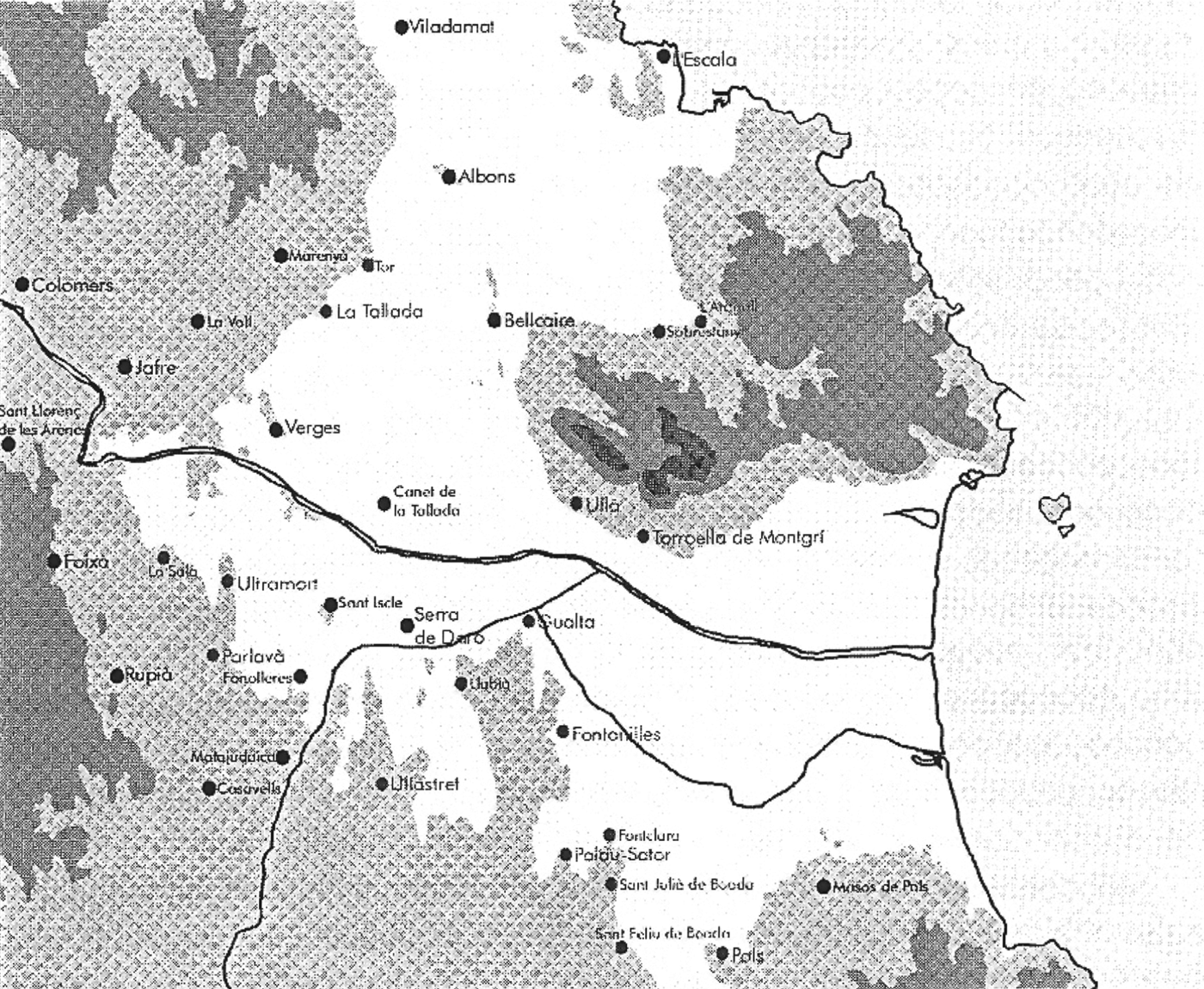
Among the Catalan counties in existence since Carolingian times, the county of Empúries was one of the last to fall within the influence of the kings of Aragon, in the fourteenth century.Footnote 3 However, the borders of the county did not remain unchanged and its area decreased as a consequence of the increasing power of both the Aragonese kings and the bishops of Girona, the main rivals of the Emporitan counts in feudal quarrels within medieval northeast Catalonia. During the last decades of the thirteenth century, the southern extreme of the county, which essentially comprises the alluvial plain of the Lower Ter around the town of Torroella de Montgrí, partially escaped from the count's rule and fell into the royal and episcopal area of influence. It is important to emphasise this change because around 1300 this zone – depicted in Figure 2 – became a puzzle of feudal and jurisdictional authority. Thus, Emporitan power remained in villages such as Verges, Sant Iscle, Ullastret and Bellcaire, the bishops of Girona asserted their influence in villages such as Ullà, Rupià, Parlavà and Ultramort, while royal power was focused on the town of Torroella de Montgrí and the village of Pals. Moreover, all these differences were exacerbated by the fact that in some villages such as Colomers, Peratallada and Gualta, jurisdictional rights were shared with other lords, usually vassals of the count, the king or the bishop. In the years 1300 to 1340 such jurisdictional fragmentation was often the reason for struggles and conflicts among different feudal lords with all the foreseeable negative effects on trade and living conditions.Footnote 4
The plain of the Lower Ter, at the southern end of the county of Empúries.
Yet in spite of these jurisdictional differences, all these territories shared a dynamic economy naturally based primarily on agriculture but also involving manufacture and trade since at least the beginning of the twelfth century. Access to the sea and the proximity of the city of Girona are essential to understanding this economic growth, as these features allowed the regular connection of this zone with the great trade and financial networks of the period. Thus the combination of its economic dynamism with its jurisdictional complexity makes the plain of the Lower Ter an extremely useful zone in which to study the role of law courts in the world of medieval credit. The research presented in this article should help us to answer the question of the degree of effectiveness of such courts in providing security both to creditors and debtors. It is surely far too simplistic to argue, as historians such as S. R. Epstein have done, that medieval institutions were generally characterised by weakness, caused in large part by juridical fragmentation, and that this had a uniformly negative impact on the economy.Footnote 5 Thus, the discussion that follows will seek to determine whether the bishop of Girona was right when in 1346, in the quotation at the opening of this article, he complained about the administration of justice in this region.
2. LOCAL LAW COURTS AND THE CREDIT MARKET
It is very important to bear in mind the existence of the different jurisdictional lords described above because, according to medieval Catalan law, jurisdictional rights allowed lords to appoint judges and notaries, and to organise their work and procedures.Footnote 6 As a whole, court procedures were fixed by the Catalan corts – or assemblies of the nobility presided over by the king – and, more generally, by Roman law, but jurisdictional lords could also regulate them, as is shown, for example, by the charters of franchises which they issued.Footnote 7 As the following paragraphs will show, in many of the villages depicted in Figure 2 it is possible to identify both law courts and notarial offices at the beginning of the fourteenth century. Thus, law courts are found in Torroella de Montgrí, Fontanilles, Ullà, Verges, Bellcaire, Rupià, Pals, Palau sa Tor, Albons, Sant Iscle, La Tallada, Serra de Daró, Fonolleres and Peratallada; and notaries worked in all these localities, but also in Ultramort, Ullastret and Foixà. This was not a static picture because some notarial offices such as that at Ultramort quickly disappeared. Moreover, not all notarial offices and law courts were fixed in one place. Some of them were itinerant and the same notaries and judges could be shared between different neighbouring localities. Thus, small villages and hamlets at the southern end of the plain shared a notary in the 1340s,Footnote 8 and it is clear that certain individual judges presided over the courts of different villages.Footnote 9
In order to understand the juridical framework of the Lower Ter plain, it is also hugely important not to forget that above all these local courts there existed a higher level of courts, those directly controlled by the main jurisdictional lords. The higher courts were the county court in Castelló d'Empúries, the episcopal court in Girona, and the royal court, also in Girona. The latter was presided over by the veguer, the highest representative of the king in the territory called the vegueria, to which all communities lying on the plain belonged. As the following discussion shows, these higher courts, and especially the episcopal court, acted like any other local court, but also had the right to hear appeals. This allowed each of these higher lords to interfere in the decisions of any court under their jurisdiction, but only those courts. At the end of this article, an example is presented of the inability of the royal officers of Torroella de Montgrí to release from prison a man from Ullà who was subject to the power of the bishop. The latter clearly stated that ‘we and the church of Girona have all civil jurisdiction, and in some instances we also have criminal jurisdiction,Footnote 10 in our village of Ullà. This is why the king, saving his honour, and his court of Torroella, cannot do or give any prorogation for the aforesaid reason to anyone from our said locality’.Footnote 11 Given these facts – three jurisdictional systems, each one with its own hierarchy of courts and each one with its area of influence – we must emphasise two essential points. First, to talk of ‘public’ and ‘private’ Catalan jurisdictions or courts in the fourteenth century is anachronistic. There were no essential differences between courts: all of them – royal, county and episcopal – were the expression of feudal power in a feudal society, and all of them – as has been shown – shared a common juridical framework.Footnote 12 Second, the precise competences of one court and those of another – for example, in whether they did or did not have full civil and criminal jurisdiction – could change over time, depending on the agreements and conflicts among jurisdictional lords.Footnote 13
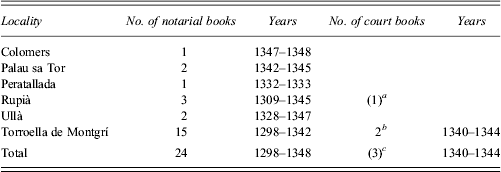
In their daily work judges were helped not only by executive officers such as bailiffsFootnote 14 and constables (sagiones), and gaolers,Footnote 15 but also by scribes and often by the notaries themselves.Footnote 16 Both notaries and judges recorded their acts in the notarial or court books, usually in Latin but increasingly in Catalan. Unfortunately, only a small proportion of all the sources that must once have existed has been preserved, now held in the historical archive of Girona (Arxiu Històric de Gerona; AHG) and in the diocesan archive of Girona of the same city (Arxiu Diocesà de Girona; ADG). The records have important gaps and vary in their contents, as Table 1 shows.
Notarial and court books relating to the plain of the Lower Ter, 1290s–1340s
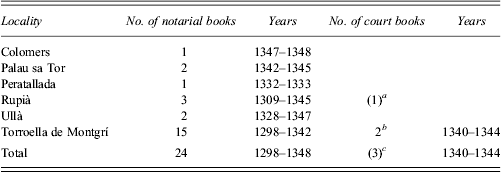
a This is not strictly a court book but some dispersed papers found inside a notarial book from Rupià.
b In fact these two court books are not exactly the same kind of source since one – of the years 1340 to 1342 – is an obligations book (this kind of register is described in the text); and the other – that of the years 1344 to 1346 – is properly a court book, that is to say the register where all court procedures were recorded.
c The papers found in the notarial book from Rupià have been included in this total, as though they were a court book.
If we bear in mind that each book contains about 300 or 400 entries/records on average, the interest of these sources is undeniable. Notwithstanding this, it is clear that the availability of the court books is very poor. Fortunately, the boundary between notarial and court records was fluid, which means that a study focused on notarial sources can still have considerable value. As some agreements recorded in the notarial books – such as grants of guardianship on the inheritances of orphans, or some purchases – required the approval of the judge, it is relatively easy to find court decisions outside the court records. Obviously, both notarial and court books do not only contain data related to the world of credit. They also provide information about several other subjects. However, it must be clearly stated that records concerning various aspects of credit use – from the contracting of debts of all sorts, to payments, cancellations, and various court procedures – were predominant in each of these sources.Footnote 17 Moreover, it is also possible to make use of the books from the episcopal chancery of Girona in which, besides many notices concerning ecclesiastical affairs there are others – often in Catalan – related to the secular administration of the bishop's feudal rights and, among these, all those involving his courts in Ullà and Rupià.Footnote 18 Consequently, and in spite of all the problems and limitations of the sources, it is possible to obtain information sufficient to build up an impression of the world of medieval credit and the role played in it by law courts in this southern corner of the Emporitan county.
3. CREDIT CONTRACTS IN THE COUNTY OF EMPÚRIES
As already noted, evidence related to credit is predominant in notarial and court sources. However, not only was there a wide range of medieval credit contracts but there were also three different ways to enter such contracts.Footnote 19 These were: first, the loan without any written contract and based upon the pledging of a good as a security; second, any sort of credit agreement before a notary made with a written record; and third, an obligation or undertaking before a court to satisfy an acknowledged debt. It is obviously not easy to identify the first kind of credit but its existence is certain. For example, when in 1333 the count of Empúries tried to control the financial activities of Jewish moneylenders, he distinguished between ‘those who lend in the county upon pledges without papers or records’ and ‘those who make loans with papers, in obligations, undertakings or other records’.Footnote 20 Credit agreements recorded in notarial books were extremely numerous and diverse. The records from any notary's office provide instances of a wide range of credit operations. These included: the basic loan in cash or agrarian foodstuffs and extended by either a Christian or a Jewish creditor; the credit sale of any thing, but especially of foodstuffs and clothes; the commanda, which was originally a sort of capital investment but quickly corrupted into a form of credit; the purchase of a future harvest, a kind of credit furiously condemned by moralists; and even the censal contract, which involved the sale of an annuity payable in cash or agricultural produce, and which was to be the leading form of credit during the following 200 years. The final way of forming a credit contract – via an undertaking before the judge – is easy to describe. The debtor obliged himself to pay the debt – incurred in a loan or credit sale – and accepted a fine in the case of default. The mechanism was simple. For example, on 6 November 1340 a weaver of Torroella de Montgrí promised before the local judge to pay within eight days to a man of the same town seven sous corresponding to the price of some looms (weaving machines) that he had bought. He accepted that the town court would receive a fine of five sous in the case of default.Footnote 21 Two days later another neighbour undertook to pay to a local Jewish moneylender 38 sous by the following June without any interest but accepting interest at the rate of 20 per cent if he was not able to repay the debt, while at the same time agreeing to a fine of 5 sous payable to the local court in the case of default.Footnote 22 Usually these obligations were recorded in special books named ‘obligations books’ such as that of the court of Torroella de Montgrí of the years 1340 to 1342, which provides many examples for this article. Such books were also kept in the villages of Ullà, Rupià and Verges, identifiable in the sources in spite of the fact that they have not survived. In 1343 the bishop of Girona himself referred to the use of such court obligations when – writing to his bailiff in the episcopal town of La BisbalFootnote 23 – he stated that ‘very often many and different people from La Bisbal and from its territory undertake in the books of our court of La Bisbal to pay certain sums of money or other things under penalty of the third, or other penalty’.Footnote 24
The boundaries between these three paths to the formation of credit contracts were not always clear. First of all, this was because the use of movable goods as pledges was usual in any sort of written agreement. When in 1341 a man and his wife of Torroella de Montgrí obliged themselves before the local court to satisfy a loan of 37 sous to a Jewish moneylender of Girona, they gave him a red cloak and a table cloth as security.Footnote 25 However, the most interesting thing is that some credit contracts were recorded both before a notary and at the law court. The quantity of such parallel recording is important. Out of 777 obligations granted before the judge of Torroella de Montgrí in the years 1340 to 1342, 426 (55 per cent) were recorded with a parallel notary document. When source survival allows, it is possible to find both types of contracts – loan or credit sale before the notary and obligation before a judge – and compare them. The basic contents are the same though the notarial books often contain a little more information. Thus, on 22 April 1341 a man from Torroella de Montgrí accepted before the local judge that he should pay a neighbour 95 sous in 3 months. On the same day the local notary recorded the same debt, but stated that the reason was the purchase of two donkeys.Footnote 26 Obviously, the key question we must try to answer is why people chose one or another form of recording credit or, indeed, both of them. The answer does not seem to be very difficult. On the one hand, to record a contract before the notary gave creditors the possibility of getting copies of their contracts – often identified in inventories – since it seems that this was not possible if the debt was recorded only before the judge.Footnote 27 The availability of such copies was not a minor matter since rights on unpaid debts were frequently sold or transferred, so the possession of credit documents could be very important.Footnote 28 Thus, it is not surprising to find large numbers of debt instrumenta – documents – amongst the goods of moneylenders.Footnote 29 On the other hand, the presence of a judge perhaps gave to the creditor an extra security in case of default so we can presume that creditors who suspected some risk in their operations were more likely to require the debtors to bind themselves before the court as well as the notary.Footnote 30 Finally, it is clear that when the amount of credit was small – that is to say less than 50 or even 30 or 20 sous – an obligation before the judge was the best and only option taken in order to avoid the expenses payable for the notary's work. We have no information on the fees paid at notaries’ offices and law courts in the Lower Ter plain but we know those of the nearby village of Palafrugell, and they show clearly the difference between the 6 or 8 diners paid when a loan or a credit sale under 100 sous was written by the notary, and the 4 diners payable to record an obligation before the judge.Footnote 31 Thus, if we look more closely at the obligations recorded before the judge of Torroella de Montgrí in the years 1340 to 1342, it is clear that the obligations without a parallel notarial contract were mostly operations involving a relatively small amount of money, 27 sous on average, in contrast to those with a parallel notary's note which involved transactions with an average value of 74 sous.Footnote 32
Yet in terms of the choices surrounding the formation of credit contracts, we must also understand why creditors and debtors chose one court rather than another in order to formalise their obligations. Again, it is possible to arrive at an answer, provided we bear in mind two key factors. The first is that significant juridical differences between all the available courts did not exist, in spite of the fact that these courts depended on different jurisdictional lords. As noted earlier, a basic legal and procedural framework was provided by Catalan legislation issued by the general assemblies in which the major jurisdictional lords took an active part. This is why differences in procedures were probably not so important as to distinguish one court from another.Footnote 33 The second key factor concerns the high degree of mobility of medieval people not only across the Lower Ter plain but also throughout the eastern part of the bishopric of Girona. This meant that both creditors and debtors could reach a wide range of courts or notarial offices to formalise their business. Thus, all systematic studies of medieval credit in this region show the wide geographical range of credit networks, especially those centred on the most important towns such as Torroella de Montgrí, Castelló d'Empúries and La Bisbal.Footnote 34 Debtors could cover distances of perhaps 20 or 30 kilometres in a day to contract a loan or a credit sale. In addition it is also clear, as will be shown further below, that borrowers did not hesitate to travel to the city of Girona, about 40 kilometres away, and also that creditors from that city – mainly Jewish moneylenders and cloth traders – went to the villages of the Lower Ter plain looking for customers. Bonanat de Llémana, a cloth trader of Girona, for example, was physically present in Ullà doing business in 1331 and in Torroella de Montgrí 13 years later in spite of the fact that he also traded in Girona.Footnote 35 All these features suggest that when residents of the Lower Ter plain were looking to make any sort of credit agreement, there were neither legal nor geographical obstacles to prevent them using whichever court or notary's office they wanted. Thus, if local options were not attractive enough, it was possible to go to the nearby towns of the region and even, somewhat further afield, to the city of Girona.
4. DELAYS AND NON-PAYMENT: THE OTHER SIDE OF CREDIT
If indebtedness was an essential feature in the lives of most Catalan families in the fourteenth century, it is important to establish whether all debts were paid according to the conditions initially agreed. In fact, both notarial and court books are full of successful debt payments. In 1322 a man of the small village of Serra de Daró paid a Jewish moneylender of Torroella de Montgrí the 200 sous owed by his wife and recorded in the local court book. In 1344 a couple from Rupià received the 30 measures of grain that a neighbour owed to them according to two obligations written in the village court book. In October 1346 a couple from Ullà paid a Jewish creditor 40 sous and made him cancel both a loan recorded in the notarial books on 7 April of that year and the corresponding obligation written in the court book of Ullà on 8 April.Footnote 36 Sometimes documents state that debts had been cancelled by degrees such as in 1344 when the agent of a Jewish widow from La Bisbal acknowledged the receipt from a widow from Rupià of the 45 sous remaining from an obligation of 80 sous recorded in the book of the court of Rupià, which was then thus declared annulled.Footnote 37
However, the same records show that other debts were paid with weeks, months or years of delay. Some of them were never repaid. The book of obligations of Torroella de Montgrí for the years 1340 to 1342 is particularly useful in this respect since it records the cancellations of debts, if satisfied, with the date and conditions of payment. On 12 March 1341, to take one example of many, a man of the village of Gualta undertook to pay 12 sous without interest to a Jewish moneylender of Torroella de Montgrí at Michaelmas (29 September), but a note at the foot of the same agreement tells us that the Jew was satisfied on 30 October, without any claim being brought to the court.Footnote 38 Thus, out of 175 obligations to Jewish moneylenders recorded in this court book during 1341, only 31 (18 per cent) were cancelled on time. The other debts were either satisfied with one degree or another of delay (68 cases, or 39 per cent), or remained unpaid (76 cases, 43 per cent).Footnote 39 Sometimes it is possible to measure the degree of delay. Of the 68 obligations repaid with delay, 38 involved a delay of less than 1 year, but in the remaining 30 cases, delay exceeded 1 year.Footnote 40 Other data tell a similar story: between the end of 1333 and August 1334, a servant of the count of Empúries recorded the delayed repayment of 206 debts owed to Jewish moneylenders from Castelló d'Empúries. In 82 instances delay ranged between 1 and 2 years, in 62 cases between 2 and 3 years, and in 60 – or a striking 29 per cent of cases – the delay exceeded 3 years.Footnote 41 Given all these examples it seems impossible not to conclude that dilatoriness and non-payment were regular features of the world of medieval credit, or, in other words, that many families remained indebted for long periods of time, which far exceeded the initial repayment terms they had agreed.
It is essential to try to understand the reaction of both debtors and creditors to this situation and, above all, how the credit market could survive, given such dilatoriness. The question is important for the present article because it relates to the issue of how far local law courts played an important role when default occurred in credit contracts. The initial response to a dilatory debtor was usually to arrive at some agreement with him. Typically, new terms of repayment were granted and old debts were consolidated in a new one. A notarial book of Torroella de Montgrí records, between March 1333 and March 1334, 21 new debt agreements granted by Jewish moneylenders because debtors were unable to pay on time which, if we bear in mind that the same book contains 154 debts owed to Jews, means nearly 14 per cent were renegotiated. Such agreements concerned all sort of debts: in 1344 an arrangement was reached between a man of Parlavà and a Jewish moneylender of Girona who agreed to cancel a total of five loans; two dating from 1339, one from 1340, one from 1342 and a final one from 1344, and ‘all court obligations’ if the debtor would pay him 170 sous; and in 1347 another Jew of Girona agreed to cancel ‘all documents and obligations’ contracted by a man of Ullà and his daughter when the girl gave him 84 sous and 4 diners ‘without any interest’.Footnote 42 Books of obligations also tell us about such agreements on unpaid debts. About 4 per cent of all obligations written in the court book of Torroella de Montgrí for the years 1340 to 1342 had to be prorogued, and, what is more interesting, others – about 6 per cent – were derived from old unpaid debts, contracted before both judges and notaries. Thus, in 1340 a man of Torroella de Montgrí undertook to pay to a Jewish moneylender of Girona 37 sous but stated that this sum corresponded to a loan of 35 sous contracted 1 year before plus a small loan of 2 sous made without any document. On the same day, another inhabitant of the town agreed to an obligation of 40 sous that derived from a loan contracted in 1336 in addition to a court obligation of that year, 1340.Footnote 43 Indirectly such agreements can also be identified in the court books of Ullà, as in 1347 when a local couple was granted a new term from a Jew of Girona concerning two unpaid debts contracted in the latter city in the years 1340 and 1344 and accepted the recording of the agreement ‘in the book of the court of Ullà’.Footnote 44 Sometimes the default of debtors even led to a second phase of renegotiation. This seems to be the case with a widow from Ullà to whom, in 1347, a Jew from Torroella de Montgrí granted a new agreement to pay the 18 sous from one obligation made before the local court into which all previous debts ‘in millet, barley, wheat and money’ had already been unified.Footnote 45 The frequency of such prorogations before the court occasioned abuses on the part of court officers who, invoking the expiration of the original terms, wanted to levy the terç fine.Footnote 46 An episcopal intervention was required in 1343 stating that ‘we order you that always where creditors grant before you prorogations to those who made obligations, we do not wish that “thirds” or obligations shall be paid by debtors, or be demanded by you’.Footnote 47
When all these measures failed to have the debts cancelled, some creditors sought an appeal against the dilatory debtors – or against their guarantors – before the courts. The first step on this path was to present a claim before the judge – a querimonia in Latin or a clam in Catalan – which specified the name of the debtor, the amount owed and sometimes the reason for the debt.Footnote 48 Some court officers neglected to write down such claims in their books and, as the bishop himself put it, ‘justice disappears and is lost for those who demand and ought to have it, and our jurisdiction is less feared and held in contempt’. To solve this, the prelate ordered the recording of ‘each and every claim and seizure’.Footnote 49 In the court book of Torroella de Montgrí for the years 1344 to 1346 more than 240 claims of this kind are recorded. A few examples will suffice to show their range: a dyer of Girona demanded 140 sous from a man of Torroella de Montgrí; a Jewish moneylender of Palau sa Tor claimed against the constable of the court because of 15 sous owed to him; a man of Castelló d'Empúries demanded the price of 20 measures of grain bought by a woman of Torroella de Montgrí; another inhabitant of Torroella de Montgrí prosecuted a woman of Girona whose father had received 120 sous from him in a commanda agreement; and a Jew from Torroella de Montgrí sued the tutor of a boy of Fontanilles for a loan recorded before the notary in 1338.Footnote 50 Such claims could be addressed against one person alone or against long lists of dilatory debtors: in 1345 a Jewish moneylender from Torroella de Montgrí brought before the local judge a claim against 15 neighbours for debts ranging from 5 to 54 sous.Footnote 51
After receiving these claims, the judge normally gave a prorogation or fadiga – usually 10 days – to allow the payment of the debt, or for some agreement between debtor and creditor to be reached. More than 100 such prorogations can be found in the court book of Torroella de Montgrí for the years 1344 to 1346. Some applied to extensive lists of dilatory debtors. In 1344, for example, following the claims of a local Jewish moneylender, a prorogation of 10 days was granted by the judge to 9 persons, both male and female, from Torroella de Montgrí and Gualta, some of whom were dilatory principal debtors, while the others were guarantors of unpaid debts.Footnote 52 After the expiration of this delay, if the creditor had still not received satisfaction, the judge proceeded to the seizure and sale of the debtor's goods. Some cases demonstrate the failure of the prorogation procedure, as when a crop of millet belonging to a man of the hamlet of l'Aragall was seized because a month had passed since he had been given two prorogations, one of 3 days for a debt of 10 measures of barley, and another of 10 days for a loan of 27 sous.Footnote 53 Where debtors had delivered to their creditors some goods as a pledge, the latter had to ask permission of the court to sell them. In 1346 the mother-in-law of a Jewish moneylender from Torroella de Montgrí announced publicly that she wanted all pledges given to her or to her son-in-law to be sold by the local court if the debtors did not redeem them within a term of 10 days.Footnote 54 On occasions pledges were described in detail. In 1346 again, 6 dilatory debtors were given 10 days to redeem – via payment of their debts – the goods they had delivered to a local Jew: a white cloth; a table cloth; a green cloth and a sword; a tunic, a white cloth, a bed sheet, a linen cloth, a measure of flax and a sword; a jerkin and a linen cloth; and, finally, another linen cloth.Footnote 55 Of course, the use of such pledges was not free of problems; in 1328 a priest of Ullà complained that he had received two stolen bedsheets as a guarantee for grain sold on credit.Footnote 56
If creditors did not possess pledges, the judge ordered the seizure of some movable goods belonging to the failed debtors. If we turn again to the court book of Torroella de Montgrí for the years 1344 to 1346, we find that out of 362 seizures of goods, 159 (44 per cent) were imposed upon various crops; 58 (16 per cent) upon debts; 53 (15 per cent) on domestic stocks of grain; and 29 (8 per cent) on furniture, wine vessels or cloth.Footnote 57 The seizure of crops had to be adapted to the agrarian cycle: sometimes the debtor was forbidden to thresh them, sometimes they were seized during threshing and in other instances the lord gave special permission to thresh, as the bishop did to a man of Parlavà in 1344.Footnote 58 Seizing goods was not without its problems, such as when a man of Torroella de Montgrí complained that the local court wanted to seize crops he had previously bought from the dilatory debtor; or when two Jewish moneylenders stated that they had rights over some crops of a failed debtor seized by the court in response to the claim of a third creditor, a man of Gualta.Footnote 59 It is also extremely interesting to see the importance of debts among seized goods because this shows us not only the widespread use of credit in medieval Catalan society, but also the fact that debts owing to debtors could also be seized by the court. Thus, in 1345, in response to a claim brought by a cloth trader from Girona against a man from Torroella de Montgrí, 32 sous owed by a neighbour to that man from Torroella de Montgrí were seized by the court.Footnote 60
It is clear that movable goods were seized first of all, and only when these were not of sufficient value to repay the debts did the seizure affect land or houses. Thus, in 1345 the bishop of Girona informed his lieutenant in Rupià that the movable goods of a local debtor were not enough to pay the 450 sous the latter owed to a Jewish moneylender but that he had offered other possessions to be auctioned. All auctions of land or houses recorded in the court book of Torroella de Montgrí during the years 1344 to 1346 were taking place due to the absence or insufficiency of movable goods to meet the debts owed.Footnote 61 This was the explanation given by the judge in 1345 to the relatives – who sued for an inheritance of 1000 sous – and the creditors – two Jewish moneylenders – of a deceased man of Sobrestany whose goods were in the hands of a curator after a decision had been made to auction all his immovable goods. In a similar fashion, a man from the same village declared himself unable to return the 100 sous received in commanda from a man of Torroella de Montgrí, and had some of his land sold by the authorities to meet the debt.Footnote 62 In one instance in 1346 the court records state explicitly that the bailiff entered the house of a debtor and ‘found no other goods’, so the judge ordered the auction of a piece of land and a vineyard.Footnote 63 In auctions issued by the court in Ullà, the procedure was the same. When, in 1345, creditors brought a claim against a man but then realised that he did not possess enough movable goods to pay what he owed, his land was auctioned and the proceeds were used to pay the plaintiffs ‘according to the contents of the court book’.Footnote 64
Thus, public auctions of goods – both movable and immovable – sometimes brought proceedings to an end. The court book of Torroella de Montgrí records 35 auctions of goods belonging to dilatory debtors between 1344 and 1346. In 1345, for example, because of the claims of a Jewish moneylender, a red cape lined with rabbit skin belonging to a woman from the village of Albons was seized and sold for 28 sous. This sum was divided into 3: 26 sous for the Jewish claimant, 1 sou for the court crier, and the remaining 1 sou for different officers of the court. In the same year, a humble dark hempen cloth, previously held by a creditor as security, was sold for the miserable amount of 9 sous.Footnote 65 It is also possible to find examples from other courts: in 1329 a cow and its calf were sold by the court of Ullà.Footnote 66 Obviously, an auction of goods could also encounter problems. For example, in 1344 a woman from Ultramort who was suing for her dowry asked the court in Rupià to auction the mas – or farmstead – of her deceased father only to realise that nobody wanted to buy it, so the judge decided to lease it to her for a term of six years; and in 1345 the court in Ullà sold some land belonging to an orphan, but the price – 165 sous – was disputed by some of the claiming creditors.Footnote 67 A further problem involved the complicity of court officers who sometimes allowed the sale of goods for a low price to the detriment of suing creditors. This happened in Ullà in 1345 when an episcopal commissioner sent an angry letter to the local bailiff stating that he and the bishop were astonished by the way in which the bailiff had managed the auction of land belonging to a local deceased man. According to the commissioner, the entire affair appeared to be full of ‘frauds and swindles’ – barats e traffegueries – so he ordered the land to be sold again, this time after the advice of two honourable people had been sought to fix a just price which finally would be delivered to the claiming creditors.Footnote 68
When debtors were so poor that they did not have any movable goods to seize, they could be imprisoned until they offered any possession to be auctioned, until some friend or relative gave guarantees sufficient to cancel their debts, or until an agreement with their creditors was reached. A 1344 letter addressed from the bishop of Girona to his bailiff in Ullà reveals partially – it was an act of grace at Easter – the procedures followed in such cases:
As we have had notice that you at the request of some Jews have imprisoned some people of Ullà for some debts and obligations, and seeing that these people do not have any movable goods with which to pay; at the request of these people and on behalf of God and the next holy Easter, we grant mercy to these imprisoned people and order that they be released. Notwithstanding, each of these people must give you sufficient guarantees that eight days after Easter he shall return to prison or reach an agreement with those who have claims against him. Despite this act of grace, we also wish you to seize any goods, both movable and immovable, of these people to be sold and auctioned in order to satisfy the creditors.Footnote 69
In fact, it seems that imprisonment was basically a measure of pressure intended perhaps to reassure suing creditors but above all to force debtors who had been sued to arrive at some arrangement with the plaintiffs or, if not, to deliver some possession to be sold.Footnote 70 Thus, in 1345 a man from Ullà acknowledged that he had been imprisoned as a guarantor of an unpaid debt to a Jewish moneylender until he delivered to the court land to be auctioned. This was then sold and the debt cancelled.Footnote 71
A final consequence that dilatoriness could have upon debtors was ecclesiastical excommunication. It seems, however, that this punishment only affected people under episcopal jurisdiction or those owing money to creditors under such jurisdiction. At least, these are the examples we have. In 1327, episcopal bailiffs reported that the prelate was disposed to absolve from excommunication a man of Parlavà if he offered some possessions to be auctioned in order to satisfy his creditor, a Jew of Girona; and in 1338 the bishop informed court officers in Verges that a neighbour had been excommunicated because of his unpaid debts owed also to a Jewish moneylender of Girona.Footnote 72 However, this procedure seems to have affected several dilatory debtors. Episcopal inquiries showed numerous people excommunicated for unpaid debts: around 1330 almost all the inhabitants from the country villages of Sant Jordi Desvalls and Vilaür suffered such punishment following their creditors’ claims.Footnote 73 Also, in some instances we find people in their testaments seeking to be exonerated from excommunication or even from being buried without ecclesiastical pardon. Thus, in 1344 a man from Ullà recognised in his will that he had been excommunicated at the request of some creditors, and in order to pay them he ordered the sale of two pieces of land and three animals along with some boxes and wine barrels; and in 1347 the widow of an excommunicated debtor from Colomers delivered a cow with its calf to the local bailiff ‘at the request of her creditors’.Footnote 74
5. THE EFFICIENCY OF LAW COURTS IN RESPONSE TO DILATORINESS
The above discussion has considered the role played by Catalan local courts within the territory of the Lower Ter plain, both with respect to the mechanisms through which parties formed and registered credit contracts – the court obligations – and to the mechanisms of contract enforcement against dilatory debtors – claims, renegotiations, seizures, imprisonment and auctions. The importance of court obligations in medieval credit networks seems to be clear, but it is also necessary to ask whether the court proceedings against dilatory debtors were effective, and whether the juridical system gave enough security to debtors and, above all, to creditors. Clearly, we must recognise that problems with the mechanisms of credit registration and enforcement did exist, and that there was a high rate of default on the part of debtors.
In spite of the apparently routine and peaceful character of all the proceedings discussed above, outbursts of rage against claimant creditors were not unknown. In 1315 the bailiff of Parlavà was accused of indifference in response to the insults received by a creditor from a local debtor; and in 1345 a widow of Torroella de Montgrí who had her crops of wheat and barley seized was threatened by the court with a fine if she insulted her creditor, a local priest.Footnote 75 It is also commonly accepted that the insults and injuries regularly suffered by Jews must be partially explained by the role of some of them as active moneylenders.Footnote 76
Some much more serious signs of inefficiency are apparent among court officers in the pursuit of dilatory debtors. Letters sent by the bishop of Girona to his local officers are very instructive on this point. In 1326 the judge of La Bisbal and the lieutenant of Rupià were threatened with excommunication after they had failed to act against a man of Rupià who owed money to a Jewish moneylender. In 1328 the bailiffs of Rupià, Parlavà and Ultramort failed to give to a draper of Girona the money they had obtained after seizing and auctioning the goods of indebted persons. Eleven years later, the bailiff of Verges also suffered excommunication because he did not pursue the debtors of a Jewish moneylender; and in 1344 the episcopal bailiff of Ullà faced exactly the same situation. Finally, in 1346 the bailiff of Ultramort was also threatened with excommunication for not having compelled a neighbour to pay debts owed to two Jewish moneylenders.Footnote 77 Sometimes it is possible to follow such failures of the court in detail, as in a 1345 case in which the episcopal lieutenant of Rupià had been excommunicated and was threatened with a fine because he had been unable, first, to bring a woman and her son to satisfy what they owed to a priest of Girona; second, to compel two neighbours to pay for cloth they had bought on credit; and, third, to force debts owed to a Jewish moneylender in Girona to be repaid.Footnote 78 On occasions it would seem that such negligence could be easily understood. In 1339, for instance, a cloth trader of Girona denounced the bailiff of Ullà because he did not wish to take action against the more than 30 people who owed the cloth trader money. In the end the bishop had to order the bailiff to do so. We know, however, that among the 30 debtors there were the notary, a local jurist and even a minor local knight.Footnote 79 In 1344 and 1345 the lieutenant of the same village neglected further claims from the cloth trader, and the bishop had to reprimand him too, and threaten him with a fine of 50 sous. Once again, the claims were addressed mainly against the local notary and his son.Footnote 80 Two months later the situation in Ullà apparently remained unaltered because the bailiff was again threatened with another fine after he continued to ignore claims from the cloth trader. The latter was now owed money by two of his neighbours, one of whom was a wealthy villager.Footnote 81 In 1345 the bailiff of the episcopal village of Ultramort was also reluctant to compel a debtor to enter the city of Girona, as his promise to a cloth trader required,Footnote 82 and the bishop had to order him to seize the debtor's goods. The debtor was a local knight.Footnote 83 Local officers could thus be forced to proceed against powerful and influential local people with whom they would have preferred to be on good terms. It is thus not surprising if procedures instigated by non-local creditors, such as Jews or cloth traders from Girona, frequently met with foot-dragging and even negligence.
Another significant problem suffered by claimant creditors was caused by the primary jurisdictional lords who – fearing social tension during periods of high prices, or needing the help of the local population during wars or political struggles – frequently granted individual or general prorogations of both terms of debts and procedures against dilatory debtors. In 1326 the bishop ordered the prorogation by some weeks of the repayment term for a loan contracted between two men from Ullà. In 1343, episcopal bailiffs received orders to stop any action for unpaid debts. Meanwhile, a man of Rupià was granted a prorogation of all his debts, and exempted from the seizure of his goods and from the payment of a fine. In the same year, the bishop acted in favour of a debtor of Ultramort because he had been forced to join the royal army and was not able to pay his debts to a Jewish moneylender. Finally, in 1347 the bailiff of Ultramort was ordered to return the cattle seized from a local widow because the bishop had granted her a prorogation.Footnote 84 The background to such measures by lords sometimes appears clear: jurisdictional lords also received agrarian rents and services from the dilatory debtors, and they did not want to threaten their own sources of income. In 1328 the bishop addressed royal officers in Torroella de Montgrí, asking them to stop a seizure of land, arguing that its tenant paid an episcopal rent and not a royal one. In 1346 the count of Empúries was requested by the bishop not to act against a man ‘considering the infertility of the soil and the usurious badness of the Jews’, because the prelate feared the man could be forced to quit his mas, which was under episcopal dominion. In the same year the bishop also asked three Jewish moneylenders of La Bisbal to grant a prorogation to a man of Rupià unable to pay his debts because he had secured them on his masada, and risked losing it.Footnote 85 Another clear example in this vein dates from 1345 when the bishop forbade the auction of a land belonging to a masada in Rupià with the argument that it would became so diminished that no man would agree to work it and the prelate would lose his rents.Footnote 86 However, on other occasions power seemed to be exercised as a form of charitable grace in favour of those debtors unable to satisfy the smallest debts, as when in 1327 the bishop ordered his bailiff in La Bisbal to stop any action against a man for the nine sous he owed; a prorogation was also granted to him. Similarly, in the same year the priest of Albons was ordered to return to a local widow the cape she had given as security.Footnote 87 Political struggles – both domestic and foreign – were also usually invoked to justify such lordly intervention. The critical phase of the war against the kingdom of Mallorca during 1343 and 1344 provides a clear example. In 1343 the bishop asked the count to prorogue debts owed to a Jew if debtors were supplying the army with foodstuffs; some weeks later a general prorogation ‘of debts and commandae’ was issued by the king to anyone joining the royal army; and in 1345 the grant was extended to those supplying the troops.Footnote 88 There are several pieces of evidence that such grants were profited from, since in the same year of 1345, 10 residents of Torroella de Montgrí presented to the court a letter issued by a royal commissioner which stated that they had provided the royal army with foodstuffs worth 200 sous, on which grounds they demanded that their debts be prorogued for two years.Footnote 89
All this evidence concerning the inefficiency of local officers, and the indulgence of jurisdictional lords, might seem to lead to the conclusion that law courts in the plain of the Lower Ter were ineffective, slow and mostly useless. Such a conclusion would support the pessimists’ point of view concerning the effectiveness of medieval institutions. However, many other pieces of evidence seem to refute such an opinion. First, we cannot have any doubt about the effectiveness of court proceedings against dilatory debtors and in favour of the creditors making claims against them, since notarial records are full of land sales ‘forced by the court’, or districtu curie in the Latin of the documents. Further examples could be added to those already presented. For instance, in 1313 a widow of Torroella de Montgrí received the price of a piece of land auctioned by the local court. In 1314 the court of the same town ‘before the claims of several creditors’ sold an entire masada in Fontanilles belonging to a woman and her son. In the next year, in the same locality, a house was sold whose tenants had not paid a dowry. In 1328 a Jewish moneylender of Torroella de Montgrí acknowledged having received from the court of Ullà 60 sous arising from the auction of a house. In 1330 the court of the same village sold a field of an indebted man ‘at the request of his creditors’. A few months later the same court sold the house of a dead man whose creditors demanded to be paid. In 1344 the lieutenant of Pals received the price of a vineyard auctioned by local court. Finally, in 1345 a man of Ullà claimed against his father-in-law in connection with the dowry of the plaintiff's wife and, because the debtor did not possess sufficient movable goods, the bailiff sold one of his vineyards and made payment to his son-in-law.Footnote 90
Second, it is also clear that on several occasions court pressure was enough to force dilatory debtors to cancel their debts or, at least, to reach to some agreement with the creditors, apparently without the loss of the debtor's goods becoming necessary. Again the footnotes written in the book of obligations of the court of Torroella de Montgrí for 1340 to 1342 are important as they make explicit the pressure of court procedures in payments or agreements. In 1341, for instance, a man of Torroella de Montgrí made an agreement with two Jewish moneylenders of Girona, father and son, concerning all his unpaid debts, just five days after the Jews had claimed before the local court. Similarly, in 1342 a man of Fontanilles and his mother were able to cancel an obligation of 70 sous contracted to a Jewish moneylender in 1341, ‘by order of the Jew because he received the money owed five days after he had claimed for it, according to the book where claims are recorded’.Footnote 91 Many other examples can be found elsewhere: in 1310 a man from Fonolleres delivered some money ‘by order of the court’ to a tavern-keeper of Rupià; in 1313 a man from Torroella de Montgrí ‘compelled by the court’ paid to a local Jewish moneylender 110 sous from a large debt of 270 sous contracted by a couple to whom he had been guarantor; in 1328 a priest from Torroella de Montgrí was paid by a man from Bellcaire to whom he had sold land, thanks to the court of Bellcaire; a few months later, the court in the little village of Sant Feliu de la Garriga compelled a man from Ullà to pay for a measure of wine bought on credit; in 1329 a man from Albons was forced by local court to repay to a canon from Ullà a loan owed since 1322; in 1330 districtu curie a man of Ullà paid a loan dating from 1323; in 1331 the guarantors of an indebted man from Ullà were forced by the local court to cancel a loan owed to a Jew from Torroella de Montgrí; in 1334 a man of Torroella de Montgrí acknowledged that he had partially satisfied a debt before a local Jew by order of the court; in 1344 a widow of Sant Feliu de Buada revealed that the court of Palau sa Tor forced her to pay 61 sous to a local tailor; and in 1346 the bishop ordered his bailiff in Ullà to give up the seizure of a piece of land if the debtors paid 400 sous and signed an agreement.Footnote 92 In the same sense, notices of indebted persons being absolved from excommunication could also indicate, even in an indirect way, the effectiveness of actions against dilatory debtors as a whole. In 1326 a priest of Verges was absolved because he had already cancelled some unpaid debts; and in 1345 a widow of Rupià agreed with a local priest that she was ready to cancel all her husband's debts because of which he had been excommunicated.Footnote 93 Certainly it can be objected that some of these court actions took place with great delay: in 1327, for example, an inhabitant of Verges ‘by order and enforcement of the court’ paid to a man 30 measures of wheat owed since 1297 by a couple to whom his father had been guarantor!Footnote 94 Such delays, however, seem to be more indicative of the internal dynamics of medieval Catalan credit, than of the efficiency of court procedures.Footnote 95
Thus, there are no serious reasons to doubt the efficiency of local courts, at least where it concerned dilatory debtors under their own jurisdiction. We might imagine that problems would arise when a debtor did not live in the village or town before whose court he was prosecuted as the latter was normally in the locality where the debt had been contracted. In such cases, communication and assistance between courts became essential to ensure the success of the enforcement system. When the court in which the claim was made and the court of the place where the debtor lived both belonged to the same jurisdiction, there were no problems. Thus, in 1345, the royal veguer of Girona made it known to the officers in Torroella de Montgrí that a group of neighbours in their town had been indebted through different court obligations and notarial loans to a Jew from Girona since 1337 and 1338, and that the Jew was now claiming against them. This communication appears to have been effective, because a few days later one of the sued debtors delivered to the court a piece of land to be auctioned.Footnote 96 This was not an isolated case. The same veguer reported that in 1338 various inhabitants of Torroella de Montgrí had undertaken before the court of Girona to pay some money to a Jewish moneylender. Now, seven years later, the Jew's widow was suing for the debts. This demand was successful too, since in a few days some of the debtors were reported to have reached to an agreement with the plaintiff.Footnote 97 It is also possible to identify a relationship between the episcopal court in Girona and the officers of local episcopal courts. In 1341 the lieutenant in Rupià was ordered to seize the goods of a local family, indebted to a Jew of Girona; in 1344, a sergeant from the episcopal court presented a letter to the bailiff or Parlavà requiring him to force a local debtor to cancel his debts; and in July 1347 the bishop sent two letters to his bailiff of Ullà: one – in Latin – to report he had granted a new term to a local man indebted to a bishop's servant, and the other – in Catalan – asking him to seize his goods.Footnote 98
When the courts involved – the claiming court, and that of the locality where the sued party lived – were subject to different jurisdictional lords, it also seems that relations between them were frequent and effective. There were, certainly, examples to the contrary; in 1326 the bishop asked the attorney general of the county of Empúries to cancel all citations issued by the court of Bellcaire regarding the people of Ullà; and in 1344 – in an example already cited – the royal attorney of Torroella de Montgrí ordered the bailiff of Ullà to free a man from this village who had been imprisoned because of his unpaid debts, but the bishop forbade his local officers to do so, arguing that jurisdiction belonged to him, not to the king.Footnote 99 Such cases do not, however, seem to have been very frequent and it is as equally possible to identify many instances of collaboration and exchange of information. Thus, in 1322 the county judge of Albons sent a letter to the royal officers of Torroella de Montgrí asking them to communicate a public announcement issued by the court of Albons notifying the sale of a masada and calling all creditors of its former tenant to present their claims. The announcement was very clear: ‘if anyone has or presumes to have any right or demand on the proceeds from the masada called d'en Bernat Pons de Nuelet, which has been sold at the request of creditors and by judicial order, he must be in Albons, either himself or his procurator, on the feast of [illegible word] about tercia hour inside the castle and before the judge, ready to show his right’.Footnote 100 In contrast, we know that in 1344 the court officers of Torroella de Montgrí seized a stock of millet from a man of the town after the county veguer of Castelló d'Empúries had informed them that he owed 40 sous to a cloth trader also from that county town.Footnote 101 The bishop – or his officers – also acted when debtors were under royal or county jurisdiction by addressing the relevant officers and asking for their intervention. Thus, in 1337 the bishop asked the county officers to prosecute a knight who had already been excommunicated because of a debt of 89 sous owed to a cloth trader of Girona; and in 1341 the court of Torroella de Montgrí forced a local man to pay his debts to two cloth traders of Girona after a request from the same prelate.Footnote 102 Furthermore, when plaintiffs claimed before the veguer court of Girona, it is also clear that royal officers did not neglect their duty. Thus, in 1346 a Jew from Girona presented to the court of Ullà a letter issued and sealed by the veguer of Girona stating that in 1339 some men subjected to the jurisdiction of Ullà had engaged themselves before the royal court in a loan of 135 sous for which the Jew was now suing.Footnote 103 Sometimes such demands from the royal veguer could be ignored by local episcopal officers, but then the bishop himself compelled them to obey the king's representative. This happened in 1345 when the prelate admonished his bailiff in Ullà: ‘as you have been requested by the aforesaid plaintiffs through a letter from the honorable veguer of Girona asking you to cause such money to be paid to the aforesaid plaintiffs. This thing you have refused to do, as people say.’Footnote 104 In this case, the procedures were effective because in a few days some men of Ullà, Torroella de Montgrí and Fontanilles ‘compelled by the court of the bishop of Girona and the court of Torroella’ were forced to pay a violari, a form of life pension, to two cloth traders of Girona and to a widow of a third, the ‘plaintiffs’ of the episcopal letter. This is a significant example of collaboration among four different courts: the two royal courts in Girona and Torroella de Montgrí, and the two episcopal courts in Girona and Ullà.Footnote 105
Apart from these telling examples, the Torroella de Montgrí court book of the years 1344 and 1346 records all letters sent and received between this court and others in which information about debtors was exchanged. It is possible to identify 40 letters whose basic geographical framework reveals the jurisdictional geography of the Lower Ter plain. Thus, from the court of Torroella de Montgrí letters were sent to the officers in Gualta (6 letters), in the county villages of Albons, Bellcaire, Empúries and La Tallada (2 letters each), in Llabià, Sant Iscle, Verges and Ullastret (1 letter each), in the episcopal village of Ullà (1 letter), in Palau sa Tor (1 letter) and, finally, to the veguer in Camprodon – an economically important town in the Pyrenees (1 letter). On the other hand, the royal officers of Torroella de Montgrí received letters from the veguer court of Girona (15 letters) and, much less importantly, from the royal court of Figueres (2 letters) and from the county court of Castelló d'Empúries and the bailiff of Fontanilles (1 letter each). Perhaps the most striking example of this collaboration between different courts – in both geographical and jurisdictional terms – comes when we find three stages of communication, as in 1344 when the bailiff of Torroella de Montgrí informed the lieutenant of Ullà that the veguer of Girona had reported about 11 men of Ullà indebted to some Jewish moneylenders of Girona.Footnote 106
Before concluding this point concerning the efficacy of local courts in the Lower Ter plain we should remember that court officers could also play two other additional roles in the mechanisms of debt satisfaction, beyond the formal – and already discussed – procedures of enforcement. Thus, on the one side judges could advise the tutors or guardians of orphans to sell at auction parts of the orphan's inheritance if creditors made a claim because of a debt owed by the child's deceased parents. There are several examples of such advice: in 1333 a tutor of a boy of Peratallada was declared to be ‘obliged to several different creditors, and not having movable goods of which such creditors could be satisfied’. With the approval of the local judge a house, two vineyards, four parcels of land, one field and other minor possessions were sold in order to satisfy the debts.Footnote 107 In contrast, it is also clear that courts could act as an official ‘board’ with which people could deposit the owed money. This does not seem to have been a very usual way to cancel debts, and we are unable to understand why it was followed, although some examples can be found, all essentially from the court book of Torroella de Montgrí for the years 1344 to 1346. Thus, in 1345 a man from Torroella de Montgrí was declared before the court to have placed ‘on the board’ the 90 sous that a neighbour had given to him to cancel a debt owed to a Jew; and in the same year a man from Fontanilles, whose goods had already been seized, agreed to pay what he owed to a Jewish moneylender from La Bisbal ‘on the local board’.Footnote 108 Sometimes it is clear that court officers acted as mediators between debtor and creditor; for example on 12 January 1346 a man from Torroella de Montgrí delivered 100 sous to the board in order to pay a creditor and cancel an obligation recorded ‘in the book of obligations of the court’, and some weeks later, on 30 March, the money was given to the debtor.Footnote 109 It was also possible that money deposited on the court board could be seized if the creditor for whom it was destined had also some unpaid debts; in 1346 a man had placed 70 sous ‘on the board’ to pay a Jew, but the cash was seized at the request of four of his neighbours, and it seems that the Jewish moneylender had to accept this.Footnote 110
6. CONCLUSIONS
The above discussion has presented a wide range of evidence relating not only to the world of medieval credit but also to the role played in it by local law courts in the different localities of the Lower Ter plain. From all of this it is possible to derive some general conclusions concerning the main question of this paper: was the juridical system in medieval Catalonia as a whole, and the local courts in particular, efficient enough to support the credit market within the region and to guarantee the transactions of all those involved in it?
First, it seems clear that the local courts had an essential role in contracts involving credit. This role was played at three levels. Through their books of obligations, the local courts provided a means of recording debts. This service was relatively inexpensive, and the presence of a judge added to the security of contracts. Most of the debts recorded in this fashion were small. The local courts also acted on occasions as a mediator in credit relationships, sometimes functioning as a ‘board’ upon which money could be deposited to cancel debts, and sometimes giving advice to indebted families about the sale of goods. Last, but not least, local courts enforced contracts against dilatory debtors through a widely known and shared range of formal legal procedures.
Second, these roles were performed with efficacy. We have no reason to doubt this with respect to the two first roles – the recording of obligations, and the mediating function – but the role of the court in enforcement demands closer analysis. Thus, there were some structural problems that on occasions could affect the efficiency of local courts. These were basically related to the feudal nature of jurisdictional power. On the one hand, there was the ambivalent attitude towards private debts sometimes shown by great feudal lords. They played simultaneous roles as lords of legal jurisdictions and as receivers of rents, which forced them to strike a balance between the interests of plaintiff creditors and their own interests in assuring the continuity of their rents. Thus, occasional examples of lords softening the enforcement procedures, through prorogations or the halting of seizures, were not accidental but a natural consequence of feudal justice. At the same time, there are examples of inefficiency among local court officers that also do not appear to have been accidental. In the hierarchical society of a medieval village, which was often based upon reciprocal favours, it was not always easy to carry out contract enforcement against a notary, or a knight or his family, and it was additionally difficult if the plaintiff was a non-resident like a Jew or a cloth trader from Girona. Perhaps surprisingly, however, the fact that jurisdiction was fragmented among at least three great lords did not seem to have caused a significant problem for the efficiency of the courts. Communication and even coordinated action between courts subject to different lords appear much more as the rule than the exception. We can be sure that if such fragmentation was a major problem, the Lower Ter plain was the ideal zone for such difficulties to emerge, given that in the first decades of the fourteenth century relations among lords here were characterised by increasing tensions.
Third, the effectiveness of local court enforcement procedures is certainly demonstrated by the dozens of auctions or payments and even agreements ‘forced by the court’ that can be found in the notarial and court books. However, the definitive demonstration of the success of the juridical system is perhaps the existence of a dynamic, complex and elaborate credit system, extending even to the last hamlet and the most humble mas of the Lower Ter plain, and adaptable to the different interests of people and to fluctuations of the economy. If there had not existed a juridical system able to offer basic guarantees both to debtors and creditors, credit networks would have remained based upon the pledging of goods as security – as they were in the eleventh and twelfth centuries – with little or no use of the written record. The success of the juridical system and common legal framework it provided is shown ultimately by the consolidation of an advanced system of credit from which everyone benefited, including the great jurisdictional lords. This was achieved in spite of jurisdictional fragmentation and the occasional weaknesses of both great lords and local officers in carrying out procedures of enforcement.
Finally, the forgoing is not intended to deny that medieval Catalan credit faced problems, among the most evident being the high rates of default and insolvency everywhere. The birth in the early 1340s of the censal contract – or the purchase of an annuity – and its immediate expansion as a basic form of credit, both public and private, was the most important and widely known response to such problems. However, it is worth stressing that the solution to problems of credit was found in the development of a new form of debt, and not in a change or even a reform of a set of juridical mechanisms that had local law courts at their core.
Thus, with seven centuries of perspective we are able to conclude by sending a reassuring message to that fourteenth-century bishop of Girona who complained that ‘justice disappears’ in his diocese: medieval Catalan justice worked reasonably well in all its procedures, but especially in those related to contracts and the credit market.