INTRODUCTION
Microsporidia are common obligatory intracellular parasites infecting a wide range of vertebrates and invertebrates (Canning, Reference Canning and Kreier1993; Wittner and Weiss, Reference Wittner and Weiss1999). They are usually pathogenic, but vary greatly in how they exploit their hosts. In particular, microsporidia are often transmitted from parents to offspring, and such vertical transmission is used either occasionally or more systematically in certain host taxa (Terry et al. Reference Terry, Smith, Sharpe, Rigaud, Littlewood, Ironside, Rollinson, Bouchon, MacNeil, Dick and Dunn2004). Vertical transmission of microsporidia relies on the parasites infecting the oocytes of female hosts. Through this transovarial transmission, they are present in host eggs before laying (Smith and Dunn, Reference Smith and Dunn1991) and, consequently, they are present in developing embryos. This transmission mode is often associated with low pathogenicity, because parasite fitness is intimately linked with that of the host (Ebert and Herre, Reference Ebert and Herre1996). Transovarially-transmitted parasites may, nevertheless, exhibit sex-specific virulence, because their fitness is dependent on female host fitness, not male (Bandi et al. Reference Bandi, Dunn, Hurst and Rigaud2001). Since males are a dead-end for parasite transmission and evolution, some microbes have evolved the ability to kill males (redirecting resources to females), or to convert males into phenotypic functional females, thereby increasing their transmission capacity (Hurst et al. Reference Hurst, Hurst, Majerus, O'Neill, Hoffmann and Werren1997; Rigaud, Reference Rigaud, O'Neill, Hoffmann and Werren1997). The result of this ‘reproductive parasitism is female-biased sex ratios associated with the infection.
Among arthropods, gammarids (Crustacea: Amphipoda) are a group in which vertically transmitted microsporidia infections are widespread (Terry et al. Reference Terry, Smith, Sharpe, Rigaud, Littlewood, Ironside, Rollinson, Bouchon, MacNeil, Dick and Dunn2004). A survey estimated that two-thirds of the species investigated are infected by members of this parasite group (Terry et al. Reference Terry, Smith, Sharpe, Rigaud, Littlewood, Ironside, Rollinson, Bouchon, MacNeil, Dick and Dunn2004), most of them exhibiting vertical transmission (Galbreath et al. Reference Galbreath, Smith, Terry, Becnel and Dunn2004; Haine et al. Reference Haine, Brondani, Hume, Perrot-Minnot, Gaillard and Rigaud2004; Terry et al. Reference Terry, Smith, Sharpe, Rigaud, Littlewood, Ironside, Rollinson, Bouchon, MacNeil, Dick and Dunn2004). A larger proportion of female than male hosts are infected by microsporidia, a phenomenon considered to result from parasite-induced sex ratio distortion (Terry et al. Reference Terry, Smith, Sharpe, Rigaud, Littlewood, Ironside, Rollinson, Bouchon, MacNeil, Dick and Dunn2004; Haine et al. Reference Haine, Brondani, Hume, Perrot-Minnot, Gaillard and Rigaud2004). However, a clear link between microsporidian infection and female-biased sex ratios in the progeny of infected females has only been demonstrated in 1 host species: Gammarus duebeni (Bulnheim, Reference Bulnheim1978; Dunn et al. Reference Dunn, Adams and Smith1993; Ironside et al. Reference Ironside, Smith, Hatcher, Sharpe, Rollinson and Dunn2003). This species is infected by at least 3 microsporidian species (Terry et al. Reference Terry, Smith, Sharpe, Rigaud, Littlewood, Ironside, Rollinson, Bouchon, MacNeil, Dick and Dunn2004), 2 of which convert putative males into functional females by feminization (Ironside et al. Reference Ironside, Smith, Hatcher, Sharpe, Rollinson and Dunn2003). However, other clear examples of host sex ratio distortion associated with microsporidia infection are still awaited in the gammarid group.
Recently, 3 vertically transmitted microsporidia were found to co-exist in populations of Gammarus roeseli (Haine et al. Reference Haine, Brondani, Hume, Perrot-Minnot, Gaillard and Rigaud2004). Several observations led us to propose that these parasites may be sex ratio distorters in this host: high vertical transmission rate associated with a deficit of parasites found in adult males, and an excess of females in host populations (Haine et al. Reference Haine, Brondani, Hume, Perrot-Minnot, Gaillard and Rigaud2004). However, a direct link between infection and female-biased sex ratios within broods is lacking, and the aim of this study was to provide such evidence. Microsporidia-induced female-biased sex ratios can be due to either male-killing (e.g. in mosquitoes, Kellen et al. Reference Kellen, Chapman, Clark and Lindegren1965), or feminization (e.g. in G. duebeni, Ironside et al. Reference Ironside, Smith, Hatcher, Sharpe, Rollinson and Dunn2003). We therefore investigated host survival during offspring development in order to discriminate between these 2 potential sources of sex ratio distortion. A comparison between sex ratio and mortality patterns in these 2 hosts, which differ phylogenetically and biogeographically (Barnard and Barnard, Reference Barnard and Barnard1983) but are infected by very closely related microsporidian species (Terry et al. Reference Terry, Smith, Sharpe, Rigaud, Littlewood, Ironside, Rollinson, Bouchon, MacNeil, Dick and Dunn2004; Haine et al. Reference Haine, Brondani, Hume, Perrot-Minnot, Gaillard and Rigaud2004), will provide useful insights into how microsporidia have evolved to exploit their hosts' reproductive systems.
MATERIALS AND METHODS
In order to maintain Gammarus roeseli offspring in the laboratory, pre-copula pairs were collected from the wild in May 2004, in the river Ouche, at Parc de la Colombière (Dijon, Côte d'Or, France). As with many gammarids, G. roeseli forms pre-copula pairs before mating, when the male guards the female for a few days before egg laying (Hynes, Reference Hynes1955). After the female moults, the eggs are laid and fertilized externally, in an incubating pouch (marsupium) where embryo development takes place. In May, some females may carry young from a previous mating in their marsupium while being in a pre-copular pair (i.e. they are close to laying a new clutch of eggs). In such cases, the young are released from the pouch before egg laying and fertilization.
In the laboratory, animals were maintained in dechlorinated, UV-treated and aerated tap water, changed automatically 6 times a day, at a temperature of 14°C±1. Of the 73 pairs collected, 40 females were carrying embryos in their marsupium and were kept for analysis. Pairs were maintained in isolation in 0·25 litre tanks, and checked daily until mating. When the young emerged, offspring were counted, separated from their mother and kept in a 0·5 litre tank (1 brood per tank). The females were allowed to lay the new clutch of eggs from which their infection status (and that of their offspring) was determined. Females that died before this laying were discarded from further analyses. The second clutch of eggs (<24 h) was removed from the brood pouch of each female (Haine et al. Reference Haine, Brondani, Hume, Perrot-Minnot, Gaillard and Rigaud2004) and fixed in absolute ethanol for DNA extraction, to test for microsporidian presence in the eggs (i.e. vertically-transmitted microsporidia), and for parasite identification. Microsporidia identification was performed using a PCR-RFLP method, following Haine et al. (Reference Haine, Brondani, Hume, Perrot-Minnot, Gaillard and Rigaud2004). Young were fed once a week with dead elm leaves and a 0·5 cm2 piece of tetramin© food, and checked monthly for survival until external sexual differentiation. Observable dead animals were removed and controlled for the absence of bacterial or pathogen infections. Sexual differentiation occurred 7 months after birth, at which point males could be distinguished from females by the gnathopods (front pair of legs) that differ between the sexes in their size and shape, a secondary sexual character typical of gammarids (Chevreux and Fage, Reference Chevreux and Fage1925). Gonadal sex was controlled by dissecting 30 randomly sampled young. The proportion of males was noted for each brood.
The size of the females (measured as the length of the fourth coxal plate, see Bollache et al. Reference Bollache, Rigaud and Cézilly2002) was taken into account as a covariable for the comparison of clutch sizes (ANCOVA analysis).
Survival was analysed according to infection status, using a Cox regression method (proportional hazards model). The ‘brood’ factor was nested within the ‘infection status’ factor to take into account the variability between broods within each infection category. The sex ratio (proportion of males) was analysed using a non-parametric Wilcoxon test. All analyses were performed using JMP© software version 5.0.1 (SAS Institute, Cary, NC, USA).
RESULTS
PCR-RFLP analysis of the eggs revealed the presence of the 3 vertically transmitted microsporidia previously found in this location (Haine et al. Reference Haine, Brondani, Hume, Perrot-Minnot, Gaillard and Rigaud2004): Nosema granulosis (12 females), Dictyocoela muelleri (6 females) and Dictyocoela sp. (roeselum) (2 females). The eggs of 11 females were uninfected, and a PCR control on these females' gonads revealed no microsporidian amplification. Due to their low numbers, the females infected by both Dictyocoela species were discarded from further analysis.
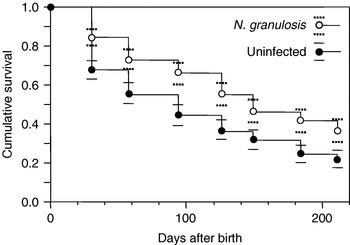
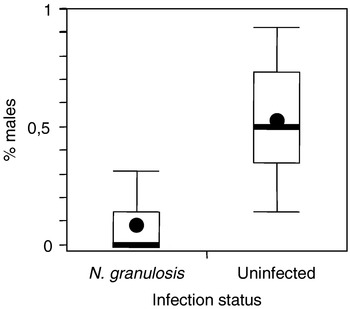
At emergence, the number of offspring per female (mean±s.e.m.) was lower in broods infected by N. granulosis (23·7±3·7; n=12) than in the uninfected ones (31·6±5·5; n=11). This difference was nevertheless non-significant (ANCOVA: Effect of infection: F1,22=2·31, P=0·14; Effect of female size: F1,22=64·16, P<0·001; Interaction infection*size: F1,22=1·80, P=0·20). Survival analysis of the 641 offspring revealed that, despite the significant variation between broods (nested term: Likelihood-Ratio χ2=91·82, P<0·0001, d.f.=21), there was a significant effect of the infection status on the survival of the young (L-R χ2=4·66, P=0·03, d.f.=1). Young in broods infected by N. granulosis showed a better survival than uninfected young (Fig. 1). All the offspring died from 1 brood of infected females and 2 broods of uninfected ones. In those where mortality was not 100%, the number of young reaching sexual maturity was 9·2±2·5 in broods infected by N. granulosis, and 8·8±1·9 in uninfected broods. In these broods there was a significant difference in sex ratio (number of males/total of surviving offspring) according to infection status (Wilcoxon test: Z=3·42, P=0·0006, 1 d.f.). Females infected by N. granulosis produced a very low proportion of males compared to uninfected females (Fig. 2). The gonadal sex was controlled for 30 randomly sampled offspring to confirm the morphological diagnosis: the 11 dissected males had testes and the 19 dissected females had ovaries.
Survival of Gammarus roeseli offspring, according to time after birth and microsporidia infection status. Number of young at birth (day 0) were 283 for females infected with N. granulosis and 358 for uninfected females. Error bars denote 95% confidence intervals.

Sex ratio (proportion of males) in broods of Gammarus roeseli, according to infection status. Dots are means, medians are thick lines across the boxes, boxes delimit the interquartiles, bars above and below the boxes are the 90th and 10th quantiles, respectively.

Since we did not control the rearing of young for density (i.e. there was 1 brood per tank, whatever the brood size), we controlled for potential correlation between brood size and the final proportion of surviving young at sexual differentiation (Spearman correlation: ρ=−0·04; P=0·82), and between survival rate and sex ratio (ρ=0·09; P=0·69).
DISCUSSION
This study revealed that infection by the microsporidian Nosema granulosis is associated with an excess of females in the broods of the amphipod Gammarus roeseli, compared with broods from uninfected females for which the sex ratio was near 1:1. This sex ratio distortion was not associated with a reduction of half in newborns, or with higher mortality in the young compared to uninfected broods, as should be observed in the case of male-killing (either early or late male-killing, Hurst et al. Reference Hurst, Hurst, Majerus, O'Neill, Hoffmann and Werren1997). Therefore, we can reject the hypothesis of male-killing to explain the deficit of males in N. granulosis infected broods. Our data provide clear evidence of a second gammarid species in which infection by N. granulosis is associated with sex ratio distortion. In another extensively studied species, Gammarus duebeni, this microsporidian induces sex ratio distortion by converting putative males into functional females, as revealed by correlative studies similar to the present one (e.g. Terry et al. Reference Terry, Smith and Dunn1998; Ironside et al. Reference Ironside, Smith, Hatcher, Sharpe, Rollinson and Dunn2003), or experimental infections (Dunn and Rigaud, Reference Dunn and Rigaud1998). Therefore, the most parsimonious hypothesis would be to consider that feminization also occurs in G. roeseli and, by generalizing the observations made in G. duebeni, our result strengthens the idea that vertically-transmitted microsporidia exploit the reproductive system of the gammarid host group, to increase the proportion of hosts of the transmitting sex (i.e. females, see Rigaud, Reference Rigaud, O'Neill, Hoffmann and Werren1997; Bandi et al. Reference Bandi, Dunn, Hurst and Rigaud2001).
Mortality in the broods was quite high, but was in accordance with survival obtained in the laboratory for G. duebeni, where the young were maintained individually in separate containers (e.g. Ironside et al. Reference Ironside, Smith, Hatcher, Sharpe, Rollinson and Dunn2003; mean mortality 0·33–0·66). In our study, we were unable to discriminate between mortality resulting from ‘natural causes’, or that resulting from cannibalism, a behaviour often seen in gammarids (see MacNeil et al. Reference MacNeil, Dick, Hatcher, Fielding, Hume and Dunn2003). However, maintaining siblings together after hatching, as opposed to isolating individuals, is probably closer to the situation in natural populations, where mortality is likely to have multi-component causes.
We found evidence for better host survival in broods from mothers infected by Nosema granulosis compared to those from uninfected mothers. To our knowledge, this is the first evidence for a positive relationship between a microsporidian infection and host survival. Most microsporidia are pathogens, inducing costs to their hosts at the level of reproduction, growth or behaviour, and some of these parasites must kill their host to fulfil their life-cycle (Wittner and Weiss, Reference Wittner and Weiss1999). In G. duebeni, N. granulosis induces a weak cost on the growth of young, but has no significant effect on host mortality or fecundity in naturally infected (Terry et al. Reference Terry, Smith and Dunn1998; Ironside et al. Reference Ironside, Smith, Hatcher, Sharpe, Rollinson and Dunn2003) and artificially infected (Dunn and Rigaud, Reference Dunn and Rigaud1998) individuals. However, in G. roeseli, a previous study showed that females infected by this parasite reproduce earlier in the reproductive season compared to uninfected females (Haine et al. Reference Haine, Brondani, Hume, Perrot-Minnot, Gaillard and Rigaud2004), and this study reveals a second potential advantage of infection by N. granulosis. The apparent differences in host fitness effects of N. granulosis on G. duebeni and G. roeseli probably arise from specific host-parasite species interactions.
In the framework of parasite transmission theory, positive effects of infection on the host are not remarkable: a vertically transmitted symbiont might be selected to provide fitness advantages to its host (e.g. Douglas, Reference Douglas1996). However, it is surprising to find a mutualistic-like interaction involving the microsporidia phylum. These eukaryotes lack mitochondria and are therefore obligate intracellular parasites, taking all their energy from the host (Wittner and Weiss, Reference Wittner and Weiss1999). They should therefore, in essence, induce a physiological cost to their hosts. In the present case, the vertically transmitted N. granulosis would be able to provide something to the host that compensates for this cost. The survival advantage associated with microsporidia infection in G. roeseli does not result in a significantly higher number of offspring reaching adulthood compared to uninfected broods. This may be due to the fact that slightly more offspring hatched from uninfected mothers (but the difference was non-significant). Better survival may therefore compensate for a slight decrease in fertility in N. granulosis infected lineages. A comparable phenomenon has already been observed in a terrestrial isopod infected by a vertically transmitted Wolbachia parasite (Rigaud et al. Reference Rigaud, Moreau and Juchault1999). Gammarus roeseli may produce better provisioned offspring in the face of parasite infection, a phenomenon demonstrated in damselflies: infected females produce fewer, larger offspring (Rolff, Reference Rolff1999). The physiological mechanisms by which N. granulosis infection increases host survival remain to be determined. However, gammarids infected by acanthocephalan parasites have increased glycogen reserves (Plaistow et al. Reference Plaistow, Troussard and Cezilly2001), and this may be a general host counter-adaptation to the metabolic load imposed by parasite infections. It is possible therefore that infected mothers produce offspring with greater reserves, which would result in greater offspring survival. Further work could determine whether there is a difference in size between offspring from infected and uninfected females during development. Alternatively, N. granulosis may protect its host from cannibalism, in a similar way to the horizontally-transmitted P. muelleri, which increases the rate of cannibalism in G. duebeni (MacNeil et al. Reference MacNeil, Dick, Hatcher, Fielding, Hume and Dunn2003).
The authors would like to thank Yannick Moret for his help in survival analysis and for discussions. This work was funded by an ATIP grant from the CNRS, and a grant from the Région Bourgogne. E. R. H. was funded by a Post-doctoral grant from the CNRS.