Health disparities research has received much attention in the past two decades.Reference Berkowitz and McCubbin 1 Variables of race, ethnicity, gender, sex, and socio-economic status have emerged as key influencers of environmental resources, relative risk, human capital, and social status.Reference Flaskerud and Winslow 2 Ethnic, racial, and socio-economic disparities exist related to the incidence and outcomes for children with CHD.Reference Knowles, Ridout and Crowe 3 – Reference Wang, Liu, Druschel and Kirby 6 Nevertheless, the extent to which these disparities affect the experience of stress for parents of children with CHD is unknown. Parents of children born with CHD experience profound stress, from the time of diagnosis, through the infant’s hospitalisation for cardiac surgery, and in the months and years that follow.Reference Lisanti, Allen, Kelly and Medoff-Cooper 7 – Reference Landolt, Ystrom, Stene-Larsen, Holmstrom and Vollrath 11 Although survival for neonatal cardiac surgery has markedly improved, children remain at risk for neurodevelopmental delay, including fine and gross motor, speech, cognitive, behavioural, and academic difficulties.Reference Wernovsky 12 Many children must return for additional surgeries or interventions throughout childhood, compounding the stress experience for parents.Reference Vrijmoet-Wiersma, Ottenkamp, van Roozendaal, Grootenhuis and Koopman 9 Although these procedures are considered either corrective or palliative, the underlying CHD leaves these children with a chronic illness. The stress of parents across the life span of the child with CHD will affect overall family functioning and the child’s home environment, influencing the neurodevelopment of the infant throughout childhood.Reference Wernovsky and Licht 13 Parental stress can also affect the parent’s own physical health, mental health, overall well-being, and quality of life.Reference Raphael, Zhang, Liu and Giardino 14 , Reference Ernst, Marino and Cassedy 15 Furthermore, studies have shown that parents of children with CHD experience more intense stress than parents of other paediatric populations, and that stress may be of particular concern when the child is <1 year of age.Reference Golfenshtein, Hanlon, Deatrick and Medoff-Cooper 10 , Reference Landolt, Ystrom, Stene-Larsen, Holmstrom and Vollrath 11 , Reference Franck, Mcquillen, Wray, Grocott and Goldman 16 – Reference Lawoko and Soares 18 This finding highlights the imperative for healthcare providers to pay focused attention to this issue and to address parental stress early and systematically. However, the question remains: do additional disparities affect parental stress and ultimately parent and child health outcomes?
Currently, no model exists describing the experience of stress for parents of children with CHD and its full impact on the family across the child’s life span. Parental stress in CHD has been studied within the context of the child’s illness, around the times of diagnosis, surgery, hospitalisation, and after discharge home.Reference Lisanti, Allen, Kelly and Medoff-Cooper 7 – Reference Vrijmoet-Wiersma, Ottenkamp, van Roozendaal, Grootenhuis and Koopman 9 , Reference Franck, Mcquillen, Wray, Grocott and Goldman 16 , Reference Lawoko and Soares 18 , Reference Doherty, McCusker and Molloy 19 Most of these studies on parental stress were framed within the context of the child’s disease and few had strong theoretical foundations. The disease-specific focus on parental stress research in CHD has not comprehensively elucidated factors related to health disparities. Although some studies in CHD acknowledge the influence of specific types of health disparity variables on parent stress, such as parental education or socio-economic status, the lack of research examining constructs within a broad parental stress framework is apparent. Studies on parental stress for parents of children with CHD have largely reported health disparity variables as incidental or secondary findings, or have included them as a covariate in their analysis and not expanded on their implications.Reference Woolf-King, Anger, Arnold, Weiss and Teitel 20 A comprehensive framework for parental stress in CHD would provide a broader lens with which to understand the full experience of stress for this population of parents.
The lack of theoretical underpinnings in parental stress research in CHD has also resulted in the use of a variety of constructs to study the stress of parents, including but not limited to parental stress, parenting stress, distress, psychological adjustment, trauma, and mental health. The transactional theory of stress originally described by Lazarus and FolkmanReference Lazarus and Folkman 21 has provided a foundation for many stress studies and frameworks for parental stress research. Lazarus and Folkman define stress as an overarching term, encompassing a stressor, or something perceived and appraised by the individual as taxing, which stimulates a stress response. Parental stress refers to any stress that is perceived by an individual while in the role of a parent for a child. Parenting stress refers to the specific stressors arising from the parenting role, whereas parental stress is more broad, encompassing all potential stress experienced by a parent. For this review, distress and psychological adjustment will be considered specific types of responses to parental stress. It is of utmost importance that research uses a theoretical foundation to define these constructs, and that variables be organised within a specific model to guide the research from conception to design and from data analysis to interpretation.
This paper will provide a brief overview of the parental stress literature addressing disparities in parents of children with CHD. Several theories and models will be presented from within the CHD literature, as well as from other paediatric populations. On the basis of the synthesis of the literature, a new comprehensive model for parental stress in CHD will be proposed. Future research and clinical implications will be discussed.
Review of literature
To date, research on parental stress in CHD has focused on the influence of the child’s severity of cardiac disease, caregiving burden, or coping to identify predictors of stress or stress response in parents. Some studies, however, have uncovered disparities that exist. As opposed to providing a systematic literature review on stress and coping of parents with CHD and their mental health outcomes, which has already been recently presented,Reference Woolf-King, Anger, Arnold, Weiss and Teitel 20 , Reference Kolaitis, Meentken and Utens 22 , Reference Jackson, Frydenberg, Liang, Higgins and Murphy 23 this review will focus on the health disparity outcomes found in the cardiac literature and compare and contrast it with parent stress literature from other populations.
Socio-economic status and social status
Education status may influence the stress of parents of children with CHD.Reference Hearps, Mc Carthy and Muscara 24 Education status has been frequently used in research as a proxy for socio-economic status and/or social status in family research.Reference Conger, Conger and Martin 25 Many studies on parents of children from various populations, such as CHD, general surgery, paediatric cancer, irritable bowel syndrome, and trauma, have found that education status influences stress for parents, with lower education associated with an increased risk for stress and post-traumatic stress symptoms.Reference Raphael, Zhang, Liu and Giardino 14 , Reference Scrimin, Haynes, Alto, Bornstein and Axia 26 – Reference Sturms, van der Sluis, Stewart, Groothoff, ten Duis and Eisma 31 Mothers with higher education who had infants in neonatal intensive care were shown in one study to experience significantly higher stress response, as measured by state anxiety.Reference Shields-Poe and Pinelli 32 This was also found to be true in one study from the cardiac population that examined mothers of children with CHD.Reference Davis, Brown, Bakeman and Campbell 33 More research is needed to determine the influence of education on parental stress.
Other measures of socio-economic status including income and occupation have been shown to influence parental stress. Parents with low income or financial difficulty experience an increase in both perceived stress, chronic stress, and stress response.Reference Sturms, van der Sluis, Stewart, Groothoff, ten Duis and Eisma 31 , Reference Dunkel Schetter, Schafer and Lanzi 34 , Reference Yildiz, Celebioglu and Olgun 35 The financial burden arising from the child’s chronic illness has been noted in cardiac and non-cardiac populations.Reference Bonis 36 , Reference Lisanti, Golfenshtein and Medoff-Cooper 37 Spijkerboer et al38 found that low socio-economic status classified by occupation type influenced greater psychologic distress in parents of children treated for CHD. Lower scores on mental well-being, as measured by the General Health Questionnaire, were found to be significantly correlated with poverty in parents with a child undergoing cardiac surgery.Reference Lopez, Frangini and Ramirez 39 Another study examined parental stress levels in a paediatric cardiac ICU and step-down unit and found that parental stress scores were negatively correlated with poverty level and that foreign-born mothers had significantly higher stress during their child’s hospitalisation.Reference Franck, Mcquillen, Wray, Grocott and Goldman 16 They concluded that poverty, place of birth, and citizenship may all play a role in predicting parental stress levels. Other studies in both cardiac and non-cardiac populations have also proposed that foreign-born parents or immigrants experience lower social status than parents living in their place of birth. These studies have shown that parents with this particular vulnerability are at risk for higher stress symptoms.Reference Vrijmoet-Wiersma, Ottenkamp, van Roozendaal, Grootenhuis and Koopman 9 , Reference Raphael, Zhang, Liu and Giardino 14 , Reference Norberg, Lindblad and Boman 27 , Reference Dunkel Schetter, Schafer and Lanzi 34 , Reference Helfricht, Latal, Fischer, Tomaske and Landolt 40
Sex
Fathers are often overlooked in maternal and child health research;Reference Dunkel Schetter, Schafer and Lanzi 34 however, the role of the father for child well-being should not be ignored. Studies from community samples confirm that the mental health of fathers influences the child’s behavioural and emotional development, as well as later psychopathology, independent of the mother’s mental health.Reference Ramchandani, Stein, Evans and O’Connor 41 , Reference Ramchandani, Stein, O’Connor, Heron, Murray and Evans 42 Unfortunately, much research on parental stress has focused on mothers, yet studies including fathers have found differences. Studies on parental stress in both cardiac and non-cardiac populations have shown that mothers and fathers perceive stress and react to stressors differently.Reference Scrimin, Haynes, Alto, Bornstein and Axia 26 , Reference Shields-Poe and Pinelli 32 , Reference Lisanti, Golfenshtein and Medoff-Cooper 37 , Reference Pinelli, Saigal and Bill Wu 43 – Reference Pinto, Weng and Sheng 49 The majority of research has shown that mothers score significantly higher on stress and anxiety measures.Reference Vrijmoet-Wiersma, Ottenkamp, van Roozendaal, Grootenhuis and Koopman 9 , Reference Dudek-Shriber 17 , Reference Scrimin, Haynes, Alto, Bornstein and Axia 26 , Reference Shaw, Deblois, Ikuta, Ginzburg, Fleisher and Koopman 46 For parents of children with CHD, mothers have been shown to have significantly higher distress, anxiety, depression, and somatisation compared with fathers.Reference Vrijmoet-Wiersma, Ottenkamp, van Roozendaal, Grootenhuis and Koopman 9 , Reference Lawoko and Soares 18 , Reference Pinto, Weng and Sheng 49 – Reference Bevilacqua, Palatta and Mirante 52 Mothers and fathers have also been shown to use different coping mechanisms to adjust to stressors as parents of children with CHD.Reference Doherty, McCusker and Molloy 19 , Reference Jackson, Frydenberg, Liang, Higgins and Murphy 23 Furthermore, the literature is replete with examples of how sex differences exist in the physiology of the stress response between men and women across the life span.Reference Carpenter, Grecian and Reynolds 53 – Reference Andiarena, Balluerka, Murcia, Ibarluzea, Glover and Vegas 58 Owing to these clear differences, it is important to consider sex as a biomarker in research on parental stress.
Most research on parental stress tends to only include mothers or have increased participation by mothers, creating a bias in the sample.Reference Lisanti, Allen, Kelly and Medoff-Cooper 7 , Reference Woolf-King, Anger, Arnold, Weiss and Teitel 20 , Reference Golfenshtein, Srulovici and Medoff-Cooper 59 This may create an unfortunate disparity in the literature and potential bias of interpretation on the experience of parental stress for fathers. In addition, no research has been published that specifically addresses parental stress in CHD for same-sex couples, adoptive parents, or single parents. It has been shown in community samples that single parents living alone are at higher risk, bearing a greater burden of stress,Reference Anderson 29 , Reference Franck, Wray, Gay, Dearmun, Lee and Cooper 60 and that love between partners, regardless of sexual orientation, can mediate parental stress.Reference Raphael, Zhang, Liu and Giardino 14 , Reference Goldberg and Smith 61 Furthermore, cohabitation seems particularly important.Reference Dunkel Schetter, Schafer and Lanzi 34 One study concluded that cohabitation with a partner was “a major determinant of stress during pregnancy and the year following birth for parents, especially for mothers. What mattered most in this sample was living together at the time of birth, not whether the couple was legally married at that time”Reference Dunkel Schetter, Schafer and Lanzi 34 (p. 623).
Additional health disparity variables
Several variables were not identified in the cardiac literature, but should be considered when examining health disparities, including race, language barriers, physical health, stigma, and social capital. General population studies on parenting stress have found an increased risk of high stress in parents who are Black, Hispanic, or non-English speaking.Reference Raphael, Zhang, Liu and Giardino 14 , Reference Dunkel Schetter, Schafer and Lanzi 34 Unfortunately, most research on parental stress in CHD has been conducted with mainly White samples or have not reported race as a demographic variable.Reference Lisanti, Allen, Kelly and Medoff-Cooper 7 , Reference Franck, Mcquillen, Wray, Grocott and Goldman 16 , Reference Hearps, Mc Carthy and Muscara 24 , Reference Lisanti, Golfenshtein and Medoff-Cooper 37 , Reference Wray and Sensky 47 , Reference Franich-Ray, Bright and Anderson 51 , Reference Menahem, Poulakis and Prior 62 – Reference Caris, Dempster and Wernovsky 69 In addition, study design for parental stress in CHD research in the United States of America, United Kingdom, Canada, and Australia often limits inclusion criteria to patients who have the ability to read or write English, or the authors do not mention translation of research instruments.Reference Lisanti, Allen, Kelly and Medoff-Cooper 7 , Reference Hearps, Mc Carthy and Muscara 24 , Reference Lisanti, Golfenshtein and Medoff-Cooper 37 , Reference Wray and Sensky 47 , Reference Franich-Ray, Bright and Anderson 51 , Reference Menahem, Poulakis and Prior 62 – Reference Jordan, Franich-Ray and Albert 65 , Reference Uzark and Jones 67 , Reference Brosig, Whitstone, Frommelt, Frisbee and Leuthner 68 , Reference Kosta, Harms and Franich-Ray 70 Furthermore, a parent’s own health or special needs status can exacerbate the parental stress experience for parents.Reference Raphael, Zhang, Liu and Giardino 14 Mothers of infants with CHD are especially vulnerable after giving birth and recovering from a vaginal delivery or Caesarean section.Reference Lisanti, Golfenshtein and Medoff-Cooper 37 Stress arises when parents are not well, in pain, or limited in their ability to care for their child. Additional consideration can be given to the stress occurring from stigma associated with certain health issues such as obesity, diabetes, and even stress and mental health itself.Reference Schabert, Browne, Mosely and Speight 71 – Reference Puhl and Heuer 73 Stigma can also be experienced by parents for a variety of reasons based on race, gender, and sexual identity, among others, and has been shown to greatly contribute to stress and affect health.Reference Clair, Daniel and Lamont 72 , Reference Hatzenbuehler, Phelan and Link 74 , Reference Schomerus, Schwahn and Holzinger 75 Finally, social capital, defined as social cohesion and community networks, is emerging as a variable contributing to health and mental health outcomes in disparities research.Reference Whitley and McKenzie 76 , Reference Murayama, Fujiwara and Kawachi 77 Although few studies have examined its influence on parent stress, one study in Vietnam has demonstrated the influence of social capital on the distress of mothers who have children with disabilities.Reference Thuy and Berry 78
Review of theoretical frameworks on parental stress
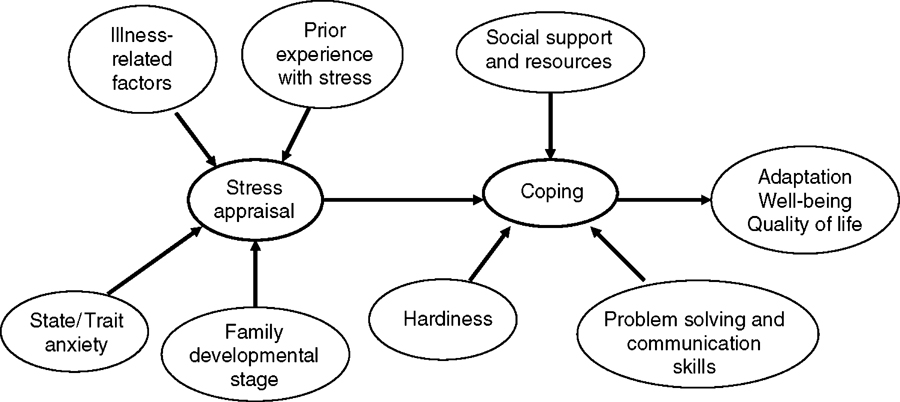
In 2006, Mussato provided a review of literature in Cardiology in the Young on theoretical frameworks on child and family adaptation and illness.Reference Mussatto 79 In her review, she highlighted constructs integral to the adjustment of families with a child who has a chronic illness and proposed an adapted framework (Fig 1). Mussato posited that earlier experience with stress, the child’s illness-related factors, anxiety, and family developmental stage would all influence the parents’ perception of the initial stress of the child’s diagnosis with a chronic illness. In addition, she proposed that the ability of the parents to cope with the stress of the child’s chronic illness is affected by their social support and resources, hardiness, problem-solving, and communication skills.
Adaptation by the family to chronic illness in their child. Reprinted with permission.

Mussato’s model includes essential components influencing the stress experience for parents of children with CHD, such as stress appraisal, coping, and adaptation, mirroring similar frameworks cited in the literature, including Thompson’s Transactional Stress and Coping model of adjustment to chronic illnessReference Thompson 80 and McCubbin and Patterson’s Double ABCX Model of Adjustment and Adaptation.Reference McCubbin and Patterson 81 She also highlighted the importance of social support on parent and child well-being, which has been proposed and validated by other frameworks, such as the Family Stress Model.Reference McConnell, Breitkreuz and Savage 30 However, from a broader perspective, none of the constructs directly address issues regarding health disparities. Some, however, can be inferred. Earlier experience with stress, for example, is important when considering how individuals perceive stress, cope, and react to stress, which in turn can influence long-term physical and mental health outcomes. Prior stress, when chronic, has been referred to in the literature as allostatic load, which occurs when physiologic systems adapting to stress are overworked, do not shut off after a stressful event, or under-respond to stress causing other systems to overwork.Reference McEwen 82 Similar to Lazarus and Folkman’s definition of stress in which a stressor elicits a stress response,Reference Lazarus and Folkman 21 the allostatic load model proposes that:
“the perception of threat and mobilization of these allostatic mechanisms are fundamentally shaped by individual differences in constitutional (genetics, development, experience), behavioral (coping and health habits), and historical (trauma/abuse, major life events, stressful environments) factors that ultimately determine one’s resiliency to stress”Reference Juster, McEwen and Lupien 83 (p. 3).
Studies have shown the physical and biopsychosocial impact of allostatic load across the life span.Reference Juster, McEwen and Lupien 83 The accumulation of allostatic load can overexpose the body to pro-inflammatory mediators of stress, resulting in adverse effects on body organs and systems, ultimately leading to disease onset and/or progression.Reference McEwen 84 Both acute stress and chronic stress can contribute to allostatic load. What is wholly unknown is the impact of past chronic stress on parental stress and on parent and child health outcomes in CHD. Furthermore, parental stress in CHD could perhaps be considered its own form of chronic stress, contributing to the allostatic load on parents. Consideration for both acute and chronic stress is paramount in the examination of allostatic load, the overall stress experience, and its impact on parent health and well-being.
Examining both chronic and acute stress for parents of children with CHD will also elucidate important health disparity variables affecting overall stress and allostatic load.Reference Dunkel Schetter, Schafer and Lanzi 34 Chronic stress is a wide category of stressors defined as the “ongoing demands that threaten to exceed the resources of an individual in areas of life such as family, marriage, parenting, work, health, housing, and finances” Reference Dunkel Schetter, Schafer and Lanzi 34 (p. 616). Chronic stressors are more prevalent for parents of racial/ethnic minorities, who tend to live in more impoverished settings with crime, pollution, and fewer resources.Reference Dunkel Schetter, Schafer and Lanzi 34 Acute stressors are those conditions or events that occur with a clear beginning and ending, such as the death of a loved one, divorce, injury, or a catastrophic event. Within the context of CHD, the child’s diagnosis and day of surgery could be considered acute stressors for parents, but parents are not isolated from exposure to other acute stressors as well. The examination of different forms of stress can more fully describe the influences of stress on parent health disparities.Reference Dunkel Schetter, Schafer and Lanzi 34 These forms include financial stress, pregnancy stress, life events, chronic life stress, perceived stress, interpersonal violence, perceived racism, and parenting stress. A more accurate conceptualisation of parental stress in CHD must include all of these forms of stress that individuals can experience while in the role of a parent for a child born with CHD.
Another model worth review is The Preconception Stress and Resiliency Pathways Model, which was developed through an interdisciplinary initiative of the National Institutes of Health and the National Institute of Child Health and Human Development to address health disparities in pregnancy and child developmental outcomes.Reference Ramey, Schafer and DeClerque 85 Major elements within the model include the:
“centrality of the preconception/inter-conception period, role of fathers and the parental relationship, maternal allostatic load (a composite biomarker index of cumulative wear-and-tear of stress), resilience resources of parents, and local neighborhood and community level influences (e.g. employment, housing, education, health care, and stability of basic necessities)”Reference Ramey, Schafer and DeClerque 85 (p. 707).
The model also highlights the inextricable link between parent stress and parent mental health with child neurodevelopment, health, and behaviour outcomes. For parents of children with CHD, this link cannot be understated, yet remains under-researched. However, there is growing recognition to explore parental stress and its influence on child development in CHD.Reference Wernovsky and Licht 13
Finally, The Preconception Stress and Resiliency Pathways Model addresses an important concept related to stress: resilience. Historically, resilience has been defined in varying ways, as a response to stress, a final outcome, a protective factor, or as a return to baseline after a stress-inducing experience.Reference Dunkel Schetter and Dolbier 86 Scholars who seek to apply resilience to chronic stress have criticised these definitions of resilience and argue that a more broad conceptualisation is needed. More recently, resilience has been defined as “a state of adaptation to a lifetime of stress and strain”(p. 13).Reference Juster, McEwen and Lupien 83 The Preconception Stress and Resiliency Pathways Model defines the concept as an overarching process and capacity of an individual, not an isolated factor or outcome, using resilience resources such as perceived social support, spirituality and religious practices, cognitive and coping skills, and tangible resources to resist the effects of long-term stress.Reference Dunkel Schetter and Dolbier 86 Resilience is then a “process involving an ability to withstand and cope with ongoing or repeated demands and maintain healthy functioning in different domains of life such as work and family”Reference Dunkel Schetter and Dolbier 86 (p.637). Within the context of parental stress in CHD, resilience can be defined similarly as the process and capacity of individuals to positively adapt and cope to stressors while in the role of parent for a child with CHD. This process of resilience will influence the stress response of the parent and the overall health and well-being of the parent and child.
Revised conceptual model
Using the themes and constructs from the theoretical models reviewed above, as well as synthesis of literature from the paediatric cardiac population, community samples, other paediatric populations, and vulnerable populations, a new conceptual model, the Parental Stress and Resilience in CHD Model, was created to provide a comprehensive perspective on parental stress (Fig 2). This new model will provide a broader lens through which researchers and clinicians can examine and support parental stress in CHD. A more comprehensive understanding of parental stress through this model will help to identify health disparity variables influencing parental stress and inform the development of interventions to support all parents and their children with CHD.
Parent Stress and Resilience in CHD Model.

The Parent Stress and Resilience in CHD Model acknowledges that prenatal factors occurring in the preconception period will have a life-long impact on the parent, as well as on the child with CHD.Reference Ramey, Schafer and DeClerque 85 Evidence is growing suggesting that the biologic stress response of mothers, specifically that of the hypothalamic–pituitary–adrenal axis dysregulation, before and during pregnancy, can have profound impact on the future mental and physical health of the mother’s offspring.Reference Dunkel Schetter, Schafer and Lanzi 34 , Reference Ramey, Schafer and DeClerque 85 , Reference Kim, Bale and Epperson 87 Past chronic stress from poverty, racism, residential segregation, community violence, and stigma will also contribute to the biologic impact of stress on the mother and child in utero.Reference Dunkel Schetter, Schafer and Lanzi 34 , Reference Hatzenbuehler, Phelan and Link 74 , Reference Ramey, Schafer and DeClerque 85 , Reference Gee and Payne-Sturges 88 In addition, this model posits that both acute and chronic stressorsReference Dunkel Schetter, Schafer and Lanzi 34 arise from three categoriesReference Lisanti, Allen, Kelly and Medoff-Cooper 7 , Reference Lisanti, Golfenshtein and Medoff-Cooper 37 : infant/child with CHD, environment, and parent.Reference Lisanti, Allen, Kelly and Medoff-Cooper 7 , Reference Lisanti, Golfenshtein and Medoff-Cooper 37 Child-related factors include the child’s gestational age at birth,Reference Kaugars, Shields and Brosig 89 current age,Reference Franck, Mcquillen, Wray, Grocott and Goldman 16 , Reference Anderson 29 illness-related factorsReference Vrijmoet-Wiersma, Ottenkamp, van Roozendaal, Grootenhuis and Koopman 9 , Reference Landolt, Ystrom, Stene-Larsen, Holmstrom and Vollrath 11 , Reference Franck, Wray, Gay, Dearmun, Lee and Cooper 60 , Reference Majnemer, Limperopoulos, Shevell, Rohlicek, Rosenblatt and Tchervenkov 66 , Reference Brosig, Whitstone, Frommelt, Frisbee and Leuthner 68 , Reference Kaugars, Shields and Brosig 89 – Reference Koehler, Fagnano, Montes and Halterman 91 – such as severity of illness, length of hospitalisation, developmental delay, other genetic issues – length of hospitalisation after cardiac surgery,Reference Franck, Wray, Gay, Dearmun, Lee and Cooper 60 child temperament and behaviour,Reference Golfenshtein, Hanlon, Deatrick and Medoff-Cooper 10 , Reference Torowicz, Irving, Sumpter and Medoff-Cooper 64 , Reference Majnemer, Limperopoulos, Shevell, Rohlicek, Rosenblatt and Tchervenkov 66 and caregiving burden.Reference Lawoko and Soares 18 , Reference Solberg, Dale, Holmstrom, Eskedal, Landolt and Vollrath 92 – Reference Lawoko and Soares 94 Environmental stressors can occur from the home environmentReference Ramey, Schafer and DeClerque 85 , such as family functioningReference Jackson, Frydenberg, Liang, Higgins and Murphy 23 , number of childrenReference Lisanti, Allen, Kelly and Medoff-Cooper 7 , and the parent partner/marital relationship.Reference Ramey, Schafer and DeClerque 85 Neighbourhoods or communities with violence, crime, poor resources, and pollution generate an added challenge for parents.Reference Gee and Payne-Sturges 88 Parents living in neighbourhoods located a far distance from a children’s hospital or who have poor access to care may also experience greater stress.Reference Lisanti, Golfenshtein and Medoff-Cooper 37 In addition, social stigma experienced by parents in their environment, as well as social capital, will influence parent stress and overall health.Reference Hatzenbuehler, Phelan and Link 74 , Reference Murayama, Fujiwara and Kawachi 77 , Reference Thuy and Berry 78 Stressors arising from the parent include a myriad of personal factors including age,Reference Turan, Basbakkal and Ozbek 95 sex,Reference Utens, Versluis-Den Bieman, Verhulst, Witsenburg, Bogers and Hess 50 , Reference Bevilacqua, Palatta and Mirante 52 , Reference Vander Haegen and Luminet 96 race and ethnicity,Reference Raphael, Zhang, Liu and Giardino 14 , Reference Dunkel Schetter, Schafer and Lanzi 34 trait anxiety,Reference Lisanti, Allen, Kelly and Medoff-Cooper 7 , Reference Vander Haegen and Luminet 96 personality,Reference Lisanti, Golfenshtein and Medoff-Cooper 37 worry,Reference Majnemer, Limperopoulos, Shevell, Rohlicek, Rosenblatt and Tchervenkov 66 and uncertainty of illness.Reference Franck, Wray, Gay, Dearmun, Lee and Cooper 60 , Reference Re, Dean and Menahem 97 The parent’s socio-economic status and social status,Reference Lawoko and Soares 18 , Reference Hearps, Mc Carthy and Muscara 24 , Reference McConnell, Breitkreuz and Savage 30 , Reference Vander Haegen and Luminet 96 , Reference Lawoko and Soares 98 any past or current life stress or life events,Reference Turan, Basbakkal and Ozbek 95 and the parent’s own healthReference Anderson 29 contribute to the stress faced by parents. In addition, the perception of the child’s severity of illnessReference Lisanti, Golfenshtein and Medoff-Cooper 37 , Reference Caris, Dempster and Wernovsky 69 and the parent’s knowledge or lack of knowledge about the child’s health and CHDReference Ahn, Lee and Choi 99 , Reference Lee, Yoo and Yoo 100 influence parental stress. Finally, parental role,Reference Lisanti, Allen, Kelly and Medoff-Cooper 7 parenting,Reference Golfenshtein, Hanlon, Deatrick and Medoff-Cooper 10 and attachment/bondingReference Anderson, Riesch, Pridham, Lutz and Becker 101 affect the stress experience for parents.
Coping,Reference Shaw, Deblois, Ikuta, Ginzburg, Fleisher and Koopman 46 , Reference Franck, Wray, Gay, Dearmun, Lee and Cooper 60 , Reference Re, Dean and Menahem 97 social support,Reference Lawoko and Soares 18 , Reference Scrimin, Haynes, Alto, Bornstein and Axia 26 , Reference McConnell, Breitkreuz and Savage 30 , Reference Tak and McCubbin 44 , Reference Shaw, Deblois, Ikuta, Ginzburg, Fleisher and Koopman 46 , Reference Visconti, Saudino, Rappaport, Newburger and Bellinger 63 , Reference Vander Haegen and Luminet 96 , Reference Stremler, Haddad, Pullenayegum and Parshuram 102 , Reference Bruce, Lilja and Sundin 103 caregiving self-efficacy,Reference Harper, Peterson and Uphold 104 locus of control,Reference Scrimin, Haynes, Alto, Bornstein and Axia 26 and other resilience resourcesReference Ramey, Schafer and DeClerque 85 , Reference Dunkel Schetter and Dolbier 86 , such as spiritual and religious practices and beliefs,Reference Kosta, Harms and Franich-Ray 70 , Reference Ahn, Lee and Choi 99 financial and tangible resources, and support from health professionalsReference Kosta, Harms and Franich-Ray 70 , Reference Re, Dean and Menahem 97 , mediate between the perception of stressors and stress response for the parent of a child with CHD. Both psychologic and physiologic forms of stress response can occur.Reference Lisanti, Allen, Kelly and Medoff-Cooper 7 , Reference Lisanti, Golfenshtein and Medoff-Cooper 37 Psychologic forms of stress response manifest as feelings of anxiety,Reference Lisanti, Allen, Kelly and Medoff-Cooper 7 depression,Reference Solberg, Gronning Dale, Holmstrom, Eskedal, Landolt and Vollrath 93 and/or hopelessness,Reference Lawoko and Soares 98 as well as clinical symptoms of acute stress disorder,Reference Shaw, Deblois, Ikuta, Ginzburg, Fleisher and Koopman 46 , Reference Franich-Ray, Bright and Anderson 51 post-traumatic stress symptoms,Reference Franck, Wray, Gay, Dearmun, Lee and Cooper 60 or post-traumatic stress disorderReference Helfricht, Latal, Fischer, Tomaske and Landolt 40 in some. Physiologic stress responses include parent biomarkers,Reference Ramey, Schafer and DeClerque 85 somatisation,Reference Lawoko and Soares 18 and allostatic load.Reference Dunkel Schetter, Schafer and Lanzi 34 , Reference McEwen 82 , Reference Ramey, Schafer and DeClerque 85
Over time, the cumulative impact of the stress/coping/response cycle in parents and the process of resilience will influence parental mental and physical health,Reference Ramey, Schafer and DeClerque 85 behaviour,Reference Ramey, Schafer and DeClerque 85 parenting,Reference Hearps, Mc Carthy and Muscara 24 well-being,Reference Streisand, Mackey and Herge 105 health care utilisation,Reference Raphael, Zhang, Liu and Giardino 14 quality of life,Reference Ernst, Marino and Cassedy 15 , Reference Caris, Dempster and Wernovsky 69 , Reference Kaugars, Shields and Brosig 89 and adjustment.Reference Ernst, Marino and Cassedy 15 , Reference Hearps, Mc Carthy and Muscara 24 Parents may also experience post-traumatic growth, a positive change through the process of resilience that includes improved self-perception, self-esteem, confidence, and personal power, increased compassion and authenticity with others, and an enhanced philosophy of life that brings meaning and maturity from past difficult circumstances.Reference Aftyka, Rozalska-Walaszek, Rosa, Rybojad and Karakula-Juchnowicz 106 These parental outcomes will ultimately influence the child’s mental and physical health,Reference Dawson, Ashman and Carver 107 behaviour and neurodevelopment,Reference Landolt, Ystrom, Stene-Larsen, Holmstrom and Vollrath 11 , Reference McCusker, Doherty and Molloy 108 and quality of life.Reference Ernst, Marino and Cassedy 15
Implications
The newly created Parental Stress and Resilience in CHD Model will provide a helpful foundation for clinicians and researchers to create interventions to reduce stress and the subsequent impact of stress for parents of children with CHD and improve overall family well-being, quality of life, and child development. The model reveals that a one-size-fits-all approach will not be successful in adequately addressing the many facets influencing the stress experience to support the process of resilience for parents of children with CHD. However, there are interventions that all centres caring for children with CHD and their parents should implement as a standard of care.
First, substantial evidence exists that the support of parental and child mental health should become a priority for the care of patients with CHD and their families. Interdisciplinary teams should address this priority in all centres caring for patients with CHD and should include mental health professionals such as psychologists. Mental health screening for issues of stress, anxiety, and depression need to be initiated for parents at diagnosisReference Pinto, Weng and Sheng 49 and during the child’s hospital stay for cardiac surgery.Reference Hearps, Mc Carthy and Muscara 24 , Reference Hynan, Steinberg and Baker 109 Early and regular screening for mental health problems should continue at outpatient clinic visits throughout the child’s 1st year of life.Reference Kolaitis, Meentken and Utens 22 Routine screening for mental health problems will assist healthcare providers in identifying parents who need early psychological support by social work or psychology. In addition, routine screening should include assessment of social risk, prior trauma, and other risk factors for parental stress and negative mental health outcomes identified by the Parental Stress and Resilience in CHD Model. Until routine screening becomes the standard of care for all centres, it will be difficult for centres to systematically address the specific needs regarding health disparities of parents and their children with CHD.
Psychological support interventions have been proposed and studied in parents of children with CHD. Prenatal counselling and support can reduce anxiety, especially for fathers.Reference Pinto, Weng and Sheng 49 In-hospital preoperative education also reduces anxiety for parents whose child is undergoing cardiac surgery.Reference Simeone, Pucciarelli and Perrone 110 Psychoeducation tailored to parents of infants with CHD that includes coaching for improved coping abilities, caregiving self-efficacy, and parenting skills, such as reading the infant cues and activities to promote development, has also shown promise.Reference McCusker, Doherty and Molloy 111 Most recently, mindful meditation has been proposed as a potential strategy for coping while the child is in the hospital for cardiac surgery.Reference Golfenshtein, Deatrick, Lisanti and Medoff-Cooper 112 Future research should determine whether these interventions mitigate parental stress for parents who are experiencing disparities, as well as ensure that the interventions do not widen any disparities by disproportionately benefiting parents at lower risk.Reference Lion and Raphael 113 Integrating routine mental health screening by mental health professionals coupled with standard educational and psychoeducational interdisciplinary programmes at targeted, at-risk periods, such as prenatal diagnosis, infant birth and hospitalisation for cardiac surgery, and at discharge and in the early months following, only represent the first set of interventions we must provide to all parents. Community-based participatory research including parents who may be at risk for disparities would be a useful methodological approach in designing future interventions that target at-risk populations.
Additional attention should also be given to family centred care and family-based interventions as an essential strategy to reduce the mutual influences of stress between parent and child.Reference Landolt, Ystrom, Stene-Larsen, Holmstrom and Vollrath 11 Some studies have specifically suggested ways to enhance parental role beginning in the paediatric cardiac ICU by providing opportunities to increase bonding and attachment between parent and child,Reference Lisanti, Allen, Kelly and Medoff-Cooper 7 , Reference Kolaitis, Meentken and Utens 22 which is uniquely threatened when a child is diagnosed with CHD.Reference Jordan, Franich-Ray and Albert 65 , Reference Ylmaz, Kavlak, Isler, Liman and Van Sell 114 – Reference Goldberg, Simmons, Newman, Campbell and Fowler 117 It is well established that early attachment behaviours between parent and child independently influence parent mental health and child physical, behavioural, and emotional development,Reference Dawson, Ashman and Carver 107 , Reference Fuchs, Mohler, Reck, Resch and Kaess 118 , Reference Treyvaud, Anderson and Howard 119 and this relationship has been confirmed in one study of mothers and children with CHD.Reference Berant, Mikulincer and Shaver 120 More attention must be given to this area of research and intervention. Other family-based interventions such as a family liaison nurse or a home visiting nurse would provide an added layer of support to families in parenting and caring for their child. These types of home visits have also been successful to support particularly vulnerable populations such as mothers with low SES.Reference Enlow, Faherty and Wallace-Keeshen 121
Social support has already shown to be effective in reducing some of the psychological and family outcomes of stress for parents of children with CHD,Reference Lawoko and Soares 18 , Reference Tak and McCubbin 44 , Reference Werner, Latal, Valsangiacomo Buechel, Beck and Landolt 90 , Reference Lee, Yoo and Yoo 100 in parents of critically ill children,Reference Stremler, Haddad, Pullenayegum and Parshuram 102 and in parents of children with other chronic illnesses.Reference Bonis 36 However, more attention is needed by both researchers and healthcare providers to assess parents’ current social support systems and provide ways to enhance their social network. One study by Lawoko and Soares94 found that significant predictors existed that placed parents at particular risk for limited social support: increased caregiving time, foreign-born parents, unemployment, financial burden of CHD, and increased levels of distress and hopelessness. Although social support is needed by all parents and is critical for parent–child health and well-being,Reference McConnell, Breitkreuz and Savage 30 a sobering reality exists: the very parents who are the most vulnerable also have the highest risk for being the most isolated. Innovative strategies are needed to foster social support networks for these vulnerable groups. Furthermore, social networks differ based on culture and race. One example is that Black/African-American parents often rely on grandparents or other family members to help care for their children, whereas White/Caucasian parents use non-family networks, such as friends or neighbours.Reference Taylor, Washington, Artinian and Lichtenberg 122 Social support interventions must be tailored based on individual need, resources, and cultural considerations. In addition, disparities have been identified in low-income families with respect to positive parenting practices that support child development. Parents from low-income households are less likely to participate in frequent, high-quality positive parenting practices, including reading, singing, and interactive play, which are associated with increased risk of child developmental delay.Reference Shah, Sobotka, Yi-Fan and Msall 123 Higher perceived social support has been correlated with increased positive interactions between parent and child.Reference McConnell, Breitkreuz and Savage 30 Social support is a promising target for intervention to reduce parent stress while also promoting child development. The development of social support beyond the neighbourhood and community context should also be considered. In the past decade, social networks have been created through organisations and social media.Reference Jacobs, Boyd, Brennan, Sinha and Giuliani 124 Parents of children with CHD are interested in joining organisations to meet other parentsReference Bruce, Lilja and Sundin 103 or using social media sites to enhance their support network.Reference Agrawal, Wright, Carberry, Sexson Tejtel, Mery and Molossi 125 Research has begun to emerge revealing how social media sites such as Facebook can be used to provide social support to individuals during health-related events.Reference Davis, Anthony and Pauls 126 Much more research is needed to understand the extent to which social media communities and other organisations support parents of children with CHD and how social risk may affect access to, and utilisation of, these supports.
Many more interventions could be created to address issues proposed by the Parent Stress and Resilience in CHD Model and a comprehensive listing of potential innovations is beyond the scope of this review. However, the model elucidates certain vulnerabilities for parents that can be targeted in future research or clinical projects. Efforts must be given to support parents with low social status, directing particular attention to parents who are foreign-born, non-English speaking, single parent, low-income, of a minority race or ethnicity, or from an at-risk community with fewer resources.
Conclusion
This comprehensive review of literature on parent stress synthesised with research from other paediatric populations uniquely conceptualised parent stress through the lens of health disparities. A new conceptual framework, the Parental Stress and Resilience in CHD Model, describes a broad view of parent stress with health, well-being, and quality-of-life implications for both parents and their children with CHD. Healthcare providers and researchers alike can use this model to design clinical projects, research studies, and innovative interventions to mitigate stress and promote resilience for all families, regardless of their risk for health disparities. The reality of allostatic load, arising from acute and chronic stress, and its biopsychosocial impact on families with a child diagnosed with CHD, must be a focus of future study. Furthermore, the link between parental stress and child emotional, behavioural, and neurodevelopmental outcomes should become a priority for research in the next decade.
Acknowledgements
The authors thank several colleagues for their review and thoughtful feedback on this manuscript: Dr Barbara Medoff-Cooper, Dr José A. Bauermeister, Dr Lisa M. Lewis, Dr Kaitlin M. Best, and Dr Abigail C. Demianczyk.
Financial Support
This work was supported by the National Institute of Nursing Research (NINR T32NR007100).
Conflicts of Interest
None.