Judging from the number of its theatrical adaptations and the countries in which it was adapted, Anna Bonacci's L'ora della fantasia (The Fantasy Hour) was indeed “the most successful Italian comedy of the postwar era.”Footnote 1 After its 1944 premiere in Rome, the play was performed again in Geneva in 1949 and in Paris in 1953 under the title L'Heure éblouissante (The Dazzling Hour). The enormous success the play received in Switzerland and France opened the way in the 1950s to numerous stagings worldwide, from Lisbon and Stockholm to Amsterdam and Mexico City. L'ora della fantasia has also been adapted for other media, including a musical, a film, and a television film.Footnote 2 In fact, one of its film adaptations, Billy Wilder's 1964 Kiss Me, Stupid, has proved to be so well known that Bonacci's comedy is now often presented on the Italian stage as Baciami stupido!, and is sometimes even set in Climax, Nevada, the location Wilder used in his film.Footnote 3
Clearly, the promoters of such productions feel that Billy Wilder will have a stronger appeal to Italian audiences than will Anna Bonacci (1892–1981), the author of more than twenty dramatic works whose name all but disappeared from the histories of Italian theatre after her international triumphs of the 1950s. A rediscovery of this important playwright has recently begun through the republication of several of her theatre works, a conference devoted to her in 2002, and the discovery of valuable unpublished material among her papers.Footnote 4 While her novels and short stories are slowly coming to light, there is no doubt that L'ora della fantasia remains her masterpiece and that its many adaptations attest to its appeal to audiences of different cultures over the past sixty years.
While it can be argued that any staging of a play is indeed an adaptation, because directors and actors bring individual input to every performance and audience response may cause alterations to a theatre event, the study of the adaptation of a play for a culture other than the original one that created the play raises a number of additional issues. “Adapting across cultures is not simply a matter of translating words,” explains Linda Hutcheon, because “cultural and social meaning has to be conveyed and adapted to a new environment.”Footnote 5 Through the process that she defines as “transculturation,” the impact and even the very meaning of a story can change radically.Footnote 6 A number of issues, then, are raised by an adaptation that had as its source the French adaptation of the Swiss adaptation of one of Bonacci's two versions of her comedy. Such is the case of the American theatrical adaptation of L'ora della fantasia.
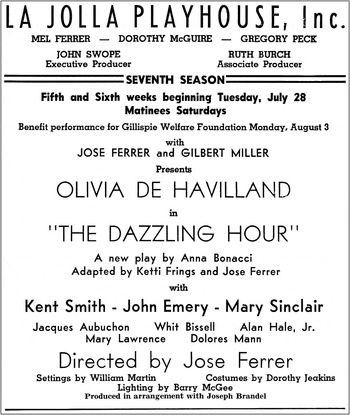
While filming Moulin Rouge in Paris in 1953, well-known actor and director José Ferrer saw L'Heure éblouissante staged at the Théâtre AntoineFootnote 7 and decided to adapt it for the American stage in collaboration with novelist and screenwriter Ketti Frings, who in 1958 would win the Pulitzer Prize for her stage adaptation of Thomas Wolfe's Look Homeward, Angel. Under direction by Ferrer, Frings and Ferrer's version of the play was performed at the La Jolla Playhouse near San Diego from 28 July to 9 August 1953 under the title The Dazzling Hour, with a cast led by Academy Award–winning actress Olivia de Havilland (Fig. 1).Footnote 8
The Dazzling Hour, Frings and Ferrer's version of the play, performed at the La Jolla Playhouse, 28 July to 9 August 1953, starring Olivia de Havilland. Courtesy of La Jolla playhouse.

Coming from the French triumph and counting on a stellar cast, the play was supposed to run for two weeks at La Jolla before moving to Broadway.Footnote 9 Reviews of the La Jolla performance, however, were less than enthusiastic: the plot and the acting were considered too heavy, and the script in need of tightening and polishing. The Dazzling Hour never made it to Broadway and did not constitute a source of pride for any of the people involved in its adaptation and production. In her autobiographical book Every Frenchman Has One, de Havilland mentions The Dazzling Hour only to comment that although it was rehearsed in Dallas to accommodate José Ferrer, it was staged at La Jolla.Footnote 10The Dazzling Hour is not mentioned in biographical profiles of Ferrer or Frings.Footnote 11
In this article, I look at the process of transculturation L'ora della fantasia underwent in its adaptation as The Dazzling Hour to attempt to explain why this comedy, which was a theatrical sensation on several international stages, failed to survive the test of a North American audience. After a brief introduction to Bonacci's two versions of L'ora della fantasia and the reception the play received in Europe, I discuss several aspects of Ketti Frings and José Ferrer's playscript: the source texts they used, the characters they cut, the changes they made regarding important themes, and the new third act they created. I argue that Frings and Ferrer chose to downplay elements of the Italian comedy that might have displeased an American audience, such as the female protagonist's unfaithfulness and the background presence of the church, and stressed instead the domestication of female sexuality and the reestablishment of conjugal harmony. My contention is that the process of transculturation Frings and Ferrer implemented modified the nature of the comedy itself. L'ora della fantasia, which was successful on the postwar stages of Europe as a comedy of errors in the classical and Renaissance tradition, was proposed to the American audience as a romantic comedy. Finally, drawing on reviews of the La Jolla performance and letters and postproduction notes found in the Ketti Frings Papers,Footnote 12 I will report on Frings and Ferrer's attempts to respond to the reviewers' comments and rework the play for future performances.
Anna Bonacci's L'ora Della Fantasia
L'ora della fantasia takes place in England around 1850. George Sedley, a village church organist with aspirations to become a composer, tries to acquire the patronage of an influential nobleman, Sir Ronalds, by offering him hospitality during a county visit. Taylor, the town mayor, who is organizing this visit and also hopes for a reward, suggests that the hospitality the Sedleys offer Sir Ronalds, who is known to be a grateful womanizer, should include access to Mrs. Sedley. Thus, Mayor Taylor sets up a plan to deceive Sir Ronalds by introducing the village courtesan, Geraldine Hubbes, as the organist's wife. Meanwhile, the legitimate Mrs. Sedley finds refuge at Geraldine's house. However, the plan does not go as intended. Because of a series of unforeseen circumstances, Mr. Sedley ends up spending the night with the courtesan, who is acting as his wife, and Sir Ronalds stays with Mary Sedley, who has been caught in the role of the courtesan.
Bonacci left two versions of the comedy that differ only in the ending of act 3. In an earlier, unpublished edition, found in the Burcardo Theatre Library in Rome (probably the one staged in 1944), after Mr. Sedley receives news that his composition will be played in London, he becomes aware of his wife's infidelity but cannot express his anger toward her without first confessing his own betrayal. At the same time, he also understands the real origin of his music's success. The play ends with Mayor Taylor urging the organist not to investigate too closely into recent events.Footnote 13 In contrast, in the later edition, which was used in the post–World War II stagings and was published in 1954, while Mrs. Sedley is aware of her husband's infidelity, he remains ignorant of his wife's involvement with Sir Ronalds and believes that the success of his composition is proof of his musical genius.Footnote 14 Each of the three main characters in the play (Mr. Sedley, Mrs. Sedley, and Geraldine), in other words, is allowed to live a fantasy hour, the time when he or she recognizes and realizes their hidden desires. In act 1, the prostitute Geraldine lives for a short time as a jealously guarded wife; in act 2, Mrs. Sedley, a model wife, spends a night of love admired not for her housekeeping but for her personal charm; and in act 3, Mr. Sedley, a village organist, is called upon to direct a performance of his music in London.
The two endings of Bonacci's L'ora della fantasia, although they differed on only a few pages, led to different interpretations of the comedy: at its premiere at the Argentina Theatre in Rome in 1944, because its plot portrayed not just one but two love triangles and its cast comprised film stars, the play was considered an example of the romantic comedy theatre genre that had been most popular during the Fascist years. Like the productions of that era, it offered a positive resolution that confirmed the sanctity of matrimony.Footnote 15 In the ending of that production, both spouses returned to the routine life of marriage on an equal footing: each had been unfaithful and was aware of the other's unfaithfulness, but neither was able to complain without revealing his or her own infidelity. This may have made the play acceptable for the morality of the time.Footnote 16 In particular, the casting of cinema sweetheart Assia Noris as Mrs. Sedley induced one reviewer to write that the play was a “romantic story” that seemed to have been written especially for the film star because it resembled the style, the motifs, the language, and “the romantic flavor of a popular film.”Footnote 17
The label of romantic comedy, however, does not seem appropriate for the post–World War II edition of L'ora della fantasia, which was staged again in Italy and throughout Europe. This revised version is based on the topos of the deceiver deceived in one of its more widespread literary forms: the story of a husband who believes that he is protecting his honor but is made a cuckold by his wife anyway.Footnote 18 Moreover, Mr. Sedley is blissfully unaware of his wife's unfaithfulness and of his wife's knowledge that he has been unfaithful too. These plot details preclude any possible romantic ending. Bonacci's later version of L'ora della fantasia, as Anna Ossani notes, seems to borrow plots and characters from sixteenth-century Italian comedy, which in turn draws from the classic comedy of Plautus and Terence: the development of the main events in the space of one night; the exchange of persons and roles; the doubling of settings, in which the two female characters swap clothes, roles, and destiny; the presence of the chorus, made up in this case of three spinsters who represent conventional village morality; and finally a prologue, which is provided in the initial song in Bonacci's play and announces the main theme of the comedy to the audience, an experience of love lived for one night only.Footnote 19 Drawing from Ossani's intuition, Ludovica Radif has proposed a further reading of L'ora della fantasia as being itself an adaptation of Plautus' Amphitryon (206 b.c.), in which a good wife is convinced to spend the night—an abnormally long night—with a man other than her husband.Footnote 20 The cuckolded husband is unable to exact revenge because his rival is much more powerful than himself (the god Jupiter, in this case), so the wife's infidelity goes unpunished.
Reviewers of postwar stagings of L'ora della fantasia rarely treat it as a romantic comedy: poet and future Nobel Prize winner Salvatore Quasimodo mentioned the “bitterness” of the 1952 staging directed by Fantasio Piccoli, which complemented the comedy's “light touch.”Footnote 21 Playwright Carlo Terron praised the “ironic melancholy” and the symmetry of a game that was deceptively brilliant but quite bitter in its essence.Footnote 22 In his review of the 1954 staging at the Eliseo Theatre in Rome, Nicola Chiaromonte defined L'ora della fantasia as “a woman's joke on male vanity” and felt that the comedy's only defect was that it wasn't “as cynical and irreverent” as the situation would have warranted.Footnote 23
Similar comments followed the stagings of the play in French as L'Heure éblouissante. Reviewers of the Swiss adaptation also characterized Mr. Sedley as a deceived deceiver who attributes to his own musical genius rewards that are actually the result of the sexual favors his wife has bestowed on a powerful person.Footnote 24 Several reviewers compared the play to a square dance in which the dancers change partners according to a precise scheme and eventually return to their initial positions.Footnote 25 French reviewers either called the play a “comedy of errors”Footnote 26 or noted the presence of themes more typical of Boccaccio's Decameron than of the Victorian England where the comedy was set.Footnote 27 The arrogance and pomposity of Mr. Sedley, a man “who talks about himself in the third person” and “already imagines how his biography will be worded in the Encyclopaedia Britannica,” made him the perfect target for an ending in which his self-importance is undermined by the audience's awareness of how events actually developed.Footnote 28
But a comedy of errors and trickery along the lines of the classical tradition must not have been what Ketti Frings and José Ferrer had in mind when they adapted Bonacci's play. In fact, they modified both the plot and the characters: they reduced the number of characters considerably and changed the third act in such a way as to create what can be defined as a conventional romantic comedy.
The Dazzling Hour: Source Texts
Several circumstances seem to indicate that Frings and Ferrer's adaptation of Bonacci's play was mediated through two French translations. A note attached to the unpublished playscript, housed in the Ketti Frings Papers, explains that The Dazzling Hour “is an English adaptation of the French play l'heure eblouissante which was optioned for American production by José Ferrer.”Footnote 29 Copies of the two versions published in French, both titled L'Heure éblouissante, are also archived with the script. The earlier one was adapted by Albert Verly and was published in Switzerland in 1950 in the magazine Le Mois Théâtral. Footnote 30 In the ending of the Verly adaptation, Mr. Sedley, convinced that the invitation to go to London is due entirely to his musical talent and wishing to impress Mayor Taylor further, leaves the stage to look for his sheet music. While he is offstage, the church sexton reveals to the mayor that he has seen Sir Ronalds emerge from Geraldine's house. Mrs. Sedley reenters, hears the sexton's story, and convinces him that what he saw was an illusion caused by fog. When Mayor Taylor reassures Mrs. Sedley that he knows how to keep a secret and that he has already forgotten everything, she replies that she has too. Offstage, the three elderly women laugh and the curtain falls. Mr. Sedley remains unaware of his wife's role in his success, and Mrs. Sedley seems more intent on forgetting events than on returning to them with any sort of nostalgia.
The second French version archived with Frings and Ferrer's adaptation was published in Paris in 1953 for the magazine Paris Théâtre after the triumph of the staging at the Théâtre Antoine.Footnote 31 The text is accompanied by photos of the production. This version is presented as being written by Anna Bonacci (who was Italian), adapted by Albert Verly (who was Swiss), and “dialogued” by Henri Jeanson (who was French)—a combination complicated enough to lead reviewers to comment that they didn't know who should be credited for the comedy's success.Footnote 32 This second French translation is noticeably different from both Verly's adaptation and the Italian original, as Jeanson added numerous lines of dialogue throughout the play. For the play's ending, Jeanson kept Verly's secret agreement between Mrs. Sedley and Mayor Taylor, who both agree to keep the events of the previous night secret. The last photo in this published version, in fact, shows both Mrs. Sedley and Taylor with their right index fingers on their lips in a gesture that underlined their pact of secrecy.
But the action of the play continues in this version: Mr. Sedley returns onstage, complaining to his wife that he can't find his manuscript. Suddenly, the couple hears Geraldine's song through the window. The stage directions explain that both Mr. and Mrs. Sedley remain “with a lost look, under the enchantment of that tune which, for them, is evocative of so many things. . . . Each one of them picks up their dream where they left off” as the curtain falls.Footnote 33 This ending underlines the continuing connection of both spouses with the events of that fateful night, during which both have lived their fantasy hour.
Further insight into the adaptation process Frings and Ferrer followed can be gained from a copy of an English translation of Bonacci's play that José Ferrer sent to John Rosenfield—the drama and music critic at The Dallas Morning News—on 16 July 1953, just a few weeks before the La Jolla premiere.Footnote 34 The letter that accompanied the typescript stated: “This is the literal translation from the original Italian. We are busy monkeying with it now. The final play will be pretty different. However, this will give you an idea of the basic storyline.”Footnote 35 A reading of this unpublished and uncredited translation suggests that it may have been translated from the Verly version: as in the 1950 Swiss rendition, Geraldine's last name is given as Hubles, Sir Ronalds has become Sir Ronald, and the ending is the same as in the Verly adaptation, with Mrs. Sedley downplaying the importance of the night she spent with Sir Ronalds.Footnote 36 In fact, the translation avoids any reference to the “fantasy hour” of the Italian title and, like the Verly version, prefers to explain Mrs. Sedley's night of love as a dreamlike experience, of which only vague memories remain in the morning.
However, of the two French-language versions of the play archived in the Frings Papers, only the 1953 version published in Paris Théâtre, the one that included dialogue Henri Jeanson had reworked, is heavily marked, and it seems to have been a more direct source for Frings and Ferrer. Many of the lines of the first two acts of The Dazzling Hour are borrowed directly from this edition.
The note at the beginning of the Frings–Ferrer playscript in the Frings Papers, moreover, explains that in addition to working with Ferrer in the adaptation, Ketti Frings also wrote a third act “which was completely different from the original.”Footnote 37 The full text—and not just the third act—is indeed very different from Bonacci's original. It is also different from the uncredited translation that Ferrer sent to John Rosenfield and from Verly's and Jeanson's adaptations.
From L'ora Della Fantasia To The Dazzling Hour: The Minor Characters
The most obvious changes begin with the number of characters. Frings and Ferrer eliminated all the minor characters from the plot—three old spinsters, an old servant, an elderly neighbor, and the church sexton. Although these cuts may have streamlined the plot and served the needs of a smaller (and younger?) cast, they also made the dialogue less humorous and the play's satirical take on superficial morality and dishonesty less pronounced. Bonacci's minor characters served as both comic relief and a source of social commentary on the moral standards set by the church in Victorian England. As Marco Maria Gazzano argues, it was perhaps the “raw psychological realism” with which Bonacci painted the “moral drift” of the middle class more than the plot itself that was the reason for the play's success on European stages.Footnote 38
The most important cut was that of the three spinsters, who in Bonacci's original plays first appear in act 1 for a rehearsal of Mr. Sedley's oratorio. Their competitive bantering about their musical abilities, their obvious interest in the upcoming visit of Sir Ronalds (especially in view of their advanced age and their unmarried status), and their off-key singing would all have incited laughter in the audience. In Frings and Ferrer's adaptation, though, the three elderly ladies are mentioned only in the context of Mr. Sedley's recounting of a failed rehearsal and of his angry dismissal of them, in a scene that is devoid of all the comic effect of their actual physical presence.Footnote 39
In Bonacci's versions, the Sedley household has two maids, young Jane and old Bute, but only one appears in the Frings–Ferrer adaptation. In Bonacci's comedy, the two women offered Mrs. Sedley contrasting models of behavior: Jane, young and pretty, sings Geraldine Hubbes's love song at the beginning of the play, whereas the elderly churchgoer Bute endlessly talks about the pastor's sermons and his depiction of the punishments reserved for those who sin, especially adulterers. Although both Jane and Bute interact with Mrs. Sedley in act 1, only Bute has a speaking role in act 3, when the Sedley spouses have been unfaithful to each other. Her presence onstage in the final act serves two functions: she notices Mrs. Sedley's unusual inattention to household details, and she voices the opinion of the scandalized churchgoing flock as to Geraldine's apparent new religious ardor, as the prostitute has lately attended every church function. Thus, through Bute's comments the audience realizes how much both women have changed after living their fantasy hours.
Frings and Ferrer chose to eliminate the character of Bute—and thus all references to churchgoing, sermons, and sinning—and retained only Jane, the young maid. Her offstage singing and the lines she speaks in the beginning of the play help characterize Mrs. and Mr. Sedley as people who are not given to romantic love or marital infidelity. When Jane introduces Mrs. Sedley to Geraldine's love song, adding details about Geraldine's home, Mrs. Sedley complains about the “improper emotions” expressed in the song and tells Jane not to sing it again.Footnote 40 Jane also complains that Mr. Sedley never responds to her greetings and never seems to even notice her presence. “My friends told me when I came here to work that this is one place where I wouldn't get pinched—and they were right,” she says, adding to a scandalized Mrs. Sedley: “I hope he at least pinches you sometime!” (TDH, 1.1.3). Jane's comments suggest not only that Mr. Sedley is a man who does not stray from his wife but also that there does not appear to be any overt expression of physical affection between the spouses.
Rocket, the church sexton, also disappears in the Frings–Ferrer adaptation. In the Bonacci versions of the play, he is a fervent admirer of Mr. Sedley's musical talent and is the only person who sees Sir Ronalds coming out of Geraldine Hubbes's house. His innocent revelation in the last scene of the play of what he has seen has the potential both to expose Mrs. Sedley's infidelity and to destroy Mr. Sedley's self-esteem. In Frings's new third act, however, Rocket's presence is not necessary for the plot because no revelation of infidelity occurs at the end of the play.
Another minor character Frings and Ferrer decided not to put onstage is Mrs. Jerome, an elderly neighbor with very poor eyesight and hearing. In the second part of act 1of Bonacci's play, a surprise visit from Mrs. Jerome, who wants to borrow a cake pan, creates a moment of comic suspense, as the neighbor could realize that the woman with Mr. Sedley is not Mrs. Sedley. Fortunately, as she can't see or hear well, she does not marvel when the supposed Mrs. Sedley fails to find the way to the kitchen in her own home. Mrs. Jerome's request initiates a crucial moment in the plot, when Geraldine drops on her foot the pan she is trying to retrieve. This accident precipitates the first physical contact between herself and Mr. Sedley; he runs to carry her from the kitchen to the living room and keeps his arms around her. In the Frings–Ferrer adaptation, Mrs. Jerome remains outside the door, but her presence brings Mr. Sedley and Geraldine close together: she “puts her arms around him” and “her finger to his lips,” as “he is trembling” (TDH, 1.2.7). The kitchen incident doesn't happen until later in this version, when Geraldine fetches ale for Mr. Sedley, finding it sort of thrilling to be “waiting on one's husband” (ibid.). Moreover, as a result of Mrs. Jerome's visit, Geraldine comments on the spouses' seemingly unaffectionate behavior. She asks Mr. Sedley, “You mean you never—here with your wife—had reason not to let a neighbor in before?” (ibid.). The visit from Mrs. Jerome serves another purpose in the Frings–Ferrer adaptation: Mr. Sedley introduces his wife to Sir Ronald as “Mrs. Jerome” the following day, when Geraldine is still playing the role of Mrs. Sedley.
While not exactly definable as a character, the background presence of the church, mentioned frequently in Bonacci's play, is also missing from the Frings–Ferrer adaptation. Bonacci's stage directions for act 1 explain that the Sedleys' home is located “near the parish” and say that, as the curtain opens, “the church bell is heard.”Footnote 41 The tolling contrasts with Jane's singing, which is heard immediately after. Furthermore, Bute, recently returned from a church service, speaks at length of the pastor's sermons on the punishment which sinners, adulterers in particular, can expect. Bonacci also uses the church as a device to show that Mrs. Sedley's moral outlook is different from that of the other villagers. When she is asked by one of the three elderly ladies in act 1 why she was not in church that evening, Mrs. Sedley lists a long series of household duties to which she had to attend, concluding that “there are those who say that work is also prayer, Miss Briggs” (T-s, 43). When she is asked in act 3 why she was not at church, she admits that she attends only on Sunday mornings (T-s, 60).
The physical and moral presence of the church applies to the life of Geraldine Hubbes as well. Because she lives near the church, she is able to listen to Mr. Sedley's music through her windows. “It's as if I attended the services,” she explains to him. “And the services are so beautiful when you play” (T-s, 47). Geraldine's desire to extend her fantasy hour will eventually lead her to attend church daily, scandalizing the local population.
The Dazzling Hour, in contrast, has very few allusions to church attendance. The first refers to the villagers, who Jane says “listen more raptly than they do to the sermon” when Mr. Sedley plays the organ (TDH, 1.1.4). The second mention refers to the location of Geraldine's home. Because there are so few references compared to Bonacci's original, The Dazzling Hour loses its critique of the small-minded, church-centered village mentality, which was part of the appeal of Bonacci's play. As Ossani has also argued, setting the events in Victorian England, in addition to avoiding the censorship of the Fascist regime, contrasted the dominant values of domesticity and high moral standards with the hidden desires and hypocrisies of bourgeois couples.Footnote 42 In The Dazzling Hour, adultery loses the connotation of sin it has in L'ora della fantasia and is merely a forgettable incident in the life of the Sedley spouses, allowing for the final tableau of husband and wife in each other's arms.
Mary and Geraldine: A Song, A Shawl, and A Wedding Ring
In addition to the development of the plot, several recurring motifs in Bonacci's play brought coherence to the three acts, especially because they created a relationship between Mary and Geraldine, the perfect wife and the prostitute. Bonacci created a tangible connection between the two women through a song and a shawl. Her play opens with the voice of the young maid, Jane, singing a love song about a long-awaited lover who stays only one night. The audience soon discovers that it is the same tune that Geraldine sings at night when she is receiving traveling businessmen. Mary Sedley orders Jane to stop singing because “the silly, overly sentimental words” remain whirling in her head (T-s, 41). Later, though, Jane mentions that Mrs. Sedley has asked her to sing the entire song one evening, thus revealing an interest in it. Mrs. Sedley says that the only reason she asked Jane to sing the song was to make sure she knew what her maid was singing (T-s, 42). At the end of act 2, however, the audience discovers that Mary Sedley has actually learned the song quite well herself. As she finally accepts Sir Ronalds's invitation to live her fantasy hour with him, the stage directions indicate that Mary closes the window shutters “as she has seen done by the woman whose character she has now fully entered” and “with a faraway, loving, dreamy voice, emerging from the depths of her undeclared sensual personality,” she sings Geraldine's song (T-s, 58).Footnote 43
A shawl is the second element that connects the two women in L'ora della fantasia. In act 1, Mary's incensed description of Geraldine's behavior includes the fact that while she is at her window, she drops her shawl down over her shoulder and looks knowingly at the passerby (T-s, 45). A shawl returns in act 2, marking a pivotal moment in the identification between the two female characters. Mary, whom traveling merchants Gordon and Bell believe to be Geraldine, has no choice but to accept and try on one of the celebrated shawls of Gordon's shawl factory, which the merchant has brought as a gift. While until that moment she has been dazed and confused by the two men's compliments, when she puts the shawl on Mrs. Sedley begins her transformation. The stage directions indicate that Mary coyly adjusts the shawl on her shoulder in front of the mirror, and when she turns toward the two merchants, she begins to enjoy their admiration (T-s, 54).
The importance of the shawl as a symbol of the connection between Mary and Geraldine is even more pronounced in act 3. The events of that fateful night, in which each experiences the life of the other, even borrowing words from each other, continue to affect the lives of the two women: Mary Sedley appears distracted, no longer the perfect housewife, and has a new subtly ironic attitude toward her husband and his claim to glory. Moreover, she feels sympathy for Geraldine, who attempts to prolong her fantasy hour by attending church functions, as if she were the organist's wife. As the play ends, Mary is picking up the shawl she received in act 2, when she was believed to be Geraldine—an object that allows her to relive her fantasy hour and recognize her previously “undeclared sensual personality” (T-s, 58).Footnote 44
Geraldine's song and her shawl play a less significant role in the American adaptation. Frings and Ferrer chose a different connection between the two women: Mary Sedley's wedding ring. In act 1, after the Sedleys have agreed to Mayor Taylor's proposal to substitute Mary Sedley for the prostitute Geraldine Hubbles, Mary asks her husband to help her remove her wedding band. The symbolic gesture, which obviously moves the wife, seems to provoke no response in the husband, who has not noticed how his wife of eight years has changed during their marriage (TDH, 1.1.16).
The wedding ring reappears onstage in the second part of act 1, when Sedley asks Geraldine to wear it to strengthen the pretense that they are husband and wife. Only after she has obtained details from Mr. Sedley of his engagement with Mary does Geraldine accept the ring; she in fact begins to cry, saying “I am here. I am your wife. I am in your house, and you hold me tight in your arms” (TDH, 1.2.12). With the exchange of a wedding ring onstage, the two in effect become a married couple, if only for one night. The closing lines of the second part of act 1 confirm the bond, as Geraldine exclaims: “Oh George! It's too beautiful! You are my husband! And I am your wife!” (TDH, 1.2.25).Footnote 45 In act 3, as he recounts the events of the night to Mayor Taylor, Mr. Sedley justifies his actions by stressing that from the moment he sent Sir Ronald away, “Geraldine became my wife . . . until dawn” (TDH, 3.12).Footnote 46 Sedley goes so far as to suggest that he did not really commit adultery because he went to bed with the person who was his wife—the woman who was wearing Mrs. Sedley's wedding ring. By the same token, the audience could possibly understand, if not justify, Mary's night with Sir Ronald because she was at that time separated from her husband. At the end of act 3, in the few moments when the two women are alone onstage, Geraldine returns the wedding ring to Mary with many thanks for letting her have an experience of warmth she “might never have had” (TDH, 3.19). Mary, for her part, resumes the role of faithful wife. The two spouses' infidelity can thus be erased.
The different choices Bonacci and Frings–Ferrer made about which objects to use to signify the connection between perfect wife Mary and courtesan Geraldine are significant. In L'ora della fantasia, Mary sings Geraldine's song and wears a shawl meant for the courtesan, thus adopting the symbols of Geraldine's trade. In The Dazzling Hour, in contrast, Geraldine wears Mary's wedding ring, the symbol of her married status. In other words, Bonacci underlined how a wife could discover her sensual side and could recover that aspect of her personality repeatedly, even after returning to her marital relationship, by looking at the shawl. Frings and Ferrer, conversely, showed that a prostitute could delight in “playing house” for one night, and that a good wife who strayed only once (and at a time when she was not even officially a wife) could happily return to her conjugal status with no permanent consequences. In other words, Bonacci destabilized the Victorian society of her play's setting (and implicitly the Fascist Italy of her time), whereas Frings and Ferrer found a way to erase the unchecked sexuality the prostitute represented by making her (albeit only temporarily) acceptable to society as a married woman, and by having the married woman quickly forget her extramarital experience.
From L'ora della fantasia to The Dazzling Hour: The Third Act
While Frings and Ferrer changed the characters, dialogues, and motifs in acts 1 and 2, they stretched the concept of adaptation in act 3. The timing changes: in Bonacci's original play, act 3 takes place ten days after act 1, highlighting the silence of the two spouses concerning the fantasy hours they have both lived. Mr. Sedley has not told his wife about his unfaithfulness, which she knows about, and he does not suspect anything of his wife's unfaithfulness. The stage directions in Bonacci's play emphasize this point: “a sense should be felt of how carefully the two spouses are trying to deceive each other. Sedley is barely managing to control a rage that may explode at any minute, trying to make his wife believe that the plot staged for [Sir Ronalds] worked as planned. Mrs. Sedley is stressing her innocent and quiet manners so that Sedley will be sure that she knows nothing of the different development of that night's events” (T-s, 59).
Frings and Ferrer, however, place the events of act 3 on the morning after the events of acts 1 and 2, thus putting the entire plot in a frame of fewer than twenty-four hours. As Mrs. Sedley returns home in the morning, she learns that there was “giggling and whispering” coming from her bedroom in the early hours of the morning (TDH, 3.2). Her husband, of course, reveals nothing of the events of the previous night, claiming to have spent it concerned about her, “restless, tossing in [his] lonely bed” (TDH, 3.4). His apparent concern for Mrs. Sedley is immediately redefined as apprehension about his own reputation; he is concerned that someone may have seen her “sneaking through the streets,” going to Geraldine's house (ibid.). In other words, in act 3 of Frings and Ferrer's version, Mr. Sedley has lost none of his selfishness and has not deepened his love for his wife. Moreover, his explicit and implicit references to Geraldine suggest that his infatuation with her might last longer than one night: not only does he mention Geraldine's “natural beauty and charm” but he also attempts to convince his wife that it would be fine to continue to live in their village (TDH, 3.5). His reference to “the treasures that [are] near to hand” and to the possibility of having “lasting friendships” and “finding new inspiration” suggest that perhaps he envisions the possibility of a longer relationship with Geraldine (TDH, 3.7–8).
Like Bonacci's protagonist, the Mr. Sedley in Frings and Ferrer's play is not surprised when Mayor Taylor brings news of the favor he has obtained from Sir Ronald, and he unceremoniously sends his wife upstairs so that he can explain to the mayor that Geraldine spent the night with him and not with Sir Ronald. Thus, the fact that his music will be played in London, he explains to an incredulous mayor, must be the result of Sir Ronald's recognition of his great talent (TDH, 3.12).
The moment when Sedley reveals that he believes that his genius has been recognized—a climactic moment in Bonacci's comedy—is resolved in different ways in its many adaptations. Most leave Mr. Sedley in blissful ignorance of how he has received the invitation to London but make Mayor Taylor aware of Mrs. Sedley's involvement. Some adaptations end with a conversation between Mrs. Sedley and Mayor Taylor in which she tries to explain the dreamlike experience she is now ready to forget and he assures her of his complicity and silence. Ketti Frings, on the other hand, created a much more complex development by bringing back onstage both Sir Ronald and Geraldine, who in Bonacci's original play, had exhausted their function of catalysts of change for the married couple.
Frings's plot exploits the comic topos of mistaken identity one more time. Sir Ronald returns to the Sedleys' house bringing back with him Geraldine, whom he still pretends to know as Mrs. Sedley. The real Mrs. Sedley therefore is forced to assume a false identity; she is introduced, as previously noted, as the neighbor Mrs. Jerome. The stated purpose of Sir Ronald's visit to the Sedleys is to apologize for his behavior of the previous night, but the audience may assume that he wishes to help Mrs. Sedley by making her husband jealous. As soon as she enters the room, in fact, Sir Ronald openly admires and compliments her, so much so that Mr. Sedley becomes increasingly agitated, ultimately showing Sir Ronald the door in a none-too-cordial fashion. We have, in sum, a repetition of the events of the first act, but for a reversed reason: the night before, at the end of act 1, Sedley had been jealous of Sir Ronald's attention to Geraldine, who was posing as his wife. In act 3, Sedley is jealous of Sir Ronald's attention to his wife, who is posing as a neighbor.
The audience understands that Mr. Sedley's second outburst against Sir Ronald may cost him the nobleman's patronage. But George Sedley's jealousy does obtain a positive result; it moves Mrs. Sedley, who declares at the end of the play that she has achieved her dream: she is loved (TDH, 3.20). The curtain falls as Mr. Sedley helps his wife put on the wedding ring she had loaned to Geraldine. Mrs. Sedley declares that she will never take it off again. The difference between this conclusion and that of L'ora della fantasia could not be more clear: in the American adaptation Mary returns to the faithful wife she was always meant to be, whereas in Bonacci's comedy, even though she has returned to her conjugal home, she tries to prolong her fantasy hour by looking at the shawl that was given to her during her time as Geraldine.
From L'ora della fantasia to The Dazzling Hour: Targeting the American Audience
In changing the ending of L'ora della fantasia, Frings and Ferrer followed a well-developed trend in adaptations that targeted American audiences, especially in cinema. Countless Hollywood adaptations of European works “correct what they take to be the flaws of their originals” by “providing improbably happy endings,” states Thomas Leitch.Footnote 47New York Times critic David Edelstein adds that the respect for family values shown by Hollywood adaptations—while “other countries . . . have a more fatalistic attitude toward adultery”—leads American filmmakers to transform a comedy “which celebrates abandoning one's marriage” after being cheated on and having extramarital sex, into one that “says that conscientious infidelity leads to a new, improved family.” A “wiser, more moral scenario” perhaps, Edelstein concedes, but certainly less fun than the original.Footnote 48
While Edelstein was not referring to L'ora della fantasia or even theatre in particular, his reflections on the Hollywood rules for adaptations—“streamline the life out of a narrative,” “dopily over-romanticize”—apply to the Frings–Ferrer adaptation of Bonacci's work. Such rules would have been even more stringent in the 1950s, during the period of the Motion Picture Production Code, which focused on church, government, and family as the cornerstones of society and emphasized that “success and happiness resulted from respecting and working within this system.”Footnote 49 There is no doubt that Ferrer and Frings, who also worked in cinema, were aware of such standards; they knew that a play that satirized the concept of sin and the influence of religion over people's lives, that showed a wife enjoying the sexual advances of strangers and elicited sympathy for a prostitute and an unfaithful wife, that staged corrupt and corrupting high-ranking members of society, that depicted success obtained through sexual favors rather than personal worth, and that ultimately portrayed adultery going unpunished, might not have met with the approval of the audience in the United States the way it had in Italy, Switzerland, and France. Hence it is no surprise that Frings and Ferrer eliminated references to religion, left Mrs. Sedley's adulterous night in the shadows, restored the reputation of Sir Ronald, corrected Mr. Sedley's weakness, and concluded the play on a note of conjugal happiness and mutual forgiveness.
Frings and Ferrer might also have tried to recreate what Stanley Cavell has defined as “comedy of remarriage”—that is, a type of Hollywood film of the 1930s and 1940s in which the plot focuses not on whether a couple will finally get together but on whether they will stay together or get together again.Footnote 50 Divorce had become “a common—but still threatening—feature of American life,” David Shumway explains, a fact that worried not only moralists but also individuals who were concerned “about the fate of their own current or future marriages.” The comedies of remarriage, Shumway claims, “reaffirm the romantic view of marriage in the face of its failure.”Footnote 51
Frings and Ferrer's was not the only adaptation of Bonacci's comedy that opted for a marital happy ending, one that showed how the events of the first two acts had caused the Sedleys to evolve and realize how important their marriage was and how inconsequential the episode of infidelity had been. The other American adaptation of L'ora della fantasia, Wilder's Kiss Me, Stupid, justifies the final reconciliation of the spouses (renamed Spooner) by having the musician finally renounce the obsessive jealousy that had characterized his attitude toward his wife. This development of character did not happen, however, in Bonacci's L'ora della fantasia, whose ending continues to emphasize the shortcomings of Mr. Sedley. At the beginning of the play, he is presented as selfish, inconsiderate, and self-glorifying. At the end, he has not changed; self-centered as he is, he believes that his wife does not know of his unfaithfulness, that she has always been faithful to him, and that the invitation to play his music in London is proof of his musical genius. Mrs. Sedley knows that he is wrong on all three counts—as does the audience, who can laugh at his expense. The ending of Bonacci's play is a silent victory for Mrs. Sedley, who can safely return to the memory of the events of her fantasy hour while her husband boasts of his musical genius, believing that his fantasy hour has come. The audience rejoices at this resolution of the night of intrigues that sees the self-centered, unfaithful husband deluded and the equally unfaithful wife getting away with her infidelity. No scene of final marital happiness is necessary, as this is not a romantic comedy; it is a tale of a deceiver deceived.
This lack of development of Mr. Sedley's character is no minor point in discussing Bonacci's comedy and its American adaptation. A character who remains self-centered throughout the three acts deserves his final “punishment,” as indeed occurs in L'ora della fantasia. However, in Frings and Ferrer's adaptation, after Mr. Sedley spends a night with Geraldine, he again meets with Sir Ronald, protests the nobleman's improper behavior, and reclaims his wife. He becomes the real protagonist (and the main agent) of act 3. With this change of character Frings and Ferrer may have provided a “wiser, more moral” ending to Bonacci's play, but they also appear to have been following another trend in 1950s U.S. theatre by making of Mr. Sedley an example of what Bruce McConachie has called the “Empty Boy,” an “adult male who reverts to boyhood as an escape from the pressures of the grown-up world.”Footnote 52 Such a character, who appeared on the American stage in the 1950s as a “bored, confused, sexually anxious married mouse” who has a sexual experience with a pretty young woman, found one of its most popular incarnations in Richard Sherman, the protagonist of George Axelrod's 1952 play The Seven Year Itch.Footnote 53 The comedy, McConachie explains, shows what happens when a sex bomb falls on a marriage. But because “Broadway audiences believed that marriage was a bulwark against communism,” McConachie continues, the play's finale showed that the protagonist, reacting to the person he saw as a potential seducer for his wife, realized that he was indeed attached to his wife and that their marriage could be saved.Footnote 54 Moreover, with his reaction he proves that he has entered responsible manhood. “Like all good adult boys in Hollywood movies,” McConachie concludes, the protagonist “lays aside his anxieties to fight for what he believes. . . . The mouse roars in the end to protect his marriage.”Footnote 55
There appear to be strong similarities between the character of Axelrod's Richard Sherman and Frings and Ferrer's George Sedley. In the American adaptation, the organist has been married eight years—a number that was never specified in Bonacci's play. He shows no maturity or responsibility; on the day of a powerful patron's arrival, he does not realize the consequences of his dismissal of his elderly performers.Footnote 56 He is more seduced than seducer when he finds himself with the beautiful and experienced Geraldine. And the day after the fateful night, when he talks to his wife, Mr. Sedley behaves like a little boy covering up mischief. Ultimately he recovers control of the situation and his manhood, however, when he reacts to Sir Ronald's compliments to his wife and throws him out of his home. By refusing to acquire fortune and glory at the cost of his honor, Sedley reestablishes the marriage bond. He has grown up.
Other circumstances connect The Seven Year Itch with Bonacci's play. Axelrod's work was “the blockbuster comedy of the early 1950s”Footnote 57—much as L'Heure éblouissante was in France—running from November 1952 to March 1955. Frings and Ferrer—who would have had the opportunity to attend a performance of the play in New York—might have been trying to capitalize not only on the success of Bonacci's play and its dazzling female protagonists in Europe, but also on Axelrod's comedy and its immature male protagonist, mixing the adultery of the source texts with the more acceptable ending of a successful Broadway show.
The Dazzling Hour: Reviews and Postproduction Corrections
If the plot about a marriage that was dragged into indifference after seven or eight years and was threatened by adultery and rekindled by jealousy worked for The Seven Year Itch, why didn't it work for The Dazzling Hour? Reviewers of the La Jolla Playhouse performance pointed to a number of issues: assuming that the play was originally in French, they lamented that much of the work's original flavor had been lost in translation: “The risqué spice of the French with the comic touch has been lost for the boldness of the American.”Footnote 58 Other comments stating that the show needed more tightening and polishing seemed to imply that the process of adaptation had not yet reached its desired goals. One reviewer suggested that the entire first act should be rewritten.Footnote 59 “Both cast and direction are much, much too heavy. Is this Ibsen?” another reviewer wondered.Footnote 60
Although Olivia de Havilland was considered “definitely not miscast,” her delivery was deemed “a little too dramatic” for the comedy.Footnote 61 She had a very difficult job, reviewers admitted, as “in the second act she [was] asked to accomplish a complete transition of character, and then in the third act . . . revert to the original.” But “her enduring duress became tiresome” and her character appeared to be “nobly suffering and insufferably noble.”Footnote 62 Reviewers, in sum, did not notice any development in the character of Mrs. Sedley from the first act to the third act.
Although I would also attribute the failure of the play to the elimination of the minor comic characters and the consequent loss of criticism of bourgeois society's moral standards, I agree with the reviewers that the character of Mrs. Sedley in The Dazzling Hour does not appear to have been very well developed, probably because of Frings and Ferrer's tightening of the timing and their desire to end on a note of conjugal happiness. The experience of a night when she had the opportunity to be appreciated for her beauty and charm seems to have changed neither Mary Sedley's character nor her attitude toward marriage; at the end of act 3, she appears happy to return to the arms of her husband. Her adulterous experience seems quickly forgotten, almost of no importance. A letter Ferrer sent to Frings may offer a clue to why they decided to downplay Mrs. Sedley's unfaithfulness: “I think it's awfully hard,” Ferrer wrote, “to sell a bill of goods to an American audience that . . . well, fundamentally what it does is endorse adultery on the part of the wife, and I don't think we'll ever get away with it.”Footnote 63
This letter, dated 9 February 1954, suggests that a few months after the La Jolla performances Frings and Ferrer were planning to work on a revised version of The Dazzling Hour that would respond to reviewers' comments. Writing to Frings from Paris, Ferrer stated that he was “all excited about the play all over again” and could “hardly wait to get back and really start swinging on it.” Insisting on the problems connected with the staging of an unfaithful wife, his biggest concern was about “whether or not Mrs. Sedley has an affair with Sir Ronald,” apparently envisioning the possibility of revising the play in such a way that Mrs. Sedley “tasted pleasure and warmth” through Sir Ronald's advances “without ever going through with it.” Ferrer quoted George Bernard Shaw's Candida as an example of plays that “kind of skirt around and touch the fringes of the subject without ever really coming to grips with it.” Perhaps referring to the opinion of reviewer Edwin Schallert, who thought that an exchange of partners was something typically French and possibly more acceptable in France than in Victorian England, Ferrer also mentioned as “very important” the possibility of setting the play in France.Footnote 64 Finally, he agreed with Frings about the casting, mentioning that he had briefly met Olivia (de Havilland, presumably), who was “hard and jet-like and burned with a withering flame.”Footnote 65
Unfortunately, the 5 February letter from Frings to which Ferrer was responding has not been preserved in the archive. Nor can a complete later version of the play be found. A set of postproduction notes and revised pages, which are archived with the playscript, suggest that in their later revision of The Dazzling Hour Frings and Ferrer were particularly interested in showing a lighter and more frivolous aspect of Mrs. Sedley's character. At the beginning of act 1, Mrs. Sedley is shown half-singing, half-humming, half-dancing Geraldine's song “but all in a secret, forbidden way” as her husband returns home and tells her off for doing so.Footnote 66 When she attempts to show affection by kissing her husband and asking him to put his arms around her, Mr. Sedley objects to her “unseemly” behavior and comments that she must have a fever (TDH-rev, 1.1.5). The contrast between this moment and the play's finale, in which the spouses embrace, would have helped the audience appreciate how much the couple had changed in the play.
Other additions to Mrs. Sedley's lines confirm that Frings and Ferrer planned to show that she was intrigued by the noble visitor in act 1. Not only does she wonder aloud about whether Sir Ronald is handsome (TDH-rev, 1.1.6), but she also proposes, toward the end of the first part of act 1, that they don't need a professional to entice him, as she herself can do the job. “You don't think, George,” she suggests, “that if I were my most charming—and exerted myself a little—and flirted a little—all in fun, of course—that I wouldn't have to leave, and maybe—” (TDH-rev, 1.1.15). But Mr. Sedley accuses her of naïveté, and she has no choice but to accept that she will have to spend the night away from her husband for the first time in eight years. The stage directions, however, reveal her true emotions: she sighs as she mentions the need to separate, “but inwardly she is glad of it” (TDH-rev, 1.1.16). Probably created in response to the reviewers' comments that Mary Sedley's transformation in the play was too abrupt and unjustified, these changes would have helped prepare the audience for the female protagonist's evolution by showing from the beginning of the play her need for affection, her interest in Geraldine's life, and especially her hidden desire to change her monotonous life at least for one night.
Unfortunately, no alternative version of the rest of the play can be found in the postproduction notes, nor is it possible to know if these modifications were meant for the planned Broadway performances, which, although announced as upcoming in the Italian press, never eventuated.Footnote 67 It seems to me that the alterations would have helped the play but would not have made it a romantic comedy (or even a comedy). By eliminating the minor characters, Frings and Ferrer lost both the openly comic moments and the underlying critique of middle-class society that constituted the strength of L'ora della fantasia. In terms of plot development, however, I believe that the main reason for The Dazzling Hour's lack of success was the third act and its unresolved threads. The reason for Sir Ronald's return to the Sedleys' house, the possible change in Geraldine's life after her night spent as virtuous Mrs. Sedley, the boastful self-esteem that Mr. Sedley exhibits when he learns of Sir Ronald's favorable response to his music, and especially the consequences that the adulterous night would have brought to the Sedley spouses, are all important elements in the plot that are never clarified in the Frings–Ferrer adaptation of Bonacci's comedy. The audience may have appreciated the final tableau of Mr. and Mrs. Sedley kissing, with Mrs. Sedley's implicit promise that she would never again be tempted to forget that she was married, but they would have wondered why she would be so willing to return to her husband. Mr. Sedley, in fact, being unaware that his wife has spent the night with Sir Ronald, is still convinced of his genius and the beauty of his music and has remained his conceited self. The postproduction notes by Ferrer or Frings remark on the “color of a mutually forgiving act” of the spouses' final conversation.Footnote 68 Unfortunately, this description overlooks the imbalance in the two spouses' situations: Mary Sedley has been unfaithful to her husband, knows that her husband has been unfaithful to her, and knows also that her husband does not suspect her betrayal. George Sedley, on the other hand, knows he has betrayed his wife but believes that his wife does not know, and he has no idea of his wife's unfaithfulness. Mr. Sedley, for all he knows, has nothing for which to forgive his wife; for all he knows, his wife ignores his unfaithfulness and has nothing to forgive.
It is not surprising, then, that L'ora della fantasia did not have the same sort of triumphal reception in the United States that it had on other international stages. The process of transculturation for American audiences attempted to make a romantic comedy of the Italian commedia degli inganni (comedy of deceptions) without developing the characters accordingly and resolving all conflicts. The fear of a negative reaction to a play that allowed Mrs. Sedley to commit adultery and get away with it, as Ferrer expressed in his 1954 letter, may explain the conventional ending, in which adultery is quickly forgotten and conjugal harmony is reinstated. A conventional ending, however, was not justified by the previous plot development and left the La Jolla audience and reviewers understandably unsatisfied. Frings and Ferrer's The Dazzling Hour remains a forgotten episode in the history of twentieth-century American theatre and a disappointing moment in the long and triumphant staging history of Anna Bonacci's L'ora della fantasia.