1 Introduction
Popular multiplayer games such as World of Warcraft (WoW), currently with 5.5 million subscribers,Footnote 1 represent massive online communities of speakers of English, Chinese and Spanish among other languages, in their persistent game worlds, each with a unique narrative and socially-determined ethos. Many massively multiplayer online games (MMOGs) also provide access to second language (L2) communities that exist around play of the game including online fan sites, databases and forums (Thorne, Fischer & Lu, Reference Thorne, Fischer and Lu2012; Ryu, Reference Ryu2013, Chik, Reference Chik2014). Interacting with other players in an L2 is promoted through the challenges and rewards embedded in the design of MMOGs, which require ongoing problem-solving and coordination as players make progress toward goals such as leveling up their avatar or completing quests. Researchers seeking to immerse L2 learners in real-world problem-solving have investigated how MMOGs support L2 learning in group play. Zheng and Newgarden (Reference Zheng and Newgardenforthcoming) reviewed online gaming studies and found two major trends: (1) researchers applied traditional second language acquisition (SLA) constructs to reveal whether interaction in games led to gains in specific linguistic areas such as vocabulary development (Rankin, McNeal, Gooch & Shute, Reference Rankin, McNeal, Gooch and Shute2008; Rankin, Morrison, McNeal, Gooch & Shute, Reference Rankin, Morrison, McNeal, Gooch and Shute2009) or sentence formation fluency, reading skill, or use of informal language (Peterson, Reference Peterson2012); or (2) researchers (Zheng et al., Reference Zheng, Newgarden and Young2012; Newgarden, Zheng & Liu, Reference Newgarden, Zheng and Liu2015) applied emerging third-wave cognitive sciences theories such as ecological, dialogical and distributed (EDD) perspectives to overcome the inadequacy of SLA theories and methods to reveal the full potential of MMOG environments. One of the major inadequacies relates to the focus of the current ReCALL theme – multimodality – in that 3D virtual worlds, which are richly imbued with manipulable material artifacts, have been simply reduced to linguistic input, while communication mediated by avatar movements, place-based meanings, and voice modalities has been reduced to flattened text data, and participation and complex learning trajectories have been measured as if they were static or linear.Footnote 2
In EDD views, however, contexts define human sense-making and afford actions that realize different arrays of values. Different sets of affordances for L2 learning are made possible by the contexts of different environments, MMOGs, or L2 classrooms. EDD-framed research asks about the agent-driven interactions of L2 learners as they “do” languaging activities together, how they draw on multimodal resources such as embodiment, voice, material artifacts, texts, or more expert others, to enact communicative projects that are constrained by socioculturally defined discourses (Gee, Reference Gee1990).
One goal of this paper is to advance research from the aforementioned second trend by addressing the question of how L2 learners and native English speakers (NESs) coordinate and make sense with language and actions in the dynamics of play of a digital game. Multimodality as both theory and analytical tool is critical in three ways in this study. First, we conceived of players’ L2 verbalizations and avatar actions as languaging for sense-making, activity that entails dynamic integration of speaking, hearing, movement, and orientation to sociocultural norms of situations. This prioritization of real-time, situated, embodied linguistic activity is a theoretical stance that we take to advance an EDD view of language in which the goal for L2 learners is to be able to take skilled linguistic action (Cowley, Reference Cowley2012; Newgarden et al., Reference Newgarden, Zheng and Liu2015). L2 learners take skilled linguistic actions when they comply with material and cultural constraints while “linking symbols and patterns of grammar with affect, artifacts and social skills” (Cowley, Reference Cowley2012: 13).
Second, we considered how use of multimodal communication channels, i.e. use of group voice chat (e.g. Skype), avatar-embodied actions and occasionally, text chat, contributed to opportunities for L2 learning. We thereby go beyond the many studies of L2 learning with digital games that have relied solely on players’ text chat as the data for uncovering L2 development, defined as a measurable change in proficiency of an individual learner over time. Our aim is not to show examples of L2 development in these terms, and furthermore, our dialogical unit of analysis does not allow it. Instead, we illustrate how and when L2 players demonstrated their abilities through enacting a variety of communicative activities that are inherent and recurrent in group play of a quest-based multiplayer game.
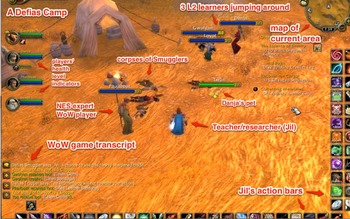
Third, we employed multimodal analysis to explore how players’ languaging creates new affordances for L2 learning. As in L2 classrooms, L2 learners in WoW make use of multiple modalities in sense-making including voice, sound effects, texts, and other artifacts in the environment. However, since the contexts for communicative activities in L2 classrooms are often merely imagined, it can easily be argued that the rich and situation-specific information provided in the designed contexts of a virtual world game may be more helpful to making sense in communicative activities. In WoW, a player’s embodiment is via an avatar, who can typically gesture, emote, speak, and move about an expansive virtual space in a multitude of virtual ways (on foot, on a mount, flying, teleporting, invisibly, in different forms, etc.). In Figure 1, an annotated screenshot of WoW play points out some of the modalities of information available to players.
Annotated screenshot from Week 8 gameplay of WoW

A second goal of this paper is to illustrate WoW’s affordances for language education through EDD perspectives. We related the EDD constructs of skilled linguistic action and recurrent languaging activities to established English proficiency standards as described in the CEFR. The CEFR, a scale now used widely throughout the world (Cambridge ESOL, 2011) was developed by the Council of Europe over a 20-year period, to provide a common basis for the design of second and foreign language curriculum by educators throughout Europe. The CEFR adopts an action-oriented approach that emphasizes how social contexts give language activities their full meaning. The scale describes speaking, listening, reading, and writing skills at six levels of proficiency, ranging from Basic (A1 to A2), to Independent (B1 to B2) to Proficient (C1 to C2) users. (See Appendix A for CEFR Oral Assessment Scale descriptors for each level). The CEFR approach aligns well with EDD and the construct of skilled linguistic action, which is how L2 learners demonstrate mastery of CEFR goals. This is not accomplished by tasks and imaginary role plays that can take away learners’ agency, but with environments (such as WoW) in which players’ actions connect to virtually-materialized consequences that matter to them as individuals and members of a community.
The overarching question for this study was: How and when do designed and emergent WoW game world features contribute to L2 learners’ abilities to take skilled linguistic action? The question reflects an EDD view that evidence of L2 learning will not be found by asking about the outcomes of gameplay in terms of discrete linguistic measures, but by looking at the dynamics of gameplay languaging. We were particularly interested in how players made use of the multiple modalities of avatar-embodiment and use of voice (via Skype) to take skilled linguistic action. We hoped to build on recent work (Newgarden et al., Reference Newgarden, Zheng and Liu2015) to identify characteristic features of skilled linguistic action that are made salient during group WoW play.
2 Literature review
2.1 Multimodality and L2 learning in digital game worlds
As noted by Newgarden et al. (Reference Newgarden, Zheng and Liu2015), few other researchers have considered the affordances of multiple modalities that are common in ditigal games, particularly the affordance for players to interact with voice in real-time during play. With some exceptions, namely Piirainen-Marsh and Tainio (Reference Piirainen-Marsh and Tainio2009); Zheng et al. (Reference Zheng, Newgarden and Young2012); Newgarden et al. (Reference Newgarden, Zheng and Liu2015); and Reinders & Wattana (Reference Reinders and Wattana2014), few researchers have analyzed players’ spoken interactions in gameplay. Findings on linguistic aspects, intersubjectivity, or use of discourse strategies have been based almost exclusively on transcripts of in-game text chat. Yet, analysis of spoken interaction by Zheng et al. (Reference Zheng, Newgarden and Young2012) of just one 47-minute WoW gameplay episode displayed an extensive range of communicative activities in the L2 (e.g. coordinating, sharing game knowledge, reporting on actions, negotiating meaning, seeking and offering help, expressing need, locating, apologizing).
The contributions of avatar-embodiment to L2 learning in a game world (ability to move in various ways through a 3D space, to change the perspective of view, to display certain emotions, gestures and make avatar-voiced sounds) have been the focus of even fewer studies. From an ecological and dialogical analysis that considered players’ avatar movement with and without coordination with speaking, Newgarden et al. (Reference Newgarden, Zheng and Liu2015) found statistical evidence that players’ multimodal languaging (i.e. when verbalizations and actions of the avatar were coordinated rather than not) impacted the quality of communicative projects (see 1.3 for explanation). Specifically, multimodal languaging in collaborative communicative projects during WoW gameplay was one of the predictors for two broad types of human values-realizing: (1) players gained information that allowed them to take their next value-laden actions (wayfinding); and (2) players paid attention to L2 sociocultural practices and cared for others (orienting to we/one). This finding suggests that avatar-embodiment, which entails projecting ourselves as we act through and as our virtual “other self” (Gee, Reference Gee2008), what we call co-acting with our avatar (Zheng and Newgarden, Reference Zheng and Newgarden2012), contributed to communicative projects that realized life-enriching values of conversing. To elaborate, in ecological psychology, all actions of an animal realize values. Hodges (Reference Hodges2009) explained that values both legitimize and constrain actions by defining what the goods of an ecosystem are. He conceptualized conversing as values-realizing activity that allows humans to perceive, to act, and to care for self and others while directing their agency to ecosystem goods. Using Hodges’s example, a good conversation is an ecosystem which offers those enacting it the goods of, for example, getting to know someone better or learning something new, when the values of, for example, relating to another person or being clear and comprehensive are realized. Conversing as values-realizing activity is an underlying assumption of an EDD view of language and cognition, and we assume that L2 learners’ ongoing values-realizing constrained and defined the ecosystems of each WoW gameplay episode. We argue that EDD can account for more of the complex factors involved in L2 learning in multimodal environments, not only in MMOGs, but also in the more sensorily immersive virtual and augmented reality environments on the near horizon.
2.2 Integrated theories of cognition, language, and learning
Zheng (Reference Zheng2012), Zheng, and Newgarden (Reference Zheng and Newgarden2012), Zheng et al. (Reference Zheng, Newgarden and Young2012) and Newgarden et al. (Reference Newgarden, Zheng and Liu2015) have led the charge of calling for an EDD understanding of second language learning, particularly with regard to investigating the affordances of virtual environments. As Zheng and Newgarden (Reference Zheng and Newgardenforthcoming) revealed in a comparative discussion of studies of L2 learning and digital games, there has been a tendency for researchers to follow deep-seated linguistics traditions of treating environments as inputs, of looking for changes in discrete aspects of learners’ outputs, or of analyzing discourse while completely ignoring learner movements and actions. In this study, the context of learning and L2 learners’ interactions with the material and linguistic resources of the gameplay environment are analyzed with reference to the EDD constructs explained next. We relate L2 learning to Chemero’s (Reference Chemero2009) animal-environment model, which blends ecological psychology with the enactivist view (Thompson, Reference Thompson2010; Maturana and Varela, Reference Maturana and Varela1998) to account for the development and refinement of abilities in a dynamic system.
2.2.1 Languaging
In EDD views, languaging is real-time embodied activity that we engage in as we converse with others for the purpose of solving problems, learning, building relationships, and achieving other results, only some of which are visible. It is “a mode of action that integrates patterns that function in different time scales: we integrate how we move and feel, with what we hear ‘us’ – me and you – saying (and do so against Discourses)” (Cowley, Reference Cowley2012).
In the distributed view of language, languaging is a first-order activity that necessarily precedes the development of a symbol system, which is therefore known as second-order language. Second-order language is historical, emergent from societally and culturally defined practices, while first-order languaging, which is constrained by the symbol system, is metabolic activity (Cowley, Reference Cowley2012). Languaging is a primary activity for L2 learning since, in the ecological view of L2 learning (van Lier, Reference van Lier2004), activity makes linguistic information relevant and available for further action. As an example of a languaging event, imagine two or more kids building with Lego blocks together. As they build, they move a Lego block to present a new thought or express a color or shape preference to each other, they manipulate the Lego to take a perspective, they move their body to interpret the space etc., all of which are necessary actions in the process of languaging. In theoretical terms, they negotiate, coordinate, co-act with gaze, with body, with the Lego (a material artifact), and with language.
2.2.2 Skilled linguistic action and Co-action
Skills with language are traced to experiences of languaging. Zheng et al. (Reference Zheng, Newgarden and Young2012) argued for skilled linguistic action as a way for L2 practitioners to rethink what L2 learners need to do, pointing to the merits of WoW gameplay as a learning environment. Newgarden et al. (Reference Newgarden, Zheng and Liu2015) explored the construct empirically, considering three cognitive mechanisms that modulate skilled linguistic action from EDD perspectives (i.e. common ground alignment, prospective coordination and co-action). Co-action can be a more advanced achievement of skilled linguistic action, although not all co-action involves languaging. In situations of languaging, people fall into co-action when they are smoothly coordinating their verbalizing and movements to accomplish something jointly that neither could alone. When two or more players team up on a quest in WoW, they may first negotiate their understanding of certain quest wordings, or locating an object, or getting to a certain location in the vast realm of Azeroth. Reaching mutual understanding of certain wordings of the quest, or locating and getting to a place are considered common ground alignment. Making a movement in a promising direction as a result of coordinating is prospective coordination. Through common ground alignment and prospective coordination, co-action can be achieved. Depending on the nature, level of the quest, and prior gameplay experiences, co-action might either be achieved quickly or it might take players longer to accomplish common ground alignment and/or prospective coordination first. Play continuously fluctuates between these types of coordination. From an EDD perspective, recurrent languaging activities such as questing, planning an attack, and traveling as a group, allow players to re-enact contextually similar, but unique pragmatic activities, detecting and picking up the information needed for them to take skilled linguistic actions in similar, yet more complex, situations of play over time.
2.2.3 Communicative Project Theory
We applied Linell’s (Reference Linell2009) Communicative Project Theory and Communicative Activity Type (CAT) analysis. Communicative Project Theory focuses on “what is going on” for participants in interaction, such as solving communicative problems, information sharing, or meaning-making (Linell, Reference Linell2009: 211). The dialogical unit of analysis for this study is the communicative project (hereafter, CP). In each CP, conversing and/or action centers on a task that requires the coordination of two or more individuals (Linell, Reference Linell2009: 178). This perspective defined how transcribed verbal and non-verbal actions were parsed for analysis.
On a more global scale, WoW gameplay was treated as a CAT as in Zheng et al. (Reference Zheng, Newgarden and Young2012) and Newgarden et al. (Reference Newgarden, Zheng and Liu2015). Following Linell’s description, it is “a comprehensive communicative project tied to a social situation type” (Linell, Reference Linell2009: 201). Further, a CAT has a clear action agenda, which is realized as a sequence, consisting of an opening, a main activity, and a closing. CATs are often a mixture of “transactional and social-relational talk” (Linell, Reference Linell2009: 211), which is true of WoW group gameplay with voice. During typical game activities, players shift according to the situational demands, between talking about what they are doing in the game and non-game topics, so both types of projects should be recognized as part of a gameplay episode.
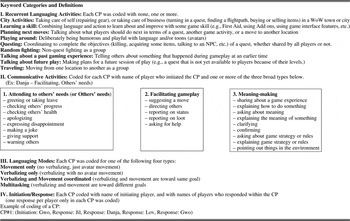
CPs were identified and linked as audio/video/transcript clips of gameplay language and action. Each project was explored to identify what was going on and what the main functions of verbalizing and acting were. Then these lower level communication types were grouped under higher-level categories that were called “Communicative Activities” (see Keyword Categories and Descriptions). These were on a more micro scale than Linell’s (Reference Linell2009) CATs; however, they are constituents of WoW gameplay as an overarching CAT.

2.2.4 How an animal-environment system learns to take skilled linguistic actions
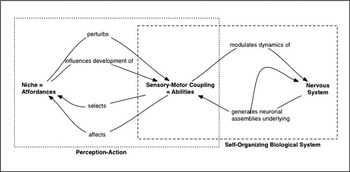
Chemero (Reference Chemero2009) posited a model of a unified animal-environment system (see Figure 2) that offers an explanation of learning compatible with non-representational EDD views of cognition. Chemero’s main advance was showing how affordances and abilities are causally interdependent. Over time, interactions between them create changes that allow for cognitive development, which is evident in the way animals perceive and act. In Chemero’s (Reference Chemero2009) words, the model reflects both short- and long-term timescales:
Over developmental time an animals’ sensorimotor abilities select its niche — the animal will become selectively sensitive to information relevant to the things it is able to do. Also over developmental time, the niche will strongly influence the development of the animal’s ability to perceive and act. Over the shorter time scales of behavior, the animal’s sensorimotor abilities manifest themselves in embodied action that causes changes in the layout of available affordances, and these affordances will change the way abilities are exercised in action (Chemero, Reference Chemero2009: 151).
Chemero’s (Reference Chemero2009) animal-environment system.3

This model can explain how L2 learners have certain linguistic abilities that allow them to act on affordances for languaging in different L2 environments. Actions in languaging have perceivable outcomes, some that accomplish goals and others that do not. In either case, information perceived feeds development of new abilities that are directed toward new goals. Applying the model to L2 learning, skilled linguistic actions are taken in the timescale of real-time communicative activities and, over a longer timescale, come to collectively represent the niche of an L2 learners’ proficiency for interacting adaptively and effectively in a variety of L2 contexts.
3 Methods
3.1 The data
This study used data from a semester-long university course entitled “World of Warcraft: Is This Who We Are?,” which explored social, cultural, and personal values. L2 learners in an intensive English program participated with NES undergraduates. Students were assigned to small groups of two or three NESs and two or three L2 learners with at least one more experienced WoW player in a group. Each group played one hour of WoW per week speaking via Skype conference call with Author 1, who recorded the gameplay and dialog using iShowU software.Footnote
3.1.1 Data selection
Author 1 explored the full data set of video recordings of gameplay for four groups. There were six to ten recordings for each group with 28 total recordings, each about one hour in length. The goal was to identify three episodes that were roughly equivalent in length from early, mid and late weeks of the semester, and included all group members (L2 learners and NESs) across all three episodes. Many recordings were incomplete or flawed due to either recording errors, breakdowns in the Skype call, or absence of one or more players in a group, leaving the set of gameplay recordings for one group as the best available set. Members of the group selected included three L2 learners and two NESs and the instructor (Author 1). The selected episodes were from Week 1, Week 8 and Week 10. These were out of a total of six episodes of play from Weeks 1, 2, 8, 9, 10, and 12 of the course. Week 12 was the final week of gameplay, but only two players were present, so it was not analyzed, and Weeks 2 and 9 had gaps in either audio or video due to technical problems. The Week 1 episode had been used to provide data for two previous unique analyses (Zheng et al., Reference Zheng, Newgarden and Young2012; Newgarden et al., Reference Newgarden, Zheng and Liu2015).
3.1.2 Participants
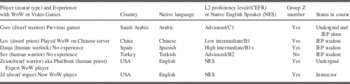
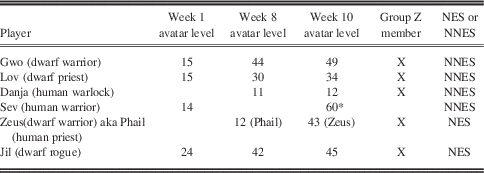
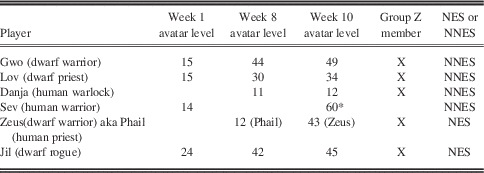
Two L2 learners, Gwo and Lov, played in all three of the group gameplay episodes selected. The group also included one other L2 learner, Danja, one NES freshman, Zeus (who also played as Phailboat, or Phail for short), and Author 1, Jil, the instructor of the course. Table 1 summarizes player information.
Summary of WoW player information

3.2 Multimodal transcription and coding
Each gameplay episode was transcribed for both spoken language and players’ avatar actions using Transana (Woods & Fassnacht, Reference Woods and Fassnacht2012) video analysis software. Applying dialogical principles (Linell, Reference Linell2009), the transcripts were parsed (broken into units) in terms of CPs. Each CP, the unit of analysis for this study, was named for its action focus and consisted of a video/audio clip with an associated language transcript and avatar action transcript. Through open coding, general gameplay activities and various types of communicative activities (CAs) were identified. Gameplay activities found to recur in all three episodes were identified as Recurrent Languaging Activities (see panel), which became the keyword category I. Communicative Activities, category II, includes the three main types of CAs found: meaning-making, facilitating gameplay, and taking care of others’ needs, one of which was assigned to each CP. Category III, Languaging Modes, includes four possibilities for the relationship of players’ verbalizing and acting within a CP. Finally, category IV, Initiation/Response was based loosely on Linell’s (Reference Linell2009) Initiation/Response analysis. Individual players’ utterances were coded as initiations of CPs or responses to others (one or more times) within a CP. Following initial coding by Author 1, Author 2 coded 10% of clips and reached intercoder agreement of 80%. After each episode was keyword coded, keyword visualizations were developed using Transana software and used to compare patterns of gameplay languaging across episodes.
Summary of WoW gameplay episode details
* Sev did not play, but was present briefly in the audio
4 Analysis and findings
4.1 Patterns of recurrent languaging activities across three times of play
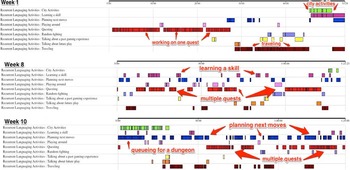
Prototypical WoW gameplay activities which recurred across the three episodes analyzed were grouped under the keyword category Recurrent Languaging Activities (RLAs). The nine types (see panel) included what Zheng et al. (Reference Zheng, Newgarden and Young2012) previously referred to as location-based activities, such as city activities, traveling, and questing. Several activities, such as learning a skill or planning next moves, have to do with becoming better at the game, which means becoming more useful to others in group play. Playing around and talking about past and future play are activities that reflect relationship-building in WoW. Figure 3 is a triplet of stacked Transana keyword maps for Weeks 1, 8, and 10 showing different patterns of RLAs over time across episodes of play.
Comparison of RLAs for Weeks 1, 8, and 10

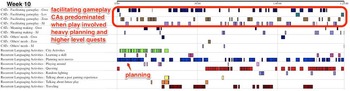
In Week 1, single RLAs stretched on without interruption as new players focused on one activity at a time, reflecting players’ limited abilities to seek and enact the full affordances of WoW. This contrasts with Week 8 when RLAs were diverse and completed more quickly as players gained more sophisticated skills. In Week 10, more skilled (higher-level) players completed more advanced quests requiring higher-level cognitive and linguistic skills. An RLA that became more salient was planning next moves, which required knowledge of the WoW environment, knowledge of ones’ skills and importantly, predicational language (Reed, Reference Reed1996). The prominence of planning next moves in Week 10 is evidence that the ability to take this type of skilled linguistic action became more important as play level advanced.
Table 2 summarizes information about each episode including players’ presence or absence, avatar level, group membership, and language status (native or non-native English speaker (NNES)) and serves as a reference for noting how RLAs and CAs relate to players’ progression in the game. Levels of players avatars ranging from 1 (starting level) to 60 (the highest level of WoW at the time) indicate their progress in the game over time.
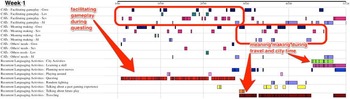
In the next section in Figures 4a, 4b, and 4c, we point out at a finer-grained level the distinct features of each of the three episodes, foregrounding questing as a major activity for illustrating the relationship between RLAs and certain types of CAs.
Week 1: Facilitating gameplay during questing

Week 8: CA diversity

Week 10: Facilitating higher-level play

4.2 Coupling of RLAs and CAs
4.2.1 Week 1: Facilitating gameplay (Figure 4a)
In Week 1, players enacted more CAs for facilitating gameplay compared to other types while questing, shifting to meaning-making CAs during the traveling and city activities period.
A total of 86 CPs were coded for 47 minutes of play. The episode was unscheduled play by group members Gwo and Lov, plus Sev, an L2 learner classmate, and Jil, the course instructor. Linear compared to other episodes, gameplay consisted of 30 minutes of questing (coordinating with language and actions to kill foe and collect required quest items) followed by ten minutes of traveling on a dark road while fighting off predators. After reaching a city, players spent ten minutes talking about how to use a game interface tool to locate a non-player character (NPC) who could repair their damaged gear (armor and weapons). Play ended when Sev accidentally learned how to fly on a gryphon, departing to another area.
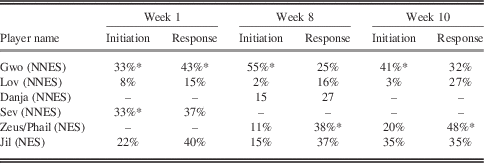
Comparison of players’ initiation and response in CPs as a percentage of total CPs over three WoW episodes (Weeks 1, 8 and 10)
* Indicates highest percentage of initiation or response in a given week
Looking at the activities involved in facilitating gameplay in the panel above i.e. suggesting a move, reporting on status, reporting on loot, and asking for help, it is apparent that the major projects in group questing, a very goal-directed activity, promoted opportunities for coordination. Although talking together during traveling promoted meaning-making, verbalizations and actions were not necessarily coordinated, so they were not considered as languaging per se.
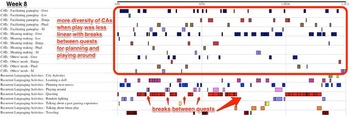
4.2.2 Week 8: CA diversity (Figure 4b)
In the Week 8 episode, when numerous quests were completed in rapid succession with bursts of planning and playing around scattered between, there was more diversity to CAs with more CAs concerning others’ needs compared to the other two episodes.
A total of 97 CPs were coded for 1 hour 14 minutes of play. This was a scheduled play session including Gwo, Lov, Danja, Phailboat, and Jil. Play centered on grouping to complete several of Danja’s low-level quests, which involved killing a large number of human NPCs known as the Defias Brotherhood, a band of smugglers controlling the farms in the area. The group coordinated to defeat two camps of Defias (see Figure 1) and then took back control of a town by defeating 30+ more. Gameplay activities alternated rapidly between group planning of next moves, questing, turning in, and picking up new quests.
The diversity of RLAs and CAs in this episode can be traced to the results of players’ recurrent actions, which led to changes in the layout of affordances (Chemero, Reference Chemero2009) in the game. Once these changes were perceived and acted on, they became new affordances for developing abilities, for example, for L2 players to participate in CAs such as planning next moves, which were critical for coordinating co-action under more challenging circumstances. When players were able to handle quests more efficiently (an example of a change in the layout of affordances), they were also able to act on affordances for playing around between quests.
4.2.3 Week 10: Facilitating higher-level play (Figure 4c)
In the Week 10 episode, the RLA planning next moves, associated with City Activities and Questing, was coupled with a particular type of CA, facilitating gameplay.
A total of 109 CPs were coded for 1 hour 13 minutes of play. After ten weeks, L2 learners Lov and Gwo had become more familiar with WoW and were interested in pursuing higher-level play. Four players (Gwo, Lov, Zeus and Jil) were able to coordinate more complex play when the lowest-level member, Danja, was not playing. CAs that facilitated gameplay were prominent. Few CAs focused on meaning-making or paying attention to other’s needs. This demonstrates the coordinated behavior of co-action, which is sustained skilled linguistic action. Stated simply, players became synced and efficient in their co-play. They reached a state of flow and little negotiation of meaning or relationship-building was needed. Although this shift in CA types is likely to occur when players become good at doing a recurrent activity in WoW, it does not necessarily imply that more coordinated play at a higher level provides fewer opportunities for languaging or L2 learning. Since players continuously create new goals and have less need to talk about what they are doing in gameplay, they may have more opportunities to talk about other things.
4.3 Participation in CAs and players’ abilities to take skilled linguistic action
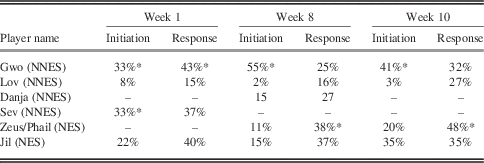
While RLAs entailed various CAs according to players’ pursuit of different game goals, analysis also revealed how players picked up on affordances to initiate and respond in these activities in relation to their different language abilities. In terms of players’ overall initiation of CPs, Gwo dominated across all three episodes. See Table 3 for a comparison of CP initiation over Weeks 1, 8, and 10 by both L2 learners and NESs (Zeus/Phail and Jil). Players’ responsiveness in CPs was also compared across the three episodes. Although a player may have responded several times within a CP, just one response per CP was counted as participation. Lov’s responsiveness, which was much higher than his initiation of CPs, was greatest in Week 10 (he participated in almost a third of all CPs), the week when four of five players in the group worked on more difficult quests. Gwo was least responsive in Week 8 when both NESs, Jil and Zeus/Phail, were each highly responsive.
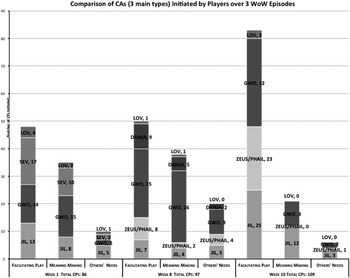
In spite of Gwo’s dominance in initiating CPs, all players (both L2s and NESs) did initiate CAs of all three types, i.e. facilitating gameplay, meaning-making and taking care of others’ needs. Facilitating gameplay was the most common type of CA over all three episodes, followed by meaning-making and taking care of others’ needs. The quantity and diversity of CAs initiated by L2 learners appears to reflect speaking proficiency level (i.e. evidence of learners’ ability to take skilled linguistic action). Lov initiated few CAs, of which 75% were of one type, facilitating gameplay, while Gwo initiated facilitating and meaning-making CAs almost equally in Weeks 1 and 8 and the most CAs concerned with others’ needs in Week 8. For NESs, the quantity and diversity of CA initiation appears to reflect the changing roles of Jil and Zeus/Phail, who acted in Weeks 1 and 8 as “guides on the side” rather than leading conversation or play, but then pursued their own individual player goals in Week 10 when participating L2 players needed little guidance. See Figure 5 below for a comparison of players’ initiation of different CA types.
Comparison of CAs initiated by players over three WoW episodes (Weeks 1, 8, and 10)

4.4 CAs and CEFR descriptors
Looking at the CAs that made up each of the three main categories, it became clear that many of them resembled descriptors of linguistic actions that speakers of an L2 are able to take at different levels of proficiency, such as those found in the CEFR (Council of Europe, 2001).
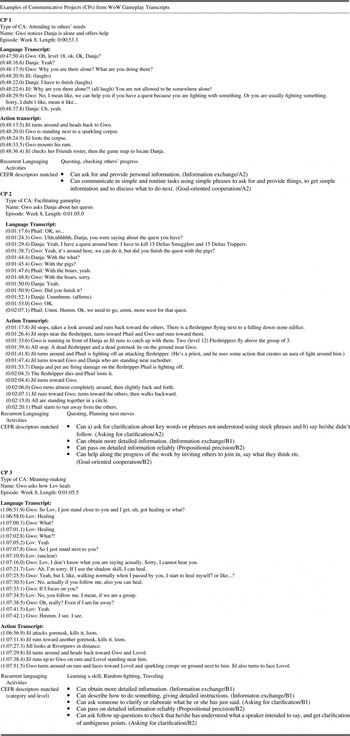
It is evident that common communicative activities in group play of WoW with voice reflected a range of linguistic actions that describe basic to advanced levels of L2 proficiency in English (from A2 to C1). These are the basis of syllabi and curriculum in L2 classrooms. To illustrate this finding more precisely, CAs observed across multiple WoW play episodes were mapped to CEFR descriptors for several categories of speaking and proficiency levels. The categories found to be most relevant to WoW activities included conversation, information exchange, goal-oriented cooperation, transactions to obtain goods and services, coherence, asking for clarification, describing experience, putting (making) a case, and propositional precision. A table matching WoW CAs with CEFR descriptors is included as Appendix B. In Appendix C, three examples of communicative projects from the WoW play transcripts are provided to illustrate each of the three main types of CAs (Attending to Others’ Needs, Facilitating Gameplay and Meaning-making). Both language and action transcripts are included. RLAs are identified along with matching CEFR descriptors, with the category and level for each. These two tables should help readers see how languaging activities in WoW resemble those in contexts of daily life.
4.5 Multimodalities of voice and 3D avatar
Multimodalities of WoW play with use of Skype included player and/or avatar voices, the ambient sounds of the WoW game world, the visual information on players’ computer screens (game interface, texts and text chat, online WoW community websites) and avatar movements and actions. Of the four modes of languaging coded (verbalizing only, movement of avatar only, coordinated verbalizing and movement, and multitasking), coordinated verbalizing and movement and multitasking were most prominent across all three episodes. Multitasking and coordinated verbalizing and movement were each enacted in conjunction with every type of recurrent languaging activity: questing, traveling, city activities, planning next moves, etc. Players were overall most frequently engaged in play that entailed both verbalizing and synchronizing their avatar’s movements and actions, which is an important part of taking skilled linguistic action.
Talking about a past gaming experience or future play co-occurred with traveling, a less demanding RLA compared to questing, that allowed for sharing of stories about adventures in WoW and establishing shared future goals. Co-action, highly coordinated multiplayer interaction, co-occurred most often with questing and city activities.
Group voice chat afforded Lov, a less verbal and less proficient L2 speaker, with a way to participate in CPs, namely by acting in accordance with group plans, often a matter of coordinating who went where and did what. Lov repeatedly demonstrated comprehension with his avatar actions. Avatar-embodiment further allowed him to realize values of caring for group members by allowing him to enact the role of a priest, expected in WoW to heal and bring other players back to life.
5 Discussion
5.1 Skilled linguistic action in contrast with proficiency
WoW gameplay is a CAT (Linell, Reference Linell2009) with socioculturally established interactive routines that are learned with experience over time. The RLAs (questing, planning next moves, traveling, learning a skill, etc.) that constitute WoW gameplay afforded richly contextualized and varied practice with a variety of CAs for L2 learners with varying levels of English proficiency.
Initiation and responsiveness reflected L2 learners’ abilities to take skilled linguistic actions. L2 learners’ speaking proficiency levels in terms of the CEFR scale were reflected by the quantity and breadth of their participation in CAs in WoW. Multimodality allowed less proficient speakers to demonstrate skilled linguistic action by coordinating their actions with group goals, even if they were not verbal.
Most of the communicative activities observed in these WoW episodes, when generalized to other types of coordination besides gameplay, can be considered as skilled linguistic actions that L2 learners should be able to take as independent speakers of English. ‘Independent’ is a CEFR level that represents intermediate to high intermediate proficiency (B1 to B2). High intermediate (B2) is considered the minimum level needed for academic work at the college level.
Standards are important and have a place in L2 teaching and learning (L2TL), but as van Lier (Reference van Lier2004) emphasized, standards should be harmonized with quality learning experiences. Citing Vygotsky, he asserted that learning “should be based on raising ‘intrinsic needs’ in a context in which the educational activities are ‘necessary and relevant for life’” (2004:19). The fantastical, world-at-war environment of WoW casts it as an unlikely place for L2 learners to participate in communicative activities that mirror those they need to engage in outside the game. However, the results of this study show clearly that they do so. The CAs afforded by WoW were identified as critical activities for coordinating with others, for making meaning, and for caring for self and others, categories that are essential for human values-realizing in the contexts of school, work, and daily living. Because languaging activities in WoW group play (and presumably other MMOGs) are recurrent, associated CAs are recurrent, yet they are also subtly different in each re-enactment, allowing L2 learners to detect patterns/invariances in wordings, actions, use of certain artifacts, etc., providing an environment for learning that is not easily orchestrated in an L2 classroom setting.
5.2 Contributions of modalities of voice and avatar-embodiment
Text chat is a powerful affordance for communicating during gameplay and researchers have pointed to its advantages as data for gameplay analysis. It is easy to record and transcription is avoided (Palmer, Reference Palmer2010). But others (Peterson, Reference Peterson2013) have found that learning texting registers and keeping up with large quantities of scrolling text was stressful for L2 learners. In contrast, in this study, the use of voice over Skype afforded complexity in the way L2 players were able to multitask, pursuing game goals with their avatar while for example, getting to know fellow players better.
Bodies and avatars and their abilities have a lot to do with what is perceived and acted upon. MMOGs like WoW are a category of game that afford what Gee (Reference Gee2008) calls “action- and goal-directed simulations of embodied experience” (Gee, Reference Gee2008: 254) which, similar to writing, let us “externalize some of the functions of the mind” (Gee, Reference Gee2008: 254). One way we can do this is by doing something with avatars that Gee claims we do all the time as part of cognition, which is taking a “projective stance” (Gee, 208: 260). We perceive and act in the world by continually meshing our goals, both who we are and who we wish to be, with what the world affords. When we play WoW, for example, as a stealthy dwarf rogue or a spell-casting human warlock, we take the same kind of projective stance, creating a dialog between our own identity and the inherited identity of our avatar.
The co-action of player and avatar in WoW gameplay that Zheng and Newgarden (Reference Zheng and Newgarden2012) described is a dialogical relationship that demonstrates alterity. Developing and drawing on alterity is critical to sociocultural learning (Linell, Reference Linell2009), to caring in conversations (Zheng, Reference Zheng2012) and therefore, to taking skilled linguistic action in the L2. Affordances of avatar-embodiment for L2 learning deserve further exploration and we encourage fellow researchers to consider them in situated accounts.
6 Implications and conclusions
In the best L2 classrooms, ongoing effort is made to create authentic contexts for engaging interactions that incorporate content that is meaningful to learners. Syllabi are carefully constructed to facilitate student learning outcomes that reflect L2 proficiency descriptors such as those presented in the CEFR. The findings of this study suggest that playing WoW together accomplished similar aims. Moreover, learners could perceive the visible outcomes of enacting CAs.
The identification of RLAs in WoW has significance for L2 learning “in the wild” of game worlds as well as for L2TL pedagogies and the design of immersive virtual reality games and environments for L2 learning. First, it suggests that WoW is a context for learning to take skilled linguistic actions, ranging from basic to proficient on the vertical CEFR scale, for learners who may not have the means or time to travel to a country where the L2 is spoken in order to experience so-called “immersion.” Play in a group, preferably a guild with L2 speakers, and use of voice via some type of internet connection, are recommended to maximize affordances for recurrent languaging activities and the communicative activities they entail. The fact that typical CAs developed in WoW gameplay could be mapped to CEFR proficiency descriptors can provide a justification for employing WoW as an L2TL environment. The table in Appendix B (CAs in WoW mapped to CEFR descriptors) could serve as a curriculum resource or assessment tool for teachers or learners engaged in self-guided study. An A2- or B1-level player might note which communicative activities in WoW are associated with speaking activities described by higher-level CEFR descriptors and pay attention to her language and actions as she participates in these. A teacher playing WoW with mixed-level learners might note which CAs come up during play and use the matching CEFR descriptors to assess proficiency or to scaffold learners to carry out actions beyond their current abilities.
The multimodal affordances of digital games should be studied further. It is likely that other MMOGs provide a similar range of communicative activities when played similarly and we assume that players of other MMOGs pick up the affordances of multimodality we identified in these WoW gameplay episodes. To reiterate, we showed that embodying avatars while verbalizing in real-time allowed L2 learners to flexibly integrate actions and words or differentiate them as the demands of coordinating actions allowed. Less verbal L2 learners could participate in CAs through acting in attunement with group goals. An understanding of learning as embodied activity can support future research in the sensory-experienced virtual environments and game worlds that are emerging. The EDD framework and methods of analysis employed in this study can advance study of embodied real-time linguistic interactions and L2 learners’ development.
That RLAs in WoW gameplay supported a wide range of communicative activities is promising and may inspire other L2 practitioners to bring students into the exciting, unpredictable world of the game, which could lead to further discoveries of WoW’s affordances for L2TL. However, it is important to be clear that RLAs are a product of players persistently playing WoW (or other games) with each other over time; they are activities that WoW affords for players who join forces to cooperate and co-act toward shared goals. Therefore, L2 practitioners need to create the necessary conditions for their emergence. They can further support players in developing the habits of good language learners, i.e. setting goals, noticing patterns and consequences, attending to pragmatics and sociocultural norms, anticipating, reflecting on experience, experimenting, and taking risks.
It is hoped that the EDD explanation of L2 languaging will resonate with others in the field who want to have a clear rationale for adopting technologies to facilitate L2 learning. The analysis provided here has demonstrated that skilled linguistic action is a valuable construct for rethinking L2 proficiency, which is not described as output or as a result of an instructional intervention such as gameplay, but as competence demonstrated in the embodied dynamics of play and other languaging activities of L2 learners. A game world such as WoW is an environment for values-realizing in situated sense-making activities. L2 learners are agents with abilities, intentions, and bodies that enable them to perceive and act as part of dialogical, distributed, complex ecosystems. In co-action with others, they have the power to bring a virtual world to life and to exploit the creative potential of living.
Acknowledgements
We wish to thank Dr. Manuela Wagner at the University of Connecticut for her thoughtful review of our first draft and for her ongoing support and interest in our work.
Appendix A
Common European Framework of Reference Oral Assessment Criteria

Appendix B
Communicative activities in WoW mapped to CEFR descriptors

Appendix C
Examples of three main types of CAs in WoW mapped to CEFR descriptors