Implications
In beef breeds that are well adapted to their production environments, there are no apparent constraints to simultaneous genetic improvement of productive and adaptive traits to maximise profitability of herds grazed in the (sub)tropics, although breed-specific parameters are required for genetic evaluations. G × E interactions are unlikely to be of major importance in tropically adapted cattle grazed in either temperate or (sub)tropical environments, although re-ranking is likely to occur in temperate breeds of cattle reared in temperate and (sub)tropical environments. Genomic selection based on single nucleotide polymorphisms offers new opportunities for commercial breeders to better breed and manage their cattle in future. However, the current major limitation to genetic improvement of beef cattle (in all environments) is the lack of large numbers of accurately recorded phenotypes for most productive and adaptive traits.
Introduction
Livestock produce ∼30% of the agricultural gross domestic product (GDP) in the developing world and ∼40% of global agricultural GDP (World Bank, 2009). Most livestock production in the developing world occurs in tropical and subtropical areas, collectively referred to herein as the (sub)tropics. Global cattle inventories estimate ∼1.5 billion head of cattle, with more than 65% located in the (sub)tropics (Morgan and Tallard, Reference Morgan and Tallard2007). Payne and Hodges (Reference Payne and Hodges1997) suggest that beef cattle breeders in developed countries depend primarily on use of additive genetic variance with some limited use of heterosis to achieve genetic improvement. In the (sub)tropics, additive genetic variance and heterosis are equally important for genetic improvement. However, in developing (sub)tropical countries, cattle breeders are generally not able to capture gains through additive genetic variance because of the difficulty of measuring and directly comparing the performance of their animals. Further, because of the variable environmental conditions in the (sub)tropics, the possibility of genotype × environment (G × E) interactions affecting genetic merit for economically important traits must be considered.
Cattle grazed at pasture in (sub)tropical environments are subjected to numerous stressors including ectoparasites (cattle ticks; horn flies, buffalo flies, screw-worm and tsetse flies; other biting insects), endoparasites (gastrointestinal helminths or worms), seasonally poor nutrition, high heat and humidity and diseases often transmitted by parasites. The impact of each stressor on production and animal welfare is often multiplicative rather than additive, particularly when animals are already undergoing physiological stress such as lactation (e.g. Turner and Short, Reference Turner and Short1972; Turner, Reference Turner1982; Frisch and Vercoe, Reference Frisch and Vercoe1984; Frisch and O'Neill, Reference Frisch and O'Neill1998). Under extensive production systems common in the (sub)tropics, it is generally not possible to control the stressors through management strategies alone. Even if intervention strategies were feasible, the treatments per sé often cause their own problems. For example, chemical treatments to control parasites generate concern about residues in beef products. In addition, the parasites acquire resistance to the chemical treatments, creating additional parasite control problems. In intensive feedlot systems and live cattle exports across (sub)tropical regions, high heat and humidity, even in the absence of other stressors, can become critically important for both production and animal welfare reasons. In such cases, management interventions may be possible, but they are difficult and/or expensive to implement, particularly in poorly adapted cattle. Therefore, the best method of reducing the impacts of these stressors to improve productivity and animal welfare is to breed cattle that are productive in their presence, without the need for managerial interventions.
Maximising beef production and profitability requires matching the ‘genotype’ to the specific production environment. Here, ‘genotype’ can be defined as breed (within a crossbreeding system), sire within breed (in a within-breed selection programme) or associations between economically important traits and single nucleotide polymorphism (SNP) genotypes (within a marker-assisted selection programme).
Some genotypes are better suited to particular environments. However, in every environment, factors limit beef production, meaning no one genotype is best in all environments. This paper examines the relative importance of productive and adaptive traits in beef breeding systems for (sub)tropical environments. It also examines the magnitude of G × E interactions in those systems, with the aim of identifying strategies that can be used to mitigate G × E where required.
Breed groupings
Although in temperate environments there may be substantial differences in performance between individual breeds, in (sub)tropical areas, differences in performance are masked by the effects of environmental stressors on productive attributes. As summarised in the review of Burrow et al. (Reference Burrow, Moore, Johnston, Barendse and Bindon2001), for most purposes in the (sub)tropics, breeds can be categorised into general breed types or groupings including:
1. Bos taurus (British and Continental);
2. Bos indicus (Brahman, Nellore);
3. tropically adapted taurine breeds (southern African Sanga, West African humpless and Criollo breeds of Latin America and the Caribbean);
4. tropically adapted indicine × British/Continental composite breeds (e.g. Santa Gertrudis, Braford, Charbray);
5. tropically adapted taurine × British/Continental composite breeds (e.g. Bonsmara, Belmont Red, Senepol);
6. East African zebu breeds (e.g. Boran); and
7. the first cross (F1) between B. indicus and B. taurus, which has attributes that are different from other breed types, particularly in harsher environments.
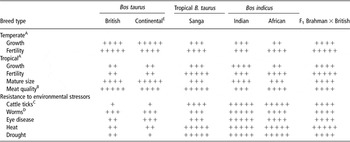
Comparative rankings of the various breed types for different characteristics in temperate and tropical environments based on the Burrow et al. (Reference Burrow, Moore, Johnston, Barendse and Bindon2001) review are shown in Table 1. Because of the paucity of direct breed-type comparisons from most (sub)tropical areas, the rankings in the (sub)tropics are largely based on results from the Belmont Research Station and from the associated research programmes in northern Australian beef industry herds. Breed-type comparisons in temperate areas are largely derived from the Meat Animal Research Center in Nebraska, USA.
Comparative rankings of different breed types for productive traits in temperate and tropical environments and for adaptation to stressors of tropical environments (Source: Burrow et al., Reference Burrow, Moore, Johnston, Barendse and Bindon2001 and references cited therein; the more +s, the higher the value for the trait)

ATemperate environment is assumed to be one free of environmental stressors, whilst tropical environment rankings apply where all environmental stressors are operating. Hence, while a score of, for example, +++++ for fertility in a tropical environment indicates that breed type would have the highest fertility in that environment, the actual level of fertility may be less than the actual level of fertility for breeds reared in a temperate area, due to the effect of environmental stressors that reduce reproductive performance.
BPrincipally meat tenderness.
CRhipicephalus microplus.
DSpecifically Oesophagostomum, Haemonchus, Trichostrongylus and Cooperia spp.
EData from purebred Continental breeds are not available in tropical environments and responses are predicted from the CSIRO Rockhampton crossbreeding data.
Relative importance of productive and adaptive traits
In this paper, tropical adaptation is defined as an animal's ability to survive, grow and reproduce in the presence of the endemic stressors of tropical environments. Economic implications for production systems from the lack of adaptation include production losses impacting on both product quantity and quality, mortalities (particularly from endemic diseases transmitted by parasites), treatment costs (where treatment is feasible) and marketing issues, for example, associated with the presence of chemical residues in beef, resulting from treatments to control parasites.
Although temperament, an aspect of cattle behaviour, is not specific to cattle reared in the tropics, it has implications for tropical adaptation because animals reared in extensive environments are generally handled less frequently than those reared in temperate environments. Inherent differences in temperament between individuals are therefore exaggerated because of the lack of routine handling. This means temperament is an important trait for management reasons under the extensive pastoral systems commonly found in the (sub)tropics.
Poor temperament affects the profitability of beef enterprises by increasing production costs, as well as increasing the risk of injury to animals and their handlers. Significant production losses have been associated with poor temperament, particularly in intensive production systems such as feedlots (Burrow and Dillon, Reference Burrow and Dillon1997; Petherick et al., Reference Petherick, Holroyd, Doogan and Venus2002) and artificial breeding programmes (Burrow et al., Reference Burrow, Seifert and Corbet1988). Sires with poor temperament have been shown to produce progeny whose beef is less tender than progeny of sires with better temperaments (Reverter et al., Reference Reverter, Johnston, Ferguson, Perry, Goddard, Burrow, Oddy, Thompson and Bindon2003b; Kadel et al., Reference Kadel, Johnston, Burrow, Graser and Ferguson2006), although Burrow et al. (Reference Burrow, Shorthose and Stark1999) and Wolcott et al. (Reference Wolcott, Johnston, Barwick, Iker, Thompson and Burrow2009) also indicate it may be possible to overcome this negative relationship between temperament and beef tenderness through use of best practice processing techniques. Regardless, with the increasing emphasis placed by consumers on ethical production systems, it is essential to consider the animal welfare implications of handling animals with poor temperaments.
Table 1 presents an aggregated summary of productive and adaptive data from a range of sources (see references in the original Burrow et al., Reference Burrow, Moore, Johnston, Barendse and Bindon2001 review). From that table, it is apparent that in the presence of environmental stressors, productive attributes (primarily growth and fertility) of poorly adapted cattle are significantly reduced relative to their performance in temperate environments or relative to the performance of adapted cattle in the (sub)tropics. Re-ranking of breeds across the different temperate and tropical environments shown in Table 1 is also examined in the following discussion of G × E interactions. However, it is apparent from Table 1 that any breeding programme designed for cattle grazing in the (sub)tropics must consider the impacts of both productive and adaptive attributes, even though adaptive traits (and some productive traits) are generally very difficult and/or expensive to measure.
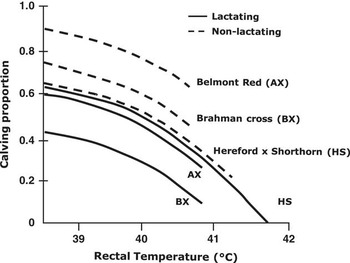
As described in many previous publications from northern Australia summarised in Table 1, the relative importance of adaptive traits and their impacts on productive traits such as growth (e.g. Frisch and Vercoe, Reference Frisch and Vercoe1984) and calving rates (e.g. Turner, Reference Turner1982) depend greatly on the breed type, the degree of severity of the individual stressor and whether or not multiple stressors are impacting on performance. For example, Figure 1 shows the relationship between rectal temperatures and calving rates in British, Brahman- and Africander-derived lactating and non-lactating crossbred cows reared at Belmont Research Station in northern Australia. The average depression in calving rates due to susceptibility to heat stress was 0.15 to 0.25 in F3 et seq. generation British crossbred cows and 0.10 in the F3 et seq. generation B. indicus (Brahman) and Sanga (Africander) × British crossbreds. Differences in performance between lactating and non-lactating British cows were much smaller than the differences evident in the Brahman and Africander cross cows (Turner, Reference Turner1982). These and other results from (sub)tropical environments suggest that breeding programmes in such areas must consider both productive and adaptive traits if they are to be effective. However, the differing impacts of environmental stressors across breed types suggest that economic weightings for use in selection indices will need to be specifically developed for each breed type and environment.
The impact of rectal temperature under conditions of high ambient temperature and calving rates of lactating and non-lactating cows of three breed types (British – Hereford × Shorthorn cross; Brahman × British; Africander × British) grazed at pasture in northern Australia (Source: Turner, Reference Turner1982).

Are the traits under genetic control?
For traits to be included in effective breeding programmes, they must be under direct or indirect genetic control. Direct genetic control is assessed by estimating the heritability of traits. Indirect genetic control is achieved through favourable or unfavourable associations (genetic correlations) between different traits.
Earlier extensive reviews of the scientific literature (e.g. Davis, Reference Davis1993; Koots et al., Reference Koots, Gibson, Smith and Wilton1994; Burrow, Reference Burrow2001) and the references therein indicate that direct and maternal growth traits at all ages are at least moderately heritable in both temperate and (sub)tropical environments, as well as in temperate and tropically adapted breeds of cattle, meaning they will respond to genetic improvement programmes. The reviews also indicate it is possible to select to improve growth rate and weights of sale progeny while simultaneously restricting calf birth weights and mature cow weights to avoid the negative consequences of dystocia and increased mature cow feed requirements.
Genetic associations exist between growth traits and body composition attributes such as retail beef yield, fat depth and marbling (the review of Burrow et al., Reference Burrow, Moore, Johnston, Barendse and Bindon2001 and references therein; Reverter et al., Reference Reverter, Johnston, Perry, Goddard and Burrow2003a and Reference Reverter, Johnston, Ferguson, Perry, Goddard, Burrow, Oddy, Thompson and Bindon2003b; Wolcott et al., Reference Wolcott, Johnston, Barwick, Iker, Thompson and Burrow2009) and feed efficiency (Robinson and Oddy, Reference Robinson and Oddy2004; Barwick et al., Reference Barwick, Wolcott, Johnston, Burrow and Sullivan2009a). Genetic and phenotypic associations also exist between growth and reproductive attributes (Burrow et al., Reference Burrow, Seifert and Hetzel1991; Burrow, Reference Burrow2001 and references therein). These associations must be included in the design of breeding programmes for both temperate and (sub)tropical environments.
The Burrow et al. (Reference Burrow, Moore, Johnston, Barendse and Bindon2001) review and references therein indicate that carcass composition traits (e.g. carcass weight, fat thickness and marbling) are moderately to highly heritable. Most estimates of retail beef yield percentage are also highly heritable, offering good potential for within-breed improvement, although a moderate-to-strong antagonistic relationship exists between yield and marbling, meaning that measurement of all traits will be required if unfavourable consequences of selection are to be avoided. Beef tenderness is lowly heritable in British breeds of cattle when processing factors are strictly controlled (Johnston et al., Reference Johnston, Reverter, Ferguson, Thompson and Burrow2003b); however, tenderness is moderately to highly heritable in B. indicus breeds (the Burrow et al., Reference Burrow, Moore, Johnston, Barendse and Bindon2001 review and references therein; Johnston et al., Reference Johnston, Reverter, Ferguson, Thompson and Burrow2003b; Wolcott et al., Reference Wolcott, Johnston, Barwick, Iker, Thompson and Burrow2009), suggesting the trait can be improved in tropically adapted cattle by selection. However, the lack of direct measurement of beef tenderness in live animals remains a constraint for breeding programmes.
Most reviews of the published literature suggest the heritability of female reproductive traits such as pregnancy rate or days to calving is low (e.g. Davis, Reference Davis1993; Koots et al., Reference Koots, Gibson, Smith and Wilton1994; Burrow, Reference Burrow2001 and references therein). However, recent reports indicate the component traits of reproduction (e.g. age at puberty and post-partum anoestrus interval) are much more heritable, and therefore potentially much more useful for genetic improvement programmes than traditional measures (Johnston et al., Reference Johnston, Barwick, Holroyd, Fordyce and Burrow2006, Reference Johnston, Barwick, Corbet, Fordyce, Holroyd, Williams and Burrow2009 and Reference Johnston, Barwick, Fordyce and Holroyd2010).
Except for a number of largely interdependent Australian studies (see reviews of Kloosterman et al., Reference Kloosterman, Parmentier and Ploeger1992; Davis, Reference Davis1993; Prayaga et al., Reference Prayaga, Barendse and Burrow2006 and references therein), there are relatively few reports of the heritability of resistance to parasites, disease and heat stress in beef cattle. Studies in sheep and beef cattle from Australia and elsewhere attribute differences in host–parasite interactions to genetics based on measured differences between breeds (e.g. Duarte-Ortuňo et al., Reference Duarte-Ortuňo, Thorpe and Tewolde1988; de Castro and Newson, Reference de Castro and Newson1993; Stear and Murray, Reference Stear and Murray1994; Sorci et al., Reference Sorci, Moller and Boulinier1997; Stein et al., Reference Stein, Ayalew, Rege, Mulatu, Malmfors, Dessie and Philipsson2009). The paucity of reports of genetic parameters for adaptive traits is assumed to be because of the great difficulty in measuring the very large numbers of animals required for such studies. This section therefore briefly reviews the scientific literature to determine the extent of genetic control of the recently introduced component traits of female reproduction and adaptive traits, to allow an evaluation of the relative impact of productive and adaptive traits in cattle breeding programmes for (sub)tropical environments.
Component traits of female reproduction
Because of the low heritability (i.e. <0.10) of most traditional measures of female reproduction, inclusion of female fertility traits in beef genetic evaluation systems may require identification of new traits that can be recorded early in life, are heritable and are genetically correlated with the underlying profit trait. One of the aims of a major study in northern Australia (Burrow et al., Reference Burrow, Johnston, Barwick, Holroyd, Barendse, Thompson, Griffith and Sullivan2003) was to identify alternative measures of female reproduction and their associations with other productive and adaptive traits in tropical cattle. The study compared Brahman and Tropical Composite heifers raised in four locations in northern Australia from weaning until they entered the breeding herds at ∼27 months of age, and subsequently had the opportunity to raise six calves before being culled at around 10 years of age. Each heifer was ovarian scanned every 4 to 6 weeks from weaning until she entered the breeding herd to determine the age at first-observed corpus luteum (CL) or corpus albicans (CA). The presence of a CL/CA was used to define the age at puberty for each heifer. Reproductive tract size was also measured at the start of the first joining period (Johnston et al., Reference Johnston, Barwick, Corbet, Fordyce, Holroyd, Williams and Burrow2009).
In females that had calved, ovarian ultrasound scanning for the presence of a CL/CA was also used to determine resumption of cycling post partum. Scanning of all cows commenced at the end of the calving period (coinciding with the start of mating) when the cows were on average 6 to 7 weeks post partum and was continued every 4 weeks up to weaning, 6 to 7 months after the start of mating. Those cows still without an observed CL/CA at weaning were scanned every 4 to 8 weeks until their first CL/CA was observed. Several traits were defined for lactating cows to investigate the degree of genetic control of post-partum lactation anoestrus. The first trait, describing the post-partum anoestrus interval (PPAI), was defined as the number of days from commencement of scanning to the estimated first ovulation date for each cow as defined by the presence of a CL/CA and from estimates of foetal age for pregnant cows. Distributions of PPAI records revealed a spike after weaning. Hence, to further investigate PPAI, the measure was divided into two traits, representing cows that first ovulated before weaning and those that first ovulated post weaning. The post-weaning trait was re-computed as the number of days from the weaning date to the estimated first ovulation date. Each of the traits was defined for lactating 3-, 4- and 5-year-old cows (Johnston et al., Reference Johnston, Barwick, Fordyce and Holroyd2010). To date, results for lactating cows have been published only for Brahmans, because of the greater incidence of post-partum anoestrus evident in that breed. Complete results will be submitted for publication in early 2012.
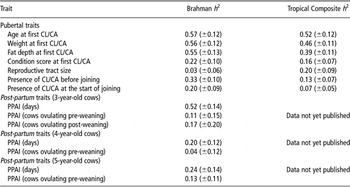
In contrast to heritabilities of <0.10 for most traditional reproductive traits, Johnston et al. (Reference Johnston, Barwick, Corbet, Fordyce, Holroyd, Williams and Burrow2009) report that several pubertal traits such as age, weight and fat depth at time of first CL/CA were moderately to highly heritable (Table 2). In general, more genetic variation was observed for Brahmans than for Tropical Composites. Genetic differences observed for age at first CL/CA in Brahmans appear to be more important than those for Tropical Composites because of the lower percentage of Brahman heifers observed with a CL/CA before joining.
Heritabilities (h 2) and standard errors (in parentheses) for heifer puberty traits in Brahmans and Tropical Composites (Source: Johnston et al., Reference Johnston, Barwick, Corbet, Fordyce, Holroyd, Williams and Burrow2009; CL – corpus luteum; CA – corpus albicans) and for lactation anoestrus traits in Brahmans only (Source: Johnston et al., Reference Johnston, Barwick, Fordyce and Holroyd2010; PPAI – post-partum anoestrus interval)

Genetic correlations between the age at CL/CA and both heifer- and steer-production traits showed important genotype differences (Johnston et al., Reference Johnston, Barwick, Corbet, Fordyce, Holroyd, Williams and Burrow2009), but the authors concluded that selection could be used to change heifer age at puberty in both Brahmans and Tropical Composites, with few major antagonisms with either steer- or heifer-production traits. Results across the four different tropical locations indicate that puberty in beef heifers is not simply controlled by weight, growth rate or age alone, but appears to involve a combination of factors relating to physiological age, size and growth rate and probably also involves body condition in Brahmans.
In lactating Brahman cows derived from the same experiment, Johnston et al. (Reference Johnston, Barwick, Fordyce and Holroyd2010) reported that calving rates were reduced relative to non-lactating cows, especially in 3-year-old cows. This was evident in their mean PPAI of 134 days, with only 53% of 3-year-old cows having their first ovulation before the weaning of their first calf. For lactating 4- and 5-year-old cows, the PPAI averaged 66 and 40 days with 81% and 93% recording an ovulation before weaning, respectively. For cows cycling before weaning, the average PPAI declined across age classes from 40 days for 3-year-old cows to 36 days for 5-year-old cows. For those cows not observed with a CL/CA before weaning, the average number of days from weaning until their first ovulation was 99, 74 and 76 for 3-, 4- and 5-year-old cows, respectively. Heritabilities of PPAI were highest (0.52) in 3-year-old cows, declining to 0.20 and 0.24 in lactating 4- and 5-year-old cows (Table 2). Results suggest that much of the genetic variance in PPAI is the result of whether or not the cow cycled before weaning. Primary reasons for delayed post-partum resumption of cycling are low body condition (Rudder et al., Reference Rudder, Seifert and Burrow1985) and the effect of suckling (Montiel and Ahuja, Reference Montiel and Ahuja2005). Until the complete dataset from six calving opportunities has been analysed, firm recommendations about which trait(s) has the most potential for use in breeding programmes cannot be made. Ideally, the complete analyses will identify early-life indicator traits that can be used to improve lifetime reproductive performance.
Adaptive traits
Stear et al. (Reference Stear, Bishop, Mallard and Raadsma2001) reviewed the livestock production literature and reported that, across species, the heritability of traits associated with resistance to many important diseases and parasites is often high and considerable variation exists among animals. Their review did not differentiate between livestock reared in temperate and tropical environments or under extensive and intensive production systems. Among ectoparasites in cattle, they reported significant heritabilities for nematode species (Stear et al., Reference Stear, Hetzel, Brown, Gershwin, Mackinnon and Nicholas1990; Mackinnon et al., Reference Mackinnon, Meyer and Hetzel1991, both based on a subset of data from northern Australia reported herein); tick infestations (Stear et al., Reference Stear, Hetzel, Brown, Gershwin, Mackinnon and Nicholas1990; Minjauw and de Castro, Reference Minjauw and de Castro2000); and buffalo fly numbers (Stear et al., Reference Stear, Hetzel, Brown, Gershwin, Mackinnon and Nicholas1990). Among endoparasites, they reported significant heritabilities for resistance to trypanosomes (Murray et al., Reference Murray, Stear, Trail, d'Ieteran, Agyemang and Dwinger1991) and also indicated the heritability of immune response traits could be substantial in pigs and dairy cattle.
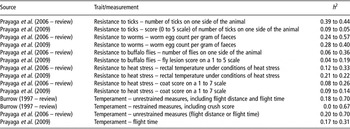
Prayaga et al. (Reference Prayaga, Barendse and Burrow2006) undertook a review of the genetics of tropical adaptation just in beef cattle, summarising the genetic basis of adaptive traits and their relationships with productive attributes. They indicated that most adaptive traits were moderately to highly heritable (Table 3). Their results were confirmed in a later, independent experiment undertaken in similar environments to the studies in the earlier review (Prayaga et al., Reference Prayaga, Corbet, Johnston, Wolcott, Fordyce and Burrow2009), indicating there is ample opportunity to improve these traits through selection, even though they are difficult to include in genetic evaluation systems because of their difficulty of measurement.
Range of heritabilities (h 2) for traits associated with resistance of cattle to stressors of tropical environments (note: except for measures of temperament, these estimates are almost exclusively derived from experiments in cattle grazed at pasture in Northern Australia)

Tick burdens in the Prayaga et al. Reference Prayaga, Corbet, Johnston, Wolcott, Fordyce and Burrow(2009) study were very low due to prolonged periods of drought.
Reference BurrowBurrow (1997) reports a wide range of measures from studies around the world that were focused mainly on temperament, whereas the Prayaga et al. Reference Prayaga, Barendse and Burrow(2006) review is restricted to measures of flight time in animals that were simultaneously recorded for productive and adaptive traits.
On the basis of the genetic correlations amongst the various adaptive traits, it appears that selection to improve resistance to any one stressor is likely to increase resistance to other stressors (Burrow, Reference Burrow2001; Burrow and Prayaga, Reference Burrow and Prayaga2004; Prayaga et al., Reference Prayaga, Barendse and Burrow2006). This is particularly true for resistance to ticks, worms and heat stress, where genetic correlations have been shown to be consistently moderately positive, suggesting the same or closely linked genes affect these traits.
The same is not true of correlations between adaptive and productive traits. Except for heat stress measured by rectal temperatures under conditions of high ambient temperatures, resistance to most environmental stressors appears to be largely independent of productive traits such as growth, reproduction and product quality, albeit the conclusions are drawn from a small number of largely interdependent Australian studies (Burrow, Reference Burrow2001). Genetic correlations between resistance to heat stress and growth and reproduction traits (Turner, Reference Turner1982 and Reference Turner1984; Burrow, Reference Burrow2001; Burrow and Prayaga, Reference Burrow and Prayaga2004) are generally significantly negative (favourable), emphasising there are many genes in common between genes controlling growth and reproduction in the tropics and rectal temperatures when ambient temperatures are high.
On the basis of this review, most economically important productive and adaptive traits are at least moderately heritable, indicating they will respond to selection. In addition, there are no major strongly antagonistic relationships between the traits that would preclude simultaneous genetic improvement for all the traits in tropical beef breeding objectives.
G × E interactions
G × E interactions may impact significantly on production levels across different environments. Such interactions have traditionally been indicated by the re-ranking of breeds, or sires within breeds, for performance across different environments or by genetic correlations between traits in different environments that are either antagonistic, or if positive, somewhat less than unity (e.g. <0.80). More recently, interest has focused on possible changes in SNP associations with economically important traits across environments as a further indication of G × E. This section examines each of the different methods of evaluating the magnitude of G × E interactions, particularly as they impact on breeding programmes in the (sub)tropics.
Re-ranking of breeds across environments
Table 1 suggests re-ranking of breeds can be routinely expected to apply across extreme temperate and (sub)tropical environments. Burrow et al. (Reference Burrow, Moore, Johnston, Barendse and Bindon2001) and Burrow (Reference Burrow2006) cite many earlier studies from a number of countries, which report that differences between breeds are significant and large for most economically important traits. However, the ranking of the breeds for those traits is not always consistent across environments. In the (sub)tropics, the easiest way for commercial beef producers to overcome G × E interactions without managerial intervention is simply to use the most appropriate breed(s), that is, those that are best adapted to the stressors of the particular environment. In within- or across-breed selection programmes, this allows optimal exploitation of the significant between-breed differences to maximise production levels, without compromising adaptation to the environment. For beef production in (sub)tropical environments, it makes little sense to use purebred British or Continental breeds of cattle unless they have specific attributes that mean the cost of using them in those (sub)tropical environments is well compensated by financial rewards through niche markets.
Re-ranking of sires within breeds
G × E interactions that involve re-ranking of sires within breeds across environments potentially have a much greater impact on beef production than re-ranking of breeds per sé. This is because it is much simpler and less expensive to change to a better adapted breed in (sub)tropical environments than it is to identify sires within breed(s) that are genetically superior for the full range of productive and adaptive traits required in these environments. For example, if breeders aim to improve beef tenderness in tropically adapted cattle, it is far easier to use tropically adapted breed types that have inherently more tender beef (e.g. the tropically adapted taurine breeds) than to select within the B. indicus breeds to improve tenderness, at least using traditional quantitative genetic approaches. In future, the use of DNA markers may make within-breed selection more feasible. It is important to independently examine the extent of G × E in both poorly adapted (British and Continental) and tropically adapted breeds.
Re-ranking of British breed sires across temperate and tropical environments
Frisch (Reference Frisch1981) compared Hereford × Shorthorn (HS) cattle selected for high growth in the presence of environmental stressors in the Australian tropics relative to a control line of HS cattle that had been selected at random. Selection for high growth in HS cattle increased adaptation to environmental stressors, but did not increase components associated with direct genes for growth. Selected animals grew faster in the presence of stressors, but control animals grew faster in their absence, suggesting that improvements in growth rate were achieved entirely through increases in resistance to environmental stressors that affected growth rate.
In contrast, Rudder et al. (Reference Rudder, Seifert and Burrow1986) compared progeny of the same HS control line sires selected in the presence of environmental stressors with progeny of commercial sires selected in the absence of parasites and reared together in the (sub)tropics. They concluded that re-ranking of sires for growth did not occur across tropical and temperate environments if the sires were selected in tropical environments. However, considerable re-ranking (G × E) occurred if bulls were selected in more benign environments and then used in harsher environments.
In the United States of America, the extent of G × E was studied for pre- and post-weaning traits of Hereford bulls and heifers and reproductive traits of females bred in Montana and raised in Montana and Florida (Burns et al., Reference Burns, Koger, Butts, Pahnish and Blackwell1979; Koger et al., Reference Koger, Burns, Pahnish and Butts1979; Pahnish et al., Reference Pahnish, Koger, Urick, Burns, Butts and Richardson1983 and Reference Pahnish, Urick, Burns, Butts, Koger and Blackwell1985). Results indicated the existence of economically important G × E interactions across environments. It should be noted the transfer of cattle was only from the temperate (Montana) to a tropical (Florida) environment. Hence, the validity of the Rudder et al. (Reference Rudder, Seifert and Burrow1986) results could not be tested in that experiment.
More recently, de Mattos et al. (Reference de Mattos, Bertrand and Misztal2000) examined weaning weight records of ∼3 million Hereford calves across the United States, Canada and Uruguay. Genetic correlations across those environments all exceeded 0.85, indicating a general absence of genotype × country interactions for weaning weight. Similarly, Jeyaruban et al. (Reference Jeyaruban, Johnston and Graser2009) estimated G × E interactions for growth, scanned carcass and reproductive traits in Angus cattle reared in Victoria (Mediterranean/temperate environments) or Queensland (warm temperate environment) in Australia. Their results showed little evidence of G × E for any of the traits across those environments.
Ibi et al. (Reference Ibi, Hirooka, Kahi, Sasae and Sasaki2005) examined the effects of G × E interactions on carcass quality attributes in Japanese Black cattle that originated in either Tohoku (20 106 animals born in a cold environment with large differences in temperature between summer and winter) or Kyusyu (34 670 animals born in a relatively warm climate throughout the year), with half of each cohort transferred to the alternate environment. A total of 54 776 carcass records were available for the study. Estimates of genetic correlations between the regions for the range of carcass traits were ⩾0.93. Corresponding estimates between management systems (reflecting length of feedlot finishing system) were all ⩾0.84. The authors concluded that G × E interactions on carcass traits of Japanese Black cattle were biologically unimportant.
From these studies, it is concluded that G × E within breeds may have a significant impact in poorly adapted breed types across extreme environments (tropical and temperate) or where breeding animals are selected in a stress-free environment for use in (sub)tropical environments. However, G × E interactions are unlikely to be of major importance for B. taurus breeds across the temperate and relatively benign subtropical environments where they are traditionally grazed.
Re-ranking of tropical breed sires across temperate and tropical environments
This section examines the use of tropically adapted sires bred in the tropics and used to generate progeny that are raised in either temperate or tropical environments or under different management systems (e.g. pasture v. grain finishing).
Johnston et al. (Reference Johnston, Reverter, Burrow, Oddy and Robinson2003a and Reference Johnston, Reverter, Ferguson, Thompson and Burrow2003b) and Reverter et al. (Reference Reverter, Johnston, Perry, Goddard and Burrow2003a and Reference Reverter, Johnston, Ferguson, Perry, Goddard, Burrow, Oddy, Thompson and Bindon2003b) examined a wide range of live animal and carcass and beef quality attributes in Brahman, Santa Gertrudis and Belmont Red breeds in Australia to determine the impact of G × E across: (a) tropical and temperate regions; (b) three market carcass weight end points (i.e. ∼220 kg, ∼280 kg or ∼340 kg); and (c) pasture- v. grain-finishing regimes. Estimates of genetic correlations showed little evidence of G × E for any trait except P8 fat depth, meat colour and marbling in tropically adapted cattle across temperate- v. tropical-finishing environments and for retail beef yield and meat colour across feedlot v. pasture finishing. Genetic correlations for most measures of beef tenderness across markets and finishing regimes were close to unity except for cooking loss in a single muscle (m. longissimus thoracis et lumborum).
A subsequent major independent study based on Brahmans and Tropical Composites in northern Australia examined whether G × E occurred for a wide range of productive and adaptive traits in steers managed in relatively benign environments from weaning at ∼6 months of age and fed a high grain diet over a 100-day finishing period relative to the performance of their half-sib heifers destined for the breeding herds and managed at pasture in (sub)tropical environments. Barwick et al. (Reference Barwick, Wolcott, Johnston, Burrow and Sullivan2009a) found that in steers grown under commercial backgrounding and grain-finishing environments, G × E interactions were indicated by the presence of significant genotype × cohort effects, with the mean cohort performance for a trait assumed to be the measure of environment level. Significant genotype × cohort effects existed for many measures at and before the steers entered the feedlot, indicating the differences evident in Brahmans and Tropical Composites could change under different environmental conditions. There was a significant tendency for daily weight gains to increase more rapidly with improvement in environment in Tropical Composites than in Brahmans. The advantage in feedlot average daily gain in Tropical Composites is greater when conditions favour faster growth and less when growth conditions are poorer. The results emphasise the need for a population-specific understanding of trait relationships and of trait differences between measurement times in order to optimise breeding programme design.
Similarly, Wolcott et al. (Reference Wolcott, Johnston, Barwick, Iker, Thompson and Burrow2009) reported that genotype-specific evaluations will be necessary to accommodate different genetic relationships between meat quality, carcass and live animal traits. Brahmans and Tropical Composites were significantly different for some key meat quality and carcass traits, supporting the ‘Meat Standards Australia’ position that B. indicus content be included as a factor in meat quality grading (see papers in Thompson et al., Reference Thompson, Polkinghorne, Anderson and Webb2008). In addition, the developmental stage when live measurements were recorded and the production environment under which animals were managed at that age influenced the magnitude and, in some cases, the direction of genetic relationships between carcass and meat quality traits and live animal measurements. This emphasises the importance of thoroughly defining measurement protocols, including animal age and condition at time of assessment, for live animal traits that are to be included in a genetic evaluation analysis.
Barwick et al. (Reference Barwick, Johnston, Burrow, Holroyd, Fordyce, Wolcott, Sim and Sullivan2009b) reported that Brahman heifers grew faster in wet seasons and slower in dry seasons than Tropical Composites, whereas Brahman steers grew slower than Tropical Composites throughout grow-out and finishing in different (sub)tropical and temperate feedlot environments. Brahman heifers were fatter and had higher condition scores at the end of wet and dry seasons than Tropical Composites, whereas Brahman steers had less fat and lower condition scores at the end of feedlot finishing. Numerous genetic correlations between heifers and steers differed substantially from unity, particularly in Brahmans, suggesting there may be scope to select differently in the sexes where that would aid their production roles (i.e. to improve reproduction and adaptation in females and feed efficiency and market attributes in steers).
The Barwick et al. (Reference Barwick, Johnston, Burrow, Holroyd, Fordyce, Wolcott, Sim and Sullivan2009b) study also indicated that genetic correlations declined as measurement environments became more different, with the rates of decline sometimes differing between Brahmans and Tropical Composites. This occurred to varying extents for the traits and breeds examined, also suggesting the different breeds were sensitive to varying environments. For example, Brahman heifers seemed better able than the Tropical Composites to align their growth with the feed available in ‘wet’ and ‘dry’ seasons and to retain fat up to the end of the ‘dry’ season. The re-ranking of Brahmans and Tropical Composites between heifers and steers for aspects of growth and fatness could represent a special case of G × E (i.e. genotype × sex interactions), given the confounding of sex and environment in the study.
There was, however, no evidence of re-ranking of sires for female reproductive performance across four different (sub)tropical environments (Johnston et al., Reference Johnston, Barwick, Holroyd, Fordyce and Burrow2006). These results, together with results from selection experiments based on tropically adapted cattle in the tropics that suggest adaptive traits are genetically independent of productive traits (e.g. Burrow, Reference Burrow2001), indicate it is possible to effectively design optimal breeding programmes that use opportunities provided by G × E across steer and heifer environments to maximise production and adaptation in beef cattle across both temperate and (sub)tropical environments.
Several other studies used data derived from national genetic evaluation schemes to evaluate G × E interactions by distinguishing ‘good’ and ‘poor’ environments on the basis of mean performance levels of animals. Bradfield et al. (Reference Bradfield, Graser and Johnston1997) used weaning weight records of 12 563 Santa Gertrudis calves to estimate (co)variance components. The analysis considered measurements on animals born in favourable Australian environments as Trait 1 and animals born in unfavourable production environments as Trait 2. An additive genetic correlation of 0.64 between production environments was significantly different from unity, suggesting the existence of genotype × production environment interactions. However, when a sire × contemporary group interaction effect was included in the model, the genetic correlation was not significantly different from unity, suggesting the ranking of Santa Gertrudis sires across production environments was caused by changes in ranking from one contemporary group to the next, rather than changes in ranking across production environments. This study clearly demonstrates the importance of including a sire × contemporary group interaction when modelling G × E interactions or undertaking genetic evaluations.
Similar findings were reported by Neser et al. (Reference Neser, Konstantinov and Erasmus1996 and Reference Neser, Erasmus, van Wyk and Deventer1998) and Nephawe et al. (Reference Nephawe, Neser, Roux, Theron, van der Westhuizen and Erasmus1999) in Bonsmara cattle in South Africa. Nephawe et al. (Reference Nephawe, Neser, Roux, Theron, van der Westhuizen and Erasmus1999) examined the possible interactions between sire and four ecological regions using birth and weaning weight records of 43 628 calves from 18 herds. Genetic correlations and expected correlated responses to selection were estimated assuming the same trait to be a different trait when measured in each of the four different regions. The results indicate that for the purpose of genetic evaluation, the three Bushveld regions were the same, but the Highveld region could be considered as a separate environment, with selection of bulls bred on the Highveld for use in the Bushveld regions likely to be less effective than selection of bulls bred anywhere in the Bushveld and conversely. However, the results also confirmed that the interaction between sire and contemporary group was more important than between sire and any designated region. The separate studies of Neser et al. (Reference Neser, Konstantinov and Erasmus1996 and Reference Neser, Erasmus, van Wyk and Deventer1998) reinforce the importance of considering both permanent maternal environment and herd–year–season by sire interactions in evaluation of G × E interactions. The authors concluded that excluding herd–year–season × sire interaction could lead to a serious overestimation of the direct additive components of growth, with the same applying for permanent maternal environment, which if excluded could lead to a serious overestimation of maternal components of growth.
Re-ranking of SNPs
To date, there are no published reports on the extent of G × E based on SNPs in beef cattle, although unpublished data from Australia, United States of America and Canada based on Illumina's BovineSNP50 Infinium Assay indicate significantly greater discord between significant SNP for growth, feed efficiency and carcass and beef quality attributes between Australia and North America relative to United States of America and Canada (Bennett GL, Goddard ME, Miller SP, Thallman RM et al., unpublished results). These results were expected and they support published results from laboratory species, for example, reproductive performance in Drosophila melanogaster across three environmental treatments (Fry et al., Reference Fry, Nuzhdin, Pasyukova and Mackay1998) and broiler chicken mortality across commercial v. selection nucleus environments (Long et al., Reference Long, Gianola, Rosa, Weigel and Avendaño2008). Long et al. (Reference Long, Gianola, Rosa, Weigel and Avendaño2008) concluded there was unlikely to be a universally optimal SNP subset for predicting trait performance, although Fry et al. (Reference Fry, Nuzhdin, Pasyukova and Mackay1998) also reported there was no evidence for SNPs with opposite fitness effects in different environments.
It is possible that prediction equations based on genome-wide SNP associations (i.e. on tens of thousands of SNPs) may prove to be more reliable indicators of performance across environments than individual SNPs. This remains to be tested, at least in beef cattle.
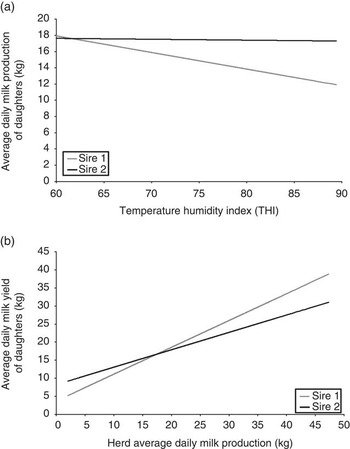
In an Australian study in dairy cattle, Hayes et al. (Reference Hayes, Bowman, Chamberlain, Savin, van Tassell, Sonstegard and Goddard2009) reported results from a genome-wide association study designed to detect SNPs associated with the sensitivity of milk production to environmental conditions (e.g. pasture rather than grain to feed cows and environments that differed substantially in daily ambient temperatures) across a wide range of production environments. Figure 2 shows the responses in milk production to environmental variables for the extreme sires under a varying temperature–humidity index and relative to performance as measured by herd average daily milk production, which was used as a surrogate for the level of feeding. SNPs associated with these responses to feeding level and temperature–humidity index were reported on chromosome 9 and 29, respectively, and were subsequently validated in two independent populations, one being a different breed of cattle. The authors suggested these validated marker panels could be used to select cows that are less sensitive to heat stress and low feeding level than average dairy cows.
Responses in milk production to environmental variables for different sires. (a) Predicted response in daily milk production of daughters to temperature humidity index for the two most extreme sires from the data set. (b) Predicted response in daily milk production of daughters to herd average daily milk production, a surrogate for the level of feeding, for two sires from the data set. Single nucleotide polymorphisms associated with these responses were validated on chromosomes 9 and 29 (Source: Hayes et al., Reference Hayes, Bowman, Chamberlain, Savin, van Tassell, Sonstegard and Goddard2009).

In a separate study, Lillehammer et al. (Reference Lillehammer, Hayes, Meuwissen and Goddard2009) identified SNPs with significant effects for all milk production traits. The significant markers were categorised according to their joint effects on production and environmental sensitivity. Approximately one-third of the significant markers affected the intercept and slope in opposite directions, suggesting the possibility they could be used to facilitate marker-assisted selection for environmental sensitivity.
It is apparent that G × E interactions will need to be considered in SNP association analysis of complex traits when undertaking genome-wide association studies, but the magnitude of their impact is still to be confirmed in well-designed livestock experiments.
Strategies to maximise adaptation and production in different environments
On the basis of the several earlier reviews of the literature cited here, Burrow (Reference Burrow2006) suggested a number of ‘rules of thumb’ that apply to optimally match ‘genotypes’ to their production and marketing environments and to overcome the detrimental impacts of G × E interactions where they exist. These ‘rules of thumb’ as they apply to crossbreeding systems include:
1. Depending on the severity of the environment and the level of stressor challenge, 25% to 75% ‘adapted genes’ are required for optimal production. Only exceptionally stressful environments require 100% ‘adapted genes’.
2. ‘Adapted genes’ can be derived from B. indicus and their derivatives, as well as the tropically adapted taurine breeds. This provides an opportunity to take advantage of heterosis from crossbreeding and to maximise productivity without reducing resistance to environmental stressors below levels acceptable for the particular environment in which production is to occur.
3. For most (sub)tropical environments, optimal levels of productivity and adaptation will be achieved using a combination of multiple breed types (e.g. B. indicus, tropically adapted taurine, British, Continental).
4. In harsh (sub)tropical environments, some B. indicus content is required to ensure sufficient adaptation to parasites (mainly ticks and worms). The harsher and wetter the environment, the greater the need for B. indicus content.
5. Even in the harshest tropical environment, it is possible to combine B. indicus and adapted taurine breeds to optimise heterosis and maximise productivity. If 60% to 100% ‘adapted genes’ are required, a purebred tropically adapted taurine breed (e.g. Sanga or Criollo) could be combined with a B. indicus or B. indicus-derived breed to provide high levels of adaptation and capture the advantages of heterosis. If lower levels of adaptation (e.g. 25% to 60%) are required, an adapted taurine composite (e.g. Bonsmara, Senepol) could be combined with a B. indicus or B. indicus-derived breed to achieve desired levels of production and adaptation.
In breeds that are well adapted to their production environment, very few antagonistic relationships exist that would preclude simultaneous genetic improvement of both productive and adaptive traits through selection to maximise herd profitability in (sub)tropical environments. The major constraint to genetic improvement under commercial production systems in the (sub)tropics is the difficulty and expense of measuring the complete range of economically important productive and adaptive traits required to achieve a balanced breeding objective.
Genomic selection on the basis of SNPs offers new opportunities for commercial breeders to better breed and manage their cattle in future. However, to achieve the levels of accuracy of SNP-based prediction equations required by these breeders depends on the availability of very large cattle resource populations that have been accurately recorded for all economically important traits. Researchers are making very rapid progress in the development of high-density SNP panels, the cost of complete genome sequencing is dropping rapidly and the analytical methodology required to use these new technologies is also well under development. The major limitation for the next 5 to 10 years at least is likely to be the lack of large numbers of accurate phenotypes. This need has been recognised in several countries with specifically designed, industry-relevant programmes now being developed to generate these phenotypes in order to ensure that new growth opportunities for the beef industry can be captured.
Acknowledgements
The findings from this review were presented at the ‘Sustainable Animal Production in the Tropics: Farming in a Changing World’ International Symposium held in Guadeloupe, 15–18 November 2010. Sincere thanks are due to INRA, BSAS, CIRAD, EAAP and WAAP for so generously funding the authors travel to participate in the symposium.