Gender mainstreaming is a curricular reform emphasizing the inclusion of gendered perspectives into required coursework for the political science major. The burden of mainstreaming gendered content (along with other diversity subjects) ultimately lies with the instructor, who must provide a rigorous, comprehensive, and intellectually challenging course. To the extent that instructors rely on textbooks to structure (and even streamline) course development, the textbook is an important entry point for exploring the prevalence of gender content in the political science curriculum. Given the symbolic status of textbooks as “repositories of official knowledge” for the discipline (Ferree and Hall Reference Ferree and Hall1996), the exploration of content on women in introductory-level American politics textbooks offers insight into the messages students commonly receive about the role of women in American political life.
In this essay, we focus on gender mainstreaming in introductory-level American politics courses and briefly present the results of a content analysis of 22 textbooks. In developing the implications of our findings, we argue that the influence of gender mainstreaming on students likely extends beyond the body of knowledge developed in a single semester. The presence of gender content likely attracts women to the major and influences whether female students are retained and ultimately graduate with bachelor's degrees in political science. It follows that textbooks with gender-mainstreamed content should provide a richer educational experience for all students and assist in developing a pipeline for female students in the major and profession more broadly.
Recent studies of women's access, inclusion, and success in academic settings are fundamentally concerned with the problem of curricular segregation (e.g., Charles and Bradley Reference Charles and Bradley2009; Riegle-Crumb et al. Reference Riegle-Crumb, King, Grodsky and Muller2012). The underrepresentation of women in certain fields—notably science, technology, engineering, and mathematics (STEM)—raises questions about persistent inequality in the nation's educational institutions. Curricular segregation can be seen as the vestige of historic discrimination against women in higher education—reflected in practices like segregating women into ladies' departments with “gender-appropriate” curricula and admissions quotas restricting enrollments for women (Ford Reference Ford2010). Contemporary curricular segregation speaks to different barriers facing women, problems such as gender-based career counseling, in which young women are encouraged to pursue stereotypical courses of study and discouraged from seeking nontraditional paths. This pattern of gender segregation has lasting effects. Notably, it is reproduced in the workforce, with implications for persistent gender differences in earnings and occupational attainment.
While not as pronounced as in the STEM fields, curricular segregation is evident in political science. Women are about 57% of all undergraduates (American Council on Education 2010), but only 40% of political science majors (APSA 2011). These figures suggest that the pipeline problem for women in academic political science starts at the outset of women's post-secondary educational experiences (APSA 2005). The underrepresentation of women in the major points to problems of both recruitment and retention. In previous work (Cassese, Bos, and Duncan Reference Cassese, Bos and Duncan2012), we have argued this disparity is not simply a matter of individual choices or preferences (e.g., lower levels of political interest). Rather, an absence of gender content in the political science core curriculum, coupled with a dearth of female faculty members, sends powerful implicit messages about women's minority status in the discipline. These messages represent a hidden curriculum (Jackson Reference Jackson1968) in political science—one that subtly discourages women from joining the field and, at the same time, reinforces stereotypes regarding gender, status, and power. Thus, the content of courses, along with who teaches them, can affect the demographic characteristics of students in the major.
Characterizing women's underrepresentation in the major as a pedagogical problem rather than a matter of personal choice raises questions about an appropriate disciplinary response. Given the link between curriculum and student demographics (Aaerni et al. Reference Aaerni, Bartlett, Lewis and Marie1999), it seems plausible that the problem can be addressed through curricular reform—specifically by the practice of gender mainstreaming. Gender mainstreaming is not a new recommendation for political science (see Wahlke Reference Wahlke1991). It is part of a broader call on the part of critical theorists to incorporate new and diverse perspectives into student learning at all levels. Its objective is to help students become more tolerant, reflective, and active democratic citizens (Banks and Banks Reference Banks and Banks1995).
Gender mainstreaming involves the active incorporation of gender into all required courses—the core curriculum as a whole. At present, courses on gender and politics are typically offered as stand-alone electives, if they are offered at all (APSA 2001). While offering important opportunities for students to explore interest in gender politics, the stand-alone course option has been criticized for relegating this material to the margins of the discipline, typically to the responsibility of a single, “marginal” faculty member. By segregating or “ghettoizing” (Stone Reference Stone1996; Wallace and Allen Reference Wallace and Allen2008) the material, students are able to self-select out of virtually all exposure. Mainstreaming obviates this problem through a concerted effort to move gender politics from the margins to the core of the undergraduate curriculum. In doing so, it transforms pernicious elements of the discipline's hidden curriculum that serve to relegate women to the sidelines of political life and discourage women from the study of political science.
A critical analysis of the undergraduate curriculum as a whole, with an eye toward mainstreaming, is a seemingly insurmountable task. Autonomy in text selection, opting out of textbook use altogether, selection of supplemental readings and course materials, a tendency not to teach directly from the text, and variability in teaching skill are just among the many factors that would complicate any effort to do so. Because we think curriculum can influence both recruitment and retention of majors, it makes sense to consider introductory-level courses first. Departments actively view introductory-level courses as recruitment tools. Such courses are likely to have disproportionate influence on a student's likelihood of pursuing future coursework in political science. Finally, the courses are virtually always required for the major, so we can be confident students are exposed to the material.
These courses also tend to be more textbook-driven than are more advanced seminars. The estimated size of the Introduction to American Politics textbook market is currently 850,000 texts per year, across all publishers. These figures do not account for the sales of used copies and provide a conservative estimate of the number of students enrolled in a textbook-driven Introduction to American Politics course. Of course, looking exclusively at the textbook does not provide a complete picture of what occurs in the classroom. A survey of course syllabi, for instance, could provide insight into the prevalence and focus of supplemental readings. Despite these caveats, textbooks offer a concrete and highly accessible, albeit imperfect, entry point for curricular analysis.
Introduction to American Politics textbooks survey the field and offer the reader a sense of the state of the discipline. The texts cover the subjects that warrant mention, discussion, and development. As such, they reflect the topics the profession values—the “official knowledge” of the discipline (Ferree and Hall Reference Ferree and Hall1996). In this respect, texts are not merely neutral educational tools—sterile delivery systems for some predetermined set of facts. Rather, they are a product of a complex set of determinants and can be thought of as both political and economic commodities (Apple Reference Apple1992). The content that is excluded reveals as much about the discipline as does the content that is included.
Wallace and Allen (Reference Wallace and Allen2008; 2010) have illustrated aspects of the hidden curriculum pertaining to race by evaluating introductory-level textbooks. Their analysis suggests that the conventional approach to American government found in most texts tends to overemphasize institutions and elite actors. As a result, the participation of women, racial, and ethnic groups in political life receives scant coverage (see also Prestage Reference Prestage1994). This thematic focus, coupled with the piecemeal and often stereotypical portrayal of African-Americans (Clawson Reference Clawson2004; Clawson and Kegler Reference Clawson and Kegler2000), serves to endorse implicitly and thus reproduce race-based social and political stratification (Allen and Wallace Reference Allen and Wallace2010). Similar observations have been made about ethnicity, gender, and sexual orientation in political science as well as other social science fields (Feiner and Morgan Reference Feiner and Morgan1990; Foster Reference Foster1999; Novkov and Gossett Reference Novkov and Gosset2007; Olivo Reference Olivo2012).
While few studies have systematically explored the political science curriculum, the picture that emerges from the studies that do exist is that “diversity” content is sparse and its coverage uneven. Content about race, ethnicity, and sexuality often lacks substance and is confined to a single chapter—the civil rights chapter (Novkov and Gossett Reference Novkov and Gosset2007; Olivo Reference Olivo2012; Wallace and Allen Reference Wallace and Allen2008). And the content that is present tends toward the superficial. Various social categories like race, gender, and sexual orientation are typically lumped together in a rather generic nod to minority status. In this respect, race, ethnicity, and gender are employed simply as descriptive categories, rather than theorized or employed as analytic categories. While texts send strong implicit and sometimes explicit signals about pervasive social and political inequality, they offer little in the way of explanation for its persistence. If inequality is not problematized for students, particularly at the introductory level, then it is not problematic.
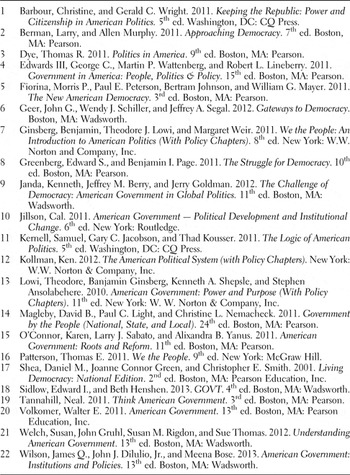
To explore the portrayal of women in American politics texts, we conducted a quantitative analysis of the gender content in 22 best-selling introductory U.S. politics textbooks with publication dates ranging from 2010 to 2013 (see Table 1). All of the books sampled were available in eBook format. Our findings are largely consistent with existing research on the political science curriculum:
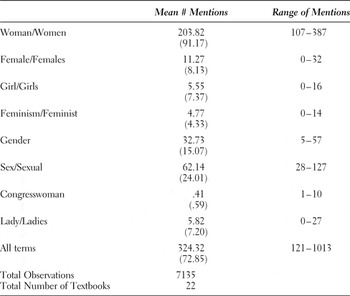
1. There is tremendous variability in the quantity of women and politics content across texts (see Table 2). While the term women/woman is fairly common (mean = 203.82; standard deviation = 91.17), a portion of these mentions are nonsubstantive, referring to “men and women” in a fashion synonymous with “people” or “citizens.” More specific references to female political actors like congresswoman (or congresswomen) or the feminist movement (feminist[s], feminism) are rather sparse, with an average of 0.41 and 4.77 mentions per text, respectively. There is a great deal of variation across texts when we examine the range of mentions. The mean number of mentions for three of eight search terms is rather high (woman/women; gender; sex/sexual), though for the remaining five, the lower end of the range is zero, indicating no mentions (female[s]; girl[s]; feminism/feminist[s]; congresswomen/woman; and lady/ladies). While there is no absolute yardstick for evaluating adequate content, some texts seem to be clearly engaging gender in meaningful ways, but many do not.
2. A substantial portion of the gendered content is located in the civil rights chapter. A plurality of the gender-related content—31% across texts—is found in the civil rights chapter. This result is consistent with Wallace and Allen's (2008) work on race and Olivo's (2012) recent work on gender. The segregation or ghettoization of gender content in this way reinforces the conceptualization of women as political outsiders with limited power in American politics.
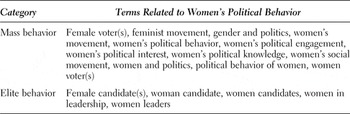
3. Regardless of the text one examines, it contains very little discussion about women's political behavior (see Table 3). To flesh out our observation of the limited number of references to women's political behavior, we developed dictionaries of terms capturing references to women's political behavior at the mass and elite levels (e.g., gender gap, women candidates). Across all texts, there were only 165 total mentions—7.5 mentions per book on average. Mass behavior was the focus of 106 mentions (64.2%) while elite behavior was the focus of 59 mentions (35.8%). The results are consistent with the characterization offered by Prestage (Reference Prestage1994) and point to mere “token mentions” of women as political actors.Footnote 1
Textbooks sampled

Number of mentions by search term

Note: Mentions include main text entries only. Standard deviations are provided in parentheses.
Search terms for women's mass and elite political behavior

Our analysis reveals limited evidence of mainstreaming in Introduction to American Politics texts. Reliance on textbooks will vary across courses, instructors, and institutions, meaning the limitations of these curricular materials will have a somewhat variable effect on student populations, but given textbook sales figures mentioned earlier, the population of students affected is likely to be rather large. Regardless, the spirit of gender mainstreaming as a curricular reform maintains that each political science major should learn that gender is an integral part of political science and an important analytic category for structuring social and political inquiry. The burden lies with the instructor to provide a meaningful educational experience for students. To the extent that instructors of undergraduate and, particularly, introductory-level courses often rely heavily on textbooks to structure their courses, textbooks with gender-mainstreamed content should provide a richer educational experience.
Given the themes uncovered in our analysis, we recommend that gender mainstreaming efforts focus on the broader inclusion of content pertaining to women's behavior at both the mass and elite levels. Modifying the curriculum in this fashion should promote female students' engagement with the material at the introductory level. In turn, this change may encourage more women to pursue studies in political science and reduce the gender imbalance among majors. Regardless of whether women choose to major in political science and enter the professional pipeline, female undergraduates would undoubtedly benefit from exposure to content about women and politics. Many students enroll in political science courses to fulfill general education requirements, and these courses likely contribute to women's political involvement beyond the academy by sparking political interest, increasing political knowledge, and contributing to a heightened sense of political efficacy. Beyond this, these courses shape both male and female students' perceptions of women's appropriate roles in the political arena. As a result, political science plays a very important role in undergraduate education—one that has the potential to impact more broadly civic and political culture in the United States.