Introduction
Cleaning interactions on tropical coral reefs are classic mutualisms which occur between small cleaners (e.g. gobies, wrasses, shrimps) and larger clients, typically reef fish. Cleaners remove disease-transmitting ectoparasites (e.g. isopods, flatworms) along with damaged tissue from posing clients (Bunkley-Williams & Williams, Reference Bunkley-Williams and Williams1998; McCammon et al., Reference McCammon, Sikkel and Nemeth2010). Thus, these interactions are important for the health of the reef fish community and can have radiating impacts across multiple trophic levels. The presence of cleaners has been shown to positively impact reef fish diversity, fish growth and larval recruitment (Bshary, Reference Bshary2003; Grutter et al., Reference Grutter, Murphy and Choat2003; Clague et al., Reference Clague, Cheney, Goldizen, McCormick, Waldie and Grutter2011; Sun et al., Reference Sun, Cheney, Werminghausen, Meekan, McCormick, Cribb and Grutter2015).
Côté (Reference Côté2000) describes cleaning symbioses as ‘co-evolutionary mosaics that vary temporally and geographically according to environmental circumstances’. These circumstances could include ecosystem-level stressors impacting community structure, behaviour and reef function, including climate change (Hughes et al., Reference Hughes, Anderson, Connolly, Heron, Kerry, Lough, Baird, Baum, Berumen, Bridge, Claar, Eakin, Gilmour, Graham, Harrison, Hobbs, Hoey, Hoogenboom, Lowe, McCulloch, Pandolfi, Pratchett, Schoepf, Torda and Wilson2018), overfishing and the use of ecologically damaging gear types (Exton et al., Reference Exton, Ahmadia, Cullen-Unsworth, Jompa, May, Rice, Simonin, Unsworth and Smith2019), and the presence of invasive predators (Andradi-Brown et al., Reference Andradi-Brown, Vermeij, Slattery, Lesser, Bejarano, Appeldoorn, Goodbody-Gringley, Chequer, Pitt, Eddy, Smith, Brokovich, Pinheiro, Jessup, Shepherd, Rocha, Curtis-Quick, Eyal, Noyes, Rogers and Exton2017; Hunt et al., Reference Hunt, Kelly, Windmill, Curtis-Quick, Conlon, Bodmer, Rogers and Exton2019), among others. Parasite load in particular has been shown to drive compensatory cleaner-seeking behaviour in reef fishes (Sikkel, Reference Sikkel2000; Grutter, Reference Grutter2001; Sikkel et al., Reference Sikkel, Cheney and Côté2004). High sedimentation and reduced coral cover are correlates of increased parasite abundance (Marcogliese, Reference Marcogliese2002; Artim & Sikkel, Reference Artim and Sikkel2013), and consequently cleaner-seeking activity (Arnal et al., Reference Arnal, Côté and Morand2001; Grutter, Reference Grutter2001). Other variables that may affect rate of cleaning interactions include client body size (Sikkel, Reference Sikkel2000; Floeter et al., Reference Floeter, Vázquez and Grutter2007), the availability of alternative food sources for cleaners (White et al., Reference White, Grigsby and Warner2007), suitability of benthos to serve as cleaning stations (Mahnken, Reference Mahnken1972; Kulbicki & Arnal, Reference Kulbicki and Arnal1999), and aggressive behaviour of resident fish, both intra- (Potts, Reference Potts1973) and inter-specifically (Arnal & Côté, Reference Arnal and Côté1998). These variables are used to explain differences in cleaning rate and behaviours across geographically distant reef sites. However, there remains a lack of research comparing variation in cleaning interactions (for example differences in rate, duration and clientele) across geographically close but ecologically dissimilar coral reef habitats on a fine scale, thus controlling for geography and any associated behaviours that may be region-specific or locally adaptive.
On Caribbean coral reefs, Pederson's cleaner shrimp Ancylomenes pedersoni (Chace) is the most common and ecologically important cleaner shrimp (Limbaugh et al., Reference Limbaugh, Pederson and Chace1961; Briones-Fourzán et al., Reference Briones-Fourzán, Pérez-Ortiz, Negrete-Soto, Barradas-Ortiz and Lozano-Álvarez2012; Huebner et al., Reference Huebner, Shea, Schueller, Terrell, Ratchford and Chadwick2019). Ancylomenes pedersoni are dedicated cleaners, defined as a species committed to a cleaning lifestyle for all or some of their non-larval ontogeny (Vaughan et al., Reference Vaughan, Grutter, Costello and Hutson2017). Almost always inhabiting sea anemones (Limbaugh et al., Reference Limbaugh, Pederson and Chace1961), its primary host is the corkscrew sea anemone, Bartholomea annulata (LeSueur) (Mahnken, Reference Mahnken1972; Briones-Fourzán et al., Reference Briones-Fourzán, Pérez-Ortiz, Negrete-Soto, Barradas-Ortiz and Lozano-Álvarez2012; Mascaró et al., Reference Mascaró, Rodríguez-Pestaña, Chiappa-Carrara and Simões2012; Huebner & Chadwick, Reference Huebner and Chadwick2012a, Reference Huebner and Chadwick2012b; Titus et al., Reference Titus, Palombit and Daly2017a) with which they can be found living singly or in groups of up to 12 individuals (Titus et al., Reference Titus, Daly and Exton2015b). The most abundant anemone in the Caribbean, B. annulata is a habitat generalist found solitarily or in small aggregations on coral reefs, seagrass beds, and hard-bottom habitats (Briones-Fourzán et al., Reference Briones-Fourzán, Pérez-Ortiz, Negrete-Soto, Barradas-Ortiz and Lozano-Álvarez2012; Titus et al., Reference Titus, Vondriska and Daly2017b; O'Reilly et al., Reference O'Reilly, Titus, Nelsen, Ratchford and Chadwick2018). This anemone species also serves as a visual cue for reef fish to locate A. pedersoni cleaning stations (Huebner & Chadwick, Reference Huebner and Chadwick2012b).
Although there have been numerous studies exploring the client pool of A. pedersoni, there is a lack of information in the literature comparing the client pool to the surrounding resident fish community. Exploring the differences between the potential and realized client pools would help improve our understanding of the services provided by this important cleaner species to the diverse fish communities found on Caribbean coral reefs. Members of over 23 families of reef fish have been observed being cleaned by A. pedersoni, with the most frequently reported being Acanthuridae, Serranidae, Mullidae, Pomacentridae and the scarine labrids (Huebner & Chadwick, Reference Huebner and Chadwick2012a, Reference Huebner and Chadwick2012b; Titus et al., Reference Titus, Daly and Exton2015a, Reference Titus, Daly and Exton2015b, Reference Titus, Palombit and Daly2017a, Reference Titus, Vondriska and Daly2017b, Reference Titus, Daly, Vondriska, Hamilton and Exton2019). Duration of cleans can vary from a few seconds to over 15 minutes, and correlate with client identity and body size, with large-bodied clients having higher average clean durations (Huebner & Chadwick, Reference Huebner and Chadwick2012a; Titus et al., Reference Titus, Daly and Exton2015b, Reference Titus, Vondriska and Daly2017b). When a potential client is within visible range, A. pedersoni rapidly waves its two long antennae, signalling its availability to clean (Limbaugh et al., Reference Limbaugh, Pederson and Chace1961; Caves et al., Reference Caves, Green and Johnsen2018). If a fish is seeking a clean it will pose, typically by tilting upwards or sideways on or near the benthos and/or changing colouration, and often exposing its underside. This invites the shrimp to inspect their bodies and remove and consume ectoparasites attached to the scales, gills and mouth (Limbaugh et al., Reference Limbaugh, Pederson and Chace1961; Mahnken, Reference Mahnken1972). The clean may be ended by either the shrimp intentionally climbing off or by the client jolting them off (Huebner & Chadwick, Reference Huebner and Chadwick2012a).
The abundance and broad habitat range of A. pedersoni and its host anemone, as well as its diverse client pool, makes this an ideal mutualism for understanding patterns of cleaning behaviour across geographically close yet ecologically dissimilar reefs. In a previous study (Titus et al., Reference Titus, Daly and Exton2015b), A. pedersoni cleaning activity was closely monitored on two reef systems: Utila and the Cayos Cochinos archipelago, Honduras. These reefs are ~45 km apart and did not differ significantly in major ecological habitat characteristics or cleaning interaction rate and behaviours (Titus et al., Reference Titus, Daly and Exton2015a). Both reefs are typical Caribbean fringing reef systems with coral cover of ~20% (Titus et al., Reference Titus, Daly and Exton2015b), low turbidity, and similar fish diversity (Titus et al., Reference Titus, Daly and Exton2015a, Reference Titus, Daly and Exton2015b; Andradi-Brown et al., Reference Andradi-Brown, Macaya-Solis, Exton, Gress, Wright and Rogers2016a, Reference Andradi-Brown, Gress, Wright, Exton and Rogers2016b). Recently, however, a unique fringing reef system, Banco Capiro, was discovered 60 km away from Utila (Bodmer et al., Reference Bodmer, Rogers, Speight, Lubbock and Exton2015). Banco Capiro lies just 8 km from the Honduran mainland and is characterized as having abnormally high scleractinian coral-cover (49–62%) for a contemporary Caribbean reef, but a depleted fish community relative to adjacent reef systems on Utila and Cayos Cochinos (anecdotal reports suggest from historical overfishing), along with high turbidity and nutrient runoff (Bodmer et al., Reference Bodmer, Rogers, Speight, Lubbock and Exton2015).
Here, we conduct extensive remote video analyses of A. pedersoni cleaning interactions at both Utila and Banco Capiro, Honduras. At each site, we compare the potential client pool (the overall fish community) to the realized client pool (fish observed at A. pedersoni stations). We also investigate the prediction that the rate, duration and clientele (including species and feeding guild composition) of fish cleaning interactions with A. pedersoni differ significantly between neighbouring reefs with contrasting environmental conditions.
Materials and methods
Study site comparison
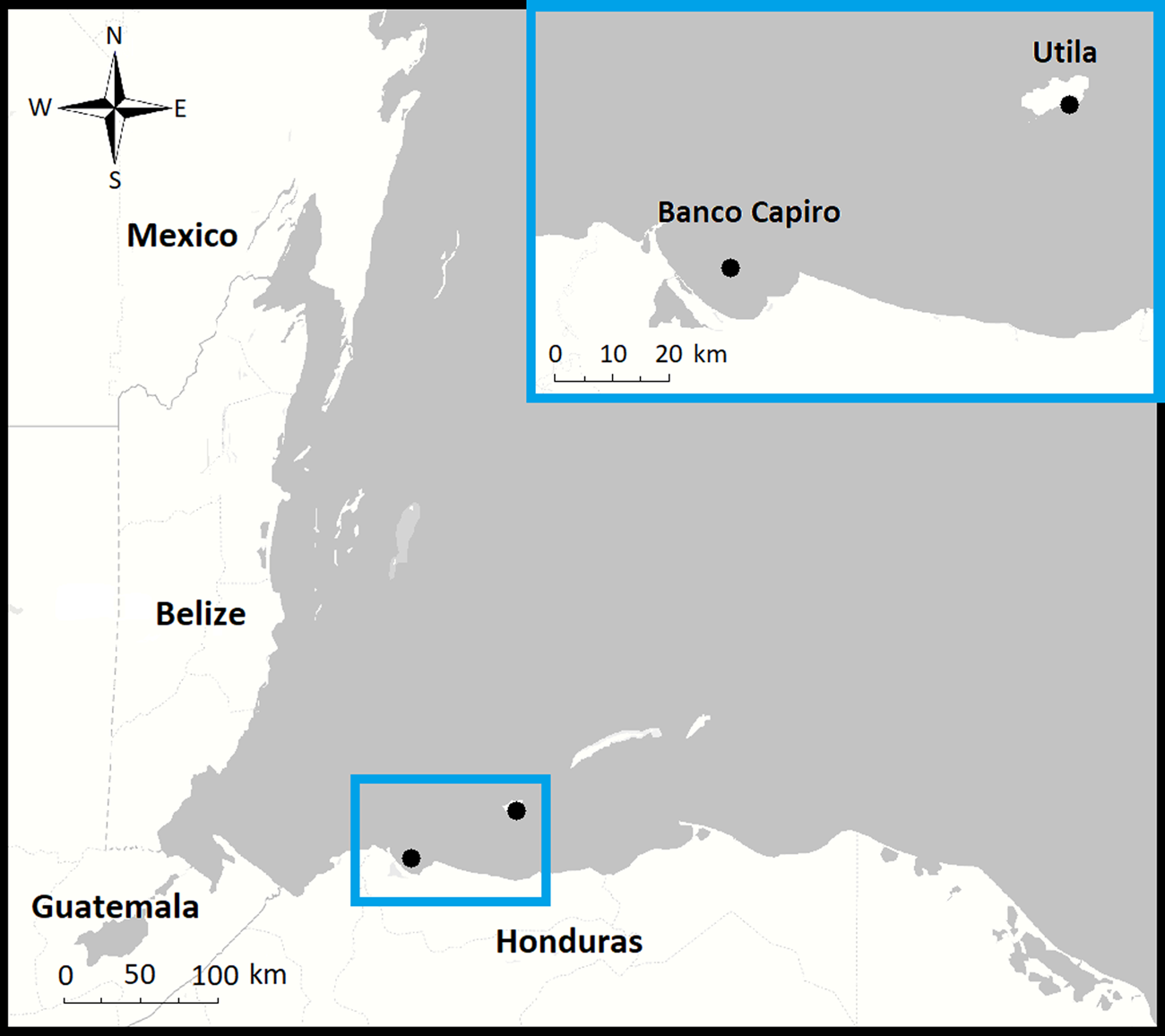
Habitat data were collected at Banco Capiro and Utila (Figure 1) from mid-June to mid-August 2016 to quantify their ecological dissimilarity. Banco Capiro (15o51′48.71″N 87o29′42.90″W) is adjacent to mainland Honduras with the top of the reef beginning at ~10 m depth and levelling out to a sandy seafloor at ~30 m. At Utila, surveys were conducted on the site Coral View (16o05′17.96″N 86o54′38.27″W), an offshore fringing reef, starting at <2 m depth and sloping immediately to ~30 m.
Map of coral reef systems Banco Capiro (15o51′48.71″N 87o29′42.90″W) and Utila (16o05′17.96″N 86o54′38.27″W) off mainland Honduras.

At both sites, stereo-video systems (SVS) were used to assess resident fish assemblage structure. A diver-operated stereo-video (DOV) was used that consisted of two Cannon HFS21 cameras at fixed angles filming the same position. Six replicate 50 m transects were surveyed at 5 and 15 m depth each on Utila and 10 and 15 m each on Banco Capiro, following transect methods detailed by Andradi-Brown et al. (Reference Andradi-Brown, Macaya-Solis, Exton, Gress, Wright and Rogers2016a). These depths were selected to represent the fish assemblages at both the crest and the slope of the reefs, encompassing the depth range in which cleaner stations were monitored. Filming for DOV was generally from a distance of 0.5 m off the substratum. Transects took ~3 minutes to complete, which was a duration deemed fast enough to minimize risk of double-counting individuals (Andradi-Brown et al., Reference Andradi-Brown, Macaya-Solis, Exton, Gress, Wright and Rogers2016a). Fish surveys commenced promptly upon water entry with the camera operator leading the way in order to minimize any potential effect of diver presence on fish behaviour. Videos were analysed using EventMeasure software (SeaGIS, Australia) and all fish were identified to species level. Only fish that were no further than 5 m in front of the camera and that were within 2.5 m of either side of the transect line were included. Thus, each transect surveyed 250 m2 of reef. Relative fish abundance was then calculated as mean number of fish per 250 m2. At each site, Simpson's Index of Diversity (1−D) was calculated to provide relative values of reef fish diversity (Simpson, Reference Simpson1949). Fish were also categorized into one of four feeding guilds to better understand the functional reef fish community structure at both sites. Each fish was categorized as either ‘herbivore’, ‘carnivore’, ‘omnivore’ or ‘planktivore’ based on dietary information provided by FishBase (Froese & Pauly, Reference Froese and Pauly2000). Note that for simplicity we used adult dietary preferences for each species as juvenile reef fish are seldom seen on fore-reef or reef crest communities in significant abundance, and no differentiation between adult and juvenile life stages was made during stereo-video analyses. Transects from both reef zones (crest and slope) were pooled together at each site (N = 12 per site) to generate an overall representation over the area where cleaner stations were analysed. Mann–Whitney U tests were performed to compare fish abundance, species richness, diversity and relative abundance of feeding guilds at each site.
Per cent live scleractinian coral cover was estimated using point-intercept video transects at 5 and 15 m depth on Utila and 10 and 15 m on Banco Capiro. Replicates of 50 m transect surveys were conducted (N = 12 and 6 at Utila and Banco Capiro respectively; discrepancy in replicates due to time logistics). The complete length of the tape was filmed, ensuring that every 25 cm was visible on camera. Upon viewing footage, the type of substrate underneath each 25 cm point was recorded. Live coral cover across sites was compared using a Mann–Whitney U test.
Turbidity was used as an indication of suspended particles, and thus a proxy for nutrient load and sedimentation (Berry et al., Reference Berry, Rubinstein, Melzian and Hill2003). Turbidity was measured using a Secchi disk that was lowered from a boat, and the depth at which the disk was no longer visible from the surface was recorded to the nearest 0.5 m. Sixteen replicates were carried out at Banco Capiro and eight at Utila (discrepancy due to unsafe weather conditions). Secchi data collection took place around mid-morning on days that coincided with observations of cleaning activity (20 June to 18 July on Banco Capiro and 20 July to 7 August on Utila). Secchi data were compared using a two-sample t-test. Additional Secchi data for Utila from July 2013 (N = 44) were also available. These data did not differ statistically from 2016 data (two-sample t-test: t = 0.1, df = 58, P = 0.9) and so were combined with the present Utila data and compared with Banco Capiro 2016 data using a two-sample non-paired t-test. All comparative statistical analyses were carried out using the software program R 3.2.1 (R CoreTeam, 2013).
Cleaning observations
A total of 39 (Utila) and 52 (Banco Capiro) B. annulata cleaning stations that hosted symbiotic A. pedersoni shrimp were found, measured, tagged and mapped, at 5–18 m depth, following Titus et al. (Reference Titus, Daly and Exton2015a, Reference Titus, Daly and Exton2015b, Reference Titus, Palombit and Daly2017a, Reference Titus, Vondriska and Daly2017b, Reference Titus, Daly, Vondriska, Hamilton and Exton2019). Stations were located haphazardly and abundance was not quantified. Generally, discovery of new stations occurred at a similar rate on both sites (typically 4–7 per ‘seeking’ dive). At each station, the number of A. pedersoni individuals were recorded as was the size of the inhabited anemone, measured as tentacle crown surface area (TCSA cm2) and calculated from the long and short diameters of the anemone tentacle crown (e.g. Huebner & Chadwick, Reference Huebner and Chadwick2012b; O'Reilly et al., Reference O'Reilly, Titus, Nelsen, Ratchford and Chadwick2018).
Underwater video cameras (GoPro Hero3 and Hero4) were deployed at tagged stations (Titus et al., Reference Titus, Daly and Exton2015b, Reference Titus, Palombit and Daly2017a, Reference Titus, Vondriska and Daly2017b, Reference Titus, Daly, Vondriska, Hamilton and Exton2019) to minimize the effect of diver presence (Titus et al., Reference Titus, Daly and Exton2015a; Andradi-Brown et al., Reference Andradi-Brown, Gress, Laverick, Monfared, Rogers and Exton2018) and increase observation length. Cameras were deployed daily at ~7:30 am, 10:30 am or 2:00 pm from 20 June to 18 July (Banco Capiro) and 20 July to 7 August (Utila). Time of day has previously been shown to not impact cleaning interaction rate in Honduras (Titus et al., Reference Titus, Daly and Exton2015a). Cameras were attached to dive weights and placed perpendicular to, and ~1 m from, each cleaning station. Videos recorded continuously, at ≤720p resolution, until battery power was lost (range = 60–252 min; mean = 130 min).
Videos were analysed following Titus et al. (Reference Titus, Daly and Exton2015a, Reference Titus, Daly and Exton2015b, Reference Titus, Palombit and Daly2017a, Reference Titus, Vondriska and Daly2017b, Reference Titus, Daly, Vondriska, Hamilton and Exton2019). Briefly, we defined a clean as visual confirmation of at least one A. pedersoni individual present on the body of a posing client fish. Clients were identified to species level and categorized by feeding guild as done for resident assemblages. Cleaning rate (number of cleaning encounters h−1), clean duration per client (defined by cumulative time in seconds that at least one shrimp was present on the body), and cumulative time that shrimp spent cleaning (s h−1) were also calculated for each station. For stations that had multiple video recordings (N = 13 at Banco Capiro; N = 15 at Utila), the means of clean rate, duration, and guild composition were used as single replicates to prevent pseudoreplication. Mann–Whitney U tests were used to compare percentage composition of feeding guilds of the clientele to that of the resident fish assemblage at each site.
Statistical analysis
Our cleaning observation data did not conform to a normal distribution and were analysed statistically using gamma-distributed generalized linear models (GLM) with a maximum likelihood scale parameter, and Bonferroni correction for multiple pairwise comparisons. The effects of site, shrimp group size and anemone body size, which have been investigated previously (Huebner & Chadwick, Reference Huebner and Chadwick2012a; Titus et al., Reference Titus, Palombit and Daly2017a), were tested on cleaning rate (clean h−1), and on cumulative inspection duration (s h−1). To enable confirmation that video duration had no significant effect on cleaning rate, a separate GLM with the same parameters was carried out, but this time incorporating video duration (minutes) and using each video as a single replicate.
Because reef fish abundance was significantly greater at Utila than Banco Capiro (see Results), a greater cleaning rate at Utila may reflect the greater fish abundance rather than reflect a true higher rate of cleaner-seeking behaviour. For this reason, we conducted a separate GLM with a standardized cleaning rate, calculated by using only abundance data of reef fish species that are known clients of A. pedersoni at both sites. To do this, we first removed abundance data for fish species that were present in the resident community but were not clientele of A. pedersoni at either site in this study. We then standardized cleaning rate by employing a simple multiplication factor at the reef site of lowest clientele fish abundance (Banco Capiro), using the formula: [S = (h/I) × r] where S = standardized relative rate, h = mean clientele fish abundance per transect at the high-abundance site (Utila), I = average clientele fish abundance per transect at the low abundance site (Banco Capiro), and r = clean rate of video (Banco Capiro). ‘S’ was calculated for all cleaning stations at Banco Capiro and the GLM analysis was repeated but with the original cleaning rate values at Banco Capiro substituted for the standardized rate.
To account for cleaning interactions where both shrimp and cleaner gobies (Elacatinus spp.) cleaned the same client simultaneously, the composition of cleaning encounters that were ‘simultaneous’ were calculated as a percentage of total recorded cleans at each reef site. The above statistical analyses were repeated excluding simultaneous cleans to determine if goby presence had a statistically significant effect on cleaning rate or accumulative clean duration.
Results
Study site comparison
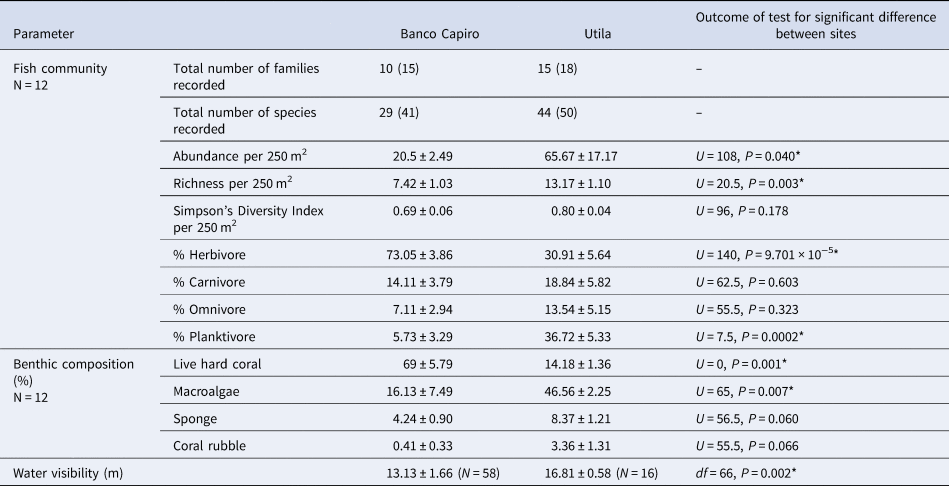
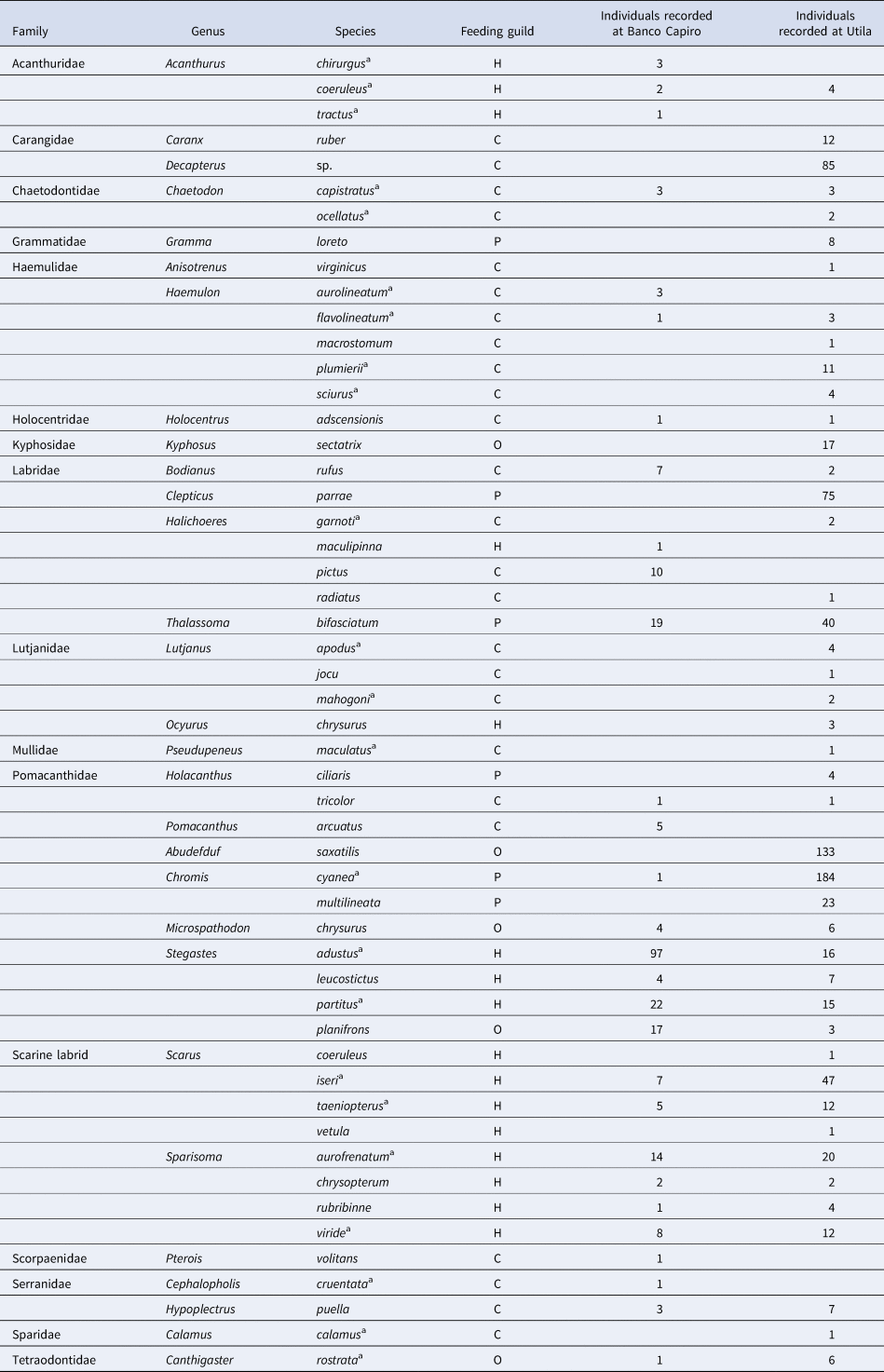
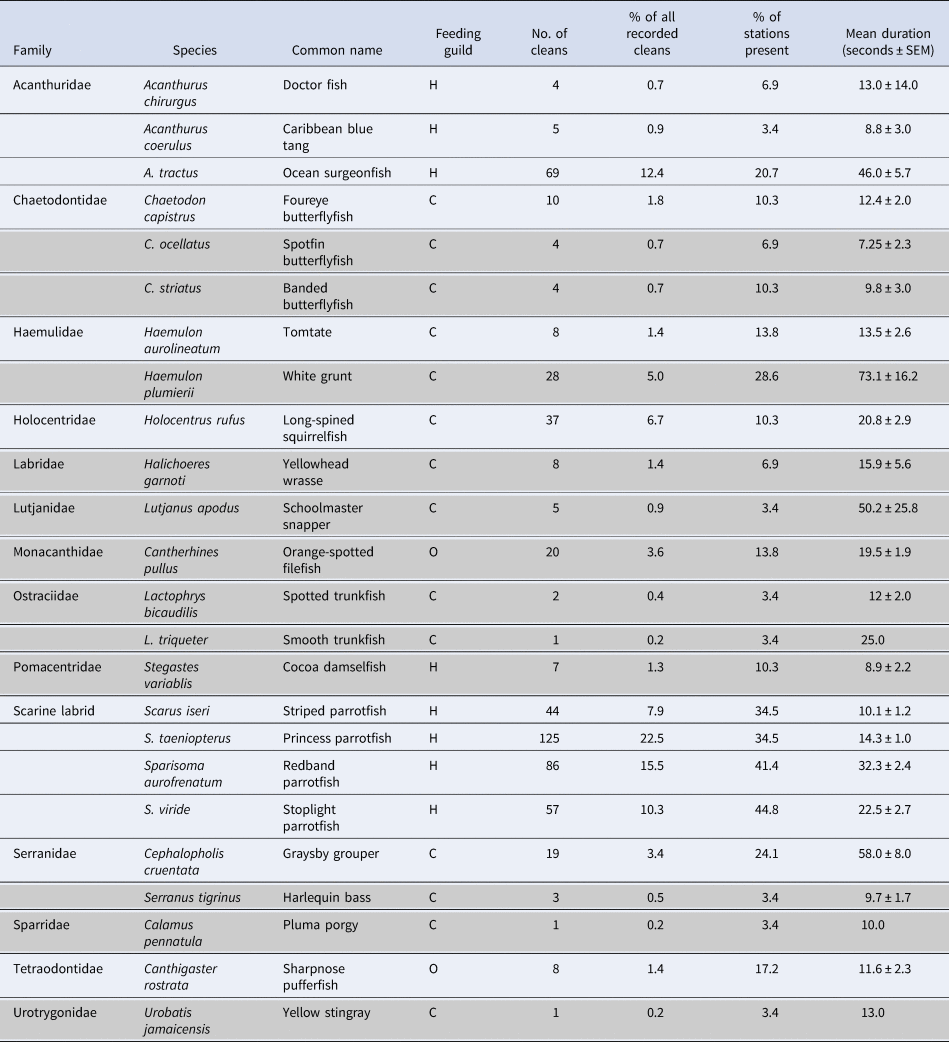
Banco Capiro and Utila differed significantly in many key environmental conditions (Table 1). Benthic assessment revealed that per cent live coral cover was ~5 times greater at Banco Capiro than at Utila (P = 0.001) and macroalgae was ~3 times greater at Utila (P = 0.007). Mean water visibility (Secchi) measurement was also significantly greater at Utila than Banco Capiro (P = 0.002; Table 1). Reef fish community assemblages also differed significantly between reef sites (Table 1). Reef fish abundance (P = 0.040) and species richness (P = 0.003) were both significantly higher at Utila than at Banco Capiro (Table 1). At Banco Capiro, the most abundant feeding guild was herbivore (73 vs 31% at Utila). At Utila, the most abundant guild was planktivore (37 vs 6% at Banco Capiro). There were no significant differences in the compositions of carnivores or omnivores between sites. Stereo-video transect surveys recorded 10 different reef fish families and 29 different reef fish species at Banco Capiro (Tables 1 & 2). At Utila, stereo-video transect surveys recorded 15 different reef fish families and 44 different reef fish species (Tables 1 & 2). The three most abundant species at Banco Capiro were dusky damselfish (Stegastes adustus), bicolour damselfish (Stegastes partitus) and bluehead wrasse (Thalassoma bisfactium). The three most abundant species at Utila were blue chromis (Chromis cyanea), sergeant major (Abudefduf saxatilis) and jacks from the genus Decapterus (Table 2). Remotely deployed video cameras (for cleaning observations) captured additional diversity not recorded by stereo-video surveys. At Banco Capiro an additional five families and 12 species were recorded, bringing the total number of recorded families to 14 and the total number of species to 41 (Tables 1 & 3). At Utila, remotely deployed video cameras also captured an additional three families, but only six additional species, bringing the total number of families to 18 and the total number of species to 50 (Tables 1 & 4).
Comparison of environmental parameters across two Honduran coral reef sites in 2016 (± = SEM)

‘*’ denotes statistical significance (P > 0.05). All statistical outcomes derived from Mann–Whitney U tests apart from ‘water visibility’ which derived from a two-sample t-test. Values in parentheses reflect the total number of families and species recorded by both stereo-video surveys and remotely deployed cleaning interaction video. Statistical analyses were performed on stereo-video survey data only.
All fish recorded across 12 replicates of 5 × 50 m (3000 m2) transects by stereo-video system at Honduran coral reef sites Banco Capiro and Utila in 2016

H = herbivore, C = carnivore, O = omnivore, P = planktivore.
a Denotes those species observed being cleaned.
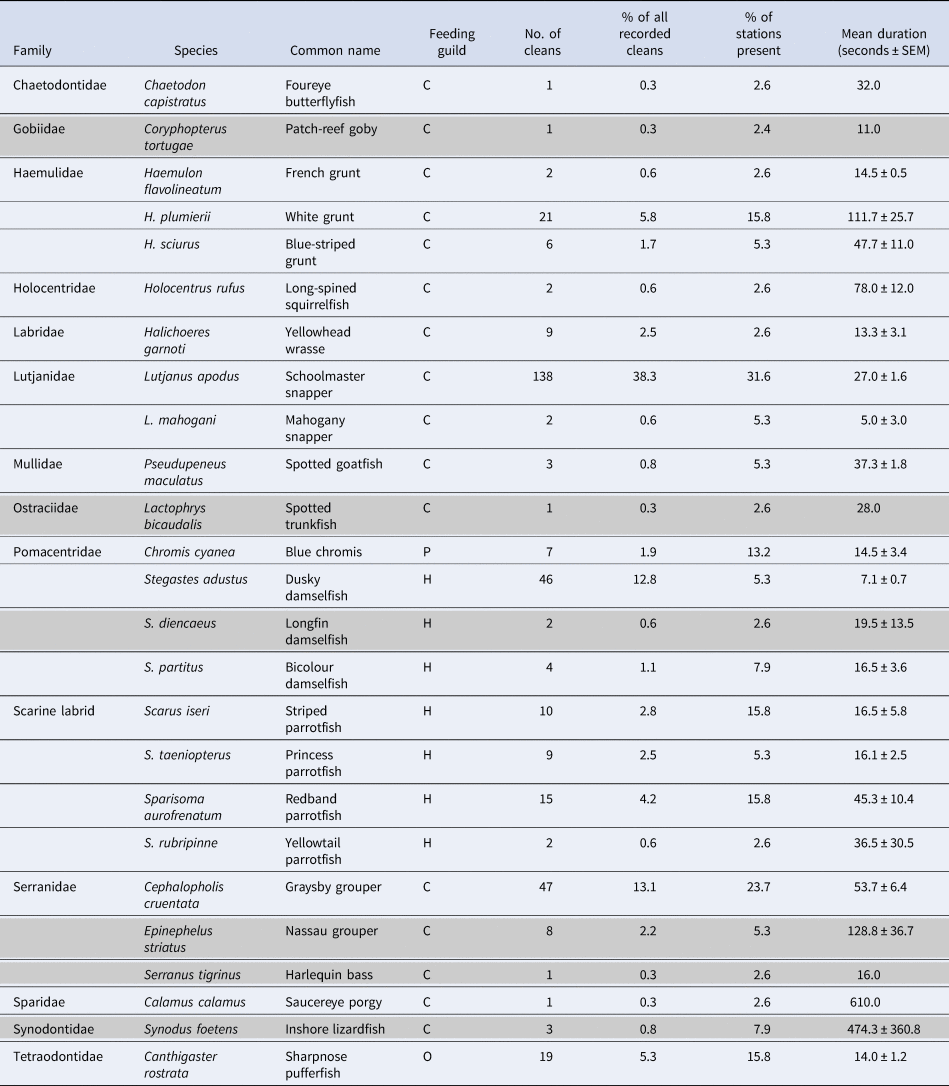
Species composition of fish clients at Ancylomenes pedersoni cleaner stations at the coral reef site Banco Capiro, Honduras

H = herbivore, C = carnivore, O = omnivore. ‘No. of cleans’ = total number of cleaning interactions recorded on site across all footage. ‘% of stations present’ = percentage of cleaning stations where at least one clean was recorded for given species. Species highlighted in grey were not recorded by stereo-video surveys.
Species composition of fish clients at Ancylomenes pedersoni cleaner stations at the coral reef site Utila, Honduras

H = herbivore, C = carnivore, O = omnivore, P = planktivore. ‘No. of cleans’ = total number of cleaning interactions recorded on site across all footage. ‘% of stations present’ = percentage of cleaning stations where at least one clean was recorded for given species. Species highlighted in grey were not recorded by stereo-video surveys.
Observation of cleaning interactions
A total of 39 and 52 A. pedersoni cleaning stations were tagged and used for analysis at Banco Capiro and Utila respectively. All, except two stations at Banco Capiro and four at Utila, were in association with corkscrew anemones, B. annulata. The remaining shrimp groups resided in crevices with no anemone readily visible. It is likely that there was previously an anemone present that had recently deceased or had retracted completely into a crevice in the reef. Group sizes of A. pedersoni ranged from one to 11 shrimp at Banco Capiro and one to eight shrimp at Utila. Average group size was significantly greater at Banco Capiro (median = 4, IQR = 1.75–6.25) than at Utila (median = 2, IQR = 1–2) (U = 1217, P = 0.001). The median anemone size was 18.9 cm2 TCSA (IQR = 6.28–32.99 cm2) at Banco Capiro and 23.6 cm2 (IQR = 9.43–40.25) at Utila. There was no significant difference in B. annulata body size between sites (U = 590, P = 0.197).
We recorded video at 29 and 38 of the cleaner stations at Banco Capiro and Utila respectively, resulting in a total of 139 h of footage at Banco Capiro and 162 h at Utila. A total of 556 cleans were recorded at Banco Capiro and 360 at Utila. Twenty-eight (5.04%) and 38 (10.55%) cleans also involved simultaneous cleaning by cleaner gobies (Elacatinus spp.) at Banco Capiro and Utila respectively. Exclusion of simultaneous cleans with Elacatinus spp. did not alter statistical outcomes of site comparisons for cleaning rate (df = 56; P = 0.386) or cumulative clean duration (df = 56; P = 0.935) in the Generalized Linear Model, and thus they were kept in the dataset.
Video footage recorded a total of 17 families of client fish across Utila and Banco Capiro collectively (21 genera and 37 species). Clients belonging to 14 families were recorded at Banco Capiro (16 genera and 23 species; Table 3) and 13 at Utila (18 genera and 25 species; Table 4). Eleven of the 17 families were observed being cleaned at both sites. The proportion of realized to potential client diversity at both sites was less than 60%. Cleaner shrimps at Banco Capiro were recorded cleaning 23 of the 41 reef fish species recorded on the reef (56%), while cleaner shrimps at Utila were recorded cleaning 25 of the 50 reef fish species recorded on the reef (50%).
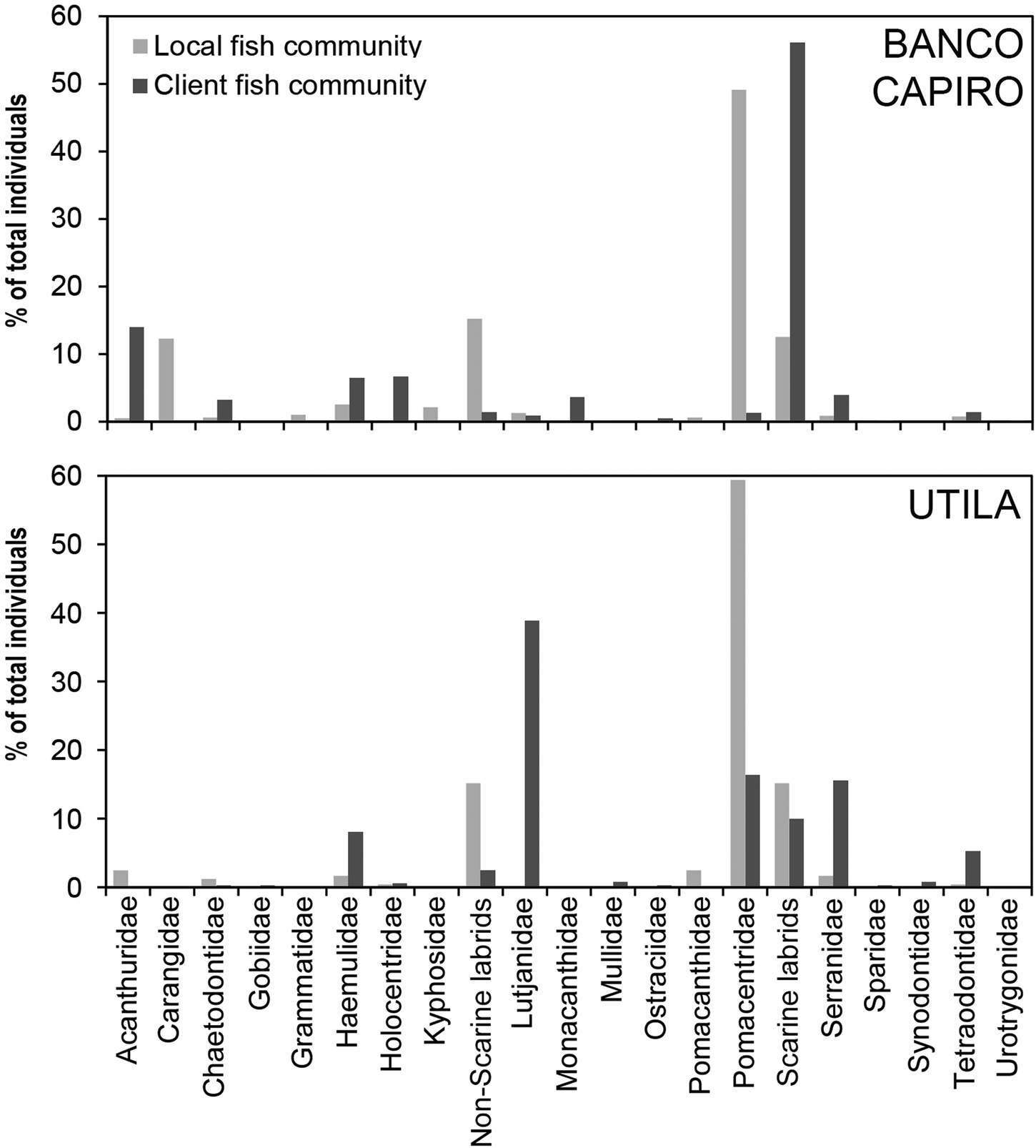
Few fish families were cleaned at a rate that was representative of their overall abundance on the reef (Figure 2). At Banco Capiro >50% of all fish species recorded during stereo-video surveys belonged to the damselfish family Pomacentridae, which received very few cleans at A. pedersoni stations. This difference consisted almost entirely of two species: the damselfishes Stegastes adustus and S. partitus. These species were only recorded being cleaned on Utila, despite being ~6× and 1.4× more abundant on Banco Capiro respectively. Conversely, parrotfishes (the scarine labrids) were greatly overrepresented in the Banco Capiro client community relative to their overall abundance (Figure 2), and represented >50% of all recorded cleans at this site, despite making up <15% of the total fish abundance. At Utila, the Pomacentridae were also greatly underrepresented relative to their abundance, yet still comprised ~20% of all cleaning interactions. The Serranidae (groupers) and Lutjanidae (snappers) were both overrepresented in the client community at Utila relative to their overall abundance on the reef (Figure 2). This was particularly striking for the Lutjanidae, which comprised ~39% of all recorded cleaning interactions on Utila despite making up <1% of the reef fish population. At Banco Capiro, three species comprised ~50% of all cleaning interactions: the princess parrotfish Scarus taeniopterus (22.5%), the redband parrotfish Sparisoma aurofrenatum (15.5%) and the ocean surgeonfish Acanthurus tractus (12.4%; Table 3). Client species recorded across the most stations here were the stoplight parrotfish Sparisoma viride (44.8% of stations) and S. aurofrenatum (41.4%). Scarus taeniopterus ranked joint-third alongside the striped parrotfish Scarus iseri (34.5%). At Utila, three species comprised ~64% of all recorded cleaning interactions: the schoolmaster snapper Lutjanus apodus (38.3%), the graysby grouper Cephalopholis cruentata (13.1%) and the dusky damselfish Stegastes adustus (12.8%). Similarly, species recorded across the most stations here were also L. apodus (31.6% of stations) followed by C. cruentata (23.7%). However, S. adustus ranked joint-sixth on the list (5.3%). Our analysis on Banco Capiro also documented the first ever recorded clean of a yellow stingray (Urobatis jamaicensis) by A. pedersoni.
Relative composition of fish families resident on reef communities (recorded using stereo-video systems across 3000 m2) and engaging in cleaning interactions at Ancylomenes pedersoni cleaner stations, at reef sites Utila (77 videos across 38 stations, total video duration = 162 h, number of cleans = 356) and Banco Capiro (63 videos across 29 stations, total video duration = 139 h, number of cleans = 560). Sample sizes can be found in Tables 2–4.

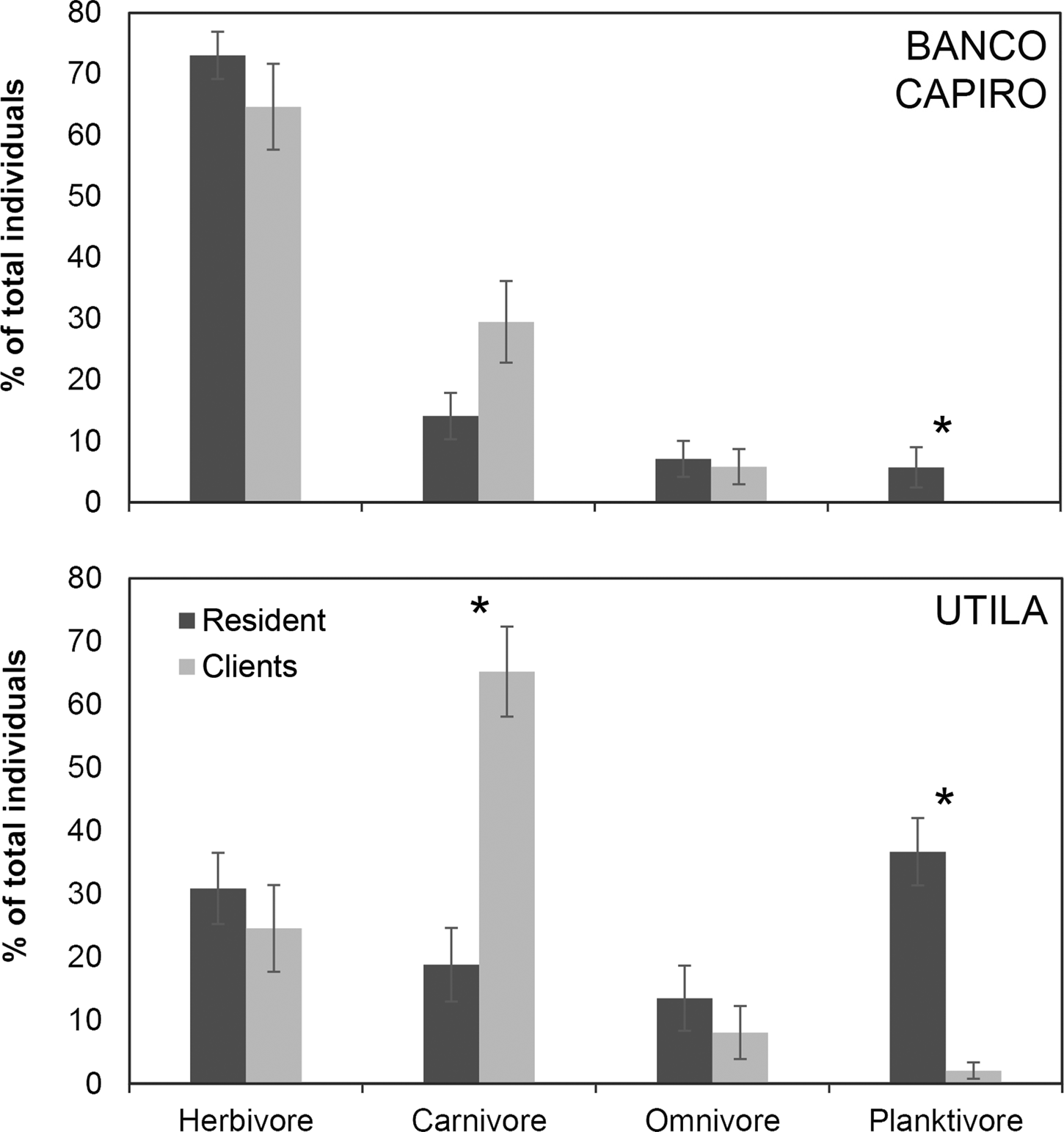
At Banco Capiro, clientele was heavily dominated by herbivores (64.65% ± 3.86; Figure 3). No significant differences were detected between clientele and resident assemblage for compositions of herbivores (U = 139.5, P = 0.626), carnivores (U = 119, P = 0.807) or omnivores (U = 103, P = 0.340). No planktivores were recorded being cleaned. At Utila, the clientele was heavily dominated by carnivores (65.22% ± 7.12). The composition of carnivores was significantly higher among the clientele than among the resident community (U = 256, P = 0.004). In contrast, planktivorous fish consisted of only 2.09% ± 1.29 of clientele, despite dominating the resident community (U = 5, P = 1.468 × 10⁻⁷). No significant difference was detected in the composition of herbivores (U = 99.5, P = 0.056) or omnivores (U = 107.5, P = 0.050) between clientele and the resident assemblage. When comparing sites, composition of herbivores was significantly larger at Banco Capiro than at Utila (U = 140, P = 0.010); composition of carnivores was significantly larger at Utila (U = 62.5, P = 0.024). No significant difference was detected in the composition of omnivores (U = 55.5, P = 0.596).
Relative abundance of fish within specified feeding guilds, in resident fish assemblages and in clientele at Ancylomenes pedersoni cleaner stations at the Honduran coral reef sites Banco Capiro and Utila. Bars = Mean ± SEM. For ‘Resident’ N = 12 for both sites. For ‘Clientele’ N = 21 and 27 at Banco Capiro and Utila respectively. ‘*’ denotes statistical significance (P < 0.05) between abundances in resident community and clientele.

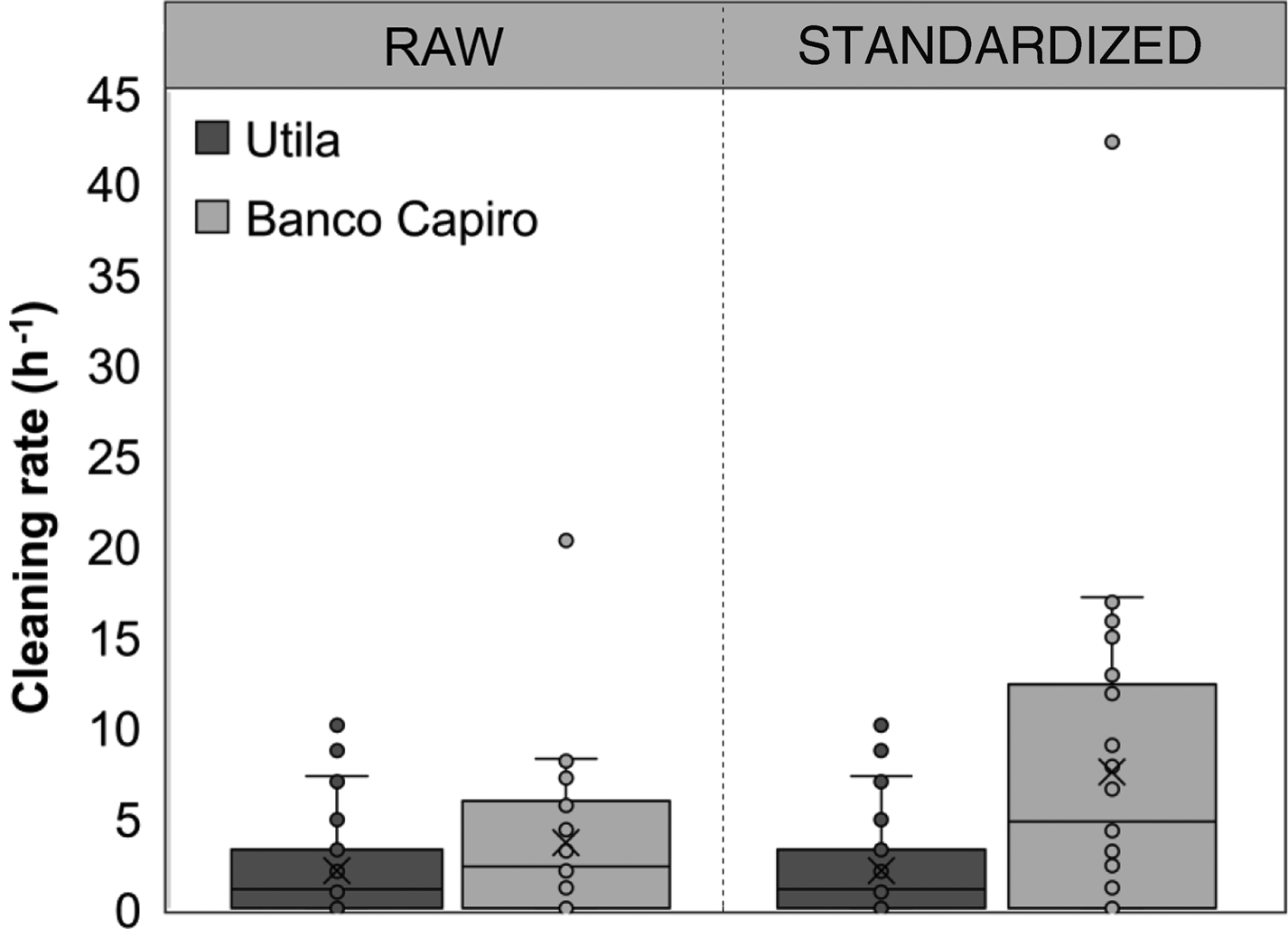
The uncorrected median cleaning interaction rates (cleans h−1) did not differ significantly between Banco Capiro and Utila based on our gamma-distributed GLM (df = 56, P = 0.453). The uncorrected median clean rate at Banco Capiro was 2.30 cleans h−1 (N = 29, IQR = 0–5.68) and at Utila was 1.05 cleans h−1 (N = 38, IQR = 0–3.09). However, when standardizing for clientele fish abundance at Banco Capiro, clean rate was significantly greater than at Utila (df = 56, P = 0.002; Figure 4). The standardized median cleaning rate at Banco Capiro was 4.78 cleans h−1 (IQR = 0–11.83), implying that clientele fish at Banco Capiro may visit A. pedersoni shrimp cleaning stations as much as 4.6 times more frequently than at Utila. The GLM detected no significant effect of cleaner shrimp group size (df = 60, P = 0.108), or anemone size (df = 59, P = 0.878) on cleaning rate. Video duration was found to have no significant association between footage length and cleaning rate (df = 137, P = 0.759).
Cleaning rate (number of cleaning encounters h−1) at Ancylomenes pedersoni cleaner stations at adjacent Honduran coral reef sites, Utila (N = 38) and Banco Capiro (N = 29, P = 0.453), and ‘Standardized’ cleaning rate demonstrating theoretical value if size of fish assemblage at Banco Capiro was equal to that of Utila, assuming a linear correlation between cleaning rate and fish abundance (P = 0.002).

Median cumulative clean duration (s h−1 site−1) did not differ significantly between sites (df = 66, P = 0.918), and was 46.5 s h−1 at Banco Capiro (N = 28, IQR = 0–114.07) and 38.5 s h−1 at Utila (N = 38, IQR = 0–123.09). However, the average clean duration per client was significantly greater at Utila (39.80 ± 4.44 s vs 24.35 ± 1.54 s; U = 73900, P = 0.00001). Shrimp group size was found to positively correlate with cumulative clean duration across both sites (df = 60, P = 0.045).
Discussion
Here we conduct one of the first cleaning behaviour studies between geographically close yet ecologically dissimilar coral reef communities in the Tropical Western Atlantic, comparing two coral reefs with major differences in fish abundance and diversity, community structure, water turbidity and live coral cover. We further add to a growing body of literature on the cleaning ecology and behaviour of Pederson's cleaner shrimp Ancylomenes pedersoni, an ecologically important cleaner on Caribbean coral reefs (McCammon et al., Reference McCammon, Sikkel and Nemeth2010; Huebner & Chadwick, Reference Huebner and Chadwick2012a; Titus et al., Reference Titus, Daly and Exton2015b, Reference Titus, Palombit and Daly2017a Reference Titus, Vondriska and Daly2017b, Reference Titus, Daly, Vondriska, Hamilton and Exton2019). Our data highlight and reinforce the importance of understanding, and accounting for, variation in patterns of cleaning behaviour on coral reef communities across fine geographic scales, particularly with respect to how the potential fish clientele community engages with cleaner species to become the realized client fish community. Clientele reef fish composition within a study site varied considerably with the broader composition of the resident community, and clientele communities also varied considerably between sites. Further, while there was no significant difference found in cleaning rate per station between sites, our standardized calculation may suggest that clients at Banco Capiro are cleaned at A. pedersoni stations, on average, over four times as frequently as those at Utila. How these patterns have been directly affected by ecological conditions at our study sites mechanistically (i.e. coral cover, turbidity, parasite load, etc.) remains unclear, but the contrast in coral reef environments between Utila and Banco Capiro, and how these correlated with differences in cleaning patterns, suggests a possible link and warrants further study. The extent to which ecological conditions drive differences in cleaning behaviour is further supported by a lack of variation in cleaning behaviour in Titus et al. (Reference Titus, Daly and Exton2015b) among ecologically similar sites.
The relationship between potential and realized clientele in cleaning interactions is highly dynamic at the community, family and species level. At both sites, <60% of all potential client species observed on the reefs were recorded engaging in cleaning interactions at A. pedersoni cleaning stations. Interestingly, this proportion of realized to potential clients is similar to other studies on dedicated (i.e. obligate) cleaner gobies from the Western Atlantic, which frequently recorded ≤50% of the potential clientele at cleaning stations in any given year (e.g. Arnal et al., Reference Arnal, Côté, Sasal and Morand2000; Sazima et al., Reference Sazima, Sazima, Francini-Filho and Moura2000; Dunkley et al., Reference Dunkley, Ellison, Mohammed, van Oosterhout, Whittey, Perkins and Cable2019). While many studies, like ours, rely solely on observations in a single year, Dunkley et al. (Reference Dunkley, Ellison, Mohammed, van Oosterhout, Whittey, Perkins and Cable2019) showed that across eight years in Tobago cleaner gobies in the genus Elacatinus never cleaned more than 66% of the potential reef fish clientele in a single year. No other year observed by Dunkley et al. (Reference Dunkley, Ellison, Mohammed, van Oosterhout, Whittey, Perkins and Cable2019) had observed gobies cleaning >50% of the potential reef fish community. For studies on patterns of cleaning behaviour by shrimps, the broader reef fish communities are rarely quantified (e.g. Chapuis & Bshary, Reference Chapuis and Bshary2009; Huebner & Chadwick., Reference Huebner and Chadwick2012a, Reference Huebner and Chadwick2012b; Titus et al., Reference Titus, Palombit and Daly2017a, Reference Titus, Vondriska and Daly2017b), or if they are, are rarely discussed in the context of potential to realized client communities (e.g. Titus et al., Reference Titus, Daly and Exton2015a, Reference Titus, Daly and Exton2015b). Highly specialized dedicated cleaner species, which receive almost all of their diet from ectoparasites, are expected to be hyper-generalists in regard to clientele (Sazima et al., Reference Sazima, Sazima, Francini-Filho and Moura2000, Reference Sazima, Guimarães, Dos Reis and Sazima2010), potentially explaining the relatively low proportion of realized to potential clientele observed across our study.
This latter hypothesis seems increasingly realistic. Dunkley et al. (Reference Dunkley, Ellison, Mohammed, van Oosterhout, Whittey, Perkins and Cable2019) recently showed that patterns of client diversity and cleaning rate were highly plastic. Over eight continuous years of monitoring in Tobago no single client fish family or species showed any clear pattern in cleaning frequency or duration at cleaner goby stations (Dunkley et al., Reference Dunkley, Ellison, Mohammed, van Oosterhout, Whittey, Perkins and Cable2019). Here, we recorded 17 fish families at A. pedersoni cleaner stations across both sites. While parrotfish (scarine labrids) made up a similar composition of the resident fish assemblages (15% at Banco Capiro and 12% at Utila), they were highly overrepresented at Banco Capiro, making up >50% of all cleans. Similarly, at Utila cleaning was dominated by one overrepresented species, the schoolmaster snapper (L. apodus), consisting of almost 40% of all cleans, despite making up barely more than 1% of the estimated resident fish population. Interestingly, our previous work (Titus et al., Reference Titus, Daly and Exton2015a, Reference Titus, Daly and Exton2015b, Reference Titus, Daly, Vondriska, Hamilton and Exton2019) on the same reef site in Utila showed that fish families Acanthuridae (surgeonfishes) and Serranidae (groupers) were highly overrepresented relative to their abundance on the reef, and that snappers were rarely recorded as clients. However, unlike our current dataset, our previous work on Utila showed that damselfishes in the family Pomacentridae were cleaned at a rate more in line with their abundance (Titus et al., Reference Titus, Daly and Exton2015a, Reference Titus, Daly and Exton2015b). In our current study, the damselfish S. adustus and S. partitus were only recorded being cleaned on Utila, despite S. adustus being by far the most abundant fish on Banco Capiro (making up 40% of the population on Banco Capiro vs 2% on Utila). It is unclear whether the skewed nature of these client pools is reflective of a difference between the preference of parasites selecting their hosts, fish species selecting their cleaners or cleaners selecting their clients. In the case of the damselfish, for example, the difference could be due to the selectivity of clients by the shrimp themselves or simply their proximity to cleaning stations. Damselfishes are known to frequently visit adjacent cleaning stations (reviewed by Dunkley et al., Reference Dunkley, Ellison, Mohammed, van Oosterhout, Whittey, Perkins and Cable2019). Thus, the idiosyncratic nature of damselfish, sea anemone, and cleaner shrimp larval settlement on the reef could explain most of the annual variation in cleaning rate among the Pomacentridae. Future studies quantifying long-term patterns of cleaning rate and client diversity are needed for A. pedersoni to better understand the nature of cleaner–client interactions, and whether the findings by Dunkley et al. (Reference Dunkley, Ellison, Mohammed, van Oosterhout, Whittey, Perkins and Cable2019) extend to cleaner shrimps as well.
While family and species level patterns of fish abundance did not necessarily correlate with cleaning frequency, in general, the feeding guild structure and abundance across the resident fish community at Banco Capiro did resemble the feeding guild structure and abundance of the clientele. The potential and realized fish clientele were dominated by herbivorous fish, while the potential and realized carnivore, omnivore and planktivore clientele were generally in line with their abundance as well (Figure 3). At Utila the pattern was less consistent, as clientele was overrepresented by carnivores and underrepresented by planktivores. There was almost a complete lack of planktivorous clients in this study, despite planktivorous fish making up ~35% of the resident fish assemblage at Utila. The blue chromis (Chromis cyanea) was the only planktivorous species to be cleaned, and this occurred only at Utila. The lack of cleans among this guild may be due to them possessing a lifestyle where they are less likely to be in contact with surfaces harbouring ectoparasites.
Although precautions were taken to minimize the effect of diver presence on fish behaviour, we must consider that diver presence during DOV surveys will likely have had some influence on the data of resident fish assemblages (Watson & Harvey, Reference Watson and Harvey2007; Andradi-Brown et al., Reference Andradi-Brown, Gress, Laverick, Monfared, Rogers and Exton2018). Additionally, the distance between the SVS operator and the substratum can make it more difficult to detect smaller and more cryptic fishes among the resident assemblage than when recording clientele at cleaner stations. Despite the significant variation in clientele diversity and abundance between Banco Capiro and Utila, the rate at which A. pedersoni cleaned reef fish did not differ significantly between sites (Figure 4A). However, after correcting for the significantly more abundant fish community at Utila, and clientele diversity at both reef sites, our data show that clientele fish at Banco Capiro are engaging in ~4× more cleaning interactions. By controlling for both client diversity and abundance our data suggest that there may be other biotic or context dependent factors driving these differences. As reviewed by Dunkley et al. (Reference Dunkley, Ellison, Mohammed, van Oosterhout, Whittey, Perkins and Cable2019), the presence of additional cleaner species on both reefs (e.g. cleaner gobies, juvenile bluehead wrasse, hogfish, etc.) could influence the cleaning interaction rate at A. pedersoni stations, especially given the highly overlapping client pool (Titus et al., Reference Titus, Daly and Exton2015b). On Utila, the facultative cleaner Thalassoma bifasciatum was approximately twice as abundant as on Banco Capiro, and around twice as many cleans on Utila were shared with cleaner gobies (Elacatinus spp.).
Perhaps the most likely explanation for the differences in cleaning rate between sites, however, is ectoparasite load on client fish. Discrepancies in the patterns and frequencies of cleaning behaviours across geographically distant coral reefs have long been noted and discussed in the cleaning literature (e.g. Bshary & Schäffer, Reference Bshary and Schäffer2002; Huebner & Chadwick, Reference Huebner and Chadwick2012a; Titus et al., Reference Titus, Vondriska and Daly2017b). Across large spatial scales, these differences have generally been attributed to variation in local patterns of parasite abundance (Grutter & Poulin, Reference Grutter and Poulin1998; Smit et al., Reference Smit, Bruce and Hadfield2014). Common reef fish parasites that are targeted by cleaner species include gnathiid and cymothoid isopods and monogenean flatworms. Parasite load is well known to drive compensatory cleaner-seeking behaviour in reef fish clients (e.g. Grutter, Reference Grutter2001; Sikkel et al., Reference Sikkel, Cheney and Côté2004). Thus, reef sites with more parasites are expected to lead to more cleaning and cleaner-seeking behaviour. Although we did not quantify parasite load, if Banco Capiro did in fact have increased parasite abundance over Utila, the factors that would potentially be driving increased parasite abundance, and thus increased cleaner-seeking behaviours, between our reef sites would be unclear. On one hand, live coral has been shown to repel gnathiid isopod larvae (Artim & Sikkel, Reference Artim and Sikkel2013), but Banco Capiro exhibits far higher scleractinian coral cover than Utila (69 vs 14%). Conversely, Banco Capiro also has a much higher sedimentation rate and suffers from high riverine and terrestrial runoff. Elevated sedimentation rates are known to drive increased parasite loads in marine food webs (Marcogliese, Reference Marcogliese2002). Anthropogenic influence has been shown to alter parasitic abundance and cleaning interactions on a local scale, for example through fishing activities (Silvano et al., Reference Silvano, Tibbetts and Grutter2012), pollution (Sasal et al., Reference Sasal, Mouillot, Fichez, Chifflet and Kulbicki2007) and temperature increases (Rosa et al., Reference Rosa, Lopes, Pimentel, Faleiro, Baptista, Trübenbach, Narcisco, Dionísio, Pegado, Repolho, Calado and Diniz2014). Without targeted research quantifying parasite loads on both reefs, and across the reef fish clientele, it is impossible to know what environmental variables may be contributing to the patterns seen here.
Other non-parasite abundance factors that we have considered include that the cleaning rate capacity is set by the shrimp themselves upon reaching a state of satiety. Observations of shrimp ignoring posing fish occurred at both sites and was not quantified, but it is well documented that not all posing fishes are cleaned (Caves et al., Reference Caves, Green and Johnsen2018). It is also possible that a small number of individual fish are repeatedly seeking cleans, thus inflating the number of interactions for that species. For example, if cleaners at one cleaning station regularly clean clients with smaller territories, the specific cleaner stations selected for monitoring in this study could have a greater influence on the apparent shape of the client pool. However, the clientele at Banco Capiro was dominated by species with relatively large home ranges, with the most frequent client, S. taeniopterus, having a home range of ~100–500 m2 (Dubin, Reference Dubin1981), S. aurofrenatum having a range of ~100–300 m2 (Mumby & Wabnitz, Reference Mumby and Wabnitz2002) and A. tractus speculated to have a range of 100–500 m2 based on analysis of the close relative A. bahianus (Chapman & Kramer, Reference Chapman and Kramer2000). The home ranges of the most frequent clients at Utila would seem to be more mixed. The most frequent client, L. apodus, can have a range of up to ~600 m2 along the reef (Chapman & Kramer, Reference Chapman and Kramer2000), but the second and third most frequent clients, C. cruentata and S. adustus, have ranges of <30 m2 (Sullivan & Sluka, Reference Sullivan and Sluka1996) and <3 m2 (Dromard et al., Reference Dromard, Bouchon-Navaro, Cordonnier, Harmelin-Vivien and Bouchon2018), respectively. At Utila, there was a consistency between the two client species with the most recorded cleans and those recorded at the most stations. However, S. adustus only ranked joint-sixth by measure of number of stations at which cleaning took place, supporting the notion that species with smaller territories can have a greater influence on the apparent shape of the apparent client pool. There was also some discord at Banco Capiro as S. taeniopterus was only the joint-third most widely recorded client across stations. There does however remain a clear dominance of scarine labrids among clientele on Banco Capiro whichever metric is used.
We also considered that cleaning duration could possibly impact cleaning rate. Durations of cleans were significantly greater at Utila, likely driven by the greater proportion of carnivorous clients (e.g. groupers, snappers), which are known to have lengthy cleaning interactions at A. pedersoni stations (see Titus et al., Reference Titus, Daly and Exton2015b). However, the cumulative time h−1 spent cleaning by A. pedersoni at both sites were not significantly different. Thus, longer cleans could simply be the reason for the lower rate at Utila, as fish may have to ‘wait their turn’ for longer, although there were no clear observations in the study to support this. Further, within a reef, variation in cleaning rate also exists across individual stations, with some stations visited regularly and others not. At this level, researchers often explore whether anemone size and cleaner shrimp group size positively correlates with cleaning rate (Huebner & Chadwick, Reference Huebner and Chadwick2012b; Titus et al., Reference Titus, Vondriska and Daly2017b), as large anemones may make it easier for fish to locate cleaning stations (Huebner & Chadwick, Reference Huebner and Chadwick2012b), and large cleaner group sizes have been shown to provide increases in service quality in other cleaner species (Bshary et al., Reference Bshary, Grutter, Willener and Leimar2008). Unlike Huebner & Chadwick (Reference Huebner and Chadwick2012a), no correlation was detected here between either shrimp group size or anemone size on cleaning rate. However, group size was found to positively correlate with clean duration, as seen in Huebner & Chadwick (Reference Huebner and Chadwick2012a).
Finally, there is known seasonal variation of Caribbean reef fish in terms of abundance (Kopp et al., Reference Kopp, Bouchon-Navaro, Louis, Legendre and Bouchon2010), spawning (Robertson et al., Reference Robertson, Schober and Brawn1993) and migration (Martínez et al., Reference Martínez, Luis, Gutiérrez-Estrada, Mazenet-González and Soriguer2010). These could influence cleaning interactions on the reefs studied here. The exact nature of seasonal influence is often species- and region- specific, therefore repeat studies at other times of year as well as published documentation on seasonal changes in fish communities on these sites would be insightful. The range of considered variables acknowledged here demonstrates the complexity of ecological influences on cleaning interactions. This study reinforces that broad comparisons of cleaning interactions are difficult to make over broad and fine geographic scales (Grutter, Reference Grutter1994; Bansemer et al., Reference Bansemer, Grutter and Poulin2002; Cheney & Côté, Reference Cheney and Côté2003). For example, on a reef with few parasites there may be little cleaning activity. Hence, extrapolating findings from a single geographic locale regarding a cleaner species' relative importance throughout its range can be misrepresentative of its true importance. Further, the presence of cryptic species-level diversity may impact the interpretation of behavioural patterns across the range of a nominal species. Titus et al. (Reference Titus, Palombit and Daly2017a) addresses the role of endemic diversification on cleaning behaviour within the Ancylomenes genus in Bermuda. Three divergent cryptic species have now been recovered within the nominally described A. pedersoni species complex; a widespread lineage throughout the Caribbean, and endemics along the Florida Reef Tract and in Bermuda (Titus & Daly, Reference Titus and Daly2015, Reference Titus and Daly2017; Titus et al., Reference Titus, Palombit and Daly2017a). Video data analysis, along with previous studies on cleaning behaviour in Bermuda, questions the role of A. pedersoni as an important cleaner species in this isolated archipelago (Nizinski, Reference Nizinski1989; Titus et al., Reference Titus, Palombit and Daly2017a). Range-wide analyses of cleaning activity for poorly studied species should thus, ideally, include a genetic component to ensure that comparisons of cleaning behaviour are truly being made at the intraspecific level.
Conclusion
Here we compared cleaning activity and clientele of Ancylomenes pedersoni at two geographically close, yet ecologically dissimilar coral reef sites in Honduras. We demonstrate that client fish assemblages might be non-representative of the potential client fish assemblage for that reef site. We also demonstrate that at a nearshore reef with high coral cover, high turbidity, and a relatively small herbivore-dominated reef fish assemblage, fish engage in cleaner-seeking behaviour with A. pedersoni substantially more frequently than on a typical offshore Caribbean reef ~60 km away. This study reinforces the importance of local ecological conditions on cleaning rates and behaviour. Future studies should be wary of conclusions on cleaning behaviours extrapolated beyond specific study sites. Thus, we encourage the inclusion of greater biogeographic assessment into cleaning behaviour studies where possible.
Acknowledgements
We wish to thank Antal Borcsok, Richard Ashley, Max Bodmer, and all the staff and volunteers at Tela Marine Research, Coral View Research Centre and Operation Wallacea Honduras during summer 2016. We thank Georgina Wright and Beth Read for supplying stereo-video systems data and Vanessa Lovenburg for 2013 Secchi data. We are also extremely grateful to the Editor, Michael Arvedlund, and two anonymous reviewers for their helpful and insightful comments that greatly improved this manuscript. This research was carried out with permission from the Honduran Government's Instituto de Conservación Forestal (permit number ICF-080-2016).