1 Introduction
Brauer graph algebras are defined combinatorially through a graph with some additional data on their vertices, given by a multiplicity function and an order over the edges attached to each vertex. They appeared first in the representation theory of groups and were defined in [Reference Donovan and FreislichDF78] to classify indecomposable modules over quasi-Frobenious algebras.
Brauer graph algebras have been recently related to cluster algebras of surfaces, gentle algebras, and mirror symmetry, see, for example, [Reference Marsh and SchrollMS14, Reference Opper, Plamondon and SchrollOPS18, Reference SchrollSch15], moreover, they have played an important role in the representation theory of tame symmetric algebras. Most of the relevant questions about their homological properties have been studied, for example, it is well understood their derived equivalence classes [Reference Antipov and ZvonarevaAZ22, Reference Opper and ZvonarevaOZ22], the classification of their two-term tilting complexes [Reference Adachi, Aihara and ChanAAC18], and their first Hochschild cohomology group [Reference Chaparro, Schroll and SolotarCSS20]. A natural relation between the trivial extension of gentle algebras and a subclass of Brauer graph algebras has been described in [Reference SchrollSch15], more precisely, the article shows that any trivial extension of a gentle algebra is actually a Brauer graph algebra, in which the multiplicity function is identically equal to one.
Several generalizations of Brauer graph algebras have been defined using slightly modified graphs or definitions, in which important properties of the algebra and its modules can be directly understood from its graph. See, for example, [Reference Green and SchrollGS17] where the so-called Brauer configuration algebras are defined, or [Reference SkowronskiSko06] where the modified Brauer algebras are constructed.
In this article, we define what we call a skew-Brauer graph, which is by definition a Brauer graph
 $\Gamma $
, that has a set of special vertices
 $\Gamma _0^{\times }$
with valency one and multiplicity function equal to one. Using this extra data, we define a path algebra called skew-Brauer graph algebra, in order to link this new family of algebras and the trivial extensions of skew-gentle algebras, which are skew-group algebras of gentle algebras with a
 $\mathbb {Z}_2$
action.
Skew-gentle algebras were defined in [Reference Geiß and de la PeñaGdlP99] to study a subclass of matrix-problems, and to describe explicitly their Auslander–Reiten sequences. This family of tame algebras is also related to several subjects, for example, they were used in [Reference Geiß, Labardini-Fragoso and SchröerGLFS16] to prove that a large class of Jacobian algebras arising from closed surfaces are also tame. Skew-gentle algebras are a generalization of gentle algebras, as they are, by definition, skew-group algebras of gentle. Both families, gentle and skew-gentle algebras, share several properties, for example, both of them are Gorenstein (see [Reference Geiß and ReitenGR05]).
Any skew-gentle algebra can also be defined by a triple
 $(Q,I,\text {Sp})$
, where
 $Q$
is a quiver,
 $I$
is a subset of paths of length two, and
 $\text {Sp}$
is a set of loops in
 $Q$
, subject to certain restrictions. This triple defines two gentle algebras, one of which we call the underlying gentle algebra. Using this definition, we show that the original skew-gentle algebra and the underlying gentle algebra also share some properties.
In this work, we study trivial extensions of skew-gentle algebras, and we show that there is a simple way to define such trivial extension using the trivial extension of the underlying gentle algebra. Even more, we show that any trivial extension of a skew-gentle algebra is a skew-Brauer graph algebra. More precisely, we have the following result.
Theorem A (Theorems 4.5, 4.10, and 4.12)
-
i) Any skew-Brauer graph algebra is a symmetric finite-dimensional algebra.
-
ii) The class of trivial extension of skew-gentle algebras coincides with the subclass of skew-Brauer graph algebras with a multiplicity function identically equal to one.
Deciding whether a trivial extension of an algebra is of finite representation type is a question that has been addressed by several authors. In this work, we consider two different tools that were used to solve that problem. The first one is the admissible cuts or cut sets, defined in [Reference FernándezFer99, Reference Fernández and PlatzeckFP06], to provide a complete characterization of the trivial extension of finite representation type. The second one is reflections of quivers and relations, defined in [Reference Hughes and WashbüschHW83], to show that any trivial extension is of finite representation type if and only if it is related to an algebra of Dynkin type through sequences of reflections. In this article, we study reflections and cut sets that preserve the class of skew-gentle algebras and their trivial extensions, in this context, we have the following results.
Theorem B (Theorems 5.4 and 5.7)
Let
 $A=A(Q,I, \mathrm {Sp})$
be a skew-gentle algebra,
 $A'$
be its underlying gentle algebra, and
 $i$
be a source in
 $A$
. Then, the reflection
 $S_i$
of
 $A'$
gives rise to a sequence of reflections
 $\overline {S_i}$
on A such that
 $\overline {S_i}(A)$
is skew-gentle. Furthermore, there exists a cut set
 $\mathcal {D}$
of
 $T(A)$
such that
 $\overline {S_i}= T(A)/\langle \mathcal {D}\rangle $
Following a natural question, we also show the following characterization of skew-Brauer graph algebras of finite representation type, see the definition of skew-Brauer tree in Section 6.
Theorem C (Theorems 6.10 and 6.11)
Let
 $B_{\Gamma ^{\times }}$
be a skew-Brauer graph algebra. Then,
 $B_{\Gamma ^{\times }}$
is of finite representation type if and only if
 $\Gamma ^{\times }$
is a skew-Brauer tree. Moreover, in this case,
 $B_{\Gamma ^\times }$
is isomorphic to the trivial extension of an iterated tilted algebra of type
 $\mathbb {D}$
.
Additionally, we present a geometric interpretation of cut sets and reflections using orbifold dissections, a geometric model inspired on the one for the derived category of skew-gentle algebras and the Koszul dual algebra (see [Reference Amiot and BrüstleAB22, Reference Labardini-Fragoso, Schroll and ValdiviesoLFSV22]). More specifically, we establish the following theorems.
Theorem D (Theorem 7.6)
Let
 $A=A(Q,I, \mathrm {Sp})$
be a skew-gentle algebra,
 $A^{\mathrm {sg}}$
be its admissible presentation, and
 $(S,M, P, \mathcal O, D^{\times })$
be its orbifold
 $\color {red}{\times }$
-dissection. Then, any good cut set of the trivial extension
 $T(A^{\mathrm {sg}})$
of
 $A^{\mathrm {sg}}$
is induced by a sequence of contracting and adding boundary segments in
 $(S,M, P, \mathcal O, D^{\times })$
.
As a consequence of Theorems B and D, one can prove that the sequences of reflections described in Theorem B are also induced by contracting and adding boundary segments.
Remark
-
(1) Generalizations of Brauer graphs have been studied by several authors. In particular, generalizations related to the trivial extension of iterated tilted of type
 $\mathbb {D}_n$
appeared in [Reference NordskovaNor21], where skew-Brauer trees are named as modified Brauer tree (and double edge algebras).
-
(2) This work started in November 2021 in the Newton Institute, since then, the authors presented preliminary results in several conferences and workshops.Footnote 1 Footnote 2 Footnote 3
-
(3) Recently, we found a similar definition of skew-Brauer graph algebras in [Reference SotoSot24].

2 Background
Let K be an algebraically closed field of characteristic
 $\neq 2$
. Let
 $Q=(Q_0,Q_1)$
be a finite quiver, where
 $Q_0$
denotes the set of vertices and
 $Q_1$
denotes the set of arrows. For an arrow
 $\alpha , $
denote
 $s(\alpha )$
the starting vertex and
 $t(\alpha )$
the ending vertex. A path
 $p$
of length
 $l>0$
from the vertex
 $x$
to the vertex
 $y$
in
 $Q$
is an ordered set of arrows
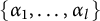 $\{\alpha _1, \dots , \alpha _l\}$
such that
 $s(\alpha _1)=x$
,
 $t(\alpha _l)=y,$
and
 $t(\alpha _i)=s(\alpha _{i+1})$
for all
 $1 \leq i \leq l-1$
, and we define
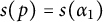 $s(p)=s(\alpha _1)$
and
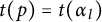 $t(p)=t(\alpha _l)$
, and by abuse of notation, we write
 $p = \alpha _1\alpha _2 \dots \alpha _l$
. A path p is a cycle if
 $s(p)=t(p)$
. In addition, for each vertex
 $i,$
we denote by
 $e_i$
the stationary path of length 0.
Consider the algebra
 $K Q$
generated by paths of any length, and denote by
 $J$
the two-sided ideal generated by arrows. A two-sided ideal
 $I$
of
 $KQ$
is called admissible if there exists
 $m \geq 2$
such that
 $J^m \subset I \subset J^2$
, where
 $J^m$
is the ideal generated by paths of length
 $m$
and
 $J^2$
is the ideal generated by paths of length 2. The set of generators in
 $I$
is called a set of relations.
The pair
 $(Q,I)$
is said to be a bound quiver, and the algebra
 $KQ/I$
is the bound quiver algebra. Every basic and connected finite-dimensional K-algebra A can be defined by a bound quiver with an admissible ideal
 $(Q_A,I_A)$
[Reference Assem, Simson and SkowronskiASS+06, Theorem 3.7], in this case,
 $Q_A$
is called the ordinary quiver of
 $A$
.
Finally,
 $a$
path
 $p$
in Q is nonzero in
 $(Q, I)$
if
 $p\notin I$
, and a nonzero path
 $p$
is maximal if for any arrow
 $\alpha \in Q$
, the paths
 $\alpha p$
and
 $p\alpha $
are elements of
 $I$
.
2.1 Gentle and skew-gentle algebras
skew-gentle algebras were defined in [Reference Geiß and de la PeñaGdlP99] as certain skew-group algebras of gentle algebras. We first recall the definition of gentle algebra.
Definition 2.1 A pair
 $(Q,I)$
given by a quiver Q and an ideal I generated by a set of paths of length two in
 $Q$
is gentle if:
-
(1) there is at most two arrows ending and starting at each vertex x;
-
(2) for every arrow
$\alpha $
in
$Q_1$
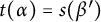
, there is at most one arrow
$\beta $
such that
$t(\alpha ) = s(\beta )$
and
$\alpha \beta \in I$
, and there is at most one arrow
$\beta '$
such that
$t(\alpha ) = s( \beta ')$
and
$\alpha \beta ' \notin I$
; -
(3) for every arrow
$\alpha $
in
$Q_1$
, there is at most one arrow
$\gamma $
such that
$s(\alpha ) = t( \gamma )$
and
$\gamma \alpha \in I$
, and there is at most one arrow
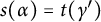
$\gamma '$
such that
$s(\alpha ) = t( \gamma ')$
and
$\gamma '\alpha \not \in I$
; -
(4) the path algebra
$A(Q,I)=KQ/I$
is finite dimensional.






An algebra A is gentle if it is Morita equivalent to an algebra
 $A(Q,I)=KQ/I$
, where
 $(Q,I)$
is a gentle pair.
If the bound quiver
 $(Q, I)$
satisfies (1)–(3), we say that the quotient
 $KQ/I$
is locally gentle.
Definition 2.2 A triple
 $(Q,I,\text {Sp})$
given by a quiver Q, an ideal I generated by a set of paths of length two in Q, and a subset Sp of loops in Q is skew-gentle if the pair
 $(Q, \langle I\sqcup \{f^2: f\in \text {Sp}\}\rangle )$
is gentle.
An algebra A is skew-gentle if it is Morita equivalent to an algebra
 $A(Q,I,\text {Sp})=KQ/\langle I\sqcup \{f^2-f: f\in \text {Sp}\}\rangle $
, where
 $(Q,I, \text {Sp})$
is a skew-gentle triple.
We refer to the elements of Sp as special loops, and we denote by
 $Q_0^{\times }$
the set of special vertices of
 $Q$
where a special loop is attached.
It is clear that, in general, the ideal associated with a skew-gentle algebra
 $A(Q,I, \mathrm {Sp})$
is not admissible. However, in [Reference Geiß and de la PeñaGdlP99], the authors provide an admissible presentation of
 $A(Q,I, \mathrm {Sp})$
. The reader can see this construction in Example 3.5.
2.2 Trivial extensions
Trivial extensions of artin algebras play an important role in representation theory. In this section, we describe a construction for the quiver and relations of a trivial extension of a bound quiver algebra. We mainly follow the articles [Reference Fernández and PlatzeckFP02, Reference Fernandez, Schroll, Treffinger, Trepode and ValdiviesoFST+22, Reference SchrollSch15].
The trivial extension of an algebra A is the algebra
 $T(A)=A\ltimes DA$
with underlying vector space
 $A\oplus DA$
and with the multiplication defined by
 $(a,f)(b,g)=(ab, ag+fb)$
, for
 $a, b\in A$
and
 $f,g\in DA$
, where
 $D=\operatorname {Hom}_K(-, K)$
.
For every finite-dimensional algebra
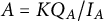 $A = KQ_A/I_A$
, where
 $I_A$
is an admissible ideal, we can construct its trivial extension
 $T(A)$
based on the quiver and relations of A and a basis of the two-sided ideal
 $\operatorname {soc}_{A^e}A$
, where
 $A^e$
is the enveloping algebra.
Recall that, as a K-vector space,
 $\operatorname {soc}_{A^e}A$
can be defined as the intersection of
 $$\begin{align*}\operatorname{soc} (_AA) = \{a\in A \colon Ja =0 \} \ \ \ \mathrm{and} \ \ \ \operatorname{soc} (A_A) = \{a\in A \colon aJ =0 \}, \end{align*}$$
where J denotes the Jacobson radical, i.e., the ideal generated by arrows (see [Reference LamLam91, Exercise 4.20] and [Reference Assem, Simson and SkowronskiASS+06, Lemma 2.10]).
Let
 $\mathcal M=\{p_1, \dots , p_r\}$
be a K-basis of
 $\operatorname {soc}_{A^e}A$
. The ordinary quiver of
 $T(A)$
is given by:
-
(1)
$(Q_{T(A)})_0=(Q_A)_0$
; -
(2)
$(Q_{T(A)})_1=(Q_A)_1 \cup \{\beta _{p_1},\dots , \beta _{p_r}\}$
, where
$\beta _{p_i}$
is an arrow from
$t(p_i)$
to
$s(p_i)$
for each
$p_i\in \mathcal {M}$
, with
$1\leq i\leq r$
.




To give an explicit description of the ideal of relations
 $I_{T(A)}$
, we need to recall some definitions from [Reference Fernández and PlatzeckFP02, Section 3].
Definition 2.3 Let
 $\mathcal {M}=\{p_1, \dots , p_r\}$
be a basis of
 $\operatorname {soc}_{A^e} A$
. Let
 $C=\alpha _1\dots \alpha _l\beta _{p_j}$
be an oriented cycle in
 $KQ_{T(A)}$
such that
 $p_j^*(\alpha _1\dots \alpha _l)\neq 0,$
where
 $\alpha _1 \dots \alpha _l$
is a path in
 $KQ_A$
,
 $p_j\in \mathcal {M}$
, and
 $p_j^*$
is the dual of
 $p_j$
. The cycle C and all the cyclic permutations of C are called elementary. In this case, we say that
 $\omega (C)=p_j^*(\alpha _1\dots \alpha _l)\in K$
is the weight of
 $C$
.
Let
 $C$
be a cycle of a quiver
 $Q$
and
 $q$
be a path contained in some cyclic permutation of
 $C$
. The supplement of
 $q$
in
 $C$
is the (possibly stationary) path
 $p$
such that
 $C=pq$
up to cyclic equivalence.
For each vertex
 $x\in Q_{T(A)}$
, we define the two-sided ideal
 $I_x'$
in
 $Q_{T(A)}$
generated by:
-
(1) Oriented cycles from x to x which are not contained in any elementary cycle.
-
(2) The elements of the form
$\omega (C')C-\omega (C)C'$
, where C and
$C'$
are different elementary cycles starting and ending at
$x$
.



The ideal of relations for the trivial extension of a finite-dimensional algebra was described in [Reference Fernandez, Schroll, Treffinger, Trepode and ValdiviesoFST+22].
Theorem 2.4 [Reference Fernandez, Schroll, Treffinger, Trepode and ValdiviesoFST+22, Theorem A.1]
Let
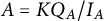 $A=KQ_A/I_A$
be a finite-dimensional algebra and let
 $T(A)=KQ_{T(A)}/I_{T(A)}$
be its trivial extension. Then, the quiver
 $Q_{T(A)}$
is as above and the ideal
 $I_{T(A)}$
is generated by the union of the following sets:
-
(1) A generating set of the ideal of relations
$I_A$
of
$A$
. -
(2) The paths that are not contained in (cyclic permutations of) any elementary cycle.
-
(3) Linear combination of paths
$\rho \in e_xKQ_{T(A)}e_y$
such that
$\rho q\in I_x'$
or
$q\rho \in I_{y}'$
for any supplement path
$q$
in an elementary cycle
$C$
, where
$I_x'$
is the ideal defined above.





2.3 Repetitive algebra and ref lections
In this section, we recall the definition of the repetitive algebra and reflections, both of them linked to an alternative construction for a trivial extension of an algebra. We mainly follow [Reference Fernández and PlatzeckFP02, Reference Hughes and WashbüschHW83, Reference SchröerSch99].
Let
 $A=KQ/ I$
be a finite-dimensional algebra with I be an ideal generated by a set of relations
 $\rho $
for
 $Q$
which are either zero relations or commutativity relations, and let
 $\mathcal M$
be a set of maximal paths in
 $(Q,I)$
. The repetitive algebra
 $\widehat A$
is defined as the path algebra
 $K\widehat {Q}/ \langle \widehat \rho \rangle $
, where
 $\widehat Q$
and
 $\widehat \rho $
are defined as follows:
-
(1) The set of vertices of
$\widehat {Q}$
is the set
$\{x[n]: x\in Q_0 \text { and } n\in \mathbb {Z}\}$
. -
(2) In the same way, every arrow
$\alpha :x\rightarrow y$
in
$Q_1$
induces arrows
$\alpha [n]:x[n]\rightarrow y[n]$
in
$\widehat {Q}$
for all
$n\in \mathbb {Z}$
. -
(3) For each maximal path
$p\in \mathcal {M}$
in
$(Q,I)$
, with
$x=s(p)$
and
$y=t(p)$
, there is an arrow
$\overline {p}[n]:y[n]\rightarrow x[n+1]$
in
$\widehat {Q}$
, for all
$n\in \mathbb {Z}$
. These arrows are called connecting arrows.










To define the set of relations
 $\widehat \rho $
, we need to introduce some definitions for paths in
 $(Q, I)$
. Let p be a path in
 $(Q,I)$
, we denote by
 $p[n]$
the corresponding path in
 $\widehat {Q}$
. If
 $p=p_1p_2$
is a maximal path in
 $(Q,I)$
, then
 $p_2[n]\overline {p}[n]p_1[n+1]$
is called full path in
 $\widehat {Q}$
.
The set of relations
 $\widehat {\rho }$
of
 $\widehat {Q}$
is given by the following list:
-
• For each monomial relation
$p\in \rho $
, the path
$p[n]$
is in
$\widehat {\rho }$
, for all
$n\in \mathbb {Z}$
. -
• For each commutative relation
$p_1-p_2\in \rho $
, then
$p_1[n]-p_2[n]$
is in
$\widehat {\rho }$
, for all
$n\in \mathbb {Z}$
. -
• Let p be a path in
$\widehat {Q}$
which contains a connecting arrow. If p is not a sub-path of a full path, then
$p\in \widehat {\rho }$
. -
• If
$p=p_1p_2p_3$
and
$q=q_1q_2q_3$
are maximal paths in
$(Q,I)$
such that
$p_2=q_2$
, then
$p_3[n]\overline {p}[n]p_1[n+1]-q_3[n]\overline {q}[n]q_1[n+1]$
is in
$\widehat {\rho }$
, for all
$n\in \mathbb {Z}$
.








To define reflections over an algebra, we need to consider
 $\nu $
the Nakayama automorphism of
 $\widehat A$
, such that
 $\nu (x[n])=x[n+1]$
for every
 $x\in Q_0$
and every
 $n\in \mathbb {Z}$
.
Let x be a source of
 $Q_A$
, we denote by
 ${\sigma _x^-Q_A}$
the full sub-quiver of
 $\widehat {Q_{{A}}}$
with vertex set
 $$\begin{align*}S=\{y[0]\in (\widehat{Q_{{A}}})_0\mid y\in (Q_A)_0,y\neq x\}\cup \{x[1]\}.\end{align*}$$
We note that
 ${\sigma _x^-Q_A}$
is a complete
 $\nu $
-slice, which is defined as a connected full subquiver of
 $\widehat {Q_{{A}}}$
that contains exactly one vertex from each
 $\nu $
-orbit of vertices of
 $Q_{\widehat {A}}$
.
The negative reflection
 $S_x^-(A)$
of A is the algebra
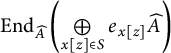 $\operatorname {End}_{\widehat {A}} \left (\bigoplus \limits _{x[z]\in S} e_{x[z]}\widehat {A}\right )$
, where
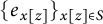 $\{e_{x[z]}\}_{x[z]\in S}$
is a set of primitive orthogonal idempotents of
 $\widehat {A}$
.
A negative reflection sequence of
 $Q_A$
is a sequence of vertices
 $x_1, \dots , x_r$
of
 $Q_A$
such that
 $x_j$
is a source of
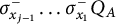 $\sigma ^-_{x_{j-1}}\dots \sigma ^-_{x_1}Q_A$
for
 $1\leq j\leq r$
.
Similarly, given a sink x of
 $Q_A$
, a positive reflection of an algebra is defined, considering
 $\sigma ^+_xQ_A$
as the full-subquiver of
 $\widehat {Q}_A$
with vertex set
 $$\begin{align*}S=\{y[0]\in (\widehat{Q_{{A}}})_0\mid y\in (Q_A)_0,y\neq x\}\cup \{x[-1]\}.\end{align*}$$
Remark 2.5 The quiver of the negative (positive) reflection
 $S^{-}_x(A)$
(resp.
 $S^{+}_x(A)$
) coincides with the quiver
 $\sigma ^-_xQ_A$
(resp.
 $\sigma ^+_xQ_A$
).
3 Trivial extension of a skew-gentle algebra
In this section, we describe the quiver and relations for the trivial extension of the admissible presentation of a skew-gentle algebra. To do this, we introduce a construction of quivers and relations that depends on a set of vertices and cycles from a given quiver. By abuse of notation and convenience, we call these vertices special, and we denote them by
 $Q_0^{\times }$
as in the previous section. This construction is slightly different from the one presented in [Reference Geiß and de la PeñaGdlP99], and revisited in [Reference Amiot and BrüstleAB22, Reference Labardini-Fragoso, Schroll and ValdiviesoLFSV22], implemented to define the admissible presentation of any skew-gentle algebra.
Definition 3.1 (sg-quiver
$Q^{\mathrm {sg}}$
)

Let Q be a quiver with a set of vertices
 $Q_0^{\times }$
(called special vertices), such that there is no loop incident at any special vertex. We define the sg-quiver
 $Q^{\mathrm {sg}}$
as follows. We start by duplicating the special vertices in Q, that is, for each vertex x in
 $Q_0$
, we define
 $$\begin{align*}Q^{\text{sg}}_0(x) = \left\{ \begin{array}{@{}ll} \{x^+, x^-\} & \text{if } x \in Q_0^{\times} \\ \{ x \} & \text{otherwise,} \\ \end{array}\right. \end{align*}$$
obtaining the set of vertices
 $Q^{\text {sg}}_0:= \bigcup _{x\in Q_0} Q^{\text {sg}}_0(x)$
. For each arrow
 $\alpha $
in
 $Q_1$
, we define the set of arrows
 $$\begin{align*}Q^{\text{sg}}_1(\alpha):=\{(x,\alpha, y) \mid x \in Q_0^{\text{sg}}(s(\alpha)), y \in Q_0^{\text{sg}}(t(\alpha))\}\end{align*}$$
obtaining the set of arrows
 $Q_1^{\text {sg}}:= \bigcup _{\alpha \in Q_1}Q_{1}^{\text {sg}}(\alpha )$
.
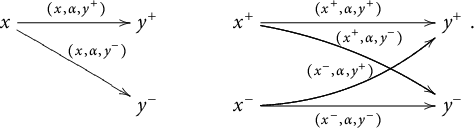
In other words, while arrows incident to non-special vertices remain the same, for an arrow in
 $Q$
of the form
 $x \xrightarrow {\alpha } y$
, if one of the vertices, say
 $y$
, belongs to
 $Q_0^{\times }$
then we will have two arrows in
 $Q^{\text {sg}}$
. If both vertices
 $x$
and
 $y$
are special, there will be four arrows in
 $Q^{\text {sg}}$
. See these cases below.
To shorten notation, we use upper scripts for new arrows in
 $Q^{\text {sg}}$
, for instance,
 $( x, \alpha , y^+ )$
can be denoted
 $ x \xrightarrow {\alpha ^+} y^+ $
, and
 $( x^-, \alpha , y^+ )$
can be denoted
 $ x^- \xrightarrow {{}^-\alpha ^+} y^+ $
(see Example 3.5). In our proofs, we denote arrows after special vertex duplication by
 ${}^{\varepsilon }\alpha ^{\varepsilon '}$
, where the indices
 $\varepsilon , \varepsilon '$
will always be considered in
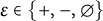
 $\{ +,-, \emptyset \}$
.
The next definition generalizes the construction of the admissible ideal of a skew-gentle algebra.
Definition 3.2 (sg-ideal
$I^{\textrm {sg}}$
)

Let
 $A=KQ/I$
be a finite-dimensional algebra with
 $Q_0^{\times }$
a set of special vertices, as in Definition 3.1, and
 $\mathcal {C}$
be a (possibly empty) set of cycles of length at least two in
 $Q$
, called special cycles, such that:
-
• The class
$\mathcal {C}$
is closed under cyclic permutations. -
• There is at most one special cycle starting at each vertex in
$Q_0^{\times }$
. -
• The ideal I is generated by the union of the following (possible empty) sets:
-
– A set of paths of length at least two that contains no paths of the form
$\alpha \beta $
with
$x=t(\alpha )=s(\beta ) \in Q_0^{\times }$
. -
– All commutative relations of the form
$C_1-C_2$
, where
$C_1$
and
$C_2$
are distinct cycles of
$\mathcal {C}$
starting at the same non-special vertex.
-





Let
 $Q^{\text {sg}}$
be the sg-quiver of Q. We define the sg-ideal
 $I^{\mathrm {sg}}$
of
 $KQ^{\text {sg}}$
as the ideal generated by the union of the following sets:
-
Type a: Commutative relations
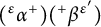
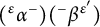
$({}^\varepsilon \alpha ^{+})({}^+\beta ^{\varepsilon '})- ({}^\varepsilon \alpha ^{-})({}^-\beta ^{\varepsilon '})$
such that
$\alpha \beta $
is a path of length 2 in Q with
$t(\alpha ) \in Q_0^{\times }$
, for all possible
$\varepsilon , \varepsilon '\in \{+,-, \emptyset \}$
. -
Type b: Commutative relations
$(\alpha _1^{\varepsilon _2})({}^{\varepsilon _2}\alpha _2^{\varepsilon _3}) \dots ({}^{\varepsilon _k}\alpha _k)-(\beta _1^{\varepsilon ^{\prime }_2})({}^{\varepsilon ^{\prime }_2}\beta _2^{\varepsilon ^{\prime }_3}) \dots ({}^{\varepsilon ^{\prime }_l}\beta _l)$
, for each difference of two different special cycles
$C_1-C_2=\alpha _1\dots \alpha _{k}-\beta _1\dots \beta _{l}$
starting at the same non-special vertex, for all possible
$\varepsilon _i,\,\varepsilon ^{\prime }_j=\{+,-, \emptyset \}$
with
$i=1, \dots , k$
and
$j=1, \dots , l$
. -
Type c: Monomial relations
$({}^{\varepsilon _1}\alpha _1^{\varepsilon _2})({}^{\varepsilon _2}\alpha _2^{\varepsilon _3}) \dots ({}^{\varepsilon _k}\alpha _k^{\varepsilon _{k+1}}),$
where
$\alpha _1\dots \alpha _k$
is a monomial relation of I, for all possible
$\varepsilon _i=\{+,-, \emptyset \}$
and
$i=1, \dots , k+1$
. -
Type d: A monomial relation
$({}^{\varepsilon _1}\alpha _1^{\varepsilon _2})({}^{\varepsilon _2}\alpha _2^{\varepsilon _3}) \dots ({}^{\varepsilon _k}\alpha _k^{\varepsilon _{k+1}})$
, for each special cycle
${C=\alpha _1\dots \alpha _{k}}$
starting at a special vertex, such that
$\varepsilon _1\neq \varepsilon _{k+1}$
, for all possible
${\varepsilon _i=\{+,-, \emptyset \}}$
and
$i=1, \dots , k+1$
.


















We say that
 $A^{\text {sg}}=KQ^{\text {sg}}/I^{\text {sg}}$
is the sg-bound quiver algebra of
 $A$
.
To show that the previous definitions generalize the construction of the admissible presentation of a skew-gentle algebra, we need to introduce the following definition.
Definition 3.3 Let
 $A=A(Q,I, \mathrm {Sp})$
be skew-gentle algebra, with
 $Q_0^{\times }$
the set of special vertices in
 $Q$
, and let
 $\rho $
be the set of paths of length two that generates
 $I$
. The auxiliary gentle algebra
 $A'$
is the algebra
 $KQ'/ I'$
, where
 $Q'=Q\setminus \text {Sp}$
and
 $I'= \langle \rho \setminus \{\alpha \beta \in I: x=t(\alpha )=s(\beta ) \in Q_0^{\times } \}\rangle $
. We say that
 $Q'$
is the auxiliary quiver of
 $A$
and
 $I'$
is the auxiliary ideal of
 $A$
.
Remark 3.4 With the above notation, the admissible presentation of a skew-gentle algebra
 $A=A(Q,I, \mathrm {Sp})$
coincides with the sg-bound quiver algebra
 $(A')^{\text {sg}}$
of the auxiliary gentle algebra of
 $A$
. In this case, when we apply Definitions 3.1 and 3.2, we consider the set of special cycles to be empty. To clarify the construction, please see Example 3.5. In this context, by abuse of notation, we denote
 $(Q')^{\text {sg}}$
by
 $Q^{\text {sg}}$
,
 $(I')^{\text {sg}}$
by
 $I^{\text {sg}}$
, and we say that
 $A^{\text {sg}} = K Q^{\text {sg}}/I^{\text {sg}}$
is the admissible presentation for the skew-gentle algebra
 $A$
.
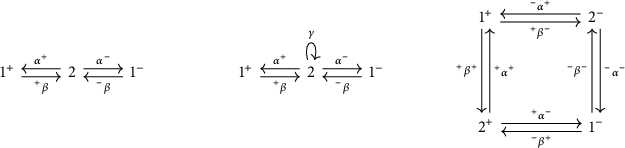
Example 3.5 Let
 $A=A(Q,I, \mathrm {Sp})$
be the skew-gentle algebra with quiver
 $Q$
:
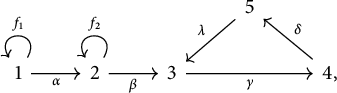
ideal
 $I = \langle \alpha \beta , \gamma \delta , \lambda \gamma \rangle $
and
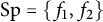 $\mathrm {Sp}=\{f_1, f_2\}$
the set of special loops. Following Remark 3.4 to compute the quiver of the admissible presentation of A, we consider
 $A'=KQ'/I$
be the auxiliary gentle algebra, where
 $Q'=Q\setminus \{f_1, f_2\}$
,
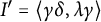 $I'= \langle \gamma \delta , \lambda \gamma \rangle $
,
 $Q_0^{\times }=\{1,2\}$
, and the set of special cycles
 $\mathcal {C}$
is the empty set.
Following the notation, the sg-bound quiver algebra
 $(A')^{\text {sg}}$
of
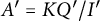 $A'=KQ'/I'$
is the algebra
 $KQ^{\text {sg}}/I^{\text {sg}}$
, where
 $Q^{\text {sg}}$
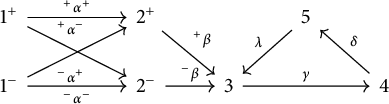
is the quiver
and
 $I^{\text {sg}}=\langle (^+\alpha ^+)(^+\beta )-(^+\alpha ^-)(^-\beta ), (^-\alpha ^+)(^+\beta )- (^+\alpha ^-)(^-\beta ), \gamma \delta , \lambda \gamma \rangle $
, which coincides with the admissible presentation of A as defined in [Reference Geiß and de la PeñaGdlP99] and denoted by the authors as
 $A^{\text {sg}}$
.
Remark 3.6 Let
 $p=\alpha _1 \dots \alpha _r$
be a nonzero path from x to y in a bound quiver algebra
 $KQ/I$
. Then,
 $p$
induces a set of nonzero paths
 $({}^{\varepsilon _1}\alpha _1^{\varepsilon _2}) \cdots ({}^{\varepsilon _r}\alpha _r^{\varepsilon _{r+1}})$
in the sg-bound quiver algebra
 $KQ^{\text {sg}}/I^{\text {sg}}$
, for all possible
 $\varepsilon _i=\{+, -,\emptyset \}$
, with
 $i=1,\dots ,r+1$
. Notice that by the commutativity relations of Type (a) of the sg-ideal
 $I^{\text {sg}}$
given in Definition 3.2, any two paths
 $({}^{\varepsilon _1}\alpha _1^{\varepsilon ^{\prime }_2}) \cdots ({}^{\varepsilon ^{\prime }_r}\alpha _r^{\varepsilon _{r+1}})$
and
 $({}^{\varepsilon _1}\alpha _1^{\varepsilon _2}) \cdots ({}^{\varepsilon _r}\alpha _r^{\varepsilon _{r+1}})$
from
 $x^{\varepsilon _1}$
to
 $y^{\varepsilon _{r+1}}$
are equivalent modulo
 $I^{\text {sg}}$
. Then, we denote the unique representative path in
 $KQ^{\text {sg}}/I^{\text {sg}}$
by
 ${}^{\varepsilon _1} p ^{\varepsilon _{r+1}}$
.
In order to compute the quiver of the trivial extension of a skew-gentle algebra
 ${A=A(Q,I, \mathrm {Sp})}$
, we need to consider a basis of the socle of the admissible presentation
 $A^{\text {sg}}$
of A (see Section 2.2). Recall that a path
 $p$
(in an admissible presentation
 $A=KQ/I$
) is called maximal, if
 $p\alpha =0$
and
 $\alpha p=0$
in
 $A$
for any arrow
 $\alpha $
in
 $Q$
.
Lemma 3.7 Let
 $A(Q,I, \mathrm {Sp})$
be a skew-gentle algebra and let
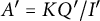 $A'=KQ'/I'$
be its auxiliary gentle algebra. Consider
 $A^{\mathrm {sg}}=KQ^{\mathrm {sg}}/I^{\mathrm {sg}}$
to be the admissible presentation of A. The following statements hold:
-
(a) A nonzero path in
$A'$
induces at most four linearly independent nonzero paths in
$A^{\mathrm {sg}}$
. Conversely, any nonzero path in
$A^{\mathrm {sg}}$
is induced by a path in
$A'$
. -
(b) A path in
$A'$
is maximal if and only if any induced path in
$A^{\mathrm {sg}}$
is a maximal path.


Proof Let
 $A=A(Q,I, \mathrm {Sp})$
be a skew-gentle algebra with
 $Q_0^{\times }$
the set of special vertices. We consider
 $A^{\text {sg}}$
the admissible presentation of A and
 $A'$
its auxiliary gentle algebra.
 $(a)$
Let
 $p=\alpha _1 \dots \alpha _r$
be a nonzero path in
 $A'$
. Following Remark 3.6, p induces set of paths
 ${}^{\varepsilon } p ^{\varepsilon '}$
for all possible
 $\varepsilon ,\varepsilon '=\{+, -,\emptyset \}$
. In particular, a path p in
 $A'$
induces exactly:
-
• four different equivalence classes of paths in
$A^{\text {sg}}$
if and only if
$s(p)$
and
$t(p)$
are special vertices, each one with different starting and ending vertex; -
• two different equivalence classes of paths in
$A^{\text {sg}}$
if and only if one and only one of the vertices
$s(p)$
or
$t(p)$
is a special vertex, coinciding exclusively either at the starting or the ending vertex; -
• exactly one equivalence class of paths in
$A^{\text {sg}}$
if and only if none of the vertices
$s(p)$
and
$t(p)$
are special.


It is also clear that any nonzero path
 $({}^{\varepsilon _1}\alpha _1^{\varepsilon _2}) \cdots ({}^{\varepsilon _r}\alpha _r^{\varepsilon _{r+1}})$
in
 $A^{\text {sg}}$
is induced by the nonzero path
 $p=\alpha _1 \dots \alpha _r$
in
 $A'$
.
 $(b)$
Let
 $p=\alpha _1 \dots \alpha _r$
be a maximal path in
 $A'$
, and let
 ${}^{\varepsilon } p ^{\varepsilon '}$
be an induced path in
 $A^{\text {sg}}$
, with
 $\varepsilon ,\varepsilon '\in \{+,-,\emptyset \}$
. Suppose that
 ${}^{\varepsilon } p ^{\varepsilon '}$
is not maximal in
 $A^{\text {sg}},$
then there exists an arrow
 ${}^{\varepsilon _1} \beta ^{\varepsilon }$
(or
 ${}^{\varepsilon '} \gamma ^{\varepsilon _2}$
) such that the path
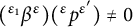 $({}^{\varepsilon _1} \beta ^{\varepsilon })({}^{\varepsilon } p ^{\varepsilon '})\neq 0$
(or
 $({}^{\varepsilon } p ^{\varepsilon '})({}^{\varepsilon '} \gamma ^{\varepsilon _2})\neq 0$
, respectively). Therefore, such a path in
 $A^{\text {sg}}$
is induced by a nonzero path
 $\beta p$
(or
 $p\gamma $
, respectively) in
 $A'$
, contradicting the fact that p is a maximal path. With similar argument, we claim that any maximal path
 ${}^{\varepsilon } p ^{\varepsilon '}$
in
 $A^{\text {sg}}$
with all possible
 $\varepsilon ,\varepsilon '\in \{+,-,\emptyset \}$
is induced by a maximal path
 $p$
in
 $A'.$
Recall that by [Reference SchrollSch15, Section 2.1], when
 $A$
is gentle, the set of maximal paths forms a basis for
 $\operatorname {soc}_{A^e}(A)$
.
Lemma 3.8 Let
 $A=A(Q,I, \mathrm {Sp})$
be a skew-gentle algebra and
 $A^{\mathrm {sg}}=KQ^{\mathrm {sg}}/I^{\mathrm {sg}}$
be its admissible presentation. Then, the set of maximal paths
 $\mathcal {M}$
in
 $A^{\mathrm {sg}}$
forms a basis of
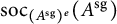 $\operatorname {soc}_{(A^{\mathrm {sg}})^e}(A^{\mathrm {sg}})$
.
Proof Let
 $A'$
be the auxiliary gentle algebra of
 $A$
. Denote
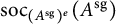 $\operatorname {soc}_{(A^{\text {sg}})^e}(A^{\text {sg}})$
by
 $R$
. As a
 $K$
-vector space,
 $R$
is the direct sum
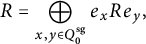 $$\begin{align*}R=\bigoplus_{x,y\in {Q^{\text{sg}}_0}}e_xRe_y, \end{align*}$$
where
 $e_x$
and
 $e_y$
are the trivial paths at a vertex
 $x$
and
 $y$
in
 $Q^{\text {sg}}_0$
.
Let x and y be two vertices in
 $Q^{\text {sg}}$
, and let
 $x'$
and
 $y'$
be their associated vertices in
 $A'$
. Since
 $A'$
is gentle, there are at most two linearly independent classes of paths
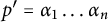 $p'=\alpha _1\dots \alpha _n$
and
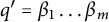 $q'=\beta _1\dots \beta _m$
from
 $x'$
to
 $y'$
(see [Reference Bekkert, Marcos and MerklenBMM03, Lemma 3]). By Lemma 3.7 and Remark 3.6, there are at most two linearly independent classes of paths
 $p$
and
 $q$
from
 $x$
to
 $y$
.
Note that there are at most four arrows ending at x and at most four arrows starting at y, which correspond to arrows ending at
 $x'$
and arrows starting at
 $y'$
. We will show that the paths
 $p$
and
 $q$
induce a basis for
 $e_x Re_y$
. We need to analyze each case based on the number of arrows ending at
 $x$
and starting at
 $y$
, respectively, and if there is exactly one independent class of paths from
 $x$
and
 $y$
or two, but we will describe two of them.
Suppose there are two independent classes of paths from x to y and suppose that there is exactly four arrows ending at
 $x$
and four arrows staring at
 $y$
, then there are exactly two arrows
 $\gamma _1$
and
 $\gamma _2$
ending at
 $x'$
and two arrows
 $\delta _1$
and
 $\delta _2$
staring at
 $y'$
, and
 $x'$
and
 $y'$
are not special vertices of
 $A'$
.
Since
 $A'$
is gentle, either
 $\gamma _1\alpha _1\notin I$
or
 $\gamma _2\alpha _1\notin I$
, and either
 $\gamma _1\beta _1\notin I$
or
 $\gamma _2\beta _1\notin I$
. Therefore,
 $p'$
and
 $q'$
are not maximal in
 $A'$
, and by Lemma 3.7, neither are
 $p$
and
 $q$
in
 $A^{\text {sg}}$
, and as a consequence,
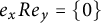 $e_xRe_y=\{0\}$
.
Suppose now that there are exactly two arrows
 $\gamma _1$
and
 $\gamma _2$
ending at
 $x$
and no arrows starting at
 $y$
. In this case, we need to consider two cases,
 $x'$
is a special vertex or not. In the first case, we have that
 $\gamma _1$
and
 $\gamma _2$
come from an arrow
 $\gamma $
in
 $A'$
, and there is exactly one independent class of path
 $p'$
from
 $x'$
to
 $y'$
, since there is exactly one arrow staring at
 $x'$
. Hence,
 $\gamma \alpha _1\notin I$
, and
 $p'$
is not maximal in
 $A'$
, neither
 $p$
in
 $A^{\text {sg}}$
, then
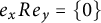 $e_xRe_y=\{0\}$
.
If
 $x'$
is not a special vertex, we have that either
 $\gamma _1$
and
 $\gamma _2$
are arrows of
 $A'$
, or they come from an arrow
 $\gamma $
in
 $A'$
. In the first case, by definition of gentle and a similar analysis as in the first case, the path or paths from
 $x'$
to
 $y'$
are not maximal, and neither the associated path or paths in
 $A^{\text {sg}}$
.
In the second case, if
 $p\neq q$
, then either
 $\gamma \alpha _1\in I$
or
 $\gamma \beta _1\in I$
; hence,
 $p$
is maximal or
 $q$
is maximal, respectively. As a consequence,
 $\{p\}$
or
 $\{q\}$
is a basis of
 $e_xRe_y$
.
Finally, if there is exactly one independent class of paths, namely,
 $p$
, then either
 $\gamma \alpha _1\in I$
or
 $\gamma \alpha _1\notin I$
. In the first situation,
 $p$
is maximal and is a basis of
 $e_xRe_y$
, while in the second case,
 $p$
is not maximal and therefore
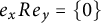 $e_xRe_y=\{0\}$
.
Lemma 3.9 Let
 $A=A(Q,I, \mathrm {Sp})$
be a skew-gentle algebra,
 $A^{\mathrm {sg}}=KQ^{\mathrm {sg}}/I^{\mathrm {sg}}$
its admissible presentation, and
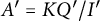 $A'=KQ'/I'$
its auxiliary gentle algebra. Then, the quiver
 $Q_{T(A^{\mathrm {sg}})}$
of the trivial extension of
 $A^{\mathrm {sg}}$
coincides with the
 $\mathrm {sg}$
-quiver
 $Q^{\mathrm {sg}}_{T(A')}$
of the trivial extension of
 $A'$
with special vertices
 $Q_0^{\times }$
.
Lemma 3.10 Let
 $A=A(Q,I, \mathrm {Sp})$
be a skew-gentle algebra and
 $A^{\mathrm {sg}}=KQ^{\mathrm {sg}}/I^{\mathrm {sg}}$
its admissible presentation and let
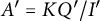 $A'=KQ'/I'$
be its auxiliary gentle algebra. We denote by
 $T(A^{\mathrm {sg}})$
and
 $T(A')$
the trivial extension of
 $A^{\mathrm {sg}}$
and
 $A'$
, respectively. Then, a cycle C in
 $T(A')$
is elementary if and only if any induced cycle
 ${}^{\varepsilon }C^{\varepsilon }$
in
 $Q^{\mathrm {sg}}_{T(A')}$
is an elementary cycle in
 $T(A^{\mathrm {sg}})$
, for all possible
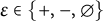 $\varepsilon \in \{+,-,\emptyset \}$
.
Proof Let
 $T(A')$
be the trivial extension of
 $A'$
, and let
 $C$
be an elementary cycle in
 $T(A')$
. Then,
 $C=\rho _1\beta _{\rho }\rho _2$
, where
 $\rho =\rho _2\rho _1$
is a maximal path in
 $A'$
and
 $\beta _{\rho }$
is the added arrow in
 $Q_{T(A')}$
with respect to the path
 $\rho $
(see Section 2.2). Following Lemma 3.7, the induced paths
 ${}^{\varepsilon } \rho ^{\varepsilon '}$
, for all possible
 $\varepsilon ,\varepsilon '\in \{+,-,\emptyset \}$
, are maximal paths in
 $A^{\text {sg}}$
. By Lemma 3.8, we can give a basis
 $\mathcal {M}$
of the socle of
 $A^{\text {sg}}$
such that
 ${}^{\varepsilon } \rho ^{\varepsilon '}\in \mathcal {M}$
. Then, by Definition 2.3, there exist arrows
 ${}^{\varepsilon '} \beta ^{\varepsilon }$
in
 $Q_{T(A^{\text {sg}})}$
such that
 $({}^{\varepsilon } \rho ^{\varepsilon '})({}^{\varepsilon '} \beta ^{\varepsilon })$
are elementary cycles in
 $T(A^{\text {sg}}).$
Notice that the arrows
 ${}^{\varepsilon '} \beta ^{\varepsilon }$
in
 $Q^{\text {sg}}_{T(A')}$
, for all possible
 $\varepsilon ,\varepsilon '\in \{+,-,\emptyset \}$
, are induced by the arrow
 $\beta _{\rho }$
in
 $T(A')$
. Therefore, the cycles
 ${}^{\varepsilon } C ^{\varepsilon }=({}^{\varepsilon } \rho ^{\varepsilon '})({}^{\varepsilon '} \beta ^{\varepsilon })$
in
 $T(A^{\text {sg}})$
are elementary cycles in
 $T(A^{\text {sg}})$
induced by
 $C$
.
With similar arguments, one can show that any elementary cycle
 ${}^{\varepsilon } C ^{\varepsilon }$
in
 $T(A^{\text {sg}})$
is induced by an elementary cycle
 $C$
in
 $T(A')$
.
Theorem 3.11 Let
 $A=A(Q,I, \mathrm {Sp})$
be a skew-gentle algebra, let
 $A^{\mathrm {sg}}$
be its admissible presentation, and
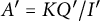 $A'=KQ'/I'$
be its auxiliary gentle algebra. Then, the trivial extension
 $T(A^{\mathrm {sg}})$
is isomorphic to the sg-bound quiver algebra of the trivial extension
 $T(A')$
, with
 $Q_0^{\times }$
as the set of special vertices and the set of elementary cycles
 $\mathcal {C}$
of
 $T(A')$
as the set of special cycles.
Proof Let
 $A=A(Q,I, \mathrm {Sp})$
be a skew-gentle algebra and let
 $A^{\text {sg}}=KQ^{\text {sg}}/I^{\text {sg}}$
and
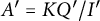 $A'=KQ'/I'$
be the algebras as described in the statement. By Lemma 3.9, the quivers
 $Q_{T(A^{\text {sg}})}$
and
 $Q_{T(A')}$
of the trivial extensions
 $T(A^{\text {sg}})$
and
 $T(A')$
coincide, then it is enough to verify that the ideal
 $I_{T(A^{\text {sg}})}$
of the trivial extension coincides with the sg-ideal
 $I^{\text {sg}}_{T(A')}$
of
 $T(A')$
.
 $\bullet $
Let x be a vertex in
 $Q_0^{\times }$
, and let
 $\alpha , \beta $
be arrows in
 $Q_{T({A'})}$
such that
 $\cdot \xrightarrow {\alpha }x\xrightarrow {\beta }\cdot $
. The commutative relations
 $({}^\varepsilon \alpha ^{+})({}^+\beta ^{\varepsilon '})- ({}^\varepsilon \alpha ^{-})({}^-\beta ^{\varepsilon '})$
in
 $I^{\text {sg}}_{T(A')}$
are of type (a). For the ideal
 $I_{T(A^{\text {sg}})}$
, we have to consider two cases:
-
(1) If
$\alpha $
and
$\beta $
are arrows of
$Q'$
, then such commutative relations are generators of
$I_{A^{\text {sg}}}$
, and therefore also of
$I_{T(A^{\text {sg}})}$
. -
(2) We assume that
$\beta $
(or
$\alpha $
) is not an arrow of
$Q'$
. Then, the arrows
${}^{\varepsilon "}\beta ^{\varepsilon '}$
in
$Q_{T(A^{\text {sg}})}$
do not belong to
$Q_{A^{\text {sg}}}$
, with
$\varepsilon "\in \{+,-\}$
, and
$\varepsilon '\in \{+,-,\emptyset \}$
. That it to say that the mentioned arrows are new arrows in the quiver
$Q_{T(A^{\text {sg}})}$
which are in correspondence with maximal paths
$({}^{\varepsilon '}\rho ^{\varepsilon })(^{\varepsilon }\alpha ^{\varepsilon "})$
in
$A^{\text {sg}}$
, with
$\varepsilon \in \{+,-,\emptyset \}$
. Therefore, the commutative relations
$({}^\varepsilon \alpha ^{+})({}^+\beta ^{\varepsilon '})- ({}^\varepsilon \alpha ^{-})({}^-\beta ^{\varepsilon '})$
in
$I_{T(A^{\text {sg}})}$
arise from the third condition of [Reference Fernandez, Schroll, Treffinger, Trepode and ValdiviesoFST+22, Theorem A.1], since the paths
$({}^\varepsilon \alpha ^{+})({}^+\beta ^{\varepsilon '})$
and
$({}^\varepsilon \alpha ^{-})({}^-\beta ^{\varepsilon '})$
have the same complement
${}^{\varepsilon '}\rho ^{\varepsilon }$
in an elementary cycle.




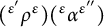




 $\bullet $
Let
 $C_1$
and
 $C_2$
be two elementary cycles of
 $T(A')$
starting at the same non-special vertex. Then, by Lemma 3.10, we have that
 ${}^{\varepsilon }C_1^{\varepsilon }$
and
 ${}^{\varepsilon }C_2^{\varepsilon }$
are elementary cycles of
 $Q(A^{\text {sg}})$
, with
 $\varepsilon =\emptyset $
. Therefore, it follows from the third condition of [Reference Fernandez, Schroll, Treffinger, Trepode and ValdiviesoFST+22, Theorem A.1] that
 ${}^{\varepsilon }C_1^{\varepsilon }-{}^{\varepsilon }C_2^{\varepsilon }$
are generators of
 $I_{T(A^{\text {sg}})}$
, and for the sg-ideal
 $I^{\text {sg}}_{T(A')}$
of
 $T(A')$
, such relations arise from relations of Type (b) in Definition 3.1.
 $\bullet $
Finally, monomial relations of
 $I_{T(A^{\text {sg}})}$
arise from monomial relations of
 $I^{\text {sg}}$
or from paths which are not contained in any elementary cycle of
 $T(A^{\text {sg}})$
. On the other hand, monomial relations of the sg-ideal
 $I^{\text {sg}}_T(A')$
of
 $T(A')$
arise from relations of Types (c) and (d) of Definition 3.1. It follows from Lemma 3.10 that these two mentioned sets are equal.
In the following example, we illustrate how to use Theorem 3.11 to compute the trivial extension of a skew-gentle algebra starting from its auxiliary gentle algebra.
Example 3.12 Let
 $A$
be the skew-gentle algebra given in Example 3.5 and let
 $A'$
be its auxiliary gentle algebra.
Following [Reference Assem, Simson and SkowronskiASS+06, Lemma 2.10], the ordinary quiver
 $Q_{T(A')}$
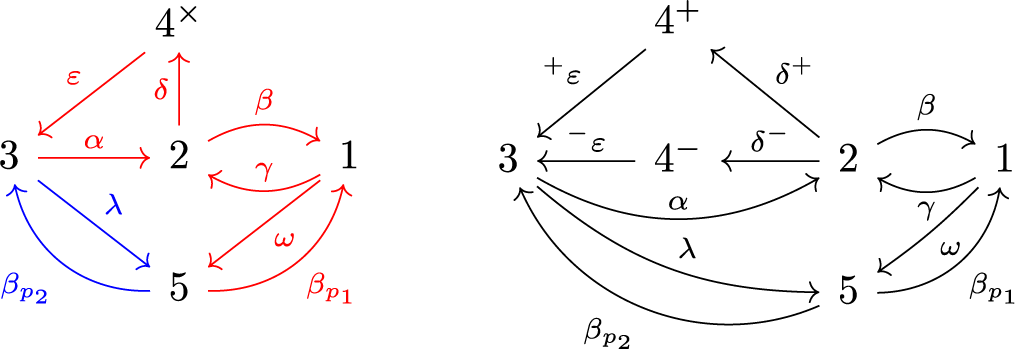
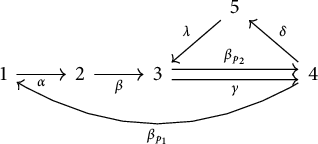
of
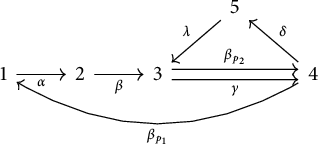
 $T(A')$
is depicted in Figure 1. Here,
 $\beta _{p_1}$
and
 $\beta _{p_2}$
correspond to the new arrows in
 $Q_{T(A')}$
associated with the maximal paths
 $p_1=\alpha \beta \gamma $
and
 $p_2=\delta \lambda $
in
 $A'$
, respectively. As a consequence, the set of elementary cycles (up to cycle equivalences) in
 $T(A')$
is given by
 $C_1=\alpha \beta \gamma \beta _{p_1}$
and
 $C_2=\delta \lambda \beta _{p_2}$
.
Ordinary quiver of the trivial extension
 $T(A')$
of the auxiliary gentle algebra
 $A'$
.
Then, by Theorem 2.4, the ideal
 $I_{T(A')}$
is generated by:
-
(1) The relations in
$I_{A}$
:
$\gamma \delta , \lambda \gamma $
. -
(2) The paths that are not contained in any elementary cycle, which in this case are of two kinds.
-
(a) The composition of any two consecutive arrows in different elementary cycles:
$\beta \beta _{p_2}$
,
$\beta _{p_2}\beta _{p_1}$
. -
(b) The paths of the form
$C\eta $
, where C is an elementary cycle and
$\eta $
is the first arrow of
$C$
:
$\alpha \beta \gamma \beta _{p_1}\alpha $
,
$\beta \gamma \beta _{p_1}\alpha \beta $
,
$\gamma \beta _{p_1}\alpha \beta \gamma $
,
$\beta _{p_1}\alpha \beta \gamma \beta _{p_1}$
,
$\delta \lambda \beta _{p_2}\delta $
,
$\lambda \beta _{p_2}\delta \lambda $
,
$\beta _{p_2}\delta \lambda \beta $
.
-
-
(3) Linear combinations of paths satisfying (3) in Theorem 2.4:
$\beta _{p_2}\delta \lambda -\gamma \beta _{p_1}\alpha \beta , \delta \lambda \beta _{p_2}-\beta _{p_1}\alpha \beta \gamma $
.



It follows from Theorem 3.11, that the trivial extension
 $T(A^{\text {sg}})$
of
 $A^{\text {sg}}$
is isomorphic to the sg-bound quiver algebra of
 $T(A')$
with
 $Q_0^{\times }=\{1,2\}$
as the set of special vertices and
 $\mathcal {C}=\{\alpha \beta \gamma \beta _{p_1}, \delta \lambda \beta _{p_2}\}$
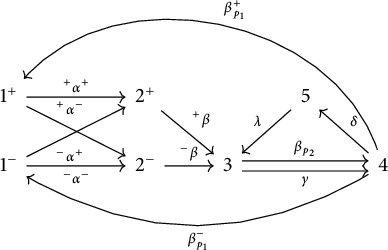
as the set of special cycles. Then,
 $T(A^{\text {sg}})$
is the algebra with quiver
Quiver of the trivial extension
 $T(A^{\text {sg}})$
.
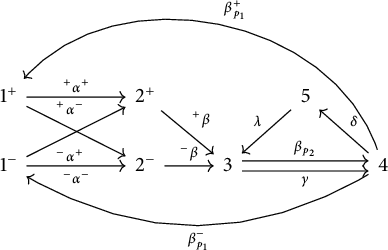
and the ideal
 $I_{T(A^{\text {sg}})}$
is generated by:
-
Type a:
$({}^{+}\alpha ^{+})({}^{+}\beta )- ({}^{+}\alpha ^{-})({}^{-}\beta )$
,
$({}^{-}\alpha ^{+})({}^{+}\beta )- ({}^{-}\alpha ^{-})({}^{-}\beta )$
. -
Type b:
$\beta _{p_2}\delta \lambda -\gamma (\beta _{p_1}^-)({}^-\alpha ^-)({}^-\beta )$
,
$ \beta _{p_2}\delta \lambda -\gamma (\beta _{p_1}^+)({}^+\alpha ^+)({}^+\beta )$
,
$\delta \lambda \beta _{p_2}-(\beta _{p_1}^+)({}^+\alpha ^+)({}^+\beta )\gamma $
and
$\delta \lambda \beta _{p_2}-(\beta _{p_1}^-)({}^-\alpha ^-)({}^-\beta )\gamma $
. -
Type c:
$({}^+\beta )\beta _{p_2}, ({}^-\beta )\beta _{p_2},\beta _{p_2}(\beta _{p_1}^+), \beta _{p_2}(\beta _{p_1}^-)$
,
$({}^+\alpha ^+)({}^+\beta )\gamma (\beta _{p_1}^+)({}^+\alpha ^+)$
,
$({}^+\beta )\gamma (\beta _{p_1}^+)({}^+\alpha ^+)({}^+\beta )$
,
$\gamma (\beta _{p_1}^+)({}^+\alpha ^+)({}^+\beta )\gamma $
,
$(\beta _{p_1}^+)({}^+\alpha ^+)({}^+\beta )\gamma (\beta _{p_1}^+)$
,
$\delta \lambda \beta _{p_2}\delta , \lambda \beta _{p_2}\delta \lambda , \beta _{p_2}\delta \lambda \beta $
. -
Type d:
$({}^+\alpha ^+)({}^+\beta )\gamma (\beta _{p_1}^+)({}^+\alpha ^-), ({}^-\alpha ^-)({}^-\beta )\gamma (\beta _{p_1}^-)({}^-\alpha ^+)$
.













4 Skew-Brauer graph algebras and trivial extension of skew-gentle algebras
In this section, we define a generalization of Brauer graph algebras, that we call skew-Brauer graph algebras, and we show that the trivial extension of any skew-gentle algebra is isomorphic to a skew-Brauer graph algebra.
Given an undirected graph
 $\Gamma $
, we denote by
 $\operatorname {\mathrm {val}}(v)$
the valency of a vertex
 $v$
, i.e., the amount of edges incident to
 $v$
in
 $\Gamma $
.
We recall that a Brauer graph
 $\Gamma $
is a tuple
 $(\Gamma _0, \Gamma _1, \mathfrak {m}, \mathfrak {o}),$
where
 $(\Gamma _0, \Gamma _1)$
is an unoriented graph with
 $\Gamma _0$
the set of vertices and
 $\Gamma _1$
the set of edges and
-
(1)
$\mathfrak {m}$
is a multiplicity function
$\mathfrak {m} : \Gamma _0 \to \mathbb {Z}^+$
, assigning a positive number to each
${v \in \Gamma _0}$
. -
(2)
$\mathfrak {o}$
is an orientation of the edges attached to each
$v \in \Gamma _0$
. For a vertex v such that
$\operatorname {\mathrm {val}}(v) = t,$
we denote
$\mathfrak {o} (v) = (x_1, \ldots , x_t)$
. In the particular case that
$\operatorname {\mathrm {val}} (v) = 1$
and the only edge attached to
$v$
is
$x$
, if
$\mathfrak {m}(v) =1,$
the cyclic ordering is given by the single element x, but when
$\mathfrak {m}(v)> 1,$
we set
$\mathfrak {o}(v) = (x,x)$
so that in the cyclic order, the successor (and the predecessor) of
$x$
is
$x$
.









Definition 4.1 A skew-Brauer graph
 $\Gamma ^{\times }$
is tuple
 $\Gamma ^{\times }=(\Gamma ^{\prime }_0,\Gamma _0^{\times }, \Gamma _1, \mathfrak {m},\mathfrak {o})$
such that
 $\Gamma =(\Gamma _0'\sqcup \Gamma _0^{\times }, \Gamma _1, \mathfrak {m},\mathfrak {o})$
is a Brauer graph with
 $\Gamma ^{\prime }_0\sqcup \Gamma _0^{\times }$
a disjoint union of the set of vertices of the graph
 $\Gamma $
, and such that any vertex
 $v \in \Gamma ^\times _0$
satisfies
 $\mathfrak {m}(v)=1$
,
 $\mathfrak {o}(v)=(x_v)$
, and v is adjacent to a single vertex
 $w\in \Gamma ^{\prime }_0$
.
We call the vertices of
 $\Gamma _0^{\times }$
special vertices and the edges attached to a special vertex are called special edges. To emphasize that a vertex
 $v$
in
 $\Gamma $
is special, we replace
 $v$
by a decorated vertex
 $v^{\times }$
.
Given a skew-Brauer graph
 $\Gamma ^{\times }$
, we call the underlying Brauer graph
 $\Gamma $
the auxiliary Brauer graph, and we call
 $B_{\Gamma }$
the auxiliary Brauer graph algebra.
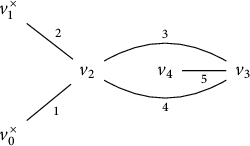
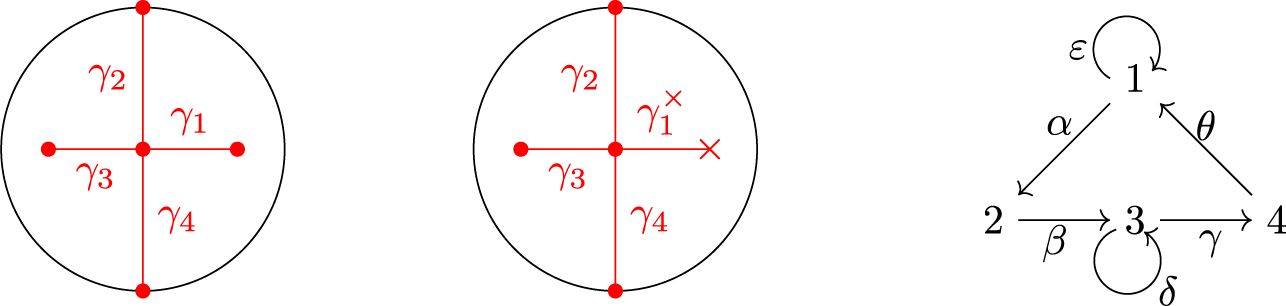
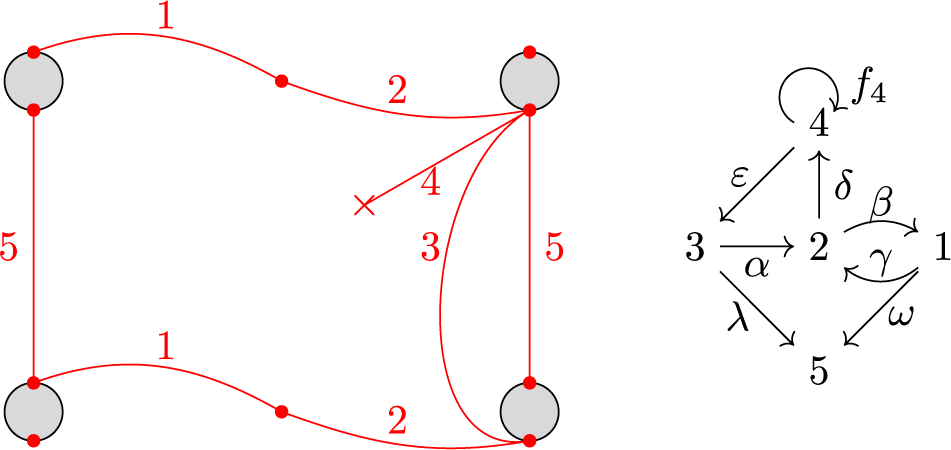
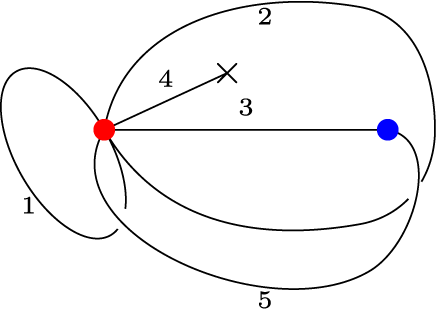
Example 4.2 Consider the graph in Figure 3 where
 $\mathfrak {m}(v_i^{\times })=1$
for
 $i\in \{0,1\}$
, and
 $\mathfrak {m}(v_4)=1$
and
 $\mathfrak {m}(v_j) \in \mathbf {N}$
for
 $j\in \{2,3\}$
.
Skew-Brauer graph with two special vertices.
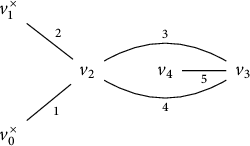
This is a skew-Brauer graph with two special vertices
 $v_1^{\times }$
and
 $v_0^{\times }$
. We have
 $\mathfrak {o}(v_0^{\times }) = (1)$
,
 $\mathfrak {o}(v_1^{\times }) = (2)$
,
 $\mathfrak {o}(v_2) = (1,2,3,4) $
,
 $\mathfrak {o}(v_3) = (3,4,5),$
and
 $\mathfrak {o} (v_4) =(5)$
.
Following [Reference SchrollSch18], given a Brauer graph
 $\Gamma $
, we define the Brauer quiver
 $Q_{\Gamma }=(Q_0, Q_1)$
as follows:
-
(1) The set of vertices
$Q_0$
is in bijection with the edges of
$\Gamma $
. -
(2) There is an arrow
$x \to y$
each time
$x$
and
$y$
are edges incident to a vertex
$v \in \Gamma _0$
and
$y$
is the immediate successor of
$x$
in the cyclic order
$\mathfrak {o}(v)$
. -
(3) Each non-distinguished vertex
$v$
of
$\Gamma $
with
$\mathfrak {m}(v)\mathrm {val}(v)\geq 2$
gives rise an oriented cycle
$C_v \colon x_1 \xrightarrow {\alpha _1} x_2 \to \cdots x_{t} \xrightarrow {\alpha _{t}} x_1$
in Q, up to cycle equivalence, established by the orientation
$\mathfrak {o}$
, i.e., if
$\mathfrak {o}(v) = (x_1, \ldots , x_t)$
(that we will set as clockwise in our examples when
$t>1$
). We say that
$C_v$
is a special cycle at
$v$
.








We define the skew-Brauer quiver
 $Q_{\Gamma ^{\times }}$
from a graph
 $\Gamma ^{\times }$
as a pair
 $Q_{\Gamma ^{\times }}=(Q_{\Gamma }, Q_0^{\times }),$
where
 $Q_{\Gamma }$
is the Brauer quiver of
 $\Gamma $
and
 $Q_0^{\times }$
is the set of special vertices that is in bijection with the set
 $\Gamma _0^{\times }$
. As before, to emphasize that a vertex
 $y$
is special in
 $Q_{\Gamma ^{\times }}$
, we replace
 $y$
by a decorated vertex
 $y^{\times }$
.
Finally, given a skew-Brauer quiver
 $Q_{\Gamma ^\times }$
, we define its admissible skew-Brauer quiver
 $Q^{\mathrm {sg}}_{\Gamma ^\times }$
as the one constructed from
 $Q_{\Gamma ^{\times }}$
following the rules described in Definition 3.1.
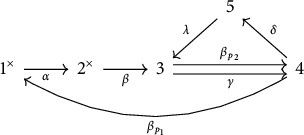
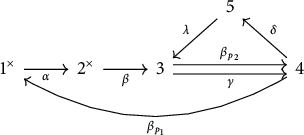
Following the previous definitions, the skew-Brauer graph in Figure 3 defines the skew-Brauer quiver
 $Q_{\Gamma ^{\times }}$
depicted in Figure 4, and its admissible skew-Brauer quiver coincides with the quiver given in Figure 2.
Skew-Brauer quiver with two special vertices.
Note that given a skew-Brauer graph
 $\Gamma ^\times $
, there is exactly one special cycle
 $C_v$
in
 $Q_{\Gamma ^{\times }}$
for every
 $v\in \Gamma _0$
with
 $\mathfrak {m}(v)\mathrm {val}(v)\geq 2$
, up to cycle permutation, and each special cycle
 $C_v$
induces
 $2^r$
cycles
 $\{C_{v,1}, C_{v,2}, \dots , C_{v,2^r}\}$
in
 $Q^{\mathrm {sg}}_{\Gamma ^\times }$
, where
 $r$
is the number of special edges attached to
 $v$
, which we call sg-special cycles at
 $v$
. Each one of the cycles
 $C_{v,l}$
and
 $C_v$
are considered up to cyclic permutation.
4.1 Skew-Brauer algebras and a set of relations
Let
 $\Gamma ^{\times }$
be a skew-Brauer graph, where
 $Q_{\Gamma ^{\times }}$
is its skew-Brauer quiver with special set of vertices
 $Q_0^{\times }$
, and let
 $Q^{\mathrm {sg}}_{\Gamma ^{\times }}$
be its admissible skew-Brauer quiver. We define the ideal
 $I_{\Gamma ^\times }$
in
 $KQ^{\mathrm {sg}}_{\Gamma ^\times }$
as the one generated by the following four types of relations:
Type 0: Difference of two paths of the form
 $$ \begin{align*}({}^\varepsilon\alpha^+) ({}^{+} \beta^{\varepsilon'})-({}^{\varepsilon}\alpha^-)({}^{-}\beta^{\varepsilon'})\end{align*} $$
for all possible
 $\varepsilon =\{+,-, \emptyset \}$
and
 $\varepsilon ' = \{+,-, \emptyset \}$
.
Type I: Difference of powers of two sg-special cycles
 $C_{v, l}$
and
 $C_{v', l'}$
at vertices
 $v$
and
 $v'$
of
 $\Gamma $
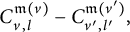 $$ \begin{align*}C_{v, l}^{\mathfrak{m}(v)}-C_{v', l'}^{\mathfrak{m}(v')},\end{align*} $$
where both cycles start at a vertex
 $y\in Q^{\mathrm {sg}}_{\Gamma ^\times }$
with
 $\mathfrak {m}(v) \operatorname {\mathrm {val}}(v) \neq 1$
and
 ${\mathfrak {m}(v') \operatorname {\mathrm {val}}(v') \neq 1}$
.
Type IIa: Paths of the form
 $$ \begin{align*}C_{v,l}^{\mathfrak{m}(v)}\alpha,\end{align*} $$
where
 $\alpha $
is the first arrow of the sg-special cycle
 $C_{v,l}$
.
Type IIb: Paths of the form
 $$ \begin{align*}C_{v,l}^{\mathfrak{m}(v)-1}({}^{\varepsilon_1}\alpha_1^{\varepsilon_2}) \cdots ({}^{\varepsilon_r}\alpha_r^{\varepsilon_{r+1}})\end{align*} $$
for each special cycle
 $C_{v}=\alpha _1 \cdots \alpha _r$
in
 $Q_{\Gamma ^{\times }}$
such that
 $s(\alpha _1)$
is a special vertex of
 $Q_{\Gamma ^{\times }}$
, for all possible
 $\varepsilon _k=\{+,-, \emptyset \},$
where
 $k=1, \dots , r+1$
with
 $\varepsilon _1\neq \varepsilon _{r+1}$
.
Type III: Paths of length two of the form
 $$ \begin{align*}\alpha\beta,\end{align*} $$
where
 $\alpha \beta $
is not a sub-path of any sg-special cycle
 $C_{v, l}$
, except when
 $\alpha =\beta $
and
 $\alpha $
is a loop induced by a vertex v in
 $\Gamma ^{\times }$
, i.e., where
 $\operatorname {\mathrm {val}}(v) = 1$
and
 $\mathfrak {m}(v)>1$
.Footnote
4
Definition 4.3 Let
 $\Gamma ^{\times }=(\Gamma _0', \Gamma _0^{\times }, \Gamma _1, \mathfrak {m}, \mathfrak {o})$
be a skew-Brauer graph. The algebra
 ${B_{\Gamma ^{\times }}=KQ^{\mathrm {sg}}_{\Gamma ^\times }/ I_{\Gamma ^{\times }}}$
is called the skew-Brauer graph algebra associated with the skew-Brauer graph
 $\Gamma ^\times $
.
Remark 4.4 Note that any skew-Brauer graph
 $\Gamma ^{\times }=(\Gamma ^{\prime }_0,\Gamma _0^{\times }, \Gamma _1, \mathfrak {m}, \mathfrak {o})$
with
 $\Gamma _0^\times =\emptyset $
is a Brauer graph. Therefore, in that case, the definition of skew-Brauer graph algebra coincides with the definition of Brauer graph algebra given in [Reference SchrollSch15].
Theorem 4.5 Skew-Brauer graph algebras (with arbitrary multiplicity function
 $\mathfrak {m}$
) are finite dimensional and symmetric.
Proof To show that
 $B_{\Gamma ^{\times }}$
is a finite-dimensional algebra, it is enough to show that the ideal
 $I_{\Gamma ^{\times }}$
is admissible. Since any sg-special cycle
 $C_{v,l}$
is either a cycle of length at least 2 or a loop surrounding a
 $v$
with multiplicity function
 $\mathfrak {m}(v)>1$
, we have that
 $I_{\Gamma ^\times }\subset J^2$
, where
 $J^2$
denotes the ideal generated by paths of length 2.
Moreover, it follows from the relations of types I, IIa, IIb, and III, that any path of length at least
 $N+1$
, where
 $$\begin{align*}N=\text{max} \, \{ \text{length} \, C_{v, l}^{\mathfrak{m}(v)}\},\end{align*}$$
is an element of the ideal
 $I_{\Gamma ^{\times }}$
, therefore,
 $I_{\Gamma ^\times }$
is admissible, as we claimed.
By [Reference YamagataYam96], to prove that
 $B_{\Gamma ^\times }$
is symmetric, it is enough to prove that the K-lineal form
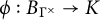 $\phi : B_{\Gamma ^\times } \to K$
given by
 $$ \begin{align*}\phi(x)=\begin{cases} 1 & \text{if } x=C_{v,l}^{\mathfrak{m}(v)} \text{ is the } \mathfrak{m}(v)\text{-power of an sg-special cycle for some } v\in \Gamma^{\times}\\ 0 & \text{otherwise} \end{cases}\end{align*} $$
satisfies
 $\phi (ab)=\phi (ba)$
for any paths
 $a,b$
in
 $B_{\Gamma ^\times }$
.
Let a and b be any two paths in
 $B_{\Gamma ^\times }$
such that
 $ab$
is not zero. By relations of types IIa, IIb, and III, we notice that
 $a$
,
 $b$
, and
 $ab$
are sub-paths of the
 $\mathfrak {m}(v)$
-power of an sg-special cycle
 $C_{v,l}^{\mathfrak {m}(v)}$
for some vertex
 $v\in \Gamma ^{\times }$
. If
 $ab=C_{v,l}^{\mathfrak {m}(v)}$
, then
 $t(ab)=t(b)=s(a)$
, and as a consequence,
 $ba$
is a cyclic permutation of
 $C_{v,l}^{\mathfrak {m}(v)}$
, then
 $\phi (ba)=1=\phi (ab)$
. It is easy to see that if
 $ab$
is not the
 $\mathfrak {m}(v)$
-th power of any sg-special cycle
 $C_{v,l}$
, then
 $\phi (ab)=0=\phi (ba)$
.
Remark 4.6 The following example shows a simple way to compute the indecomposable projective modules of skew-Brauer graph algebras corresponding to vertices of
 $Q^{\mathrm {sg}}_{\Gamma ^\times }$
using its associated Brauer graph. It also shows that skew-Brauer graph algebras are not special biserial.
Example 4.7 Let
 $\Gamma ^\times =(\Gamma ^{\prime }_0, \Gamma ^\times _0, \Gamma _1, \mathfrak {m}, \mathfrak {o})$
be the skew-Brauer graph of Example 4.2, and
 $\Gamma =(\Gamma ^{\prime }_0 \sqcup \Gamma ^\times _0, \Gamma _1, \mathfrak {m}, \mathfrak {o})$
its associated Brauer graph. For simplicity, we set
 $\mathfrak {m}(v_i)=1$
for every
 $i=0,1,2,3,4,5$
. Following [Reference SchrollSch18], one can compute the indecomposable projective
 $B_\Gamma $
-module
 $P_i$
of each vertex
 $i\in Q_{\Gamma }$
from
 $\Gamma $
, for example, the indecomposable modules
 $P_2$
and
 $P_3$
(denoted by their composition factors) are as follows:
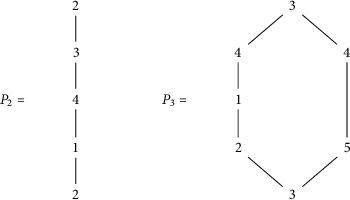
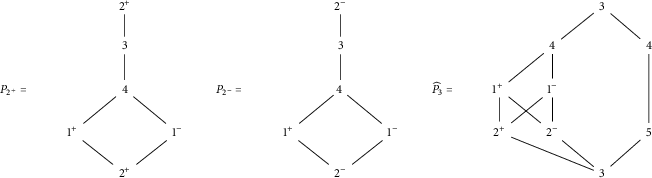
Since the vertex
 $2$
corresponds to a special vertex in
 $Q_{\Gamma ^{\times }}$
, then there are two indecomposable projectives
 $B_{\Gamma ^\times }$
-modules
 ${P_2^+}$
and
 ${P_2^-}$
, both of them are obtained from
 $P_2$
by replacing every special vertex
 $i$
in their composition series of
 $rad(P_2)/soc(P_2)$
by
 $i^+$
and
 $i^-$
and adding the respective linear maps induced by the arrows in
 $Q^{\mathrm {sg}}_{\Gamma ^\times }$
, and then replacing the socle and the top by
 $2^+$
and
 $2^-$
, respectively. While, for
 $P_3$
, there is only one projective
 $B_{\Gamma ^\times }$
-module
 $\widehat {P_3}$
which is obtained from
 $P_3$
by replacing every special vertex i in their composition series of
 $rad(P_2)/soc(P_2)$
by
 $i^+$
and
 $i^-$
and considering their respective linear maps induced by the arrows in
 $Q^{\mathrm {sg}}_{\Gamma ^\times }$
. Then, the projectives
 $P_2^+, P_2^-$
, and
 $\widehat {P_3}$
are as follows:
4.2 The trivial extension of a skew-gentle algebra
In this section, we state a relation between the trivial extension of skew-gentle algebras and a subfamily of skew-Brauer graph algebras. To do that, we adapt the construction of generalized ribbon graphs given in [Reference Labardini-Fragoso, Schroll and ValdiviesoLFSV22, Remark 3.4]. In particular, we recall the definition of
 $sp$
-maximal paths, which generalizes the notion of maximal paths in algebras defined by non-admissible quiver presentations.
Given a skew-gentle algebra
 $A=A(Q,I, \mathrm {Sp})$
, we say that a path
 $p\neq 0$
in
 $A$
is
 $sp$
-maximal if
 $p\alpha =\alpha p=0$
in A for every arrow
 $\alpha $
in Q that is not a special loop, and if
 $s(p)$
(resp.
 $t(p)$
) is a special vertex, then the first arrow (resp. the last arrow) of
 $p$
is the special loop attached to it.
Notice that, given a skew-gentle algebra
 $A=A(Q,I, \mathrm {Sp})$
,
 $f=f^k$
modulo
 $I$
for any special loop
 $f$
and for any
 $k\in \mathbb N$
. Therefore, we can assume without loss of generality that if a path
 $p$
contains a special loop, the exponent of
 $f$
is one.
Example 4.8 Let
 $A_1=A_1(Q,I_1, \textrm {Sp}_1)$
be a skew-gentle algebra with quiver
 $Q$
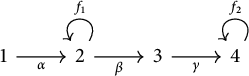
ideal
 $I_1=\langle \alpha \beta , \beta \gamma , f_1^2\rangle $
and
 $\textrm {Sp}_1=\{f_2\}$
the set of special loops. Then, the set of
 $sp$
-maximal paths in
 $A_1$
is given by
 $\alpha f_1 \beta $
and
 $\gamma f_2$
. For the skew-gentle algebra
 $A_2(Q,I_2,\textrm {Sp}_2)$
sharing the same quiver as
 $A_1$
, but with the ideal
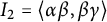 $I_2=\langle \alpha \beta , \beta \gamma \rangle $
, and the set of special vertices
 $\textrm {Sp}_2=\{f_1, f_2\}$
, the set of
 $sp$
-maximal paths in
 $A_2$
coincides with the set for
 $A_1$
.
We define a skew-Brauer graph
 $\Gamma ^\times _{A}=\Gamma ^\times $
associated with a skew-gentle algebra
 $A=A(Q,I, \mathrm {Sp})$
as follows:
-
• The set of vertices
$\Gamma _0'$
of
$\Gamma _A^\times $
is in bijection with the union of:-
i) all sp-maximal paths in
$A$
; -
ii) trivial paths
$e_x$
such that
$x$
is either the source or the target of only one arrow or
$x$
is the target of exactly one arrow
$\alpha $
and the source of exactly one arrow
$\beta $
, and
$\alpha \beta \neq 0$
in
$Q$
.
-
-
• The set of special vertices
$\Gamma ^\times _0$
is in bijection with trivial paths
$e_x$
such that
$x$
is a special vertex of
$Q$
. -
• The set of edges of
$\Gamma ^\times _A$
is in bijection with the vertices of
$Q_0$
(note that this includes the special vertices).


The multiplicity function
 $\mathfrak {m}$
is the constant function equal to 1, and the cyclic ordering of the edges attached to each vertex
 $v_0\in \Gamma _0$
is given either by the order of the sp-maximal path associated with
 $v_0$
or
 $\mathfrak {o} (v)=(e_x)$
otherwise.
Lemma 4.9 Let
 $A=A(Q,I, \mathrm {Sp})$
be a skew-gentle algebra and
 $A'$
be its auxiliary gentle algebra. Then, the sp-maximal paths of the skew-gentle algebra
 $A$
are in bijection with the maximal paths of the auxiliary gentle algebra
 $A'$
.
Proof Let
 $\rho =\alpha _1\dots \alpha _k$
be an
 $sp$
-maximal path in
 $A$
and
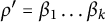 $\rho '=\beta _1\dots \beta _k$
be the path in
 $A'$
, where
 $\beta _i=\alpha _i$
if
 $\alpha _i$
is not a special loop and
 $\beta _i=e_{t(\alpha _{i-1})}$
otherwise. We claim that
 $\rho '$
is a maximal path in
 $A'$
.
Notice that
 $\rho '\neq 0$
, otherwise,
 $\beta _i\beta _{i+1}$
is a zero relation in
 $A'$
for some i, which implies that
 $\beta _i=\alpha _i$
and
 $\beta _{i+1}=\alpha _{i+1}$
and
 $\alpha _i\alpha _{i+1}$
is a zero relation in
 $A$
, as a consequence,
 $\rho $
is not an sp-maximal path.
Suppose
 $\rho '$
is not a maximal path in
 $A'$
. Then, there exists at least one arrow in
 $Q_{A'}$
such that
 $\alpha \rho '\neq 0$
or
 $\rho '\alpha \neq 0$
in
 $A'$
. Without loss of generality, suppose that
 $\alpha \rho '\neq 0$
in
 $A'$
. We notice that if the start
 $s(\rho )=x$
of
 $\rho $
is not a special vertex, then
 $\alpha $
is not a special loop and
 $\alpha $
is an arrow of
 $Q_{A}$
, then
 $\alpha \rho $
is not zero in
 $A$
, a contradiction with the hypothesis. Now, if
 $x$
is a special vertex, then the first arrow
 $\alpha _1$
of
 $\rho $
is the special loop attached to
 $x$
and
 $\alpha \rho $
is not zero in A, again a contradiction with the hypothesis.
Theorem 4.10 Let
 $A=A(Q,I, \mathrm {Sp})$
be a skew-gentle algebra and
 $\Gamma _{A}^{\times }=(\Gamma _0', \Gamma _0^{\times }, \Gamma _1, \mathfrak {m}= 1, \mathfrak {o})$
be its skew-Brauer graph. Then,
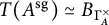 $T(A^{\mathrm {sg}})\simeq B_{\Gamma _{A}^{\times }}$
.
Proof Let
 $A'$
be the auxiliary gentle algebra of
 $A$
. As a consequence of Lemma 4.9, it is easy to check that
 $\Gamma _A^{\times }$
as Brauer graph, namely, the Brauer graph
 $\Gamma =(\Gamma _0'\cup \Gamma ^\times _0,\Gamma _1,\mathfrak {m}, \mathfrak {o})$
coincides with the Brauer graph
 $\Gamma _{A'}$
.
By [Reference SchrollSch15, Theorem 1.2], the trivial extension
 $T(A')$
of
 $A'$
is isomorphic to the Brauer graph algebra
 $B_{\Gamma _{A'}}$
and moreover, by Theorem 3.11, we have that
 $T(A)$
is isomorphic to
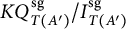 $KQ^{\mathrm {sg}}_{T(A')}/I^{\mathrm {sg}}_{T(A')}$
. It is easy to check that the last presentation is isomorphic to the skew-Brauer graph algebra
 $B_{\Gamma _{A}^{\times }}$
described in Section 4.1. Therefore, the statement follows.
To prove the second theorem of this section, we need to recall the definition of admissible cut from [Reference Fernández and PlatzeckFP02]. Let
 $T(A)$
be the trivial extension of a bound quiver algebra
 $A$
and let
 $\mathcal {D}$
be a set of arrows of
 $Q_{T(A)}$
. We say that
 $\mathcal {D}$
is an admissible cut of
 $Q_{T(A)}$
if it consists of exactly one arrow of each elementary cycle in
 $Q_{T(A)}$
(see Definition 2.3). Moreover, we say that the algebra B is an admissible cut of
 $T(A)$
if it is the quotient algebra
 $T(A)/\langle \mathcal {D}\rangle $
, where
 $\mathcal {D}$
is an admissible cut of
 $Q_{T(A)}$
. We say that
 $T(A)/\langle \mathcal {D}\rangle $
is the quotient algebra of
 $T(A)$
induced by
 $\mathcal {D}$
.
Notice that the definition of admissible cut is given for trivial extensions of bound path algebras. However, it is possible to generalize this idea to give a recognition theorem of trivial extension (see [Reference Fernandez, Schroll, Treffinger, Trepode and ValdiviesoFST+22] for details). To do this, given an algebra
 $A,$
we consider a finite set
 $\mathcal {C}$
of nonzero cycles of length at least two, then a cut set
 $\mathcal {D}$
of
 $A$
with respect to
 $\mathcal {C}$
is a subset of arrows
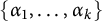 $\{\alpha _1, \dots , \alpha _k\}$
of
 $Q_A$
containing exactly one arrow in each cycle of
 $\mathcal {C}$
, and such that
 $\alpha _i$
appears at most once in each cycle C of
 $\mathcal {C}$
. This definition corresponds to the definition of allowable cut given in [Reference Fernandez, Schroll, Treffinger, Trepode and ValdiviesoFST+22].
Remark 4.11 If A is a trivial extension of a bound path algebra
 $B$
, then any admissible cut is indeed a cut set with respect to the set of the elementary cycles.
Theorem 4.12 Let K be an algebraically closed field and let
 $\Gamma ^{\times }=(\Gamma ^{\prime }_0, \Gamma _0^\times , \Gamma _1, \mathfrak {m}, \mathfrak {o})$
be a skew-Brauer graph with
 $\mathfrak {m}(v)=1$
for every vertex v in
 $\Gamma _0$
and
 $B_{\Gamma ^\times }=KQ_{\Gamma ^{\times }}/I_{\Gamma ^{\times }}$
be its associated skew-Brauer graph algebra. Then, there exists (not necessarily unique) skew-gentle algebra
 $A=A(Q,I, \mathrm {Sp})$
, such that
 $T(A^{\mathrm {sg}})\simeq B_{\Gamma ^{\times }}$
.
Proof Let
 $\Gamma ^{\times }=(\Gamma ^{\prime }_0, \Gamma ^{\times }_{0}, \Gamma _1, \mathfrak {m}, \mathfrak {o})$
be the skew-Brauer graph with
 $\mathfrak {m}(v)=1$
for every vertex
 $v$
in
 $\Gamma _0$
and
 $B_{\Gamma ^\times }$
be a skew-Brauer algebra with
 $\mathcal {C}$
the set of sg-special cycles and
 $Q_0^{\times }$
the set of special vertices.
Consider
 $B_{\Gamma }$
be the auxiliary Brauer graph algebra, with
 $\Gamma =(\Gamma ^{\prime }_0\cup \Gamma ^{\times }_{0}, \Gamma _1, \mathfrak {m}, \mathfrak {o})$
. Notice that
 $Q_\Gamma $
is also obtained from
 $Q_{\Gamma ^{\times }}=(Q_\Gamma , Q_0^{\times })$
by forgetting the extra information of
 $Q_0^{\times }$
. We claim that any admissible cut of
 $B_{\Gamma }$
induces a cut set of
 $B_{\Gamma ^{\times }}$
.
By [Reference SchrollSch15], there exists an admissible cut
 $\mathcal {D}$
on
 $B_{\Gamma }$
such that
 $B_{\Gamma }/\langle \mathcal {D}\rangle $
is gentle. Let
 $\mathcal {D}'$
be the set of arrows
 $$ \begin{align*}\mathcal{D}'=\{{}^{\varepsilon}\alpha^{\varepsilon'} \mid \alpha\in \mathcal{D} \quad\text{for all possible }\quad \varepsilon, \varepsilon'\in\{+,-, \emptyset \}\}\end{align*} $$
in
 $B_{\Gamma ^{\times }}$
.
Recall that by definition of
 $B_{\Gamma ^{\times }}$
, the set of sg-special cycles
 $\mathcal {C}$
is induced by the set of special cycles of
 $B_{\Gamma _A}$
. To fix notation, for each special cycle
 $C_v$
of
 $Q_\Gamma $
, denote by
 $\{C_{v, 1}, \dots C_{v, 2^r}\}$
the set of
 $2^r$
sg-special cycles in
 $Q_{\Gamma ^\times }^{\mathrm {sg}}$
(up to cyclic equivalence).
Suppose that there is an sg-special cycle
 $C_{v,l}= {}^{\varepsilon _1}\alpha _1^{\varepsilon _1'} \dots {}^{\varepsilon _m}\alpha _m^{\varepsilon _m'}$
that contains two different arrows
 ${}^{\varepsilon _i}\alpha _i^{\varepsilon _i'}$
and
 ${}^{\varepsilon _j}\alpha _j^{\varepsilon _j'}$
of
 $\mathcal {D}'$
. Then, by construction, the cycle
 $C_v=\alpha _1\dots \alpha _m$
is special and
 $\alpha _i$
and
 $\alpha _j$
are arrows of
 $\mathcal {D}$
. Since
 $\mathcal {D}$
is an admissible cut, then
 $\alpha =\alpha _i=\alpha _j$
, and because
 $B_{\Gamma }/\langle \mathcal {D}\rangle $
is gentle
 $\alpha $
appears exactly once in
 $C_v$
, this implies that
 ${}^{\varepsilon _i}\alpha _i^{\varepsilon _i'}={}^{\varepsilon _j}\alpha ^{\varepsilon _j'}_i$
.
To finish the proof, it is enough to observe that the algebra
 $B_{\Gamma ^\times }/\langle \mathcal {D}'\rangle $
is the admissible version of
 $B_{\Gamma }/\langle \mathcal {D} \rangle $
with
 $Q_0^{\times }$
the set of special vertices of
 $B_{\Gamma ^{\times }}$
.
We introduce the following definition motivated by the cut sets of a skew-Brauer algebra
 $B_{\Gamma ^\times }$
used in Theorem 4.12, which are induced by cut sets of its auxiliary Brauer algebra
 $B_{\Gamma }$
.
Definition 4.13 Let
 $\Gamma ^{\times }=(\Gamma ^{\prime }_0, \Gamma _0^\times , \Gamma _1, \mathfrak {m}, \mathfrak {o})$
be a skew-Brauer graph with
 $\mathfrak {m}(v)=1$
for every v in
 $\Gamma _0$
and
 $B_{\Gamma ^\times }=KQ_{\Gamma ^{\times }}/I_{\Gamma ^{\times }}$
be its associated skew-Brauer graph algebra. A cut set
 $\mathcal {D}$
is good if it is induced by a cut set
 $\mathcal {D'}$
of its auxiliary Brauer graph algebra
 $B_{\Gamma }$
, namely,
 $$ \begin{align*}\mathcal{D}=\{{}^{\varepsilon}\alpha^{\varepsilon'}\mid \alpha\in \mathcal{D'} \quad\text{for all possible }\quad \varepsilon, \varepsilon'\in\{+,-, \emptyset \}\}.\end{align*} $$
We observe that any good cut set of a skew-Brauer graph algebra induces a skew-gentle algebra. We show that converse is not true in the following example.
Example 4.14 In this example, we show a cut set
 $\mathcal {D}$
of skew-Brauer algebra that is not good, but the quotient algebra induced by
 $\mathcal {D}$
is skew-gentle.
Let
 $B=kQ_{\Gamma ^\times }/I_{\Gamma ^\times }$
be a skew-Brauer algebra with quiver
 $Q_{\Gamma ^{\times }}$
and skew-Brauer graph
 $\Gamma ^{\times }$
depicted below

To compute the cut set, see that the admissible presentation
 $B^{\mathrm {sg}}=KQ^{\mathrm {sg}}_{\Gamma ^\times }/I^{\mathrm {sg}}_{\Gamma ^{\times }}$
of the algebra B is given by quiver
 $Q^{\mathrm {sg}}_{\Gamma ^{\times }}$
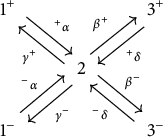
with sg-special cycles
 $({}^+\alpha )(\gamma ^{+}), ({}^-\alpha )(\gamma ^{-}), (\beta ^+)({}^+\delta ), (\beta ^-)({}^-\delta )$
and their permutations, and the ideal
 $I_{\Gamma ^{\times }}^{\mathrm {sg}}$
is generated by all relations:
-
(1)
$C-C'$
, where C and
$C'$
are sg-special cycles that start at the same vertex, for example,
$(\gamma ^{+})({}^+\alpha )- (\beta ^-)({}^-\delta )$
; -
(2) the paths of length 2 that start and end in two different vertices of the set
$\{1^+, 1^-, 3^+, 3^-\}$
, for example,
$({}^+\alpha )(\beta ^-{})$
; -
(3) the paths of length 3 of the form
$C\eta $
, where C is an sg-special cycle, and
$\eta $
is the first arrow of C, for example,
$(\gamma ^{+})({}^+\alpha )(\gamma ^{+})$
; -
(4) and finally, the paths of length 3 of the form
$(\eta _1^{\varepsilon })({}^{\varepsilon }\eta _2)(\eta _1^{\varepsilon '}),$
where
$(\eta _1^{\varepsilon })({}^{\varepsilon }\eta _2)$
is an sg-special cycle that starts at 2,
$\varepsilon , \varepsilon '$
are either
$+,-,$
and
$\varepsilon \neq \varepsilon '$
, for example,
$(\gamma ^{+})({}^+\alpha )(\gamma ^{-})$
.







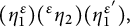



Consider
 $\mathcal {D}=\{{}^+\alpha , \gamma ^-,{}^+\delta , \beta ^-\}$
a cut set of
 $B^{\mathrm {sg}}$
. The quotient algebra of
 $B^{\mathrm {sg}}$
induced by
 $\mathcal {D}$
is the algebra
 $A=KQ/I,$
where the quiver Q is
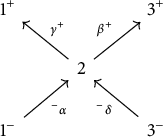
and I is the ideal generated by the relations:
 $$\begin{align*}({}^-\alpha)(\gamma^{+}), ({}^-\alpha)(\beta^{+}), ({}^- \delta)(\gamma^+), ({}^-\delta)(\beta^+).\end{align*}$$
Finally, A is isomorphic to the skew-gentle algebra
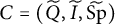 $C=(\widetilde {Q}, \widetilde {I}, \widetilde {\textrm {Sp}})$
, where
 $\tilde {Q}$
is the quiver
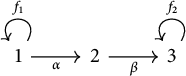
 $\tilde {I}=\langle \alpha \beta \rangle $
is the ideal and
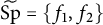 $\widetilde {\textrm {Sp}}=\{f_1, f_2\}$
is the set of special loops.
5 Admissible cuts, the repetitive algebra, and ref lections
In this section, we consider the non-admissible presentation of a skew-gentle algebra, and we describe the quiver of its repetitive algebra. We also describe the positive and negative reflections on a skew-gentle algebra. Moreover, we analyze the good cuts over a skew-gentle algebra and the relationship between these two notions.
The following definition of repetitive algebra for skew-gentle algebras, in their non-admissible presentation, is an extension of the one given for basic algebras by Hughes and Waschbüsch.
Definition 5.1 Let
 $A=A(Q,I, \mathrm {Sp})$
be a skew-gentle algebra,
 $Q_0^{\times }$
be the set of special loops, and
 $\mathcal {M}$
be the set of sp-maximal paths in A. The repetitive algebra of A is
 $\widehat {A}=K\widehat {Q}/\widehat {I,}$
where
 $\widehat {Q}$
and
 $\widehat {I}$
are defined as follows:
-
• The set of vertices of
$\widehat {Q}$
is the set
$\{x[n]: x\in Q_0 \text { and } n\in \mathbb {Z}\}$
. We say that
$x[n]$
is a special vertex in
$\widehat {Q}$
if and only if x is a special vertex in Q and
$n\in \mathbb {Z}$
. -
• The set of arrows
$\widehat {Q}_1$
is the set
$\{\alpha [n]: x[n]\to y[n]: \alpha \in Q_1\text { and } n\in \mathbb {Z}\}$
. -
• Each
$sp$
-maximal path
$p: x\to y$
induces a set of connecting arrow
$\overline {p}[n]: y[n]\to x[n+1]$
for all
$n\in \mathbb {Z}$
.









To define the set of relations
 $\widehat {\rho }$
of
 $\widehat {Q}$
, we need to introduce the following definition. If
 $p=p_qp_2$
is an sg-maximal path in A, then
 $p_2[n]\overline {p}[n]p_1[n+1]$
is an sg-full path in
 $\widehat {Q}$
.
The set of relations
 $\widehat {\rho }$
of
 $\widehat {Q}$
is given by the following list:
-
(1) Each monomial relation
$p\in \rho $
induces a path
$p[n]$
in
$\widehat {\rho }$
, for all
$n\in \mathbb Z$
. -
(2) Each relation
$f^2-f$
in
$\rho $
induces a relation
$f^2[n]-f[n]$
in
$\widehat {\rho }$
, for all
$n\in \mathbb Z$
. -
(3) Any path p in
$\widehat {Q}$
which contains a connecting arrow is an element of
$\widehat {\rho }$
if p is nor a sub-path of an sg-full subpath.


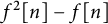


Lemma 5.2 Let
 $A=A(Q,I, \mathrm {Sp})$
be a skew-gentle algebra and denote by
 $A^{\mathrm {sg}}$
its admissible presentation. Let
 $A'$
be the auxiliary gentle algebra of
 $A$
. Then, the quiver
 $Q_{\widehat {A}^{\mathrm {sg}}}$
of the repetitive algebra of
 $A^{\mathrm {sg}}$
coincides with the
 $\mathrm {sg}$
-quiver
 $Q^{\mathrm {sg}}_{\widehat {A'}}$
of the repetitive algebra of
 $A'$
, considering the set of special vertices in
 $Q_{\widehat {A'}}$
as the set
 $\{x[n]: x\in Q_0^{\times } \text { and } n\in \mathbb {N}\}$
.
Proof It follows from Lemma 3.9 and that the sg-maximal paths in
 $A$
are in correspondence with maximal paths in
 $A'$
.
Example 5.3 Let
 $A=A(Q,I, \mathrm {Sp})$
be the skew-gentle algebra with quiver
 $Q$
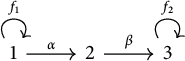
ideal
 $I= \langle \alpha \beta \rangle $
and the set of special vertices
 $Q_0^{\times }=\{1,3\}$
.
To compute the repetitive algebra of
 $A$
, we need to find the sg-maximal paths in
 $A$
. In this case, there are exactly two sg-maximal paths, namely,
 $p_1=f_1\alpha $
and
 $p_2=\beta f_2$
. Then, by the definition, the quiver
 $Q_{\widehat {A}}$
of repetitive algebra of the algebra
 $A$
is the following:

While the quiver of the repetitive algebra of the admissible presentation
 $A^{\mathrm {sg}}$
of A
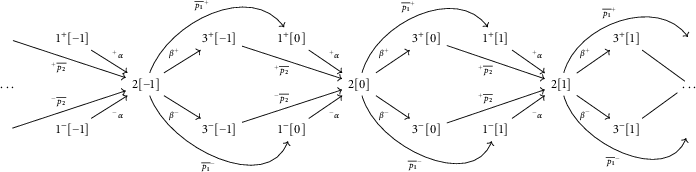
One can check that the set of relations coincides with the relations induced by the sg-ideal of the repetitive algebra
 $\widehat {A}$
.
The next result shows when reflections on a skew-gentle algebra return a skew-gentle algebra.
Theorem 5.4 Let
 $A=A(Q,I, \mathrm {Sp})$
be a skew-gentle algebra and
 $x$
be a source in its auxiliary gentle algebra
 $A'$
. If x is a special vertex (resp. non special vertex), then the negative reflection sequence
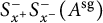 $S^-_{x^+}S^-_{x^-}(A^{\mathrm {sg}})$
(resp. the negative reflection
 $S^-_{x}(A^{\mathrm {sg}})$
) is skew-gentle.
A similar result follows when x is a sink in
 $A'$
, if we consider positive reflections.
Proof Let x be a source of
 $Q_0$
. If
 $x\in Q_0^{\times }$
or
 $x\notin Q_0^{\times }$
, in both cases, it follows from Lemma 5.2 that the sg-quiver
 $(\sigma _xQ_{A'})^{\mathrm {sg}}$
coincides with the quivers
 $\sigma _{ x^+}\sigma _{x^-}Q_{A^{\mathrm {sg}}}$
and
 $\sigma _{ x}Q_{A^{\mathrm {sg}}}$
, respectively. It is easy to see that the algebra
 $S^-_x(A')$
is a gentle algebra, where x is a sink vertex for its ordinary quiver. Therefore, the sg-algebra
 $(S^-_x(A'))^{\mathrm {sg}}$
is skew-gentle, which is isomorphic to
 $S_{x^+}S_{x^-}(A)$
and
 $S_{x}(A)$
, respectively.
The following example shows that certain sequences of reflections over a skew-gentle algebra, not defined as in the previous theorem, can also result on a skew-gentle algebra.
Example 5.5 Let
 $A=A(Q,I, \mathrm {Sp})$
be the skew-gentle algebra from Example 5.3.
By Theorem 5.4, the algebras
 $S_{1^{+}}^-S_{1^-}^-(A^{\mathrm {sg}})$
and
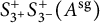 $S_{3^{+}}^+S_{3^-}^+(A^{\mathrm {sg}})$
are skew-gentle. We note that the algebra
 $S_{3^-}^+S_{1^-}^-(A^{\mathrm {sg}})$
is also skew-gentle, but it is not obtained by a sequence of reflections as described in Theorem 5.4.
To show the link between reflections and admissible cuts, we need to use the following result, which is part of a work in progress [Reference Álvarez, Bravo, Fernández, Guazzelli, Müller, Rojas and TrepodeÁBF+24]. For the benefit of the reader, we include the proof of this result.
Lemma 5.6 [Reference Álvarez, Bravo, Fernández, Guazzelli, Müller, Rojas and TrepodeÁBF+24]
Let
 $A=KQ/I$
be a gentle algebra,
 $T(A)$
its trivial extension, and
 $x$
a source vertex of
 $A$
. Then, there exists an admissible cut
 $\mathcal {D}$
of
 $B$
such that:
-
(1)
$S^-_x(A)$
is isomorphic to the quotient
$T(A)/\langle \mathcal D \rangle $
. -
(2) the admissible cut
$\mathcal {D}$
contains the arrows in
$Q$
that start at
$x$
; in other words,
${\mathcal {D}\cap Q_1=\{\alpha \in Q_1\mid s(\alpha )=x\}}$
.



Proof Let x be a source vertex in A. We denote by
 $B=S^-_x(A)$
the negative reflection of
 $A$
. By [Reference Hughes and WashbüschHW83], we have that the trivial extension algebra
 $T(A)$
of
 $A$
coincides with the trivial extension algebra
 $T(B)$
of B, and moreover, by [Reference Fernandez, Schroll, Treffinger, Trepode and ValdiviesoFST+22], there exists an admissible cut
 $\mathcal {D}$
of
 $T(A)$
such that
 $B=T(A)/<\mathcal {D}>$
.
To prove the second statement, let
 $\gamma : y\to z$
be an element of
 $\mathcal {D}\cap (Q)_1$
. Suppose
 $s(\gamma )\neq x$
. By construction,
 $(\gamma ,0):(y,0)\rightarrow (z,0)$
is an arrow of
 $\sigma ^-_x(Q_{A})=Q_B$
, contradicting the fact that
 $\gamma $
is in
 $\mathcal {D}$
. Therefore,
 $s(\gamma )=x$
.
Conversely, if
 $\gamma $
is an arrow of
 $Q_1$
such that
 $s(\gamma )=x$
, since the vertex
 $x$
is a sink of
 $Q$
we have that
 $\gamma \notin (Q_{B})_1$
and consequently
 $\gamma \in \mathcal {C}$
.
Theorem 5.7 Let
 $A=A(Q,I, \mathrm {Sp})$
be a skew-gentle algebra and let
 $x$
be a source vertex in the auxiliary gentle algebra
 $A'$
of
 $A$
. If
 $x$
is a special vertex (resp.
 $x$
is not a special vertex), then,
 $S^{-}_{x^+}S^{-}_{x^-}(A^{\mathrm {sg}})=T(A^{\mathrm {sg}})/\langle \mathcal {D}\rangle $
(resp.
 $S^{-}_{x}(A^{\mathrm {sg}})=T(A^{\mathrm {sg}})/\langle \mathcal {D}\rangle $
), where
 $\mathcal {D}$
is the good cut of
 $T(A^{\mathrm {sg}})$
induced by the cut set
 $\mathcal {D}'$
such that
 $$ \begin{align*}\mathcal{D}'\cap (Q_{A'})_1=\{\alpha \in (Q_{A'})_1\mid s(\alpha)=x\}.\end{align*} $$
Proof Let
 $x$
be a source vertex in
 $A'$
and suppose that
 $x$
is a special vertex of
 $A$
. We denote by
 $B=S^-_{x^+}S^-_{x^-}(A^{\mathrm {sg}})$
the negative reflection sequence of
 $A^{\mathrm {sg}}$
. By Theorem 5.4, we know that
 $B$
is a skew-gentle algebra and
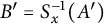 $B'=S^{-1}_x(A')$
is the auxiliary gentle algebra of
 $B$
.
By Lemma 5.6, there exists an admissible cut
 $\mathcal {D}$
of
 $A'$
such that
 $\mathcal {D}'\cap (Q_{A'})_1=\{\alpha \in (Q_{A'})_1\mid s(\alpha )=x\}$
, which induces a good cut set
 $\mathcal D$
in
 $T(A^{\mathrm {sg}})$
. The result follows from Theorem 5.4.
6 Skew-Brauer graph algebras of f inite representation type
In this section, we show that the class of skew-Brauer graph algebras of finite representation type is characterized by the structure of the skew-Brauer graph as a graph and the number of special vertices on it. In the remainder of this section, we consider nontrivial skew-Brauer graphs
 $\Gamma ^{\times }$
, that is, with at least one special vertex.
Definition 6.1 A skew-Brauer graph
 $\Gamma ^\times =( \Gamma ^{\prime }_0, \Gamma _0^{\times }, \Gamma _1, \mathfrak {m}, \mathfrak {o})$
, with
 $\Gamma _0^{\times }\neq \emptyset $
, is a skew-Brauer tree if the underlying graph
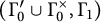 $(\Gamma ^{\prime }_{0}\cup \Gamma _0^\times , \Gamma _1)$
is a tree,
 $\mathfrak {m}(v)=1$
for all
 $v \in \Gamma ^{\prime }_0 \cup \Gamma _0^{\times }$
, there is exactly one special vertex in
 $\Gamma ^\times $
, and
 $\Gamma $
has at least two edges. We say that
 $B_{\Gamma ^{\times }}$
is a skew-Brauer tree algebra if
 $\Gamma ^{\times }$
is a skew-Brauer tree.
We exclude from the previous definition the skew-Brauer graph consisting of exactly one edge and one special vertex, since in this case,
 $B_{\Gamma ^{\times }}$
is isomorphic to the direct sum of two copies of
 $\mathbb {A}_1$
.
Recall that a Brauer tree algebra is a Brauer graph algebra defined by a graph
 $\Gamma $
that is a tree, with
 $\mathfrak {m}(v) = 1$
for all but at most one
 $v \in \Gamma _0$
. Since skew-Brauer graph algebras are symmetric, we also recall the classification of symmetric finite representation type algebras.
Lemma 6.2 [Reference Aihara, Chan and HonmaACH22, Theorem 2.11]
A non-simple basic symmetric algebra is of finite representation type if and only if it is isomorphic to an algebra in the following mutually exclusive classes:
-
(1) Trivial extensions of iterated tilted algebras of Dynkin type.
-
(2) Brauer tree algebras with exactly one vertex v with multiplicity
$\mathfrak {m}(v)>1$
. -
(3) Modified Brauer tree algebras with exactly one vertex v with multiplicity
$\mathfrak {m}(v)>1$
.


In the previous lemma, the family of Brauer tree algebras with
 $\mathfrak {m}(v)=1$
for all
 $v$
coincides with the trivial extensions of iterated tilted algebras of Dynkin type
 $\mathbb {A}$
(see [Reference Wang and ZhangWZ22, Lemma 3.1]). The definition of Brauer graph algebras, Brauer tree algebras, and modified Brauer tree algebras can be found in [Reference SchrollSch18, Section 2.3] and [Reference SkowronskiSko06, Sections 2.8 and 3.6]. We notice that modified Brauer tree algebras are not necessarily biserial, see, for example, the projective-injective
 $P_1$
in [Reference SkowronskiSko06, Example 3.7].
Lemma 6.3 Let
 $B_{\Gamma ^{\times }}= KQ^{\mathrm {sg}}/I^{\mathrm {sg}}$
be a skew-Brauer graph algebra of finite representation type, where
 $\Gamma ^{\times }$
is not a skew-Brauer graph with two edges. Then,
 $\Gamma ^{\times }$
has at most one special vertex.
Proof Let
 $B=B_{\Gamma ^{\times }}$
be a skew-Brauer graph algebra of finite representation type. Suppose that
 $\Gamma ^{\times }$
has at least two special vertices
 $v^{\times }$
and
 $w^{\times }$
. By definition
 $\Gamma ^{\times }$
is connected, then there exists a minimal path
 $\rho $
of edges in
 $\Gamma ^{\times }$
that join
 $v^{\times }$
and
 $w^{\times }$
as depicted in the following figure:

Quivers of skew-Brauer graphs with underlying tree graph and two edges.
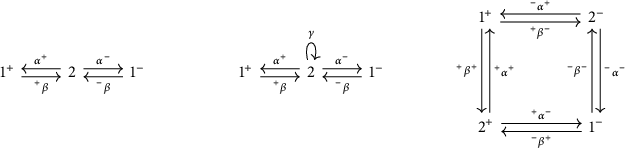
We denote by
 $Q_{\Gamma }$
the quiver of the auxiliary Brauer graph algebra. Recall that there is a unique special cycle
 $C_{x_i}$
in
 $Q_{\Gamma }$
, up to cyclic equivalence, induced by the edges attached to the vertex
 $x_i\in \Gamma $
, for
 $i=\{1, \dots , k\}$
.
For each
 $i\in \{1, \dots , k\}$
, we define a sub-path
 $\rho _i$
of the special cycle
 $C_{x_i}$
from the vertex
 $a_{i+1}$
to
 $a_{i}$
if
 $i$
is odd or the sub-path from
 $a_{i}$
to
 $a_{i+1}$
if
 $i$
is even. Then, the walk
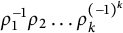 $\rho _1^{-1}\rho _2\dots \rho _k^{{(-1)}^{k}}$
defines a non-linearly oriented sub-quiver
 $Q'$
of type
 $A_n$
without relations in
 $Q_{\Gamma }$
such that the first and the last vertex are special. As a consequence,
 $B$
contains an algebra of Dynkin type
 $\tilde {D}_n$
as a sub-algebra, which is a contradiction because
 $B$
is an algebra of finite representation type.
Lemma 6.4 ([Reference Assem, Simson and SkowronskiASS+06, Section II.3 Lemma 3.6], [Reference SchrollSch18, Section 2.3], and [Reference SkowronskiSko06, Section 3.6])
-
(1) If two basic connected isomorphic algebras are defined by a bound quiver with an admissible ideal, then their quivers coincide.
-
(2) Let
$KQ/I$
be a Brauer graph algebra defined by an admissible ideal, then for all
$x\in Q_0$
, we have that
$x$
is the start (end) of exactly two arrows or
$x$
is the start (end) of exactly one arrow. -
(3) Let
$KQ/I$
be a modified Brauer tree algebra defined by an admissible ideal, then for all
$x\in Q_0$
, we have that
$x$
is the start (end) of exactly two arrows or
$x$
is the start (end) of exactly one arrow and
$Q$
must contain exactly one loop.


It follows from the previous lemma that any bound quiver algebra
 $A$
cannot be isomorphic to a Brauer graph algebra or a modified Brauer graph algebra if its quiver
 $Q_A$
has three or more arrows ending at (or starting from) any of its vertices.
In the following lemma, we describe some properties of a subclass of skew-Brauer graph algebras that are relevant to this section.
Lemma 6.5 Let
 $B=B_{\Gamma _i^{\times }}$
be a skew-Brauer graph algebra associated with one of the following skew-Brauer graphs:

-
(1) If B is either
$B_{\Gamma _1^\times }$
, where
$\mathfrak {m}(w)=1$
or
$B_{\Gamma _2^\times }$
, then B is isomorphic to a Brauer graph algebra (for one of the graphs
$\Delta _{1,2}$
in Figure 6). -
(2) If
$B=B_{\Gamma _1^\times }$
with
$\mathfrak {m}(w)\neq 1$
, then B is not of finite representation type.


Proof By the definition of skew-Brauer graph algebras, the quiver
 $Q_B$
of
 $B$
is one of the quivers depicted in Figure 5: the first two quivers correspond to
 $\Gamma _1^\times $
with
 $\mathfrak {m}(w)=1$
and
 $\mathfrak {m}(w)\neq 1$
, respectively, while the last one corresponds to
 $\Gamma _2^\times $
with arbitrary
 $\mathfrak {m}(v)$
.
To prove the first statement, suppose that
 $B$
is either
 $B_{\Gamma _1^\times }$
with
 $\mathfrak {m}(w)=1$
or
 $B_{\Gamma _2^\times }$
. Let
 $C$
be any cyclic permutation of the elementary cycle
 $({}^+\beta ^{\epsilon })({}^{\epsilon }\alpha ^+)$
or
 $({}^-\beta ^{\epsilon })({}^{\epsilon }\alpha ^-)$
, for any possible
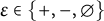 $\epsilon \in \{+,-, \emptyset \}$
, and let
 $m$
be a natural number greater than 1. It follows from relations of type 0 and relations of type III, that any
 $m$
-power
 $C^m$
of the cycle
 $C$
is zero in
 $B$
, and as a consequence, one can assume that
 $\mathfrak {m}(v)=1$
. Then, we have that
 $B$
is isomorphic to a Brauer graph algebra
 $B_\Gamma $
with
 $\Gamma $
one of the Brauer graphs
 $\Delta _1$
or
 $\Delta _2$
, respectively.
Brauer graphs
 $\Delta _1$
(left) and
 $\Delta _2$
(right).

with
 $\mathfrak {m}(v_i)=1$
for
 $i=1,2,3,4$
.
Now, suppose that
 $B=B_{\Gamma _1^{\times }}$
where
 $\mathfrak {m}(w)\neq 1$
. Then, the algebra is given by the second quiver in Figure 5 and the ideal
 $$ \begin{align*} \begin{aligned} I_{B_{\Gamma_1^{\times}}}=\ &\langle (\alpha^{+})({}^+\beta)-(\alpha^{-})({}^-\beta), \gamma^{\mathfrak{m}(w)+1}, \gamma^{\mathfrak{m}(w)}-(\alpha^{-})({}^-\beta), \gamma^{\mathfrak{m}(w)}-(\alpha^{+})({}^+\beta), \\ &({}^+\beta)\gamma, ({}^+\beta)(\alpha^{-}), ({}^-\beta)(\alpha^{+}),({}^-\beta)\gamma, \gamma(\alpha^{+}), \gamma(\alpha^{-}) \rangle. \end{aligned} \end{align*} $$
We observe that
 $B$
is an algebra of infinite representation type, since there is a band module associated with the word
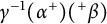 $\gamma ^{-1}(\alpha ^{+})({}^+\beta )$
.
Lemma 6.6 Let
 $B=B_{\Gamma ^{\times }}$
be a skew-Brauer graph algebra with a non empty set
 $\Gamma _0^{\times }$
of special vertices and suppose that
 $B$
is neither
 $B_{\Gamma _1^\times }$
where
 $\mathfrak {m}(w)=1$
nor
 $B_{\Gamma _2^\times }$
, where
 $\Gamma _i^{\times }$
is one of the following two skew-Brauer graphs:

Then,
 $B$
is not a Brauer tree algebra.
Proof Let
 $\Gamma ^\times $
be a skew-Brauer graph with a special vertex
 $v^\times $
. By definition of skew-Brauer graph, there exists a non-special vertex
 $v\in \Gamma ^{\times }$
such that v and
 $v^\times $
have exactly one edge
 $x$
in common. We claim that if
 $v$
has valency at least three,
 $B_{\Gamma ^{\times }}$
is not a Brauer graph algebra.
Since
 $v$
has at least valency three, consider x and
 $y=\mathfrak {o}^{-1}(x)$
two different edges attached to
 $v$
, where
 $y$
might be a loop. Then, by Remark 4.6, there are at most two projectives in
 $B_{\Gamma ^\times }$
associated with
 $y$
, namely,
 $P_y$
or
 $P_{y^+}$
and
 $P_{y^-}$
, in both cases, the projectives are not biserial (see Example 4.7). As a consequence,
 $B_{\Gamma ^\times }$
is not a Brauer graph algebra, and in particular is not a Brauer tree algebra.
Now, we suppose that v has valency two. In this case,
 $x$
and
 $y=\mathfrak {o}^{-1}(x)$
are two different edges attached to
 $v$
and
 $y$
is not a loop, otherwise, the valency of v would be greater than 2. We denote by
 $w$
the vertex in
 $\Gamma ^{\times }$
such that
 $y$
is the edge connecting
 $v$
and
 $w$
.
By hypothesis, the valency of
 $w$
is at least two, or if the valency of
 $w$
is one, then
 $\mathfrak {m}(w)\neq 1$
. In the second case,
 $B$
is the skew-Brauer graph
 $B_{\Gamma _1^{\times }}$
with
 $\mathfrak {m}(w)\neq 1$
, and by Lemma 6.5, is not of finite representation type, therefore cannot be isomorphic to a Brauer tree algebra.
Now, we suppose that w has valency at least two. By the definition of the quiver
 $Q=Q_{\Gamma ^\times }$
, the local configuration for the vertex
 $y \in Q$
associated with the edge
 $y$
in
 $\Gamma ^{\times }$
(here y receives the same name by abuse of notation) is as follows:
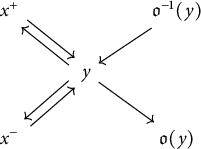
where
 $\mathfrak {o}(y)$
and
 $\mathfrak {o}^{-}(y)$
might be equal. Then, there are tree arrows ending at
 $y$
and, by Lemma 6.4,
 $B$
is not a Brauer graph algebra as we claim.
Lemma 6.7 Let
 $\Gamma ^\times $
be a skew-Brauer graph with at least two edges and with a non-empty set
 $\Gamma _0^{\times }$
of special vertices. If
 $B_{\Gamma ^{\times }}$
is of finite representation type, then it is not a modified Brauer tree algebra.
Proof Since
 $B_{\Gamma ^{\times }}$
is of finite representation type, by Lemma 6.3,
 $\Gamma ^{\times }$
has exactly one special vertex
 $v^{\times }$
. By the definition of a skew-Brauer graph, there is exactly one edge
 $x$
incident to
 $v^\times $
. We denote by
 $v$
the other vertex of
 $x$
.
Consider the edge
 $y = \mathfrak {o}(x)$
having
 $v$
and
 $u$
as vertices. This is the minimal configuration for a skew-Brauer graph with a special vertex. We analyze cases for the rest of the graph.

Case 1: Suppose
 $\mathfrak {m}(u)> 1$
or
 $\mathrm {val}(u)>1$
. Then, the vertex
 $y \in Q_{\Gamma ^{\times }}$
is the end of three arrows.
Case 2: The following three
 $\mathfrak {m}(u) = 1$
,
 $\mathrm {val}(u)=1,$
and
 $\mathrm {val}(v)>1$
hold. Then, there are exactly two arrows ending at
 $y \in Q_{\Gamma ^{\times }}$
and one arrow starting at
 $y$
.
Case 3: The graph
 $\Gamma ^{\times }$
is the one depicted above. In that case, either there is no loop in
 $Q_{\Gamma ^{\times }}$
or the vertex
 $y$
is the start and end of three arrows, one of them being a loop.
Given the three cases, by Lemma 6.4(3), the algebra
 $B_{\Gamma ^{\times }}$
is not a modified Brauer tree algebra.
So far, we have established that, except for small pathological cases (see Lemma 6.5), skew-Brauer graph algebras of finite representation type are not Brauer graph algebras nor modified Brauer tree algebras. So we should explore the existence of representation finite skew-Brauer graph algebras in the family of trivial extensions of iterated tilted algebras of type
 $\mathbb {D}$
or
 $\mathbb {E}$
. The following result shows that any skew-Brauer graph algebra of finite representation type is not the trivial extension of an iterated tilted algebra of Dynkin type
 $\mathbb {E}$
.
Lemma 6.8 Let
 $\Gamma ^\times $
be a skew-Brauer graph with at least two edges and with a non-empty set
 $\Gamma _0^{\times }$
of special vertices. If
 $B_{\Gamma ^{\times }}$
is of finite representation type, then
 $B_{\Gamma ^{\times }}$
is not isomorphic to a trivial extension of an iterated tilted algebra of Dynkin type
 $\mathbb {E}$
.
Proof By Lemma 6.3, the skew-Brauer graph
 $\Gamma ^{\times }$
has exactly one special vertex, let
 $v^{\times }$
be such vertex and let u be the non-special vertex of
 $\Gamma ^{\times }$
that shares an edge with
 $v^{\times }$
. Since
 $\Gamma ^{\times }$
has exactly one special vertex, there are exactly two special cycles in
 $Q_{\Gamma ^{\times }}$
induced by the edges attached to
 $u$
. These cycles share all arrows except two, having the following diagram.

We notice that vertices
 $a_1^+$
and
 $a_1^-$
have exactly one arrow ending and one arrow starting at them, a property that is not allowed in the quivers of trivial extension of iterated tilted algebras of Dynkin type
 $\mathbb {E}$
, see [Reference FernándezFer99, Section 3] for a complete list of quivers of trivial extension of iterate tilted algebras of Dynkin type.
Remark 6.9 In general, computing cut sets (or admissible cuts) is not an easy task, as the computations depend on the set of elementary cycles of the trivial extension of an algebra. However, in the context of trivial extension of gentle algebras, if we consider its Brauer graph, any set of arrows
 $\mathcal {D}$
in
 $Q_{\Gamma }$
containing exactly one arrow of each special cycle is a cut set, and furthermore
 $T(B/ \langle D \rangle )$
is isomorphic to B (see [Reference SchrollSch15, Theorem 1.3]).
Theorem 6.10 Let
 $\Gamma ^{\times }$
be a skew-Brauer graph with at least two edges and with
 $\Gamma _0^{\times }\neq \emptyset $
. If the skew-Brauer graph algebra
 $B_{\Gamma ^{\times }}$
is of finite representation, then:
-
(1)
$B_{\Gamma ^{\times }}$
is isomorphic to a trivial extension of an iterated tilted algebra of Dynkin type
$\mathbb {A}_3$
or
$\mathbb {D}_n$
for some natural number
$n\geq 4$
, and -
(2)
$\Gamma ^{\times }$
is a skew-Brauer tree graph.


Proof
 $(1)$
Let
 $\Gamma ^\times =(\Gamma ^{\prime }_0, \Gamma _0^{\times }, \Gamma _1, \mathfrak {m}, \mathfrak {o})$
be a skew-Brauer graph, let
 $\Gamma =(\Gamma ^{\prime }_{0}\cup \Gamma _0^\times , \Gamma _1, \mathfrak {m}, \mathfrak {o})$
be its auxiliary Brauer graph, and
 $\widehat {\Gamma }=(\Gamma ^{\prime }_{0}\cup \Gamma _0^\times , \Gamma _1)$
be its underlying graph. We now analyze
 $B=B_{\Gamma ^{\times }}$
based on the number of edges in
 $\Gamma $
.
Suppose that
 $\Gamma ^{\times }$
has exactly two edges, then by Lemma 6.5,
 $\Gamma ^{\times }=\Gamma _1^{\times }$
with multiplicity function identically one. Even more,
 $B_{\Gamma ^\times }$
is isomorphic to the Brauer tree algebra associated with the Brauer tree shown in Figure 6, and in this case,
 $B_\Gamma $
is isomorphic to the trivial extension of the iterated tilted algebra of Dynkin type
 $\mathbb {A}_3$
(see [Reference SchrollSch15, Theorem 1.3] and [Reference Wang and ZhangWZ22, Lemma 3.1 and Theorem 3.2]).
Now, we assume that
 $\Gamma ^{\times }$
has more than two edges. In particular, this assumption implies that
 $\Gamma ^{\times }$
is not
 $\Gamma _1$
nor
 $\Gamma _2$
described in Lemma 6.5. Since
 $B_{\Gamma ^\times }$
is of finite representation type, Lemma 6.3 implies that the skew-Brauer graph
 $\Gamma ^{\times }$
has exactly one special edge.
By Lemma 6.6, we have that
 $B_{\Gamma ^\times }$
is not a Brauer tree algebra (hence it is not isomorphic to the trivial extension of an iterated tilted algebra A of Dynkin type
 $\mathbb {A}$
.). By Lemma 6.7, we know that
 $B_{\Gamma ^\times }$
is not a modified Brauer tree algebra. And by Lemma 6.8,
 $B_{\Gamma ^\times }$
is not a trivial extension of an iterated tilted algebra of type
 $\mathbb {E}_{6,7,8}$
. Thus, the classification theorem in Lemma 4.5 implies that
 $B_{\Gamma ^\times }$
is isomorphic to the trivial extension of an iterated tilted algebra A of Dynkin type
 $\mathbb {D}$
.
 $(2)$
To prove that
 $\Gamma ^\times $
is a skew-Brauer tree, we first observe that the multiplicity function
 $\mathfrak {m}$
of
 $\Gamma ^{\times }$
is identically equal to one. This follows because
 $B = B_{\Gamma ^\times }$
is isomorphic to the trivial extension of an iterated tilted algebra
 $A$
of finite representation type, and by [Reference YamagataYam81, Theorem 2], the quiver
 $Q_A$
does not have an oriented cycle.
We now prove that the underlying graph
 $\widehat {\Gamma } = (\Gamma ^{\prime }_{0}\cup \Gamma _0^\times , \Gamma _1)$
is in fact tree. Suppose that
 $\widehat {\Gamma }$
is not a tree, then there exists a cycle
 $\mathcal {C}$
in
 $\widehat {\Gamma }$

such that
 $x_i\neq x_j$
if
 $i\ne j$
and
 $a_{k}\neq a_1$
. We denote by
 $V=\{x_1, \dots , x_k\}$
the set of vertices of
 $\mathcal {C}$
.
We notice that for each vertex
 $x_i$
there is exactly one special cycle
 $C_{x_i}$
, up to cycle equivalence, in
 $Q_{\Gamma }$
, given by the edges attached to each
 $x_i$
, for
 $i=1\dots , k$
. Since there are no repetition of vertices in
 $\mathcal {C}$
and each arrow of
 $Q_{\Gamma }$
belongs to exactly one especial cycle, then by Remark 6.9, the set
 $$ \begin{align*}\mathcal{D}=\bigcup\limits_{i=1}^{k}\{\alpha_{x_i}\in Q_{\Gamma}\mid \alpha_{x_i}: a_i \to b_i \}\bigcup \mathcal{D}_2\end{align*} $$
is a cut set of
 $Q_{\Gamma }$
, where
 $\mathcal {D}_2$
is any set of arrows containing exactly one arrow
 $\alpha _x$
that is not a loop of each special cycle
 $C_x$
with
 $x\notin V$
, and
 $\mathfrak {o}(x_{i})=(\dots , a_{i}, b_i,\dots )$
up to rotation. By Theorem 4.12 and [Reference Fernandez, Schroll, Treffinger, Trepode and ValdiviesoFST+22, Theorem 3.6], there exists a good cut
 $\mathcal {D}'$
of
 $Q_B$
induced by
 $\mathcal {D}$
such that
 $T(B/\langle \mathcal {D}'\rangle ) \simeq B$
.
Finally, to prove the claim, observe that the quiver
 $Q_{\Gamma }$
has an oriented cycle induced by the cycle
 $\mathcal {C}$
in
 $\Gamma $
given by the sub-paths of
 $C_{x_i}$
from the vertex
 $a_{i+1}$
to the vertex
 $a_i$
in
 $Q_A$
for
 $i=2, \dots , k$
and the sub-path of
 $C_{x_1}$
from the vertex
 $a_1$
to
 $a_k$
, and therefore
 $B/\langle \mathcal {D}'\rangle $
has also an oriented cycle. This contradicts [Reference YamagataYam81] as
 $B$
is a trivial extension of an iterated tilted algebra of Dynkin type
 $\mathbb {D}_n$
.
Theorem 6.11 Any skew-Brauer tree algebra is of finite representation type.
Proof Let
 $\Gamma ^{\times }$
be a skew-Brauer tree. If
 $\Gamma ^{\times }$
has exactly two edges, using similar arguments as in the proof of Theorem 6.10,
 $B_{\Gamma ^{\times }}$
is isomorphic to the trivial extension of type
 $\mathbb {A}_3$
.
Now, suppose that
 $\Gamma ^{\times }$
has more than two edges. By Theorem 4.10,
 $B=B_{\Gamma ^{\times }}$
is a trivial extension of a skew-gentle algebra. We will show that
 $B$
is actually a trivial extension of an iterated tilted algebra of Dynkin type
 $\mathbb {D}_n$
.
Let
 $v^{\times }$
be the unique special vertex in
 $\Gamma ^{\times }$
, u be the unique non-special vertex in
 $\Gamma ^{\times }$
that shares an edge with
 $v^{\times }$
, and
 $u_2, \dots , u_k$
be the non-special vertices in
 $\Gamma ^{\times }$
that share an edge with
 $u$
. Denote these last edges by
 $a_2, \dots , a_k$
, respectively, see the picture below.
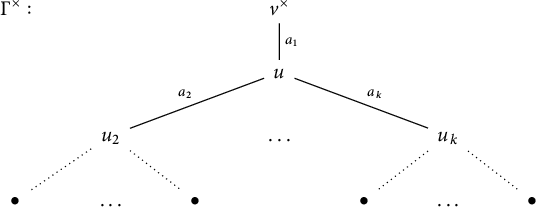
Since the underlying graph of
 $\Gamma ^{\times }$
is a tree, the subgraph obtained by deleting the vertex
 $u$
is disconnected, consisting of connected components
 $\Gamma _1, \Gamma _2, \dots , \Gamma _k$
. These components are in bijection with the vertices
 $v^{\times }, u_2, \dots , u_k$
, where each
 $u_i$
is a vertex of the connected component
 $\Gamma _i$
and
 $\Gamma _i$
is a tree for
 $i = 2, \dots , k$
. Furthermore,
 $\Gamma _1$
is associated with the special vertex
 $v^{\times }$
.
By [Reference Wang and ZhangWZ22, Lemma 3.1], each connected component
 $\Gamma _i$
for
 $i=2, \dots , k$
induces a trivial extension of an iterated tilted algebra of Dynkin type
 $\mathbb {A}_n$
. Then, any cut set
 $\mathcal {C}_i$
of
 $\Gamma _i$
defines an iterated tilted algebra of Dynkin type
 $\mathbb {A}_n$
Even more, by construction of
 $Q_{\Gamma ^{\times }}$
, there are exactly two special cycles in
 $Q_{\Gamma ^{\times }}$
induced by the edges attached to
 $u$
that share all arrows except two, having the following diagram.
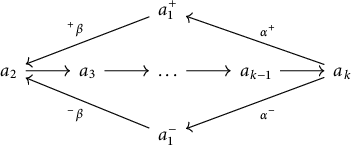
It is clear that the set
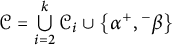 $\mathcal {C}=\bigcup \limits _{i=2}^k \mathcal {C}_i \cup \{\alpha ^+, {}^-\beta \}$
is a cut set of
 $B_{\Gamma ^{\times }}$
. Then, the induced quotient algebra
 $A=B/ \langle \mathcal {C}\rangle $
of
 $B$
has the following quiver:

where each
 $a_i^*$
has attached an iterated tilted algebra of Dynkin type
 $\mathbb {A}_n$
. Then, by [Reference Assem and SkowronskiAS06, Section 7, Main theorem, case D3] and [Reference KellerKel91], A is an iterated tilted algebra of Dynkin type
 $\mathbb {D}$
.
7 A geometric interpretation using dissections
In this section, we use generalized dissections of orbifold surfaces, that were originally considered in [Reference Amiot and BrüstleAB22, Reference Labardini-Fragoso, Schroll and ValdiviesoLFSV22] to study the derived categories of skew-gentle algebras, to give a geometric version of the good cut set. We follow [Reference Amiot and BrüstleAB22, Reference Labardini-Fragoso, Schroll and ValdiviesoLFSV22, Reference Opper, Plamondon and SchrollOPS18] for the next definitions and results.
7.1 Computing trivial extensions of skew-gentle algebras using dissections
In this section, we obtain a skew gentle algebra
 $A=A(Q,I,\mathrm {Sp})$
from an orbifold dissection. By our previous results, we know that
 $T(A^{\mathrm {sg}})$
is isomorphic to a skew-Brauer graph algebra
 $B_{\Gamma ^{\times }}$
. We use the geometry to compute the quiver
 $Q_{\Gamma ^{\times }}$
and to determine the special cycles, consequently, we have all the information needed to define
 $B_{\Gamma ^{\times }}$
.
An orbifold marked surface is a tuple
 $O=(S,M,P, \mathcal {O}),$
where
 $S$
is a compact and oriented Riemann surface with boundary,
 $M$
is a finite set of marked points in the boundary
 $\partial S$
,
 $P$
is a finite set of marked points in the interior of
 $S$
, called punctures, and
 $\mathcal {O}$
(with
 $\mathcal {O} \cap P = \emptyset $
) is a set of orbifold points of order two. In particular, when
 $\mathcal {O}=\emptyset $
, we call it a marked surface and denote it simply by
 $(S,M,P)$
. Even more, a marked surface
 $(S,M,P)$
is unpunctured if
 $P=\emptyset $
.
A boundary segment is a curve in
 $\partial S$
that is delimited by its endpoints in
 $M$
and does not contain other points in
 $M$
. An arc is a curve
 $\gamma \colon [0,1] \to S$
, injective on
 $(0,1)$
up to orbi-homotopy, considered up to injective orbi-homotopy relative to its endpoints
 $\gamma (0)$
and
 $\gamma (1)$
, and such that its endpoints belong to
 $M \cup P \cup \mathcal {O}$
. See [Reference Chas and GadgilCG16] for the definition of orbi-homotopy.
A  -dissection of an orbifold marked surface
 $O=(S, M,P, \mathcal {O})$
is a set
 $D^{\times }$
of arcs that cuts
 $O$
into (possibly degenerate) polygons with exactly one edge as a boundary segment, each
 $x\in \mathcal {O}$
is an endpoint of exactly one arc, there are no boundary components without marked points in the interior of the polygons,Footnote
5
and each point
 $x\in M\cup P$
is the ending point of at least one arc of
 $D^{\times }$
. In this context, a degenerate polygon is one that can contain:
-
(1) Special arcs: Arcs ending at an orbifold point
$x\in \mathcal {O}$
(with no other arc incident to
$x$
), or -
(2) Self-folded arcs: Arcs ending at a puncture
$p\in P$
(with no other arc incident to
$p$
).Footnote
6


The arcs that are not of the form
 $(1)$
or
 $(2)$
, and the boundary segments, split the surface into topological polygons. To distinguish a special arc from the other arcs, we will denote it as
 $\gamma ^{\times }$
. The tuple
 $(S,M, P, \mathcal {O}, D^{\times })$
is called orbifold dissection.
The list of polygons might contain what we call trivial polygons, i.e., bigons enclosed by an edge in the dissection and one boundary segment and containing no orbifold points, consequently having no special arc, in their interior.
If there are no orbifold points in
 $O$
, we call it
 -dissection of
 $(S, M, P)$
and the tuple
 $(S,M,P, D^{\times })$
is called surface dissection.
The  -dissection
 $(S, M,P, \mathcal {O}, D^{\times })$
is defined in [Reference Labardini-Fragoso, Schroll and ValdiviesoLFSV22, Section 4] as the dual dissection of another orbifold dissection. In this construction, the orbifold dissection
 $(S, M,P, \mathcal {O}, D^{\times })$
has two different kinds of points: the red points and the black points, in our definition, we are omitting the latter. The authors also show that
 -dissection is related to the Koszul dual algebra of
 $A$
. In this section, we establish a different convention to construct a quiver
 $Q$
and an ideal I that recovers, in our case, a skew-gentle algebra
 $A(Q,I,\textrm {Sp})$
and also data of the trivial extension
 $T(A^{\mathrm {sg}})$
of
 $A^{\mathrm {sg}}$
.
We define the quiver of the skew-gentle algebra
 $A =A(Q,I, \mathrm {Sp})$
from a
 -dissection
 $(S,M,P, \mathcal {O}, D^{\times })$
. We start by defining
 $Q$
and
 $\mathrm {Sp}$
following the rules:
-
(r1) Each arc
$\gamma _i$
gives rise to a vertex
$i$
of
$Q$
and each special arc
$\gamma _j^{\times }$
corresponds to special vertex
$j^{\times }$
of
$Q$
. -
(r2) Each internal angle between arcs (either special or not) in a polygon gives rise to an arrow oriented in counterclockwise direction.
-
(r3) Each special arc
$\gamma ^{\times }_i$
defines a special loop
$f_i:i \to i$
in
$Q$
. -
(r4) Each self-folded arc
$\gamma _j$
defines a non-special loop
$g_j:j\to j$
in
$Q$
.


Example 7.1 In Figure 7, we show a  -dissection and a
 -dissection, each one with two degenerate polygons.
Two dissections for the disk that define the same Q but give rise to different relations.
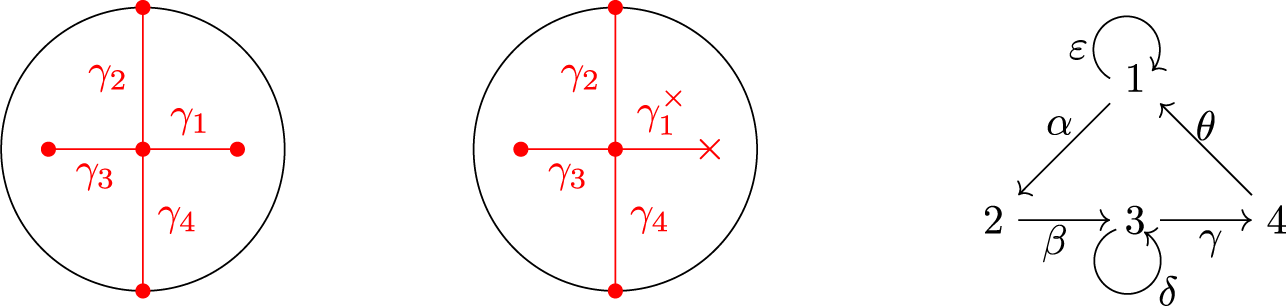
The surface on the left has two self-folded arcs
 $\gamma _1$
and
 $\gamma _3$
, while the orbifold surface in the middle has a self-folded arc
 $\gamma _3$
and a special arc
 $\gamma _1^{\times }$
.
For each nontrivial (degenerate) polygon
 $P_i$
denote by
 $p_i =\alpha _1 \ldots \alpha _t$
the composition of all arrows, such that for all
 $i \alpha _i \notin \mathrm {Sp}$
, arising from the interior of
 $P_i$
touring the interior of the polygon clockwise.
For the  -dissection in Example 7.1 (left),
 $p_1 = \beta \delta \gamma $
and
 $p_2 = \theta \varepsilon \alpha $
. While for the
 -dissection in Example 7.1 (center),
 $p_1 = \beta \delta \gamma $
and
 $p_2 = \theta \alpha $
, and
 $\varepsilon \in \mathrm {Sp}$
.
We complete the definition for the skew-gentle algebra
 $A=A(Q,I, \mathrm {Sp})$
arising from a
 -dissection by giving the set of relations of
 $I$
.
-
(1) Any composition of arrows
$\alpha \beta $
(where
$ \alpha , \beta \notin \mathrm {Sp}$
) that is not a subpath of a
$p_i$
is a relation. In particular, a non-special loop
$g_i$
defines a relation
$g_i^2=0$
. -
(2) The composition of two arrows
$\alpha \beta $
that is a subpath of
$p_i$
and such that
$t(\alpha ) = s(\beta )$
is the source of a special loop.


For each path
 $p_i$
, if
 $s(p_i)$
(or
 $t(p_i)$
) is a source for a special loop
 $f_j$
, define
 $\widetilde {p_i}= f_j p_i$
(or
 $p_i f_j$
). With these relations, we have that
 $\widetilde {p_i}$
is an
 $sp$
-maximal path for
 $A=(Q,I, \mathrm {Sp})$
as in Section 4.2.
Remark 7.2 For the skew-gentle algebra arising from an orbifold dissection, there is a correspondence between the length of a maximal path modulo I and longest (oriented) sequence of non-boundary edges in a polygon. For this reason, each polygon in an orbifold dissection must contain a boundary edge. An absence of the boundary segment would result in a path of infinite length modulo
 $I$
. Then, the bound quiver algebra would not be finite dimensional and thus falls beyond our setup.
For the  -dissection in Example 7.1 (center), we have
 $I = \langle \alpha \beta , \delta ^2, \beta \gamma , \gamma \theta , \theta \alpha \rangle $
.
Note that it can happen that two arrows form a subpath in
 $Q$
and they arise from the interior of the same polygon, but their composition has to be a relation. This is the case for
 $\beta $
and
 $\gamma $
in Example 7.3.
We can use the  -dissection to obtain the quiver
 $Q_{\Gamma ^{\times }}$
that will define the (admissible) trivial extension of
 $A$
. Recall that, by Theorem 4.10, the trivial extension of
 $A^{\mathrm {sg}}$
is isomorphic to a skew-Brauer graph algebra, with skew-Brauer graph
 $\Gamma ^{\times }$
(having multiplicity function
 $\mathfrak {m}=1$
).
The quiver
 $Q_{\Gamma ^{\times }}$
is obtained from the
 -dissection by adding to Q a new arrow
 $\beta _{p_j}$
from
 $t(p_j)$
to
 $s(p_j)$
for each path
 $p_j$
arising from a nontrivial polygon
 $P_j$
. That is, we complete a cycle for each
 $sp$
-maximal path. Then, we remove special loops
 $f_i$
and decorate the corresponding vertices
 $i^{\times }$
.
The family of special cycles
 $\mathcal {C}$
is formed by all (the cyclic permutations of) cycles
 $C_{P_j} = p_j \beta _{p_j}$
, arising from nontrivial (degenerate) polygons. This is enough to define the admissible trivial extension
 $B_{\Gamma ^{\times }}$
. We see the procedure in the following example.
Example 7.3 The  -dissection in Figure 8 is formed by two polygons. The polygon
 $P_1$
is delimited by edges
 $1,2,3,2,1,5$
and boundary, and the polygon
 $P_2$
is delimited by edges
 $3,5$
and boundary. The quiver
 $Q$
for the
 -dissection is the one in Figure 8 (left). In this case,
 $P_1$
contains the maximal path
 $p_1 = \gamma \delta \varepsilon \alpha \beta \omega $
and generates a new arrow
 $\beta _{p_1}$
(in red) and
 $P_2$
contains the maximal path
 $ p_2 = \lambda $
and generates the new arrow
 $\beta _{p_2}$
(in blue). For this example, the quivers
 $Q_{\Gamma ^{\times }}$
and
 $Q^{\mathrm {sg}}_{\Gamma ^{\times }}$
are given in Figure 9.
A  -dissection of the torus with one boundary component and Q defined by this dissection.
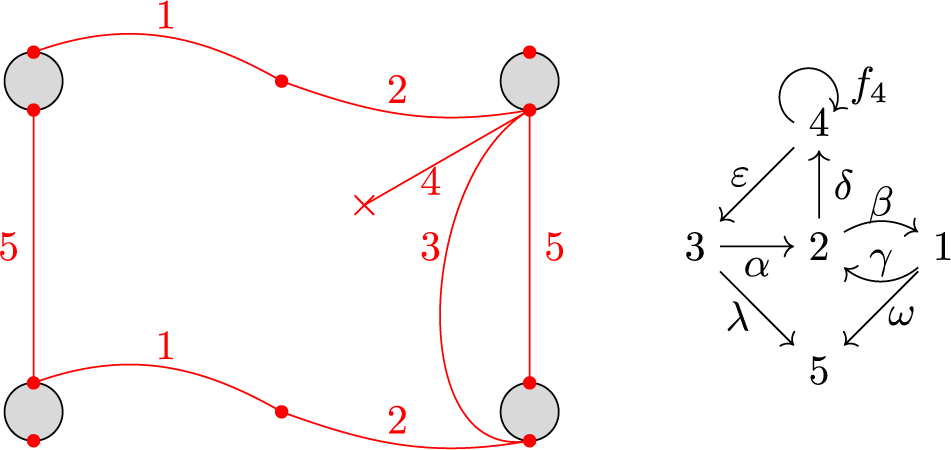
Quiver
 $Q_{\Gamma ^{\times }}$
for a
 -dissection and quiver
 $Q^{\mathrm {sg}}_{\Gamma ^{\times }}$
.
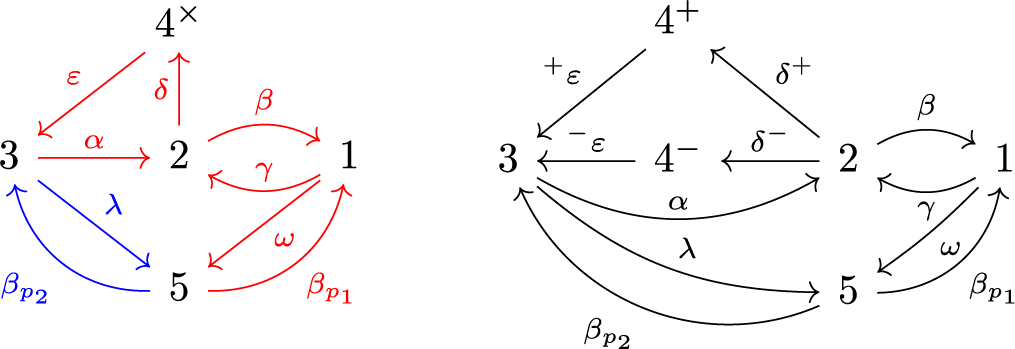
The trivial extension for
 $A=A(Q,I, \mathrm {Sp})$
defined by the
 -dissection is
 $B_{\Gamma ^{\times }} =KQ^{\mathrm {sg}}_{\Gamma ^{\times }}/I_{\Gamma ^{\times }}$
, where
 $I_{\Gamma ^{\times }}$
arises from the cycles
 $C_{P_1}=p_1 \beta _1$
and
 $C_{P_2}=p_2 \beta _{p_2}$
and considering the skew-Brauer relations (see Section 4.1). In the next list of relations,
 $* \in \{ +,-\}$
.
Relation of type 0:
 $\delta ^+ {}^{+}\varepsilon - \delta ^- {}^{-}\varepsilon $
.
Relations of type I. These relations arise from arcs shared by nontrivial polygons.
-
• arc
$3$
sits between
$P_1$
and
$P_2$
:
$\alpha \beta \omega \beta _{p_1} \gamma \delta ^* {}^{*}\varepsilon - \lambda \beta _{p_2.}$
-
• arc
$5$
, between
$P_1$
and
$P_2$
:
$\beta _{p_2} \lambda - \beta _{p_1} \gamma \delta ^* {}^*\varepsilon \alpha \beta \omega .$
-
• arc
$1$
, between
$P_1$
and
$P_1$
:
$\omega \beta _{p_1} \gamma \delta ^* {}^*\varepsilon \alpha \beta - \gamma \delta ^* {}^*\varepsilon \alpha \beta \omega \beta _{p_1.}$
-
• arc
$2$
, between
$P_1$
and
$P_1$
:
$\delta ^* {}^*\varepsilon \alpha \beta \omega \beta _{p_1} \gamma - \beta \omega \beta _{p_1} \gamma \delta ^* {}^*\varepsilon \alpha. $












Relations of type IIa.

Relations of type IIb:
 $\delta ^- {}^{-}\varepsilon \alpha \beta \omega \beta _{p_1} \gamma \delta ^{+}$
and
 $\delta ^+ {}^{+}\varepsilon \alpha \beta \omega \beta _{p_1} \gamma \delta ^{-}$
.
Relations of type III:
 $ \beta \gamma , \gamma \beta , \alpha \delta ^*, {}^{*}\varepsilon \lambda $
,
 $\beta _{p_1} \omega $
,
 $\beta _{p_2} \alpha $
,
 $\lambda \beta _{p_1}$
,
 $\omega \beta _{p_2}$
.
The skew-Brauer graph for Example 7.3 is depicted in Figure 10.
Skew-Brauer graph.
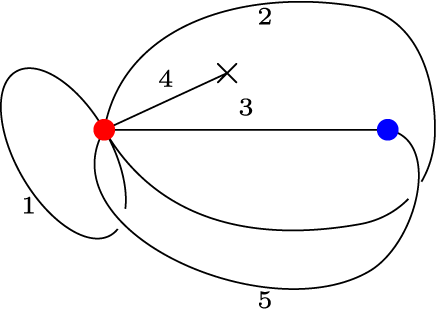
We summarize the construction proposed in this section in the next proposition.
Proposition 7.4 Each  -dissection
 $(S,M, P, \mathcal {O}, D^{\times })$
defines a skew-gentle algebra
 $A=A(Q,I, \mathrm {Sp})$
. Moreover, the quiver and relations for its trivial extension
 $T(A^{\mathrm {sg}})$
can be obtained from the dissection.
Proof The  -dissection describes a skew-gentle algebra
 $A=A(Q,I, \mathrm {Sp})$
. The ideal I is given so that each (nontrivial) polygon is associated with an
 $sp$
-maximal path
 $\widetilde {p_i}$
. We define a new arrow
 $\beta _{p_i}$
for each of these paths as in Theorem 3.11, we set the
 $i^{\times }$
as special vertices and we define the special cycles (up to cyclic permutation) as
 $p_i \beta _{p_i}$
. With all thisn we get the quiver and relations for
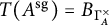 $T(A^{\mathrm {sg}}) = B_{\Gamma ^{\times }_A}$
.
7.2 Contracting and adding boundary segments
Let
 $\mathcal {X} = (S,M, P, \mathcal {O}, D^{\times })$
be a
 -dissection that splits the surface into (degenerate) polygons, where
 $P_1, \dots , P_n$
denote the nontrivial polygons. We provide a geometric characterization of good cut sets for the trivial extension of skew-gentle algebras by defining a two-step operation.
For an arbitrary fixed nontrivial polygon
 $P_i$
and either a fixed internal angle
 $\theta $
between two arcs of
 $P_i$
or a fixed puncture x that is the ending point of a self-folded arc of
 $P_i$
(and no other arcs), we define the addition-contraction at
 $(P_i,\theta )$
or
 $(P_i, x)$
, respectively, as follows.
(Step 1: Contraction) For the polygon
 $P_i$
, there is exactly one edge, say
 $b$
, that is a boundary segment. We note that
 $b$
can be a boundary component with one marked point. If
 $b$
is a boundary segment with two different endpoints, then we contract
 $b$
by identifying the points and obtaining a vertex
 $\widetilde {x}$
. If
 $b$
is a boundary component with one marked point, then we contract
 $b$
to a single marked point
 $\widetilde {x}$
. In both cases, we obtain a polygon
 $\widetilde {P}_i$
with no boundary segment as an edge.
(Step 2: Addition for
 $\boldsymbol {(P_i,\theta ))}$
For the internal angle
 $\theta $
in
 $\widetilde {P}_i$
opposite to a vertex y of
 $\widetilde {P_i}$
, we add a boundary (segment or component) as follows:
-
(1) if
$y\in M$
, we add a new boundary segment, splitting the red marked point (see Figure 11 left);Figure 11:Adding a boundary segment at
$\theta $
or x. -
(2) when
$y\in P$
, we add a new boundary component in
$\theta $
having
$y$
as a marked point (see Figure 11 center).





(Step 2: Addition for
 $\mathbf {(P_i,p))}$
If
 $x\in P$
is the ending point of a self-folded arc of
 $P_i$
(and no other arcs), we replace
 $x$
by a boundary component, having
 $x$
has a marked point (Figure 11 right).
In the two cases, we obtain a new polygon
 $P_i'$
with exactly one edge that is a boundary segment. We denote the resulting
 -dissection by:
 $\tau _{(P_i, \theta )}\mathcal {X}$
or
 $\tau _{(P_i, x)}\mathcal {X}$
, respectively. The new dissection splits S into (degenerate) polygons, and the set of nontrivial polygons is
 $\{P_1, \dots , P_m\}\setminus P_i\cup \{P_i'\}$
.
Example 7.5 A  -dissection for the annulus and the new
 -dissection after a contraction–addition at
 $(P_2,\theta )$
.
Observe that both  -dissections in Figure 12 generate the skew-Brauer graph algebra B (with
 $\mathfrak {m} =1$
) from Example 4.2. Each one of two
 -dissections defines a skew-gentle algebra that is a good cut (Definition 4.13) for B.
A  -dissection
 $\mathcal {X}$
and the new
 -dissection
 $\tau _{(P_2, \theta )} \mathcal {X}$
.
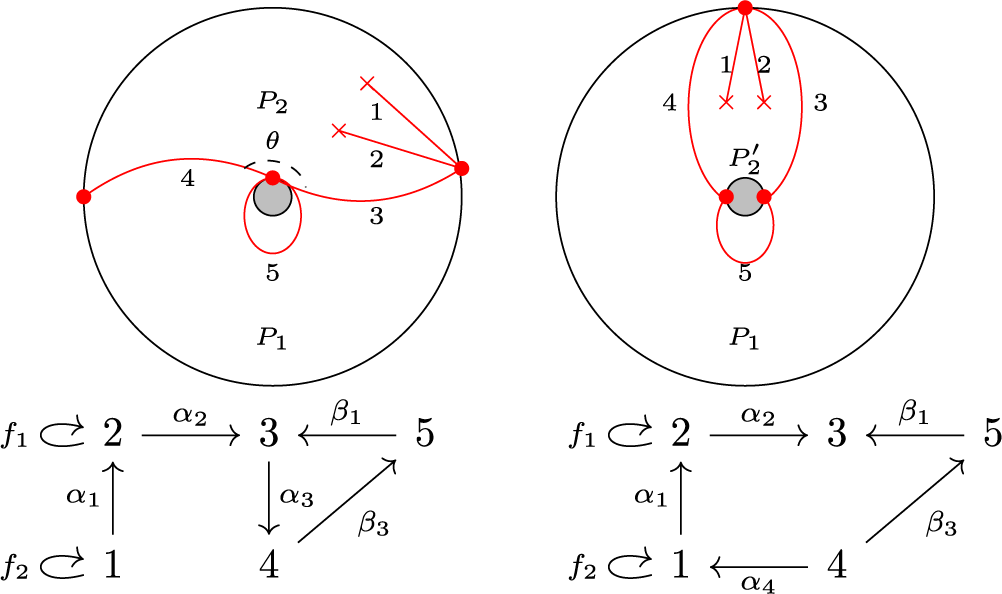
Theorem 7.6 Let A be a skew-gentle with
 $\mathrm {Sp}$
the set of special vertices, and
 $\mathcal {X}=(S,M, P, \mathcal {O}, D^{\times })$
its
 -dissection and let
 $\mathcal {D}$
be a good cut set of
 $T(A^{\mathrm {sg}})$
. Then, there is a sequence of contraction–addition moves taking
 $\mathcal {X}$
to
 $\widetilde {\mathcal {X}}$
, where
 $\widetilde {\mathcal {X}}$
is the
 -dissection of the quotient algebra of
 $T(A^{\mathrm {sg}})$
induced by
 $\mathcal {D}$
.
Proof Let
 $\mathcal {D}$
be a good cut of
 $T(A^{\mathrm {sg}})$
. By definition, there exists an admissible cut
 $\mathcal {D}'$
of the trivial extension
 $T(A'),$
where
 $A'$
is the associated gentle algebra of A. By [Reference SchrollSch15, Theorem 1.3],
 $\mathcal {D}'$
is a set of arrows containing exactly one arrow from each one of the special cycles of
 $T(A')$
, which by Lemma 4.9 are in bijection with the nontrivial (degenerate) polygons of
 $\mathcal {X}$
. To fix notation, denote by
 $\alpha _{i}$
the arrow of
 $\mathcal {D}'$
associated with the nontrivial polygon
 $P_i$
.
Each arrow
 $\alpha _{i}$
of
 $\mathcal {D}'$
corresponds to either an internal angle
 $\theta _i$
of a polygon
 $P_i$
opposite to a vertex
 $x\in M\cup P$
, or to a puncture
 $x_i$
that is the ending point of a self-folded arc of
 $P_i$
(and no other arcs) or corresponds to a boundary segment of
 $P_i$
. Only in the first two cases, we need to apply a contraction–addition at
 $(P_i,\theta _i$
or at
 $(P_i, x_i)$
.
Since
 $\mathcal {D}'$
is an admissible cut of
 $T(A')$
, there are no repeated polygons in the list of contraction–addition at
 $(P_i, \theta _i)$
or
 $(P_i, x_i)$
induced by the arrows of
 $\mathcal {D}'$
. Then, we can define a sequence
 $\tau $
of contraction–addition, and it is well-defined. Finally, by construction,
 $T(A^{\mathrm {sg}})/\langle \mathcal {D\rangle }$
is isomorphic to the skew-gentle algebra obtained from
 $\tau \mathcal {X}$
.
7.3 On derived equivalent skew-gentle algebras
The following example shows that contraction–addition does not necessarily induce derived equivalent skew-gentle algebras.
Example 7.7 Let
 $A$
and
 $B$
be the skew-gentle algebras associated with the
 -dissections depicted in Figure 13, with nontrivial polygons
 $P_1$
and
 $P_2$
and
 $P_1'$
and
 $P_2$
, respectively. One can see that
 $A$
and B are related by a contraction–addition at
 $(P_1,\theta )$
, and even more, the
 -dissections are induced by good cuts of a skew-Brauer graph algebra with multiplicity
 $\mathfrak {m} =1$
.
 -dissection
 $\mathcal {X}$
(left) and the new
 -dissection
 $\tau _{(P_1,\theta )} \mathcal {X}$
(right).
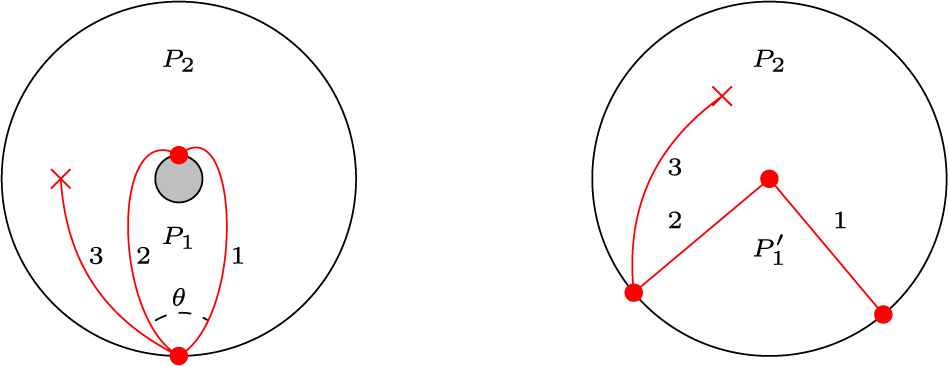
Let A be the skew-gentle algebra defined by
 $\mathcal {X}$
in Figure 13, and consider B defined by
 $\tau _{(P_1,x)} \mathcal {X}$
.

Hence,
 $A$
is defined by the quiver on the left and taking the ideal
 $\langle \beta _1 \alpha _2, f_3^2-f_3\rangle $
, while
 $B$
is defined by the quiver on the right considering the ideal
 $\langle \beta _2 \alpha _1, \alpha _1 \beta _2, f_3^2-f_3\rangle $
.
Following [Reference Labardini-Fragoso, Schroll and ValdiviesoLFSV22, Theorem 7.3] and looking at the  -dissections,Footnote
7
it is easy to see that the determinants of their q-Cartan matrices are
 $\mathrm {det}\, (C_A)_q = 1$
and
 $\mathrm {det}\, (C_B)_q = 1-q^2$
. The ordinary Cartan matrices are obtained by evaluating
 $q=1$
, hence we can find their determinants
 $\mathrm {det}\, (C_A) = 1$
and
 $\mathrm {det}\, (C_B) = 0$
. Since these determinants are derived invariants [Reference Bocian and SkowrońskiBS05, Proposition 1.5], we conclude that
 $A$
and
 $B$
are not derived equivalent.
7.4 Ref lections as geometric moves on a -dissection
 -dissection
By Theorems 5.7 and 7.6, any sequence of reflections in a skew-gentle algebra
 $A$
can be interpreted as a sequence of contraction–addition on its
 -dissection. In this section, we present another interpretation of reflections as local moves in
 -dissections. We will present examples of reflections on
 -dissections and show how these moves behave locally.
Let A be a skew-gentle algebra defined by a  -dissection. Let
 $y$
be a vertex that is a source or a target in
 $Q_{A'}$
, where
 $A'$
is the auxiliary gentle algebra of
 $A$
. Such a vertex will be associated with a red arc y that can be a special arc, as is Figure 14 right, or a regular red arc. If the vertex
 $y$
is a target, the arc y is such that if we pivot counterclockwise on one of its endpoints, we meet the boundary edge of a polygon (see Figure 14 left).
Positive reflection
 $S_y^+$
with
 $y$
a non-special target vertex (right). Negative reflection
 $S_y^-$
with y a special source vertex (left).
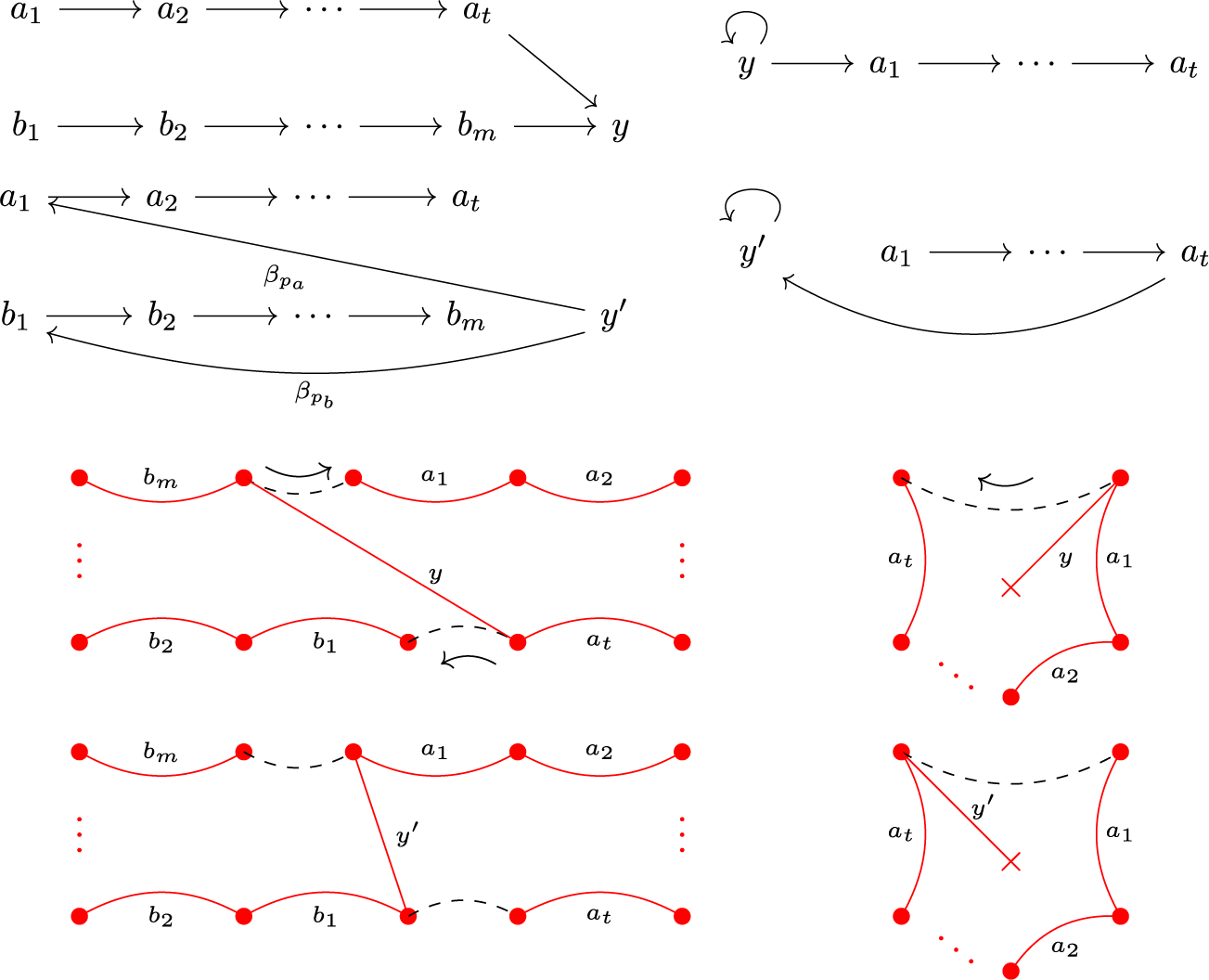
Let
 $y$
be a non-special target vertex. Consider
 $p_a$
and
 $p_b$
the maximal paths in
 $A'$
ending at
 $y$
. See that one of these paths might be trivial, that is, the case when one of the polygons having
 $y$
as an edge is a trivial polygon. Let
 $\beta _{p_1}$
and
 $\beta _{p_2}$
be the new arrows in
 $Q_{\widehat {A'}}$
, then
 $S^+_y(A)$
is given by a quiver and the (non-admissible) ideal defined by a new
 -dissection, exchanging locally the vertex y and the vertex
 $y'$
as in the next figure. If
 $y$
is special, we see the local exchange
 $S^-_y (A)$
in the right part of the figure. The negative and positive reflections for non-special and special vertices are analogous.
Example 7.8 Let
 $A$
be the skew-gentle algebra defined by the
 -dissection on the left of Figure 12. Thus,
 $A= KQ/I,$
where
 $Q$
is the quiver on the left,
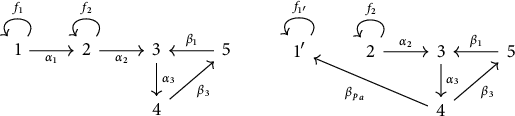
and
 $I = \langle f_1^2 - f_1, f_2^2- f_2, \alpha _1 \alpha _2 , \alpha _3 \beta _3 , \beta _1 \alpha _3 \rangle $
. Then,
 $\beta _{p_a}$
is the new arrow arising from the path
 $p_a=\alpha _1\alpha _2\alpha _3$
and
 $S_1^-(A)$
is the skew-gentle algebra defined by the quiver on the right and the ideal
 $J= \langle f_{1'}^2 - f_{1'}, f_2^2- f_2, \alpha _3 \beta _3 , \beta _1 \alpha _3 \rangle $
, that is associated with the
 -dissection after applying a move as the one in Figure 14 right.
Acknowledgements
A.G.-E., V.G., and Y.V. would like to thank the Isaac Newton Institute for Mathematical Sciences, Cambridge, for support and hospitality during the programme “Cluster Algebras and Representation Theory” where part of the work on this article was undertaken. We especially thank Elsa Fernández for her valuable comments on iterated tilted algebras.