1. Introduction
Contemporary societies are increasingly exposed to climate change but also to other threats such as demographic changes or market crises that are the result of socioeconomic development and are manifest at multiple scales. This situation has generated a new interest in understanding the manner in which communities organize in response to different types of menaces in different contexts (UN/ISDR 2004). Research in natural resource management has been particularly productive in that regard. According to ecology and complex systems scholars, different disturbances may require different responses from communities, but there may be also commonalities (Anderies et al. Reference Anderies, Ryan and Walker2006; Berkes et al. Reference Berkes, Colding and Folke2003). Also, a number of scholars studying natural resource management have pointed to the collective action problems involved in adapting to changes, as well as the transaction costs of solving those problems (Araral Reference Araral2013b; Lam Reference Lam2006; Villamayor-Tomas Reference Villamayor-Tomas2014). All this scholarship calls for a systematic characterization of disturbances and the collective responses they trigger.
This paper advances an institutional economics approach to the study of climate change adaptation by local communities (Araral Reference Araral2013b). Specifically, the paper aims to understand adaptation to climate change by looking at a broad spectrum of disturbances, including climate-related disturbances such as droughts and floods as well as other kinds of disturbance. The research questions that drive the study are: Are there identifiable patterns in the way local communities collectively respond to different kinds of disturbance, including droughts and floods but also others? Do disturbance characteristics affect the way communities respond? If so, how?
Empirically, this paper relies on a unique dataset of 50 disturbance collective response cases obtained from a study of five Spanish irrigation associations (WUAs). Studying adaptability in the irrigation context is useful for several reasons. Irrigated agriculture is one of the economic activities in which the impact of climate change disturbances is most evident (Boken et al. Reference Boken, Cracknell and Heathcote2005). Second, an important part of institutional economics theory in the field of natural resource management is based on the study of local irrigation governance (Ostrom et al. Reference Ostrom, Gardner and Walker1994). Spain is well recognized for the long tradition and autonomy of its irrigation associations (Ostrom Reference Ostrom1990), many of which have successfully evolved to combat a variety of threats such as droughts, floods, wars and plagues over centuries. In the last 20 years, however, a series of severe droughts and the growth of cities and industry in Spain have resulted in a new concern about the ability of the irrigation sector to adapt (Lopez Galvez and Naredo Reference Lopez Galvez and Naredo1997). Understanding how irrigation communities cope with such threats can be particularly illustrative of patterns of adaptation to different types of disturbances.
Theoretically, the study relies on transaction costs and collective action theories (Ostrom et al. Reference Ostrom, Gardner and Walker1994; Williamson Reference Williamson1985). Transaction costs theory is used to characterize disturbances by looking at the uncertainty they generate, their frequency, the distance of the transacting partners they affect and their impact on asset-specific transactions. Collective action theory is used to feature responses based on the collective action tasks they involve. Relationships between different types of disturbances and responses are then explored via qualitative comparative analysis (QCA).
2. Theoretical framework: transactions, coordination and cooperation
Theory on tradable property rights (Coase), institutional design principles (Ostrom) and transaction costs (Williamson), also coined as the COW framework, can constitute a foundation for the analytics of climate change adaptation (Araral Reference Araral2013b). A few studies on climate adaptation in the irrigation sector have set the path in that direction (Araral Reference Araral2013a, Varela-Ortega et al. Reference Varela-Ortega, Blanco-Gutiérrez, Esteve, Bharwani, Fronzek and Downing2016; Villamayor-Tomas Reference Villamayor-Tomas2014). This study builds on those efforts. Specifically, the study adopts a model according to which the responses of self-organized communities to disturbances depends on the extent to which the disturbances motivate cooperative responses and the costs of collective action (Fleischman et al. Reference Fleischman, Boenning, Garcia-Lopez, Mincey, Schmitt-Harsh, Daedlow, Lopez, Basurto, Fischer and Ostrom2010).
Disturbance features and the motivation for cooperation
Disturbance can be defined as an ‘event that disrupts social or ecological communities, resulting in changes to the physical or social environment’ (Fleischman et al. Reference Fleischman, Boenning, Garcia-Lopez, Mincey, Schmitt-Harsh, Daedlow, Lopez, Basurto, Fischer and Ostrom2010). Different authors have theorized about types of disturbances. Salafsky et al. (Reference Salafsky, Salzer, Stattersfield, Hilton-Taylor, Neugarten, Butchart, Collen, Cox, Master, O'Connor and Wilkie2008), for example, distinguish between threats and stresses; and Schoon and Cox (Reference Schoon and Cox2011) classify disturbances depending on aspects such as intensity or frequency.
Transaction cost theory can be used to reason about the relationship between disturbance features and the motivation for cooperation. Transaction costs scholars are interested in the governance conditions that make transactions between economically motivated agents function efficiently given the risk that agents behave opportunistically (Williamson Reference Williamson1985). Hagedorn (Reference Hagedorn2008) developed the concept of nature-related transactions (nr-t) to recognize the mediating role of physical conditions in human interactions. According to the concept, many interactions between individuals happen only indirectly, as they use shared biophysical resources. Thus, it is necessary to study not only the characteristics of the transactions resulting from person-to-person interactions, but also those that emerge from person-to-nature-to-person interactions. This concept applies particularly well to the study of irrigation systems and associations, where interactions between farmers are mediated by the use of shared infrastructure and water resources.
Scholarship applying transaction costs economics to environmental governance has identified a number of nr-t features and theorized about their impact on the motivation for cooperative governance structures (Thiel et al. Reference Thiel, Schleyer, Hinkel, Schlüter, Hagedorn, Bisaro, Bobojonov and Hamidov2016). The paragraphs that follow describe these features and explore their applicability to characterizing disturbances and their impact on motivation for cooperative responses in the irrigation context.
In an asset-specific transaction, the investments made to accomplish the transaction are rather unique to the partners involved. If the transaction fails, partners are likely to incur losses ‘because, for example, alternative transacting partners cannot deliver the same good or service or because they do not have access to the same assets’ (Thiel et al. Reference Thiel, Schleyer, Hinkel, Schlüter, Hagedorn, Bisaro, Bobojonov and Hamidov2016: 12). To minimize the risk of failure, partners may be particularly willing to engage in long-term cooperation under a common organization as opposed to ad hoc contracting (Williamson Reference Williamson1991). Irrigation associations are a good example of the relevance of asset specificity. Farmers in irrigation systems engage in three fundamentally nature-related transactions: water use, water allocation and infrastructure maintenance (Tang Reference Tang1992). Water use is an nr-t because the amount of water withdrawn by a farmer in an irrigation system affects the amount of water that other farmers in the system can use. Water allocation is also an nr-t because farmers in an irrigation system cannot usually withdraw the water all at once, i.e. some farmers will not be able to use water if other farmers are doing it already. Infrastructure maintenance is also an nr-t because the infrastructure is shared, so if a farmer does not maintain it, this will affect not only him but also other farmers. All three nature-related transactions are highly asset specific. The investments of a farmer in the irrigation infrastructure cannot be recovered if other farmers fail to invest too and/or if the farmer moves elsewhere. Similarly, there are cropping investments every year that will not be recovered if there are water use or water allocation issues. Irrigation associations secure all those investments by integrating farmers within a cooperative regime of water and infrastructure management rules; however, some disturbances can challenge the performance of those rules. The reduction of water availability during a drought, for example, can increase opportunistic behaviour among farmers and decrease compliance with water management rules (Osés-Eraso et al. Reference Osés-Eraso, Udina and Viladrich-Grau2008). Similarly, urbanization can decrease the willingness of farmers to keep investing in the shared infrastructure (Cox Reference Cox2014). The non-recoverable losses that occur if water use, water allocation or infrastructure maintenance transactions fail may constitute a sufficient motivation for farmers to engage cooperative responses that secure these transactions.
Environmental uncertainty refers to the occurrence of ‘random acts of nature’ that affect transactions (Williamson Reference Williamson1985: 57). As posed by Williamson, the risk of opportunistic behaviour by partners in a transaction increases with environmental uncertainty. In highly uncertain situations, partners may prefer cooperating within an overarching organization rather than just engaging in ad hoc contracting (Williamson Reference Williamson1991). Nature-related transactions, like those featured in irrigation systems, are particularly vulnerable to uncertainty because of their exposure to environmental disturbances (Thiel et al. Reference Thiel, Schleyer, Hinkel, Schlüter, Hagedorn, Bisaro, Bobojonov and Hamidov2016). One way to assess the uncertainty generated by a disturbance is by looking at its intensity. Disturbance intensity can be defined as the deviation from a norm given a time frame (Schoon and Cox Reference Schoon and Cox2011). Changes that occur progressively over time (e.g. demographic transitions) may represent significant deviations from the norm in the long term; however, deviations are small in the short term and therefore relatively predictable over time. Alternatively, intense or sudden changes (e.g. a flood) are difficult to predict and generate information gaps. In irrigation systems, gaps might include the lack of information about the impact of the disturbance on the infrastructure, resource availability, or the behaviour of farmers, for example. The risk that rent seekers use those information gaps opportunistically would motivate a majority of farmers to engage in cooperation and respond collectively to the disturbance.
The frequency of transactions also motivates the establishment of cooperative arrangements. Everything else being equal, the frequency of a transaction contributes to the profitability of scale economies if partners decide to cooperate and integrate the transaction in a common organization (Williamson Reference Williamson1991). This logic can be extrapolated to the study of disturbances in the irrigation context: disturbances that occur frequently facilitate farmers standardizing their responses under a common cooperative strategy (Janssen et al. Reference Janssen, Anderies and Ostrom2007). However, there is a caveat to bear in mind. Frequency is an attribute of intense disturbances (Schoon and Cox Reference Schoon and Cox2011). As such, one could argue that that frequency diminishes the uncertainty generated by intense disturbances (Janssen et al. Reference Janssen, Anderies and Ostrom2007). In that case, the risk of opportunistic behaviour and the motivation for cooperation among farmers would also be expected to decrease.
Finally, there is the relational distance between transacting partners. Relational distance depends on social and physical distance. Social distance indicates the existence of heterogeneous interests and experiences among transacting partners. Everything else being equal, interest heterogeneity increases the risk of opportunistic behaviour and thus the motivation for cooperation among transacting partners (Thiel et al. Reference Thiel, Schleyer, Hinkel, Schlüter, Hagedorn, Bisaro, Bobojonov and Hamidov2016). Physical distance is rather related to the location where the costs or benefits of transactions originate. As physical distance increases, so do the barriers to proper information flows, the room for opportunistic behaviour, and the motivation for cooperation (Thiel et al. Reference Thiel, Schleyer, Hinkel, Schlüter, Hagedorn, Bisaro, Bobojonov and Hamidov2016). In the irrigation context, disturbances caused by agents other than the irrigators (e.g. urbanization) require the accommodation of more heterogeneous interests than those caused by the irrigators themselves (e.g. rule compliance issues). Similarly, disturbances that originate outside an irrigation system (e.g. droughts) affect partners that are physically more distant than the partners affected when disturbances originate inside the system (i.e. the breakage of a canal).
In synthesis, disturbances can be featured by looking at the uncertainty of their occurrence and their frequency, as well at the asset specificity and distance of the transactions and agents they affect. Uncertainty and distance would increase the risk of opportunistic behaviour and in turn the motivation for cooperation; frequency would motivate cooperation mostly by facilitating the development economies of scale; and asset specificity would do it by increasing the losses in case of failure to cope with the disturbance satisfactorily. Different combinations of these features would motivate cooperative responses to different degrees.
The costs of collective action: cooperation versus coordination responses
Irrigation associations act as cooperatives to carry some tasks but also allow farmers to coordinate ad hoc with each other or with other agents and organizations to accomplish other tasks. Whether the associations opt for one or the other mode of collective action shall be explained by the transaction costs of each option (Menard Reference Menard, Karantininis and Nilsson2007). A similar logic can be used to reason the about responses to disturbances. As pointed by Araral (Reference Araral2013b), adaptation transaction costs (ATC) ‘lie at the heart of the analytics of climate adaptation in the local commons, and minimizing ATC holds the key to climate adaptation’ (pp. 150).
The costs of collective action depend on the number of collective tasks that must be carried out. A well-established distinction of collective tasks includes communication, decision making and enforcement (Ostrom et al. Reference Ostrom, Gardner and Walker1994). The tasks can be cumulative resulting in first, second and further-order collective action processes (Fowler Reference Fowler2005; Panchanathan and Boyd Reference Panchanathan and Boyd2004). Coordination is one of the simplest forms of collective action (Bowles Reference Bowles2009). For just coordination to happen communication and/or collective choice among individuals may be sufficient. In game theoretic terms, coordination is associated with the resolution of assurance problems, which are defined by the existence of win–win situations where there are no incentives for some individuals to free ride on the cooperative behaviour of others. Everything else being equal, once agents coordinate, they will do it indefinitely. As pointed by Bowles (Bowles Reference Bowles2009), in coordination situations, ‘the challenge to governance is limited to the less challenging how to get there problem rather than also having to solve the more demanding how to stay there problem’ (p. 44).
Cooperation goes beyond coordination. Cooperation situations are characterized by the commitment of participants to the maintenance of common pool resources and/or the provision of public goods, such as infrastructure and institutions (Ostrom et al. Reference Ostrom, Gardner and Walker1994). Commitment in cooperation situations require enforcement because there is a permanent risk that free riders will jeopardize the efforts of those who cooperate (Fehr Reference Fehr2004). Thus, there is the need of interventions that change the structure of payoffs and guarantee individuals not only get there but also stay there. From an institutional perspective, this not only involves communication and collective decision making, but requires enforcement mechanisms (Fowler Reference Fowler2005; Panchanathan and Boyd Reference Panchanathan and Boyd2004).
3. Background
The study was carried in the north-east of Spain. The area under study expands across the inter basin of the Gállego and Cinca rivers, which are born in the Pyrenees Mountains and flow into the Ebro River by the city of Zaragoza (in the region of Aragon).
The basics of the organization of irrigation management in Spain are prescribed by law. At the irrigation system level, water is managed by water user associations (WUAs). For that purpose, WUAs are organized into an assembly of users, an executive board, a secretary/field guard and a president. At the basin level, water is managed by a river basin organization (RBO), e.g. the Ebro River Water Agency (CHE). RBOs are responsible for allocating water among the WUAs and the promotion of new infrastructures at the basin level. Also, the local governments of the municipalities where irrigation systems are located have authority over drinking water and land use.
4. Methods
The units of analysis in this study are disturbance response cases observed in five irrigation systems within the area of study. One disturbance may hit different irrigation systems. Also, one irrigation association may develop multiple independent responses to cope with a disturbance. Thus, the number of disturbance response cases in this study results from the number of disturbances identified, the number of irrigation systems hit by each of those disturbances, and the number of responses developed in each system to cope with each disturbance.
The selection of the systems was purposive and aimed to maximize the diversity of disturbances studied, including those linked to climate as well as others. The study of disturbances and the various responses over time requires the use of multiple data sources (Araral Reference Araral2013c). In this study, data were obtained from a thorough review of assembly meeting minutes in the last 20 years in each of the five WUAs that manage the selected irrigation systems. The data obtained were used to elaborate a list of disturbances and responses for each system. Where one WUA had developed multiple responses to a disturbance, the responses were coded separately if they had been designed and/or implemented independently from each other. For example, the construction of an in-system water reservoir and the development of rules to manage it were coded as one response to droughts, while the development of a drought quota policy was coded as a separate response. Then, the relevance of the disturbances and the independence of the responses were checked through a series of group and individual interviews with executive board members and farmers of the WUAs.
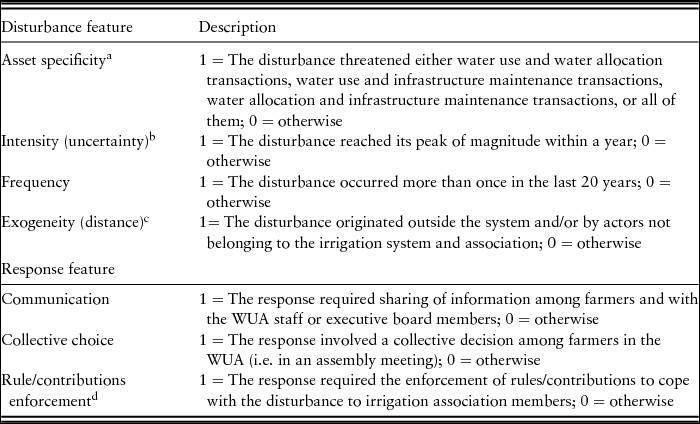
The analysis proceeds in several steps. First the information about each disturbance response case was coded into different disturbance and response variables based on the reviewed theory (Table 1; see also Appendix for further information and an example of a coded case). It is important to note that disturbances that were not intense were not coded for frequency, as the latter is a feature that applies only to intense disturbances in a given time frame (Schoon and Cox Reference Schoon and Cox2011). Thus the data collection resulted in two datasets, one including all the disturbance response cases, and one including only the disturbance response cases associated with intense disturbances. As detailed below, the analysis was carried for each dataset separately.
Measurement of disturbance features

Notes:
a As reasoned in section 2, water use, water allocation and infrastructure maintenance are key highly asset-specific transactions in irrigation systems.
b There are different types of uncertainty and possible proxies for it (Santoro and McGill Reference Santoro and McGill2005). As reasoned in section 2, intensity is one plausible proxy as events that occur suddenly create more uncertainty than those that unfold progressively, everything else being equal (Janssen et al. Reference Janssen, Anderies and Ostrom2007). Intensity was also relatively easy to measure in the empirical context of this study.
c As reasoned in section 2, exogenous disturbances (i.e. those originated outside an irrigation system and/or by non-irrigators), can proxy for the social and the physical distance of transacting partners, respectively.
d In irrigation systems, responses may involve the implementation of ad hoc infrastructure investments, rules or both (Araral Reference Araral2013a). The categories of ‘rule enforcement’ and ‘contributions enforcement’ aim to capture different combinations of these options. Enforcement entails the existence of both monitoring and sanctioning mechanisms (Coleman and Steed Reference Coleman and Steed2009).
In a second step, the disturbance response cases were further coded into a ‘cooperation’ outcome variable. Based on the reviewed theory, the presence or absence of enforcement in the response was used as a proxy for distinguishing cooperation from coordination responses (Bowles Reference Bowles2009). In irrigation systems and other local common pool resource contexts, enforcement is usually linked to the implementation of resource appropriation rules and/or ad hoc infrastructure contributions (Ostrom et al. Reference Ostrom, Gardner and Walker1994). Thus, the cooperation variable was assigned a 1 if ‘rule enforcement’ and/or ‘contributions enforcement’ were present, regardless of whether other collective tasks were also present.
Qualitative comparative analysis (QCA) was used to explore the associations or combinations of disturbance characteristics and cooperation. In QCA, cases are understood as types in terms of the combinations of conditions that characterize them (Ragin Reference Ragin2000). The method does not assume independent effects of conditions on outcomes, which is particularly appropriate in the study of complex socio-ecological processes like those involving adaptation (Lam and Ostrom Reference Lam and Ostrom2010). Also, QCA offers the possibility of comparing small to medium-size samples of cases, which was practical for this study because of the difficulties of gathering data about disturbances and responses. QCA also has limits. It requires explaining relationships in terms of necessity and sufficiency, which is not how mainstream theory is usually formulated (Ragin Reference Ragin2000). Also, there is the trade-off between the number of conditions included in the analysis and the meaning of its results, as many conditions produce very complex results that can be hard to interpret theoretically (Schneider and Wagemann Reference Schneider and Wagemann2010).
The analysis proceeds in three steps following the QCA standard analysis (Schneider and Wagemann Reference Schneider and Wagemann2010):
1. First, the analysis explored whether any of the disturbance features were necessary and/or sufficient for cooperation to emerge.
2. Second, the analysis explored whether combinations of asset specificity, intensity and exogeneity were sufficient for cooperation to emerge with the full dataset of disturbance response cases. Also, the role of frequency was explored with the subset of cases of intense disturbances.
3. Third, the analysis was replicated to explain the absence of cooperation (i.e. the emergence of just coordination), with both the full dataset and the dataset of intense disturbances.
Additionally, the robustness of the results was checked against an aggregated version of the dataset.
5. Results: Patterns of disturbances and responses
Disturbances
Data collection resulted in the identification of 17 disturbances. Some disturbances (‘lack of labour factor’, ‘crop intensification’, ‘road/railway development’, ‘landslides’ and ‘droughts’) occurred in more than one system, making a total of 29 disturbance cases (ndc). Disturbances can be grouped depending on the configuration of features (specificity, intensity, frequency and exogeneity) that characterize them.
The group of ‘Internal and progressive cooperation threats’ (ndc = 7) includes disturbances that are asset specific, have emerged progressively (are not intense, and not frequent), and have originated from within the system (are not exogenous). A paradigmatic example of this type of disturbance is the decrease of labour factor due to an ageing and out-migrating population (not exogenous) in recent decades (CESA 2012). This trend has unfolded slowly over the last decades (not intense) and is expected to continue at least in the coming years (Pinilla Navarro and Saez Perez Reference Pinilla Navarro and Saez Perez2009). Many WUAs in Spain, including the five associations under study, rely on labour and monetary contributions from farmers to maintain part of the infrastructure, as well as their active involvement in water allocation to guarantee that water flows into the plots at the expected time. The progressive rural depopulation has threatened the effectiveness of those two operations in all five systems (high asset specificity).
The other three groups include: ‘External and frequent disturbances’ (ndc = 6), ‘External and infrequent disturbances’ (ndc = 5), and ‘External and progressive disturbances’ (ndc = 2). The disturbances in these groups have in common their low asset specificity, i.e. the disturbances have threatened only one of the three main transactions carried in the irrigation systems. The momentary breakage of a main canal or the impact of landslides on the infrastructure have affected the ability of farmers to allocate water in a timely manner during the irrigation campaign; however, the events have not threatened the ability of farmers to access the water they needed by the end of the irrigation campaign or to fulfil regular infrastructure maintenance duties (low asset specificity). Similarly, the flooding of a large number of plots near a lake has created controversy about whether the affected farmers should keep fulfilling their regular infrastructure duties, but not about whether there would be sufficient water to satisfy their needs or whether the water would be properly allocated.
Responses
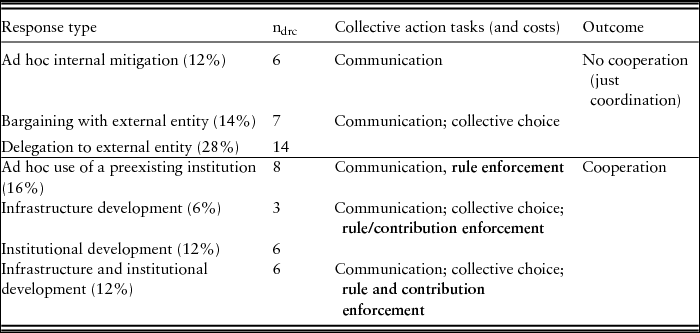
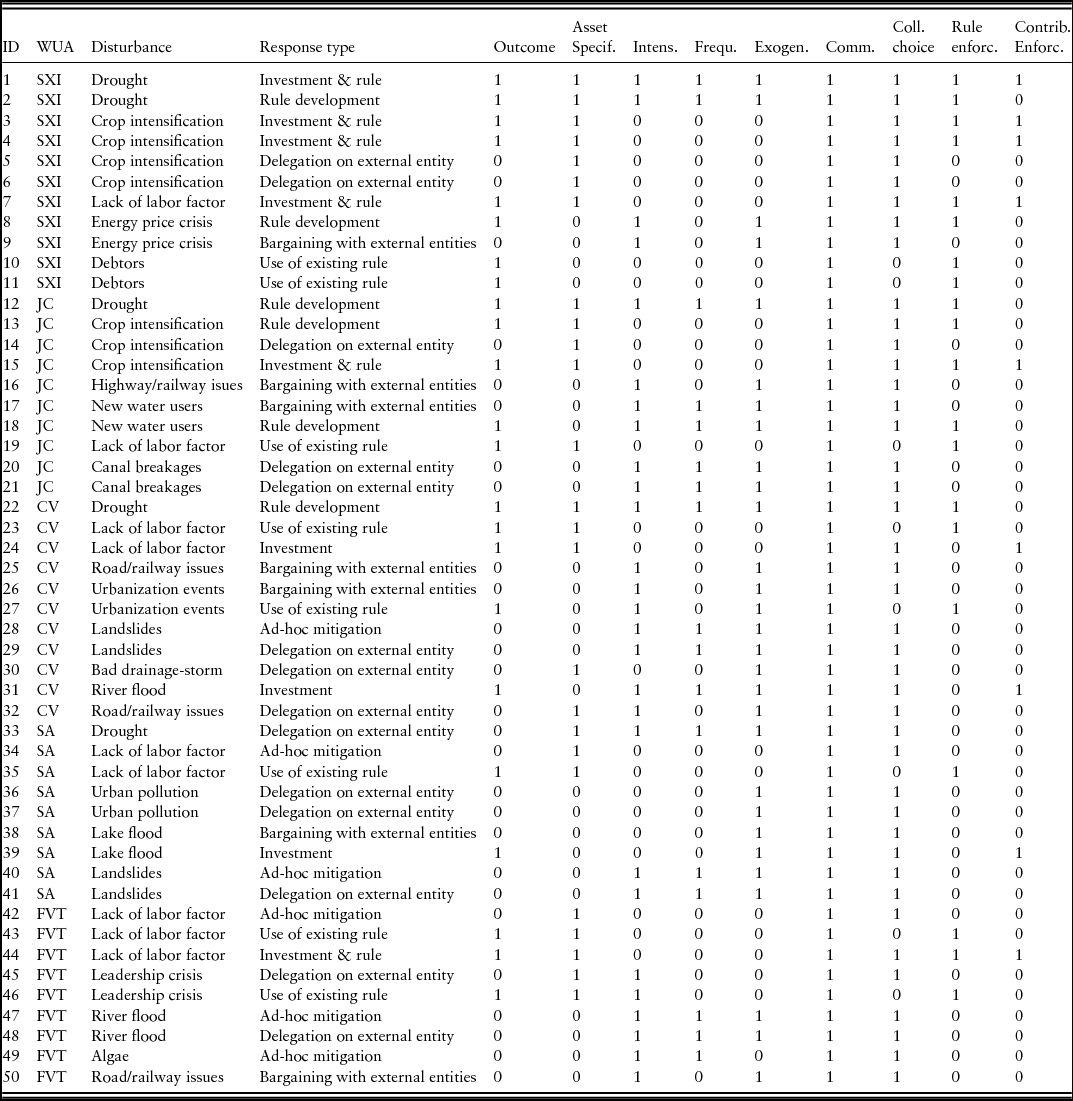
The irrigation associations developed an average of two responses per disturbance case, resulting in a pool of 50 disturbance response cases (Appendix, Table A1). The exploration of collective action tasks resulted in the identification of six types of responses (Table 2). The most frequent type of responses is the ‘delegation to external entity’ (n disturb-resp cases = 21), which involves communication and collective choice tasks. The most frequent collective tasks are communication (present in all instances) and collective choice (present on 36 occasions). This was expected given that communication and collective decision making are two of the most basic forms of collective action (Ostrom et al. Reference Ostrom, Gardner and Walker1994). The outcome splits the sample into 23 cooperation responses and 27 non-cooperation (i.e. just coordination) responses.
Response types (ndisturbance-response cases = 50)

As expected, there is a gradient of responses depending on the number of collective action tasks (and costs) involved (see Outcome 2). Cooperation responses, defined by their reliance on enforcement tasks, tend to involve more collective action tasks than coordination responses. An exception to this is the ‘ad hoc use of a pre-existing institution’ (a cooperation response), which is, judging by the number of tasks involved, as demanding as ‘bargaining with an external entity’ and ‘delegation to an external entity’ (coordination responses).
Non-cooperation responses
Among the non-cooperation (i.e. just coordination) responses, the least demanding type, from a collective action perspective, is the ‘ad hoc internal mitigation’ type. A paradigmatic example of this type is how two WUAs respond to infrastructure issues due to the occurrence of landslides. When a landslide breaks or blocks the infrastructure, whoever first notices it informs the guard, who then carries out the dredging of the canal, sometimes with the help of day-labourers and heavy machinery. This is not perceived by farmers as a rule or a norm but just a ‘way of doing things’. The guards cannot monitor every single event that affects the system. Communication among the farmers and the guard is thus key to the success of the response. The measures taken by the guard are then reported to all farmers in an ordinary assembly meeting, but only ad hoc, for ratification.
‘Bargaining with external entities’ and ‘delegation to external entities’ are two types of responses that also entail relatively low collective action costs. In both types, communication happens mostly between farmers and the WUA executive board. The issues are also tackled in general assembly meetings to decide on the most appropriate course of action that the executive board should follow. The responses do not require the enforcement of any rules among the farmers. Regular assembly meetings are also used to ensure that the executive board has implemented the decided course of action. Common examples of the ‘delegation’ type include the use of letters of complaint and requests for investments in the RBO and local governments in response to river flood damage and breakages in the main canal that connects the irrigation systems. An example of the ‘bargaining’ type is the response developed by three WUAs to cope with road and railway construction. The construction intersected the main and secondary canals in the irrigation system. In all systems, the assembly of farmers explicitly authorized the executive board of the WUAs to represent their interests against the construction firms and the department of public works, and guarantee that the affected infrastructure was reconstructed properly.
Cooperation responses
Among the cooperation responses, the least demanding response from a collective action perspective is the ‘ad hoc use of a pre-existing institution’. An example is the response used in four of the systems to cope with maintenance problems due to the decreased labour factor. In all systems, the guard has the authority to carry out the maintenance works if farmers fail to perform their duties. The costs of the works and a penalty are then charged to the farmers. This institution had been developed in the past as a deterrence measure; however, as infractions have become more and more frequent in all four systems, it has also grown in relevance as a maintenance measure. The measure involves communication and enforcement, but not collective choice as the rule already existed.
Institutional and infrastructure development are the two types of response that entail the highest collective action costs. Both types of responses require the development of monitoring and sanctioning mechanisms, in addition to communication and collective choice. An example of rule development is the quota policy that two WUAs developed in response to droughts. Under the quota policy every farm is allotted a rate of water per hectare. If farmers go over their quotas they are sanctioned. The policy is approved in each association by the ensemble of farmers, and is also ratified every time the executive board needs to use it. An example of infrastructure development is, for example, the remodelling of river diversion infrastructure in the aftermath of a river flood in one of the WUAs. The remodelling is approved in the assembly, and a special fee is collected among all farmers to finance it.
In a good number of cases, responses involve both infrastructure investment and the development of rules to manage the new infrastructure. A good example is the investment in sprinkler irrigation by two WUAs to better cope with the lack of labour, and the changes that have followed this investment to adapt the water allocation rules to the new technology.
Combinations of responses
A fair number of disturbance cases were addressed by both cooperation and coordination responses. WUAs relied only on coordination responses in 13 disturbance cases; only on cooperation responses in eight disturbance cases; and on both coordination and cooperation responses in nine disturbance cases. In seven out of the nine disturbance cases where cooperation and coordination responses coexisted, the coordination response consisted of delegation or bargaining with external entities.
Analysis of disturbances and responses
The analysis of necessity yielded relatively clear results. ‘Asset specificity’ and ‘frequency’ have the highest consistency value (the response was cooperative in around 70% of the cases where the disturbance was asset specific or frequent);Footnote 1 however this value is far from reaching 0.9, which has been used as a threshold of necessity in previous studies (Schneider and Wagemann Reference Schneider and Wagemann2010). All the other consistence scores were below 0.6. Coverage scores (the percentage of cases within the group of cooperation responses that share a disturbance feature) also indicate that none of the features is sufficient on its own to trigger cooperative responses. None of the features reaches the coverage threshold of 0.7 (Schneider and Wagemann Reference Schneider and Wagemann2010), although ‘asset specificity’ and (lack of) ‘exogeneity’ are close (0.680 and 0.667, respectively).
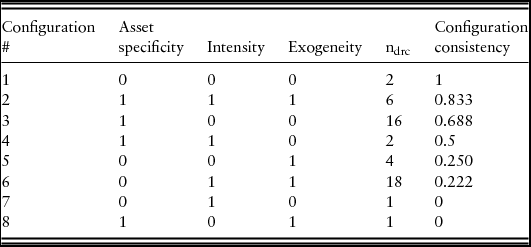
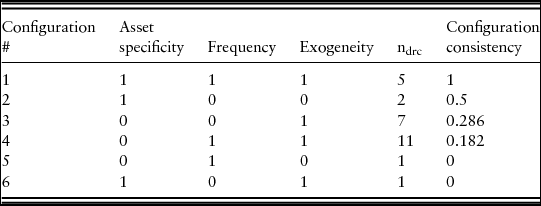
The analysis of sufficiency first required synthesizing the data into two truth tables, one for the full sample of disturbances and one for the sub-sample of intense disturbances (see Appendix, Tables A2 and A3). The truth table includes all configurations of disturbance features that are represented by actual cases (i.e. disturbance response cases), and information about the extent to which the cases are associated with the outcome (i.e. cooperation responses). Then the truth table was minimized via Boolean algebra into a complex solution. The complex solution is the minimal expression of all configurations that are empirically associated with the outcome. Contrary to the parsimonious solution, the complex solution does not require making ad hoc assumptions about configurations for which no empirical cases have been observed (Ragin and Sonnett Reference Ragin, Sonnett, Kropp and Minkenberg2004). As pointed out by Schneider and Wagemann (Reference Schneider and Wagemann2010), both need to be reported (see Appendix, Table A4, for the parsimonious solutions).
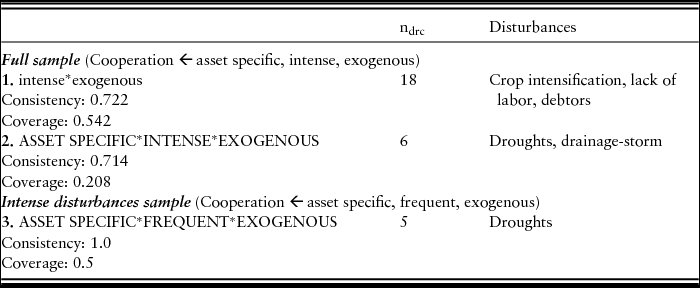
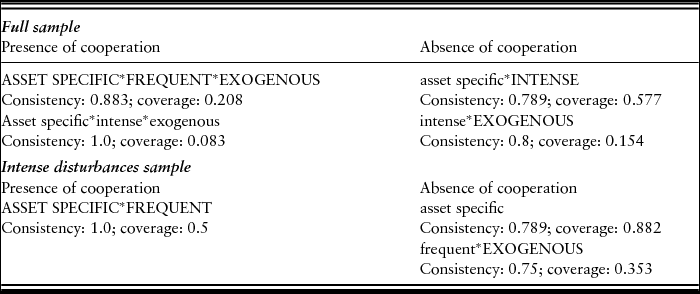
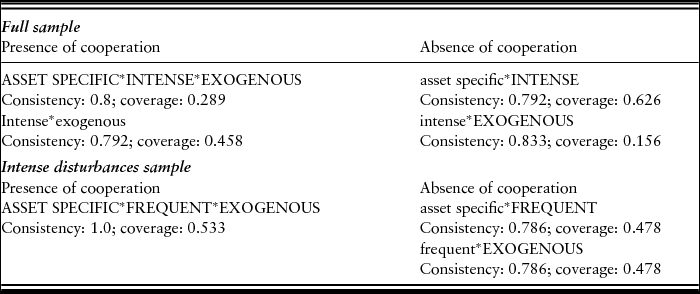
As shown in the full sample analysis (solutions 1 and 2 in Table 3), two configurations of disturbance features are sufficient for cooperation. The first represents cooperation threats that emerge progressively from within the system, such as crop intensification; the second refers to sudden external threats such as droughts. The analysis of the intense disturbances sample yields one solution (solution 3). This solution represents frequent and exogenous cooperation threats, and further qualifies the findings from solution 2. According to the solution, intense and frequent threats such as droughts are sufficient to motivate cooperation, but intense and infrequent threats (such as a leadership crisis) are not.
Configurations of disturbance characteristics that are sufficient for cooperation (complex solution)

Notes: The sufficiency cut for the full sample analysis was downgraded to 0.65 as this cut represented a natural break in the data (Schneider and Wagemann Reference Schneider and Wagemann2010). In the rest of sufficiency analyses 0.7 matched the natural breaks in the data.
Upper case letters = presence of condition; lower case letters = absence of condition.
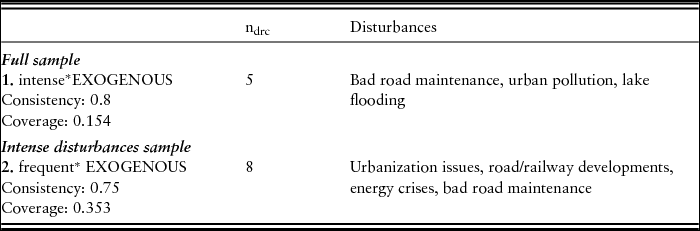
According to the analysis of necessity for the absence of cooperation (i.e. occurrence of just coordination) no individual condition is necessary. All scores are below 0.7. The highest score holds for the presence of exogeneity (0.731) but still far from the 0.9 threshold. A look at the coverage scores reveals that the absence of ‘asset specificity’, with a score of 0.720, is the only sufficient condition for the lack of cooperation. This means that whatever combinations of disturbance characteristics involving the absence of asset specificity are also sufficient for the absence of cooperation. That said, the sufficiency analysis revealed two other sufficiency paths, one per sample (see Table A5 in Appendix).
The first path refers to progressive and external events such as urban pollution. The configuration confirms that progressive disturbances also need to be internal to trigger cooperation, regardless of asset specificity. The second path represents external and infrequent events, such as road/railway development, and confirms that external disturbances are less amenable to cooperation, again regardless of asset specificity.
A cross-tabulation revealed a strong association between the exogeneity of disturbances and the ‘delegation to external entities’ and ‘bargaining with external entities’ coordination responses. Half of the ‘delegation to external entities’ responses (five out of eleven) addressed exogenous and frequent disturbances; while most of the ‘bargaining with external entities’ responses (five out of seven) addressed exogenous and infrequent disturbances.
The robustness check with the aggregated data yielded very similar results (see Appendix, Table A6).
6. Discussion
The characterization of disturbances and responses and the QCA results motivate some discussion points. First, the relatively broad scope of disturbances identified raises the question of whether the adaptation policy community's current focus on climate change is justified scientifically. Climate-related disturbances such as droughts, floods, or algae burst events represented less than 24% of all disturbance cases analysed in this study. Other important disturbances included the lack of labour factor, crop intensification and urbanization issues, to mention a few. The diversity of disturbances identified justifies the interest of understanding climate change adaptation in comparative perspective. One important step in that direction is the development of theoretically and empirically meaningful classifications of disturbances and responses (Salafsky et al. Reference Salafsky, Salzer, Stattersfield, Hilton-Taylor, Neugarten, Butchart, Collen, Cox, Master, O'Connor and Wilkie2008). In this study, the characterization of disturbances according to asset specificity, uncertainty, frequency and distance allowed the identification of four group disturbances, encompassing 20 of the 29 disturbance cases identified. Similarly, the classification of collective responses according to collective action tasks and costs yielded a scale that can be used for further analytical purposes. Works in the common pool resource tradition have highlighted the exposure of local resource management systems to external interventions and events (Cox et al. Reference Cox, Arnold and Villamayor Tomás2010) and the need to expand theory to understand how those systems cope with such events (Armitage Reference Armitage2005). Resilience scholars have theorized about the importance of slow-moving versus fast-moving changes (Janssen et al. Reference Janssen, Anderies and Ostrom2007) and other disturbance features (Schoon Reference Schoon2008). Scholars have also identified different types of adaptations based on observation of local experiences (Agrawal Reference Agrawal, Mearns and Norton2010; Smit and Skinner Reference Smit and Skinner2002). The classifications resulting from this study take a step further in integrating the study of disturbances and responses under a common theoretical framework that is also relevant empirically.
Second, the analysis of coordination responses reveals insights about the division of labour between governance levels in adaptation processes. Most of the coordination responses developed by WUAs consisted of delegating to or bargaining with external entities. The contribution of multi-level management to adaptive capacity is well understood among scholars and practitioners (Olsson et al. Reference Olsson, Folke and Berkes2004). Less is known about how labour should be divided between governance levels (Frey et al. Reference Frey, Villamayor-Tomas and Theesfeld2016). The subsidiarity principle in the context of environmental governance states that management decisions should occur at the lowest level at which they can be performed competently (Marshall Reference Marshall2008). Resilience scholars have used this principle to argue for a fit between the scale at which disturbances occur and the governance level at which they should be addressed (Levin et al. Reference Levin, Barrett, Aniyar, Baumol, Bliss, Bolin, Dasgupta, Ehrlich, Folke, Grenning, Holling, Jansson, Jansson, Ler, Martin, Perrings and Sheshinski1998). In this study, WUAs tended to address external entities in the advent of external disturbances; delegation responses tended to address frequent disturbances, while bargaining responses followed infrequent ones. All this supports the fit hypothesis and encourages looking at both the origin and frequency of disturbances when studying the division of labour between governance levels. Finally, the reliance of WUAs on external entities did not preclude WUAs from developing their own responses, which raises the question of the appropriate degree of complementarity and redundancy across governance levels (Low et al. Reference Low, Ostrom, Simon, Wilson, Berkes, Colding and Folke2003). This study was not designed to address that question; however, the assessment of disturbances and responses in terms of the risk of opportunism and collective action costs, respectively, shall be useful for that purpose.
Another insight is related to the (only) relative importance of new rule development (i.e. as opposed to the adaptation of existing rules and non-institutional responses) to address disturbances. Institutional design, i.e. the implementation of new policies, is one of the cornerstones of climate change adaptation (see Roggero et al. Reference Roggero, Bisaro and Villamayor-Tomas2017) for an overview of the climate adaptation literature). In this study, however, new rule development occurred in only 24% of the disturbance response cases. Also, the ‘ad hoc use of a pre-existing institution’ occurred in 16% of the cases, which illustrates that given institutions can be reinterpreted to address situations for which those institutions had not been originally designed. This type of institutional change, which has been coined by path dependency scholars in different ways (Streeck and Thelen Reference Streeck, Thelen, Streeck and Thelen2005), has barely been explored by adaptation scholars. As framed in this study, the ‘ad hoc use of a pre-existing institution’ is a relatively low-cost adaptation strategy; however, its association mostly to the occurrence of internal and progressive threats suggests that such a strategy may not be suitable for all occasions.
Last but not least, the QCA results illustrate the opportunities in and limitations of using transaction costs economics to understand adaptation. According to the analysis, disturbances that are asset specific, intense but frequent, and exogenous (e.g. the droughts in this study) are sufficient to trigger cooperative responses. This supports expectations based on transaction costs theory. According to Williamson (Reference Williamson1985), cooperative governance arrangements are more likely to emerge given asset-specific and uncertain transactions, or given asset-specific and frequent transactions. In the first case, the high costs and high probability of contract failure would make risk sufficiently high to make cooperation worth it, even if cooperation costs are high. In the second case, frequency would reduce the costs of cooperation, which would pave the way for cooperation, given high costs of contract failure (and regardless of the probability of such failure). According to the QCA findings, both uncertainty (i.e. created by intense disturbances) and the profitability of economies of scale (i.e. stemming from frequent disturbances) would be sufficient to trigger cooperation, given that asset-specific assets are at risk. Additionally, the findings point to an alternative path, which is the occurrence of progressive and internal disturbances, regardless of their asset specificity (i.e. crop intensification, lack of labour factor, debtors). This path is rather congruent with relational theory, which aims to explain cooperation by looking at the formation of trust relationships rather than the minimization of opportunistic behaviour (Lui et al. Reference Lui, Wong and Liu2009). In contrast to transaction costs theory, relational theory builds on the assumption that economic agents are willing to commit to long-term cooperative relationships with each other if necessary (Joshi and Stump Reference Joshi and Stump1999). Behaviour in trust-based relationships is controlled not through incentives but through internalization. Thus, time and the credibility of partners are essential. According to this, disturbances that unfold progressively would allow for sufficient time to develop cooperative solutions incrementally if necessary, and provide a long enough time horizon to make those solutions attractive on grounds of short term cost. Additionally, if the disturbances originate within a community, members could more easily build on their physical proximity, internal norms and trust relationships than if the disturbances are originated by outsiders. Given these conditions, even a minimum of asset specificity would make cooperation cost-effective.
7. Conclusions
Other than the specific findings reported and discussed in the previous sections, this study triggers some final reflections. First, it is still unclear in the adaptation scholarship whether climate change adaptation challenges are fundamentally different from other types of events that hit our societies on different scales. This study has illustrated that societies (e.g. natural resource management communities and associations) opt for different collective adaptation responses depending on the risks of opportunism and collective action costs involved, and regardless of whether the disturbances are climate-related.
Second, an important step in comparing adaptation to different disturbances and develop solid adaptation theory is the use of meaningful classifications of events and responses. Previous studies have pointed to different ways to characterize disturbances (Salafsky et al. Reference Salafsky, Salzer, Stattersfield, Hilton-Taylor, Neugarten, Butchart, Collen, Cox, Master, O'Connor and Wilkie2008; Schoon and Cox Reference Schoon and Cox2011), but there is no theory about how these disturbance features combine in real scenarios, and align with responses. As illustrated in this study, the Coase–Ostrom–Williamson (COW) framework reveal a powerful means of constructing such classifications.
Third, transaction costs theory is relevant but should not be used as the only theoretical pillar for understanding disturbances and adaptation responses. Relational theory, which looks at social capital dynamics, can also be useful. Although transaction costs and relational theory can be interpreted as antagonistic, scholars have proposed models that integrate both (Joshi and Stump Reference Joshi and Stump1999). Adaptation studies will benefit from those efforts. As illustrated in this study, the observation of disturbance characteristics can help in understanding when one theory is more applicable than the other.
As a final reflection, this study illustrates the capacity of local organizations to respond to a variety of disturbances, including climate-related ones as well as many others. Irrigation associations and other local natural resource management organizations in many countries are depositaries of extensive adaptation experience and knowledge, which stems from their long exposure to a variety of threats to their organizational performance and sustainability over time. Being able to capitalize on that knowledge is a priority for the policy community (UN/ISDR 2004).
Appendix
Illustration of variable measurement and coded case
The response cases were based on three sources of data: meeting minutes from the executive committee and general assemblies (1970–2010); a focus group interview with members of the executive committee of each irrigation association; and individual interviews with members of the executive committee and farmers. Focus groups and group interviews in general can be recommended when the subject under discussion concerns people's habits and is not thought through in detail by participants; however, individual interviews may still be necessary for triangulation purposes (Morgan Reference Morgan1997). Scanning the meeting minutes was not allowed, so relevant pieces of text were recorded and then transcribed. Individual interviewees were selected using a snow-ball procedure. All the group and individual interviews were recorded. The recordings were used to enhance the notes taken during the interviews. The formal characterization of cases was carried out by a single person (the author). The use of multiple coders adds reliability to measurement, which is appropriate if data are collected from only one source and there are potential interpretation issues. In this study, all facts from the minutes were checked by the focus groups. Remaining gaps were filled through individual interviews.
Case 42 (Internal progressive cooperation threat and Use of existing rule responses)
Summary:
- Disturbance: In old irrigation systems like the FVT, there are many small secondary and tertiary ditches that bring water to the plots or collect drained water. Over time, compliance with maintenance duties in respect of these ditches has decreased. This is labor-intensive work that can be done only to some extent with machines. Agriculture is part time for an increasing number of farmers and there is less labour available to carry out maintenance duties. If the ditches are not dredged, water does not flow properly and this generates water allocation problems.
- Response 1: When a farmer does not comply with his maintenance duties and this is detected by the guard, the association has the authority to carry out the duties and then charge the farmer accordingly. As the problem of lack of compliance has scaled up, the association has started acting only if farmers complained.

Database of disturbance-response cases

Truth table for full dataset

Truth table for intense disturbances dataset

Configurations of disturbance characteristics that are sufficient for cooperation (parsimonious solution)

Configurations of disturbance characteristics that are sufficient for the absence of cooperation, in addition to any configuration of non-asset-specific disturbances

Configurations of disturbance features that are sufficient for cooperation (aggregated data; complex solution)