

I. Introduction
WhiskyFootnote 1 is one of just a few goods that matures and accrues value over time. Other examples include wine, which accrues value because it improves in quality even after it is bottled, and timber, which accrues value because trees gain biomass with age. Like wine and timber, whisky also has a multi-period production process, but the maturation processes, traits of the final goods, and even the producers’ general strategic decisions are not perfectly relatable to whisky. Whisky distilleries consistently offer a product line in which the primary distinguishing factor within their own brand is product age, which implies the existence of multiple optimal maturation ages for a single producer.
The existence of multiple optimal maturation ages is not usually considered in the literature. In wine economics, researchers often explicitly assume a unique optimal maturation age (Goodhue, LaFrance, and Simon, Reference Goodhue, LaFrance and Simon2009). Others concede consuming bottles from the same vintage at different years could be optimal in order to track quality improvements in the overall batch (Jaeger, Reference Jaeger1981) or employ a model which obfuscates the product's age (Wohlgenant, Reference Wohlgenant1982). Multiple harvesting ages for a single vintage have been analyzed in forestry economics (Salo and Tahvonen, Reference Salo and Tahvonen2002, Reference Salo and Tahvonen2003), although the emphasis here is typically on the existence of and convergence towards a steady state with a single maturation age.
One possible explanation for the difference in maturation practices is the presence of product differentiation among brands of whisky. In that regard, distilleries that sell multiple ages of whisky may be comparable to other instances of multiproduct firms that promote product variety within their product lines. However, many of the existing studies of multiproduct firms rely on cases in which product variety is measured using product line size (Klemperer, Reference Klemperer1992; Alexander, Reference Alexander1997; Draganska and Jain, Reference Draganska and Jain2005; Draganska, Mazzeo, and Seim, Reference Draganska, Mazzeo and Seim2009; Watson, Reference Watson2009) and restrict their analyses to cases of horizontal differentiation. In the case of whisky, distilleries offer product lines that are primarily vertically differentiable within their own brands. It is, therefore, unclear whether previous findings on the role of consumer preferences and competitors’ product lines hold with respect to a vintage good.
The purpose of this article is to explore the production decisions of whisky distilleries and determine what market conditions incentivize the production of multiple maturation ages. Its primary contribution is an analysis of the determinants of multiple maturation ages for vintage goods. More generally, it exploits the characteristics of single malt Scotch whisky to make several additional insights into the determinants of product variety. Typically, a firm's product variety is only measured as the total number of products it offers. This article supplements this metric with product age statements, providing a second measure of variety that is easily assessed and corresponds to vertical differentiation. Furthermore, this article demonstrates how product variety is impacted by market concentration and firm ownership. Analyses of market concentration and product variety often highlight instances in which two firms merge and they reposition their respective products to minimize competition against their counterparts and avoid cannibalizing profits between brands. Many Scottish distilleries are owned by parent companies with multiple distilleries, allowing for further inquiry into how product lines are structured in light of market concentration.
A theoretical model is first employed that explores product maturation when brands are differentiable and distilleries are able to exert market power. Results show that brand substitutability, distillery size, and firm ownership all potentially influence product variety and maturation decisions. An additional empirical analysis of distilleries’ product variety further confirms the results derived from the model. Both product line composition and product line size are influenced by comparable brands owned by the same parent company. This implies that parent companies are aware of substitutability between their brands and structure distilleries’ product lines so as to avoid offering similar products that cannibalize their profits.
II. Whisky and Product Differentiation
Single malt Scotch whisky is produced by first malting barley and then kilning it. After kilning, it is ground, mixed with water, and fermented before being distilled at least twice in a copper pot still. At this point in the production process, the spirit is commonly referred to as “new-make,” which is essentially just un-aged whisky. In Scotland, it cannot be referred to as whisky until it has been aged in a barrel for at least three years. Unlike wine, whisky will not continue to improve with age once it is bottled.
A distillery will typically produce a “core range” of whiskies, which means that it will consistently bottle and sell the same types of whiskies from year to year, although these whiskies will each possess unique traits to differentiate themselves within the range. The primary distinguishing factor is often age, although distilleries can employ various techniques during the production process to create a whisky that is tangibly different in a way other than additional maturation. Examples include alternating the intensity of peating the malt, maturing whisky in an ex-sherry cask, or bottling at cask strength. The ages in a distillery's core range also tend towards certain numbers. For example, many distilleries produce a 10 or 12 year old (yo.) as their youngest whisky with an age statement, although producing both of these ages (or an 11 yo.) is very uncommon. The next youngest whisky produced will typically be between 14 and 16 years old, if another is produced at all. Ages of additional bottlings tend to increase in fixed increments, for example, three or five years. Most distilleries produce three or fewer whiskies, although some distilleries have a core range with more than ten different whiskies.
There are approximately 100 distilleries in Scotland, the largest of which accounts for less than 4% of total industry capacity. This suggests that most distilleries should have only a small share of the overall market and little impact on equilibrium prices. However, the market may be segmented because of consumer preferences for particular qualities and styles of Scotch whisky. This would in turn enable distilleries to exert market power depending on the qualities of their whiskies and might incentivize product variety, including multiple maturation ages in a product line.
Alternatively, distilleries may produce multiple maturation ages because of uncertainty in either the production process or market conditions over time. For example, Krasker (Reference Krasker1979), Jaeger (Reference Jaeger1981), and Ashenfelter (Reference Ashenfelter2008) demonstrate how uncertainty with respect to future vintage quality can influence wine prices. This is unlikely to affect whisky maturation. Whisky is produced in a more controlled environment and is much less sensitive to weather patterns, hence quality uncertainty is not a significant issue with respect to maturing whisky. On the other hand, both demand and input prices can fluctuate, and Jaeger (Reference Jaeger1981) and Wohlgenant (Reference Wohlgenant1982) found evidence suggesting that such uncertainty can influence the production and maturation decisions of a winery. For whisky, the price of barley has the greatest potential to unpredictably fluctuate from year to year, although this element of uncertainty would not affect the distillery's decision to mature portions of a batch of new-make to different ages. It may then be the case that producers offer a diverse product line to hedge against demand uncertainty, a strategy which has been noted in other industries (Carlton and Dana, Reference Carlton and Dana2008; Chen, Yeh, and Hu, Reference Chen, Yeh and Hu2011). This is possibly a factor, but likely not the only one.
Product line size may be affected by the degree of substitutability between brands. Because of regional differences in inputs (e.g., the distillery's source of water), as well as production practices specific to distilleries and regions, one distillery's 12 yo. whisky is different than another's 12 yo. whisky. These different products may satisfy demand from consumers with heterogeneous preferences. A distillery may, therefore, offer multiple expressions of whisky to capture a greater share of the market, with particular products targeting different segments that the distillery is well-suited to serve.
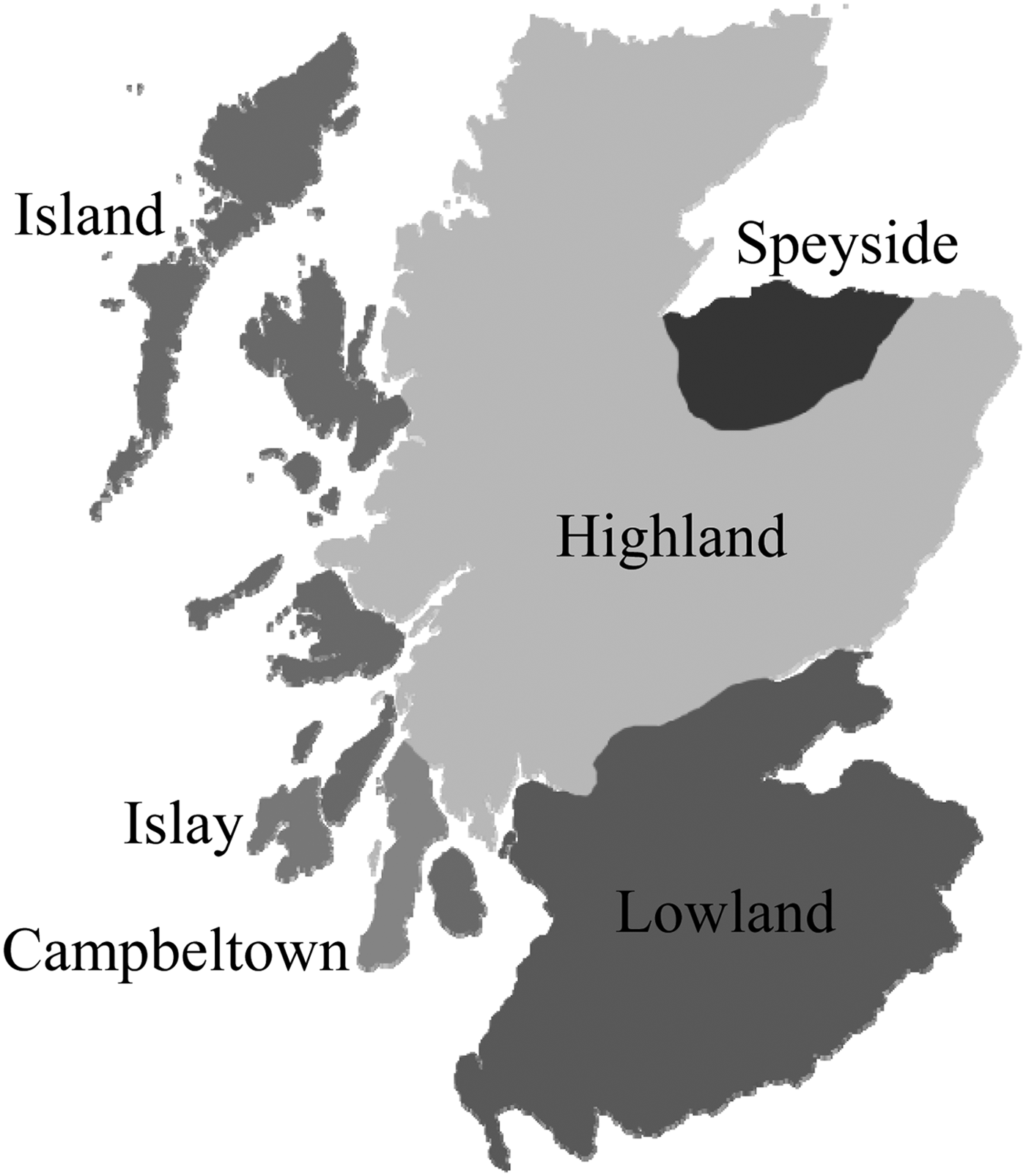
Earlier research on market power and multiproduct firms often includes identifying where in a particular state-space firms strategically locate their products. Measuring vertical differentiation is relatively straightforward because of age statements, but quantifying horizontal differentiable qualities is more problematic. The general profile of a distillery's whisky is often classified with upwards of 35 flavor dimensions (Piggott and Jardine, Reference Piggott and Jardine1979) and distilleries have further opportunities to differentiate their products by using various cask finishes, bottling their whisky at different cask strengths, etc. Consequently, precisely defining a suitable state-space to describe Scotch whisky characteristics is impractical, even if only a subset of these flavors determines market segmentation. However, distilleries in Scotland are commonly categorized based on their region. While regional classification does not necessarily bind the distillery to particular production practices, certain trends do emerge. For example, distilleries from Islay produce some of the smokiest whiskies, whereas those produced in the Speyside region are sweeter and considerably less smoky. Almost half of all Scottish distilleries are located within the Speyside region, with another one-quarter of distilleries in the Highland region. Regions are illustrated in Figure 1.
Scotch Producing Regions

There are several possible scenarios for brand substitutability that could affect how distilleries determine their product lines. First, consumers may not care about the various attributes that distinguish whiskies and treat all brands as interchangeable. That is, even if there are differences between brands, consumers regard a whisky from one distillery as if it were identical to a whisky with the same age from another distillery. In this scenario, anCnoc 12 yo. (a Speyside) and Bowmore 12 yo. (an Islay), would be perfect substitutes, as consumers treat them as homogenous for their purposes. Alternatively, consumers may give more weight to some flavor characteristics than others. Then most consumers would regard Aberlour 12 yo. and Balvenie 12 yo. (both Speysides) as better substitutes for anCnoc 12 yo. than Bowmore 12 yo. Lastly, consumers may have considerably stark preferences with brands’ flavor profiles and view each brand of whisky as a unique product. In this scenario each distillery operates as a monopoly.
If firms are aware of their substitutability with respect to other brands, then this will be reflected in the variety of their product lines. In this context, a firm's product variety may be impacted either through the total number of products offered, selected maturation ages, or both. Alexander (Reference Alexander1997) and Watson (Reference Watson2009), for example, find that when new firms enter a particular segment of the market where other firms are already competitive, the total number of products offered by each firm decreases. More concentrated segments of the market may not be impacted in terms of overall product variety, but firms may offer fewer products individually. Furthermore, Mazzeo (Reference Mazzeo2002) demonstrates that product quality is also an important criteria and that if a firm enters a particular market segment it may offer a product at a different quality level so as to distinguish its brand from potential competitors.
Product positioning in response to brand substitutability would also be reflected in instances when a single firm owns multiple distilleries. Decades of growth in the industry have led to instances of firms establishing new distilleries adjacent to distilleries they already own, as well as firms buying established distilleries to create a portfolio of brands. This creates a scenario in which distilleries are owned by parent companies and many distilleries have “sister” distilleries whose whiskies may be close substitutes. By the end of 2013, only 16 of the 99 Scottish distilleries were independently owned. The rest were owned by a parent company that had at least two distilleries.
Some attention has already been given to the effect of mergers on the market for blended Scotch whiskies.Footnote 2 Specifically, Ashenfelter and Hosken (Reference Ashenfelter and Hosken2010) study the merger between Guinness and Grand Metropolitan to form Diageo, and they find that it led to a significant price increase for brands such as J&B, Johnny Walker, and Scoresby. The effect of mergers on single malt Scotches remains unstudied. Generally, mergers tend to increase product variety in the overall market. Merging firms have an incentive to reposition their products farther away from each other to better differentiate their brands so as to avoid cannibalizing profits while also capturing a greater market share for the parent firm (Berry and Waldfogel, Reference Berry and Waldfogel2001; Gandhi et al., Reference Gandhi, Froeb, Tschantz and Werden2008; Draganska, Mazzeo, and Seim, Reference Draganska, Mazzeo and Seim2009; Sweeting, Reference Sweeting2010). However, the previous studies do not consider instances when goods are vertically differentiable. Berry and Waldfogel (Reference Berry and Waldfogel2001) and Sweeting (Reference Sweeting2010) study the effect of mergers on radio stations’ programming, which is only horizontally differentiable. Gandhi et al. (Reference Gandhi, Froeb, Tschantz and Werden2008) and Draganska, Mazzeo, and Seim (Reference Draganska, Mazzeo and Seim2009) establish theoretical frameworks in which product variety could be measured vertically, but neither pursues this in their analysis. The present study, therefore, contributes to the literature by estimating the impact of market concentration on product variety when goods are vertically differentiable, in this case through distilleries’ maturation decisions.
III. Optimal Maturation
To analyze the production and aging decisions of a profit-maximizing distillery, let a denote the age of whisky, where a = 0, …, M and M is the maximum maturation age beyond which whisky loses its value. M is assumed to be finite, but sufficiently large so as to not restrict the optimal solution. The quantity of un-aged whisky (new-make) that will be aged for a years is denoted as x a. The total amount of new-make cannot exceed the distillery's capacity W, which is fixed at the time of distillation. Whisky steadily evaporates during its time in storage with an evaporation rate ε. If x a was initially distilled, only (1 − ε)ax a is left after a years of maturation.
Costs are incurred during three different phases of a whisky's production. Marginal distillation costs are c D. With a discount factor δ and marginal storage cost c S, the present value of total storage costs is  $\mathop \sum \nolimits_{a = 1}^M \mathop \sum \nolimits_{v = 0}^{a-1} \delta ^vc_Sx_a$. Note that storage costs are a function of the initial amount of casked whisky and do not decrease even though a percentage of the whisky evaporates. Marginal storage costs are also constant, which is consistent with the modeling assumptions of Krasker (Reference Krasker1979), Jaeger (Reference Jaeger1981), and Goodhue, LaFrance, and Simon (Reference Goodhue, LaFrance and Simon2009) for wine storage. After sufficient maturation, whisky is taken out of its casks and bottled. Marginal bottling costs are c B and the present value of bottling costs is δ a(1 − ε)ac Bx a.
After the whisky has been matured for a years, it can be sold at price p a(x a, θa), where the price for age a is a function that is continuous, decreasing, and concave in x a and θa. The latter parameter is a vector of outputs from all other distilleries selling a whisky of the same age. Whereas the standard Cournot model assumes price is a function of aggregate supply because goods are not differentiable, this form allows for the marginal change in a distillery's price to vary depending on the substitutability of rival brands. If a rival brand is a substitute, then the first and second derivatives of p a(x a, θa) with respect to its output θ a are negative, although the effect is smaller than the effect x a has on its own price unless the rival brand is a perfect substitute. If the alternate brand is not a substitute at all, its output will not influence the distillery's price.
Implicit in the construction of p a(x a, θa) is the assumption that whiskies of different ages are not substitutes. While this may be a somewhat strong assumption, there is evidence to suggest that firms deliberately leave gaps in their product lines so as to differentiate their own products and avoid cannibalizing their profits (De Fraja, Reference De Fraja1996; Siebert, Reference Siebert2015). This is supported by the composition of distilleries’ product lines. As noted earlier, whisky ages in a distillery's product line tend to be spaced in increments such as three or five years. In this case, whiskies aged for a − 1 and a + 1 years might have an effect on p a(x a, θa), but a distillery would rarely produce ages so close together. Consequently, for all ages a and h that a distillery actually produces, if a ≠ h then x h does not affect the price for age a. It may be possible that a rival distillery's whisky of age h affects the distillery's price for age a, but the results and intuition derived from the model remain largely the same.
For convenience, the parenthetical portion of p a(x a, θa) is suppressed in the remainder of the article. The present value of revenue from age a is, thus, written as δ a(1 − ε)ap ax a. Combining revenue with cumulative costs, the present value of profit from a year's batch of new-make is
 $$\matrix{ {\mathop \sum \limits_{a = 0}^M \delta ^a{\lpar {1-\varepsilon} \rpar }^ap_ax_a-\mathop \sum \limits_{a = 0}^M c_Dx_a-\mathop \sum \limits_{a = 1}^M \mathop \sum \limits_{v = 0}^{a-1} \delta ^vc_Sx_a-\mathop \sum \limits_{a = 0}^M \delta ^a{\lpar {1-\varepsilon} \rpar }^ac_Bx_a{\rm,}} \cr} $$
subject to
 $$\matrix{ {W \ge \mathop \sum \limits_{a = 0}^M x_a} \cr} $$
and
 $$\matrix{ {x_a \ge 0} \cr} $$
for all ages a = 0, …, M. Let  $x_a^{\ast}$ denote the optimal amount to be aged for a years. Then the first order conditions from the corresponding Lagrangian describe the profit-maximizing combination of maturation ages and can be written as
 $$\matrix{ {\partial {\rm {\cal L}}/\partial x_0 = \displaystyle{{\partial p_0} \over {\partial x_0}}x_0^{^\ast} + p_0-c_D-c_B-\lambda ^{^\ast} \le 0{\rm,}} \cr} $$
 $$\matrix{ {\partial {\rm {\cal L}}/\partial x_a = \delta ^a{\lpar {1-\varepsilon} \rpar }^a\left( {\displaystyle{{\partial p_a} \over {\partial x_a}}x_a^{^\ast} + p_a} \right)-c_D-\mathop \sum \limits_{v = 0}^{a-1} \delta ^vc_S-\delta ^a{\lpar {1-\varepsilon} \rpar }^ac_B-\lambda ^{^\ast} \le 0} \cr} $$
for a = 1, …, M,
 $$\matrix{ {x_a^{^\ast} \partial {\rm {\cal L}}/\partial x_a = 0} \cr} $$
for a = 0, …, M,
 $$\matrix{ {\lambda ^{^\ast} \ge 0{\rm,}} \cr} $$
and
 $$\matrix{ {\lambda ^{^\ast}\left( {W-\mathop \sum \limits_{a = 0}^M x_a^{^\ast}} \right) = 0.} \cr} $$
The model can be used to understand the maturation decisions of a distillery by analyzing how specific parameters increase or decrease the production of pre-existing ages in its product line and the shadow value of capacity λ*. Consider one of the most straightforward cases in which the distillery produces multiple ages of whisky. In this example, it produces two ages of whisky and its capacity constraint is binding. Assume j identifies the first whisky in the distillery's product line,  $x_j^{\ast}\gt 0$. Without loss of generality, let j ≠ k, where k identifies a second age that the distillery also produces,
 $x_k^{\ast}\gt 0$. Given a marginal increase in distillery capacity, the increase in production for both ages can be written as
 $$\matrix{ {\displaystyle{{\partial x_j^{^\ast}} \over {\partial W}} = \displaystyle{{\delta ^k{\lpar {1-\varepsilon} \rpar }^k\left( {\displaystyle{{\partial^2p_k} \over {\partial x_k^2}} x_k^{^\ast} + 2\displaystyle{{\partial p_k} \over {\partial x_k}}} \right)} \over {\delta^{\,j}{\lpar {1-\varepsilon} \rpar }^{\,j}\left( {\displaystyle{{\partial^2p_j} \over {\partial x_j^2}} x_j^{^\ast} + 2\displaystyle{{\partial p_j} \over {\partial x_j}}} \right) + \delta ^k{\lpar {1-\varepsilon} \rpar }^k\left( {\displaystyle{{\partial^2p_k} \over {\partial x_k^2}} x_k^{^\ast} + 2\displaystyle{{\partial p_k} \over {\partial x_k}}} \right)}} \gt 0} \cr} $$
and
 $$\matrix{ {\displaystyle{{\partial x_k^{^\ast}} \over {\partial W}} = \displaystyle{{\delta^{\,j}{\lpar {1-\varepsilon} \rpar }^{\,j}\left( {\displaystyle{{\partial^2p_j} \over {\partial x_j^2}} x_j^{^\ast} + 2\displaystyle{{\partial p_j} \over {\partial x_j}}} \right)} \over {\delta^{\,j}{\lpar {1-\varepsilon} \rpar }^{\,j}\left( {\displaystyle{{\partial^2p_j} \over {\partial x_j^2}} x_j^{^\ast} + 2\displaystyle{{\partial p_j} \over {\partial x_j}}} \right) + \delta ^k{\lpar {1-\varepsilon} \rpar }^k\left( {\displaystyle{{\partial^2p_k} \over {\partial x_k^2}} x_k^{^\ast} + 2\displaystyle{{\partial p_k} \over {\partial x_k}}} \right)}} \gt 0.} \cr} $$
This result demonstrates that if the distillery is already operating at capacity, a further increase in capacity will lead to an increase in production of both goods. At the same time, the shadow value of capacity λ* decreases,
 $$\displaystyle{{\partial \lambda ^{^\ast}} \over {\partial W}} = \displaystyle{{\delta ^{\,j + k}{\lpar {1-\varepsilon} \rpar }^{\,j + k}\left( {\displaystyle{{\partial^2p_j} \over {\partial x_j^2}} x_j^{^\ast} + 2\displaystyle{{\partial p_j} \over {\partial x_j}}} \right)\left( {\displaystyle{{\partial^2p_k} \over {\partial x_k^2}} x_k^{^\ast} + 2\displaystyle{{\partial p_k} \over {\partial x_k}}} \right)} \over {\delta^{\,j}{\lpar {1-\varepsilon} \rpar }^{\,j}\left( {\displaystyle{{\partial^2p_j} \over {\partial x_j^2}} x_j^{^\ast} + 2\displaystyle{{\partial p_j} \over {\partial x_j}}} \right) + \delta ^k{\lpar {1-\varepsilon} \rpar }^k\left( {\displaystyle{{\partial^2p_k} \over {\partial x_k^2}} x_k^{^\ast} + 2\displaystyle{{\partial p_k} \over {\partial x_k}}} \right)}} \lt 0.$$
If a third age M was not initially produced, then  $x_m^{\ast}= 0$ and its first order condition is
 $$\matrix{ {\delta ^m{\lpar {1-\varepsilon} \rpar }^mp_m-c_D-\mathop \sum \limits_{v = 0}^{m-1} \delta ^vc_S-\delta ^m{\lpar {1-\varepsilon} \rpar }^mc_B-\lambda ^{^\ast} \le 0.} \cr} $$
Since an increase in capacity decreases λ*, it brings the first order condition for  $x_m^{\ast}$ closer to zero. Given a significant enough change in capacity, maturing a third age m of whisky would become more profitable than further increasing production of ages j and k, so long as the present value of its marginal profit is positive when
 $x_m^{\ast}= 0$. All else equal, larger distilleries should, therefore, have larger product lines with more ages of whisky.
Aside from capacity, the degree of competition for a specific product age can also influence product line decisions. Suppose the distillery is operating at capacity when another brand increases its output of age j. If that competitor's whisky is at least somewhat substitutable, then the distillery responds by decreasing its production of age j and increasing its production of age k by an equal amount. These changes in production can be written as
 $$\matrix{ {\displaystyle{{\partial x_j^{^\ast}} \over {\partial \theta _j}} = -\displaystyle{{\delta^{\,j}{\lpar {1-\varepsilon} \rpar }^{\,j}\left( {\displaystyle{{\partial^2p_j} \over {\partial x_j\partial \theta_j}}x_j^{^\ast} + \displaystyle{{\partial p_j} \over {\partial \theta_j}}} \right)} \over {\delta^{\,j}{\lpar {1-\varepsilon} \rpar }^{\,j}\left( {\displaystyle{{\partial^2p_j} \over {\partial x_j^2}} x_j^{^\ast} + 2\displaystyle{{\partial p_j} \over {\partial x_j}}} \right) + \delta ^k{\lpar {1-\varepsilon} \rpar }^k\left( {\displaystyle{{\partial^2p_k} \over {\partial x_k^2}} x_k^{^\ast} + 2\displaystyle{{\partial p_k} \over {\partial x_k}}} \right)}} \lt 0} \cr} $$
and
 $$\matrix{ {\displaystyle{{\partial x_k^{^\ast}} \over {\partial \theta _j}} = \displaystyle{{\delta^{\,j}{\lpar {1-\varepsilon} \rpar }^{\,j}\left( {\displaystyle{{\partial^2p_j} \over {\partial x_j\partial \theta_j}}x_j^{^\ast} + \displaystyle{{\partial p_j} \over {\partial \theta_j}}} \right)} \over {\delta^{\,j}{\lpar {1-\varepsilon} \rpar }^{\,j}\left( {\displaystyle{{\partial^2p_j} \over {\partial x_j^2}} x_j^{^\ast} + 2\displaystyle{{\partial p_j} \over {\partial x_j}}} \right) + \delta ^k{\lpar {1-\varepsilon} \rpar }^k\left( {\displaystyle{{\partial^2p_k} \over {\partial x_k^2}} x_k^{^\ast} + 2\displaystyle{{\partial p_k} \over {\partial x_k}}} \right)}} \gt 0.} \cr} $$
If the competitor increases production of the substitute whisky, this also decreases the distillery's shadow value of capacity. The change can be written as
 $$\displaystyle{{\partial \lambda ^{^\ast}} \over {\partial \theta _j}} = \displaystyle{{\delta ^{\,j + k}{\lpar {1-\varepsilon} \rpar }^{\,j + k}\left( {\displaystyle{{\partial^2p_j} \over {\partial x_j\partial \theta_j}}x_j^{^\ast} + \displaystyle{{\partial p_j} \over {\partial \theta_j}}} \right)\left( {\displaystyle{{\partial^2p_k} \over {\partial x_k^2}} x_k^{^\ast} + 2\displaystyle{{\partial p_k} \over {\partial x_k}}} \right)} \over {\delta^{\,j}{\lpar {1-\varepsilon} \rpar }^{\,j}\left( {\displaystyle{{\partial^2p_j} \over {\partial x_j^2}} x_j^{^\ast} + 2\displaystyle{{\partial p_j} \over {\partial x_j}}} \right) + \delta ^k{\lpar {1-\varepsilon} \rpar }^k\left( {\displaystyle{{\partial^2p_k} \over {\partial x_k^2}} x_k^{^\ast} + 2\displaystyle{{\partial p_k} \over {\partial x_k}}} \right)}} \lt 0.$$
An increase in a competitor's output of age j, therefore, decreases the distillery's own production of age j, possibly to the point where the distillery no longer has a strong enough incentive to mature any whisky to j years. On the other hand, the decrease of the shadow value of capacity could incentivize the expansion of the product line.
If the two-whisky distillery was already operating below capacity before the increase in output from competition, the effect on product variety is stronger. Since the capacity constraint is non-binding, λ* = 0 and there is no possible incentive to start producing a third age of whisky. Production of the impacted whisky still decreases,
 $$\matrix{ {\displaystyle{{\partial x_j^{^\ast}} \over {\partial \theta _j}} = -\displaystyle{{\left( {\displaystyle{{\partial^2p_j} \over {\partial x_j\partial \theta_j}}x_j^{^\ast} + \displaystyle{{\partial p_j} \over {\partial \theta_j}}} \right)} \over {\left( {\displaystyle{{\partial^2p_j} \over {\partial x_j^2}} x_j^{^\ast} + 2\displaystyle{{\partial p_j} \over {\partial x_j}}} \right)}} \lt 0{\rm,}} \cr} $$
but production of the other whisky is not affected,Footnote 3
 $$\matrix{ {\displaystyle{{\partial x_k^{^\ast}} \over {\partial \theta _j}} = 0.} \cr} $$
These results suggest that regions with significant competition could have greater variety overall, as distilleries set their production and maturation decisions to avoid competition. If capacity constraints are binding, distilleries could have greater product variety, so long as competition limits the quantity of production without completely preventing it. Alternatively, distilleries’ product lines might be less diverse individually if competition prevents the production of certain ages without creating enough incentive to produce other ages. Furthermore, if distilleries in the competitive region have excess capacity, they would have smaller product lines and would strategically choose ages that differentiate them from possible substitutes in order to minimize head-to-head competition.
The model can also be extended to explore product line decisions when multiple distilleries are owned by a parent company. Suppose a parent company buys N distilleries, each with its own product prices, evaporation rates, marginal production costs, and distillery capacities. The parent company chooses each distillery's product line and output to maximize the present value of total profit, but it recognizes that production from one distillery will cannibalize some of its other distilleries’ profits if they produce the same age and are at least somewhat substitutable. In this case, the parent company maximizes the present value of total profit, which can be written as
 $$\matrix{\hskip 58.5pt \mathop \sum \limits_{d = 1}^N \left( \mathop \sum \limits_{a = 0}^M \delta^a \lpar {1-\varepsilon_i} \rpar ^ap_{ad}x_{ad}-\mathop \sum \limits_{a = 0}^M c_{Dd}x_{ad}-\mathop \sum \limits_{a = 1}^M \mathop \sum \limits_{v = 0}^{a-1} \delta^vc_{Sd}x_{ad} \right. \hskip 40pt \lpar 18 \rpar \cr \left. -\mathop \sum \limits_{a = 0}^M \delta^a{\lpar {1-\varepsilon_d} \rpar }^ac_{Bd}x_{ad} \right){\rm,} \cr} $$
subject to capacity constraints and recognizing x ad is an element of θab in p ab, d ≠ b. First order conditions for any whisky where a > 0 and  $x_{ad}^{\ast}\gt 0$ are now
 $$\matrix{ \hskip 10pt{\partial {\rm {\cal L}}/\partial x_{ad} = \delta ^a{\lpar {1-\varepsilon_d} \rpar }^a\left( {\displaystyle{{\partial p_{ad}} \over {\partial x_{ad}}}x_{ad}^{^\ast} + p_{ad}} \right) + \mathop \sum \limits_{b\ne d} \delta ^a{\lpar {1-\varepsilon_b} \rpar }^a\left( {\displaystyle{{\partial p_{ab}} \over {\partial x_{ad}}}x_{ab}^{^\ast}} \right)-c_{Dd}} {\hskip 10pt \lpar 19 \rpar} \cr \hskip -15pt{-\mathop \sum \limits_{v = 0}^{a-1} \delta ^vc_{Sd}-\delta ^a{\lpar {1-\varepsilon_d} \rpar }^ac_{Bd}-\lambda _d^{^\ast} = 0.} \cr} $$
The exact effect the merger has on  $x_a^{\ast}$ will depend on the parameterization of the model, but the results suggest that any time a distillery accounts for its sister distilleries, there is a strong possibility that product variety is impacted. Consider the counterfactual, that product line decisions are not impacted by company ownership. For simplicity, assume that the parent company owns two distilleries. Let
 $x_{a1}^i $ be the amount distillery 1 would produce were it independently owned and let
 $x_{a1}^s $ be the optimal amount when it has a sister distillery. If neither of the sister distilleries changes its production after the merger,
 $x_{ad}^i = x_{ad}^s $ for both distilleries. If the capacity constraint is non-binding for distillery 1 and
 $x_a^i \gt 0$, first order conditions from Equations (5) and (19) imply
 $$\matrix{ {\delta ^a{\lpar {1-\varepsilon_2} \rpar }^a\left( {\displaystyle{{\partial p_{a2}} \over {\partial x_{a1}}}x_{a2}^i} \right) = 0{\rm,}} \cr} $$
which can only be true if the two brands are not substitutable,  $\displaystyle{{\partial p_{a2}} \over {\partial x_{a1}}} = 0$, or distillery 2 did not originally produce age a,
 $x_{a2}^i = 0$. Otherwise, at least one of the distilleries will adjust its output as a result of the merger, possibly impacting variety as quantities of production are altered.
If the capacity constraints are binding, there is a possibility that neither distillery will adjust its output in response to a merger. First order conditions from Equations (5) and (19) then imply that the shadow value of capacity can decrease because of the merger,
 $$\matrix{ {\lambda _1^s -\lambda _1^i = \delta ^a{\lpar {1-\varepsilon_2} \rpar }^a\left( {\displaystyle{{\partial p_{a2}} \over {\partial x_{a1}}}x_{a2}^i} \right) \le 0.} \cr} $$
If  $\displaystyle{{\partial p_{a2}} \over {\partial x_{a1}}} = 0$ or
 $x_{a2}^i = 0$, the brands are not cannibalizing each other's profits, so the shadow value is unchanged,
 $\lambda _1^s -\lambda _1^i = 0$, and there is no additional pressure on the distillery's product line to adjust. However, if
 $\displaystyle{{\partial p_{a2}} \over {\partial x_{a1}}}x_{a2}^i \lt 0$ for any single age then the merger decreases the shadow value of capacity for distillery 1.
The change in λ 1 indicates how and why product lines adjust in light of a merger. The diminished value of λ 1 increases the attractiveness of previously un-produced age m, increasing the likelihood that the merger incentivizes  $x_{m1}^{\ast}\gt 0$, especially if
 $\displaystyle{{\partial p_{m2}} \over {\partial x_{m1}}} = 0$ or
 $x_{m2}^{\ast}= 0$. At the same time, if
 $x_{m1}^{\ast}$ increases because of a merger and capacity was already binding, it must be offset by a decrease in production somewhere else in the distillery's product line. If capacity is binding and pre-merger product lines are somewhat substitutable, the merger creates an incentive to shift towards ages where there is less head-to-head competition between sister distilleries.
IV. Brand Substitutability and Product Variety
The findings in the preceding section identify conditions of imperfect competition that could lead a distillery to produce multiple ages of whisky. The findings also identify conditions for substitutability between brands and changes in market conditions that could impact product variety. In order to gauge substitutability, analyzing distilleries’ product line variety in light of sister distilleries is key. The employed strategy is to use distilleries’ regional classifications as a proxy to measure differences in brands’ flavor profiles and determine how sister distilleries’ product lines affect a distillery's own product variety. Specifically, the probability that distilleries offer particular ages is estimated, as well as the overall number of whiskies each distillery offers. These estimations also account for sister distilleries’ product variety and potential substitutability of products.
In order to measure product positioning, whiskies are classified according to the single malt Scotch categories from the San Francisco World Spirits Competition. This international competition's categories are selected for several reasons. First, it is one of the premiere spirits competitions in the world, so its chosen categories are recognized by the industry and are not arbitrary. Other competitions and industry experts suggest categories for Scotch whisky that differentiate products based on prices, classify them into two groups depending on whether a whisky has an age statement or not, or offer no categorization scheme at all. The categories from the San Francisco World Spirits Competition present a logical breakdown between whiskies based on ages. Categories include: whiskies 12 years and younger, whiskies between 13 and 19 years, whiskies 20 years and older, and whiskies with no age statement (NAS).
A linear probability model is used to determine what factors influence a distillery's decision to produce at least one product in a given age category. The general setup is as follows. The probability that distillery i offers age class A is determined by the distillery's capacity, what regional style of Scotch it produces, and whether a sister distillery offers a whisky in the same category,
 $$\matrix{ {A_i = \alpha + \beta Capacity_i + \gamma Speyside_i + \delta Sister_i + \varepsilon _i{\rm.}} \cr} $$
In the Equation (22), A i is equal to one if distillery i has at least one product of age category A and is equal to zero otherwise. Capacity is the distillery's capacity, measured in millions of liters of pure alcohol per year, Speyside is a dummy variable equal to one if the distillery is located in the Speyside region, and Sister is the number of sister distilleries that offer a whisky in the same age category.
It is expected that a distillery's capacity will have a non-negative effect on the probability of offering a particular age (β ≥ 0), since greater capacity corresponds with the ability to produce more output. If the distillery is located within Speyside, this may decrease the probability that it produces a particular age (γ ≤ 0) since the Speyside region has the highest population of distilleries and this segment of the market may be more competitive if Scotch whisky is horizontally differentiable by region. Also, if a parent company owns multiple distilleries, it may be less inclined to have its brands compete against each other and cannibalize their profits. In this case, a distillery is less likely to offer age category A if a sister distillery already produces that age (δ ≤ 0).
One extension is to see if all sister distilleries equally affect each other's product positioning. Because of regional style differences, brands may be horizontally differentiable, distilleries may be serving different segments of the market, and brands might not be close substitutes if they are located in different regions. Accordingly, a second specification splits the Sister variable into two variables: SisterRegion and SisterNon, where SisterRegion is the number of sister distilleries in the same region that offers a whisky in age category A, and SisterNon is the number of sister distilleries in a different region offering category A. The linear probability model then becomes
 $$\matrix{ {A_i = \alpha + \beta Capacity_i + \gamma Speyside_i + \delta _1SisterRegion_i + \delta _2SisterNon_i + \varepsilon _i{\rm.}} \cr} $$
As with the first specification, it is expected that if a sister distillery offers category A, distillery i is less likely to in order to avoid competing against its parent company's brands (δ x ≤ 0; x = 1, 2). Additionally, if brands are horizontally differentiable based on regional attributes then consumers may not perceive all whiskies as homogenous, and sister distilleries in the same region are likely to have a stronger effect than those distilleries in a different region (δ 1 ≤ δ 2).
A linear probability model is useful for this estimation because of the obvious endogenous relationship between distillery i offering A when accounting for the products of sister distillery j, since distillery i would be considered a sister distillery for observation j. Accordingly, the initial specification is executed as a two-stage least squares model, with total sister capacity and the total numbers of sister distilleries located in Speyside and elsewhere as instruments for the sister distillery variables. For Equation (23), which distinguishes between sister distilleries by region, instruments include total sister capacity in the same region, total sister capacity in other regions, and the total number of sister distilleries located in Speyside and elsewhere.
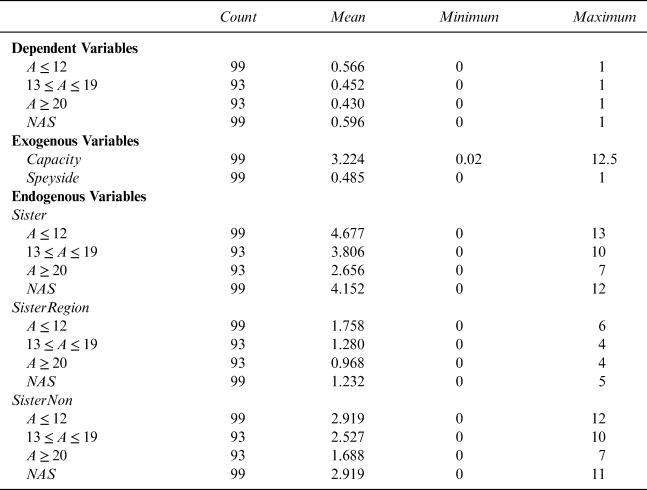
Data on distilleries’ product lines, capacities, and ownership come from the Malt Whisky Yearbook 2013 (Ronde, Reference Ronde2012), an annual publication containing industry-relevant information and statistics. Product lines were also cross-checked with brands’ websites in order to ensure accuracy. Summary statistics are presented in Table 1.Footnote 4
Summary Statistics – Product Positioning

The data show that product ages are well-distributed among distilleries. A randomly selected distillery has roughly a 50% chance of producing any of the four age categories, with slightly higher probabilities for both the youngest and NAS categories and slightly lower probabilities for all ages above 12 years. About 80% of all distilleries have at least one sister distillery that offers a product in the same age category. Even after accounting for differences in regional classifications between sister distilleries, more than half of all distilleries are paired with at least two sister distilleries (one in the same region and one outside) that produce the same age category.
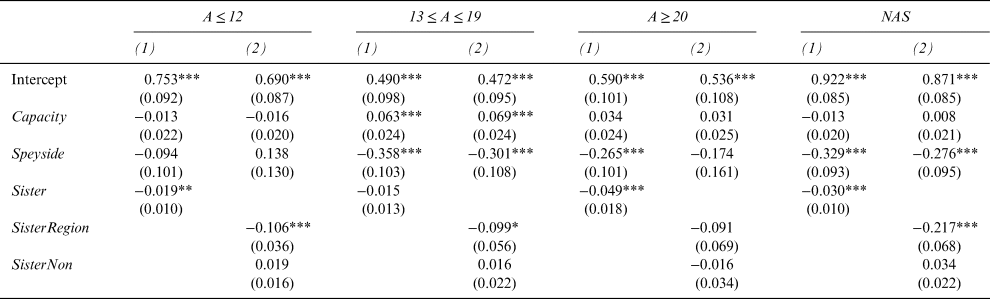
Empirical results are presented in Table 2. For the youngest age category, A ≤ 12, neither the distillery's capacity nor its regional style appear to have much impact on the decision to produce this type of whisky. Coefficients are not statistically different from zero, and they tend to be small. Sister distilleries’ products do appear to have an impact. If the distillery has a sister distillery which offers a whisky 12 years or younger, it is less likely to offer it as well. Furthermore, when sister distilleries are differentiated according to their regional location, a sister distillery in the same region has a larger effect, as the coefficient for SisterRegion is negative and statistically different from zero whereas the coefficient for SisterNon is smaller in absolute size and not statistically significant. This indicates that parent firms are aware that offering similar products from sister distilleries in the same region will cannibalize their own profits but regionally different whiskies are not close substitutes and are not a significant factor when the parent firm is deciding whether or not a particular distillery should offer a young whisky.
2SLS Results – Product Positioning

Notes: *, **, and *** represent p-values of 0.1, 0.05, and 0.01, respectively.
Standard errors are reported in parentheses.
For the mid-range age category (13 ≤ A ≤ 19), distillery size has a positive effect on the probability that a distillery will produce such a whisky. The average marginal effect for an additional one million units of capacity is between 6.3 and 6.8%, depending on the specification for modeling sister distillery product positioning. Regional styles also appear to matter in this instance, as Speyside distilleries are considerably less likely to offer this category, by as much as 35.8%. Sister distilleries do not appear to influence product positioning with respect to this particular age group, as only one of the coefficients for sister distilleries is statistically significant, and only at the 10% level. This is somewhat surprising, as the opposite results were found for the younger category, but signals that the relationship between sister distilleries is not necessarily constant across all age categories.
For the oldest age category, A ≥ 20, distillery size does not seem to have an effect. The initial specification finds that Speyside distilleries are less likely to produce older whiskies, as are those with sister distilleries selling a product of comparable age. But after controlling for regional classifications of sister distilleries, these effects lose their statistical significance. As with other age categories, no significant relationship between sister distilleries in other regions is apparent.
Whiskies without an age statement represent a fourth class of whisky that are harder to vertically differentiate because their attributes are not as clearly communicated as those with an age statement, and almost certainly represent a heterogeneous mix of whiskies because of the various production techniques distillers use to market their product in lieu of an age statement. Even the NAS category appears to be sensitive to sister distilleries’ product lines, exactly as seen in the case of whiskies 12 years and younger. The effect appears to be concentrated on sister distilleries in the same region, and there is no apparent effect from sister distilleries in other regions. In general, Speyside distilleries are also much less likely to produce NAS whiskies.
Across age categories, capacity only has a significant effect on the mid-range age category. Small distilleries are just as likely as large distilleries to produce a whisky of the given age category. In general, the signs of coefficients for sister distilleries product variety confirmed expectations: δ < 0. When a parent company owns multiple distilleries and one of those distilleries produces a particular age category, the company's other distilleries are less likely to produce a whisky in the same category. This supports the hypothesis that companies have incentive to position their products so as to avoid competition among their brands. Furthermore, because δ 1 < δ 2, it appears that parent companies are aware of the substitutability of their different brands, and that some brands are better substitutes for others. If these distilleries were independently owned and had no sister distilleries, many of them would be more likely to offer a greater variety of whiskies.
In addition to measuring product variety by determining what ages each distillery makes, product variety can also be a measure of the total number of products offered (Alexander, Reference Alexander1997; Berry and Waldfogel, Reference Berry and Waldfogel2001; Watson, Reference Watson2009). Distilleries’ product line size is expected to be impacted in several ways. First, segments of the market with a higher concentration of distilleries (e.g., Speyside) are likely more competitive than regions with only a few distilleries, so product lines should be smaller for Speyside distilleries than those in areas where distilleries have fewer rivals (Watson, Reference Watson2009). Additionally, for instances in which multiple distilleries are owned by a parent firm, distilleries have incentive to position their products so as to increase the distance between them, thereby decreasing competition between their brands in a manner that sometimes consolidates product line size while also discouraging entry of other firms (Alexander, Reference Alexander1997; Berry and Waldfogel, Reference Berry and Waldfogel2001). It is, therefore, expected that the effect of a sister distillery's product line size will be negative, but the size of the effect will depend on whether the distilleries are located in the same region and are close substitutes.
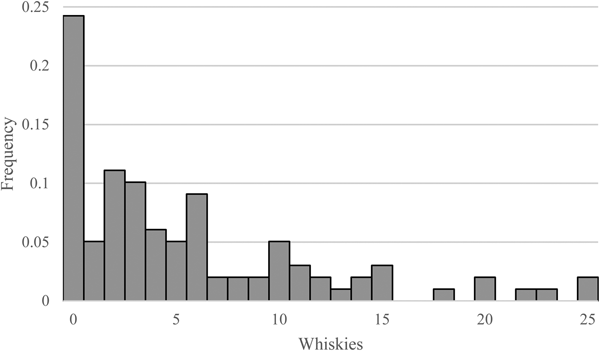
The distribution of product line sizes by distillery is summarized in Figure 2. The mean number of whiskies per distillery is about 5.6, with a median of 3 and the full range between 0 and 25. Distilleries that do not offer any products are not inactive. Rather, they represent a number of distilleries whose output only goes towards blended whiskies. In theory, nothing prevents distilleries from bottling all of their whisky as single malt whisky, but in practice their products may have to compete in segments of the market that are already well-saturated with competitors. Almost all of the distilleries that do not offer a single malt whisky are located in the Highland and Speyside regions, the two regions with the most distilleries.
Number of Expressions per Distillery

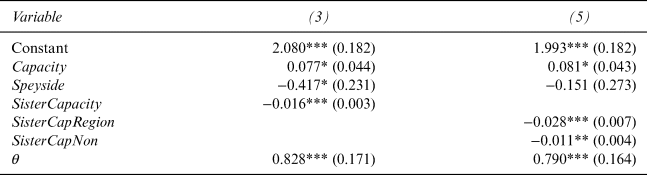
A negative binomial model is used to estimate distilleries’ product line size due to the discrete nature and apparent overdispersion of the data. The model takes two forms to account for regional variability in the effects of sister distilleries. The basic negative binomial model has the conditional mean
 $$\matrix{ {\mu _i = \exp \lpar {\alpha + \beta Capacity_i + \gamma Speyside_i + \delta SisterCapacity_i} \rpar } \cr} $$
and conditional variance
 $$\matrix{ {\mu _i + \theta \mu _i^2 {\rm.}} \cr} $$
Similar to the estimations from Equations (22) and (23), it is expected that capacity will have a positive effect on a distillery's product line size (β > 0) because larger distilleries are able to produce more output, and distilleries may produce a greater variety of expressions to avoid oversaturating specific market segments. Distilleries in the Speyside region are expected to have smaller product line sizes (γ < 0) because there are so many active distilleries in this region producing comparable products. Ideally, the estimation would also include the number of products offered by sister distilleries, similar to the specification in Equation (23), but dealing with endogenous variables in a count model is more difficult than instrumenting in the case of a linear probability model. Accordingly, total sister distillery capacity is used as a proxy for sister distilleries’ product line size. Because capacity should increase product line size, δ should have the same sign as the true effect of sister distillery product line size (δ < 0). However, the size and the corresponding average marginal effects of δ cannot be literally interpreted. Even so, sister capacity should demonstrate the general effect of product line sizes from sister distilleries if an effect is present.
A second specification distinguishes between sister distilleries located in the same region and those located elsewhere,
 $$\eqalign{ \mu _i &= {\exp\lpar {\alpha + \beta Capacity_i + \gamma Speyside_i + \delta_1SisterCapRegion_i} } \cr&\quad \hskip 5.5pc { { +\ \delta_2SisterCapNon_i} \rpar {\rm,}} \cr} $$
and using the same conditional variance as in Equation (25). The same hypotheses apply with respect to capacity and regional differences (β > 0, γ < 0). It is expected that the product line sizes of sister distilleries in the same region will have a larger effect than the effect of sister distilleries in other regions, and that regional differences will lead to the relationship δ 1 <δ 2 for product lines.
Results for the negative binomial models in Equations (24) and (26) are summarized in Table 3. The estimate for θ is positive and statistically different from zero, confirming that the conditional mean is overdispersed. Both estimations report that capacity has a positive effect on product line size, although the effect is apparently small and only statistically significant at the 10% level. When sister capacity is not regionally differentiated, the coefficient for the Speyside dummy variable is negative and statistically significant, although controlling for regional differences in sister distilleries appears to diminish this effect. The initial estimation confirms that sister distilleries’ total capacity has a negative effect on product line size. By differentiating sister capacity based on regions, results for Equation (26) find a negative and statistically significant effect for both regional variables, and the effect for sister distilleries in the same region is larger, confirming expectations.
Negative Binomial Results – Product Line Size

Notes: *, **, and *** represent p-values of 0.1, 0.05, and 0.01, respectively.
Standard errors are reported in parentheses.
The market for Speyside whiskies appears to be the most competitive segment of the market, with the fewest opportunities to introduce products without strong competition due to close substitutes. Distilleries in the Speyside region are generally less likely to produce a whisky of any particular age category and tend to produce fewer whisky expressions overall. Regional differences also suggest limits to the substitutability between brands and this is reflected in the product lines of distilleries owned by parent companies. Parent companies structure their distilleries’ product lines so as to avoid offering close substitutes of their own goods. This leads to instances in which distilleries are less likely to offer whiskies of a particular age if a sister distillery in the same region already produces such a whisky. Ages offered by a sister distillery in a different region appear to have little to no impact. Additionally, the overall size of product lines also appears to be affected by sister distilleries’ product line sizes. The effect is largest for sister distilleries in the same region, but a smaller effect is present for sister distilleries located elsewhere. The negative relationship implies that increased ownership among a smaller number of parent companies led to a market equilibrium in which many distilleries offer fewer products than they would were they independently owned. Because of brand substitutability, they carefully chose product quality levels and limited the total number of products to best suit the needs of the parent company.
V. Conclusion
This article presents an analysis of the production of whisky, a vintage good whose quality is determined by the distillery during maturation. Production models for other vintage goods are inadequate when trying to study the maturation of whisky. Wine improves with age, although it tends to be characterized as having a unique optimal maturation age, and consumers can continue the maturation process after purchase. Whisky distilleries, on the other hand, entirely control the maturation process and they typically bottle portions of the same batch of new-make after different lengths of time.
Results from the theoretical model identify and describe market conditions in which multiple maturation ages are a consequence of imperfect competition. While it may not be surprising that some of the biggest and best-known brands (e.g., Glenfiddich and Glenlivet) are able to exert market power, results from the analysis indicate than even lesser known brands from smaller distilleries are differentiable. This allows them to exert some market power, possibly by targeting smaller segments of the overall market where there are few close competitors.
Distilleries’ product lines are analyzed to determine how general product characteristics, distillery size, and the presence of sister distilleries affect product variety. These analyses find several crucial elements that define the market for single malt Scotch whisky. First, distillery capacity does not have much of an impact on the distiller's decision to produce whiskies of a particular age. Second, distilleries in the Speyside region are less likely to produce most ages of whisky because there is a high concentration of distilleries there that all produce a similar product. While every distillery may produce a whisky that has a unique flavor profile, it appears that single malt Scotches are comparable enough by consumers’ standards, and their substitutability impacts distilleries’ maturation decisions. This is further reflected in the effects of sister distilleries on a distillery's decision to offer a particular product. If two distilleries are owned by a parent company, they are less likely to produce whiskies that are close substitutes. These results are generally only significant for sister distilleries in the same region, which supports the idea that whisky is horizontally differentiable based on regional flavor profiles. Finally, firm ownership also has an effect on the total number of products a distillery offers. If the distillery is owned by a parent company with multiple distilleries, the distillery is likely to have a smaller product line size than it would have were it independently owned. These findings suggest that distilleries produce multiple ages of whisky to capture a greater market share but that the existence of close substitutes from competing brands causes distilleries to decrease their overall product variety.
These results demonstrate that it is extremely unlikely that the single malt Scotch whisky industry is perfectly competitive despite the almost 100 active distilleries in Scotland. Instead, distilleries are able to compete for smaller segments of the market because consumers differentiate between brands based on product characteristics. This in turn creates an opportunity for firms to exert market power. Firms’ ability to capture a larger market share through increased product variety explains why distilleries produce multiple ages of whisky, and evidence based on regional styles and firm ownership supports this.
Future work could consider further developing and applying a model of monopolistic competition with market share data. This will require additional information on all product prices and costs, as well as volume of production for individual ages and consumers’ preferences with respect to quality to better estimate maturation decisions of multiproduct firms using a structural approach. Regrettably, there is insufficient data as of yet to do so. Finally, the aged spirits considered could likewise be broadened to include other spirits including other whiskies, rum, and brandy.