Introduction
A 2007 report by the London School of Economics estimated a projected increase from 468,000 to 855,000 cases (83%) of cognitive impairment between 2002 and 2031 in the UK, with care costs rising from £5.4 billion to £16.7 billion in real terms within the same period.Reference Comas-Herrera, Wittenberg, Pickard and Knapp1 The authors calculated that if new treatments were developed to offset approximately 1% of people with cognitive impairment each year, then this would negate the increase in costs. Cognitive genetic research is one area that aims to broaden our understanding of the biological basis of mental functioning and its decline with age in both cognitively healthy individuals and those with dementia. Since 1995 several hundred studies have investigated cognitive candidate genes, often with inconsistent findings.Reference Payton2 Of these genes apolipoprotein E (APOE) has received the most attention.
This review will take a detailed look at the genetic association studies that have published their findings on APOE and cognition using Alzheimer's disease (AD) and non-demented individuals, and attempt to interpret the results thus far presented. The methodological strengths and weaknesses of these studies will be discussed and suggestions for future study designs will be given.
Relevant publications were acquired through the National Center for Biotechnology Information (PubMed) website (http://www.ncbi.nlm.nih.gov/) using the keywords: cognition, APOE, decline, memory, gene, polymorphism, Alzheimer's disease, normal ageing. The author also used electronic copies of publications that he had accumulated from NCBI, colleagues and other authors over a period of years. Full details of the search methods are available from the author.
The cognitive phenotype
In 1904 the English psychologist Charles Spearman published an article on his discovery of the general factor in human intelligence.Reference Spearman3 Spearman found that individuals who performed well on one type of cognitive test (such as a test of memory) also performed well on diverse measures of cognitive ability (such as tests of vocabulary ability), and that the covariance could be largely attributed to a single factor, which he coined general intelligence or as it is sometimes referred to, ‘g’. Even after more than a hundred years of psychometric research and numerous unsuccessful attempts to disprove it, ‘g’ remains one of the most replicated outcomes in psychology.Reference Carroll4 An example of the close correlation between tests can be seen from the analysis of the Wechsler Adult Intelligence Scale-III (WAIS-III), which is comprised of thirteen subtests.Reference Wechsler5 Factor analysis performed on scores obtained from 2450 volunteers showed that the thirteen tests produce an agglomerate of four group factors, which comprise working memory, perceptual organization, processing speed and verbal comprehension.Reference Deary6 The mean correlation between these group factors was 0.76, and their correlation with ‘g’ ranged from 0.78 to 0.94. Despite being a robust finding in the general population, a smaller study (n = 105) performed on low IQ people (IQ of 74 or below) found that only two factors could be extracted from the WAIS-III, suggesting that the three-tier, four-factor model is only applicable above a certain IQ.Reference Jones, van Schaik and Witts7
One of the most contentious issues regarding the ‘g’ factor is its heritability. The nature versus nurture debate that lasted for the majority of the twentieth century eventually yielded under overwhelming empirical evidence which found that environment and genes contribute roughly equally (50%) towards the variation in intelligence observed within the general population.Reference Devlin, Daniels and Roeder8, Reference Bouchard and McGue9 More recently interactions between genes and environment have been reported in several fields including obesity,Reference Qi and Cho10 cancer,Reference Thorgeirsson, Geller and Sulem11 asthmaReference Kim, Elwood and Asher12 and cognition.Reference Caspi, Williams and Kim-Cohen13–Reference Johnson, Harris, Starr, Whalley and Deary16 The ‘nature-via-nurture’ hypothesisReference Ridley17 whereby genetic effects can be modulated by cues from the environment is certainly a compelling one, and despite the limited number of publications in this area the notion that having a genetic predisposition to be smart also requires a suitable environment to optimize that capacity is a logical concept.
Another intriguing finding concerning the genetic contribution towards the variance in ‘g’ is that its heritability appears to increase with age. Typical estimates of 30% heritability in early childhood increasing to 80% heritability in late adulthood have been consistently reported by twin studies.Reference McClearn, Johansson, Berg, Pedersen, Ahern, Petrill and Plomin18–Reference Giubilei, Medda and Fagnani20 Genes involved in brain development from childhood to adulthood may be one contributing factor responsible for the increase. Indeed, brain volume, cortical surface area and cortical thickness are all highly heritable (0.81–0.95) and moderately correlated with cognitive abilities (0.27 working memory and 0.39 processing speed).Reference Peper, Brouwer, Boomsma, Kahn and Hulshoff21–Reference Panizzon, Fennema-Notestine and Eyler23 In later life there is an increase in neuronal damage from factors such as oxidative stress and increased inflammation, which require protection and repair.Reference Fatokun, Stone and Smith24, Reference Godbout and Johnson25 Genetic variants that increase the susceptibility towards damage or are involved in damage reduction may therefore be another contributing factor towards the increased heritability.
With the genetic contribution towards the variation in cognition being so high, it may have been expected after 14 years of research that a definitive gene associated with intelligence would have been identified. Unfortunately, this is not the case. During this period, over 50 genes have been investigated and over 200 publications have been produced, and yet not one of these findings has been consistently replicated by multiple independent groups.Reference Payton2 This does not imply that the search for intelligence genes has been a failure. On the contrary, there are several genes that do appear to be very interesting, one of which is APOE.
Mechanisms by which apolipoprotein E may alter cognitive function
The APOE gene codes for apolipoprotein E (ApoE), whose primary function in the brain is the transport of cholesterol from astrocytes to neurones, which is necessary for the building and maintenance of neuronal membranes and myelin sheaths.Reference Mauch, Nägler, Schumacher, Göritz, Müller, Otto and Pfrieger26 Human ApoE exists as three common isoforms (ɛ2, ɛ3 and ɛ4), which are determined by a combination of two single nucleotide polymorphisms (SNPs) (rs7412 and rs429358) that code for either a cysteine or arginine amino acid at positions 130 and 176 (updated from: www.ncbi.nlm.nih.gov; original position 112 and 158). In a Caucasian population the ɛ2, ɛ3 and ɛ4 variants exist at a frequency of approximately 8, 79 and 14%, respectively,Reference Mahley and Apolipoprotein27, Reference Small, Rosnick, Fratiglioni and Bäckman28 with the ɛ4 allele frequency increasing to 40% in AD.Reference Bertram and Tanzi29 Whilst ApoEɛ3 exhibits normal lipid metabolism, ApoEɛ4 is associated with increased cholesterol levels and confers increased risk of developing AD, with heterozygous (ɛ2ɛ4/ɛ3ɛ4) and homozygous (ɛ4ɛ4) individuals being 3–4 and 10–12 times more likely to develop late onset AD.Reference Munoz and Feldman30 In contrast, ApoEɛ2 binds with a lower affinity to low-density lipoprotein receptors and has been associated with a delayed onset of AD.Reference Raber, Huang and Ashford31, Reference Khachaturian, Corcoran, Mayer, Zandi and Breitner32
The mechanisms by which APOE influences cognitive function are not fully understood, although several likely mechanisms of action exist.Reference Bu33 APOE is believed to be involved in neuronal development and repair following injury, with ApoEɛ3 promoting and ApoEɛ4 reducing neurite outgrowth.Reference Mahley and Apolipoprotein27, Reference Nathan, Bellosta, Sanan, Weisgraber, Mahley and Pitas34–Reference Teter, Xu, Gilbert, Roses, Galasko and Cole36 Evidence from studies of professional boxers and American football players suggest that the inability of ApoEɛ4 to repair injury may result in a gradual decline of neuronal network function, and this in turn may lead to a faster rate of cognitive decline.Reference Kutner, Erlanger, Tsai, Jordan and Relkin37, Reference Jordan, Relkin, Ravdin, Jacobs, Bennett and Gandy38 APOE is also one of a number of amyloid-β (Aβ) chaperones and its immunoreactivity in amyloid plaques suggests that it interacts directly with Aβ in the brain.Reference Strittmatter, Weisgraber and Huang39, Reference Rebeck, Reiter, Strickland and Hyman40 APOEɛ4 has a lower binding affinity for Aβ than APOEɛ3 and this is correlated with an increased deposition of Aβ, which is thought to be a primary pathogenic event for AD and which is likely to contribute towards cognitive dysfunction.Reference Bennett, Wilson and Schneider41–Reference Drzezga, Grimmer and Henriksen43 Finally, ApoE cleavage products have been found to cause neurotoxicity in the hippocampus and cortex of animals and have been identified in the cerebral spinal fluid and brains of AD patients where they interact with neurofibrils and tau proteins.Reference Marques, Tolar, Harmony and Crutcher44–Reference Huang, Liu, Wyss-Coray, Brecht, Sanan and Mahley46 ApoE cleavage products have also been shown to cause significant cognitive impairment in rats.Reference Eddins, Klein, Yakel and Levin47
The APOE gene and cognition in non-demented individuals: cross-sectional studies
APOE is a risk factor for AD,Reference Corder, Saunders and Strittmatter48 one of the primary characterizations of which is a rapid and irreversible decline in cognitive function.Reference Bookheimer and Burggren49 This finding prompted research into the effects of APOE on the cognitive abilities of non-demented people that for a number of years yielded a series of inconsistent reports. In 2004 a meta-analysis was performed using data from 38 studies, representing over twenty thousand people,Reference Small, Rosnick, Fratiglioni and Bäckman28 and this was extended recently by a meta-analysis of 77 studies comprising over forty thousand people.Reference Wisdom, Callahan and Hawkins50 The initial study by Small and colleagues collapsed the large array of psychometric tests into eight cognitive domains that comprised: primary memory, episodic memory, visuospatial ability, perceptual speed, executive functioning, attention, verbal ability and global cognitive function. Test scores were then compared for the APOEɛ4 and non-APOEɛ4 groups. The results showed significant association for the tests of global cognitive functioning, executive functioning and episodic memory with the presence of the ɛ4 allele predicting poorer performance. Interestingly, increasing age appeared to reduce the strength of association. The authors argued that this is similar to that observed in AD where APOEɛ4 becomes a less significant risk factor with increasing age.Reference Breitner, Wyse and Anthony51–Reference Farrer, Cupples and Haines52 In addition, only those homozygous for the ɛ4 allele, and not heterozygous individuals, showed a significant association with global cognitive functioning and episodic memory when compared against non-carriers, and the effect sizes were small (<0.10 of a standard deviation). Conversely, the presence of APOEɛ2 was associated with an increase in cognitive performance, although once again the magnitude of the effect was small. No associations were observed for any other cognitive domain.
Reassuringly, the results from the most recent meta-analysis by Wisdom and colleagues remained similar to those described above.Reference Wisdom, Callahan and Hawkins50 Dividing the tests into the same eight domains but almost doubling the sample size, it was observed that APOEɛ4 carriers scored significantly lower compared with the non-ɛ4 group for the tests of executive functioning, episodic memory and global cognitive functioning. These findings mirrored the earlier meta-analysis results in terms of small group effect sizes (0.003 to 0.14 standard deviations) that were only observed in APOEɛ4 homozygous individuals. In addition, APOEɛ2 was associated with increased performance on the tests of episodic memory, although once again the effect sizes were small. Similarly, no associations were seen for the tests of attention, verbal ability, primary memory or visuospatial ability. However, the studies did differ in two findings. Firstly, the Wisdom study found an association with processing speed that was not observed by the initial meta-analysis. This was likely to be as a consequence of a larger sample size, which increased the power to detect smaller effects. The second difference between the two studies concerned the effect of age. Small and colleagues found that as participants aged the effect size of the APOEɛ4 variant became smaller. In contrast, Wisdom and colleagues found that increasing age also amplified the effect size between APOEɛ4 and non-APOEɛ4 groups for measures of global cognitive ability and episodic memory. Wisdom argued that their results were consistent with findings for the general population where an increase in age results in greater pathological differences.Reference Corder, Ghebremedhin, Thal, Ohm and Braak53 The reason for these apparent differences remains unknown, although a study conducted on participants (n = 466) at age eleven and again at age eighty found that the effects of APOEɛ4 on cognition were only evident in the elderly group, indicating that age is an important interacting factor.Reference Deary, Whiteman and Pattie54 Unfortunately, the age at which APOEɛ4 has its optimum effect remains unclear.
Despite their differences, both meta-analysis data are suggestive of a weak association between the ɛ4 allele and cognitive deficit and the ɛ2 allele and improved performance in cognitively healthy elderly individuals. There also appears to be a domain-specific effect for episodic memory, global cognitive functioning (measured by individual tests such as the Alice Heim Part-1 test,Reference Heim55 MMSEReference Folstein, Folstein and McHugh56 and the Moray House TestReference Deary, Whiteman, Starr, Whalley and Fox57), executive functioning and possibly processing speed, but not for several other domains. APOEɛ4 certainly has greater adverse effects on brain regions such as the hippocampusReference Mueller, Schuff, Raptentsetsang, Elman and Weiner58 and white matter myelin breakdownReference Bartzokis, Lu and Geschwind59 and this may go some way towards explaining the cognitive domain specificity. However, an increased thinning of sub-regions of the hippocampal complex (entorhinal cortex and subiculum) by as much as 13% in APOEɛ4 older, non-demented individuals does not necessarily equate to a greater loss of cognitive abilities.Reference Burggren, Zeineh, Ekstrom, Braskie, Thompson, Small and Bookheimer60
There are also several limitations to both meta-analysis studies. Primarily, they had to cope with extremely diverse measures, some of which tapped into multiple cognitive domains and some of which had poor psychometric validity. The majority of studies had used the MMSE to assess cognitive function, which was originally designed as a screening tool for dementia.Reference Folstein, Folstein and McHugh56 Unfortunately, the MMSE has severe ceiling effects, which means almost a quarter of cognitively healthy participants score either 29 or 30 on the test (which has a maximum score of 30).Reference Tombaugh and McIntyre61 It is therefore difficult to differentiate between medium and high performing people and this ultimately impacts on statistical power. A further limitation of the two meta-analysis studies is that information on variables such as gender, hypertension and diabetes was only reported by a minority of groups and therefore several important confounders were not adjusted for. Inadequate sample size was also a problem for many studies and this meant that genotype data was often substituted for the presence or absence of APOEɛ4. Finally, there were very few studies that had used younger participants and so the effect of APOE on cognitive development is still undetermined. It is also likely that a certain degree of cognitive dysfunction caused by APOEɛ4 in older adults may have been the result of incipient AD rather than its impact on normal ageing. As no studies followed up their participants with an assessment of dementia status, the answer to this rather expensive and lengthy but nevertheless important question is unknown.
The APOE gene and cognition in mentally healthy individuals: longitudinal studies
In contrast to the cross-sectional studies discussed above, there are far fewer publications that have looked at APOE variants and the longitudinal decline of cognitive abilities in non-demented elderly people. The main reason for this is that decline in cognitively healthy people tends to be gradual (approximately 6% per decade between the ages of 50 and 80 for executive function) and therefore extensive periods of time are required to measure the rate of decline with any accuracy.Reference Rabbitt and Lowe62 The genetic contribution towards cognitive decline (approximately 30%) is less than the genetic contribution towards the cognitive ability score (intercept) and appears to affect the acceleration of decline (quadratic) rather than the rate of decline (slope).Reference Finkel, Reynolds, McArdle and Pedersen63 Other confounders such as selective drop-out, practice effects and inter-/intra-individual differences in the decline of specific cognitive domains also require adjusting for.Reference Rabbitt, Diggle, Holland and McInnes64 Sadly, the relatively high complexity of such analysis means that it is rarely performed in cognitive longitudinal studies.
Between 1994 and 2009 there have been 23 independent studies that have examined the effect of APOEɛ4 on cognitive decline in cognitively healthy adults.Reference Savitz, Solms and Ramesar65–Reference Caselli, Dueck and Osborne72 Despite an initially encouraging 16 studies that have reported an association between APOEɛ4 and an increased rate of cognitive decline, it is important to first weigh the merits of the study designs used. Firstly, 21 studies had a follow-up period ranging from 1 to 8 years with a mean follow-up of 4.7 years. Given the modest rate of cognitive decline of healthy older people,Reference Rabbitt and Lowe62 most of these studies were attempting to identify a genetic effect on a variance in decline of less than 3%. In addition, most of the studies used the MMSE to measure general cognitive functioning, only a handful of studies adjusted for practice effects and selective drop-out, and no studies followed their subjects to determine which ones went on to develop dementia. Sample size was also an issue with 16 studies using less than 1000 volunteers, and seven using less than 250 volunteers.
Those studies with a longer follow-up and/or a larger sample size did find that the APOEɛ4 was a susceptibility allele towards cognitive decline, although the nature of the association appears complex. A study by Kozauer and colleagues used 659 subjects who had been assessed using the MMSE at four time points spanning a 22-year period and immediate recall, delayed recall and word recognition at the final two time points which spanned a 10-year period.Reference Kozauer, Mielke, Chan, Rebok and Lyketsos70 The study was relatively unique as it used younger participants with a mean age of 34.9 years at the initial time of testing and 58.4 years at the last (fourth) assessment. A comparison of the presence or absence of APOEɛ4 found that cognitive decline was significantly greater for the test of delayed recall for APOEɛ4 carriers, but the association was only observed in individuals who were under the age of 65 years at the final assessment. The lack of association in the older participants may have been a result of survival bias given those with the ɛ4 allele would be at higher risk from stroke and heart disease and therefore only the fittest individuals would be still participating. These results partially supported an earlier study of 5804 elderly participants (aged 70–82 years) who were selected as part of a clinical trial of statin (Prospective Study of Pravastatin in the Elderly at Risk) and who were assessed for tests of immediate recall, delayed recall, processing speed and global cognitive functioning over a period of 3 years.Reference Packard, Westendorp and Stott66 In agreement with the Kozauer study it was found that the presence of the ɛ4 allele predisposed to the increased decline of delayed recall. However, an association was observed for immediate recall, which was not found in the Kozauer study. No association was found for tests of processing speed or attention. Indeed, the findings of these studies reflect those of the cross-sectional reports where the effects of APOEɛ4 are both small and cognitive domain specific.
Other investigations have found an association between cognitive decline and APOEɛ4, but only when interacting with other risk factors. A study of cognitively normal elderly Chinese subjects (n = 1487) found no association between APOEɛ4 carriers and non-carriers and cognitive decline (mean follow-up 1.5 years) in the whole sample.Reference Niti, Yap, Kua and Ng71 However, when they divided by depression status they found that APOEɛ4 depressed volunteers (Geriatric Depression Scale score ≥5) declined significantly faster than APOEɛ4 non-depressed volunteers after adjusting for multiple confounders including vascular risks, smoking, age, physical activity and gender. Another interaction study that followed a large elderly cohort (n = 2021) for 4 years found that those homozygous for APOEɛ4 scored lower on the MMSE and Symbol-Digit Modalities test (measure of processing speed) but only in association with risk factors such as head injury and education.Reference Christensen, Batterham and Mackinnon69 Lastly, a recent study has shown that APOE genotype modulates the association between cognitive functioning in old age and serum calcium levels, where high calcium and APOEɛ4 correlated with reduced cognitive function assessed over a 5-year period.Reference van Vliet, Oleksik, Mooijaart, de Craen and Westendorp73
Although the current data support an association between APOEɛ4 and cognitive decline, the evidence is far from unequivocal. Inadequate follow-up, small sample size, insensitive psychometric tests and not adjusting for potential confounders have all been restrictive factors in determining the outcome of the ɛ4 allele on cognitive decline in healthy individuals.
The APOE gene and cognition decline in Alzheimer's disease
The presence of APOEɛ4 has been associated with accelerated brain atrophy, greater white matter hyperintensity volumes, altered glucose metabolism and cerebral blood flow, atrophy of entorhinal cortex, hippocampus and amygdala and an increase in plaque load and neurofibrillary tangle formation.Reference Nagy, Esiri, Jobst, Johnston, Litchfield, Sim and Smith74–Reference Cherbuin, Leach, Christensen and Anstey76 The first characteristic of AD to become apparent is a progressive and irreversible loss in memory function. This inevitably results in complete incapacity leaving patients unable to communicate, maintain continence, eat independently or recognize self, family or friends. There is substantial variance in the rate of cognitive decline during the course of the disease, which is determined by the independent actions of genes and environment and interactions between the two.
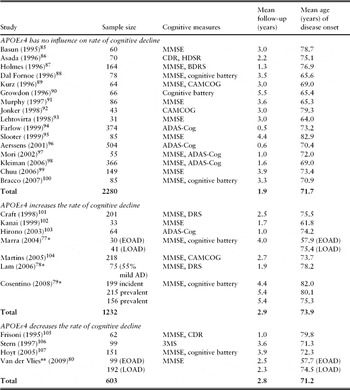
The effect of APOE on cognitive decline in AD patients has been far from conclusive. Of the 27 publications (Table 1), 16 (combined total of 2280 patients) reported that APOEɛ4 has no effect on the rate of cognitive decline, 7 (combined total of 1232 patients) found APOEɛ4 increased the rate of decline and 4 (total of 603 patients) reported that APOEɛ4 reduced the rate of decline. Despite being the largest group, the studies that found no association also had the shortest mean follow-up time (1.9 years) compared with the studies that found that APOEɛ4 accelerated decline (2.9 years) and the studies that found it decreased decline (2.8 years). A reduced follow-up period would reduce the power to detect an association if one existed and therefore the case for overwhelming numbers giving the correct interpretation is diminished. The mean patient age for disease onset was similar between the three groups (71–74 years) and is therefore unlikely to account for the discrepancies. Of the studies that found an association between APOEɛ4 and a faster rate of cognitive decline, three of them found an association with either the younger patients or those with mild symptoms.Reference Marra, Bizzarro and Daniele77–Reference Cosentino, Scarmeas, Helzner, Glymour, Brandt, Albert, Blacker and Stern79 Of the four studies that reported non-APOEɛ4 patients having a faster rate of cognitive decline, one found that early onset AD patients (n = 99, mean age 57.7 years) declined faster than late onset AD patients (n = 192, mean age 74.5 years) and that the effects in early onset were more pronounced.Reference Van Der Vlies, Koedam, Pijnenburg, Twisk, Scheltens and Van Der Flier80 This finding is the opposite of that reported by Marra and colleagues who used similar aged early onset AD patients (n = 30, mean age 57.9 years).Reference Marra, Bizzarro and Daniele77 Despite using a smaller sample size, the Marra study had a longer follow-up period (4.0 years compared with 2.5 years) and used a more comprehensive battery of cognitive tests.
Association studies that have investigated APOEɛ4 and cognitive decline in Alzheimer's disease patients

MMSE, Mini-Mental State Examination; DRS, Dementia Rating Scale (Mattis, 1988); CDR, Clinical Dementia Rating; HDSR, Hasegawa's Dementia Screening-Revised; CAMCOG, Cambridge Cognitive Examination; ADAS-Cog, Alzheimer's Disease Assessment Scale-Cognitive Subscale; BDRS, Blessed Dementia Rating Scale; 3MS, modified Mini-Mental State Examination.
*Association only observed in the younger AD subjects or in those with mild symptoms; **stronger association in EOAD patients.
There are several probable reasons for the inconsistencies within the literature including those already discussed for the longitudinal studies of non-demented people. In addition, population-specific effects have also been shown to be important in AD with the annual change in MMSE scores being between 2 and 4 marks per year in CaucasiansReference Morris, Edland and Clark81–Reference Plassman and Breitner83 and 1.3 marks per year in Chinese subjects.Reference Lam, Tang, Ma, Lui, Chan, Leung and Chiu78 The majority of studies have used either the MMSE as a stand-alone measure of decline or they have used it in combination with other measures. As well as being problematic for the measurement of cognition in non-demented people, the MMSE also has limitations in determining cognitive function in AD patients. Certainly, the MMSE tends to be less sensitive to changes in individuals with mild or very severe symptoms so that a 3-point difference between 24 and 27 is not the same as a 3-point difference between 14 and 17, and therefore data will be ordinal rather than representative of a ratio.Reference Plassman and Breitner83 Finally, other factors such as the inclusion of patients with variable times of disease onset, type and duration of medical treatment and rehabilitation therapy may also alter outcome.
Conclusion
Overall the current data concerning the effects that APOEɛ4 exerts on cognitive ability and its decline in non-demented and AD individuals are suggestive of a weak, domain-specific association that is likely to be influenced by factors such as age, depression and the level of education. However, it is evident when evaluating the literature that a wide variety of methodologies have been employed that makes it difficult for the reader to interpret the data and draw any firm conclusions. Certainly, future studies should consider:
1 Using a more sensitive and comprehensive battery of cognitive tests.
2 Performing power calculations to determine a statistically meaningful sample size and length of follow-up.
3 Correcting for relevant confounders such as vascular risk factors and age.
4 Looking for interactions with depression, education and head injury.
5 Monitoring dementia status when investigating the cognitive decline of non-demented people.
With such a seemingly modest contribution of APOEɛ4 towards cognition, there will certainly be other contributory factors, both genetic and environmental. Gene–environment interactions have already been discussed, but there is also a high probability of gene–gene interactions that may substantially strengthen an association. For example, several polymorphic regions upstream of the APOE gene have been associated with an increased risk of AD or altered expression, and these may also play a role by interacting with APOEɛ alleles in regulating cognition.Reference Bekris, Galloway, Montine, Schellenberg and Yu84 Despite the APOE gene being of interest to cognitive genetic studies there is clearly much improvement and additional research required in order to determine its true function as a susceptibility gene.