Introduction
Facial nerve paralysis is commonly due to infectious causes, trauma and middle-ear surgery. It may also be caused by tumours involving the facial nerve, congenital anomalies or systemic disease.Reference May1, Reference Jonkees2 Facial nerve paralysis usually involves only one facial nerve, which often results in cosmetic problems as well as disordered phonation and mastication, as the condition frequently does not resolve even after aggressive treatment. This may lead to physical and psychological sequelae, with long-term, prominent deficits.
There have been many reports on the cause, diagnosis, treatment and prognosis of facial nerve paralysis in adults,Reference Hughes3–Reference Salman and MacGregor5 but few cases have been reported in children.
The objective of this study was to analyse the causes, clinical features, treatment modalities and recovery rate in children diagnosed with peripheral facial nerve paralysis.
Materials and methods
We retrospectively reviewed the clinical data of twenty-four children under the age of 15 years who had been diagnosed with peripheral facial nerve paralysis between January 2001 and June 2006. Children suffering from facial nerve paralysis caused by central nervous system lesions were excluded.
We undertook a retrospective medical record review to determine each child's age and sex and their facial nerve paralysis aetiology, diagnostic tools, treatment modalities and grade at initial diagnosis. Causes of facial nerve paralysis included infection, trauma, neoplasm and iatrogenic paralysis, as assessed by past history, systematic review, and serological and radiological studies. Peripheral facial nerve paralysis without an identifiable cause was classified as Bell's palsy. The grade of facial nerve paralysis and the recovery rate after treatment were evaluated according to the House–Brackmann facial nerve grading system. Using this system, a grade of I or II was defined as a satisfactory result. Treatment modalities were analysed in terms of the aetiology of paralysis. Appropriate treatment modalities were used in each case in order to maximise recovery (Table I). All patients consented to give the information of the diseases.
Clinical profile of children

Pt no = patient number; y = year; grade = House–Brackmann grade; M = male; F = female; L = left; R = right; S = steroid; PT = physical therapy; AV = antiviral agent; AB = antibiotic; OP = operation; HZ = herpes zoster; AOM = acute otitis media; temp bone fx = temporal bone fracture
Results
Age and sex distribution
The 24 children were aged from three to 15 years, with a mean age of 11.3 years. There were 14 boys (58.3 per cent) and 10 girls (41.7 per cent). The median follow-up duration was 9.2 months (range, 6.7 to 15.2 months). All 24 cases involved unilateral facial nerve paralysis, 11 on the right side and 13 on the left.
Aetiology of facial nerve paralysis
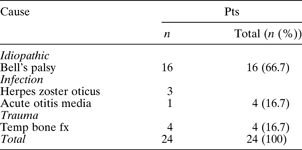
The aetiology of the children's facial nerve paralysis included infection (four patients), trauma (four) and unknown causes (i.e. Bell's palsy; 16 patients). Peripheral facial nerve paralysis without an identifiable cause was classified as Bell's palsy. Three patients' facial nerve paralysis was due to herpes zoster oticus, and one patient's paralysis to acute suppurative otitis media. Four patients had traumatic facial nerve paralysis, all caused by temporal bone fractures (Table II). Tumours and iatrogenic causes were not encountered. No patients with bilateral facial nerve paralysis were encountered.
Causes of facial nerve paralysis in children

Pts = patients; temp bone fx = temporal bone fracture
All patients underwent clinical history taking, physical examination, auditory evaluation and electroneurography. Patients with otitis media or temporal bone fracture were also assessed by temporal bone computed tomography. Auricular herpes zoster suspected from physical examination was confirmed by testing for serological viral markers.
The length of time from the onset of facial nerve paralysis to treatment varied from 1 to 18 days, with a mean of 4.6 days.
Treatment
All patients with facial nerve paralysis were treated with oral steroids, ophthalmological care to protect their eyes, and facial physical therapy. The steroid dosage was similar to the Ballenger regimen, but with the dose reduced according to the child's weight. If the child weighed 20 kg, 24 mg for the first 5 days; 16 mg for the next 2 days; then 8 mg for 2 days; and family 4 mg on the last day.
Antiviral agents were also administered to three patients with herpes zoster oticus. Acyclovir (Zovi®; Korea United, Seoul, South Korea), an antiviral agent, was administered intravenously for 7 days at a dosage of 10 mg/kg/day.
Steroid therapy together with myringotomy was performed for patients with acute suppurative otitis media.
Three patients with delayed facial nerve paralysis plus temporal bone fracture were treated with oral steroids and intravenous antibiotics with secondary cephalosporin. In one patient with sudden-onset facial nerve paralysis caused by a temporal bone fracture, facial nerve decompression was performed via a transmastoid approach (Table III).
Treatment for facial nerve paralysis in children, by cause

Pts = patients; AV = antiviral agent; AB = antibiotic; AH = antihistamine; temp bone fx = temporal bone fracture; FNP = facial nerve paralysis
Facial nerve paralysis grades and recovery rates
Of the 24 patients, 15 presented with House–Brackmann grade IV facial nerve paralysis (the commonest grade), four with grade III, four with grade II and one with grade V (Figure 1).
Patients' House–Brackmann facial nerve paralysis grades on presentation; grade IV (62.5 per cent; 15/24) was commonest.

House-Brackmann grade I paralysis was observed in one patient, grade II in eight, grade III in seven, grade IV in seven and grade V in one on discharge (Figure 2).
Patients' House–Brackmann facial nerve paralysis grades at discharge; 37.5 per cent of patients (nine of 24) showed a satisfactory recovery at this stage.

Six months after hospital discharge, grade I House–Brackmann paralysis was observed in 10 patients, grade II in 12, grade III in one and grade IV in one (Figure 3). Therefore, 22 of the 24 patients (91.6 per cent) recovered to House–Brackmann grade II or less. Five of the 16 patients with Bell's palsy had recovered to grade II on their day of discharge, but, six months later, all 16 were House–Brackmann grade II or less. Two of the three patients with herpes zoster oticus recovered to House–Brackmann grade II or less. Of the four patients with temporal bone fractures, the three with delayed facial nerve paralysis improved to House–Brackmann grade II or less with conservative treatment, while the one patient with sudden-onset facial nerve paralysis (and grade V paralysis pre-operatively) had recovered to grade III paralysis six months post-operatively. The one patient with facial nerve paralysis caused by acute suppurative otitis media recovered completely after treatment.
Patients' House–Brackmann facial nerve paralysis grades after six months' follow up; 91.6 per cent (22/24) showed a satisfactory recovery.

Discussion
The causes of peripheral facial paralysis include trauma, infection, malignancy, congenital abnormality and idiopathic palsy. According to May et al.,Reference May, Fria, Blumenthal and Curtin6 the most common cause of facial nerve paralysis in children is idiopathic palsy, followed by trauma, otitis media and congenital neoplasm. Evans et al. Reference Evans, Licameli, Brietzke, Whittemore and Kenna7 reported that peripheral facial nerve paralysis in children is most commonly associated with infection; other causes included trauma, iatrogenic paralysis, congenital anomaly and idiopathic palsy. In the South Korean study of Hong et al. Reference Hong, Byun, Yeo, Cha and Park8 common paediatric causes included Bell's palsy, herpes zoster oticus, otitis media, trauma, birth injury, leukaemia and burns. In the present study, idiopathic palsy was the most common cause (66.7 per cent, 16/24), followed by temporal bone fracture (16.7 per cent, four of 24), and infections such as herpes zoster oticus and otitis media (12.5 per cent, three of 24, and 4.2 per cent, one of 24, respectively); these results are similar to other authors' findings.
In the adult population study of Park et al. Reference Park, Ahn, Choi and Muhn9 the commonest House–Brackmann facial nerve paralysis grade at diagnosis was IV (43 per cent); after treatment, this improved to grade II or less over a six-month follow-up period. HughesReference Hughes3 found that 86.4 per cent of patients with facial nerve paralysis improved to House–Brackmann grade II over a nine-month follow-up period. Hong et al. Reference Hong, Byun, Yeo, Cha and Park8 reported House–Brackmann grade IV as the most commonly observed grade (65.3 per cent) at initial diagnosis, and found that 93.1 per cent of patients improved within six months of treatment. In the present study, 15 patients (62.5 per cent) were House–Brackmann grade IV at initial diagnosis, but 91.6 per cent had recovered to grade II or less within six months of treatment.
Danielidis et al. Reference Danielidis, Skevas, Van Cauwenberge and Vinck10 reported that 78.5 per cent of their patients aged zero to nine years showed complete recovery of facial nerve function following Bell's palsy, as did 79 per cent of 10- to 19-year-olds. In the present study, all 16 children (i.e. younger than 15 years) diagnosed with Bell's palsy recovered to House–Brackmann grade II or less after steroid therapy. The one patient with acute serous otitis media recovered completely from facial nerve paralysis after treatment. Three of the four patients with temporal bone fractures, and two of the three patients with herpes zoster oticus, recovered to House–Brackmann grade II or less. Therefore, in the present study, idiopathic Bell's palsy and acute serous otitis media would appear to have better prognoses compared with other causes of facial nerve paralysis.
Since the prevalence of acute serous otitis media has decreased due to antibiotic therapy and early treatment, the prevalence of facial nerve paralysis as a complication of this condition has also decreased. In the present study, only one child had acute otitis media; however, further studies with larger numbers of cases are needed to confirm this result.
Treatment methods for peripheral facial nerve paralysis can be divided into pharmaceutical and surgical intervention, but the question of which is more effective is still debated. In Engström and colleagues' study of Bell's palsy cases,Reference Engström, Berg, Stjernquist-Desatnik, Axelsson, Pitkäranta and Hultcrantz11 prednisolone shortened the time to complete facial recovery, whereas valaciclovir had no such effect. Sullivan et al. Reference Sullivan, Swan, Donnan, Morrison, Smith and McKinstry12 reported no evidence of any benefit from acyclovir given alone, nor of any additional benefit of acyclovir used in combination with prednisolone. Adour et al. Reference Adour, Byl, Hilsinger, Kahn and Sheldon13 proposed that, since Bell's palsy develops as a sensory neuritis due to relapse of herpes zoster virus, prednisolone therapy should be commenced within one week. However, the double blind study conducted by May et al. Reference May, Wette, Hardin and Sullivan14 found that the effectiveness of steroid therapy was statistically insignificant. FischReference Fisch, Silverstein and Norrell15 stated that surgical intervention should be considered in Bell's palsy patients if electroneurography detected more than 90 per cent degenerative changes within two weeks of onset. In the present study, patients with suspected Bell's palsy received oral methylprednisolone 1.2 mg/kg/day, with gradual tapering of the dose. Ophthalmological evaluation and facial physical therapy were also performed.
Furuta et al. Reference Furuta, Ohtani, Aizawa, Fukuda, Kawabata and Bergstrom16 suggested, in a study using polymerase chain reaction analysis, that the main mechanism of paediatric facial nerve paralysis due to herpes zoster oticus is reactivation of the varicella-zoster virus. Hato et al. Reference Hato, Kisaki, Honda, Gyo, Murakami and Yanagihara17 found that 78.6 per cent of paediatric patients with facial nerve paralysis recovered after treatment with steroids and antiviral agents. In the present study, patients definitively diagnosed with herpes zoster oticus (by serological viral marker study on the day of presentation) were treated with intravenous acyclovir 5 mg/kg twice a day during admission and oral acyclovir 10 mg/kg/day after discharge. As a result, 66.6 per cent of these patients recovered to House–Brackmann grade II or less patients after discharge, a slightly reduced recovery rate compared with Bell's palsy.
Mekeham et al. Reference Makeham, Croxson and Coulson18 found that facial nerve paralysis caused by infection (mostly herpes zoster oticus; rarely, acute or chronic otitis media) had a good prognosis and did not require surgical treatment.
Our one patient with facial nerve paralysis caused by acute otitis media (with House–Brackmann grade III at initial diagnosis) recovered completely with a combination of myringotomy and antibiotics.
Of our four patients with facial nerve paralysis caused by temporal bone fracture, three had longitudinal fractures. Of these three patients, two had House–Brackmann grade III paralysis at initial diagnosis and one had grade IV paralysis. All three of these patients showed delayed facial nerve paralysis, and had recovered to grade II or less six months after treatment.
• This study aimed to evaluate the causes, treatment modalities and recovery rate of paediatric facial nerve paralysis, by analysing 24 cases
• The most common cause was idiopathic Bell's palsy
• Paediatric facial nerve paralysis can be successfully treated by conservative methods in the majority of cases
• In cases of facial nerve paralysis associated with trauma, radiological investigation is needed to enable further evaluation and treatment
Ulug and Arif UlubilReference Ulug and Arif Ulubil19 reported that 81.8 per cent of patients with traumatic facial nerve paralysis recovered to House–Brackmann grade II or I after surgery via a middle cranial fossa or transmastoid approach (the approach being based on radiological findings). They stated that the decision of whether to perform surgery or not should be based on electroneurographic findings. Yeoh et al. Reference Yeoh, Mahmud and Saim20 found that 66 per cent of patients with traumatic facial nerve paralysis recovered to House–Brackmann grade II or I after facial nerve decompression via the transmastoid approach.
Our one patient with sudden-onset facial nerve paralysis caused by traumatic temporal bone fracture (who at diagnosis had House-Brackmann grade V paralysis and 95.2 per cent degeneration on electroneurography) recovered to grade III six months after facial nerve decompression plus steroid and antibiotic therapy. This suggests that surgical treatment leads to a good outcome in patients with traumatic facial nerve paralysis. In this case, facial nerve decompression via a transmastoid approach was possible because the fracture line involved the mastoid sigment of facial nerve.
In the present study, Bell's palsy was the most common cause of paediatric facial nerve paralysis, and patients improved with conservative treatment such as steroid therapy. Furthermore, we found that the recovery rate for paediatric facial nerve paralysis was similar to or slightly better than that for adult facial nerve paralysis. However, the clinical significance of these findings may be somewhat limited as this study had no control group.
Radiological studies are needed to investigate the diagnosis and treatment of facial nerve paralysis.
Facial nerve paralysis associated with trauma or otitis media can be successfully treated with a combination of steroids, antibiotics and surgery, with the decision to proceed with the latter based on electroneuroconductive studies.