I begin with a story.
Il y a quelques années, j'entendois avec plusieurs personnes Musiciens, un Concert nocturne; la salle du Concert étoit ouverte de tous côtés, nous étions dehors, & il faisoit un orage épouvantable. On exécuta l'ouverture de Pigmalion, & au fortissime de la reprise il survint un éclair terrible, accompagné d’éclats de tonnerre; nous fumes tous frappés au même instant du rapport merveilleux qui se trouvoit entre la tempête & la Musique; assurément ce rapport n'a pas été cherché par le Musicien, il ne l'y a pas même soupçonné. Ce qu'il a conçu comme une symphonie brillante, devint pour nous un tableau par le hasard des circonstances.Footnote 1
A few years ago, with several musical persons, I heard an evening concert. The concert hall was open on all sides. We were outside, and there was a terrible storm. The overture to Pigmalion was performed, and at the fortissimo of the reprise, a frightful flash of lightning suddenly struck, accompanied by claps of thunder. At the same moment, we were all struck by the marvellous relation between the storm and the music. Certainly, this correspondence had not been sought by the composer; he had not even suspected it. That which Rameau had conceived as a brilliant symphonie had become for us, by chance, a tableau.
Written by Michel-Paul Guy de Chabanon in his first work of lasting historical significance, the Éloge de M. Rameau (1764), the above passage describes an outdoor concert. The anecdote intrigues me in several different ways. It begins by setting the scene, a cloudy sky and an impending storm; the music, almost in the background, is intruded upon by reverberating claps. Provocatively, as if the audience is collectively struck by the same bolt of lightning, the music becomes something more: the music and the storm are one and the same because of their conceptual, even literal, similarities.
Looking at the text through another lens, however, we arrive at quite a different reading. Stories like this one typify the long eighteenth century's pervasive interest in animated statues.Footnote 2 Stemming from Ovid's Metamorphoses, the story of a statue coming to life ‘is as central a fable as we have’,Footnote 3 inhabiting such diverse disciplines as philosophy, art, music, science and religion, several of which are relevant to our understanding of Chabanon's account. On the one hand, the animated statue occupies a privileged place in early-modern spectacle. Numerous stage works besides Rameau's Pigmalion (1748) – including Jean-Baptiste Lully's tragédie en musique Cadmus et Hermione (1671), Michel de La Barre's Le Triomphe des arts (1700) and Jean-Jacques Rousseau and Horace Coignet's melodrama Pygmalion (1770) – depict statues stepping off their pedestals and attaining life. Importantly, these musical settings often portray their statues participating in or even directly revealing the moral of the story.Footnote 4 On the other hand, living statues form an integral part of eighteenth-century theories of sensibility, coming to life and acting as the mouthpiece for human enquiry. As is well documented, philosophers from René Descartes to Étienne Bonnot de Condillac all relied on moving sculptures (whether machines, statues or automata) to deliver their messages. In focusing on the supposed ‘lived’ experiences of their creations, these writers used them to sculpt an enlightened form of subjectivity, equating experience and knowledge with the sculptures’ awakening.Footnote 5
Rameau's version of the myth is perhaps the most famous, and certainly the most discussed in music scholarship, most likely for its conflation of these two tropes into a single musical event.Footnote 6 The curtain rises to reveal Pigmalion putting the finishing touches on a statue so beautiful that he is overcome with love and desire for it.Footnote 7 Unable to act upon these feelings for his creation, it appears as though Pigmalion will be forever alone. Venus, moved by the anguish of Pigmalion's unrequited love, grants his wish: unbeknownst to Pigmalion, Cupid zooms across the stage and brings his statue to life. Pigmalion and his sculpture are now able to be together in love. The climax of the story resides in the moment of animation. In Rameau's retelling, with a livret by Sylvain Ballot de Sauvot based on Antoine Houdar de la Motte's play, the statue's awakening receives a fascinating sonic analogue. (The relevant passage is given in Example 1.) At the close of Pigmalion's lament, Cupid flies across the stage and a lush harmony fills the air. Awash with euphonious sounds, the audience hears Pigmalion respond with wonder. An astonished Pigmalion bears witness as his statue slowly comes to life. She descends from her pedestal, walks toward her sculptor and sings, transforming before our very eyes from a mere prop into a moving, breathing character. The term for this transfiguration – of something inanimate becoming animate – is prosopopoeia, and it has long been used to describe the statue's first steps.Footnote 8 The statue thus becomes sensibility incarnate.
‘D'où naissent ces accords?’, Jean-Philippe Rameau, Pigmalion, Acte de ballet, mis en musique par M. Rameau. Et exécuté pour la premiére [sic] fois par l'Académie Royale de Musique, le 27. Août 1748, Scene 3, bars 43–58 (Paris: chez l'auteur, la veuve Boivin, Leclair, 1748), transcription Stephen Kovaciny
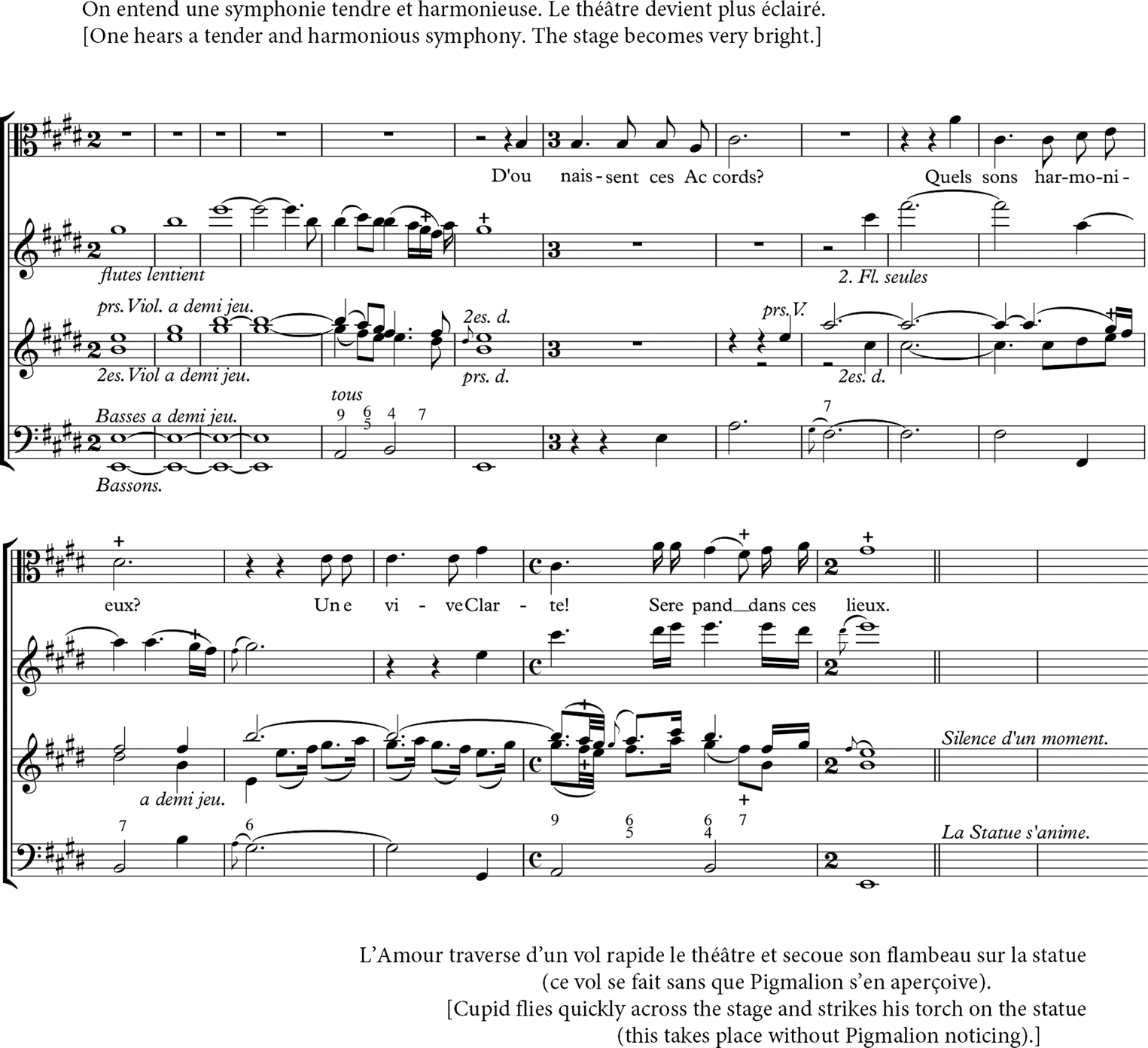
Crucially, Pigmalion and the statue experience this music along with the audience and thus embody the moment of transformation sensorially. In responding to E major's diegetic arrival, Pigmalion alerts the audience to its effect on him, attending to the music through sensory experience: ‘Whence come these chords? What are these harmonious sounds?’ (‘D'où naissent ces accords? Quels sons harmonieux?’). The answers to these questions, of course, lie in the music. The source of these harmonies is none other than the corps sonore, or ‘sonorous body’, what Rameau believed to be the generator of the overtone series and hence the progenitor of all music. The momentous onset of E major, replete with arpeggiated flutes sounding the upper partials and droning strings the fundamental, intones the voice of nature.Footnote 9 Hearing this voice herself, the statue responds by narrating her animation through introspective reflection: ‘What do I see? Where am I? What am I thinking? How is it that I have the power to move?’ (‘Que vois-je? Où suis-je? Et qu'est-ce que je pense? D'où me viennent ces mouvements?’). The moment of animation evokes the same experience within the audience as it does for the characters. As if speaking for the parterre below him, Pigmalion asks, ‘By what intelligence has a dream seduced my senses?’ (‘Un songe a-t-il séduit mes sens?’).Footnote 10 The sights, sounds and emotions of the acte de ballet's defining tableau resonate throughout the concert hall, transforming the audience along with the statue on the stage.
One could say, then, that Chabanon is using the allegorical scene to represent his own animation. What strikes me as a reader is how he elicits his own transformation scene – that is to say, how he and the ‘several musical persons’ experiencing a symphonie become consciously aware of the tableau. The narrative's linguistic imagery supports this: the flash of lightning and clap of thunder not only reflect Pigmalion's inanimate statue being animated by Cupid's flame, but also speak to Chabanon the passive listener becoming animated by an emerging understanding of the music. It is a clever move to make. Many reading the Éloge de M. Rameau would be conversant with the narrative arc of this acte de ballet, which itself was one of the composer's most celebrated and popular works. Moreover, Chabanon seems conscious of this tactic. Throughout the eulogy, he consistently mentions experiences like this one, employing the approach of musical experience throughout his text: ‘What am I to do to praise Rameau? To recall for my fellow citizens, if I may, the memory of some sensations that they have experienced in his works’ (‘Qu'ai-je donc à faire pour célébrer M. Rameau? A renouveller, si je puis, parmi mes concitoyens, le souvenir des sensations qu'ils ont éprouvées à la representations de ses Ouvrages’).Footnote 11 The story is therefore a case in point. The suggestive sequence of events, the shifting of experience from the music to Chabanon's animation, and even the subject matter itself almost too perfectly parallel Rameau's scene. Like Pigmalion, Chabanon hears something in the music that wasn't there before; like the statue, he voices his encounter and its effect on him. It seems the choice of Pigmalion has (as I will shortly elucidate) both meaning and significance, and it certainly reveals something about how Chabanon perceives music. But like all good stories, there is a twist. Chabanon's tale does not concern the transformation scene per se. Rather, he focuses on the ‘frightful flash of lightning’, ‘accompan[ying] claps of thunder’ and, above all, how these elements transform his aesthetic experience of the ballet's instrumental overture.
Using this hermeneutic window as both our point of departure and our guide, what follows is an attempt to reconstruct the sylleptic influences underpinning Chabanon's broader aesthetic transformation. Syllepsis, here derived from the work of the literary theorist Michael Riffaterre, attempts to distinguish between the immediate meaning of words in context and the meaning of words when read between texts. A word thus has two possible understandings, one that is meaningful and another that is significant, and Riffaterre employs this duality as a key component of intertextual reading.Footnote 12 I therefore engage syllepsis as a method for mediating ideas or concepts between, amongst and through their intertextual traces. For ‘the intertext leaves in the text an indelible trace . . . that governs the deciphering of its literary message’ (‘l'intertexte laisse dans le texte une trace indélébile . . . qui . . . gouverne le déchiffrement du message dans ce qu'il a de littéraire’).Footnote 13 Such a tactic echoes the ontological hermeneutics of Hans-Georg Gadamer, particularly the interpretative labour associated with reading a text: ‘the voice that speaks to us from the past – be it text, work, trace – itself poses a question and places our meaning in openness’, and our responsibility as readers is to ‘attempt to reconstruct the question to which the transmitted text is the answer’, to remember and recover these indelible traces.Footnote 14
My more pressing claim, then, is that the retelling of this story re-enacts the musical problem it was originally intended to counter: how does one theorize the body, and thus the self, in and through music? Chabanon could have chosen any overture, instrumental symphony or even one of Rameau's keyboard pieces, but selected – rather consciously, I believe – an intertext laden with philosophical and musical baggage to probe this larger question. Unfolding in tandem with Chabanon's own transformation was a parallel transformation in eighteenth-century musical aesthetics that began to recast the body in music's own image, forcing writers, critics and musicians alike to reconsider the intermediation between music, emotion and meaning.Footnote 15 After all, Chabanon describes a collective, not individual, experience. As Ghyslaine Guertin has argued, Chabanon's ideas operate through an implicit union of – or, in some cases, linking between – ‘universal’ and ‘singular’ experiences, such that the musical work, often heard as a communal event, becomes the object of privileged experience for each listener.Footnote 16 This brings up two points that, while resolved within the ensuing discussion, require emphasis from the outset. First, what I am tracing here is a collection of messy and often contradictory accounts of what sound is, how perception encounters and reconciles sound, how the perception and sensation of sound relate to each other, and, above all, how sound, perception and sensation inform the emerging definition of the modern musical subject. Understanding Chabanon, then, must be done (to borrow from Gary Tomlinson) in a manner that ‘helps us to underscore the situatedness of . . . historical knowledge, to keep in full view the negotiation of divergent viewpoints – the intersection of differing interpreters, texts, and contexts – from which such knowledge emerges’.Footnote 17 In this sense, Chabanon acts as one of many possible chaperones to those navigating the labyrinthine ways and byways of a period fraught with intense thinking and spirited arguing about these issues, and, for this purpose, he will allow us to map the myriad connections between them.
The second point, intimated by the first, is that Chabanon's particular place within this network implies pathways that are otherwise uncharted, understudied or outright ignored. Though born in the French colony of Saint-Domingue (present-day Haiti), Chabanon relocated to Paris in the 1740s and remained there all his life.Footnote 18 During this time he developed a keen awareness of the Enlightenment's coming to terms with how music could provoke aesthetic experiences within listeners. For this reason, Chabanon's writings are often cited as advancing one of the first – if not the first – aesthetic theories of ‘musical autonomy’. Yet despite this achievement, little has been written about how or why he comes to this conclusion. Thus, although I account for the modern musical subject's emergence by way of Chabanon's personal experience, it will become apparent that this aesthetic transformation represents (like the trope of the animated statue) that of the many, of a shared and collective experience. In this understanding, the enlightened body – be it Chabanon's, the statue's or our own – necessarily resides at the heart of musical experience; but it is also responsible for the physiological undercurrents and philosophical overtones of the Enlightenment's confrontation with its own subjectivity. Unlike any other figure of his time, as we shall see below, Chabanon participates in and even directly reveals this new subjectivity through this rhetorical prosopopoeia – that is to say, through his tale's materializing attentiveness to and subsequent voicing of his animation. Grounded at once through the science of acoustics, novel theories of sensory experience, and the musical theories that they engendered, Chabanon – stirred, as it were, by Rameau's theory of harmony – articulates an aesthetic theory based upon music's materiality. It is indeed the sudden realization of music's aesthetic autonomy, under the aegis of the statue's metaphorical becoming, that participates in the story's crystallization of ‘the listening self’.
From Mechanical to Sensible
‘. . . I heard an evening concert’. By the time Chabanon penned these words, the question of how music could influence listeners was already well worn. The early-modern era was rife with theories that attempted to explain how objects provoked physical, emotional and intellectual responses in subjects.Footnote 19 The most relevant example is Cartesian metaphysics, where sensation is a bodily reaction and understanding is an imaginative function. Since a human being is both body and mind, we must assume, to quote philosopher Alison Peterman, that each ‘is a substance distinct from and independent of the other’.Footnote 20 As Jairo Moreno has argued, the earliest rumblings of this trend occurred in Descartes's Compendium musicæ (written 1618; published 1650), a treatise on music theory and aesthetics. Here, sound constitutes an object of perception – the work opens with ‘the object of music is sound’ (‘Hujus objectum est Sonus’) – and, as a direct result, forms the ‘impetus . . . for inquiry about the figure to whom sound constitutes an object’.Footnote 21 Descartes's subsequent writings rehearse this sensitive trajectory in so far as they attempt to understand the relationship – not the division – between objects of perception and the various effects they produce in subjects. Perhaps nowhere is this more prevalent than in Descartes's final work, Les Passions de l'ame (1650), which advances not a theory of mind–body dualism but instead one of their union.Footnote 22 A perception arises from a physical object's impression on the senses; the passions, on the other hand, are caused by ‘nothing other than the vibration imparted by the animal spirits to the [pineal] gland in the middle of the brain’ (‘n'est autre que l'agitation, dont les esprits meuvent la petit glande qui est au milieu du cerveau’).Footnote 23 Les Passions de l'ame thus develops an aesthetic doctrine based at once on a theory of sense perception and a conjoined theory of mental representation, providing a framework for describing affective transmission as material action.
The resultant interpretation of the passions and their capacity to unite mind and body has significant consequences, most notably ‘the disappearance of the [conscious] will as the locus of human agency, and its gradual replacement by the passions and affections (and later ‘emotions’) themselves and finally, by the body’.Footnote 24 What matters here is the turn from Cartesian representation toward sensationalist corporeality. Jean-Baptiste Dubos's celebrated Réflexions critiques sur la poésie et sur la peinture (1719) illustrates this development.Footnote 25 Deeply influenced by John Locke, Dubos's treatise made a substantial contribution to eighteenth-century thought by bringing British empiricism to French audiences. It was likewise responsible for heralding an enlightened aesthetic theory by enquiring into the role of ‘sentiment’, a word with overt sensory connotations. Sentiment, however, is not ‘an explicit reference to the five senses, nor to sensory perception in general’. Rather, it is the proverbial ‘sixth sense’, the body's ‘internal faculty that perceives beauty through the five senses’.Footnote 26 In its purest form, sentiment can be described as the inner feeling that arises in response to a work of art's sensory effects. While the word sentiment appears in earlier writings, Dubos's use of it gives an elevated role to the senses themselves. From then on, it was legitimate to consider aesthetic experience to be contingent upon the sensations of the beholder independent of rational principles. Sensibility had emerged.Footnote 27
Sensationalist rhetoric, endorsed by the philosophes, Encyclopaedists and others, increasingly emphasized phenomenological experience over the phenomenon being experienced.Footnote 28 In the context of this genealogy, this shift in emphasis contextualizes eighteenth-century materialism as an aesthetic transfer from sensation to feeling, from affecting objects to affected subjects.Footnote 29 Denis Diderot, for instance, invested great power in sensing and feeling. In the middle of the century, Diderot published two Lettres, each concerning the sudden arrival of a different sense once withheld. The second of these, the Lettre sur les sourds et muets (1751), embodies the philosophe's approach through the ear and hearing. Taking the form of a dialogue, Diderot asks his interlocutor to envision an animated homme-automate that operates like a clock. He details, first, how the heart represents the clock's mainspring, then how other parts of the individual's chest constitute related components of its movement, and finally how the head is like a bell affixed with little hammers that ring on the hour. He continues:
Elevez sur ce timbre une de ces petites figures dont nous ornons le haut de nos pendules; qu'elle ait l'oreille panchée, comme un musician qui écouteroit si son instrument est bien accordé. Cette petite figure sera l'ame. Si plusieurs des petits cordons sont tires dans le même instant, le timbre sera frappé de plusieurs coups, & la petite figure entendra plusieurs sons à la fois.Footnote 30
Above this bell, place one of those tiny figurines that decorate the tops of our clocks, and let it have its ear inclined like a musician who listens if his instrument is in tune. This tiny figurine will be the soul. If many of the little strings are pulled at the same time, the bell will be struck by several blows, and this little figure will hear several sounds at once.
Analogies like this one flood Diderot's texts and are meant to build on similar images found in Descartes and others.Footnote 31 The walking clock's true purpose, however, is soon revealed: the soul is unconscious of its existence unless it deliberately examines itself.Footnote 32 Subjectivity is made human only when one hears one's own inner workings tick.
Diderot's Lettre sur les sourds et muets was not the only text to explore a ‘living’ mechanical body. Among many examples, Étienne Bonnot de Condillac's epistemological fable is perhaps the most famous version. In his Traité des sensations (1754) Condillac imagines a statue that possesses, first, the sense of smell, then hearing, taste and sight, and finally touch. By presenting the sculpture with only one sense before gradually introducing others, the Traité des sensations lists what the statue knows at each step along the way. One notices a hierarchy in the way Condillac orders the senses: he begins with the four senses that cannot judge the external world and ends with the only sense that can, touch. In the chapter on hearing, for example, he theorizes that ‘when the ear is struck, the statue becomes the sensation that it experiences. Thus, at will, we transform the statue into a noise, a sound, a symphony’ (‘Lorsque son oreille sera frappée, elle deviendra la Sensation qu'elle éprouvera. Ainsi, nous la transformerons, à notre gré, en un bruit, un son, une symphonie’).Footnote 33 By contrast, touch is treated as a means to an end, used to explore the statue's capacity at last to experience the world outside itself. When Condillac begins to reunite the five senses in the second volume, made up of parts three and four, hearing is the second (after smell) to be combined with touch. After stepping off its pedestal, the statue now traverses a forest and listens to its surroundings: ‘Here the statue is the song of birds, there the noise of a waterfall, further on that of rustling trees, a moment later the noise of thunder or a terrible storm’ (‘Ici elle est le chant des oiseaux, là le bruit d'une cascade, plus loin celui des arbres agités, un moment après le bruit du tonnerre ou d'un orage terrible’).Footnote 34
And so we come full circle, hearing once more the terrible storm of Chabanon's tale. Initially presented as a curious story, Chabanon's recounting of his musical experience as a shift between hearing a symphonie and perceiving a tableau is an analogy not only for Pigmalion's statue doing the same but also for the time period's converging ideas about phenomenology. The shift from mechanical to sensible, coextensive with the turn from object to subject, is manifest in the changing conceptions of the body's relationship to the world around it: ‘The living human being was no longer the Cartesian inflexible machine, manufactured from clockwork cogs and wheels, nor was it Condillac's inert marble statue. Rather, the organism was a sensible fluidity, shaped by its equally mutable environment’.Footnote 35 The sensible fluidity of the listening body, as the primary vehicle of musical sensibility, must be shaped by its physical response to music's vibrational materiality. As theorists focused on the human body's mechanical animation, they too began reimagining its bioacoustic sympathies, best exemplified by the eighteenth century's recasting of the statuesque body as a musical one, an instrument.
Tuning the Body Through Harmony
From Athanasius Kircher's never constructed (one hopes) ‘cat organ’ to Louis Bertrand Castel's ocular harpsichord, the boundaries of instrumentality blurred the lines between fact, fiction and philosophy. Yet one of the most telling invocations of instrumentality in the enlightened zeitgeist wasn't an instrument at all, but a metaphor: l'homme clavecin, or the human harpsichord. While the human instrument was a common trope of anthropomorphism throughout early modernity – indeed, even earlier – its reappearance in the Enlightenment personified eighteenth-century sentimentality and epistemology, with human bodies and their fibres being compared to harpsichords, keys and strings.Footnote 36 François Cartaud de La Vilate, for instance, writes: ‘We are species of harpsichords that quiver with certain noises or that harmoniously vibrate when one consults the chords of their play’ (‘Nous sommes des espéces de clavecins, qui frémissent à de certains bruits, ou qui s'ébranlent harmonieusement quand on consulte les accords de leur jeu’).Footnote 37 The naturalist Charles Bonnet, too, explains that ‘each nervous fibre is a kind of key or hammer destined to render a certain tone’ (‘Chaque Fibre est une espèce de Touche, ou de Mateau destiné à rendre un certain ton’).Footnote 38 Even Diderot asserts ‘we are instruments endowed with sensibility and memory. Our senses are the keys struck by the nature that surrounds us’ (‘Nous sommes des instruments doués de sensibilité et de mémoire. Nos sens sont autant de touches qui sont pincées par la nature qui nous environe’).Footnote 39 In this basic form, the human-harpsichord metaphor was a staunchly materialist notion. The outside world roused the interior body through sympathetic vibration. Vibrating or reverberating nerves became the explicit focus of this materiality since they were responsible for all sensation, imagination and feeling. They had a primacy to them, an elementary unity, akin to the line in mathematics. Eighteenth-century thinkers treated the nervous fibre as a deterministic and authoritative unit of the body.Footnote 40
As an anatomical object, the nerve resides within the body, covered by muscles, flesh and skin. It also has a unique anatomical agency since it is both the object of study and the instrument by which it is to be studied. It is by examining the nervous system that we sense how we sense. The Encyclopédie, ou Dictionnaire raisonné des sciences, des arts et des métiers (1751–1765) describes the relationship between nerves and sensations in several articles, two of which inform my discussion. The first, ‘Vibration’, explains the matter as follows: ‘sensations are effected by means of the vibration of the nerves, which proceed from external objects’ (‘On suppose que les sensations se font par le moyen du mouvement de vibration des nerfs, qui part des objets extérieurs’).Footnote 41 ‘Nerf’, the second article, links especially to music, defining the headword as ‘a long, white, round body similar to a string made up of different threads or fibres’, which is ‘the organ of our sensations’ (‘corps rond, blanc & long, semblable à une corde composée de différens fils ou fibres . . . [qui est] l'organe des sensations’).Footnote 42 Descartes also conceives of the nerves as string-like bodies. In the Compendium musicæ, he refers to musical strings as nervum, facilitating the metaphorical slippage.Footnote 43 As we have seen, Descartes goes even further in Les Passions de l'ame. While examining how outside objects act against one's sensory organs, he explains that all objects affect the subject ‘in the same manner when you pluck [tire] one end of a string [corde], you cause movement in another’ (‘En mesme façon que lors qu'on tire l'un des bouts d'une corde on fait mouvoir l'autre’).Footnote 44 Read side by side, these descriptions recognize the experiential as a link between exterior sensations and interior nerves in an interdependent vibratory system, constituting the physiological and material forms of sensation.
Such sensory poetics relate directly to Jean-Philippe Rameau's comments on aurality. Thomas Christensen has noted that Rameau was careful to describe our experience of vibrating strings, evidenced by the twelve propositions and seven experiments included in his third treatise, Génération harmonique, ou Traité de musique théorique et pratique (1737).Footnote 45 For example, the second experiment shows how bowing only one string on a cello or viol will cause another unbowed string to vibrate sympathetically. This formulation of resonance relates especially to the twelfth and final proposition:
Ce qu'on dit des Corps sonores doit s'entendre également des Fibres qui tapossent le fond de la Conque de l'Oreille; ces Fibres sont autant de corps sonores auxquels l'Air transmet ses vibrations, et d'où le sentiment des Sons et de l'Harmonie est porté jusqu’à l'Ame.Footnote 46
What is said of corps sonores must also be understood of the fibres lining the base of the cochlea of the ear. These fibres are also corps sonores, to which the air transmits its vibrations, and from which the feeling [sentiment] of sounds and harmony is carried to the soul.
The ear itself is a corps sonore, which places the listener into an intimate relationship with the sounding body. This correlation allows him to experience the proportions of the divided, intellectualized string as an inherent part of the undivided, natural string without reflection. Indeed, the ear's capacity to hear harmony, Rameau states, derives ‘directly and immediately’ from the corps sonore's resonance.Footnote 47 The corps sonore is both what we hear and how we hear.Footnote 48
By the 1750s and 1760s, Rameau's latent materialist tendencies had garnered greater force. Goaded by Jean-Jacques Rousseau's Lettre sur la musique françoise (1753), Rameau saw fit to describe harmony's role in affecting his listeners emotionally. Throughout his response, the Observations sur notre instinct pour la musique (1754), Rameau encourages us to regard musical gestures and their expressivity as attributes of the fundamental bass and corps sonore.Footnote 49 Now, however, he relies upon the concept of ‘instinct’ to make his claims. ‘Instinct’ (as well as the interchangeable ‘sentiment’) symbolizes for Rameau how listeners, regardless of musical training, intuitively hear music and its expression, including but not limited to the principles and laws he had established within his harmonic theory.Footnote 50 To this end, Rameau directly relates harmonic motion to human emotion. As Cynthia Verba summarizes: ‘When the emotions or actions of the text “progress” to the darker and less benign realm or to the sadder and more resigned emotions, there is a harmonic tendency to favor the subdominant or flat direction’; meanwhile, when feelings turn to ‘joy, hope or love’, Rameau favours the ‘dominant or sharp’ side of the harmonic spectrum.Footnote 51
While simplistic, Rameau's reading of harmony in this way nevertheless shows us that he conceived of music itself as capable of communicating emotion to the audience directly through its harmonic succession (melody, he maintains throughout his writings, is merely its product).Footnote 52 Harmony's resonance, he explains later, is alone responsible for generating emotion:
S'il s'agissoit ici de comparaisons, n'attribueroit-on pas naturellement à la joye cette foule de descendans qu'offrent les soumultiples, dont la résonance indique l'existence? . . . Et par une raison toute opposée, n'attribueroit-on pas aux regrets, aux pleurs, &c. ces multiples dont le morne silence n'est réveillé que par des divisions à l'unisson de Corps qui les fait frémir?Footnote 53
If comparisons were to be made [between the dominant and subdominant], wouldn't one naturally attribute to joy this crowd of descendants that the overtones offer, whose resonance indicates their existence? . . . And by the complete opposite reasoning, would we not attribute regrets, tears, and so on to [the submultiples, below the fundamental sound], whose mournful silence is awoken only by their division at the unison with the sounding body that makes me quiver [that is, vibrate sympathetically]?
Though not an explicit reference to l'homme clavecin (Rameau never uses the term), the metaphor certainly forms the underlying basis for a theory of affective transmission: the corps sonore, Rameau believes, stirs music's emotional resonance within the reverberating human body. Remember, the nerves form a connected network; as Diderot had described several years earlier, musical sensation ‘depends on a particular disposition not only of the ear, but of the whole system of nerves. If there are resonant [parts of the] head, there are also bodies I would willingly call harmonic’ (‘En Musique, le plaisir de la sensation dépend d'une disposition particulière non seulement de l'oreille, mais de tout le systême des nerfs. S'il y a des têtes sonantes, il y a aussi des corps que j'appellerois volontiers harmoniques’).Footnote 54 For if the ear's fibres are resonant strings and musical sensations affect the entire body, a rather telling idea appears in Rameau's chapter on expression in the late Code de musique pratique (1760): ‘Harmony . . . as given by the corps sonore . . . must produce on us, who are passive harmonic bodies, the most natural and therefore most common effect to all’ (‘L'Harmonie . . . tel que la donnent les corps sonores . . . doit produire sur nous, qui sommes des corps passivement harmoniques, l'effet le plus naturel, & par conséquent le plus commun à tous’).Footnote 55 The corps sonore affects us because our bodies are comprised of hidden resonant strings. We respond to the corps sonore because we are corps sonores.
That Rameau reaches for an expressive doctrine to justify his prized principe de l'harmonie should surprise no one familiar with his writings. Structures of feeling that reconceptualized the body through harmony were common throughout the early modern era, drawing influence from both the musica humana tradition and the novel theories of sensibility outlined above, and Rameau would have been keen to borrow opportunistically from such sources. While Rameau eventually abandons aesthetics for universal mysticism – believing the corps sonore to be the divine seed of all human knowledge – his attempt to relate the body specifically to his music theory is nevertheless essential for understanding Chabanon's De la Musique considérée en elle-même et dans ses rapports avec la parole, les langues, la poésie et la théâtre (1785) and its variation on the same theme:
Les sons aigus ont je ne sais quoi de clair & de brillant qui semble inviter l'ame à la gaîté. Comparez les cordes hautes de la harpe aux cordes basses du même instrument, vous sentirez combine celles-ci disposent plus facilement l'ame à la tendresse: qui sait si les larges ondulations des cordes longues & peu tendues, ne communiquent pas à nos nerfs des vibrations semblables, & si cette habitude de notre corps n'est pas celle qui nous donne des sensations affectueses? L'homme, croyez-moi, n'est qu'un instrument; ses fibres répondent aux fils des instrumens lyriques qui les attaquent & les interrogent.Footnote 56
High sounds have an inexplicable clarity and brilliance that seem to invite the soul to gaiety. If you compare the treble strings of the harp to the bass notes of the same instrument, you will perceive how the latter more easily dispose the soul to tenderness. Who knows if the wide undulations of these long and less taut strings are not communicating similar vibrations to our nerves and if this habit of our body is not what gives us the inner feelings of affection? Believe me, the human body is only an instrument. Its fibres respond to the sounds of lyric instruments that attack and provoke them.
The master metaphor notwithstanding, Chabanon's invocation of the nerves and their ability to receive tones resembles Rameau's description of sounding bodies and passive harmonic bodies in aesthetic approach and scope. The high notes (‘dominant’ direction) are juxtaposed against the lowest (‘subdominant’ direction) in both musical quality and physiological affect. This citation of instrumental agency, then, does not employ the broader Enlightenment trope alone. It appears also to be a conscious parallel to Rameau's use of auditory fibres as resonant strings. What is a harp string but a corps sonore? Along similar lines, what is a nerve but our interior corps sonore?
Feeling Analogies
The human harp(sichord) undergirds the body's tacit attunement to its sonorous environment, from works for the stage to the natural world around us. Humanity is harmonic, to borrow from Diderot. Yet questions still linger. After all, how, exactly, does one experience emotion musically? Although Rameau is less than forthright in his assertions, chalking it up to a vague resonance, Chabanon addresses these concerns by relating Rameau's harmonic theory to two modes of expérience common in eighteenth-century affective doctrines, sensation extérieure and sentiment inné (sometimes intérieur). He uses these experiential modes to unify a single phenomenological engagement with music, such that an external sound strikes our ear and some internal feeling arises as a result: ‘Music assimilates (as best it can) its noises to other noises, its movements to other movements, and the sensation it brings to sentiments that are analogous to them’ (‘Elle assimile (autant qu'elle peut) ses bruits à d'autres bruits, ses mouvemens à d'autres mouvemens, & les sensations qu'elle procure, à des sentimens qui leur soient analogues’).Footnote 57 Sensation and sentiment function as opposite poles of musical experience: one side is the ‘hearing’ of a sound and the other is the ‘hearing’ of an analogous feeling.
For some, this may not seem so radical. Many others assert, as we encountered above, a comparable binary between sensation and sentiment. There are even veritable parallels with dualistic perception and passion, as well as aesthetically induced imitation and representation. For example, Charles Batteux theorized mimesis as the singular principle by which artworks express their objects. Under a broader notion of representation (if understood as re-present or present again), beauty was perceived through a work of art's ability to depict its object(s) – for instance, how accurately a painting retraced a bowl of fruit or a sculpture matched the contours of a body.Footnote 58 Representation was also said to participate in a work of art's ability to elicit passionate response. The feelings an artwork provokes in the beholder lie in a conceptual approximation, or ‘verisimilitude’ (vraisemblance), between an object and the feeling it is meant to arouse. ‘The copy of the object’, Dubos explains, ‘excites in us a copy of the passion that the imitated object would itself have excited’ (‘La copie de l'objet doit . . . exciter en nous une copie de la passion qui ressemble à celle que l'objet imité y auroit pû exciter’).Footnote 59 As the basis for a theory of art, eighteenth-century mimesis serves to elicit the passions, an idea laid forth by Descartes a generation earlier. In terms of music, which like all art forms was also considered imitative, it is verisimilitude that creates an aesthetic truth because music can represent sounds found in nature: ‘There is truth’, Dubos writes, ‘in a symphony composed to imitate a storm’ (‘Il y a de la verité dans une symphonie, composée pour imiter un tempête’).Footnote 60
A closer reading of Chabanon's argument, however, reveals a difference not of degree but of kind.Footnote 61 A well-known critic of musical imitation, Chabanon was sceptical about this proposed mimetic framework. This is not to say that imitative aspects did not exist at all (painting, for instance, ‘is by essence obligated to imitate with fidelity’ (‘La peinture est tenue par essence à imiter, & fidellement’)),Footnote 62 but there remain problems with mimesis as a governing principle:
Il ne suffit pas d'enoncer généralement que les Arts sont l'imitation de la Nature. Ces mots ont un sens plus ou moins clair, suivant l'Art auquel on les applique: relativement à tel Art en particulier, peut-être n'ont-ils aucun sens. Si vous dites que l'Art de peindre & de sculpter est l'imitation de la nature, je vous entends: tout ce que la nature a formé de sensible à nos yeux, mon œil doit le retrouver sur la toile & sur la pierre . . . Mais de quoi la nature nous servira-t-elle pour juger d'un Ouvrage d'Architecture? Ou a-t-elle placé le modèle que je dois confronter avec l’œuvre de l'Art? Direz-vous que ce modèle existe en nous, que le type ideal du beau est dans notre tête? Cette idée toute platonique me paroît creuse & vuide. Ce que j'y vois de plus clair, c'est que vous me renvoyez au tact du gout & du sentiment.Footnote 63
It is not enough to state generally that the arts are the imitation of nature. These words only have meaning depending on the art to which they are applied: relative to any particular art, perhaps they do not have any meaning. If you say that the art of painting and sculpture is the imitation of nature, I understand you: everything that nature has formed that is perceptible to our eyes, my eye should recognize on the canvas and in the stone . . . But with what has nature furnished us by which we judge a work of architecture? Where has it placed the model that I must compare with the work of art? Are you saying that this model exists within us, that the ideal type of beauty is in our heads? This Platonic idea appears hollow and empty to me. What I see clearly there is what is returned to the delicacy of my taste and sentiment.
By mocking mimesis openly, Chabanon derides both the relevance and perceptibility of artistic imitation. That music can depict a storm, then, means little, since music – unique among the arts – ‘pleases not by imitation but by the sensation it procures’ (‘La Musique au contraire plait sans imitation, par les sensations qu'elle procure’).Footnote 64 Following this idea through, Chabanon ultimately contends that music can portray anything one wishes because it imperfectly depicts all.Footnote 65
As is well known, music was also said to be an imitation or ‘sign’ of the inarticulate cries of the passions, an idea championed by Jean-Jacques Rousseau. In Rousseau's thinking, music and language shared a common origin because they both (at least initially) intended to communicate emotion. The first guttural cries of early humans carried with them vocal accents, which almost operatically signified affective states from speaker to listener. These accents, Rousseau writes, ‘penetrate to the very depths of the heart’ through this semiotics.Footnote 66 As expressions of desire, these inarticulate cries would eventually evolve into articulated speech, allowing us to communicate more effectively over time. While this narrative did not begin with Rousseau, the eloquent Genevan did become the primary target for those in disagreement. As with his critique of Dubos, Chabanon sets his sights on the very foundation of Rousseau's argument: ‘All the power of music, it has been said, consists in imitating the inarticulate cry of the passions, but how is a melody made from a passionate cry? This is what bothers me. Does the precept amount to inferring the cry of a passion within an air? . . . This is not at all [music's] foundation, basis, or essence’ (‘Toute la puissance de cet Art, a-t-on dit, consiste à imiter le cri inarticulé des passions. Mais d'un cri, comment fait-on un chant? Voilà ce qui m'embarrasse. Le précepte se réduit-il à insérer dans un air le cri d'un passion? . . . ce n'en est plus le fonds, la base & l'essence’).Footnote 67 Chabanon comes to view music and language as ‘sisters rather than daughters of one another’ (‘sœurs, & non filles l'une de l'autre’) because song developed independently from speech.Footnote 68 By imagining distinct origins for each, Chabanon proposes instead that ‘musical sounds are not signs that express the song, they are the song itself’ (‘les sons en Musique ne sont pas les signes qui experiment le chant, ils sont le chant même’), and that sounds – whether real or imagined – ‘are not the expression of the thing, they are the thing itself’ (‘On chante, on note les sont que l'on a dans la tête: ces sons ne sont pas l'expression de la chose, ils sont la chose même’).Footnote 69 Music is a language all its own.Footnote 70
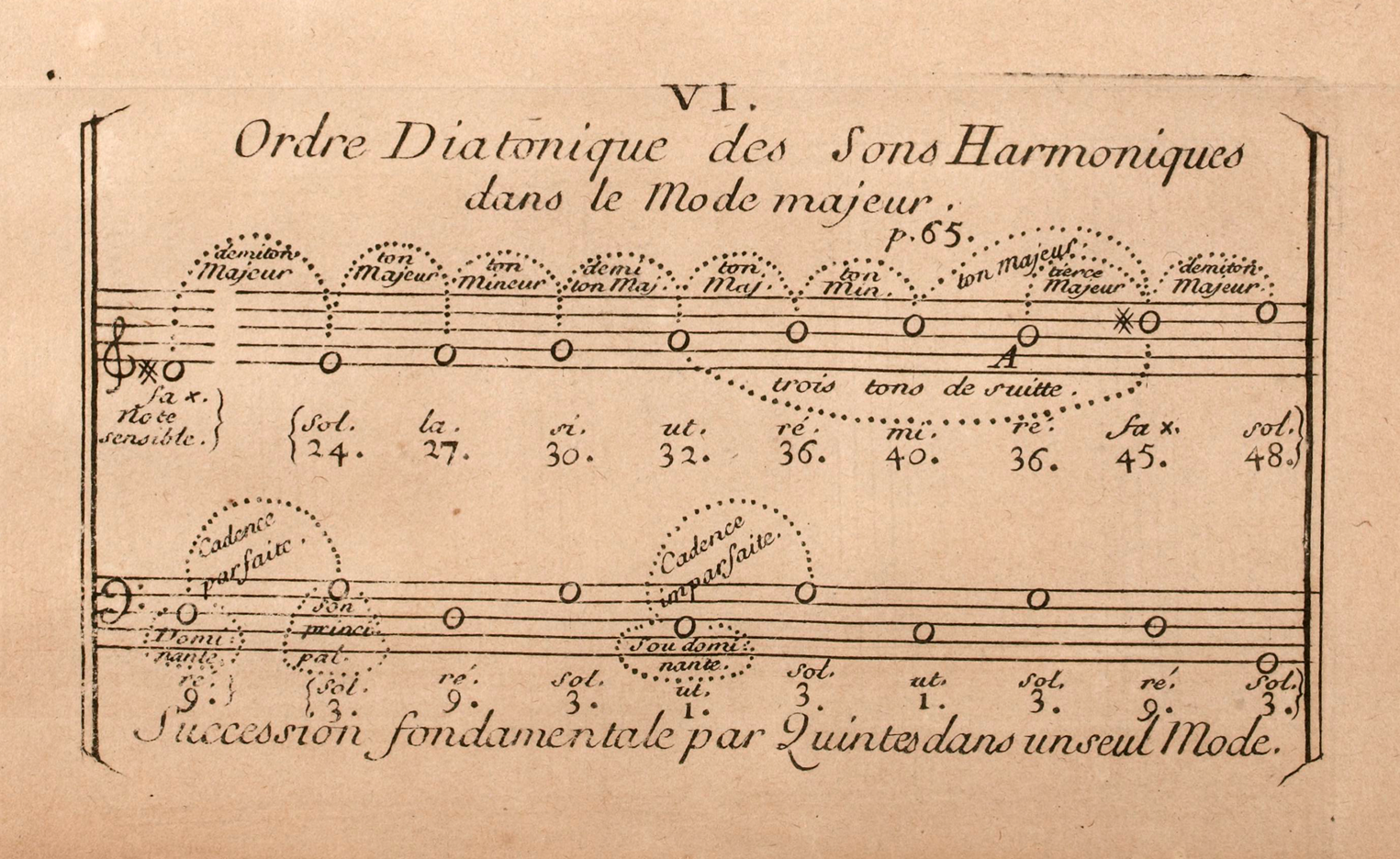
Chabanon's new dictum that music is a language apart from all others relates to Rameau's theory of the fundamental bass, which, as Allan Keiler has shown, functions as a metalinguistic system.Footnote 71 Rameau believes the fundamental bass, as a representation of harmonic succession and progression, behaves grammatically. Rameau introduced this notion first in his Nouveau systême, where he claims that any individual, regardless of musical experience, can sing the diatonic order of the scale because the principle of harmony rests within us. As shown in Figure 1, each note of the G major scale is conceptually accompanied by an implied fundamental bass, a phenomenon known as sous-entendu.Footnote 72 Here, the fundamental bass note  ${G \over 3}$ supports the melodic note
 ${G \over {24}}$; likewise, when the diatonic scale ascends, the fundamental bass note
 ${D \over 9}$, a fifth higher, supports
 ${A \over {27}}$; and so on. The individual sound represents only its constituent parts, whereas its successive ordering represents either a harmonic or melodic progression.Footnote 73 In this sense, the fundamental bass, through its well-formed connections (liaison en harmonie), acts as would a language. To Rameau's ear, then, a harmonic progression is governed by the pure tone relationships rooted in nature and thus conforms to a linguistic order.Footnote 74
Melodic derivation from Rameau's fundamental bass, in Jean-Philippe Rameau, Génération harmonique, ou Traité de musique théorique et pratique (Paris: Prault, 1737), example VI. Reproduced from gallica.bnf.fr
Tonal organization becomes something of a leitmotiv throughout Chabanon's writings. In the Éloge de M. Rameau, for instance, he explains that the ‘successive order’ of musical tones is ‘prescribed’ by nature and ‘immutable’.Footnote 75 Later in De la Musique considérée en elle-même, he maintains that we arrange pitches into their diatonic order because of our instinctive aurality (sous-entendu). With this autonomous rhetoric in hand, Chabanon resolves that individual sounds are themselves incapable of expressing meaning; but once chained together melodically, the whole has the means to transform into a referential semiotic system:
Toute sensation produite par un objet sans mouvement, ne peut guères être imitative, elle ne peut avoir aucune conformité avec nos actions, nos mœurs, nos caractères. Ne faites entendre qu'un son à l'oreille, & continuez-en la durée, cette sensation morte & inactive ne peindra rien à l'esprit. Au contraire, faites succéder plusieurs sons l'un à l'autre, ainsi que le fait la Musique, leur progression lente ou rapide, uniforme ou variée, leur donnera un caractère, & les rendra susceptibles d’être assimilés à d'autres objets.Footnote 76
Any sensation produced by an object without movement can hardly be imitative; it can have no conformity with our actions, our customs, or our characters. Just try to conceive of a sound in your ear and continue to sustain it; this lifeless and inactive sensation will depict nothing to the mind. On the contrary, make several sounds follow one another, as music does, and their slow or fast, uniform or varied progression gives them a character and renders them susceptible of being assimilated to other objects.
This rejection of individual ‘sound symbolism’ (to borrow from Claude Lévi-Strauss's estimation of Chabanon's writings) gives rise to Chabanon's rebuke of musical imitation.Footnote 77 Any sound merely represents itself, for ‘music has no dictionary’.Footnote 78
So, I ask again, how did eighteenth-century listeners experience emotion in and through music? Part of the answer lies within the human-harpsichord metaphor and its ability to attune (assimiler) music to the body's fibres. We feel a musical passage to be tender not because it mimetically represents ‘the same physical and spiritual condition’ we have in the case of a lover, parent or friend (all of which are different nuances of tenderness in Chabanon's view), but because ‘between the two situations – the one real, the other musical – the analogy is such that the mind agrees to take one for the other’ (‘Mais entre ces deux situations, l'une effective, l'autre musicale . . . l'analogie est telle, que l'esprit consent à prendre l'une pour l'autre’).Footnote 79 As he elaborates:
La théorie des Arts, considérée sous ce point de vûe, devient la théorie de nos sensations les plus délicates, & de nos goûts les plus exquis. Le Philosophe qui s'en occupe interroge chaque fibre du cœur, examine le rapport qu'elles ont toutes avec nos différens organes. Il contemple notre ame correspondante avec nos sens, qui, Ministres de ses affections, lui apportent le Plaisir & la douleur. Il réfléchit sur chacun de ces sens, qui, séparé des autres, isolé dans son poste, & n'ayant en apparence aucun moyen de communiquer avec eux, y communique cependant par la médiation de l'ame . . . C'est ainsi, (me pardonnera-t-on une comparaison si peu élevée?) c'est ainsi que l'araignée, placée au centre de sa toile, correspond avec tous les fils, vit, en quelque sorte, dans chacun d'eux, & pourroit . . . transmettre a l'un, la perception que l'autre lui auroit donnée.Footnote 80
Considered from this point of view the theory of the arts becomes the theory of our most delicate sensations and our most refined tastes. The philosopher who occupies himself with [this theory] questions each fibre of the heart and examines the relationship that they all have with our different organs. He contemplates that our soul communicates with our sensations, which, as ministers of its affections, furnish the soul with pleasure and sadness. The soul reflects on each of these senses, which, separated from the others, are isolated and have no apparent means of communicating with them. Nevertheless, each sense communicates through the mediation of the soul . . . It is as (will I be pardoned a less elevated comparison?) – it is the same as the spider that, located in the centre of its web, corresponds with all of its threads, and, to some degree, living in each of them, would be able . . . to transmit to one the perception that another would have given it.
Chabanon stresses instead a semiotics of association based upon indirect sensation. A musical sound tacitly transfers its reverberations to another internal yet unsounding sensitive fibre. The soul, located in a cluster of nerves in the middle of the autonomic system, mediates the transformation of musical sensation into bodily sentiment through its affective, analogical agency.Footnote 81
‘L'analogie’ – or what we today might call ‘association’ – displaces the older mimetic processes by way of music's sympathetic relationship with the listener. As a manifestation of the human-harpsichord trope, this network of string-like fibres becomes the mechanism by which the body relates (assimile) sounds to particular affective states. To Chabanon, music is first and foremost a sonic phenomenon that must be understood by the physical medium of sound vibration and its subsequent effect on the sympathetic parts of the body. The body, after all, is only an instrument, one that receives tones through its sensible fibres. We hear musical tones and then, at a secondary but immediate stage, relate those tones to a passionate response, one internalized through the very act of listening. Music thus is defined by and through this material reality, the ‘thing itself’: ‘What is music?’, he asks. ‘The art of sounds. Here we examine the individual properties of sounds, the cold, lifeless materials that this art animates and vivifies. By what means does it give them this existence, whence results a pleasure so lively and touching for our senses?’ (‘Qu'est-ce que la Musique? L'art des sons. Ici nous examinons les propriétés individuelles des sons, élémens premiers de l'art Musical, matériaux froids & sans vie, que cet art anime, & qu'il vivifie. Par quels proceeds leur donne-t-il cette existence, d'où il résulte pour nos sens un plaisir si vif & si touchant?’)Footnote 82 The embodiment of musical phenomena is the musical experience itself. The musical body comes to life.
The Aesthetics of Self-Reflexivity
Let us return to Rameau's Pigmalion. The composer was no doubt pleased with his self-conscious scoring of the corps sonore, proudly referring to its effect in his theoretical writings. One instance occurs in the Démonstration du principe de l'harmonie (1750):
La proportion harmonique donne la plus parfait harmonie qu'on puisse entendre, son effet est admirable, quand on sçait la disposer dans l'ordre qu'indique la nature . . . après l'avoir employée souvent sans succès, j'ai eû le bonheur de rencontrer à peu près tout ce qu'il falloit dans le chœur de l'Acte de Pigmalion, que j'ai donné l'Automne de 1748, où Pigmalion chante avec le chœur l’Amour triomphe. Et même encore dans la fin de l'Ouverture de ce même Acte.Footnote 83
The harmonic proportion [of the corps sonore] gives the most perfect harmony that could be heard. Its effect is admirable when a composer knows how to place it in the order that nature indicates . . . After having used it often without success, I have had the good fortune [of using it] when Pigmalion sings with the chorus ‘L'Amour triomphe’ from the acte de ballet Pigmalion, which I presented in the autumn of 1748. And even more so at the end of the overture of the same work.
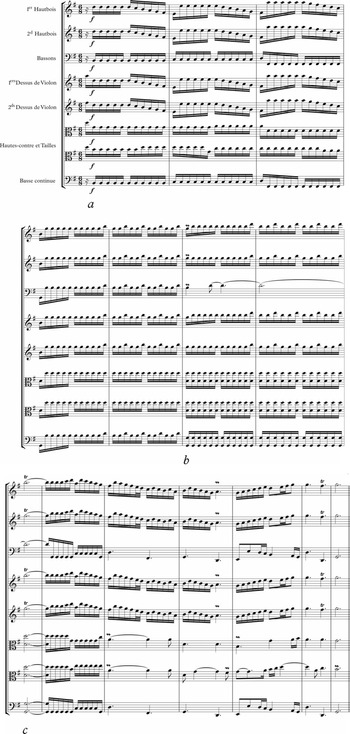
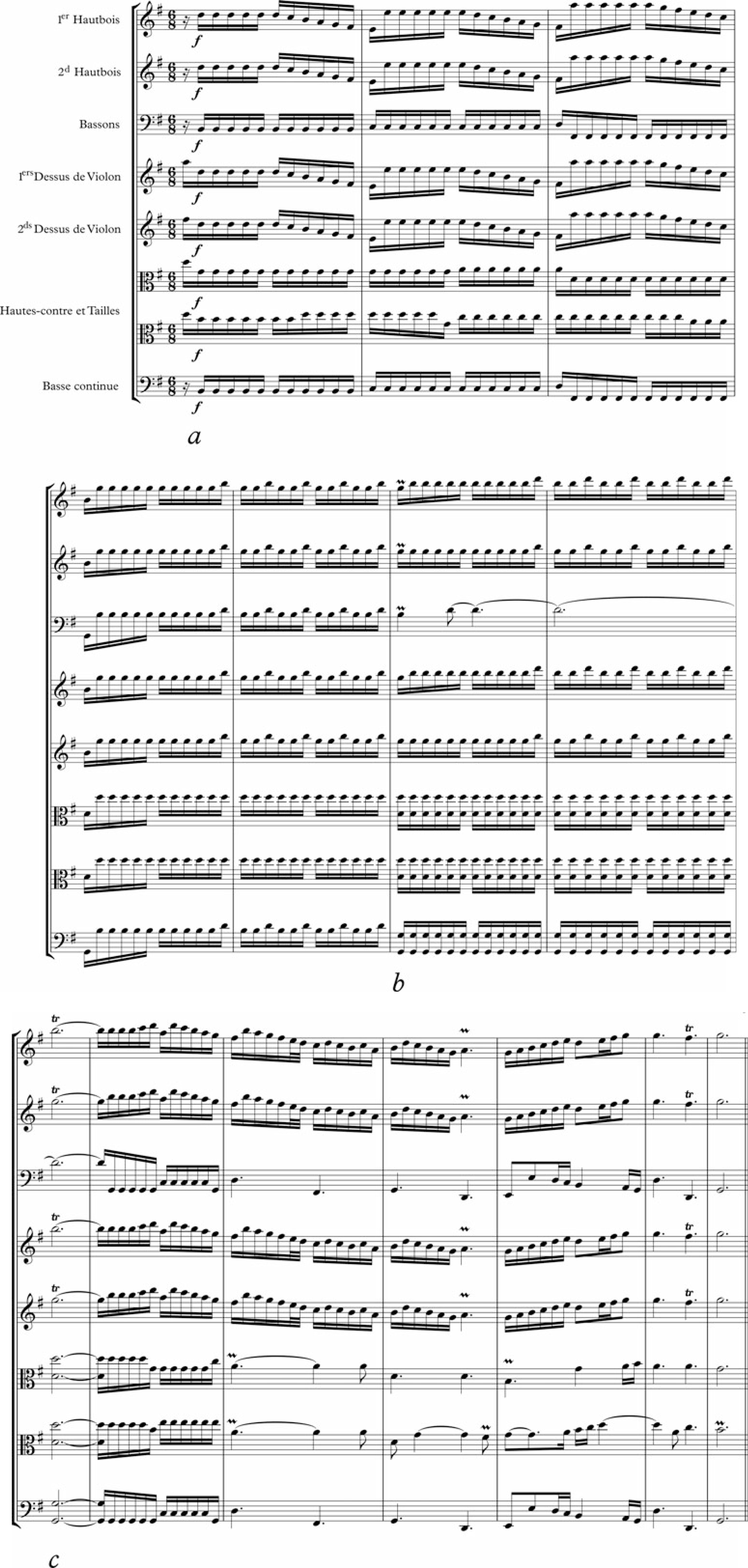
These two moments are noteworthy, Rameau claims, because they adhere to the exact harmonic proportions of their respective corps sonores.Footnote 84 ‘L'Amour triomphe’ from the fifth scene reinforces the central theme of the work – love's power to animate – through its own sonic representation of the corps sonore, which forges an intertextual link with the statue's transformation in Scene 3.Footnote 85 The final sentence of this passage, though, lands in a place with no possible textual allusion, pointing out the corps sonore at the end of the overture. Looking to the score provided in Example 2, the corps sonore (marked b in bar 70) emerges from a first-inversion triad at the beginning of the phrase (marked a in bar 65). And in case the audience missed it, Rameau emphasizes this moment by abruptly stopping the undulating semiquavers – except for the upper voices’ ornamentation of the sons harmoniques – which at last announces the corps sonore for all to hear (marked c in bar 72). Notably, this is the most drastic texture change in the reprise.
Rameau, Overture, Pigmalion, bars 65–78, transcription Stephen Kovaciny
We have encountered this moment before. At the outset of this article, I noted how Chabanon describes his own transformation, not by Cupid's flame, but by a flash of lightning and claps of thunder – in other words, the corps sonore ‘at the fortissimo of the reprise’. By attending to the emergence of corps sonore at the end of the overture, Chabanon is alerting his reader to its effect on him. Indeed, one would not be hard pressed to hear Chabanon's ‘what is music?’ as intoning Pigmalion's ‘what are these harmonious sounds?’; nor would it be a stretch to interpret Chabanon's enquiry into the music's animating effects as being a rephrasing of the sculpture's survey of her movements. When the cold marble statue comes to life later in the acte de ballet, it is because of the reverberation of the corps sonore. The music, through its sympathy, renders the lifeless sculpture foreign to what it once was, transfiguring the statue at will from a body to a musical body, and into enlightened harmony.
That said, the metaphor of transformation-as-becoming so central to the Pigmalion myth bears a resemblance to another familiar tale: Condillac's Traité des sensations. As discussed above, Condillac sought to reimagine his fictitious statue as the enlightened sensible subject, one who attains her own form of prosopopoeia and thus her personhood. Throughout the treatise, the statue's sensations endow it with only crude recognition of its objects. Condillac thus accounts for the statue and brings it into being through its own experiences. When it hears music, for instance, the sculpture experiences itself as being music. Eventually, through a combination of sensations, the statue develops more complex forms of cognition like judgment, memory and imagination (among others). These initial experiences apply solely to what occurs outside the statue's marble exterior, leaving it without proper knowledge of its body. To achieve this awareness, Condillac permits his creation the sense of touch. Upon caressing its marble flesh, the statue responds immediately ‘it's me’ (‘c'est moi’). The statue touches other parts of its body: ‘c'est moi, c'est encore moi’.Footnote 86 This dramatic moment of self-reflexivity arises from feeling its own experiences, from sensing its body's place within its sensory landscape. Unlike the other senses, which at first only transform the statue into what it is experiencing, touch grants the sculpture an instantaneous realization of subjectivity.Footnote 87
The theatricality of self-awareness central to the Traité des sensations provides a powerful allegory for Chabanon's emergent aural subjectivity. But given the nature of Chabanon's anecdote, and the fact that it appears in a eulogy for Rameau, I would be remiss not to draw from the composer–theorist himself, who provides a similar parable in the Démonstration du principe de l'harmonie. After placing himself into a state of musical innocence and naivety, Rameau recounts his own transformation:
Je me mis à regarder autour de moi, & à chercher dans la nature, ce que je ne pouvois tirer de mon propre fond, ni aussi nettement, ni aussi sûrement que je le désirois. Ma recherche ne fut pas longue. Le premier son qui frappa mon oreille fut un trait de Lumiere. Je m'apperçus tout d'une coup qu'il n’étoit pas un, ou que l'impression qu'il faisoit sur moi étoit composée.Footnote 88
I began to look around me and search in nature for what I could not draw from myself, neither as clearly nor as surely as I would have desired. My search was not long. The first sound that struck my ear was like a flash of light. I suddenly perceived that it was not one [single sound] but that the impression it made on me was composed [of several sounds].
Rameau's sudden realization that sounds are compound in nature proclaims awareness of his changing sensibilities. It is in this moment that he perceives the critical distinction between noise and sound, and implicitly transforms ignorance into knowledge: ‘voilà’, he says to himself, ‘there is the difference between noise and sound’ (‘voilà, me dis-je sur le champ, la différence du bruit & du son’).Footnote 89 But while Rameau experiences the flash of light, no thunder follows. Instead, we must wait fourteen years to get such satisfaction. Chabanon was also struck, both by the metaphorical bolt of lightning and his sudden realization, perceiving not the difference, but the relationship between the storm and the music. As if in the same state of musical innocence, he ends his story: ‘that which [Rameau] had conceived as a brilliant symphonie had become for us, by chance, a tableau.’Footnote 90
To re-enact the aesthetic passage from noise to sound is to entwine Rameau's story with his own. As if struck by the same trait de lumière, Chabanon hears the music as if for the first time and realizes something that was not there before: the music itself in all its purity as the corps sonore. The experience clearly had a profound effect on Chabanon – so profound, in fact, that he reiterates this anecdote again and again in his writings. The story appears both in the Observations sur la musique in 1779 and in De la Musique considérée en elle-même in 1785, though without a direct reference to the flash of lightning. The thunder as well as the point of the story nevertheless remain.Footnote 91 This amendment notwithstanding, the allegory's refrain-like appearances (to say nothing of Chabanon's several other references to the acte de ballet) attest to its importance. And after reliving it for a third time, he concludes with an emphatic plea to his readers: ‘Artist musicians, who reflect upon the practices of your art, does this example teach you nothing?’ (‘Artistes Musiciens, qui réfléchissez sur votre Art, cet exemple ne vous apprend-t-il rien?’).Footnote 92
Rameau's Statue
The questions we ask influence the answers we find. How we go about addressing them also matters. Supposing this reconstruction of Chabanon's version of the myth is correct, then what did he believe this example was teaching? Far from writing his question off as mere rhetorical flourish, a punchy and provoking way to conclude a serendipitous meeting between man and music, I think it only fair to take him at his word. We know now that his story serves to probe commonly held beliefs about music's role in aesthetic theory – namely, to challenge the dictum that music is an imitation of nature. We also know, through his broader use of analogy, that a piece of music and a natural event such as a storm need but a weak resemblance for one to portray the other. Because of their shared resonance, the corps sonore and the rumbling heavens are one and the same despite authorial intent. Rameau, after all, did not intend to depict a tempest. The rapid bowing of the strings instead forms the sound of hammer and chisel as it comes into contact with stone. Or so we are led to believe when the curtain rises to reveal Pigmalion gazing at his finished statue. Remember that the music, although important to the arc of Chabanon's narrative, is not his primary focus, nor is even the storm. Rather, it is the aesthetic perception of these features that seizes his attention. It is only after the thunder disperses that the music re-enters the frame. Beguiled by this experience, Chabanon remembers the very instant the music enthralled his sensorium, hearing in the music a change from a mere instrumental overture to something more: ‘You have seen that the overture to Pigmalion heard during a storm became, as a result, the storm's very portrayal. This example dispenses with the need of citing others’ (‘Vous avez vu que l'ouverture de Pygmalion, entendue au moment d'un orage, en étoit devenue la peinture parlante. Cet exemple dispense d'en citer d'autres’).Footnote 93
Thus, in the end, this has less to do with the music in question than it does the question of music. The rehearsal of circumstances underlying this encounter signifies something far more encompassing than a particular overture and a coincidental storm. The reference to this moment in the music, while provocative, serves to alert the reader to a deeper proposition, to a definitive moment, that Chabanon is mirroring in his account. Chabanon contends that music articulates its own aesthetic, one that necessitates a theory of bodily experience as distinct from the other arts – hence the title of his treatise, De la Musique considérée en elle-même, ‘of music considered on its own terms’.Footnote 94 In establishing an aesthetics of music based upon the shared materiality of sound and body, Chabanon realizes the full implications of the music itself, treating Rameau's music theory as a manifestation of music's aesthetic autonomy. After all, Rameau's music theory ‘is to harmony’, Castel famously declared, ‘what the human face is to man’ (‘La basse fondamentale est dans l'harmonie, ce qu'est le visage dans l'homme’).Footnote 95 Or, as Chabanon puts it: ‘one, like Pigmalion, models the statue; the other, like Cupid, touches it and makes it speak’ (‘L'un, comme Pygmalion [sic], modèle la Statue; l'autre, comme l'Amour, la touche & la fait parler’).Footnote 96 Music and its aesthetic are modelled from the same material, chiselled, as it were, from the same piece of stone, and granted the same voice. Through this rhetorical prosopopoeia – that is to say, endowing the music itself with name, face and voice – Chabanon ultimately comes to recognize his own voice in the music, an inner voice, that he believes allows the music to ask questions of us.Footnote 97
But to hear this as Chabanon's only locution would be to miss the larger point. Granting a voice to the statue in the acte de ballet, and thus to music in general, implies the subject(s) to whom music constitutes a voice. After all, eighteenth-century animated statues – those that move, speak, hear and sing – signify the collective self, the several musical persons attending an outdoor concert; indeed, they suggest an ‘us’.Footnote 98 To Chabanon, living in each of us is a passive and mutely responsive corps sonore waiting to be plucked, to be envoiced by the music – perhaps even prompting us to say ‘c'est moi’. In his newly acquired aesthetic form, Chabanon becomes the mouthpiece of a new aesthetics of music. Although the storm was circumstantial, the purpose of the tale is not. Chabanon is careful to choose this overture and this moment; he is mindful to reflect Rameau's language, and to articulate his point through the audience's shared auditory response to the sounding body. It is through the transformation from sensation to sentiment, from symphonie to tableau, and from ‘sounding body’ to ‘listening self’, that Chabanon becomes Rameau's statue. Chabanon himself transforms. And to read Chabanon's story in this light not only transforms how we might interpret his texts, but also adds to our understanding of the animated statue as a figure of eighteenth-century thought, and, perhaps most importantly, as an allegory for music and how we experience it.