


Introduction
Inflammatory bowel disease (IBD) consists of the gastrointestinal diseases Crohn’s disease and ulcerative colitis (Mittermaier et al., Reference Mittermaier, Dejaco, Waldhoer, Oefferlauber-Ernst, Miehsler, Beier and Moser2004). Crohn’s disease is an inflammatory illness of the intestinal tract from the mouth to the anus. Ulcerative colitis is limited to inflammation of the colon. Physical complaints patients with IBD may experience include bowel pains, diarrhoea, weight loss, fatigue, fever attacks, (perianal) fistulas, joint pain and mucus and blood in faeces (Graff et al., Reference Graff, Walker, Lix, Clara, Rawsthorne, Rogala and Bernstein2006; Greenley et al., Reference Greenley, Hommel, Nebel, Raboin, Li, Simpson and Mackner2010). The onset of the disease is usually between 15 and 30 years of age. Exacerbations of IBD can be intense and unpredictable and are often accompanied by the aforementioned symptoms (Husain and Triadafilopoulos, Reference Husain and Triadafilopoulos2004). Currently, the exact causal nature of IBD is unknown. Multiple factors (i.e. genetics, microbiota, environment and immune response) have a contribution to the aetiology of IBD (Zhang and Li, Reference Zhang and Li2014).
General dysfunctional beliefs about the world, others, and self (e.g. ‘I am a total failure’) make one vulnerable for depression and anxiety disorders, particularly when confronted with life stressors (Beck, Reference Beck1987; Beck et al., Reference Beck, Rush, Shaw and Emery1979). In line with this view, previous research has indicated general dysfunctional beliefs to be a risk factor for the onset of episodes of depression and anxiety disorders in a group of primary care attendees (Weich et al., Reference Weich, Churchill and Lewis2003). Whereas research has been conducted on the association between general dysfunctional beliefs and psychiatric disorders (i.e. anxiety, depression, bipolar disorder) among the general population (Alatiq et al., Reference Alatiq, Crane, Williams and Goodwin2010; Otto et al., Reference Otto, Teachman, Cohen, Soares, Vitonis and Harlow2007; Teasdale, Reference Teasdale1988), research into general dysfunctional beliefs among specific somatic disease groups is scarce. To the best of our knowledge, there is only one study investigating the assessment of general dysfunctional beliefs in IBD and irritable bowel syndrome (IBS) (Kovacs and Kovacs, Reference Kovacs and Kovacs2007). The results indicate that patients with IBS report more general dysfunctional beliefs compared with both IBD and healthy subjects, while IBD and healthy subjects did not differ with respect to these general dysfunctional beliefs.
Several studies investigated the role of specific illness beliefs (e.g. ‘My illness has major consequences for my life’) and their applicability to mental health behaviour in patients with medical conditions (e.g. myocardial infarction, type II diabetes) (Hagger et al., Reference Hagger, Hardcastle, Hingley, Strickland, Pang and Watts2016; Petrie et al., Reference Petrie, Jago and Devcich2007). Other studies among various chronic disease groups (i.e. atrial fibrillation, coronary artery disease, type II diabetes mellitus, multiple sclerosis) found associations between specific illness beliefs and psychological distress (Jopson and Moss-Morris, Reference Jopson and Moss-Morris2003; McCabe and Barnason, Reference McCabe and Barnason2012; Skinner et al., Reference Skinner, Khunti, Carey, Dallosso, Heller and Davies2014; Stafford et al., Reference Stafford, Berk and Jackson2009). Additionally, associations have been reported between specific patients’ illness beliefs about their psychiatric disorders (e.g. depression, eating disorders and schizophrenia) and the level of depressive and anxiety symptomatology (Baines and Wittkowski, Reference Baines and Wittkowski2013). Other studies have investigated the effect of specific illness beliefs on patients with IBD specifically (Dorrian et al., Reference Dorrian, Dempster and Adair2009; Han et al., Reference Han, McColl, Barton, James, Steen and Welfare2005; Kiebles et al., Reference Kiebles, Doerfler and Keefer2010; Knowles et al., Reference Knowles, Wilson, Connell and Kamm2011; Rochelle and Fidler, Reference Rochelle and Fidler2013; van der Have et al., Reference van der Have, Minderhoud, Kaptein, Leenders, Siersema, Fidder and Oldenburg2013). Generally, studies focusing on IBD found that specific (illness) beliefs had a significant direct influence on the level of depression and anxiety patients experienced (Dorrian et al., Reference Dorrian, Dempster and Adair2009; Knowles et al., Reference Knowles, Wilson, Connell and Kamm2011; Rochelle and Fidler, Reference Rochelle and Fidler2013).
Specific illness beliefs were shown to have a significant direct influence on the level of depression and anxiety in patients with Crohn’s disease (Knowles et al., Reference Knowles, Wilson, Connell and Kamm2011). Three other studies focused on both Crohn’s disease and ulcerative colitis (Dorrian et al., Reference Dorrian, Dempster and Adair2009; Kiebles et al., Reference Kiebles, Doerfler and Keefer2010; Rochelle and Fidler, Reference Rochelle and Fidler2013) and used the Revised-Illness-Perception-Questionnaire (IPQ-R) (Moss-Morris et al., Reference Moss-Morris, Weinman, Petrie, Horne, Cameron and Buick2002) to measure the influence of specific illness beliefs on psychological distress. Two studies found that specific illness beliefs are associated with adjustment to IBD (Dorrian et al., Reference Dorrian, Dempster and Adair2009; Kiebles et al., Reference Kiebles, Doerfler and Keefer2010). The third study found that negative specific illness beliefs were related to higher levels of anxiety and depression in patients with IBD (Rochelle and Fidler, Reference Rochelle and Fidler2013).
According to Beck’s Cognitive Behavioral Theory cognitive factors (both situation specific beliefs, such as specific illness beliefs and underlying general dysfunctional beliefs, described by other authors as core beliefs or schemata) are theorized to lead to outcomes such as anxiety and depression (Clark and Beck, Reference Clark and Beck2010). Our hypothesis is that, in line with the theory of Beck, general dysfunctional beliefs are just as, if not more, important as specific illness beliefs in targeting anxiety and depression in patients with a somatic illness.
Until now, no studies have investigated the comparison between general dysfunctional beliefs and/or specific illness beliefs and their association with anxiety and depressive symptomatology in patients with IBD. This study will focus on a subgroup of patients with IBD with a low level of mental quality of life (QoL) who participated in a randomized clinical trial investigating the effect of individual cognitive behavioral therapy on QoL, anxiety and depression, the so-called QL!C study (Bennebroek Evertsz’ et al., Reference Bennebroek Evertsz’, Bockting, Stokkers, Hinnen, Sanderman and Sprangers2012; Bennebroek Evertsz’ et al., Reference Bennebroek Evertsz’, Sprangers, Sitnikova, Stokkers, Ponsioen, Bartelsman and Bockting2017).
The aim of this study is to examine the unique contributions of general dysfunctional beliefs and specific illness beliefs (explanatory variables) to the explained variance of anxiety and depressive symptomatology (outcome variable) among patients with IBD with poor mental QoL, measured using the mental health subscale of the Medical Outcomes Study 36-item Short Form Health Survey (SF-36) (Bennebroek Evertsz’ et al., Reference Bennebroek Evertsz’, Bockting, Stokkers, Hinnen, Sanderman and Sprangers2012; Bennebroek Evertsz’ et al., Reference Bennebroek Evertsz’, Sprangers, Sitnikova, Stokkers, Ponsioen, Bartelsman and Bockting2017). We will specifically examine this objective in a patient subgroup with depressive disorder, anxiety disorders and/or adjustment disorders with anxiety and/or depressive symptomatology. We decided to add patients with an adjustment disorder to this group as within the group of patients with IBD many patients with adjustment disorders also have anxiety and/or depressive symptomatology. These patients seriously suffer from their somatic disease and treatment might be helpful, although adjustment disorders are differentiated from other mental disorders because of presumed differences in severity and consequences of the condition. Moreover, there are also studies indicating that in adjustment disorders the consequences can be severe (such as suicide), if not treated (Appart et al., Reference Appart, Lange, Sievert, Bihain and Tondeurs2017).
Method
Participants and recruitment procedure
IBD patients were consecutively recruited from the Academic Medical Centre (AMC), Vrije Universiteit Medical Centre (VUmc), the Slotervaart and the Flevo hospitals for participation in the QL!C study (Bennebroek Evertsz’ et al., Reference Bennebroek Evertsz’, Bockting, Stokkers, Hinnen, Sanderman and Sprangers2012; Bennebroek Evertsz’ et al., Reference Bennebroek Evertsz’, Sprangers, Sitnikova, Stokkers, Ponsioen, Bartelsman and Bockting2017). This is a cross-sectional observational design, i.e. baseline data were used of a randomized clinical trial. IBD was diagnosed and assessed by gastroenterologists at least 3–6 months before study entry. At the gastroenterology departments from the four participating medical centres, all patients with IBD were asked to complete the SF-36 (Ware and Sherbourne, Reference Ware and Sherbourne1992) as part of standard medical care. A three-step recruitment procedure was used. Firstly, patients with IBD were pre-selected with a score of ≤ 23 on the mental health subscale of the SF-36, indicative of poor mental QoL. The mental health subscale of the SF-36 consists of five items that require a response on a 6-point scale (range 5–30). The cut-off score of 23 is chosen, as scores of 23 or lower were found to be indicative of depression and anxiety in primary care patients, with a high level of sensitivity, but a rather low level of specificity (Means-Christensen et al., Reference Means-Christensen, Arnau, Tonidandel, Bramson and Meagher2005; van den Beukel et al., Reference van den Beukel, Siegert, van Dijk, Ter Wee, Dekker and Honig2012). Secondly, these patients were contacted by telephone to check if they were in need of psychological care and wanted to participate in the QL!C study and if so, a telephone-version of the semi-structured Structural Clinical Interview for DSM-IV Axis-I Disorders (SCID-I) interview (van Groenestijn et al., Reference van Groenestijn, Akkerhuis, Kupka, Schneider and Nolen1999) was administered. Finally, patients completed a set of online or printed questionnaires at baseline before randomization.
Inclusion and exclusion criteria
Eligible patients had to meet the following inclusion criteria: (1) diagnosis of Crohn’s disease or ulcerative colitis; (2) age above 18 years; (3) score of ≤23 on the mental health subscale of the SF-36; (4) physically and mentally able to attend eight weekly sessions; and (5) sufficient command of Dutch. Exclusion criteria were: (1) current psychotherapy; and (2) severe other psychiatric disorders (i.e. substance abuse, bipolar disorder, or psychosis) as assessed with the SCID-I (van Groenestijn et al., Reference van Groenestijn, Akkerhuis, Kupka, Schneider and Nolen1999).
Structural Clinical Interview for DSM-IV Disorders-I (SCID-I)
The SCID-I assesses Axis I psychiatric diagnoses (e.g. anxiety and depression disorders) and is a semi-structured clinical interview (van Groenestijn et al., Reference van Groenestijn, Akkerhuis, Kupka, Schneider and Nolen1999). The duration of administration can be up to two hours. The SCID-I was administered by telephone, by experienced psychologists who received a specific training by a clinical psychologist. These structural interviews were audiotaped and verified by a clinical psychologist.
General dysfunctional beliefs
General dysfunctional beliefs (attitudes) are measured by the Dysfunctional Attitude Scale (DAS) (Riskind et al., Reference Riskind, Beck and Smucker1983), a measure of depression-related beliefs. It consists of 40 items, for example ‘If a person asks for help, it is a sign of weakness’, ‘What other people think about me is very important’ and ‘My value as a person depends greatly on what others think of me’. Each item can be answered on a 7-point scale ranging from –3 (strongly disagree) to 3 (strongly agree). Higher scores indicate higher levels of general dysfunctional beliefs. The DAS demonstrates good reliability and convergent construct validity (de Graaf et al., Reference de Graaf, Roelofs and Huibers2009; Riskind et al., Reference Riskind, Beck and Smucker1983).
Specific illness beliefs
Specific illness-related beliefs (cognitions) are measured by the Revised Illness Perception Questionnaire (IPQ-R) (Moss-Morris et al., Reference Moss-Morris, Weinman, Petrie, Horne, Cameron and Buick2002). This questionnaire consists of seven subscales. The consequences subscale (6 items) describes the effect of the disease on physical (‘My illness is a serious condition’), psychological (‘My illness has major consequences on my life’) and social functioning (‘My illness causes difficulties for those who are close to me’). The personal and treatment control subscales (both 6 items) contain questions about whether the illness or its effects can be modified by personal interference (‘What I do can determine whether my illness gets better or worse’) or treatment interference (‘My treatment can control my illness’), respectively. The emotional representation subscale (6 items) expresses the experienced negative emotions caused by the illness. The illness coherence subscale (5 items) measures the patient’s understanding of his or her illness. The timeline acute/chronic subscale (6 items) incorporates questions on the extent to which the illness is regarded as being chronic or acute and the subscale timeline cyclic (4 items) represents the perceived changeability of the illness symptoms.
Each item can be answered on a 5-point Likert scale, ranging from 1 (strongly disagree) to 5 (strongly agree). Low scores on the two subscales personal control and treatment control indicate dysfunctional illness-related beliefs, and low scores on the other subscales indicate functional illness-related beliefs. The IPQ-R is considered a valid measure of illness perceptions in mental health in patients with several somatic diseases (Baines and Wittkowski, Reference Baines and Wittkowski2013).
Anxiety and depressive symptomatology
Anxiety and depressive symptoms combined were assessed as the total score on the standardized and validated Hospital Anxiety and Depression Scale (HADS) (Spinhoven et al., Reference Spinhoven, Ormel, Sloekers, Kempen, Speckens and VanHemert1997). The HADS-total consists of 14 items, divided into two 7-item subscales for anxiety and depression, which range from 0 (no complaints) to 21 (maximum complaints). Scores are derived by summing responses for each of the two subscales or for the scale as a whole. Higher scores indicate greater levels of anxiety or depressive symptomatology (Spinhoven et al., Reference Spinhoven, Ormel, Sloekers, Kempen, Speckens and VanHemert1997). The HADS yields good levels of reliability and validity in assessing anxiety disorders and depression in patients and in the general population (Bjelland et al., Reference Bjelland, Dahl, Haug and Neckelmann2002; Spinhoven et al., Reference Spinhoven, Ormel, Sloekers, Kempen, Speckens and VanHemert1997).
Statistical analysis
In case of missing data, we used multiple imputation as this is the preferred approach leading to less bias and more statistical power compared with complete case analyses (Rubin, Reference Rubin1987). We used a set of ten imputations for each missing data point, and analyses of the resulting ten datasets were subsequently pooled using the established Rubin’s rules (Rubin, Reference Rubin1987). Ten data sets are generally considered amply sufficient to account for missing data uncertainty (de Graaf et al., Reference de Graaf, Ten Have and Dorsselaer2010). The imputation model included all variables used in the analyses as recommended (de Graaf et al., Reference de Graaf, Ten Have and Dorsselaer2010). We imputed under the assumption that the missingness mechanism was missing at random (MAR) or missing completely at random (MCAR).
Bivariate Pearson’s correlations between the DAS total score and the IPQR subscales were calculated to examine the degree of overlap between the two questionnaires.
To examine the non-unique (univariable) and unique (multivariable) contribution of general dysfunctional beliefs and specific illness beliefs to the explained variance of anxiety and depressive symptomatology, a series of linear regression analyses were performed. In each of these analyses, the DAS total score and the IPQR subscale scores served as independent variables and the HADS-total score as the dependent variable. First, the associations between the DAS total score and the IPQR subscale scores with the HADS-total score were analysed separately using univariate regression models. Second, we used a multivariable regression model to investigate the unique association of the DAS total score and all seven IPQR scores with the HADS-total score. In subsequent analyses, we studied the extent to which the specific illness beliefs had added predictive value over and above the general dysfunctional beliefs by evaluating whether the model improved when the total set of IPQR variables were added to the DAS. Improvement in predictive power was assessed in terms of R 2 change and its statistical significance using the F-test. The same procedure was followed to evaluate the reverse, i.e. the added value of DAS total to IPQR subscales. In addition, we repeated the analyses while adjusting for the potential confounders (i.e. gender, being in a relationship (yes/no), level of education (low or high), being employed (yes/no), and number of operations (as a proxy for IBD severity)) by adding them as independent variables in the regression equations.
The analyses of model improvement were repeated within a subsample of patients with IBD who have a depressive disorder and/or anxiety disorder, and/or an adjustment disorder with anxiety and/or depressive symptomatology. As pooled results for analyses of model improvement were unavailable, results of unimputed data were reported. For reasons of statistical power, we refrained from adjustment for potential confounders in these subsample analyses. Furthermore, the results of these subgroup analyses must be considered exploratory as we did not formally assess the statistical significance of the interaction between the presence of one of these disorders on the one hand and the general dysfunctional beliefs and specific illness belief items on the other, due to lack of statistical power.
The level of statistical significance was set at 0.05, two-sided. In addition to p-values, we report unstandardized regression coefficients (B) with confidence intervals to indicate their range of likely values. In addition, we report standardized regression coefficients (β) to evaluate the size of effects, where values of .1, .3 and .5 can be interpreted as indicating small, medium and large effects, respectively (Cohen, Reference Cohen1988). The adjusted R 2 is used to evaluate the explained variance of the HADS-total score. All analyses were performed using IBM SPSS Statistics version 20.0.
Results
Demographic and clinical characteristics
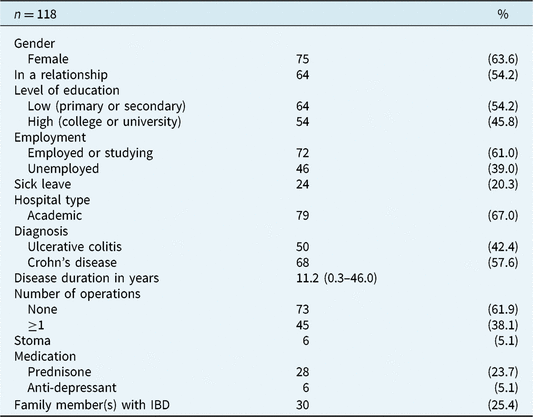
Demographic and clinical characteristics of the participants with IBD and poor mental QoL of the QL!C study (n = 118) are summarized in Table 1. Nearly two-thirds (63.6%) of the IBD sample was female, and the mean age was 39.0 years (range 19.4–76.5).
Demographic and clinical baseline characteristics of the subgroup of patients with IBD and poor mental QoL

Values are means (SD) unless stated otherwise.
Association of general dysfunctional beliefs and specific illness beliefs with the level of anxiety and depressive symptomatology
Missing values for HADS were 5%, for DAS 7%, and for IPQR 14%. These missing data were replaced using multiple imputation. The correlations between the subscales of the IPQ-R and the DAS were close to zero (all < .1) and not significant, indicating that the two questionnaires provide distinct information.
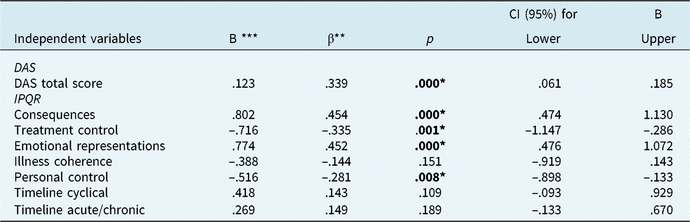
Univariate analyses showed significant associations between the level of anxiety and/or depression (HADS) and general dysfunctional beliefs as measured by the DAS total and four IPQR subscales (respectively: consequences, personal control, emotional representations and treatment control; see Table 2).
Univariate analysis: association of general dysfunctional beliefs (DAS-total) and specific illness beliefs (IPQ-R) with anxiety and depressive symptomatology (HADS-total)

Dependent variable: HADS-total. CI (95%) = 95% confidence interval.
*** B is the unstandardized regression coefficient, where 1 point increase in the predictor variable (e.g. DAS total score) is associated with B point(s) increase in the dependent variable (i.e. HADS total score).
** β is the standardized regression coefficient, where 1 standard deviation increase in the predictor variable (e.g. DAS total score) is associated with β point(s) increase in the dependent variable (i.e. HADS total score). Standardized βs were based on the original unimputed data.
* Bold values are significant (p < .05).
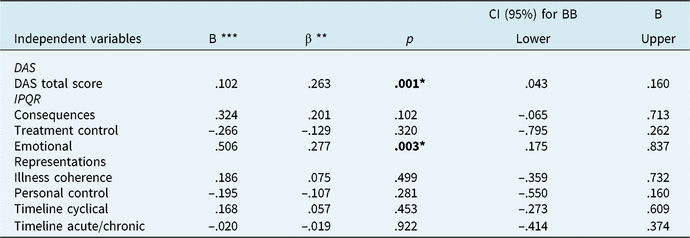
Multivariable analysis: independent contributions of specific illness beliefs (IPQR) and general dysfunctional beliefs (DAS-total) in the prediction of anxiety and depression symptomatology (HADS-total)

CI (95%) = 95% confidence interval
*** B is the unstandardized regression coefficient, where 1 point increase in the predictor variable (e.g. DAS total score) is associated with B point(s) increase in the dependent variable (i.e. HADS total score)
** β is the standardized regression coefficient, where 1 standard deviation increase in the predictor variable (e.g. DAS total score) is associated with β point(s) increase in the dependent variable (i.e. HADS total score). Standardized βs were based on the original unimputed data.
* Bold values are significant (p < .05)
Unique association of general dysfunctional beliefs or specific illness beliefs with anxiety and depression symptomatology
General dysfunctional beliefs and specific illness beliefs explained 14.9 and 25% of the variance of HADS-total, respectively.
In the multivariate regression analysis (see Table 3), both the general dysfunctional beliefs (DAS total) and the IPQR subscale emotional representations showed a significant unique association (i.e. remained statistically significant) with depression and anxiety (HADS-total).
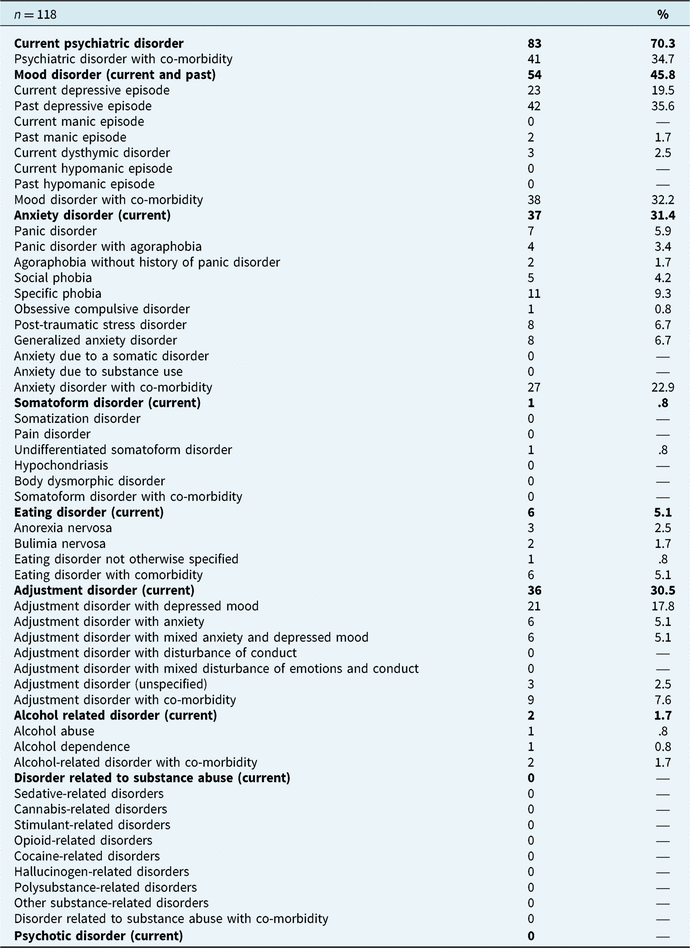
Prevalence of psychiatric disorders among patients with IBD and poor mental QoL

Psychiatric disorders are not mutually exclusive, patients could have more than one psychiatric disorder.
The added value of the DAS relative to IPQR was investigated. The results indicate that the DAS provides a unique contribution over and above the IPQR subscales in their association with the level of anxiety and depression (HADS-total) (IPQ-R added to DAS: R 2 change = 0.264, F change = 5.38, p < 0.001 and DAS added to IPQR: R 2 change = 0.066, F change = 9.41, p = 0.003).
Adjustment for potential confounders in both the univariable and multivariable analyses did not change the conclusions. The pattern of statistical significance remained unaltered while unstandardized regression coefficients decreased less than 25% upon adjustment.
The prevalence rates of DSM-IV psychiatric disorders among the patients with IBD are summarized in Table 4. Among 78 patients with IBD and psychiatric disorders (i.e. depressive disorder and/or anxiety disorders and/or an adjustment disorder with anxiety and/or depressive symptomatology), the DAS had statistically significantly added predictive value for anxiety and depression, not vice versa (DAS added to the IPQ-R: R 2 change = 0.074, F change = 5.316, p = 0.025 and IPQ-R added to DAS: R 2 change = 0.187, F change = 1.926, p = 0.083). Analyses were based on 63 patients with complete baselines.
Discussion
Our study shows that general dysfunctional beliefs of patients with IBD are associated with the level of anxiety and depression. Specific illness beliefs in the domains of illness consequences, personal-, and treatment control and emotional representations of the illness are, according to the univariate analysis, also associated with anxiety and depression in the total patient group. The specific illness beliefs combined were superior in explaining unique variance in depressive and anxious symptoms compared with the general dysfunctional beliefs.
Our findings regarding specific illness beliefs indicate that patients with IBD who believe that their illness has serious consequences and patients who have negative emotions related to their illness are more likely to have a higher level of anxiety and depression. Moreover, patients with a low sense of illness control (due to treatment or their own behaviour) report more anxiety and depressive symptoms. Similar results are found in previous studies, investigating the association between perceived serious consequences of patients’ illness and psychological distress in various chronic disease groups (i.e. atrial fibrillation, rheumatoid arthritis, multiple sclerosis, coronary artery disease, cardiovascular disease and type 2 diabetes mellitus) (Grace et al., Reference Grace, Krepostman, Brooks, Arthur, Scholey, Suskin and Stewart2005; Groarke et al., Reference Groarke, Curtis, Coughlan and Gsel2004; Jopson and Moss-Morris, Reference Jopson and Moss-Morris2003; McCabe and Barnason, Reference McCabe and Barnason2012; Skinner et al., Reference Skinner, Khunti, Carey, Dallosso, Heller and Davies2014; Stafford et al., Reference Stafford, Berk and Jackson2009). Prior research on the influence of personal or treatment control on psychological distress showed mixed results for various disease groups (Grace et al., Reference Grace, Krepostman, Brooks, Arthur, Scholey, Suskin and Stewart2005; Groarke et al., Reference Groarke, Curtis, Coughlan and Gsel2004; Jopson and Moss-Morris, Reference Jopson and Moss-Morris2003; McCabe and Barnason, Reference McCabe and Barnason2012; Skinner et al., Reference Skinner, Khunti, Carey, Dallosso, Heller and Davies2014; Stafford et al., Reference Stafford, Berk and Jackson2009). The association found for negative emotions is in agreement with the findings of an earlier study among patients with IBD (Dorrian et al., Reference Dorrian, Dempster and Adair2009).
General dysfunctional beliefs (but not specific illness beliefs) provided a unique contribution to the association with anxiety and depressive symptomatology in the subsample of patients with IBD with depressive disorder, anxiety disorders and/or adjustment disorders. Therefore psychological interventions in patients with IBD with a co-morbid depressive disorder, anxiety disorders, and adjustment disorders might have to specifically target general dysfunctional beliefs especially instead of specific illness beliefs. A common psychological treatment to treat depression and anxiety is cognitive behavioural therapy, based on Beck’s cognitive model (Beck, Reference Beck1987; Beck et al., Reference Beck, Rush, Shaw and Emery1979). Cognitive therapists teach patients to identify and challenge their enduring general dysfunctional beliefs as well as automatic negative thoughts (such as specific illness beliefs). Moreover, several studies (Ellis, Reference Ellis2000) suggested changing both general dysfunctional beliefs and specific illness beliefs to make patients more resilient to a broader range of future life events. Future studies are needed to investigate the added value of addressing specific illness beliefs above general dysfunctional beliefs on therapy outcomes.
Overall, no association was found between the level of anxiety and depression on the remaining patient’s specific illness beliefs, i.e. understanding their illness, the extent to which the illness is perceived as being chronic or acute and the perceived changeability of the illness. This finding is not totally surprising as earlier studies on IBD (Dorrian et al., Reference Dorrian, Dempster and Adair2009; Kiebles et al., Reference Kiebles, Doerfler and Keefer2010) and atrial fibrillation (McCabe and Barnason, Reference McCabe and Barnason2012) showed inconsistent results with regard to the relationship between patient’s understanding of their illness and psychological distress. In two studies a better understanding was found to correlate with lower levels of psychological distress (Dorrian et al., Reference Dorrian, Dempster and Adair2009; McCabe and Barnason, Reference McCabe and Barnason2012) whereas another study also did not find an association (Kiebles et al., Reference Kiebles, Doerfler and Keefer2010). This inconsistent relationship might depend on factors such as coping styles, personal characteristics, and the severity of the illness.
With respect to the perceived chronicity or the acuteness of the disease (subscale ‘timeline’ of the IPQ-R), our findings are in line with previous research. Other studies focusing on IBD (Dorrian et al., Reference Dorrian, Dempster and Adair2009; Kiebles et al., Reference Kiebles, Doerfler and Keefer2010) and atrial fibrillation (McCabe and Barnason, Reference McCabe and Barnason2012) similarly did not find an association with psychological distress. In contrast to our study, perceiving symptoms as cyclic and unpredictable (i.e. the perceived changeability of the illness) was reported to be a risk factor for anxiety (Dorrian et al., Reference Dorrian, Dempster and Adair2009; McCabe and Barnason, Reference McCabe and Barnason2012). We have no explanation for these inconsistent results.
Some limitations of this study merit attention. Because our findings are based on cross-sectional data, we cannot infer a causal relationship between general dysfunctional beliefs and/or specific illness beliefs and the level of anxiety and depression. Prospective research is needed to examine this causality.
Additionally, we stated that psychological interventions in patients with IBD with a co-morbid depressive disorder, anxiety disorders, and adjustment disorders might have to target general dysfunctional beliefs especially instead of specific illness beliefs. Further research is suggested as this finding was demonstrated in a limited sample and was therefore considered exploratory.
This study has several strengths. Firstly, recruitment of patients with IBD took place in two academic and two peripheral medical centres. As these centers treat patients with different severity, the results are likely to apply to a wide spectrum of patients with IBD, enhancing the generalizability of this study. Secondly, we selected patients with IBD with a poor level of mental QoL. These patients suffer most and are the ones who are most in need of psychological help. To the best of our knowledge, no study has previously selected patients based on their initial well-being. Lastly, in our study, we used the SCID-I (van Groenestijn et al., Reference van Groenestijn, Akkerhuis, Kupka, Schneider and Nolen1999) that is regarded as the ‘gold standard’ when it comes to determining the accuracy of psychiatric diagnoses.
Conclusions
Both general dysfunctional beliefs and some specific illness beliefs were found to be associated with anxiety and depressive symptomatology. Particularly, psychological interventions may have to target especially general dysfunctional beliefs of patients with IBD with co-morbid psychiatric disorders to be effective, as is common in CBT. It should be noted that this only applies to those who have poor mental QoL.
According to our previous research (Bennebroek Evertsz’ et al., Reference Bennebroek Evertsz’, Sprangers, Sitnikova, Stokkers, Ponsioen, Bartelsman and Bockting2017), prevalence of psychiatric disorders in patients with IBD with poor mental QoL was found to be high. The used screening procedure in which patients are screened on QoL and subsequently on psychiatric disorders appeared to be feasible in the hospital environment. In general, our research findings underline the need for psychological treatment for this group of patients with IBD.
Acknowledgments
We acknowledge the contribution of I.M. Olsthoorn for her support in the reference preparation and review of earlier drafts of the article.
Conflicts of interest
The authors declare that they have no competing interests. F. Bennebroek Evertsz’ received an unrestricted research grant from Scheringh and Plough of 20.000 euros to study psychological factors in IBD.
Ethical statements
Authors have abided by the Ethical Principles of Psychologists and Code of Conduct as set out by the APA. The QL!C study protocol (F. Bennebroek Evertsz’ et al., Reference Bennebroek Evertsz’, Bockting, Stokkers, Hinnen, Sanderman and Sprangers2012) was approved by the MEC of the AMC Amsterdam and confirmed by the institutional ethics review committees from the participating medical centers (i.e. Flevo Hospital, Slotervaart Hospital, VUmc).
Financial support
The research was funded by a Grant from the non-commercial Stomach Liver Bowel Foundation (Maag Lever Darm Stichting, MLDS) from the Netherlands (registration number: WO 07-45).
Authors’ contributions
F.B.E., C.B., M.S. and R.S. designed the study. F.B.E. drafted the paper (which was added and modified by all other authors) and was responsible for the supervision of the psychologists who administered the SCID-I by telephone. H.B. and M.G.E.V. contributed to the analytic strategy. All authors read and approved the final manuscript.



Comments
No Comments have been published for this article.