Introduction
The debate on medical priority setting has raged ever since the establishment of the so-called Oregon list in the United States in the beginning of the 1990s. A number of western countries (for instance Canada, the Netherlands, and Sweden to name a few) have since then made an effort to introduce explicit priority setting in health-care decisions. Although different approaches have been used, the development of explicit priority setting in most countries has taken place at a national health-care level, particularly entailing the establishment of guidelines in terms of ethical principles and ranking lists as grounds for priority setting (Ham et al., Reference Ham, Robert, Martin and Singer2003).
In Sweden, an ethical platform was set up in 1997, stipulating that priority setting in health-care (including pharmaceuticals) should be based on three ethical principles: (1) human dignity, (2) need and solidarity, and (3) cost-effectiveness (Ministry of Health and Social Affairs, 2000). The second principle – need and solidarity – is in accordance with the general Swedish welfare model, which implies that those who are in less urgent need of health-care should, in solidarity towards those of greater need, stand back in favour of the latter. Based on these principles, guidelines were established dividing health care into four groups of priority, three of which were to be provided by the Swedish welfare system:
Priority I (e.g. life-threatening diseases or conditions, diseases that would result in untimely death or permanent disability without health care, severe chronic diseases, palliative care and care of patients with impaired autonomy);
Priority II (e.g. prevention and rehabilitation);
Priority III (e.g. health care of less severe acute and chronic diseases and injuries);
Priority IV (e.g. health care for other reasons than disease or injury).
In a manner similar to the situation in other western countries, the Swedish guidelines have been criticized for not being applicable in clinical practice. The implementation of priority-setting guidelines has therefore been anything but easy, and few concrete solutions tend to survive politically.
Accountability for reasonableness
The many problems associated with the implementation of general ethical principles as guidelines for priority setting have resulted in a second phase in the international priority-setting debate, a phase in which the focus is on processes rather than on ethical principles (Holm, Reference Holm1998). In the absence of consensus regarding the relevance of ethical principles, it has been argued that priority setting is legitimate if everyone agrees on a fair priority-setting procedure: so-called accountability for reasonableness (Daniels and Sabin, Reference Daniels and Sabin1997). By linking the means of priority setting to theories of democratic deliberation, fair and legitimate priority setting is thus seen to be dependent on the satisfaction of four conditions:
publicity – the decisions (including the rationales) must be publicly available;
relevance – fair-minded people must agree that the decisions are aimed at pursuing appropriate patient care under resource constraints;
revisability/appeals – it must be possible to appeal against the decisions in a fair appeals procedure, in the light of new information; and
enforcement/regulation – there must be some kind of regulation guaranteeing the three conditions described above.
According to this normative framework, the condition of publicity enables stakeholders to study the pattern of decisions over time, and assess whether like cases are treated alike (Daniels and Sabin, Reference Daniels and Sabin1997). The fulfillment of the second and third conditions is thought to increase the probability of voluntary rather than forced compliance by creating incentives for the decision-maker to involve stakeholders in the decision-making process and thereby decrease the probability of subsequent appeal. More recently, a fifth condition has been added for legitimate priority-setting procedures, namely a public understanding of the necessity of limiting access to health care due to limited health-care resources (Daniels and Sabin, Reference Daniels and Sabin2002). The addition of an extra condition has been justified by a greater awareness that the design of public information regarding the rationales and arguments plays an essential role for success in increasing public understanding or ‘social learning’ (Daniels et al., Reference Daniels, Teagarden and Sabin2003).
On the basis of research on how priority-setting decisions for new medical technologies are in fact made in Canada, Singer and colleagues (2000) as well as Gibson and colleagues (2002), argue that six elements – rather than four or five – characterize fair and legitimate priority-setting processes empirically: (1) the institution where the decision was made, (2) the people who participated in the decision making, (3) factors considered important for decision making, (4) reasons, (5) process, and (6) appeals. Hence, it is argued that when such a process is explored attention should be paid to each of these six elements with concomitant questions. In accordance with this view, Martin et al. (2001) conclude that priority-setting rationales change with the context and that priority-setting rationales involve clusters of factors rather than simple trade offs.
Accountability for reasonableness and central drug reviews
Prescription drugs are one of the fastest-growing cost components in most modern health care systems. Efforts to control escalating costs, while simultaneously maximizing population health outcomes, have led many countries to implement priority setting by the means of restrictive criteria on the funding of new original pharmaceuticals and other expensive health technologies. The Australian Pharmaceutical Benefits Advisory Committee (PBAC) was one of the first examples of this new order, requiring health economic evaluations in support of applications for the listing of new pharmaceuticals on its schedule of pharmaceuticals benefit (Henry, Reference Henry1992). Since then, a number of western countries have caught on to this trend of centralized drug reviews (see for instance Anell, Reference Anell2004; McMahon et al., Reference McMahon, Morgan and Mitton2006; Morgan et al., Reference Morgan, McMahon, Mitton, Roughead, Kirk, Kanavos and Menon2006a, Reference Morgan, McMahon and Mitton2006b), demanding health economic evidence supporting reimbursement.
Priority setting in health care occurs at the macro-, meso-, and the micro-levels. However, research concerned with the evaluation of priority-setting processes considered against theories of accountability of reasonableness has primarily focused on decision making at the hospital level (see for instance Bell et al., Reference Bell, Hyland, DePellegrin, Upshur, Bernstein and Martin2004; Martin et al., Reference Martin, Shulman, Santiago-Sorrell and Singer2003a, Reference Martin, Walton and Singer2003b). In addition, little attention has been paid to examining the institutional conditions within which priority-setting decisions are made (Gibson et al., Reference Gibson, Martin and Singer2005). Although there is a growing literature describing central drug review processes, there have only been a few evaluations of the review processes in terms of fairness of priority-setting procedures carried out in Canada, New Zealand, Australia, and the UK (Mitton et al., Reference McMahon, Morgan and Mitton2006) and Canada (Ontario), Norway, and Uganda (Kapiriri et al., Reference Kapiriri, O.F. and D.K.2006). This previous research has primarily focused on evaluating priority-setting processes against the framework set up by theories of accountability of reasonableness and comparisons between the differing health care systems. This means that there is little understanding of what implementing accountability of reasonableness actually brings about.
Aim of the paper
In October 2002, a central drug review authority – the Swedish Pharmaceutical Benefits Board (LFN) – was introduced in Sweden. The LFN is charged with making decisions on the reimbursement status of medical products, primarily pharmaceuticals, based on applications from pharmaceutical companies. Drugs approved by the Swedish Medical Products Agency (MPA) are thus no longer automatically included in the pharmaceutical benefits system. Although the main objective of the LFN is to optimize the use of drugs from a societal perspective, the authority is also commissioned to increase transparency in priority setting in health-care. The aim of this paper is threefold: to describe the priority-setting procedure for new original pharmaceuticals at the LFN, to analyse the outcome of the procedure in terms of decisions and the relative importance of ethical principles, and to examine the reactions of stakeholders.
Methods
Design
The findings in this report are based on a qualitative case study of decision making regarding the reimbursement for new pharmaceuticals in Sweden. A case study methodology was chosen as priority setting by reimbursement authorities is complex, social and context dependent, and since a central tendency among all types of case studies is that it tries to illuminate a decision or set of decisions, why they were taken, how they were implemented, and with what result (Yin, Reference Yin2003).
Setting
A number of important health-care reforms have been introduced in Sweden since 1997, with the aim of increasing cost control or cost-effective use of pharmaceuticals. While several previous reforms, i.e. introduction of parallel trade, increased user-charges, and mandatory formulary committees and decentralized drug budgets, mainly focused on an increased cost control, some more recent health-care reforms have come to focus on increased cost-effectiveness (Anell and Persson, Reference Anell and Persson2005). In October 2002 mandatory generic substitution and a centralized review process to assist in making drug coverage decisions managed by the Pharmaceutical Benefits Board (LFN) were introduced in Sweden. Although the county councils are financially responsible for the drug budgets, Swedish prescribers have, with few exceptions, a statutory right of free prescription of pharmaceuticals. The mandatory formulary committees in all of Sweden’s 21 county councils are primarily responsible for inducing an increasing cost awareness among prescribing physicians, and follow up on prescription patterns and drug costs within each county council.
Sampling and data collection
In general, two major sampling techniques were used in this study. First attempts were made to identify all key participants involved in the priority-setting procedure in general, as well as all publicly available documents relating to priority setting at the LFN (e.g. information sheets, educational material directed towards prescribers, patients, and applying companies and written published decisions). Second, individuals and documents that were identified as representing an important role or viewpoint in some illustrating cases of the priority-setting process were included.
This study is based on data such as public documents, records, articles in media, and interview data. In order to investigate the decision-making process, the outcomes of the decision making, and reactions from stakeholders, data sources have been of varying importance in different parts of the study.
In order to map out the decision-making process at the LFN, two chief sources of data were used. The first source was official documents, records, and Acts regulating the decision-making process, as well as the prescribed duties of the authority. In this study, documents published in the 1990s gave information on the historical context of priority setting at Swedish reimbursement authorities, while more contemporary documents provided perspectives on those overarching regulations, restrictions, and guidelines at the national level that affect the actual decision making. The amount of documents as well as their quality and public accessibility afforded insight into the transparency of the process. The second source of data was semi-structured interviews with representatives of the LFN and major stakeholders, conducted in order to receive a more complete picture of the decision-making context. In total, five face-to-face interviews were conducted with this main purpose, involving representatives of the LFN, The Federation of Swedish County Councils, The Swedish Association of the Pharmaceutical Industry, The Swedish Medical Association, and The Swedish Disability Federation.
The main sources for the analysis of final decisions and the relative importance of ethical principles were official documents and records. All publicly available decisions by the LFN made from October 2002 to August 2005 were studied retrospectively. In order to analyse the occurrence of increased social learning and the reactions to the decision making, six cases of decisions were studied in greater detail. The selection of the six cases was based on the following criteria:
the case was classified as being of ‘principal importance’ by the LFN;
the drug was approved for limited and/or conditioned subsidy or was rejected for subsidy;
stakeholders explicitly tried to influence the priority-setting process.
Consequently, the following cases were chosen: Viagra/Cialis (erectile dysfunction), Xenical/Reductil (obesity), Concerta (ADHD), and Crestor (hypercholesterolemia).
The main sources of data for the analysis of the six cases were articles in media as well as interview data. They were used to analyse attitudes towards the decision-making process as well as to identify explicit lobbying activities. The Swedish database ‘Artikelsök’ was used for identifying articles in the daily press as well as Swedish medical journals, and the search item was the brand names of the respective pharmaceuticals. To further increase the understanding of reactions, stakeholders who were identified in the articles as having conducted explicit lobbying were invited to participate in a semi-structured interview. However, four of these stakeholders declined interview participation. The actual number of interviewees in each case was hence determined by the occurrence of explicit lobbying in terms of official letters/phone calls/visits and appeals against of the decision in a court of law, as well as by willingness to participate. In total, 18 interviews were conducted, involving 23 interviewees.
Data analysis
Although this was not grounded theory research, methods of data analysis derived from grounded theory were found to be the most suitable ones for analysing the sets of data obtained within. Use of this analytic technique was appropriate for developing analytic categories or hypotheses about the complex social phenomenon of pharmaceutical priority setting (Pope et al., Reference Pope, Ziebland and Mays2000). The four conditions of the ethical framework known as ‘accountability for reasonableness’ provided a guiding framework for data analysis. The interview transcripts and the published decisions provided key texts for analysis, while articles in the media were used to verify, support, or highlight key issues that emerged.
The data were coded openly, i.e. data were segmented and coded with a label identifying parts of texts relating to a concept or idea. Consequently, concepts were organized into overarching themes and compared in a search for patterns in the decision making and so as to ensure consistency.
The validity of the findings was assessed in two ways. First, a member check was implemented, meaning that the interviewees were asked to verify the results. Second, the data were triangulated from three different sources (documents, articles in media and interviews) in order to maximize comprehensiveness and diversity.
The general decision-making process at the LFN
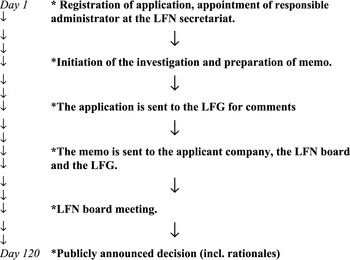
Decision making by the LFN is regulated by the Swedish Act on Pharmaceutical Benefits. According to this Act, the LFN is responsible for decisions on the pricing of and reimbursement for pharmaceuticals in Sweden. The reimbursement system is basically product-oriented, but the LFN is entitled to only grant subsidy for some specific indications in relevant cases. In addition, the decision-making process preceding the decision is covered by the Official Secrets Act, and only the applying company is entitled to announce the existence of an application. Besides Swedish regulation, the LFN also has to comply with the European Union transparency directive, which means (among other things) that the decision-making process should take no longer than 120 days and that applicants must be informed of the rationales for subsidy rejection.
The board consists of 11 persons (including the chairman) with personal commissions, and deputies. The members are appointed by the Swedish government and represent a multitude of perspectives, for instance medical expertise, user-groups, pharmaceutical-related authorities, and payers (the county councils). According to the Act on Pharmaceutical Benefits etc., an application for reimbursement should be evaluated on the basis of four criteria: the principle of human dignity, the principle of need and solidarity, the principle of cost-effectiveness, and the principle of marginal benefit (mentioned in order of importance).
Overview of the decision making process for new original pharmaceuticals

In 2003, the LFN made 5,900 pricing and reimbursement decisions (Jansson and Anell, Reference Jansson and Anell2005). While the board makes decisions regarding new original, generic, and licensed pharmaceuticals, the director-general makes the remaining decisions, primarily decisions on changes in already determined prices but also on new packages and potencies, as well as on whether to reimburse specific parallel-imported pharmaceuticals or not. Decisions on price changes constitute the vast majority of the total number of decisions, while approximately 1% (70 cases) of the 5,900 decisions concerned new original pharmaceuticals or new modes of preparations. The latter decisions are, however, regarded as being of principal importance by the LFN (Jansson and Anell, Reference Jansson and Anell2005).
The decision-making process concerning new original pharmaceuticals is initiated when the company authorized to sell the specific pharmaceutical sends an application for subsidy to the LFN. According to the Act on Pharmaceutical Benefits etc., section 8, the applicant has the burden of proof when it comes to showing that the applicant pharmaceutical is cost-effective compared to the most relevant alternative pharmaceuticals. When the application has been registered, the LFN appoints a team of administrators, consisting of a pharmacist, a health economist, and a lawyer, to prepare a memorandum (memo) as a basis for its decision. According to the Act on Pharmaceutical Benefits etc., section 9, the county councils and the applying company are entitled to deliberations with the LFN before the decision is made. On behalf of the 21 Swedish county councils, these deliberations are conducted by a committee on Pharmaceutical Benefits (LFG) organized by the Federation of Swedish County Councils. After the decision has been made, an official letter is sent to the applicant and to the LFG, and the decision (including rationales and reasons) is published on the internet (www.lfn.se). These appraisals range in length from two to approximately ten pages, which illustrates the background of the issue, analysis of the available research, the rationales for the decision, and finally any associated appeal process. In addition to publishing final decisions, the LFN also publishes documentation on its website describing its appraisal methods. The applying company is entitled to withdraw the application right up to the posting of the official letter, thereby avoiding publicity.
According to the Act on Pharmaceutical Benefits section 26, parties affected by the decisions can appeal against the decision in a public administrative court. The definition of ‘affected parties’ is unclear, however. The leave and the appeal must be sent to the secretariat within three weeks after the serving of the decision. While the secretariat examines the leave, the board has an opportunity to reconsider the decision. If the board adheres to the decision, the claim is forwarded to the county administrative court of Stockholm, and the judicial system makes the final decision. If, on the other hand, the LFN decides to revise the decision according to the claim, the claim is withdrawn and the new decision is enacted.
Decisions and relative importance of ethical principles
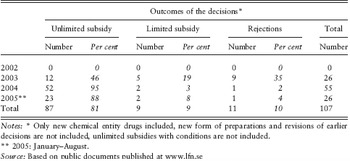
A run-through of the publicly announced decisions during the first 33 months of operation show that the LFN made 107 principally important decisions related to new pharmaceuticals (Table 1), none in 2002, but a steadily increasing number since then. The number of rejections was highest in 2003 and has been minimal in 2004 and 2005 (2% and 4%). Moreover, while the subsidy was limited in 19% of cases in 2003, only 3% and 8%, respectively, resulted in a limited subsidy in 2004 and 2005. The percentage of unlimited subsidies (i.e. reimbursement for all licensed indications) has, however, increased since the first operational year of the authority, and 95% of the new pharmaceuticals for which applications for reimbursement were submitted were granted unlimited subsidy in 2004.
Distribution of reimbursement decisions 2002–2005

Notes:
* Only new chemical entity drugs included, new form of preparations and revisions of earlier decisions are not included, unlimited subsidies with conditions are not included.
** 2005: January–August.
Source:
Based on public documents published at www.lfn.se
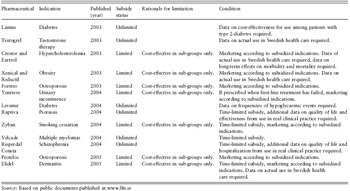
The analysis of the public documents and the interviews with stakeholders suggest that the principle of cost-effectiveness has been given a prominent role in the decision making (for an overview of the decisions and the rationales stated, see Tables 2 and 3). Among those pharmaceuticals that received an unconditional subsidy, the cost-effectiveness has been estimated as generally acceptable, although the demand for health economic documentation has been less stringent in relation to orphan drugs.
Pharmaceuticals with limited and/or conditioned subsidy October 2002–August 2005

Source:
Based on public documents published at www.lfn.se
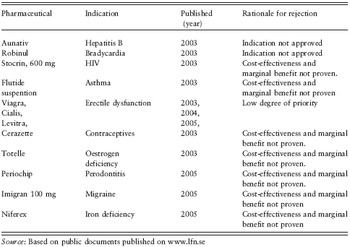
Rationales for rejecting subsidy 2002–August 2005

Source:
Based on public documents published on www.lfn.se
Limitations of the subsidy to specific indications have been made in nine cases only between 2002 and 2005. These limitations have primarily concerned pharmaceuticals intended for large patient populations, where large differences in terms of utility and/or cost-effectiveness were identified for subgroups of patients (see Table 2).
Pharmaceuticals approved for limited reimbursement chiefly consist of therapies aimed at the treatment of large patient populations, for example hypercholesterolemia, obesity, diabetes, and osteoporosis. With regard to these pharmaceuticals, cost-effectiveness has only been proven for some patient groups, usually the most severely ill. According to the interviews with LFN staff members, one prerequisite for the LFN to limit the subsidy is also that there is a reasonable chance that the limitation has an effect in real practice (Jansson and Anell, Reference Jansson and Anell2005). The analysis of the public records and the public statements shows that the LFN has in some way made the subsidy conditional in all of the cases of limited subsidy and in a few of those involving unlimited subsidy. The attaching of conditions to a subsidy has often been connected with the marketing of the drug. The LFN does not, however, have any way of making sure that this condition is complied with. A condition may also involve the applicant’s being forced to carry out follow-up studies of the actual use of the drug in clinical practice, or to produce extensive clinical data regarding the effects on hard end-points. The condition may also include time-limits, for instance when the clinical and/or health economic documentation is insufficient but the drug is perceived as important.
Also, the rejections have primarily been based on rationales such as the absence of supporting evidence of cost-effectiveness and marginal benefit (see Table 3). In three cases, though, the reason stated for the rejection was ‘low degree of priority’ – in other words, the principle of need and solidarity was invoked.
Social learning and stakeholder reactions to the decision-making process
According to the interviews with stakeholders and public statements, the Swedish Association of the Pharmaceutical Industry and the Swedish Disability Federation resisted the new authority prior to the introduction of the LFN, stating that priority setting of pharmaceuticals was a problem to be solved by the physician and his (her) patient, or by already existing authorities (Jansson and Anell, Reference Jansson and Anell2005). However, their resistance declined during the first active year of the authority, and the stakeholder organizations have only been actively engaged in explicit media lobbying in a few cases. In general, interviewed representatives of the major stakeholder organizations stated a perception of the priority-setting process as being fair and legitimate and implicitly accepting that limiting access to health-care services is necessary owing to scarce health-care resources (Jansson and Anell, Reference Jansson and Anell2005).
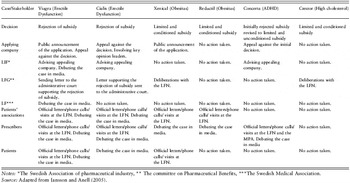
The analysis of the case studies of the decision-making process regarding reimbursement for six pharmaceuticals during 2003 shows that individual actors, rather than stakeholder organizations, have tried to exert a direct influence on the decision-makers (see Table 4). Particularly those directly affected by the decision (e.g. individual patients, prescribers, pharmaceutical companies, and patients’ associations) have lobbied during the decision-making process, sending official letters, contacting the LFN by telephone or making official visits. Moreover, debates on the case in the media have been frequent, with a view to put pressure on the LFN. The fiercest lobbying occurred when the pharmaceutical was intended for large patient groups and had a history of reimbursement, as in the cases of Viagra and Xenical. In these two cases, the applying company also publicly announced the existence of an application. Besides, there are a few examples of co-operation in lobbying between different patient associations as well as companies and key medical opinion leaders, for instance in the cases of Viagra and Cialis (Jansson and Anell, Reference Jansson and Anell2005).
Overview of actions taken in six cases of reimbursement

Notes:
*The Swedish Association of pharmaceutical industry, ** The committee on Pharmaceutical Benefits, ***The Swedish Medical Association.
Source:
Adapted from Jansson and Anell (Reference Jansson and Anell2005).
In six of the 11 cases of rejected applications up to August 2005, appeals have been made against the decisions. Only in one of these cases, Concerta, has the LFN revised the decision after receiving advice from the Medical Products Agency (MPA) in Sweden, resulting in unlimited subsidy for the pharmaceutical (see Table 4). Interestingly, no limited/conditioned subsidies have yet been appealed against.
Discussion
Implementing accountability for reasonableness at the LFN
This evaluation of the priority-setting procedures at the LFN indicates that all four conditions proposed by Daniels and Sabin (Reference Daniels and Sabin1997) for fair and legitimate procedures are fulfilled. It was found that the centralized drug review agency has transparent procedures and decision-making principles and all major decisions on reimbursement status for individual pharmaceuticals (including analysis and rationales) are publicly available on the internet (the publicity condition). The decision criteria used are stipulated by Swedish law and therefore have the support of the Swedish Parliament, so called ‘Riksdagen’. The committee consists of representatives of major stakeholders (payers, patient groups, authorities, and medical experts) and the decision has been received well by major stakeholders with few exceptions (relevance condition). In addition, there are regulations guaranteeing the revisability and enforcement conditions.
Similarly to Mitton and colleagues (Reference McMahon, Morgan and Mitton2006), this study suggests that open dialogue and consultation with major stakeholders is one important way to enhance the relevance of the process. Another important reason for the LFN success in implementing accountability for reasonableness is the extensive regulation encouraging the fulfillment of the conditions of publicity as well as the relevance and revisability of the LFN decisions. In addition, the authority itself has made an effort to fulfill the conditions to an even greater extent. For instance, in the respect of the publicity condition, all decisions considered by the authority as being of principal importance, regardless of whether a subsidy is granted or rejected, are publicly announced including rationales – although the authority is only obliged to publicly announce rationales if the applications are totally or partly rejected. The LFN has also carefully demonstrated its consideration of the four decision criteria stipulated by Swedish law in all of the published decisions, although a discussion regarding the expected consequences of the decision is often lacking.
The stated reason for the extensive reporting on the rationales for decisions is to make it easier for case laws to evolve. Despite the good intentions, treating like cases alike does not seem to be a simple matter in real practice, since no general agreement as to the definition ‘like cases’ exists. For instance, looking at the twin cases of Viagra and Cialis, there seem to be case laws prevailing based on the decisions to reject both applications stating identical reasons; and in the cases of Xenical and Reductil decisions to limit /condition the subsidy were accounted for in exactly the same way. However, if the cases of Viagra/Cialis are instead compared to the cases of Xenical/Reductil, the conclusion is no longer that obvious. The two pairs of pharmaceuticals could be defined as similar cases, since both were defined as so-called life-style drugs and were consequently excluded from the pharmaceutical benefits system in 2001. In these two cases, the decisions as well as rationales differ. While the board completely rejected the applications of subsidy for Viagra/Cialis, stating its conviction that prescription would not be limited to indications granted subsidy, the board found it more likely that the limitations attached to the subsidy of Xenical/Reductil would be respected. Similar conservative behaviour among reimbursement committees have been reported, from for instance Canada, related to so-called prescription creeps, i.e. use of pharmaceuticals beyond the limitations in reimbursement (Laupacis, Reference Laupacis2006).
One key lesson from the research on accountability for reasonableness in hospital priority-setting processes was that the revisability of decisions is a very important component in fair priority setting (Madden et al., Reference Madden, Martin, Downey and Singer2005). This study points to the difficulties in defining who is entitled to appeal against the decision. In the Swedish example, the court has, in a precedent case, chosen not to define individual patients as entitled to appeal, while appeals by the pharmaceutical companies have been accepted.
Decisions and relative importance of ethical principles
The principle of cost-effectiveness has been frequently used to restrict or reject applications for reimbursement in Sweden. In all the illustrated cases, the LFN has demanded health economic documentation, and the principle of cost-effectiveness has been touched upon when stating the rationales for the decision in the vast majority of cases of accepted as well as rejected applications (with the exception of orphan drugs) published on the website of the authority. This could partly be explained by the stated mission of the authority: to optimize the use of drugs from a societal perspective. A parallel can be made to NICE in the United Kingdom, which publish the appraisals, including details on the evidence used in the appraisal process, where clear evidence of the use of the cost-effectiveness criteria to restrict or reject health technology by NICE have also been reported (Towse and Pritchard, Reference Towse and Pritchard2002). Concern for evidence in terms of economic and clinical trials occurring in controlled settings has been expressed by participants in the UK and Canadian central drug review processes in an earlier study (Mitton et al., Reference McMahon, Morgan and Mitton2006). The LFN has solved this issue by making time-limited reimbursement decision, where the applicant is obliged, in due time, to prove that the cost-effectiveness indicated in early modelling studies is applicable in clinical practice.
Another reason for the LFN’s frequent use of the cost-effectiveness criterion may be the difficulties in implementing rather vague principles such as need and solidarity and human dignity. It has been suggested that the principle of need and solidarity must, in order to become operational, be complemented by principles that guide the ranking of need, as well as the choice concerning what to achieve by meeting a need (Liss, Reference Liss2004).
The use of cost-effectiveness as a criterion in decision making raises the question of societal threshold values in order to determine what is to be considered cost-effective and whether threshold values should fluctuate depending on the context. In an evaluation of the National Institute for Clinical Excellence (NICE) working methods, it was concluded that NICE should justify its decision-making criteria and specify the relative importance of the different criteria (Hill et al., Reference Hill, Garattini, van Loenhout, O’Brien and de Joncheere2003). Beyond this, the committee pointed out that the prevailing threshold values for cost-effectiveness needed to be explicitly specified. Some of this criticism could also be directed against the LFN. For instance, the relaxed demand for health economic documentation for orphan drugs when making pricing and reimbursement decisions in Sweden is not uncontroversial (Ramsberg et al., Reference Ramsberg, Lundin, Engström and Jacob2004). Also, it is not clear what value the Swedish population assigns to a QALY (Quality Adjusted Life-Years) or what threshold values the LFN applies. For instance, the only indication of the value that Swedes assign to a life lost has been estimated in connection with road accidents; however, this estimate could probably be used to indirectly estimate the expected value of a Swedish QALY for priority setting in health care (Persson and Hjelmgren, Reference Persson and Hjelmgren2003).
Reactions from stakeholders
The Swedish case shows that the pharmaceutical companies’ right to appeal has been used in a majority of those cases where the LFN has rejected an application However, none of the cases of limited and/or conditioned subsidy has resulted in an appeal, which may be considered as an acceptance of the rationales referred to by the LFN. Another possible explanation is that conditioned or limited subsidy is considered a far better outcome than the uncertainty engendered by a court appeal. This case study also shows that those directly affected by the decision (i.e. individual patients, pharmaceutical companies, and prescribers) have primarily taken action when the pharmaceutical had a history of previously being subsidized.
The perception of legitimacy may be influenced by unequal access to decision-makers among stakeholders (Gibson et al., Reference Gibson, Martin and Singer2002). In those cases where the involvement of stakeholders has not been perceived as favourable for the pharmaceutical company, the application has consequently not been publicly announced. This has resulted in an unequal power distribution in favour of the pharmaceutical company. These results support the claim of a fifth ‘empowerment condition’ as proposed by Gibson and colleagues (2005) included in the theoretical framework. Up to August 2005, the LFN had decided to revise only one decision of rejection out of nine in favour of the applicant. According to the interviews with staff members at the LFN and other stakeholders involved in the specific cases, the revision of the decision was made after consulting the Swedish Medical Products Agency (MPA) on the issue of whether licensed drugs could be compared to approved drugs, rather than being the result of pressure by the applicant company. It is also interesting to note that in a few cases where the lobbying was fierce, the application was rejected by the LFN. On the other hand, the number of rejections has decreased rapidly after 2003, more applications being granted unconditional subsidy than before. This may imply that the power differences did not have any major influence on the outcomes of the process; but could also mean that stakeholders have simply learned the rules of the game.
The impact of LFN decisions is ultimately bound up with the question of whether they are implemented in actual clinical practice or not. A previous study (Jansson and Anell, Reference Jansson and Anell2006) suggests that formulary committees in Sweden are more restrictive in their recommendations than the LFN, but patient unwillingness to accept that health-care resources are limited prevents individual physicians from trading off even marginal therapeutic effects. However, the general acceptance of the priority-setting procedure, in spite of prior resistance among the major stakeholders, suggests that the LFN has, after all, contributed to an increased social learning about the necessity of priority setting in health-care. The results of this study therefore suggest that applying accountability of reasonableness may be conducive to priority setting in the face of scarce health-care resources.
Conclusions
This study suggests that LFN’s implementation of accountability for reasonableness has facilitated the development of a priority-setting procedure for decision making in the reimbursement for new drugs in Sweden that is generally perceived as fair and legitimate by the major stakeholders. In response to demands for openness and transparency, the applicability of decision criteria has become even more important. Because of its relative ease to operationalize, the principle of cost-effectiveness has been frequently used as a decision criterion. In particular, the principle has been claimed when estimated sales of the pharmaceutical are high and the cost-effectiveness and/or utility varies among subgroups of patients or indications. The results of this study also suggest that implementing accountability for reasonableness encourages social learning in terms of accepting the necessity of priority setting in health care.
Acknowledgements
The author is grateful for financial support from the Swedish National Centre for Priority Setting in Health Care and valuable comments from the anonymous referees.The views expressed herein are those of the author, and do not necessarily reflect those of the supporting institution.