


INTRODUCTION
The traditional view in electoral research holds that Congressional election campaigns are principally aimed at highlighting the virtues of the individual candidates (Jacobson Reference Jacobson1978). This is particularly important in the case of incumbents, who tend to be higher quality candidates and thus able to elicit greater affinity from the voters regardless of their party affiliation (Cover Reference Cover1977; Jacobson Reference Jacobson2009). This emphasis on the role of the individual rather than the party in Congressional elections is consistent with the once-dominant view that largely downplayed the significance of party reputations in shaping voter decisions (Mayhew Reference Mayhew1974a; Stokes and Miller Reference Stokes and Miller1962).
More recent research, however, assigns a much greater electoral significance to the parties’ collective reputations. Numerous studies point to the presence and significance of partisan electoral tides (e.g., Brady, D'Onofrio, and Fiorina Reference Brady, D'Onofrio, Fiorina, Brady, Cogan and Fiorina2000; Clagget, Flanigan, Zingale Reference Claggett, Flanigan and Zingale1984; Kawato Reference Kawato1987). Others have examined how partisan tides shape the strategies of different political actors (Jacobson and Kernell Reference Jacobson and Kernell1983), or how polarization in Congressional party politics drives electoral outcomes (Jones Reference Jones2010). Various theories of Congressional parties are also motivated by the premise that the parties’ collective reputations have a significant electoral effect (Aldrich Reference Aldrich1995; Cox and McCubbins Reference Cox and McCubbins1993). The implication of these studies is that the personal characteristics of candidates have come to exert a smaller influence on electoral outcomes relative to the collective reputations of the parties (Jacobson Reference Jacobson1998).
The increasing electoral significance of parties has been accompanied by an underlying shift in the informativeness of parties’ collective reputations relative to the reputations of individual legislators, and voters today are far more aware of what the parties stand for than they were in the past (Hetherington Reference Hetherington2001). These findings fit with the logic of studies in voting behavior, which argue that voters act as Bayesian learners who use the record of candidate's party to form their prior beliefs about the candidate himself (Bartels Reference Bartels2002; Bartels and Achen Reference Bartels and Achen2006; Green and Gerber Reference Green and Gerber1999; Grynaviski Reference Grynavski2006). Greater intraparty homogeneity in legislative behavior makes party labels more informative and provides voters with stronger priors about their candidates (Snyder and Ting Reference Snyder and Ting2002). Consequently, the individual actions of legislators have less influence in changing voters’ minds.
The increase in the informativeness of party labels has changed not only the way voters view candidates, but also the pattern of effort that individual incumbents in different electoral environments must put into campaigning. We argue that the increasing importance of party reputations has significantly contributed to the patterns of growth in campaign expenditures over the past four decades. The increase in campaign spending has been particularly large in “marginal” districts, where support for the incumbent's party is weak. This is because stronger party reputations have made it much more expensive to court voters in marginal districts, who will not vote for the average member of an incumbent's party, but would choose the incumbent based on hisFootnote 1 individual record. Even though these voters would be willing to vote for the incumbent on the basis of his own legislative record, the party's reputation increasingly dominates voters’ prior beliefs about him and makes it harder for the incumbent to efficiently communicate his record to voters.
In order to counter voters’ unfavorable prior beliefs about him, the incumbent must engage in additional campaigning at a greater monetary expense. Additional campaigning serves to better inform voters about the incumbent's more favorable record, and shifts voters away from their prior assumption that the incumbent is just like the rest of his party. Therefore, the earlier argument that incumbent spending is primarily aimed at informing voters about their own virtues, rather than their parties’ (Jacobson Reference Jacobson1978, Reference Jacobson2009), remains largely applicable. However, the stronger collective reputation of the parties demands that incumbents in marginal districts spend more to highlight the parts of their record that set them apart from their parties.
To derive testable hypotheses based on our argument, we develop a simple formal model that describes the joint effect of party and personal reputations on the campaign spending of congressional incumbents. We model each type of reputation as composed of two parts: substance and clarity, analogous to the mean and the variance in statistics. We show that these variables interact with one another to generate three main predictions. First and foremost, when a party has a clearer reputation, incumbents in marginal districts must spend more. Second, a different relationship holds for the incumbents in safer districts, where a clearer party reputation can be advantageous. Last, as party brands become clearer, incumbents in marginal districts find it increasingly costly to maintain a voting record that is too close to their party's. We evaluate and find empirical support for each of these arguments based on electoral and campaign spending data for House elections from 1972 through 2008.
Taken together, these findings should change how scholars think about the role of party brands. Party brands are often treated as public goods that aid the electoral prospects of party members (Aldrich Reference Aldrich1995; Cox and McCubbins Reference Cox and McCubbins1993). By contrast, we show that party brands are simply externalities that help members in relatively safe districts, but can harm the electoral prospects of incumbents in more marginal districts. Both the positive and negative effects of the party's brand become more intense as party brands become more precise. Not only do campaigns become more expensive for incumbents in marginal districts, but it also becomes more expensive for these incumbents to vote with their party. Both findings should encourage new research on how (and whether) parties can compensate marginal incumbents for the increasing cost of party polarization.
A MODEL OF REPUTATIONS AND CAMPAIGN EXPENDITURES
Following a number of previous articles (Bartels Reference Bartels2002, Bartels and Achen Reference Bartels and Achen2006, Green and Gerber Reference Green and Gerber1999, Grynaviski Reference Grynavski2006), we model the manner in which voters respond to information about parties and incumbents as a Bayesian learning problem. We use the model to show how the reputation of the incumbent's party affects voters’ prior beliefs about his record, and how this in turn affects how much an incumbent needs to spend in order to communicate his record to the voters in his district.
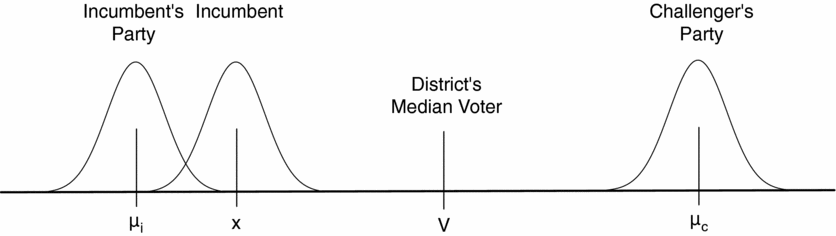
We model the reputations of both the party and the individual incumbent as probability distributions.Footnote 2 The reputation of the incumbent party is assumed to be the voter's prior belief about where the incumbent stands relative to the voter. This assumption is consistent with a substantial body of research in voting behavior, which observes that party affiliation of candidates constitutes a heuristic or “information shortcut” that furnishes voters with useful information about the candidates themselves (Brady and Sniderman Reference Brady and Sniderman1985; Popkin Reference Popkin1995; Snyder and Ting Reference Snyder and Ting2002). We assume that this belief is normally distributed with mean μi, and variance si 2.
We model the new information provided by an incumbent's campaign as being drawn from his own reputation (which we assume to be based on his legislative record). This assumption is consistent with work by Coleman and Manna (2000), who show that the more campaign expenditures an incumbent incurs, the more knowledgeable voters become about his own legislative record in the past. We also assume that the incumbent is closer to the district median than his party. This is consistent with what Erikson and Wright (Reference Erikson, Wright, Dodd and Oppenheimer2008) have found. The incumbent's personal reputation is assumed to be a normal distribution with the mean x and the variance σ2.
Voters in our model evaluate the perceived position of the incumbent relative to the perceived location of his challenger. As challengers typically have no record to campaign on, we model the challenger's reputation as simply being the reputation of the challenger's party, which is distributed normally with mean μc and variance sc 2. The assumption that the challenger does not run on an individual record is consistent with much of the empirical literature on Congressional campaigns (Jacobson Reference Jacobson2009).
To keep the model tractable, we do not model the challenger's spending decision. We therefore do not account for any indirect effect that parties’ reputations might have on incumbent spending through their effect on challenger spending. The existing literature suggests that challenger spending increases as a function of incumbent spending (and vice versa) (Erikson and Palfrey Reference Erikson and Palfrey2000). So, the most likely risk of this simplifying assumption is that we are underestimating the effect of polarization on incumbent spending.Footnote 3
The incumbent is, of course, campaigning in an attempt to win over the median voter in his district. In modeling the voter choice, we assume a standard unidimensional policy space. We label a district's median voter V and assume that she is located somewhere between the mean locations of the incumbent's party and the challenger's party. In any given election, the outcome is a function of the relative distance between the candidates’ perceived locations. This allows us to simplify the model by assuming that the incumbent's party is located at 0 and the challenger's party is at 1, i.e., μi = 0 and μc = 1, without loss of generality. This also has the useful consequence of allowing V to be interpreted as the district's partisanship, or the degree to which the district leans towards the challenger's party relative to the incumbent's.
The model, as we have described it so far, is shown in Figure 1 above.
Diagram of the Model

Campaigning consists of the incumbent drawing the voter's attention to his record, which we model as the voter observing random draws from the distribution of the incumbent's individual reputation.Footnote 4 This means that, after a single draw, the posterior belief of the voter regarding the position of the incumbent is characterized by a normal distribution with the following expected mean and variance:
 \begin{eqnarray}
E[( {\mu _1 |n = 1})] = \frac{x}{{\sigma ^2 \left( {\frac{1}{{s_i^2 }} + \frac{1}{{\sigma ^2 }}} \right)}},\\
s_1^2 = \frac{1}{{\frac{1}{{s_i^2 }} + \frac{1}{{\sigma ^2 }}}}\nonumber
\end{eqnarray}
Campaigning costs the incumbent money. We model this as the incumbent paying for each observation drawn from the distribution that characterizes his own reputation, N(x, σ2). Let n be the number of draws from this distribution, so that a higher n represents greater campaign expenditures. The voter observes these draws and updates her belief accordingly. After n draws, μn , the perceived location of the candidate is characterized by a normal distribution with the following expected mean and variance:
 \begin{equation}
E[(\mu_n | n)] = \frac{{nx}}{{\sigma ^2 \left( {\frac{1}{{s_i^2 }} + \frac{1}{{\sigma ^2 }}} \right)}},\\
s_n^2 = \frac{1}{{\frac{1}{{s_i^2 }} + \frac{n}{{\sigma ^2 }}}}\nonumber
\end{equation}
The median voter, V, chooses the incumbent only if the utility she expects to obtain from voting for him is greater than the utility of voting for the challenger. For the sake of simplicity, we assume that the voter's expected utility is a linear function of the distance between her ideal point and the perceived locations of the two candidates.Footnote
5
Because the challenger's perceived location is the same as that of his party, at μc
= 1, the voter perceives the challenger's distance to be 1 − V. The incumbent, however, can change the voter's perception of where he stands by showing the voter draws from his record. Therefore, the voter perceives the incumbent's distance to be V −
 $\frac{{nx}}{{\sigma ^2 ( {\frac{1}{{{\rm s}_{\rm i}^2 }} + \frac{n}{{\sigma ^2 }}} )}}$
.
In order to account for the possibility that the voters’ utility is affected by uncertainty, we incorporate the term
 $ - \frac{\lambda }{2}s^2 $
in the voter's utility function. Here, s
2 is the appropriate variance and λ is the Arrow-Pratt index of absolute risk aversion. Risk aversion means that greater uncertainty in a candidate's location lowers the voter's utility independent of any other factor. As λ approaches 0, the voter becomes risk neutral and the voter only cares about the distance between an incumbent and herself. For λ > 0 voters prefer candidates with records that they perceive as being less variable.Footnote
6
Risk aversion decreases the utility of voting for the incumbent by
 $\frac{\lambda }{{2( {\frac{1}{{s_i^2 }} + \frac{n}{{\sigma ^2 }}} )}}$
. Because the challenger is assumed to have no personal reputation of his own, risk aversion decreases the utility of voting for the challenger by
 $\frac{{\lambda s_c^2 }}{2}$
.
Therefore, V's expected utility of voting for the incumbent and the challenger after n draws is:
 \begin{eqnarray}
\begin{array}{c}
EU_i = - V + \displaystyle\frac{{nx}}{{\sigma ^2 \left( {\frac{1}{{s_i^2 }} + \frac{n}{{\sigma ^2 }}} \right)}} - {\rm }\frac{\lambda }{{2\left( {\frac{1}{{s_i^2 }} + \frac{n}{{\sigma ^2 }}} \right)}},\\[30pt]
EU_c = - \left( {1 - V} \right) - \displaystyle\frac{{\lambda s_c^2 }}{2}
\end{array}
\end{eqnarray}
Given the substantial costs that an incumbent must incur for fundraising, in terms of time, policy compromises, and potential bad publicity (Baron Reference Baron1989; Erikson and Palfrey Reference Erikson and Palfrey2000), we expect that the incumbent would seek to minimize campaign expenditure whenever possible. They will therefore only spend what is necessary to win over the voter V. This winning condition occurs when the voter expects to gain greater utility from voting for the incumbent, i.e., EUi > EUc , which leads to the following inequality:
 \begin{equation}
- V + \frac{{nx}}{{\sigma ^2 \left( {\frac{1}{{s_i^2 }} + \frac{n}{{\sigma ^2 }}} \right)}} - \frac{\lambda }{{2\left( {\frac{1}{{s_i^2 }} + \frac{n}{{\sigma ^2 }}} \right)}} > - (1 - V) - \frac{{\lambda s_c^2 }}{2}
\end{equation}
Because the left-hand side of the inequality (4) is linear in n, we need only to rearrange the terms and solve for n to find the minimum requisite campaign expenditure, n . Solving this inequality for n provides the minimum number of draws that the incumbent needs to pay for from his own distribution to secure reelection, and is given by:Footnote 7
 \begin{equation}
n > \bar n = \max \left[ {\frac{{\frac{{\sigma ^2 }}{{s_i^2 }}\left( {2V - 1 - \frac{{\lambda s_c^2 }}{2}} \right) + \frac{{\lambda \sigma ^2 }}{2}}}{{\left( {x + 1 - 2V + \frac{{\lambda s_c^2 }}{2}} \right)}},0} \right]
\end{equation}
Having defined how an incumbent decides to spend money, we now define the conditions under which the reputation of the incumbent's party is harmful (increasing how much the incumbent has to spend) or helpful (decreasing the amount an incumbent must spend). Let us define a positive parameter K =
 $\frac{1}{2}( {1 + \lambda s_c^2 })$
.Footnote
8
This permits us to rewrite Equation (5) as follows:
 \begin{equation}
\bar n = \max \left[ {\frac{{\frac{{2\sigma ^2 }}{{s_i^2 }}\left( {V - K} \right) + \frac{{\lambda \sigma ^2 }}{2}}}{{\left[ {x + 2\left( {K - V} \right)} \right]}},0} \right]\end{equation}
In effect, K allows us to distinguish between the “marginal” and “incumbent-party friendly” districts, while accounting for effects of voter risk aversion.Footnote 9 If V < K, then the voter favors the mean reputation of the incumbent's party, and would be willing to vote for an incumbent located at the mean of his party. We call these districts “incumbent party-friendly.” If V > K, then the voter disfavors the mean reputation of the incumbent's party, and would not vote for an incumbent located at the mean of his party. We call these districts “marginal.”
We also define districts in terms of how marginal they are. The marginality of the district refers to how far the voter is from the incumbent's party. As we have fixed the incumbent's party's location at 0 and the challenger's party's location at 1, a district's marginality is simply defined by the location of the median voter, V. Therefore, a district is more marginal if the value of V is large, while it is less marginal—and more incumbent-party friendly—if V is small.
In practice, the campaign expenditures by incumbents are also impacted by additional factors outside of our simple model. Spending may depend on factors particular to a given district or to the national circumstances under which the election takes place. We capture this by incorporating a noise term Ci (t) which has a positive nonzero mean that varies both across time t and across districts i within given any period, but is orthogonal to the parameters characterizing both party and candidate reputations. The revised expression for n then becomes:
 \begin{equation}
\bar n = \max \left[ {\frac{{\frac{{2\sigma ^2 }}{{s_i^2 }}\left( {V - K} \right) + \frac{{\lambda \sigma ^2 }}{2}}}{{[x + 2(K - V)]}},0} \right] + C_i (t)\end{equation}
We can now derive and prove two main propositions about how the incumbent's campaign spending is affected by the interaction between his own party's collective reputation and his district's characteristics.Footnote 10
Proposition 1 . As the variance of an incumbent's party reputation becomes larger, his campaign spending decreases in marginal districts and increases in incumbent-party friendly districts.
Proof. We can show this simply by differentiating Equation (7) with respect to si 2, the variance of the party reputation, which yields the following:
 \begin{equation}
\frac{{\partial \bar n}}{{\partial s_i^2 }} = - \frac{{2\sigma ^2 \left( {V - K} \right)}}{{s_i^4 [x + 2\left( {K - V} \right)]}}
\end{equation}
The parameters σ2 and x are the variance of the incumbent's personal reputation and the incumbent's distance from his party, respectively. As such, these are always positive and do not affect the sign of the derivative. Indeed, the sign of the derivative depends only on the district's marginality: The derivative becomes positive if V < K, i.e., the district is incumbent-party friendly; it is negative, on the other hand, if V > K, i.e., the district is marginal.Footnote 11
Our argument, that higher uncertainty in a party's reputation leads to an electoral advantage in a marginal districts, might appear to be at odds with some of the existing literature, most notably Shepsle (Reference Shepsle1972), who suggests that candidates might be harmed by higher uncertainty in their perceived position if voters are risk averse. It is not. In the existing literature, voters are aware of the distribution of an incumbent's own positions and evaluate him accordingly. In our model, prior to an incumbent's campaign, voters only know the reputation of the incumbent's party. Given this fact, the incumbent sometimes spends money to inform the voters that he is different from his party. Viewed through this lens, greater uncertainty in the party reputation is only advantageous in marginal districts, where the incumbent wishes to efficiently communicate that he is different from his party. However, in incumbent-party friendly districts, where incumbents don't need to distance themselves from the party, a more uncertain party reputation does hurt the incumbent if voters are risk averse.
Proposition 1 has an additional implication. Observe that the derivative
 $\frac{{\partial \bar n}}{{\partial s_i^2 }}$
decreases as the district become more marginal (V increases). This means that, in very marginal districts, a higher variance in the incumbent's party reputation decreases spending a lot; while in less marginal districts, a higher variance in the incumbent's party reputation only decreases spending a little. Likewise, in districts that are very incumbent-party friendly, a higher variance in the incumbent's party reputation increases spending a lot, while in less incumbent-party friendly districts, a higher variance in the incumbent's party reputation only increases spending a little. This implies the following corollary to Proposition 1.
Corollary 1. The effect of variance in the incumbent's party reputation depends on how marginal or party-safe the incumbent's district is. Variance in the incumbent's party reputation decreases spending less when the district is less marginal.
An incumbent's campaign spending also depends on the distance between the incumbent and his party.
Proposition 2. As the incumbent's position becomes closer to his party's, his campaign expenditures will increase in marginal districts and decrease in incumbent-party friendly districts.
Proof. To show this, we differentiate n with respect to x, the distance between the incumbent and his party:
 \begin{equation}
\frac{{\partial \bar n}}{{\partial x}} = \frac{{ - \left[ {\frac{{2\sigma ^2 }}{{s_i^2 }}\left( {V - K} \right) + \frac{{\lambda \sigma ^2 }}{2}} \right]}}{{[x + 2\left( {K - V} \right)]^2 }}
\end{equation}
The sign of the derivative
 $\frac{{\partial{\bar n}}}{{\partial x}}$
depends, again, on the marginality of the districts. If the district is marginal, i.e., V > K, then this derivative is negative. A decrease in the value of x, the incumbent's distance from his party, leads to an increase in the value of
n
. Therefore, in marginal districts, moving toward the party (and by assumption, away from the voter) always makes it more expensive for an incumbent to highlight his own record. On the other hand, in an incumbent-party friendly district, i.e., V < K, the derivative is positive, implying that the incumbent could decrease their spending by moving closer to the party.
Proposition 2 has an additional implication. Observe that the magnitude of the derivative
 $\frac{{\partial \bar n}}{{\partial x}}$
increases as the uncertainty of the party reputation, s
2
i
, decreases. This means that, as the party reputation becomes clearer over time, being closer to the party leads to even greater spending in marginal districts, and leads to even less spending in incumbent-party friendly districts.Footnote
12
A more precise party brand helps the voter distinguish where the candidate stands, relative to his party. This means that the candidate's position has a larger effect on his spending. This leads to the following corollary:
Corollary 2. An incumbent's distance from his party has a greater effect on the incumbent's spending when his party's reputation becomes clearer.
EMPIRICAL EVALUATION OF THE MODEL
Our dependent variable is the inflation adjusted campaign expenditures of House incumbents, which we posit, reflects the effort of incumbents to inform voters about their own record (Coleman and Manna Reference Coleman and Manna2000; Jacobson Reference Jacobson1978, Reference Jacobson2009). Our formal model leads to two major predictions and two subsidiary predictions concerning how changes in an incumbent's party reputation shape his campaign spending.Footnote 13
-
1. First, Proposition 1 indicates that the uncertainty of an incumbent's party reputation affects the incumbent's campaign spending, but this effect depends on the marginality of his district. In an incumbent-party friendly district, a more uncertain party reputation causes incumbent spending to increase. In a marginal district, a more uncertain party reputation causes incumbent spending to decrease. As indicated by Corollary 1, the magnitude of this effect depends on how marginal the district is.
-
2. Second, Proposition 2 shows that an incumbent's spending is affected by the distance between him and his party, but that this effect depends both on the marginality of a district and on the clarity of the incumbent's party reputation. First, being further from the party decreases incumbents’ spending the most in the most marginal districts, and this effect attenuates as a district become less marginal. Second, distance from the party has the greatest effect on incumbent spending when the incumbent's party has a clearer (less uncertain) reputation.
In testing these hypotheses, we recognize that the political reputations of both individual legislators and parties are products of many sources that, most likely, cannot be accounted for in full. However, we follow the argument offered by Cox and McCubbins (Reference Cox and McCubbins1993; Reference Cox and McCubbins2007) and Woon and Pope (Reference Woon and Pope2008) that a large proportion of these reputations is the product of various legislative activities that take place on record within Congress. The widely used DW-Nominate scores capture one important set of these reputation-shaping intralegislative activities: aggregate patterns of roll call votes cast by legislators (Poole and Rosenthal Reference Poole and Rosenthal2000). Therefore, we operationalize the pertinent reputations using the DW-Nominate scores as follows:
Party Reputation and District Characteristics
In our formal model, we have normalized a median voter V's distance from the incumbent's party and the challenger's party to be between 0 and 1. We can therefore use a measure of district's partisanship to capture each district's normalized distance from each party. As the presidential vote-share of the incumbent's party in the most recent presidential election has been frequently used as a reasonable measure of a district's affinity for the national party brand (e.g., Canes-Wrone et al. Reference Canes-Wrone, Brady and Cogan2002), we use this variable to capture District Partisanship for the incumbent's party in a given district.
The larger the presidential vote share, the closer the district median is to the incumbent's party. In our formal model, a district's marginality decreases monotonically as the district median, V, moves closer to the incumbent's party. Therefore, District Partisanship serves as a measure of a district's marginality. As District Partisanship increases, a district becomes less marginal.
Proposition 1 shows that the effect of District Partisanship on incumbent spending depends on the variance of his party's reputation. To measure this, we use the standard deviation of a party's DW-Nominate scores, which we label Uncertainty in Party Reputation. This measure captures the amount of dispersion, or “spread,” among party members’ collective voting records, and is directly related to how predictable a legislator's behavior will be given his party label. It therefore fits our concept of reputational uncertainty. A larger standard deviation in the party's DW-Nominate scores indicates that the party reputation is more variable and less clear.
Corollary 1 to Proposition 1 shows that the effect of variance in a party's reputation varies continuously with a district's marginality. Variance in a party's reputation should cause spending to decrease the most in the most marginal districts. This effect should attenuate as districts become less marginal, and, in the least marginal districts, uncertainty in the incumbent's party reputation should increase spending. We capture this effect with a continuous interaction between Uncertainty in Party Reputation and District Partisanship.
Individual Reputation
Proposition 2 shows that an incumbent's campaign expenditures depend on their distance from the party. We capture this through distance between an incumbent's first dimensional DW-Nominate score and their party's mean DW-Nominate scores in each Congress prior to the election, which we label Incumbent-Party Distance.
The effect-size of an incumbent's distance from his party depends on both the district's marginality, as noted in Proposition 2, and on the uncertainty in his party's reputation. We capture these through two interactions. We interact Incumbent-Party Distance with District Partisanship to capture the dependence of Incumbent-Party Distance on the district's marginality. To account for the dependence of Incumbent-Party Distance on Uncertainty in Party Reputation, we interact these variables.
Empirical Model
The baseline statistical model we use to evaluate our hypotheses is an ordinary least squares regression of the following form (with variables listed in the same order as the hypotheses they test):
 \begin{eqnarray*}
&&{\rm Incumbent's}\,{\rm Campaign}\,{\rm Expenditures} \\
&&\quad = b_0 + b_1 \,({\rm Uncertainty}\,{\rm in}\,{\rm Party}\,{\rm Reputation}) \\
&& \qquad +\,b_2 \,({\rm District}\,{\rm Partisanship}) \\
&& \qquad +\,b_3 \,({\rm District}\,{\rm Partisanship}\\
&&\qquad \times \,{\rm Uncertainty}\,{\rm in}\,{\rm Party}\,{\rm Reputation}) \\
&& \qquad +\,b_4 \,({\rm Incumbent{\hbox{-}}Party}\,{\rm Distance}) \\
&& \qquad +\,b_5 \,({\rm Incumbent{\hbox{-}}Party}\,{\rm Distance}\\
&&\qquad \times \,{\rm Uncertainty}\,{\rm in}\,{\rm Party}\,{\rm Reputation}) \\
&& \qquad +\,b_6 \,({\rm Incumbent{\hbox{-}}Party}\,{\rm Distance}\\
&&\qquad \times \,{\rm District}\,{\rm Partisanship})
\end{eqnarray*}
We also include the following control variables to capture factors that are known to shape Congressional elections and campaign expenditure strategies:
-
1) Challenger's Campaign Expenditure. Existing research (e.g., Erikson and Palfrey Reference Erikson and Palfrey2000; Erikson and Wright Reference Erikson, Wright, Dodd and Oppenheimer1993; Jacobson Reference Jacobson2009) indicates that the more challenger spends, the better he does. An incumbent facing a lavishly spending challenger thus needs to spend more himself to thwart electoral danger. To account for this, we include the expenditure incurred by the challenger in the fully specified statistical model.
-
2) Challenger Quality. An incumbent's electoral prospects are known to become more difficult when facing a challenger who has previously won an elected position (Jacobson and Kernell Reference Jacobson and Kernell1983). To account for this, we include a dummy variable taking the value of 1 when the challenger has held an elected office previously and 0 otherwise.Footnote 14
-
3) Freshman. First-time incumbents often enjoy comparatively less political influence than the more established ones. This is due to, among other reasons, the fact that a new incumbent has fewer opportunities to perform electorally useful activities (Mayhew Reference Mayhew1974b) or less access to influential committee assignments (Munger Reference Munger1988). To account for this, we include a dummy variable that takes the value of 1 if it is the first time that the incumbent faces a reelection and 0 otherwise.
All the electoral and campaign finance data that we use have been collected and generously provided by Gary Jacobson. DW-Nominate and associated data have been obtained from Keith Poole and Howard Rosenthal's website (http://www.voteview.com). All our measures of incumbent and challenger spending have been appropriately adjusted for inflation, using 1983 as the baseline year.
Campaign expenditures are, as we noted earlier, potentially affected by numerous factors particular to the district or year. To help account for these unmeasured differences, we employ a two-way fixed effects model with district and year fixed effects.Footnote 15 In order to address the changes in district lines due to redistricting, we code postredistricting districts as separate from the old districts with the same number. By including district fixed effects, we account for any mean variation in a district that accounts for incumbent's mean level of spending. Year fixed effects allow us to control for mean levels of spending in any given year, which may be the product of various political events, such as presidential popularity and economic performance. Year fixed effects also control for any systematic time trends that may drive mean campaign expenditures.
RESULTS
Estimating the full model raises concerns about multicollinearity, as it includes three interactions of continuous variables. To allay such concerns, we run three separate models that include only one interaction each. We then fit the full model including all three interaction terms, noting that compared to our estimates of the same interaction terms in the first three models, this has almost no impact on coefficients’ sign, size, or significance.
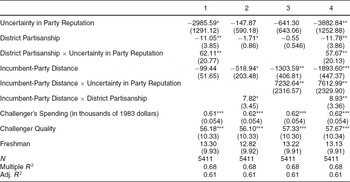
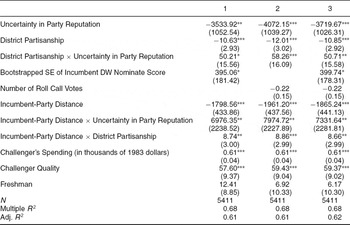
Table 1 below shows the results of our statistical analysis using Liang and Zeger (Reference Liang and Zeger1986) standard errors clustered by district.Footnote 16 The first three columns show the results of the regressions using a single interaction term each. The first column shows the interaction between the uncertainty in the incumbent's party's reputation and district partisanship. The second shows the interaction between an individual candidate's distance from his party and uncertainty in the incumbent's party's reputation. The third column shows the interaction between an individual candidate's distance from his party and district partisanship.
Effect of Party and Individual Reputations on Incumbent Campaign Expenditures: Two-Way Fixed Effects Regression, House Elections: 1972–200818

Notes: * p < 0.05; ** p < 0.01; *** p < 0.001. Liang-Zeger (1986) standard errors, clustered on districts, are reported below each coefficient.
We evaluate the implication of the Proposition 1 via the first three variables in our model (Uncertainty in the Party Reputation, District Partisanship, and the interaction between these variables). The estimated coefficients for these variables are shown in the first three rows of columns 1 and 4 of Table 1.
We have argued that greater uncertainty in party reputation decreases spending the most in the most marginal districts. In column 1 (and 4) the coefficient on Uncertainty in Party Reputation represents the effect of uncertainty in a party's reputation when the district is the most marginal (that is, when District Partisanship is 0). This is because these terms are also interacted (Braumoeller Reference Braumoeller2004). We therefore expect the coefficient of Uncertainty in Party Reputation to be very negative and statistically significant, which it is.
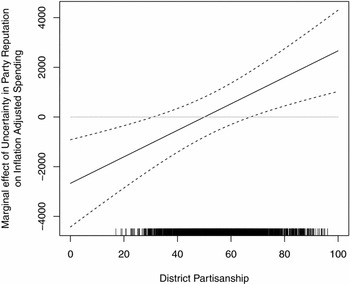
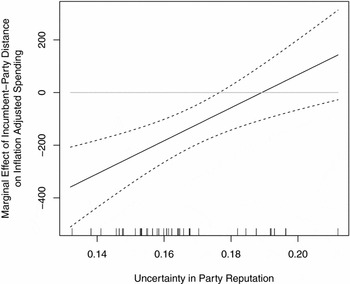
We have argued, via Corollary 1, that uncertainty in the incumbent's party reputation should reduce spending less in less marginal districts. If voters are risk averse, an uncertain party reputation can even increase spending in the least marginal districts. This is shown through the positive coefficient on District Partisanship × Uncertainty in Party Reputation. To make the interaction more interpretable, we plot the estimated marginal effect of Uncertainty in Party Reputation on incumbent spending as a function of District Partisanship in Figure 2 below. Dashed lines represent 95% confidence intervals of the estimated effect.
Marginal Effects of Uncertainty in Incumbent's Party Reputation on Incumbent Campaign Spending as a Function of District Partisanship

Figure 2 shows that the effect of the greater uncertainty in the incumbent party's reputation on campaign spending attenuates as districts become less marginal. Indeed, greater uncertainty in the incumbent's party reputation seems to actually increase spending in the least marginal districts. Given the uncertainty in our estimation, we cannot say precisely where the sign of the effect changes. However, our best estimate is that the transition from a negative to positive effect occurs when the presidential vote share of an incumbent's party is around 55%. Interestingly, 55% is almost exactly the median value in district partisanship among the incumbents in our sample. We therefore speculate that a greater uncertainty in party reputation is potentially harmful to roughly half of a party's incumbents, forcing them to spend more on their campaigns, but helpful to the other half, reducing their need to incur campaign expenditures.
We have argued, in Proposition 2, that an incumbent's campaign spending depends on the incumbent's distance from his party. In marginal districts, a greater distance from the party reduces incumbent spending.Footnote 17 Furthermore, distance from the party should reduce spending the most in the most marginal districts. This is demonstrated in columns 2 and 4 of Table 1. Here, the variable Incumbent-Party Distance is interacted with District Partisanship. Therefore, the coefficient on Incumbent-Party Distance itself represents the effect of distance from the party when a district is the most marginal (i.e., District Partisanship is 0). As expected, this coefficient is negative and significant.
On the other hand, it is less helpful for the incumbent to be far from his party in less marginal districts. Accordingly, the positive coefficient on Incumbent-Party Distance × District Partisanship shows that distance from the party decreases incumbent spending less as a district becomes less marginal.
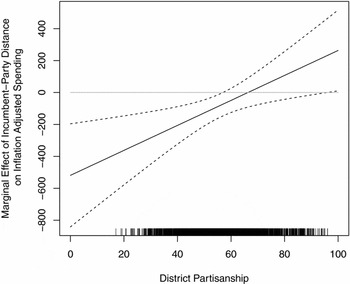
We also illustrate this interaction by plotting the marginal effect of Incumbent-Party Distance on campaign spending as a function of District Partisanship in Figure 3 below.
Marginal Effects of Distance from the Party on Incumbent Campaign Spending as a Function of District Partisanship

Again, this figure shows that the benefits of disassociating from the party decrease as District Partisanship increases.
Proposition 2 further implies, as we have noted via Corollary 2, that the effect of the Incumbent-Party Distance is magnified by a smaller uncertainty in his party's reputation: In marginal districts, the cost of being close to one's party is greater when the party reputation is less uncertain. In incumbent-party friendly districts, the cost of being further from one's party is greater when the party reputation is less uncertain. We test this by interacting Incumbent-Party Distance and Uncertainty in Party Reputation, as shown in columns 3 and 4 of Table 1. We further illustrate this via Figure 4, showing the marginal effect of Incumbent-Party Distance on campaign spending as a function of Uncertainty in Party Reputation.
Marginal Effects of Distance from the Party on Incumbent Campaign Spending as a Function of Uncertainty in the Incumbent's Party Reputation

Figure 4 shows an interesting trend in incumbents’ incentive to disassociate from their party. Over the past four decades, the uncertainty in both parties’ reputations has decreased substantially. During the period of our study, the standard deviation of the DW-Nominate scores for the House Democrats fell from 0.21 to 0.15. During the same time, the standard deviation of the DW-Nominate scores House Republicans fell from 0.19 to 0.15. Figure 4 indicates that in 1972, deviating from the party did not decrease an incumbent's spending. Distancing oneself from the party only reduced incumbents’ spending once the parties become sufficiently unified in their voting behavior.
DISCUSSION
Numerous scholars have argued that Congressional elections take place in the shadow of the parties’ collective reputations (Campbell et al. Reference Campbell, Converse, Miller and Stokes1960; Cox and McCubbins Reference Cox and McCubbins1993; Popkin Reference Popkin1995; Snyder and Ting Reference Snyder and Ting2002). This is because the party reputation can substantially affect how voters view individual candidates, and can even take precedence over an incumbent's own reputation if the party brand is informative enough. A strong and informative party label means that candidates increasingly face voters who view them as a typical partisan, and whose minds are harder to change on this front. Facing such voters, candidates are left with two possible choices: they may redouble their own personal effort to disseminate information about themselves, or resign themselves to the relative anonymity of being seen as a mere partisan.
Running as a typical partisan in an incumbent-party friendly district does not represent a special hardship. However, such a strategy is unlikely to yield success in marginal districts. If the party label alone does not suffice to ensure electoral success, the candidate is forced to campaign as an individual, predominantly focusing on his own individual merits and relying on his own resources. As Jacobson (Reference Jacobson1978, 485) observed: “campaign spending is important to candidates who need to makes themselves known to voters.” (emphasis added). As our results indicate, directing voters’ attention to the person of the candidate and away from the party is complicated by a stronger party reputation.
Our findings are consistent with previous arguments that both the reputations of the party and its individual members are strongly shaped by their legislative activities, and that these reputations have significant electoral consequences (Cox and McCubbins Reference Cox and McCubbins1993; Reference Cox and McCubbins2007; Woon and Pope Reference Woon and Pope2008). Intraparty homogeneity in the legislative process shapes elections by shaping the information available to the voters (Aldrich Reference Aldrich1995). By providing reliable information about most incumbents, stronger party reputations de-personalize elections, encouraging voters to ignore individual candidates and their reputations. Candidates with distinct and consistent legislative reputations of their own would be affected less by the weight of stronger party reputations, but as parties have grown more homogeneous, such candidates have grown fewer in numbers.
While we do not dispute the argument that collective party reputations play an important role in shaping the outcome of Congressional elections, we are more skeptical of the claim that strengthening the party's reputation constitutes a public good that confers a net electoral benefit on all members, and that parties exist principally for the purpose of proactively building and maintaining a precise reputation (Aldrich Reference Aldrich1995; Cox and McCubbins Reference Cox and McCubbins1993). Our findings show that a clearer, stronger party reputation does not uniformly benefit all party members. While a clearer party reputation may prove an electoral boon to the incumbents in incumbent-party friendly districts, it turns the electoral environment in marginal districts toxic.
In terms of its aggregate electoral impact, a stronger party reputation may not even serve the interests of the party as a whole. By assisting in the electoral defeats of incumbents in marginal districts, or, at least making their reelection bids more difficult, a stronger party reputation might actually weaken a majority party's hold on its status in the chamber. In this vein, our findings place into context Mayhew's famous suggestion that the best service a Congressional party can provide for its incumbents is to leave them alone, so that they may carve out their own unique reputation to fit their districts (1974a, 100). In districts where the party is not especially well liked, the personal reputation of the incumbent, not the party, offers the best path to electoral success. However, a stronger party reputation gets in the way by crowding out the role of individuals and driving up the cost of campaigning.
From the perspective of the party on the whole, this can be particularly dangerous because a clearer party reputation is divisive in a way that a weak party reputation is not. A strong party reputation accentuates internal divisions within the party, as it confers both greater rewards and stiffer penalties for different subsets of party members, giving each side even more of an incentive to fight. While the incumbents in incumbent-party friendly districts may have gained, they did so by alienating their colleagues in marginal districts, possibly poisoning prospects for cooperation within the party framework in Congress. In this vein, our argument may provide some explanation for the “ends against the middle” voting that has been seen more in recent congresses.
Why, then, did the Congressional politics of 1970s and 1980s begin the trend towards stronger party reputations that we see today, as observed by Rohde (Reference Rohde1991)? We suggest that the contrast between the patterns of campaign expenditures in 1972 and 2008 provides at least a partial answer. Even a moderate and weak party reputation is still a reputation: it still provides the backdrop that helps and hinders the electoral efforts by party candidates of different stripes. The weak reputations of the parties in the early 1970s offered no significant electoral benefit to the candidates running in highly partisan districts. The later development of stronger party reputations did, but only by shifting the burden to their intraparty rivals representing marginal districts. Thus, the changing nature of party politics in Congress in the past several decades may have been, to some degree, the product of an intraparty struggle over the party's brand that ended up conferring costs and benefits upon different subsets of partisans.
Ultimately, however, the ability of Congressional parties to unify their membership behind a clear, homogeneous label may be limited by the electoral advantage offered by individual maverickness. We have shown that establishing a distinct personal record provides an individual legislator with an alternative to a difficult and costly campaign. Consistently bucking the party on record provides an incumbent with a fairly inexpensive method of drawing attention to himself in lieu of spending campaign money (and having to raise it in the first place). Furthermore, the electoral payoff of a distinctive individual record increases as the party reputation becomes stronger.
Perhaps the party in power can forestall defections from the party brand by paying incumbents off with electorally useful resources that make up for the burden created by its collective reputation. For example, an incumbent's district may receive targeted government expenditures that benefit the incumbent electorally (Carroll and Kim Reference Carroll and Kim2010). Party leaders heavily involved in fundraising and the disbursement of campaign funds might target their money specifically at these marginal incumbents precisely because they need it most, and because these incumbents are particularly tempted to defect. However, because the electoral advantage of being a maverick rises as the party reputation becomes more informative, such side payments must rise as well. If so, too much cohesion—and too informative a party label—might simply become something that a party cannot afford.
APPENDIX
In this Appendix, we address how the uncertainty in personal reputations of the incumbents themselves shape their campaign spending, in addition to party reputation and the district characteristics, as noted in footnote 13.
The Effect of Variance in Personal Reputation
Greater uncertainty in an incumbent's reputation has two consequences. First, it makes it more difficult to show that the incumbent is in fact distinct from his party. Second, it inflates the perceived uncertainty of his position, in conjunction with that of the party.Footnote 19 Both these effects lower the utility the voter obtains from choosing the incumbent. Specifically, Equation (7) implies a straightforward relationship between an incumbent's campaign spending and the clarity of his personal reputation, σ2. This implies the following proposition:
Proposition A1. An incumbent's campaign expenditures increases as his personal reputation becomes less clear.
Proof. In all districts where the incumbent's campaign spending is positive, i.e., n ≥ 0, the following must be true:
 \begin{equation}
\frac{{2\sigma ^2 }}{{s_i^2 }}\left( {V - K} \right) + \frac{{\lambda \sigma ^2 }}{2} > 0\end{equation}
This can be rewritten as:
 \begin{equation}
\frac{2}{{s_i^2 }}\left( {V - K} \right) + \frac{\lambda }{2} > 0
\end{equation}
Differentiating Equation (5) with respect to σ2 yields the following:
 \begin{equation}
\frac{{\partial \bar n}}{{\partial \sigma ^2 }} = \frac{{\frac{2}{{s_i^2 }}\left( {V - K} \right) + \frac{\lambda }{2}}}{{[x + 2(K - V)]}}
\end{equation}
The left-hand side of the inequality (2) appears in the numerator, while the denominator is positive for all cases that we consider, as per footnote 11 above. Thus, the derivative
 $\frac{{\partial \bar n}}{{\partial \sigma ^2 }}$
must always be greater than 0 given inequality (2), in all districts with nonzero incumbent campaign spending, regardless of district characteristics.
What are the potential measures that capture the uncertainty in an incumbent's individual reputation? We have consistently used measures derived from the legislative records of both the party and the incumbents as stand-ins for their relative locations and uncertainties, specifically DW-Nominate Scores. DW-Nominate outputs provide a measure of uncertainty in the form of bootstrapped standard errors of the legislators’ first dimensional scores (Carroll et al. Reference Carroll, Lewis, Lo, Poole and Rosenthal2009). However, alternate measures may be applicable, such as the number of roll call votes that a legislator participates in. The larger the value of an incumbent's the bootstrapped standard errors are, the larger the uncertainty in his personal reputation is. The more votes that a legislator participates in, on the other hand, the smaller the uncertainty in his personal reputation is likely to be.
Table 2 above provides the output of the full empirical model that includes each of these variables. Column 1 shows the results using bootstrapped standard errors of first dimensional DW-Nominate Scores, column 2 shows the results using the number of roll call votes, and column 3 shows the results using both.
The Effects of an Incumbent's Personal Reputation on Campaign Expenditures

As expected, larger bootstrapped errors (which indicate greater uncertainty in an incumbent's record) correspond to a modest increase in campaign spending. The number of votes cast in a congress also has the expected sign, but at a lower level of statistical significance. This provides some evidence that incumbents with a less ideologically consistent record find it more difficult to convey information about where they stand relative to the party and the voters in a district. However, these findings also suggest that these effects are comparatively insignificant relative to the party reputation and district characteristics, which we have described as more important.






Comments
No Comments have been published for this article.