Introduction
In response to concerns that patients were finding inaccurate and potentially harmful medical information online, the government of Belgium hired an advertising company in 2014 to persuade patients to stop searching the Internet for health information. The motto of the campaign, “Don't Google it, check a reliable source,” used the Google AdWords feature to redirect any citizen querying Google Belgium for the top-100 most searched medical symptoms to a government-sponsored website called “Health and Science” (gezondheid en wetenschap).Footnote 1 The site, run by the Belgian Centre for Evidence-Based Medicine, hosts a searchable database of medical information with links to peer-reviewed scientific research and additional formally validated resources.Footnote 2 The website hosts a humorous video described by the advertising firm DDB as an “awareness video, showing what could possibly happen when you consult Dr. Google.” DDB also produced a video explaining how the award-winning campaign worked. In that video, after presenting several scenarios in which gullible Googlers find search results for “twitching eyelid” promoting an apple juice cure and self-injection with a huge needle, the onscreen narrator concludes, “So remember kids, don't Google it” (see fig. 1).
“Don't Google It” video (produced by DDB Belgium, 2014)

The authoritative dismissal of the actions of “75% of the population” described in this video as using Google rather than consulting a doctor to diagnose their symptoms exemplifies the deficit model of science communication at work. Despite a preponderance of evidence demonstrating that online search has been helpful, not harmful, to the vast majority of patients, a paternalistic view of medical knowledge gatekeeping continues to shape public discourse (Crocco et al. Reference Crocco, Villasis-Keever and Jadad2002; Cole et al. Reference Cole, Watkins and Kleine2016). The deficit model of science communication promotes a model of expertise where participation in the creation of knowledge and dissemination of information is limited to researchers with formal credentials. At the bottom of the hierarchy thus produced is the general public, seen as a passive audience, a target of science communication, and a locus of concern over the dissemination of misinformation through inaccurate media representations (see Vidal's introduction in this issue). Recent developments in crowdsourcing, citizen science, and distributed computing have challenged that model by demonstrating the substantial contributions that “non-experts” can make to scientific discovery through digitally enabled tools for exploring, analyzing, and sharing information. In contrast to the deficit model, the citizen science model identifies expertise as an attribute of life experience and an emergent property of passionate attention to an area of personal concern. These characteristics of the “non-expert” are re-coded as legitimate, novel forms of insight that official experts cannot claim; in this alternative model, the deficit lies not with amateurs, but with the experts themselves.
The challenge to traditional models of scientific expertise has been particularly energetic among citizens concerned with healthcare, often termed “e-patients,” who form extensive online peer-to-peer communities, demand access to their own health data, conduct crowd-sourced experiments, and “hack” health problems that traditional medical experts have failed to solve. This article will explore the evolving aesthetics of science films that enact the transition from a deficit model to a patient-centered model of visual representation and health communication. The first section will provide a historical context for understanding the role of film and video in patient activist movements. The second section will discuss the trajectory from patients being filmed as nameless, voiceless human research subjects to patients directing the recording of their own health narratives through activist cinematography. This section will map the evolution of participatory knowledge-making through participatory media. The final section will describe an emergent style of agency in e-patient videos, comparing several different approaches to patient-centered video, and concluding with a proposal for an aesthetic of imperfection in patient-centered medical films.
1. Media Activism in Patient-Led Movements: The Legacy of AIDS
The history of patient video activism is entwined with the histories of social justice movements such as civil rights, women's rights, and LGBTQ rights that demanded and helped create space for formerly silenced voices to be heard in civic debate (Petersen and Markle Reference Petersen James and Merkle1981; Fee Reference Fee1982; Stewart Reference Stewart1990). By directly challenging the claims of dominant social groups to exclusive representative authority to speak on behalf of marginalized members of society, these movements have played an important role in shaping the broader social context in which the deficit model of science communication operates. The AIDS activist movement offers a particularly illuminating example of how patient activism has challenged the representational techniques of scientific authority by designing alternative techniques for expressing situated knowledges (Haraway Reference Haraway1988) through media interventions and by engaging directly in the practices of scientific research (Wachter Reference Wachter1991; Epstein Reference Epstein1996).
When HIV/AIDS entered national consciousness in the late 1980s, mass media representations of the emerging pandemic stoked fear and misinformation through sensationalistic coverage that many critics found harmful to the communities of gay men most affected by the disease in the early 1980s (Treichler Reference Treichler1987). The mass media played an important role in shaping public awareness about HIV/AIDS, and consequently, they also became a target for activists who felt that information and understanding about AIDS was being shaped by vested interests who did not care enough about the people who were dying from this new disease (Epstein Reference Epstein1996). In the pre-internet era of early AIDS activism, most people around the world accessed news through broadcast and print media (Gurevitch and Curran Reference Gurevitch and Curran2005; Budd, Craig, and Steinman Reference Budd, Craig and Steinman1999). These top-down distribution models posed a challenge for less powerful members of society seeking a public platform for their voices. However, many AIDS activist groups, in particular the AIDS Coalition to Unleash Power (ACT-UP) and Queer Nation, used strategies of theatrical civil disobedience designed for screen-based media coverage (Crimp Reference Crimp2011). These groups expressed anger that their needs – as patients and as caregivers of patients – were not being met, noting that they were often mistreated in healthcare settings, the drugs they needed were taking too long to be approved and were too expensive once they were approved, and too little government funding was being directed toward understanding HIV/AIDS (France Reference France2016).
Activist groups such as ACT-UP challenged the deficit model of top-down broadcast media by organizing large groups of activists and recording their own videos, while also designing their events to ensure that they would be covered by mainstream news media (Hubbard Reference Hubbard2014). ACT-UP planned protests at locations and on dates that would generate mass media attention, including a protest at the New York City general post office near closing time on Tax Day, April 15, 1987.Footnote 3 In response to a protest ACT-UP staged on the floor of the New York Stock Exchange in 1989, a drug manufacturer dropped the price of an important AIDS drug, AZT, by several thousands of dollars.Footnote 4 As art historian Douglas Crimp has recounted, a protest at the U.S. Federal Drug Administration (FDA) marked a turning point in the evolution of ACT-UP as an organization that gained some measure of scientific credibility for non-scientist citizen participants. Crimp argues that, “The FDA action was ‘sold’ in advance to the media almost like a Hollywood movie, with a carefully prepared and presented press kit, hundreds of phone calls to members of the press, and activists’ appearances scheduled on television and radio talk shows around the country. When the demonstration took place, the media were not only there to get the story, they knew what that story was, and they reported it with a degree of accuracy and sympathy that is, to say the least, unusual” (Crimp Reference Crimp2011). ACT-UP members’ careful preparation for media engagement persuaded scientists that they were capable of mastering the details of complex policies related to FDA drug approval procedures, and by demonstrating their skill in this domain, those activists transformed the model of knowledge dissemination around AIDS research.
The core concept presented by AIDS activists to scientists at the FDA and in other biomedical research and treatment settings – that patients’ voices are an integral part of healthcare, and need to be heard and respected – is at the heart of the e-patient movement today. In both cases, the groups worked strategically to ensure that those voices became part of the media landscape through video recordings that could circulate through news outlets, videotape exchanges, and later, through websites. By working to shape the public representation of their message, sociologist Steven Epstein argues, ACT-UP activists shaped the discourse around patient participation in research, emphasizing empowerment, “greater equality in the doctor-patient relationship; and the demand for a greater role for patient groups in determining research priorities, assessing research findings, or making regulatory or policy decisions on the basis of those findings” (Epstein Reference Epstein1995, 428). The success of this movement highlights the role of communications and representational media in challenging conventions related to participation and exclusion, experience, expertise, and authority.
In effect, the ACT-UP example demonstrates that the deficit model of science communication can create sites of contestation that savvy media producers can coopt for their own purposes. Epstein notes that the effectiveness of the patient activists in this case is surprising because it is
at variance with the popular notion of science as a relatively autonomous arena with high barriers to entry. It is a result that illustrates the danger of understanding the role of laypeople in scientific controversies solely in passive terms – as a resource available for use, or an ally available for enrollment, by an entrepreneurial scientist who is conceived of as the true motive force in the process of knowledge making. (Epstein Reference Epstein1995, 409)
While these patients were eventually seen as contributing important knowledge to the process of scientific research, these results were not generalized across all of medicine. In fact, the e-patient movement demonstrates similar motivations driving both patient activism and physician resistance.
2. Participatory Knowledge-Making through Participatory Media
AIDS-era video activists devised strategies that not only responded to their experience of marginalization by medical researchers, but also worked to remediate the representation of gay men in visual culture, particularly in the mass media. Prior to the AIDS pandemic, gay men had rarely been openly present on television, except as villains, caricatures, or subjects of moralizing sociological investigation, as exemplified by the hour-long documentary The Homosexuals (CBS, 1967), which featured interviews with gay men who sat in shadows, hidden behind houseplants, and speaking through voice altering technology for fear of having their identities discovered. By demanding airtime and claiming control of the narrative about AIDS, groups like ACT-UP challenged the marginalization of non-normative voices within the scientific community, thereby targeting a fundamental exclusionary feature of the deficit model of science communication.
In the early years of the Internet, before Google and YouTube and Facebook existed, a physician with deep ties to the counterculture movement of the 1960s began thinking about how this emerging digital tool for communication and connection might transform medical knowledge hierarchies. After years of dialogue and collective research on this topic, and with the support of the Robert Wood Johnson Foundation, the physician Tom Ferguson and his colleagues (known as “the e-Patients Scholars Working Group”) published an important white paper in the early twenty-first century called, “e-patients: how they can help us heal healthcare” (Ferguson Reference Ferguson2007). In it, the authors define e-patients as “individuals who are equipped, enabled, empowered and engaged in their health and health care decisions” (ibid., ii), and they link this new form of empowerment to the newly available, non-expert sources of information that list-serves, chat rooms, and other early forms of online communities could provide. In their description of the co-emergence of the Internet and online patient communities, Ferguson and his colleagues posed critical questions about the transformation of the deficit model of medical communication by asking, how are “groups of expert amateurs . . . able to provide their members with such valuable medical help? What will be the consequences of turning the previous century's doctor knows best model of medical information flow upside down? How often and in what cases do patients actually know best?” (ibid., vi). The introduction to the e-patient white paper ends with a call to action, asking readers to join the dialogue about e-patients at the project's new weblog, epatients.net.
Anticipating the “Don't Google it” campaign, the “e-patients white paper” presents a set of observations about the challenges and opportunities of open information systems in medicine. Two key conclusions of the report were that, “We have underestimated patients’ ability to provide useful medical resources,” and “We have overestimated the hazards of imperfect online health information” (ibid., 26–29). Citing the Institute of Medicine Report, “To Err is Human: Building a Safer Health System,” (Kohn et al. Reference Kohn, Corrigan and Donaldson2000) which famously reported that 44,000 to 98,000 hospital deaths occur each year due to medical errors, Ferguson questions the comparative risks at play in hospitals and online. The paper goes on to describe efforts to identify harms caused by Internet search for health advice, including the creation of a “Database of Adverse Events Related to Internet Use,” which found one case of a possible fatality in four years of research, and eventually ceased operations due to lack of findings (Ferguson Reference Ferguson2007, 29). Ferguson and his colleagues concluded that, “adopting the traditional passive patient role and putting oneself in the hands of a medical professional may be considerably more dangerous than attempting to learn about one's medical information on the Internet” (ibid., 30).
At present, the e-patient white paper is posted on the website of the Society for Participatory Medicine (SPM), an organization that emerged from the work of Ferguson's group and is now home to the SPM's peer-reviewed publication, The Journal of Participatory Medicine. A cursory glance at this site, its twitter stream, and the active community response to blog postings immediately signals the powerful role that online social networks play in the e-patient movement. The Society for Participatory Medicine website shows that digital platforms can serve as powerful communication tools, connecting patients to providers and – perhaps most importantly – to each other. At the core of the organization's mission is a challenge to the deficit model, rooted in “promoting the concept of participatory medicine, a movement in which networked patients shift from being mere passengers to responsible drivers of their health, and in which providers encourage and value them as full partners.”Footnote 5 The idea that patients should be active participants in their healthcare frames them as new kinds of health “experts,” capable of helping health professionals and other patients collaborate to achieve health goals.
Embedded in the e-patient philosophy is the concept of “peer-to-peer healthcare,” defined by Susannah Fox as a new form of participatory medicine, driven by the recognition that “Patients and caregivers know things – about themselves, about each other, about treatments – and they want to share what they know to help other people. Technology helps to surface and organize that knowledge to make it useful for as many people as possible” (Fox Reference Fox2011). Fox was a member of the original “e-patients Scholars Working Group” that co-authored the “e-patients white paper” with Tom Ferguson, and later served as Chief Technology Officer of the United States Department of Health and Human Services.Footnote 6 As lead technology strategist for the federal agency dedicated to protecting the health of all Americans,Footnote 7 Fox advocated for technology to enable patient empowerment at the highest level of government. Notably, Fox also reported considerable resistance to policy proposals that challenged the deficit model of health communication.Footnote 8
Organizations such as the Society for Participatory Medicine, their partners WEGO Health, Health 2.0, Vertical Health and other organizations demonstrate an ongoing transformation in the ways that patients can connect online and access web resources, and the e-patient movement has become more sophisticated as these tools have evolved. As medical social media expert Bryan Vartabedian has argued in his analysis of the transformation of medicine in the digital age, in the early days of the Internet, patients were able to use the web to access information from read-only files – a significant step forward from not having any access to other patients or medical information, but only a first step. In the second phase of this movement, the social web enabled the beginnings of peer-to-peer healthcare. As the web matured and expanded from being an open repository of information to a site for communication and exchange, patients found each other and formed robust social networks of tremendous value to the participants (Vartabedian Reference Vartabedian2012; Rainie and Wellman Reference Rainie and Wellman2012). In the contemporary era of do-it-yourself content creation, e-patients are not only communicating with each other, they are building databases online, conducting their own scientific experiments, sharing creative output, and helping shape the practices of participatory, patient-centered medicine. Moreover, through the federally funded Patient-Centered Outcomes Research Institute (PCORI) in the United States, patient-reported outcomes are now reshaping research practices, especially through intuitive, user-friendly web-based interfaces that allow them to enter their own data into peer-to-peer healthcare community sites such as PatientsLikeMe and Crohnology.Footnote 9
Media scholar Henry Jenkins defined participatory culture as “a culture with relatively low barriers to artistic expression and civic engagement, strong support for creating and sharing one's creations, and some type of informal mentorship whereby what is known by the most experienced is passed along to novices” (Jenkins Reference Jenkins2009b, xi). This description captures the essence of the e-patient movement, with its emphasis on patients sharing “expert” insights hard-won through experience of the daily challenges of living with chronic or rare diseases. Instead of privileging scientific processes of discovery such as randomized, controlled trials, with their high barriers to entry, e-patients emphasize the importance of sharing personal stories that capture the important details and data of the patient experience in the form of narratives that others can easily access online and understand.Footnote 10
A key player in the evolution of participatory culture was the emergence of what Tim O'Reilly called “web 2.0” platforms for sharing content (O'Reilly Reference O'Reilly2005), such as user-friendly blog platforms and video sharing sites like YouTube that boast billions of visits per day.Footnote 11 A pioneer of early web-based communities, Howard Rheingold has described a key technical-structural feature of participatory media: “Many-to-many media now make it possible for every person connected to the network to broadcast as well as receive text, images, audio, video, software, data, discussions, transactions, computations, tags, or links to and from every other person. The asymmetry between broadcaster and audience that was dictated by the structure of predigital technologies has changed radically” (Rheingold Reference Rheingold and Bennett2008, 100). The asymmetry described by Rheingold finds an analogy in the top-down model of science communication that characterizes the deficit model of expert communication to science-illiterate masses. Just as “many-to-many media” have transformed journalism by enabling ordinary citizens to contribute valuable content to the documentation of daily life, these same media transformations have facilitated a dramatic growth in patient activism that challenges traditional approaches to the dissemination of scientific expertise.
From the vantage point of participatory media enthusiasts, the explosive growth of YouTube might be seen as a sign of active engagement in public dialogue by millions of users around the world. From the perspective of knowledge gatekeepers in medicine, in contrast, this development might be cause for alarm. Indeed, medical schools across the United States have noted that lecture halls are emptying out as students seek more engaging versions of their in-person lectures, available on demand for streaming at double speed.Footnote 12 While a handful of medical schools have embraced this development (Prober and Heath Reference Prober and Heath2012; Straumsheim Reference Straumsheim2016), far more medical educators raise concerns about misinformation online (Chung et al. Reference Chung, Rosalind, Joyner, Sims and Moon2012). Physician and digital health expert Eric Topol has argued that participatory media is changing the relationships between doctors and patients by contributing to the flattening of knowledge hierarchies in medicine, noting, “The internet and the unprecedented growth of online, health-oriented peer-to-peer networking have forced a rapidly approaching parity of knowledge between the public and the medical profession” (Topol Reference Topol2012, 227). If Topol's assessment is correct, the availability of medical information online might threaten to disrupt the healthcare industry in significant ways, particularly in light of the Pew Research Center's finding that one-third of Americans already go online to gain information about medical conditions (Fox and Duggan Reference Fox and Duggan2013).
As scholars in the field of science and technology studies have shown, the mere availability of a new information technology does not change human behavior unless that technology is situated in a relevant social context (Oudshoorn and Pinch Reference Oudshoorn, Pinch, Hackett, Amsterdamska, Lynch and Wajcman2008). Participatory medicine must therefore be understood as a dynamic product of engagement with collaborative media, rather than as a side effect of technological innovation. As Jenkins argues, “Participatory culture is emerging as the culture absorbs and responds to the explosion of new media technologies that make it possible for average consumers to archive, annotate, appropriate, and recirculate media content in powerful new ways” (Jenkins Reference Jenkins2009b, 8). Along with online multiplayer videogames such as Foldit (Hand Reference Hand2010), user-generated videos are among the most widespread and popular new media tools enabling participatory culture to develop outside of traditional closed information systems. While Jenkins has noted that participatory media cultures predate YouTube and the Internet, the ease of sharing on these open platforms has transformed screen culture and the communities that form around these online spaces (Jenkins Reference Jenkins, Burgess and Green2009a). In the era of citizen science, the hierarchical model of scientific authority that once enabled the dominance of what theorist Michel Foucault called the “clinical gaze” (Foucault [1963] Reference Foucault1994) has been displaced by the model of shared expertise embraced by patient activists. As a result, the aesthetics of the clinical gaze have also been displaced as novel approaches to medical expertise are expressed through alternative representational forms. Online videos produced by and about e-patients on sites such Chronology, PatientsLikeMe, and the American College of Surgeons Patient Education portal demonstrate the characteristics of this new genre of science communication.
3. A New Style of Agency in e-Patient Films
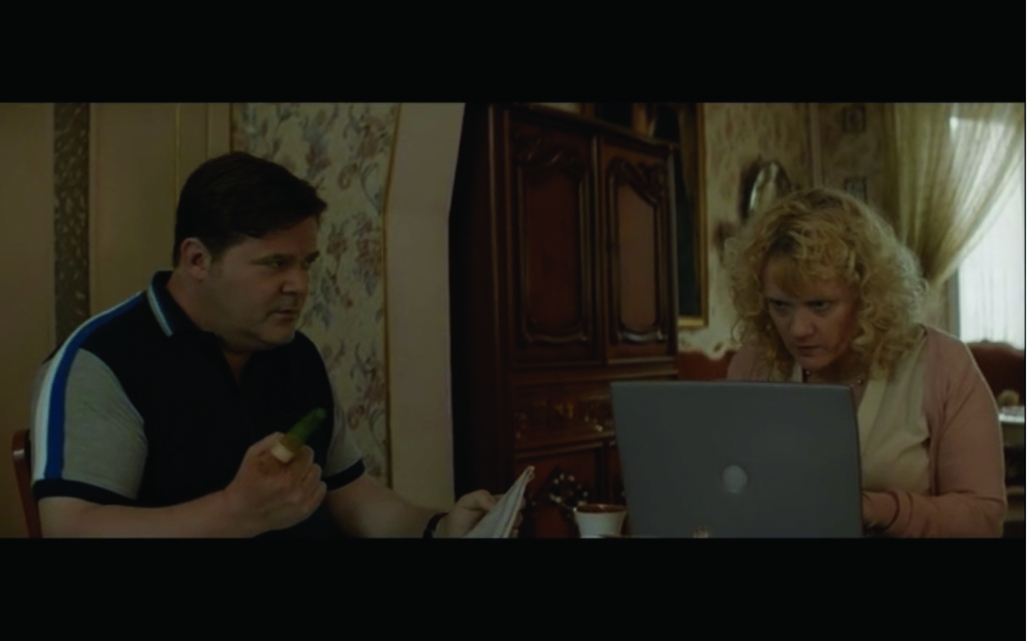
The video produced by the international advertising agency DDB for the “Don't Google it” campaign provides an illuminating comparison to e-patient films. Marked by high production values, including the use of special effects, editing, and prosthetic makeup, the DDB video creates the illusion that diagnosis by “Dr. Google” will instantaneously transform search results into visible symptoms on the Internet user's body. The setting shows a white, middle-aged couple seated at a table in a middle-class dining room, the woman at a laptop and the man reading a newspaper. After she dotingly bandages a cut on his finger, the woman types the initial query, “infected finger,” into the Google search engine. The man appears irritated by her fussing, framing the following sequence as a gendered portrayal of poor judgment and health illiteracy in action. Playing on the notion of “viral video,” the misinformation provided by Google immediately infects the patient's body, escalating the effects from turning his finger green to making the finger fall off, followed by hair loss, terrible nose bleeds, and development of skin ulcers, which finally infect the woman, too. At that point, she fearfully closes the laptop to halt the flow of contagion, and viewers receive the key message of the campaign, “Don't Google it, check a reliable source.”Footnote 13
The magical qualities attributed to the Google search engine in this video are visualized through props and makeup to demonstrate the real, physical harm that can come from consumption of inaccurate health information online. The fantastical quality of the symptoms displayed in the video serves not merely to create a humorous effect that balances out the more serious message of the Centre for Evidence-Based Medicine. Rather, these representational techniques also foreground the professional production values and sophisticated persuasion techniques of a health campaign run by a global advertising firm and financed by a national government agency. The visual aesthetics of the “Don't Google it” video subtly establish the authority and legitimacy of the message being conveyed, in an effort to reinforce the foundations of medical knowledge hierarchies that are threatened by user activities such as “googling symptoms” in the information age. As a message that aims to reinforce the traditional, “Ask your doctor” deficit model of health communication, the highly mediated visualization techniques of the “Don't Google it” video signal their affinity with other models of techno-mediated science communication. While the citizen science and e-patient movements may challenge the sole authority of formally credentialed experts to speak, those low-budget to no-budget groups may nonetheless find it difficult to compete with the big-budget messaging available to a national government-sponsored campaign.
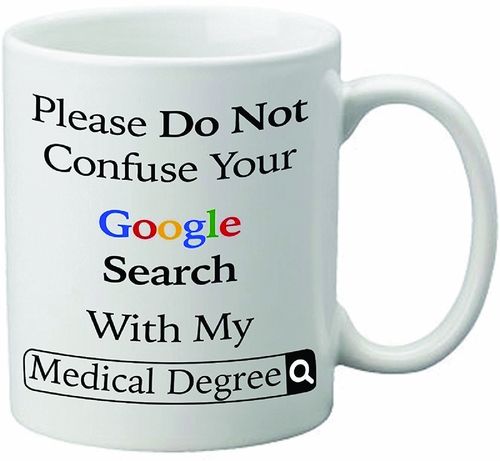
Social media networks exploded with the outrage of engaged patients responding to the Belgian government's online advertising campaign aimed at persuading them not to Google their symptoms and instead, to “check a reliable source.”Footnote 14 Many engaged patients and physicians argued that the campaign expressed an outdated and condescending caricature of naïve, health illiterate web surfers (Elwyn Reference Elwyn, Quinlan, Mulley, Agoritsas, Vandvik and Guyatt2015). Susannah Fox asked “I can't imagine a U.S. campaign to reign in people's Dr. Google consults, can you?” on twitter, and medical doctor Joyce Lee posted a lengthy commentary titled, “Wake up health care: Patients Google it” (Lee Reference Lee2014). Yet the debate persists, with new contributions annually, ranging from staged debates in news media outlets to memes such as the image of a coffee mug emblazoned with the challenge, “Please do not confuse your Google search with my medical degree” that went viral in November of 2015, with over 73,000 shares in 48 hours on Facebook (see fig. 2).Footnote 15
“Please do not confuse your Google search with my medical degree” (Facebook meme, 2015)

In August of 2016, The New York Times newspaper staged a debate on the topic, titled, “Are Medical Websites, Like WebMD, Healthful?”Footnote 16 The discussion featured opinions from four commentators, including an article written by a medical doctor, titled, “Stop Asking Dr. Google for Advice.”Footnote 17 To make his point that even educated people cannot discern good advice from bad on “Dr. Google,” the author of the piece described how one of his patients caused himself physical harm by following a treatment he found on a “do-it-yourself internet site.” That patient was a physician. The article implies that if a credentialed medical doctor can be misled by information found on the Internet, no ordinary citizen could reasonably be expected to filter out medically dubious search results. Despite the cautionary tale, over one hundred readers posted responses to this essay, almost all of them critical of the author's stance.
As a message that aims to reinforce the traditional, “Ask your doctor” deficit model of health communication, the highly mediated visualization techniques of the “Don't Google it” video signal their affinity with other contemporary forms of techno-mediation in science. When considered in comparison with the higher-tech, higher-cost production quality of the DDB campaign, many e-patient videos present a distinctly low-tech, low-cost, do-it-yourself (DIY) aesthetic. The contrast between the funding, quality of production, and aesthetics of these two different types of videos raise important questions related to the deficit model of science communication. In the era of YouTube, when videos created by nationally accredited associations of medical doctors share the same distribution platform as homemade e-patient videos, what distinguishes the quality, credibility, and authority of one presentation over another? Has the ethos of twenty-first century, “broadcast yourself” participatory media reframed viewer responses to polished versus imperfect production values? In the domain of medicine, how does a DIY, patient-generated visual aesthetic interface with the increasingly techno-mediated aesthetics of computer-generated clinical visualizations?
Consider, for example, the videos produced by Sean Ahrens, a San Francisco Bay Area-based computer programmer who created an online network called Crohnology.com for patients with the autoimmune diseases Crohn's and Colitis.Footnote 18 Ahrens founded Crohnology in 2011 to share and build upon the knowledge he and other patients had gained through many years of efforts at managing and curing their own disease when traditional biomedical approaches could not help. As Ahrens describes the initial motivation for creating the startup on his blog, “Patients are walking around with a vast wealth of data in their head that – up until now – we have been simply letting disappear.”Footnote 19 Ahrens expands on the idea that patient experience should be captured and understood, to argue that the present alternative is a profit-driven enterprise with limited benefits for patients with unconventional needs. He explains,
Out of the entire possibility space of treatments that exist, the ones that make economic sense to bring to market are only a tiny fraction – we're almost exclusively studying the treatments that make multi-billion dollar returns. This means that the playbook that doctors are treating patients off of is a subset of what actually works. That means things that can't be patented – like diets, natural therapies, many things that patients find effective outside the doctor's office – don't get the clinical evidence they need for a doctor to prescribe them. It's a very real possibility that the cure for the world's worst diseases exists outside of what our economic system is studying.Footnote 20
In this commentary, Ahrens links the deficit model of science communication to economic drivers of biomedical research that limit the range of legitimate scientific expertise to revenue-generating enterprises. Under this model, the knowledge generated by self-experimenting patients, whose needs have not been met by what sociologist Adele Clarke and colleagues have called the “Biomedical TechnoService Complex Inc.” (Clarke et al. Reference Clarke, Mamo, Fosket, Fishman and Shim2010, 202), is doubly marginalized, both for lacking formal scientific credentials and for lacking commercialization prospects.
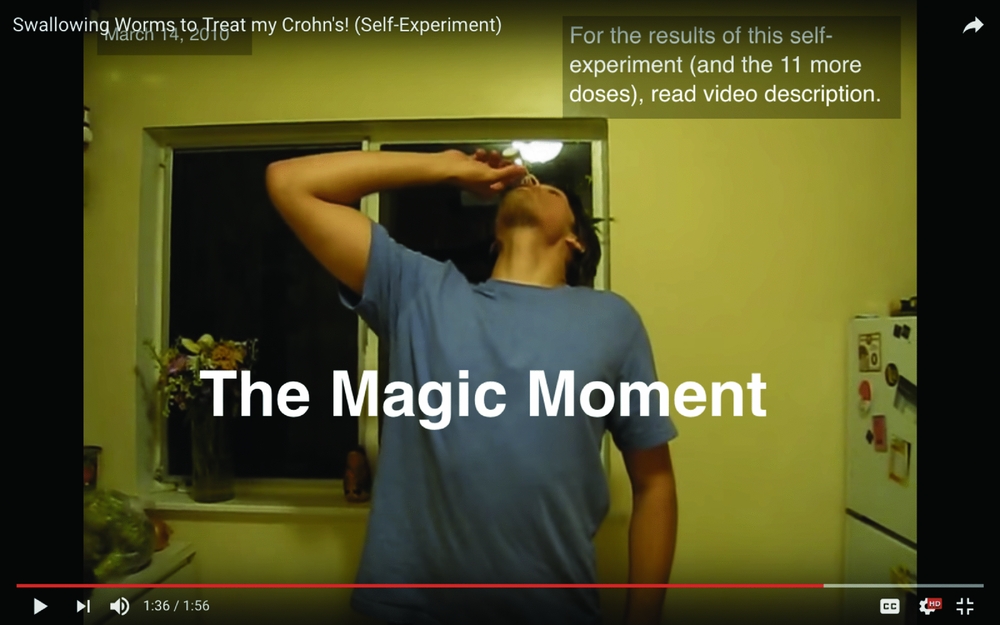
In August of 2016, Ahrens posted a video on YouTube that he had recorded in 2010, documenting his own self-experimentation ingesting pig whipworm eggs in an attempt to treat his longstanding, painful symptoms of Crohn's disease. Like many videos posted on YouTube, Ahrens’ video is clearly a low-tech, do-it-yourself production. The video is shot in the kitchen of his San Francisco apartment, with location lighting from an overhead fluorescent kitchen lamp that reflects a glare off of the kitchen window. The handheld (possibly smartphone) camerawork by his roommate is wobbly and casts shadows as the cameraman moves around the kitchen, obscuring parts of the image as he moves in for a close-up of the shot glass containing parasitic worms (see fig. 3). The unfiltered soundtrack captures the movement of Ahrens’ and the cameraman's feet as they move about the small room, as well as the echo of Ahrens’ voice on the low-fidelity, built-in audio recording equipment.
Sean Ahrens, “Swallowing Worms to Treat my Crohn's! (Self-Experiment)” (YouTube, Aug 19, 2016)

Although the self-experiment was recorded in 2010, it wasn't posted online until 2016. As Ahrens explains in his YouTube comments, “I'm [publishing this video] now because I just published my experiment and a full report of the results in the July 2016 Issue of the American Journal of Gastroenterology. I believe having a patient self-experiment published in a major medical journal is a big step for the ePatient movement!”Footnote 21 The juxtaposition between the style of Ahrens’ self-made video and the formal presentation of the experiment in the American Journal of Gastroenterology is striking. When viewed without the frame of a credible scientific journal backing Ahrens’ claim to legitimacy, the video could easily be dismissed as another of the millions of videos posted daily on YouTube by anonymous users with uncertain qualifications to make claims or dispense advice.
Ahrens explicitly promotes the value of patient self-experiments in his comments on the video, stating, “I think it's super important for the advancement of medical knowledge for patients who do self-experiments (or just treatment variations, diets, etc.) on themselves to record and publish those so we can build up a resource of patient's real-world (and otherwise unrecorded) collective knowledge. This will help medical information to flow from patients up.”Footnote 22 Naming the insights gained from his experience as “medical information,” Ahrens treats his DIY video as a different form of the same expertise that he presents in the American Journal of Gastroenterology, despite the different connotations of selectivity and validity in the closed, peer-reviewed setting of the journal, as compared with the open, unfiltered platform of YouTube.
Ahrens’ essay is published in the “In My Own Voice” section of the journal, with a preface from the editor stating,
Editor's Note: This article discusses the experience, ingenuity, and determination of Sean Ahrens, a young patient with Crohn's disease who took it upon himself to treat his longstanding, symptomatic Crohn's disease with pig whipworm eggs. Reading this story will make some of you uncomfortable. You might question whether this work belongs in a medical journal or sends the wrong message to readers. However, we recognize that this topic is controversial and that N=1 reports cannot and should not change practice. The purpose of this story is not to encourage the use of pig whipworm or to demonstrate its efficacy (or lack thereof). We firmly believe that patients are uniquely qualified to provide insights into how they view their illnesses, weigh risks and benefits, and ultimately achieve self-efficacy. Stories like this are important for us to acknowledge and understand, even if they do not change our practice. (Ahrens Reference Ahrens2016)
Despite the editor's anticipation of skepticism among readers of the journal, the acknowledgement that patients can provide unique insights into their own illnesses gestures toward acceptance of patient autonomy to seek and act on information obtained outside of formal clinical settings. Ahrens cites a research study that suggested the potential efficacy of treating ulcerative colitis with parasitic worms, but he identifies the more direct sources of inspiration as two friends with Crohn's who were “self-dosing with human hookworm” (Ahrens Reference Ahrens2016, 918). He further describes how he obtained the pig whipworm eggs by mail order from Thailand. Despite the unconventional nature of his approach, Ahrens methodically describes how he tracked the results of the experiment, using a Google form on his phone to record gut pain, bowel movements, and blood in his stool. At the end of the article, Ahrens indicates that although he is unsure what conclusions to draw from his self-experimentation, his ongoing self-tracking demonstrates that his health has continued to improve. Viewed in isolation from the scientific article, Ahrens’ self-experiment video might be viewed as a crazy stunt, a joke, or simply as part of the wildly heterogeneous collection of user-created videos posted on YouTube every day without any formal evaluation or validation. As the concluding section of this article will discuss, the aesthetic qualities of the video do not produce a professional effect, and indeed, Ahrens’ video would stand out for its maverick, do-it-yourself style if it were featured on any traditional medical website. However, Ahrens’ unfiltered direct address, expressed through an authentically personal perspective, challenges viewers to consider what “patient-centered” really looks like in the era of participatory medicine.
Conclusion: A Short History of Agency in (Medical) Film
The philosophical underpinnings and aesthetic strategies of ACT-UP and e-patient media activism dates back to more than half a century ago, when a global political movement of anti-colonial artists embraced the power of “imperfect cinema” aesthetics to express their critique of authoritarianism and oppression in Cuba, Argentina, North Africa, and the Middle East (Armes Reference Armes1987). Framing the aesthetics of Hollywood as an imperialist form of polished, “perfect” cinema that conveyed oppressive ideological effects by hiding the real conditions of human existence behind glossy spectacle, avant-garde activist filmmakers of the 1950s and 1960s espoused a “Third Cinema” expressing an “aesthetics of hunger” that made use of whatever tools were available to enable them to create and distribute globally their message of resistance and empowerment of the people (Rocha [1965] Reference Rocha and Martin1997). These filmmakers deliberately embraced anti-Hollywood techniques to present an alternative view of the lives and experiences of communities that were invisible in the fictional worlds invented on Hollywood screens.
Expanding on the “Third Cinema” critique of the ideological implications of film aesthetics, film scholars identified stylistic traits associated with particular models of power, such as the “male gaze” (Mulvey Reference Mulvey1975) and the “colonial gaze” (Fanon [1952] Reference Fanon1967; Snead Reference Snead1994; Tobing-Rony Reference Tobing Rony1996). These terms describe the aesthetics and effects of films made by producers who occupied positions of dominance over the populations they represented, as in predominantly male directors of Hollywood films featuring sexualized female stars, or colonial occupiers filming so-called “natives” performing invented or decontextualized cultural rituals that reinforce racial stereotypes. In these films, the point-of-view conveyed through the camera reproduced hierarchical social relations, and reinforced the filmed subject's lack of agency. The medical analogy was the “clinical gaze” (Foucault [1963] Reference Foucault1994), enacted cinematically by doctors who filmed (often unconscious) patients in vulnerable positions without their consent, to be used as representative cases for the edification of professional colleagues in exclusive expert settings (Ostherr Reference Ostherr2013).
Medical films had been made by doctors for other doctors since the late-nineteenth century (Boon Reference Boon2008), and over time, an aesthetics of the clinical gaze emerged from this archive. In clinical films, patients were rarely acknowledged as participants, though their bodies provided the setting for the demonstration of the surgical and other techniques that were the focal points of the films. Many of the medical films produced from the late-nineteenth century to the 1970s were filmed as close-ups of surgical procedures, with voiceover narration added in postproduction, along with clarifying animations or other special effects to illuminate the signature features of the demonstration (Ostherr Reference Ostherr2013). Facial close-ups were rarely employed, rendering the patients and the masked and gowned medical professionals as anonymous actors on the clinical stage. While the approach presented in these historical films may seem outdated and in violation of contemporary medical ethics, to this day patients are rarely acknowledged in medical films where they appear.
In contrast to surgical films where patients’ bodies provide the anonymous backdrop to a medical intervention, films produced today by surgical organizations for the purpose of patient engagement or education present a distinct style of address. For example, the American College of Surgeons (ACS), the primary professional organization for board-certified surgeons in the United States, produced a series of videos to teach patients the skills needed to manage a postoperative feeding tube at home. Under the ACS website's “Patients and Family” tab, as part of the ACS Surgical Patient Education Program, the website provides video resources such as, “Feeding Tube Home Skills Program,” “Ostomy Home Skills Program,” and “Your Lung Operation – Education for a Better Recovery.”Footnote 23 Like Sean Ahrens’ film, these videos start with a patient directly addressing the camera, demonstrating a marked difference from earlier models of science communication that solely enabled medical professionals to speak. Moreover, the patients in the ACS videos directly address the imagined viewer through comments that explicitly acknowledge the educational function of the film, such as, “You might want to get a pen. . .” or, “You can pause as many times as you need to. . .”Footnote 24 One video, called “Feeding Tube Skills: What is an Enteral Feeding Tube?”Footnote 25 is narrated by a cancer survivor who admits that she was scared about having a feeding tube at home. The intimate, personal characteristics conveyed through these approaches might at first seem to suggest that the ACS videos share in the “power to the patients” philosophy expressed by Ahrens and other e-patients.
However, the aesthetic is clearly that of a traditional professional organization, with the mode of address shifting away from the patient's narrative immediately once the “content” of the educational intervention begins. The instructional sequences are all voiced over by a professional-sounding off-screen narrator and contain no personalizing touches from the patients themselves. The patient is only a framing device for deficit model communication. Notably, the text describing the video addresses the expected viewers, stating, “You and your family are important members of the surgical team. Watching these videos should help you understand how to care for yourself or family member after an operation.”Footnote 26 Yet, the production credits do not include any patient participation in consulting or producing the videos, identifying the contributors as, “the ACS with input from the American Pediatric Surgical Nurses Association, American Pediatric Surgical Association, American Society of Parenteral and Enteral Nutrition, the ACS Commission on Cancer, and the Wound, Ostomy and Continence Nurses Society (WOCN®).”Footnote 27 The ostensibly patient-centered videos produced by the ACS therefore demonstrate the persistence of the deficit model as enacted through slight – and superficial - accommodation to the movement toward patient-centered care.
In comparison with the American College of Surgeons videos, PatientsLikeMe, a major online, patient-driven data-sharing community with over 400,000 members, also hosts a large sampling of patient testimonial videos, recounting the benefits of participation in the online community. Like the ACS videos, the PatientsLikeMe videos feature professional production values in their musical scores, lighting, sound, and editing. At the end of each video, viewers are urged, “Donate your data. For you. For others. For good. Data for good.”Footnote 28 These videos serve as advertisements for the organization's mission, rather than serving educational or documentary functions, and this orientation plays an important role in framing the patient stories. Unlike the ACS videos, the PatientsLikeMe videos truly convey a patient-centered approach, with each video shot entirely from the patient's perspective and narrated in her or his own voice. However, the emotional yet uplifting musical score, coupled with the well-defined narrative arc of each patient story and the patient's address to an interlocutor positioned off-screen behind the camera, clearly frames each video as a polished piece of persuasive media.
When viewed alongside the ACS and PatientsLikeMe videos, Sean Ahrens’ video stands out for its low production values, its do-it-yourself aesthetic, its extreme approach to self-experimentation, and its surprising validation through intermediation with a peer-reviewed scientific journal. Many other e-patient videos share all but the last of these qualities, positioning them as deeply meaningful to their creators and the engaged patient community, but scientifically illegible through traditional, deficit model analytical frames. In the era of peer-to-peer healthcare and participatory media, rigorously reviewed scientific information shares the same distribution platform as independently produced, highly individualistic personal creations. In this unfiltered context, production aesthetics play a critically important role in establishing the credibility of a communication, as do the algorithms driving online search results. While the government of Belgium may urge citizens to stop using online search entirely for medical information needs, the “Don't Google It” campaign also manipulates search results through the Google AdWords algorithm, which redirects users to a site designed to provide aesthetic assurance of scientific legitimacy. The spare layout, cool blue and white tonality, and professional iconography on the Gezondheid en wetenschap (Health and Science) website all lend themselves to a sense of legitimacy and credibility.Footnote 29
Yet, like the ACS and PatientsLikeMe sites, the Belgian government-sponsored site lacks a sense of connection to real patients, with their experience-driven passion, frustration, sense of urgency, and lack of professional resources. The core principles of citizen science are gaining momentum in their challenge to deficit models of science communication. The next step for organizations claiming to represent a true patient-centered perspective will be the integration of the aesthetic of scientific credibility with the raw style of a YouTube video of a guy swallowing worms in his apartment. When medical organizations acknowledge that true collaboration with patients requires a transformation of both knowledge hierarchies and the representational systems that support them, a model of surplus will finally replace the deficit model.