During the reign of Louis XIV, few courtiers led careers as full and consequential as that of François Fénelon. Born in 1651 to a nobleman from an ancient line but with little wealth, Fénelon was well schooled through scholarships, rising as a young priest, scholar, teacher, and administrator through the Church hierarchy. The 1685 Revocation of the Edict of Nantes gave Fénelon the opportunity to distinguish himself as an educator at a school for girls who had recently converted from Calvinism to Catholicism. A rising star in King Louis XIV's court, he was mentored by the Crown's leading theologian and political theorist, Jacques Bénigne Bossuet, Bishop of Meaux, and rubbed shoulders with notables like the Duc de Saint-Simon. These associations led to his appointment as special tutor for Louis XIV's three grandsons, one of whom eventually became Philip V, king of Spain. Fénelon's own ambitions were rewarded in 1695, when he was appointed Archbishop of Cambrai. Over the course of his decorated career, Fénelon wrote theology, mysticism, and pedagogy, as well as more lighthearted fictional literature. He died in 1715, a few months before Louis XIV's own death.
Fénelon is not widely read today and is certainly underappreciated by historians of political thought. Ryan Patrick Hanley may well be right that no other thinker in the Western canon was so well known in his time and so little known today.Footnote 1 In these two companion volumes under review, Hanley redresses this lacuna, promoting Fénelon as among the most important European political philosophers of the early eighteenth century. For the first time, English readers are treated to both a full-scale consideration of Fénelon's political thinking, and a sampling of his most essential writing. Given Hanley's already seasoned success as an important scholar of early modern political thought, these volumes constitute the best way for English-language readers to appreciate Fénelon's role in the transformation of political ideas from the last years of Louis XIV through the early Enlightenment.Footnote 2
Hanley recognizes that Fénelon wrote in three distinct genres, often for different audiences: pedagogical treatises and juvenilia in his capacity as an educator, theological and pastoral writings as part of his duties as priest and archbishop, and political writings in his role as courtier. Properly relating these three genres to one another is his goal. He rejects a standard view that Fénelon was primarily a religious thinker whose political and pedagogical ideas stem from his Catholicism.Footnote 3 While avoiding any temptation to make Fénelon a systematic thinker, much less a dogmatic one, Hanley nonetheless sees unity in Fénelon's thought, arguing that his overarching ideas transcend any one genre.
Hanley's account centers around the 1699 publication of Fénelon's Adventures of Telemachus, a fictional prose poem that self-consciously imitates Homer's Odyssey by following the adventures of the son of Odysseus across the ancient Mediterranean world. Fénelon wrote Telemachus as a mirror for princes to educate the eleven-year-old Louis de France, Duc de Bourgogne (1682–1711), grandson of Louis XIV and second in line (behind his father) to inherit the French throne. More than any other of his works, Hanley argues, Telemachus incorporates Fénelon's pedagogical, political, and spiritual ideas into something almost approaching an ideology. As Hanley notes, Telemachus not only became a best seller from its first year of publication, but also, over the course of the eighteenth century, no book other than the Bible was produced in more editions and translated into as many languages. My own research confirms 445 editions in French, Danish, Dutch, English, German, Greek, Italian, Latin, Polish, Portuguese, Russian, Spanish, and Swedish. Nor did the popularity of Telemachus diminish when Europe became engulfed in the French Revolution. More editions, in fact, of Telemachus were produced during the 1790s than in any other decade.Footnote 4 Few books were more popular than Telemachus. Hanley calls Telemachus Fénelon's “political masterwork,” the “cornerstone of his project of political reform.”Footnote 5 Hanley aims to recover Telemachus as a major milestone in early modern political thought on a level with the works of Machiavelli, Locke, Bossuet, Montesquieu, and Rousseau. However, as I will suggest here by reviewing the publication and reception history of Telemachus, it is an unlikely candidate for a major work of political theory, and in contrast to his contemporaries Locke and Bossuet, there is little evidence that Fénelon thought of himself as a political philosopher.
The Political Philosophy of Fénelon is organized thematically. Its chapters address education, economics, war, statesmanship, religion, theology, and love. While Telemachus is featured in almost every chapter, Fénelon's other writings are called in for supporting roles as they are needed. The result is a balanced and readable account revealing the coherence of Fénelon's ideas and demonstrating why Telemachus became so popular during the eighteenth century. At the center of Hanley's interpretation is the emphasis Fénelon placed on the need to regulate amour-propre, or self-love. In his pedagogical writings, Fénelon highlights the role of education to provide a toolkit for every individual to curb their own amour-propre. Considering what we know about the young the Duc de Bourgogne, the intended first reader of Telemachus, whom Hanley describes as “a willful boy disposed to powerful passions,”Footnote 6 such emphasis seems well placed. In his later political writings as well, Fénelon emphasizes how regulating the monarch's amour-propre often means the difference between a dangerous tyrant and a beloved king. Finally, in his religious writings, Fénelon embraces the total annihilation of amour-propre through what he terms “pure love.” In this way, Hanley shows with much insight how Fénelon's writings—whether pedagogical, political or religious—show a preoccupation with controlling self-love.
Hanley's effective way of approaching Fénelon helps explain what made him so popular to Enlightenment readers and especially to philosophes such as Rousseau, who famously instructs Émile and his future wife Sophie to read Telemachus.Footnote 7 Given the important role Rousseau assigned to amour-propre, it is no wonder that he embraced Fénelon.Footnote 8 What is curious, however, is how little interested Hanley seems to be in the intellectual context that sparked Fénelon's focus on amour-propre. After all, from his excellent work on Adam Smith and Rousseau Hanley knows better than most scholars that during the 1680s the nature of amour-propre was insightfully explored by Jansenist moralists such as Pierre Nicole (1625–95).Footnote 9 While Hanley makes clear the lineage between Rousseau and Fénelon, he might have explained how the latter's moral ideas fit with his reputation as an opponent of Jansenism.Footnote 10
Alongside regulating amour-propre, Hanley identifies Fénelon's economic ideas as another reason for his eighteenth-century importance. Assuming a leading position in what would become known as the great debate over luxury, Fénelon criticized modern commercial states for embracing fashion and conspicuous consumption while ignoring the plight of Europe's impoverished peasantry. Nonetheless, Fénelon recognized that commercial societies could do far more to encourage trade in necessities, lifting ordinary families out of poverty through agricultural improvement. “His goal,” explains Hanley, “was to develop a political economy capable of generating the abundance of necessities that would provide the modern nation with a level of opulence sufficient to guarantee its freedom and security.”Footnote 11
Rousseau was again perhaps the most famous student of Fénelon's economic ideas, taken especially with Fénelon's attack on fashion and excessive urban consumption. From Fénelon, Rousseau learned to value ancient societies such as Sparta and the early Roman republic over modern commercial monarchies. Rousseau was hardly alone. These ideas attracted many Enlightenment thinkers. The Chevalier d'Eon viewed Telemachus as the basis for resisting “arbitrary” taxation, while the Physiocrat Victor de Riquetti, Marquis de Mirabeau, advocated for renewed investment in agriculture.Footnote 12
As a result of his residency as Archbishop of Cambrai, close to the battlefields during the long and devastating War of the Spanish Succession (1701–14), Fénelon developed strong ideas regarding war and international affairs that the well-known literary historian Paul Hazard identified as “a defense of human rights.”Footnote 13 Hanley doesn't go this far, but he does argue that, outraged by what he witnessed, Fénelon developed notions of “just war” that were meant to restrain aggressive monarchs such as Louis XIV. Likewise, Fénelon repudiated imperial notions of universal monarchy and improvised his way towards something Hanley regards as a balance-of-power theory, requiring monarchs to show respect for their neighbors. What upset Fénelon more than anything was the suffering war caused among peasants. “The entire countryside is overwhelmed by the demand for wagons for military transport,” he wrote in a fascinating memorandum reproduced in Hanley's anthology. “All the horses of the peasants are being killed. This serves only to spoil the plowing for the coming years, and to leave no hopes of survival to either the people or the troops.”Footnote 14 Louis's wars brought little glory to France and threatened to plunge the kingdom's economy into a severe depression.
Chapter 4, entitled “Justice, or on Statesmanship,” is thematically the closest perhaps to modern political theory, in which Hanley moves from Fénelon's first principles to appropriate types of government authority. As in earlier chapters, it is hardly surprising that those first principles revolve around the monarch's command of amour-propre. Just as the Christian turns one's attention away from the self and onto God, so the monarch should love his people more than himself. Indeed, for Fénelon, the difference between a legitimate monarch and a tyrant is not so much the degree of the king's power, or, how power is distributed institutionally, but rather the extent to which the monarch uses power for the good of his or her people. This is what Telemachus's tutor, Mentor, means when he teaches that a king “has absolute power to do good,” but nonetheless finds his “hands bound as soon as he wants to do evil.” Hanley puts it this way: “Good governance of the state requires good governance of the self.”Footnote 15 Yet whether Hanley is correct to claim that such an ideology constitutes “a move toward democracy” or even a “steadfast commitment to the superiority of the rule of law” is doubtful.Footnote 16 Fénelon's insistence that monarchs exhibit virtue through love for their people can justify abuse of power as well as inhibit it. For example, Fénelon supported forced conversion and was against religious toleration, so long as Louis XIV's motivation was rooted in love and not hatred. “The masses know nothing and decide everything. It refuses to follow the Church and is not ashamed to do whatever it wants,” Fénelon exclaimed from the pulpit. “Outside the Church, our brothers, alienated from us, fall prey to a confusing toleration, unknown in antiquity, which is apathetic to religion, and which results in veritable irreligion.”Footnote 17 The more we view Fénelon's political theory within the context of Louis XIV's reign, the more we perceive a loyal courtier rather than a progressive dissident.
In the final three chapters of The Political Philosophy of Fénelon, Hanley relates more directly the archbishop's theology to his political thought. Each of these chapters revolves around the three pillars that make up Fénelon's religious outlook: faith, hope, and love. Whether Christian or otherwise, faith itself—that is, the strength of one's own religious belief—provides humility and moderates selfishness. In this regard, Christian faith arms Europe's statesmen, courtiers, and military officers against indulging their amour-propre. A monarch's strong Christian faith, Fénelon asserts, restrains wrongful behavior more effectively than laws or other institutional mechanisms. Meanwhile, for Fénelon hope and love are inextricably intertwined. To oversimplify a bit, love, especially pure love, is the aim of all Christian faith, and hope serves as a vehicle along the way of helping convert the individual to a pure love of God; that is, where one lives solely within God's will instead of one's own. Only total immersion in God's love can definitively reduce and eventually suppress amour-propre.
In these late chapters, Hanley makes good use of Fénelon's 1707 address Discourse Delivered at the Consecration of the Elector of Cologne, another piece translated into English for the first time in the companion anthology. Here Fénelon articulates the relationship between the civil and ecclesiastical realms, insisting that the Church does not need the help of princes. However gifted, kings are “feeble and weak men,” as much in need of divine grace as anyone else. On the other hand, the Church is infallible and works mysteriously through its leaders. Princes should seek the spiritual direction of Church leaders but avoid constraining their functions. Hanley sees in this speech a “strict separation of church and state,” but he acknowledges that this does not mean anything like the modern sense of the term in which the state is secular, but rather a division for separating functions in which both realms strive to further the Catholic state religion.Footnote 18
While Hanley informs us that “Fénelon was known largely as a religious thinker in his day,”Footnote 19 in fact this understates the case. Fénelon was not simply a religious thinker but during his lifetime his religious activism became better known than even his books and raised much controversy. During the 1680s the wealthy widow Jeanne-Marie Bouvier de la Motte-Guyon developed a mystical form of Catholic worship that increasingly found a following among French elites. The doctrine, soon known as Quietism, required that individual Catholics quiet all feeling and consciousness of their interior selves to maximize one's love for God. During the 1690s, Fénelon became charmed by Guyon's piety and developed into one of her closest allies. Through over 125 letters to one another, they became close friends. Although Fénelon was ostensibly her supervisor, when it came to Quietist mysticism, she was the master and he the student. “God opens [the self] to himself by pushing out the amour-propre that once occupied the space,” Fénelon wrote to Guyon. “To be in God is to be entirely dispossessed of one's will and to want only by means of purely divine movement.”Footnote 20
Guyon's Quietism also captured the imagination of the king's mistress and soon-to-be secret wife, Madame de Maintenon—although unlike Fénelon her induction into Quietism did not last long. Meanwhile, established leaders of the French Catholic Church, including Bishop Bossuet, found Quietism dangerous, because it seemed to release Catholics from the awesome responsibility of identifying their own sins through confession, contrition, and searching introspection. For Bossuet, Guyon's doctrine left intact the sinful self. In 1694 the Archbishop of Paris condemned Guyon's writings and she was soon jailed in the Bastille. Meanwhile, Fénelon remained loyal to her and championed Quietism in arguments with Bossuet. In 1697, Fénelon published in Paris the Maxims of the Saints, a defense of Quietism that was his most controversial book to date. It was immediately reprinted in Holland and translated into English and German. In March 1699, Pope Innocent XII denounced the book, and Fénelon immediately made a public recantation. Nonetheless, damage to his career had been done; his apartments at Versailles were seized, and he was banished to Cambrai. Six weeks later The Adventures of Telemachus was published in Paris, after a valet secretly stole a copy of the manuscript. Within days the first print run sold out, and then the French government banned any further sales of the book. The Paris publisher was forced to sell the manuscript to a Dutch publisher, where it could freely circulate. The banning of Telemachus was collateral damage for the greater controversy surrounding the Maxims of the Saints, something that, as we shall see, was misunderstood by Fénelon's eighteenth-century disciples.Footnote 21
Hanley's interest in upgrading Fénelon's status to political philosopher depends upon interpreting Telemachus as a major work of political theory. For Hanley and others, this perspective hinges upon the effect Telemachus had on Louis XIV. “The king, reading the lessons it sought to teach his grandson, immediately (and rightly) saw in it a repudiation of the sort of glory and grandeur to which he had dedicated his reign,” claims Hanley. “The result was Fénelon's banishment from court—and thus the same text that would bring Fénelon fame in the Enlightenment was, in the short run, the cause of the end of his formal political career.”Footnote 22 In this regard, it was Fénelon's desire in Telemachus to limit the scope of monarchical power, along with his vision of political virtue and religious toleration, that offended the king. Such an interpretation is not Hanley's invention. It is employed by other scholars, including Patrick Riley, and, as we shall see, is found as early as 1723.Footnote 23 However, according to noted Fénelon scholar Henk Hillinaar, “the legend of a tolerant, enlightened Fénelon” at odds with King Louis XIV “is no longer tenable in light of recent developments in Fénelon scholarship.”Footnote 24
Evaluating Telemachus as a work of political theory, then, requires a more precise rendering of its reception history and historical context than Hanley provides in his two volumes. Fénelon wrote Telemachus between 1693 and 1695. It was read by the preteen Bourgogne at that time and reused for his two younger brothers soon thereafter. Fénelon claimed that he never intended to publish the work and considered it little more than a piece of ephemeral juvenile literature meant to capture the attention his willful pupil, and to make him think about his future on the French throne. To be sure, Fénelon meant the work to be political in the sense of teaching the preteen how to rule, but he did not imagine that it might live beyond the duke and his brothers. “I only intended to amuse M. the Duc de Bourgogne through these adventures and to instruct him through entertainment, without ever planning publication.”Footnote 25 There is no reason to dispute his assessment, and indeed, Hanley cites the same quotation.Footnote 26 During the years it circulated in manuscript copies between c.1695 and 1699, Telemachus raised no controversy for its author, and the work is hardly mentioned in Fénelon's mammoth correspondence. There is no evidence that Louis XIV himself ever read or commented on Telemachus.Footnote 27
There was no official blemish on Fénelon's career until he became caught up in Quietism. The specific context for the initial publication of Telemachus had less to do with Fénelon's political philosophy and everything to do with his participation in Quietism and its subsequent persecution. Fénelon was no longer welcome at court because of the Maxims of the Saints, not for Telemachus. At the time of its initial publication in 1699, neither Fénelon nor anyone else seems to have viewed Telemachus as a book with political ideas critical of Louis XIV.
For its first fifteen years (1699–1715), most editions of this best seller were published by Adrien Moetjens in The Hague. Moetjens hired a minor French polemicist, Jean Baptiste de la Landelle, Abbé de Saint-Rémy, to write a long preface that framed Telemachus within the context of the disputes over Quietism. For Saint-Rémy, the conflict between Fénelon and opponents like Bossuet was motivated by fundamentally religious issues. Fénelon's treatment was evidence of “cruel persecution,” in which a man was punished for pursuing a pious form of Catholicism. Saint-Rémy defended Fénelon by saying that “pure and disinterested love” was no heresy, but a noble calling at the root of an inspired Christianity. The more this story was retold, the more “the public condemns [Fénelon's] adversaries and admires his behavior.” This authoritative introduction presented the author of Telemachus as a victim of religious prejudice more than as a political thinker. Moetjens and Saint-Rémy ignored Fénelon's political ideas. For them, his significance as a celebrity drew from his persecution as a Quietist activist.Footnote 28
Saint-Rémy gave Telemachus a peculiarly Protestant orientation. Holland and England, after all, had been at war with King Louis XIV for much of the 1690s and the first decade of the eighteenth century. For the Dutch, Louis was a ruthless tyrant who sought to incorporate Holland and German Protestant lands into a universal Catholic monarchy. Fénelon, who lost his position because of his religious ideals, became for Saint-Rémy an example of Louis XIV's bigotry and intolerance. Saint-Rémy argued that if a man such as Fénelon, whose own Christian morals were beyond reproach, was unsafe at the court of Louis XIV, then everyone outside France should shudder at the prospect of French expansion. Saint-Remy's impactful preface was reprinted by Moetjens eight times between 1703 and 1715.
In 1711, Fénelon reentered political life when his former pupil, the Duc de Bourgogne, became direct heir to the throne following the death of his father. Given that Louis XIV had been on the throne for almost seven decades and was turning seventy-three years of age, there was good reason for anticipating change. Fénelon became the leading light of a circle that advised Bourgogne regarding reforms that might be enacted early in the new king's term. Such a plan, dubbed the Tables de Chaulnes, is also reprinted in Hanley's anthology for the first time in English.Footnote 29 Reflecting a decade of weariness from the long War of the Spanish Succession, the reform plan called for peace and for a stronger role for France's nobility in the monarchy's administration.Footnote 30 This experience certainly helped Fénelon's reputation as a reforming statesman and political thinker, as it was rumored that he was favored to become a minister when Bourgogne became king. Yet we should remain cautious about the status of the Tables de Chaulnes. It is hardly a complete plan for reforming government, nor is it any kind of White Paper. A sketch of key words and sentence fragments strung together according to theme, it is little more than notes and jottings of important conversations among Fénelon and his colleagues. While the document is certainly interesting and with some historical importance, Hanley's characterization of it as “a repudiation of absolute monarchy” seems exaggerated.Footnote 31 The Bourgogne reformers hoped to change the character of the monarchy by establishing institutional mechanisms for aristocratic consultation. But while such groups would advise the king and carry out his policies, they would not hold legislative authority and thus hardly eroded the king's lawmaking abilities. Andrew Mansfield may be closer to the mark in describing these efforts as undermining absolutism rather than repudiating it.Footnote 32 Unfortunately, Bourgogne died of measles in 1712, leaving Fénelon without a political patron. Nonetheless, the establishment of the Bourgogne circle, along with the continued success of Telemachus, made some readers see the book in a more political light.
In 1717, some two years after the deaths of Fénelon and Louis XIV, Fénelon's family produced new edition of Telemachus with the support of the monarchy, allowing it to circulate freely throughout France. The family hired a Scottish devotee of Fénelon, Andrew Michael Ramsay, who made several improvements to the new edition, including a fifty-page introduction, where he became the first commentator to argue that Telemachus exhibited a profound political theory of virtue, and thus of virtuous monarchy, that rivaled and was meant to supplant conventional early modern political theory. “Everybody knows the systems of Machiavelli, Hobbes, and … Pufendorf and Grotius,” noted Ramsay. But Fénelon goes far beyond them. “The author of Telemachus is Original, in having joined the most perfect Politics to the ideas of the most consummate virtue.”Footnote 33 Ramsay's introduction found its way into many, if not most, eighteenth-century editions, resulting in a new appreciation for Fénelon as a political thinker.
In 1721, Ramsay followed up his introduction with a formal political treatise, the Essay on Civil Government, which extended Fénelon's reputation as a political theorist by asserting on the title page that Ramsay's views were entirely “according to the principles of the late Archbishop of Cambray.”Footnote 34 Two years later Ramsay published the first biography of Fénelon, reinforcing the prelate's reputation as a political theorist and claiming—perhaps for the first time—that Louis XIV despised Telemachus because of its political ideas: “it furnished his enemies with a new pretext to blacken him with the king.”Footnote 35 Both of Ramsay's books reinforced Fénelon as a stalwart against “despotism” and a defender of rule of law, helping to make The Adventures of Telemachus a classic work of political theory and not simply a young adult adventure book. If the European Enlightenment absorbed Fénelon as a major political philosopher, it was often through the mediation of the Chevalier Ramsay. Indeed, when Hanley describes Fénelon as “not merely a political thinker but a political philosopher,” he is essentially using the formula created by Ramsay.Footnote 36
Ramsay's reframing of Archbishop Fénelon opened the door to his adoption by Enlightenment philosophes as one of their founders. They achieved this gradually through minimizing Fénelon's religious ideas and highlighting his role as a dissident evicted from Louis XIV's court. During the eighteenth century, editions of Fénelon's theological and pastoral writings slowed to a trickle, despite the incredible success of Telemachus. His Maxims of the Saints—the work that got him banished from Versailles and that in his lifetime was certainly his best-known book other than Telemachus—was not published during the eighteenth century outside England (and there only in English). Readers wanted the Fénelon presented by Ramsay: the political theorist and literary master rather than the Quietist mystical priest. By mid-century the Enlightenment public had all but secularized Fénelon and his Telemachus.
The shaping of Fénelon as a founding Enlightenment philosophe took a new turn when, during the 1770s, Jean le Rond d'Alembert brought to light an angry letter Fénelon had written to King Louis XIV highly critical of the king's warmongering and foreign policy. It is perhaps the most fascinating piece Hanley includes in his anthology, where it appears in English for the first time.Footnote 37 It is an extraordinary document, claiming that France's foreign and economic policies have led the kingdom to the point of ruin and widescale poverty:
Meanwhile your people, whom you ought to love as your own children, and who have been up to now so devoted to you, are dying of hunger. The cultivation of the land is almost abandoned. The towns and the countryside are being depopulated. All the arts languish and cannot feed the workers. All trade is wiped out. As a result you have destroyed half of the genuine domestic power of your state, in order to make and defend vain foreign conquests.Footnote 38
Early in the letter, Fénelon used the traditional formula of blaming such failures on errant ministers. But as he writes, his outrage seems to swell until he attacks the king personally for this catastrophe. “It is you, Sire, who have brought on yourself all this confusion, because the entire kingdom having been ruined, you have everything in your hands,” he seemed to almost shout at the king. “You are afraid to open your eyes,” he dares to write.
You are afraid of being compelled to sacrifice some part of your glory. This glory that swells your heart is dearer to you than justice, than your own tranquility, than the preservation of our people constantly dying from diseases caused by famine, than even your eternal salvation, which is incompatible with this idol of glory … You love only your glory and your ease.Footnote 39
According to Fénelon, Louis XIV had succumbed to his own amour-propre at the expense of the kingdom. Such brazen truth to power is remarkable for the period. Neither Montesquieu, Voltaire, nor Rousseau, nor even Diderot or d'Holbach, wrote down such words about Louis XV. Only the Jacobins in their trial of Louis XVI matched the venom of Fénelon's attack. Perhaps this is the reason why Voltaire doubted its validity; he exclaimed that if the letter were real, Fénelon would surely have been imprisoned.Footnote 40 But many others who read the letter when it was first published in 1785 credited its veracity and viewed Fénelon more as a political martyr than simply a victim of religious intolerance.Footnote 41
However, we know next to nothing about the conditions behind the production of this letter, which was discovered only after Fénelon's death buried among his papers. We don't know when it was first composed; we don't know whether anyone other than its author saw the letter; we don't know whether the letter was ever sent; and we certainly don't know whether Louis XIV ever received it, much less read it. All this matters. If Fénelon never intended to send the letter or show it to anyone else, it may have been an exercise in private journal writing to ease ambivalent feelings towards his king. If Fénelon wrote the letter during the 1680s, it would seem far more prescient and radical than in 1708–11, when the kingdom was weary from war. Unfortunately, Hanley gives us few clues or insights concerning its composition; nor does he explain how it came to light or when it was first published. The letter remains almost as baffling as it is compelling.
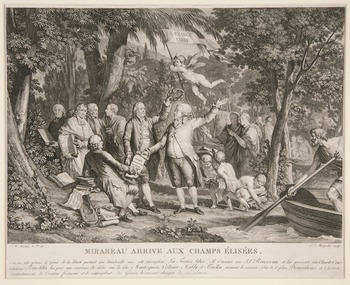
Fénelon's reputation as an Enlightenment political philosopher and martyr continued into the French Revolution, where his book and his exemplary life were lauded for inspiring the events of 1789. “In Telemachus,” claimed one pamphlet from 1793, Fénelon “delivered the first basis of a royal republic; some 100 years later, our first Convention in its Declaration of the Rights of Man established the foundations of a popular republic.”Footnote 42 When the Grenoble librarian Pierre Vincent Chalvet advocated for universal literacy throughout the new nation so that “Telemachus and [Rousseau's] Social Contract” could be read by every peasant, his address was placed in the official record of the National Convention.Footnote 43 The Jacobins put on plays depicting Fénelon's life.Footnote 44 Yet perhaps his revolutionary reputation is best illustrated in the well-known memorial engraving of 1790, honoring the death of revolutionary orator and deputy Honoré Mirabeau, in which Fénelon, shown holding a folio edition of Telemachus, stands alongside Montesquieu, Voltaire, Franklin, Rousseau, and Mably. The message is clear: Fénelon's political philosophy helped to establish the origins of French revolutionary thought (see Fig. 1, where Fénelon is fourth to the left of Mirabeau, approaching the sitting Rousseau).
Louis-Joseph Masquelier after Jean-Michel Moreau le jeune, Mirabeau arrive aux Champs Elysées (1790), Yale University Art Gallery, public domain.

Following the era of the French Revolution, Fénelon's reputation remained widespread. Editions of his complete or selected works were published throughout the nineteenth century and his Jacobin image was kept vibrant. For example, Lamartine's biography highlights the political radicalism of Telemachus. “When we follow the chain attentively, link by link, from the most fanatic tribunes of the Convention to … J. J. Rousseau, from J. J. Rousseau to … the preceptor to the Duc de Bourgogne,” Lamartine argued hyperbolically, “we shall discover in Fénelon the first revolutionary, the first tribune of the people, the first reformer of kings, the first apostle of liberty; and in Telemachus we shall acknowledge the evangelist of the truths and errors of modern revolutions.”Footnote 45 At the same time, Telemachus continued to be used as a school textbook, especially to teach foreign languages. One 1837 Paris edition had facing-page columns in French, Italian, German, Spanish, Portuguese, and English.Footnote 46 Likewise, there was a renewed appreciation for Fénelon's pastoral and pedagogical writings, which now became almost as popular as Telemachus.Footnote 47
Fénelon, then, remains a complex and enigmatic thinker who can, at various times, appeal to conservatives, moderates, and radicals. A Christian mystic, a complicit accomplice in Louis XIV's efforts to forcibly convert Protestants, an archbishop near the apex of Louis XIV's court, a pacifist during the War of the Spanish Succession, a loyal Catholic who renounced his own book only months after he published it, a critic of luxury who inspired Enlightenment political economy, a philosopher of virtue embraced by Jacobin democrats: Fénelon's writings take us in all these directions. If there is still little reason for political theorists today to regard Telemachus as a major milestone in the history of political thought, Hanley nonetheless succeeds in rescuing Fénelon from relative obscurity and making a compelling case for reflecting on his life and career.
The case of Fénelon and his Telemachus demonstrates the agency of the eighteenth-century public.Footnote 48 After all, Lamartine's profile would have been unrecognizable to Fénelon, who hardly thought of himself as a “revolutionary,” and certainly not a “tribune of the people.” Rather, the reframing of Telemachus occurred from the unplanned and disjointed collaboration of commentators, readers, and publishers over the course of the century that transformed the book into a major work of Enlightenment political theory. While the gap between reputation and historical reality may have been wide, this is not to diminish or invalidate the public's judgment. Every era, of course, appropriates books for its own usage. However, despite Hanley's rigorous analysis, this lacuna between how Fénelon viewed himself and his later legacy as a progressive political theorist is left largely unexplained. Like commentators from Ramsay through Lamartine, Hanley views Fénelon as pushing France and Europe towards liberalism, embracing religious toleration, individual freedom, and limited government. But Fénelon was no nineteenth-century liberal; even his identity as a political theorist cannot be taken for granted. As we have seen, neither his contemporaries nor even Fénelon himself viewed his writings as promoting political radicalism. Rather, what is remarkable about Fénelon is less the quality of his political ideas and more the manner in which they were reframed and reintroduced to eighteenth-century readers after his death until he became an Enlightenment icon.
Telemachus is a masterwork of young adult literature. Like Harry Potter or Star Wars in our own day, the book was originally meant as an epic adventure story to warm the hearts of preteens and guide them towards virtue. Superb in its rhetorical style, in its ability to entertain eighteenth-century readers (though twenty-first-century readers beware), in its imitative power to evoke Homer's ancient world, Telemachus shares few equals. Yet Fénelon did not mean for it to be read as a serious work of political theory, and perhaps that is one reason why, until recently, it has been largely ignored by historians of political thought.