


Introduction
The Canadian House of Commons is required under its Standing Orders to have a committee devoted to the status of women (Janse and LeBlanc, Reference Janse and LeBlanc2025). Like other standing committees of the House, it typically meets for two hours twice a week and may study legislation, initiate subject matter studies, examine order-in-council nominations and study estimates, amongst other things. Committee work therefore represents an important part of Members of Parliament’s (MP) role as legislators (Stilborn, Reference Stilborn2014). In addition to being able to hold ministers to account, House committees provide the opportunity for MPs to hear from a range of witnesses, including subject matter experts, interest groups and citizens. By sharing their input on a variety of topics, these witnesses ultimately shape committees’ stances on economic, social and political issues, thereby informing how the committee reports back to the House on specific matters. Despite their relevance in the legislative process, House committees remain understudied in Canadian political science, with a few exceptions (Franks, Reference Franks1971; Johnson et al., Reference Johnson, Burns and Port2017; Malloy, Reference Malloy2004; McGrandle, Reference McGrandle2025; Stilborn, Reference Stilborn2014; Tremblay and Mullen, Reference Tremblay and Mullen2007). Not only has their conceptualization as a space wherein state-society interactions happen on a weekly basis been overlooked (Bochel and Berthier, Reference Bochel and Berthier2021; Grace, Reference Grace2016), but their potential to further the representation of minoritized groups in Canada has yet to be fully examined.
Following the establishment of the House’s Standing Committee on the Status of Women (FEWO) and building upon Pitkin’s (Reference Pitkin1967) work on political representation, Tremblay and Mullen (Reference Tremblay and Mullen2007) questioned the committee’s role in advancing both the descriptive and substantive representation of women in Parliament. They argue that, as a committee made up almost entirely of women MPs, FEWO had the potential to improve the representation of women’s needs and interests within the House of Commons, thereby establishing a relationship between descriptive and substantive forms of representation. In studying women’s representation in political institutions, scholars have however underlined the importance of taking into account whose needs and interests are considered to be represented, as women’s needs are complex and may vary depending on other identifying factors, such as their race, age, sexual orientation or religion (Celis and Mügge, Reference Celis and Mügge2018; Evans, Reference Evans2016; Reingold et al., Reference Reingold, Haynie and Widner2021; Smooth, Reference Smooth2011).
Building on developments within the broader literature on representation, which has underscored the need for greater attention to intersectionality by questioning which women are being represented, this study examines the extent to which FEWO has applied an intersectional lens in its representation of women in Canada’s Parliament. In doing so, I position FEWO playing an active role in the representation of women in two ways: 1) through its interaction with Parliament and the presentation of reports, and 2) through its interaction with civil society, more specifically women’s groups and organizations appearing as witnesses before the committee. By looking at the studies the committee has reported on since its creation in the 38th Parliament and at the witnesses it has heard from as part of those studies, I argue that FEWO is more likely to report on universalistic rather than intersectional issues and to hear from universalistic rather than specific groups of women.
The first section considers parliamentary committees’ roles in Westminster political systems and draws upon the literature on the political representation of women to formulate hypotheses guiding the analysis. The second section discusses how House committees are organized, how they conduct their work, how they select witnesses and produce committee reports. The third section details my methodological design wherein, drawing from the publicly available data on the House of Commons committees’ website and using a directed content analysis (Hsieh and Shannon, Reference Hsieh and Shannon2005), I identify the studies for which a report was presented in the House, distinguishing between intersectional studies—studies that have explicitly focused on an issue affecting a specific group of women (for example, violence against Indigenous women and girls, challenges faced by senior women or abuse of older women)—and universalistic studies or studies that have instead focused on a broader issue without specifying a particular group of women (for example, intimate partner violence, pay equity or menstrual equity). Using an inductive approach based in grounded theory (Holton, Reference Holton2010; Johnson et al., Reference Johnson, Burns and Port2017; Moghaddam, Reference Moghaddam2006), I further examine the organizational witnesses who have appeared before the committee on both types of studies, identifying all organizations appearing before the committee and coding their mission statements into various categories. The fourth section showcases the study’s findings, which relate to whose needs and interests FEWO has actively sought to represent over the years. The final section situates these findings in terms of the extent to which FEWO has applied an intersectional approach in its representation of women in the Canadian House of Commons.
Parliamentary Committees and Representation of Women
While often overlooked in the Canadian legislative studies literature, committees and their role in Westminster political systems have garnered some attention. Studies have thereby unpacked the role that committees play in their interaction with Parliament, which notably includes examining legislation (McGrandle, Reference McGrandle2025; Thomas, Reference Thomas1978; Zwibel, Reference Zwibel2016) and overseeing policies and expenditures (Malloy, Reference Malloy2004; Winfield, Reference Winfield2010). For instance, in her research on amendments to government legislation, McGrandle (Reference McGrandle2025, 16) shows that committees exert an “extensive influence on government legislation,” despite bills being typically referred to committee after second reading (Zwibel, Reference Zwibel2016). Looking at the relationship between public account committees in Canadian legislatures and legislative auditors, Malloy (Reference Malloy2004) for his part demonstrates how the power of committees to scrutinize government activities and the use of resources allows committees to act as a forum wherein examined issues are placed before the public and the media.
Another strand of work has turned to the consultative role of committees and their interactions with the broader population (Skogstad, Reference Skogstad1985). Committees proactively seek outside perspectives, expertise and opinions to assist them in their work. In doing so, they hear from a range of witnesses, including department officials, stakeholders, policy experts, academics, civil society organizations and individuals. When it comes to consulting civil society actors, recent work has brought to light issues ranging from biases in the selection and questioning of witnesses (Johnson et al., Reference Johnson, Burns and Port2017) to a lack of transparency regarding the witness selection process (Zwibel, Reference Zwibel2016) and a lack of diversity of those appearing before committees (Holli, Reference Holli2012). Despite these issues, most agree that committees act as a linkage between the state and civil society (Bochel and Berthier, Reference Bochel and Berthier2021; Hough, Reference Hough2012; Pedersen et al., Reference Pedersen, Halpin and Rasmussen2015).
By interacting with Parliament, and more precisely with the House of Commons, and by acting as a linkage between the state and civil society, committees can play an active role in representing the needs and interests of citizens, civil society organizations and stakeholders. In this research, I position FEWO as playing an active role in representing the needs and interests of women in two ways: 1) the issues it studies and reports on to the House, and 2) the witnesses it hears from. In Canada’s parliamentary system, standing committees make their views known through the presentation of reports to the House. Usually stemming from a motion adopted by the committee to initiate a study, these reports are the product of evidence gathered throughout meetings, drawing from witness testimony and written briefs. One must note that not all studies lead to a report presented in the House, for various reasons that will be explained later. The analysis presented herein is limited to studies for which a report was produced and presented in the House as these provide a window into the issues to which FEWO is actively seeking to draw the attention of the House of Commons, and more specifically of the government.
Insofar as they provide a forum wherein citizens, civil society organizations, stakeholders and experts can directly intervene on issues, committees are also a space within which actors are provided with a platform to shape public policy. As such, FEWO not only presents an opportunity to represent women through the studies it reports on to the House of Commons, but also through the perspectives that are represented by witnesses appearing before the committee. By examining the studies conducted and reported on by the committee, and the witnesses it has heard from as part of those studies, this research aims to better understand these different facets of representation.
In her pathbreaking work on the different forms of representation, Pitkin (Reference Pitkin1967) identifies different ways in which citizens’ representation is achieved within political institutions, notably in a descriptive and substantive way. In its simplest form, descriptive representation is about “standing for” those represented, insisting on the shared characteristics between the representative and the represented (Childs, Reference Childs2008; Tremblay, Reference Tremblay1998). One could therefore think that having women-identifying MPs sitting on the Standing Committee on the Status of Women or in the House ensures that women are represented in the House of Commons. However, focusing only on descriptive representation overlooks the activity of representing, namely how political representatives actually “act for” those they seek to represent (Childs, Reference Childs2008; Rayment, Reference Rayment2024). For Lombardo and Meier (Reference Lombardo and Meier2016: 3), representation within political institutions “is about making sure citizens, or more specifically, different groups of citizens are “present” in political discussions for which they are not physically present.” But how do women MPs represent women?
Scholars have turned to substantive representation to investigate how women MPs represent women. Substantive representation focuses on “the nature of the activity itself, what goes on during representing, the substances or content of acting for others, as distinct from its external and formal trappings” (Pitkin, Reference Pitkin1967: 113–4). In other words, it is about representing the needs and interests of groups of citizens (Severs et al., Reference Severs, Celis and Erzeel2016; Tremblay, Reference Tremblay1998). Descriptive and substantive forms of representation are nevertheless deeply intertwined. Numerous scholars have indeed demonstrated that increasing the number of women in politics positively impacts women’s substantive representation: the more women enter politics, the more likely they will defend women’s interests (Childs, Reference Childs2008; Dodson, Reference Dodson2006; Mansbridge, Reference Mansbridge2005; Rayment, Reference Rayment2024; Reingold, Reference Reingold2000; Tremblay, Reference Tremblay1998). This logic has underpinned the long-standing view that gender parity within political institutions is a necessary means to achieve adequate representation of women’s needs and interests within political institutions (Phillips, Reference Phillips1995; Tremblay, Reference Tremblay1998). For instance, in her study of Canada’s 35th Parliament, Tremblay (Reference Tremblay1998) finds that women MPs are more concerned with women’s issues than their men counterparts and consequently speak more frequently on women’s issues during legislative debates. Studying United States representatives, Dittmar (Reference Dittmar, de Geus, Tolley, Goodyear-Grant and Loewen2021) finds that increasing women’s descriptive representation furthermore shapes how policy problems are defined, and which policy solutions are advanced.
In exploring the relationship between women’s descriptive and substantive representation, scholars have emphasized that women are not a monolith (Dittmar, Reference Dittmar, de Geus, Tolley, Goodyear-Grant and Loewen2021; Evans, Reference Evans2016). As Smooth (Reference Smooth2011) argues “studies on the substantive representation of women assess the extent to which representatives are ‘standing for’ or ‘acting for’ women without thoroughly engaging the critical question, ‘Which women?’” (Reference Smooth2011: 438, also Ditmar, Reference Dittmar, de Geus, Tolley, Goodyear-Grant and Loewen2021). Asking this question acknowledges that issues affect women differently, depending on their race, class or sexual identities (Crenshaw, Reference Crenshaw1991; Dhamoon, Reference Dhamoon2011; Hancock, Reference Hancock2007). Simply stated, women’s issues may not be women’s issues for all. Scholars point to the value of intersectional analyses to grasp the complex, fluid and context dependent aspects of women’s interests (Celis and Mügge, Reference Celis and Mügge2018; Evans, Reference Evans2016; Montoya et al., Reference Montoya, Bejarano, Brown and Allen Gershon2022; Smooth, Reference Smooth2011).
As a committee made up almost entirely of women MPs, FEWO offers an interesting case-study not only to investigate how committees may carry out a representative role in the House of Commons, but also to apply an intersectional lens to identify the forms representation takes therein. For instance, does FEWO study women’s issues that may be conceived as more universal, or does it actively seek to study issues that affect specific groups of women, thereby attending to the complexity of women’s identities? Previous work on women’s representation has identified women’s issues to include themes “that align with feminist or women’s movement policy aims” (Rayment, Reference Rayment2024: 25), such as pay equity, violence against women, maternity leave, political equality and workplace discrimination. Others have instead found that these issues do not always resonate within specific, and historically underrepresented, groups of women (Smooth, Reference Smooth2011), arguing for the need to adopt an intersectional approach when studying women’s issues. As Razack (Reference Razack1996) reminds us, the notion of women’s issues in Western society has tended to reflect the needs and interests of women in privileged locations, conceived as universal, and to obscure those of marginalized women, viewed as specific. Drawing upon this line of work, a first, tentative hypothesis is proposed regarding the studies reported by FEWO to the House of Commons:
Hypothesis 1: The studies reported by FEWO to the House are most likely to address universalistic issues.
Previous work on representation has furthermore focused on “non-elective representation” (Saward, Reference Saward2016), which includes witness appearances before committee. Celis and Childs (Reference Celis, Childs, Diehl and Saward2024) insist that elected representatives must hear and listen to the voices of diverse women because, as McCallion and Goodyear-Grant (Reference McCallion and Goodyear-Grant2026) argue, witnesses who appear before committees can represent the views of the groups with which they are associated. This article therefore examines which perspectives FEWO seeks out. Does it mainly hear from more universalistic women’s organizations, or from organizations that represent more specific viewpoints? While several studies have underscored the overall underrepresentation of women among committee witnesses (Bochel and Berthier, Reference Bochel and Berthier2018; Coil et al., Reference Coil, Wiliamson, Bruckner, O’Connor and Gill2024; Geddes, Reference Geddes2018; McCallion and Goodyear-Grant, Reference McCallion and Goodyear-Grant2026), the diversity of women’s perspectives considered by committees has been largely overlooked. Previous work on intersectionality and women’s underrepresentation in Parliament and political debates nevertheless provides some general insight into this matter. In her study of parliamentary debates in Westminster, Siow (Reference Siow2023) has for instance found that minoritized women’s voices are significantly underrepresented, both descriptively and substantively. In their study of the Flemish headscarf debate, Severs et al. (Reference Severs, Celis and Meier2013) have for their part brought to light how Muslim women’s voices were largely excluded from a debate that specifically concerned them. Finally, Kantola et al.’s (Reference Kantola, Elomäki, Gaweda, Miller, Ahrens and Berthet2023) research on the European Parliament has revealed how gender diversity is often viewed as applying to white women only, thereby perpetuating the underrepresentation of minoritized women in Parliament. Drawing upon this line of work, I propose a second hypothesis regarding who FEWO is most likely to hear from:
Hypothesis 2: FEWO is most likely to hear from universalistic groups of women.
Before assessing FEWO’s application of intersectionality in its choice of studies and witness appearances, it is necessary to first understand how committees work, including how their membership is established, what powers are granted to them through the Standing Orders, how they decide what to study and report on in the House and how they seek different viewpoints. In the next section, I turn my attention to the functioning of House of Commons Standing Committees in general and of the Standing Committee on the Status of Women in particular.
House of Commons Standing Committees
The Standing Orders are written rules that govern the proceedings of the House of Commons. They provide for the establishment of 25 standing committees automatically restored at the start of each session (Janse and LeBlanc, Reference Janse and LeBlanc2025). The Standing Committee on Procedure and House Affairs (PROC) is responsible for determining the membership of all committees, though it usually delegates this responsibility to the party whips through a routine motion. PROC then presents a report to the House and the composition of each committee is officially established once the House adopts PROC’s report. Committee members comprise MPs from all recognized parties, typically in approximate proportion to their representation in the House. While non-members, including independent MPs, may attend and, in some cases, participate in committee meetings, they are neither allowed to move motions nor vote (Janse and LeBlanc, Reference Janse and LeBlanc2025). Each committee is responsible for electing a Chair and two Vice-Chairs; only when a Chair is elected can a committee meet to undertake any kind of business. All but four committees are presided by a member of the governing party. The other four committees, including the Standing Committee on the Status of Women, are presided by a member of the official opposition (Janse and LeBlanc, Reference Janse and LeBlanc2025), which can generate different political dynamics. Committees usually meet twice a week for two hours and they typically follow the schedule agreed to by the whips of recognized parties. Public meetings are either televised or broadcast online, and the recordings are available online.
The House of Commons delegates some of its powers to committees. Each committee oversees its own proceedings and remains, for the most part, in charge of its own agenda (Janse and LeBlanc, Reference Janse and LeBlanc2025).Footnote 1 House committees concentrate most of their time on the following work: examining legislation referred to them by the House by undertaking a clause-by-clause study (typically after the second reading of a bill), scrutinizing the Main and the Supplementary Estimates (this happens about four times a year) and self-initiating subject matter studies (which represents the bulk of committee work). To carry out their work, committees hold various powers, pursuant to Standing Order 108(1)(a), including the power to enquire, to hear from witnesses, to gather evidence and to report to the House (Janse and LeBlanc, Reference Janse and LeBlanc2025).
While legislation and estimates are typically referred to a committee through an order from the House, self-initiated subject matter studies result from the committee adopting a motion to that effect. The motion will usually establish the parameters of the study, such as its goal and duration. In some cases, a motion initiating a study may specify which witnesses the committee will invite; this is notably the case when the committee wants to invite specific ministers or department officials. Committees are often said to be masters of their own proceedings. Each committee decides how it wants to go about gathering evidence and inviting witnesses, unless otherwise instructed by the House (Janse and LeBlanc, Reference Janse and LeBlanc2025). That being said, and despite slight differences across committees, most follow a similar process, which involves accepting the receipt of briefs from members of the public and allowing each party to select who it wants to invite. The number of witnesses invited typically depends on each party’s representation in the House; each party will provide the committee clerk with a prioritized list of witnesses. In some cases, committees may want to have only one list of witnesses to which all members have agreed to. The clerk, along with the analysts, may then prepare a work plan, with tentative panels, after which the clerk proceeds with inviting the witnesses. Some committees may want to adopt the workplan before the clerk proceeds with inviting witnesses. Committees may also put out a call for witnesses and may decide to invite them. Not all witnesses invited appear before the committee; this of course may happen for a variety of reasons, including scheduling conflicts or issues and witness preparedness to appear within potentially short timeframes. In addition to inviting witnesses, committees often seek out opinions through written briefs. Once it receives a written submission, the committee has discretion as to whether it accepts the brief as part of the evidence gathered for a specific study. Should it decide to accept it, the brief becomes the property of the committee and is usually published on the committee’s web page.
Whether they study a bill or undertake a self-initiated subject matter study, committees will usually seek out opinions and invite witnesses. That being said, there are significant differences between reporting on a bill and reporting on a self-initiated subject matter study. First, committees studying bills must report to the House, but they are not obligated to do so when they undertake self-initiated subject matter studies. Second, committees reporting back on bills must only report the bill itself; they cannot formulate recommendations or provide other forms of commentary on the bill (Janse and LeBlanc, Reference Janse and LeBlanc2025). When they report on self-initiated subject matter studies, committees will typically address a set of recommendations to the attention of the government; they may also ask that the government table a comprehensive response to the report within 120 days, pursuant to Standing Order 109 (Janse and LeBlanc, Reference Janse and LeBlanc2025). A motion to concur the committee report can also be moved during Routine Proceedings, thereby initiating a debate that can last up to three hours (see Standing Order 66(2) in Janse and LeBlanc, Reference Janse and LeBlanc2025). Lastly, once a committee concludes the study of a bill, it promptly proceeds with its presentation in the House. In contrast, once a committee stops hearing from witnesses appearing as part of a self-initiated subject matter study, it proceeds with providing Library of Parliament analysts with drafting instructions. Once drafted, the report is shared with members of the committee who will undertake its study, which in some cases can extend over several weeks. This is worth keeping in mind as the sometimes-long duration of self-initiated subject matter studies may lead to studies not being reported to the House. As committees make their views known through the presentation of reports to House, and because a motion to concur a committee report can only be moved once a study has been reported on, this article focuses only on studies that have been the subject of a report duly presented in the House by FEWO.Footnote 2
The Standing Committee on the Status of Women (FEWO)
The Standing Committee on the Status of Women was created in the 38th Parliament and met for the first time on October 19, 2004. While its size has varied over the yearsFootnote 3 , in the 44th Parliament, it was composed of 11 members, almost all women. Upon its establishment in 2004, FEWO organized consultations with women’s organizations across the country and identified four main priorities for consideration: the impact of federal government funding on the ability for women’s organizations to provide services and advocate for equality, the strengthening of the federal government’s capacity to take into account gender inequality, the persistent and disproportionate poverty rate among women and the continuous level of violence experienced by women (House of Commons, n.d.). Drawing upon these priorities, the committee undertook four initial subject matter studies on gender-based analysis, Status of Women Canada funding, pay equity and access to maternity and parental benefits for self-employed workers.
Standing Order 108(2) provides FEWO with the mandate to “study and report on all matters relating to the mandate, management and operation of the department or departments of government” (House of Commons, 2023) related to the status of women and gender equality. This includes overseeing the policies, programs, expenditures and legislation that relate to Women and Gender Equality Canada and initiating subject matter studies that concern women and gender equality more broadly. In other words, FEWO has the liberty to initiate any kind of study it wishes to bring to the attention of the House, as long as it relates to women and/or gender equality. Because this provides MPs with the opportunity to bring forward any kind of issue, first before the committee, and then before the House, and because FEWO is mostly made up of women, it offers a unique venue for studying how committees apply an intersectional lens in their representation of women in the House of Commons.
What I suggest herein is twofold. First, I posit that by looking at the studies brought forward by the committee and reported on in the House, we can understand both the committee’s priorities over time and the groups of women it has actively sought to represent. By incorporating an intersectional analytical lens, we can further develop this understanding beyond the broad category of “women” and identify whether the committee has actively represented issues faced by different groups of women. Second, because studies themselves are only one basis for framing the subject matter, witnesses may influence how the committee ultimately reports on an issue. For instance, the committee may invite an organization representing the interests of a specific group of women (for example, Indigenous women) on a study that is not solely focused on that group (for example, pay equity). For this reason, I suggest identifying the witnesses who have appeared as part of these studies to see whether and how FEWO applies an intersectional lens in its representation of women.
Methodological Design
Committees make their views known through the presentation of reports in the House, which then become available to the public. For this reason, committee reports provide a general sense of the issues that committees wish to bring to the attention of the House. A report is generally presented when a committee has completed the study of a bill, conducted a self-initiated study, examined expenditures (estimates) or adopted a resolution. Table 1 sums up all the reports presented to the House by FEWO over time, distinguishing between bills, self-initiated studies, estimates and resolutions.
Reports Tabled by the Standing Committee on the Status of Women Over Time

Table 1. Long description
The table presents the number of reports tabled by the Standing Committee on the Status of Women over various parliaments, categorized by type of report. The table has 7 rows and 7 columns. The columns are labeled with parliamentary sessions: 38 (2004-2005), 39 (2006-2008), 40 (2008-2011), 41 (2011-2015), 42 (2015-2019), 43 (2019-2021), and 44 (2021-2025). The rows are labeled with types of reports: Bills, Self-initiated studies, Estimates, Resolutions, and Total number of reports tabled. Row 1: Bills, 38: 0, 39: 0, 40: 1, 41: 1, 42: 2, 43: 0, 44: 2. Row 2: Self-initiated studies, 38: 5, 39: 7, 40: 8, 41: 8, 42: 5, 43: 8, 44: 8. Row 3: Estimates, 38: 0, 39: 2, 40: 2, 41: 5, 42: 7, 43: 4, 44: 1. Row 4: Resolutions, 38: 0, 39: 22, 40: 11, 41: 0, 42: 1, 43: 2, 44: 1. Row 5: Total number of reports tabled, 38: 5, 39: 31, 40: 22, 41: 14, 42: 18, 43: 11, 44: 12.
a This includes one question of privilege raised in committee and reported to the House in the 39th Parliament.
This analysis focuses only on studies for which a report was presented in the House and that express the committee’s views on women’s needs and interests. As such, studies on estimates were excluded from the analysis. Mobilizing a directed content analysis approach (Hsieh and Shannon, Reference Hsieh and Shannon2005) guided by previous work on intersectionality (Crenshaw, Reference Crenshaw1991; Dhamoon, Reference Dhamoon2011; Labelle, Reference Labelle2020), studies were divided into two categories: 1) intersectional studies, which actively addressed the intersection between gender and another social category, such as race, age or sexuality, and 2) universalistic studies, which are issue-based and framed as more all-encompassing. To categorize these studies, I examined the motion adopted by the committee to initiate that study and coded whether it mentioned a specific group of women. Intersectional studies include a study on the red dress alert, on violence against Indigenous women and girls and on the challenges faced by senior women in Canada while universalistic studies include studies on the barriers facing women in politics, on the economic security of women in Canada and on menstrual equity.Footnote 4
Although it is possible that studies categorized as universalistic nonetheless include some focus on intersectional identities, I adopt this harder test of focus based on the initiating motion to ensure I distinguish between studies that actively included an intersectional lens, versus those that incidentally incorporated these perspectives. This distinction between active and incidental focus is important because should the motion explicitly indicate a specific group of women, committee analysts will provide members with witness suggestions that incorporate those identities, and the study title will reference the specific group. For example, on February 1, 2022, FEWO adopted a motion to “undertake a study on human trafficking of women, girls, and gender-diverse individuals for sexual exploitation in Canada” (House of Commons, 2022a), which led to the title of the study appearing as “Human Trafficking of Women, Girls and Gender Diverse People.”
After identifying and distinguishing between intersectional and universalistic studies, I examined the list of witnesses for each study. As committee witnesses have been generally overlooked in Canadian legislative studies, I used an inductive approach based in grounded theory to categorize witnesses (Moghaddam, Reference Moghaddam2006). While some categories emerged from the committee’s own witness classification system (for example, individuals, organizations and department officials), in line with Johnson et al. (Reference Johnson, Burns and Port2017), the categories were updated as I progressed with the data collection. Witnesses appearing as part of the study of a bill or during a self-initiated study were therefore coded into five categories: 1) individuals, 2) organizations, 3) department officials, 4) ministers and 5) city/provincial governments.
Department officials and ministers are typically invited for any study, but because they represent the government’s interests, they were not considered in the analysis. City and provincial governments were also excluded from the analysis because they represent specific institutional interests. Finally, I decided to only retain organizational witnesses for the analysis, as organizations are generally driven by a specific and pre-established set of interests that are more evidently identifiable through mission statements than individual interests.Footnote 5 Additionally, since organizations make up the majority of witnesses appearing before FEWO, they are a pertinent indicator as to who FEWO sought to hear from. A total number of 853 organizations appeared as witnesses before FEWO as part of the study of a bill or a self-initiated study, between 2004 and 2024. While the 44th Parliament was only dissolved in March 2025, committees did not meet prior to dissolution. Some organizations have appeared more than once, but they were counted multiple times only if they appeared as part of different studies.
Drawing upon Labelle (Reference Labelle2020)’s categorization of LGBTQ civil society organizations in Canada, I classified organizations based on a content analysis of their mission statements. I coded each organization as either: 1) specific (for example, Pauktuutit Inuit Women of Canada and Calgary Immigrant Women’s Association) or 2) universalistic (for example, YWCA Hamilton and Ending Violence Association of British Columbia). This strategy was adopted to identify organizations that proactively represented the perspectives of historically underrepresented groups of women. Specific organizations were then further coded, depending on whether they represented 1) racialized individuals (for example, Coalition nationale des organismes de femmes de minorités raciales et ethnoculturelles francophones), 2) Indigenous peoples (for example, Native Women’s Association of Canada), 3) disabled women (for example, DisAbled Women’s Network Canada), 4) immigrant communities (for example, Immigrant Women Services Ottawa), 5) senior/ youth (for example, Women Elders in Action) or 6) LGBTQ (for example, Wisdom2Action). Once again, following Johnson et al. (Reference Johnson, Burns and Port2017)’s inductive methodological approach, and drawing from grounded theory’s open coding (Holton, Reference Holton2010), categories were updated as the data collection progressed and eventually stabilized once all data fit existing categories.
Of course, an organization that does not explicitly represent a specific group of women may highlight or speak about issues affecting certain groups of women. For instance, in its testimony, the YWCA may highlight some of the realities faced by women of colour or Indigenous women. Similarly, an organization that does not explicitly represent a specific group of women may be represented at the hearing by a disabled person or an Indigenous woman, who may provide a more specific or intersectional viewpoint. My interest is not specifically on what groups say in committees, but instead on what is signalled by their presence (see Holli, Reference Holli2012). Given this study’s focus on who the committee actively seeks to hear from, I restrict the analysis to the organizational witnesses the committee invited to its table.
Results
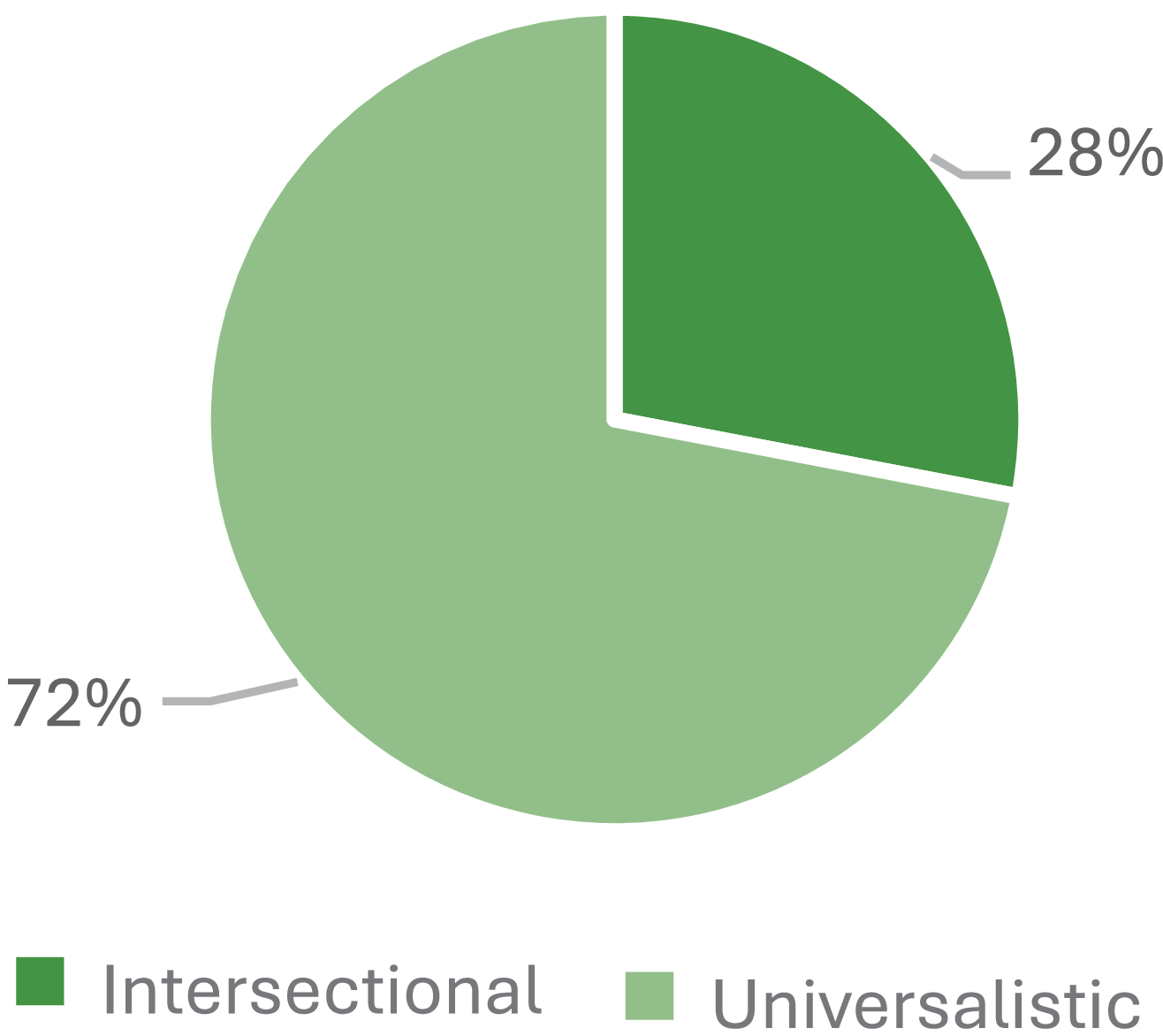
From the 38th to the 44th Parliament, FEWO reported to the House on a total of 92 bills, resolutions and self-initiated studies. Out of these studies, 71 were universalistic, meaning that they focused on an “all-encompassing” issue, while only 21 were explicitly intersectional, focusing instead on a specific group of women. As Figure 1 shows, this amounts to about less than a quarter of studies addressing issues that could be characterized as specific to different groups of women.
Proportion of All Studies Characterized as Intersectional and Universalistic.

Out of the 92 studies for which a report was presented to the House, 50 were the result of self-initiated studies, which are typically subject matter studies conducted over numerous meetings. During these meetings, committees hear from many witnesses. For example, for its study on Women and Girls in Sport in the 44th Parliament, FEWO heard from 35 witnesses. Similarly, for its study on Maternal and Child Health in the 40th Parliament, the committee received testimony from 22 different witnesses. Since self-initiated studies represent the most substantial work undertaken by FEWO, it is worth looking at the proportion of intersectional and universalistic self-initiated studies. Interestingly, the numbers shown in Figure 2 roughly resemble those in Figure 1, with about only a quarter of self-initiated studies having explicitly focused on a specific group of women. Of these, 7 have focused on senior women or young girls, 6 on Indigenous women and one on gender-diverse (LGBTQ) individuals. The other 36 studies were universalistic and included studies on human trafficking, barriers facing women in politics, sexual misconduct in the Canadian armed forces and the participation of women in non-traditional occupations.
Proportion of Self-Initiated Studies Characterized as Intersectional and Universalistic.

When we look at the distribution of intersectional and universalistic self-initiated studies over time, we see a significant increase at the turn of the 41st Parliament (2011–2015), as shown in Figure 3. In fact, intersectional studies comprise 50 per cent of self-initiated studies in both the 41st and 44th Parliaments. In the 41st Parliament, all but one of these studies focused on senior women and young girls, while in the 44th Parliament (2021–2025), half of these studies focused on Indigenous women.
Proportion of Self-Initiated Intersectional and Universalistic Studies Over Time.

While different parties have formed government during the period studied, this has not appeared to impact the committee’s work with respect to the proportion of self-initiated intersectional and universalistic studies. This significant increase at the turn of the 41st Parliament is however interesting and while this article cannot empirically explain why, it is worth noting a significant change regarding the committee membership. Following the 2011 general election, the New Democratic Party (NDP) became the official opposition. Consequently, its FEWO membership went from one member to four members, with one of them being elected Chair. It is therefore possible to suggest that as the NDP has historically been more left leaning than the other parties (Collie, Reference Collie2023; Massé and Béland, Reference Massé and Béland2024), changes of this nature in the committee membership may have played a role in shaping the committee’s agenda. Moreover, the fact that an Indigenous MP was a member of the committee during the 44th Parliament might explain the relative increase in studies focusing on Indigenous women, thereby highlighting the potential relationship between descriptive and substantive representation (Mansbridge, Reference Mansbridge1999; Tremblay and Mullen, Reference Tremblay and Mullen2007). All in all, the relationship between FEWO’s membership and its choice of studies is certainly worth exploring in further research.
Despite a significant increase in intersectional studies at the turn of the 41st Parliament, these data show that the studies reported by FEWO to the House are still more likely to address universalistic issues, thereby confirming the first hypothesis.
Organizational Witnesses Appearing before the Committee
Of the 853 organizations appearing before FEWO, 301 provided testimony as part of an intersectional study and 552 as part of a universalistic study. When we look at all these organizations, 67 per cent do not explicitly represent a specific group of women, as shown in Figure 4. Of the 33 per cent of organizations remaining, Indigenous women were most often represented (149 organizations), along with organizations representing senior women or young girls (67 organizations).
Organizations Appearing before FEWO Overtime.

If we distinguish between intersectional and universalistic studies, there are relevant differences. As Figure 5 illustrates, the appearance of organizations representing specific groups of women significantly increases when the committee undertakes an intersectional study. While we may expect organizations representing specific groups of women to appear on studies that concern those specific groups (see also Coil et al., Reference Coil, Wiliamson, Bruckner, O’Connor and Gill2024), it is worth noting that the representation of specific groups of women significantly decreases when the committee undertakes a universalistic study, as shown in Figure 6.
Organizations Appearing before FEWO as Part of Intersectional Studies.

Organizations Appearing before FEWO as Part of Universalistic Studies.

Several observations can be made from Figures 5 and 6. First, when the committee takes on an intersectional study, the presence of organizations representing the perspective of women from traditionally underrepresented groups nearly doubles. Second, intersectional studies seem to favour organizations that represent the interests of Indigenous women and, to a lesser extent, the interests of senior women or young girls. This result is unsurprising given that 13 of the 14 studies coded as intersectional focused on either Indigenous women or senior women and young girls, but nonetheless suggests that a study focusing on a specific group of women is more likely to ensure this group’s needs and interests are being considered. What is more, the other intersectional study, which specifically targeted gender-diverse populations (LGBTQ) subjected to human trafficking, also focused on human trafficking of women more generally. Not only was there no significant increase of LGBTQ organizations appearing as part of that study, but no organization representing the interests of gender-diverse populations appeared before the committee.Footnote 6 This finding supports the argument that when the committee commences a study focusing on one specific group of women, it is most likely to hear from organizations that represent the needs and interests of that group.
Third, the presence of organizations representing the interests of racialized, disabled and immigrant women remains the same whether or not the committee undertakes an intersectional study. While racialized and immigrant women have been represented by a variety of organizations over the years, women with disabilities have been represented by a handful of groups; of those, the DisAbled Women’s Network of Canada appeared on 15 different studies from the 39th to the 44th Parliament. Organizations representing immigrant women have for their part been appearing before the committee since the 41st Parliament only. One possible explanation to this is the notion of “usual suspects,” meaning that the committee may be more inclined to invite a witness that has already appeared before them (see also Bochel and Berthier, Reference Bochel and Berthier2021; Geddes, Reference Geddes2018). This tendency could ensure predictability—the committee is already aware of the organization’s stance on various issues—but also increase the chances for the organization to accept the invitation as they are already aware of the committee setting, norms and proceedings.
These results thereby confirm, albeit with some nuance, the second hypothesis and suggest that FEWO is most likely to hear from universalistic organizations. While this is generally true, the extent to which the committee hears from universalistic organizations does depend on the kind of study the committee is undertaking. This nuanced finding is consistent with Coil et al. (Reference Coil, Wiliamson, Bruckner, O’Connor and Gill2024)’s findings that women are more likely to appear before House and Senate committees in the United States when the hearing deals with legislative priorities directly impacting women.
Looking at the proportion of intersectional organizations appearing before the committee during universalistic studies over time, it appears to be roughly the same from the 38th to the 44th Parliaments, as shown in Figure 7. That said, in intersectional studies, there is a slight increase of specific groups’ representation from the 39th to the 41st Parliament, along with a steady representation during the 41st, 42nd and 44th Parliaments. In fact, Figure 8 reveals how specific groups made up the majority of organizational witnesses invited to appear as part of intersectional studies during the 39th and the 40th Parliaments, after which they represented roughly 50 per cent of organizations that testified.
Proportion of Specific and Universalistic Organizations Appearing Over Time during Universalistic Studies.

Proportion of Specific and Universalistic Organizations Appearing Over Time during Intersectional Studies.

These last two figures thereby highlight three findings. First, that organizations representing the interests of specific groups of women have been heard by the committee since its creation in the 38th Parliament, albeit to varying degrees. Second, the proportion of organizations representing the interests of specific groups of women has increased over time, notably when the committee’s studies explicitly target one group of women in the motions that initiate them. Third, that this increased representation has come hand in hand with the increase in intersectional studies undertaken by the committee since the 41st Parliament (see Figure 3).
Discussion and Conclusion
To what extent has FEWO applied an intersectional lens in its representation of women? On the one hand, since the 39th Parliament, FEWO has sought to represent specific groups of women, albeit to different extents. By increasing the proportion of intersectional studies over time, the committee has been paying more attention to the issues affecting certain groups of women, in particular Indigenous women, senior women and young girls. Yet, the studies reported by FEWO to the House are still more likely to address universalistic issues. Consistent with previous work, unless designed to address a specific population, subject matter studies appear to initially conceive of women’s issues as “universal.” As Celis and Mügge (Reference Celis and Mügge2018: 4) remind us, laws and policies about equal pay or maternity leave may reflect the needs of women, “but, to what extent are those specific policy issues representative for all women in society?”
While the committee has sought to hear from specific groups of women, their representation within universalistic studies has remained marginal. Previous work points to the misconception that minoritized groups cannot act as spokespersons for the broader group’s issues and interests, while groups belonging to the majority—such as White, cisgender and heterosexual women—are understood to speak on behalf of all (Celis and Mügge, Reference Celis and Mügge2018; Labelle, Reference Labelle2020; Strolovitch, Reference Strolovitch2006). This assumption might help explain the patterns documented here. In contrast, as the data show, women located in less dominant social locations have a higher chance of being included and having their interests relayed in the House by appearing on an intersectional study, especially if that study specifically concerns them. While these results are encouraging, Celis and Childs (Reference Celis, Childs, Diehl and Saward2024) insist on the importance of including, hearing from and listening to a diversity of voices throughout the process of representation, meaning that specific standpoints should not be excluded from studies on universalistic issues.
Some voices have nevertheless remained absent from FEWO’s conversations, albeit to various degrees. Indigenous women have been fairly well-represented before the committee, with a variety of organizations appearing before the committee on both intersectional and universalistic studies. Senior women and young girls have also been represented, additionally benefitting from being included in intersectional subject matter studies. Conversely, immigrant and racialized (non-White) women have seen their interests marginally represented before the committee, while LGBTQ women’s representation has been close to absent.
To explain these gaps, one might turn to the influence of the governing party’s agenda with regards to women’s issues. While this would necessitate more research that falls outside the scope of this article, this explanation is limited for two reasons. First, as a committee chaired by the opposition, the governing party’s influence is limited, especially during minority governments. This limitation is particularly significant considering that out of the seven Parliaments included in this study, five were under a minority government. Second, no pattern pertaining to the party composition of the House of Commons emerges when analyzing the data. For instance, we do not see that a certain group of women’s representation increases when a certain party forms government, nor do we see that same group’s representation decreases when the party is in the opposition.
Drawing upon previous work highlighting the relationship between descriptive and substantive representation, one might turn to committee membership for another explanatory avenue (see Bird, Reference Bird2010; Mansbridge, Reference Mansbridge1999). For instance, one might argue that if a quarter of FEWO’s studies during the 44th Parliament focused on Indigenous women and if 43 Indigenous organizations appeared before the committee, this pattern might be because a member of the committee identified as Indigenous or represented a constituency largely composed of Indigenous people. This would appear to be consistent with recent work by Carrière and Koop (Reference Carrière and Koop2023) on Indigenous elected officials and the representation of Indigenous interests within Canada’s representative institutions. As this may be more relevant than looking at the governing party’s agenda, further research would be needed to investigate whether an MP’s individual identification and the composition of their constituency correlate with the committee undertaking intersectional studies and hearing from specific groups of women. Holli’s (Reference Holli2012) work on Finnish standing committees suggest that the relationship between a committee member’s identity and the committee’s selection of witnesses may be more limited than initially expected.
Finally, another explanatory avenue may be contextual. External factors could shape the committee’s decision to undertake a specific study or to invite a specific group. For instance, the rise in studies focused on Indigenous women and the increase of Indigenous organizations appearing before the committee during the 44th Parliament may have been the result of the agenda-setting impact of the National Inquiry into Missing and Murdered Indigenous Women and Girls, which tabled its final report in 2019 (National Inquiry into Missing and Murdered Indigenous Women and Girls, 2019). The National Inquiry’s Calls for Justice were in fact referenced in one of the motions initiating a study on resource development and increased violence against Indigenous women and girls (House of Commons, 2022a). Furthermore, in the Fall of 2022, following the Hockey Canada sexual assault scandal and other news reports, members of the committee requested a meeting to discuss undertaking a study of women and girls in sport (House of Commons, 2022b). The study did take place, and the committee presented its report to the House on June 14, 2023. While both examples point to the relevance of contextual factors in the committee’s agenda-setting process, further research would certainly be needed to clarify this relationship.
This study cannot explain why FEWO has actively sought to represent certain groups of women but not others, but it is worth concluding on a factor that may have impeded the committee’s ability to include and to hear from all groups of women. Specifically, the data capture witnesses who have appeared before the committee but not those who have been invited and ultimately did not. It is possible that the committee sought to hear from organizations representing specific groups of women, but these organizations declined or were unable to do so. Some of these reasons include a lack of awareness of the committee, a lack of understanding of its role and process, time constraints or a lack of resources to properly prepare for a committee, especially when sought on short notice. Future research should examine these explanations, including inequalities in access.
In addition to these constraints, there are other hurdles to participation. The procedural rules governing committee meetings, such as the time limits imposed on opening statements and questions from members, as well as the moving of motions, can inhibit witnesses’ participation, especially when witnesses are invited to testify about a personal experience or an experience dealing with any form of trauma. This observation falls in line with criticisms from witnesses about their experiences testifying and the lack of trauma-informed approaches (Passafiume, Reference Passafiume2024; Wright, Reference Wright2021a). While subsequent efforts have attempted to implement trauma-informed approaches and accommodate vulnerable witnesses (House of Commons, 2022c; Wright, Reference Wright2021b), the politicization of committee meetings (and their acute mediatization) may render some witnesses more reluctant to accept an invitation to appear.
Finally, as this study solely focused on FEWO, it is worth underlining that voices less frequently heard in this committee may figure in other committees of the House. For instance, in the 44th Parliament, the Standing Committee on Veteran Affairs reported on a study pertaining to fairness in the services offered to francophone, women and LGBTQ veterans. As part of this study, the committee heard from the LGBT Purge Fund and Rainbow Veterans of Canada. Indigenous women organizations have furthermore been invited to speak on various studies undertaken by the Standing Committee on Indigenous and Northern Affairs over time. The Calgary Immigrant Women’s Association, moreover, testified to the Standing Committee on Citizenship and Immigration on differential outcomes in Immigration, Refugees and Citizenship Canada decisions, while the South Asian Women’s Rights Organization appeared before the Standing Committee on Human Resources, Skills and Social Development and the Status of Persons with Disabilities as part of its study on the federal contribution to reducing poverty in Canada.
The analysis reveals that by studying the work of committees, we better understand how women and other social groups are represented in Parliament. By interacting with women’s organizations through witness appearances and with Parliament through the presentation of reports, FEWO has actively represented women for more than 20 years. But has it applied an intersectional lens in its representation of women’s needs and interests in the House of Commons? Unfortunately, as the data provided for this study has shown, despite slight improvements over the last 20 years, FEWO has yet to fully incorporate an intersectional lens in the subject-matter studies it has chosen to report on in the House of Commons, and in the perspectives it has sought to bring around its table.
Acknowledgements
I would like to thank Charlie Feldman, Scott Lemoine and Jean-François Godbout for previous comments on the manuscript, as well as the anonymous reviewers and journal editors for their extremely insightful suggestions.
Competing interests
The author is employed at the House of Commons.




 Open access

