

1 Introduction
Subject Islands are one of the strongest known constraints on extraction. Whereas it is often possible to extract an NP from an NP complement, as in (1), extracting an NP from an NP subject as in (2) is generally regarded as impossible (e.g. Chomsky (Reference Chomsky1977: 106), Kayne (Reference Kayne1981: 114), Huang (Reference Huang1982: 497), Lasnik & Saito (Reference Lasnik and Saito1992: 42), Nunes & Uriagereka (Reference Nunes and Uriagereka2000: 21), and Jackendoff (Reference Jackendoff2002: 42)).

Indeed, whereas NP extractions from NP complements are well-attested in corpora as the sample in (3) taken from the Corpus of Contemporary American English (Davies Reference Davies2008) illustrates, there are to our knowledge no English attestations of NP extraction from NP subjects whatsoever.Footnote [2]

A number of experimental studies have confirmed that Subject Island violations like those in (2) yield significantly lower acceptability ratings than uncontroversially grammatical controls (Sprouse Reference Sprouse2009, Clausen Reference Clausen2011, Crawford Reference Crawford2011, Goodall Reference Goodall2011, Sprouse et al. Reference Sprouse, Caponigro, Greco and Cecchetto2015), and although comprehenders are known to postulate gaps as soon as possible (Crain & Fodor Reference Crain, Fodor, Dowty, Kartunnen and Zwicky1985, Stowe Reference Stowe1986, Frazier Reference Frazier1987, Stowe, Tanenhaus & Carlson Reference Stowe, Tanenhaus and Carlson1991) – including inside NP objects like (1) (Tollan & Heller Reference Tollan, Heller, Hammerly and Prickett2016) – there is no clear evidence that comprehenders actively postulate gaps inside NP subjects like those in (2) (Stowe Reference Stowe1986, Pickering et al. Reference Pickering, Barton, Shillcock, Clifton, Frazier and Rayner1994).
Matters are made more complex by the fact that Subject Island effects can often be alleviated if the subject-embedded gap is ‘parasitic’ (Engdahl Reference Engdahl1983) on a second gap outside the island environment, as in (4) and (5).Footnote [3]

Not all Subject Islands can be avoided via parasitism, however. Subject-embedded gaps in tensed relative clauses like (6) are widely believed since Engdahl (Reference Engdahl1983) to be impossible to rescue via a secondary gap. The contrasts in (5) and (6) were experimentally validated by Kurtzman & Crawford (Reference Kurtzman, Crawford and Sherer1991) and Phillips (Reference Phillips2006).

Phillips (Reference Phillips2006) additionally provides evidence suggesting that comprehenders actively postulate gaps in subject-embedded infinitival environments like those in (5), but not in subject-embedded finite environments like those in (6). From this, Phillips (Reference Phillips2006: 808) concludes that the language parser does not postulate gaps in positions where no gap is licit, parasitic or otherwise, which in turn lends support to the view that Subject Island effects are due to grammatically illicit filler–gap dependencies, rather than to cognitive constraints or performance limitations.
It is sometimes unclear what can be concluded from a null effect, however, because an experiment can fail to detect an extant effect either because the methodology was not sensitive enough, or because of a design flaw. In the present paper we provide evidence that Phillips (Reference Phillips2006), Sprouse (Reference Sprouse2009), Crawford (Reference Crawford2011), Goodall (Reference Goodall2011), and others have overstated the significance of their null effect findings. We show that subject-internal gaps can in fact become as acceptable as uncontroversially acceptable controls (Experiment 1) and are actively postulated during online sentence comprehension (Experiment 2), by simply increasing their frequency, provided that the propositions they express are highly felicitous to begin with. We then examine gaps that are claimed to be illicit even parasitically, such as tense-embedded gaps like those in (6b), and again find evidence suggesting that increased exposure can not only induce comprehenders to view such gaps as acceptable as uncontroversially acceptable controls (Experiment 3), but also to actively postulate such gaps during online sentence comprehension (Experiment 4). We argue that the simplest interpretation of the facts is that extraction from subjects is grammatically licit, but usually deemed unacceptable for two functional reasons: (i) they are strongly contrary to comprehenders’ expectations about where gaps usually reside, a factor that can be mitigated with increased exposure; (ii) subject-internal gaps often – though not always – pragmatically presuppose very unusual discourse circumstances.
More specifically, we claim that if a proposition is highly felicitous then the mention of the referents therein is necessarily relevant as well. Consequently, such a proposition more naturally lends itself to subject-internal gaps, simply because the mention of such subject-internal referents is relevant for the proposition. In such cases, repetition can more easily induce the amelioration of the island effect, or even alleviate it completely. Our work thus highlights the importance of making sure the items employed in experimental island research express equally highly felicitous propositions to begin with, independent of extraction, so that the effect caused by extraction can be better isolated from orthogonal stylistic, semantic and pragmatic differences. We conclude by arguing that Subject Island effects are epiphenomenal, and that linguistic theory need not be made more complex with constraints that block such filler–gap dependencies.
2 Two broad views of Subject Island phenomena
In this section we discuss in more detail two major opposing views of what Subject Island effects are and what they mean for linguistic theory, and discuss what we consider to be their strengths and weaknesses.
2.1 The architectural view
Mainstream generative grammar assumes that islands are due to the very architecture of the human language faculty. Thus, extraction from subjects has been argued to be impossible because of basic constraints on movement (Takahashi Reference Takahashi1994, Chomsky Reference Chomsky1995, Nunes & Uriagereka Reference Nunes and Uriagereka2000, Sabel Reference Sabel2002, Boeckx Reference Boeckx2003, Nunes Reference Nunes2004, Rackowski & Richards Reference Rackowski and Richards2005, Rizzi Reference Rizzi2007, Stepanov Reference Stepanov2007, Chomsky Reference Chomsky, Freidin, Michaels, Otero and Zubizarreta2008, Müller Reference Müller2011, Haegeman, Jiménez-Fernández & Radford Reference Haegeman, Jiménez-Fernández and Radford2013, Chesi & Bianchi Reference Chesi and Bianchi2014). Although no consensus yet exists about the exact nature of Subject Island effects, the architectural view has been claimed to be on the right track because of supporting psycholinguistic evidence: Phillips (Reference Phillips2006), Sprouse (Reference Sprouse2007, Reference Sprouse2009), Wagers & Phillips (Reference Wagers and Phillips2009), Phillips, Wagers & Lau (Reference Phillips, Wagers, Lau and Runner2011), Phillips (Reference Phillips2013), Sprouse et al. (Reference Sprouse, Caponigro, Greco and Cecchetto2015), and others argue that Subject Island violations cannot be constructed by the language processor during language processing, or primed or ameliorated, as there are no mental representations to prime or ameliorate in the first place. As Sprouse (Reference Sprouse2007: 123) puts it: ‘extra-grammatical factors that affect the acceptability – and are predicated on the existence of a representation – such as syntactic priming, should not affect the acceptability of ungrammatical sentences’.
The architectural view faces two kinds of potential challenges. First, Do & Kaiser (Reference Do and Kaiser2017) shows that Subject Island violations can in fact be primed when the prime and the target were separated by only one sentence.Footnote [4] Second, whereas Sprouse (Reference Sprouse2009), and Crawford (Reference Crawford2011) found no evidence that the acceptability of Subject Island violations increases by making such filler–gap dependencies more frequent, others have found clear amelioration effects (Hiramatsu Reference Hiramatsu2000, Clausen Reference Clausen2011, Chaves & Dery Reference Chaves, Dery and Santana-LaBarge2014).Footnote [5] The fact that different experiments have arrived at different results suggests that the amelioration of Subject Island violations is highly sensitive to the particular experimental items and methodologies (Snyder Reference Snyder2017). On the other hand, no experiment has until now shown that Subject Island violations can become as acceptable as uncontroversially grammatical controls.
2.2 The functional view
Chaves (Reference Chaves2013) and Hofmeister et al. (Reference Hofmeister, Casasanto, Sag, Sprouse and Hornstein2013), more recently propose an alternative view in which Subject Island effects (and certain other phenomena) are instead due to probabilistic knowledge about the distribution of gaps: if the correct location of a gap is syntactically, semantically, or pragmatically highly unlikely in that particular utterance, then it is less likely for the sentence to be acceptable. For instance, if an object gap is strongly predicted in a given sentence context (given local cues and past experience with such constructions), a gap within a preceding complex subject would have low probability, making signs of a dependency inside the complex subject unlikely. This scenario leaves open the possibility that gaps within complex subjects can be predicted and posited, given sufficient cues that change the parser’s expectations (Hofmeister et al. Reference Hofmeister, Casasanto, Sag, Sprouse and Hornstein2013: 49).
Indeed, there is good experimental evidence that speakers attend to probabilistic information about the syntactic distribution of filler–gap dependencies (van Schijndel, Schuler & Culicover Reference van Schijndel, Schuler and Culicover2014), and that gap predictability is crucial for online processing of islands (Michel Reference Michel2014). More broadly, there is ample evidence that speakers attend and adapt to probabilistic information when processing a variety of linguistic input, including upcoming words (Kutas & Hillyard Reference Kutas and Hillyard1984, Altmann & Kamide Reference Altmann and Kamide1999, DeLong, Urbach & Kutas Reference DeLong, Urbach and Kutas2005, Creel, Aslin & Tanenhaus Reference Creel, Aslin and Tanenhaus2008, Arai & Keller Reference Arai and Keller2013), lexical categories (Tabor, Juliano & Tanenhaus Reference Tabor, Juliano and Tanenhaus1997, Gibson Reference Gibson2006, Levy & Keller Reference Levy and Keller2013), syntactic structures (Lau et al. Reference Lau, Stroud, Plesch and Phillips2006; Staub & Clifton Reference Staub and Clifton2006; Levy Reference Levy2008; Fine et al. Reference Fine, Qian, Jaeger and Jacobs2010, Reference Fine, Jaeger, Farmer and Qian2013; Levy et al. Reference Levy, Fedorenko, Breen and Gibson2012; Fine & Jaeger Reference Fine and Jaeger2013; Farmer et al. Reference Farmer, Fine, Yan, Cheimariou and Jaeger2014), semantics (Altmann & Kamide Reference Altmann and Kamide1999, Federmeier & Kutas Reference Federmeier and Kutas1999, Kamide, Scheepers & Altmann Reference Kamide, Scheepers and Altmann2003), and pragmatics (Ni, Crain & Shankweiler Reference Ni, Crain and Shankweiler1996, Mak, Vonk & Schriefers Reference Mak, Vonk and Schriefers2008, Roland et al. Reference Roland, Mauner, O’Meara and Yun2012).Footnote [6]
In order to understand what can make a gap more plausible than another, we must briefly turn our attention to the function of filler–gap dependencies in general. Erteschik-Shir (Reference Erteschik-Shir1981), Van Valin (Reference Van Valin1986), Kuno (Reference Kuno1987), Deane (Reference Deane1992), Takami (Reference Takami1992), and Goldberg (Reference Goldberg2006: ch. 7) have argued that extraction is in general restricted to the informational focus of the proposition, i.e. to referents that are new or important in the sense that the speaker assumes the hearer cannot predict that they would be key participants in the given state of affairs. Perhaps the clearest example of the role of information focus in islands is the Coordinate Structure Constraint (CSC) and its (non-)ATB exceptions, illustrated in (7).

As Kehler (Reference Kehler2002: ch. 5) demonstrates, the CSC and its ATB exceptions follow from whether there is a parallel discourse coherence relationship between the conjuncts (7a, b), and non-ATB exceptions follow from whether the information focus is established only with reference to one of the conjuncts, as in (7c). For further empirical evidence that the CSC is pragmatic, see Kubota & Lee (Reference Kubota and Lee2015). The Complex NP Constraint (CNPC) is another type of island that is arguably constrained in very much the same way, since the only known acceptable exceptions to the CNPC involve relative clauses that express new information rather than backgrounded information (Erteschik-Shir & Lappin Reference Erteschik-Shir and Lappin1979, Kuno Reference Kuno1987, Deane Reference Deane1992, Goldberg Reference Goldberg, Sprouse and Hornstein2013). This is illustrated by the relative clauses in (8), which express assertions and therefore easily contain the information focus.

Now, given that subject phrases are typically reserved for topic continuity rather than for introducing new referents (Chafe Reference Chafe1994, Lambrecht Reference Lambrecht1994, Kuno Reference Kuno1972, Bayer & Salzmann Reference Bayer, Salzmann, Brandt and Fuß2013), it follows that subjects are more likely to be pronominal or elliptical than objects, and that extraction from English subject phrases is difficult because the information focus is unlikely to reside in the subject.Footnote [7] Crucially, whether a subject-internal referent can be the informational focus or not, is a matter of degree, and more likely in some propositions than in others. For example, classic Subject Island violations like *Which rebel leader did the rivals of shoot Castro? are arguably unacceptable because out of the blue it is unclear why the rebel leader is worthy of mention in the proposition The rivals of a rebel leader shot Castro. Without a suitable context, the rebel leader has no obvious bearing on the assertion that people shot Castro. As Kluender (Reference Kluender, Chand, Kelleher, Rodríguez and Schmeiser2004: 495) insightfully notes: ‘Subject Island effects seem to be weaker when the wh-phrase maintains a pragmatic association not only with the gap, but also with the main clause predicate, such that the filler–gap dependency into the subject position is construed as of some relevance to the main assertion of the sentence’.Footnote [8] Indeed, recent functional magnetic resonance imaging evidence from Matchin et al. (Reference Matchin, Almeida, Sprouse and Hickok2018) suggests that Subject island effects activate networks involved in conceptual-semantic processing, as expected in the present account. In our view, the items employed by previous Subject Island experiments tend to fail this pragmatic constraint. Consider for example What does John know that a bottle of fell on the floor? from Snyder (Reference Snyder2000). Out of the blue, there is no clear a priori reason for why the content of a bottle is important for the fact that John knows that a bottle fell on the floor. This kind of problem can be avoided using suitable contextualizations or experimental items normed to be as plausible as non-island controls, i.e. items that have highly felicitous declarative counterparts. No prior research on islands has normed items in this way, to our knowledge.
Although it is not easy to construct sentences where a dependant of the subject can be easily deemed as the informational focus, it is by no means impossible. The key to achieving this is to make sure that in the declarative form of the utterance all the referents in the sentence (especially those embedded in the subject phrase) are highly relevant for the overall proposition. For instance, the extraction in (9a) is particularly acceptable because whether or not an impeachment causes outrage crucially depends on who is impeached (cf. with Would the impeachment of Donald Trump cause outrage?). Similarly, in (9b) whether or not an attempt failed or succeeded crucially depends on what was attempted (cf. with The attempt to find the culprit ended in failure).

We know of no empirical reason for assuming that such extractions are syntactically different from standard Subject Island violations. See Chomsky (Reference Chomsky, Freidin, Michaels, Otero and Zubizarreta2008: 160 fn. 39), Jiménez-Fernández (Reference Jiménez-Fernández2009: 111), Chaves (Reference Chaves2013), and Haegeman et al. (Reference Haegeman, Jiménez-Fernández and Radford2013) for more examples of acceptable English extractions from a variety of subject phrases, including from transitive constructions.
The functional account also explains why a subject-embedded gap usually becomes more acceptable in the presence of a second non-island gap: since the two gaps are co-indexed, then the fronted referent is trivially relevant for the main assertion, as it is predicated by the main verb. For example, the low acceptability of (10a) is arguably caused by the lack of plausibility of the described proposition: without further contextual information, it is unclear how the attempt to repair an unspecified thing
 $x$
is connected to the attempt causing damage to a car.

Our informants report that (10a) becomes more acceptable if it is contextually established that
 $x$
is a component of the car. In contrast, (10b) is felicitous even out of the blue because it conveys a proposition that is readily recognized as being plausible according to world knowledge: attempting to fix
 $x$
can cause damage to
 $x$
. If Subject Island effects are indeed contingent on how relevant the extracted subject-embedded referent is for the assertion expressed by the proposition, then a range of acceptable patterns is to be expected, parasitic or otherwise. This includes cases like (11), where both gaps are in Subject Island environments. As Levine & Sag (Reference Levine, Sag and Müller2003), Levine & Hukari (Reference Levine and Hukari2006: 256), and Culicover (Reference Culicover2013: 161) note, cases like (11) should be completely unacceptable, contrary to fact. The conclusion that Subject Island effects are contingent on the particular proposition expressed by the utterance thus seems unavoidable.
(11) This is a man who [friends of _] think that [enemies of _] are everywhere.
Further corroborating evidence for the role of pragmatics in extractions from subject phrases comes from the fact that all Subject Island violations attested in corpora that we are aware of involve relative clauses that describe new information rather than background information, underlined in (11). For example, (11a) asserts that ‘five of their eight children are still living at home’, rather than merely asserting that ‘they have eight children’. For more about relative clauses that express assertions rather than background information see Menn (Reference Menn1974), McCawley (Reference McCawley1981), Lambrecht (Reference Lambrecht1988), and Lambrecht (Reference Lambrecht2000).

In addition to being attested in corpora, Abeillé et al. (Reference Abeillé, Hemforth, Winckel and Gibson2018) provide experimental evidence that extractions like (11) are in fact acceptable.Footnote [9] Finally, note that Kluender & Kutas (Reference Kluender and Kutas1993) and Van Valin (Reference Van Valin, Devriendt, Goossens and van der Auwera1995) point out that PP extractions in general have an additional advantage over NP extractions in that the grammatical function of the extracted phrase is clearer from the onset: the presence of the preposition leads to fewer potential gap sites that are consistent with the extracted constituent, especially when the filler–gap dependency is short as in (11).
All of the above evidence is consistent with the proposal in Chaves (Reference Chaves2013) and Hofmeister et al. (Reference Hofmeister, Casasanto, Sag, Sprouse and Hornstein2013) that the more syntactically, semantically, and pragmatically plausible the subject-internal gap, the more acceptable such extractions should be, especially if comprehenders have the chance to adjust to the unusual syntactic location of the gap by being exposed to multiple exemplars of such sentences. We argue that such amelioration should be facilitated when the very mention of the subject-embedded referent is a highly felicitous discourse move to begin with. For the mention of any given referent to be felicitous and in accordance to the Gricean Maxims of Quantity (‘Be brief’) and Manner (‘Avoid Prolixity’), the context must be such that the referent is not irrelevant for the proposition. In addition, for a referent to be extractable it must not only be relevant for the proposition, it must in addition play a pivotal role in it, as the informational focus. Hence, the more pragmatically felicitous the mention of a given referent is (subject-embedded or not) the more easily it can be deemed the informational focus, and the more felicitous the extraction. Because subjects tend to be topics, it follows that subject-embedded referents must be rarer than object-embedded referents. Using Tregex (Levy & Andrew Reference Levy and Andrew2006), we have confirmed that NPs consisting of a nominal head followed by a PP occur about twice as often immediately after the verb (as objects) than immediately before the verb (as subjects) in the Wall Street Journal corpus (16159 occurrences vs. 8426), Brown corpus (4667 occurrences vs. 2222), and Switchboard corpus (1595 occurrences vs. 890). Of course, other languages may deploy different pragmatic biases, and regard subject-embedded referents as more likely informational foci than English does, potentially explaining at least some of the cross-linguistic variation in Subject Island effects surveyed in Stepanov (Reference Stepanov2007)Footnote [10] .
The experiments we describe below collectively suggest that ensuring that a proposition with subject-embedded referents is highly felicitous is sufficient to allow the extractability of such subject-embedded referents when their frequency is increased. More specifically, Experiment 1 shows that sentences with subject-embedded gaps and sentences with object-embedded gaps that express essentially the same (highly felicitous) propositions rapidly become equally acceptable, within as much as 8 exposures. Experiment 2 offers supporting online evidence for the very same effect of adaptation to sentences with subject-embedded gaps in a self-paced reading task. In Experiments 3 and 4 we show that the similar effects arise in more extreme Subject Islands that are embedded in tensed relatives, which are allegedly impossible to ameliorate parasitically or otherwise. Our results are consistent with the functional view, but not with the architectural view. As a consequence, we argue that pragmatics and probabilistic knowledge must be taken into consideration in experimental research about filler–gap dependencies, if an explanatory and comprehensive account of island effects is to be reached.
3 Experiment 1: Extraction from simple subjects
The paradigm in (4), repeated below in (12), is traditionally assumed since Engdahl (Reference Engdahl1983) to show that subject-internal gaps are licit only if they are parasitic on a non-island gap. We reject this conclusion for two reasons.

First, many authors such as Kuno & Takami (Reference Kuno and Takami1993); Pollard & Sag (Reference Pollard and Sag1994: 195 fn. 32); Culicover (Reference Culicover1999: 230); Levine, Hukari & Calcagno (Reference Levine, Hukari, Calcagno, Culicover and Postal2001: 204); Levine & Sag (Reference Levine, Sag and Müller2003: 252 fn. 6) and others have noted that some Subject Island violations are rather acceptable, like those in (9) above or (13) below.

Second, and more importantly for the present work, (12a) and (12b) express very different propositions and have different pragmatic requirements, and therefore there is no a priori reason to expect that (12a) and (12b) should receive identical acceptability judgements. The contexts in which (12a) is felicitous are stricter than those of (12b) because the pragmatic status of subjects is different from that of objects, as already discussed in Section 2.2. Thus, it is unclear what conclusions can legitimately be drawn from comparing sentences like (12a, b). Rather, we argue that it is far more appropriate to compare the acceptability of near-truth-conditionally equivalent sentence pairs such as (14), where the order of the subject and the object can be switched without a radical difference in truth conditions because the verb is a symmetric predicate.

In Experiment 1 below we show that although the acceptability (14b) starts out as much lower than (14a), after about 8 exposures the former has become as acceptable as the latter. Crucially, no such radical and sharp amelioration occurs with uncontroversially ungrammatical controls.
3.1 Methods
3.1.1 Participants
We analyzed data provided by 74 participants with IP addresses originating from the United States that were recruited through Amazon.com’s Mechanical Turk (AMT) crowdsourcing marketplace. For evidence that sentence acceptability data obtained via AMT parallel data obtained in the laboratory, see Munro et al. (Reference Munro, Bethard, Kuperman, Lai, Melnick, Potts, Schnoebelen and Tily2010), Gibson, Piantados & Fedorenko (Reference Gibson, Piantadosi and Fedorenko2011), Melnick, Jaeger & Wasow (Reference Melnick, Jaeger and Wasow2011), and Sprouse (Reference Sprouse2011). All self-reported as native speakers of English, and had accuracy levels of at least 85% in comprehension questions, with a mean accuracy level of 90%.
3.1.2 Design and materials
We constructed 22 experimental items, each of which had two versions, as shown in (15). Every item involved a symmetric predicate. The location of the gap is made explicit below, though no such indication was made in the actual stimuli. See Appendix A for a complete list.Footnote [11]

To ensure that the Subject and Object conditions of our 22 experimental items expressed equally plausible propositions, we conducted a norming task over the declarative counterparts of the items. For example, the sentence pair in (15) was converted into The report of this committee supposedly contradicts the recommendations of the experts and The report of the experts supposedly contradicts the recommendations of this committee, respectively, and participants were asked to rate the plausibility of the sentences. This plausibility norming stage ensures that the propositions described by the items are equally highly felicitous to begin with. Hence, any difference in acceptability must come from extraction itself, not from other sources independent from extraction. A group of 100 participants recruited through AMT were asked to rate the plausibility of these declarative counterparts of our items using a 1–7 Likert scale. An overall
 $t$
-test revealed that the plausibility of Subject and Object conditions did not differ,
 $t=-0.9,p=.366$
. We also conducted pairwise
 $t$
-tests on the responses for the Subject and Object conditions of each experimental item pair. These tests revealed that only two pairs exhibited a statistically significant difference in plausibility, but the remaining 20 pairs did not (all
 $p$
s
 ${>}$
.05). We nevertheless used all 22 pairs in the experiment, and included their plausibility ratings as an additional predictor in our analysis. In doing so, any difference attributable to the location of the gap will not be confounded by differences in plausibility which vary individually across experimental items.
Items were counterbalanced across two lists using a Latin Square design so that each participant only responded to one version of each experimental item. Experimental items were interspersed among 44 distractor items, pseudorandomized so that different participants saw items in different orders. A sample of the distractors is seen in (16) and (17), which were either object gaps or subject gaps, some of which were clause-embedded. Half of the distractors were ungrammatical, as in (17).

The ungrammatical distractors were relatively homogeneous, and therefore can be taken to function as additional controls: they all consisted of which interrogatives with an adverb and a clause-embedded gap. The source of oddness always involved an incorrect word in the embedded VP.
3.1.3 Procedure
Participants were asked to judge how natural each sentence was, by giving it a rating from 1 (very unnatural) to 7 (very natural). In order to ensure that comprehenders were attending to the structure and meaning of the experimental items, half of the grammatical distractors were immediately followed by a (non-trivial) True/False question; for example, (16c) was followed by (18).

3.2 Results
The mean response for the Subject condition was 3.99 (SD
 $=1.69$
), and for the Object condition 5.08 (SD
 $=1.51$
), confirming the existence of an island effect. The mean response for the grammatical distractors was 5.7 (SD
 $=1.46$
), and 2.67 (SD
 $=1.59$
) for the ungrammatical distractors.Footnote
[12]
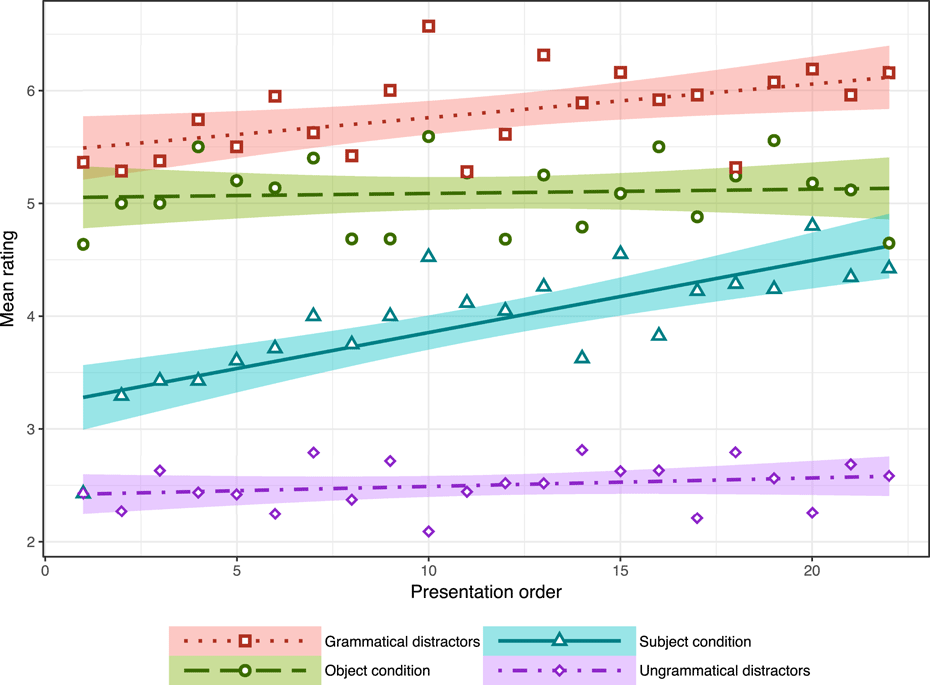
An LMER model with gap location, presentation order, plausibility, and all possible interactions between the three factors as fixed factors revealed a main effect of gap location in which subject gaps were rated lower than object gaps (
 $\unicode[STIX]{x1D6FD}=-1.06$
,
 $t=-7.69,p<.0001$
), and a significant interaction between gap location and presentation order, suggesting that the acceptability of Subject and Object items changed differently during the experiment (
 $\unicode[STIX]{x1D6FD}=0.061$
,
 $t=5.23$
,
 $p<.0001$
). No significant effect of plausibility was found, nor of interactions. Since no two participants saw the items in the same order, the changes in acceptability cannot be due to any particular item order.
Simple effects analyses were conducted separately on each gap location condition by conducting LMER models with presentation order as fixed predictors. Presentation order was not significant for the object gap condition (
 $\unicode[STIX]{x1D6FD}=0.004$
,
 $t=0.58,p=.56$
), and highly significant for the subject gap condition (
 $\unicode[STIX]{x1D6FD}=0.065$
,
 $t=7.84,p<.0001$
), even with models that include plausibility as a (non-significant) predictor. Separate models revealed that while the acceptability of the ungrammatical distractors did not increase during the experiment (
 $\unicode[STIX]{x1D6FD}=-0.003$
,
 $t=1.41$
,
 $p=.24$
), that of the grammatical distractors did (
 $\unicode[STIX]{x1D6FD}=0.005$
,
 $t=1.98$
,
 $p=.04$
). Figure 1 shows regression lines for all conditions and distractors, with 95% confidence intervals.
(Colour online) LMER of each item type with presentation order as a fixed predictor (Experiment 1).

Each point in Figure 1 corresponds to the average acceptability rating for items in the given order of representation. Since no two participants saw the experimental items in the same order, each point corresponds to the average rating that different participants gave to different items in the given order as the experiment progressed.
Recall that in this experiment each participant read 11 subject island violations, and 11 object counterparts. We can therefore use the interaction estimate between the subject gap condition and presentation order to predict when the acceptability difference between subject gap items and object difference will disappear:
 ${\approx}17$
presentations (i.e.
 $-1.06/0.061$
 $=$
subject gap coefficient / interaction coefficient). In other words, the model suggests that if the experiment had been five items longer then the acceptability of the Object and Subject items would completely overlap, assuming the acceptability increase is linear. In fact, a post hoc analysis already suggests that the acceptability of the Subject items became as high as the acceptability of the Object items in a subset of the data consisting of the last four presentation orders (144 responses). There, the mean acceptability was 4.48 (SD
 $=1.62$
) for Subject condition items, and 5.03 (SD
 $=1.55$
) for Object condition items. An LMER model was run on this subset of data, with gap location as a fixed predictor, and found no significant difference between the two conditions (
 $\unicode[STIX]{x1D6FD}=-0.55$
,
 $t=-1.68$
,
 $p=.1$
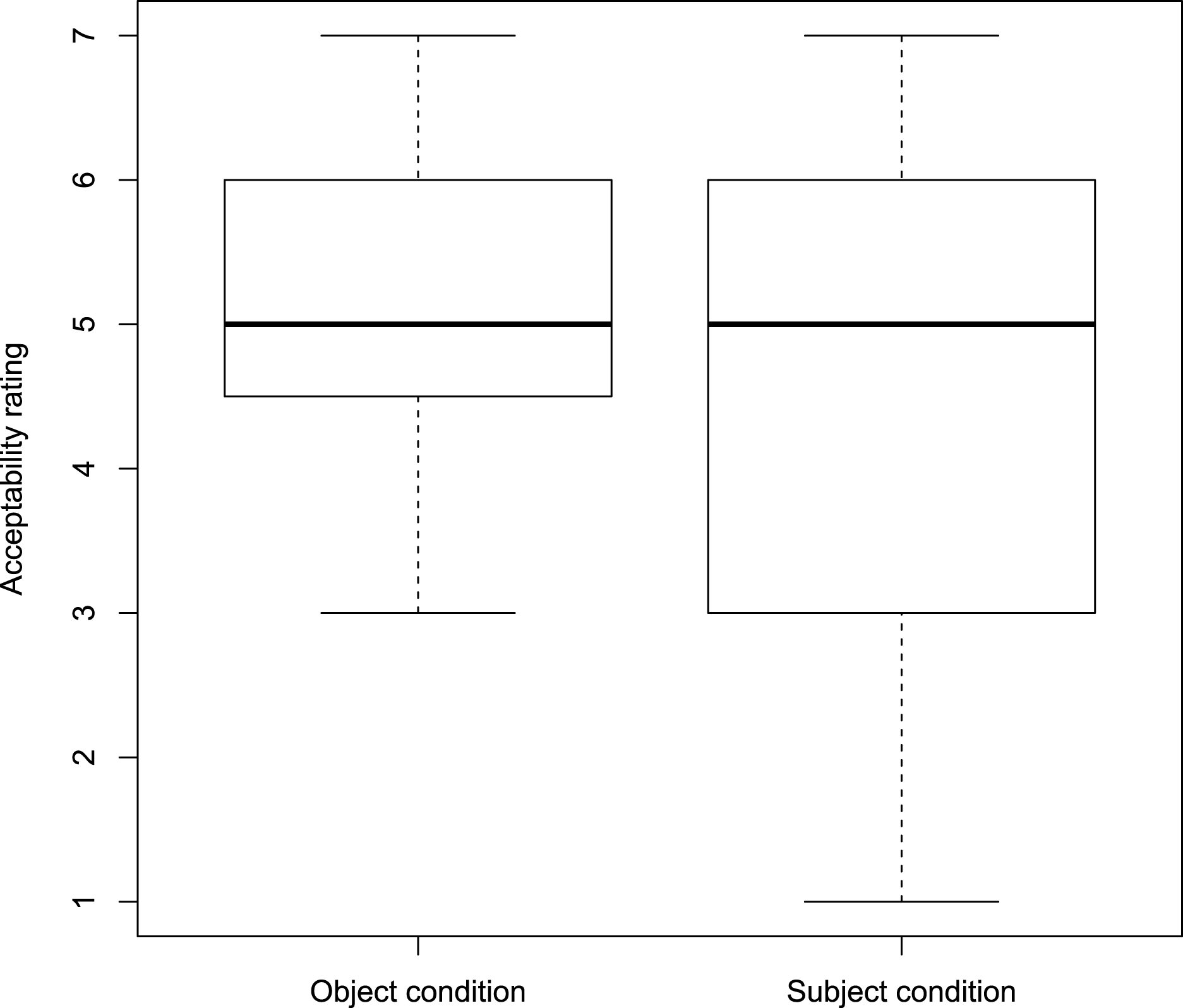
). The plots in Figure 2 illustrate the overlap between Subject item ratings at the end of the experiment and Object item ratings at the end of the experiment.
Ratings at the end of Experiment 1.

Focusing on a smaller window consisting of the last two presentation orders, the mean acceptability was 4.41 (SD
 $=$
1.57) for Subject condition items, and 4.92 (SD
 $=$
1.71) for Object condition items (96 responses). An LMER model ran on this subset of data with gap location as a fixed predictor found it to not be significant (
 $\unicode[STIX]{x1D6FD}=-0.39$
,
 $t=-1.26$
,
 $p=.21$
). By selecting only these late presentations we have reduced the sample size considerably, and therefore raised the odds of not finding a significant difference even though one may exist. This problem can be mitigated by using robust statistics, such as bootstrapping (Wilcox Reference Wilcox2005, Larson-Hall & Herrington Reference Larson-Hall and Herrington2010). Accordingly, we sampled with replacement from the 96 total data points (48 per condition) to create 1056 data points (528 per condition). This process was repeated a total of 100 times, and for each upsampled dataset we ran an LMER model with gap location as a fixed predictor, allowing the random effects to have different slopes for the main factor. We again found no significant difference between Subject and Object conditions (mean
 $t=-0.95$
, SD
 $=0.01$
).
Finally, we compared the acceptability of Subject condition items seen towards the end of the experiment with the acceptability of Object condition items at the beginning of the experiment. If Subject Island effects are as strong as standardly assumed, and due to the architecture of the language faculty, then repeated exposure should not cause Subject Island violations to be as acceptable as the ‘first-impression’ acceptability ratings of grammatical controls. After all, linguists routinely collect ‘first-impression’ judgements, and deem those reliable. Thus, a different subset of data was formed containing 78 responses for Subject items with presentation order of 20 or higher (mean response 4.41; SD
 $=$
1.66), and 78 responses for Object items with presentation order of 3 or lower (mean response 4.75; SD
 $=$
1.68). An LMER model with gap location as a fixed predictor revealed that gap location was again not significant (
 $\unicode[STIX]{x1D6FD}=-0.29$
,
 $t=-1.35$
,
 $p=.17$
).
Our findings indicate that the acceptability of Subject items became indistinguishable from the acceptability of Object items. A replication of this experiment without comprehension questions yielded the same overall results.
3.3 Discussion
Our findings suggest that the acceptability contrast between extracting from NP complements and extracting from NP subjects vanishes if the underlying propositions are equally plausible, and comprehenders are exposed to the two types of extraction in equal and sufficient amounts (at least 8 exposures). This result shows how extreme the amelioration caused by repeated exposure can be. The fact that the acceptability of the grammatical distractors also increased is unremarkable, since there is no reason to assume that acceptability judgements of grammatical sentences should be constant. If such structures are sufficiently complex, stylistically marked, or unexpected in some way it is likely that comprehenders initially experience difficulty parsing such sentences but gradually become more proficient at it with repeated exposure. As Fine et al. (Reference Fine, Qian, Jaeger and Jacobs2010, Reference Fine, Jaeger, Farmer and Qian2013), Fine & Jaeger (Reference Fine and Jaeger2013), and Farmer et al. (Reference Farmer, Fine, Yan, Cheimariou and Jaeger2014) show for garden-path sentences, comprehenders can quickly adapt to overcome unusual grammatical structures. Moreover, the fact that the grammatical controls were rated higher than the Object condition items is also unremarkable, as there is no reason for structurally different grammatical sentences expressing different propositions to have identical acceptability ratings; see for example Keller (Reference Keller, Alterman and Kirsh2003), Luka & Barsalou (Reference Luka and Barsalou2005), and Lau et al. (Reference Lau, Clark and Lappin2015) for independent evidence that sentence acceptability is correlated with sentence probability.
There are three possible interpretations for our findings. One is that Subject Island violations are ungrammatical but somehow can be deemed as acceptable as uncontroversially ungrammatical sentences, as ‘grammatical illusions’.Footnote [13] We find such a view implausible given that the naive native speakers we have consulted over the years have no problem providing an appropriate context for Subject Island violations like those in (19), which they deem as completely acceptable. There is no reason to believe there is anything illicit about such sentences, nor that they are structurally special.

Moreover, what would make comprehenders start hallucinating only after a number of exposures? It is unclear what the underlying mechanism would be. If data like (19) and our experimental findings are nothing but ‘grammatical illusions’ then there is no guarantee, for example, that parasitic gaps embedded in infinitival subjects which Phillips (Reference Phillips2006: 808) found to be acceptable are in fact grammatical. More generally, in the absence of a clear criterion to distinguish true from illusionary grammaticality, it becomes impossible to objectively determine whether any (un)acceptable sentence is in fact (un)grammatical or not.
An alternative interpretation is one where Subject Islands start out as ungrammatical, but somehow become grammatical (e.g. perhaps due to the change of a microparameter for subject subextraction out of certain verbal structures). If so, our results would speak against the architectural approach because they are inconsistent with constraints on extraction being intrinsic properties of the language faculty. However, such an account flies in the face of the fact that some Subject Island violations like (19) are quite acceptable, even without repetition. Of course, any model can always be made more complex in order to account for additional facts. The question is whether such an extension is independently motivated or not. We are unaware of any configurational account that is consistent with the full range of empirical and behavioral facts.
The simplest interpretation, in our view, is one where Subject Island violations are simply not (syntactically) illicit. Their oddness, whenever any exists, is due to the subject-internal gap being unlikely, and contrary to comprehenders’ prior expectations about the distribution of filler–gap dependencies. In this view, it is unnecessary to complicate theories of grammar with syntactic constraints that prevent extraction from subjects, as there are no such constraints. As already discussed in Section 2.2, subject phrases are typically reserved for topic continuity rather than for introducing new referents, and therefore are much less likely to involve the informational focus. Hence, it is pragmatically unlikely for sentences to contain subject-embedded gaps, simply because extraction targets the informational focus, not the topic. Another, perhaps related factor that may further preempt speakers from considering the possibility of subject-embedded gaps is that sentences with complex subjects are harder to process than sentences with complex complements, even in the absence of extraction (Amy & Noziet Reference Amy and Noziet1978, Eady & Fodor Reference Eady and Fodor1981, Kynette & Kemper Reference Kynette and Kemper1986, Ferreira Reference Ferreira1991, Clark & Wasow Reference Clark and Wasow1998, Tsiamtsiouris & Cairns Reference Tsiamtsiouris and Cairns2009), and that more cognitive effort is required to process unexpected input (Boston et al. Reference Boston, Hale, Kliegl, Patil and Vasishth2008, Demberg & Keller Reference Demberg and Keller2008, Smith & Levy Reference Smith and Levy2008, Roark et al. Reference Roark, Bachrach, Cardenas and Pallier2009), especially at the beginning of the utterance (Petten & Kutas Reference Petten and Kutas1990). Of course, matters are made worse by the fact that processing long-distance dependencies is cognitively costly (Wanner & Maratsos Reference Wanner, Maratsos, Hale, Bresnan and Miller1978; Frazier Reference Frazier1987; Pickering & Barry Reference Pickering and Barry1991; Kluender Reference Kluender, Culicover and McNally1998; Warren & Gibson Reference Warren and Gibson2002, Reference Warren and Gibson2005; Sussman & Sedivy Reference Sussman and Sedivy2003; Chen, Gibson & Wolf Reference Chen, Gibson and Wolf2005; Phillips, Kazanina & Abada Reference Phillips, Kazanina and Abada2005). The net effect of all these pragmatic and cognitive pressures is that speakers may simply prefer to avoid positing subject-embedded gaps, causing them to be extremely rare, though not grammatically impossible. But by increasing the frequency of such constructions comprehenders can adapt and revise their expectations about the plausibility of subject internal gaps, all else being equal. For a maximum entropy model consistent with the linear increase of acceptability in the presence of increased exposure see Chaves (Reference Chaves, Hartmann, Knecht, Konietzko and Winkler2018).
4 Experiment 2: Gap filling inside simple subjects
The previous offline experiment suggests that the acceptability of Subject Island violations is influenced by the probability of the input. In the next experiment we provide online sentence processing evidence that Subject Island effects are also sensitive to the probabilities of the input. Together, the two experiments suggest that the functional view is superior to the architectural view.
It is well known that comprehenders postulate gaps and attempt to fill them as soon as possible (Crain & Fodor Reference Crain, Fodor, Dowty, Kartunnen and Zwicky1985, Stowe Reference Stowe1986, Frazier Reference Frazier1987, Stowe et al. Reference Stowe, Tanenhaus and Carlson1991), but such an effect has not been systematically observed inside subject phrases. For example, Stowe (Reference Stowe1986) and Experiment 2 of Pickering et al. (Reference Pickering, Barton, Shillcock, Clifton, Frazier and Rayner1994) probed sentences like (20), and found no slowdown in reading time at the regions in bold, suggesting that comprehenders do not postulate subject-internal gaps.

Although these null effects would seem to support the view that subject-internal gaps are not postulated during sentence comprehension because they are not grammatical, such a view is inconsistent with the fact that subject-internal gaps are licit, at least parasitically, as in (4b) and (5b) above.
Crucially, the experiments in Stowe (Reference Stowe1986) and Pickering et al. (Reference Pickering, Barton, Shillcock, Clifton, Frazier and Rayner1994) did not contain any items with subject-embedded gaps, but given that probabilistic knowledge influences active gap filling (Michel Reference Michel2014, van Schijndel et al. Reference van Schijndel, Schuler and Culicover2014), then including such gaps in the experimental items might make their postulation more likely. Experiment 2 below confirms this.
4.1 Method
4.1.1 Participants
We analyzed data provided by 41 participants who were recruited in AMT, using recruitment protocols identical to Experiment 1. All had accuracy levels of at least 80% in comprehension questions, with a mean accuracy level of 87%. There were 15 additional participants whose accuracy scores were lower than the 80% threshold, as well as 20 additional participants who participated in similar experiments in the past. Data collected from these participants were discarded.
4.1.2 Design and materials
A between-subject block design was employed to investigate whether gap filling inside subject phrases is contingent on the probability of such gaps. Participants were randomly assigned to one of two groups, which we will call the Subject group and the Object group. In both groups, participants were exposed to two blocks of sentences, reading a total of 45 sentences in the first block, and 30 sentences in the second block. Participants in the Subject group read 15 Subject Island violation sentences and 30 distractor sentences in the first block, while participants in the Object group read 45 distractors in the first block. The second block was identical for both groups, and contained 10 Subject Island ‘violation’ sentences and 20 distractors. (21) illustrates the Subject items that participants saw. The symbol ‘|’ indicates the regions that were shown during the experiment. See Appendix B for a complete list.

The adverb (region 4) is consistent with a gap-less parse because adverbs can modify an upcoming NP (e.g. in attested examples like the infants of reportedly non-smoking mothers, or in the execution of allegedly innocent people). It is the main verb region (region 5) that is incompatible with a gap-less parse.
A sample of distractors is in (22). There were three types in each of the three blocks: object extractions like (22a, b), where the gap is in a complement phrase instead of the subject, adverbial extractions like (22c), where the gap is an adverb that modifies the main verb, and matrix subject interrogatives like (22d), where the wh-phrase immediately precedes the verb that selects it. Some distractors contain the preposition of in the subject, others in the object, others none at all.

4.1.3 Procedure
Participants read sentences on a self-paced moving window display (Just, Carpenter & Wooley Reference Just, Carpenter and Wooley1982). Programming and presentation of the experimental stimuli was done using Ibex 0.3.9 (Drummond Reference Drummond2013). See Futrell (Reference Futrell2012: 25–35) for validation studies showing that Ibex self-paced reading experiments with AMT participants can replicate classic self-paced reading experiments run in the laboratory. See also Enochson & Culbertson (Reference Enochson and Culbertson2015) for an AMT self-paced reading validation study of the classic filler–gap experiment by Wanner & Maratsos (Reference Wanner, Maratsos, Hale, Bresnan and Miller1978).
Each trial began by presenting a sequence of dashes representing the non-space characters in the sentences. Pressing the space bar caused the dashes corresponding to the first region to be replaced by words. Subsequent presses revealed subsequent regions, while the previous region reverted to dashes. Reading times between each pair of button presses were recorded. The comprehension question that was presented after half of the distractor items had only two possible answers, yes or no, which appeared in random order. The responses to the comprehension questions were recorded, and participants were informed of any incorrect answers. Participants completed four practice trials at the beginning of the experiment to familiarize themselves with the task. The experiment immediately followed the practice trials. Presentation of sentences was quasi-randomized within blocks, the structure of which was entirely implicit (i.e. from the participants’ perspective, 75 sentences were shown one at a time, without breaks or any explicit indication of the block structure of the experiment).
4.2 Results
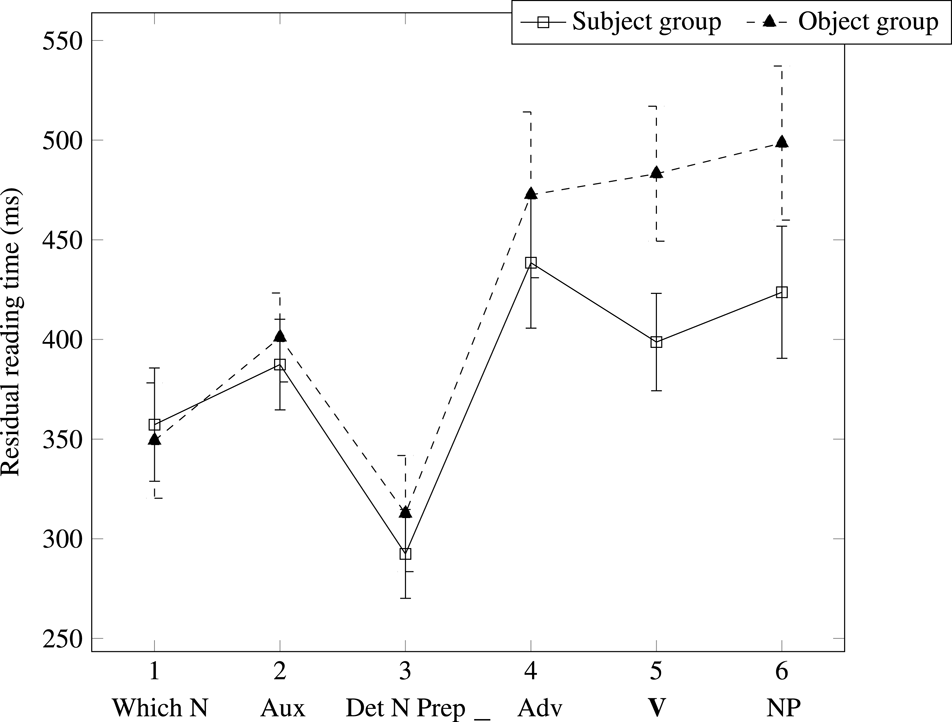
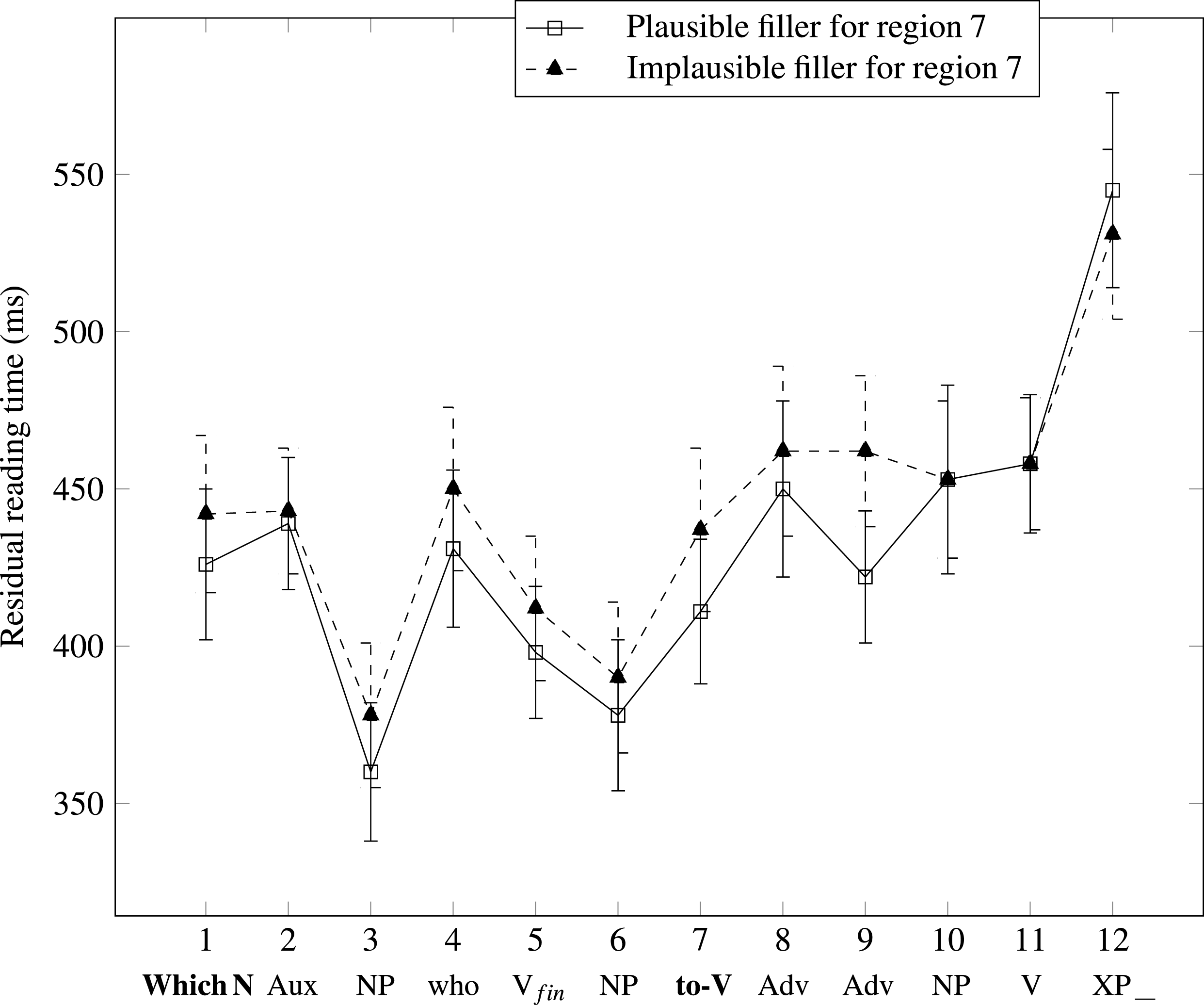
For each region of interest, we excluded reading times that were less than 100 ms and more than 1500 ms long, and replaced data points that were greater or less than 2.5 standard deviations from each participant’s mean with these boundary values. We then computed residual reading times by subtracting from the actual reading time for a region the reading time predicted by a regression equation relating region length to reading time (Trueswell & Tanenhaus Reference Trueswell and Tanenhaus1994). This regression equation was computed separately for each participant, using all regions in the experimental and distractor items. Residual reading times for all sentence regions were analyzed using an LMER model to test whether reading times of sentences with Subject Island violations in Block 2 was affected by the sentences in Block 1. Figure 3 shows mean residual reading times, where bars represent 95% confidence intervals.
Mean residual reading times for all sentence regions in Block 2 (Experiment 2).

Region 5 exhibited a significant effect (
 $\unicode[STIX]{x1D6FD}=86.80$
,
 $t=2.07$
,
 $p=.04$
), suggesting that participants in the Subject group (i.e. who saw 15 Subject Island violation sentences in Block 1) read the region of interest of the Subject Island violations in Block 2 faster than participants in the Object group (i.e. who saw zero Subject Island violation sentences in Block 1). No region before region 5 exhibited a significant effect.
4.3 Discussion
Since the only difference between the two groups of participants consisted of whether there were Subject Island violations in the Block 1 of items, the observed difference in reading times can only be attributed to that difference. The reading time differences appear after the critical region (the gap site), suggesting that comprehenders that were not trained to process Subject Island violations had more difficulty in processing such sentence regions. The fact that the participants in the Subject group processed the critical region faster than those in the Object group is consistent with the view that the former comprehenders adjusted their expectations about subject-embedded gaps during their exposure to Block 1, and therefore were less surprised by such gaps in Block 2 than the participants in the Object group. In sum, our results are consistent with the findings of Experiment 1, in that the processing of filler–gap dependencies in Subject Island environments is sensitive to the probability of the input. Together, the two experiments suggest that extraction from subjects is in principle construable by the parser, and their processing and acceptability is sensitive to their (syntactic, semantic and pragmatic) probability.
5 Experiment 3: Parasitic extraction from tensed subjects
Perhaps it can be argued that subject-internal gaps like the ones examined so far are postulated during online sentence processing because they can in principle be made licit if parasitic on a second gap. After all, such gaps are not necessarily illicit because they can still potentially be ‘rescued’ later in the sentence, if there is another gap downstream. In what follows we consider tense-embedded Subject Island violations because they are widely claimed to disallow any kind of amelioration, parasitic or otherwise. For example, although a subject-embedded gap in an infinitival phrase like (23a) can be made licit if parasitic on a second gap as in (23b), subject-embedded gaps in tensed phrases like (24a) remain illicit even in the presence of a second gap, as in (24b). Such contrast has been experimentally validated by Kurtzman & Crawford (Reference Kurtzman, Crawford and Sherer1991) and Phillips (Reference Phillips2006).

Interestingly, Phillips (Reference Phillips2006) found that the acceptability of (24a) is significantly lower than that of (24b), even though the parasitic gap is (allegedly) illicit. This presents a puzzle for the architectural view because if the subject-embedded gap is ungrammatical and beyond parasitic rescue, then (24a, b) should be equally unacceptable. But in the functional view expounded in Section 2.2 extractions like (24a) are expected to be worse than (24b) because in the former case the extracted referent is predicated by the main verb, a canonical informational focus domain. Furthermore, both (24a, b) are expected to be odd if in these particular propositions the odds of the extracted referent what being the patient of repaired happen to be particularly low. This would predict that ideal conditions the presence of tense should not hamper extraction so severely, as in counterexamples like (25).Footnote [14]

To be sure, none of the sentences in (25) are easy to process, or regarded as unquestionably acceptable by all speakers, and so the grammatical status of such parasitic gaps remains somewhat unclear. Although tensed-embedded Subject Island gaps like (24a, b) should never be licit and should never be postulated during online sentence processing according to Phillips (Reference Phillips2006), we show below that such subject-embedded gaps can become as acceptable as undisputedly grammatical controls (Experiment 3) and are actively postulated during online sentence processing (Experiment 4), employing the same experimental paradigms as Phillips (Reference Phillips2006).
Experiment 3 probes items like (25d, e) and shows that although they initially receive very low acceptability ratings, they quickly improve to the point of being as acceptable as uncontroversially grammatical controls. This sharp amelioration effect should be impossible if such gaps are grammatically and computationally illicit, as explicitly assumed by Phillips (Reference Phillips2006: 803) and others. In this study we compare the acceptability of three types of sentences, illustrated in (26). The Parasitic gap items contain one gap embedded in a tensed relative inside the subject, and another gap in the complement of the main verb. The Object gap items contain exactly one gap, corresponding to the main verb’s object. In order to provide a baseline for low-acceptability items, we included in the experiment Non-parasitic gap items, which contain a gap located inside the tensed relative in the subject phrase, but no second gap.

5.1 Method
5.1.1 Participants
We analyzed data provided by 135 participants who were recruited via AMT, using recruitment protocols identical to Experiment 1. There were 22 additional participants who reported they were not native speakers of English. Data collected from these participants were discarded.
5.1.2 Design and materials
There were 24 experimental items, and three versions of each experimental item as illustrated in (26). The full list is in Appendix C.
The 24 experimental item triples were counterbalanced across three lists using a Latin Square design so that each participant only responded to one version of each experimental item, and were interspersed among 36 distractor items. The distractors are illustrated in (27), half of which were ungrammatical, as shown in (28). Exactly as in previous experiments, all items were pseudorandomized and interspersed with distractors.

To ensure that the propositions conveyed by relative clauses in the Parasitic gap items are plausible to begin with, a norming task was conducted on the declarative counterparts of the subject-embedded relative clauses. For example, the relative in (26a) was converted to the declarative clause in (29).

A group of 23 native English speakers were recruited through AMT to evaluate the plausibility of the 24 declarative counterparts of the relative clauses in the Parasitic gap type condition together with 15 plausible distractors such as (30a, b), 15 moderately plausible distractors like (30c, d), and 20 implausible distractors as in (30e, f). Raters were asked to use a 1–7 Likert scale in order to ‘rate the likelihood of the situations described by the sentences’.

Mean responses were 5.6 (SD
 $=1.4$
) for the experimental items, 6.45 (SD
 $=0.88$
) for the plausible distractors, 2.51 (SD
 $=1.66$
) for the moderately plausible distractors, and 1.79 (SD
 $=1.41$
) for the implausible distractors. Pairwise
 $t$
-tests comparing the means for the experimental items against the means of the plausible distractors, as well as against the means of the moderately plausible distractors were significant (against the plausible distractors:
 $t=-8.91,p<.0001$
; against the moderately plausible distractors:
 $t=22.81,p<.0001$
), indicating that the plausibility of the relative clauses in the Parasitic gap type items lies in between the plausibility of our ‘plausible’ and ‘moderately plausible’ distractors.
Unlike in Experiment 1, there was no plausibility norming across conditions in the present experiment. Consequently, the items are structurally and pragmatically complex in different ways across conditions, and therefore there should be no expectation that they are equally pragmatically or equally (un)acceptable either.
5.1.3 Procedure
The procedure was identical to that of Experiment 1.
5.2 Results
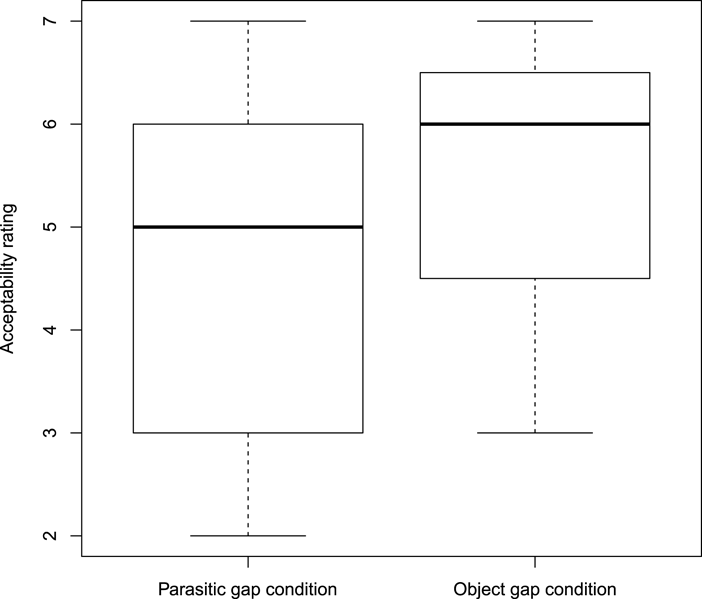
The mean responses for each of the three stimulus types were 4.26 (SD
 $=1.77$
) for Parasitic gap items, 5.46 (SD
 $=1.56$
) for Object gap items, and 2.67 (SD
 $=1.52$
) for Non-parasitic gap items. Note that if one adopts the same criterion as Phillips (Reference Phillips2006: 808), then the items in the Parasitic gaps condition should be automatically deemed grammatical, as their mean acceptability is above the middle of the scale. Finally, the mean response for the grammatical distractors was 5.21 (SD
 $=1.66$
), and for the ungrammatical distractors it was 2.99 (SD
 $=1.64$
).
To determine whether the mean acceptability responses were statistically different from each other across the three types of sentences, three pairwise LMER comparisons with construction type as a fixed predictor were conducted. All pairs were found to be significantly different (Parasitic gap vs. Object gap:
 $\unicode[STIX]{x1D6FD}=1.225$
,
 $t=14.47$
,
 $p<.0001$
; Parasitic gap vs. Non-parasitic gap:
 $\unicode[STIX]{x1D6FD}=-1.60$
,
 $t=-18.9$
,
 $p<.0001$
; Object gap vs. Non-parasitic gap:
 $\unicode[STIX]{x1D6FD}=-2.836$
,
 $t=-35.14$
,
 $p<.0001$
). In order to determine if the acceptability of the experimental items increased during the experiment, LMER models with order of experimental presentation as a fixed predictor were used, analyzing each of the three construction types separately. Object gap items became increasingly more acceptable (
 $\unicode[STIX]{x1D6FD}=0.036$
,
 $t=4.1$
,
 $p<.0001$
), and so did Parasitic gap items, only twice as fast (
 $\unicode[STIX]{x1D6FD}=0.062$
,
 $t=5.9$
,
 $p<.0001$
), suggesting that the acceptability ratings of the two conditions converge, given enough presentations. Note that both kinds of items were relatively complex and so the acceptability increase likely reflects the effect of comprehenders adapting to them and becoming more proficient at processing such constructions. Finally, the acceptability ratings of Non-parasitic gap items did change (
 $\unicode[STIX]{x1D6FD}=0.014$
,
 $t=1.64$
,
 $p=.1$
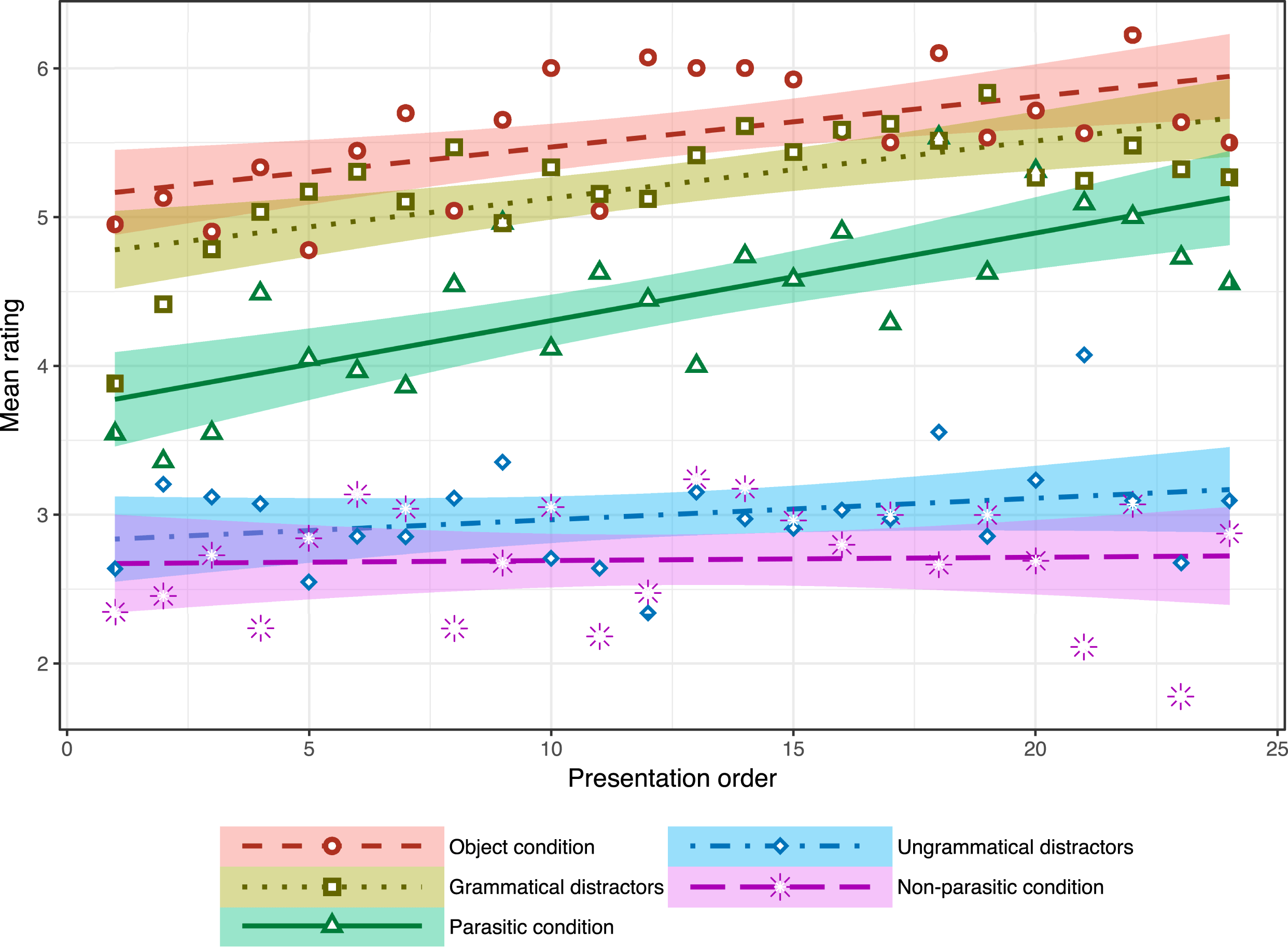
), perhaps because such sentences described less felicitous propositions because the extracted referent had no obvious bearing on the main predicate (see Section 2.2). Figure 4 shows the results, according to the experimental presentation order. As in Experiment 1, no two participants saw the same presentation order and each point corresponds to the mean rating according to presentation order.
(Colour online) LMER of each item type with presentation order as a fixed predictor (Experiment 3).

Analogously to Experiment 1, a subset of the data was formed consisting of the last four presentation orders (83 responses). The mean acceptability was 5.72 (SD
 $=1.43$
) for Object gap condition items, and 4.86 (SD
 $=1.65$
) for Parasitic gap condition items. An LMER model was run on this subset of data with gap location as a fixed predictor, and found it to be significant (
 $\unicode[STIX]{x1D6FD}=0.73$
,
 $t=2.64$
,
 $p=.01$
). However, focusing on a smaller window consisting of the last two presentation orders (35 responses), the mean acceptability of the Parasitic gap condition was 4.65 (SD
 $=1.66$
), and the mean acceptability for the Object gap condition was 5.6 (SD
 $=1.29$
). An LMER model with construction type as a fixed predictor found no significant difference (
 $\unicode[STIX]{x1D6FD}=0.53$
,
 $t=1.52$
,
 $p=.148$
), as Figure 5 illustrates. Given the concerns raised by such a small sample size, we adopted the same bootstrapping approach employed in Experiment 1 and sampled with replacement from the 35 total data points (17 per condition) to create 1118 data points (559 per condition). This process was repeated 100 times, and for each upsampled dataset an LMER model was ran with gap location as a fixed predictor, allowing the random effects to have different slopes for the main factor. The results were again not significant (mean
 $t=0.62$
, SD
 $=0.04$
).
Subset of ratings at the end of Experiment 3.

Finally, as in Experiment 1, we compared the acceptability ratings of Parasitic gap items that were seen by participants at the end of the experiment with an equal number of Object gap items seen in the beginning of the experiment, by forming a subset of our data consisting of 72 type Parasitic gap responses whose presentation orders were 18 or higher and of 72 type Object gap responses whose presentation order was either 1 or 2. The mean response for the Parasitic condition was 4.88 (SD
 $=1.75$
), and the mean response for the Object gap condition was 5.15 (SD
 $=1.51$
). Again, construction type was not significant (
 $\unicode[STIX]{x1D6FD}=0.343$
,
 $t=1.35$
,
 $p=.17$
), suggesting that the acceptability of Parasitic gap items by the end of the experiment was not significantly different from the acceptability of Object gap items at the beginning of the experiment. The above results suggest that tense-embedded subject-internal parasitic gaps can be deemed as acceptable as uncontroversially grammatical sentences, in ideal conditions.
5.3 Discussion
The acceptability of Parasitic gap items increased twice as fast Object gap items during the experiment. We suspect these results were caused by comprehenders becoming more proficient at processing such complex sentences. Future research is needed to determine whether Non-parasitic gap items are truly immune to frequency effects, or simply harder to ameliorate, perhaps for the reasons outlined in Section 2.2. Nonetheless, our results suggest that sentences with tense-embedded parasitic subject gaps can be rated as acceptable as grammatical counterparts, given enough exposure. Our findings are therefore consistent with the view that speakers can overcome their prior expectations about where gaps are usually located if such sentences express highly plausible propositions to begin with. If the acceptability of Subject Island violations is sensitive to the probability of the filler–gap dependency in the particular sentence and context, as argued by Hofmeister et al. (Reference Hofmeister, Casasanto, Sag, Sprouse and Hornstein2013), then it makes sense that different experiments and/or different Subject Island violation items can lead to different results. Experiment 4 provides online evidence that comprehenders do in fact actively postulate subject-internal gaps within such tensed relative clauses, contra Phillips (Reference Phillips2006).
6 Experiment 4: Gap filling in tensed subject phrases
Past research on gap filling in subject-embedded tensed relatives is rather inconclusive. Clifton & Frazier (Reference Clifton, Frazier, Tanenhaus and Carlson1989) manipulated the verb inside relative clauses in a speeded acceptability experiment so that the latter could be an optionally transitive verb as in (31a) or an obligatorily intransitive verb as in (31b). The relevant subject phrase is bracketed for perspicuity.

Speakers took a longer time to judge the former, suggesting the postulation of a gap inside the subject-embedded relative, but as Phillips (Reference Phillips2006) notes, this may simply reflect readers’ uncertainty over the argument structure of the optionally transitive verb. Similarly, Experiment 1 of Pickering et al. (Reference Pickering, Barton, Shillcock, Clifton, Frazier and Rayner1994) probed sentences like (32) and found a slowdown in reading time at the tensed relative clause verb, painted, rather than at the complement the large mural.

Although this finding is consistent with the formation of a long-distance dependency in which there is a gap in the subject-embedded relative clause, Pickering et al. (Reference Pickering, Barton, Shillcock, Clifton, Frazier and Rayner1994) concede that the slowdown may simply reflect overall processing load at that region of the sentence. To resolve this impasse, Phillips (Reference Phillips2006: 807–814) conducted a semantic plausibility self-paced reading experiment which suggests that comprehenders attempt to resolve filler–gap dependencies in subject-embedded infinitival verb phrases (i.e. comprehenders postulated a gap after expand in (33a) when the filler phrase was compatible with the relative verb), but make no such attempt in subject-embedded tensed verb phrases (i.e. gaps were never postulated after expanded in (33b)).

Given these results, Phillips (Reference Phillips2006: 803) concludes that the language processor does not postulate gaps in subject-embedded tensed structures because such gaps are grammatically illicit, parasitically or otherwise. However, the argument that parasitic gaps in subject-embedded tensed structures are illicit is undermined by the existence of counterexamples like (25) above, and by the results of our Experiment 3. We conjecture that the comprehenders in Phillips (Reference Phillips2006) did not attempt to postulate subject-internal gaps in tensed environments like (33b) because of a flaw in the experimental items. At least eight out of 24 items (over 30%) in the tensed and plausible conditions used in Phillips (Reference Phillips2006) actually contained semantically infelicitous critical regions. This becomes obvious if we focus on Phillips’ relative clauses, and simply ‘undo’ the extraction. For example, in the plausible condition in (33b), the noun phrase becomes the proposal that expanded the schools, which is semantically felicitous. Unfortunately, this was not the case for several of the experimental items. In (34) we list some problematic noun phrases drawn from the critical regions of the plausible conditions used in Phillips (Reference Phillips2006: 820).

The phrase (34a) is bizarre in the tensed condition because request is not a suitable agent for the verb ask. In contrast, the infinitival counterpart is felicitous because to ask the question is a complement of request. The same problem arises in all the other phrases listed in (34). All the experimental items should have been equally felicitous in both the infinitival and the tensed conditions, but because more than half of the items in the tensed condition were odd (at least 12 were odd because the filler phrase was implausible, and at least 8 were odd as seen in (34)), it is possible that comprehenders adapted to the near-systematic oddness of the sentences in the tensed condition and simply refrained from attempting to fill gaps in that condition. If the source of extraction is defective, then the result is at least as defective. Below we show that comprehenders can in fact postulate subject-internal gaps in tensed relatives during online sentence processing, using the same paradigm of Phillips (Reference Phillips2006).
6.1 Method
6.1.1 Participants
We analyzed data provided by 30 participants who were recruited in AMT, using recruitment protocols identical to Experiment 1. All had accuracy levels of at least 80% in comprehension questions, with a mean accuracy level of 87%. There were 11 additional participants whose accuracy scores were lower than the 80% threshold. Data collected from these participants were discarded.
6.1.2 Design and materials
We constructed 20 pairs of experimental sentences like the two pairs shown in (35) and (36). See Appendix D for a complete list. Each pair of items differed in the semantic plausibility of the extracted phrase in region 1 as a filler for a potential gap at the end of the relative clause in region 7. For example, whereas the noun bill is a semantically plausible complement for to pass, the noun table is not. Region 10 contained the grammatically correct object of the verb in region 7, and region 11 corresponded to the main verb of the clause.

Thus, the critical regions of interest were regions 7 through 11. If comprehenders attempt to resolve the filler–gap dependency at region 7, inside a subject-embedded tensed relative clause, then there should be a slowdown in reading time when the filler phrase is a semantically implausible complement for the verb at region 7. The adverbs at regions 8 and 9 were designed to delay and maximize the possibility of linking the extracted phrase to the object of the verb at region 7. Crucially, the adverbs are temporarily compatible with a parse in which they modify an upcoming main verb phrase, illustrated in (37a), or an upcoming complement, as in (37b). Although the latter is the correct parse for the adverbs in our experimental items, this is a rather infrequent and therefore dispreferred use of such adverbs, though perfectly grammatical and attested in corpora.Footnote [15]

Crucially, the verbs at region 7 are strongly transitive, and as is well known, gaps tend to be postulated after strongly transitive verbs even if they are implausible and even before there is direct evidence for a missing object (Stowe et al. Reference Stowe, Tanenhaus and Carlson1991). But if comprehenders postulate a gap at region 7 in the implausible condition, gap filling fails because the filler is not a plausible object for the verb. As a consequence, the presence of the adverbs in regions 8 and 9 will be rather unexpected precisely because such adverbs are typically used as verb phrase modifiers, and there should be additional processing difficulty in the adverbial regions. No extra difficulty should arise in the plausible condition because the adverbs are consistent with an upcoming main verb phrase parse. Finally, note that region 7 always consisted of a ‘purpose’ infinitival VP adjoined to the tensed VP heading the relative. Thus, any gap postulated at region 7 crosses a total of three classic ‘barriers’ to extraction: modification, tense, and a subject phrase.
To ensure that there is a difference in plausibility between the plausible and implausible versions of each experimental sentence pair, a norming study was conducted in which a separate group of 53 native English speakers recruited through AMT were asked to evaluate the propositions expressed by the relative clauses of our items. For example, the two conditions in (35a) were used to produce the declaratives in (38). Participants were then asked to rate the plausibility of such sentences, using a 1–7 Likert scale, with 1 being ‘very implausible’, and 7 being ‘very plausible’. Pairwise
 $t$
-tests revealed a significant plausibility difference for all pairs (all
 $p$
s
 ${<}$
.05).

After the norming study, the experimental sentence pairs were counterbalanced across two lists so that each participant only responded to one version of each sentence. Experimental sentences were interspersed among 50 distractor items, and the experiment was presented in a different random order for each participant. Distractors were of four types, as illustrated in (39), half of which were followed by (non-trivial) comprehension questions, also shown in (39).

The first type of distractor, exemplified in (39a), consisted of a complex interrogative in which the gap is deeply embedded in a clausal complement of the matrix. The second type of distractor, seen in (39b), consisted of a standard parasitic gap interrogative construction in which one gap is a complement of the subject nominal and the second gap is embedded in the matrix verb phrase. The third type of distractor consisted of declarative clauses with a demonstrative subject and a complex relative clause embedded in the complement phrase, as in (39c). The fourth and final type of distractor consisted of a declarative-embedded interrogative, as in (39d). As in previous experiments, the distractors were homogeneous and therefore can act as additional controls.
6.1.3 Procedure
The procedure was identical to that of Experiment 2.
6.2 Results
For each region of interest, reading times less than 100 ms and more than 1,500 ms long were excluded, and data points greater or less than 2.5 standard deviations from each participant’s mean were replaced with these boundary values. Residual reading times were computed as in Experiment 2. An LMER model was used to test whether the residual reading times for all sentence regions were affected by the plausibility of the filler phrase. Mean residual reading times are in Figure 6. The bars represent 95% confidence intervals.
Mean residual reading times for all sentence regions (Experiment 4).

There was a main effect of plausibility at the verb region 7 (
 $\unicode[STIX]{x1D6FD}=-26.94,t=-2.037,p=.042$
), indicating that participants read the infinitival verb phrase more slowly when the filler was an implausible gap-filler at that verb’s region (mean 437 ms, SD
 $=$
205) than when the filler was a plausible gap-filler at that same region (mean 411 ms, SD
 $=$
229). The plausibility effect at this region suggests that comprehenders postulate gaps inside a subject-embedded tensed relative clause. There was no significant effect of plausibility at region 8 (
 $\unicode[STIX]{x1D6FD}=-13.63,t=-0.977,p=.329$
), but at region 9 there was again a main effect of plausibility (
 $\unicode[STIX]{x1D6FD}=-38.35,t=-3.397,p=.0007$
), in which participants again slowed down in the implausible filler phrase condition only (mean 462 ms, SD
 $=$
203 vs. 422 ms, SD
 $=$
183). No other regions before 7 or after 9 registered any significant effects.
6.3 Discussion
The evidence suggests that comprehenders postulate a gap at region 7, given that the items in the implausible filler phrase condition lead to a significant increase in reading time at that region. As already noted above, gaps tend to be postulated after strongly transitive verbs even if they are implausible and even before there is direct evidence for a missing object (Stowe et al. Reference Stowe, Tanenhaus and Carlson1991). If comprehenders postulate a gap at region 7 in the implausible condition, then gap filling fails because the filler is a semantically implausible object for the verb. And after failing to fill it because of its implausibility, comprehenders come to expect the verb’s true object. However, they instead encounter adverbs that are most consistent with an upcoming main verb phrase, and therefore the slowdown at region 9 only arises in the implausible condition.
In sum, our findings suggest that comprehenders can postulate gaps in subject-embedded tensed relatives, contrary to the null effects found by Phillips (Reference Phillips2006) in an analogous experiment. We hypothesize that the latter was caused by semantically infelicitous tensed items. The fact that active gap filling sometimes occurs in subject-embedded tensed phrases, and sometimes does not, is consistent with the hypothesis that the online processing of filler–gap dependencies is modulated by extra-grammatical factors, such as probabilistic information about the expected distribution of gaps, given the semantics and pragmatics of the items.
7 General discussion
Following Erteschik-Shir (Reference Erteschik-Shir1981), Van Valin (Reference Van Valin1986), Kuno (Reference Kuno1987), Deane (Reference Deane1992), Takami (Reference Takami1992) and others, we assume that extraction is in general restricted to the informational focus of the proposition. As a consequence, extraction from subject phrases should be difficult given that subjects are typically reserved for topic continuity, and subject-embedded referents are unlikely to be the informational focus of the utterance. This conclusion is independently supported by corpus data showing that attested Subject Island violations invariably involve relative clauses that describe new information rather than background information, and that complex NPs tend to be objects rather than subjects.
Our hypothesis is that if the entire proposition is highly pragmatically felicitous, then the mention of its embedded referents must be highly felicitous too, even if subject-embedded. If the mention of a given referent (subject-embedded of not) is highly felicitous, it is more likely for such a referent to be understood as the informational focus, and thus easier for it to be extracted. This is consistent with the intuition expressed by Shimojo (Reference Shimojo2002), Kluender (Reference Kluender, Chand, Kelleher, Rodríguez and Schmeiser2004: 495), and Chaves (Reference Chaves2013) that Subject Island violations tend to be more acceptable when the extracted referent is relevant for the main assertion. More generally, in order for the mention of a referent to be felicitous and in accordance with the Gricean Maxims of Quantity (‘Be brief’) and Manner (‘Avoid Prolixity’), the context must be such that the referent is not irrelevant for the proposition. As we show, because subjects tend to be topics, subject-embedded referents are rarer than object-embedded referents, even without extraction.
According to our findings, ensuring that a proposition with subject-embedded referents is highly felicitous to begin with suffices to induce the extractability of such subject-embedded referents, if their frequency is increased. Our results are most consistent with the functional approach proposed by Chaves (Reference Chaves2013) and Hofmeister et al. (Reference Hofmeister, Casasanto, Sag, Sprouse and Hornstein2013) in which the more syntactically, semantically, and pragmatically plausible the subject-internal gap, the more acceptable such extractions should be, especially if comprehenders have the chance to adjust to the unusual syntactic location of the gap by being exposed to multiple exemplars of such sentences. We argue that such amelioration is facilitated when the very mention of the subject-embedded referent is a highly felicitous discourse move to begin with. Such an account also explains why a subject-embedded gap often becomes acceptable ‘parasitically’ if co-indexed with a non-island gap: since the extracted referent is an argument of the main predicate, it is trivially relevant for the main assertion. Our account is also consistent with the findings of Polinsky et al. (Reference Polinsky, Gallo, Graff, Kravtchenko, Morgan, Sturgeon, Sprouse and Hornstein2013), which suggests that Subject Island violations in transitive predicates tend to be stronger than in unaccusatives. If the subject is an agent or an actor, it initiates or controls the event, and is by default more relevant for the assertion than any subject-embedded referent. However, if the subject is not an agent or actor, then it is easier for a phrase other than the subject to be construed as relevant, including a subject-embedded referent. Thus, it is not easy to extract from subjects of transitive verbs – though not impossible; see Chomsky (Reference Chomsky, Freidin, Michaels, Otero and Zubizarreta2008: 160 fn. 39), Jiménez-Fernández (Reference Jiménez-Fernández2009), and Chaves (Reference Chaves2013). Ultimately, Subject Island effects are likely proposition-dependent, and in particular, contingent on the degree to which the subject-embedded referent is relevant for the assertion.
The functional account of Subject Island phenomena requires no special assumptions about the grammar or about the parser. It is well known that speakers generally attend to frequencies in linguistic input, and can adapt to changes in order to overcome the processing difficulty caused when the input is unusual and inconsistent with their prior experience. In particular, comprehenders likely make use of expectations about the distribution of filler–gap dependencies to efficiently prune the search space during gap detection, mitigating the processing costs associated with resolving such dependencies during online sentence comprehension; see for example Michel (Reference Michel2014) and van Schijndel et al. (Reference van Schijndel, Schuler and Culicover2014). We conclude that linguistic theory need not be complicated by constraints that block extraction from subjects, as the behavioral phenomena are graded, fluid and thus likely functional in nature.
APPENDIX A
Experiment 1
(1) Which animal does the mating call of {reportedly mimic the sounds of the Gray Catbird?, the Gray Catbird reportedly mimic the sounds of?}
(2) Which artist does the son of {frequently collaborate with the daughter of the Governor?, the Governor frequently collaborate with the daughter of?}
(3) Which athlete does the manager of {faintly resemble the agent of Tiger Woods?, Tiger Woods faintly resemble the agent of?}
(4) Which celebrity does the wife of {reportedly quarrel with the fiancee of the Mayor?, the Mayor reportedly quarrel with the fiancee of?}
(5) Which committee does the report of {supposedly contradict the recommendations of the experts?, the experts supposedly contradict the recommendations of?}
(6) Which company does the chairman of {usually bump heads with the CEO of IBM?, IBM usually bump heads with the CEO of?}
(7) Which condition does the treatment of {typically mimic the effects of eczema?, eczema typically mimic the effects of?}
(8) Which country does the King of {allegedly resemble the President of Sweden?, Sweden allegedly resemble the President of?}
(9) Which disease does the vaccine for {generally interact with the treatment of malaria?, malaria generally interact with the treatment of?}
(10) Which inmate does the description of {plainly match the photos of the suspect?, the suspect plainly match the photos of?}
(11) Which movie does the plot of {radically deviate from the script of the play?, the play radically deviate from the script of?}
(12) Which nation does the budget surplus of {nearly equal the fiscal deficit of Brazil?, Brazil nearly equal the fiscal deficit of?}
(13) Which politician does the son of {sometimes socialize with the ex-wife of Clint Eastwood?, Clint Eastwood sometimes socialize with the ex-wife of?}
(14) Which pundit does the wife of {rarely agree with the opinions of the President?, the President rarely agree with the opinions of?}
(15) Which road does the end of {actually coincide with the beginning of Route 66?, Route 66 actually coincide with the beginning of?}
(16) Which singer does the brother of {regularly hang out with the daughter of Bill Clinton?, Bill Clinton regularly hang out with the daughter of?}
(17) Which skirt does the color of {totally clash with the patterns of the jacket?, the jacket totally clash with the patterns of?}
(18) Which song does the beat of {supposedly coincide with the melody of “Ice, Ice Baby”?, “Ice, Ice Baby” supposedly coincide with the melody of?}
(19) Which state does the Governor of {actively oppose the senator from Vermont?, Vermont actively oppose the senator from?}
(20) Which movie does the score of {clearly sound like the main theme of “The Godfather”?, “The Godfather” clearly sound like the main theme of?}
(21) Which stock does the value of {often parallel the price of the dollar?, the dollar often parallel the price of?}
(22) Which team does the manager of {definitely look like the coach of the Lakers?, the Lakers definitely look like the coach of?}
APPENDIX B
Experiment 2
Block 1, List 1
(1) Which animal | does | the song of | reportedly | mimic | the Gray Catbird’s sounds?
(2) Which artist | does | the son of | frequently | collaborate | with the Governor’s daughter?
(3) Which athlete | does | the manager of | clearly | resemble | Tiger Woods’ agent?
(4) Which tune | do | covers of | always | become | popular around Christmas?
(5) Which committee | do | the findings of | supposedly | contradict | the expert’s recommendations?
(6) Which company | does | the chairman of | usually | disagree | with his own advisors?
(7) Which condition | does | the treatment of | typically | mimic | the effects of eczema?
(8) Which country | does | the King of | clearly | resemble | Sweden’s President?
(9) Which disease | does | the vaccine for | frequently | interact | with malaria treatments?
(10) Which inmate | does | the description of | barely | match | the suspect’s photos?
(11) Which movie | does | the plot of | radically | deviate | from the play’s script?
(12) Which sculpture | do | the replicas of |traditionally | sell | for thousands of dollars?
(13) Which nation | does | the budget of | nearly | equal | Brazil’s fiscal deficit?
(14) Which politician | does | the son of | often | socialize | with Shakira’s ex-husband?
(15) Which pundit | does | the wife of | rarely | support | her own husband’s opinions?
Block 2, List 1&2
(16) Which road | does | the end of | actually | coincide | with Route 66’s beginning?
(17) Which singer | does | the voice of | reputedly | irritate | the American Idol judges?
(18) Which skirt | does | the color of | totally | clash | with the jacket’s patterns?
(19) Which song | does | the beat of | supposedly | mirror | the melody of ‘Ice Ice Baby’?
(20) Which state | does | the Governor of | actively | despise | the senator from Iowa?
(21) Which stock | does | the price of | often | coincide | with the dollar’s value?
(22) Which team | does | the manager of | definitely | look | like the Lakers’ coach?
(23) Which song | does | the chorus of | almost | sound | like the national anthem?
(24) Which celebrity | does | the wife of | reportedly | bicker | with the Mayor’s fiancee?
(25) Which company | do | the employees of | allegedly | reject | salary increases?
APPENDIX C
Experiment 3
(1) Which incident did the bystanders who {witnessed find terrifying?, fled into the subway find terrifying?, witnessed end up going into therapy?}
(2) Which woman do all the men who {work with want to date?, work in the corner office want to date?, work with become more productive?}
(3) Which products did the customers who {ordered online not receive for three weeks?, visited the store want to buy?, ordered online not have poor credit?}
(4) Which articles did the journalists who {wrote decide not to publish?, you interviewed decide not to publish?, wrote decide to quit their job?}
(5) Which puzzle did the kids who {solved enjoy the most?, came to my parties enjoy the most?, solved feel very tired?}
(6) Which virus did the mice that were {infected with never recover from?, in the lab never recover from?, infected with never get sick?}
(7) Which client did the lawyers who {worked for end up suing?, felt discriminated end up suing?, worked for try to sue the state?}
(8) Which celebrities do the people who {follow on Twitter also follow on Facebook?, are over fifty years old follow on Facebook?, follow on Twitter have college degrees?}
(9) Which company did the interns who {worked for receive bonuses from?, graduated from college receive bonuses from?, worked for start non-profit organization?}
(10) Which tax bill do the senators who {support probably benefit from?, cheat on taxes probably benefit from?, support probably get lots of donations?}
(11) Which disease did the children who {fell victim to eventually recover from?, were malnourished recover from?, fell victim to were malnourished?}
(12) Which drink did the guests who {ordered love the most?, sat on the patio love the most?, ordered sat on the patio?}
(13) Which products do the customers who {buy recommend to their friends?, visit the store recommend to their friends?, buy never return to the store?}
(14) Which proposal did the people who {rejected end up accepting?, were in the courthouse end up accepting?, rejected go home?}
(15) Which patient did the doctors who {examined decide not to treat?, were at the private clinic decide not to treat?, examined been transferred to another hospital?}
(16) Which newspaper did the editor who {criticized get fired from?, criticized the photojournalist get fired from?, criticized blackmail the mayor?}
(17) Which politician do all the people who {support end up hating?, support the campaign end up hating?, support end up changing their political party?}
(18) Which law did the congressman who {proposed accidentally vote against?, was arrested for fraud accidentally vote against?, proposed fired his secretary?}
(19) Which movies do the people who {rent usually watch with friends?, are single usually watch with friends?, rent usually have nightmares?}
(20) Which program do the children who {participate in enjoy the least?, you interview enjoy the least?, participate in sign consent form?}
(21) Which suspect did the policeman who {arrested forget to handcuff?, went missing yesterday forget to handcuff?, arrested write to the newspapers?}
(22) Which witness did the detectives who {questioned accuse of lying?, were fired accuse of lying?, questioned quit the police force?}
(23) Which toys did the kids who {liked try to steal?, came to the party try to steal?, liked have great time?}
(24) Which girl do all the boys who {dance with fall in love with?, move to my street fall in love with?, danced with leave the party early?}
APPENDIX D
Experiment 4
- (1a)
Which greeting | did | the shoppers | who | came | to the store | to buy | sometimes | simply | a newspaper | get | the most?|
- (1b)
Which product | did | the shoppers | who | came | to the store | to buy | sometimes | simply | a newspaper | get | the most?|
- (2a)
Which problem | did | the fans | who | went | to the bar | to watch | only | probably | some contest | end up | having later?|
- (2b)
Which game | did | the fans | who | went | to the bar | to watch | only | probably | some contest | end up | seeing instead?|
- (3a)
Which complaint | did | the neighbor | who | got | a trap | to catch | basically | just | squirrels | end up | getting?|
- (3b)
Which critter | did | the neighbor | who | got | a trap | to catch | basically | just | squirrels | end up | also ensnaring?|
- (4a)
Which error | did | the customers | who | went | to our website | to purchase | typically | mostly | clothing | detest | the most?|
- (4b)
Which product | did | the customers | who | went | to our website | to purchase | typically | mostly | clothing | detest | the most?|
- (5a)
Which complaint | did | the reporter | who | hid | in the bushes | to photograph | allegedly | only | some birds | get | fired for?|
- (5b)
Which celebrity | did | the reporter | who | hid | in the bushes | to photograph | allegedly | only | some birds | get | punched by?|
- (6a)
Which nickname | did | the witness | who | returned | to court | to answer | probably | merely | a survey | help | reveal?|
- (6b)
Which question | did | the witness | who | returned | to court | to answer | probably | merely | a survey | help | resolve?|
- (7a)
Which building | did | the doctor | who | moved | to Nigeria | to cure | maybe | just | sore throats | end up | dying in?|
- (7b)
Which epidemic | did | the doctor | who | moved | to Nigeria | to cure | maybe | just | sore throats | end up | dying from?|
- (8a)
Which avenue | did | the defendant | who | sold | the house | to pay | perhaps | merely | the mortgage | have | to abandon?|
- (8b)
Which fee | did | the defendant | who | sold | the house | to pay | perhaps | merely | the mortgage | have | to waive?|
- (9a)
Which rule | did | the fireman | who | smashed | a window | to unlock | only | just | a padlock | fail | to follow?|
- (9b)
Which door | did | the fireman | who | smashed | a window | to unlock | only | just | a padlock | fail | to notice?|
- (10a)
Which table | did | the senators | who | attended | the meeting | to pass | maybe | only | one statute | end up | sitting at?|
- (10b)
Which bill | did | the senators | who | attended | the meeting | to pass | maybe | only | one statute | end up | supporting?|
- (11a)
Which candy | did | the children | who | got | a vaccination | to prevent | apparently | only | measles | become | allergic to?|
- (11b)
Which disease | did | the children | who | got | a vaccination | to prevent | apparently | only | measles | become | immune to?|
- (12a)
Which vehicle | did | the gardener | who | dug | a hole | to plant | probably | mostly | some seeds | cause | damage to?|
- (12b)
Which tree | did | the gardener | who | dug | a hole | to plant | probably | mostly | some seeds | cause | damage to?|
- (13a)
Which sport | did | the teenager | who | flew | to Hollywood | to meet | probably | just | a pen pal | fall | in love with?|
- (13b)
Which celebrity | did | the teenager | who | flew | to Hollywood | to meet | probably | just | a pen pal | fall | in love with?|
- (14a)
Which injury | did | the mason | who | climbed | the wall | to repair | supposedly | mostly | some bricks | end up | suffering from?|
- (14b)
Which chimney | did | the mason | who | climbed | the wall | to repair | supposedly | mostly | some bricks | end up | fixing too?|
- (15a)
Which inspector | did | the engineer | who | pressed | a button | to activate | only | just | one machine | complain | about?|
- (15b)
Which computer | did | the engineer | who | pressed | a button | to activate | only | just | one machine | complain | about?|
- (16a)
Which scam | did | the journalist | who | traveled | to Sochi | to interview | mostly | only | athletes | fall | victim to?|
- (16b)
Which celebrity | did | the journalist | who | traveled | to Sochi | to interview | mostly | only | athletes | fall | in love with?|
- (17a)
Which senator | did | the congressman | who | drafted | a document | to propose | maybe | simply | a tax break | anger | the most?|
- (17b)
Which plan | did | the congressman | who | drafted | a document | to propose | maybe | simply | a tax break | oppose | the most?|
- (18a)
Which fee | did | the subscribers | who | use | the Internet | to download | mostly | only | music | hate | the most?|
- (18b)
Which movies | did | the subscribers | who | use | the Internet | to download | mostly | only | music | watch | at home?|
- (19a)
Which mistake | did | the kids | who | were | at the store | to buy | perhaps | simply | candy | cause | their parents | to make?|
- (19b)
Which toy | did | the kids | who | were | at the store | to buy | perhaps | simply | candy | cause | some damage | to?|
- (20a)
Which substance | did | the policeman | who | exited | the car | to confront | presumably | only | a juvenile | find | in the sidewalk?|
- (20b)
Which suspect | did | the policeman | who | exited | the car | to confront | presumably | only | a juvenile | point | a gun at?|