Traditionally, children with tetralogy of Fallot who developed hypercyanotic spells either underwent placement of a Blalock–Taussig shunt or complete repair when appropriate. Over recent years, several centres have reported the role of transcatheter stent placement in the right ventricular outflow tract as an alternative means of stabilising pulmonary blood flow in the setting of hypercyanotic spells.Reference Cools, Boshoff, Heying, Rega, Meyns and Gewillig 1 – Reference Stumper, Ramchandani and Noonan 6 This strategy stabilises pulmonary blood flow for a period of time until the child is a favourable surgical candidate.
Methods
We reviewed all the children with severe right ventricular outflow tract obstruction, defined as peak instantaneous gradient >64 mmHg, hypoplastic pulmonary annulus, and/or hypoplastic branch pulmonary arteries who developed hypercyanotic spells and underwent transcatheter stenting of the right ventricular outflow tract between January, 2008 and December, 2013. The medical charts and catheterisation data were reviewed of each child. We also reviewed the outcome of surgical intervention in each child who underwent stent placement. Specifically, we assessed the growth of the pulmonary arteries from the time of stent placement up to the time before surgical repair. Measurements of the branch pulmonary arteries were taken from the serial echocardiograms measured at the proximal branch pulmonary arteries and the Z-scores were derived.Reference Pettersen, Du, Skeens and Humes 7 The latest pulmonary arterial dimensions were measured from the most recent echocardiogram immediately before surgical repair.
Patient demographics
There were a total of nine children who underwent placement of one or more stents in the right ventricular outflow tract. There were four male and five female patients. The median age at the time of stent placement was 39 days (range 12–60 days); the median weight was 3.6 kg (range 2.6–4.3 kg), and the median body surface area was 0.23 m squared (range 0.18–0.25 m2). Among all, four patients had tetralogy of Fallot, four patients had complete atrioventricular septal defect with tetralogy of Fallot, and one patient had dextrocardia and double-outlet right ventricle with severe pulmonary stenosis in the setting of pentalogy of Cantrell.
Pre- and intra-procedural stabilisation
Patients were treated with a combination of knee-chest position, inhaled oxygen, intravenous fluid bolus, intravenous morphine, beta-blockers such as esmolol or propranolol, and/or phenylephrine while experiencing a hypercyanotic event. Intubation, sedation, and paralysis were used when required.
Catheterisation technique
All the procedures were performed under general anaesthesia. An esmolol infusion was given to prevent spells during the procedure, especially at the time of balloon inflation, with phenylephrine or metaraminol boluses as required. Blood pressure and heart rate were monitored with arterial access throughout the procedure. Femoral or jugular access was obtained in the standard manner using the Seldinger technique. The right ventricular outflow tract was crossed with a Judkins right catheter (JR1), and an appropriate-sized wire (0.014″ or 0.018″ depending on stent size) was placed in whichever pulmonary artery was believed to provide optimal wire stability. A pre-mounted stent (Vision Express or Herculink from Abbott (Abbott Vascular, Santa Clara, California, United States of America) or Formula 418 from Cook (Bloomington, Indiana, United States of America)) was placed across the right ventricular outflow tract and the pulmonary annulus. A long 4-Fr or 5-Fr Flexor sheath from Cook Medical was used to deliver the stent across the right ventricular outflow tract in five of the nine patients, and fluoroscopy was used to guide deployment of the stent, which was just introduced through the short femoral sheath in the remaining four patients.
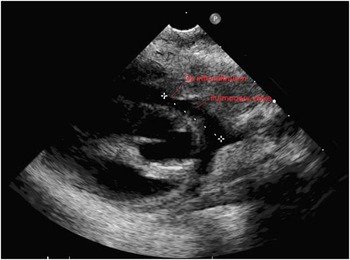
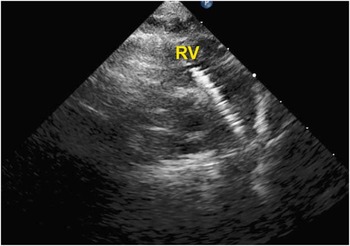
Echocardiography was used to pre-select the required stent diameter – 1 mm larger than the main pulmonary artery measured above the supravalvar narrowing – and stent length – just below the os infundibulum to just above the supravalvar narrowing of the main pulmonary artery (Fig 1). As previously mentioned, echocardiography was also used during stent deployment in four patients to ensure optimal stent position. The stent could be visualised as a cross-hatched structure separate from the balloon in the long-axis parasternal view of the right ventricular outflow tract (Fig 2), and its position was then adjusted to straddle the os infundibulum and supravalvar area of the pulmonary artery. In these four cases, the stent was introduced over a 0.014″ Grand Slam wire (Asahi, Abbott Vascular) through the femoral short introducer sheath without using a long sheath. The Grand Slam wire was exchanged after a BMW GW was used to cross the valve and enter the lower right pulmonary artery. A 3-Fr Gensini catheter (Balt, Montmorency, France) was used to exchange the BMW wire for the Grand slam wire.
Echocardiographic measurement of the right ventricular outflow tract (RVOT) to pre-select a stent.

Visualisation of the stent in the right ventricular outflow tract (RVOT) before deployment in the long-axis parasternal view on echocardiography.

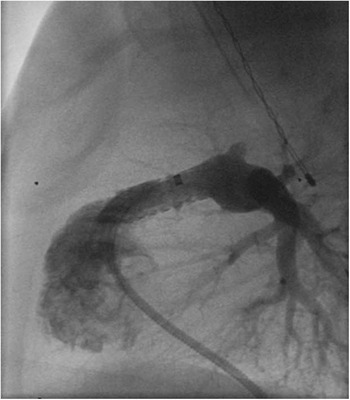
In four cases with an elongated infundibulum, two or more overlapping stents were implanted to prevent sub-stent dynamic muscular obstruction from developing. The stent crossed the pulmonary annulus in all cases, which acted as an anchor for the stent (Fig 3). In the patient with pentalogy of Cantrell, the catheterisation was undertaken before repair of the sternal and left ventricular diverticulum as the patient had a very hypoplastic pulmonary annulus and branch pulmonary arteries (3 millimetres each). The sternal and LV diverticulum were subsequently repaired at the time of complete repair of the cardiac defect.
Angiography in the lateral projection following stent placement, demonstrating a widely patent right ventricular outflow tract stent.

Results
All the patients who underwent stenting of the right ventricular outflow tract presented with hypercyanotic spells or worsening oxygen saturations in the setting of hypoplastic branch pulmonary arteries and pulmonary annulus. Patients who were of appropriate weight with favourable cardiac anatomy including good-sized branch pulmonary arteries underwent primary surgical repair of the cardiac lesion. There were no patients on extracorporeal membrane oxygenation at the time of catheterisation.
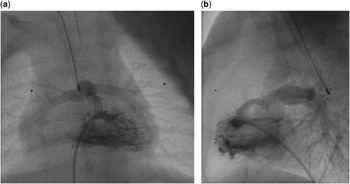
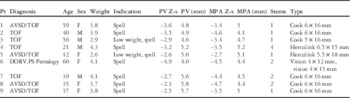
Catheterisation was performed via the femoral venous approach in eight patients and initially via the jugular approach in one patient (Figs 1, 4). The jugular approach was hoped to provide easier access for the stenting procedure, but resulted in a pericardial tamponade, and access was switched to the femoral venous approach before successful stenting. Successful stenting of the right ventricular outflow tract was achieved in all patients; five patients had one stent implanted, three patients had two stents implanted, and one patient had four overlapping stents implanted (Table 1). In those with only one stent implanted, the stents used included a Cook Formula 418 6×16 mm stent in three patients, a Cook Formula 418 5×16 mm stent in one patient, a Herculink 6.5×15 mm in one patient, and a Herculink 5.5×18 mm stent in one patient. In one patient, two Vision coronary stents (a 15 and 12 mm stent) were placed, and two Cook Formula 418 6×16 mm stents were implanted in another patient. The patient with four overlapping stents had 4 Cook Formula 418 6×16 mm stents implanted (Fig 4).
( a and b ) Anteroposterior ( a ) and lateral ( b ) angiograms demonstrating tetralogy of Fallot with severe right ventricular outflow tract obstruction and hypoplastic pulmonary annulus in a child weighing 2.9 kg.

Catheterisation procedure including age and weight at the time of procedure and the number and type of stents implanted in the right ventricular outflow tract.

AVSD=atrioventricular septal defect; Pt=patient; TOF=tetralogy of Fallot; Z-s=Z-score.
Age at catheterization (days), weight at catheterization (kilograms).
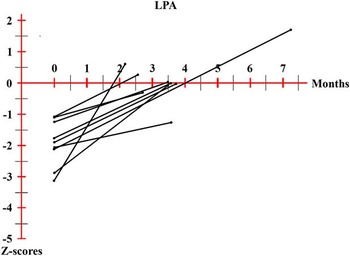
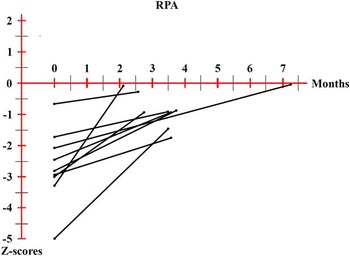
The median oxygen saturation increased from 60% (range 54–72%) to 96% (90–100%). The median left pulmonary arterial size increased from 3.4 mm, Z-score −1.93 (range 2.8–3.5 mm, −1.08 to −3.15 Z-scores), to 5.5 mm, 0 Z-score (range 5–7.3 mm, −1.26 to +1.7 Z-scores) (Fig 5), and the median right pulmonary arterial size increased from 3.3 mm, −2.68 Z-score (range 2.3–3.6 mm, −5 to −0.69 Z-scores), to 5.5 mm, −0.92 Z-score (range 5.1–6 mm, −1.45 to−0.09 Z-scores) (Fig 6), from the time immediately after stent deployment until surgical intervention.
Change in Z-score of the left pulmonary artery following stenting of the right ventricular outflow tract.

Change in Z-score of the right pulmonary artery following stenting of the right ventricular outflow tract.

In seven patients, the procedure was uncomplicated; one patient developed pericardial tamponade requiring pericardiocentesis but recovered well. A second patient developed significant pulmonary oedema following stent deployment, which settled with ventilation and diuretic treatment. All nine patients underwent successful surgical repair. The median duration from time of stent placement to surgical repair was 3.6 months (range 2.2–7.3 months); one patient waited for seven months to undergo repair because of in utero growth restriction and failure to thrive with associated 22q11 deletion. There was no significant residual pulmonary obstruction in any of the surgical patients. In two cases, there was a small fragment of residual stent, which could not be removed by the surgeon from the right ventricular outflow tract in one case and from the tricuspid valve subvalvar apparatus in the second case. This did not cause any haemodynamic compromise. Both these patients had the stent placed for over four months, which may have attributed to the difficulty of complete removal. There were no cardiac arrhythmias in any of the patients post-operatively, including the two patients who had retained stent fragments in the right ventricular outflow tract.
Discussion
Several previous reports have documented the role of stenting the right ventricular outflow tract in small children with tetralogy of Fallot beforeReference Cools, Boshoff, Heying, Rega, Meyns and Gewillig 1 – Reference Stumper, Ramchandani and Noonan 6 and after surgical repair.Reference Lee, Song, Choi and Baek8In patients with unrepaired tetralogy of Fallot, this has been demonstrated to improve oxygen saturation and prevent hypercyanotic spells. Our study further highlights the potential to resolve hypercyanotic spells in small neonates with right ventricular outflow tract obstruction – some in combination with atrioventricular septal defects – and hypoplastic pulmonary arteries, and, furthermore, demonstrates significant branch pulmonary arterial growth from the time of stent implantation to surgical intervention. There was a significant increase in Z-scores of both left and right pulmonary arteries, indicating pulmonary arterial growth. This strategy appears to allow for pulmonary arterial growth similar to reports of patients who have undergone a Blalock–Taussig shunt;Reference Ishikawa, Takahashi and Sato9however, unlike a Blalock–Taussig shunt, anterograde anatomical flow to the branch pulmonary arteries may be less likely to lead to over-circulation or acute thrombosis – both seen with shunt palliation in these patients – and a reported mortality rate of 7%.Reference Al Habib, Jacobs and Mavroudis 10
Furthermore, one of the disadvantages of adopting this approach is that the pulmonary valve function is sacrificed by transannular placement of the stent. All the patients in our series had a hypoplastic pulmonary annulus, which would have required a transannular patch at the time of surgical correction rather than a valve-sparing procedure. Theoretically, one could balloon-dilate the pulmonary annulus and stent the infundibulum, but this may result in migration of the stent as the annulus acts as an anchor to retain stent position.
In one of the patients, despite good initial stent position across the annulus, there was dynamic muscular obstruction below the stent, which required additional overlapping stents to ensure that there was no residual subpulmonary obstruction. This alleviated the hypercyanotic episodes, but required extensive stent resection at the time of surgical repair, with a small segment of stent unable to be removed from the tricuspid subvalvar apparatus. The residual presence of a small segment of stent in two patients after repair of tetralogy of Fallot was well tolerated.
Small neonates with hypercyanotic spells appear to be good candidates to undergo transcatheter stenting of the right ventricular outflow tract. The presence of the stent may only be required for 2–3 months until the children reach a favourable weight and pulmonary arterial growth for complete repair.
Technically, the procedure was performed via a femoral approach in eight patients and via the jugular approach in one patient. The jugular approach did not confer any advantage to performing the procedure; three patients had simultaneous administration of an esmolol infusion for rate control during deployment of the stent. This stabilised the right ventricular outflow tract for placement of the stent.
Patients with hypoplastic pulmonary annulus and pulmonary arteries in the absence of hypercyanotic events did not undergo elective stenting of the outflow tract and were closely followed-up to assess pulmonary arterial and annular growth. The degree of pulmonary arterial growth following stent placement was similar to the large series of 52 patients reported by Stumper et al.Reference Stumper, Ramchandani and Noonan6If they remained asymptomatic, we waited until they reached appropriate weight and anatomy to tolerate primary surgical repair.
Limitations
There are a number of limitations to this study. The number of patients included in the study is relatively small, as we specifically studied patients with hypoplastic branch pulmonary arteries and hypercyanotic spells who were deemed to be at high risk for primary surgical repair. The study cohort was a heterogeneous group comprising patients with tetralogy of Fallot, tetralogy of Fallot with complete atrioventricular septal defect, and double-outlet right ventricle. Further prospective studies are required to compare the efficacy of transcatheter stenting of the right ventricular outflow tract for shunt placement.
In conclusion, transcatheter stenting of the right ventricular outflow tract has a role in treating small neonates with right ventricular outflow tract obstruction, hypoplastic pulmonary arteries, and hypercyanotic spells. This resolves hypercynaotic spells, allows reasonable pulmonary arterial growth, thus enabling children reach successful complete repair of their cardiac lesion. The placement of a Blalock–Taussig or surgical repair when possible remains the standard treatment in children with a normal-sized pulmonary annulus, and stenting of the right ventricular outflow tract should be reserved for patients with a hypoplastic pulmonary annulus. A prospective randomised trial of outcomes of children undergoing Blalock–Taussig shunt and right ventricular outflow tract stent placement in the this specific group of patients with hypoplastic pulmonary annulus and pulmonary arteries is indicated.
Acknowledgement
The authors are grateful to Mr Andrew Pendred for assistance in preparation of the figure illustrations for this manuscript.
Financial Support
This research received no specific grant from any funding agency, commercial, or not-for-profit sectors.
Conflicts of Interest
None.
Ethical Standards
The authors assert that all procedures contributing to this work comply with the ethical standards of the relevant national guidelines.