1. Introduction
Many immigrants who arrived in England and Wales in the nineteenth century started their own businesses. This article provides the first overview of immigrant entrepreneurs of all nationalities for the period 1851–1911. The immigrant population had a higher rate of business proprietorship than the English- and Welsh-born population but immigrants from different locations exhibited different rates of entrepreneurship. Immigrant entrepreneurship has been an important area of study for research examining the place of immigrants in the economy, with debates occurring over the contribution of immigrant entrepreneurs, and the extent to which they crowded out, were assimilated to or diversified the population of business proprietors in their host country, with an absence of consensus about whether immigrant entrepreneurship was of benefit to wider society.Footnote 1 Other studies of the period have shown that Victorian and Edwardian England and Wales were not unusual in having higher rates of entrepreneurship among foreign-born individuals than among the native-born population.Footnote 2 Thus, immigrants made an important contribution to the economy by providing both goods and services, and employment. Many of their businesses were small and in areas of the economy, such as dressmaking or food preparation and retail, often considered by historians to be less important than industrial production. However, small and medium enterprises formed the majority of all businesses and were vital to the Victorian and Edwardian economy. Moreover, consumer goods production, retail, and services are increasingly recognised as more important than previously thought.Footnote 3 Nevertheless, this should not disguise the precarious nature of much immigrant entrepreneurship, especially in the East End of London, but in that respect, as in many others, immigrant business proprietors were similar to English- and Welsh-born entrepreneurs.Footnote 4 Indeed, as this article shows, immigrant entrepreneurs had many similar characteristics to their English- and Welsh-born contemporaries; what determined differences between the two groups were the different structural conditions they experienced, particularly the labour market conditions.
The immigrant entrepreneurs and their enterprises took many forms and the routes by which they came to run businesses varied greatly. For example, Michael Marks, the son of a Russian tailor, arrived in England in 1882, fleeing anti-Semitic pogroms in Russia. He started out running market stalls in Leeds, Castleford and Wakefield selling clothing, household goods and toys. Over the next decade this expanded into a business with multiple ‘penny bazaars’ in towns throughout Lancashire. In 1894, he entered into a partnership with Thomas Spencer creating the, still existing, retail chain firm Marks and Spencer; it became a limited company in 1903. Michael Marks was a director until his death in 1907, when his probate valuation found him worth over £27,000 at his death.Footnote 5
Others had rather more difficult experiences. Carlo Moriggia was born in Stazzona, Italy in 1839; he arrived in England in 1856.Footnote 6 In 1861, he was boarding in Spitalfields, working as a looking-glass vendor.Footnote 7 By 1871, he had moved to Lambeth and was managing a business in which he was also a pastry cook.Footnote 8 Sometime between 1871 and 1877 he decided, however, to go into business with his brother, Giovanni, as ice manufacturers and refreshment house keepers. In 1877, they went into liquidation; however, they had, just prior to bankruptcy, fraudulently transferred the lease of a house and other property into the names of Giuseppe Padrolli, a relative of theirs, and Walter O'Connor, both of whom were their employees. Carlo, Giovanni and O'Connor were found guilty and imprisoned for, respectively, eighteenth months, two years, and nine months. Padrolli was found not guilty.Footnote 9 Carlo was returned in the 1881 Census as a shopkeeper, suggesting he had opened a new business after leaving prison.Footnote 10 In 1891 he was an employer, running a confectionery business; in 1901 he was running a restaurant.Footnote 11 This business was clearly quite successful, and he had recovered from the troubles of bankruptcy and imprisonment. When he died in 1907, in Gravadona Italy, his estate was valued at £14,691.Footnote 12 His brother, Giovanni, followed much the same career path as Carlo after their bankruptcy. In 1881 he was running a refreshment room in Islington, and in 1891 a restaurant in Aldgate, which he was still running in 1901. By 1911 he had retired and was living with his daughter and son-in-law.Footnote 13 He died later that year, and his estate was valued at probate at £1,300. While probate valuations are not simple reflections of wealth, the substantial difference in Carlo and Giovanni's valuations suggest that Giovanni had been somewhat less successful than his brother in recovering from the setbacks of the late 1870s.
Others had more precarious experiences. Abraham and Fanny Schneider (born in Riga and Windau (modern-day Ventspils), respectively) arrived in London from Riga some time between 1888 and 1890; in the 1891 Census they were both working as dressmakers on their own account (self-employed sole proprietors). By 1901 Abraham was still working as an own-account dressmaker, but Fanny had no recorded occupation; in 1911 when they were both aged 58 neither had an occupation and they were living with their daughter, Rachel, and son-in-law, Phillip. Little is known about them, but running their own businesses as dressmakers helped the Schneiders survive in London as recent immigrants.Footnote 14
Those with higher skill levels tended to fare better. For example, Wilhelm Ehrhardt, who was born in Mecklenburg in 1832, arrived in England in 1851 and was already recorded in the skilled trade of ‘watch maker’.Footnote 15 He was practising the same trade in each Census between 1851 and 1891. He moved to Birmingham shortly after arriving in England and started a watchmaking business in 1854. Over this period his business increased in size from 19 employees in 1861 to 125 people in 1881.Footnote 16 When he died his estate was valued at £43,162.Footnote 17 Other successful immigrants who became large employers were children of middle- and upper-class families, who set up businesses on their arrival using family capital, such as Ivan Levinstein. He arrived in Britain from Prussia in 1864, having previously worked in his father's dye-making business in Neu-Schöneberg and set up his own dye-making firm in Salford.Footnote 18 In 1881 he was employing 50 people and his firm continued to grow and was one of the largest British-based business in the industry by the early twentieth century.Footnote 19 His was one of the four firms that merged in 1926 to form Imperial Chemical Industries (ICI), although Levinstein himself had died a rich man in 1916, when his probate valuation was £113,884.Footnote 20
These five examples show some of the many ways in which immigrants came to found their businesses in England and Wales, some driven by harsh economic necessity, some continuing behaviours they had witnessed or practiced in their place of birth. Some were dramatically successful, others struggled, and contrasting fortunes could be found even within the same family. While some of their stories are well known, such as Marks or Levinstein, others are unremarked upon or known only in specialist circles, such as Moriggia, Ehrhardt or the Schneiders. There have been few historical studies of immigrant business proprietors that examine them as a social group rather than as an aspect of a more general study of a particular immigrant community.Footnote 21 Other studies have focused exclusively on migrant entrepreneurs, but usually only on those from a particular ethnicity and location, such as Andrew Godley's study of Jewish entrepreneurs in London and New York.Footnote 22 We lack a general picture of the nature of immigrant business proprietorship, how it varied across time and between different immigrant communities, and how they compared to the existing English and Welsh population. This article provides the first general overview of the immigrant entrepreneurs in nineteenth- and early twentieth-century England and Wales, outlining the trend in numbers, geography and sectoral distribution. It also compares the incidence of business proprietorship among immigrant and non-immigrant communities and provides some possible explanations for the differing levels of entrepreneurship exhibited by different national and regional groups.
Historical and contemporary studies of migrant entrepreneurship have suggested several reasons why immigrants are more likely to start businesses than native-born people.Footnote 23 First, immigrants often face difficulties entering waged labour markets and consequently they start businesses out of necessity. Second, many migrant communities create networks that allow capital to be raised and provide other supports to help compensate for the disadvantages faced by immigrants in accessing resources.Footnote 24 Third, it has been suggested that immigrants, having already taken one bold decision, to migrate, were more likely to take another, starting a business.Footnote 25 Fourth, it is argued that the culture of migrants’ origin communities affects the propensity to start businesses, namely that many immigrants came from places or groups that were more entrepreneurially minded than the host country. Furthermore, in the particular context of British economic history the spectre of declinism inevitably rears its head. Some scholars have suggested that British culture dampened the entrepreneurial spirit, and that immigrants, untainted by the supposedly anti-business culture of Britain, were inevitably more entrepreneurial than the British-born.Footnote 26 Fifth, it is also argued that immigrants have a better perception of market opportunities than lifelong residents.Footnote 27 Finally, research on ethnic entrepreneurship has found that immigrant communities generate their own new markets, which are either run by a particular community solely for that community, such as kosher food production, or provide novel services and goods for both immigrant and native populations.Footnote 28 The data used in this article offer a chance to examine these issues on the basis of an entire population, rather than through case studies or sampled populations.
2. Census data and immigration
The creation of I-CeM, an integrated, standardised electronic version of the England and Wales Censuses for 1851–1911, allows us to identify the majority of immigrant business proprietors on a national scale for the first time.Footnote 29 Migrants can be identified using the birthplace data contained in the Censuses, as in each Census individuals were asked to report their birthplace. There was some variation in the information requested in each Census. Those born in England and Wales had to give their county and town or parish of birth; those in England and Wales who were born in Scotland or Ireland were to give the county; those born somewhere in the British Empire had to give the name of the colony or dependency; and those born in any other foreign country were to give the name of the country and whether they were a ‘British subject’, ‘naturalised British subject’ or ‘foreign subject’ followed by their nationality (‘French’, ‘Russian’, etc.). In 1911 this changed, and two columns were provided, one for birthplace and one for nationality.
The accuracy of birthplace data is unclear; studies of Preston, Colyton, Bethnal Green and six Kentish parishes, which have compared individual birthplaces across more than one census found changes in reporting affected 4 to 17 per cent of individuals.Footnote 30 While many of these were minor errors, some changes such as those in Preston turned migrants into non-migrants and vice versa.Footnote 31 Part of this is explained by the apparent tendency for residents to adopt their place of residence as their place of birth, which tends to reduce the level of migration identifiable in the census.Footnote 32 There is further doubt, expressed by the General Register Office in the nineteenth century and by modern scholars, about the accuracy of the reporting of foreign birthplaces, particularly with regard to the issue of British subjects born abroad.Footnote 33 Foreign birthplaces suffered from the same problem of inconsistency across censuses as described above. Furthermore, the birthplaces given by individuals are heterogeneous and have to be related to contemporary geographies, which often differ from modern states. The example of Nathan Shonman illustrates both issues. Shonman ran a bazaar and in 1891 reported his birthplace as Iceland, yet in 1901 he reported his birthplace as Poland.Footnote 34 In his naturalisation certificate his birthplace was stated as Płock, which is in modern Poland, but at that date was part of the Russian Empire.Footnote 35 These issues are important, but little can be done to correct them given that the analysis in this article is based on cross-sectional, not panel, data. However, in order to reduce the issues associated with individuals recording different birthplaces the categories used for analysis have been kept large. Thus, international migration is examined using 14 categories that cover large geographical entities.Footnote 36 Assuming that any error is likely to be caused either by shifts between different locations within countries, or between different countries within larger geographical entities (continents, regions), this minimises the chance of an individual being in the wrong category.
There are other issues to allow for when using census data to study migration. Census data will only identify first-generation migrants and thus underestimates the size of migrant communities. Furthermore, it can give only limited information about the characteristics of individual migrants at the moment of travel and whether they were newly arrived or long-term residents at the moment of the census in question.Footnote 37 However, in the absence of large-scale panel data on migrants with linkage to other richer sources of information, the census provides the most complete source for examining the characteristics and behaviour of migrant entrepreneurs available across the whole of England and Wales.
‘Immigrant’ is taken in this article to refer to any individual who was born outside the United Kingdom and moved to England and Wales. Consequently, British subjects born elsewhere who moved to England or Wales appear as immigrants. The majority are included in the British Empire category used below, but all categories include a certain proportion of British subjects born abroad. The article focuses on foreign-born; as Ireland was part of the United Kingdom throughout the period, Irish immigration is excluded (except to make some brief comparisons), as well as that from Scotland and internal migration within England and Wales. These groups are large and complex, with their own dynamics, which are subjected to analysis elsewhere.Footnote 38 The census data, as noted above, is inadequate to accurately capture all foreign-born migration. However, the laissez-faire approach to immigration adopted by the British state from 1850 until 1905 meant that the non-British subjects faced no additional obstacles to migration compared to these ‘hidden’ British subjects.Footnote 39 Thus, the factors affecting British-subject immigrants and non-British immigrants were more similar in the nineteenth century than at other points in Britain's history. This fairly open approach also meant that there were fewer reasons for people to disguise their immigrant status and consequently the nineteenth-century Census is likely to be an effective source for identifying immigrant individuals.Footnote 40
The article also focuses exclusively on business proprietors. I-CeM allows us to identify the majority of business proprietors in each Census year. In the 1891, 1901 and 1911 Censuses there was an explicit question that asked individuals to report their employment status as a worker, employer or own account. Response to these questions was not universal, but the non-response issue can be addressed by weighting the data in analyses.Footnote 41 The earlier Censuses for 1851, 1861 and 1881 lacked this question; however, they asked all employers and masters to describe themselves as such and to report their number of employees.Footnote 42 This gives a sample of entrepreneurs that can then be enhanced through a reconstruction process in which likely employers and own-account individuals were identified using a statistical approach in order to create a business proprietor population for 1851–1881 that is equivalent to the 1891–1911 data. It is accepted that this will not be fully accurate, but it provides a way to analyse the potential proprietor population for the whole period.Footnote 43 The combination of these data on business proprietors and the birthplace information allows the first large-scale analysis of immigrant business proprietors in the nineteenth and early twentieth centuries.
3. Immigration in Victorian and Edwardian Britain
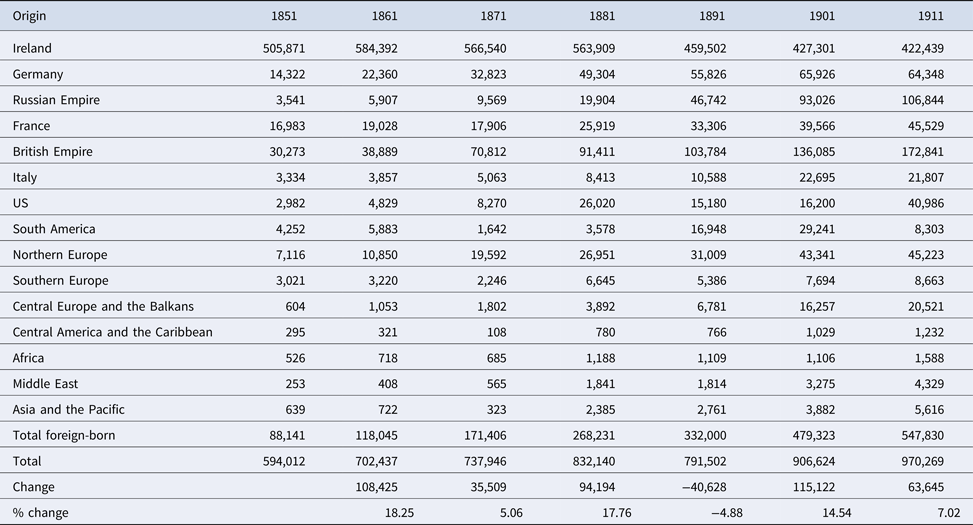
The United Kingdom has long been a country characterised by high levels of migration with historians documenting extensive internal and international migration at least as far back as the Black Death.Footnote 44 Between 1851 and 1911 the number of overseas-born migrants rose from 599,701 to 980,412, broken down as shown in Table 1. This table shows steady increases in the German, French and northern European populations across the period. The population of migrants from southern Europe, Central America and the Caribbean, Africa and the Middle East remained relatively stable, though African, Middle Eastern and southern European migrants increased in the 1870s. Migration from Italy, Central Europe and South America was fairly stable until the 1890s when it increased significantly. Migration from the US peaked in the 1880s before declining slowly over the next 30 years. The number of Russian migrants increased slowly between 1851 and the 1870s before taking off in the 1880s. This reflected the movement of Jews out of the Russian Empire, driven partly by the anti-Semitic Pogroms and partly by the changing economic situation in Russia and the increasingly precarious economic position of the Jewish population.Footnote 45 Godley's study of Jewish entrepreneurship presents evidence that the majority of Jewish migrants to London were from the north of the Pale of Settlement, the area that suffered the most severe economic pressures in this period and thus that most migration to London was driven by economic forces.Footnote 46 The increase in migrants from Asia was driven by a significant rise in the numbers coming from China after 1871. However, as John Seed points out, many of those born in China were the children of British merchants, soldiers and missionaries.Footnote 47 The growth in the numbers of migrants from the British Empire after the 1860s is something that has gone unexamined by historians, who tend to characterise immigration to Britain as dominated by arrivals from Ireland and continental Europe.Footnote 48 Much of the change between 1861 and 1881 was driven by an increase in the numbers coming from India, Australia and Canada, which rose from 17,702 people in 1861 to 52,775 in 1881. The next large increase, between 1891 and 1901, was also caused by increases in migration from India, Australia and Canada; however, there was also significantly more migration from South Africa, with almost twice as many South African residents present in 1901 as there had been in 1891. Much of the migration from India was of individuals born there but who were British subjects. Their precise extent is hard to judge as many did not follow the Census instructions to specify their nationality if born abroad. However, in 1891 35 per cent of those born in India declared they were British subjects; and the 1911 Census report stated that just 4,067 of those born on the Indian sub-continent were not of European parentage, 7 per cent of the total Indian-born population.Footnote 49 The Australian, Canadian and South African migration, however, goes unmentioned in many histories and represents a pre-history of twentieth-century migration from what would become the Commonwealth to the United Kingdom.
Migration to England and Wales (1851–1911)

Note: Data for 1871 taken from the Census Report; these contain an ambiguous ‘other states’ category in the America category; these have all been included in South America, but some likely to have been from Central America or the Caribbean.
Sources: 1851–1861, 1881–1911: Kevin Schürer, Edward Higgs, Alice M. Reid and Eilidh M. Garrett, Integrated Census microdata, 1851–1911, Version 2 (2016) [data collection], UK Data Service, SN: 7481, https://doi.org/10.5255/UKDA-SN-7481-1, enhanced; 1871: Census of England and Wales, 1871, Population abstracts: ages, civil condition, occupations and birth-places of the people, Vol. III, Parliamentary Papers, LXXI (1873), l-li.
Irish migration within the United Kingdom, although excluded from our analysis of business proprietors, is included in Table 1 to illustrate the changing balance between Irish and international migration. Throughout this period the Irish were part of the United Kingdom and were the largest single group of migrants to Great Britain. The beginning of this period was dominated by post-Famine migration, which drove the large increase in 1851–1861. While the rate of migration declined after this, migration from Ireland remained high for the rest of this period and Britain remained a popular destination, reflecting the ease of access and both the long-established patterns of migration from Ireland to Britain and the more general factors that promoted high migration from Ireland throughout the nineteenth century.Footnote 50 Yet the gap between total Irish and total international migrant numbers shrank during this period, with the international migrants overtaking Irish migrants by 1901.
This article is primarily concerned with the activities of immigrants once they had arrived in England and Wales, rather than their reasons for migrating. However, it is clear that numerous push and pull factors drove migration to England and Wales. First, changes in the economic and demographic structure of Europe and the wider world promoted migration; population growth and the slow decline of agriculture created structural conditions in Europe conducive to emigration. To take one example, Germany in the nineteenth century experienced rapid population growth, which created pressure on agricultural land; this, combined with periodic agricultural downturns and fragmented landownership promoted emigration. An additional factor was the decline of some industries in Continental Europe. For example, the effect of cheap textile production in Manchester on the rural cottage textile industry in Westphalia prompted some individuals to consider emigration as a solution to un- or under-employment.Footnote 51 Such issues also help explain shifts in the rates of emigration. As an example, in Germany, emigration declined as the country industrialised, which meant the economy was increasingly able to absorb the growing population and thus the need to emigrate was less pressing.Footnote 52 Secondly, a small but interesting group was driven by political pressure. Many of this group came from Germany, such as the 1,100–1,300 people (including Karl Marx) who left Germany after the failure of the 1848 Revolution. However, political refugees from elsewhere also arrived in the United Kingdom during this period. French, Polish, Hungarian and Italian exiles fled after the 1848 Revolutions, further French exiles arrived following the failure of the 1871 Commune, and more Germans came after the Anti-Socialist Laws were passed in 1878 in response to two assassination attempts on Kaiser Wilhelm I.Footnote 53
If these factors help explain why people left countries, other factors are required to explain why they chose England and Wales as their destination. Again, these reasons are a combination of economic and social factors. The British economy was characterised by relatively high wages and a fragmented labour market, which made finding employment relatively easy, although difficulties remained as we will see later in this article.Footnote 54 Economic enticements were enhanced by the presence of pre-existing networks and communities of migrants. It is notable that many of the largest migrant communities had long histories of immigration into England and Wales. This could take a supportive form, whereby existing migrant communities created business and employment opportunities, which were communicated back to the home country.Footnote 55 However, it could also create opportunities for exploitation as evidenced by the large number of young boys sent from Italy to London to work as street musicians, which was of considerable concern for British authorities and the Italian community.Footnote 56
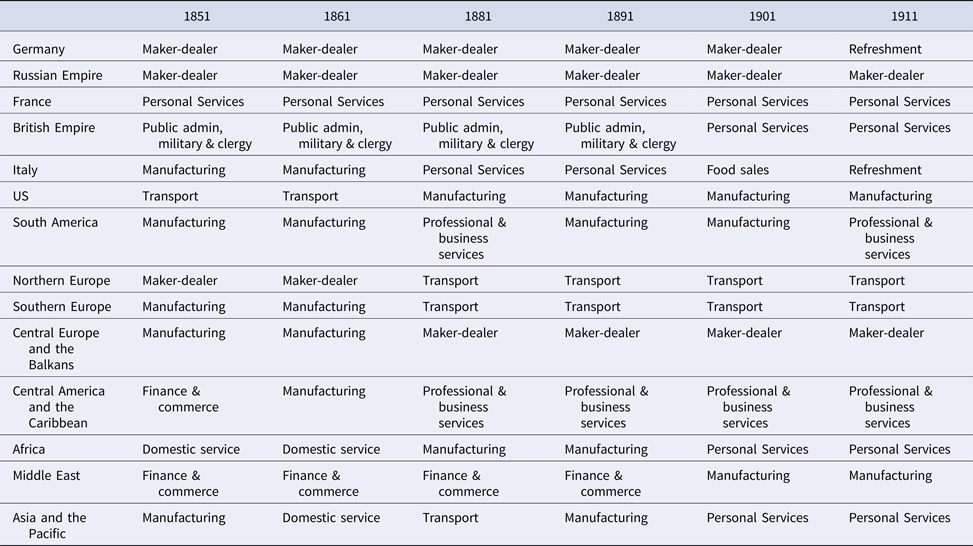
There was also considerable variation in the characteristics of existing migrant communities in terms of their demographics, location and occupations, and such characteristics varied not just between and within nationalities but also across time. For example, the German migrant population ranged from street musicians to merchant bankers. However, there were some concentrations in terms of occupation. Table 2 shows the most common aggregate occupational category for the economically active members (workers and entrepreneurs) of each migrant group for each census year.Footnote 57 There was considerable stability in the most common economic activities of many immigrant communities, with some occupations particularly associated with certain nationalities. For example, of the 12,716 immigrant tailors in 1891, 2,369 of these were from Germany and 8,139 were born in Russia; tailors were quarter of the total Russian-born economically active population in that year. These immigrant tailors were 7 per cent of the total number of tailors in England and Wales, but the majority lived in London, where they made up 19 per cent of all tailors.
Most common migrant occupations, England and Wales (1851–1911)

Source: I-CeM.
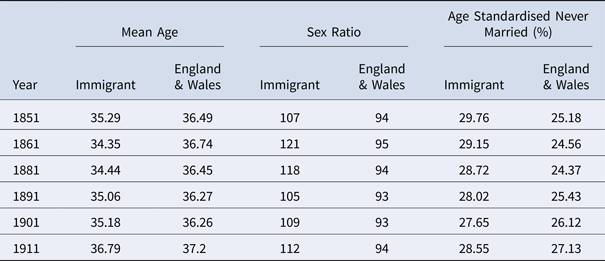
Given that the act of migration often interacted with individual life cycles, the demographic characteristics of immigrants tend to differ from those of the native-born population. Table 3 compares some demographic characteristics of the immigrant and native-born populations. The immigrant population was, on average, younger than the native population. Furthermore, the age profile was very different as there were few immigrant children. For example, in 1911 8.4 per cent of immigrants were aged ten or under compared to 23 per cent of the English- and Welsh-born population. The sex ratios show that immigrant men outnumbered immigrant women. The sex ratio is even more imbalanced if it is restricted to the economically active population; for example, in 1891 the immigrant economically active sex ratio was 296 while for the English and Welsh population it was 227. The proportion of never married was higher for immigrants, although the gap between the two communities reduced across the period. The difference was driven by single men – for example, in 1891 32 per cent of immigrant men were unmarried, compared to 25 per cent of the native-born population. The uneven sex ratio, younger mean age, and higher rates of never married for men suggest that, despite the undoubted importance of family migration, many migrants were working-age single men.
Demographic characteristics of immigrants, England and Wales (1851–1911)

Notes: Never married rate standardised to 1891 age structure; age and never married rate aged 15 and over.
Source: I-CeM.
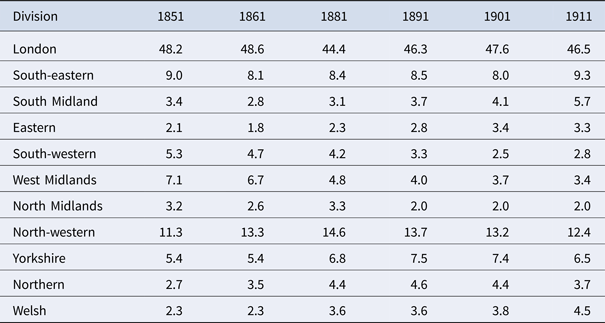
The geography of migrant residence is characterised by a wide dispersion of migrants from the British Empire. However, non-British empire immigrants lived almost exclusively in large towns, especially in London; indeed, in each census year 44 to 48 per cent of the non-British Empire migrants lived in London, as shown in Table 4. There were other smaller concentrations in Lancashire and Yorkshire, mainly in the cities of Manchester, Liverpool and Leeds, but the history of immigration in nineteenth-century England and Wales is one dominated by London. In London itself, migrant communities were concentrated in the East End, with smaller communities in Westminster, Marylebone, Hampstead and St Pancras. Outside London there were towns with small immigrant populations that were proportionally the same size as that of London. These locations were, unsurprisingly, port and resort towns. In 1851 these were towns like Dover, Torquay, Brighton and Hull. In such towns, the Census shows that the immigrant population made up around 1 per cent of the total population and about 1–1.5 per cent of the economically active. In London the equivalent figures were 1.1 and 1.6 per cent. Given that the Census only identifies first-generation immigrants, the total population was likely to have been somewhat higher. By the end of this period, port and resort towns were still the locations with the most significant immigrant populations; however, the size of the immigrant populations in these locations had increased and a range of new ports had emerged. Thus, in 1911 places like Barry and Penarth in Glamorgan, Falmouth in Cornwall, and Margate in Kent had immigrant populations that made up 2.25 to 2.75 per cent of their total populations, and 2.7 to 6.2 per cent of the economically active population. In such towns, economically active immigrants were often employed in shipping and other transport related occupations, or in refreshment. For example, in Barry, 53 per cent of immigrants were employed in transport, mainly sailors and other individuals working in the docks from Spain, Greece, Sweden, Norway and Denmark. Some of these were individuals enumerated on the Census day aboard ships in port, but others were sailors and other maritime workers resident in the towns in question.
Share of immigrant population in Census registration divisions (1851–1911)

Note: Migrants from the British Empire excluded.
Source: I-CeM.
4. Immigrant entrepreneurs
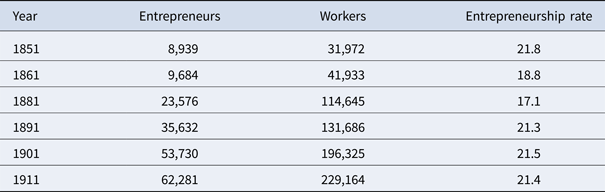
As with the immigrant population more generally, the numbers of migrant entrepreneurs increased across this period, as Table 5 shows. Entrepreneurs here include both employers and the own-account self-employed. However, while the absolute numbers increased, the overall proportion of entrepreneurs among the immigrant economically active population remained stable. The immigrant entrepreneurship rate was considerably higher than that for those born in England and Wales, roughly 20 entrepreneurs per hundred were economically active, compared to 13 per hundred for the English- and Welsh-born population.
Migrant entrepreneurs, England and Wales (1851–1911)

Note: 1851, 1861 and 1881 figures enhanced by reconstruction.
Sources: I-CeM and British Business Census of Entrepreneurs (hereafter BBCE).
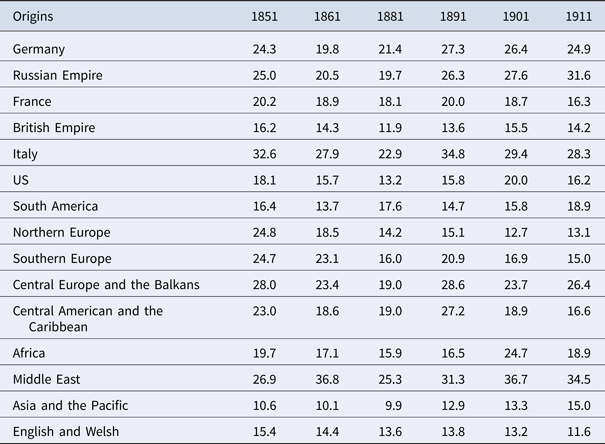
This overall figure hides considerable variation between migrants born in different locations, as shown in Table 6. Some communities were fairly stable across the period, such as those born in Germany or the British Empire. However, others changed significantly. Thus, those born in the Russian Empire, the Middle East or Asia all became more entrepreneurial towards the end of the period, while the entrepreneurship rates of immigrants from France, Italy, northern Europe, and southern Europe declined. There was variation in the level as well as the pattern; those immigrants from Germany, Russia, France, Italy, the US, southern Europe, Central Europe, Central America, Africa and the Middle East all had entrepreneurship rates that were consistently higher than those of the English- and Welsh-born population. Those from the British Empire were less entrepreneurial between the 1860s and 1890s, which is unsurprising given that most immigrants from the British Empire were older colonial civil servants and merchants retiring to Britain. People born in northern Europe were initially more entrepreneurial than the native population but declined, and in 1901 had lower entrepreneurship rates than people born in England and Wales. The rate for migrants from Asia and the Pacific went in the opposite direction, starting lower and ending higher.
Immigrant entrepreneurship rates by origin, England and Wales (1851–1911)

Note: 1851, 1861 and 1881 figures enhanced by reconstruction.
Sources: I-CeM and the BBCE.
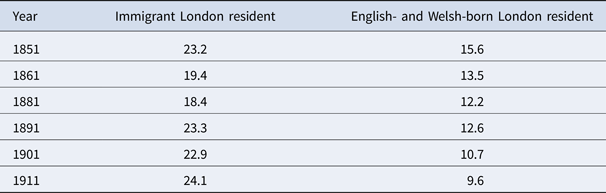
In general, the share of immigrant business proprietors in each census division (region) mirrored the general distribution of the immigrant population seen in Table 4; thus, there was a similar concentration in London, where 46 to 49 per cent of immigrant entrepreneurs were resident. It might be argued that London, as a wealthy population centre, was likely to promote unusually high levels of business proprietorship among the existing local population because its wealth and size increased the scope for business development. However, as Table 7 shows, the entrepreneurship rate for immigrants was higher than the rates for English- and Welsh-born individuals resident in London, suggesting that something more than just than location was driving the high rates of immigrant business development. Furthermore, while the English- and Welsh-born population's entrepreneurship rate declined over time, in line with the national trend, the immigrant entrepreneurship rate rose. The decline in English- and Welsh-born entrepreneurship was driven by concentration of businesses into larger firms and the decline of own-account activity, described by the authors elsewhere.Footnote 58 However, immigrant entrepreneurship remained concentrated in sectors which maintained high entrepreneurship rates and were little affected by business concentration, such as food production, tailoring and other clothes manufacture, especially among immigrants from Russia, Italy, Central Europe and the Balkans.
London entrepreneurship rates, immigrant and English and Welsh communities (1851–1911)

Note: 1851, 1861 and 1881 figures enhanced by reconstruction.
Sources: I-CeM and the BBCE.
The entrepreneurship rates shown in Tables 4–7 all suggest that there were important differences between the business activities of immigrant communities and those of individuals born in England or Wales. On average, immigrants were more likely to be business proprietors and, while there was variation depending on place of birth, this was true for most of the immigrant communities resident in nineteenth- and early twentieth-century England and Wales. An important question is why were people born outside the United Kingdom more entrepreneurial than those born in England and Wales?
The first area to consider is the nature of the labour market. The difficulties facing immigrants in entering the labour market arose from a variety of causes. First, they might lack the relevant language or other skills. Entry into many of the older London trades was restricted by trade bodies or more informal mechanisms. For example, throughout this period coopers in London had to serve an apprenticeship, and each cooper could take on one apprentice who themselves had to be the son of a cooper.Footnote 59 Secondly, their own skills might not match the available jobs. For example, Morris Cohen, a naturalised mantle manufacturer interviewed by the Royal Commission on Alien Immigration related how when he arrived in London in 1877 there were few ladies’ tailors in England. He set up a successful business based on his own experience as a ladies’ tailor, one that employed several other migrants who had been ladies’ tailors before migrating to London. Some of his employees later left and set up their own ladies’ tailoring businesses. By 1903 his business employed over 180 people, ‘50 of these are English Christians, about 50 English Jews, and the remainder are aliens who do the principal parts of the work, such as basting and fitting, and which I cannot get done by English workers. These English workpeople have all learned their trade from the original foreign workmen, who brought the new manufacture into this country’, later commenting ‘an English tailor is unfitted for fancy needlework such as is required for the mantle trade’.Footnote 60 In this case, immigrant tailors could find no work in such fields because no such English or Welsh businesses existed; consequently they had to start their own enterprises. Thirdly, immigrants might also face discrimination such as that suffered by West African sailors in early twentieth-century Liverpool.Footnote 61 These reasons suggest that many immigrants may have struggled to enter the labour market and consequently been more likely to start their own business.
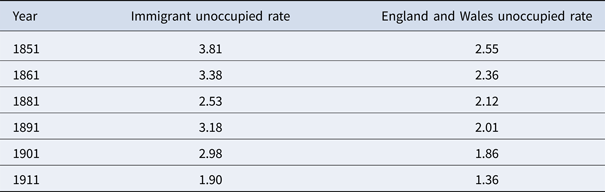
One measure of a community's ability to access the labour market is the unemployment rate. Unemployment is difficult to measure using census data; however, we can identify men of working age who reported no occupation or explicitly stated they were unemployed, and compare them as a proportion of the total employed population for the immigrant population and those people born in England and Wales.Footnote 62 Table 8 shows the results of this exercise. In each year, the unoccupied rate was higher for the immigrant communities than for the population born in England and Wales, suggesting that immigrants found it harder to enter the labour market.
Unoccupied rates, men, aged between 15 and 65, England and Wales (1851–1911)

Note: Wildcard occupation string search for *unemploy* and search for ‘–’ (blank entries).
Sources: I-CeM and the BBCE.
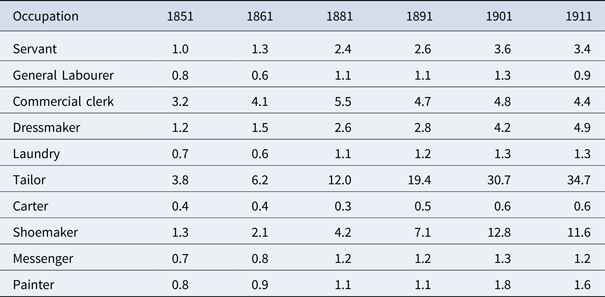
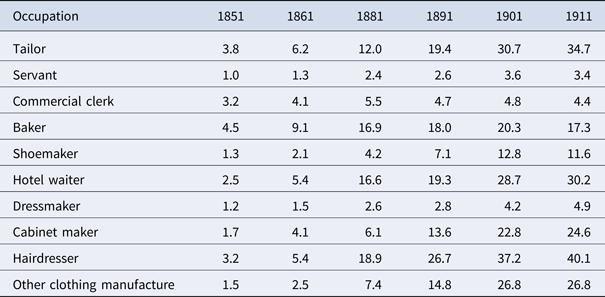
Another way to examine this issue is to assess how easy it was for immigrants to obtain employment in common occupations. Table 9 shows the proportion of immigrant workers in each census year in the ten most common occupations in London in 1891.Footnote 63 Table 10 shows the ten most common immigrant occupations in 1891 and the share of immigrants in those professions. London is focused on here as the largest and most important centre for immigration in this period.
Most common London occupations (1851–1911), immigrant share of workforce

Sources: I-CeM and the BBCE.
Most common London immigrant occupations (1851–1911), immigrant share of workforce

Sources: I-CeM and the BBCE.
There is some overlap between the two tables, thus tailors, servants, commercial clerks and shoemakers were occupations that employed significant proportions of the immigrant workforce and were also common occupations among the entire London population; although only in tailoring, and later in the period shoemaking, did immigrants constitute a substantial share of the total workforce. The other occupations in Table 10 were relatively small in the total London economy, although bakers, hotel waiters and cabinet makers were fairly large occupations. The occupations in Table 10 are a mixture of old industries (cabinet making), new trades (hotel waiters and hairdressers) and trades in which the cost of entry was low and immigrant entrepreneurship was high (tailoring and baking).Footnote 64
In other words, immigrants were concentrated in all occupations where entry to the labour force was likely to be easier than in older London trades or in more general occupations where competition from English- and Welsh-born people was fiercer. There were few immigrants in trades dominated by London-born individuals, such as bookbinding, printing and other paper trades, leather or silk working, ship building or dock labouring.Footnote 65 Neither were immigrants able to enter trades dominated by internal migrants such as the building trades. The restrictions that prevented immigrants from freely entering all parts of the labour force increased the likelihood that immigrants would chose business proprietorship instead of wage labour, especially given that the highest paid occupations, such as the building trades, coopering or printing, were often those closed to them.Footnote 66 This issue, namely the ability to earn a high wage, was important because of the particular household structure of immigrant families.
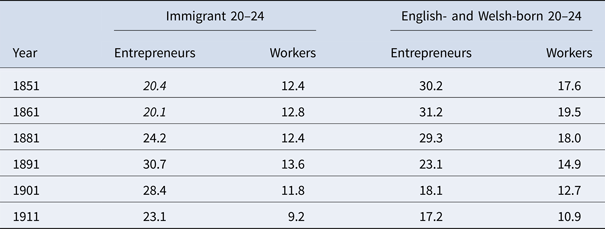
There is ample testimony about the importance of the family to entrepreneurs in Victorian and Edwardian England and Wales. They provided labour and capital to businesses and the needs of the family often determined the nature of the firm.Footnote 67 Table 11 shows the proportion of immigrant and English and Welsh entrepreneurs and workers aged between 20–24 who were married. This age group was chosen as an imperfect way, in the absence of data on entry dates, to identify recent migrants. Also, given the mean age of marriage in this period, they were likely to have been recently married. For both immigrants and the English- and Welsh-born population a higher proportion of entrepreneurs were married than workers. The earlier years are difficult to interpret as the number of young immigrant entrepreneurs identified by the data reconstruction process is small, for example in 1851 only 583 immigrant entrepreneurs identified were aged between 20–24, compared to 62,816 born in England or Wales. It is likely therefore that the earlier figures are the result of small sample sizes rather than real change. But for the years with reliable data, 1891–1911, it is clear that immigrant entrepreneurs were substantially more likely to be married at this young age than their English and Welsh counterparts.
Proportion of immigrant and English- and Welsh-born entrepreneurs and workers married, aged 20–24, England and Wales (1851–1911)

Note: ‘E&OA’ are totals of employers and own account. Figures in italics are calculated from fewer than 600 individuals.
Sources: I-CeM and the BBCE.
Marriage could promote entrepreneurship in two ways. First, the urgent necessity of supporting a family may have made wage labour less attractive, especially if immigrants were restricted in the kinds of wage labour they could obtain as suggested above. Secondly, families provided important sources of capital and labour that were less available to unmarried individuals.Footnote 68 Even if immigrants did not arrive already married, they tended to marry people from the same country; half of all immigrant entrepreneurs in 1891 were married to people from the same country as themselves, with similar proportions in 1901 and 1911, where the data is most reliable. Such high rates of endogamy suggest that the immigrant communities were more closely integrated than native communities and this had advantages in terms of networks and the ability to find employees or raise capital. For example, Jewish immigrants who arrived in the 1880s often found employment in the clothing industries. One important reason for this was the pre-existence of Jewish-owned businesses in these areas in London and elsewhere.Footnote 69 This existing community, and others, provided information, employment, training and resources, which created favourable conditions for individuals to start their own businesses.
Finally, immigrant entrepreneurs often started businesses in industries characterised by low start-up costs. Among immigrant employers the most common occupations were all small-scale maker-dealers: tailors, bakers, butchers and hairdressers. The one exception was the large number of foreign merchants; however, such individuals were rather different immigrants, tending to be older and middle class. Among own-account immigrants the most common occupations were musicians, tailors (again), dressmakers, hawkers and costermongers, shoemakers, confectioners and watchmakers.
Behind all these factors was also the necessity of making a living; an immigrant arrived from outside the country and quickly had to find a means to live. These factors not only help explain the difference in business proprietorship rates between immigrants and individuals born in England and Wales, they also help explain variation between immigrants from different locations. Thus, immigrants from northern Europe (Denmark, Sweden, Norway and the Netherlands) from 1881 onwards had a lower entrepreneurship rate than immigrants from Germany, despite the fact that in 1851 and 1861 their rates had been similar (see Table 6). The difference here was driven by a change in the employment pattern of northern European immigrants in the 1860s and 1870s. In the earlier period, northern Europe immigrants worked in a variety of different occupations: domestic service, the merchant marine, commerce, maker-dealing, teaching and clerical work. However, from the 1880s onwards, employment as sailors was much more dominant. Thus, in 1851, 5.4 per cent of northern European migrants were employed in mercantile shipping, and the figure in 1891 was 21 per cent, part of the growth of foreign sailors in British shipping that occurred throughout the second half of the nineteenth century.Footnote 70 Shipping as a trade offered little in the way of entrepreneurial opportunity and thus the increase in waged employment among northern European migrants in that industry meant a decrease in business proprietorship for that migrant group. In contrast, German migrants continued throughout this period to mainly work in occupations characterised by high levels of business proprietorship: baking, sugar refining, tailoring, commerce and butchery. The change in northern European entrepreneurship and the contrast with German activity was not driven by a dulling of the entrepreneurial spirit among Dutch, Norwegian, Danish and Swedish migrants, but instead shifts in their previous occupational profile.
It is also important to note that there was a group of exceptional immigrants within both employers and own account who were higher status. These were mainly merchants, some of whom were temporarily in the country on business, and others who were resident as agents, factors or intermediaries for foreign businesses. This was part of a major two-way international interaction among the elite merchant, banking and large exporting businesses in the main trading nations that had been going on since at least the eighteenth century. The relocation or expansion of those already in business is different from starting a new enterprise, less driven by personal factors, and more influenced by business expansion plans and market opportunities.Footnote 71 In historical research elite business migration has been examined previously only through case studies.Footnote 72 Now it is possible to identify this group as a whole – in 1891 there were 2,345 immigrant merchants, of these, 1,269 were employers, 685 were own account and 391 were workers. These merchants were 1.4 per cent of the total economically active immigrant population in that year. This is a small proportion of the whole immigrant population, which is the main focus of the discussion here, and the factors lying behind their migration differed. We can now show that this small group was also relatively exceptional in the countries from which they originated: in 1891 42 per cent were from Germany, and smaller but significant groups came from France, Switzerland, the Netherlands, Italy, Turkey and the US. These groups indicate something of the growing attractions of the United Kingdom, and especially of London, as a centre for international business. However, these merchants were shrinking as a proportion of the total immigrant workforce. In 1851 there were 1,231 such merchants, who made up 3 per cent of all foreign-born economically active people; by 1911, when there were 2,195 merchants, the proportion had dropped to 0.75 per cent.
5. Conclusion
During the second half of the nineteenth century the immigrant communities in England and Wales were, in general, more entrepreneurial than the population born in England and Wales. They were also more likely to be business proprietors than Irish or Scottish migrants.Footnote 73 The Census data used in this article indicate the main reasons why this occurred. Immigrants tended to find it harder to get waged employment and consequently were often driven by necessity into founding businesses. Necessity might also arise as a consequence of family structure; many immigrants were young and unmarried when they arrived; however, if they were married, they needed to be able to support a family, something which was exacerbated by the difficulty they had in entering the waged labour market. This necessity entrepreneurship was often in less profitable trades and it is notable that immigrants from the Russian Empire exhibited one of the highest rates of business proprietorship but that the majority of these proprietors were either small employers or own-account individuals in a low-wage industry such as tailoring.Footnote 74 Immigrants from the Russian Empire, many of whom had worked in craft industries previously, could arrive in England and start a small business relatively easily, or they could work for a compatriot for a short time, learning skills, building up capital and connections, before starting their own business. But in these sectors competition was high and profits low so that own-account activity predominated.
In the context of long-running debates over the economic impact of immigrants, this article has shown that immigrant entrepreneurship was common, and, in an economy characterised by small businesses, they made an important contribution to the British economy of the Victorian and Edwardian eras. This article has been able, for the first time, to quantify the number of immigrant entrepreneurs and their sectoral and demographic characteristics. This whole-population approach, rather than using case studies to examine those from particular places, supports arguments that stress the contingent nature of entrepreneurship; that people's choices to start businesses are taken in, and shaped by, conditions beyond their own control. A recently arrived Eastern European Jew in the East End of London faced a very different set of circumstances compared to a long-resident German industrialist. In this they were similar to English and Welsh entrepreneurs, all of whose choices to start businesses were limited and enabled by their social and economic context. However, further questions remain, about the effect of immigrant entrepreneurship on English- and Welsh- business proprietors: did immigrants crowd them out or did they promote innovation and growth? Questions such as these and others, combined with these entirely novel census data and other sources will allow a more rounded picture of immigrant entrepreneurship to be developed.
This article has stressed the economic and demographic factors promoting immigrant business proprietorship in contrast to other factors, notably the cultural aspects highlighted by other authors.Footnote 75 This is not to claim that culture is irrelevant to economic activity. However, using Census data and examining the issue at scale makes cultural analysis difficult. Previous studies have tended to try to control for all economic factors and assert that what difference remains after such controls must be due to cultural difference. Yet, it is unclear that the historical data available is sufficiently robust to allow such assumptions to be made. What appears more likely from the analysis here is that economic and demographic factors were of greater importance than is often assumed when immigrant economic activity is discussed. Studies that stress the relationship between entrepreneurship and culture often forget that most businesses are small and that necessity rather than ambition frequently drives business proprietorship. If we are seeking to explain the incidence of immigrant entrepreneurship, therefore, we would be better served examining the economic conditions immigrants had to live in, rather than using explanations reliant on national ‘cultures’ that are difficult to evidence or measure.
Acknowledgements
This research has been supported by the ESRC under project grant ES/M010953: ‘Drivers of Entrepreneurship and Small Businesses’.
The data used are derived from two related sources. The first is K. Schürer, E. Higgs, A. M. Reid, E. M. Garrett, Integrated Census Microdata, 1851−1911, version V. 2 (I-CeM.2) (2016) [data collection], UK Data Service, SN: 7481, http://dx.doi.org/10.5255/UKDA-SN-7481-1; enhanced version of: Higgs, Edward and Schürer (University of Essex), The Integrated Census Microdata (I-CeM), Essex: UKDA, SN-7481 (2014). We are grateful to Kevin Schürer, Alice Reid and others at the Cambridge Group for help and advice in using I-CeM version 2. The second is the British Business Census of Entrepreneurs (BBCE), which was created by the ‘Drivers of Entrepreneurship’ project and will be available at the UK Data Archive later in 2019. It links with I-CeM through each individual’s RecID.
Thanks are also due to the anonymous reviewers for their helpful suggestions and to the audience at at the Association of Business Historians conference in Glasgow in June 2018 who commented on an early version of this research.