





Introduction
Empiric antibiotics are frequently prescribed for possible urinary tract infections (UTI) before culture results are available. Later, urine cultures often result with pathogens resistant to the empiric antibiotic or finalize as negative, which can lead to treatment failure or increased risk of antibiotic resistance and adverse drug events. Reference Ostrow, Prodanuk and Foong1–Reference Autore, Neglia and Di Costanzo7
Ideal strategies to improve appropriate antibiotic use in pediatric patients with possible UTI in the ambulatory setting are unclear. This outpatient Antimicrobial Stewardship Program (ASP) led initiative aimed to increase appropriate antibiotic changes when a pathogen was resistant to empiric antibiotics and increase antibiotic discontinuation when a bacterial UTI was not culture-confirmed.
Methods
This initiative was implemented in an academic health system with approximately 670,000 outpatient encounters and 57,000 emergency department (ED) visits annually among patients <18 years. The initiative was piloted in a free-standing quaternary care children’s hospital ED and expanded throughout the system (Figure 1). The baseline period was April 15, 2023–April 12, 2024 and the implementation period was April 15, 2024–April 19, 2025.
Antibiotic changes or discontinuations among urine cultures with resistance to empiric antibiotics or negative for infection.

We included encounters for patients <18 years with a urine culture collected in the health system and an antibiotic prescription with an indication of uncomplicated UTI, cystitis, complicated UTI, or pyelonephritis. Antibiotic indication is a required field at the time of electronic prescription entry in our health system. We excluded encounters with culture-confirmed UTI caused by a pathogen susceptible to the prescribed antibiotic.
In the baseline period, ED nurses performed postprescription review of positive urine cultures and antibiotics were not routinely discontinued for negative urine cultures. There was no formalized process for postprescription review in outpatient clinics. Monday–Friday (excluding holidays and vacations) during the implementation period, an ASP pharmacist reviewed an electronic medical record (EMR) report containing antibiotic prescriptions within the past 3 days for a UTI in patients <18 years of age.
Mismatches included when the uropathogen was interpreted as intermediate or resistant to the prescribed empiric antibiotic based on the Clinical and Laboratory Standards Institute standards. 8 For pyelonephritis, nitrofurantoin was considered resistant and oral cephalosporins were considered resistant if the minimum inhibitory concentration for cefazolin was above 2 ug/mL. 8 Recommendations for antibiotic changes to a susceptible antibiotic were made to the primary team by telephone or EMR messages. At our institution, the recommended empiric antibiotic treatment for uncomplicated UTI is cephalexin based on local Enterobacterales susceptibility data.
Negative urine cultures included those with no organism growth, <10,000 colony forming units (CFU) of bacteria/mL, normal flora, or contamination (i.e., mixed flora as determined by the microbiology lab). Reference Ostrow, Prodanuk and Foong1–Reference Wang, Lee, Zimmerman, Mills and Bryl3,Reference Shaikh, Lee, Krumbeck and Kurs-Lasky9 For negative cultures, the ASP team reviewed the patient’s EMR for contraindications to discontinuing antibiotics (i.e., concomitant infection requiring antibiotics, receipt of antibiotics before collection of the urine culture, imaging consistent with a UTI, initial culture obtained at an outside hospital, or inability to exclude UTI). When applicable, the patient’s caregiver was called by the ASP team (for ED patients) or primary team to reassess symptoms and recommend antibiotic discontinuation. Interventions were documented in the patient’s EMR. Patients were reviewed 30 days after antibiotic discontinuation to assess for possible UTI. Days of antibiotics saved were calculated by subtracting the day of therapy when the antibiotic was stopped or changed from the total intended duration.
Complicated patients (e.g., medically complex, unclear UTI diagnosis, or intermediate susceptibility) were reviewed with an ASP physician before discontinuing antibiotics or recommending antibiotic changes. Antibiotics were continued despite mismatch only if clinical response was validated via phone and the susceptibility pattern or UTI diagnosis was unclear.
Outcome measures and analysis
In this pre- post-implementation analysis, the proportions of encounters with an intervention were tracked during the baseline and implementation periods. The denominator was the same throughout the baseline and implementation periods, and included all UTI encounters with a negative culture or mismatch within any of the included areas of the health system (Figure 1). A change from baseline was defined as when the proportion of interventions were above the baseline period center-line for eight consecutive months. Reference Wheeler, Davis and Brilli10 For encounters with a 30-day hospital admission, EMR review assessed whether the admission was due to a culture-confirmed UTI. Statistical comparisons between baseline and implementation periods were done using the Chi-squared or Fisher exact test when applicable. The analysis was approved as quality improvement by the local Institutional Review Board.
Results
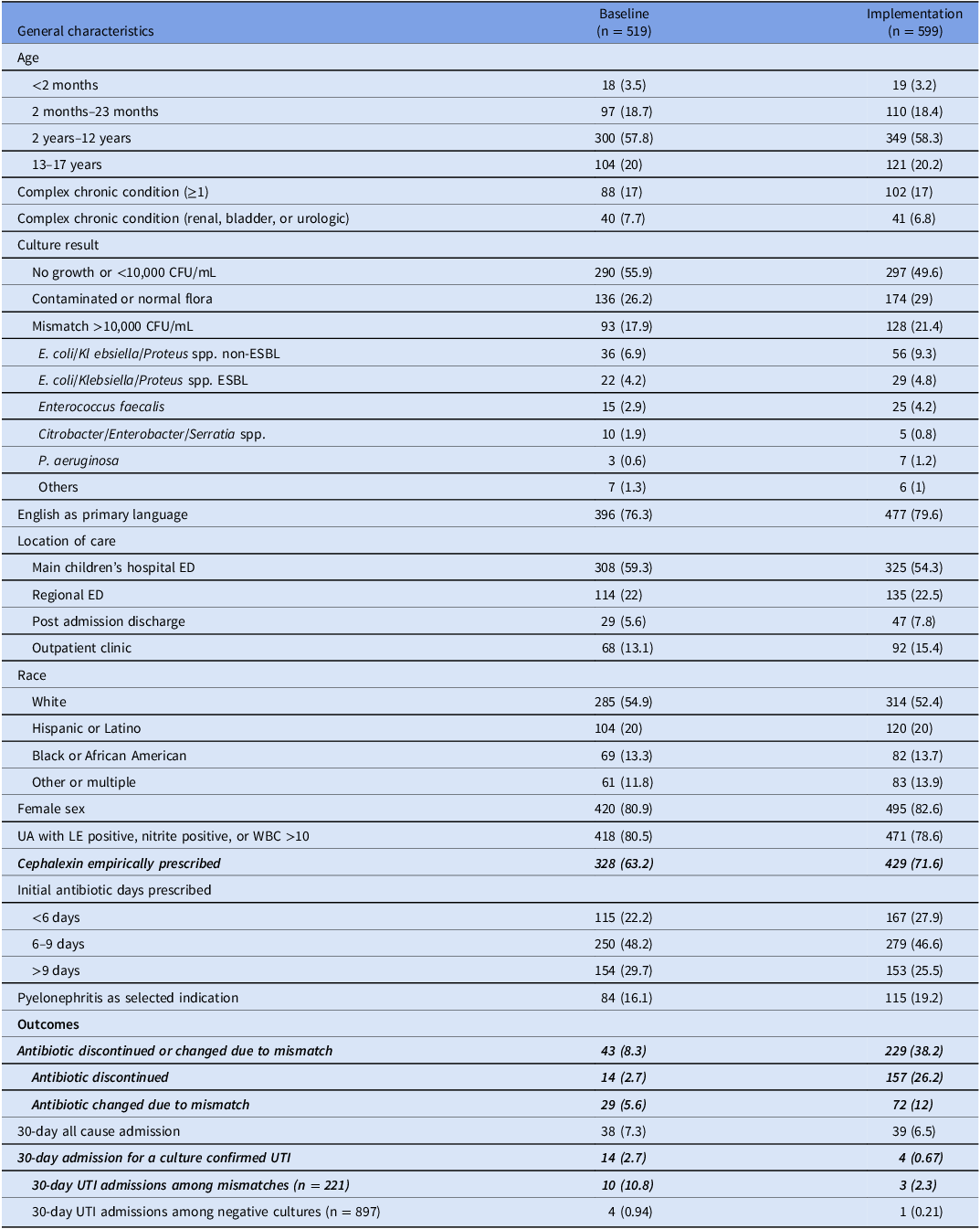
UTI encounters with a negative urine culture result or mismatch occurred in 34.1% (519/1520) of encounters in the baseline period vs 38.6% (599/1551) in the implementation period. Cohorts were similar in both periods, although there was less empiric cephalexin use at baseline (Table 1). Estimated weekday pharmacist time spent on the initiative was 2.4 hours per day with an average of 2.3 potential daily interventions.
Characteristics and outcomes of encounters with a negative culture or mismatch

Table 1. Long description
A table comparing characteristics and outcomes of encounters with a negative culture or mismatch during baseline and implementation periods. The table has 25 rows and 4 columns. Column headers are General characteristics, Baseline (n = 519), and Implementation (n = 599). Row labels include Age, Complex chronic condition, Culture result, English as primary language, Location of care, Race, Female sex, UA with LE positive, nitrite positive, or WBC >10, Cephalexin empirically prescribed, Initial antibiotic days prescribed, Pyelonephritis as selected indication, Outcomes, Antibiotic discontinued or changed due to mismatch, Antibiotic discontinued, Antibiotic changed due to mismatch, 30-day all cause admission, 30-day admission for a culture confirmed UTI, 30-day UTI admissions among mismatches, and 30-day UTI admissions among negative cultures. Each row contains specific data points for both baseline and implementation periods. Notable trends include similar distributions across age groups, complex chronic conditions, and culture results between the two periods. There is a slight increase in the implementation period for encounters where cephalexin was empirically prescribed and a notable increase in antibiotic discontinuation or change due to mismatch.
ED, emergency department; ESBL, extended-spectrum beta-lactamase; CFU, colony forming units; UTI, urinary tract infection; UA, urinalysis; LE, leukocyte esterase; WBC, white blood cell.
Characteristics in bold font and italicized had statistically significant differences between cohorts, with P value < .05.
During implementation, 1,084 days of unnecessary (745 d) or inappropriate (339 d) antibiotic exposure were avoided. There was a sustained increase in antibiotic interventions compared to the baseline year (Figure 1), with fewer 30-day admissions for a culture-confirmed UTI (Table 1). Among 346 encounters with an identified ASP intervention (15.9% of the 1551 UTI encounters), 58.7% of interventions were successful. Successful interventions increased from 21.4% during the first 8 weeks to 87.2% by the last 8 weeks of implementation, P < .001 (Supplementary Figure 1).
Mismatches represented 21.2% (93/439) and 28.6% (128/448) of positive cultures at baseline and implementation, respectively. Among mismatches, 31.2% (29/93) were optimized at baseline and 56.3% (72/128) during implementation, P < .001 (Supplementary Figure 2). Enterococcus faecalis or Pseudomonas aeruginosa was the causative pathogen in 54% (7/13) of mismatches with a 30-day UTI admission. During the implementation period, ASP recommendations to change antibiotics were not accepted in two patients (one with E. faecalis receiving cephalexin and one receiving nitrofurantoin for pyelonephritis), who were subsequently admitted within 30-days. Among the 56 mismatches without an antibiotic change during the implementation period, 49 (87.5%) had an unclear resistance pattern or unclear UTI diagnosis, with one subsequently admitted within 30-days (Supplementary Table 1).
Among patients with negative cultures, 3.3% (14/426) of encounters had antibiotics stopped at baseline and 33.3% (157/471) during implementation, P < .001 (Supplementary Figure 3). During implementation, one patient with antibiotics stopped by the primary team required subsequent admission for a culture-confirmed UTI (Table 1) and another had antibiotics re-started 3 weeks later due to a clinical diagnosis of UTI without culture confirmation. Common reasons antibiotics were continued despite negative cultures (n = 314) included identification of a contraindication to stopping (n = 172; 54.8%) and inability to contact the caregiver (n = 60; 19.1%). Among the 172 contraindications identified, 49 (28.4%) were pretreated urine cultures and in 33 (19.2%) an infection couldn’t be excluded (Supplementary Table 1).
Discussion
Our institution successfully implemented a multifaceted outpatient pharmacist-led postprescription antibiotic review initiative for potential pediatric UTIs. The impact of the initiative and increase in interventions seen over time may be due to improved process changes as well as a possible institutional culture change as support was garnered from key stakeholders and individual clinicians for expansion of this initiative to new areas and patient populations.
The decrease in 30-day admissions observed may have been attributed to the increase in antibiotic changes due to mismatches. Possible reasons for antibiotic continuation despite mismatches before this initiative included lack of a consistent urine culture follow-up process and challenges with accurate interpretation of susceptibility reports (especially for E. faecalis and P. aeruginosa). Despite these findings, cephalexin remains the recommended empiric antibiotic for uncomplicated UTI at our institution based on overall frequency of pathogens causing UTI and antibiogram data.
This antibiotic discontinuation initiative expanded upon prior studies by performing antibiotic discontinuations for negative culture results in areas outside the ED and urgent care settings, and included more complex patients (e.g., those with underlying urologic abnormalities or diagnosed initially with possible clinical pyelonephritis). Reference Ostrow, Prodanuk and Foong1–Reference Wang, Lee, Zimmerman, Mills and Bryl3 The significant portion of encounters with negative cultures but contraindications to discontinuation after EMR review illustrates the importance of a detailed EMR review before discontinuing antibiotics.
This analysis has limitations. We did not capture patients if they were admitted outside of the health system. Caregivers may have continued antibiotics despite agreeing to stop during phone calls. Unmeasured differences between the patient populations may impact the findings. We used a conservative definition for UTI and did not recommend antibiotic discontinuation for children with 10,000–50,000 CFU/mL growth on urine culture. Lastly, due to the observational nature of the study, we cannot definitively conclude that the lower admission rates and other outcomes observed during the implementation period were due to our interventions. Despite these limitations, this study demonstrates feasibility and impact of implementing an outpatient ASP-led initiative focused on UTI treatment.
Supplementary material
The supplementary material for this article can be found at https://doi.org/10.1017/ice.2026.10514.
Acknowledgments
SK serves as a contractor for Merck and served as a consultant for Optum and received research support from Pfizer in the past year. JSS has research grant funding from Merck for work outside the current project. All other authors have no conflict of interest or funding to disclose that is relevant to this research.



 Open access

