


Introduction
Health anxiety involves a persistent fear or worry about one's health, along with beliefs one has an illness or may contract a disease (Taylor and Asmundson, Reference Taylor and Asmundson2004). Excessive reassurance-seeking, an intense focus on bodily sensations, and a sense of alienation from other people often accompany health anxiety (Longley, Watson and Noyes, Reference Longley, Watson and Noyes2005). Health anxiety is common, ranging from 1.3% to 10.7% in population based studies (i.e. based on subclinical diagnostic criteria; Creed and Barsky, Reference Creed and Barsky2004). Health anxiety is also costly to the health care system: compared to individuals with well defined medical conditions, individuals with high levels of health anxiety have higher rates of anxiety, depression, and healthcare utilization (Fink, Ørnbøl and Christensen, Reference Fink, Ørnbøl and Christensen2010). Research supports a dimensional model of health anxiety as opposed to a categorical model (Ferguson, Reference Ferguson2009). Such findings suggest the importance of studying the whole continuum of health anxiety, with evidence showing subclinical levels of health anxiety (i.e. elevations in health anxiety falling below a diagnostic threshold) are a risk factor for severe, diagnosable levels of health anxiety (Taylor and Asmundson, Reference Taylor and Asmundson2004). Subclinical levels of health anxiety have high prevalence rates, onset early during early adulthood (i.e. ages 18–25 years), and are related to comorbid problems (e.g. depression; Pugh and Hadjistavropoulos, Reference Pugh and Hadjistavropoulos2011). Thus, it is important to investigate subclinical levels of health anxiety in early adulthood.
Catastrophizing of bodily sensations and health-related anxiety
Health-related anxiety is the affective experience of health anxiety and involves anxious, fearful emotions about perceived health problems (e.g. “I worried about the physical problems of getting older”; MacSwain et al., Reference MacSwain, Sherry, Stewart, Watt, Hadjistavropoulos and Graham2009; Stewart and Watt, Reference Stewart, Watt, Asmundson, Taylor and Cox2001). Catastrophizing of bodily sensations is the cognitive experience of health anxiety, especially the perpetual/attentional aspect of this experience (e.g. attending to and dwelling upon bodily sensations). Specifically, catastrophizing of bodily sensations involves repetitive and unconstructive thoughts about bodily sensations (e.g. “I kept thinking about my bodily sensations”; Rief, Hiller and Margraf, Reference Rief, Hiller and Margraf1998; Stewart and Watt, Reference Stewart, Watt, Asmundson, Taylor and Cox2001). According to cognitive behavioral theories and empirical investigations, catastrophizing of bodily sensations involves both the appraisal of bodily sensations as threatening along with the perceived inability to cope effectively with these bodily sensations (Marcus, Hughes and Arnau, Reference Marcus, Hughes and Arnau2008; Salkovskis and Warwick, Reference Salkovskis and Warwick1986). That is, catastrophizing of bodily sensations involves magnified, negative appraisals of bodily sensations as well as rumination about, overconcern with, and intolerance of bodily sensations. Such catastrophizing of bodily sensations is linked to health anxiety (Fergus and Valentiner, Reference Fergus and Valentiner2011; Marcus et al., Reference Marcus, Hughes and Arnau2008; Weck, Neng, Richtberg and Stangier, Reference Weck, Neng, Richtberg and Stangier2012). Evidence suggests the affective and the cognitive experience of health anxiety are moderately correlated, but distinct constructs that are differentially related to various outcomes (MacSwain et al., Reference MacSwain, Sherry, Stewart, Watt, Hadjistavropoulos and Graham2009). For example, Longley et al. (Reference Longley, Watson and Noyes2005) found health-related cognitions were positively and significantly correlated with how many medical tests participants had undergone, whereas health-related affect was not significantly correlated with how many medical tests participants had undergone.
Advancing research on catastrophizing of bodily sensations and health-related anxiety
Cognitive behavioral models of health anxiety (e.g. Warwick and Salkovskis, Reference Warwick and Salkovskis1990), and previous cross-sectional research, suggest catastrophizing of bodily sensations is linked with health-related anxiety. For example, health anxiety is linked to maladaptive beliefs about bodily sensations, intolerance of uncertainty, and a ruminative cognitive style about bodily sensations (Fergus and Valentiner, Reference Fergus and Valentiner2011; Marcus et al., Reference Marcus, Hughes and Arnau2008; Weck et al., Reference Weck, Neng, Richtberg and Stangier2012).
In the present study, we extend existing research by testing whether catastrophizing of bodily sensations is a maintenance factor in health-related anxiety, thereby filling a major gap in knowledge. Health anxiety is a persistent (i.e. temporally stable) problem; for example, Longley et al. (Reference Longley, Watson and Noyes2005) reported high 8-week test-retest correlations for health-related anxiety (r = .76) and research on the natural course of health anxiety indicates 50% to 70% of patients with health anxiety do not spontaneously remit (olde Hartman et al., Reference olde Hartman, Borghuis, Lucassen, van de Laar, Speckens and van Weel2009). It is therefore important to identify maintenance factors responsible for the persistence of health anxiety. Previous research indicates public, interpersonal behavior (e.g. reassurance-seeking) may maintain health anxiety (Birnie et al., Reference Birnie, Sherry, Doucette, Sherry, Hadjistavropoulos and Stewart2013). In the present study, we test whether a private, intrapersonal behavior (i.e. catastrophizing of bodily sensations) also maintains health anxiety over time by studying 452 participants (with an equal number of women and men) using a 14-day daily diary study with longitudinal follow-up. Identification of such maintenance factors is vitally important, as such research may highlight targets for prevention, assessment, and treatment of health anxiety.
Hypotheses
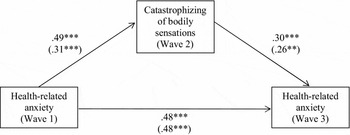
Drawing on cognitive behavioral models of health anxiety and past cross-sectional research (e.g. Taylor and Asmundson, Reference Taylor and Asmundson2004; Fergus and Valentiner, Reference Fergus and Valentiner2011), we hypothesized catastrophizing of bodily sensations is a maintenance factor for health-related anxiety. More specifically, we hypothesized an indirect effect wherein Wave 1 health-related anxiety contributes to Wave 3 health-related anxiety through Wave 2 catastrophizing of bodily sensations as shown in Figure 1.
Hypothesized model showing catastrophizing of bodily sensations as a maintenance factor for health-related anxiety. Numbers represent standardized path coefficients. Values for women are outside brackets; values for men are inside brackets. **p < .01; ***p < .001

We also tested whether the proposed mediational sequence shown in Figure 1 differs across women and men. Research on gender differences in health anxiety is scarce (MacSwain et al., Reference MacSwain, Sherry, Stewart, Watt, Hadjistavropoulos and Graham2009). In particular, there is little (or no) direct evidence regarding our question of interest (i.e. gender differences in the link between catastrophizing of bodily sensations and health-related anxiety). Looking to the broader literature on generalized anxiety, theory and evidence suggest the relation between health-related anxiety and catastrophizing of bodily sensations may be stronger in women than in men. Personality factors (e.g. elevations in anxiety sensitivity in women) and biological factors (e.g. fluctuations in reproductive hormones in women; McLean and Anderson, Reference McLean and Anderson2009) may make women more susceptible to the affective experience of anxiety, whereas socio-cultural factors (e.g. socialization processes encouraging catastrophizing in women; McLean and Anderson, Reference McLean and Anderson2009) and cognitive factors (e.g. a greater propensity toward repetitive cognitions in women) may make women more likely to catastrophize in response to anxiety (Ginsberg, Reference Ginsberg2004; MacSwain et al., Reference MacSwain, Sherry, Stewart, Watt, Hadjistavropoulos and Graham2009). That said, because there is (to our knowledge) no direct evidence upon which to base hypotheses about gender differences in the connection between catastrophizing of bodily sensations and health-related anxiety, our tests of gender differences were considered exploratory. Such tests are important, as provision of gender-sensitive clinical services requires an understanding of whether models of health anxiety apply to both men and women.
Method
Participants
Participants (N = 452) were recruited as part of a larger study on heterosexual romantic couples that comprised 226 women and 226 men. The larger study examined the role of personality and health-related thoughts, feelings, and behaviors. All participants in the larger study were included in the present study. Having an equal number of women and men allowed for tests of potential gender differences in the link between catastrophizing of bodily sensations and health-related anxiety. Mean ages were 21.48 years for women (SD = 4.13) and 22.35 years for men (SD = 4.52). Most participants were Caucasian (88.5%) and born in Canada (86.9%). Participants were eligible for the study if they had been in a relationship for at least 3 months, had face-to-face contact at least five times per week, and at least one member of the couple was attending university. On average, couples were dating for 2.12 years (SD = 2.24), and had face-to-face contact an average of 6.44 days per week (SD = 0.84); 38.25% of the couples were living together. Only a small percentage of interested participants were excluded because they did not meet inclusion criteria.
Measures
Catastrophizing of bodily sensations
The Bodily Sensations Catastrophizing Scale (BSCS; Sherry and Stewart, Reference Sherry and Stewart2012)Footnote 1 was designed to assess catastrophizing of bodily sensations on a daily basis. Participants rated three items (“I felt I couldn't stand my bodily sensations anymore”; “I worried all the time about what my bodily sensations might mean;” and “I kept thinking about my bodily sensations”) on the degree to which each item applied to them during the past 24 hours. Participants used a scale from 1 (not at all) to 10 (all the time). Scores ranged from 3 to 30, with higher scores indicating higher levels of catastrophizing of bodily sensations. Unpublished psychometric data (Gautreau, Sherry and Stewart, Reference Gautreau, Sherry and Stewart2012)Footnote 2 found that the BSCS had excellent internal consistency (α = .90) and was significantly correlated with health anxiety measured by the Health Anxiety Inventory Short Form (r = .57; Salkovskis, Rimes, Warwick and Clark, Reference Salkovskis, Rimes, Warwick and Clark2002) and pain catastrophizing measured by the Pain Catastrophizing Scale (r = .48; Sullivan, Bishop and Pivik, Reference Sullivan, Bishop and Pivik1995), supporting its convergent validity.
Health-related anxiety
The Multidimensional Inventory for Hypochondriacal Traits-Worry Subscale (MIHT-W; Longley et al., Reference Longley, Watson and Noyes2005) assessed health-related anxiety. The Worry Subscale was used because it represents the affective core of health anxiety, which is generally seen as one of the most salient features of health anxiety (Taylor and Asmundson, Reference Taylor and Asmundson2004), and because this subscale has strong psychometric properties. This subscale has seven items concerning anxiety about one's health (e.g. “I worried a lot about my health”). Participants responded to items based on the past 14 days. Participants used a scale from 1 (strongly disagree) to 5 (strongly agree). Scores ranged from 7 to 35, with higher scores indicating higher levels of health-related anxiety. Longley et al. (Reference Longley, Watson and Noyes2005) found that the MIHT-W had good internal consistency (α = .80) and that the MIHT-W was significantly correlated with the affective scales of the Whitely Index (r = .72; Pilowsky, Reference Pilowsky1967) and the Illness Attitude Scale (r = .73; Kellner, Reference Kellner1987), supporting convergent validity.
Procedure
Our study involved a 14-day daily diary study with a 14-day longitudinal follow-up. The experience sampling aspect of our design provides greater ecological validity, increased reliability through repeated assessments, and diminishes recall bias by asking people to report catastrophizing of bodily sensations closer to their actual occurrence. We also used a three-wave design (outlined below) that reduces temporal confounding and permits stronger inferences regarding mediational processes.
Dalhousie University's research ethics board approved our study. Participants were recruited via posters distributed around Dalhousie University and through the Psychology Department's experimental participation system. Interested participants contacted a research assistant and were scheduled to complete Wave 1 in the lab. At Wave 1, participants consented to participate, and then completed a demographics questionnaire and a baseline measure of health-related anxiety in the lab. Wave 2 involved a 14-day daily diary study, starting the day after Wave 1. During Wave 2, participants completed internet-based questionnaires measuring catastrophizing of bodily sensations once per day for 14 consecutive days. Participants filled out these online questionnaires each night before bed. In an effort to improve response rates, all participants were sent a daily e-mail reminder. Online questionnaires were time-stamped to verify when participants completed each questionnaire. Participants were encouraged to complete online questionnaires independently from their partner. Wave 3 occurred 14 days after Wave 2 ended. The average amount of time between Waves 1 and 3 was 30.76 days (SD = 2.07). During Wave 3, participants completed the measure of health-related anxiety a second time in the lab. Participants were then debriefed. Each participant was given either $25 or $10 and three bonus points for a university course.
Data analysis
Missing data
At Wave 1, 452 people (100%) participated; at Wave 2, 448 people (99.1%) participated; at Wave 3, 441 people (97.6%) participated. On average, participants submitted 11.23 (SD = 2.83) daily reports. Response rates ranged from a high of 84.1% on Day 5 to a low of 75.2% on Day 10. Missing data were minimal for all variables (1.3% total). Our data were missing completely at random (MCAR), as indicated by a nonsignificant Little's MCAR test (Little, Reference Little1988). Maximum likelihood robust estimation (MLR) in Mplus was used to handle missing data. Small's omnibus test indicated study variables were multivariate nonnormal (DeCarlo, Reference DeCarlo1997); however, MLR estimation and bootstrapping are robust against violations of multivariate nonnormality (Mallinckrodt, Abraham, Wei and Russell, Reference Mallinckrodt, Abraham, Wei and Russell2006).
Analytic plan
Path analysis was used to test the hypothesized model in Figure 1. Wave 2 catastrophizing of bodily sensations was averaged from daily scores across the 14 days. And the indirect effect of Wave 1 health-related anxiety on Wave 3 health-related anxiety through Wave 2 catastrophizing of bodily sensations was tested using bootstrapping. Compared to other tests of mediation, bias-corrected bootstraps offer the highest statistical power (Mallinckrodt et al., Reference Mallinckrodt, Abraham, Wei and Russell2006). Random sampling with replacement was used to make 20,000 (N = 226) bootstrap samples; these samples were used to estimate bias-corrected standard errors and 95% confidence intervals for the hypothesized indirect effect. An indirect effect is considered significant (p < .05) if its 95% confidence interval does not include zero. A significant indirect effect suggests mediation has occurred.
Multi groups analysis using Mplus software tested if the hypothesized model in Figure 1 generalized across men and women (Byrne, Reference Byrne2001). A constrained model (with each path constrained to equality) was compared with an unconstrained model (with paths allowed to vary freely) when testing gender differences. Historically, chi-square difference tests were used in comparing constrained and unconstrained models. However, evidence shows chi-square difference tests are unduly strict and highly sensitive, especially when samples sizes are large (N > 200; Cheung and Rensvold, Reference Cheung and Rensvold2002). Rather than using a chi-square difference test, we followed evidence indicating a ΔCFI ≤ .01 provides clear support for the constrained model over the unconstrained model (Cheung and Rensvold, Reference Cheung and Rensvold2002), thereby suggesting invariance across women and men. This ΔCFI criterion was used to evaluate our results of gender differences.
Results
Descriptive statistics and bivariate correlations
Means, standard deviations, alpha reliabilities, and bivariate correlations appear in Table 1. Means fell within one standard deviation of means from earlier studies using similar samples (e.g. Birnie et al., Reference Birnie, Sherry, Doucette, Sherry, Hadjistavropoulos and Stewart2013), suggesting our means are consistent with means from past work. Paired-samples t-tests were used to compare women and men on mean levels of Wave 1 health-related anxiety, Wave 2 catastrophizing of bodily sensations, and Wave 3 health-related anxiety. One significant difference was observed: Women reported higher levels of catastrophizing of bodily sensations than men (t(222) = −3.37, p < .001, d = .45). Alpha reliabilities were adequate (≥ .77). Wave 1 health-related anxiety, Wave 2 catastrophizing of bodily sensations, and Wave 3 health-related anxiety were intercorrelated for both women and men. Study variables were not correlated with demographic variables. Demographics were therefore not used as covariates.
Means, standard deviations, alpha reliabilities, and bivariate correlations
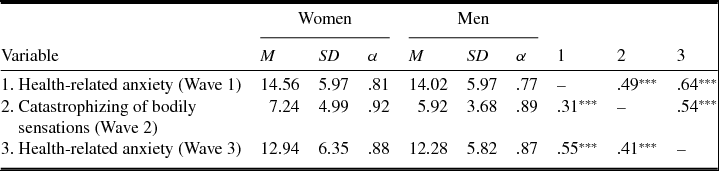
Notes: For correlations, women are above the diagonal; men are below the diagonal
***p< .001
Indirect effects
Bootstrapping was used to test the hypothesized indirect effect of Wave 1 health-related anxiety on Wave 3 health-related anxiety through Wave 2 catastrophizing of bodily sensations. Bootstrapped estimates suggested the indirect effect was significant for women (β = 0.15, B = 0.16, [95% CI: 0.07, 0.25], and SE = 0.04) and for men (β = 0.08, B = 0.09, [95% CI: 0.03, 0.15], and SE = 0.03; see Figure 1).
Gender differences
Multigroups analysis found one path with gender variance: the path from Wave 1 health-related anxiety to Wave 2 catastrophizing of bodily sensations was stronger in women than in men (ΔCFI = .019).
Addressing the potential overlap of items
We conducted supplementary analyses to examine whether our results were not due to overlap of items in our measures. Three doctoral-level clinical psychologists independently rated the potential overlap of items measuring catastrophizing of bodily sensations and health-related anxiety. An item from one construct (e.g. catastrophizing of bodily sensations) was designated as potentially overlapping with an item from another construct (e.g. health-related anxiety) when all raters identified the item as potentially overlapping. One health-related anxiety item (i.e. “If I noticed some problem with my body [e.g. a skin blemish], I worried it might lead to something serious”) was rated as potentially overlapping with catastrophizing of bodily sensations. One catastrophizing of bodily sensations item (i.e. “I worried all the time about what my bodily sensations might mean”) was rated as potentially overlapping with health-related anxiety.
We reran our central analyses (i.e. bivariate correlations, tests of indirect effects, and tests of gender differences) after we removed these two potentially overlapping items. The direction, magnitude, and significance of our results were essentially unchanged when these two potentially overlapping items were excluded from our central analyses. All these results are available from the second author upon request. These supplementary analyses suggest our results are not due overlap of items in our measures.
Discussion
The present study used a novel daily diary design including longitudinal follow-up to show catastrophizing of bodily sensations maintains health-related anxiety over time. Consistent with our hypotheses derived from cognitive behavioral models of health anxiety, and past cross-sectional research (e.g. Fergus and Valentiner, Reference Fergus and Valentiner2011; Taylor and Asmundson, Reference Taylor and Asmundson2004), we found Wave 1 health-related anxiety contributed to Wave 3 health-related anxiety indirectly through Wave 2 catastrophizing of bodily sensations.
Catastrophizing of bodily sensations and health-related anxiety
Our results were congruent with past research demonstrating a link between catastrophizing of bodily sensations and health anxiety (Fergus and Valentiner, Reference Fergus and Valentiner2011; Marcus et al., Reference Marcus, Hughes and Arnau2008; Weck et al., Reference Weck, Neng, Richtberg and Stangier2012).In addition, our results extend these past findings by showing catastrophizing of bodily sensations and health-related anxiety are involved in a vicious cycle over time, where health-related anxiety contributes to catastrophizing of bodily sensations, which in turn contributes to more health-related anxiety contributes (see Figure 1).
Little, if anything, is known about gender differences in the relationship between catastrophizing of bodily sensations and health-related anxiety; thus, our study makes a novel contribution to an understudied area. Multigroup analyses showed only one gender difference: the Wave 1 health-related anxiety → Wave 2 catastrophizing of bodily sensations path was stronger in women than in men (see Figure 1). When worried about their health, women appear more likely to catastrophize about their bodily sensations than men. Socialization processes encouraging catastrophizing in women and/or a greater propensity toward repetitive cognitions in women may make women more likely to catastrophize bodily sensations in response to health-related anxiety (Ginsberg, Reference Ginsberg2004; MacSwain et al., Reference MacSwain, Sherry, Stewart, Watt, Hadjistavropoulos and Graham2009), although such possibilities remain speculative. Alternatively, men may be more likely to engage in other responses when they are worried about their health (e.g. bodily checking). This conjecture is consistent with our finding that women reported higher levels of catastrophizing of bodily sensations than men. Despite finding one gender difference in our model, the hypothesized mediational model held for both men and women, suggesting its relevance to men and women alike. Overall, our data suggest there are more similarities than differences between men and women when it comes to catastrophizing of bodily sensations, health-related anxiety, and their interrelation.
Clinical implications
Given the central role of catastrophizing of bodily sensations in maintaining health-related anxiety, our study points toward catastrophizing of bodily sensations as an intervention target. Catastrophizing of bodily sensations may be amenable to cognitive behavioral therapy wherein catastrophic thinking is targeted, challenged, and restructured (Taylor and Asmundson, Reference Taylor and Asmundson2004). Alternatively, evidence suggests mindfulness-based cognitive therapy is effective; in this approach, patients are encouraged to use mindfulness (i.e. fully experiencing present moments without judgment or evaluation) to manage health anxious cognitions (McManus, Surawy, Muse, Vazquez-Monte sand Williams, Reference McManus, Surawy, Muse, Vazquez-Montes and Williams2012). Mindfulness-based cognitive therapy allows patients with health anxiety to treat their catastrophic thoughts as events to be observed and accepted rather than thoughts to be challenged and restructured (as is done in traditional cognitive behavioral therapy). Both treatments may provide a means to alter the catastrophic thinking that may maintain health anxiety.
Limitations and future directions
Our one-month time lag between measurement occasions is a potential limitation. Both longer-term, multi-wave longitudinal studies and intensive experience sampling studies are needed to advance understanding of the temporal link between catastrophizing of bodily sensations and health-related anxiety. Our specified temporal sequence (i.e. Wave 1 health-related anxiety →Wave 2 catastrophizing of bodily sensations → Wave 3 health-related anxiety) likely captures only one iteration in an ongoing vicious cycle between catastrophizing of bodily sensations and health-related anxiety. The present study used self-reports, giving rise to the possibility that participants had limited insight into the cognitive processes we assessed (i.e. catastrophizing of bodily sensations). Future studies might use cognitive tasks to assess catastrophizing of bodily sensations (e.g. implicit association tasks or card sorting tasks; Weck et al., Reference Weck, Neng, Richtberg and Stangier2012). Moreover, despite preliminary data supporting the reliability and the validity of the BSCS (Sherry and Stewart, Reference Sherry and Stewart2012), less is known about this new scale, including several aspects of validity (e.g. factorial and discriminant validity). As is typical of daily diary studies, we used this brief author-generated measure to reduce participant burden. However, future studies may benefit from using published measures of catastrophizing (e.g. Rief et al., Reference Rief, Hiller and Margraf1998). Our study also focused on cognitive aspects of health anxiety (i.e. catastrophizing). However, there are several other aspects of health anxiety, such as behavioral aspects (e.g. reassurance-seeking) and perceptual aspects (e.g. a tendency to focus on bodily sensations; Longley et al., Reference Longley, Watson and Noyes2005). Bodily sensations were not directly and explicitly measured in our study. In future, greater attention should be paid to bodily sensations (i.e. their duration, intensity, and frequency) in seeking to understand the link between health-related anxiety and catastrophizing. Our sample also involved predominantly advantaged, Caucasian undergraduates, suggesting our results may not generalize to other samples (e.g. clinical samples). Although there was no theoretical or empirical rationale to anticipate one partner's catastrophizing of bodily sensations or health-related anxiety would influence another partner's catastrophizing of bodily sensations or health-related anxiety, it remains possible that our sample of romantic couples may have influenced one another in ways not accounted for by our methods or our statistics.
Conclusions
The present study is the first empirical research that we know of showing catastrophizing of bodily sensations as a maintenance factor for health-related anxiety over time. Our results support the much discussed conjecture that catastrophizing of bodily sensations is a maintenance factor in health-related anxiety (e.g. Taylor and Asmundson, Reference Taylor and Asmundson2004; Warwick and Salkovskis, Reference Warwick and Salkovskis1990). Indeed, our results point toward a cyclical, self-perpetuating pattern wherein catastrophizing of bodily sensations and health-related anxiety contribute to one another over time. These findings are relevant for prevention, assessment, and treatment efforts because they suggest that targeting catastrophizing of bodily sensations may reduce health-related anxiety.
Acknowledgements
This article was based on an honors thesis conducted by Chantal Gautreau. Chantal Gautreau was supervised by Simon Sherry and by Sherry Stewart. This article was supported by a grant from the Social Sciences and Humanities Research Council of Canada Standard Research Grant. Sarah Doucette is thanked for her research assistance.



Comments
No Comments have been published for this article.