Introduction
Phlebotomine sandflies (Diptera: Psychodidae) of the genus Phlebotomus in the Old World and Lutzomyia in the New World are the principal vectors of Leishmania to humans within their wide geographical range (Killick-Kendrick, 1990; Ready, Reference Ready2013). The intracellular Rickettsia-like bacterium Wolbachia pipientis Hertig has been detected in sandflies (Benlarbi & Ready, Reference Benlarbi and Ready2003), and in this report we investigate its distribution in Iranian sandflies and the implications.
Wolbachia are α-proteobacteria, purple, Gram-negative and maternally inherited bacteria (Saiful Islam, Reference Saiful Islam2007; Brennan et al., Reference Brennan, Keddie, Braig and Harris2008). This bacterium is a reproductive parasite and a secondary symbiont thought to infect over 60% of insect species (Tanaka et al., Reference Tanaka, Furukawa, Nikoh, Sasaki and Fukatsu2009; Perlman et al., Reference Perlman, Magnus and Copley2010). Only Wolbachia is known to induce four phenotypes of reproductive defects (cytoplasmic incompatibility (CI), male killing, feminization of genetic males and parthenogenesis induction), among which CI is the most common (Turelli & Hoffmann, Reference Turelli and Hoffmann1999; Weeks et al., Reference Weeks, Reynolds and Hoffmann2002; Cordaux et al., Reference Cordaux, Bouchon and Grève2011). Wolbachia infections are found in many species of mites, crustaceans and insects, including sandflies (Ono et al., Reference Ono, Braig, Munstermann, Ferro and O'Neill2001; Benlarbi & Ready, Reference Benlarbi and Ready2003; Hilgenboecker et al., Reference Hilgenboecker, Hammerstein, Schlattmann, Telschow and Werren2008; Wu & Hoy Reference Wu and Hoy2012).
More recently, the relatively fast evolving Wolbachia surface protein gene (wsp) has been used to improve phylogenetic resolution within the species clade of W. pipientis, which was divided into four groups (A–D) and 12 subgroups (Zhou et al., Reference Zhou, Rousset and O'Neill1998; Ono et al., Reference Ono, Braig, Munstermann, Ferro and O'Neill2001). Groups A and B are concordant with those identified by 16S rDNA for the strains of W. pipientis from insects, mites and crustaceans, whereas groups C and D harbour the strains from filarial nematodes.
Traditionally, Wolbachia spp. detected in arthropods have been divided in two groups (A and B) based on sequences of the 16S rRNA, ftsZ and wsp genes (Werren et al., Reference Werren, Zhang and Guo1995; Zhou et al., Reference Zhou, Rousset and O'Neill1998). It is worth noting that the sharing of wsp sequences between A and B strains indicates a strong genetic cohesiveness of Wolbachia strains, supporting designation of these bacteria within the same species, W. pipientis (Baldo et al., Reference Baldo, Dunning Hotopp, Jolley, Bordenstein, Biber, Choudhury, Hayashi, Maiden, Tettelin and Werren2006). Both groups contain Wolbachia spp. that has been detected in several genera of sandflies. Indeed, group A contains the Wolbachia species detected in Sergentomyia minuta, and Wolbachia species detected in Phlebotomus. Group B contains Wolbachia species detected in sandflies belonging to Phlebotomus and Lutzomyia genera (Werren et al., Reference Werren, Zhang and Guo1995; Zhou et al., Reference Zhou, Rousset and O'Neill1998; Ono et al., Reference Ono, Braig, Munstermann, Ferro and O'Neill2001). Wolbachia has been used recently to resolve the phylogenetic relationships among different Wolbachia strains. Based on wsp gene sequences from different Wolbachia isolates, it was proposed that the Wolbachia A and B clades be divided into 12 groups (Zhou et al., Reference Zhou, Rousset and O'Neill1998).
There have been very few reports of wsp gene being isolated and sequenced from Wolbachia of sandfly species using PCR to amplify a fragment of the wsp gene (Zhou et al., Reference Zhou, Rousset and O'Neill1998; Cui et al., Reference Cui, Chang, Stickman and Rowton1999; Ono et al., Reference Ono, Braig, Munstermann, Ferro and O'Neill2001; Kassem et al., Reference Kassem, Hassan, Abdel Hamed, Osman, Khalab and Madkour2003), in order to investigate the numbers of W. pipientis strains infecting wild populations of sandflies (Benlarbi & Ready, Reference Benlarbi and Ready2003; Parvizi et al., Reference Parvizi, Benlarbi and Ready2003). The current report does this for Phlebotomus papatasi and subgenus Paraphlebotomus species from different zoonotic cutaneous leishmaniasis (ZCL) foci (Nadim & Seyedi-Rashti, Reference Nadim and Seyedi-rashti1971; Parvizi & Ready, Reference Parvizi and Ready2008; Akhavan et al., Reference Akhavan, Yaghoobi-Ershadi, Khamesipour, Mirhendi, Alimohammadian, Rassi, Arandian, Jafari, Abdoli, Shareghi, Ghanei and Jalali-zand2010; Motazedian et al., Reference Motazedian, Parhizkari, Mehrabani, Hatam and Asghari2010) and for subgenera Adlerius and Larroussius species from different zoonotic visceral leishmaniasis (ZVL) foci (Nadim & Seyedi-Rashti, Reference Nadim and Seyedi-rashti1971; Nadim et al.,Reference Nadim, Javadian, Tahvildare-Bidruni, Mottaghi and Abai1992; Parvizi et al., Reference Parvizi, Mazloumi-Gavgani, Davies, Courtenay and Ready2008), and it is an essential piece of information for assessing how W. pipientis might be used to drive transgenes through wild populations of this sandfly (Zhou et al., Reference Zhou, Rousset and O'Neill1998; Benlarbi & Ready, Reference Benlarbi and Ready2003).
Few infections of W. pipientis have already been identified only in P. papatasi in Iran. Therefore, more investigations on infection of this sandfly in a wider geographical range are required. In addition, infection status needs to be established in other sandfly species, in which W. pipientis has never been recorded from Iran or elsewhere.
Material and methods
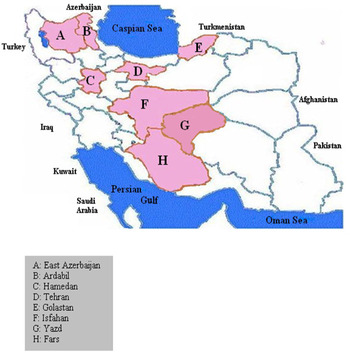
Sandflies were collected from villages in ten regions of eight provinces, using CDC traps and sticky papers (fig. 1). Sandflies were dissected. The head and genital terminalia of sandflies were kept for identifying species based on morphological characters. Thorax and abdomen were stored at −80 °C until required for extracting DNA and PCR (Parvizi et al., Reference Parvizi, Benlarbi and Ready2003).
Locations of Iranian provinces where sandfly species were sampled.

About 550 base-pairs (bp) (minus primers) of the wsp gene were amplified by PCR using the primer pair wsp 81F (Forward) and wsp 691R (Reverse), with PCR amplification being carried out according to the protocol of Benlarbi & Ready (Reference Benlarbi and Ready2003).
A 20 μl PCR reaction mixture consisted of 2 μl 1× Promega buffer, 2 μl MgCl2 5 mM, 0.5 μl of each dNTP 0.25 mM, 1 μl of each primer 0.75 μl, 0.2 μl TaqDNA polymerase 0.05 unit/μl (Promega) and 2 μl of sandfly genomic DNA 1.5 mM. The PCR amplification was carried out with the following thermal profile using a GeneAmp® PCR System 9700 thermal cycler (PE Applied Biosystems): 2 min. denaturation at 94 °C; 35 cycles of denaturation at 94 °C for 30 s, annealing at 55 °C for 45 s, extension at 72 °C for 1 min. 30 s; and a final extension at 72 °C for 10 min (Parvizi et al., Reference Parvizi, Benlarbi and Ready2003).
After amplification, the samples were fractionated by horizontal submerged gel electrophoresis, using 1.5% agarose gels and DNA size markers (Promega PCR markers G316A or Bioline Hyper ladder IV). DNA fragments were visualized by ethidium bromide staining, then excised and purified using a Geneclean II Kit (BIO 101 Inc) before cycle sequencing each strand. The sequences obtained were edited and aligned with database sequences using SequencherTM 4.1.4 software to identify unique sequences (=haplotypes), which were analysed phylogenetically using MEGA 4 (Tamura et al., Reference Tamura, Dudley, Nei and Kamur2007).
Results
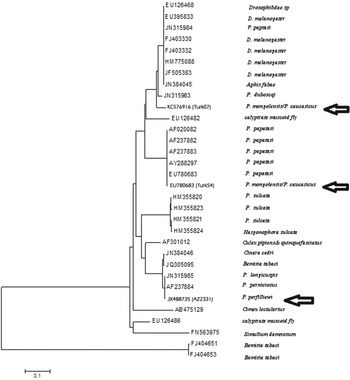
Three haplotypes of wsp gene from Iranian sandflies were found. Haplotype Turk 54 was identified in two GenBank sequences from strains of W. pipientis isolated from P. papatasi originating from Iran and Egypt (GenBank accession EU780683; AY288297) (table 2), and it predominated in Iranian sandflies infected with W. pipientis (144/158 infections). Two new haplotypes, Turk 07 (10/158 infections) and AZ2331 (4/158 infections) of W. pipientis were identified in Iranian sandflies (fig. 2). The haplotype Turk07 (GenBank accession number KC576916) was isolated from two males of Phlebotomus mongolensis, two males of Phlebotomus caucasicus and six females of P. mongolensis/P. caucasicus originating from Turkemen Sahara, Iran. The haplotype AZ2331 (GenBank accession number JX488735) was isolated from Phlebotomus perfiliewi originating from East Azerbaijan province, and it was distinguishable from a sequence previously submitted in GenBank (AF237884 strain wPrn of W. pipientis) isolated from Phlebotomus perniciosus originating from Italy only by having an ambiguous base (G/A) at nucleotide position 18.
Unrooted neighbour-joining tree showing the relationships of the haplotypes of the Wolbachia surface protein gene (wsp) fragment found in Iranian sandflies and GenBank.

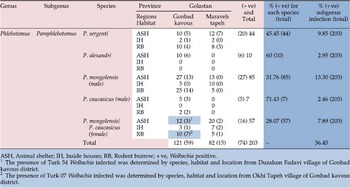
Populations of sandflies from different regions and habitats originating from areas endemic and non-endemic for ZCL and ZVL in Iran were screened by PCR for W. pipientis infections using the species-specific but non-strain specific primers for the wsp genes. In all collections, 203 males and females of the subgenus Phlebotomus (Paraphlebotomus) were identified from different habitats in 13 villages from two districts of Turkemen Sahara, Golastan province, Iran (table 1): 74 out of the 203 specimens were found with Wolbachia infections; and all four species were infected (Phlebotomus sergenti 20/44, Phlebotomus alexandri 6/10, P. mongolensis 27/85, P. caucasicus 5/7 and P. mongolensis/P. caucasicus 16/57) (table 1). The females of P. mongolensis and P. caucasicus, as well as the females of all Adlerius species in Iran, could not be separated morphologically based on the structure of the spermathecae or the weakly developed pharyngeal armature (Theodor & Mesghali, Reference Theodor and Mesghali1964; Parvizi et al., Reference Parvizi, Tahehrkhani and Ready2010a , Reference Parvizi, Naddaf and AlaeeNovin b ).
Number of Paraphlebotomus subgenus species screened for Wolbachia infections.

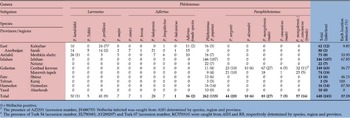
Many males and females of P. papatasi were identified and chosen from different habitats in 62 villages from ten districts and eight provinces of Iran (table 2). Of all P .papatasi screened for the wsp gene, 155/262 were positive, with infections found in seven provinces and most originating from Isfahan and Hamedan provinces (table 2).
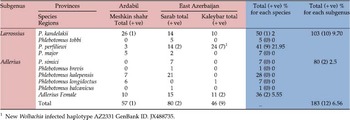
Of the four Larrossius and five Adlerius species identified, 183 males and females were screened for wsp from 12 different villages in three districts of Ardabil and East Azerbaijan provinces, Iran: P. (La.) perfiliewi (9/41), Phlebotomus (La.) kandelakii (1/50) and Adlerius species (2/80, both females) were positive (table 3).
Wolbachia infections in P. papatasi from different habitats and various geographical locations in Iran.

Wolbachia infections in two subgenera species using wsp gene in three endemic visceral leishmaniasis locations in North West of Iran.

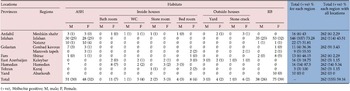
In total, 638 male and female Iranian sandflies were screened for wsp gene, and 241 of them were positive (table 4). However, only 158 out of 241 (65.56%) of these PCR products contained enough DNA for successful direct sequencing. Three haplotypes of the wsp gene were obtained from Iranian sandflies. The three sequences were aligned with some wsp sequences of Wolbachia from sandflies and other insects (Matsumoto et al., Reference Matsumoto, Izri, Dumon, Raoult and Parola2008; Azpurua et al., Reference Azpurua, Cruz, Valderama and Windsor2010; Henri & Mouton, Reference Henri and Mouton2012), and phylogenetic relationships were generated via neighbour-joining analysis using MEGA software (fig. 2). The common haplotype (Turk 54) and the new haplotype Turk 07 are in the A-group and a new haplotype AZ2331 isolated from P. perfiliewi is in the B-group of strains of W. pipientis.
Numbers and percentages of Wolbachia infections (wsp gene) in sandfly species screened by PCR from different regions in Iran.

Discussion
Previously, we had identified a single strain of W. pipientis in wild-caught P. papatasi from Iran by targeting the wsp gene (Parvizi et al., Reference Parvizi, Benlarbi and Ready2003). But some unanswered questions included the possible presence of other strains that might have been missed if the PCR primers exhibited haplotype specificity (Mitsuhashi et al., Reference Mitsuhashi, Fukuda, Nicho and Murakami2004). Also, the screening of more sandfly species and specimens from different habitats and locations might have revealed a greater diversity of wsp gene haplotypes. This has now been carried out for the first time in Iran, revealing the presence of the wsp gene in four Paraphlebotomus species (P. sergenti, P. alexandri, P. mongolensis and P. caucasicus), two Larroussius species (P. perfiliewi and P. kandelakii) and females of Adlerius species. The infection rates were significantly higher in Isfahan compared with other locations sampled (χ2 test: P<0.05) (tables 1 and 2). The overall ratio of infection rates within animal shelters (ASH) and rodent burrows (RB) in Golastan Province were significantly higher than elsewhere ( χ2 test: P<0.05) and most infections were found in ASH (tables 1 and 2).
Three haplotypes of the wsp gene were obtained (tables 1 and 4). Two were new (GenBank accession numbers KC576916 and JX488735), indicating new strains of Wolbachia. Regardless of geographical origins and habitat, most wild sandfly species mentioned in this report have been found infected with one common, widespread strain of W. pipientis (Turk 54, GenBank ID. EU780683; AY288297). The 564-bp haplotype (minus primers) had good and readable sequences. It was distinguished as an A-group strain of W. pipientis (wPap), and it was previously isolated from P. papatasi originating from Israel/West Bank (AF237883) (Ono et al., Reference Ono, Braig, Munstermann, Ferro and O'Neill2001) and India (GenBank accession number AF237882 (Ono et al., Reference Ono, Braig, Munstermann, Ferro and O'Neill2001), as well as from Spain and Iran (Benlarbi & Ready, Reference Benlarbi and Ready2003; Parvizi et al., Reference Parvizi, Benlarbi and Ready2003). In addition, a new haplotype Turk07, isolated from P. mongolensis and P. caucasicus, is also in the A-group, in contrast to the new haplotype AZ2331 isolated from P. perfiliewi which is in the B-group of strains of W. pipientis. The latter differs by only one nucleotide from strain wPrn (GenBank ID AF237884) isolated from P. perniciosus in Italy (fig. 2) (Rasgon & Scott, Reference Rasgon and Scott2003; Matsumoto et al., Reference Matsumoto, Izri, Dumon, Raoult and Parola2008; Azpurua et al., Reference Azpurua, Cruz, Valderama and Windsor2010; Henri & Mouton, Reference Henri and Mouton2012; Parvizi et al. Reference Parvizi, Bordbar and Najafzadeh2013a , Reference Parvizi, Fardid and Soleimani b ). Therefore, we can conclude that more than one A-group strain of W. pipientis occurs in sandfly species in Iran.
The geographical and species distributions of the three Wolbachia strains in Iran are likely to depend on horizontal transmission (Benlarbi & Ready, Reference Benlarbi and Ready2003). This raises the possibility of using W. pipientis to drive transgenes through wild sandfly populations, with the objective of intervening in the transmission of Leishmania. This can be done by genetic engineering techniques followed by the mass release of transgenic insects. Such an approach could be very useful for the biological control of a variety of parasites and viruses (Werren, Reference Werren, Harvard and Berlocher1998; Dobson et al., Reference Dobson, Fox and Jiggins2002; Mitsuhashi et al., Reference Mitsuhashi, Saiki, Wei, Kawakita and Sato2002; Rasgon et al., Reference Rasgon, Styer and Scott2003; Parvizi et al., Reference Parvizi, Fardid and Amirkhani2009).
The wsp gene is a very useful tool for typing different Wolbachia strains (Zhou et al., Reference Zhou, Rousset and O'Neill1998; Weeks et al., Reference Weeks, Reynolds and Hoffmann2002; Werren et al., Reference Werren, Baldo and Clark2008). It is notable that wsp gene sequences have almost ten times greater divergence than the 16S rDNA sequences of Wolbachia from different host taxa (O'Neill et al., Reference O'Neill, Giordano, Colbert, Karr and Robertson1992; Rousset et al., Reference Rousset, Bouchon, Pintureau, Juchault and Solignac1992), which comparatively makes it the fastest evolving of five ubiquitous Wolbachia genes (gatB, coxA, hcpA, fbpA and ftsZ) among insect species (Zhou et al., Reference Zhou, Rousset and O'Neill1998; Baldo et al., Reference Baldo, Dunning Hotopp, Jolley, Bordenstein, Biber, Choudhury, Hayashi, Maiden, Tettelin and Werren2006). wsp typing is analogous to antigen protein typing used for pathogenic bacteria (Perez-Losada et al., Reference Perez-Losada, Viscidi, Demma, Zenilman and Crandall2005). Its widespread use as a reliable marker for strain typing is also supported by its presumed role in host–symbiont interactions (Zhou et al., Reference Zhou, Rousset and O'Neill1998; Van Meer et al., Reference Van Meer, Witteveldt and Stouthamer1999; Pintureau et al., Reference Pintureau, Chaudier, Lassabliere, Charles and Grenier2000; Baldo et al., Reference Baldo, Bartos, Werren, Bazzocchi, Casiraghi and Panelli2002; Shoemaker et al., Reference Shoemaker, Machado, Molbo, Werren, Windsor and Herre2002; Nirgianaki et al., Reference Nirgianaki, Banks, Frohlich, Veneti, Braig, Miller, Bedford, Markham, Savakis and Bourtzis2003; Kyei-Poku et al., Reference Kyei-Poku, Colwell, Coghlin, Benkel and Floate2005). The use of more polymorphic Wolbachia sequences (Baldo et al., Reference Baldo, Dunning Hotopp, Jolley, Bordenstein, Biber, Choudhury, Hayashi, Maiden, Tettelin and Werren2006; Siozios et al., Reference Siozios, Loannidis, Lisa, Andersson and Braig2013) could improve strain identification in sandflies. So far, strain identification has depended on wsp sequencing, with relatively few isolations from Lutzomyia shannoni Dyar (Colombia), Lutzomyia trapidoi (Panama), Lutzomyia whitmani Coutinho & Antunes (Brazil), Lutzomyia vespertilionis (Panama), P. papatasi Scopoli (India, Iran and Israel), P. perniciosus Newstead (France and Italy) and S. minuta (France) (Zhou et al., Reference Zhou, Rousset and O'Neill1998, Ono et al., Reference Ono, Braig, Munstermann, Ferro and O'Neill2001, Matsumoto et al., Reference Matsumoto, Izri, Dumon, Raoult and Parola2008; Azpurua et al., Reference Azpurua, Cruz, Valderama and Windsor2010).
Acknowledgements
The work was supported by the Pasteur Institute of Iran, grant 532 awarded to Dr Parviz Parvizi. The collections of sandflies were made possible by the assistance of the Centre of Health Services in Golastan, Isfahan, Fars, Yazd, East Azerbaijan and Ardabil provinces. We thank Mehdi Baghban for helping with the field work, Elnaz AlaeeNovin for assistance in the Molecular Systematics Laboratory and Dr Paul Ready for amending the text. A part of this research was funded through studentships to Somaieh Soleimani, based at the Pasteur Institute of Iran, Tehran, and registered for an MSc degree in Islamic Azad University, Qom, Iran.