Staphylococcus aureus and Candida spp. are the second and fourth most common causes of hospital-onset bloodstream infections (BSIs) in the United States, respectively, and are associated with a high morbidity and mortality.Reference Edmond, Wallace, McClish, Pfaller, Jones and Wenzel 1 , Reference Wisplinghoff, Bischoff, Tallent, Seifert, Wenzel and Edmond 2 BSIs with more than 1 organism occur in 3%–29% of candidemia cases, and although these BSIs may be associated with a higher morbidity and mortality than monomicrobial BSIs, the epidemiology of these coinfections has not been well defined.Reference Sancho, Artero, Zaragoza, Camarena, Gonzalez and Nogueira 3 – Reference Kim, Yoon, Kim and Sohn 12 The objectives of this study were to describe the epidemiology of BSIs involving both Candida spp. and methicillin-resistant S. aureus (MRSA) and to quantify the effect of MRSA coinfection on mortality among adults with candidemia.
METHODS
The Georgia Emerging Infections Program (EIP), funded by the Centers for Disease Control and Prevention (CDC), conducts ongoing active population- and laboratory-based surveillance for candidemia and MRSA BSIs among residents of the 8 counties of metropolitan Atlanta (adult population: 2.8 million). 13 EIP staff regularly contact clinical microbiology laboratories in acute care hospitals and all reference laboratories serving metropolitan Atlanta to identify cases. The patient information from the monthly reports for candidemia and MRSA BSI was recorded in pathogen-specific databases. These data from March 1, 2008, through November 30, 2012, were merged to create the data set for this study.
A case of coinfection was defined as incident culture of MRSA collected within 30 days before or after an incident blood culture with Candida spp., where the date of incident Candida spp. culture collection was day 0. An incident culture was defined as the first positive blood culture of an organism (ie, MRSA or Candida spp.) or the first positive blood culture 30 days after any previous culture with the same organism in a resident of the catchment area. All patients with incident blood culture with Candida spp. without coinfection served as controls. A sensitivity analysis was performed restricting coinfections to those occurring within 3 days.
All patients at least 18 years old were included. Medical charts were reviewed for all cases as part of routine EIP activities. Characteristics that were extracted from medical chart reviews included outcome after 30 days following incident culture date; intensive care unit admission any time during the hospitalization; nursing home residence at the time of hospital admission; exposure to antibiotics, hyperalimentation, or antifungals within the 14 days prior to incident culture date; treatment with antifungals within the 30 days following incident culture date; central venous catheter present within the 2 days prior to incident culture date; and cancer, surgery, liver disease, diabetes mellitus, and dialysis within the 90 days prior to collection of incident Candida spp. culture. Thirty-day outcome was ascertained by reviewing hospital discharge summaries and any additional hospital records 30 or more days after incident candidemia infection, which were available for 72.5% of patients. The annual population-based rates of coinfection, MRSA BSI, and candidemia were calculated. Annual mortality was calculated using the date of the first Candida spp. isolated from December 1 of the previous year to November 30 of each year. Categorical variables were assessed with χ2 or Fisher exact test, as appropriate.
Risk ratios were calculated and a multivariable logistic regression model for the occurrence of coinfection compared with mono-infection with Candida was developed. Variables eligible for inclusion in the model included previously established characteristics associated with infection with more than 1 organism (old age, previous surgery, previous antibiotic exposure, diagnosis with cancer, previous hospitalization, previous hyperalimentation, and diagnosis with a hematologic malignancyReference Lin, Lai and Chen 4 , Reference Weinstein, Relier and Murphy 6 , Reference Bouza, Burillo, Munoz, Guinea, Marin and Rodriguez-Creixems 7 , Reference Kim, Yoon, Kim and Sohn 12 ) and variables that had P≤.20 in the univariate analysis. SAS, version 9.2 (SAS Institute), was used for all analysis.
RESULTS
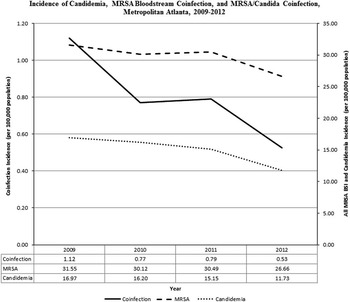
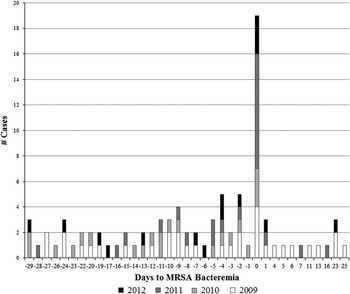
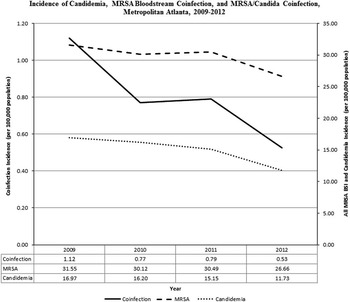
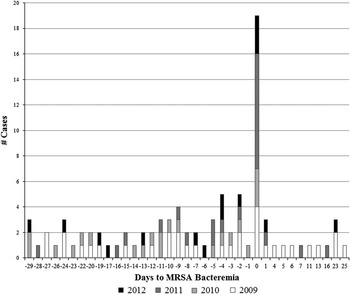
During the study period, there were 4,013 cases of incident MRSA BSI and 2,070 cases of incident candidemia, including 110 cases of candidemia with MRSA coinfection. The incidence of coinfection per 100,000 population decreased from 1.12 to 0.53 between 2009 and 2012, paralleling the decreased incidence of all MRSA BSIs and candidemia in this population (Figure 1). MRSA BSI preceded candidemia (60.9%) in most coinfections. Half of the MRSA BSIs occurred within 8 days of incident candidemia, including 20.0% on the same day (Figure 2).
The incidence of bloodstream infections (BSIs) with Candida spp. and methicillin-resistant Staphylococcus aureus (MRSA) isolated within 30 days decreased among patients in Metropolitan Atlanta from 1.12 to 0.53 per 100,000 population from 2009 to 2012. Incidence was calculated using yearly population estimates from the Census Bureau and the number of cases with the first pathogen isolated from December 1 of the previous year to November 30 of each year.
Number of candidemia cases in 8-county Metropolitan Atlanta coinfected with methicillin-resistant Staphylococcus aureus (MRSA) bacteremia within 30 days of first Candida spp. isolated from blood. Candidemia cases are shown by number of days to MRSA, with initial Candida spp. isolation on day 0, and by year of isolation (December 1 of the previous year through November 30 of each year).
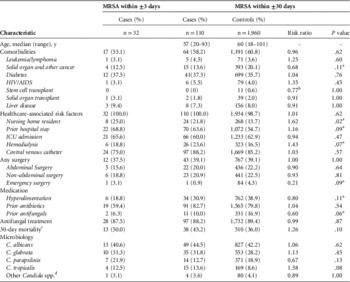
The median (range) age of monomicrobial candidemia controls was 60 (18–101) years and similar to that of coinfection cases (57 [20–93] years) (Table 1). From 2009 to 2012, the proportion of coinfection cases in patients older than 65 years decreased from 47% to 27%, while the proportion of cases admitted to the intensive care unit during hospital stay increased from 50% to 73% and 30–day mortality increased from 30% to 58%.
Univariate Comparison of Patients with MRSA/Candida Coinfection Within 3 or 30 Days and Candidemia Mono-infection in 8-County Metropolitan Atlanta March 1, 2008–November 30, 2012
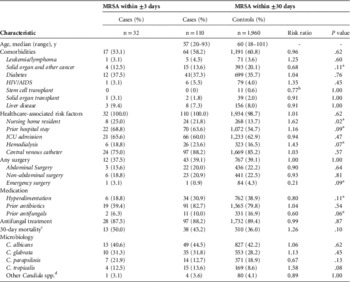
NOTE. Data are no. (%) unless otherwise indicated. The risk ratio and P value compare the cases/controls at 30 day intervals. HIV, human immunodeficiency virus; ICU, intensive care unit; MRSA, methicillin-resistant Staphylococcus aureus.
a Variables eligible for the logistic model.
b 0.5 added to 1 cell.
c 570 patients (27.5%) have unknown outcome at 30 days.
d Includes C. krusei, C. lusitaniae, and nonspeciated Candida.
Most cases and controls had at least 1 underlying comorbidity, with diabetes occurring in more than a third of all candidemia patients. Healthcare exposure was almost universal. More than 85% of both cases and controls had central venous catheters, more than half were previously hospitalized, more than half admitted were admitted to the intensive care unit, and nearly 40% had surgical procedures, of which half were abdominal surgeries. C. albicans was the most common organism isolated from both cases (44.6%) and controls (42.2%), although the proportion of coinfection cases with C. tropicalis (13.6%) was notably higher than that of controls (8.6%). The mortality at 30 days of coinfection cases (45.2%) was similarly high compared with the mortality among controls (36.0%; P=.10).
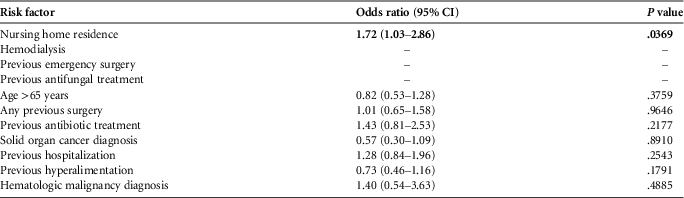
In the univariate analysis, nursing home residence (risk ratio, 1.62; P=.02), prior hospital stay (1.16; P=.09), and hemodialysis (1.43; P=.07) were associated with increased risk of coinfection (Table 1). In multivariate analysis, the only significant predictor of coinfection was nursing home residence at the time of hospitalization (odds ratio, 1.72 [95% CI, 1.03–2.86]) (Table 2).
Results of Logistic Regression Model of Risk Factors for MRSA/Candida Bloodstream Coinfection Compared With Candida spp. Mono-infection Among Residents of 8-County Metropolitan Atlanta March 1, 2008– November 30, 2012
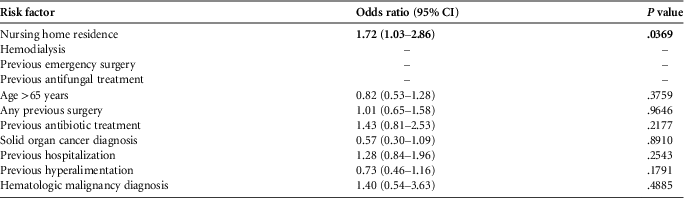
NOTE. MRSA, methicillin-resistant Staphylococcus aureus. Bold values indicate statistical significance, p<.05.
In the sensitivity analysis, 32 (29.1%) of the 110 co-infections occurred within 3 days. Notable differences in this subset of patients included a lower proportion of patients with hyperalimentation, prior antibiotics, and prior antifungals, and a mortality rate of 50.0% (Table 1). No significant differences in the distribution of Candida spp. was noted among coinfections within 3 days and those within the 30-day before or after window, although there was a trend toward a higher proportion of C. parapsilosis (21.9% vs 12.7%) within the 3-day coinfection window.
DISCUSSION
In a large metropolitan area over 5 years, 5.3% of patients with candidemia also had a MRSA BSI within 30 days, with many occurring prior to or on the same day as the Candida BSI. From 2009 to 2012, the incidence of coinfection decreased by more than 50%, paralleling the decrease in both MRSA BSI and candidemia in this population. In multivariate analysis, only residence in a nursing home significantly increased the risk for coinfection compared with monomicrobial candidemia.
Many of the risk factors for MRSA and Candida BSIs overlap and may be synergistic. Frail nursing home residents may have a combination of antibiotic exposure and multiple comorbidities that increase risk for coinfection.Reference Lesse and Mylotte 14 Several of these factors, such as antibiotic exposure, are modifiable, and future prevention efforts should target these factors. Other factors associated with nursing home residence, such as chronic skin breakdown and diabetes, may be mitigated through skin care, frequent turning, and glycemic control to reduce the risk for coinfection.
In most patients, MRSA BSI preceded candidemia. Patients with MRSA infection likely had increased antibiotic exposure, including initial broad-spectrum empirical therapy, which may have predisposed them to fungemia. MRSA infection also may have increased length of stay and resulted in prolonged central venous access for treatment. Alternatively, MRSA BSI may be a marker of acuity and severity of illness.
The observed reductions in MRSA and Candida spp. during the study period likely reflect efforts directed at these pathogens as well as general infection control interventions, including chlorhexidine bathing. One potential explanation for the apparent increase in mortality may be that current measures have reduced infections more effectively in lower-risk patients, with much of the remaining disease occurring among those at the highest risk for mortality. The 58% mortality among patients with MRSA and Candida coinfections emphasizes the ongoing need for effective prevention efforts.
Both cases and controls had significant healthcare exposures, with most patients having a recent hospitalization, intensive care unit admission, and central venous access. Among the healthcare exposures, central venous access is likely the most modifiable, but efforts to reduce hospital stays and to prevent readmissions may also be effective. Although central line bundles have been widely implemented, daily assessment of necessity may not be consistently performed. Checklists and other process improvement activities that address this gap may prevent BSIs with Candida spp. and MRSA. Approximately 80% of patients with candidemia had received antibiotics, and other than the presence of a central venous catheter, this was the most common risk factor in both coinfection and candidemia alone. Similarly, more than 10% of both cases and controls had received antifungals within the 2 weeks prior to incident candidemia. Although prior antibiotic exposure is a well-described risk factor for candidemia, the magnitude of this exposure reinforces the importance of antimicrobial stewardship, particularly since a significant proportion of antibiotic use in the hospital may be unnecessary and carries hospital and societal costs.Reference Hecker, Aron, Patel, Lehmann and Donskey 15 , Reference Roberts, Hota and Ahmad 16
In contrast to previous studies, we did not find an increased mortality in coinfection compared with candidemia, but the overall 30-day mortality was close to 40%.Reference Bouza, Burillo, Munoz, Guinea, Marin and Rodriguez-Creixems 7 , Reference Kim, Yoon, Kim and Sohn 12 The absolute difference in mortality of 9% did not achieve statistical significance and may be due to the modest sample size of cases in this study. The finding of 50% mortality at 30 days in patients with coinfection occurring within 3 days suggests a possible additive effect for concurrent MRSA and Candida BSI. Heightened awareness is warranted after 1 major BSI pathogen has been identified, particularly for nursing home residents.
Both synergistic and antagonistic interactions between Candida spp. and bacterial pathogens have been observed in vitro, including synergy with S. aureus.Reference Azoulay, Timsit and Tafflet 17 – Reference Klaerner, Uknis, Acton, Dahlberg, Carlone-Jambor and Dunn 26 C. albicans has been reported to provide S. aureus with increased ability to form biofilms, increased resistance to vancomycin, and increased virulence.Reference Carlson 19 , Reference Harriott and Noverr 24 , Reference Harriott and Noverr 25 Our observation that patients with candidemia due to C. tropicalis had the highest rate of MRSA coinfection (although not statistically significant) may be related to previous findings of greater biofilm-forming ability among non–C. albicans species.Reference Pathak, Sharma and Shrivastva 27 Although we did not observe an increased risk associated with central venous catheters in coinfected patients compared with mono-infected patients, there was a high proportion of central venous catheters in both groups. Future investigation may include the burden and composition of biofilms in coinfections as well as the effect of other potential sites of biofilm formation, such as prosthetic joints and implanted cardiac devices, which were not included in this study.
This study has some limitations. Thirty-day mortality could not be determined in approximately 25% of patients with candidemia. As previously mentioned, the number of cases is modest, but this study still represents one of the largest collections of coinfections to date. It is possible that some controls may have been misclassified because blood cultures were not collected in a standardized way across different medical facilities. Incidence of candidemia may be underestimated in patients already receiving antifungals. Some coinfection cases may have been missed because only the incident culture collection date was recorded for each pathogen in the pathogen-specific databases. The necessity for and documentation of central venous catheters and antimicrobial use were also not assessed. There may be increased case finding of coinfection from heightened awareness following a positive blood culture growing MRSA or Candida spp. Additionally, the clinical threshold to obtain initial or follow-up blood cultures may be different for nursing home residents compared with critically ill hospitalized patients.
To our knowledge, this is the first study describing the population-based epidemiology of infections involving Candida spp. and MRSA in a large metropolitan area. Future analyses will include coinfection with other pathogens commonly isolated with Candida spp., such as Staphylococcus epidermidis, methicillin-susceptible S. aureus, Enterococcus spp., and Escherichia coli.Reference Bouza, Burillo, Munoz, Guinea, Marin and Rodriguez-Creixems 7 Our findings that coinfection with MRSA and Candida spp. is associated with nursing home residence and that MRSA BSI most often precedes fungemia warrant further study of these infections.
ACKNOWLEDGMENTS
We thank the Georgia EIP surveillance officers, for their diligence and feedback in collecting these data; Wendy Baughman, for coordinating Georgia EIP; Janine Scott, for guidance; Tom Chiller and Angela Ahlquist-Cleveland of the CDC, for coordinating the national candidemia surveillance project; and Isaac See and Nicole Gualandi of the CDC, for coordinating the national MRSA surveillance project.
Financial support. CDC’s EIP.
Potential conflicts of interest. All authors report no conflicts of interest relevant to this article.