Archives of feeling
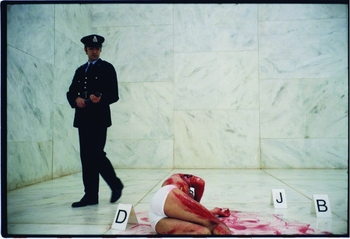
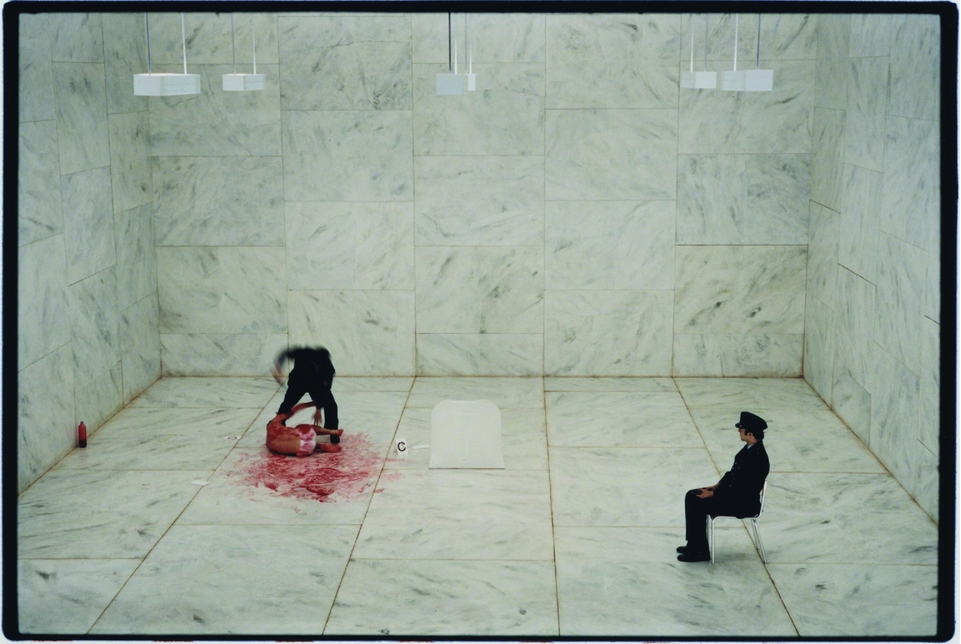
Zürcher Theater Spektakel, September 2005. I stand with heart thumping at the closing images of Socìetas Raffaello Sanzio's BR.#04 Brussels, one of only several audience members remaining from an initially full house. The rest of the audience left this performance all at once, clumsily, loudly, in rebuke of having to see something that they had not come for: a scene which, it seems, had no place in the theatre at all. The scene was the relentless bashing of a man by performers wearing police uniforms wielding batons. The set housing these men was a vast marble cavern that, in the set-up to the bashing, had allowed voluminous fake blood poured from plastic water bottles to swim across the white, opulent bureaucracy of the space. Before the blood was poured, the space had been cleaned. A black female cleaner entered with a mop: the rhythmic lethargy in her mopping occurring well before the entry of two men, who dressed themselves in police uniforms and set out crime-scene markers as evidence and history of a death. They then poured the blood over a third man, who had meanwhile undressed to stand near-naked between the markers in preparation for his bloody, brutal beating. And then, they beat him (see Fig. 1).
BR.#04. Bruxelles, Tragedia Endogonidia, photograph by Luca Del Pia.

In the theatre of Socìetas Raffaello Sanzio, as Joe Kelleher and Nicholas Ridout have explained, the spectator ‘is already in the archive, reexamining the state of the imprints’.Footnote 1 Innumerable scholars have since contemplated this scene to form a secondary archive of sorts, positioning it as an emblematic example of how a postdramatic aesthetic creates a postmodern ethics and politics, arresting as it does the spectator's embodied relation to a certain ‘fake’ real established by its spectacular mise en scène. Maria Magdalena Schwaegermann, former artistic director of the Zürcher Theater Spektakel, explains that for her (and presumably for the audience of the 2005 festival) this scene became an endurance test ‘to the bitter end . . . so that the image [was] burnt into my brain’.Footnote 2 Helena Grehan recalls how she sat ‘squirming as the beatings continued’,Footnote 3 and Joe Kelleher describes their ‘interminable’ sound as a ‘nauseous crescendo mixed with interference’, forcing the room to ‘vomi[t] its memories at last’,Footnote 4 to ‘brea[k] through the mimesis’.Footnote 5 For Nicholas Ridout, the beating's staging was ‘so obviously signaled . . . that it [was] experienced as something intolerable, intolerably real’.Footnote 6 For myself, the scene made me feel very much as if my cellular stitching, momentarily, might have just come undone.
Many such accounts testify to a theatre that both feels the affect of its audience (the room itself is what “vomits”), and doubly sears itself into the bodies of its spectators in order to enable – in director Romeo Castellucci's terms – a somewhat violent ‘penetrat[ing] [of the spectator's] shell’.Footnote 7 In doing so, they intimate that this distinctive form of corporeal ‘penetration’ evolves through a conscious complication of performance paradigms, or what Gabriella Novati describes as the ‘negation of representation through representation and the negation of theatre through theatre’.Footnote 8 Such a process of negation might be considered via Rebecca Schneider's terminology (albeit writing in a different context), which argues that theatre consists of both ‘real and faux – action and representation’, and it is in this conundrum of the ‘both/and’ that ‘the represented bumps uncomfortably . . . against the affective, bodily, instrument of the real’.Footnote 9 Erika Fischer-Lichte, for example, argues that Castellucci's Giulio Cesare ‘emphatically direct[s] the spectator's attention to the specific peculiarity and individuality of the actor's phenomenal body’, resulting in a ‘perceptional multistability’ in which ‘the order of perception . . . is upset . . . and another one has to be established’.Footnote 10 Bridget Escolme similarly observes that the same work's ‘laying bare [of] the mechanics of representation insists upon an ethical relation . . . that “acting” cannot’.Footnote 11 Sam Trubridge suggests that Tragedia Endogonidia ‘turn[s] speculation upon itself’, ‘excee[ding] the suspension of disbelief and hel[ping] to locate the audience's experience within a realm of material and physical reality’.Footnote 12 And Ehren Fordyce likewise argues that this inversion of spectatorship occurs through, and as, a theatricalization of the ‘border of semiosis’ itself.Footnote 13
The accumulation in the scholarly archive of these doubly affective stagings, where the stage would first seem to perform our bodily affect and second seem to affectively enter our bodies, suggests that when watching Socìetas Raffaello Sanzio one feels a kind of feeling that ruptures how we as watchers are more usually used to being constituted by theatrical vision. To be more specific, it seems that the very inversion of a mechanics of representation generates a particular affective dimension through its process of self-negation. In this article, I am interested in understanding more about the affective dimension that emerges when theatre fails to resemble itself. In what ways does the body's phenomenal perceptibility come to the fore when the spaces between theatrical dissimulation seem to come performatively unstuck?
As can be seen in the responses given above, the scholarship on Socìetas Raffaello Sanzio operates textually to account for something which is distinctly wordless, fleeting, phenomenological. It testifies to a ‘squirming’, ‘interminable’, ‘intolerable’ mechanism by which bodies become ‘penetrated’ and ‘brains are burnt’. For my purposes, it is this forceful demonstration of the embodied nature of watching their work which also tells us something about the company's investment in theatre as a memory machine: that Socìetas Raffaello Sanzio are deeply concerned with enacting a form of cultural memory. In this article I suggest that their works work to account for the spectator's body as a form of archival knowledge, and that the theatrical is – in this instance – the methodology that enables the re-perception of certain corporeally and affectively archived cultural traits. I take my starting point from theorists such as Ann Cvetkovich and Ann Pellegrini, who have observed in affect both a cultural and a ‘pre-cultural’ form of bodily cognition, where it is an archive of ‘public sentiments’ and a formation that holds ‘historical burden . . . on and for the body’.Footnote 14 Rebecca Schneider similarly positions the body as a locus of knowledge which remains through the ‘affective transmissions of showing and telling’,Footnote 15 the ‘“sedimented acts” and spectral meanings that haunt material in constant collective interactions, in constellation, in transmutation’.Footnote 16 Through a vision of the spectator's body as archival, the theatre of Socìetas Raffaello Sanzio might be understood as an antidote to the sensorial, affective cooption of our bodies by other culturally hegemonic practices of looking, seeing and feeling.
In this article I focus solely on the scene within BR.#04 Brussels described above, to suggest that Socìetas Raffaello Sanzio construct a meta-affective state for the spectator that is built out of a continuous collapse and rebuilding of relations between real and fake, sensation and spectacle. By meta-affective, I mean to indicate the tautologous nature of feeling, in that it occurs always, but often implicitly, as a kind of doubled activity. In the words of Jean Luc Nancy, ‘A subject feels . . . This means that he hears (himself), sees (himself), touches (himself), tastes (himself), and so on . . . and thus always feels himself feeling a “self” that escapes . . . or hides.’Footnote 17 The promise of theatrical meta-affect can be the ontological surprise or rupture that enables feelings to be re-felt. A dramaturgy of meta-affect can work to dis- and replace relations between self and feeling, and self and other, and can hence be central to the imagining of a politics and ethics of cultural memory. As Joe Kelleher has made clear, Socìetas Raffaello Sanzio theatrically assemble both the place of looking and ‘the place where looking breaks down’.Footnote 18 Nicholas Ridout has contemplated this place via the historical conceptualization of a Vibratorium, a mechanism which operates as ‘an experimental apparatus for the exploration of intersubjective or social affect and its transmission’.Footnote 19 In simple terms, the place where looking breaks down might be understood as the place where Western sensory hierarchies begin to be inverted. More complexly, it might be understood as the place where the practice of social subjectivity is repurposed by a disturbance of the normally culturally unified relations between feeling, knowing and seeing. I want to contemplate why this rupture of the sensorium offers a fertile ground from which to conceptualize an affective theatre of cultural memory.
My intentions are twofold. I first suggest that the beating scene within BR.#04 articulates a theatrical response to central concerns faced by contemporary memory and trauma culture. In this, I argue that its form has much to offer, metonymically, post-traumatic postmodernity.Footnote 20 I want to extend these discussions, however, by borrowing a phrase from Kelleher's own response to BR.#04 which observes ‘a suffering that resides . . . in the image’.Footnote 21 The premise of a meta-affective register foregrounds how theatricality can articulate a conception of the remembering body in postmodernity that moves it beyond simple alignments between spectator sensation of, and empathic identification with, a suffering other. Such alignments have a tendency to produce spectator sensation – or the affective register – as that which, in Jill Bennett's terms, avoids ‘precod[ing] by a representational system’.Footnote 22 An ‘image that suffers’ places the burden of the wound in the domain of neither the object nor the subject. In Lisa Saltzman's treatment of installation art, an image is in this way ‘post-indexical’ in its suffering: it feels the feelings that we might otherwise be supposed to be feeling.Footnote 23 I want to suggest that BR.#04 models a form of theatrical spectatorship which reconfigures how the body thinks it knows through feeling. It remediates the function of affect, by refusing to use it to bind the suffering other to the ‘empathically’ engaged spectator. This form of spectatorship, as a radical kind of sensationship, forces us to feel feeling, and the truth-effects held therein. It hurts: morally, emotionally and physically.
Memory theatres
Jeanette Malkin's Memory-Theater and Postmodern Drama, published in 1999, draws thematic and stylistic comparisons between postmodern drama and new millennial contexts of memory and trauma culture. Malkin's research importantly assimilates modernity's seminal theorizations on memory through literature, philosophy and psychoanalysis (Proust, Benjamin, Freud) alongside modernity's signature historical events (Hiroshima, the Holocaust). She argues, via postmodern theorists such as Frederic Jameson and Pierre Nora, that we render ourselves culturally through these structures; that is, through the ‘centrality of the fragment and the explosion . . . the “blasting open” of history and the collapse of linear and controlling “grand narrative”’.Footnote 24 While the epochal memory movements Malkin recounts point to specific memory topoi (deep memory, repressive memory, traumatic memory, amnesic memory), Malkin also implies that these specific cultural mnemonics coalesce to reflect a context that often integrates their multiple temporalities. We might then understand that while prefaced by different disciplinary leanings, the traumatic belatedness so well theorized by Cathy Caruth or Jameson's amnesic impulse might not be mutually exclusive ways of experiencing subjectivity in postmodernity.
Malkin conceptualizes postmodern drama's mnemonic impulses by analogizing the architectonic memory theatre of Italian Renaissance rhetoritician Giuilio Camillo. As Malkin explains, Camillo's design for a seven-levelled wooden amphitheatre (which was incidentally never built) ‘actualized the idea of “staging” memories by deploying a permanent set of images that were to provide a physical model for memorization’, wherein ‘a mélange of occult and mythic icons’ were paraded before the subject.Footnote 25 The postmodern inklings of the structure are also apparent: ‘Camillo's building was devised so that the spectator stood at its center, where the stage should have been, surrounded by the profusion of potent icons’.Footnote 26 As Frances Yates has explained, Camillo's model of theatrical architecture was designed to aid in the science of memory; that is, to improve what Yates terms ‘artificial’ as opposed to ‘natural’ memory via technés of good recall.Footnote 27 Its legacy, however, can be observed in how it theatricalizes remembering, and, more importantly, in how it positions the rememberer centre stage. Indeed, in this antique proposition for an architecture of remembering – one that is designed to aid relations between a subject and their memory – we nonetheless see a spatial configuration that already understands memory as somehow constructed, as somehow engaged in the operations of both performance and performativity. We also see a configuration that stages a body staging itself in the act of memory, making the rememberer the subject of the action.
While Camillo uses the theatrical metaphor to conceive of memory in spatial and visual terms, Malkin makes clear how postmodern theatre practitioners have used the memory metaphor to underpin theatre's relationship with the meta-traumatas of the twenty-first century. In this respect, Malkin characterizes a theatre whose ‘overabundance of disconnected stimuli: conflicting discourses, intruding images, overlapping voices, hallucinatory fragments’ demonstrates a ‘need to return and “rehearse” past moments or images, to repeat, quote, recycle . . . [offering] no aesthetically constructed release from the past’.Footnote 28 Memory-theatre is that which both ‘imitates conflicted and sometimes erased memories of a shared past; and . . . that [which] initiates processes of remembrance through practices of repetition, conflation, regression’.Footnote 29 Her thesis pre-empts Hans-Thies Lehmann's own commentary on the structural mimeticism struck between postdramatic theatre and post-traumatic postmodernity; and particularly, his observations that the ‘post-’ of postdramatic, like the postmodern, can be understood as an ‘anamnesis’ of drama.Footnote 30 What both Malkin and Lehmann intimate is that the postdramatic, while deconstructive, is equally recollective, and thereby indicative of what Dominic LaCapra terms ‘structural trauma’: the loss evoked in the ‘passage from nature to culture, the eruption of the pre-Oedipal or pre-symbolic in the symbolic, the entry into language’.Footnote 31 As both a symptom of structural trauma and its possible remedy, the postdramatic pathologizes and rhetoricizes modernity's romance with loss.
In their roaming city-based repertoire Tragedia Endogonidia (of which BR.#04 Brussels is the fourth episode), Socìetas Raffaello Sanzio recollect both structural and historical loss. Their memory-theatre observes a kind of tautology of loss, which in its acts of incomplete recollection observes structural trauma, and in its thematic content observes what LaCapra alternately terms ‘historical trauma’ – real-world events that have occurred, as in ‘the Shoah or the dropping of the atom bomb’.Footnote 32 The Tragedia cycle contains the fading imprints of the West's fin de millénaire atrocities, but this is importantly a form of tragedy that is already a remnant, a fragmentary formal order. As an endogonidial form, its creational self-replication positions tragedy as a kind of ‘originary difference’ in the Derridean sense – as that which, in longing for wholeness, only ever discovers its own multiplicity or rupture. Romeo Castellucci explains this contradictory impulse by understanding tragedy as a mechanism which presupposes death – ‘an end (of the hero)’ – and the endogonidial as alternately reproductive ‘ad infinitum’, a mechanism's ‘division of itself by itself, a sort of fall-out of spores’.Footnote 33 Their dramaturgy hence politicizes what it is to recollect loss through what are themselves lost forms – particularly those forms, such as tragedy, which hold a specifically recollective function. Tragedia Endogonidia mourns the sanctity of tragedy as a formal code, producing the spectator within a logic that inverts the European theatrical sensorium as well as the symbologies of the late capitalist West.
In this dramaturgical logic, heroes are fleetingly witnessed through gesture, narratives become whittled down to sound bytes, and the chorus is evacuated. B.#02 Berlin offers an homage to the ‘mute, tragic stature’ of Germany's revolutionary Ulrike Meinhof with the vista of a mourning mother masturbating desperately on the edge of her bed.Footnote 34 In A.#02 Avignon, a stage direction reads, ‘the gold room is covered with white fabric . . . On the right of the stage, three epileptics’. It continues, ‘After a period of general convulsions two of the epileptics suddenly stop, then get up and walk off’.Footnote 35 The logic of such performance sits in how it balances readability against inexplicability – a convulsing body is extracted from teleological narrative but works viscerally to shake an audience into new kinds of perception. It is important to recognize that while the company aims to access a ‘pre-ontological’ state through pre-tragic form,Footnote 36 the equally implied ‘post-’ of their engagement with attic tragedy registers a postmodern ambivalence for how historical traumas can be unwedded from the image apparatus around them. For this reason, scholars have varyingly remarked on what the ‘post-/pre-’ status of their response generates: a kind of pre-ontological affect summonses what Ridout has termed the ‘material, feminine, infant and . . . animal’,Footnote 37 and what Freddy Decreus has described as ‘that point beyond language, beyond that first system that differentiated meanings’.Footnote 38 At the same time, any recovery of origins only ever pinpoints originary difference: the entry of tragedy as the mark of the law, that ‘constitutive element in the establishment of a certain political order: that of the city and the class struggle’.Footnote 39
The virtual traumas of the twentieth-century West here become responsible for the failure of tragedy to redeem loss from the spectacular image-sphere in which it occurs. This is a vision of tragedy which understands that the ‘postpolitical, postdemocratic and post-tragic’ aspects of the age mean that even feeling has been conquered by commodity.Footnote 40 Romeo Castellucci explains that tragedy becomes ‘a mechanism to expose the dead body’, and Claudia Castellucci further suggests that theatre can enable a politicized apprehension of the dead body that goes beyond the consensus-making performativities of the media spectacle. This arises in how an ‘exposure of the realities of representation’ can force a ‘fall into representation’ which destabilizes conventional spectatorship and enables other modes of perceptivity to emerge.Footnote 41 A vista in which tragedy has been banalized by its own perpetuating mediality is what drives this conceit:
Disasters and the slaughters of innocents are everywhere referred to as ‘tragedies’, but this is an idea of tragedy that does not know how to distinguish these things from spectacle; nor how to think of them in terms of political crisis; nor how to gather them up on behalf of a metropolitan community, among people who are at the same time amassed and dispersed.Footnote 42
In this regard, the company is recollective of how structural forms such as tragedy are implicated in histories of violence and yet fail to restore these histories to contemporary recollection. In this post-/pre- tragedy, the tautology of tragedy's own denouement sits squarely in the question of how the loss of tragedy might itself be restaged. The significance of the company's practice is in their capacity to strike a re-perception of this loss of loss and enable it to be provisionally found.
In positioning the figural dead body at the centre of their work, Socìetas Raffaello Sanzio produce a theatrical form that answers to the repetitions of traumatic scenography that haunt the mediatized stages of the West. They further intimate an important metonymy between the figural dead body to be revealed by tragedy and that other figure who, according to Camillo, stands at the very centre of the theatre, performing remembering. This envisaging of the spectatorial-cum-remembering body as central to the mnemonic field of culture suggests a kind of synaesthetic, or affective, grounding of memory work that operates through a body's sensory, corporeal, even cellular, systems. While in Castellucci's theatre, spectators are made witness to (or indeed refuse to become witness to) the scene of a body's brutal disappearance, in Camillo's memory theatre the rememberer stands centre stage, engaged in a kind of affective contagion with the textual traces stored around her: a figure who, from the perspective of hindsight, we now come to re-witness.
Un-feeling feeling
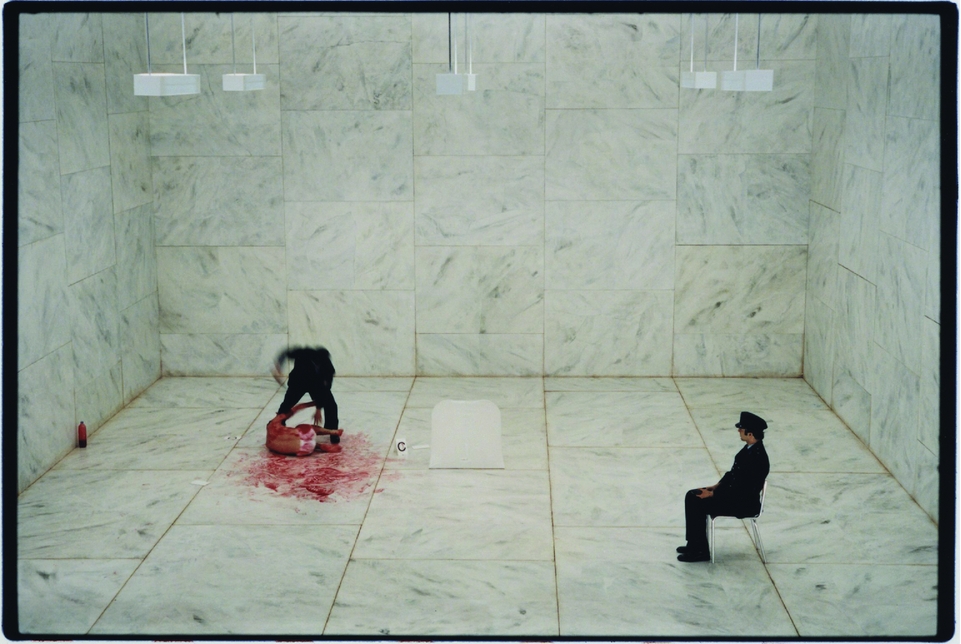
In BR.#04 Brussels, the brutally loud thump of the beating action was technically enabled by the real-time amplification of rubber batons as they charged against the performer/victim's body. Because real-time sound was amplified (microphones were implanted in the policeman's truncheons), the audience was not subjected to hearing a sound that merely sounded like beating, rather they heard the sound of beating being made (see Fig. 2). And as the responses from a variety of sources indicate, it seems that this very durational act of beating was what possibly forced an early escape for many spectators, as if they were themselves being beaten, as if their bodies resisted not the level of the noise per se, but rather its capacity for corporeal penetration.
BR.#04. Bruxelles, Tragedia Endogonidia, photograph by Luca Del Pia.
Scott Gibbons is the long-time collaborating sound artist with Socìetas Raffaello Sanzio. His repertoire has been widely lauded for its unique techniques of ‘micromusic’ and ‘isolationist ambiance’, in which he manipulates one particular sonic register (water or stones) on what has been described as a ‘molecular level’. In the company's words, this means ‘inserting potentially unlimited chromatic variants into normal notation in such a way as to give each sound a plurality of timings and durations which have nothing to do with unifying metric form’.Footnote 43 In the Cryonic Chants series, for instance, sound takes central focus and becomes a kind of material register that supersedes the ritualized gothic bodily happening occurring in the space.Footnote 44 As Daniel Sack has noted, Gibbons's score for the Tragedia cycle was celebrated for being ‘based entirely on the human voice digitally manipulated into ear-splitting screams and groans that approach the limits of audibility’.Footnote 45 While molecularization of most of the sound in BR.#04 occurred by using remastered recordings taken from an audio file of the body's noise, the very ‘seed of the sound’ in the bashing sequence was created in the shared-time space of the audience, and was composed, ‘molecularly’, of the act of rubber touching live flesh. In this respect, when we understand that the ‘composer's decision to use only voice-based sounds makes his music part of the truth, a sign of the truth’, the ‘sign of the truth’ in the bashing sequence was rather the actual generation of this kind of sonic authenticity.Footnote 46 Indeed, both the performer's body and the amplified truncheons were required to make the real-time sound that illustrated the scene it was also occasioned by.
In Lehmann's argument, postdramatic theatres offer ‘a transition from represented pain to pain experienced in representation’.Footnote 47 As I recounted above, the beating scene was experienced as ‘interminable’, a ‘nauseous crescendo’, a cause for ‘squirming’. And yet the affective spectatorial response and the refusal to watch that I witnessed occurred despite the fact that the metatheatrical markers positioning it within the faux field of representation were clearly laid plain: there was fake blood poured from plastic water bottles; the performers dressed, undressed and redressed themselves in costumes; and so on. In this respect, the particular spectatorial experience of BR#.04 Brussels occurred between these two opposing parameters. Indeed, the transformation of perception incurred by the work emerges from the interpolation of the twin paradigms of theatre and performance, or ‘fake’ and ‘real’, and, more precisely, the felt effect of their coincidental enactment.
While Ridout has observed that it is the ‘tendency to see the “real”’ in the company's work which ‘is in fact an effect of the success of their pretending’,Footnote 48 the inverse is simultaneously made to occur in this scene. In this, the success of their realness is what reveals simulation. Or, put differently: the ability to see the ‘fake’ in their work is an effect of the success of their non-matrixed enactment in real time. While the former tracks the representation of pain such that it might generate an empathic spectatorship via the success of its pretense, the latter might be seen to countertrack the representation of pain to reveal instead the pain in, and of, representation itself (to intentionally misread Lehmann). Susan Sontag might understand this countertrack as revealing a certain ‘iconography of suffering’ contained by news media, an iconography that has nonetheless become part of the ‘quintessential modern experience’.Footnote 49 In Sontag's meditation on the spectacle of atrocity, what is observed is the capacity for the media both to flatten an event, such that ‘a catastrophe that is experienced will seem eerily like its representation’, and to generate relations of power through its remediation: ‘a suffering that is outrageous, unjust, and should be repaired’ only confirms that ‘this is the sort of thing which happens in that place’.Footnote 50
Sontag's reading of the mediatized iconography of suffering runs parallel to Kelleher's aforementioned reading of BR.#04 as containing a ‘suffering that resides in the image’. As I explained earlier, an ‘image that suffers’ places the burden of the wound in the domain of neither the object nor the subject, indicating a kind of post-indexicality to the cultural representation of histories of trauma and their discursive re-renderings. In BR.#04, its depiction of suffering (the moment of beating) is dramaturgically dissected while it continues its sonic penetration of spectator bodies. This dramaturgical dissection literally pulls the image apart even though its affective impact continues to work sensorially in the space. In forming an image that suffers, the subject in the image is continuously disrupted from ever completely entering the domain of representation; it cannot completely become the realm that is ‘the mediatized iconography of suffering’. Instead, the subject in the image – the body that is being beaten – is sustained outside the very image-sphere which its body has been nonetheless appropriated to produce.
Here, what we instead witness is the body in the process of becoming an iconography of suffering; more importantly, we witness our own affective relation to the split dimensions of visual upset and sonic penetration that this singular body is able to charge. In this, BR.#04 models a form of theatrical spectatorship which reconfigures how the spectator body thinks it knows through feeling: the image itself is what feels the feelings that we might otherwise be supposed to be feeling. These tautologous feelings, as they connect to a particular and located historical trauma, and as this particular trauma connects to a cultural practice in which trauma is publicly displayed in the name of ‘cultural memory’, rupture how it is that citizen bodies come to respond to, feel, and circulate the lived experiences of others in the name of empathy. Pain, as indistinct from the spectacle in which it is remediated, instead culturally presents the loss of loss itself, or, to paraphrase Romeo Castellucci, presents an idea of tragedy that does not know how to distinguish itself from spectacle. In the beating moment, we are able to enact a politicized apprehension of the dead body, because we re-perceive the political machinations that have spectacularly created it.
It is the simultaneity of both tracks – represented pain and pain in, and of, representation – that cannot ever reveal the bashing of a body from outside the mediated sphere in which it occurs. Doubly, it is the simultaneity of both tracks which creates an affectively embodied relation to the bashing and at once disables the parameters of this spectatorial encounter. What can be revealed, and countered, is the spectator's more usually unproblematized ‘felt’ relation to the spectacle itself. In this sense, I am at once feeling with an other in their feeling of pain and also feeling my own seeing of pain; I watch the durational nature of this act of pretense. In my reading, it is the conjunctive ‘both/and’ of these dramaturgies that accesses the bodily archive of the spectator, and arrests how that archive has been formed in – and as – processes of cultural memory. The transformation of perception enabled here works to reconfigure how the body thinks it knows through feeling, such that feeling becomes un-felt, or twice felt. In this, it remediates the function of affect, by refusing to use it to bind the staged, beaten body onstage to the ‘empathically’ engaged spectator. It is precisely this duality that causes a form of spectatorship that hurts.
The empathy affect
As Elaine Scarry has famously made clear, having (or experiencing) a body in pain is a type of feeling that exists outside language. When in pain, there are never enough words to typify that pain exactly. When not in pain, it is impossible to ‘feel’ the pain of another, because true feeling would necessarily involve being in the same kind of pain oneself. This is what Scarry calls pain's ‘unsharability’: ‘For the person whose pain it is, it is “effortlessly” grasped . . . while for the person outside the sufferer's body, what is “effortless” is not grasping it.’Footnote 51 The unsharability of embodied feeling, alongside many other ‘uns’ spoken by trauma discourse,Footnote 52 has been placed in useful tension with the alternate prefix ‘re-’, thanks to a number of perspectives put forward in performance studies.Footnote 53 Diana Taylor, Susan Leigh Foster and Joseph Roach, amongst others, have theorized how bodies can get close to knowing and feeling each other, through re-feeling – as a kind of choreographic history – the coalescence between embodied action (performance) and its signification (performativity).Footnote 54 Within these forms of discussion, the practice of feeling as another body (feeling as kinaesthetic movement, and thereby as motorsensory empathy) is most usually invested in an ethics of feeling for, or about, another body. As Foster writes, ‘like “kinesthesia”’, empathy names ‘the experience of merging with the object of one's contemplation’, and is an ‘experience undertaken by one's entire subjectivity’.Footnote 55
Theorizing the unsharability of feeling in models of spectatorship, however, relies less on arguments for forms of embodied repetition on behalf of spectators and more on ideas of an affective ‘arrest’ of the viewer. Affect here extends ideas around physical sensation to include the physiological propensity for emotion, or what has been more intangibly theorized as the transmission of bodily intensities: ‘those resonances that circulate about, between, and sometimes stick to bodies and worlds, and in the very passages or variations between these intensities and resonances themselves’.Footnote 56 Affect comes to explain how feeling is, to some extent, transmitted, shared, felt. For Denise Varney, the form of spectatorial experience established by ‘post-semiotic’ theatre can be understood via Brian Massumi, who posits that in a highly mediated, ‘post-ideological’ era, the power of an image resides in its felt ‘intensity’, such that ‘semantically or semiotically-ordered levels of analysis are no longer adequate to the task’.Footnote 57 In Varney's terms, ‘affect theorizes responses to the arts that are not only cognitive, but also . . . sensual and erotic as in our unmediated, “autonomic” or involuntary responses’.Footnote 58 Jill Bennett similarly identifies the autonomic within affect, arguing akin to Scarry (but on the level of emotions) that it is ‘impossible to feel emotion as past . . . One cannot be a spectator of one's own feelings; one feels them, or one does not feel them’.Footnote 59 Affect, as such, comes to be interpreted as enabling a ‘real-time somatic experience, no longer framed as representation’.Footnote 60 In both readings, affect is both the mechanism of a highly mediatized culture, and the possible aesthetic antidote to its effects.
While much has been made of the structural relationships between postmodern theatre and memory, less has been made of how its mechanisms for affectivity connect with a broader politics or ethics of cultural memory. In the models of spectatorship offered by Varney and Bennett, the sensuous complicity of the spectator with their mediated world is remediated by an arts practice that speaks in corporeal, rather than purely cognitive, measures. Further, for Bennett, affect has a role in enabling a form of sensorial empathy towards the subject of trauma that works against the kinds of ‘crude empathy’ that merely offer ‘feeling for another based on the assimilation of the other's experience to the self’.Footnote 61 In Bennett's model, empathy is ‘grounded not in affinity (feeling for another insofar as we can imagine being that other) but on [sic] a feeling for another that entails an encounter with something irreducible and different, often inaccessible’.Footnote 62 Empathy here is deeply aligned with an argument for affect's effectivity; indeed, empathy comes to justify a range of artistic responses within memory and trauma discourse more broadly as a moot point practice of a range of supposedly ethical spectatorships. Yet arguments for an empathic politics and aesthetics of relations tend to overlook the gritty particularity of this affect.
In her discussion of empathy, Sara Ahmed observes that empathy operates as an impossible affect, forever conflicted, remaining ‘a “wish feeling”, in which subjects “feel” something other than what another feels in the very moment of imagining they could feel what another feels’.Footnote 63 She explains, ‘even when we feel we have the same feeling, we don't necessarily have the same relationship to the feeling’, intimating that at the heart of empathy there exists an important, but often overlooked, discordance between an intention to enact it and the actuality of performing it.Footnote 64 Quite cynically – but interestingly – perhaps empathy might always already be diverting itself from its own central cause. While it might not be possible to feel emotion as past, it might be possible to feel emotion as doubled, or even tripled or quadrupled. In this respect, we might ask how Bennett's argument for empathic, affective engagement sits against a contention such as Ahmed's that empathy only ever operates in future tense, as a wish, as deceptively multiple or even perhaps dissimulating. In view of the kind of spectator response I witnessed at the 2005 staging of BR.#04 Brussels we might further ask whether there is a form of dramaturgy that might arrest the empathy-effect of affect itself?
Spectatorship that hurts
In his philosophy on the materiality of sound, Jean-Luc Nancy qualifies the fundamentally meta-affective state of all sensation:
A subject feels . . . This means that he hears (himself), sees (himself), touches (himself), tastes (himself), and so on . . . and thus always feels himself feeling a ‘self’ that escapes . . . or hides . . . as long as it resounds elsewhere as it does in itself, in a world and in the other.Footnote 65
While Nancy gives credit to Aristotle for his thinking, and indeed there is nothing particularly novel about the notion that sensation is implicated in how we know and make ourselves, there is possibly something helpful in the proposition that we self-reflexively ‘feel’ ourselves ‘feeling a “self”’. This implies that subjectivity is a necessary engagement with the tautology of sensation, and that it nonetheless suppresses this tautology in aid of producing a seemingly unified practice of sensory perception, such that ‘I feel myself feeling’ becomes downgraded to ‘I feel’, and hence presents the self-possessing unified subject to, and as, and of, and in, the world.
Nancy's focus on the tautology of sensory perception connects to similar observations on the tautology of affect. Akin to Ahmed's reading of empathy, Eve Sedgwick has argued that affects ‘can be, and are, attached to things, people, ideas, sensations, relations, activities, ambitions, institutions, and any number of other things, including other affects. Thus, one can be excited by anger, disgusted by shame, or surprised by joy’.Footnote 66 Within this vision of a kind of amorphous and multidirectional transmissibility, meta-affect becomes a felt awareness of the transmission – or transmissibility – of other embodied feeling-states that occur within and between bodies. Meta-affect observes that feeling necessarily occurs in duplicate and triplicate, and – via feeling – makes feelings apparent to each other. In the field of anthropology, meta-affect has been used to describe how emotions become socially intelligible. Greg Urban observes in Amerindian Brazilian ritual wailing ‘how one emotion (sadness) points to or “comments upon” another emotion (the desire for social acceptance)’.Footnote 67 In this, the ritual both mourns the deceased and secures acceptability for the mourner in the social order. Similarly, Helga Kotthoff observes in Georgian ritual lamentation various forms of ‘feeling rules’Footnote 68 that connect the dominant affect of grief to other cultural values of ‘communality, gender, regional identity, morality, religion, social hierarchy’.Footnote 69 For Kotthoff, the ‘aesthetics of pain’Footnote 70 within the performance actually encase the possibility for a broader ‘reproduction of culture’ itself, such that affect-networks of gender, family and agency are themselves contained within the ritual's gender-based norms and codes.Footnote 71
In his discussion, Nancy is particularly concerned with how listening is differentiated from hearing, arguing that ‘to listen is to be straining toward a possible meaning, and consequently one that is not immediately accessible’, whilst sound is that which is known and heard.Footnote 72 Nancy further makes clear how the act of listening works in relation to the optical register:
In terms of the gaze, the subject is referred back to itself as object. In terms of listening, it is, in a way, to itself that the subject refers or refers back . . . In still other words, the visual is tendentially mimetic, and the sonorous tendentially methexic (that is, having to do with participation, sharing, or contagion).Footnote 73
In this reading, the sound that is occasioned through one singular body (the body being beaten) resonates through the spectatorial bodies of the audience such that the ‘sign of the truth’ becomes a kind of uncontrollable contagion. What is being spread, however, is not the spectacle of a beating, but the very ‘molecular’ sonic components that are transmitted by it. The contagion brought forth by the materiality of molecular sound as it enters the spectator's auditory system and circulates through the cochlear receptors produces sound as material, and as a fleshly signifier that enters the fleshly gap of the body's eardrum. In terms of Erin Manning's reading on the politics of touch, it might be seen to sound itself through a body, relationally engendering a process of tactile, sensate individuation.Footnote 74
But how does this moment of affective listening connect, first, to the act of spectatorship being undertaken, and hence the scene being witnessed, and, second, to a methodology of spectatorship as respondent to the concerns of broader memory and trauma culture? What is brought about by a theatre which enables the empathy-effect to be meta-affectively revealed?
While the audience witnessed a clearly self-reflexive representation of a bashing, occurring within this was the necessity to sonically produce (not merely illustrate) the scene with the non-representational, durational act of bashing. In this respect, the sound molecules are what entered the fleshly molecules of spectators in the space. As an eruptive event, the amplified violence manifested within the skin, eyes, ears of those watching. The affective contagion here – the simultaneous becomingness of both beaten body and spectators – occurs, if we agree with Nancy, as a methexic practice of self-extension or self-sameness on the level of sound, even as we simultaneously know, on the level of vision, that the pain being witnessed is an enactment. In hearing (becoming, even) the sound of a beaten body whilst seeing the correlative act of theatricalizing beating, my own sensorial subjectivity is suddenly made plain: I hear myself hearing, see myself seeing, feel myself feeling, as my processes of hearing, feeling and seeing syncronically upset each other.
The transformation of perception enabled by this scene creates its own meta-affective glare, in which affects upon affects seem to touch, undo and redo each other. In this, the empathy-effect cannot be produced merely to bind me in a relation of power to the staged, beaten body, in Sontag's sense of a ‘suffering that is outrageous’ but ‘the sort of thing which happens in that place’. Instead, I feel myself feeling for the pain of another. This is spectatorship that truly hurts, and indeed might cause a rushed, hurried exit from the space. If feelings are the archived bodily trace of an affect, then Socìetas Raffaello Sanzio reconfigure how the body thinks it knows through feeling to create a meta-affective theatrical politics and ethics of cultural memory.